Deviant Tendency: An inside look at the politics of Iran

[Editor’s note: the following is a short essay by Payam Ghorbanian. Payam was born in Tehran, Iran. He got his bachelor of science in Engineering from Zanjan University in Zanjan, Iran. He has been participating in liberal political activities and he was involved with some think tanks in Iran. He is doing research in the field of international relations and Iran’s foreign policy as an independent activist. He is now living in San Jose, California.

I am excited to post his thoughts because of their potential as a conduit for intercultural dialogue and exchange. I have left his essay largely intact, but did break up some of his longer paragraphs for clarity’s sake. Thanks to Payam for taking the time to write this, and you can find his other essay at Notes On Liberty here, here, and here]

Last month was kind of exciting for me. Mahmoud Ahmadinejad’s brother said “… my brother has gotten rid of his deviant friends…”. The term “Deviant Tendency” has been using in Iran for calling Mr. Esfandiar Rahim Mashaei and his followers. Mr. Mashaei had been represented by Ahmadinejad for being the next president of Iran but the Guardian Council of the Constitution turned that willing down. Therefore Ahmadinejad left his office while he was so disappointed and at that time he said that the council has just deprived Iran of having a distinguished president. Although with “Approbation Supervision”, which implies the right for acceptance or rejection of elections legality and candidate’s competency, probably just the supreme leader and his followers can be qualified through the barrier of the Guardian Council.

I do not really care about this rumor whether or not Ahmadinejad and Mashaei are separated, the issue would be what Mr Mashaei’s political and social views are and what it is wrong with that. Also why the supreme leader and his followers do not like him? Why they tried to make him isolated even though he has no official title? As you might know during the second term of Ahmadinejad’s presidency, Mashaei was the chief of staff of the president of Iran. But why are they still scared of him? I should mention this that from my point of view, I am 100 percent sure that they (Ahmadinejad and Mashaei) just made this ending relations story up to have this chance for getting qualified for the next presidency election. But why are the supreme leader’s followers so excited of hearing that rumor? Apparently they still like Ahmadinejad but just him and as they said there would not be another chance for the combination of Ahmadinejad plus Mashaei to survive.

Now pay attention to these quotes:

“The area of Islamism has come to end, we had an Islamic revolution in 1979 but the area of Islamism is finished”

or

“Today, Iran is friend with American and Israeli people, No nation in the world is our enemy.”

These sentences and quotes have been told by the nearest person to Mahmoud Ahmadinejad, who is Mr. Rahim Mashaei. Obviously one could talk about these ideas in the free world and no one is going to be prosecuted because of that. However, talking about ending of Islamism inside a revolutionary country like Iran would be insane. I believe these types of moderation comments about Islam and also talking about people of Israel and United States not to be enemy of the Iranian people were all about politics, and Mr. Mashaei did not believe in what he said. But what were his points at that time?

It was the time that Green Movement and protestors confronted against rigged election. I would say Mashaei did all these things to reduce pressures over Ahmadinejad and in order to deceiving and poisoning the people’s mind, those people of the middle class who desperately believe in the new relations between Iran and the free world. Also I believe Mashaei did all these things to be a target instead of AhmadiNejad, which is literally about what old friends do for each other.

In Iran and especially in Shia beliefs of Islam, an ultimate savior of humankind and the final Imam of the twelve Imams will emerge with Jesus Christ and will set the kingdom of heaven on the earth to bring peace and justice to the world. It is the belief that the twelfth Imam disappeared hundreds of years ago and went into occultation state, but he will definitely re-appear around the end of the world, before the Day of Judgment. Before the Islamic revolution in Iran and probably before uprising of Ayatollah Khomein, there was a common trend that Shia would wait up until its survivor comes back. However, Khomeini argued that government should be run with traditional Islamic rules and for this to happen a leading Islamic jurist must provide “Guardianship” and as he said “Wilayat” over the people. This guardianship would be remained till the Twelfth Imam returns.

At that time this theory was accepted by the revolutionists and as the result of that, the last king of Iran felt down and “Wilayat AL Faqih” (guardianship of the Islamic Jurists) popped up. The terms of your majesty were destroyed and the Imam and the Wilayat was established and then the supreme leader was considered as the twelfth Imam’s deputy, which means that his orders are the lord’s orders and any questions or criticizes would be called as hostility against the twelfth Imam. This chart will help you out to understand more clearly about the hierarchy of Imams in Shia.

When I was living in Iran I always heard some rumors about the distinguished people who they or their followers believe that they are in connection with the twelfth Imam. They claim they can talk to him in person and get orders from him without any problem. Probably in the past they could take advantage of people’s stupidities. However, they had never been accepted by the politicians inside Iran before Ahmadinejad’s presidency started. Now you can tell why they have been called as Deviant Tendency. Mashaei claimed that he could talk to the twelfth Imam in person and he believed that when we can have access to the real source, why we should follow his deputy, who does not have any confirmation from the real lord.
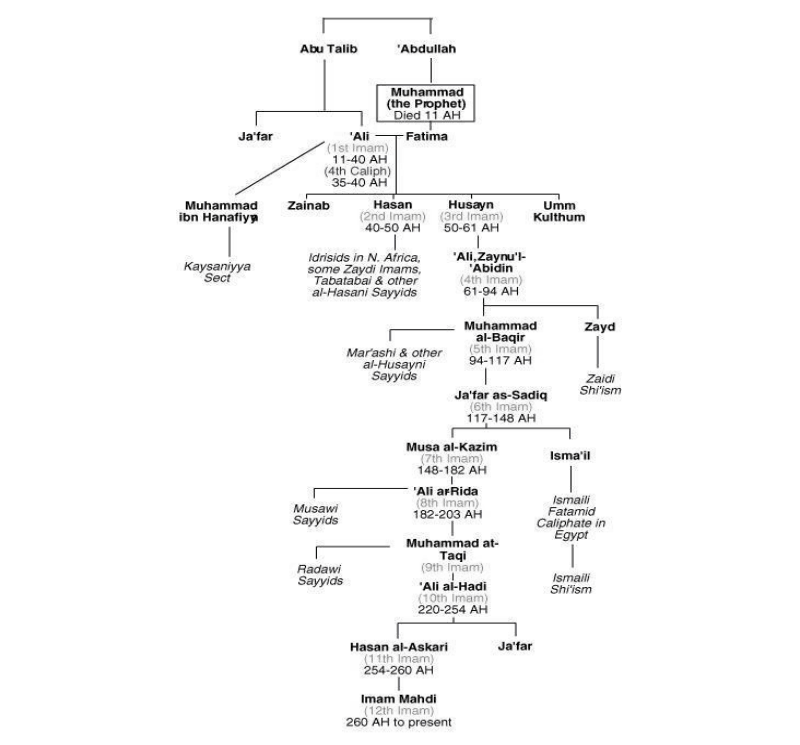
chart of persian imams

Before Mashaei tried to extend his theory, the revolutionary guard crippled all of his ambitions subsequently. His followers were arrested and he was about to get caught too but it seemed that Ahmadinejad was completely in agreement with what he was saying. Ahmadinejad tried to protect Mashaei but as you know he lost the protection of the supreme leader. As a result, his authority dropped considerably. He got teased and he lost his connections and finally he got kicked out of the power circle and all of these were about his friendship with Mashaei, which he truly believed in him.

And now the new game has just started. First it was announced by Ahmadinejad’s brother that there would not be any connection between his brother and the deviant tendency. Then Ahmadinejad had a speech in Mashahd, one of the most religious cities in Iran where the 8th Imam of Shia has been buried, and he said:

“… the only way to overcome the enemies of the nation is standing on the value of our goals in the same way that Khomeini has showed us. I would totally remain on that way to serve the nation and revolution and its values and principles.”

He also tried to imply on revolution principles, the principles that revolutionists believe has been neglected after Rohani became a president.

New Issue of Econ Journal Watch: Does Economics Need an Infusion of Religious or Quasi-Religious Formulations?

The new issue of Econ Journal Watch is out and EJW has teamed up with the Acton Institute to feature ‘religion and economics’ as the topic for a symposium.

As some of you may know, my fellow Editor-in-Chief Fred Foldvary is an editor for the journal, and Warren is the math reader, so this project holds a special place here at NOL. I just wish they’d be a little less humble about their endeavors elsewhere and share this type of stuff themselves (this humility is a recurring problem in the libertarian quadrant of the blogopshere)!

At any rate, here is the lineup:

The Prologue to the symposium suggests that mainstream economics has unduly flattened economic issues down to certain modes of thought (such as ‘Max U’); it suggests that economics needs enrichment by formulations that have religious or quasi-religious overtones.

Robin Klay helps to set the stage with her exploration“Where Do Economists of Faith Hang Out? Their Journals and Associations, plus Luminaries Among Them.”

Seventeen response essays are contributed by authors representing a broad range of religious traditions and ideological outlooks:

Pavel Chalupníček:
From an Individual to a Person: What Economics Can Learn from Theology About Human Beings

Victor V. Claar:
Joyful Economics

Charles M. A. Clark:
Where There Is No Vision, Economists Will Perish

Ross B. Emmett:
Economics Is Not All of Life

Daniel K. Finn:
Philosophy, Not Theology, Is the Key for Economics: A Catholic Perspective

David George:
Moving from the Empirically Testable to the Merely Plausible: How Religion and Moral Philosophy Can Broaden Economics

Jayati Ghosh:
Notes of an Atheist on Economics and Religion

M. Kabir Hassan and William J. Hippler, III:
Entrepreneurship and Islam: An Overview

Mary Hirschfeld:
On the Relationship Between Finite and Infinite Goods, Or: How to Avoid Flattening

Abbas Mirakhor:
The Starry Heavens Above and the Moral Law Within: On the Flatness of Economics

Andrew P. Morriss:
On the Usefulness of a Flat Economics to the World of Faith

Edd Noell:
What Has Jerusalem to Do with Chicago (or Cambridge)? Why Economics Needs an Infusion of Religious Formulations

Eric B. Rasmusen:
Maximization Is Fine—But Based on What Assumptions?

Rupert Read and Nassim Nicholas Taleb:
Religion, Heuristics, and Intergenerational Risk Management

Russell Roberts:
Sympathy for Homo Religiosus

A. M. C. Waterman:
Can ‘Religion’ Enrich ‘Economics’?

Andrew M. Yuengert:
Sin, and the Economics of ‘Sin’

Not too shabby, eh? I’ll admit upfront I haven’t been able to read any of the articles yet, but once I find some work out here in Austin I’ll be able to patch together a schedule that’ll allow for a little leisure. You can always download the entire issue, too (pdf). Econ Journal Watch is an important project that is dedicated to exploring and criticizing the underlying assumptions of the discipline of economics, but it is done in a way that is classy, professional, and informative.

Consumerism and Christmas

You all may recall that after 9/11 Osama bin Laden explained his orchestration of the terrorist deed that murdered some 3000 innocent human beings as payback for America’s materialism. (His anti-materialist rant is routine – a good discussion of his views may be found here.)

Yet as the writer of the above piece notes, anti-materialism is a common theme among most religions. Sure, the idea that human life is about preparation for an after-life — a spiritual life superior to the mundane one we can lead here on Earth — is central to religions.

In the West, however, many religions have made peace with the mundane elements of human existence so there tends to be a less avid denunciation of materialism, which is how the idea of being seriously concerned with living prosperously here on Earth is usually designated. After all, the Christian God is both human and divine (in the person of Jesus).

Destruction of life is generally deemed to be a sin for Christians, whereas, as bin Laden has noted, the love of death is central in his version of Islam. As one account has it, “This originated at the Battle of Qadisiyya in the year 636, when the commander of the Muslim forces, Khalid ibn Al-Walid, sent an emissary with a message from Caliph Abu Bakr to the Persian commander, Khosru. The message stated: ‘You [Khosru and his people] should convert to Islam, and then you will be safe, for if you don’t, you should know that I have come to you with an army of men that love death, as you love life’.” This account is widely recited in contemporary Muslim literature.

Yet despite the Western theological tradition’s more friendly attitude toward the mundane, nearly every Christmas leaders of Christian denominations tend to revert to the original, anti-life doctrines by condemning commercialism. The latest Pope followed the previous one by lamenting the “materialist” approach to celebrating Christmas. They referred to “the dead-end streets of consumerism,” according to newspaper reports, chiding people everywhere for what the report calls “being caught up with consumerist pursuits.”

Ironically, the Pope issued his proclamations from St. Peter’s Square at the Vatican. If you have ever visited the Vatican, as I and millions of others have, you would know it to be one of the West’s, if not the world’s, most opulent places. And as to consumerism, the gift shop dominates the entrance to the Vatican, where one is invited to spend great sums of money on various small or sizable trinkets. Commerce flourishes there, believe me, as the Vatican cashes in on the desire of many of the visitors to take away some reminder of their having been to that historically and theologically significant place.

Of course, even apart from the Vatican, the Roman Catholic Church, as well as others within Christianity, often excel in ostentatious display of riches – one need but go to high mass on Christmas Eve to witness this.

And why not? That is how human beings tend to celebrate what they value highly, by honoring the occasion with gift-giving. And gift-giving necessarily involves commerce – most of us aren’t skilled at the crafts that it takes to create the various gifts we wish to bestow upon those we love and cherish. I personally bought airline tickets for some of my family members and a computer for another, in part because I have no airplane in which to fly them where they would like to go and no factory and expertise to make a modern, up-to-date computer. To obtain these gifts, I rely, as do billions of others, on commerce.

So why then would Popes besmirch consumerism and commerce? Beats me. (And remember, also, that “materialism” is ultimately a nonsense term – nothing we purchase is simply material but embodies the creative intelligence – indeed the creative spirit – of many human beings!)

So, I urge all Popes to change their message and to have a more generous understanding of all who make use of commerce in our celebration of Christmas!

Separation of Church and State (More Islamophobia!)

…Malaysia’s appeal court ruled Monday [10/14/13 – JD] that a Roman Catholic publication can’t use the term ‘Allah’ to refer to the Christian God, despite its widespread use among Malay-speaking Christians.


The dispute dates back to 2007. After Syed Hamid Albar, then the home minister, prohibited the church’s Herald newspaper from using the word ‘Allah’- arguing it should be solely for Muslims….

From Gangopadhyay and Fernandez in WSJ 10/15/13, p. A13.

Technical note: “Allah” is a foreign word to all Malaysians. It’s an Arabic word. All Malaysians’ native tongues are unrelated to Arabic.

Yes, there may be more there than meets the eye. So? Try imagining a US court – state or federal- or a French court, ruling that Calvinists may not legally use a given foreign word, that the particular word is reserved for the use of Roman Catholics!

Not that the court ruling in Malaysia is that unfamiliar. They used to do stuff like that in Europe. It was some time ago, a long, long time ago, actually.

Libertarian Foreign Policy: A Dialogue on Imperialism

Ghaddafi is dead. Hooray.

Now on to the part where we actually have to think about the consequences of our actions. Why don’t we take a look at the region of the Middle East that has actually held elections without being occupied by a foreign power: the Palestinian territories.

Would you like to Google ‘Fatah’ and ‘Hamas’, or shall I?

It’s great that Ghaddafi is dead, and it would be nice if our actions in helping to bring him down were celebrated throughout the Muslim world. I won’t hold my breath though. After bombing the Serbians to help out Muslim Bosniaks the U.S. was thanked with a couple of airplanes being flown into our commercial buildings (it also refroze relations with Russia that still haven’t thawed).

The point I make here is not that all Muslims should be lumped together, but rather than our foreign policy establishment DOES lump all Muslims together. They never take into account all of the intricacies involving the political processes taking place in this part of the world. The effort in Serbia was a calculated response by the Clinton administration to win over the hearts and minds of the whole Muslim world, but what we got instead was soured relations with Russia and a nod of approval from the monarchies of the Gulf states, Turkey, and the autocratic regimes of Jordan and Egypt. One enemy (though certainly not the only one) of the Gulf state monarchies – al-Qaeda – had a different opinion on the matter.

Al-Qaeda looked the other way and saw military troops protecting the monarchies of the Gulf states.

Does anybody here seriously think that helping to dislodge a brutal dictator from power in the Muslim world is going to earn us the approval of the same Muslim world? In fact, what happens if – miraculously – a liberal, secular regime is voted into office in Libya? What do think will be the claims of the rival parties (especially the Islamist ones): that the elections were held fair and square, or that the new liberal regime is a mere puppet of the West?

Bottom line: unless there is a direct threat to the U.S. republic, we shouldn’t be playing that Old World game of Realpolitik. All that leads to is intrigue, speculation, and entangling alliances. Sure, some dictators have died because of our efforts. Then again, some have also benefited. Everybody is a hypocrite of course, but the more we can avoid being so, the better. The idea – nay wish! – that the newly liberated people of the Arab world will somehow elect secular, Western-friendly governments after 50 years of oppression by regimes that were perceived by the Muslim public to be secular and Western-friendly belongs to be filed under the category of ‘fantasy,’ not foreign policy.

The Ghaddafi regime undertook policies that were hostile to the West. His regime sponsored terrorism against innocent people in the West. I am glad he is dead. I am glad that his own people shot him in the streets. But I think one of the major complaints that Libyan elites had for his policies was not that he sponsored these acts, but rather that he sponsored them under the guise of anti-colonialism rather than for Islam.

A couple of thought exercises: what happens if the Libyan electorate chooses to entrust an Islamist political party hostile to the West with running the state? Does the United States accept the outcome, or do we take the same route we did when Hamas was elected in the Gaza Strip?

How would the U.S. be perceived by the Muslim world if our role there was limited to one of trading, and not one of policing?

Has anybody here thought about the possibility of a prolonged civil war in Libya due to regional rivalries that have been suppressed by a strong-arm dictatorship for the last 40 years? After all, the main reasons given for NATO’s operation in Libya was twofold: 1) to keep Libya from disintegrating into a civil war that would send thousands of refugees to Europe’s decadent shores and 2) to win over the hearts and minds of the Muslim world.

Can we be confident that these goals have been accomplished, or are we merely stabbing at shadows in the dark in the name of democracy?

Buddhist Leaders Call on Myanmar to Expel Muslims

From the New York Times:

After a ritual prayer atoning for past sins, Ashin Wirathu, a Buddhist monk with a rock-star following in Myanmar, sat before an overflowing crowd of thousands of devotees and launched into a rant against what he called “the enemy” — the country’s Muslim minority.

“You can be full of kindness and love, but you cannot sleep next to a mad dog,” Ashin Wirathu said, referring to Muslims.

There is much more in the piece, including this:

[…] images of rampaging Burmese Buddhists carrying swords and the vituperative sermons of monks like Ashin Wirathu have underlined the rise of extreme Buddhism in Myanmar — and revealed a darker side of the country’s greater freedoms after decades of military rule. Buddhist lynch mobs have killed more than 200 Muslims and forced more than 150,000 people, mostly Muslims, from their homes.

Ashin Wirathu denies any role in the riots. But his critics say that at the very least his anti-Muslim preaching is helping to inspire the violence.

What began last year on the fringes of Burmese society has grown into a nationwide movement whose agenda now includes boycotts of Muslim-made goods. Its message is spreading through regular sermons across the country that draw thousands of people and through widely distributed DVDs of those talks. Buddhist monasteries associated with the movement are also opening community centers and a Sunday school program for 60,000 Buddhist children nationwide.

This bad news is, of course, contradictory to everything Dr Delacroix and other imperialists have written on the subject of religious extremism. Imperialists in this century like to pretend that Islam has suddenly appeared to take the place of communism as the preeminent threat to peace and prosperity in the world. They point to violence, poverty and state-sponsored oppression as examples of Islam’s inherent incompatibility with the liberal world order.

This is all anecdotal evidence. There is nothing inherently violent about Islam. All religions are equally authoritarian at their core.

I pull two things from this piece: 1) it reaffirms my commitment to secular government and 2) it reconfirms my skepticism of democracy. These two things go hand-in-hand, of course.

A government that decides to adhere to one religion is necessarily going to oppress those it does not sponsor. This is easy enough for our Western readers to understand, but it is an argument that does not have nearly enough clout in the non-Western world (you could perhaps exclude China from this list, and India has essentially been Westernized; New Delhi even has its own condescending policy towards its indigenous minorities).

The democratic aspect, too, should be familiar to Western readers. Democracy needs restraints, and lots of them. The reasons for this are practically infinite, but suffice it to say here going to war in the name of democracy is a foolish, morally horrendous thing to do. The fact that imperialists today often shroud their lust for power in terms of democracy speaks volumes about the immoral nature of their worldview. (h/t Eugene Volokh)

Istanbul: The Protests

A moderately Islamist government has been in power in Turkey for about 10 years now. Over the weekend it faced its first stern test. One brave Turkish blogger has decided to reach out to the rest of the world:

No newspaper, no television channel was there to report the protest. It was a complete media black out.

But the police arrived with water cannon vehicles and pepper spray.  They chased the crowds out of the park.

In the evening of May 31st the number of protesters multiplied. So did the number of police forces around the park. Meanwhile local government of Istanbul shut down all the ways leading up to Taksim square where the Gezi Park is located. The metro was shut down, ferries were cancelled, roads were blocked.

Yet more and more people made their way up to the center of the city by walking.

They came from all around Istanbul. They came from all different backgrounds, different ideologies, different religions. They all gathered to prevent the demolition of something bigger than the park:

The right to live as honorable citizens of this country.

Read the rest. Hurriyet, one of Turkey’s best media outlets, has been doing an excellent job covering events after the fact. Their English-language site is here, and I recommend reading the site on a daily basis (even after the violence is over).

Here is my two cents: the Erdogan government (the Islamist one) put one too many straws upon the camel’s back. Ankara simply took too many liberties when it came to regulating the cultural and material life of the Turkish people. Too many blasphemy laws and too many clothing restrictions, coupled with too poor an economic performance made these protests inevitable. The harsh crackdown on an otherwise free people ensured violence and larger protests.

By the way, Turkey’s first post-Ottoman government, headed by the ardent secularist and Europhile, Mustafa Kemal Ataturk, also insisted on regulating the cultural and material lives of Turkish citizens, so Islam has nothing to do with this (check out our many discussions we’ve had here on the blog on this).

Rather, the “authoritarianism lite” of the Turkish state has more to do with its status as a post-colonial imperial state and a Cold War pawn than it does with any inherent cultural traits of the Turkish people or of the Islamic faith.

Around the Web

  1. Against Seriousness
  2. When Food Isn’t the Answer to Hunger
  3. Fiscal Consolidation in Earlier British History
  4. *Must Read* HAP vs. RR vs. the Pundits: Scoring the Reinhart, Rogoff Dispute

Sorry for the lack of posts lately. I’ve been busy.

The Intricacies of Political Life in Afghanistan and Pakistan: Is Islam Prominent?

Riffing off of Dr Delacroix’s piece on Afghanistan, and reading through the comments, I thought it’d be a good idea to “go with the flow” (as they say in Santa Cruz). Anatol Lieven has a must-read piece in the National Interest on the US government’s failures in Afghanistan and Pakistan. Among the gems:

I have been struck, both in the United States and in Britain, by the tendency of officers and officials to speak and write as if protecting the lives of troops from Taliban attack is the first duty of the U.S. and British states. In fact, it is the duty of soldiers to risk their lives to protect the civilian populations of their countries, and the only valid reason why the U.S. and British militaries are in Afghanistan at all is to protect their fellow citizens from terrorism. If that equation is reversed, and the needs of the war in Afghanistan are actually worsening the terrorist threat to the U.S. and British homelands, then our campaign there becomes not just strategically but morally ludicrous.

Indeed, one of the most common leaps of logic that neoconservatives and Leftists make in regards to foreign policy and the rule of law is the role of militaries in society. If there is to be a role for the state, it should be limited to maintaining a domestic court system, providing for the defense of the state, and signing trading pacts with other polities. Anything more than this results in things like exploitative generational gaps, trouble paying the bills, and terrorist attacks.

Lieven continues, explaining the geopolitical situation in Afghanistan and Pakistan: Continue reading

Religion or Institutions: A Final Word

Over at Facts Matter, I believe I finally settled the issue of whether or not Islam is to blame for the violence in the Middle East. I put the nail in the coffin with this:

Still no evidence. I am, again, arguing about the real color of a unicorn’s horn…

Dr J asks:

Refresh my memory: Blasphemy laws where? “Popping up….”

Right now? Post-socialist Europe. And post-coup Thailand. And post-monarchist Nepal. Go ahead: Google it!

Are you implicitly stating that Russia is part of the historical West? Peter the Great just another Montesquieu?

Nope. You didn’t specify that the examples had to be from the traditional West. Speaking of moving the goalposts:

Death for converting, anywhere? (I did add this.)

Can you provide me with an instance of this happening in a Muslim state?

One more from Dr J:

With what penalties? (Death or more?)

Fines as far as I know. Again, can you give me an instance of a death sentence carried out in a Muslim state in the name of blasphemy?

David: rather than try to rebut every one of your points, I think I’ll just let your comments stand on their own. For your own benefit, insert the word “Muslim” in place of the word “Christian” throughout your lengthy defense of the latter.

If you do this, you’ll not only be proving my point, but you’ll have a better understanding of what is going on in the Middle East today. The difference between the United States and, say Russia or Egypt, is institutional.

Max Weber famously argued that Protestantism was responsible for the rise of capitalism in the West. There was something about Protestantism that changed the way northern Europeans thought about the world, as well as how they justified their actions. He was wrong, of course, but his argument continues to influence large swathes of opinion today. Why? Because of “selective anecdotal evidence that is fortified by the perceived well-being of contemporary Protestant states.”

The myth of Islam’s violent penchant should die with the same last breath of the imperialist’s claim of superior foresight. If anybody wants to go a couple more rounds in the ‘comments’ section here, I’d be glad to take you on. If you are hesitant, ask yourself if this is because you are afraid you might be proven wrong, or because you know deep down inside that you are absolutely correct about Islam’s mythical penchant for violence.

Religion or Institutions? An Ongoing Dialogue

Dr. Delacroix and I are continuing our back-and-forth over at Facts Matter. My latest volley:

Religion is often such an important part of a given culture that it is commonly treated separately giving the false impression that it’s a different subject in its own right [Dr. Delacroix]

This is true up to a point. Once a society adopts one of the “great religions” as their own, though, the cultural-religious blend disappears and two distinct categories arise. Small tribes with their parochial animist beliefs are one thing, but large nations sharing a holy book are quite another.

As it stands, the stonings of women in Saudi Arabia are political acts, not cultural ones. Thus the Saudis (or their enemies) are using religious undertones to their political advantage. The violence and backwardness of the region – which I readily admit is prevalent – goes back to institutions and their political and economic ramifications.

The lack of books in the Arab world is another case in point. During the late Ottoman era, and during the era of European imperialism, Arabs gobbled up books left and right. Once Arab socialism and other anti-colonial movements began to isolate their societies, the demand for books was severed.

What do you think would happen if the states of Iraq and Egypt, for example, suddenly lifted their controls on trade, universities, the press and the internet? Would Arab culture or Islam hinder the thirst for knowledge in the citizens of these countries?

Cue Marvin Harris.

From the Comments: Islam’s “Violent Penchant”; Shooting Rampages and Stonings

Dr. Delacroix takes me to task over my dismissal of Islam’s inherently violent penchant. I think violence on grand scales, including war and terrorism, are always and everywhere a product of politics and institutions. Dr. Delacroix argues that Islam itself provokes violence. He writes:

A French citizen with a Muslim name goes on vacation to the tribal areas of Pakistan and to Afghanistan. Latter on he goes on a shooting rampage. The probabilities are such that he has to have sought his victims. The first set of victims were Muslim soldiers in the French army. Of course, for a jihadist such soldiers are traitors. The second set of victims were Jewish children and an adult in a Jewish school. You have to look for a Jewish school in France. I wouldn’t know how to find one. It’s not as if the killer wanted to kill children and then he went to as school that happened to be Jewish.

None of this means anything according to Brandon. Of course, this anecdote is only one of of several I presented in support of the idea that Islam has a violent penchant. Brandon dismisses “anecdotes” as evidence. He seems to say that if I had presented a thousand anecdotes, I would have accomplished nothing. I imagine he believes it’s enough to say “not so” for his negative thesis (no violent penchant) to be considered true.

Strange mental world!

I did not say anything about what is responsible for terrorism in the Middle East. I only took exception to a small statement of faith of Brandon’s in a larger development.

Why was the French citizen in Afghanistan and Pakistan? I ask because both states are in the middle of an international conflict (along with France, I might add). Continue reading

Origins of Terrorism in the Middle East

I just recently came across a very, very good book on the history of the Middle East. As far as theory goes, it is lacking, but it is readable enough that the intelligent layman can pick it up and learn new things from it. Written by historian Eugene Rogan, it’s titled The Arabs: A History and it has won numerous awards. Be sure to check it out. One new fact that I learned is that while terrorism as a tactic in the Middle East did not appear on the radar until the 1920s, it was undertaken on behalf of Jewish interests, not Muslim ones. Rogan explains:

The terrorists had achieved their first objective: they had forced the British to withdraw from Palestine. Though their methods were publicly denounced by the leaders of the Jewish Agency [the pre-state government], the Irgun and Lehi [terrorist organizations] had played a key role in removing a major impediment to Jewish statehood. By using terror tactics to achieve political objectives, they also set a dangerous precedent in Middle Eastern history-one that plagues the region down to the present day.

Now, I am not “blaming the Jews” for terrorism in the Middle East, nor is the historian. What I would like to do is point out that the theories and excuses about Islam’s violent penchant produced by Western analysts are horribly wrong. In a similar vein, Arab culture is not to blame for the violence in the region, either. Terrorism is entirely a product of politics.

What we have in the Middle East is simply a problem of statecraft. A conceptual turn away from cultural and religious explanations for the violence in the Middle East and towards one that looks at political and legal institutions and the economic consequences that arise from them would do wonders for the region (and the world). If we cannot even agree on the fundamentals of what is wrong with the Middle East institutionally, we sure as hell are not going to agree upon anything else. This goes for domestic and regional factions in the Middle East as well as for Western ones.

Israel exists. It is a state in the Middle East, and a highly successful one at that. This may well explain why terrorism has been used so often, as a political tactic, for almost a century in the Middle East. It also helps to explain – conceptually – why terrorist attack rates were so high in Sri Lanka until the defeat of the guerrilla insurgency a few years ago, and why Latin America has suffered from chronic terrorism. Arab culture and Islam, on the other hand, do not explain terrorism in other parts of the world. I see no reason why we should make an exception to the rule for terrorism in Middle East. This is an institutional problem, not a cultural one.

The Trees, the Bramble, and the Forest

I apologize for not blogging much lately. I have finished summer school and have been enjoying my week off from rigorous studies. Back to the grindstone!

In China, protesters have been surrounding the Japanese embassy in Beijing and recently begun hurling debris at both policemen protecting the embassy and the embassy itself. In other parts of China (but not in the “special economic” [free trade] zones) Chinese citizens have been burning Japanese flags and calling on their government to take a harder line on a territory dispute and in trading policies with Japan.

The violence is not limited to the embassy or Japanese flags, of course. Japanese businesses have also been vandalized, threatened, and shut down due to the violence currently raging throughout the Chinese state. Continue reading

Islamophobia (Part 2 of 2)

In Part 1 of this essay, Islamophobia, I recounted some facts about terrorism that seems linked to Islam and I made some hypotheses about how Muslims in general array themselves with respect to this terrorism. In this second and last part, I divulge some of the bases of my worst suspicions regarding moderate Muslims.

I wish someone with credentials would help me disentangle who is what and in what proportions among Muslims in connection with the varying degrees of rejection of violent jihad described above. In the meantime, I feel intellectually free to speculate within reason and on the basis of other information I have, factual information, that is, not hearsay.

The first helpful element in my speculation is that, of course, I understand violent Muslim fanatics well. Anyone reasonably well versed in European history would, My ancestors used to be just like them. I never tire of repeating on this blog and elsewhere that the First Crusade (1099) massacred everyone there after taking Jerusalem. That massacre followed acts of cannibalism during the siege. And more recently, it’s clear that tens of thousands of witches were burned at the stake in Europe. (Note: The figure of millions advanced by feminists is silly propaganda bullshit.) Violent jihadists and other fanatics hold not mystery to me because I used to be they. Used to be. Continue reading