Relicts of the past? The current challenges for diplomacy

The last few weeks were quite a blast for me: I’ve interned at the German embassy in Rome. A new job in a new city. I thought to process the experiences I made here in one (or a few?) articles.

It’s been quite a rough month for Germany’s Foreign Affairs department. First, Daniel Kriener, the German ambassador in Venezuela, was forced to leave the country after welcoming Interim President Guiadó at the airport of Caracas. Interestingly, although plenty of other diplomats joined him, he was the only one to be declared a “persona non grata” for interfering in Venezuela’s internal affairs. A few weeks later, a deputy speaker of the German Bundestag (who is also a member of the liberal party) demands to expel the US ambassador Grenell for the same offence. Prior, the US diplomat has criticized Germany’s plan to break their promise of contributing more to NATO’s defence budget. Albeit I politically agree with both actions of the diplomats in these cases, they delineate the ongoing structural changes in the diplomacy sector. To illustrate this, I will first provide a theoretical framework to analyze ongoing diplomatic challenges before trying to examine the role of diplomacy in the future.

Principal-Agent Theory and decreasing relevance

I conceive diplomacy as mostly a principal-agent based problem. I believe that many problems in diplomatic negotiations can be traced back to the classic effects of asymmetric information. Since two principals, in this case two states, cannot negotiate with each other directly in most cases, these arbitrations are carried out between various agents. Those agents are of course not always the ambassadors. In a broad meaning, one can apply the principal-agent paradigm to diplomacy by every negotiating process initiated by the state.

Through the lens of the principal-agent paradigm, I perceive the main task of diplomacy to achieve a good negotiating position, for example through an informational advantage. However, due to globalization, state-to-state diplomacy has been drastically weakened. The negotiating game is now mostly carried out within other institutions with lower transactions costs. Two countries want a new trade deal? Just orientate on WTO Rules. Sue another country? Call the International Criminal Court. A few voices made reasonable arguments even for abolishing unnecessary embassies and only keeping the crucial ones. The Trump administration, for example, seems not eagerly committed to fill the around 18 vacant ambassador positions hastily.

Certainly, the globalization combined with the expansion of robust institutions leaves little space for traditional diplomacy as a driving force in interstate relations. This is not necessarily a bad development: As Paul W. Meerts points out, this can be a huge chance for weaker states since negotiating in multilateral rather than bilateral constellations tends to weaken the position of stronger states. Thus, playing out the trump cards in negotiations will be harder for the hegemon. We can currently witness this in the Brexit debate: Even though the strong states, Germany and France, have a vast repertoire of power resources to use as leverage against GB in the negotiations, the can hardly deploy them through EU’s multipolar negotiating structure.

Contrary, there are also recent examples of deploying bilateral traditional diplomacy measures successfully. China’s initiation of Italy’s accession to the Belt Road Initiative (see Tridivesh Singh Maini’s great article here for a quick overview) is a prime example for this. But no other case shows the weaknesses of bilateral diplomacy in a more drastic way: China was able to transpose their tremendous power resources into a deal which heavily favours the Chinese economy. The very ambiguous agreement laid down a strategy of “closer economic collaboration.” The oppositional criticism of the deal coming from the very left and the right is based on economic nationalism and thus misses the important point. Chinese government exerts immense influence on key enterprises like  Tencent, Alibaba, and Badoo: Digital fundamental research topics such as AI were distributed to the firms not through competition but through the state ( I highly recommend Amy Webb’s EconTalk if you want to dig deeper into this.). Once they build sufficient digital infrastructure here in Europe, network effects and technological advantage will come into effect and engender high entry barriers and exit costs. This makes it easy for China to enforce its regulation rather than obeying European ones. Although it is hard to finally determine if multilateral negotiations would have secured a politically better deal, I favour higher short-term transaction cost of multilateral negotiations over the long-term threat showed above.

Embassies as service provider

Of course, taking care of a good interstate negotiation position is not the only task of an embassy. A popular counterargument is that the principal-agent perspective neglects the vital daily business of embassies to help their citizens abroad. Speaking of large and prestigious Embassies though, I estimate that their role as service provider for abroad living citizens will further decline. Most of their maintenance work for citizens living abroad will be redundant due to technological process and further institutionalization. Renewing a Passport, issuing visas and transporting back coffins (yep) are a frequent task, but easy to “source out” to private actors in the future.

But what is the role for ambassadors and embassies then?

This question is where it gets interesting in my opinion. Deeply rooted in international conventions and international customary law, discreet and silent work has been prerequisite for an ambassador. Carefully collecting small pieces of information and building bridges to local actors were the key for a good negotiating position. But as elaborated above, international institutions do the job more efficiently. A new role of ambassadors as advocates for concrete policy measures would be diametrically opposed to international conventions. Based upon the “legality creates legitimacy” premises, a further politicization of diplomacy seems not at present having a majority and thus is unlikely to be buttressed by legal means.

However, if we fall back into a narrative of nationalism, bilateral diplomacy will regain relevance. Otherwise, it will continue to slowly lose importance and eventually wane. Hence, the main challenge nowadays is to look for the right niche for traditional diplomacy – and it seems that it has not been found yet.
Three Lessons on Institutions and Incentives (Part 3): Innovation means creative destruction

The concept of creative destruction was popularised by Joseph Schumpeter and assumes that the economy is in a equilibrium. The “entrepreneur,” therefore, is an unbalancing factor that, through innovation, displaces the winners of the prevailing situation until then, generating a new equilibrium. This notion was criticized by other economists such as Friedrich Hayek and Israel Kirzner, who saw that the entrepreneur, far from being a disequilibrating factor, obtained its benefits by identifying the points of disequilibrium of a system and arbitrating between them.

The concept of “creative destruction,” on the other hand, focuses on businesses that go to waste from the irruption of the entrepreneur. This emphasis allows us to understand why there will be those who see with fear or disgust the very idea of ​​innovation. In contrast, Hayek and Kirzner emphasize the benefits of the new equilibrium: greater efficiency in the allocation of resources and, consequently, a greater generation of wealth. The notion of Schumpeter allows us to explain why many oppose innovation, that of Hayek and Kirzner gives us reasons to move forward with it. Strictly speaking, in order for innovation not to cause damage at the aggregate level, it must satisfy the Kaldor-Hicks criterion, that is, the gains from innovation must be so high as to allow a hypothetical compensation to the ones who lost the new distribution of resources.

In short, the notion of creative destruction that both William Easterly and Acemoglu & Robinson use, although it might differs from Schumpeter’s, meets the said Kaldor-Hicks criterion. In these cases, innovation does not represent a social disvalue, but on the contrary it generates a benefit for the whole. Therefore, it goes without saying that any brake on an innovation of this nature generates social loss. At this point, if innovation -also called “creative destruction”- is systematically curtailed, in order to seek to protect activities that would otherwise be displaced, society may encounter the following scenarios: a relative delay (regarding its potential) of its development, or a stagnation, or setback. In all three scenarios, inequality in wealth and income increases, or society sees its standard of living delayed or diminished in a homogenous way. In this last case, the protected sectors are also harmed by the brakes imposed on innovation.

[Editor’s note: Here is Part 2; Here is the entire Longform Essay.]

Three Lessons on Institutions and Incentives (Part 2); Institutions: definition and subtypes

Implicitly, Douglass C. North, William Easterly, and Daron Acemoglu & James A. Robinson share the same notion of “institution.” In this respect, what must be taken into account is not a real definition of the former but its operative concept, that is, what characteristic features relate it to the rest of the concepts of each theoretical body. In this sense, we can affirm that for these authors an institution is a limiting factor for human interaction. More precisely, in terms of D.C. North, institutions can be defined as abstract constraints imposed on human social decisions that structure political, economic, and social interaction. The rational agent finds limited its action and its spectrum of choices by institutions, which can be derived as much from the law as from custom, his habits, or his moral constraints.

However, the particular limitations that a particular person experiences are not relevant, but those that are incorporated into the behavior of a large number of human beings that interact with each other, which allows them to recognize a structural pattern of human social action. In this way, although an institution limits human action, because it is widespread throughout the social fabric, building it, it allows each individual inserted in such a set of interactions to represent expectations about the behavior of their fellow human beings that have a high probability of being true (something similar to what Friedrich A. Hayek had previously enunciated in his concept of “spontaneous order”). These expectations allow each individual to make plans with a high degree of probability of accomplishment, or at least to identify those actions that could be ruinous. In this sense, an institution is not only a limitation of human action, but, correlatively, a motivator for it, i. e. an incentive. The structure of human interactions that institutions project in the political, economic, and social fields helps the rational agent to make more efficient decisions, since they have a lower margin of risk. Of course, not all the incentives generate the same economic performance.

It is true that any pattern of human interactions that constrains the scope of choices of the agent (i.e., institutions), however inefficient they might be, represent an advantage over the total absence of it, since it works as a hedge against the arbitrary power and violence from third parties. Thus, the main distinction to be drawn is between anomie and institutionalization.

This latter opinion is expressly stated in Why Nations Fail: the extractive institutions -the ones that establish rules that favor a group at the expense of the whole-, both politically and economically, although they are harmful, are less so than civil war, polarization, factions, or anarchy. Acemoglu & Robinson argue that a country that does not have “inclusive” institutions, but at least have extractive institutions, might experience a rapid development obtained from the importation of discoveries from better organized countries – the phenomenon of “catch up.” However, after reaching a certain maturity, if the country in question does not advance towards political and economic opening, stagnation and subsequent implosion will be difficult to avoid.

Here is where the book of Acemoglu & Robinson finds its point of greatest affinity with the work of William Easterly: to continue on a path of growth and development, countries and their ruling classes must be willing to admit that progress only comes through innovation and that all innovation is accompanied by a process of “creative destruction.”

[Editor’s note: You can find Part 1 here. You can find the entire Longform Essay here.]

Three Lessons on Institutions and Incentives (Part 1): Introduction

There are books that are aimed at a spectrum of readers that are counted within the “well-informed public.” They are not books confined to academic circles, they are not for mass consumption, but they do concern problems that involve entire countries and are written in a register that involves certain intellectual training. In this genre, there are three works that have much to say about the relationship between institutions and incentives. The first of them dates from 1990 and was published by a Nobel Prize winner in Economics, Douglass C. North: Institutions, Institutional Change and Economic Performance, which elaborates the distinction between formal and informal institutions and incremental and disruptive institutional change, ending with a historical analysis that seeks to explain the differences in economic performance between the United States and Latin America. It is an academic book that can be approached by the said well-informed public.

Eleven years later, in 2001, William Easterly published The Elusive Quest for Growth: Economists’ Adventures and Misadventures in the Tropics. It is proposed as a political essay in which an economist interprets his own professional experience as a member of international teams for the development of Third World countries. To do this, drawing on the theoretical notions of other leading economists, such as Paul Romer (who later, in 2018, received the Nobel Prize in Economics), he makes an assessment on the development plans for the Third World that were implemented since the end of World War II. The central thesis of Easterly stresses that, in order to have an empirical relevance, every theory of development -or of the absence of it- must carry the following behavioral postulate: “people respond to incentives.” If this reality is not taken into account, there is no public policy that can be successful. The main lessons that can be drawn come from the theoretical instruments deployed to explain the political dynamics of most of these countries, particularly in regard to the phenomenon of polarized societies.

The third book to consider is also the more recent publication. Why Nations Fail, by Daron Acemoglu & James A. Robinson, was published in 2012 and reached the global debate on the realm of the well-informed public. The proportions achieved by the population of academics and professionals, in addition to the extension of the internet, allowed the aforementioned book to generate varied opinions along both traditional and digital media throughout the world. Acemoglu & Robinson dedicate their pages to those countries that were successful, as well as those that were not, but also here, in the case of this book, the most juicy lessons truly comes from the conceptual structure that articulates the whole book. Among such notions, we find those of inclusive and extractive institutions, which in turn are divided into political and economic institutions. The worst of the institutions are preferable to the total lack of institutions. Thus, a country organized around a closed political and economic system will be preferable to a failed state. However, once a certain degree of centralization and institutionality has been achieved, it is preferable to move towards a pluralist democracy and a competitive economy. The challenge is how to accomplish such transitions.

Since there are still four years left until the year 2023 – following the periodicity of the selected works – we are still in time to make a brief synthesis of the ideas that can be applied to the analysis of the impact of the institutions on economic and political incentives.

[Editor’s note: this is the first part of a rich series on institutions and incentives. You can find the full, Longform Essay here.]

The Institutional Foundations of Antisemitism

Antisemitism has returned to mainstream politics in Europe and America. One fundamental misconception about antisemitism is that it is simply another form of racism. Thus Jeremy Corbyn responds to charges of antisemitism with “ ‘I’ve spent my whole life exposing racism in any form”. But of course, Corbyn is, at the very least, an enabler of antisemitism (and there is evidence he holds antisemitic prejudices himself — see here).

Why is antisemitism different from other forms of racism? And what makes antisemitism unique. When Noel Johnson and I began writing Persecution & Toleration, we didn’t envision antisemitism returning to prominence, but I believe our analysis sheds important insight on the institutional foundations of antisemitism.

Continue reading

Nightcap

  1. How does emigration impact institutions? Michelangelo Landgrave, NOL
  2. How Can Crypto-currencies Democratize Society? Chhay Lin Lim, NOL
  3. The Political is about to disrupt the crypto-currency scene -or at least they say so. Federico Sosa Valle, NOL
  4. A few further remarks on foreign policy and libertarianism Edwin van de Haar, NOL

Forging ahead, falling behind and fighting back: British economic growth from the industrial revolution to the financial crisis

Nick Crafts can be viewed as the doyen of British economic history. His major publications date back to the 1970s – a favorite of mine is this piece from 1977 on the role played by chance in determining whether the Industrial Revolution would occur in England or France.  He is also the joint author of the Crafts-Harley interpretation of the Industrial Revolution.  But, perhaps because the majority of his research focuses on British economic history, he remains highly underrated outside of the UK.  His new book Forging ahead, falling behind and fighting back: British economic growth from the industrial revolution to the financial crisis summarizes much of his research.

I’ve reviewed it for the Economic History Review. But given the whims of academic publishing, it may be a long time until my review appears in print so I’ve decided to post a preview of my draft below.

**************************

Why was Britain the first industrial nation and the workshop of the world? Why was it eventually caught up and overtaken? Why once it had fallen behind the United States, did it fall further behind its European rivals in the Post-War period? And how did it recover its relative position in the 1980s and 1990s? All these questions are addressed in Nicholas Crafts’s slim new book.

In Forging ahead, falling behind and fighting back, Crafts provides a macroeconomic perspective on the British economy from 1750 to today. The word macro is advisory. Crafts surveys the British economy from 1000 feet, through the lens of growth theory and growth accounting. The upside of this approach is that he delivers a lot of insight in a small number of pages. Readers looking for discussions of individual inventors, innovations, politicians, or discussion of specific policy decisions can look elsewhere.

The first part of the book provides an overview of the Crafts-Harley view of the British Industrial Revolution. This view emphasizes the limited scope of economic change in the early 19th century. On the eve of the Industrial Revolution, the British economy already had a comparatively modern structure, with many individuals working outside agriculture. Growth between 1770 and 1850 was highly reliant on a few key sectors and TFP growth was modest (0.4% a year). Most workers remained employed in traditional sectors of the economy. It took until the second half of the 19th century for the benefits of steam, the general purpose technology of the age, to fully diffuse through the economy. Nonetheless, from a long-run perspective, the achievements of this period, a small but sustained increases in per capita GDP despite rapid population growth, were indeed revolutionary.

An important theme of the book is institutional path dependency. Characteristics of Britain’s early position as an industrial leader continued to shape its political economy down to the end of the 20th century. Crafts mentions two interesting instances of this. First, Britain’s precocious reliance on food imports from the early 19th century onwards left a legacy that was favorable of free trade. Elsewhere in the world democratization in the late 19th century often led to protectionism, but in Britain, it solidified support for free trade because, after the expansion of the franchise, the median voter was an urban worker dependent on cheap imported bread. Second, industrial relationships were shaped the nature of the economy in the 19th century. Britain thus inherited a strong tradition of craft unions that would have consequences in conflicts between labor and capital in the 20th century.

The second part of the book considers the late Victorian, Edwardian, and inter-war periods. It was in the late 19th century that the United States overtook Britain. A venerable scholarship has identified this period as one of economic failure. Crafts, however, largely follows McCloskey in exonerating Edwardian Britain from the charge of economic failure. The presence of fierce competition limited managerial inefficiencies in most areas of the economy; though there were notable failures in sectors where competition was limited such as the railways. The main policies errors in this area were thus ones of omission rather than commission: more could have been done to invest in R&D and support basic science – an area where the US certainly invested in more than the UK.

The seeds of failure, for Crafts, were sown in the interwar period. Traditionally these years have been viewed relatively favorably by economic historians, as the 1930s saw a shift away from Industrial Revolution patterns of economic activity and investment in new sectors. However, in a comparative light, TFP growth in the interwar period was significantly slower than in the US. The new industries did not establish a strong export position. This period also saw the establishment of a managed economy, in which policymakers acceded to a marked decline in market competition. Protectionism and cartelization kept profits high but at a cost of long-run productivity growth that would only be fully revealed in the post-war period.

Most economic historians view the postwar period through the lens of Les Trente Glorieuses. But in Britain, it has long been recognized that this was an era of missed opportunities. Simple growth accounting suggests that Britain underperformed relative to its European peers. Thus though the British economy grew faster in these years than in any other period; it is in this period that Britain’s relative failure should be located.

Crafts examines this failure using insights from the literature on “varieties of capitalism” which contrasts coordinated market economies like West Germany with liberal market economies like the United States or Britain. In the favorable conditions of postwar recovery and growth, coordinated market economies saw labor cooperate with capital enabling both high investment and wage restraint. Britain, however, lacked the corporatist trade unions of France or West Germany. As a legacy of the Industrial Revolution, it inherited a diverse set of overlapping craft unions which could not internalize the benefits of wage restraint and often opposed new technologies or managerial techniques. Britain functioned as a dysfunctional liberal market economy, one that became increasingly sclerotic as the 1960s passed into the 1970s.

An important insight I got from this book is that government failure and market failure are not independent.  Examples of government failure from the postwar period are plentiful. Industrial policy was meant to “pick winners.” But “it was losers like Ross Royce, British Leyland ad Alfred Herbert who picked Minsters” (p. 91). Market power became increasingly concentrated. Approximately 1/3 of the British economy in the 1950s was cartelized and 3/4 saw some level of price fixing. Britain’s exclusion from the EEC until the 1970s meant that protective barriers were high, enabling inefficient firms and managerial practices to survive. High marginal rates of taxation and weak corporate governance encouraged managers to take their salary in the form of in-kind benefits, and deterred innovation. Labor relations became increasingly hostile as the external economic environment worsened following the end of Bretton Woods.

Britain recovered its relative economic position after 1979 through radical economic reforms and a dramatic shift in policy objectives. Though of course, the Thatcher period saw numerous missteps and policy blunders, what Crafts argues was most important was that there was an increase in product market competition, a reduction in market distortions, and a reduction of trade union power, factors provided the space that enabled the British economy to benefit from the ICT revolution in the 1990s.

Rarely does one wish a book to be longer. But this is the case with Forging Ahead, Falling Behind, and Fighting Back. In particular, while a short and sharp overview of the Industrial Revolution is entirely appropriate, given the number of pages written on this topic in recent years, the last part of the book does need extra pages; the argument here is too brief and requires more evidence and substantive argumentation. One wishes, for instance, that the theme of institutional path dependency was developed in more detail. Despite this, Forging Ahead, Falling Behind, and Fighting Back is a notable achievement. It provides a masterly survey of British economy history tied together by insights from economic theory.

No Country for Creative Destruction

Imagine a country whose inhabitants reject every unpleasant byproduct of innovation and competition.

This country would be Frédéric Bastiat’s worst nightmare: in order to avoid the slightest maladies expected to emerge from creative destruction, all their advantages would remain unseen forever.

Nevertheless, that impossibility to acknowledge the unintended favourable consequences of competition is not conditioned by any type of censure, but by a sort of self-imposed moral blindness: the metaphysical belief that “being” is good and “becoming” is bad. A whole people inspired by W. B. Yeats, they want to be gathered into the artifice of eternity.

In this imaginary country, which would deserve a place in “The Universal History of Infamy” by J.L. Borges, people cultivate a curious strain of meritocracy, an Orwellian one: they praise stagnation for its stability and derogate growth because of the stubborn and incorruptible conviction that life in society is a zero-sum game.

Since growth is an unintended consequence of creative destruction, they reason additionally, then there must be no moral merit to be recognised in such dumb luck. On the other hand, stagnation is the unequivocal signal of the good deeds to the unlucky, who otherwise could suffer the obvious lost coming from every innovation.

In this fantastic country, Friedrich Nietzsche and his successors are well read: everybody knows that, in the Eternal Return, the whole chance is played at each throw of the dice. So, they conclude, “if John Rawls asked us to choose between growth or stagnation, we would shout at him: Stagnation!!!”

But the majority of the inhabitants of “Stagnantland” are not the only to blame for their devotion to quietness. The few and exceptional proponents of creative destruction who live in Stagnantland are mostly keen on the second term of the concept. That is why some love to say, from time to time, “we all are stagnationist” – the few contrarians are just Kalki’s devotees.

These imaginary people love to spend their vacations abroad, particularly in a legendary island named “Revolution”. Paradoxically, in Revolution Island the Revolutionary government found a way to avoid any kind of counter-revolutionary innovation. It is not necessary to mention that Revolution Island is, by far, Stagnantlanders’ favourite holiday destination.

They show their photos from their last vacation in Revolution Island and proudly stress: “Look: they left the buildings as they were back in 1950!!! Awesome!!!” If you dare to point out that the picture resembles a city in war, that the 1950 buildings lack of any maintenance or refurbishment, they will not get irritated. They will simply smile at you and reply smugly: “but they are happy!”

Actually, for Stagnantlanders, as for many others, ignorance is bliss, but their governments do not need to resort to such rudimentary devices as censure and spying to prevent people from being informed about the innovations and discoveries occurring in other countries, as Revolutionary Island rulers sadly do. Stagnantlanders simply reject any innovation as an article of faith!

Notwithstanding, they allow to themselves some guilty pleasures: they love to use smartphones brought by ant-smuggling and to watch contemporary foreign films which, despite being realistic, show a dystopian future to them.

As everything is deteriorated, progress is always a going back to an ancient and glorious time. In Stagnantland, things are not created, but restored. As with Parmenides, they do not believe in movement, but if there has to be an arrow of time, you had better point it to the past.

Moreover, Stagnantland is an imaginary country because it does not only lack of duration, but of territory as well. As the matter of fact, no man inhabits Stagnantland, but it is indeed stagnation that inhabits the hearts of Stagnantlanders. That is how, from dusk to dawn, any territory could be fully conquered by the said sympathy for the stagnation.

Nevertheless, if we scrutinise the question with due diligence, we will discover that the stagnation is not an ineluctable future, but our common past. Human beings appeared very much earlier than civilisation. So, all those generations must have been doing something before agriculture, commerce, and institutions.

Before the concept of creative destruction had been formulated by Joseph Schumpeter, it was needed a former conception about how people are conditioned by institutions: Bernard Mandeville pointed out how private vices might turn into public benefits, if politicians arranged the correct set of incentives. The main issue, thus, should be the process of discovery of such institutions.

That is why the said aversion to competition and innovation is hardly a problem of a misguided sense of justice, but mostly a matter of what we could coin as “bounded imagination”: the difficultly of reason to deal with complex phenomena. Don’t you think so, Horatio?

Afternoon Tea: “Confucian Constitutionalism in Imperial Vietnam”

The phantasm of “Oriental despotism” dominating our conventional views of East Asian imperial government has been recently challenged by the scholarship of “Confucian constitutionalism.” To contribute to our full discovery of the manifestations of Confucian constitutionalism in diverse Confucian areas, this paper considers the case of imperial Vietnam with a focus on the early Nguyễn dynasty. The investigation reveals numerous constitutional norms as the embodiment of the Confucian li used to restrain the royal authority, namely the models of ancient kings, the political norms in the Confucian classics, the ancestral precedents, and the institutions of the precedent dynasties. In addition, the paper discovers structuralized forums enabling the scholar-officials to use the norms to limit the royal power, including the royal examination system, the deliberative institutions, the educative institution, the remonstrative institution, and the historical institution. In practical dimension, the paper demonstrates the limitations of these norms and institutions in controlling the ruler due to the lack of necessary institutional independence. At the same time, it also suggests that the relative effectiveness of these norms and institutions could be achieved thanks to the power of tradition. The study finally points out several implications. First, the availability of the constitutional norms and institutions in the tradition is the cultural foundation for the promotion of modern constitutionalism in the present-day Vietnam. Second, the factual material concerning the Vietnamese experiences can hopefully be used for further study of the practice of Confucian constitutionalism in East Asia and further revision of the “Oriental despotism” - based understanding of imperial polity in the region. Third, the findings may also be useful for a more general reflection on pre-modern constitutionalism.

That is from Son Ngoc Bui, a legal scholar at the Chinese University of Hong Kong’s law school. Here is a link.

Economic Liberalism and (Re)Building Europe after WWII.

It is important to understand that economic recovery and growth in Europe after World War II is not as tied to Keynesianism, unfunded welfarism, and corporatism as is sometimes assumed.

The Glorious Thirty Years of European recovery from world war and subsequent growth were not due to ‘Keynesianism’ etc. The Thirty Years ended because the influence of liberal policies had weakened and the costs of other policies had accumulated to create an obviously dysfunctional system. Left-wingers (and communitarian-corporatist conservatives) who think ‘market fundamentalists’ overthrew a well functioning social and economic settlement which was behind all the economic growth and associated institution building (post-war national recovery and European Union construction) are in error. It is a major error to ignore the influence of Austrian School liberals (see the discussion by a leading current practitioner of Austrian economics, Peter Boettke) and the related Ordoliberalismus of the Freiburg School.

My remarks on what the major terms and schools in this paragraph refer to have become uncontrollably long, so they are relegated to the bottom of the post. I hope readers will have the patience to reach them.

The key points are that the German post-war Economic Miracle came from Ordo-liberal policies, while economic growth in France after Charles de Gaulle came to power for the second time in 1958 comes from the policies of Jacques Rueff, a civil servant, judge, and economist who participated in the 1938 Walter Lippmann Colloquium in Paris, a decisive event in the revival of liberal economic thinking attended by Hayek and many other notable liberal thinkers.

Such ideas have had a lot more influence in France than lazy propagators of clichés about statist France and liberal America understand. Of course, if we look at the French and American economies we can see notable ways in which the US economy is more liberal, but that should not obscure the reality that France has had good economic times and that these have come about because liberal economic policies were applied, even where, as under de Gaulle, the political narrative of the government was not liberal. The France of 1958 and after was able to stabilise institutionally after a real danger of the collapse of constitutional democracy and have a good economic period because of neoliberal economic ideas.

Some on the left think the relative revival of market liberalism in the 1970s can be rooted in the Chilean Coup of September 1973, after which economic policy was to some degree influenced by Chilean economists with doctorates from the University of Chicago. This revival of market liberalism is known as neoliberalism, a potentially useful term which came out of the Lippmann Colloquium (see below) that has unfortunately collapsed into an empty term of abuse for any kind of market thinking in government policy, wherein even the most modest accommodation of economic rationality is labelled ‘neoliberal’ and therefore extreme, authoritarian, and based on the narrow greed of the rich. It is sometimes accompanied by attempts to read enlightenment liberals as somehow ‘really’ left-liberal, social democratic, or even socialist.

The reality is that neoliberal ideas were first obviously influential on Continue reading

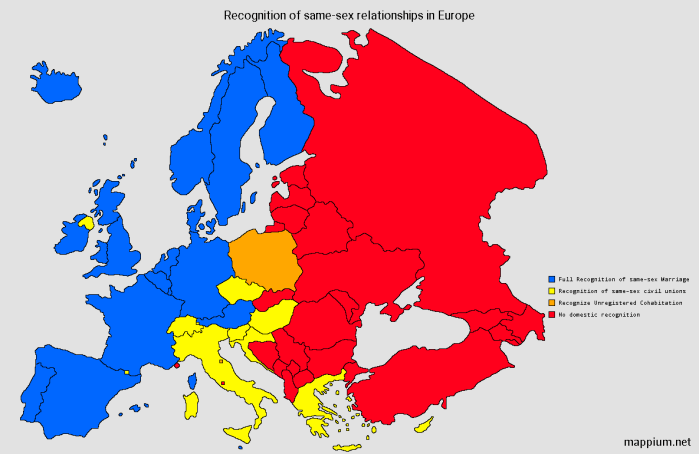
Eye Candy: Gay marriage in Europe (2018)

NOL gay marriage Europe
Click here to zoom

Opponents of gay marriage might have trouble explaining this one, at least in the free world.

Too many shadows whispering voices. Faces on posters too many choices. If when why what how much have you got…

The EU’s laudable Asia Connectivity Strategy

The European Union (EU) has put forward a plan for enhancing connectivity within Asia, and has been dubbed as the Asia Connectivity Strategy.

The EU does not want to give an impression that the Asia Connectivity Strategy (ACS) is a counter to the Belt and Road Initiative (BRI). Yet, senior officials of the EU, while commenting on the broad aims and objectives of the project, have categorically stated that the primary goal of the Asia Connectivity Strategy is enhancing connectivity (physical and digital) while also ensuring that local communities benefit from such a project, and that environmental and social norms are not flouted (this is a clear allusion to the shortcomings of the BRI). There are no clear details with regard to the budget, and other modalities of the project (EU member countries are likely to give a go ahead for this project, before the Asia-Europe Meeting in October 2018). The EU has categorically stated that it would like to ensure that the ACS is economically sustainable.

Other alternatives to BRI: the US

It is not just the EU, but also the US, along with Japan and Australia, which are trying to create an alternative vision to the BRI.

Continue reading

Nightcap

  1. Regional politics is restraining Kurdish militancy in Iran Fazel Hawramy, Al-Monitor
  2. Ignoring Ayn Rand won’t make her go away Skye Cleary, Aeon
  3. Culture and Institutions Alesina & Giuliano, Journal of Economic Literature
  4. Medieval Robots: Magic, Nature, and Art Dylan Cahn, Origins

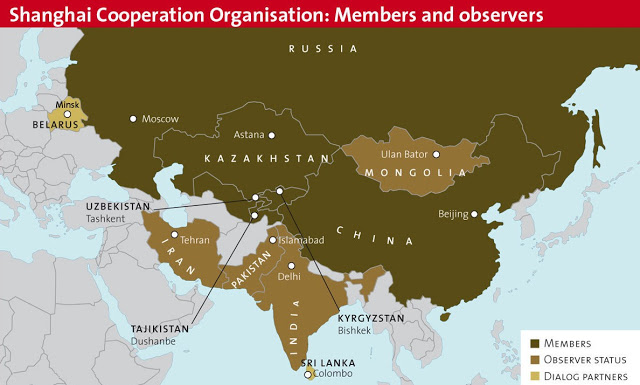
Eye Candy: Shanghai Cooperation Organization

NOL map SCO 2018
Source

First off, Shanghai and Warsaw are two very different cities, and because of that I think the SCO is a different animal than the Warsaw Pact. For one thing (aside from the difference in the two cities, one being selected for its geographical prominence, the other for its commercial acumen), the Warsaw Pact was a military alliance led by the Soviet Union, while the SCO is dedicated to political and economic cooperation as well as military security. Notably, the security aspect of the SCO is dedicated to coordinating state-led efforts against terrorism and separatism rather than against a rival alliance.

I don’t see anything wrong with multilateral efforts undertaken by states other than the US. I don’t see any need to worry, fret, or otherwise suspect the SCO of undermining world peace and prosperity. The fact that the SCO is made up of cooperating autocratic regimes rather than democratic ones does not faze me. The SCO has been making overtures to the democracies of India, Iran, and Sri Lanka (be sure to check out Tridivesh’s excellent take on India and the SCO), and multilateral cooperation among states is in itself an exercise in political participation among equals, albeit not at an individual level.

There is also cause to be happy that China and Russia have bound themselves up in such a prominent cooperative venture, too, given the two powers’ history of fighting each other. The SCO is contributing to peace and prosperity, and while it appears on the surface that the venture is designed to be a rival of the Western-built world order, the Shanghai Cooperation Organization actually contributes to it.

(h/t Nick)

Brexit Breakdown

Ir has been obvious for at least a month now that soft Brexit has won out in the UK, though the Prime Minister Theresa May would never admit such a thing directly. Government discussion of access to the EU internal market at its existing level, or very close, and keeping the border open between the Republic of Ireland and Northern Ireland (a fundamental of the peace settlement in the north) would at the very least require continuing regulatory alignment in goods (that is, following the rules made by the European Union).

It seems very likely that negotiations of the terms of exit with the EU itself would make even this partial alignment with the internal market inadequate in order to get the desired level of access. At the very least EU negotiators would demand some inclusion of services (financial services are the big issue here) and something at least resembling free movement of labour.

That inclusion would be full UK access to the internal market after exiting and would require at least a Swiss style relationship with the EU, in which there is full market access in exchange for accepting EU rules and something close to free movement of labour. Such a relationship would mean accepting judgments of the European Court of Justice even if they are not incorporated into UK law. The UK might not follow Switzerland into EFTA (European Free Trade Association, see paragraph below).

It has even been suggested that the UK might find it necessary to adopt a ‘Norway’ solution, in which the UK is directly a member of the European Economic Area. Norway has free movement but opts out of common agricultural and fisheries agreements. It is not part of the EU customs agreement. Like Iceland, Lichtenstein, and Switzerland, it is a member of the European Free Trade Area, which essentially harmonises regulations between these countries and the EU; that is, EU regulations are enforced by EFTA institutions.

It is clear that most Conservative MPs and businesses (though more large business than small business) regard something like the arrangements above, soft Brexit, as preferable to hard Brexit (trade agreement with the EU as a completely external country, possibility of no deal). These MPs and business people, along with most Treasury economists and economists in general, believe that keeping complete access to EU markets is more valuable than vague claims of a trade boom through deals with non-EU states across the world.

Hard Brexiteers believe that economic growth of other parts of the world requires breaking free of EU shackles on global free trade. The soft Brexit, as well as Remain, argument is that membership of the EU does not prevent trade with the rest of the world and that some EU countries are already doing that very well compared with the UK. On this argument, geographical proximity will always make EU trade disproportionately important so that limiting access to EU markets in the hope that non-EU countries will want free trade agreements is unnecessary and probably very damaging.

May’s drift towards soft Brexit after presenting herself as the guardian of hard Brexit has the support of most of the Cabinet, and Conservative MPs, but has been disappointing hard Brexiteers for some time. An agreement of the full cabinet at the Prime Minister’s country residence for soft Brexit has led to the resignation of the two most hard Brexit-oriented ministers.

It seems unlikely this this will deter May from a soft Brexit policy, which everyone agrees can only become more soft in negotiations with the EU to achieve an agreed exit. It also seems unlikely that most Conservative MPs will resist this policy. The biggest problem for May could be that the opposition parties want to vote against the government in call circumstances, so could vote with hard Brexit Conservative MPs to bring down any Brexit agreement.

At this point Brexit might completely break down, with the UK becoming a full member of EFTA, so in practice a member of the EU which exchanges some opt-outs for absence from the decision making processes and institutions. It might even lead to a suspension of Brexit, or a second referendum in which the electorate chooses between the exit package and staying in the EU.

At present, the most likely options in descending order are: 1. soft Brexit, outside formal association with the EU, but like that in practice, 2. formal association with the EU, maybe meaning membership of EFTA, 3. the complete breakdown of Brexit. This could change and so far change has been to move further and further away from hard Brexit.

Personally I support continuing membership of the EU. It is inevitable that large parts of the UK economy will ‘align’ with EU regulations, so it is best to be part of the institutions and processes which decide on these regulations. That is the most pragmatic version of my argument.

I am also a strong European integrationist, even a federalist romantic. The qualification of this idealism is that integration should not go further than public opinion or institutional capacity can accept at any one moment and that economic realities should guide the relationship with Europe for and against the kind of integration I favour at heart.

My own ideal is a kind of revival of the medieval dreams of ‘universal’ (i.e. European) Empire. The poet Dante was a great exponent of such a vision in his classic of political thought On Monarchy, which does not exclude city republics, even favours them under a high European sovereign. We can join it with Marsiglio of Padua’s slightly later call for an empire with elections to have something like democratic federation for Europe.

Leaving my European romanticism aside for the moment, the current realities are that the UK’s exit from the EU has become more and more complicated by the disadvantages of disentangling complex and far reaching institutional and economic links, particularly when most people involved want to keep an open border with the Republic of Ireland and keep 100% of the current level of access to the internal market.