- Would the British Raj simply be replaced by a Hindu Raj? Brent Otto, JHIBlog
- Signal, noise, and statelessness in India Ameya Naik, Pragati
- Our insular British culture Chris Dillow, Stumbling & Mumbling
- Toward a new “Ostpolitik”? Ulrich Speck, Berlin Policy Journal
India
India’s approach towards BRI: Need for pragmatism
(new title)
Recently, China’s consular general in Kolkata, Ma Zhanwu, while speaking at a function, proposed a bullet train connecting Kunming (in China’s Yunnan Province) with Kolkata, the capital of India’s eastern state of West Bengal. Said Ma:
With joint efforts of India and China, a high-speed rail link could be established between the two cities.
It would be pertinent to point out that the proposal for a bullet train connecting Kunming and Kolkata had been discussed earlier at the Greater Mekong Subregion (GMS) meet in 2015. In fact, enhancing connectivity between India and China through the Kolkata-Kunming multi-modal corridor (officially the Bangladesh-China-India-Myanmar Economic Corridor, or BCIMEC), which covers a distance of 2,800 kilometres, has been under discussion for over 2 decades, through the Track II K2K (Kolkata-Kunming) dialogue. During former India Prime Minister Manmohan Singh’s China visit, in October 2013, sister city relations were established between Kunming and Kolkata.
In recent years, China has been pro-actively reaching out to West Bengal Chief Minister Mamata Banerjee, and has invited her to visit on repeated occasions, though she has been unable to visit (she was all set to visit in June 2018, but her trip was cancelled at the last moment). Apart from this, a number of Chinese investors have expressed interest in investing in West Bengal and even attended the Bengal Global Business Summit 2018.
Given the increasing emphasis on connectivity with South East Asia, through India’s North East (one of the key aims of India’s ‘Act East Policy’), it was believed that the BCIMEC would tie in neatly with India’s vision for connectivity.
However, tensions between India and China – due to the Doklam standoff as well as Beijing’s insistence that BCIMEC be included in its official Belt and Road Initiative (BRI) – have contributed to a wane in New Delhi’s interest in the project, at least for the time being. The Rohingya crisis, and more general tensions between Bangladesh and Myanmar, are also a major impediment to the project.
The China Myanmar Economic Corridor: Why New Delhi should pay close attention
While a high speed train is an ambitious project, New Delhi can not be closed to the BCIMEC and should pay close attention to the China-Myanmar Economic Corridor (the Memorandum of Understanding for this project was signed on September 9, 2018). While the China-Myanmar Economic Corridor (CMEC) has been under discussion for some time, there have been numerous debates with regard to the economic implications for Myanmar (the Kyaukphyu Deep Sea Port project, as well as Special Economic Zones, have been contentious). The increasing debate on the issue of ‘debt trap diplomacy’ has only increased apprehensions within sections of the Myanma government (the stake of Chinese conglomerate CITIC in the deep sea port has been reduced from 85 percent to 70 percent due to domestic pressures). Myanmar has also made it clear that it would not like to depend only on Chinese investments, and the recently-signed MOU categorically states that third party investments from Japan, South Korea, and Thailand in CMEC projects are more than welcome. Interestingly, an article on CMEC in Chinese media acknowledges some of the apprehensions vis-à-vis CMEC, and also bats for closer cooperation between China and other Asian and Western countries.
The proposal for the bullet train connecting Kolkata-Kunming came days after the agreement had been signed between China and Myanmar. China would like to extend this corridor all the way to India (while speaking about rail connectivity between Kunming and Kolkata, the Chinese diplomat also spoke about an industrial cluster along the route).
How should New Delhi play it?
While New Delhi’s objections to the BRI are valid, it does need to shed blinkers. It is free not to participate in those components of the project with which it is not comfortable, but there are projects, like the BCIMEC, where it can easily find common ground with China. This will give a boost to India’s infrastructure in the eastern and northeastern part of the country, and complement it’s Act East Policy. If third countries are allowed to invest in CMEC, Indian companies should explore opportunities, as this will enhance their presence in Myanmar while also bolstering the Act East Policy.
China’s narrative in South Asia
Post the Wuhan Summit, there has been a clear change of narrative from the Chinese side. China has expressed its keenness to work jointly with India in Afghanistan – in capacity-building projects. This was unthinkable a few years ago.
China’s burgeoning economic relationship with Nepal has sent alarm signals in New Delhi. China’s decision to give Nepal access to its ports (Tianjin, Shenzhen, Lianyungang and Zhanjiang) raised the hackles in New Delhi. Pragmatists realize that New Delhi can not dictate Nepal’s ties with China, and the fact is that Kathmandu would like to benefit economically from its ties with both China and India.
Interestingly, China has been urging Nepal to strengthen economic ties with India. During his visit to Beijing, Nepal’s Prime Minister, K.P. Oli, made an unequivocal pitch for strong ties between Kathmandu and New Delhi (as well as Kathmandu and Beijing). He stated that the economic progress of both India and China was an opportunity for Nepal, and stated that Nepal wanted to emerge as a bridge between both countries, and would not like to get embedded in zero sum geopolitical games. Nepal’s former Prime Minister, Prachanda, during his visit to India, also referred to the need for close ties with both India and China.
India should also keep in mind a few other points
While many in New Delhi are pointing to Malaysian Prime Minister Mahathir Mohammad’s stand against Chinese projects, it is important to keep in mind that while the Malaysian PM has scrapped a few projects, he has continued to reiterate the relevance of the China-Malaysia relationship (there is need for nuance). Second, it is one thing to point out the shortcomings of the BRI project, but India needs to prove its own track record in big ticket connectivity projects (New Delhi has been extremely slow when it comes to the implementation of connectivity projects within the neighbourhood). Third, there are areas where India is already working with China, so rigidity and paranoia do not make much sense. If even Japan is willing to participate in certain projects of BRI, there is absolutely no reason why India should not at least be open to elements of the project. It is also important to look at connectivity from an economic dimension and not a narrow security prism as large sections of India’s strategic community do. Finally, New Delhi can not put all its eggs in the American basket. While India’s strategic relationship with the US has witnessed an improvement, and Washington has repeatedly spoken about the need for greater connectivity within the ‘Indo-Pacific’, the US is not likely to invest significantly in economic connectivity projects. India thus can not be totally dismissive of Beijing-led connectivity initiatives.
While New Delhi needs to exhibit pragmatism, Beijing on its part needs to address the concerns of India, and other countries, with regard to the BRI.
INDIA: A case study in the demise of representative democracy
India of 1947 had battled decades of colonialism to embrace self-rule. Whatever divisions seeped through party ranks, coalesced – and how beautifully – to fight for the right the people to a democracy. Having a common enemy helped. Compounded by the ability of the political leaders of that time to weave magic through words, connecting the plights of the millions to the queen-ship of one propelled movements across the breadth of the Indian subcontinent. While much has been said of the academic prowess as well as the oratory skills of the Founders, it was their ability to connect across barriers of identity that ultimately pushed the wheel. How dearly they protected their freedom of speech, expression and press is perhaps telling of the importance they assigned to being connected with those they had chosen to represent. How is it then that a deeply flawed election system and disjointed lines of public communication yielded one of the biggest civil disobedience movements the world had ever seen?
In terms of representation and reach, India 2018 is better abled than India 1947. And yet, it fell upon the unelected shoulders of four men and one woman to correct a deeply violent, colonial and bigoted law. The right to sexual identity was granted by five cis heterosexual individuals; the ones in need of representation reduced to being mere petitioners. India celebrated breaking off one more shackle, the Judiciary reveled in being the harbinger of liberal values to the Indian legal system yet one more time and the Parliament, as always, stayed mum. It is not that either of the institutions have embraced staunch anti/pro liberal positions. The Indian judiciary has its share of misogynists much like the Parliament. Misogyny is not illegal. But what is illegal is the Parliament’s distance from her electorate. Even if one were to contend that a majority of India does not support homosexuality, the increasing momentum of the movement should have propelled an informed debate within and without the Parliament. Instead, the government chose to not object to the petitions filed in favor of decriminalizing homosexuality as if that is the extent of the responsibility they owe to the LGBTQ community of the country. The distance between a judicial decriminalization of homosexuality and one done through a legislative device is the distance between a populist democracy and a representative one. The counter-majoritarian difficulty seems almost trivial when democratic institutions lose their representative character.
The biggest reason behind the rising legitimacy of an essentially non-democratic institution as the Judiciary is not a power grab by the Supreme Court judges. Howsoever activist they might get, the requirement of giving a reasoned decision tempers their emotions. The Indian Parliament, on the other hand, has come to rely on this increasing politicization of the judiciary to avoid political battles that might require concessions from their mostly unreasoned manifestos. The result is a lack of deliberation that is disturbingly dismal for a democracy as huge as India. The requirements of representation have come to be restricted to a periodical holding of elections. Members of Parliament are neither Burkean agents nor Pateman’s representatives. They are a political class unto themselves working towards a steady demise of the largest democracy in the world.
A short note from New Delhi on the 2018 Eastern Economic Forum
Chinese President Xi Jinping recently attended the Eastern Economic Forum (EEF), hosted by the Russian city of Vladivostok, which was held on September 11th and 12th of 2018. President Xi (who became the first Chinese President to attend the EEF) met with Russian President Vladimir Putin for the third time in as many months. Significantly, Japanese Prime Minister Shinzo Abe also attended the Forum, which was titled “The Russian Far East: Expanding the Range of Possibilities.”
Both Xi and Putin repeatedly referred to not just their close personal rapport (Chinese President Xi Jinping, while referring to their individual ties, stated that his and Putin’s ‘friendship was getting stronger all the time’), but also the deepening of economic and strategic ties between Russia and China, as well as the convergence on key global issues (neither side missed the opportunity to target the US for it’s inward looking economic policies).
China was also participating in military exercises, held in Siberia, which have been dubbed ‘Vostok 2018’ (Beijing clarified that these military exercises were not targeted at any third party). The military exercise (September 11-17, 2018) involves 300,000 troops, 1,000 planes, and a number of warships. China sent over 3,000 People’s Liberation Army personnel for the military exercises.
China-Russia Economic Times
A number of issues were discussed during the course of the Forum. Both sides agreed that there was a need to accelerate bilateral economic ties. Trade has witnessed a significant rise in recent years, while in 2017 it was estimated at over $80 billion. In 2018, bilateral trade could surpass $100 billion. Chinese investments in Russia have also been increasing. According to the Russia-China Investment Fund (RCIF; set up in 2012), 150 representatives from China and Russia have already identified 73 projects estimated at $100 billion. Also according to the RCIF, 7 projects estimated at well over $4 billion have already been undertaken.
Both sides also agreed to promote stronger synergies between the Belt and Road Initiative (BRI) and the Eurasian Economic Union (EEU).
Given the fact that the Forum was held in Russia’s Far Eastern Region (RFE), the need to increase Chinese investment in the RFE was high on the agenda. President Xi stated that China has always been a key participant in development projects in the Eastern parts of Russia. China’s Shandong Hi-Speed Group is also likely to invest in highway projects in the RFE.
Recent years have witnessed an increasing Chinese economic presence in Khabarovsk, which is the second largest city in the Eastern Region and 800 kilometres from Vladivostok. It may also be pertinent to point out that a large number of Russians have been uncomfortable with the growing Chinese economic clout, as well as immigrants. In 2010, the Chinese population in the Russian Far East was estimated at less than 30,000, though according to some estimates the population is much higher.
Protectionism
Both Russia and China warned against growing economic protectionism. Xi stated that he was all for greater international cooperation, and even lashed out at the growing tendency towards protectionism. Xi’s views were echoed by Putin, who stated that ‘the world and global economy are coming up against new forms of protectionism today with different kinds of barriers which are increasing.’
Putin made the point that protectionism was a threat, especially to Asia-Pacific (significantly, the current Trump administration has been using the term ‘Indo-Pacific,’ much to the chagrin of the Chinese).
What was also significant was that Xi came down heavily on ‘unilateralism’ at a time when China itself is being accused of ‘expansionist tendencies’ and promoting ‘Debt Trap Diplomacy.’ What was even more interesting was a reference to ‘UN Charter.’
The message emanating from the forum was clear: that the economic as well as strategic partnership between Moscow and Beijing is likely to strengthen, and both will try to develop an alternative narrative to that currently emerging from Washington.
Significance of meeting: Why India would be watching
New Delhi would be observing the Forum and meetings between Putin and Xi, since it’s own relations between Russia and China are of vital importance. While Russia is important in the security context, economic ties with Beijing are important for New Delhi.
New Delhi attaches immense significance to ties with Moscow
There are many in analysts in New Delhi who argue that India should be cautious in strengthening strategic ties with the US, given that this could cause friction in New Delhi’s relations with Moscow (Russia’s improved defense ties with Pakistan are often cited as a consequence of New Delhi moving too close to Washington DC). There are others who argue that New Delhi’s ties with Moscow are robust and time-tested, and will not be impacted by close ties with Washington DC. Russian President Vladimir Putin will be visiting India in October 2018 (for the 19th annual India-Russia Summit), while Indian External Affairs Minister Sushma Swaraj, during her Moscow visit, met with Deputy Prime Minister Yuri Borisov. Both of them jointly chaired the 23rd India-Russia Inter-Governmental Commission on Trade, Economic, Scientific, Technical, and Cultural Cooperation (IRIGC-TEC) meeting. A number of issues, including the need to boost bilateral trade and enhance people-to-people contact, were discussed. Significantly, this was Swaraj’s third visit to Russia in 11 months and she stated that India accorded ‘high priority’ to ties with Russia.
The fact that Swaraj’s visit to Russia took place after a successful 2+2 dialogue with the US, where a number of important defense agreements including COMCASA were signed, shows that New Delhi realizes the importance of ties with Russia. India is likely to sign a deal with Russia for the procurement of the S-400 air defence system, even though the USA has not given India any assurances with regard to a waiver from CAATSA (Countering America’s Adversaries through Sanctions Act) if India purchases defence equipment from Russia. During the visit, India is also likely to go ahead with an agreement with Russia for four frigates for the Indian Navy. While two of these will be manufactured in Kaliningrad, two will be manufactured in Goa.
New Delhi-Beijing ties
The issue of trade tariffs, which was highlighted by Putin and Xi, has also not gone unnoticed by New Delhi. One of the reasons (apart from the desire for peace and tranquility on borders) why India has been pro-actively reaching out to China is a convergence on economic issues. In fact, days after the 2+2 Summit, US President Trump, while referring to India and China, stated that the US has been providing subsidies to India and China for far too long and can not afford to do so any longer.
In terms of investments, there has not been much progress so far due to political disputes, but there is scope for greater economic cooperation between both countries through enhanced connectivity. New Delhi, on its part, should be open to projects like BCIM Corridor (Bangladesh, China, India, Myanmar). The recent proposal out of Beijing to start a railway line from Kunming to Kolkata may not seem possible in the short run, but in the long run it is definitely worth examining, and would give a boost to economies of India’s Eastern and North Eastern states. Interestingly, on September 9th, 2018, Myanmar signed a memorandum of understanding (MoU) with China for agreeing to establish the China-Myanmar Economic Corridor (CMEC). New Delhi should see this connectivity project as an opportunity rather than an obstacle.
Conclusion
New Delhi, while enhancing strategic cooperation with Washington, needs to keep in mind that there is a plethora of economic as well as other issues of global importance where New Delhi can find common ground with Beijing and Moscow. India bilaterally shares robust economic ties with China, and a strategic relationship with Russia. All three countries are also working closely in BRICS as well as SCO. New Delhi also needs to keep in mind that while strategic ties with Washington are important, Trump’s unpredictability will compel New Delhi to keep all its options open and think in a nuanced manner. While historically New Delhi shares close ties with Moscow, the logic of geography can not be ignored in the context of India-China ties.
Eye Candy: the states in India’s federation
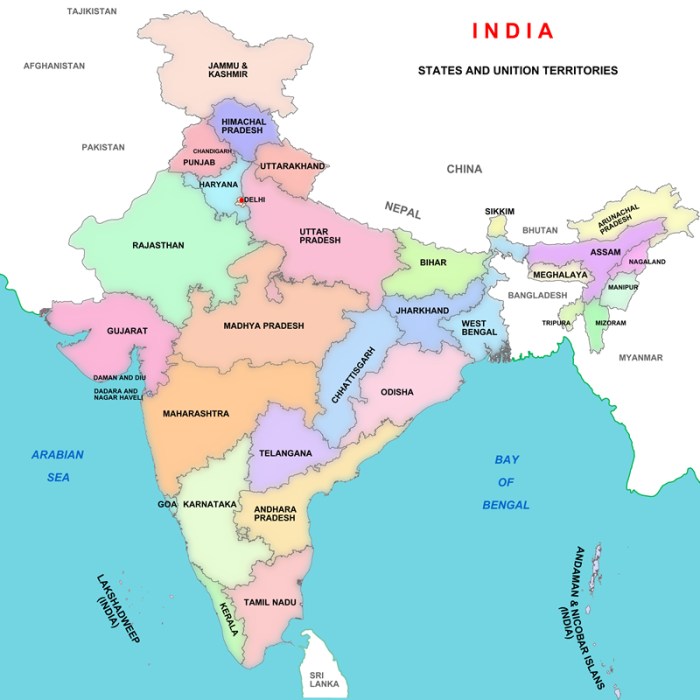
Stay tuned for more on India from a sub-state perspective. I’m going to find the GDP (PPP) per capitas of these states. I’m going to find their population densities. I’m going to find their literacy rates and their life expectancy rates. I’m going to find out much more about India over the coming 12 to 16 months.
In the meantime, here are all of NOL‘s posts from Tridivesh, a resident of New Delhi. And here are all of NOL‘s posts from Shree, a resident of New York.
RCH: 10 rivalries that shaped world history
My weekend column for RealClearHistory, in case you missed it, was fun to write. An excerpt:
4. The Mughals versus the Persians (1600s -1739). The Mughal Empire, an Indian polity that ruled over much of the subcontinent, fought three wars against two Persian dynasties (Safavids and Afsharids) and lost all of them. Much of the fighting was done around the city of Kandahar, in what is now Afghanistan. Kandahar was for a long time an important fortress for empires and dynasties that lorded over both Persia and India. While the Mughals had their pride stung by the losses, they could at least find solace in the fact their realm was the most economically successful on the planet at the time. India and Iran have long been weary regional rivals and sometime allies, but geographic distance and terrain have made outright wars between the two civilizations rare and limited. The rivalry between Iran and India has been a cultural one rather than a military one.
Read the rest (if you haven’t already!).
China and the liberal vision of the Indo-Pacific
Mike Pompeo’s recent speech (titled ‘America’s Indo-Pacific Economic Vision’) at the Indo-Pacific Business Forum hosted by the US Chamber of Commerce in Washington, DC, has been carefully observed across Asia. Beijing has understandably paid close special attention to it. Pompeo emphasized the need for greater connectivity within the Indo-Pacific, while also highlighting the role which the US was likely to play (including financial investments to the tune of $113 million in areas like infrastructure, energy, and digital economy). The US Secretary of State, while stating that this vision was not targeted at anyone, did make references to China’s hegemonic tendencies, as well as the lacunae of Chinese connectivity projects (especially the economic dimension).
The Chinese reaction to Pompeo’s speech was interesting. Senior Chinese government officials were initially dismissive of the speech, saying that such ideas have been spoken in the past, but produced no tangible results.
A response article in the Global Times is significant here. Titled ‘Indo-Pacific strategy more a geopolitical military alliance’ and published in the communist state’s premier English-language mouthpiece, what emerges clearly from this article is that Beijing is not taking the ‘Indo-Pacific vision’ lightly, and neither does it rule out the possibility of collaboration. The article is unequivocal, though, in expressing its skepticism with regard to the geopolitical aspect of the Indo-Pacific vision. Argues the article:
[…] the geopolitical connotation of the strategy may lead to regional tensions and conflicts and thus put countries in the region on alert.
The piece is optimistic with regard to the geo-economic dimension, saying that American investment would be beneficial and would promote economic growth and prosperity. What must be noted is that while the US vision for an ‘Indo-Pacific’ has been put forward as a counter to the Belt and Road Initiative (BRI) of China, the article also spoke about the possible complementarities between the US vision for an ‘Indo-Pacific’ and China’s version of BRI. While Pompeo had spoken about a crucial role for US private companies in his speech, the article clearly bats in favor of cooperation between the Indian, Japanese, Chinese, and US governments, rather than just private companies. This is interesting, given the fact that China had gone to the extent of dubbing the Indo-Pacific vision as “the foam on the sea […] that gets attention but will soon dissipate.”
While there is absolutely no doubt that there is immense scope for synergies between the Indo-Pacific vision and BRI, especially in the economic sphere, China’s recent openness towards the Indo-Pacific vision needs to be viewed in the following context.
First, the growing resentment against the economic implications of some BRI projects. In South Asia, Sri Lanka is a classical example of China’s debt trap diplomacy, where Beijing provides loans at high interest rates (China has taken over the strategic Hambantota Project, since Sri Lanka has been unable to pay Beijing the whopping $13 billion). Even in the ASEAN grouping, countries are beginning to question the feasibility of BRI projects. Malaysia, which shares close economic ties with Beijing, is reviewing certain Chinese projects (this was one of the first steps undertaken by Mahathir Mohammad after taking over the reigns as Prime Minister of Malaysia).
Secondly, the Indo-Pacific vision has long been dubbed as a mere ‘expression’ that lacks gravitas in the economic context (and even now $113 million is not sufficient). Developments over recent months, including the recent speech by Pompeo, indicate that the American Department of State seems to be keen to dispel this notion that the Indo-Pacific narrative is bereft of substance. Here it would be pertinent to point out that Pompeo’s speech was followed by an Asia visit to Indonesia, Malaysia, and Singapore.
The US needs to walk the course and, apart from investing, it needs to think of involving more countries, including Taiwan and more South Asian countries like Sri Lanka and Bangladesh in the Indo-Pacific partnership.
The Indo-Pacific also speaks in favor of democracy as well as greater integration, but countries are becoming more inward-looking, and their stands on democracy and human rights are more ambiguous than in the past. Japan is trying to change its attitude towards immigration, and is at the forefront of promoting integration and connectivity within the Indo-Pacific. Neither the US, nor India, Japan, or Australia have criticized China for its human rights violations against the Uighur minority in Xinjiang province.
Here it would also be important to state that there is scope for China to be part of the Indo-Pacific, but it needs to look at certain projects beyond the rubric of the BRI. A perfect instance is the Bangladesh, China, India, Myanmar (BCIM) Corridor, which India was willing to join, but China now considers this project as a part of BRI.
In conclusion, Beijing can not be excluded from the ‘Indo-Pacific’ narrative, but it cannot expect to be part of the same, on its own terms. It is also important for countries like the United States and India to speak up more forcefully on key issues pertaining to freedom of speech and diversity (and ensure that these remain robust in their own respective countries), given that one of the objectives of the Indo-Pacific vision is a ‘Free and Open Indo-Pacific’.
Nightcap
- Violent Conflict and Political Development Over the Long Run: China Versus Europe Dincecco & Wang, Annual Review of Political Science
- Why was the 20th century not a “Chinese Century”? Brad DeLong, Grasping Reality
- Law and border Jacob Levy, Niskanen
- The story of Indian magic John Butler, Asian Review of Books
Courts as Modern Civic Churches?
India is in the middle of an anachronistic power tussle. Watching The Tudors right when the Indian Supreme Court is hearing submissions in the Sabrimala case placed before me an interesting hypothesis – the King v Church tug of war is replicating itself, albeit democratically, in the controversy surrounding the Essential Practices Test.
First introduced in the Shirur Mutt case (1954 AIR 282), the doctrine provides for a test that would make state interference justified under a Constitution that gives to her citizens (Article 25), the freedom to practice and profess their religion, and to religious denominations (Article 26), the right to manage affairs and administer properties, both being subject to restrictions on public order, morality, and health. Essentially, the test gives the Court the power to determine what constitutes “essential to the practice of the religion” and holds that everything non-essential is subject to legislative action by the State.
A number of scholars (Gautam Bhatia, Shreya Atrey) have commented on the un/desirability of the consequences of such a test. The clearest of them all comes from Jacobsohn who characterizes the test as an attempt to internally reform the religion by allowing the judges to “re-characterize the religion in a more progressive light”.
What has given these objections much weight is the support Justice Chandrachud has lent to the skepticism of judicial discretion bestowed by the doctrine. He questions the ecclesiastical function of the court and proposes to use constitutional morality as the one stop test for determining the constitutionality of a religious practice, instead of going the long way of finding the non-essential elements that may be subjected to progressive restraints. This adherence to the constitutional word is consistent with the treatment of the constitution as the new-age charter of a civic religion, a notion oft repeated and celebrated in India.
King Henry VIII’s ostensible zeal for reform came out of his hatred for papal supremacy. Divine rights of the Kings placed the King directly under God, and God alone. He would then become the supreme mortal in terms of matters relating to governance and spirituality. The Indian courts do not wish to claim any such supremacy over spiritual matters (yet). What they seek to do is social reform – a venerable objective behind the framing of the Indian constitution. In that, they seek to be not just interpreters and guardians of the constitution, but active participants of change in realizing the aims of the constitution.
But one must question this insistence that in religion, like with the legislation, there is an umbra and a penumbra and that the latter is so hierarchy placed that it may be interfered upon, whereas the umbra is so essential that it may not be touched. What is religion but not faith? And what is faith but not a collection of beliefs organically coalesced to create charters that may look different for each generation? Is it not possible that a religion undergo change so as to value a tenet A over B within a span of decades? Is it also not possible that A and B exist simultaneously without harming the essentiality of each other, howsoever inconsistent they might seem to an educated rational mind? Since when has religion been the epitome of moral consistency?
Much can be said on the justifiability of this aspiration. Much more can be said of the legitimacy of the court’s position on such matters. Democratically speaking, ridding a society of its ills is more likely to give positive results if it comes from a joined political action rather than from a bench of judges who, in all their wisdom, are not privy to a large section of the society. Of course, the Indian supreme court has “grounded itself” (a phrased used by Dr. Rajeev Dhavan) and has acquired the kind of legitimacy that demands respectful obedience from its supporters. And this has been primarily because of the non-traditional use of judicial description for activism against a falling parliament often mired in political games to care much about the legal and policy lacunae deserving attention.
Sabrimala is an especially thorny issue, not just because the judges must conclusively decide the path the judiciary wishes to take with respect to social reform but also because they can either be the ecclesiastical court and inform the citizens of the immorality (grounded in the constitution, no doubt but then looking at the vastness of the Indian constitution, it can probably accommodate all moral philosophers barring Peter Singer) of their actions or they can let arguably unethical practices live, giving individual liberty the space that separation of church and state demands.
How will Imran Khan’s electoral triumph affect Pakistan’s relationship with India?
Many analysts (internal and external) believed that the 2018 election would be a tough fight with the PTI (Pakistan-Tehreek-I-Insaaf) having a slight edge (as a consequence of support from Pakistan’s deep state). Surveys also predicted a close fight (the importance of undecided voters was highlighted in all of these) with the PTI having a slight edge.
Former PM Nawaz Sharif’s return to Pakistan, along with daughter Maryam Nawaz Sharif, in spite of both facing jail terms, was thought of by many as a gamble which could have been a game changer in Punjab. Sharif returned to Pakistan, leaving his ailing wife Kulsoom Nawaz in London, and this, many believed, would help PML-N (PTI’s chief rival) in securing sympathy votes.
Ultimately, the PTI actually romped home quite comfortably, and emerged as the single largest party with 119 parliamentary seats, while the PML-N was a distant second with 63 seats (PML-N did emerge as the single largest party in the provincial election) and the People’s Party of Punjab (PPP) was at the third position.
Imran Khan’s India Policy
While there has been a lot of focus on the support which PTI has received from the army, there is also curiosity about what sort of policy Imran Khan will follow vis-à-vis India. It has been argued that the Indian establishment is not particularly comfortable with Imran Khan (who, unlike Sharif, may not challenge the Pakistan army’s India policy). The Indian High Commission in Islamabad is supposed to have been in touch with some of his close advisors (every government keeps channels of communications open with all political forces, and there is nothing unusual about this) in the run up to the elections.
At this stage, it is very tough to predict Imran Khan’s precise approach towards India. On the one hand, he has made belligerent statements against India, accusing Nawaz Sharif of being soft on India. While speaking in 2016, Khan had stated:
‘Our premier [Nawaz Sharif], instead of raising voice [for Kashmiris], is busy in making his business flourish there.
On another occasion he had taken a dig at Nawaz Sharif, saying that not every Pakistani is more concerned about his business than his country.
In fact, a day before the polls, Khan stated that Nawaz Sharif was more concerned about India’s interests and was even willing to discredit Pakistan’s army, which is why India preferred him.
How seriously should we take Imran Khan’s rhetoric
In the past few elections, including Nawaz Sharif’s triumphs in 1997 and 2013, anti-India propaganda did not find much traction, and the PML-N itself has indulged in anti-India rhetoric. So Khan’s statements should not be taken seriously.
A retired diplomat who has served in Pakistan, TCA Raghavan, also the author of a book titled People Next Door very aptly stated:
These statements are very common in Pakistan politics. We have to separate political rhetoric from what he actually does when he is in power.
No substantial headway can be expected over the next few months, between both countries, given the mammoth geopolitical and economic challenges which Imran Khan is facing. On the Indian side too, no grand gesture can be expected, given the fact that elections are to be held in May 2019. Backdoor diplomacy, of course, cannot be ruled out. A meeting between Imran Khan and Indian Prime Minister Narendra Modi on the sidelines of the United Nations General Assembly (UNGA) is also a possibility.
In the long run however, there could be some movement forward. In his first address to the Pakistani people, Imran Khan spoke in favor of resolving contentious issues through dialogue, while also pitching for closer economic linkages and jointly combating poverty.
In a media interview recently, he stated:
If you have a good relationship with India, it opens up trade, and trade with a huge market. Both countries would benefit.
PTI has made strong inroads into Punjab, and the business community of the province has been in favour of closer economic ties with India for sometime.
Imran’s familiarity with India
During Khan’s address to the Pakistani people, he also spoke about his familiarity with India, as well as personal ties through his cricketing career.
In 2015, during his visit to India, Imran met with PM Modi and backed peace initiatives between both countries. During his visit, Imran also met with Delhi Chief Minister Arvind Kejriwal (who he praised) and, in the past, he has had kind words for Nitish Kumar’s governance.
Even some of Khan’s close advisors, like former Foreign Minister Khurshid Kasuri and current Vice President of PTI Shah Mahmood Qureshi (who also served as Foreign Minister during the PPP government led by Asif Ali Zardari), are experienced and are familiar with India. Kasuri has numerous personal friendships in India, Qureshi, an agriculturalist, was president of the Farmers Association of Pakistan and has strong links in Indian Punjab.
Conclusion
Pakistan is facing numerous internal challenges and it is virtually impossible to comment on how things will pan out in the context of India-Pakistan ties. A lot will, however, depend upon the intent of the Pakistan army, as well as ties between Imran Khan and the army, and the role which both China and the United States play in South Asia. While Imran Khan’s initial overtures should be welcomed, it is best to wait and watch and not prophesize, as far as India-Pakistan relations are concerned.
From the comments: the Ottoman Empire and its millet system
Barry’s excellent series on Ottomanism, nationalism, and republicanism has been so good it might be hard to keep up with the dialogues it’s sparked. Here’s something from Barry in regards to a question about the Ottoman Empire’s millet system (I’ve edited it slightly, breaking up the response into more easily-digestible paragraphs):
I think I’ve tried to address this in the post. I do say that the idea of a ‘milltet system’ is a retrospective idealisation of Ottoman version of classical Muslim concept of protected minorities. In a slightly less direct way I’ve cast doubt on the idea of a pluralist Ottomanism developing on a federal basis as you mention or on a less territorial cultural pluralist basis.
As I argue in the post, Ottoman accommodation of minorities was in collapse from the early 20th century, Serbian uprisings leading to Serbian autonomy and then a war leading to Greek Independence. I presume that Ottoman modernist pluralism/federalism was simply unobtainable by then, it was just far too late for the Ottoman state to become a kind of Switzerland or even a liberalised highly pluralised unitary state.
The movement towards a national republic for the core Ottoman lands, i.e. what is now Turkey, can be traced back at least to the destruction of the Janissary order and the Serb/Greek break aways. Part of what I am arguing overall, as I hope will be clear as proceed, is that it is very very difficult for a traditional state based on a traditional hierarchy of traditional communities/estates/corporations existing over a large varied territory can exist in the modern world without some kind of top down homogenisation (think of the way China expanded over the centuries assimilating conquered peoples into Han culture) or a Russian style solution of constant political autocracy in different forms in which Slavic Orthodox Russian identity is at the centre even where Orthodox Christianity is apparently replaced by Bolshevism/Marxism-Leninism.
In short what I’m assuming and arguing is Ottoman pluralism/cosmopolitanism is an illusion, that there was never anything more than a temporary balance between components, fragmentation and separatism kept growing and separation between ‘nation states’ was inevitable. If we look at the world now, we might take India as the closest thing to a federalised liberalised Ottomanism, but India still rests on a massive predominance of Hinduism, a de facto hierarchy in which Hinduism is above other religions, regional and caste based violence, and a persistent element of Hindu chauvinism which is now explicitly in power and has never really been out of power even when the governmental ideology was apparently something else.
I’m not suggesting there is some alternative conception of what could have happened in the sub-continent which would work better than what there is now, but I can’t see that Indian neo-imperial (because based on the work of imperial regimes over the centuries) federalism works better than Turkish national-republicanism.
There is more on the millet system at NOL here, here, and here. And here is an excellent Barry essay on imperial nostalgia that’s on topic and worth reading (or re-reading).
Meat-y Twitter Spat: Choice, Vegetarianism and Caste in India
A couple of weeks ago I was in the middle of submission week (when am I not?). Obviously, an otherwise mundane tweet piqued my supremely scattered mind’s ever-shifting interest. The series of tweets argued that unless one had actually tasted meat, she was not a vegetarian by choice but a vegetarian by caste. It seemed a silly proposition to me. It seemed as silly as claiming that unless one has lived off meat for a year, she is a meat eater by caste, not by choice. Urban Indian Vegetarians (towards whom the tweets were directed) do not live in an either-or world; their individual judgments, howsoever influenced by the household they were born in, do not flicker between ‘my caste dictates I must not eat meat’ and ‘my taste buds like/dislike meat’. Between the orthodox social and the over simplified gustatory lies an ocean of personal judgments.
In response to my tweets, I was told I was missing the context, that upper caste Hindus were vegetarians because of a puranical belief in the impurity of meat. Sure, I said. If I look down upon a meat eater from some ill-founded moral high ground, I am nothing but a bigot who deserves to be called out. If, however, I chose to stick to my greens without ever experiencing the delight that is a chicken butter masala but have no qualms with you eating pork, what seems to be the problem?
Like a number of judgments we make (moral or otherwise), food preferences are also influenced by the environment we grow up in. But does mean that a child’s food preferences are motivated by the same reasons as her ancestors? People from coastal areas prefer seafood. While their ancestors might have preferred a healthy diet of fish over okra for any number of reasons (Religion? Caste? Sheer affordability?), could the children, as individuals capable of making free-standing judgments exposed to very different environments, take a liking for fish for completely different reasons, unaware and independent of their ancestors’?
Can contextualizing discount generalisations? We have consensus on contextualizing not working out well for Trump and his feelings for Mexicans how much ever the Mexican drug lords might have contributed to the law and order situation in America. Mexicans do not become rapists because of their identity. Muslims do not turn into terrorists because of their identity. The logic of it seems pretty clear. Can we then derive a principle from this consensus? Context does not justify identity based generalisations. Casteism is a very real problem in India. But no matter what the context, you are wrong if you think you have the qualification to approve of someone’s personal choices. Calls for contextualization seem like an attempt to sweep social-identity-based generalisations under the rug – the very thing that brought about casteism in the first place.
Identity based stratification is a very real problem across the world. The trick is not to demonize the identity but call out the dehumanizing ideology that is functioning in that group. My Jewish friends can choose to go Kosher for any number of reasons, as long as they don’t demonize the rest of us. My white friends are not racists if they are attracted towards other white people. And my gay friend need not sleep with a person of the opposite gender to prove that his choice of life partner is not influenced by his lesbian moms. Choice, by definition, means having an alternative option. Not exercising all the alternatives is a prerogative and it does not take away from the legitimacy of your choice.
But this forms only a minuscule percentage of the replies I got to my tweets. Most just called me an Upper Caste {insert abuse}. I soon realized this was not a debate on what prompts vegetarianism in India. This was a statement. And I, by virtue of my social identity, was not eligible to comment on it. Makes me wonder – the politics of identity is like an hourglass. One side will always lose as long as you continue to use something as tricky as sand as a parameter. I will turn more academic in my series on Arendt where I evaluate her take on identity (because I was also told that Arendt would want us to contextualize and I humbly disagree). I will discuss Arendt on collective identity, her idea of what it meant to separate ‘the political’ from ‘the social’, and finally, identity politics.
P.S: Stepping out of your echo chamber is really bad for your twitter notification bar. Excellent for the follower count though.
A note on India’s performance at the recent SCO Summit
The Shanghai Cooperation Organization (SCO) Summit, from June 9-10, went largely as expected. The Indian Prime Minister, Narendra Modi, met the Chinese President, Xi Jinping, on the sidelines of the summit. New Delhi’s proposal to have an informal summit, in India in 2019, on the lines of the Wuhan Summit (held in April 2018) was accepted by the Chinese. Agreements were also signed between both countries with regard to sharing hydrological data on the Brahmaputra River, and export of non-Basmati varieties of rice from India. Another issue, which was discussed during the Modi-Xi meeting, was the joint capacity development project in Afghanistan, which was first proposed during the Wuhan Summit.
Commenting on his meeting with the Chinese President, Modi tweeted:
Met this year’s SCO host, President Xi Jinping this evening. We had detailed discussions on bilateral and global issues. Our talks will add further vigour to the India-China friendship.
Modi’s meetings with leaders of other member countries
The Indian PM met other leaders of member countries, including the presidents of Tajikistan and Uzbekistan. While there was no formal meeting with the Pakistani President Mamnoon Hussain, Modi did shake hands with Hussain and exchange pleasantries. Interestingly, Chinese President Xi Jinping, during his address, had spoken about the presence of both leaders, as well as entry of both countries into the SCO. Said the Chinese President: Continue reading
The great global trend for the equality of well-being since 1900
Some years ago, I read The Improving State of the World: Why We’re Living Longer, Healthier, More Comfortable Lives on a Cleaner Planet by Indur Goklany. It was my first exposition to the claim that, globally, there has been a long-trend in the equality of well-being. The observation made by Goklany which had a dramatic effect on me was that many countries who were, at the time of his writing, as rich (incomes per capita) as Britain in 1850 had life expectancy and infant mortality levels well superior to 1850 Britain. Ever since, I accumulated the statistics on that regard and I often tell my students that when comes the time to “dispell” myths regarding the improvement in living standards since circa 1800 (note: people are generally unable to properly grasp the actual improvement in living standards).
Some years after, I discovered the work of Leandro Prados de la Escosura who is a cliometrician who (I think I told him that when I met him) influenced me deeply in my work regarding the measurement of living standards and who wrote this paper which I will discuss here. His paper, and his work in general, shows that globally the inequality in incomes has faltered since the 1970s. That is largely the result of the economic rise of India and China (the world’s two largest antipoverty programs). 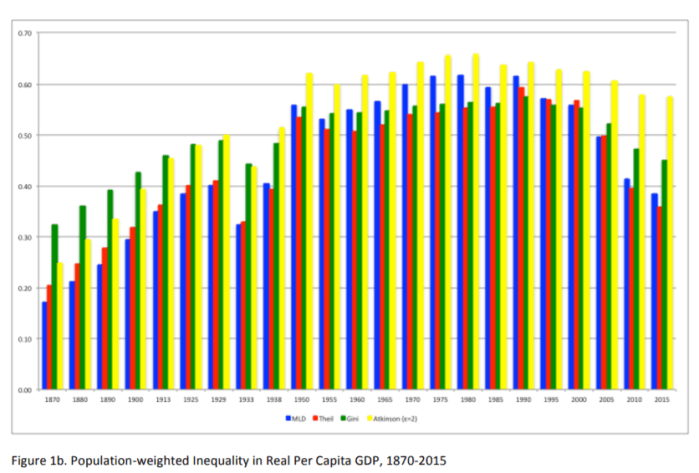
However, when extending his measurements to include life expectancy and schooling in order to capture “human development” (the idea that development is not only about incomes but the ability to exercise agency – i.e. the acquisition of positive liberty), the collapse in “human development” inequality (i.e. well-being) precedes by many decades the reduction in global income inequality. Indeed, the collapse started around 1900, not 1970!
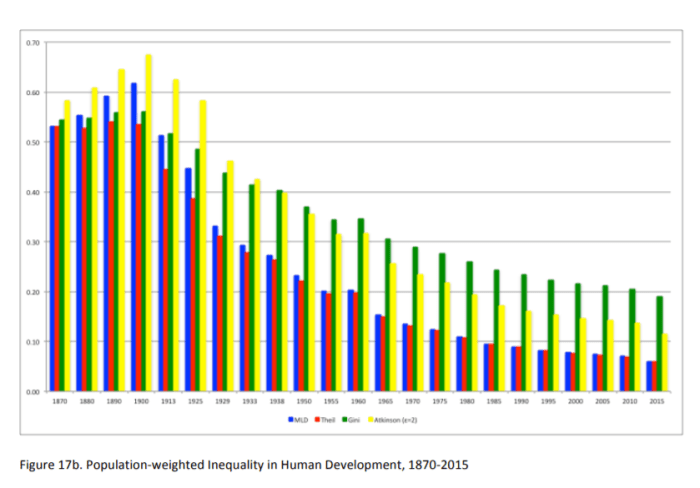
In reading Leandro’s paper, I remembered the work of Goklany which had sowed the seeds of this idea in my idea. Nearly a decade after reading Goklany’s work well after I fully accepted this fact as valid, I remain stunned by its implications. You should too.
Nightcap
- A Common Free Speech Misunderstanding Ken White, Popehat
- Giovanni Gentile’s philosophy is to this day highly original Flaminia Incecchi, JHIBlog
- Why dictators exploit ancient ruins Paul Cooper, BBC
- The French Revolution’s impact on diplomacy Blake Smith, the Wire
 Notes On Liberty