Nightcap

  1. A libertarian review of Chappaquiddick Stephen Cox, Liberty Unbound
  2. The 19th century war on dogs Livia Gershon, JSTOR Daily
  3. The NBA is thriving because it has embraced individualism Douglas French, National Review
  4. After reading this, I can’t imagine why… Anar Parikh, Anthro{dendum}

Rosenbloom on the Colonial American Economy

Joshua Rosenbloom is an economic historian worth following if you are interested in American economic history during the colonial era. He has recently published what appears to be an overview article of the topic (probably for a book or an invited symposium) which perfectly summarizes the current state of the research. I believe that this should be widely read by interested parties.  Here are key excerpts for some of the topics he discusses. I provide some comments to enrich his contribution, but these should be understood as complements rather than substitutes to this excellent overview of the American economy during the colonial era.

On Economic Growth 

Mancall and Weiss (…) concluded that likely rates of per capita GDP growth could not have been higher than 0.1 percent per year and were likely closer to zero. In subsequent work, Mancall, Rosenbloom and Weiss (2004) and Rosenbloom and Weiss (2014) have constructed similar estimates for the colonies and states of the Lower South and the Mid-Atlantic regions, respectively. Applying the method of controlled conjectures at a regional level allowed them to incorporate additional, region-specific, evidence about agricultural  productivity and exports, and reinforced the finding that there was little if any growth in GDP per capita during the eighteenth century. Lindert and Williamson (2016b) have also attempted to backcast their estimates of colonial incomes. Their estimates rely in part on the regional estimates of Mancall, Rosenbloom and Weiss, but the independent evidence they present is consistent with the view that economic growth was quite slow during the eighteenth century.

This is still a contentious point (see notably this article by McCusker), but I believe that they are correct. In my own work, using both wages and incomes, I have found similar results for Canada and Leticia Arroyo Abad and Jan Luiten Van Zanden have found something roughly similar for the Latin American economies (Mexico and Peru).

It is also consistent with even simplistic accounts of the neoclassical growth model. The New World was an economy of abundant land input whose outputs (agricultural produce) were mostly meant for local consumption. If one wanted to increase his income, all he had to do was use more inputs at really low costs. There is very little in this situation to invest in increasing total factor productivity and incomes would only increase at the dis-aggregated level (following the same region over time) as we are capturing the extent of inputs included over time (e.g. the long-settled farmer has a high income because he has had the time to build his farm, but the short-settled farmer brings the average down because he is just starting that process).

On Monetary History and Monetary Puzzles

In lieu of specie, the colonists relied heavily on barter for local exchange. In the Chesapeake transactions were often denominated in weights of tobacco. However, tobacco was not used as a medium of exchange. Rather merchants might advance credit to planters for the purchase of imported items, to be repaid at harvest with the specified quantity of tobacco. Elsewhere book credit accounts helped to facilitate transactions and reduce the need for currency. The colonists regularly complained about the shortage of specie, but as Perkins (1988, p. 165) observed, the long run history of prices does not suggest any tendency of prices to fall, as would be expected if the money supply was too small. (…) With only a few exceptions the colonies issuance of these notes did not give rise to inflationary pressures. There is by now a large literature that has analyzed the relationship between note issuance and prices, and finds little evidence of any correlation between the series (Weiss 1970, 1974; Wicker 1985; Smith 1985; Grubb 2016. As Grubb (2016) has argued, this suggests that while the circulation of bills of credit may have facilitated exchange by substituting for book credit or other forms of barter, they did not assume the role of currency.

In this, Rosenbloom summarizes a puzzle which has been the subject of debates since the 1970s (starting with West in 1978 in this Economic Inquiry article). In many instances (like South Carolina and Pennsylvania), the large issues of paper money had no measurable effect on prices.  This is a puzzle given the quantity theory of the price level. The proposition to solve the puzzle is that as the paper money printed by colonies tended to be backed by future assets, they were securities that could circulate as a medium of exchange. If properly backed and redeemed, people would form expectations that these injections were temporary injections and there would be no effect on the price level all else being equal. Inflation would only occur if redemption promises were not held or were believed to be humbug. This proposition has been heavily contested given the limited information we hold for the stock of other media of exchange and trade balances. I have my own take on this debate on which I weigh using a similar Canadian monetary experiment (see here), but this is a serious debate. Basically, it is a historical battleground between the proponents of the fiscal theory of the price level (see notably the classical Sargent and Wallace article) and the proponents of the quantity theory of the price level.  Anyone interested in the wider macroeconomic debate should really focus on these colonial experiments because they really are the perfect testing grounds (which Rosenbloom summarizes efficiently).

On Mercantilism, the Navigation Acts and American Living Standards

The requirement that major colonial exports pass through England on their way to continental markets and that manufactures be imported from England was the equivalent of imposing a tax on this trade. The resulting price wedge reduced the volume of trade and shifted some of the producer and consumer surplus to the providers of shipping and merchant services. A number of cliometric studies have attempted to estimate the magnitude of these effects to determine whether they played a role in encouraging the movement for independence (Harper 1939; Thomas 1968; Ransom 1968; McClelland 1969). The major difference in these studies arises from different approaches to formulating a counterfactual estimate of how large trade would have been in the absence of the Navigation Acts. In general, the estimates suggest that the cost to the colonists was relatively modest, in the range of 1-3 percent of annual income. Moreover, this figure needs to be set against the benefits of membership in the empire, which included the protection the British Navy afforded colonial merchants and military protection from hostile natives and other European powers.

The Navigation Acts were often cited as a burden that the colonists despised, but many economic historians have gone over their impact and they appear to have been minimal. It does not mean that they were insignificant to political events (rent-seeking coalitions tend to include small parties with intense preferences). However, it does imply that the action lies elsewhere if someone wants to explain the root causes of the revolution or that one must consider distributional effects (see notably this article here).

These are the sections that I found the most interesting (as they relate to some of my research agendas), but the entire article provides an effective summary for anyone interested in initiating research on the topic of American economic history during the colonial era. I really recommend reading it even if all that you seek is an overview for general culture.

On demography and living standards in the colonial era

This is a topic that has been bugging me. Very often, historians will (accurately) point out mortality statistics in the United States, Canada (Quebec) and the Latin America during the colonial era were better than in the comparable Old World (comparing French with French, British with British, Spanish with Spanish). However, they will argue that this is evidence that living standards were higher. This is where I wish to make an important nuance.

Settlement colonies (so, here there is a bigger focus on North America, but it applies to smaller extent to Latin America which I am more tempt to label as extractive – see here) are generally frontier economies. This means that they are small economies because of small populations.  This means that labor and capital are scarce relative to land. All outputs that come from the relatively abundant factor will thus tend to be cheaper if there is little international trade for the goods that they are best at producing. The colonial period pretty much fits that bill. The American and Canadian colonies were basically agricultural colonies, but very few of those agricultural outputs actually crossed the Atlantic. As such, agricultural produces were cheap. This is akin to saying that nutrition was cheap.

This, by definition, will give settlement colonies an advantage in terms of biological living standards. As they are not international price takers, wheat is cheaper than in the old world. This is why James Lemon spoke of the New World as the “Best poor man’s country” (I love that expression) : it was easy to earn subsistence. However, beyond that it is very hard to go beyond. For example, in my dissertation (articles still in consideration at Cliometrica and Canadian Journal of Economics) I found that when wages were deflated by a subsistence basket containing very few services and manufactured goods and which relied heavily on untransformed foods, Canada was richer than the richest city of France. Once you shifted to a basket that marginally increased transformed goods and manufactured goods, the advantage was wiped away.

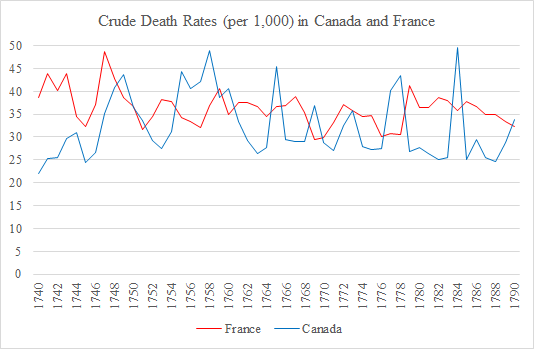
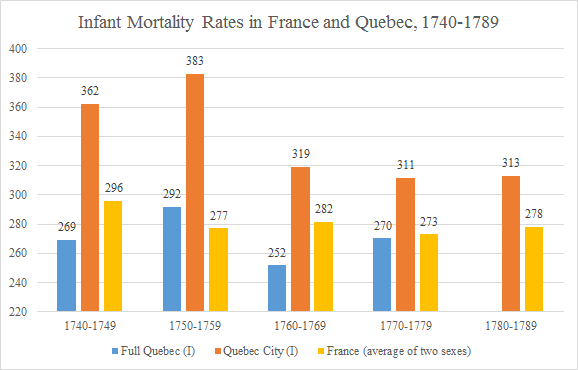
Yet, everything indicates that mortality rates were greater in Paris and France and than in Quebec City and Quebec as a whole (but not by a lot) (see images below).  Similar gaps seem to exist for the United States relative to Britain, but the data is not as rich as for Quebec. However, the data that exists for New England suggests that death rates were lower than in England but the “bare bones” real incomes measured by Lindert and Williamson show that New England may have been poorer than Great Britain (not by much though).

Crude Death Rates

IMR

I am not saying that demographic and biological data is worthless. Quite the contrary (even I wanted to, I could not since I have a paper on the heights of French-Canadians from 1780 to 1830)! The point is that data matters in context.  The world is full of small non-linearities between variables. While “good” demographic outcomes are generally tracking “good” economic outcomes, there are contexts where this may be a weaker relation (curvilinear relations between variables). I think that this is a good example of that point.

The Gradual, Eventual Triumph of Liberty

Today I’d like to write a few words of hope and encouragement to those who already understand liberty’s value. I read a speech from 1853 that stood out to me. It’s easy to be caught up in the daily news cycle and feel that liberty is constantly under attack and threatened at every hand, that every gain is clawed back as liberties are eroded one at a time. At times like that, it is good to step back and took a better look at the broader history of the world.

The speech I read was by a gentleman named Parley P. Pratt, an apostle of the Church of Jesus Christ of Latter-day Saints in the Utah territory. This was just a few years after the Mormons, including Pratt and his family, had been driven from their homes by mobs and by indifferent and sometimes hostile state and federal governments in the United States proper to find freedom and refuge in the Rocky Mountains. There they still held 4th of July celebrations, honoring the sacrifices for liberty their fathers had made. Pratt, by this point in his life, had traveled through England and parts of Europe, much of the US, Canada, and along the Pacific into Mexico, and met with many people from Asia as well – a remarkably well-traveled man.

Despite the very real failures of the government to protect their individual rights or redress their grievances, he spoke in praise of the Constitution. The main thrust of his address was that the cause of liberty would expand and someday fill the world:

The longer I live, and the more acquainted I am with men and things, the more I realize that … the Constitution of American Liberty was certainly dictated by the spirit of wisdom, by a spirit of unparalleled liberality, and by a spirit of political utility. And if that Constitution be carried out by a just and wise administration, it is calculated to benefit not only all the people that are born under its particular jurisdiction, but all the people of the earth … . It seems broad enough, and large enough, to receive and protect all that may be in any way deprived of the common rights of man. …. [The principles of the Constitution] embrace eternal truths, principles of eternal liberty, not the principles of one peculiar country, or the sectional interest of any particular people, but the great, fundamental, eternal principles of liberty to rational beings – liberty of conscience, liberty to do business, liberty to increase in intelligence and in improvement […]

There is a day coming when all mankind upon this earth will be free. When they will no longer be shackled, either by ignorance, by religious or political bondage, by tyranny, [or] by oppression (Journal of Discourses, Vol. 1, p. 137-143)

Pratt claimed this would not happen predominantly by revolution and violence, but by America being a beacon light to the world. He spoke of throngs of people who would sit in his day enjoying to hear of our freedoms, our institutions, and our scientific and cultural progress. He spoke of the immigrants coming to this country from all parts of the world specifically to find that freedom, and that once enlightened by being allowed to think and reason and act for themselves without the bondage of kings, state religions, or other powers they would blossom and rise up in greatness. Whether they eventually returned to their native lands or not, this would act as an “indirect influence … on those despotic nations” of Europe and Asia.

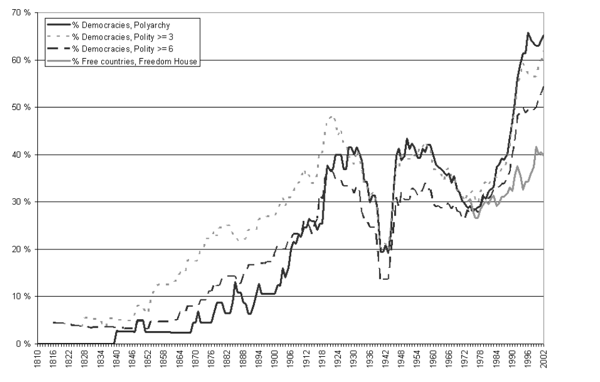
Recognizing that our liberty is remarkably multi-faceted, I will focus on the same categories Pratt mentioned. At the time he spoke, there were exactly 3 nations that were in some measure democracies, where at least some large percentage of the populace had the liberty of choosing their leaders. You can see for yourself how this has grown in the intervening 160+ years:

NOL Watson 1
source: Our World in Data

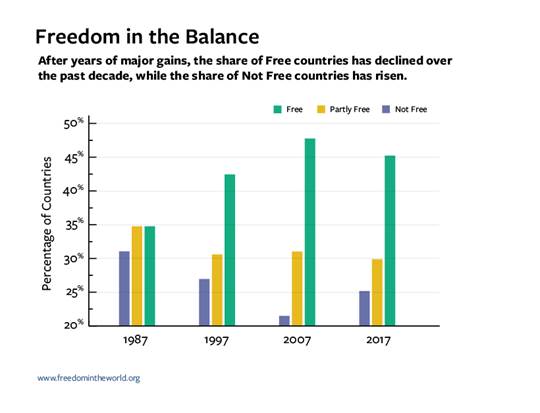
Billias’ 2009 work on how the principles of American constitutionalism were “heard round the world” shows that waves of influence gradually spread the principles of self-determination, liberty, separation of powers, and checks and balances into the freedom movements and constitutions of most of the world. Even while warning that the last ten years have seen declines in liberty overall worldwide, Heritage shows us that the last thirty years still show remarkable improvement:

NOL Watson 2

From a time when the US was one of very few countries to legally protect religious liberty, today nearly three-fourths of all the countries in the world have a constitution that specifically protects freedom of belief, and two-thirds permit some religious proselytism – which preserves freedom of expression (Pew Global Restrictions on Religion). There is still much to do to improve and preserve religious liberty around the world, both in legally acknowledged protections and in fostering an actual peaceful society where religious groups are not subject to violence and persecution.

Despite the distance left to go, the cause of liberty has clearly moved forward in great ways in the last 160 years. Much as Pratt predicted, much of this was accomplished without great revolutions and civil wars, but through the power of example as free nations and free people proved themselves a beacon to the world. There is still good cause to believe in that fundamental converting power from setting the right example and allowing free people to govern themselves.

Nightcap

  1. The Men Who Made the Third Reich Richard Evans, the Nation
  2. Missionaries Didn’t Ruin Native Cultures John McGreevy, Commonweal
  3. Gutenberg: the democratizer of knowledge Bettina Baumann, Deutsche Welle
  4. Richer than Rockefeller? David Henderson, EconLog

The best economic history papers of 2017

As we are now solidly into 2018, I thought that it would be a good idea to underline the best articles in economic history that I read in 2017. Obviously, the “best” is subjective to my preferences. Nevertheless, it is a worthy exercise in order to expose some important pieces of research to a wider audience.  I limited myself to five articles (I will do my top three books in a few weeks). However, if there is an interest in the present post I will publish a follow-up with another five articles.

O’Grady, Trevor, and Claudio Tagliapietra. “Biological welfare and the commons: A natural experiment in the Alps, 1765–1845.” Economics & Human Biology 27 (2017): 137-153.

This one is by far my favorite article of 2017. I stumbled upon it quite by accident. Had this article been published six or eight months earlier, I would never have been able to fully appreciate its contribution. Basically, the authors use the shocks induced by the wars of the late 18th century and early 19th century to study a shift from “self-governance” to “centralized governance” of common pool resources. When they speak of “commons” problems, they really mean “commons” as the communities they study were largely pastoral communities with area in commons.  Using a difference-in-difference where the treatment is when a region became “centrally governed” (i.e. when organic local institutions were swept aside), they test the impact of these top-down changes to institutions on biological welfare (as proxied by infant mortality rates). They find that these replacements worsened outcomes.

Now, this paper is fascinating for two reasons. First, the authors offer a clear exposition of its methodology and approach. They give just the perfect amount of institutional details to assuage doubts.  Second, this is a strong illustration of the points made by Elinor Ostrom and Vernon Smith. These two economists emphasize different aspects of the same thing. Smith highlights that “rationality” is “ecological” in the sense that it is an iterative process of information discovery to improve outcomes.  This includes the generation of “rules of the game” which are meant to sustain exchanges. These rules need not be formal edifices. They can be norms, customs, mores and habits (generally supported by the discipline of continuous dealings and/or investments in social-distance mechanisms). On her part, Ostrom emphasized that the tragedy of the commons can be resolved through multiple mechanisms (what she calls polycentric governance) in ways that do not necessarily require a centralized approach (or even market-based approaches).

In the logic of these two authors, attempts at “imposing” a more “rational” order (from the perspective of the planner of this order) may backfire. This is why Smith often emphasizes the organic nature of things like property rights. It also shows that behind seemingly “dumb” peasants, there is often the weight of long periods of experimentation in order to adapt rules and norms in order to fit the constraints faced by the community.  In this article, we can see those two things – the backfiring and, by logical implication, the strengths of the organic institutions that were swept away.

Fielding, David, and Shef Rogers. “Monopoly power in the eighteenth-century British book trade.” European Review of Economic History 21, no. 4 (2017): 393-413.

In this article, the authors use a legal change caused by the end of the legal privileges of the Stationers’ Company (which amounted to an easing of copyright laws).  The market for books may appear to be “non-interesting” for mainstream economics. However, this would be a dramatic error. The “abundance” of books is really a recent development. Bear in mind that the most erudite monk of the late middle ages had less than fifty books from which to draw knowledge (this fact is a vague recollection of mine from Kenneth Clark’s art history documentary from the late 1960s which was aired by the BBC). Thus, the emergence of a wide market for books – which is dated within the period studied by the authors of this article – should not be ignored. It should be considered as one of the most important development in western history. This is best put by the authors when they say that “the reform of copyright law has been regarded as one of the driving forces behind the rise in book production during the Enlightenment, and therefore a key factor in the dissemination of the innovations that underpinned Britain’s Industrial Revolution”.

However, while they agree that the rising popularity of books in the 18th century is an important historical event, they contest the idea that liberalization had any effect. They find that the opening up of the market to competition had little effects on prices and book production. They also find that mark-ups fell but that this could not be attributed to liberalization. At first,  I found these results surprising.

However, when I took the time to think about it I realized that there was no reason to be surprised. First, many changes have been heralded as crucial moments in history. More often than not, the importance of these changes has been overstated. A good example of an overstated change has been the abolition of the Corn Laws in England in the 1840s. The reduction in tariffs, it is argued, ushered Britain into an age of free trade and falling food prices.

In reality, as John Nye discusses, protectionist barriers did not fall as fast as many argued and there were reductions prior to the 1846 reform as Deirdre McCloskey pointed out. It also seems that the Corn Laws did not have substantial effects on consumption or the economy as a whole (see here and here).  While their abolition probably helped increase living standards, it seems that the significance of the moment is overstated. The same thing is probably at play with the book market.

The changes discussed by Fielding and Rogers did not address the underlying roots of the level of market power enjoyed by industry players. In other words, it could be that the reform was too modest to have an effect. This is suggested by the work of Petra Moser. The reform studied by Fielding and and Rogers appears to have been short-lived as evidenced by changes to copyright laws in the early 19th century (see here and here). Moser’s results point to effects much larger (and positive for consumers) than those of Fielding and Rogers.  Given the importance of the book market to stories of innovation in the industrial revolution, I really hope that this sparks a debate between Moser and Fielding and Rogers.

Johnson, Noel D., and Mark Koyama. “States and economic growth: Capacity and constraints.” Explorations in Economic History 64 (2017): 1-20.

I am biased as I am fond of most of the work of these two authors. Nevertheless, I think that their contribution to the state capacity debate is a much needed one. I am very skeptical of the theoretical value of the concept of state capacity.  The question always lurking in my mind is the “capacity to do what?”.

A ruler who can develop and use a bureaucracy to provide the services of a “productive state” (as James Buchanan would put it) is also capable of acting like a predator.  I actually emphasize this point in my work (revise and resubmit at Health Policy & Planning) on Cuban healthcare: the Cuban government has the capacity to allocate large quantities of resources to healthcare in amounts well above what is observed for other countries in the same income range. Why? Largely because they use health care for a) international reputation and b) actually supervising the local population. As such, members of the regime are able to sustain their role even if the high level of “capacity” comes at the expense of living standards in dimensions other than health (e.g. low incomes). Capacity is not the issue, its capacity interacting with constraints that is interesting.

And that is exactly what Koyama and Johnson say (not in the same words). They summarize a wide body of literature in a cogent manner that clarifies the concept of state capacity and its limitations. In doing so, they ended up proposing that the “deep roots” question that should interest economic historians is how “constraints” came to be efficient at generating “strong but limited” states.

In that regard, the one thing that surprised me from their article was the absence of Elinor Ostrom’s work. When I read about “polycentric governance” (Ostrom’s core concept), I imagine the overlap of different institutional structures that reinforce each other (note: these structures need not be formal ones). They are governance providers. If these “governance providers” have residual claimants (i.e. people with skin in the game), they have incentives to provide governance in ways that increased the returns to the realms they governed. Attempts to supersede these institutions (e.g. like the erection of a modern nation state) requires dealing with these providers. They are the main demanders of constraints which are necessary to protect their assets (what my friend Alex Salter calls “rights to the realm“). As Europe pre-1500 was a mosaic of such governance providers, there would have been great forces pushing for constraints (i.e. bargaining over constraints).

I think that this is where the literature on state capacity should orient itself. It is in that direction that it is the most likely to bear fruits. In fact, there have been some steps taken in that direction For example, my colleagues Andrew Young and Alex Salter have applied this “polycentric” narrative to explain the emergence of “strong but limited states” by focusing on late medieval institutions (see here and here).  Their approach seems promising. Yet, the work of Koyama and Johnson have actually created the room for such contributions by efficiently summarizing a complex (and sometimes contradictory) literature.

Bodenhorn, Howard, Timothy W. Guinnane, and Thomas A. Mroz. “Sample-selection biases and the industrialization puzzle.” The Journal of Economic History 77, no. 1 (2017): 171-207.

Elsewhere, I have peripherally engaged discussants in the “antebellum puzzle” (see my article here in Economics & Human Biology on the heights of French-Canadians born between 1780 and 1830). The antebellum puzzle refers to the possibility that the biological standard of living (e.g. falling heights, worsening nutrition, increased mortality risks) fell while the material standard of living increased (e.g. higher wages, higher incomes, access to more services, access to a wider array of goods) during the decades leading to the American Civil War.

I am inclined to accept the idea of short-term paradoxes in living standards. The early 19th century witnessed a reversal in rural-urban concentration in the United States. The country had been “deurbanizing” since the colonial era (i.e. cities represented an increasingly smaller share of the population). As such, the reversal implied a shock in cities whose institutions were geared to deal with slowly increasing populations.

The influx of people in cities created problems of public health while the higher level of population density favored the propagation of infectious diseases at a time where our understanding of germ theory was nill. One good example of the problems posed by this rapid change has been provided by Gergely Baics in his work on the public markets of New York and their regulation (see his book here – a must read).  In that situation, I am not surprised that there was a deterioration in the biological standard of living. What I see is that people chose to trade-off shorter wealthier lives against longer poorer lives. A pretty legitimate (albeit depressing) choice if you ask me.

However, Bodenhorn et al. (2017) will have none of it. In a convincing article that has shaken my priors, they argue that there is a selection bias in the heights data – the main measurement used in the antebellum puzzle debate.  Most of the data on heights comes either from prisoners or enrolled volunteer soldiers (note: conscripts would not generate the problem they describe). The argument they make is that as incomes grow, the opportunity cost of committing a crime or of joining the army grows.  This creates the selection bias whereby the sample is going to be increasingly composed of those with the lowest opportunity costs. In other words, we are speaking of the poorest in society who also tended to be shorter. Simultaneously, fewer tall individuals (i.e. rich individuals) committed crimes or joined the army because incomes grew. This logic is simple and elegant. In fact, this is the kind of data problem that every economist should care about when they design their tests.

Once they control for this problem (through a meta-analysis), the puzzle disappears. I am not convinced by the latter part of the claim. Nevertheless, it is very likely that the puzzle is much smaller than initially gleaned. In yet to be published work, Ariell Zimran (see here and here) argues that the antebellum puzzle is robust to the problem of selection bias but that it is indeed diminished. This concedes a large share of the argument to Bodenhorn et al. While there is much to resolve, this article should be read as it constitutes one of the most serious contributions to the field of economic history published in 2017.

Ridolfi, Leonardo. “The French economy in the longue durée: a study on real wages, working days and economic performance from Louis IX to the Revolution (1250–1789).” European Review of Economic History 21, no. 4 (2017): 437-438.

I discussed Leonardo’s work elsewhere on this blog before. However, I must do it again. The article mentioned here is the dissertation summary that resulted from Leonardo being a finalist to the best dissertation award granted by the EHES (full dissertation here). As such, it is not exactly the “best article” published in 2017. Nevertheless,  it makes the list because of the possibilities that Leonardo’s work have unlocked.

When we discuss the origins of the British Industrial Revolution, the implicit question lurking not far away is “Why Did It Not Happen in France?”. The problem with that question is that the data available for France (see notably my forthcoming work in the Journal of Interdisciplinary History) is in no way comparable with what exists for Britain (which does not mean that the British data is of great quality as Judy Stephenson and Jane Humphries would point out).  Most estimates of the French economy pre-1790 were either conjectural or required a wide array of theoretical considerations to arrive at a deductive portrait of the situation (see notably the excellent work of Phil Hoffman).  As such, comparisons in order to tease out improvements to our understanding of the industrial revolution are hard to accomplish.

For me, the absence of rich data for France was particularly infuriating. One of my main argument is that the key to explaining divergence within the Americas (from the colonial period onwards) resides not in the British or Spanish Empires but in the variation that the French Empire and its colonies provide. After all, the French colony of Quebec had a lot in common geographically with New England but the institutional differences were nearly as wide as those between New England and the Spanish colonies in Latin America. As such, as I spent years assembling data for Canada to document living standards in order to eventually lay down the grounds to test the role of institutions, I was infuriated that I could do so little to compare with France. Little did I know that while I was doing my own work, Leonardo was plugging this massive hole in our knowledge.

Leonardo shows that while living standards in France increased from 1550 onward, the level was far below the ones found in other European countries. He also showed that real wages stagnated in France which means that the only reason behind increased incomes was a longer work year. This work has also unlocked numerous other possibilities. For example, it will be possible to extend to France the work of Nicolini and Crafts and Mills regarding the existence of Malthusian pressures. This is probably one of the greatest contribution of the decade to the field of economic history because it simply went through the dirty work of assembling data to plug what I think is the biggest hole in the field of economic history.
On the popularity of economic history

I recently engaged in a discussion (a twittercussion) with Leah Boustan of Princeton over the “popularity” of economic history within economics (depicted below).  As one can see from the purple section, it is as popular as those hard candies that grandparents give out on Halloween (to be fair, I like those candies just like I do economic history). More importantly, the share seems to be smaller than at the peak of 1980s. It also seems like the Nobel prize going to Fogel and North had literally no effects on the subfield’s popularity. Yet, I keep hearing that “economic history is back”. After all, the Bates Clark medal went to Donaldson of Stanford this year which should confirm that economic history is a big deal.  How can this be reconciled with the figure depicted below?

EconomicHIstoryData

As I explained in my twittercussion with Leah, I think that there is a popularity for using historical data. Economists have realized that if some time is spent in archives to collect historical data, great datasets can be assembled. However, they do not necessarily consider themselves “economic historians” and as such they do not use the JEL code associated with history.  This is an improvement over a field where Arthur Burns (former Fed Chair) supposedly said during the 1970s that we needed to look at history to better shape monetary policy. And by history, he meant the 1950s. However, while there are advantages, there is an important danger which is left aside.

The creation of a good dataset has several advantages. The main one is that it increases time coverage. By increasing the time coverage, you can “tackle” the big questions and go for the “big answers” through the generation of stylized facts. Another advantage (and this is the one that summarizes my whole approach) is that historical episodes can provide neat testing grounds that give us a window to important economic issues. My favorite example of that is the work of Petra Moser at NYU-Stern. Without going into too much details (because her work was my big discovery of 2017), she used a few historical examples which she painstakingly detailed in order to analyze the effect of copyright laws. Her results have important ramifications to debates regarding “science as a public good” and “science as a contribution good” (see the debates between Paul David and Terence Kealey on this in Research Policy for this point).

But these two advantages must be weighted against an important disadvantage which Robert Margo has warned against in a recent piece in Cliometrica.  When one studies economic history, one must keep in mind that two things must be accomplished simultaneously: to explain history through theory and bring theory to life through history (this is not my phrase, but rather that of Douglass North). To do so, one must study a painstaking amount of details to ascertain the quality of the sources used and their reliability.  In considering so many details, one can easily get lost or even fall prey to his own prior (i.e. I expect to see one thing and upon seeing it I ask no question). To avoid this trap, there must be a “northern star” to act as a guide. That star, as I explained in an earlier piece, is a strong and general understanding of theory (or a strong intuition for economics). To create that star and give attention to details is an incredibly hard task and which is why I argued in the past that “great” economic historians (Douglass North, Deirdre McCloskey, Robert Fogel, Nathan Rosenberg, Joel Mokyr, Ronald Coase (because of the lighthouse piece), Stephen Broadberry, Gregory Clark etc.) take a longer time to mature. In other words, good economic historians are projects that have have a long “time to build problem” (sorry, bad economics joke).  However, the downside is that when this is not the case, there are risks of ending up with invalid results that are costly and hard to contest.

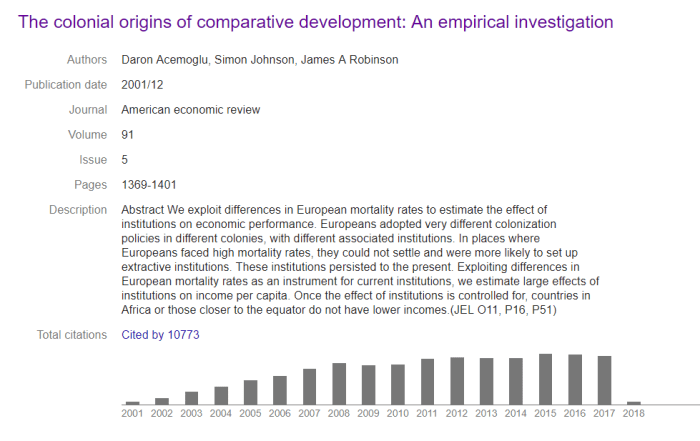
Just think about the debate between Daron Acemoglu and David Albouy on the colonial origins of development. It took more than five years to Albouy to get his results that threw doubts on Acemoglu’s 1999 paper. Albouy clearly expended valuable resources to get the “details” behind the variables. There was miscoding of Niger and Nigeria, and misunderstandings of what type of mortalities were used.  This was hard work and it was probably only deemed a valuable undertaking because Acemoglu’s paper was such a big deal (i.e. the net gains were pretty big if they paid off). Yet, to this day, many people are entirely unaware of the Albouy rebuttal.  This can be very well seen in the image below regarding the number of cites of the Acemoglu-Johnson-Robinson paper on an annual basis. There seems to be no effect from the massive rebuttal (disclaimer: Albouy convinced me that he was right) from the Albouy piece.

AcemogluPaperCites

And it really does come down to small details like those underlined by Albouy. Let me give you another example taken from my work. Within Canada, the French minority is significantly poorer than the rest of Canada. From my cliometric work, we now know that there were poorer than the rest of Canada and North America as far as the colonial era. This is a stylized fact underlying a crucial question today (i.e. Why are French-Canadians relatively poor).  That stylized fact requires an explanation. Obviously, institutions are a great place to look. One of the institution that is most interesting is seigneurial tenure which was basically a “lite” version of feudalism in North America that was present only in the French settled colonies. Some historians and economic historians argued that there were no effects of the institutions on variables like farm efficiency.  However, some historians noticed that in censuses the French reported different units that the English settlers within the colony of Quebec. To correct for this metrological problem, historians made county-level corrections. With those corrections, the aforementioned has no statistically significant effect on yields or output per farm. However, as I note in this piece that got a revise and resubmit from Social Science Quarterly (revised version not yet online), county-level corrections mask the fact that the French were more willing to move to predominantly English areas than the English were willing to predominantly French areas. In short, there was a skewed distribution. However, once you correct the data on an ethnic composition basis rather than on the county-level (i.e. the same correction for the whole county), you end with a statistically significant negative effect on both output per farm and yields per acre. In short, we were “measuring away” the effect of institutions. All from a very small detail about distributions. Yet, that small detail has supported a stylized fact that the institution did not matter.

This is the risk that Margo speaks about illustrated in two examples. Economists who use history merely as a tool may end up making dramatic mistakes that will lead to incorrect conclusions. I take this “juicy” quote from Margo (which Pseudoerasmus) highlighted for me:

[EH] could become subsumed entirely into other fields… the demand for specialists in economic history might dry up, to the point where obscure but critical knowledge becomes difficult to access or is even lost. In this case, it becomes harder to ‘get the history right’

Indeed, unfortunately.

*The Islamic Enlightenment* | A critical review

De Bellaigue, Christopher. (2017) The Islamic Enlightenment: The Struggle Between Faith and Reason 1798 to Modern Times. Liveright Publishing Corporation (Norton & Company) New York, London.

In 1798, in view of the Pyramids, a French expeditionary force defeated the strange caste of slave-soldiers, the Mamlukes, who had been ruling Egypt for several centuries. The Mamlukes charged the French infantry squares on horseback, ending their charge with the throwing of javelins. The Mamlukes were thus eliminated from history. The French lost 29 soldiers. In the conventional narrative, the battle woke up the whole Muslim world from its long and haughty slumber. The defeat, the pro-active reforms of Napoleon’s short-lived occupancy, and the direct influence of the French scholars he had brought with him lit the wick of the candle of reform or, possibly, of enlightenment throughout the Islamic world.

De Bellaigue picks up this conventional narrative and follows it to the beginning of the 20th century with a dazzling richness of details. This is an imperfect yet welcome thick book on a subject seldom well covered.

This book has, first, the merit of existing. Many people of culture, well-read people with an interest in Islam – Islam the sociological phenomenon, rather than the religion – know little of the travails of its attempted modernization. Moreover, under current conditions of political correctness the very subject smells a little of sulfur: What if we looked at Muslim societies more closely and we found in them some sort of intrinsic inferiority? I mean by this, an inferiority that could not easily be blamed on the interference of Western, Christian or formerly Christian, capitalist societies. Of course, such a finding could only be subjective but still, many would not like it, and not only Muslims.

Second, and mostly unintentionally, possibly inadvertently, the book casts a light, an indirect light to be sure, on Islamist (fundamentalist) terrorism. It’s simple: Enlightened individuals of any religious background are not likely to be also fanatics willing to massacre perfect strangers. Incidentally, I examine this issue myself in a fairly parochial vein, in an essay in the libertarian publication Liberty Unbound: “Religious Bric-à-Brac and Tolerance of Violent Jihad” (January 2015). With his broader perspective, with his depth of knowledge, De Bellaigue could have done a much better job of this than I could ever do. Unfortunately he ignored the subject almost entirely. It wasn’t his topic, some will say. It was not his period of history. Maybe.

Continue reading

Lunchtime Links

  1. Interview with a secessionist
  2. Ducking questions about capitalism
  3. The perverse seductiveness of Fernando Pessoa
  4. Yet in this simple task, a doffer in the USA doffed 6 times as much per hour as an adult Indian doffer.”
  5. Conflicted thoughts on women in medicine
  6. The Devil You Know vs The Market For Lemons (car problems)

Lunchtime Links

  1. My country, your colony | why the Holocaust in Europe?
  2. compliance and defiance to national integration in Africa [pdf] | on doing economic history
  3. ethnonationalism and nation-building in Siberia [pdf] | cosmopolitanism and nationalism
  4. political centralization and government accountability [pdf] | decentralization in military command
  5. unified China and divided Europe [pdf] | unilateralism is not isolationism

Some Thoughts on State Capacity

State capacity is an important topic and the subject of much recent attention in both development economics and economic history. Together with Noel Johnson I’ve recently written a survey article on the topic (here). At the same time, many libertarians and classical liberals are uncomfortable with the concept (see here and here). I think these criticisms are useful but misplaced. Addressing them will hopefully move the debate forward in a useful fashion.

Here I will just focus one issue. This is the argument recently made by Alex Salter that state capacity is a black box. Alex notes correctly that we have a detailed and convincing theory for how markets can lead to economic growth (by directing resources to their most efficient use). In contrast, according to Alex:

“State capacity, by itself, addresses neither the information issue nor the incentive issue. While governance institutions obviously began centralizing at the beginning of the modern era, this is just a morphological description of what happened to institutions. On its own, that’s insufficient as a causal explanation”.

I think Alex and other critics are on the wrong track here. State capacity is not alternative explanation for economic growth to that offered by markets. The relevant question is what impeded market development before, say, 1700, and what enabled the growth of markets after around 1700. The evidence provided by a body of research suggests that prior to 1700 market development was impeded by political fragmentation both within and between states. Critics of the state capacity argument should engage with this literature.

A second claim Alex makes is that we lack a theory for why the more centralized states that arose after 1700 were less rent-seeking and predatory than their weaker and more internally fragmented predecessors. But in fact we have a fairly good understanding of many of the mechanisms responsible for the demise of the more costly forms of recent seeking that characterized medieval and early modern Europe. This understanding is based on the work of James Buchanan and Mancur Olson.

The basic argument is this. Medieval and early modern states were mostly devices for rent-extraction and rent-seeking. But this rent-extraction and rent-seeking was largely decentralized. They collected taxes through a variety of costly and inefficient means (such as selling monopolies). They then spent the tax revenue on costly wars.

Decentralized rent-extraction was costly and inefficient. For example, it is well known that weights and measures varied from place to place in preindustrial Europe. What is less well known is that there were institutional reasons for this, as each local lord wanted to use his own measures in order to extract more surplus from the peasants who were forced to grind their grain using his mill. Local cities similarly used their own systems of weights and measures in order to extract surplus from traveling merchants. This benefited each local lord and city authority but imposed a large deadweight loss on the economy at large.

The logic of internal tariffs was similar. Each local lord or city would choose their internal tariffs in order to maximize their own income. But we know from elementary microeconomics that in this setting each local authority will set these tariffs “too high” because they will not take into account the effect of their tax rate on the tax revenue of their neighbors who also set their tariffs too high.

When early modern European rulers invested in state capacity, they sought to abolish or restrict such internal tariffs, to impose uniform taxes, and to standardize weights and measures. This resulted in a reduction in deadweight loss as when the king set the tax rate he considered the tax revenue he gets from his entire realm, and internalized the negative externality mentioned above.  The reasoning is identical to that which states that a single combined monopolist may be preferable to an up-stream and down-stream monopolist. When it comes to a public bad (like rent-seeking) a monopolist is preferable to competition.

Political Decentralization and Innovation in early modern Europe

My full review of Joel Mokyr’s A Culture of Growth is forthcoming in the Independent Review. Unfortunately, it won’t be out until the Winter 2017 issue is released so here is a preview. Specifically, I want to discuss one of the main themes of the book and my review: the role of political decentralization in the onset of economic growth in western Europe.

This argument goes back to Montesquieu and David Hume. It is discussed in detail in my paper “Unified China; Divided Europe’’ (forthcoming in the International Economic Review and available here). But though many writers have argued that fragmentation was key to Europe’s eventual rise, these arguments are often underspecified, fail to explain the relevant mechanisms, or do not discuss counter-examples. Mokyr, however, has an original take on the argument which is worth emphasizing and considering in detail.

Mokyr focuses on how the competitive nature of the European state system provided dynamic incentives for economic growth and development. This argument is different from the classic one, according to which political competition led to fiscal competition, lower taxes, and better protection of property rights (see here). That argument rests on a faulty analogy between competition in the marketplace and competition between states.  The main problem it encounters is that while firms can only attract customers by offering lower prices (lower taxes) or better products (better public goods), states can compete with violence. Far from being competitive, low tax states like the Polish-Lithuanian commonwealth were crushed in the high-pressure competitive environment that characterized early modern Europe. The notion that competition produced low taxes is also falsified by the well-established finding that taxes were much higher in early modern Europe than elsewhere in the world.

It is also not the case that political fragmentation is always and everywhere good for economic development. India was fragmented for much of its history. Medieval Ireland was fragmented into countless chiefdom prior to the English conquest. Perhaps we can distinguish between low-intensity but fragmented state systems which tended not to generate competitive pressure such as medieval Ireland or South-East Asia and high-intensity fragmented state systems such as early modern Europe or warring states China. But even then it is not clear that a highly competitive and fragmented state system will be good for growth. In general, political fragmentation raised barriers to trade and impeded market integration. Moreover a competitive state system means more conflict or more resources spent deterring conflict. For this reason political fragmentation tends to result in wasteful military spending. It can be easily shown, for instance, that a much higher proportion of the population spent their lives in the economically wasteful activity of soldiering in fragmented medieval and early modern Europe than did in either the Roman empire or imperial China (see Ko, Koyama, Sng, 2018).

Innovation and Decentralization

What then is Mokyr’s basis for claiming that political fragmentation was crucial for the onset of modern growth? Essentially, for Mokyr the upside of Europe’s political divisions was dynamic. It was the conjunction of political fragmentation with a thriving trans-European intellectual culture that was crucial for the eventual transition to modern growth. The political divisions of Europe meant that innovative and heretical thinkers had an avenue of escape from oppressive political authorities. This escape valve prevented the ideas and innovations of the Renaissance and Reformation from being crushed after the Counter-Reformation became ascendant in southern Europe after 1600. Giordano Bruno was burned in Rome. But in general heretical and subversive thinkers could escape the Inquisition by judiciously moving across borders.

Political fragmentation enabled thinkers from Descartes and Bayle to Voltaire and Rousseau to flee France. It also allowed Hobbes to escape to Paris during the English Civil War and Locke to wait out the anger of Charles II in the Netherlands. Also important was the fact that the political divisions of Europe also meant that no writer or scientist was dependent on the favor of a single, all powerful monarch. A host of different patrons were available and willing to compete to attract the best talents. Christina of Sweden sponsored Descartes. Charles II hired Hobbes as a mathematics teacher for a while. Leibniz was the adornment of the House of Hanover.

The other important point that Mokyr’s stresses is Europe’s cultural unity and interconnectedness. As I conclude in my review, Mokyr’s argument is that

“the cultural unity of Europe meant that the inventors, innovators, and tinkers in England and the Dutch Republic could build on the advances of the European-wide Scientific Revolution. Europe’s interconnectivity due to the Republic of Letters helped to give rise to a continent-wide Enlightenment Culture. In the British Isles, this met a response from apprentice trained and skilled craftsmen able to tinker with and improve existing technologies.  In contrast, political fragmentation in the medieval Middle East or pre-modern India does not seem to have promoted innovation, whereas the political unity of Qing China produced an elite culture that was conservative and that stifled free thinking”.

It is this greater network connectivity that needs particular emphasize and should be the focus of future research into the intellectual origins of growth in western Europe. At present we can only speculate on its origins. The printing press certainly deserves mention as it was the key innovation that helped the diffusion of ideas. Mokyr also points to the postal system as a crucial institutional development that enabled rapid communication across political boundaries. Other factors include the development of a nascent European identity and what Chris Wickham calls, in his recent book on medieval Europe, “the late medieval public sphere” (Wickham, 2016). These developments were important but understudied complements to the fragmented nature of the European state system so frequently highlighted in the literature.

Mexicans in Mexico

I just spent another two weeks in Mexico, in Puerto Vallarta to be specific, a town pretty much invented by Liz Taylor and Richard Burton. (See the movie “Night of the Iguana.”) The more time I spend in Mexico, the more I like Mexicans. I may have to repeat myself here.

Mexican cities are clean because people sweep in front of the their doors every morning without being told. Everybody there works or is seeking hard to work. Everybody is polite and friendly. One exception: an older taxi driver showed some discrete ill humor with me. I had mistakenly given him 15 cents (American) for a tip. That’s it. Every other interaction I had was gracious or better. (It’s true that my Spanish is good and that I was accompanied most of the time by my adorable 8 year-old granddaughter modeling a broad-brim straw hat.)

Every time I am in Mexico, I notice something new. This time, I was there during the summer vacation period and Mexicans from the US were numerous and very visible. They come to Mexico to kiss old grandpa and grandma, in one case, to get married, and to a large extent, for a vacation, like everyone else. They tend to be loud and better dressed than the locals. They are brisk consumers who buy their children the best beach equipment and all the tours available, like new consumers often do. Many are garrulous and strike up a conversation with strangers easily. They know their place in the sun. I may be dreaming but I think there is something distinctively American about them.

I also bumped into a surprisingly large number of “returnees for good,” including several who got stuck on the southern side of the southern border. Many more lived in the US (legally or not, we don’t often talked about that), made their pile, and took their savings and deliberately started life anew in the old country. One bought two taxis, several built houses, another acquired a ranch where some of his less urbanized relatives live and make a living. He mentioned cows, of course, but also horses. There is a whole program of upward mobility in the simple word “horses.” Unless you have a dude ranch (unknown in Mexico, I think), horses are only for recreation. Manuel, back from short-order cooking in Los Angeles, can even afford to have his children ride. All those brief Mexican acquaintances speak well of the US; they are proud of their stay in this country but they are happy to be back in Mexico for good. In 2009, my co-author Sergey Nikiforov and I had already stated about Mexican immigrants that Mexicans, by and large, would rather live in Mexico. (“If Mexicans and Americans could cross the border freely.” [pdf])

Returnees play all kinds of bridge roles where their American experience is useful. The main “client relations specialist” in my hotel was a 23 year-old guy who had been brought up (illegally) in Colorado. Of course, his English is perfect. Soon, he will open his own business, I think.

I don’t want to give the impression that the returnees’ fate is merely to serve the needs of American tourists and visitors. It seems to me that, like many bilingual people who have lived in more than one country, they are naturally cosmopolitan types who are useful in many non-domestic business situations. (I have modest qualifications to pass judgment here because I taught international business at an elementary level for 25 years. I also worked as a consultant in that field for several years.)

The average literate Mexican is an avid student of Americana. With the help of returnee relatives, he may actually excel there. Everyone below 30 in Mexico is studying English. I have said it before: in a few years, we will be begging them to come back.

Surprisingly little talk about “the wall.” Mexicans have a sense of humor. Of course, I, myself, believe that Pres. Trump will succeed. He will build a solar electricity-producing wall, sell the electricity to Mexicans at low cost (thus making them pay for the wall) and they will thank him!

The End of the Past


On Branko Milanovic’s recommendation, I read Aldo Schiavone’s The End of the Past. Scholarly and elegantly written, it provides one of the best imaginative reconstructions of the ancient Roman economy.

Previous posts have touched on the economies of late antiquity, the modernist primitivist debate, and diagnosed problems in many recent assessments of the ancient economy (here, here, here, and here). I want to use Schiavone’s book to revisit a question raised by Peter Temin in The Roman Market Economy. How advanced was the Roman economy? Specifically, how did it compare to the economy of Europe in late medieval or early modern times? Was the Roman economy only as developed as that of Europe circa 1300 or was it as advanced as that of western Europe on the eve of the Industrial Revolution in say 1700.

This question is not mere idle speculation. It matters for our understanding of the causes of long-run economic growth whether an industrial revolution could have happened in Song China or ancient Rome. This type of counterfactual history is crucial for pinning down the casual mechanisms responsible for sustained growth, especially as historians like Bas van Bavel are now proposing explicitly cyclical accounts of growth in societies as varied as early medieval Iraq and the Dutch Republic (see The Invisible Hand? (OUP, 2016))

Temin’s GDP estimates suggest that Roman Italy had comparable per capita income to the Dutch Republic in 1600. The Empire as a whole, he suggests, may have been comparable to Europe in 1700 (Temin 2013, 261). My gut reaction is that this is plausible as an upper-bound. Schiavone (who was writing several years before Temin), however, raises important points that I had fully not considered previously.

Schiavone opens with an account of a speech given by Aelius Aristides celebrating the wealth of the Roman empire in the mid-2nd century AD.

“Whatever each culture grows and manufactures cannot fail to be here at all times and in great profusion. Here merchant vessels arrive carrying these many commodities from every region in every season and even at every equinox, so that the city takes on the appearance of a sort of common market for the world. One can see cargoes from India and even from southern Arabia in such numbers that one must conclude that the trees in those lands have been stripped bare, and if the inhabitants of those lands need anything, they must come here to beg for a share of what they have produced….

Your farmlands are Egypt, Sicily, and all of cultivated Africa. Seaborne arrivals and departures are ceaseless, to the point that the wonder is, not so much that the harbor has insufficient space for all these merchant vessels, but that the sea has enough space (if it really does). Just as there is a common channel where all waters of the Ocean have a single source and destination, so that there is a common channel to Rome and all meet here: trade, shipping, agriculture, metallurgy— all the arts and crafts that are or ever were and all things that are produced or spring from the earth. What one does not see here does not exist” (Aristides, The Roman Oration).

This is a panegyric addressed to flatter the emperor but its emphasis on long-distance trade, commerce, manufacturing is highly suggestive. Such a speech is all but impossible to imagine in an predominantly rural and autarkic society. Aristides is painting a picture of a highly developed commercialized economy that linked together the entire Mediterranean and beyond. Even if he is grossly exaggerates, the imagine he depicts must have been plausible to his audience. In evaluating the Roman economy in the age of Aristides, Schaivone notes that:

“Until at least mid-seventeenth century Amsterdam, so expertly described by Simon Schama — the city of Rembrandt, Spinoza, and the great sea-trade companies, the product of the Dutch miracle and the first real “globalization of the economy — or at least, until the Spanish empire of Philip II, the total wealth accumulated and produced in the various regions of Europe reached levels that were not too far from those of the ancient world” (Schiavone, 2000, 94).

This is the point Temin makes. Whether measured in terms of the size of its largest cities — Rome in 100 AD was larger than any European city in 1700 — or in the volume of grain, wine, and olive oil imported into Italy, the scale of the Roman economy was vast by any premodern standard. Quantitatively, then, the Roman economy looks as large and prosperous as that the early modern European economy.

Qualitatively, however, there are important differences that Schiavone draws out and which have been obscured in recent quantitative debates about GDP estimates.

Observe that Roman history leaves no traces of great mercantile companies like the Bardi, the Peruzzi or the Medici. There are no records of commercial manuals of the sort that are abundant from Renaissance Italy; no evidence of “class-struggle” as we have from late medieval Europe; and no political economy or “economics”, that is, no attempts to systematize one’s thoughts and insights concerning the commercial world. The ancient world, in this view, only superficially resembled that of early modern Europe. Seen from this perspective, the latter contained the potential for sustained growth; the former did not. Why is this?


The most obvious institutional difference between the ancient world and the modern was slavery. Recently historians have tried to elevate slavery and labor coercion as crucial causal mechanism in explaining the industrial revolution. These attempts are unconvincing (see this post) but slavery certainly did dominate the ancient economy.

In its attempt to draw together the various strands through which slavery permeated the ancient economy, Schiavone’s chapter “Slaves, Nature, Machines” is a tour de force. At once he captures the ubiquity of slavery in the ancient economy, its unremitting brutality—for instance, private firms that specialized in branding, retrieving, and punishing runaway slaves — and, at the same time, touches the central economic questions raised by ancient slavery: to what extent was slavery crucial to the economic expansion of period between 200 BCE and 150 AD? And did the prevalence of slavery impede innovation?

It is impossible to do justice to the argument in a single post. Suffice to say that after much discussion, and many fascinating interludes, Schiavone suggests that ultimately the economic stagnation of the ancient world was due to a peculiar equilibrium that centered around slavery.

One can think of this equilibrium as resting on a two legs. The first is the observation that the apparent modernity of the ancient economy — its manufacturing, trade, and commerce rested largely on slave labor. The expansion of trade and commerce in the Mediterranean after 200 BC both rested on, and drove, the expansion of slavery. Here Schiavone note that the ancient reliance on slaves as human automatons — machines with souls — removed or at least weakened, the incentive to develop machines for productive purposes.

The existence of slavery, however, was not the only reason for the neglect of productive innovation. There was also a specific cultural attitude that formed the second leg of the equilibrium:

“None of the great engineers and architects, none of the incomparable builders of bridges, roads, and aqueducts, none of the experts in the employment of the apparatus of war, and none of their customers, either in the public administration or in the large landowning families, understood that the most advantageous arena for the use and improvement of machines — devices that were either already in use or easily created by association, or that could be designed to meet existing needs — would have been farms and workshops”

The relevance of slavery colored ancient attitudes towards almost all forms of manual work or craftsmanship. The dominant cultural meme was as follows: since such work was usually done by the unfree, it must be lowly, dirty and demeaning:

“technology, cooperative production, the various kinds of manual labor that were different from the solitary exertion of the peasants on his land — could not but end up socially and intellectually abandoned to the lowliest members of the community, in direct contact with the exploitation of the slaves, for whom the necessity and demand increased out of all proportion . . . the labor of slaves was in symmetry with and concealed behind (so to speak) the freedom of the aristocratic thought, while this in turn was in symmetry with the flight from a mechanical and quantitative vision of nature”

Thus this attitude also manifest itself in the disdain the ancients had for practical mechanics:

Similar condescension was shown to small businessmen and to most trade (only truly largely-scale trade was free from this taint). The ancient world does not seem to have produced self-reproducing mercantile elites. Plausible this was in part because of the cultural dominance of the landowning aristocracy.

The phenomenon coined by Fernand Braudel, the “Betrayal of the Bourgeois,” was particularly powerful in ancient Rome. Great merchants flourished, but “in order to be truly valued, they eventually had to become rentiers, as Cicero affirmed without hesitation: ‘Nay, it even seems to deserve the highest respect, if those who are engaged in it [trade], satiated, or rather , I should say, satisfied with the fortunes they have made, make their way from port to a country estate, as they have often made it from the sea into port. But of all the occupations by which gain is secured, none is better than agriculture, none more delightful, none more becoming to a freeman’” (Schiavone, 2000, 103).

Such a cultural argument fits perfectly with Deirdre McCloskey’s claim in her recent trilogy that it was the adoption of bourgeois cultural norms and specifically bourgeois rhetoric that distinguished and caused the rise of north-western Europe after 1650 (here, here, and here).


Having taken note of the existence of such a powerful equilibrium — one resting on both material and cultural foundations, we can now return to Schiavone’s argument for why a modern capitalist economy did not develop in antiquity. He argues that given the prominence of slavery and the prestige of the landowning elite, economic expansion and growth of the kind that took place between c. 200 BCE to 150 CE was not self-reinforcing. It generated a growth efflorescence that lasted several centuries, but it ultimately undermined itself because it was based on an intensification of the slave economy that, in turn, reinforced the cultural supremacy of the landowning aristocracy and this cultural supremacy in turn eroded the incentives responsible for driving growth.

Compare and contrast with early modern Europe. The most advanced economies of early modern Europe, say England in 1700, were on the surface not too dissimilar to that of ancient Rome. But beneath the surface they contained the “coiled spring”, or at least the possibility, of sustained economic growth — growth driven by the emergence of innovation (a culture of improvement) and a commercial or even capitalist culture. According to Schiavone’s assessment, the Roman economy at least by 100 CE contained no such coiled spring.

We are not yet at the point when we can decisively assess this argument. But the importance of culture and the manner in which cultural and material factors interacted is clearly crucial. The argument that the slave economy and the easy assumptions of aristocratic superiority reinforced one another is a powerful one. For whatever historical reasons these cultural elements in the Roman economy were relatively undisturbed by the rise of merchants, traders and money grubbing equites. Likewise slavery did not undermine itself and give rise to wage labor.

Why this was the case can be left to future analysis. The full answer to the question why this was the case and a more careful consideration of the counterfactual “could it have been otherwise” are topics deserving their own blog post.

Star Trek Did More For the Cultural Advancement of Women Than Government Policies

The fondest memories of my childhood center on the time I spent with my father watching Star Trek. At the time, I simply enjoyed science fiction. However, as an adult I have often revisited Star Trek (on multiple occasions) and I realized that I had incorporated subconsciously many elements of the show into my own political reasoning.

Not to give too much away about my age, my passion with Star Trek started largely with the Voyager installments. As a result, I ended up seeing Kate Mulgrew as Captain Janeway. And that’s what she was: the captain. I never saw the relevance that she was a woman. A few years ago, I saw her speak at the Montreal Comic-Con (yes, I am that kind of Trekkie) and she mentioned how crucial she thought her role to be for the advancement of women. By that time, I had already started to consider Star Trek as one of the most libertarian-friendly shows ever to have existed. While its economics were strange, its emphasis on tolerance, non-intervention and equality of rights make it hard to argue that it is not favorable to broadly-defined liberal mindset. However, I had not realized how much so until I heard Mulgrew speak about her vision of the role. After all, I had somehow forgotten that Mulgrew was a woman and how novel her role was.

One person who understands how important was this point is Shannon Mizzi who wrote a piece for Wilson Quarterly which I ended up reading while I was still a PhD student. Her core point was that in Star Trek, women were simply professionals. They were rarely seen doing other things than their work. While she argues that this meant that Star Trek played an underappreciated role in the history of women’s advancement, I am willing to go a step further. That step is to assert that the cause of the cultural advancement of women has been better served by Star Trek than by governments. (Please note that I am only considering cultural advancement)

The pre-1900 economic and social history of women would be sufficient in itself to make this point of mine. After all, women were given a lesser legal status by governments. This is both a necessary and sufficient element to assert that, overall, governments have been noxious to women’s advancement over many centuries. One century of legal emancipation would still leave Star Trek as a net positive force. But that would be a lazy argument on my part and I should simply focus on the present day. In fact, thanks to a wealth of data on wage gaps, gender norms and measures of legal institutions, I can more easily back up the claim.

My friend Rosemarie Fike of Texas Christian University is the first person that comes to mind in that regard. Her own doctoral dissertation, Economic Freedom and the Lives of Womenintroduced me to a wide literature on the role of economic freedom in the advancement of women. To be sure, Rosemarie was not the first to try to measure the role of economic freedom (which we should understand as how small and non-interventionist a government is). There had already been some research showing that higher levels of economic freedom were associated with smaller hourly wage gaps between genders and how liberalizing reforms were associated with wage convergence between genders. However, some economists have been arguing that there are other “soft sides” to economic freedom – like in the promotion of cultural equality and norms that promote certain types of attitudes. This is where Rosemarie’s work is most crucial. In a section of her dissertation, she essentially builds up on the work of (my favorite Nobel laureate) Gary Becker regarding preferences and discrimination. Basically, the idea is that free markets will penalize people who willingly discriminate. After all, if an employer refuses to hire redheads for some strange reason, I can compete by hiring the shunned redheads at a lower wage rate and out-compete him. In order to stay in business, the ginger-hating fool has to change his behavior and hire redheads which will push wages up. Its hard to be a racist or misogynist when it costs you a lot of money.

However, if you prevent this mechanism from operating (by intervening in markets), you are making it easier to be bigoted-chauvinistic-male-pigs. As a result, laws that prevent market operations (like the Jim Crow laws did for blacks) enshrine discriminatory practices. Individuals growing up in such environment may accept this as normal and acceptable behavior and strange beliefs about gender equality may cement themselves in the popular imagination. When markets are allowed to operate, beliefs will morph to reflect the actions taken by individuals (see Jennifer Roback’s great story of tramways in the US South as an example of how strong markets can be in changing behavior and see her article on how racism is basically rent-seeking). As a result, Rosemarie’s point is that societies with high levels of economic freedom will be associated with beliefs favorable to gender equality.

But the mirror of that argument is that government policies, even if their spirits have no relation to gender issues, may protect illiberal beliefs. Case in point, women are more responsive to tax rates than men – much more. In short, if you reduce taxes, women will adjust their labor supply more importantly at the extensive and intensive margin than men will. This little, commonly accepted, fact in labor economics is pregnant with implications. Basically, it means that women will work less in high tax environments and will acquire less experience than men will. Since it is also known that differences in the unmeasured effects of experience weigh heavily in explaining the remaining portion of the gender pay gap, this means that high tax rates contribute indirectly to maintaining the small gender pay gap that remains. Now, imagine what would be the beliefs of employers towards women if they did not believe that women are more likely to work fewer hours or drop out of the workforce for some time? Would you honestly believe that they would be the same? When Claudia Goldin argues that changes in labor market structures could help close the gap, can you honestly say that the uneven effect of high tax rates on the labor supply decisions of the different genders are not having an effect in delaying experimentation with new structures? This only one example meant to show that governments may, even when it is not their intent, delay changes that would be favorable to gender equality. There are mountains of other examples going the larger effects of the minimum wage on female employment to the effects of occupational licencing falling heavily on professions where women are predominant.

With such a viewpoint in mind, it is hard to say how much governments helped the cultural advancement of women (on net) over the 20th and 21st centuries . However, Star Trek clearly had a positive net effect on that cultural advancement.  That is why I am willing to say it here: Star Trek did more for the cultural advancement of women than governments did.