- The Gospel in a time of social distancing Casey Cep, New Yorker
- China’s misplaced pandemic propaganda Minxin Pei, Japan Times
- City of globalists David Corbin, Modern Age
- Edmund Burke and the American constitution Ofir Haivry, American Affairs
China
Nightcap
- Rand Paul tests positive for coronavirus Bresnahan & Ferris, Politico
- The urgent lessons of World War I Brian Frydenborg, Modern War Institute
- Underestimating China Scott Sumner, MoneyIllusion
- Albania was not a True Communist country during the Cold War Griselda Qosja, Jacobin
Coronavirus and the BRI
The Corona Virus epidemic has shaken the world in numerous ways. The virus, which first emerged in the Chinese city of Wuhan (Hubei province), has led to the loss of over 12,000 lives globally. The three countries most impacted so far have been Italy (4,825 lives lost), China (3,287 lives lost), and Iran (1,500 lives lost) as of Saturday, March 21, 2020.
While there are reports that China is limping back to normalcy, the overall outlook for the economy is grim, to say the least, with some forecasts clearly predicting that even with aggressive stimulus measures China may not be able to attain 3% growth this year.
The Chinese slow down could have an impact on the country’s ambitious Belt and Road Initiative (BRI). While China has been trying to send out a message that BRI will not be impacted excessively, the ground realities could be different given a number of factors.
One of the important, and more controversial, components of the BRI has been the $62 billion China Pakistan Economic Corridor (CPEC), which has often been cited as a clear indicator of ‘Debt Trap Diplomacy’ (this, some analysts argue, is China’s way of increasing other country’s dependency on it, by providing loans for big ticket infrastructural projects, which ultimately lead to a rise in debts).
The US and multilateral organizations like the International Monetary Fund (IMF) have predictably questioned the project, but even in Pakistan many have questioned CPEC, including politicians, with most concerns revolving around its transparency and long-term economic implications. Yet the Imran Khan-led Pakistan Tehreek-E-Insaaf (PTI) government, and the previous Pakistan Muslim League (Nawaz) (PML-N) government, have given the project immense importance, arguing that it would be a game changer for the South Asian nation.
On more than one occasion, Beijing has assured Pakistan that CPEC will go ahead as planned with China’s Ambassador to Pakistan, Yao Jing, stating on numerous occasions that the project will not be hit in spite of the Corona Virus. Senior officials in the Imran Khan government, including the Railway Minister Sheikh Rashid Ahmed and Foreign Minister Shah Mehmood Qureshi, in an interview with the Global Times, stated that while in the short run Corona may have an impact on CPEC, in the long run there would be no significant impact.
Analysts in Pakistan however, doubt that there will be no impact, given the fact that a large number of Chinese workers who had left Pakistan are unlikely to return. Since February 2020, a number of reports have been predicting that the CPEC project is likely to be impacted significantly.
Similarly, in the cases of other countries too, there are likely to be significant problems with regard to the resource crunch in China as well as the fact that Chinese workers cannot travel. Not only is Beijing not in a position to send workers, but countries hit by COVID-19 themselves will not be in a position to get the project back on track immediately, as they will first have to deal with the consequences of the outbreak.
Some BRI projects which had begun to slow down even before the outbreak spread globally were in Indonesia and Bangladesh. In Indonesia, a high speed rail project connecting Jakarta with Bandung (estimated at $6 billion) has slowed down since the beginning of the year, and ever since the onset of the Corona Virus, skilled Chinese personnel have been prevented from going back to Indonesia. Bangladesh too has announced delays on the Payra Coal power plant in February 2020. As casualties arising out of the virus increase in Indonesia and other parts of Asia and Africa, the first priority for countries is to prevent the spread of the virus.
While it is true that Beijing would want to send a clear message of keeping its commitments, matching up to its earlier targets is not likely to be a mean task. Even before the outbreak, there were issues due to the terms and conditions of the project and a number of projects had to be renegotiated due to pressure from local populations.
What China has managed to do successfully is provide assistance for dealing with COVID-19. In response to a request for assistance from the Italian government, China has sent a group of 300 doctors and corona virus testing kits and ventilators. The founder of Ali Baba and one of Asia’s richest men, Jack Ma, has also taken the lead in providing assistance to countries in need. After announcing that he will send 500,000 coronavirus testing kits and 1 million masks to the United States, Ma pledged to donate more than 1 million kits to Africa on Monday March 17, 2020, and on March 21, 2020, in a tweet, the Chinese billionaire said that he would be donating emergency supplies to a number of South Asian and South East Asian countries — Afghanistan, Bangladesh, Cambodia, Laos, Maldives, Mongolia, Myanmar, Nepal, Pakistan, and Sri Lanka. The emergency supplies include 1.8 million masks, 210,000 test kits, 36,000 protective suits and ventilators, and thermometers.
China is bothered not just about it’s own economic gains from the BRI, but is also concerned about the long term interests of countries which have signed up for BRI.
The Corona Virus has shaken the whole world, not just China, and the immediate priority of most countries is to control the spread of the pandemic and minimize the number of casualties. Countries dependent upon China, especially those which have joined the BRI, are likely to be impacted. What remains to be seen is the degree to which BRI is affected, and how developing countries which have put high stakes on BRI related projects respond.
Coronavirus and the spirit of internationalism
Introduction
Iran has asked the International Monetary Fund (IMF) for emergency funding (it is for the first time since 1962 that Iran has sought IMF assistance) to fight the deadly Corona Virus outbreak (COVID19).
As of Saturday, March 14, 2020, Iran reported over 600 deaths (611) and over 12,000 cases arising out of the deadly virus. That makes Iran the third most affected country in the world after China and Italy. A number of prominent personalities, including the country’s Vice President (Eshaq Jahangari) and two other senior cabinet members, have contracted the virus.
On Wednesday, March 4, 2020, the IMF’s managing director, Kristilina Georgieva, stated that developing countries will be supported in their efforts to take on the Corona Virus through the Fund’s Rapid Financial Instrument. The IMF announced a $50 billion aid package with the aim of specifically assisting ‘low income’ and ‘emerging market’ economies. (On Monday, the World Bank had announced a $12 billion package to deal with the epidemic.)
Iran’s Central Bank chief, Abdolnaser Hemmati, said on Thursday that he had written to the IMF requesting $5 billion in emergency funding via the latter’s Rapid Financing Instrument. In a tweet on Thursday, the Iran’s Foreign Minister, Javad Zarif, urged the IMF to release this amount immediately. The Iranian Foreign Minister also said that Iran was facing a severe shortage of medicines and equipment. US sanctions on Iran, which have prevented it from selling oil or participating fully in the world’s financial ecosystem, have had a detrimental impact on the country’s economy. Iran, in a letter to the UN Secretary General Antonio Guerres, stated that US sanctions should be suspended keeping in mind the current crisis.
Iran’s apprehensions
Even if the IMF were to agree to releasing $5 billion for Iran, there are a number of obstacles that may result in Iran not being able to get the money from the IMF. First, the US is part of the IMF’s decision-making board (interestingly, in his tweet Zarif had stated that the IMF/IMF board should act responsibly) and even if the IMF agrees to disburse the amount, given the strains between Washington and Tehran it is quite possible that the US will veto such a move by the IMF. If Trump is willing to annoy US allies like the EU (on Wednesday, Trump took a decision to suspend flights from 26 Schengen countries to US, for a period of 30 days without consulting the EU), there is no reason why he will adopt a nuanced approach towards Iran.
Second, the Financial Action Task Force (FATF) has blacklisted Iran, which means that even if IMF agrees to provide the loan, banks and financial institutions can block such transactions.
Corona Virus is an opportunity for the US to exhibit statesmanship and maturity, and also lower tensions with Iran. While Trump has claimed to being open towards engaging with the Iranians, and seems to have changed his approach towards Tehran, he has not really exhibited much statesmanship in dealing with Tehran. Ever since the killing of Iranian General Qasem Soleiman (a major general in the Islamic Revolutionary Guard Corps) in a drone attack, in January 2020, ties went further downhill.
Opportunity for the US
This is an opportunity for the US to send a positive message to the international community, and to also distinguish between the Iranian public and its political class. China’s messaging with regard to helping the international community has been far better. On March 12, 2020, a team of Chinese doctors reached Italy (Italy, which is the most worst hit nation after China, had requested assistance from the latter). A number of Italian leaders have also criticised EU countries for being slow in reacting to Italy’s call for assistance.
Positive steps taken by China
What is also significant is that at a time when Washington and Beijing have been engaged in unnecessary mud-slinging with regard to the virus, with the US Secretary of State Mike Pompeo dubbing the Corona Virus as ‘Wuhan Virus’, and a senior Chinese diplomat responding by calling it a ‘conspiracy’ by the US army, on Friday March 13, 2020, Chinese billionaire Jack Ma stated in a tweet that he would donate one million face masks and 500,000 corona virus testing kits to the US. Earlier, Jack Ma’s charitable foundation, and his China-based company’s foundation, the Alibaba Foundation, had already donated supplies to a number of countries including Japan, Korea, Italy, Iran, and Spain.
Conclusion
In case, the US does not agree to provide immediate assistance to Iran, other countries should step in including US allies like the UK, EU member states, and Japan. It is also important for multilateral organizations to show their teeth and not allow petty politics to come in the way of the fight against COVID 19. The Corona Virus is a clear reiteration of the point that while there may be numerous problems with economic globalization, we live in a truly interconnected world however much we may try to obliterate this fact. Humanity should trump petty politics and bickering, and this is an opportunity to revive the true spirit of internationalism.
Biden vs. Sanders: The view from New Delhi
After Joe Biden’s remarkable performance on Tuesday, March 3, 2020, where he won 10 states, Wall Street surged on Wednesday. Many argue that the former Vice President, with his centrist economic views as compared to Senator Bernie Sanders, would be more acceptable not just to centrist supporters of the Democrats, as well as US corporates, but interestingly even some Republicans who are not comfortable with Trump’s economic policies. Donors of the Democratic Party are also rallying behind Biden, and Sanders is trying to use this point in his favor, saying that the ‘political establishment’ is not happy with his rise. The Vermont Senator, with his radical economic policies, has based his campaign on challenging the current status quo (where a section of the elite have disproportionate influence).
If one were to look at Biden’s key stand on foreign policy issues, his remarks on Afghanistan were criticised not just by Afghan leaders but also strategic analysts. Biden stated that US should not be concerned with ‘nation building’ in Afghanistan, but rather with countering terrorism. Reacting to his remarks, spokesman for Afghan President Ashraf Ghani stated:
Afghanistan fought and stood as a whole nation to the face of tyrants such as the Soviet Invasion, Terrorism invasion and now, it is in the front lines so that the other nations are safer. ISIS [Daesh] & the Taliban, the major terror networks and the enemies of the world are defeated here.
Former Afghan President Hamid Karzai stated that Biden’s remarks were ‘unrealistic and immature’ and sent a message that US was not really concerned about nation building in Afghanistan. Other observers of Afghanistan were also surprised by Biden’s remarks (as number 2 in the Obama Administration, he played a key role in the formation of the Unity government in 2014).
On China, Biden’s approach seems to be more nuanced than Trump’s. In May 2019, he stated that while US needed to watch its own interests, excessive paranoia vis-à-vis China was uncalled for. A month later (in June 2019) he stated that “China poses a serious challenge to us, and in some areas are a real threat.”
At the same time, like the Republicans and Democrats, Biden has opposed the entry of Huawei into the United States’ 5G network, arguing that this would be a security threat (in a presidential primary debate, Biden alluded to this point along with other candidates). Interestingly, an article in China’s main English-language daily, Global Times, argues that Biden would be a better bet for China than Bernie Sanders given that he is more predictable and has experience in dealing with China.
One issue on which Biden has drawn flak from Bernie Sanders is the Trans Pacific Partnership (TPP), a brain child of former President Barack Obama (TPP was an important component of Obama’s ‘Pivot to Asia’ policy which sought to counter China’s economic and strategic influence in the Asia-Pacific region – now referred to as Indo-Pacific).
Sanders’ approach to TPP is identical to that of Trump (whose first decision was to pull out of the TPP). Sanders had praised Trump’s decision saying that this decision was in the interest of American workers.
The Vermont Senator has argued that Biden supported the TPP, which would be damaging to American workers. While seeing the popular mood, Biden has revised his stand and stated that he would go ahead with the deal but will renegotiate it (interestingly, Trump’s 2016 opponent Hillary Clinton also turned against the TPP even though as Secretary of State she had fervently backed the deal).
When in power, the approach to crucial policy issues changes and that could be the case as far as Joe Biden is concerned. On issues like China and TPP it is highly unlikely that Biden will take a fundamentally different position from the Republican Party given the current narrative prevalent in the US. Having been an insider, it is likely though that he will follow a more cautious approach and not upset the apple cart too much.
Chinese government idolatry in a time of the coronavirus
I just found this video about some people’s initial responses to the coronavirus in China. The idolatry for the Chinese government, within China, is very remarkable: “Not afraid! We have our government, government can protect us!”
Nightcap
- Fighting China: think counterinsurgency, not war John Vrolyk, War on the Rocks
- Learning history Branko Milanovic, globalinequality
- Might disagreement fade like violence? Robin Hanson, Overcoming Bias
- Has “human rights” replaced inequality? Katharine Young, Inference
Despite pressure from Trump, Iran’s world role will continue to be important
Introduction
Ever since taking over as President, Donald Trump’s approach towards Iran has been excessively rash and lacking in nuance. The US withdrawal from JCPOA (Joint Comprehension for Plan of Action), the imposition of sanctions, and brash statements by Trump have heightened tensions between both countries. Allies of the US, including EU member states (especially Germany and France), have expressed their disapproval of Trump’s Iran policy on numerous occasions.
In August 2019, during the G7 Summit at Biarritz (France), it seemed that Trump might have changed his approach towards Iran. The US President expressed his openness to engaging with Iran and dubbed it as a country of immense potential. After the attack on Saudi Oil facilities, there has been a visible shift in the approach of Germany, France, and the UK towards Iran. All three countries blamed Iran for the attacks. In a meeting on the sidelines of the United Nations General Assembly (UNGA) these three countries issued a statement condemning the attack. They also held Iran squarely responsible for the attack. Said the joint statement:
It is clear to us that Iran bears responsibility for this attack
Why China is giving importance to Iran Continue reading
Nightcap
- Fear and loathing at the NATO summit? Curt Mills, American Conservative
- The Russians are in Libya now, too Frederic Wherey, Foreign Policy
- Is the 21st century really about US-China? Will Staton, Areo
- The opioids have been nothing but good to us Steven Landsburg, Big Questions
China’s upcoming troubles: class or nation?
Hopefully you caught Joel Kotkin’s thoughtful essay on China’s looming class struggle (it was in a nightcap from a few days back). Kotkin is a geographer at the University of Chapman.
I think he’s wrong, of course. He’s not wrong about China’s continuing troubles (I agree with him that things will only get worse), but on how these troubles will really begin to flare up. I don’t see class as the major issue, I see nationalism as China’s biggest fault line (and have since at least 2013).
Here’s how I’ve laid it out in my head. Think of Hong Kong and Taiwan, two places that are Chinese but not part of the People’s Republic. Beijing has lots of problems with both polities. Is class or nation a better gauge to use here? Nation! Nobody in Beijing is harping on the riches accrued by democratic Chinese polities. The Communists are drumming up nationalistic furor instead. Nationalism is the better tool to use to understand contemporary China.
Here’s the kicker, though. In order to drum up nationalistic furor, you’ve got have a nation, correct? The problem for China is that it has several dozen nations within its borders (here’s that 2013 post again), and nationalism in China favors the Han ethnic group over the others. The harder Beijing leans on nationalism, then, the more it squeezes out non-Han ethnic groups from its coalition of the willing. And Beijing is leaning hard on nationalism. It’s going to have to lean harder, too, since liberty is apparently not on the table.
Be Our Guest: “Liberty, Government, and Technology: 2019”
Jack Curtis is the latest to submit a piece for NOL‘s “Be Our Guest” feature. A slice:
We will compare China, Russia and the United States. China is a post-communist police state that has never experienced democracy. Russia is a post-communist, quasi democratic republic devolving back into a police state. And the United States is a traditionally democratic republic. Excepting the vagaries of disparate cultures, their three governments seem increasingly similar, revising themselves to adopt the new technology. However, these revisions have not originated only within governments; they also reflect the gradual confluence of the underlying societies.
Do read the rest, and I must point out that Jack has been a long time reader of NOL. For that I am personally grateful. It’s nice to be able to link up and collaborate like this.
Submit your own thoughts to us. Be our guest. Tell your friends, too.
Nightcap
- Disney, the NBA, and China in Hong Kong Tyler Cowen, MR
- Blizzard, esports, and China in Hong Kong Layne Vandenberg, the Diplomat
- China’s dirty little secret: land ownership Ian Johnson, NY Times
- The People’s Republic of China at 70 Austin Williams, spiked!
Nightcap
- What does a post-Putin Russia look like? Jakub Grygiel, American Interest
- A primer on China’s “People’s Armed Police” Joel Wuthnow, War on the Rocks
- How can people be smart consumers, but dumb voters? Chris Dillow, Stumbling & Mumbling
- The imperial myths driving Brexit Alex von Tunzelmann, the Atlantic
Nightcap
- The concept of “myth” in postwar Germany Tae-Yeoun Keum, JHIBlog
- Notes on Warsaw (good comments, too) Tyler Cowen, MarginalRevolution
- What if everyone’s wrong about China? Tyler Cowen, Bloomberg
- Film criticism’s boring left turn Steven Volynets, Quillette
Hong Kong protests: justified but futile in the end
The world is closely watching the developments in Hong Kong. Brave youngsters are testing the limits and patience of the Hong Kong authorities, first protesting against the extradition law, enabling Hong Kong citizens to be sent to China in case of serious allegations, and now with much broader demands for several kinds of liberties. Anybody with who cares for personal and political freedom can only watch in great sympathy, knowing that this is a modern day version of a number of small Davids against the towering power of the Chinese autocratic Goliath, with the Hong Kong authorities as its stumbling middle man.
I happened to be in Hong Kong for a few days, just for touristic purposes, in the first half of the past week. Arriving from mainland China on Monday, we encountered the protests a number of times. The protests caused major traffic jams, making it impossible to leave the train station in the regular way. Yet a small detour on the metro sufficed to reach our hotel. Later that night, we tried to reach one of the night markets, which turned out to be impossible: not only had the traders already packed their stuff, because a prominent protest location was just around the corner, students had also blocked the road and made sure our taxi returned nicely to where it came from.
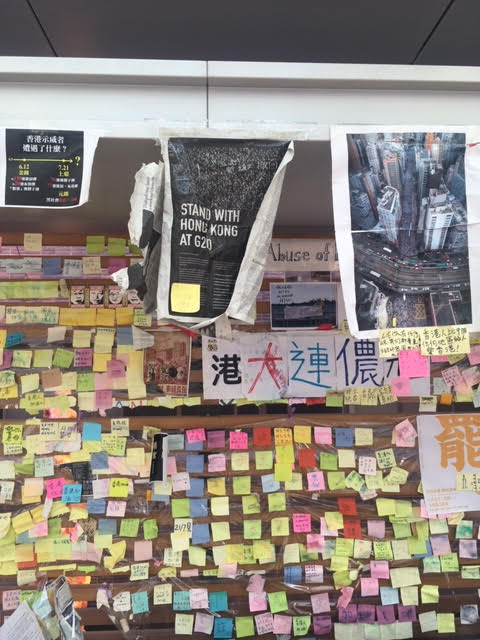
In the hotel we could watch live footage from confrontations between the police and the protesters, with the latter throwing stones and rocks against a police station just a few hundred meters from our hotel in Kowloon City. At times, it seemed there were as many journalists as there were protesters, which is of course an encouraging sign from the perspective of press freedom. The next day we went to Hong Kong University, but only the Student Union was in full protest mode, there were no visible signs of other unrest at the campus.


There were lots of protests at night though, as the coverage in the main Hong Kong quality paper South China Morning Post made clear.
One of the main questions this week was whether the Chinese army or police force would interfere. The local Chinese army commander hinted at it, while about 12,000 policemen gathered in nearby Shenzhen, just across the border in the mainland. The Hong Kong authorities, notably executive leader Carrie Lam and several police commanders, emphasized they were perfectly capable of handling this situation themselves. Given the developments in the past months one can question this, but the hesitation of Beijing to interfere is comprehendible. They do not want unrest, in the wake of the 70th anniversary of the People’s Republic later this year, while they know that direct action will make it impossible to get realigned with Taiwan in the foreseeable future, which has been a main goal of any Chinese leader since Mao, current leader Xi Jinping in particular.
Lam hinted at a press conference that the protests only foster the quick termination of the ‘one country two systems’ situation, agreed as part of the handover Treaty with the British in the nineteen eighties. One of the important elements is that Hong Kong keeps its own liberal laws and regulations for the first 50 years after the transfer of sovereignty in 1997.
Earlier protests died down, without much change achieved, mainly because the protesters did not succeed in broadening their movement to the wider public in Hong Kong. Although there was a supporting demonstration of public servants last Friday, this may happen again. On Wednesday, small traders already complained about the income they lose due to all the protests. And there are the mysterious groups of men in white t-shirts who beat up the protesters.
However, in the midterm, the protests will be futile. In the end this is an internal Chinese issue. Sure enough, there will be international protests, and depending on the outcome of the current crisis, perhaps also economic sanctions against China, if it just ends the protests by police or army action. These international protests are mainly symbolic though. Economic sanctions are the instruments of the impotent, not the powerful. Never have they worked to change a regime, or to make live very miserable for the leaders of a country. They do hit the population, but his and her concerns are easily overlooked in the international arena. The sad but undeniable truth is that no foreigner is going to die for Hong Kong. The great powers will treat this an internal Chinese affair. The USA already said so. No foreign power will intervene in China if the terms of the Sino-British Treaty are tampered with. At present, it is far more likely that Hong Kong will lose its special status, perhaps also earlier than the 50 years agreed, than that China will change into the liberal direction. The world may protest, but in the end the Chinese will have their way.
 Notes On Liberty