Where the World’s Unsold Cars Go To Die [Zerohedge]

I don’t have time to comment a ton on this (Life has just been absurd lately) but wanted to make sure more people saw this.

The guys over at Zerohedge noticed a surprising sight on google maps in the city of Sheerness, United Kingdom. West coast, below the River Thames and next to River Medway. Left of A249, Brielle Way. A car lot full of unsold, brand new cars. Zerohedge claims these are all new cars that cannot fit on overcapacity dealer lots. If true this would be a prime example of malinvestment spurred on by government bailout and subsidies. Quite literally a textbook case of the Austrian Business Cycle.

Further research is needed since I do not know whether these lots are standard practice or a new feature of our post-2008 crash world. It is possible that these are merely staging grounds for cars before they ship to dealers but at first glance I tend to agree with Zerohedge’s conclusion that “There is proof that the worlds recession is still biting and wont let go. All around the world there are huge stockpiles of unsold cars and they are being added to every day. They have run out of space to park all of these brand new unsold cars and are having to buy acres and acres of land to store them.”  

Something to keep an eye on regardless.

The Canons of Economics

by Fred E. Foldvary

A “canon” is a set of items which are regarded by the chiefs of a field to be the accepted elements of the domain. Every religion, for example, has a canon of accepted ideas and documents such as the established books of the Bible. Every scientific field has a canon of propositions and facts accepted as genuine by the experts and by those in authority such as editors of the major journals and most members of the departments of the prominent universities.

The canon of economics consists of the propositions, methods, and historical facts accepted as true and applicable by most scholarly economists. This canon appears in textbooks and in the articles of the prominent journals. The ideas and methods outside the canon are referred to as heterodox economics, in contrast to the mainstream or orthodox canon. There have been articles and organizations about the mainstream and alternative canons, but they have not laid out what the canons consist of. Here is my attempt.

The canon of orthodox neoclassical economics consists of 1) supply and demand; 2) graphical curves of equal utility, inputs, and output; 3) marginal analysis (additional amounts of utility, inputs, outputs); 4) the factors or input variables of capital goods and labor; 5) the price level; 6) equations of production and utility; 7) the government-influenced money supply and the market-based velocity of the circulation of money; 8) economic and accounting profit; 9) market failure and government corrections; 10) equilibrium; 11) maximizing and minimizing within constraints; 12) the premises of subjective values, self-interest, scarcity, unlimited desires, and the uncertainty of the future; 13) the “time preference” for present day good relative to future goods; 14) the trade-off between goods and leisure; 15) the trade-off between equity and efficiency; 16) diminishing marginal utility; 17) diminishing marginal products; 18) theory from mathematical models; 19) econometric testing of hypotheses; 20) the producer and consumer surplus.

Neoclassical economics is divided into several sub-schools for macroeconomic theory. The major schools and their canons are:
1) Keynesian or demand-side economics, with the canons of the consumption function, spending multiplier, and the determination of output from autonomous spending and the multiplier.
2) The Monetarist school, its canon being the equation of exchange: Money times velocity equals the price level times real output, hence monetary inflation generally causes price inflation.
3) The New Classical school with its canon of rational expectations, which makes inflationary policy ineffective.
4) The New Keynesian school with its canon of wages, prices, and interest rates stuck above equilibrium; it accepts New-Classical rational expectations but claims that contracts and other rigid conditions make expansionary policy effective in increasing output.

The heterodox Austrian economic school of thought accepts these elements of neoclassical economics:1, 3, 4, 7, 8, 12, 13, 14, 15, 16, 17, 20. Austrians reject the excessive emphasis on 6, 9, 10, 11, 18, 19. The canons of the Austrian school that have not been absorbed into the mainstream are: 1) the time and interest-based structure of capital goods; 2) market dynamics rather than equilibrium; 3) dispersed knowledge; 4) discrete marginal utility based on diminishing importance; 4) axiomatic-deductive theory (praxeology); 5) entrepreneurship as both discovery and creative reconstruction; 6) free-market money and banking; 7) roundabout production; 8) the market as spontaneous order; 9) the failure of government intervention; 10) the evenly rotating economy that illustrates the role of entrepreneurship in the real world of uncertainty and change.

The Marxist school canon includes 1) class struggle, 2) the labor theory of value; 3) the surplus from labor taken by the capitalists who dominate labor; 4) benefits from socializing wealth.

The Georgist or geo-classical school has these canons: 1) land and its rent as major elements of the economy; 2) the margin of production as the least productive land in use; 3) land speculation and the movement of the margin raising rent and reducing wages; 4) the creation of land rentals from public goods; 5) depressions resulting from land-value bubbles; 6) economic effects of replacing market-hampering market-hampering taxes and subsidies with land-value taxation; 7) the surplus as land rent; 8) the ethics of labor and land; 9) harmony between equity and efficiency, and 10) the social behavioral effects of economic justice.

There is also a school of thought called “public choice,” which has been accepted by neoclassical economics as well as by other schools, as a side branch. Its canon includes: 1) self-interest in politics; 2) the rational ignorance of voters; 3) transfer-seeking and getting due to concentrated interests and spread-out costs; 4) vote trading by representatives; 5) bureaucrats maximizing their power and comfort; 6) the primacy of the median voter; 7) constitutional versus operational choice; 8) clubs that provide collective goods to their members.

The classical economics canon, before it turned neoclassical, included these elements: 1) Say’s law, that production pays factors that enable effective demand; 2) the division of labor; 3) economic growth from unhampered production and free trade; 4) the margin of production as the least productive land in use; 5) population growth pushing the margin to less productive land; 6) the three factors of production as land, labor, and capital goods.

A problem in economics today is that each canon excludes the useful elements of other schools. Economics needs a universalist canon that integrates the best elements from all schools of thought. However, economists disagree on what the canon should be. In my judgment, the most glaring omission in the mainstream canon is the neglect of the Austrian-school time-structure of capital goods, its neglect of the creation of land rent by public goods, and its neglect of the benefits of a prosperity tax shift, the replacement of market-hampering taxes with market-enhancing payments of land rent and pollution charges.

Note: This article first appeared in the Progress Report.

Distribution of Wealth — A Distortion of Focus

A ‘sociology’ paper by LA Repucci

Wealth vs Wages

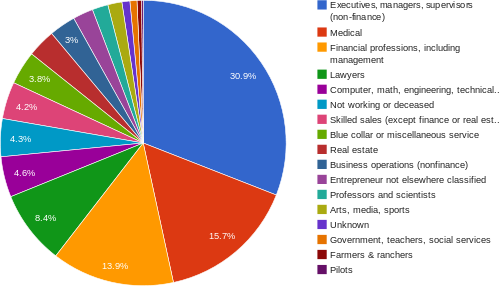
Much hay is made of the distribution of wealth in the modern United States.  Recently, the Occupy movement has protested the accruing affluence of a shrinking number of individuals that constitute the top ‘1%’ of wealthy within the country.  Data suggests that the top 1% of income earners in the country represent a myriad of professions, investments, and financial instruments as revenue streams, with the largest portion (30.9%) represented as the executive/corporate professionals, as shown by graphic 1.1 below:

1.1: Top 1% of Wage Earners by Profession, US.  Source, Wikicommons

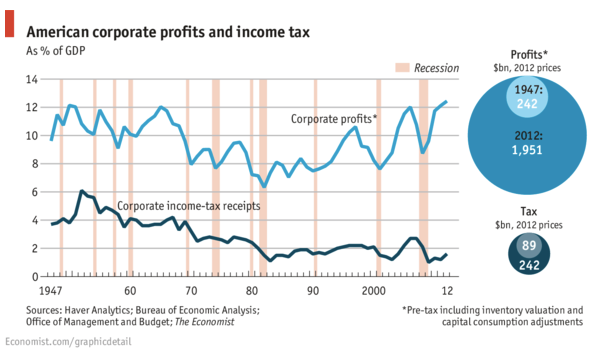
Analyzing the data from this table paints a picture of broad distribution of wage incomes across a myriad of industries, but fails to account for the disproportionately massive amounts of wealth that aren’t generated by salaries at all, nor are they representative of the fact that the wealthiest legal entities within the US aren’t people — they are tax-sheltered corporate entities:

1.2: Corporate Profits vs Tax Liability

The Corporate Model

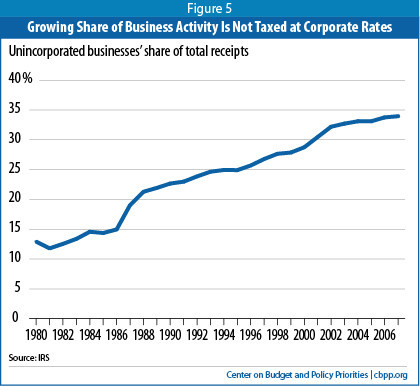
Corporations are paper entities recognized by the state as legal persons.  They exist in order to generate and accrue revenue, and pay stakeholders.  Unlike natural persons, corporate entities are immortal.  Instead of competing on the open marketplace for revenue, the most successful and largest corporations have discovered a way to cut the market out of their revenue streams altogether.  It is simply easier and more cost effective to lobby the state to enact laws that protect their revenue stream and squash market forces than it is to operate within a competitive market.  Progressive, draconian tax structures enacted as a hedge against corporate domination of wealth may be adopted by government in an effort to increase tax revenue from the corporations, but in reality, simply provide further incentive for corporations to allocate resources in an effort to mitigate or outright eliminate their tax liability within the US.  For example, Google, the fastest growing and wealthiest of the new tech giants, pays a majority of it’s taxes in Ireland and Bermuda — nations with a far friendlier income tax policy than the US — and bypass their US tax liability almost entirely due to the so-called ‘loophole’ in the income tax law, resulting in the federal government’s lost tax revenue from one of the largest US corporations in history. This leads increasingly to a larger percentage of individuals, sole proprietors and small-to-mid cap businesses shouldering an increasing burden within the tax structure as shown in 1.3 below.

1.3

The State’s Culpability

The new corporate model of tax evasion coupled with astronomical growth in profits-to-cost relies heavily on the government’s complicit action with regard to tax policy and recognition of corporate person-hood.  It is in a company’s interest to make money — but to ‘saw the ladder off’ below them, they require government cooperation to enact laws that make tax sheltering and corporate personhood possible.  This culture of lobbying and outright appropriation of the legislative process has progressed to the point that there is little differentiation between the state and the corporation.  Insurance companies write health care laws, and banking institutions write tax laws and set monetary policy.  The roots of this collaboration run deep through US history, crystallized notably by the creation of the Federal Reserve Bank in 1913 on Jekyll Island by J.P. Morgan, Paul Warburg and other global-level financiers with the collusion of Senator Nelson Aldrich, who had close ties to both Morgan and Nelson Rockefeller. (Further reading: ‘The Creature from Jekyll Island’ by E.B. White)  The Federal Reserve Act of 1913 was signed into law by then US President Woodrow Wilson, and effectively turned over control of the nation’s monetary policy, issuance of currency, and anti-market fixing of interest rates to a private bank set up as a for-profit corporation called the Federal Reserve Bank, effectively undoing the American Revolution and the work of his predecessor, President Andrew ‘Old Hickory’ Jackson.  The ‘Fed’ as it is known today, continues to be the sole issuer of paper money accepted for the payment of taxes in the US.  While the people remain ‘free’ to trade in whatever currency or barter they choose, all state and federal taxes in the US must be paid in Federal Reserve Notes, giving the Fed a monopoly on currency.

The Corporate-State Combine

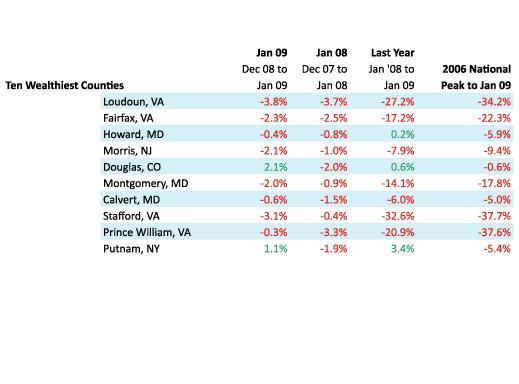
A century of the above-outlined activities of corporate entities have led to an overlap between the banking community and government that often goes understated.  JP Morgan/Chase market their banking services directly to government, as clearly outlined in their marketing materials: https://www.jpmorgan.com/pages/jpmorgan/cb/government. It is no surprise that most of the nominees for president, cabinet members, the Fed and legislators exist in a professional ‘revolving door’ environment that moves them from banking to high office and back over the course of their careers.  For example, both major party candidates for president in the last 20 years have had direct professional ties to JP Morgan and Goldman Sachs.  This ‘partnership’ has led to a century of collusion between government and banking, taking an ever-increasing cut of the total wealth out of the real market, and enriching our legislators to the point that many of the wealthiest counties in the nation now surround Washington DC as evidenced in the data provided.  This corporate-government combine acts as a siphon, sucking wealth out of the population through inflation, currency devaluation and increased tax burden, and enriches the corporate interest through outright gifting (TARP, Stimulus, Bailouts, etc) to the wealthiest of the wealthiest of the 1%.  Warren Buffett, one of the wealthiest men in the world and owner of Berkshire Hathaway Ltd. championed bailouts while his firm received the largest portion of us taxpayer money from the TARP program. Buffett himself pounds the table for higher tax rates, while he and his company manage to ‘limit’ their tax liability and avoid paying taxes owed back to 2002.  Mr. Buffett is a major campaign contributor to our current President, Barack Obama.

Solutions

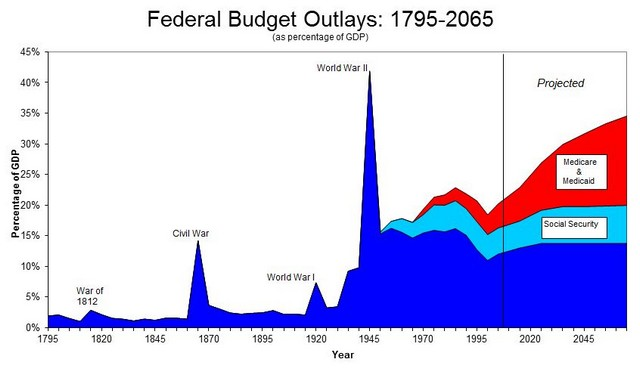
With the compound factors of massive increases in government spending (roughly $20,000 annually per citizen), and the steady evaporation of corporate tax liability (less than 40% of the total tax base of businesses in the US is covered by large-cap corporations) the problem of the distribution of wealth in the US is starkly apparent.  To identify what is going wrong in the economy is one thing — providing real solutions is another entirely.  Both major political parties offer their version of the fix — the right would suggest cutting government spending on services and lowering the tax base to broaden it and encourage large cap corporate interests to pay their income taxes in-country.  The left advises steeply progressive tax laws on private citizens (one would assume the left would suggest tax reform for large corporations, but the democrat party has been in charge of the tax law for decades with no such legislation to speak of), and consumption and indulgence taxes on goods and services, combined with further devaluation of the dollar through Quantitative Easing (QE) and raising (or outright elimination of) the debt ceiling.

While it would seem that these two paths are the only potential ‘fixes’ to our nation’s distribution of wealth problem, neither of these plans would provide real, permanent relief to the average citizen who is continually squeezed out of the middle of the economy, with an ever-increasing portion of their revenue taken by the state through tax, and devalued by the state through inflation.  Indeed, it would seem that our problem is not ‘distribution of wealth’, but rather, the redistribution of wealth through taxation and devaluation of the dollar.  Looking at the problem from this perspective, the solutions become simpler and multi-fold.

Monetary Policy/END THE FED

Should the Federal government enact law that checks the monopoly power of the Fed to issue currency by accepting in payment of taxes any and all used currencies in the market, the nation would be free to adopt currencies other than the dollar.

Bitcoin, a decentralized crypto-currency, is a notable example of a market solution to the problem of distribution of wealth.  Though Bitcoin has it’s detractors and a relatively small market cap, it’s value has continued to skyrocket on the open market, and is in the early stages of large-scale adoption and public use.  Bitcoin requires no bank or government to ‘mint’ it as a currency, and is freely traded electronically between users with no bank needed.

Similarly, gold and silver have been used for thousands of years the world over as viable hard currencies.  Hard currencies cannot be devalued through running of a printing press like paper currencies, nor through the click of a button like crypto-currencies.  As there is a finite amount of gold and silver in the market, it’s value has a ‘hard floor’ — it is always worth at least it’s value as a raw material.

The fact that the Federal government will only accept Federal Reserve Notes (which, in itself violates the constitutional directive for the US Treasury to mint coin, not a private bank) in payment of taxes effectively gives the FED a monopoly on currency.  The last US President to order the Treasury mint silver certificates was John F. Kennedy.

Commercial Policy/END CORPORATE PERSON-HOOD

Corporations are legal ‘persons’ with the ability to lobby the legislature directly, resulting in tax laws and policies that favor them over natural citizens of the US.  This has resulted in laws being written directly by corporations, including insurance companies’ authorship of the Affordable Healthcare Act.   The insurance companies’ stock has risen by a factor of 2-5 due to the implementation of the law, while the cost of health insurance for the average citizen has skyrocketed.  Ending corporate person-hood would go a long way to ending the power of lobbyists to purchase legislators, and result in elected officials representing the people who elect them.

Tax Policy/END THE TAX

‘Taxes’, ‘tariffs’, or any other name the state wishes to apply, are simply pseudonyms for extortion — that is, the violation of individual property rights through threats of aggressive reprisal.  When private entities such as a thief or mob perform the same action, we rightly call it theft.  It is completely inconsequent what a thief does with your money once he has violated your rights to acquire it, even if he assures you that it is to your personal, direct benefit that he take your property from you by force.  To fix the distribution of wealth, and as well to return to a moral society where one does not live on the property of his neighbor through state-sponsored theft, all taxes should be eliminated.  If a portion of the population would like to provide a service or product to their neighbors, let them do so legitimately through voluntary free association and exchange.  The state spends more than it takes in in taxes, and floats the rest on credit.  This activity has crippled the purchasing power of the dollar, which has lost 99% of its total purchasing power on the market in the 100 years the Fed has controlled the nation’s currency.

Bibliography:

Wikimedia Commons. N.p., n.d. Web. 04 Dec. 2013.

JP Morgan.com “State and Local Government.” N.p., n.d. Web. 06 Dec. 2013.

Cogan, John F. Federal Budget Deficits: What’s Wrong with the Congressional Budget Process. Stanford, CA: Hoover Institution, Stanford University, 1992. Print.

“Could we build a bridge between Austrian Economics and New Institutional Economics? – A Pre-History of Soft Budget Constraint”

This is the title of a paper by Claudio Shikida. Here’s the abstract:

The concept of soft budget constraint is recent in economic analysis. It has become increasingly important in economic theory, for its role as a system of incentives. However, soft budget constraint plays also an important role in the history of economic thought, where it can be traced back until Mises’s writings on economic calculation and property rights, both derived from the debate of the economic calculation in socialist regimes. In this sense, soft budget constraint can be viewed as a bridge between Austrian Economics and New Institutional Economics. Since Mises, like other Austrian economists, is virtually ignored in Brazilian courses of Economic Thought, this article intends to show his importance as a forerunner of the concept of soft budget constraint, and will try to link these two theoretical views of economic systems.

You can read the whole thing here. Any thoughts?

What Ails You, Economy?

The Keynesian is ever mistaking economic activity for economic growth, credit expansion for wealth creation, profligacy for progress. Growth, wealth, progress. He uses his own definitions of each to reinforce his definitions of the others. And they are all fallacious.

When the Austrian tells the Keynesian that the printing and spending of mere pieces of paper cannot lead to more wealth in society, the Keynesian retorts that it is undeniable that credit expansion and stimulus lead to more economic activity. In this he is technically correct. Printing more dollars and handing them out to those who would consume and invest them, does indeed lead to “activity,” even more perhaps than there otherwise would have been.

But our Keynesian assumes, or assumes that his audience will assume, that mere economic activity is growth, is wealth, is progress. Presumably this includes even that activity which our Austrian rightly considers overinvestment (more properly, malinvestment), overconsumption, and/or the proverbial breaking of windows, each of these a common side-effect of the Keynesian witchdoctor’s remedies (often intended to cure ailments caused by earlier interventions, some Keynesian, some not).

If the Keynesian’s definition of economic activity doesn’t (oh, but it does!) include these things then the burden of proof is on him to show that his prescriptions lead to more real growth than would their absence on an unhampered market. And that his incantations lead, on the whole, to economic health rather than disease. A free market is largely unencumbered by the ailments mentioned above so in order to do this it would need to be shown that the sicknesses that do affect it are somehow worse than those caused by intervention.

And to be sure, pure economic freedom isn’t perfect. It has its own share of maladies. But these are all coughs and sneezes by comparison. Cures, if they are needed at all, come from the market itself. The economic meddlers and potion peddlers only serve to make things worse.

We must admit that not even on the most unfettered of markets does all economic activity lead to growth. For human actors err, and the market punishes their errors. How much more is all this the case under a centrally-planned expansionary-monetary/stimulatory-fiscal regime? And how much more severe will be the punishment?

Cognitive Blocks and Libertarianism

Last year Brian Gothberg, who was lecturing at a summer seminar I attended in 2009, left the following comment in response to a post about media coverage and Austrian economics:

I think there’s a perceptual or cognitive block, that simply makes it hard for many people to see government activity in the foreground of the story, as an actor which actively and (often) arbitrarily changes outcomes. It reminds of the recent Brian Greene programs on cosmology on PBS. In one, he compares the treatment of space, through most of scientific history, as simply being the unadorned theater stage, upon which the truly interesting things actually happen. It’s only later that Einstein (using Riemann’s math) described space as having positive, unambiguous characteristics. After Einstein brought space itself into the foreground, you could make statements about particular things that space did do, and other particular things that space did not do.

Another example: at a gathering of friends with children, my wife and I were observing a small boy (3-ish) who kept biting the other children. When it came to tears, parents would come in and intervene, and scold him. Later, we watched the same parents — who were baffled at the boy’s biting — laugh and giggle as the father playfully bit his son. Apparently, nobody had ever brought the father’s behavior into the foreground, for their scrutiny, as a possible influence on the son’s problem. Sometimes, the obvious does stare people in the face. I think that the way we describe the role and actions of government, in the press and schools, goes a long way to explain this cognitive block. Libertarianism is nothing like common sense; not nearly.

I was reminded of this as I read the following 2008 piece by Roger Lowenstein in the New York Times, where he documents the regulatory regime that was built by the state in the years leading up to the Great Recession. Check this out: Continue reading

Boombustology: A Review

These days commentators near and far are announcing booms and bubbles in Treasury securities, gold, China – perhaps even a bubbles. Vikram Mansharamani is in the China camp, but his arguments stand out from the others. If you can get past the title of his book – Boombustology – you will be rewarded with a thorough, well-documented, yet mercifully brief and readable exposition of a theory of booms and busts applied to past events and China’s future.

Most macroeconomists see the boom-bust cycle as an unsolved problem. Like physicists in search of a Grand Unified Theory, they long for a model that accounts for all the major aspects of the business cycle. Perhaps they are hampered by looking through the wrong end of a telescope. Mansharamani uses not just one but five “lenses” to examine the subject. In addition to micro- and macroeconomics, they include psychology, politics, and biology. He is not the first economist to invade these fields. Rather his accomplishment lies in assembling ideas from each of those areas, applying them to past boom-bust cycles, and putting his ideas on the line by issuing a brave prediction of a forthcoming Chinese economic train wreck.

Austrian Business Cycle Theory

The author’s macro lens includes Austrian business cycle theory. That theory says inflation of the money supply causes a drop in interest rates, which is misinterpreted as an increased aggregate preference for saving over consumption, leading to investments in more roundabout means of production. When it becomes clear that there has been no such preference shift, these undertakings are seen to be at least partial mistakes, requiring write-offs and retrenchment – a bust. The boom is the problem, not the bust, which is the market’s attempt to realign itself to the realities of time preference. Austrian business cycle theory has great merit but leaves some things unexplained.

Mansharamani’s micro lens includes the concept of reflexivity. Market participants don’t just observe prices but also influence them. Reflexive dynamics occasionally give rise to instabilities in which rising prices lead to increased demand.  A simpler term would be a “bandwagon effect.” I recall an office party in 1980 where one of the secretaries asked about buying gold – precisely at the peak, as it turned out. All she knew about gold was that it was way up and therefore must be going higher. I should have realized that when you see financially unsophisticated people like her climbing on a bandwagon, you can be pretty sure there’s no one left to sell to and nowhere for prices to go but down, which is where gold and silver prices went in 1980, and in a big hurry.

From psychology Dr. M. borrows ideas and data about cognitive biases. For example, subjects asked to guess some bland statistic, like the number of African countries that belong to the UN, are influenced by the spin of a wheel of fortune: When the wheel lands on a high number, they guess higher. He translates this and a dozen other cognitive biases into irrational market behavior that can foster booms and busts.

He introduces his biology lens with an analogy to the spread of an infectious disease. When the prevalence of a disease reaches a high level, the infection rate necessarily slows and the disease begins to wane, just like the 1980 gold market.  But it is devilishly difficult to “inoculate” oneself against infectious ideas. Individual investors who can do so have a decent chance to beat the market averages over time, I believe. (Those who would pursue these ideas in greater depth would do well to find James Dines’s quirky and expensive but worthwhile book, Mass Psychology.) Continue reading

Around the Web: Cato Unbound Edition

The response essays to Dr. Horwitz’s Cato Unbound lead-off essay are now up.

Horwitz, Economy and Empirics by Bryan Caplan, a very good critic of the Austrian School

Free bankers George Selgin asks: How Austrian Is It?

And Antony Davies plays nice by saying “come to the middle!”

My own quick thought: none of these guys are hostile to the Austrian School the way a Keynesian would be. I take this as a sign that Keynesianism is dead intellectually, rather than any sort of selective bias on the part of Cato Unbound’s very good editors.

Around the Web

Political scientist Jacob Levy shares his thoughts on unions

Social liberalism and the drug war, in which Bill Clinton and the Left gets taken to task for its hypocrisy

Austrian economics and anthropology: what’s the connection?

Austrian Economics and Empirical Research

Economist Steve Horwitz has a great lead-off in this month’s Cato Unbound. It’s all about the Austrian School of economics and its various detractors and factions. Some highlights:

Rather than being anti-empirical, modern Austrian economists are trying to open up the box of what counts as “empirical evidence” to include forms normally dismissed out of hand by the rest of the profession. Arguably, then, modern Austrians might well be more empirical than other economists, at least as judged by their professional work […]

Good economics for Austrians means sound arguments, not just valid ones. Too much of modern economics consists of valid reasoning from false premises about human action. The accuracy of those premises matter greatly for Austrians.

That is one reason why subjectivism is more important than praxeology for understanding Austrian applied research. Economics is radically subjectivist in the sense that human action depends upon the perceptions of the world held by the actor […]

Subjectivism also explains Austrian skepticism about statistical correlation being the privileged form of empirical evidence. It only provides correlation, and to provide causation requires a theoretical explanation. If such explanations must start with actors’ perceptions of the world, then forms of empirical evidence that capture such perceptions would be at least as useful. Austrians therefore frequently turn to primary source material and interview and survey work as well as quantitative data to tell a complete story of how a particular economic phenomenon came to be and functioned. How did actors perceive their options and constraints and what sorts of consequences emerged from their choices?

Dr. Horwitz goes on to give readers a brief list of introductory readings for those who are interested in the academic side of the Austrian School, rather than just the political and popular side. Highly recommended. You read the whole thing here.

Update: Longtime reader (and admin of NOL’s Facebook page) Hank points us to a rebuttal over at the Mises Institute’s blog. I didn’t find it convincing, but it’s still worth a look.

Around the Web

The Images of Progressive Citizenship. Haunting.

Paul Ryan it is.

The 5 worst Olympic mascots.

Austrian themes, data, and sports economics. By co-blogger Stephen Shmanske

Chicago, Vienna and San Francisco

Co-editor Fred Foldvary has a great essay up on three schools of economic thought that deserves to be read by all.  An excerpt:

The Vienna school emphasizes the dynamics of the economy, while the Chicago method is to apply self-interest and economizing in an equilibrium analysis.  The San Francisco school uses both equilibrium and dynamics.  The dynamic approach of change over time is used to show the advance of rent and lowering of wages as the margin of production moves to less productive land and as land speculation moves the margin out even further.  Equilibrium shows that since market rent is based on the fixed supply of land and the demand to rent space, the tax on land not affecting the rent.

The San Francisco school agrees with the Vienna school that the spontaneous order of the free market best allocates goods to human desires.  But the San Francisco school points out that if the ground rent is not tapped for public revenue, when taxes on other things finance civic works, then there is in effect a subsidy to land owners, which distorts the market.

The San Francisco school has a theory of the business cycle based on land values, which rise during a boom, when speculation carries land prices so high that investment gets choked off, resulting in a recession.  But San Francisco has lacked a consensus on the role of central banking and money.

Check out the rest here.

I tend to pay attention whenever Dr. Foldvary writes, because he is the guy who wrote a book in 2007 accurately predicting the economic collapse of 2008.  You can access the book for free here.

Austrian Economics and the Left

Matt Yglesias has a post up over at Slate.com on Ron Paul and Austrian Economics.  I won’t get into the details of what he got right and wrong about his largely honest attempt to explain the Austrian School to Leftists (the word “crank” was only used once!  A new high for the Left).  Instead, what I’d like to do is hone in on this whopper:

Many of the original Austrians found their business cycle ideas discredited by the Great Depression, in which the bust was clearly not self-correcting […]

Has Yglesias conveniently forgotten about Hoover’s attempts to prop up wages and his signing of the protectionist Smoot-Hawley tariff?

Why don’t Hoover’s policies get more attention by economists and journalists trying to understand and explain the Great Depression, or am I missing something?