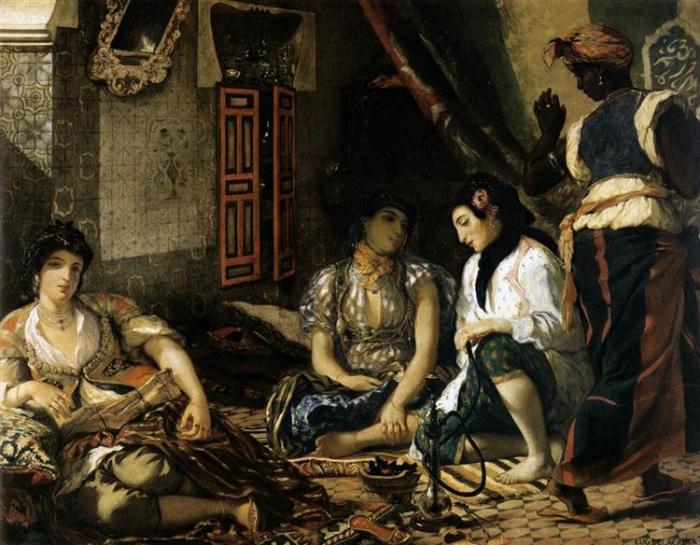
Afternoon Tea: The Women of Algiers in their Apartment (1834)

From Eugene Delacroix, as requested by Jacques Delacroix (no relation):

nol art delacroix the women of algiers 1834
Click here to zoom

Nightcap

  1. Reflections on Zimbabwe and its white folks Diana Stone, London Review of Books
  2. Whose civilization? Which clash? Daniel McCarthy, Modern Age
  3. Should the government really make parenting ‘easy’? Rachel Lu, the Week
  4. What the… ?

Expression at the polls

Last election, Jillian Ostrewich drove to a polling place at a Houston rec center, expecting to vote. But she made the mistake of wearing a “Houston Fire Fighters” t-shirt. An election worker confronted Jillian, insisting that she couldn’t vote unless she turned the offending shirt inside out. The rationale: a measure on the ballot was related to firefighter pay, and the shirt was related to firefighters.

Tony Ortiz suffered a similar fate in Dallas. Tony’s crime was wearing a MAGA hat while he stood in the voting line outside his local library. An election worker said he couldn’t wear the hat to the polls because the MAGA slogan constituted “electioneering.” Tony responded that the hat had nothing to do with any issue or candidate on the ballot. The election worker threatened to call the police.

These election workers were relying on a Texas law that forbids electioneering or wearing “a badge, insignia, emblem, or other similar communicative device relating to a candidate, measure, or political party appearing on the ballot” in or near a polling place. The law even prohibits someone from wearing an ID if the name is the same as someone appearing on the ballot. A violation is a criminal misdemeanor. Today, my colleagues and I at Pacific Legal Foundation filed a lawsuit on behalf of Jillian and Tony challenging the Texas ban.

As it happens, the Supreme Court issued a decision just last year striking down a similar law in another case brought by Pacific Legal Foundation called Minnesota Voters Alliance v. Mansky. The Minnesota law in MVA prohibited wearing a “political badge, political button, or other political insignia” in the polling place. The Court said states can limit some electioneering at the polling place to prevent voter intimidation and excessive disruption. But the government has to have some clear and logical basis for sifting “what may come in from what must stay out.”

The word “political” was not a clear boundary. As the Court noted, almost anything could be considered political, and the fuzzy language offered too much wiggle room for abuse and discrimination. The attorney arguing for Minnesota drove this point home during an onslaught of blistering questions in oral argument: how about a rainbow flag shirt? Permitted, maybe. How about a “Parkland Strong” shirt? Permitted, probably. How about an NRA shirt? Definite no. How about a shirt with the text of the Second Amendment? Definite no. At about that point, most everyone knew the outcome of the case–the attorney had just proven the inherently arbitrary standard he was trying to defend.

The Texas case filed today is a bit different. For one, the ban extends to 100 feet outside the polling place, which clearly encompasses sidewalks and other public areas where speech rights enjoy their widest berth. But the ban is not quite as amorphous as the word “political.” Instead, the ban extends to messages that relate to a candidate, measure, or party on the ballot.

This slightly narrower language probably doesn’t save the Texas law. After all, almost anything can be considered related to a candidate if the candidate has taken any kind of position on it. If a candidate has criticized Trump (have any not?), then is Tony’s MAGA hat “related” to the candidate? If Ben & Jerry’s takes a position on a ballot measure, does a Ben & Jerry’s shirt relate to that ballot measure? Maybe, but it depends on the election worker–and therein lies the problem. As the Supreme Court said in MVA, “A rule whose fair enforcement requires an election judge to maintain a mental index of the platforms and positions over every candidate and party on the ballot is not reasonable.” Not only would such an index be impossible, but the contents and application of that index would be dictated by an election worker’s own biases and background.

The integrity of the electoral process is vital. But surely Jillian’s firefighter shirt or even the much-reviled MAGA emblem do not imperil the right to vote. Wed don’t shed the right to express ourselves in peaceable ways when we step into a polling line.

Nightcap

  1. A closer look at US hostage recovery policy Danielle Gilbert, War on the Rocks
  2. How to restore democracy in Venezuela Ryan Berg, RealClearWorld
  3. How markets and the State leave the community behind Oren Kass, New York Times
  4. I won’t drive the roundabout Irfan Khawaja, Policy of Truth

A short note on India’s air strikes in Pakistan

Indian Foreign Secretary Vijay Gokhale, while issuing a statement with regard to India’s air strikes on a training camp of the dreaded terror group Jaish-E-Muhammad (JeM) in Pakistan on February 26, 2019, dubbed these as pre-emptive ‘non-military strikes’. The Foreign Secretary stated that the Indian Air Force hit the largest training camp of the JeM, which is in Balakot, Pakistan, and a large number of JeM terrorists were killed in the strike.

The rising tensions between both countries have understandably caught the world’s attention.

JeM had claimed responsibility for the dastardly terror attack in Pulwama, Kashmir, on February 14, 2019 in which over 40 CRPF soldiers were killed. While efforts have been made to designate JeM chief a ‘global terrorist’ at the UN, China has blocked such moves.

The Indian side also made it clear that these air strikes were neither targeted at civilians nor at the Pakistani military. This served two purposes; one it would prevent further escalation and second, it could give some space to Imran Khan’s civilian government.

The international community was quick to react to the attacks by the Indian Air Force (IAF), and asked both sides to de-escalate. The US, while asking Pakistan to take action against terror groups on their soil, also stated that both sides should de-escalate. In a statement issued on February 26, 2019, US Secretary of State Mike Pompeo also asked Foreign Ministers of both countries to resume direct communication and avoid any ‘further military activity’.

A statement issued by the Chinese Foreign Ministry spokesperson also spoke in favour of India and Pakistan exercising ‘restraint’ and the need for peace and stability in South Asia. Even during Sushma Swaraj’s visit to Beijing, a day after the strikes, China, while condemning terrorism, emphasized on the need for reduction of tensions. It did not change.

Domestically, Prime Minister Narendra Modi received full support from the opposition, including the Congress Party. The President of the Congress Party was quick to tweet and congratulated the Indian Air Force. Even other prominent political leaders supported the IAF.

The Indian PM did not miss the opportunity to mention the IAF’s action at a political rally. While speaking at a rally in the Indian state of Rajasthan, Modi paid homage to the para-military troops who died in the February 14 terrorist attack, and also made a reference to the action of the Indian Air Force:

…I want to assure you that the country is in safe hands.

Foreign Minister Sushma Swaraj also met with opposition leaders from different political parties on February 26, 2019. This was in stark contrast to the surgical strikes in 2016 on terror camps in Uri (located in PoK).

Some BJP spokespersons also made unnecessary uncalled for statements. (The BJP did issue instructions to its spokespersons to not issue any uncalled for statements).

Risks of escalation and Indian media

Sections of the Indian electronic media went overboard as usual, something which has been witnessed post 26/11.

While media channels may believe they are raising patriotic fervour, pushing the PTI government led by Imran Khan and the Pakistani army into a wall may not be a very smart move. As mentioned earlier, the usage of the word ‘non-military’ strike was meant to give space to the Pakistan government.

Post the attack, Imran Khan was criticised by the opposition and will be under pressure. His immediate reaction was that Pakistan would respond at a time and place of its choice and also asked the Pakistani nation to be prepared for all eventualities.

Post the Pulwama attack, a well-known Indian strategic analyst had made an important point:

The Pakistani army might be more likely to start a war if its image takes too hard a beating in the eyes of the Pakistani people, than if it suffers physical damage outside the limelight.

It is not just the electronic media, but the narrative on social media which further raises tempers.

Bobby Ghosh, a prominent journalist, made an interesting comment on Twitter:

People keep saying the India-Pakistan conflict is more dangerous now because both have nukes. But other new weapons greatly increase the risk: Twitter, Facebook, WhatsApp… and hyper-nationalistic TV networks.

Conclusion

Not just the international community, but even sane minds in India and Pakistan realise the costs of conflict, and have been pitching for de-escalation. Apart from the role of the international community, a lot will also depend upon domestic narratives in both countries. While the Modi government received the support of the opposition post the Pulwama terror attack, it needs to focus now on not just taking all political players along but also ensuring that tensions do not rise further as things could go out of control. The media on its part needs to be more responsible, and as for the social media, a lot of it is driven by the views of the political leadership. The political leadership will thus need to change the direction of the narrative, so that tempers are calmed down.

Afternoon Tea: Diomedes Devoured by his Horses (1866)

NOL art Moreau diomedes devoured by his horses 1866
Click here to zoom

This one is just plain crazy, and it’s by the French painter Gustave Moreau. Here is a wiki on the story of Diomedes, by the way. And here is Barry Stocker on ancient Greek thought.


Nightcap

  1. Anti-Semitism from Trotsky to Soros James Sheehan, Commonweal
  2. How to combat parochialism in philosophy Peter Adamson, Times Literary Supplement
  3. The era of limited government is over Ross Douthat, New York Times
  4. The paradox of voting Arathy Puthillam, Pragati

Should the US intervene in Venezuela?

With the ongoing troubles in Venezuela some commentators ask for a humanitarian intervention, by the US. Intervention by other countries, for example Brasil, seem to be out of the question. And of course the US has long regarded Central and South America their backyard, going back to the Monroe doctrine. What would be a liberal perspective on this? Basically, there are three answers.

Most people who call themselves liberal in the US have a favourable attitude towards humanitarian intervention. Or used to have this over the past decades (until it went wrong -at least in their view- in Iraq and Afghanistan). Their motives differ, but they would probably argue that there is a moral duty to intervene on behalf of the suffering majority. This moral duty, however defined in detail, is seen to exist when grave abuse of human rights take place in failed state situations, people’s lives are under threat, when a danger of genocide exists. The intervention may take place unauthorized (without United Nations Security Council mandate), or authorized. Dangers of intervention are recognized by liberals, as for example the potential for abuse by the intervening state is ever present. Liberals are less concerned about the duty of the governments of intervening countries towards their own citizens.

Classical liberals start by pointing out there is never a moral duty to intervene, because, as Adam Smith wrote, for humans there is only the duty to mind the happiness of their relatives, friends, country. This is not to say there is never a right to intervention in the classical liberal view. For sure, this right should be exercised in very rare circumstances, as international relations is more about preserving order than about achieving justice for all, and more about the importance of sovereignty for individual liberty than about obligations or rights following from a shared humanity. Yet prudent leaders do have some room for manoeuvre in international politics, according to classical liberals. However, intervention can only take place if they are able to explain to their voters and countrymen how the intervention would promote natural liberty. Foreign intervention is often counterproductive, and only an option when international disorder is seriously under threat. However, most often, the benefits of nonintervention outweigh the costs of attempting a universal protection of even a limited set of rights. Interventions start with the best intentions, but will often have unforeseen, negative consequences, which only in rare cases will be justified.

Libertarians normally have the most straightforward position: the anarcho-capitalists will not allow their private armies to conduct foreign adventures, while most minarchists (Rand excepted) are of the same opinion in case of (partly) publicly funded armies. So for them it is easy, no troops to Caracas.

How about the classical liberal and social liberal (as I continue to call them) position towards Venezuela? First of all: there is no question the situation is bad for large groups of Venezuelans. Maduro is a rotten and corrupt leader, standing on the shoulders of his socialist fairy tale teller predecessor – who was by the way democratically elected by those same Venezuelans, in very large numbers. Closing borders is the common instrument of autocratic leaders without any societal support. Inflation is high, the oil sector is in peril, basic medical services are beyond the reach of millions. There is a contending president, Guaidó, yet he appears to lack the support of the army and other crucial actors. The Catholic church refuses to take a position, for example.

Yet the costs of an intervention are high and the outcome uncertain. The military part might not be so easy, and will cost lives and lead to tremendous economic damage, both in Venezuela and the US. Guaidó, who now seems the reasonable alternative, is basically a young and unproven guy, without any track record. No certainty exists that he will lead the country in the good direction, even if he wants too. To reconstruct the country will almost certainly demand billions of dollars, which will not be easily recouped once the oil sector is on its feet again (remember that argument from the start of the intervention in Iraq?). It will take years before US troops on the ground can return home.

Needless to say this analysis is incomplete and lacks sufficient detail for any policy decision. Still, all in all, I would advise against intervention. Despite the bad situation, the proposed cure seems worse, not least from the perspective of the intervening country.

Musk in contempt?

The SEC wants to slam Elon Musk with contempt over a thirteen word tweet. Musk has taken to Twitter to both vaunt his company and castigate the SEC. He’s under an existing SEC settlement that requires company oversight of his communications. Musk’s brief tweet on Feb. 19 that stoked the ire of the SEC said: “Tesla made 0 cars in 2011, but will make around 500k in 2019.” The SEC swooped in, charging that Musk hadn’t received preapproval for the tweet and convinced Musk had misled the public.

The SEC’s overzealous attempt to wield the contempt power is disturbing. Especially given Musk’s vocal and mocking disdain for the SEC, the regulator’s attempted coup over the content of his tweets raises serious First Amendment concerns. Here, it seems the 500K estimate was not precise, but Musk went on to clarify on his Twitter feed, and he didn’t conjure the number from the ether. At worst, it was incomplete information. Welcome to Twitter. I just can’t quite stomach the fact that a regulator is out there lurking, ready to pounce on any linguistic imprecision in a forum where brevity is the name of the game. Obviously, Musk’s statements have an impact on the market, but investors are sophisticated actors who should be expected to do their homework. The SEC’s paternalistic and aggressive monitoring of Twitter feeds should raise our hackles.

Nightcap

  1. Why weakly enforced rules? Robin Hanson, Overcoming Bias
  2. What’s changed since Salman Rushdie’s notorious novel? Bruce Fudge, Aeon
  3. Spacefaring civilization Nick Nielsen, Grand Strategy Annex
  4. Is the universe pro-life? Bobby Azarian, Quartz

Venezuela and the World

Nicolas Maduro’s regime seems to be on the ropes. Brazil, being one of Venezuela’s neighboring countries, feels this especially well. The border between the two countries is getting increasingly tense.

Nicolas Maduro came to power after the demise of Hugo Chavez. Chavez on his turn was the first leader connected to Foro de São Paulo to come to power as president in a Latin America country.

Foro de São Paulo is a coalition of leftist groups in Latin America created in the transition from the 1980s to the 1990s to answer to the collapse of the Soviet Union. Perceiving that they would no longer be able to depend on the USSR for help, Fidel Castro as his allies in Latin America decided to help themselves. Chavez’ rise to power was the first result of these efforts. He was followed by Lula da Silva in Brazil, Evo Morales in Bolivia, Nestor Kirchner in Argentina, and many others. At one point in the mid-2000s, it seemed that Latin America was already informally a “Union of the Latin American Socialist Republics”.

At closer inspection, it is possible to see that the relationship between members of the Foro de São Paulo was not always perfectly harmonious. There were inside fights for leadership. Besides that, some leaders were more pragmatic and others more idealist. Even more, the Brazilian Worker’s Party, one of the main players in the organization, was itself internally divided. But none of this stopped members of the Foro de São Paulo from giving significant support to one another.

In the 2010s Foro de São Paulo suffered from many obstacles. Oil prices went dramatically down, making Venezuela – one of the main oil producers in the world – a less dependable ally for Cuba and other partners. Dilma Rousseff, chosen by Lula da Silva to be his successors in Brazil, proved to be shamelessly incompetent as a president. In 2016 she was impeached from office under corruption charges and Lula himself was eventually sentenced to jail. Jair Bolsonaro’s election to the presidency last year marks a right-turn in Brazilian politics that further hurts the Foro de São Paulo’s ability to support Venezuela.

According to political scientist John Mearsheimer, it is simply impossible under current technological development for one country to be a global hegemon. Nevertheless, it is clear that countries try the next best thing: to be regional hegemons and to stop other countries from doing the same in other regions. The US, with its Monroe Doctrine and world diplomacy, is a very good example of this. At least since the beginning of the 20th century, the US was able to secure undisputed leadership in the American continent. However, one of the most important developments of the last decade is China’s economic advance in Latin America. Russia, a country economically very weak, is nevertheless constantly trying to oppose US diplomacy, and Latin America is not an exception.

During the Worker’s Party years, Brazil massively helped Venezuela. The ideological affinity between it and Chavez’s supporters was key in this process. Today leftist leaders in Brazil unashamedly show their hypocrisy by criticizing Bolsonaro’s remarks on intervening in Venezuela.

The fact is that countries, independently of the ideology of those in power, do try to intervene in one another’s internal affairs, no matter what international law might say about this. However, as Stephen M. Walt observes, the chances of such interventions to succeed are highly dependable on domestic factors, mostly the disposition of domestic groups to welcome an intervention.

Venezuela, one of the world’s potentially richest nations is under great humanitarian crises thanks to socialism. Socialists around the globe already have their answer to this: Venezuela was never socialist. Regardless, Venezuela is a real problem, and to buy into the left’s narrative will not help to solve it.

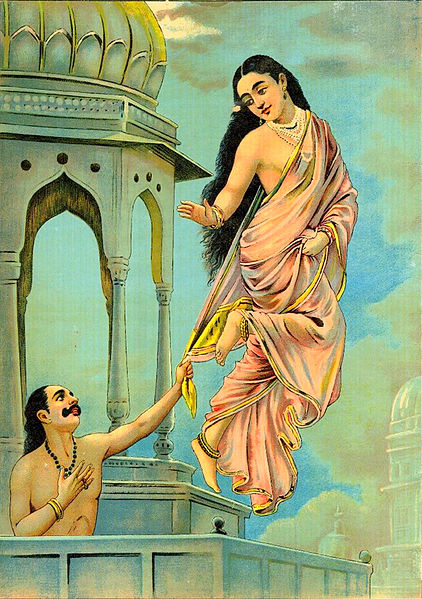
Afternoon Tea: Urvashi and Pururavas (unknown)

From the great Malayi (India) painter Raja Rami Varma:

NOL art Varma urvashi and pururavas
Click here to zoom

Varma was one of the first artists in colonial India to blend Western art with Indian traditions. Urvashi and Pururavas is an old Hindu love legend (wiki). And here is a wiki on Varma.

Here is yet another wiki, on the Malayali.

Nightcap

  1. A Mexican perspective on NAFTA Roberto Salinas-Leon, Law & Liberty
  2. Prosperity, the periphery, and the future of France Andrew Hussey, Literary Review
  3. The Indian Ocean slave trade Geoffrey Clarfield, Quillette
  4. The meaning of the exoplanet revolution Caleb Scharf, Aeon

Nightcap

  1. Have we ever been modern? Anthony Pagden, Cato Unbound
  2. Missing the elephant in the room Chris Dillow, Stumbling & Mumbling
  3. Why celibacy matters Ross Douthat, New York Times
  4. A reflection on Tito and Franco Branko Milanovic, globalinequality

Libertarianism and Neoliberalism – A difference that matters?

I recently saw a thoroughgoing Twitter conversation between a Caleb Brown, which most of you presumably know from the Cato Daily Podcast, and the Neoliberal Project, an American project founded to promote the ideas of neoliberalism, regarding the differences between libertarianism and neoliberalism. For those who follow the debate, it is nothing new that the core of this contention goes way beyond an etymological dimension – it is concerned with one of the most crucial topics in the liberal scholarship: the relationship between government and free markets.

Arbitrary categories?

I can understand the aim to further structure the liberal movement into subcategories which represent different types of liberalism. Furthermore, I often use these different subcategories myself to distance my political ideology from liberal schools I do not associate with, such as paleo-libertarianism or anarcho-capitalism. However, I do not see such a distinct line between neoliberalism and libertarianism in practice.

As describes by Caleb Brown (and agreed on by the Neoliberal Project), neoliberalism wants to aim the wealth generated by markets at specific social goals using some government mechanism, whilst libertarianism focuses on letting the wealth created by free markets flow where it pleases, so to say. In my opinion, the “difference” between these schools is rather a spectrum of trust in government measures with libertarianism on one side and neoliberalism on the other.

I’ve often reached a certain point in the same discussion with fellow liberals:

Neoliberal: I agree that free markets are the most efficient tool to create wealth. They are just not very good at distributing it. By implementing policy X, we could help to correct market failure Y.

Libertarian: Yeah, I agree with you. Markets do not distribute wealth efficiently. However, the government has also done a poor job trying to alleviate the effects of market failures, especially when we look at case Z… (Of course, libertarians bring forth other arguments than public choice, but it is a suitable example.)

After reaching this point, advocating for governmental measures to fix market failures often becomes a moral and personal objective. My favourite example is emission trading. I am deeply intrigued by the theoretical foundation of the Coase-Theorem and how market participants still can find a Pareto-efficient equilibrium by just negotiating. Based on this theoretical framework, I would love to see a global market for carbon emission trading.

However, various mistakes were made during the implementation of emission allowances. First, there were way too many emission allowances on the market which engendered the price to drop dangerously low. Additionally, important markets such as air and ship transportation were initially left out. All in all, a policy buttressed by a solid theory had a more than rough start due to bad implementation.

At this point, neoliberals and libertarians diverge in their responses. A libertarian sees another failure of the government to implement a well-intended policy, whereas a neoliberal sees a generally good policy which just needs a bit further improvement. In such cases, the line between neoliberals and libertarians becomes very thin. And from my point of view, we make further decisions based on our trust in the government and on our subjective-moral relation to the topic as well.

I saw government too often fail (e.g. engaging in industry politics), which should be left nearly entirely to free markets. However, I also saw the same government struggling to find an adequate response to climate change. Contrary, I believe that officials should carry on with their endeavours to counteract climate change whereas they should stay out of industry politics.

Furthermore, in the recent past, there has been a tremendous amount of libertarian policy proposals put forth which remodeled the role of government in a free society: A libertarian case for mandatory vaccination? Alright. A libertarian case for UBI? Not bad. A libertarian case for a border wall? I am not so sure about that one.

Although these examples may define libertarianism in their own context, the general message remains clear to me: libertarians are prone to support governmental measures if they rank the value of a specific end higher than the risk of a failed policy. Since such an article is not the right framework to gather a robust amount of data to prove my point empirically, I rely on the conjecture, that the core question of where the government must interfere is heavily driven by subjective moral judgements.

Summary

Neoliberals and Libertarians diverge on the issue of government involvement in the economy. That’s fine.

Governmental policies often do not fully reach their intended goals. That’s also fine.

The distinction between neoliberals and libertarians is merely a threshold of how much trust one puts in the government’s ability to cope with problems. Both schools should not value this distinction too much since it is an incredibly subjective issue.