Sao Paulo. Carnival. Two men climb on a newsstand, bus stop, or truck. The video is not so clear. What is clear is that they are half-naked. What they do next is pretty graphic, and I don’t feel comfortable describing it here. Bolsonaro, the president of Brazil, makes a tweet about what happened. Several websites, including Reason, criticize Bolsonaro.
The fact that several sites on the left criticize Bolsonaro does not surprise me, but I am disappointed with Reason. But let’s get some facts. Carnival is indeed a traditional party in Brazil, at least in some cities like Rio de Janeiro and Salvador. But for many people, Carnival is just a cultural imposition. Maybe the editors of Reason do not even know it, but Carnival is an official holiday. That is: even if you want to work, you are duly prohibited from doing so. Another thing that the editors of Reason forgot to report is that Carnival is largely sustained with public money. That is: like you or not, the party is partially sustained with your money raised through taxes. Another part of the money comes from organized crime. Yes. Carnival is partially supported by the state and partly by organized crime. Only a minimal part of the money is voluntarily given away by people interested in attending the party. That is: for a good anarcho-capitalist, Carnival is almost completely sustained by organized crime.
I grew up in a neighborhood in Rio de Janeiro where the carnival blocks start early and end late. Several streets are closed. My right to come and go is severely impaired. Even if I close all the windows (while it is 100º F outside), the noise of the music still prevents me from even thinking. I always think about people who are sick and need to rest. Or that they are elderly. Or families with small children. Carnival is the least libertarian party I can imagine: your participation is not voluntary. In fact, one of the most famous Carnival songs has very telling lyrics: “who does not like samba, good people are not. It’s bad in the head or sick on the foot.” To be clear: if you do not like samba you have a taste different from mine and we will respect ourselves? Not! You’re a bad person!
So, it is against this party that Jair Bolsonaro manifested himself. I’m proud of my president. One thing that Bolsonaro certainly did not do was try to be populist. If he wanted to be a populist, he would have done what all the presidents before him did: sponsor the bread and circus. By stating as he did, Bolsonaro proved that it is anything but populist. Reason has no idea what is going on in Brazil.
As a good libertarian I will say: if you like samba, you have a bad musical taste. Anyway, it’s your taste, not mine. But if you support Carnaval, you are attending a party that harms millions of people. You are not really thinking about your neighbor. And if you call yourself a libertarian and oppose Bolsonaro on this, something is very wrong. Maybe you just have no idea what is going on in Brazil.
My latest at RealClearHistory deals with Texas and its secession from Mexico. An excerpt:
There are other similarities, too, starting with the fact that Texas was not the only state in Mexico to try and secede from Mexico City. The self-declared republics of Rio Grande, Zacatecas, and Yucután also asserted their independence from Mexico, though Texas was the only state to actually succeed in its rebellion. Unlike the 13 North American states attempting to secede from the British Empire, the Mexican provinces did not band together to form a united front against a common enemy.
Texas itself was the northern part of a larger state called Coahuila y Tejas. When Mexico originally seceded from Spain, Coahuila y Tejas joined the new republic as its poorest, most sparsely populated member state. In addition to economic and demographic problems, Coahuila y Tejas shared a border with the Comanche and Apache Indians, who in the 1820s were still powerful players in regional geopolitics. Life in Coahuila y Tejas was nasty, brutal, and short.
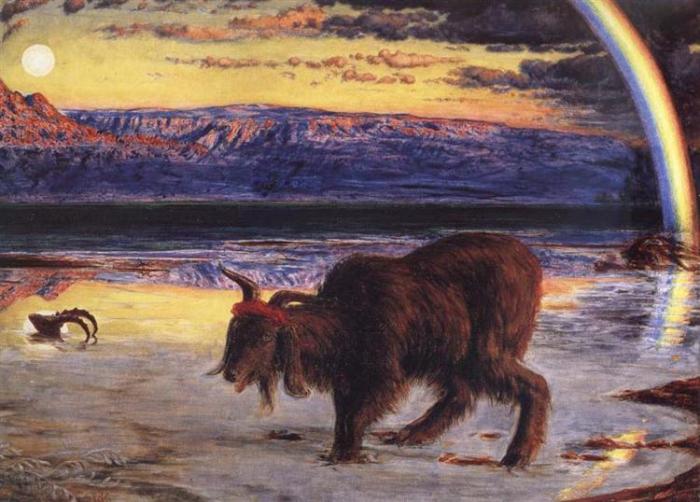
Man, I like this one. It was painted by William Holman Hunt, an English painter. Hunt belonged to a school of art that called itself the Pre-Raphaelite Brotherhood. Here is a wiki on the Brotherhood.
But as abstract ideas go, pollution taxes are pretty appealing. Holding constant lots of things that we can’t really hold constant, it means replacing the inefficiency resulting from poorly defined/enforced property rights with a world where prices more accurately reflect the costs of one’s decisions.
Let me come back to the things we’re “holding” constant in a bit. Why do I want to throw my weight behind shifting public perceptions in favor of pollution taxes?
Which is not to say a carbon tax isn’t overrated by the median policy wonk. There are a ton of important caveats, but on balance, as a policy for use in the next 50 years, I think they’re a useful tool to enhance efficiency or replace worse tools.
Again, there are no panaceas. I’m also not a huge fan of the “Economists’ Statement on Carbon Dividends” as written (for reasons I’ve hopefully mostly addressed). I suspect the best case scenario for my preferred carbon tax policy would be a modest improvement. I think the bulk of the gain would be a cultural shift away from “let’s regulate our problems!” to “let’s leverage incentives to address our problems!” Not Earth shattering, but a step in the right direction.
So let me state my position, then we can dig into criticisms and caveats.
Let’s make marginal shifts away from taxing investment and towards taxing negative externalities. As we go, let’s spend a lot of effort trying to study the impacts and adjust accordingly. Let’s heavily agument that with abatement policies rather than trying to return to some pre-industrial climate target.
Okay, let’s dig into criticisms and caveats.
Public choice considerations
Geoengineering and other alternatives
Cost
Coordination
Uncertainty
1-Public choice considerations
A Green New Deal will be a rent-seeking bonanza. Pollution taxes will face the same sorts of problems that plague the tax code in general. There will be intentional loop-holes and accidental screw ups.
We have to continue to push for reducing the complexity of tax codes in general. But I can’t deny that a carbon tax would be a step back on this margin.
Minus a hundred points for my position.
2-What about geoengineering?
Geoengineering sounds like a possible panacea. Maybe it is. But I’m not willing to flip a switch and find out the hard way all at once.
First off, geoengineering is scary. The climate is a complex system and complex systems are difficult-impossible to manage well. And that’s especially concerning if it means that anyone with a few million bucks can try to fiddle with Earth’s thermostat.
But it seems like a plausible tool that might be used to address climate change. Similar to my take on a carbon tax, I think the way to go is baby-steps plus research.
What about subsidizing “green _____”
Personally, I’m skeptical. Solar sounds appealing, and I (personally) think windmills are beautiful. But I don’t think the government will do a good job of picking winners and losers. Pollution taxes are appealing to me because they don’t require bureaucrats to choose. Again, I think the way to go is to use pollution taxes to offset other taxes–while continuing to advocate for reduced size/scope of government and a return to federalism.
Plus five points for my position.
3-Cost
We should also remember that GDP is an imperfect measure of well being. The current figures aren’t directly comparable to the figures we’d get in a post-carbon-tax world. A one-time fall in GDP doesn’t (necessarily) mean we’ve screwed things up.
Still, it’s worth remembering that a) we can go too far with a carbon tax, and b) we don’t have access to a silver-bullet solution. So let’s start small and gradually increase carbon taxes till we get close to (our best estimate of) the optimal level.
Plus epsilon points for my position.
4-Coordination
The basic idea of a carbon tax is that we’re dealing with a global-scale externality problem. But small scale taxes are unlikely to do much beyond shifting where pollution happens. A fully effective tax would require multi-lateral coordination. And, as a country, we aren’t very good at that.
Trying to create a tax on imported carbon-intensive goods that didn’t face a tax at home seems a) sensible at first blush, and b) a massive opportunity for public choice problems.
On the other hand, we could justify a tax commensurate with the local impacts (something like 10% of the global impact). This fits nicely with my idea of starting small and adjusting at the margin.
But even within the U.S. there are coordination issues. Long Island will likely face net costs from climate change, but other areas will benefit from a longer growing season.
Plus 10 points for my position, but also minus 10 points.
5-Uncertainty
Uncertainty cuts both ways: we’re currently accidentally manipulating the climate and that could turn out to be catastrophic. Trying to intentionally manipulate it in the other direction is also dangerous. Again, the appropriate focus is on marginal tinkering [much as it clashes with my non-interventionist priors] rather than ambitious global engineering [which grabs my priors by the lapels and knees them in the groin].
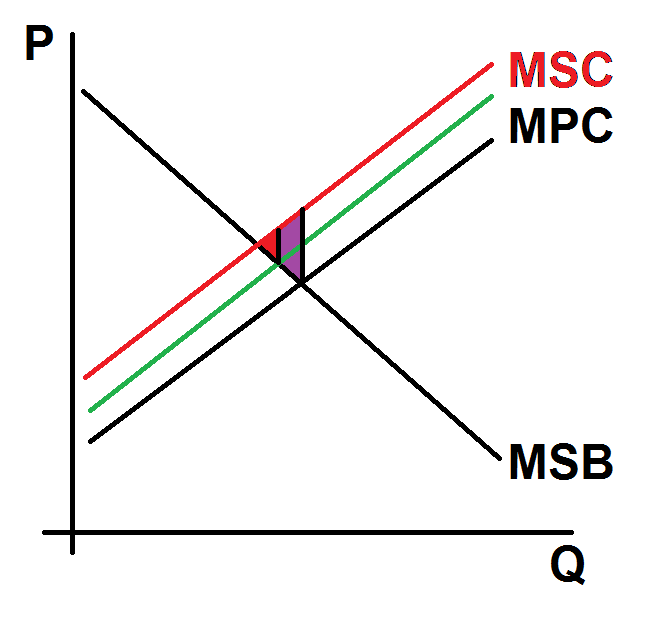
When I teach externalities, I draw a graph like this:
Negative externalities when we magically know their magnitude.
In this market, we end up with an equilibrium quantity defined by the point where Marginal Private Cost equals Marginal Social Benefit (MPC = MSB). But the Marginal Social Cost (MSC) is greater, so we get a deadweight loss equal to the triangle I’ve shaded in red and purple.
It’s important to note: we don’t actually know where the MSC curve is. It’s somewhere above MPC, but we’re basically in the position of trying to eliminate a subsidy we don’t know the size of.
The relevant models–climate models and economic models–are filled with uncertainty that we simply cannot resolve without real life experience.
What does the economic way of thinking tell us? Act on the margin. Setting a tax that pushes supply (MPC) up to the green line doesn’t fully address the problem (as I’ve assumed it to be in this graph), but it’s an improvement.
Even better, it’s an improvement where the biggest returns are experienced up front. This modest tax fails to get rid of the red deadweight loss (DWL) area, but it eliminated 3/4 of the total DWL.
Plus X points for my position where X is a random variable with an unknown distribution, positive first derivative, and negative second derivative.
tl;dr:
At my friend’s behest I’ve been looking at Bob Murphy’s critique of carbon taxes. I find it’s shifted the magnitude of my prior opinion, but not the direction. I still think carbon/pollution taxes are a good idea, but I no longer think they’re a great idea. My take away from Murphy’s work is that the optimal carbon tax is fairly modest. My response is to advocate for getting a very modest carbon tax on the books, then gradually shift tax policy in that direction.
For climate change (and any other problem) we ought to be pluralists. A mix of approaches is ideal. Part of the appeal of Pigouvian taxes is that they allow and encourage a wide range of responses. The best pollution abatement scheme isn’t something we can look up in a binder. We have to discover it, and crowdsourcing is the appropriate way to do that.
But carbon taxes are only one part. We should also advocate for changes that will ameliorate harm. I am more bullish on these policies than I am on a carbon tax:
Make it easier for the world’s poorest people to move to rich countries that will be better able to cope with climate change.
Quit subsidizing flood insurance.
Quit subsidizing polluting industries (and other industries).
Even though geoengineering scares me, we should try to learn more. Ditto for any other possible tools that come along.
Neomi Rao, nominee to the D.C. Circuit Court of Appeals, has fallen victim to an old fissure–conservative and libertarian disagreement over unenumerated rights. At the hint that she believes that rights exist outside the express text of the Constitution, conservatives have pounced, concerned that Rao will betray conservatives on abortion issues. On both political and legal dimensions, this concern is silly.
As a general matter, it’s beyond clear that Rao is qualified. Conservatives shouldn’t cripple a great candidate over a minor issue. The Supreme Court has many times confirmed that unenumerated rights exist. Rao is bound by those precedents, including Roe, and whether she agrees with those precedents or not is immaterial to the job she’s nominated to do. The chance that Rao will even have a chance to expand the existing list of recognized unenumerated rights is exceedingly low. It just doesn’t come up that often, and the courts already have tests for assessing whether a right should be recognized.
But perhaps more importantly, non-enumerated rights don’t lean toward one side of the ideological spectrum or the other. The Supreme Court of the early twentieth century recognized, for instance, liberty of contract as a constitutionally protected right–though unenumerated. Progressive jurists bent on defending Roosevelt’s New Deal did so in part by opposing the enforcement of unenumerated rights. Unenumerated rights also include other “conservative” causes such as the right to earn a living. And, of course, unenumerated rights have also favored “liberal” values such as a broad right to privacy. In short, it is unclear why Rao’s alleged support for the enforcement of unenumerated rights should enter into the partisan calculus.
And then there’s the simple fact that unenumerated rights do in fact exist and deserve constitutional protection. The history and passage of the Ninth Amendment, which says enumeration of rights shouldn’t detract from those retained by the people, make this clear. The founding generation didn’t see rights as reserved to a fixed set of especially important activities. In fact, many feared that the enumeration of certain rights would imply that the unenumerated ones shouldn’t be recognized. That fear has turned to be prescient, despite the inclusion of the Ninth Amendment, which was written to make clear that the enumerated rights shouldn’t be seen as implying that unenumerated rights should go unprotected.
In short, not only would Rao be right to recognize such rights–though the scope of those rights is always a matter of intense debate–she has to recognize them under binding law, and her thoughts on the matter are unlikely to make much difference to her job. If she gets nominated to the Supreme Court later down the road, the concern may have more relevance. For now, just get her confirmed.
While addressing a joint press conference in Hanoi, after his summit with North Korean Leader Kim Jong Un, US President Donald Trump spoke not just about the Summit, but also the current state of US-China relations. Trump criticised his predecessors for not doing enough to address the trade imbalance with China, while also making the point that he was all for China’s economic progress and growth, but not at the cost of the US.
If one were to look beyond the Summit in terms of the US-Vietnam economic relations, top US companies – Boeing and General Electric – sealed some important deals.
Given the focus of Trump’s visit (which was the Summit with Kim), perhaps these deals did not draw the attention they ought to have. The fact is that the US has begun to recognise Vietnam’s economic potential, as well as its geopolitical significance in Asia. This long note will give a backgrounder to Vietnam’s economic growth story in recent years, highlight some of it’s key strategic relationships, and then examine the nature of the China-US-Vietnam economic triangle.
I won an essay contest back in my undergraduate days for an essay on optimism. I understand that poverty worldwide is on the run. I understand that none of us have suffered through a devastating worldwide war like most of our ancestors did. In many ways, we have it good.
But Donald Trump is still President of the United States of America. I still remember waking up to the news that he had beat Hillary Clinton. It was surreal (it didn’t help that I was living Austin, where everything is a bit foggier, brain-wise).
Unlike Jacques, who seems to be so in love with Trump that he would get down on his knees and do whatever Trump wanted him to do, I don’t like Donald Trump. I don’t think he’s done a good job. I don’t even care that the left-leaning press is dishonest when it comes to reporting on his administration. I think this is the difference between libertarians like me, who lean more to the left, and libertarians like Jacques and Bruno, who lean more to the right.
Jacques and Bruno are not really defending the Trump and Bolsonaro administrations. And they’re not really speaking up for these two administrations because they hate leftists more than they like liberty. Guys like Jacques and Bruno care more about Truth than anything else, and the global mainstream media’s narrative skews left and is often dishonest.
Me? I’ve grown accustomed to dishonesty in media. I’ve also grown accustomed to ignorance. I pick and choose which dishonest or ignorant bits I want to challenge. When journalists write or say something about guys like Trump or Bolsonaro that are blatantly wrong, I make a mental note of the dishonest nature of the reporting, but that’s about it. Guys like Trump and Bolsonaro are bad for liberty, after all. I’d rather focus on the mainstream press’ dishonesty when it comes to people like Alexandra Ocasio-Cortez. The fawning over her is at least as concerning as the dishonest portrayals of Trump or Bolsonaro.
Left-wing populism is just as bad as right-wing populism, and everybody in the democratic world is going to be stuck with populism for quite awhile. Truth is on its way out the door, and I don’t know if it’ll be back in my lifetime.
Folks, I’m still plugging away at RealClearHistory. This week’s focus was on Iraq. Here’s the link to my Tuesday column. And here’s the link to my weekend column. I’m not going to spoil anything. Just read ’em already!

 Notes On Liberty