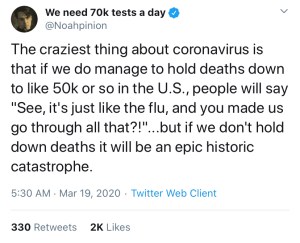
Wats On My Mind: the state of the economy

I wrote the following update for my Principles of Macroeconomics students and thought it might just count as an update for Wats On My Mind.

In the first two minutes of class, I asked you how you would know how the economy is doing. Let’s focus on our three big areas: GDP, unemployment, and inflation.

Initial estimates are that GDP decreased by 4.8% in the first quarter (Jan-Mar). Let me comment on that a bit:

  1. That number is almost certainly inaccurate. It will be revised 3 months from now, 6 months from now, and be finalized 9 months from now. That is totally normal – as more and more data rolls in, our estimates get better. My bet is that the number is worse than that because closed firms won’t be reporting anything yet.
  2. The number for the second quarter will certainly be worse than that. We were only closed for 2-3 weeks in March, so the fact that we’re done that much in such a short window is a bad sign. We have already been closed longer in this quarter and the careful, measured opening we’re doing right now – which I think is wise to prevent a new spike of cases – won’t make for an instantaneous rebound.
  3. This is as bad as we saw during the Great Recession, but faster. Again, my hope and expectation is that our recovery will also be faster.
  4. GDP dropped in the EU by 14%. So it could be a lot worse!

The Bureau of Labor Statistics also released new numbers. So far 30 million Americans have filed for unemployment. That is roughly 18-19% of the workforce. This is officially, as expected, the highest unemployment rate since the Great Depression in the 1930s. The good news is that the number of new applicants has been going down each week, from 6.8 million at the end of March to “only” 3.8 million last week. (Recall: That’s still 4x larger than the previous high set in the 1980s.) The other bit of good news is that 90% of unemployed workers expect to return to their old job, while that number is usually only 40%. That gives me more encouragement that we could quickly bounce back.

Inflation is DOWN. If this were primarily a supply shock, we would be seeing overall higher prices. That means the drop in aggregate demand is bigger than the supply shock. To a Keynesian or a Monetarist, that also means that all the fiscal and monetary stimulus we have done so far is not enough and more needs to be done. To a Classical economist, the thing that needs to be fixed is still supply – demand itself is not terribly important. A Hayekian, of course, thinks all this stimulus is making things worse – it messes with the price signals markets rely on.

To get a rough estimate of where inflation is going, I have been recommending comparing TIPS bonds to nominal bonds because the difference between the interest rate on those bonds (the TIPS spread) is the market’s best guess of inflation. As you can see here the TIPS spread fell from 1.8% in 2019 to 0.5% at the end of March. During April, it has recovered slightly to 1-1.2%. A very rough guesstimate based on that suggests we would need a stimulus 3x as large as we have done right now to return inflation expectations to normal. !!!

The very idea of having Congress spend an extra $5 trillion on top of what is already being done is more than my little fiscally-conservative heart can comprehend just now. Politically, though, I expect Congress will find it in their hearts/re-election campaigns to have another round of stimulus. The Federal Reserve has even called on Congress to spend more, so have no fears of monetary offset hampering anything. Here is a monetarist arguing the Fed needs to do a great deal more to ensure spending expectations don’t fall. One of the points, though, is that we should not expect hyperinflation is around the corner.

On that first day, most students suggested looking at the stock market. From Feb 21-Mar 23 the Dow lost 10,000 points – 1/3 of its value. Since then it has recovered more than half. Notice that the drop came BEFORE quarantine and that the stock market has been recovering even as unemployment has climbed to record heights. This is another reason I don’t recommend imagining that the stock market gives a clear and unbiased view of what’s going on in “the economy”! The situation right now is clearly much worse than it was a month ago, so trying to figure out current conditions would not make sense. If I wanted to give it the best spin possible, I’d say the stock market is predicting better times ahead despite how bad things currently are.

 A few other data points:

  • 59% of Americans say they can social distance as long as needed, which is up from a few weeks ago. (Gallup)
  • Western European countries started reopening earlier than we have and they are starting to see an increase in cases and deaths again. Now, so far that’s only a 3-day trend and it could just be a blip, but it’s not encouraging.
  • Most people are actually behaving like decent, responsible people during the crisis – and they usually do.

Paid Sick Leave and Schelling Focal Points

Paid sick leave is something I want more people to have. Of course it’s a good thing. Sick leave is valuable, but it’s not free so we have to ask it it’s worth it.

Right around the 11:30 mark is a tragic and hilarious line: “Dildos are not essential items. Books for kids, yes, but dildos? … No!” Good for John Oliver noting that deciding what is essential isn’t straight forward–apparently frivolous things might keep people inside and so serve the public health.

This is a classic Austrian point: prices (are supposed to) communicate information about how urgently people want a product. We run into trouble trying to prevent prices from reflecting the underlying economic crappiness of a crisis. Price gouging should be allowed for toilet paper and especially for grocery/Amazon workers. And the price of grocery workers should be passed on to consumers.

What we’ve got now requires each of us to not only ask “am I willing to pay this price?” but also engage in a moral calculus that is hard. I have to ask (as a person striving to be moral) if it’s really worth ordering X, Y, and Z from Amazon. But as a person who has to strive to be moral, it’s entirely too easy to fall for bad rationalizations.

So how do we help these essential-yet-replaceable* workers? Paid sick leave sure sounds good. And given the externalities involved in a pandemic, there’s a strong argument for mandating it.

But it’s worth remembering (particularly as a long run policy) that if we push on one part of a compensation bundle, something’s going to give. If we require employers to provide a company car (or simply encourage company cars through preferential tax laws), we shouldn’t be surprised to see monetary compensation fall. The same logic applies to paid sick leave.

But I’m my own devil’s advocate, so let me make a counter argument. I rarely use my sick days. I think I’ve taken 2 or 3 in the last 6 years. (I’m absolutely reevaluating that position now!) There’s this idea floating around in the back of my head that tells me to just tough it out and keep working. This isn’t because I carefully weighed pros and cons, it’s just received “wisdom” picked up by osmosis from the broader culture.

American culture values work over value. There’s no shortage of bullshit work because we’re in a work-too-hard equilibrium. This is not to say that hard work doesn’t have benefits. I’m happy when ambitious entrepreneurs work “too” hard to provide greater value. But there are a lot of cases where we create work for its own sake (especially in the higher ed racket, but apparently we’re not alone).

Essentially, we’re all playing a coordination game where we choose between “[appear to] work to make things better” and “stay home instead of passing your illness to other people.” Given American work culture, the Schelling focal point is <work, work>.

On the compensation end of things employers have to decide between offering more sick leave or some other compensation (like money). In this end, there is some benefit to zigging where other employers zag. If I’m running the only business to offer paid paternity leave, I get my pick of the best family-oriented workers while my competitors have to outbid each other to get the best of the other workers. But any mid-level HR manager is more likely to play the risk-averse strategy of following “best practices.”

So we’re in an equilibrium that underrates sick leave. We want to be in an equilibrium where it’s just good business sense to offer sick leave during a global pandemic. But coming from our current equilibrium, offering sick leave is a costly decision to privately provide a public good; it’s unlikely to happen unless the culture already promotes it.

I think we can get that equilibrium. I think we’re already moving towards it (ask yourself: would the board of the East India Company be more likely to offer sick leave than Amazon?). But we’re not there yet.

Paid sick leave should be good business sense right now**. But it depends on a culture where such behavior is widespread. I’m not convinced we could flip a switch and get that culture over night. Given that, I’m at least somewhat okay with contradicting my libertarian priors and calling for emergency mandates for paid sick leave. 2020 America isn’t likely to coordinate on the “right” short-term solution and coercion is probably the most efficient*** way to deal with this common pool problem. But outside of a public health emergency we shouldn’t allow top down mandates about the mix of compensation offered in markets (certainly not with the sort of people we elect to be on top).


(A couple rhetorical points: First, John Oliver isn’t speaking the language of those on the right. They won’t even be convinced that the issues he’s talking about are important. I think that’s a shame. Second, this is a tough time to try to argue against paid sick leave. In 2020 America, mandatory paid sick leave is probably required because we’re at the wrong Schelling point. Again, I don’t think conservatives or right-libertarians will find Oliver’s motivations convincing, but I believe that they could be persuaded. But that’s another blog post.)

(Two important counterpoints to the above: first, price increases hurt the poor. The way to solve that is to give charity money to the poor, not to try to make markets communicate information about relative scarcity and act as charity–that’s half-assing twice and it’s bound to be more inefficient than the charity would be costly. Second many people categorized as “essential” aren’t in a position to demand higher wages*. I don’t have an easy solution to this issue. Let’s talk about it in the comments.)

*Which is to say, workers who are in the same position as water in the diamond-water paradox.
**Not to say it would be cheap or easy.
***There you go. Now my friends on the left can accuse me of being a bloodless economist for opposing paid sick leave in general, and my friends on the right can accuse me of being a bloodless economist for supporting

Damned Models and Cutting off the Chinese

I have a good eye for what ought to be there but isn’t. Don’t congratulate me; it’s a natural talent. I am retired so, I usually spend hours listening to the radio, reading newspapers and, watching television and, (Oops) on the internet. Nowadays, I do more of the same.

Today’s lecture is going to be a little longer than usual, on the one hand. On the other hand, there will not be a test. Bear with me; it’s going to be worth it (if I say so myself).

The first thing that’s missing from the endless and frankly a little sickening commentary on the C-virus epidemic is a good explanation of what’s a “model.” I mean the kind of models that are being blamed a little bit everywhere and especially in the conservative media for seemingly wildly inflated predictions (of infections, of deaths, of anything connected to this illness). Just from listening to talk radio, I think that some, or many, believe that with “computer models,” computers actually do the thinking instead of people. It’s not so.

The second thing missing is a clear description of the downside of national economic self-sufficency that appears so tempting now that we are extra-sensitive to both the comparative incompetence of our China-based suppliers, and to the possible ill-will of the Chinese Communist authorities.

First, first: a model is logically pretty much the same thing as we do when we say, ” On the one hand, on the other hand.” That’s as in, “One the on hand, If have saved $20, I will buy a nice cake; on the other hand, if I manage to save $200, I will look for a good used bike.”

The problems are: 1 that we have only so many hands; if we had one hundred each, and remembered each, we could produce mental models that cover more possibilities; 2 that we are not agile at combining possibilities, like this: “If the third hand and the fortieth hand are combined with the fifty-first then, this will happen.”

Models – designed by humans working slowly – can be entered into computers with many values and many combinations of values to tell us what would (WOULD) happen if… That’s all, folks.

Don’t blame the models, don’t blame those who build the models, in this capacity, rather, blame those who don’t do the needful to explain to decision-makers what actual models do and don’t do. (It’s true that they are often the same as those who actually construct the models but in a different role.)

Also, blame American universities and colleges that should have been in the business of teaching this stuff to all students since the late sixties and that have only done it for a tiny elite minority. A big missed opportunity. Even high school students could learn, I believe.

Second undiscussed issue. Under normal circumstances, self-sufficiency has a certain intuitive appeal: Let’s not count on others because they might fail, or fail us and, at any rate, distance makes the best linkages vulnerable. Now that we worry about running out of essential medical supplies made in China, now that we fear a shortage of the raw materials that go into our medical drugs, our intuition seems broadly vindicated. It did not help that a highly placed Chinese Communist official actually threatened the US aloud, about a month ago, with withholding medications. (I am guessing he is not going to have a happy retirement.)

Much about our intuition is correct, of course. As I never tire of stating (wittily, if you ask me), we should not count on steel deliveries from China to build the naval ships we would use in a war with China. The steel deliveries might be too late.

That’s on the one hand. On the other hand, there is a downside to national self-sufficiency. It violates the general principle that specialization makes for efficiency. Just imagine that you had to grow all your own grain, harvest it, mill it, raise your own cattle, slaughter it, butcher it, skin it, preserve the meat, treat the skins (and cut and sew clothes out of them). You would do a bad job of some of these tasks, at least, possibly of all. You would have much less to consume than is true now. You would be poor.

And that’s the downside: National self sufficiency is a sure path to poverty. I am not speaking of small differences but of big ones. I remember clearly when the cheapest hammer at the hardware store cost $20, five years later, the cheapest hammer cost only $5. What happened in between was expanded imports from China. (Don’t even begin to talk about quality; the difference among the cheapest items of a kind is largely illusory anyway, or much exaggerated.) And if you think this is a special case, ask your self if the Canadians – who love bananas – should grow their own in the name of self-sufficiency.* (For an expanded view of international trade, see my series of articulated short essays beginning here: “Protectionism; Free Trade, Step-by-Step.”)

Here again, American colleges and universities deserve strong blame. First, many don’t even require a course in economics to graduate. One of the best undergraduates I have known personally, an honors students who is now very successful in her career, never heard a single lecture on anything pertaining to economics. Second, economics professors, by and large, do a piss-poor job of teaching international trade. Across 25 years of teaching in a business school, I have met a fair number of good MBA students who had taken three courses in international trade and still did not see the possible downside of self-sufficiency. So, this simple idea is not widespread among the educated populace. It’s not well anchored enough in the opinion media for many to push back intelligently against the wave of demands that the US minimize its dependency on what we obtain from abroad in general. (A national policy designed to induce American companies to source in Vietnam, for example, rather than in China is a different and defensible proposition.)

So, here you have it: Models are not to blame, confusion about them is; economic self-sufficiency is the road to poverty though it might be worth it. Knowing these two things does not prevent us from taking action collectively. It makes for more rational action in these irrational times.

* Those of you who received a decent education in economics might wonder here if I have just dealt improperly with the topic of Comparative Advantage. I haven’t, I have not even begun.
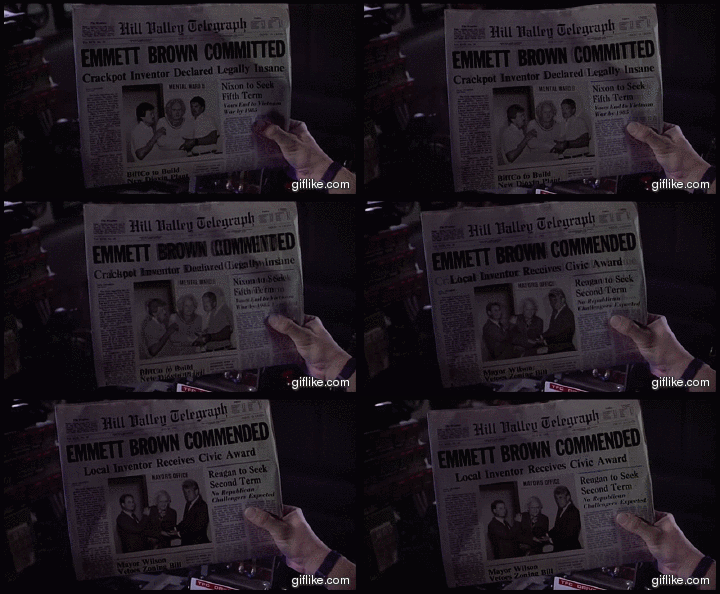
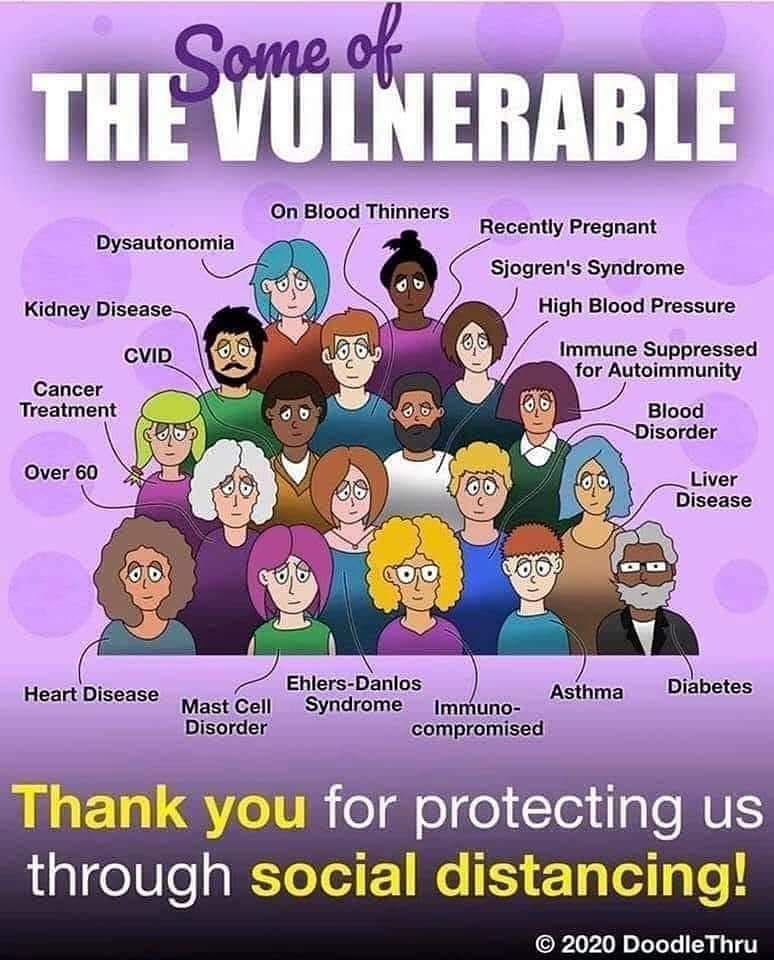
A Timely Agent Based Model

I’m going to play economic imperialist and declare that epidemiology is partly within the domain of economics. I’m not sure how big the overlap is, but certainly there are economic questions that bear epidemiological type modeling. The movement of ideas is, in the long run, as important as the movement of a virus is in the short run. In any event, economists should be using this sort of methodology more often.

Crisis, governments and the micro-macro conundrum

Layoffs and salary cuts are individual firm responses to a crisis that may make sense from a micro perspective- it is about saving money – but they will have dire consequences on the macro level.

I lived through this in Greece. Ten years ago, every firm was expecting the worst to come from the memorandum. They started making people redundant, pulling out from planned investment and cutting salaries. Unemployment went up, demand collapsed, public revenue went down, more austerity measures were needed and the downward spiral deepened. The country ended up losing one third of its economy in just four years.

Will it now be Greece on steroids everywhere?

The side effects of myriads of micro adaptations appear on the macro level. This is a key problem for economics and is particularly challenging for Austrian economics. Entrepreneurs creatively respond to a crisis by adopting a cautious and defensive approach long before some of them could spot new opportunities for investment and take positive action to exploit them. But if they all choose to first play ‘defense’, they shape the macro-environment in patterns that keeps telling most of them “keep on protecting yourself”, “there are more risks than opportunities out there”. Both supply and demand are on a continuous downward spiral. While some discerning entrepreneurs will spot some opportunities even in the direst of the circumstances, their plans need time to materialise and some may never come to fruition. In the meantime, most economic actors are not well positioned to start what they know to do well, and many have already lost their money in activities that went downhill.

On the other hand, the side effects of a large top down intervention such as the global lock down confirms the Austrian critique that central planning is also a risky endeavour. In an effort to control a complex reality, radical top-down interventions can divert investment to the specific activities they prop up, which appear sustainable for as long as this diversion lasts. Restrictive measures can also backfire, such as Greece’s shock austerity that was intended to balance the budget in Greece, or can prolong a precarious environment, such as the debt-fuelled bailouts elsewhere to save the banking system.

The problem is that policymakers do not have the tools to gain a full grasp of any potential unintended or undesired consequences from their actions. When they focus on one range of analysis, such as preventing a spike of deaths during the epidemic, the measures they take can generate a cascade of negative side effects in areas off their alarmed radar which they may have no idea how to arrest or fix.

I don’t see this micro-macro antithesis as an automatic validation of post Keynesianism in the sense that capitalism is always inherently unstable. It is unstable in periods of crisis when the micro and the macro can become a contradiction.

Exogenous shocks periodically happen. But it is worth studying what post Keynesians state: a crisis can emerge endogenously as in the financial markets.

The way out may be to think in terms of resilience rather than stability. I am inspired by Hilton Root’s forthcoming book Network Origins of the Global Economy. Resilience is the capacity of a system to accommodate turbulences and absorb shocks in recurrent episodes of instability. The system is unstable but can withstand the stresses.

Are multiple adjustments by adaptive agents able to bring about resilience in a system? Or do we need a central node to gain control and bring about order? Is a centrally-induced order a structure of relations that can be resilient over time, given that it depends on the health of the central node and knowing that the capacity of governments to understand and predict is limited?

Again: Never reason from a fatality change

The future isn’t written yet

Last week Richard Epstein predicted around 500 fatalities in the United States (I originally misread his estimate to be 50,000 for the US, not the whole world). His estimate was tragically falsified within days and he has now revised his estimate to 5,000. I still think that’s optimistic but I am hopeful for less than 50,000 deaths in the United States given the social distancing measures currently in place.

Today, several US peers have become excited about a Daily Wire article on comments by a British epidemiologist, Neil Ferguson. He has lowered his UK projections from 500,000 to 20,000 Coronavirus fatalities. The article omits the context of the change. The original New Scientist article (from which the Daily Wire is derivative with little original reporting) explains that the new fatality rate is partly due to a shift in our understanding of existing infections, but also a result of the social distancing measures introduced.

The simple point is:

Policy interventions will change infection rates, alter future stresses on the health system, and (when they work) lower future projections of fatalities. When projections are lower, it is not necessarily because the Coranavirus is intrinsically less deadly than believed but because appropriate responses have made it less deadly.

A PPE pandemic reading list

I haven’t written for a while – other duties get in the way – but I’d like to suggest this reading list in Philosophy, Politics, and Economics for the present time of crisis and perplexity. The main reason is that everyone seems to be an expert in Economics, Epidemiology, and Political Philosophy these days, assuming that from “facts” we can easily derive “values” and answer the question, “what is to be done?” I think this is at best a naïve attitude and at worst the same rationalistic hubris we experience everytime a political issue is simplified and reduced to a matter of “science”. Yes, there are facts and they shouldn’t be ignored, but it’s not easy to decide what is to be done, morally and politically, in light of those facts.

The first item on the list is Leviathan by Thomas Hobbes. A classic, and a reminder that people choose all the time to sacrifice some degree of liberty in the altar of survival (or a chance to survive), but also a reminder that Leviathan may turn from friend to foe, from protector to persecutor – and there is very little we can do about it. The second item is John Locke’s Second Treatise of Government, which then explores this topic in light of the fact that civil government shouldn’t have absolute power. It makes an attempt to show us how that power can, or should, be limited within a certain sphere of responsibility. Though it’s still there to protect us.

In this time of pandemic, people feel tempted to panic. People and politicians are calling for dramatic measures, and one reason is that the use of government coercion – which, according to Locke, ought to be limited – might be necessary to force people to cooperate, for example, by staying home. This is a proposed solution to the dilemmas of collective action posed by the problem that some may “free-ride” on the rest, and, as a result, the disease will keep spreading, frustrating any attempt to slow it down. Against dramatic, desperate and, perhaps, arrogant, use of political power, and in favor of prudence and wisdom, Edmund Burke’s collection of writings from the period of the French Revolution can be a beacon of light. On the other hand, explaining the dilemmas of collective action and suggesting ways of solving them, Mancur Olson offers an insightful look at incentives and group behavior in The Logic of Collective Action.

However, the idea that government coercion is the only solution to dilemmas of collective action (such as imposing a quarantine, for example) doesn’t hold water. In fact, other economists follow Olson in saying the problem is real and challenges a strict individualist way of thinking, but, adding to Olson’s point, they also acknowledge the role of private action and sanctions in fostering cooperation. Elinor Ostrom’s Governing the Commons is a wonderful study that opens up a number of possibilities for private enforcing of collective action to preserve and promote the frugal allocation of common goods. This can be complemented by The Quest for Community, an overlooked work by sociologist Robert Nisbet, where it becomes clear that, between individuals, the state, and the market, there’s room for other associations and communities that strengthen civil society – particularly in this challenging time. Nisbet’s lesson invites liberty-loving people to reflect on whether a hyper-individualistic view of the world ends up pitting helpess individuals against Leviathan instead of offering the buffer zone of community in between. This is something Alexis de Tocqueville discussed in the 19th century.

And just for the sake of dealing with the issue that “is” doesn’t easily lead to “ought”, and that science might have facts and an explanation for them, but does not easily conduce to a proper discussion on values policy, I must finish this PPE pandemic reading list with F. A. Hayek’s The Constitution of Liberty. On Chapter 4, for example, Hayek introduces a constrast between “rationalist liberalism” and “anti-rationalist liberalism”. Rationalist liberals assume too easily that knowledge of the facts on the ground will give them what they need to re-design a society governed by reason. Hayek warns us against this technocratic assumption and offers a defence of “anti-rationalist liberalism”. Anti-rationalist liberals understand the importance of spontaneous order and of constraining power (even at a time of crisis) while prudently balancing the values of liberty and safety in light of past experience and tradition.


Three Additional readings:

Buzan, Waever and De Wilde, Security: A New Framework for Analysis (1997). In a liberal democracy, the state steps in suspending some civil liberties only if it can persuade citizens that there’s a threat that justifies it. This book offers a framework to interpret how such threats are constructed in official and non-official discourse, and to what extent this construction of a threat can be effective.

Robert Higgs, Crisis and Leviathan (2013). 25th anniversary edition. Looks at US history and how government employed crises to its advantage and the advantage of the ruling elites. In particular, security and economy related issues are dealt with.

Sanford Ikeda, Dynamics of the Mixed Economy (2002). Shows that a time of crisis might be a time for further interventionism in the economy, as Higgs (see above) suggests, but might also be a time for disintervention, as seems to be the case with part of the agenda today (FDA deregulation, etc.) This is based on Ludwig von Mises’ view that interventionist economies are not very stable and are always swinging as a pendulum between socialism and capitalism.


Never reason from a fatality rate


Richard Epstein has produced several posts and a video interview arguing that the mainstream media is overreacting to the Coronavirus pandemic. Richard understands the potential seriousness of this situation and the proper role of government. He recognises the value of the Roman maxim Salus populi suprema lex esto – let the health of the people be the highest law. In public health emergencies, many moral and legal claims resulting from individual rights and contracts are vitiated, and some civil liberties suspended.

Nevertheless, along with Cass Sunstein, Richard claims that this particular emergency is likely to be overblown. His justification for this is based on data for infection and fatality rates emerging from South Korea and Singapore that appear (currently) under control with only a relatively small proportion of their population infected. This was achieved without the country-wide lockdowns now being rolled out across Europe. Extrapolating from this experience, Richard suggests that the Coronavirus is not too contagious outside particular clusters of vulnerable individuals in situations like cruise ships and nursing homes.

The line of argument is vulnerable to the same criticism that one should never reason from a price change. The classic case of reasoning from a price change is reading oil prices as a measure of economic health. When oil prices drop, it could herald an economic boom or, paradoxically, a recession. If the price dropped because supply increased, when OPEC fails to enforce a price floor, then that lower price should stimulate the rest of the economy as transport and travel become cheaper. But if the price drops because economic activity is already dropping, and oil suppliers are struggling to sell at high prices, then the economy is heading towards a recession. The same measure can mean the opposite depending on the underlying mechanism.

The same logic applies to epidemics. The transmission rate is a combination of the (potentially changing) qualities of the virus and the social environment in which it spreads. The social environment is determined, among other things, by social distancing and tracking. Substantial changes in lifestyle can have initially marginal, but day after day very large, impacts on the infection rate. When combined with the medium-term fixed capacity of existing health systems, those rates translate into the difference between 50,000 and 500,000 deaths. You can’t look at relatively low fatality rates in some specific cases to project rates elsewhere without understanding what caused them to be the rate they are.

Right now, we don’t know for sure if the infection is controllable in the long run. However, we now know that South Korea and Singapore controlled the spread so far and also had systems in place to test, track and quarantine carriers of the virus. We also now know that Italy, without such a system, has been overrun with serious cases and a tragic increase in deaths. We know that China, having suppressed knowledge and interventions to contain the virus for several months, got the virus under control only through aggressive lockdowns.

So the case studies, for the moment, suggest social distancing and contact tracing can reduce cases if applied very early on. But more draconian measures are the only response if testing isn’t immediately available and contact tracing fails. Now is sadly not the time for half-measures or complacency.

I believe that Richard’s estimated fatality rates (less than 50,000 fatalities in the US) are ultimately plausible, but optimistic at this stage. Perversely, they are only plausible at all insofar as people project a much higher future fatality rate now. People must act with counter-intuitively strong measures before there is clear and obvious evidence it is needed. Like steering a large ship, temporally distant sources of danger must prompt radical action now. We will be lucky if we feel like we did too much in a few months’ time. Richard believes people are more worried than warranted right now. I think that’s exactly how worried people need to be to adopt the kind of adaptive behaviors that Richard relies on to explain how the spread of infection will stabilise.

Human Capital Diversification vs Pancake Mix

I went to the grocery store yesterday (late morning) expecting either business-as-usual or empty shelves. I was surprised to see both. I’m currently regretting not taking photos because it probably will be business-as-usual by the time I go back.

Some shelves were empty, and others were full. What I saw was a direct visualization of what my neighbors don’t know how to cook.

Going through my store I could see that my neighbors know how to put jarred sauce on pasta. But I saw the opportunity to blend some canned whole tomatoes and make my own sauce. “International” foods were largely untouched, but anything in the local culinary lexicon was sparse.

The whole Baking Needs aisle was basically fine, except for the pancake mix which was all gone. This is really the whole story. Who buys pancake mix? Culinary illiterates.

(Disclaimer: I’m a biased source when it comes to pancakes. I take pancakes as seriously as 75th percentile Bostonian takes the fact that the Yankees suck.)

It takes a modest amount of skill to make pancakes, but the ingredients are cheap and YouTube wants to help you. Now is a great time to up your pancake game. But even if you just follow the directions on any random pancake recipe you’re stirring together flour, salt, baking powder, sugar, eggs, oil, and milk.

The mix will either give you a crappy shelf-stable replacement for the eggs and/or milk (yuck!) or hold your hand as you stir together some powder with eggs, oil, and milk.

Thinking back to my career as an omnivore, I can recall a time when I’ve bought ingredients I really should have made. I’m not judging people who don’t know how to cook, because I’ve been there.

What I’m pointing out is that those people are always going to have the hardest time when it comes to food shortages. I’d be in the same boat if I was shopping at a store that didn’t sell the limited set of ingredients I know how to use.

There’s a tension in economics that we don’t pay enough attention to: gains from specialization vs. gains from diversification. At a system level (and in a Principles class) the two go together. But at the level of individual there is a lot to be said for diversification–you’re more robust to change, resilient in the face of problems, and perspectives gained in one domain may have lessons to apply to others.

I’m grateful I haven’t taken my own human capital specialization so far that I can’t make my own pancakes.

Prediction: Online Adjuncting is About to Boom

SUNY has been pushing for more online for some time. It means an increased ability to sell credentials to a broader market with lower real estate costs.

As far as I can tell, the primary constraint has red tape. I don’t know who put it there (unions? accreditors? governments?), but getting a class certified to go online on my campus has meant going through a steep enough up front cost that few people bother. Combine that with the fact that an online class is simply less fun and you’ve got a recipe for a mercifully slow expansion of online teaching.

That changed this week. Now almost all of SUNY is online, like it or not. The red tape might be there when we get back to normal, but the up front cost to getting a class online will fall enough that many adjuncts will get in on the action next fall.

About 15% of summer 2020 classes are slated to be led by adjuncts. I predict that by summer 2021 that will increase to 25% and that will just be the start of a much larger trend of adjunctification of online classes.

“There’s Nothing Morally Wrong With Not Wanting to Work Hard at School”

That’s a point I agree with in an opinion piece I recently stumbled across.

And it relates to a larger point that’s been brewing in my head the longer I hang around campus. Most of these kids simply shouldn’t be here. They don’t want it enough, and they really don’t need it. There’s nothing wrong with the fact that they don’t want to work hard enough to make school a valuable experience. College is a distraction for most kids who really should be getting work experience instead.

I’d love to live in a world where people valued education and pursued it for its own sake. I’d love to find out my garbage man is a lover of classic Russian literature. But I actually live in a world where people value schooling which they pursue for credentials. And any education they get along the way is an accidental byproduct. The one things students seem to learn is how to flatter their professors. Sure, they learn while they’re at school (how can you be 18 and not learn something?!), but I’m far from convinced that they learn because of school.

The trouble is that the one thing schools have been effective at teaching students is how important school is. Is it so important that nearly a quarter of “amusement and recreation attendants” should have bachelor’s degree or higher? I won’t argue that carnies should be high school drop-outs like in the good old days. But if I had the choice between one who passed my class (with a C+) and one who spent an extra couple years learning how to make sure a bolt is tightened properly, I know who I want operating my teacups.

As a society, we’re fooling ourselves. We’ve set up a system where we convince kids that they need a degree to live a good life, and it becomes a self-fulfilling prophecy as college graduates go on to uncritically hire college graduates. That leaves an unsustainable tension: most students (rightly) don’t want to work hard at school, but they want to go to school. “Society” wants them to work hard at school, but doesn’t want to deny anyone a degree. At best we end up wasting everyone’s time. At worst, we set kids up for failure then leave them with student loans. In either case we erode standards and diminish the signalling value of school along with the educational value. We need someone to go into high schools to tell kids that there’s nothing morally wrong with opting out of college entirely.

13 Books for 2020 – What A Year!

2020 is turning into quite the publishing year.

Perhaps every year is like this and I just haven’t been paying attention before. Now, as I actively scan publisher sites and newsletters for upcoming books, there seems to be an abundance of super-interesting new stuff: how is anybody – even someone like me who does this for a living – supposed to keep up?

#1: The year began at full (or stagnating…?) speed with University of Houston professor Dietrich Vollrath‘s Fully Grown: Why a Stagnant Economy is a Sign of Success, With praise by Tyler Cowen and reviews in The Economist and the Wall Street Journaland actually a lot of good discussions on Twitter – I’m sad that I haven’t taken time to read it. Later, perhaps, on the off-chance that nothing else on this incredible lists comes in the way.

#2: Next up was Diane Coyle‘s Markets, State, and People. Coyle, the endlessly interesting public intellectual/economist and newly(-ish) appointed Professor of Public Policy at Cambridge, is someone we all should read: she manages to be controversial and still balanced, provocative but still interesting. This book, however, seems to be in line with all the other “Third Way” books of last year: Acemoglu and Robinson’s The Narrow Corridor; Raghuram Rajan’s The Third Pillar; Branko Milanovic’s Capitalism, Alone. Crowded field. As I haven’t even gotten around to her previous book on GDP yet, I imagine I’ll read that one first whenever I carve out some time for Coyle.

The curse of modernity is quickly adding up.

#3: Changing gears somewhat at least in terms of topics I have started reading Charles Murray‘s Human Diversity: The Biology of Gender, Race, and Class and it’s exactly as provocative as you might think. Delivered, however, with the seriousness of scientific investigation and a massive chip on his shoulder. Still, exactly the kind of antidote to madness that fuels a lot of my priors. I’ll write up a comment or two whenever I finish this 528-page tome.

#4: In a similar vein is the Dutch writer and historian Rutger Bregman‘s Humankind: a Hopeful History, scheduled to be released in June. As Bregman isn’t somebody that I usually agree with, I’m very excited to read this take of his, which is hopefully a mix of Paul Bloom’s End of Empathy, Ruth DeFries’ The Big Ratchet and Paul Seabright’s The Company of StrangersSort of like Yuval Harari’s Sapiens but better (and no, I’m not on Team Harari despite this excellent long-read in The New Yorker).

#5: Going back a little bit to what I think is chronologically the next book to be released (on Tuesday March 10 in the U.S., but not until April in the U.K.) is Robert Bryce’s A Question of Power: Electricity and the Wealth of NationsHaving recently written a piece on electricity generation and being into the weeds about climate change and emissions, I’m very curious about this take on electricity as a critical source for our prosperity. I hope it reads a little like an improved version of Zubrin’s best chapters in Merchants of Despair.

#6: March is also the month for Angus Deaton and Anne Case‘s Deaths of Despair and the Future of Capitalism (Amazon says it’s already out in the U.K.) Their hugely successful and highly relevant pet project for the last few years, Deaton and Case’s case(!) for how rising morbidity rates indicate a collapse of the fabric of society is a pretty standard one by now: globalization, economic inequality, the hollowing-out of tight-knit communities and the various forces that may have fueled this.

The reviews are already popping up left and right (WSJ, Financial Times) and their session was the most exciting and most talked-about at the ASSA meeting in San Diego. As I understand it, the latest findings is that American life expectancy that pesky ever-increasing number that fell in recent years, in no small part due to overdoses and opioids has recovered and is now again on the up-tick. Maybe Deaton and Case’s book will be one for an odd historic event rather than foreshadowing “The Future of Capitalism” (also, what’s up with shoving ‘Future of Capitalism’ into your titles?!).

#7: In a similar topic, Robert Putnam yes, the Harvard professor famous for Bowling Alone and the idea of social capital is back with another sweeping analysis of what’s gone wrong with American society. The Upswing: How America Came Together a Century Ago and How We Can Do It Again, coming out in June, is bound to make a lot of waves and receive a lot of attention by social commentators.

#8: Officially published just yesterday is John Kay and former Bank of England Governor Mervyn King‘s Radical Uncertainty: Decision-Making for an Unknowable Future. Admittedly, this is the book I’m least excited about on this list. Reviewing King’s 2016 End of Alchemy where King discussed his experiences of the financial crisis and the global banking system for the Financial Times, John Kay discussed exactly that: the title? “The Enduring Certainty of Radical Uncertainty.” Somebody please press the snooze button. Paul Krugman’s 4000 word review of End of Alchemy ought to be enough; I’d be surprised if Kay and King brings something new to the table in thus poorly-titled release (though, of course the fringe already loves it).

The Really Good Stuff

While the above eight titles are surely worth at least some of your time, the next five are worth all of it.

#9: I’ll begin with my two biggest hypes: Matt Ridley‘s How Innovation Works: And Why It Flourishes in Freedom, coming out May 14th in the U.K. and May 19th in the U.S. The author of The Rational Optimist and The Evolution of Everything is back with another 400-page rundown of a deep-seated and hyper-relevant topic: how do societies innovate and progress? What conditions assist it, and which obstacles prevent it? 

I expect a lot of spontaneous order-type arguments, debunked Great Man fallacies, and some Mariana Mazzucato take-downs.

#10: The second hype, William Quinn and John Turner‘s Book and Bust: A Global History of Financial BubblesSince John first told me about this book over a year-and-a-half ago, I’ve been super excited – I’m a big fan of his work and I’m looking forward to receiving my review copy in the next couple of weeks. Publication date: August.

#11: For somebody who writes about bubbles and financial markets more than most people think healthy, I’m gonna get a warm-up in MIT professor Thomas Levenson‘s Money for Nothing: The South Sea Bubble & The Invention of Modern CapitalismWhat’s with all these books on historical financial bubbles? Yes, you’re right: 2020 marks the three-hundred year anniversary of the South Sea Bubble, that iconic period of John Law in France and the similar government funding scheme in England will surely receive a lot of attention this year.

#12: Some environmental stuff at last: Bjørn Lomborg, the outspoken author and voice of reason in the climate change space announced that his False Alarm: How Climate CHange Panic Costs Us Trillions, Hurts The Poor, and Fails To Fix the Planet will be published in June this year! While possibly the least boring book on this list, the title receives lowest possible marks. What overworked publisher decided that this page-long subtitle was a good idea?!

#13: Also, Alex Epstein of the Centre for Industrial Progress and host of Power Hour (one of my all-time favorite podcasts) has been working on an update to his hugely popular The Moral Case for Fossil Fuels. As far as I understand, we’re to receive an updated and revised version in August the Moral Case for Fossil Fuels 2.0!


So. The next six months have at least thirteen pretty interesting books coming up. I imagine there are a bunch more for the rest of the year and a few I have completely overlooked.

Also, after this burst of links, Amazon should probably offer Notes On Liberty an affiliate program.

In sum: you can see my fields of interests overlapping here: (1) financial history and financial markets; (2) environment, climate change, and its solutions; (3) Big Picture society stories, preferably by interesting or quantitatively savvy authors. Not enough on the fourth big interest of mine: (4) money and monetary economics – particularly in historical contexts. Perhaps not, as David Birch’s Before Babylon, Beyond Bitcoin is on my desk, and I’m currently re-reading William Goetzmann’s Money Changes Everything both first released in 2017.

Also: the absence or underrepresentation of women (or ethnic minorities or any other trait you care a lot about) might disturb you: 2 out of 17 authors women (4 out of 27 authors mentioned) Needless to say, it must be because I’m sexist.

Post-script: Ha! As I just heard about Stephanie Kelton‘s upcoming book The Deficit Myth: Modern Monetary Theory and the Birth of the People’s Economy, I’m gonna quickly add it to the list and satisfy both of my qualms above: not enough women (now: 3/18 authors!), and not enough monetary economics. Splendid!

Happy reading, everyone!

“Medicare For All” will never work: a Brazilian view

Even though I don’t follow the news, it’s somewhat impossible not to know that Bernie Sanders is making a lot of buzz as the possible Democrat candidate for the coming presidential elections. I know: he presents himself as a democratic socialist; he says that some European countries are good examples for the US. I believe that as a Brazilian I have something to say about that.

Bernie Sanders often compares the US with countries like Denmark or Sweeden. I believe there is a fundamental problem with that: the US is a gigantic country with a gigantic population. And a very diverse population at that! Nordic countries are tiny, with a tiny and homogenous population. How about comparing the US and Brazil? The two countries have about the same size and the population is not too different. Besides, Brazil is as culturally diverse as the US. Maybe more!

So here are some things about Brazil that I think people should know. Brazil is by definition a social democracy. That is not written anywhere, but one has only to read our constitution to be aware of that. Brazil’s constitution is very young: it was promulgated in 1988. As so, it reflects more recent political ideas. For example, it basically puts healthcare as a human right that the government has to provide for the population. So, Brazil has (in theory) a free universal healthcare system.

How is healthcare in Brazil in reality? Horrible. Inhumane. Media news are basically the same every week: long waiting lines for the most basic treatments. People dying without care. Few doctors. Overprice. Medication and equipment rooting without use. I don’t think that people in Brazil are different from people in the US. We have the same chromosomes. The difference is in how we deal with the issue. Brazil decided that healthcare is a right and that it should be provided by the government. The result is that we don’t have healthcare.

I believe I know why things are the way they are in Brazil: healthcare is a need. No doubt about that! But there is something really bad when a need is turned into a right. A right means that you have to get it, no matter what. But, really? No matter what? Second, there is something very deceiving when one talks about “free” healthcare. Really? Free?! Doctors have to get paid. Medicine costs money. One can’t possibly be serious when they say “free healthcare”. Finally, I suspect that the Austrian School of economics has something very important to say about the government running the healthcare system. More than anyone else, Friedrich Hayek pointed to how free prices are important for the economy. In a truly free economy, supply and demand interact with prices: high prices mean low supply; low prices mean high supply. This simple mechanism functions as a compass for everyone. However, when the government interferes, the result is inefficiency.  Too much medicine is bought and just rots. Or too little, and people die.

I’m not sure how many Bernie supporters read Notes on Liberty. But I really wish some of them would check what happens in Brazil. We tried to have a free universal healthcare system. We tried to have free college. We tried all these things. It didn’t work. I believe that the Austrian School can explain why. I know, it’s a bummer. There is nothing nice about people dying for lack of treatment. However, if you agree with me that this is a problem, I believe I’m in the right position to say that socialism – democratic or not – is not the solution.

Departments of Higher Education should have mystery shoppers

As you know, I teach at a SUNY campus. As you can imagine, the views I express here are only my own and certainly not those of any authority figure in the bureaucracy I live in or the higher ed industry more broadly. My union would be mortified.

In my opinion–coming from a limited perspective within the sausage factory–the problem we’re facing is that universities are good at education and bad at credentialing (at least when there’s a significant demand for the signal value of a degree). This has lead to a host of problems–Baumol disease, growing administrative expense, all sorts of cultural unsavoriness, declining standards, grade inflation, etc.

Education just happens. You can’t plan for it. You don’t do x amount of philosophy and then you’re enlightened. But a navel-gazing, consequence free environment with a culture of inquiry is a fine place for education to happen.

Credentialing on the other hand is a common pool with the usual problems. It doesn’t have to interrupt the educational component of the university, but when actors in this setting follow the basic economic logic of their situation enrollments (and budgets) expand and the nature of the good produced by schools shifts from unquantifiable to commodity.

In such a setting there is a strong case to be made for regulation. At the very least to manage the common pool resource of the signal value of a bachelor’s degree, but more ideally to ensure students aren’t simply learning to minimize cost while navigate a bureaucracy.

Of course, NOL readers know that regulation is never easy and comes with many problems of its own. In fact, many of the problems I see in the industry are the natural bureaucratic outcome of such regulation (particularly as I sit here avoiding the work I’ve got to do making my tenure packet more closely resemble a checklist version of the guidelines my campus gave me. God I hate this!). For a taste of how this mess is currently killing the goose that laid the golden eggs, check out BadAssessment.

How do we improve the regulatory quality? Mystery Shoppers!

My industry is disciplined through:
* direct state regulations,
* marginal nudges through strings-attached financing,
* “self”-regulation through quasi-public regional accreditation and much-less-public discipline-specific accreditation,
* direct consumer experience,
* U.S. News (and similar) rankings, and
* Peter Theil and other critics complaining about how the education system is broken.
My proposal could be done at any of these levels, but to my knowledge is only actually done at the statistically invalid level of direct consumer experience.

Governments could invent many students and their traits and send copies of these students to a sample of online programs. Teams would manage sets of students and gather data. With several of these students taking different paths through each school the agency could learn something useful about the school as a whole–is it a degree mill? How does the actual student experience compare to other schools? Are there pitfalls that might put vulnerable groups at a disadvantage?

Peter Theil could do it more aggressively and generate an upper-bound estimate on the bullshit in the industry.

The College Board or U.S. News would probably turn it into a new costly margin of competition between schools, but that’s probably an improvement over what we’ve got now.

To my knowledge, nobody is doing this. In my opinion, given the stakes and the size of the industry, it’s worth approaching this from many directions. Mystery shoppers would certainly be a more direct evaluation than the hundreds of pages of sacrificial paperwork we’re currently using.

Goodbye Rudy

In 2008 I found myself at SJSU study economics as an undergrad. That was the big turning point that landed me on this blog.

A lot of people insist that was a fantastically interesting time to study economics, what with the global financial sector crumbling and society at large humbly learning a lesson in allowing markets to discipline irresponsible risk taking. (Right? Isn’t that what happened?). But for me, what was fascinating was the intellectual framework that allowed you to dig into the root causes. The SJSU econ department was a fantastic place for me to start building up that framework.

Fall 2008 was professor Rudy Gonzalez’s last semester before retirement and my second semester in that program. I took advantage. Rather than four discrete classes (Law & Econ, History of Economic Thought, Labor Econ, and Public Choice) I essentially had a 12 credit class in Economics broadly understood. It was the most intellectually fruitful semester in my economics career.

Rudy was the sort of freewheeling professor I try to be. He set a tone. In Rudy’s classes I learned the most in the gaps between the stuff for the exam. My classmates and I came out of his classes debating concepts and engaging with ideas. This was the semester I wrote my best joke: The Physiocrats. I learned a lot from studying for those exams, but the best stuff was in the digressions.

I think my students hate it when I digress. They’ve been trained by a lifetime of standardized tests and the empty promise that ambition is as simple as uncritically ticking off the right boxes: take these classes in this order, get a degree, then get a job (whatever that means). There’s a lot of lip service to the importance of education, but now education is a commodity. Bricks to be stacked mechanically.

In Rudy’s class, education was a process of enlightenment. Knowledge wasn’t an assembly of bricks, but a garden–different bits of knowledge growing and complementing one another, fertilized with jokes and stories.

It was in his class I decided I wanted to be an economics professor. He also gave me a copy of the paper that convinced me of anarchism. I’m still trying to share a taste of the excitement I got in his class with my students. It’s an uphill battle, but I’m glad I’ve had the chance to fight ignorance with economics and humor.

Goodbye Rudy. You will be missed.