From the Comments: Mexican communist art at San Francisco’s public colleges

My college (City College of San Francisco) has a “Diego Rivera Theater” featuring a mural by the artist that spans the width of the building. It is the cultural asset of which the college is most proud. It is very nice to look at. Here’s a picture.

That’s from David Potts, who teaches philosophy at City College of San Francisco and blogs at Policy of Truth.

I’ve seen the real thing. It’s absolutely beautiful. If you’re doing the tourist thing in San Francisco, or if you live there and are looking for something to do, make sure you hit up CCSF.

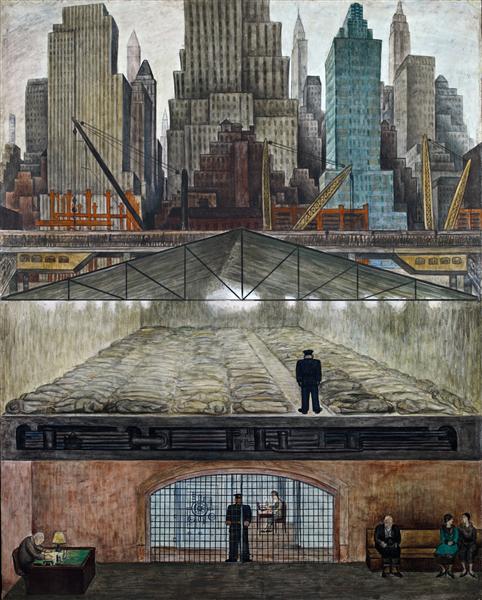
Afternoon Tea: Frozen Assets (1931)

This is from the communist Mexican artist Diego Rivera:

nol art rivera frozen assets 1931
Click here to zoom

Created during the Great Depression, this one is almost too predictable. It’s beauty alone, though, makes it worthy of an afternoon with tea.

Here is more from NOL on the Great Depression.

Liberty and pro-choice arguments

Abortion never struck me as a liberty issue. Fundamental ideas that inform libertarian thinking don’t pick a “side” for or against abortion, late-term or otherwise. Abortion is a random issue. But my pro-choice credentials face greater and greater scrutiny as I pal around right-libertarians and conservatives, and I’ve had to re-investigate my own decision-making process here.

I find each political side — abortion jurisprudence — wholly unconvincing. When a sperm and egg becomes “life” is so outside thousands of colloquial years of the word, there’s nothing analytic in the definition to illuminate policy choices; I don’t think medical science is going to answer the philosophical question of the concept of “life” either (“clinical death” violates what should be commonsense notions of death); etcetera. And then, of course, the pro-choice camp (which emphasizes parental choice) rarely cares about parental choice afterward, like in education, and the pro-life camp is an absurdly broad name for their legitimate concerns. The philosophy of abortion is probably interesting — the politics is a waste of time.

Here is what, I think, enforces my libertarian advocacy of choice. I am probably more radically pro-choice than most people I know, but this provides a basic defense.

If the question of whether or not life is “worth it” is a sensible question in the first place, then it is not one that can be answered a priori. Life is an inherently qualitative experience. This is clear enough by the fact that some people would rather choose to have died at age 60 after having lived to age 80, if we take their judgment as the best authority on their own life’s worth (and I do, and I think we should). Therefore, in advance, its not knowable if a person’s life will be worth it. People generally do enjoy living (more than they would otherwise?); this might not be the case if, for instance, the Nazis won and we all were born in camps. This is an accidental property of the current world. We live in a generally worthwhile time period, suggesting life is generally going to be determined to be worth it by each individual.

Since the worth of life is not a priori, the best guess in advance is that from local knowledge. Parents have the most local knowledge about the future of their child’s immediate life, before it gets unpredictable and the knowledge gets divided by millions of individuals who will impact their life and also understand ongoing trends. Therefore, parents are the best option to make a judgment call about whether or not their child’s life will be worth it — if they can care for it, if they will have a genetic problem, etc. Not politicians. Not voters. Not interest groups concerned with in utero life in the abstract.

Thus, parental choice.

It’s been said this is an “anti-human” argument. Lots of us came from lower income or impoverished households, myself included. Our lives are still found worthwhile. Why strawman, as if we’re in countries with terrible childhood obesity, malnutrition, drug addiction, gang violence?

It’s true that in general life is found to be worthwhile. But there’s no Leibniz-like principle that it must be. Nor does the aggregate data that people do, often, qualify life as worth living, mean that random individuals overcome parental ownership of the best localized knowledge.

This, I think, is a libertarian argument for choice. It depends on the point that abortion is a unique sort of event — we’re not talking about an old man’s caretaker, who must have the best local knowledge about whether or not we should pull the plug. The question need not arise about who makes important choices once someone is cognizant and autonomous. The argument rides on the point that there’s a vacuum in decision-making autonomy for fetuses by their very intrinsic nature, and we have to make proxy choices in advance.

We give parents plenty of other choices by law. When we are debating potential- or possible-beings still in the womb, before our language game definitively identifies them as “alive,” choice should default to the parents, and I should have no right to the woman’s body to make choices for her about a possible-being I will never see, feed, care for or otherwise worry about except to force the woman to take care of it for nearly two decades.

Afternoon Tea: Le Coq (1938)

A Picasso:

nol art picasso le coq 1938
Click here to zoom

This one is in a private collection somewhere…

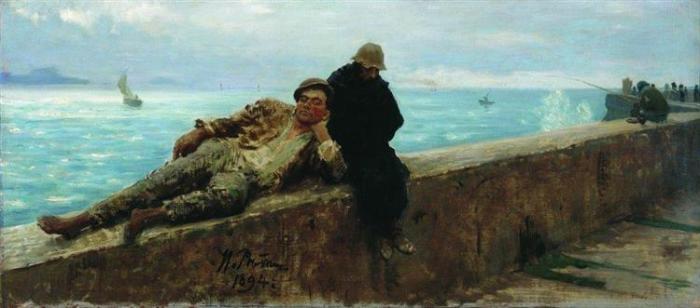
Afternoon Tea: Tramps. Homeless. (1894)

From the estimable Russian artist Ilya Repin:

nol art repin tramps homeless 1894
Click here to zoom

If anybody knows where this is displayed today, please let me know either by email or simply in the ‘comments’ section.

Middle-class: questioning the definitions

  Vestis virum (non) redit

                                                                                    ~ Latin proverb

As Brexit drags on, there is a reassessment occurring of Margret Thatcher and her legacy. After all, in addition to being a stalwart defender of free markets, free enterprise, and free societies, she helped design the EEC, the precursor to the EU. So in the process of leaving the EU, there is a lingering question regarding whether the referendum is a rejection of Thatcher’s legacy. Those who equate the referendum with a repudiation of Thatcher offer explanations along the lines of: “Thatcher destroyed the miners’ way of life [NB: this is a retort spat out in a debate on the freedom-vs.-welfare split in the Leave faction; it has been edited for grammar and clarity.].” Sooner or later, Thatcher-themed discussions wend their way to the discontents of capitalism, especially the laissez-faire variety, in society, and the complaints are then projected onto issues of immigration, sovereignty, or globalism. 

On the other side of the Atlantic, Tucker Carlson’s January 2 polemical monologue contained similar sentiments and provoked a response that proved that the same issues have divided America as well. Much of Carlson’s complaints were predicated on the concept of “way of life,” and here lies a dissonance which has meant that swaths of society talk without understanding: merely possessing a way of life is not equal to having values. In all the discussion of the “hollowing out of the middle-class,” one question is never raised: What is the middle-class?

It is only natural that no one wants to ask this question; modern society doesn’t want to discuss class in a real sense, preferring to rely on the trite and historically abnormal metric of income. To even bring up the C- word outside of the comfortable confines of money is to push an unspoken boundary. Although there is an exception: if one is speaking of high-income, or high-net-worth individuals, it is completely acceptable to question an auto-definition of “middle-class.” Everyone can agree that a millionaire describing himself as middle-class is risible. 

It is the income dependent definition that is the source of confusion. The reality is that modernity has conflated having middle income with being middle-class. The two are not one and the same, and the rhetoric surrounding claims of “hollowing out” is truly more linked to the discovery that one does not equal the other. 

In his The Suicide of the West, Jonah Goldberg wrote on the subject of the back history of the Founding Fathers:

[….] British primogeniture laws required that the firstborn son of an aristocratic family get everything: the titles, the lands, etc. But what about the other kids? They were required to make their way in the world. To be sure, they had advantages – educational, financial, and social – over the children of the lower classes, but they still needed to pursue a career. “The grander families of Virginia – including the Washingtons – were known as the ‘Second Sons,’” writes Daniel Hannan [Inventing Freedom: How the English-Speaking Peoples Made the Modern World (HarperCollins, 2013)]. [….]

In fact, Hannan and Matt Ridley [The Rational Optimist: How Prosperity Evolves (Harper, 2010] suggest that much of the prosperity and expansion of the British Empire in the eighteenth century can be ascribed to an intriguing historical accident. At the dawn of the Industrial Revolution, the children of the affluent nobility had a much lower mortality rate, for all the obvious reasons. They had more access to medicine, rudimentary as it was, but also better nutrition and vastly superior living and working conditions than the general population. As a result, the nobility were dramatically more fecund than the lower classes. Consequently, a large cohort of educated and ambitious young men who were not firstborn were set free to make their way in the world. If you have five boys, only one gets to be the duke. The rest must become officers, priests, doctors, lawyers, academics, and business men.

Goldberg concisely summarized the phenomenon which Deirdre McCloskey argues created the original middle-class. But more importantly, Goldberg’s history lesson emphasizes that the origins of America, from an idea to a reality, have a deep socio-cultural angle, one that is tied to status, property rights, and familial inheritance, that is often lost in the mythology.

As Goldberg explained, the complex, painful history of disenfranchisement due to birth order was the real reason the Founding Fathers both opposed the law of entail while simultaneously focusing almost myopically on private property rights in relation to land. As Hernando de Soto studied in his The Mystery of Capital, George Washington, who held land grant patents for vast, un-surveyed tracts in Ohio and Kentucky, was horrified to discover that early settlers had established homesteads in these regions, before lawful patent holders could stake their claims. Washington found this a violation of both the rule of law and the property rights of the patent holders and was open to using military force to evict the “squatters,” even though to do so would have been against English common law which gave the property to the person who cleared the land (Washington was no longer president at that point, so there was no risk that the aggressive attitude he expressed in his letters would lead to real action.).   

Before repudiating Washington for his decidedly anti-liberty attitude on this score, we should turn to Deirdre McCloskey and her trilogy – The Bourgeois Virtues: Ethics for an Age of CommerceBourgeois Dignity: Why Economics Can’t Explain the Modern World, and Bourgeois Equality: How Ideas, Not Capital or Institutions Enriched the World – for an understanding on why this might be important, and why conflating way of life with social standing and identity is both fallacious and dangerous. 

Part II coming soon!

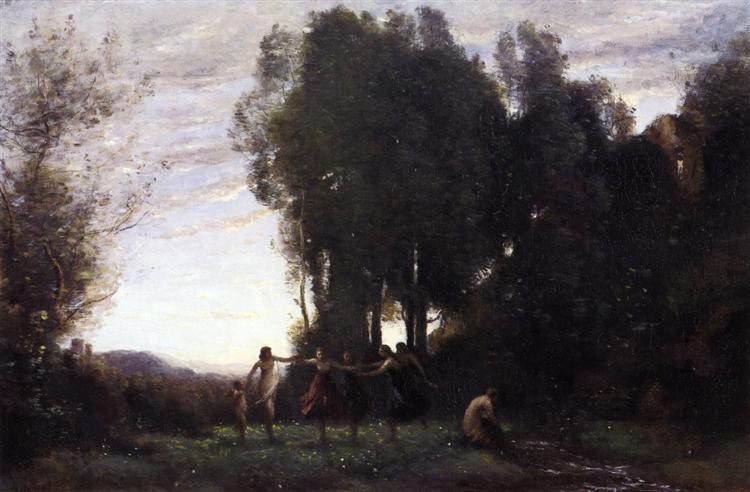
Afternoon Tea: Circle of Nymphs, Morning (1857)

From Camille Corot, a French painter from the 19th century:

nol art corot circle of nymphs morning 1857
Click here to zoom

I love mornings.

Government isn’t the only problem

Working in a college, I’m at the front lines of a significant problem: wasteful bullshit jobs. In fact, I am writing this post to procrastinate editing a bureaucratic report (that nobody cares about) that has been slowly grinding the joy out of my life for the past several months. I have to write this report for the benefit of regulatory oversight which, ironically, is supposed to ensure that I use my privileged position for the benefit of society instead of wasting my efforts on pointless or destructive outlets.

In my case, this bullshit aspect of my job is a predictable outcome of working in a state sponsored bureaucracy. But the same disease afflicts private industry too.

If I’m the head of a Fortune 500 company, I have incentive to increase profitability of my company, but I have competing interests too. Most importantly I have to maintain my position of power within the company. Bruce Bueno de Mesquita and coauthors have laid out the logic of the situation in The Dictator’s Handbook, and The Logic of Political Survival–in a nutshell, I have to worry about competition for positions of power within any hierarchy. This requires engaging in cooperative rent-seeking to keep the right people happy. If I don’t, I risk losing my position to a sycophant who will.

We shouldn’t be surprised to see Niskanenian logic show up in these situations. Corporate flunkies are like a private army that can help me keep my position of power even if they don’t contribute to the profitability of the firm. Even if I want to maximize profits, if I have to worry about keeping my position, I have to engage in some of this costly, inefficient rent-seeking.

In other words, “firms maximize profit” is an approximation that brushes aside methodological individualism. Don’t get me wrong, there’s evolutionary pressure on firms that will push in that direction. But within a firm there’s evolutionary pressure preventing the firm from fully maximizing. (In other other words, if I survive this report I’ll have to start reading up on corporate governance.)

This logic is a natural source of bullshit jobs, even in a free market. Regulatory capture should make it worse, but we’ll never completely eliminate it.

On a more speculative note, I think we also have to worry about culture. For one, our current culture drives the demand for increased regulation. For another, we prize work for work’s sake to the point that most people would rather see someone fritter away their brief experience as a sentient being than see them fail to live up to social expectations. Such notions, I think, are behind the surprising lack of riots in the street you might expect in a world where most people know we face this problem of bullshit jobs. But I’ll leave any further speculation for the comments.

tl;dr: Our economy is beset with bullshit jobs that sap our creative capacity and crush our souls. And pretty much everyone knows it. Government is part of the problem, partly because regulation creates demand for paper-pushing, and partly because anti-competitive regulation converts lively, profit-seeking firms into private bureaucracies in their own right. But there are deeper problems: our willingness to abide, and the fundamental logic of hierarchical organizations.

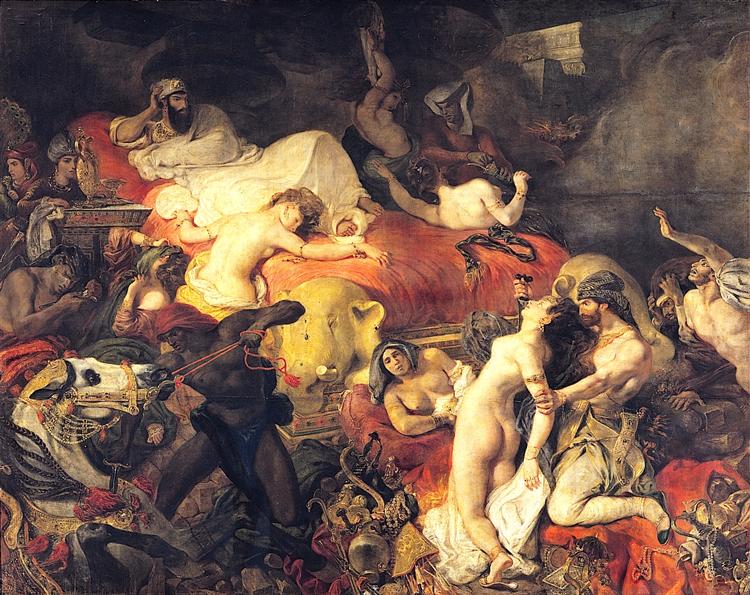
Afternoon Tea: Death of Sardanapalus (1827)

Delacroix requested Delacroix so, here you go:

nol art delacroix death of sardanapalus 1827
Click here to zoom

Bad Religion

The Heidelberg Catechism is one of my all-time favorite Christian documents. Written in 1563, mostly by Zacharias Ursinus, the Heidelberg (as it is sometimes called) is composed by 129 questions and answers (the classical format of a catechism), supposed to be studied in 52 Sundays (that is, one year). I believe it is very telling that, being a catechism, the Heidelberg was written thinking mostly about younger people, even children. Ursinus himself was only about 29 years old when he wrote it. Maybe it is a sign of the times we live in that the Heidelberg sounds extremely deep for most readers today.

Throughout its questions and answers, the Heidelberg covers mostly three Christian documents: The Ten Commandments, the Lord’s Prayer (“Our Father who art in Heaven…”) and the Apostle’s Creed. The catechism is also divided into three main parts: Our sin and misery (questions 3-11), our redemption and freedom (questions 12-85), our gratitude and obedience (86-129). Probably an easier way to remember this is to say that the Heidelberg is divided into Guilt, Grace, and Gratitude. That is also, according to many interpreters, the basic division of the Apostle Paul’s Letter to the Romans, historically one of the most important books in the Bible.

I mention all these characteristics about the Heidelberg Catechism because I think they are worth commenting on. As I learned from a friend, that is the Gospel: Guilt, Grace, and Gratitude. As C.S. Lewis observed in Mere Christianity, Christians are divided on how exactly this works, but all agree that our relationship with God is strained. That is the guilt. However, in Jesus Christ, we can restart a peaceful relationship with God. That is the grace. This should be followed by a life of gratitude. That is the way the Gospel is good news. If you don’t emphasize these three points you are not really presenting the Biblical gospel. To talk about grace without talking about guilt is nonsense. To talk about guilt and not grace is not good news at all. To talk about guilt and grace but not of gratitude is antinomianism. To talk about gratitude (or obedience) without talking about guilt and especially grace is legalism. But also, notice how unbalanced the three main parts are: Ursinus dedicated way more space for grace and gratitude that he did for guilt.

That’s not accidental. Also, it is very interesting that he talks about the Ten Commandments when he is dealing with gratitude. It didn’t have to be this way. Ursinus could have included the Law when talking about guilt. He could use the law to show how miserable we are for not fulfilling it. But instead, he wanted to show that obeying God is a sign of gratitude. You are free already. Obeying will not make you any more saved. But it is certainly the behavior of a truly restored person.

If you read so far, I should first thank you for your attention, but also say that I am completely unapologetic for speaking so openly on Christian themes. At some point in history, Christians decided to adapt to the modern culture. That was the birth of Christian Liberalism. Modern man, some of them assumed, could no longer believe in stories of gods and miracles. Modern science was able to explain things that societies in the past thought to be supernatural occurrences. The Bible was at worst pure nonsense or at beast a praiseful reflection of the piety of people in the past, but certainly not a supernatural revelation from God. But if you take away the supernatural elements of the Bible, what do you have left? Good morals, some thought. I believe they were wrong.

The social gospel is one consequence of Christian liberalism. The central miracle in the Bible is that Jesus, a mortal man, was dead for three days and resurrected. That is indeed a miracle. Make no mistake: people in the first century knew as well as we do that people don’t come back to life after three days. Maybe they knew it better than we do, for in the 21st century, for many of us, death is not a part of everyday life. For them, it certainly was. Christians have believed through almost two thousand years that Jesus’ death and resurrection have something to do with us being reconciled to God. But if Jesus didn’t resurrect, and no one really heard from God that he is angry, what do we have left? The answer, according to Christian liberals, is social justice. Reform society. I believe that for this, they own society at large an apology, and I will explain why.

I heard from too many people that the reason they don’t go to church is that Christians are hypocrites. “Do as I say, but not as I do”. Maybe they are right. The balance between guilt, grace, and gratitude if fundamental for Christianism to work. Salvation (reestablishing a rightful relationship with God) is by grace, not by works. Say that salvation is by works and you set the board in a way that you are sure to lose. As I already mentioned, I think it is just wonderful that the Heidelberg Catechism talks about the Law of God (The Ten Commandments) when it is discussing gratitude, not guilt, and I believe this is a great lesson for us today.

I say all this today because I believe that political correctness is (at least to a great degree) the bastard son (or daughter) of the social gospel. See the recent Gillette commercial that caused so much controversy, for example. Are they really saying anything wrong? Don’t men behave sometimes in ways that are less than commendable? I believe we do. Especially coming from a Latino culture as I do, I am more than willing to say that men all too often are disrespectful towards women and also towards other men. However, how the people at Gillette know this? If there is no God, or if he didn’t speak, how can you tell what is ethically commendable behavior and what is not?

I am no specialist, but as far as I know, more than enough atheist philosophers are willing to admit that in a sole materialist worldview there are no universal grounds for morality. As the poet said, “if there is no God, then all things are permissible”. It is always important in a conversation like this to explain that I am not saying that atheists cannot be ethical people. That is absolutely not what I am saying. Some of the best people I ever met were atheists. Some of the worst were Christians who were at church every single Sunday. With that explained, what I am saying is that there is no universal guide for human behavior if there is no God and everything just happened by chance. There are particular guides, but not a universal one, and to adhere to them is really a matter of choice.

The way that I see it, people at Gillette want men to feel bad and to change their behavior. They want men to feel guilty and to have gratitude. But where is the grace? I believe that is why this commercial irritated so many people. It makes people at Gillette look self-righteous or legalistic. Or both! But it definitely doesn’t help men to change their ways, supposing that there is something to change. I believe there is. There is a lot to change! But political correctness is not the way to do it.
Afternoon Tea: No Kakinomoto Hitomaro (1835)

From Japanese artist Katsushika Hokusai:

nol art hokusai no kakinomoto hitomaro 1835
Click here to zoom

This one can be found at the Guimet Museum in Paris, in case you’re ever there…

Afternoon Tea: Portrait of pianist and professor of Saint Petersburg Conservatory Sophie Menter (1887)

From Ilya Repin, a painter from the Russian Empire:

nol art repin sophie menter 1887
Click here to zoom

Afternoon Tea: The Calling of Saint Matthew (1600)

From Caravaggio, one of Jacques’ favorites:

nol art caravaggio calling of saint matthew
Click here to zoom

Why I turned right

I understand things are not the same everywhere in the World, but until just a few years ago, to call yourself “right-wing” in Brazil was virtually unthinkable. The reasons for that are not totally clear, but the fact is that “right-wing” was a name with a very bad connotation. Brazil went through a military dictatorship from 1964 to 1985. This dictatorship was set in place to prevent a perceived communist threat in the country, especially after the Cuba Revolution of 1959. Therefore, it was an anticommunist dictatorship.

My understanding is that, because of that, to be “right-wing” in Brazil was understood as “being in favor of dictatorship”, and left-wing to be “for democracy”. Of course, examining things with just a little more care, nothing could be further from the truth. Fidel Castro and Che Guevara were no democrats. Actually, the military dictatorship in Cuba lives on. Mao Zedong was a horrendous dictator. So were Stalin and Lenin. There is no reason to believe that Trotsky would have been any less authoritarian.

There is no reason to believe that the socialists/communists in Brazil would have been democratic once in power. But they didn’t come to power, and because of that people could fuel the romantic image of revolutionaries unjustly persecuted by the military. Although I disagree with Brazilian philosopher Olavo de Carvalho in many points, I believe he is totally right on this: the military in Brazil was great in fighting the communist guerrilla. Thanks to them, we don’t have something similar to FARC in Brazil today. But when it came to propaganda and cultural war they were just awful. Communists in Brazil (and in other places) were great in selling the image of Che Guevara as a romantic hero fighting against the evil North-American Imperialism.

And this is the paradigm I grew up with. Either you are a freedom fighter, opposing evil capitalists and imperialism, or you are subservient to foreign powers and injustice. Considering this background, of course, nobody would like to be called right-wing. However, things changed.

One of the things that made me turn right was studying the right-wing political ideologies. I discovered that classical liberals and conservatives were not against the poor, just the opposite. The best example I can think of is Adam Smith: his Wealth of Nations is actually a love letter for those who are oppressed by unjust economic exploitation. What Adam Smith was trying to find out is what makes the lives of the simple people better. His answer, in a nutshell, was the free market. Similarly, the Founding Fathers were trying to give the common folk a better living without oppression. And they did. Very different from all the leftist revolutions. In short, free markets and liberal democracy work.

The second thing that made me turn right was the hypocrisy of some leftists. I realized that they want you to have freedom of choice, but only if you choose what they want. If you feel you have homosexual inclinations, they want you to have the freedom to embrace homosexuality. And so do I! But God forbid (or Marx forbid) you decide (for whatever reason) to fight homosexuality and become (or remain) straight.  They want women to have the freedom to get jobs. But they don’t want them to have the freedom to stay home to raise the kids. The examples are many, but the summary is this: I realized that many leftists are not ready to defend your right to be different.

I’m really sorry that things come down to what two consenting adults do in a closed room. I really am. But it seems to me that much of the leftist agenda is to have the freedom to choose only if you choose what they want. And this is what made me turn right: to accept other peoples choices as much as I want them to accept mine. Liking it or not.

Afternoon Tea: Town on the Blue River (1910)

This is from the Austrian painter Egon Schiele:

nol art schiele town on the blue river 1910
Click here to zoom

Schiele was a buddy of Gustav Klimt’s but he died at the age of 28 in the Spanish flu pandemic.