Mid-Week Reader: The Justice of US Intervention in Syria

I’d like to announce a new weekly series of posts that I will be making: the Mid-Week Reader. Every Wednesday (hopefully), I will post a series of articles that I find interesting. Unlike most ventures in micro-blogging, though,  I will try to make all the articles focus on a specific topic rather than leave you with a random assortment of good articles (which Branden already does so well most weekends). This week’s topic: with Trump bombing Syria last week despite ostensibly being a dove (hate to say I told you so), I give you a series of articles on the justice, historical background, and press reaction to the bombing.

  • Fernando Terson and Bas van der Vossen, who are co-authoring on the topic of humanitarian intervention, each have interesting pieces at Bleeding Heart Libertarians debating the bombing of Syria from the perspective of Just War Theory. Terson argues that it was just, Vossen disagrees.
  • Over at The American Conservative, John Glasser of the Cato Institute has an article arguing that Trump’s invasion is neither legally authorized nor humanitarian.
  • Any discussion of foreign policy is incomplete without Chris Coyne’s classic paper “The Fatal Conceit of Foreign Intervention,” a political-economic analysis of foreign policy which concludes all sorts of foreign intervention are likely to fail for similar reasons that socialist economic intervention fails.
  • As perhaps a case study of Coyne’s analysis, Kelly Vee of the Center for a Stateless Society has an article summarizing the history of United States’ actions in Syria going back to World War II and how it’s gotten us into the current situation.
  • At Vox, Sean Illing interviews CUNY professor of journalism Eric Alterman on how the press fails to critically assess military intervention.

Immigration, Cultural Change, and Diversity as a Cultural Discovery Process

I have spent a couple of posts addressing various spurious economic and fiscal arguments against looser immigration restrictions. But, as Brandon pointed out recently, these aren’t really the most powerful arguments for immigration restrictions. Most of Donald Trump’s anti-immigrant rhetoric revolves around strictly alleged cultural costs of immigration. I agree that for all the economic rhetoric used in these debates, it is fear of the culturally unfamiliar that is driving the opposition. However, I still think the tools of economics that are used to address whether immigration negatively impacts wages, welfare, and unemployment can be used to address the question of whether immigrants impact our culture negatively.

One of the greatest fears that conservatives tend to have of immigration is the resulting cultural diversity will cause harmful change in society. The argument goes that the immigrant will bring “their” customs from other countries that might do damage to “our” supposedly superior customs and practices, and the result will be a damage to “our” long-held traditions and institutions that make “our” society “great.” These fears include, for example, lower income immigrants causing higher divorce rates spurring disintegration of the family, possible violence coming from cultural differences, or immigrants voting in ways that are not conducive to what conservatives tend to call “the founding principles of the republic.” Thanks to this insight, it is argued, we should restrict immigration or at least force prospective immigrants to hop through bureaucracy so they may have training on “our” republican principles before becoming citizens.

There are a number of ways one may address this argument. First, one could point out that immigrants face robust incentives to assimilate into American culture without needing to be forced to by restrictive immigration policies. One of the main reasons why immigrants come to the United States is for better economic opportunity. However, when immigrants are extremely socially distant from much of the native population, there a tendency for natives to trust them less in market exchange. As a result, it is in the best interest of the immigrant to adopt some of the customs of his/her new home in order to reduce the social distance to maximize the number of trades. (A more detailed version of this type of argument, in application to social and cultural differences in anarchy, can be found in Pete Leeson’s paper Social Distance and Self-Enforcing Exchange).

The main moral of the story is that peaceable assimilation and social cohesion comes about through non-governmental mechanisms far more easily than is commonly assumed. In other words, “our” cultural values are likely not in as much danger as conservatives would have you think.

Another powerful way of addressing this claim is to ask why should we assume that “our” ways of doing things is any better than the immigrant’s home country’s practices? Why is it that we should be so resistant to the possibility that culture might change thanks to immigration and cultural diversity?

It is tempting for conservatives to respond that the immigrant is coming here and leaving his/her home, thus obviously there is something “better” about “our” cultural practices. However, to do so is to somewhat oversimplify why people immigrate. Though it might be true that, on net, they anticipate life in their new home to be better and that might largely be because “our” institutions and cultural practices are on net better, it is a composition fallacy to claim that it follows from this that all our institutions are better. There still might be some cultural practices that immigrants would want to keep thanks to his/her subjective value preferences from his or her country, and those practices very well might be a more beneficial. This is not to say our cultural practices are inherently worse, or that they are in every instance equal, just that we have no way of evaluating the relative value of cultural practices ex ante.

The lesson here is that we should apply FA Hayek’s insights from the knowledge problem to the evolution of cultural practices in much the way conservatives are willing to apply it to immigration. There is no reason to assume that “our” cultural practices are better than foreign ones; they may or may not be, but it is a pretense of knowledge to attempt to use state coercion to centrally plan culture just as it is a pretense of knowledge to attempt to centrally plan economic production.

Instead of viewing immigration as a necessary drain on culture, it may be viewed as a potential means of improving culture through the free exchange of cultural values and practices. In the market, individuals are permitted to experiment with new inventions and methods of production because this innovation and risk can lead to better ways of doing things. Therefore, entrepreneurship is commonly called a “discovery process;” it is how humanity may ‘discover’ newer, more efficient economic production techniques and products.

Why is cosmopolitan diversity not to be thought of as such a discovery process in the realm of culture? Just as competition between firms without barriers to entry brings economic innovation, competition between cultural practices without the barrier to entry of immigration laws may be a means of bettering culture. When thought of in that light, the fact that our cultural traditions may change is not so daunting. Just as there is “creative destruction” of firms in the marketplace, there is creative destruction of cultural practices.

Conservative critics of immigration may object that such cultural diversity may cause society to evolve in negative ways, or else they may object and claim that I am not valuing traditions highly enough. For the first claim, there is an epistemic problem here on how we may know which cultural practices are “better.” We may have our opinions, based on micro-level experience, on which cultural practices are better, and we have every right to promote those in non-governmental ways and continue to practice them in our lives. Tolerance for such diversity is what allows the cultural discovery process to happen in the first place. However, there is no reason to assume that our sentiments towards our tradition constitute objective knowledge of cultural practices on the macro-level; on the contrary, the key insight of Hayek is it is a fatal conceit to assume such knowledge.

As Hayek said in his famous essay Why I’m Not a Conservative:

As has often been acknowledged by conservative writers, one of the fundamental traits of the conservative attitude is a fear of change, a timid distrust of the new as such, while the liberal position is based on courage and confidence, on a preparedness to let change run its course even if we cannot predict where it will lead. There would not be much to object to if the conservatives merely disliked too rapid change in institutions and public policy; here the case for caution and slow process is indeed strong. But the conservatives are inclined to use the powers of government to prevent change or to limit its rate to whatever appeals to the more timid mind. In looking forward, they lack the faith in the spontaneous forces of adjustment which makes the liberal accept changes without apprehension, even though he does not know how the necessary adaptations will be brought about. It is, indeed, part of the liberal attitude to assume that, especially in the economic field, the self-regulating forces of the market will somehow bring about the required adjustments to new conditions, although no one can foretell how they will do this in a particular instance.

As for the latter objection that I’m not valuing tradition, what is at the core of disagreement is not the value of traditions. Traditions are highly valuable: they are the cultural culmination of all the tacit knowledge of the extended order of society and have withstood the test of time. The disagreement here is what principles we ought to employ when evaluating how a tradition should evolve. The principle I’m expressing is that when a tradition must be forced on society through state coercion and planning, perhaps it is not worth keeping.

Far from destroying culture, the free mobility of individuals through immigration enables spontaneous order to work in ways which improve culture. Immigration, tolerance, and cultural diversity are vital to a free society because it allows the evolution and discovery of better cultural practices. Individual freedom and communal values are not in opposition to each other, instead the only way to improve communal values is through the free mobility of individuals and voluntary exchange.

The Enforcement Costs of Immigration Laws are Greater than Alleged Welfare Costs

As I mentioned in my note yesterday, the common argument that immigration is significantly costly through welfare is mostly empirically falsified. The fact of the matter is immigrants usually aren’t qualified for such programs, illegal immigrants mostly cannot and do not receive them, and immigrants as a whole wind up contributing more to the government’s balance sheet through economic growth and tax receipts than they take through welfare transfer payments.

However, there is one fact I neglected to mention yesterday worthy of its own post: if those opposed to immigration on the grounds of welfare costs were really sincere in that argument, they also need to consider the fiscal costs of enforcing their beloved immigration laws. As the New York Times editorial board pointed out yesterday, these costs are not insignificant:

The Migration Policy Institute reported in 2013 that the federal government spends more each year on immigration enforcement–through Immigration and Customs Enforcement and the Border Patrol–then on all other federal law enforcement agencies combined. The total has risen to more than $19 billion a year, and more than $306 billion in all since 1986, measured in 2016 dollars. This exceeds the sum of all spending for the Federal Bureau of Investigation; the Drug Enforcement Administration; the Secret Service; the Marshals Service; and the Bureau of Alcohol, Tobacco, Firearms, and Explosives.

These fiscal costs get worse when you consider that Donald Trump wants to expand ICE’s budget even further and, of course, the $8-$12 billion dollar wall.

Further, if you are a civil liberties type concerned with the social and fiscal costs of mass incarceration, immigration enforcement looks even bleaker:

ICE and the Border Patrol already refer more cases for federal prosecution than the entire Justice Department, and the number of people they detain each year (more than 400,000) is greater than the number of inmates being held by the Federal Bureau of Prisons for all other federal crimes.

The war on immigrants makes the war on drugs look tame.

Of course, these costs are pretty small when compared to the welfare state, but immigrants are not the ones driving up those welfare costs and they might even reduce it with more tax receipts. The truth is that furthering immigration restrictions and enforcement is truly fiscally irresponsible, not respecting the right to freedom of movement and contract.

Welfare Costs are not a Good Argument Against Immigration

Note: A version of this was initially posted on my old, now defunct blog. However, has become increasingly relevant in the age of Trump, and is worthy of reconsideration now.

It’s one of the most common arguments against looser immigration going back to Milton Friedman to Donald Trump. It is commonly claimed that even though loosening immigration restrictions may be economically beneficial and just, it should be opposed due to the existence of the welfare state. Proponents of this claim argue that immigrants can simply come to this country to obtain welfare benefits, doing no good for the economy and adding to budget deficits.

Though this claim is on its face plausible, welfare is not nearly as much of a compelling reason to oppose immigration as so many argue. It is ultimately an empirical question as to whether or not the fiscal costs of immigration significantly outweigh the fiscal benefits of having more immigrants pay taxes and more tax revenue economic growth caused by immigration.

Before delving into the empirical studies on the matter, there is one very important fact that is too often neglected in these discussions: there are already heavy laws restricting all illegal immigrants and even the vast majority of legal ones from receiving Welfare. As the federal government itself–specifically the HHS–notes:

With some exceptions, “Qualified Aliens” [ie., legal immigrants] entering the country after August 22, 1996, are denied “Federal means-tested public benefits” for their first five years in the U.S. as qualified aliens.

If we were to allow more immigrants, there are legal mechanisms stopping them from getting welfare. There are some exceptions and even unlawful immigrants occasionally slip through the cracks, but this is already a major hole in the case that welfare means we should hold off on immigration reform. The vast majority of immigrants cannot receive welfare until years after they are legalized.

However, for the sake of argument, let us ignore that initial hole in the case against increased immigration. Let’s generously assume the majority of immigrants–legal and illegal–can somehow get their hands on welfare. There is still little reason to expect that additional immigrants would be any more of a fiscal drag on welfare programs for the vast majority of our population simply because they are not the type of people who typically wind up on welfare. Our welfare programs are primarily designed to protect a select few types of people: the sick and elderly (Social Security and Medicare), and women and children (SCHIP, SNAP, TAMPF, etc.) If one looks at the demographics of immigrants coming into the country, however, one finds that they do not fit in the demographics of those who typically qualify for welfare programs. According to the Census Bureau, the vast majority (75.6%) of the total foreign-born population (both legal and illegal immigrants) are of working age (between 25 and 65).  Most immigrants, even if they were legal citizens, would not qualify for most welfare programs to begin with.

On the other hand, poverty rates are higher among immigrants and that means more would qualify for poverty-based programs. However, most immigrants are simply not the type to stay in those programs. Contrary to common belief, immigrants are mostly hard-working innovators rather than loafing welfare queens. According to Pew Research, 91% of all unauthorized immigrants are involved in the US labor force. Legal immigrants also start businesses at a higher rate than natural born citizens and file patents at almost double the rate of natives. As a result, immigrants have fairly high social mobility, especially intergenerationally, and so will not stay poor and on welfare all that long.

Put it together, and you find that immigrants generally use many major welfare programs at a lower rate than natives. Immigrants are 25% less likely to be enrolled in Medicare, for example, than citizens and actually contribute more to Medicare than they receive while citizens make Medicare run at a deficit. From the New York Times:

[A] study, led by researchers at Harvard Medical School, measured immigrants’ contributions to the part of Medicare that pays for hospital care, a trust fund that accounts for nearly half of the federal program’s revenue. It found that immigrants generated surpluses totaling $115 billion from 2002 to 2009. In comparison, the American-born population incurred a deficit of $28 billion over the same period

Of course, nobody would advocate restrictions on how many children are allowed to be born based on fiscal considerations. However, for some reason the concern becomes a big factor for immigration skeptics.

If you are still not convinced, let us go over the empirical literature on how much immigrants cost fiscally. Some fairly partisan studies, such as this one from the Heritage Foundation (written by an analyst who was forced to resign due to fairly racist claims), conclude that fiscal costs are very negative. The problem, however, is that most of these studies fail to take into account the dynamic macroeconomic impact of immigration. Opponents of immigration, especially those at the Heritage Foundation, generally understand the importance of taking dynamic economic impacts of policy changes into account on other issues, e.g. taxation; however, for some (partisan) reason fail to apply that logic to immigration policies. Like taxes, immigration laws change people’s behavior in ways that can increase revenue. First of all, more immigrants entering the economy immediately means more revenue as there are more people to tax. Additionally, economic growth from further division of labor provided by immigration increases tax revenue.  Any study that does not succeed in taking into account revenue gains from immigration is not worth taking seriously.

Among studies that are worth taking seriously, there is general consensus that immigrants are either a slight net gain fiscally speaking, a very slight net loss or have little to no impact. According to a study by the OECD of its 20 member countries, despite the fact that some of its countries have massive levels of immigration, the fiscal impact of immigration is “generally not exceeding 0.5 percent of G.D.P. in either positive or negative terms.” The study concluded, “The current impact of the cumulative waves of migration that arrived over the past 50 years is just not that large, whether on the positive or negative side.”

Specifically for the United States, another authoritative study in 1997 found the following as summarized by David Griswold of the Cato Institute:

The 1997 National Research Council study determined that the typical immigrant and descendants represent an $80,000 fiscal gain to the government in terms of net present value. But that gain divides into a positive $105,000 fiscal impact for the federal government and a negative $25,000 impact on the state and local level (NRC 1997: 337).

Despite the slight negative impact for states, as Griswold notes, there is no correlation between immigration and more welfare for immigrants:

Undocumented immigrants are even more likely to self-select states with below-average social spending. Between 2000 and 2009, the number of unauthorized immigrants in the low-spending states grew by a net 855,000, or 35 percent. In the high-spending states, the population grew by 385,000, or 11 percent (U.S. Census 2011; NASBO 2010: 33; Passel and Cohn 2011). One possible reason why unauthorized immigrants are even less drawn to high-welfare-spending states is that, unlike immigrants who have been naturalized, they are not eligible for any of the standard welfare programs.

The potential fiscal impact of immigration from the Welfare state is not a good reason to oppose it at all. There are major legal barriers to immigrants receiving welfare, immigrants are statistically less likely to receive welfare than natives for demographic reasons, and all the authoritative empirical evidence shows that immigrants are on net not a very significant fiscal drag and can, in fact, be a net fiscal gain.

Why did the Pseudo-Libertarians Bring a White Nationalist to ISFLC in the first place?

This weekend I attended the International Students for Liberty Conference in DC, the largest global meeting of libertarian students, professionals, and intellectuals. I was excited to meet a few friends I seldom get to see from across the world, listen to a few exciting talks by some of my favorite intellectual influences, such as Jonathan Haidt, Steve Horwitz, Edward Stringham, Sheldon Richman and the like. It was my third time attending the conference, and I always enjoy myself there.

However on Saturday afternoon, something that I did not want to see at all had reared its ugly face and even more hideous haircut: alt-right pseudo-intellectual think tank head and noted white nationalist blowhard Richard Spencer decided to come and troll us libertarians. I was just walking through the lobby when I looked over and saw him sitting at the hotel bar surrounded by a gang of ostensible thugs wearing “Make America Great Again” hats.

Now at this point, it is worth noting that Richard Spencer was in no way invited to this event by SFL in any official capacity. It is easy to be misled on this point as Spencer, being a complete fraud, had a sign next to him saying “Richard Spencer at ISFLC” as though he were invited. Immediately after seeing Spencer, I walked over to talk to some SFL staff who said he would not be allowed in the conference and, though he had every right to just hang out in a public space outside of the conference, he was in no way allowed in the conference itself.

Instead, Spencer was invited by a group calling themselves “The Hoppe Caucus,” named after noted bigot Hans-Hermann Hoppe. It is perhaps revealing that a bunch of students who want to invite a self-proclaimed white nationalist who does the Nazi salute to Trump and calls for “ethnic cleansing” of non-whites to a libertarian conference give themselves this name. The organizers were originally planning to invite Augustus Sol Invictus (the linked post was deleted) to do a similar event hijacking the conference, but were unable to pay for his travel. (The same Augustus Sol Invictus who was kicked out of a Libertarian Party Senate race for being a “neo-Nazi” who supports eugenics and participating in Satanic goat-sacrificing rituals.)

The “Hoppe Caucus” is nothing more than a Facebook page started by a couple of alt-right crypto-fascists masquerading as libertarians surrounding websites like the oxymoronically named The Liberty Conservative and the grossly misnamed trashy click-bait site  Liberty Hangout. I do have the misfortune of knowing a couple of the people who were involved in organizing Spencer. Only one of whom at any point in any official capacity associated with SFL as a low-level campus coordinator, and is mostly associated with YAL as a state chair and various other alt-right blogs. He shall remain unnamed as, from what I’ve seen, he’s been too cowardly to explicitly associate himself with the group publicly. Notably, he also recently left SFL’s CC program after some SFL staffers were blocking him from bringing Augustus. Another is a former YAL chapter leader who is now doing work with a number of right-wing think tanks in the midwest and writes for the Liberty Conservative, whose name is Mitchell Steffen.

I stood around at a distance observing Richard Spencer and the growing crowd around him, it appeared to me to be fairly standard relatively boring tone of conversations that happen at the conference, just with the notable difference of a fair amount of complete bigotry and Nazism. I went downstairs and decided not to feed the trolls. But about a half an hour to forty minutes later, I heard that Jeffery Tucker of the Foundation for Economic Education, a conference speaker who was actually invited there, went upstairs to confront Richard Spencer. You can watch a recording of the exchange here. After the conversation got heated, hotel security intervened and kicked Spencer out of the venue. As Robby Soave notes in Reasonsome have reported that Spencer requested for security to escort him out, though it is unclear if that is the case (there is at least one video, see around 40:33 which seems to suggest Spencer asked for security, though was being kicked out).

Now, to combat further misinformation put out by the same group of complete liars who brought Spencer at the Liberty Conservativeno, Richard Spencer did not “nearly start a riot.” Meanwhile in reality, while Tucker was visibly upset, he did not threaten nor engage in violence at all, nor did any other attendee at the conference. First, Spencer and Tucker talked for nearly twenty minutes without any physical altercation, and Tucker arrived after nearly an hour of peaceful discussion between Spencer and some students. You can watch the videos linked above for proof. If merely getting impassioned in a debate is “nearly a riot,” these Hoppe occultists are the true snowflakes who need a safe space.

Further, Tucker and the other attendees were not upset because Spencer “merely show[ed] up in the Hotel Bar.” We were upset because these frauds dishonestly put up a sign implying that Spencer was invited and was there in an official capacity. In order to attend, one needed to pay a registration fee for the conference, which Spencer didn’t, and needed to be invited to be a speaker, which he wasn’t. He was committing fraud and attempting to disrupt a peaceful private event, if he went unchallenged the press (like Liberty Conservative’s fact-free report implies) would assume he was invited there officially. Additionally, it is a complete lie to say that around fifty attendees was “one of the best attended breakouts” at the conference, of all the breakouts I attended the smallest was around 45 (Stringham’s lecture) and most were well above 150 (eg., Haidt’s lecture and Caplan and Wilkinson’s Basic Income debate). I know you alt-righters love your alternative facts, but just because you can put them on your dumpy little click-bait site doesn’t make them true.

Regardless of the reality of the situation, some pseudo-libertarians have rushed to Spencer’s defense saying Tucker reacted in a hyperbolic fashion and didn’t take Spencer’s right to free speech seriously. Some have even idiotically claimed that the “left libertarians” at SFL (I am one of the few, the majority of the conference attendees are not, by the way) used force to oust Richard Spencer. Somehow, when Tucker asserts the liberty and dignity of all human beings it’s some act of aggression because the fascist snowflakes didn’t like his tone, but if Hoppe fanboys demand that communists get thrown out helicopters and their homeboy Spencer demands the state ethnically cleanse black people, that’s hunky dory.

First, nobody from SFL ousted Spencer, he either left of his own accord because he couldn’t handle Tucker’s debate or the hotel kicked him out, which the hotel is well within its rights to do because of this thing these pseudo-libertarians have apparently forgotten called private property. Spencer intruded on a private event with the intention of misleading everyone about his involvement in it, Tucker cleared up Spencer’s and the Hoppe Caucus’ fraud, and the hotel kicked him off of their private property for trespassing. It’s amazing how these crypto-fascists think “free association” is primary if you’re a bigot who doesn’t want to serve a gay person a wedding cake, wants to “physically remove, so to speak” people they disagree with from society or is a racist who discriminates against black people. But when it comes to an actual libertarian not wanting a Nazi at their private event all of a sudden “free association” doesn’t matter because they can lazily caterwaul “free speech.” It’s almost like they don’t actually believe in free association unless you’re a white, straight Christian fascist like them.

Further, the idea that all ideas always get the same hearing is a gross misunderstanding of the point of free speech and the usefulness of public discourse in a liberal political order. The fact is, there is always an opportunity cost to inquiry. Racism, Nazism, white nationalism and the like were long ago proven to be continuously false and extremely dangerous, and it would be a misuse of intellectual resources to continually need to “engage with them.” This is for the same reason astronomers do not need to continually write academic papers disproving flat-earth conspiracy nutters, medical biologists do not need to continually refute anti-vaxxer cranks, and economists do not need to continually engage with erroneous labor theories of value in their original academic work. The intellectual resources of the community of inquiry can be better used by addressing new ideas that are actually relevant to our current situation, not by continually discussing with dogmatic cranks who spew pseudo-scientific lies about race.

Of course, it is arguable that this principle is not applicable in the current situation because ideas like Spencer’s have gained popularity, possibly in part because of a breakdown in discourse in the United States caused by some on the left refusing to engage in any serious discourse with anything they don’t agree with. This means one ought to write refutations of the odious seeds of the alt-right, like Tucker himself has done. But free speech, and even the necessity of engaging with an intellectual (or in this case, pseudo-intellectual) opponent does not mean you hand him the loudspeaker by inviting him to your conference, and it does not mean you let him defraud and defame you by pretending to be a part of a private event to which he was not invited. Just because a Nazi has the liberty right to free speech does not mean they have the claim right to oblige you to give them a platform for said speech. (The difference between claim-rights and liberty-rights is lost on both Hoppe fans and Hoppe himself.)

Even though I am happy that my libertarian peers stood up to Spencer at the conference, I think this is time for libertarians to engage in serious reflection. These weren’t just a group of odious, intellectually immature, adolescent edge-lords crashing an event. Though they were also that, this was a group of pugnacious kids who were to some extent legitimized by prominent student groups. One made it past the screening into SFL’s CC program, and while it is worth noting he’s one of a very few bad CC’s out of over a hundred across the country and is no longer a CC because SFL was stopping his excesses, the fact that he thought SFL would be a good platform for his nonsense and that he was a CC for this long (about six months) in the first place should cause some concern. Further, he and others involved are prominent in YAL, not only chapter presidents but even state chairs.

Why would a group of pretty overt fascists feel comfortable masquerading as libertarians and naming their fake news sites after the ideas of liberty? Why would they feel and think inviting a prominent neo-Nazi to a large libertarian event was a good idea in the first place? Why are pseudo-intellectual occultist hacks, snake-oil salesmen, bigots and conspiracy theorists like Milo, Molyneux, Cantwell, Hoppe, Alex Jones, and the like so revered by self-proclaimed “libertarians” in such large circles? Why, when I mention I’m a libertarian, do I feel the need to disassociate myself with so many other libertarian students who are newer to the movement? I think this points to a series of deep problems with the infrastructure of the “libertarian movement” as it exists, and I will chronicle them one by one: an overly intensive focus on activism, populism, a history of right-wing fusionism of various sorts, and immature contrarianism.

Activism
Activism is clearly something any political movement of any form is going to have to engage on at some level. By activism, here, I mean recruiting new people to your movement, spreading your ideas through popular culture, engaging a little in the political process and engaging in grass-roots movement building with activities like tabling, advertising for and organizing events, and the like. It’s something I’m admittedly not particularly good at nor do I enjoy doing it, so I do have reason to downgrade its importance on some personal level admittedly. However, I still believe that a number of student groups in the liberty movement–particularly YAL and to a lesser extent SFL–have put far more emphasis on it than is warranted, and I think it is doing legitimate damage to their cause.

Activism is all about the numbers–how many chapters did you start? how many emails did you get on your list from tabling? how many attendees do you have at your event? how many votes did your candidate get?–and not about the quality of participation or ideas–do your chapters actually do good work, if any at all? will the people you got on your email list ever actually engage with you? did your attendees at the event get anything meaningful or useful out of your event? did the voters actually vote for your candidate because he was good? Undoubtedly, the numbers are important–part of the reason why libertarianism was stifled for so long was high-quality white papers were just being written by think tanks and nobody would read them. However, lately numbers seem to be all that too many people in the development departments of political activist non-profits and think tanks and too many activists think about it alone. It’s all about quantity, not about quality.

YAL has next to no screening–at least that I’m aware of–for who can start a YAL chapter and who makes it up in their ranks. SFL, meanwhile, does have some screening and an application process for becoming a CC, but it’s still obviously pretty easy for alt-right entryists to make it pass that process. Because what seems to matter most to them–and all that seems to matter for YAL–is that they can brag that they have a hundred CCs and hundreds of YAL chapters. The result: you have a recently-resigned SFL campus coordinator and current YAL State Chair bringing a neo-Nazi to a prominent SFL event. Further, they train their activists to focus on these metrics and not metrics of quality (which they don’t even really provide often) for measuring their goals and success of their activism. The result: YAL presidents are trained not to worry that when they invited Milo to “#trigger” leftists that Milo said nothing even remotely related to libertarianism, or that the attendees of his event got nothing substantive out of it; all that mattered was that YAL scored a media-hit because their rabble were roused and their leftist ideological opponents were upset, and that they got a lot of attendees.

Now the reason for the focus on activism is understandable: it’s the easiest way to prove to your donors as an organization that their money is doable, and it is absolutely true that if you don’t have a readily available way to measure the success of your well-state goals means there’s no way to improve. Things like attendance numbers, number of email registrations, and number of chapters and media hits, are an easy way to do this. But when your activism has deteriorated in quality to the point that you have a bunch of entryist activists who are promoting ideas that are literally antithetical to your cause, when they–while representing your organization–are bringing Nazis to a libertarian event, maybe it’s time to reconsider the usefulness of your metrics. They are such a poor measure of quality and can easily be substituted for things like surveys of the attendees of the event for their perception on the event’s quality (IHS does this a lot, and I see SFL doing it more and more often). Further, why not train your activists not only to be activists but to be legitimately good ambassadors for your ideas, or even to be remotely familiar with the ideas they’re supposed to be promoting in the first place (which far too many activists are not beyond a very superficial level)?

Further, this activist mindset creates an in-your-face attitude almost akin to religious proselytizing. The activist thinks “I have the truth already and am now just looking to spread it” and uses in-your-face style evangelism to do so. That mindset is not likely to produce quality ideological ambassadors, but rather pugnacious little dogmatists. As my fellow Notewriter Brandon Christensen once noted in a Reason Papers article, it is at odds with the humility inherent in the libertarian ethos, but very much at home in morally chauvinist ideologies like fascism which Richard Spencer loves. It’s not surprising that YAL-style in-your-face activism is attracting the undesirables just because the type of social interaction it requires is not at home with the psychological mental state libertarianism requires, but is very at home with crypto-fascists like Hoppe.

Populism
I won’t spend a lot of time on this one since I spent ample time in an article on the dangers of populism to liberty last month. Suffice it to say, the events of this weekend reaffirms what I had to say in that article about how populism inherently will lack principles and turn into something nasty:

Because the main thing driving populist movements are “the people vs. the elites” rather than the core principles the movement tries to espouse, there’s good reason to think the base of that movement will abandon many of those principles as it grows simply on the basis that they have something similar to what “the elites” believe. It’s not surprising that many of the younger pseudo-libertarians who supported Ron Paul have since jumped on either the Trump or Sanders bandwagon, or, even worse, have defected into the crypto-fascist, dark corners of the alt-right (Stefan Molyneux and Chris Cantwell’s occultists are examples of this). Even left-wing populist movements often have abandoned leftist principles throughout history (the Jacobins in the French Revolution, for example).

Now add the pseudo-libertarians who have jumped on the Richard Spencer and Hans-Herman Hoppe bandwagon to the list of evidence for why populism is so toxic.

Right-Wing Fusionism
When libertarianism in its present form was first fomenting in the seventies, the biggest global conflict was between the communist Soviet Union and the United States. Further, at the time the biggest issues in domestic policy were about creeping state economic regulatory policy left over from the progressive era and social welfare programs with Johnson’s Great Society. All these were big issues for libertarian ideology so they formed a coalition with what was currently the biggest political opposition to those: the emerging post-war conservative movement. It was always an awkward marriage, with intellectuals lashing out against each other from both sides, and honestly both making good points about how libertarianism and conservatism were wholly incompatible. But the awkward coalition, it was argued, was necessary to resist the growing state at home and the specter of communism abroad (even though libertarians and conservatives at the time, obviously, deeply disagreed and fought about the Vietnam war and America’s militaristic impulse to resist the Soviets with foreign intervention).

Today, though, it is clear that this alliance is no longer working. The right in the United States, for one, has morphed into something even more incompatible with liberty than the old Buckley-Kirkian conservatism with which it was once awkward bedfellows with into an ultra-nationalistic program of protectionist economic planning, opposition to cultural pluralism, and hostility to religious liberty (for non-Christians).

If one knows the history of right-wing libertarian fusionism, it should surprise no one that modern ideological delinquent libertarians are are inviting a white nationalist to speak at your conference. There was, of course, the odious phase of “paleo-libertarianism” Rothbard and his cult tried to launch in the early nineties embracing Pat Buchanan like the Hoppe Caucus embraces Trump, the toxic fruit of which includes the infamous outright racist Ron Paul letters which read like some of Richard Spencer’s delusions. In fact, there is a direct line from this “paleo” poison and Hoppe himself to Richard Spencer, Spencer and another white nationalist Jared Taylor were invited to speak at Hoppe’s Property and Freedom Society Conference in 2010 and 2013 respectively on the alt-right and race relations. Hoppe started the Property and Freedom Society in 2006 after feeling that the old Mont Pelerin Society, started by Hayek and Friedman in the forties, wasn’t sufficiently racist-friendly for him.

Even one of my personal favorite libertarian thinkers, FA Hayek, fell for the fusionist vial of toxin in his uncomfortably close relationship with a certain Chilean fascist dictator (obviously not that this discredits his stellar academic work). The point is that even our best intellectuals, and obviously sophomoric college kids, wind up being more defined by what they oppose that they are willing to ally with anyone who’s an enemy of their enemy–including those most opposed to their ideas–at the expense of actually improving anyone’s lives when political alliance is valued over principle.

This does not mean we substitute right-wing fusionism with some left-wing fusionism where we let the likes of Elizabeth Warren get away with saying “The heart of progressivism is libertarianism” like Reagan did. This doesn’t mean we form an alliance with the left and pretend to be ideologically in the same place as politicians from major leftist political parties who poison our ideas by doing things that have nothing to do with our ideology. It would be a fool’s errand to institutionally ally ourselves on as many issues as we can with existing leftist institutions, like libertarians did with right-wing ones in the past. I much prefer the infuriatingly slow, though necessary, process of social and intellectual change through discourse, cultural engagement, entrepreneurship, and resisting state tyranny where we can. If need be, maybe ally with groups like the ACLU or Heritage on a single issue where we may agree with them. But don’t sit there and pretend that the alliance is anything more than a temporary, single-issue co-authorship for expedience. These little alliances should not make you delude yourself into thinking something like “liberaltarian” (in the American progressive sense of liberal) is anymore meaningful than the oxymoronic “conservatarian” and start bringing Stalinists to your conferences.

My point is that, obviously, fusionism has had a corrosive effect on libertarians to the point that it’s not even clear what self-identified libertarians believe at this point, if it claims to support liberty while its members feel comfortable giving a platform to white nationalist neo-Nazis. I understand the need for a movement to be big-tent and not fraction off with infighting, but when your movement includes people who work for self-identified white nationalists while everyone else is trying to claim something from the classical liberal tradition your big-tent is turning into a circus dominated by demented clowns.

Contrarianism
This last point is something pointed out well by Kevin Vallier a few years ago in reaction to one of Hoppe’s more vitriolic racist screeds:

Libertarianism is an unpopular view. And it takes particular personality types to be open to taking unpopular views. Some of these personality types are people who are open to new experience, love the world of ideas and have a disposition for independent thought. However, some of these personality types simply enjoy holding outrageous and provocative views, who like to argue and fight with others, who like insult and and shock. The contrarian is someone of the latter type.

…The worst flaw in the contrarian trap is that it makes libertarians open to views that deserve to be unpopular and despised, including the thinly-veiled racism of the sort the Hans Hermann Hoppe trades in from time to time. The social democratic left can’t just be wrong about the state, they have to be wrong about everything, and obviously wrong at that.

And this applies not just to libertarians, but also to the edge-lord alt-righters who have now successfully co-opted a number of American conservative institutions. In reality, these are just people with the psychological composition and intellectual (im)maturity of a 14-year-old troll in his mommy’s basement posting nonsense on 4Chan who use cartoon frogs to try to thinly veil their odious ideology. They are just contrarians who never grew out of going “No” when their teacher told them to do something in high school, but instead of the teacher telling Pink to “eat your meat” it’s Jeffery Tucker saying “respect the basic liberties of other human beings.” The problem is because libertarianism is still somewhat on the fringe, but just mainstream enough for it to be popular among contrarians, it is attractive to people with that level of immaturity. This is exacerbated by the fact that, for the reasons listed above, the libertarian movement are giving these immature edge-lords a platform.

My main reason for making these points is that while SFL is completely justified in pointing out about how they had nothing to do with Spencer’s presence and opposed it, and libertarians should be happy that we stood up to a Nazi in our midst, we need to remember: not playing footsies with Nazis is the bare minimum for being ideologically tolerable, and not something to be celebrated. We need to recognize that the reason Spencer even felt comfortable showing up and the reason minor leaders in libertarian student organizations felt comfortable inviting him his a symptom of a deeper disease that’s been in the making for quite some time. I do not know exactly how to address this disease, but the first step to fixing a problem is admitting that we have one.

Against Libertarian Populism

Over at The Liberty Conservative (which is, in my opinion, something of an oxymoronic name), Alex Witoslawski of the Leadership Institute recently wrote an article defending populism as a strategy for libertarian activists to embrace. I am going to disagree with Alex at almost every turn, but it should be known that I am friends with Alex and mean no ill-will towards him. In fact, he privately asked me for my input and asked that I publish my criticisms publicly.

Alex defines populism as “a political strategy that aims to mobilize a largely alienated base of the populace against out-of-control elites.” In order for a movement to be populist, Alex claims it must use four distinguishing factors:

Messaging: the central message obviously has to revolve around the theme of populism – “the people versus the privileged elites”

Strategy: put simply, the central strategy of populism is to bypass the ruling class – academia, mainstream media, and political establishment – in order to get the message out directly to the masses

Tactics: in order to achieve the strategic goal of bypassing the ruling class, populist candidates and organizations must make use of grassroots organizing, events, digital communication (social media and email), and the alt-media to communicate directly with the masses

Issues: the message of “the people vs. the elites” is closely adhered to on every single issue advocated; in addition to this, the policies advocated for must be sufficiently radical to inspire a core base of supporters who will passionately support the populist campaign/organization as donors and activists.

To cite reasons why libertarians should embrace this populist ethos, Alex cites the recent surprising election of Donald Trump and the relatively successful Ron Paul primary campaigns of 2008 and 2012, and gives the example of Lew Rockwell’s and Murray Rothbard’s infamous paleolibertarian phase in the late eighties and early nineties for inspiration. Let me give eight reasons why principled libertarians–and classical liberals–neither can be nor should be populists:

1. Is Populism even Necessary for Electoral Victory?
It’s not even apparent that populism is always and everywhere the best electoral strategy in the first place. The three best turnouts, for example, in LP history for president were the decidedly non-populist Gary Johnson campaigns and the non-populist, left-leaning Ed Clark/David Koch 1980 campaign, ranking much lower with less than half the votes of Clark/Koch was the much more populist Ron Paul 1988 campaign. For further evidence, there were many similarities between populists and progressive parties in the late nineteenth and early twentieth century, one of the few major differences were the degree of technocracy and even outright elitism that progressives embraced (populists were more Jacksonian, progressives Wilsonian). Which parties and candidates were more popular at polls? Progressives. All this is, of course, anecdotal and casual historical evidence from which no necessary causality can be established, but so are the examples of Trump vs. Cruz and Rand vs. Ron that Alex gives. There’s likely an empirical political science literature on the electoral effectiveness of populist messaging that might shed light on this question, one with which I am admittedly ignorant, but, at any rate, this is an antecedent point to my main argument.

2. The Narrow Focus on Electoral Politics
Even if populism does win elections, it’s not even clear that’s a good goal. As any good anarchist will tell you, electoral victories are not the only, or even a particularly good, measure of a political movement’s accomplishments. Who can cater to a rationally ignorant and irrational voting population has little to do with whether your ideology is actually improving anyone’s lives. In fact, for reasons I’ll get to in a later, if all you’re doing is winning elections, there’s a fair chance you’re making people’s lives worse. The goal should be to minimize the real world importance of elections, to get politics out of people’s lives, not to make electoral politics the end goal. Consistent libertarianism is (or at least should be), in fact, not really a political movement at all; it seeks the abolition of politics to begin with.

3. Populism’s Democratic Ethos Leads to Support for Bad Policies 
Even if you manage to get a majority of voters to vote for ostensibly libertarian politicians, the question of how to implement those principles in real-world policy is much more complex. Populists, because the goal is to “tear down the establishment,” are likely to call for haphazard, potentially dangerous policies which democratize institutions that shouldn’t be controlled by the people (eg., courts, central banks, etc.) and make currently controlled democratic institutions more democratic. It goes without saying that putting coercive institutions in control of rationally ignorant and irrational political actors is pretty rash–be they “elites” like politicians and bankers or “the little guy” like supposedly disenfranchised voters.

Examples of such bad ideas supported by populist libertarians include congressional term limits or auditing the fed. Those policies may have libertarian normative goals, but it requires working technical economics and institutional analysis to know if they’re the best way to work towards those goals. For reasons anyone who knows the first thing about public choice can tell you, the masses will never have such knowledge. In fact, the populist attacks on “the elites” are likely to lead people to detest those who do have such knowledge, exacerbating the Dunning-Kruger effect. (Call me an elitist, but I’d go far as to say that populism of any form is just the political manifestation of the Dunning-Kruger effect.)

4. Populism will Likely Turn into Something Nasty
Because the main thing driving populist movements are “the people vs. the elites” rather than the core principles the movement tries to espouse, there’s good reason to think the base of that movement will abandon many of those principles as it grows simply on the basis that they have something similar to what “the elites” believe. It’s not surprising that many of the younger psuedo-libertarians who supported Ron Paul have since jumped on either the Trump or Sanders bandwagon, or, even worse, have defected into the crypto-fascist, dark corners of the alt-right (Steffan Molyneux and Chris Cantwell’s occultists are examples of this). Even left-wing populist movements often have abandoned leftist principles throughout history (the Jacobins in the French Revolution, for example).

The irrationality of the masses makes it hard for them to have any principles–libertarian or not–for very long. Indeed, even the examples Alex gives are pretty bad examples of libertarians. Rothbard and Rockwell, of course, embraced outright racist and homophobic nonsense to appeal to their culturally conservative base (sometimes using Ron Paul’s name), which is antithetical to the classically liberal ethos of libertarianism which values reducing all forms of coercion–be it through casual institutional forms of oppression or statist coercion.

5. Populism’s Demand for Immediate Change is Likely to Cause Unforeseen Harm
Unlike other methods Alex mentions, populism is a form of immediatism. It really is just a post-enlightenment, first-world, institutionally democratic form of revolution. It’s no coincidence that most populist movements, from Bernie Sanders to Ron Paul rely on the language of revolution to further their appeal. However, there is good reason to be skeptical of any accelerated method of political change–be it “the masses” taking over and overhauling the errors of “the elites,” or violent revolutions like those in late eighteenth century France or early twentieth century Russia.

Institutions and policies often serve tacit functions in society of which we aren’t even focally aware. We are in a radical position of ignorance about what the effects of sudden change that populism demands, such as swapping out entirely who’s in power and changing all policies to the whims of “the masses,” whether those whims are libertarian principles or not. In sum, ironically given the name of the site Alex writes for, populism can never really even be conservative–not in the bastardized tea party or paleo sense, but in the principled Burkean sense. Even if I agree with the ends any political movement aims for, epistemic humility necessitates far more gradualism than populist rhetorical strategy can possibly accommodate.

6. Populism Leads to a Breakdown in Discourse and Awful Praxis
Whether you’re a conservative, libertarian, or liberal, if you are existing in a democracy the main thing you should strive for is to be understood by others. In fact, the alleged raison être for democracy–though famously fails at in its present institutional form–is aiming at better forms of government through arriving at some sort of consensus through open and honest public discourse. In order to have any sort of functional democracy in this sense–which, again, we are already woefully lacking in existing democracies–fulfill the primary function of speech, which is understanding. In order to do this, a necessary norm for discourse to function is the assumption of the good will of all participants in discourse.

The first assumption of populism, much like most crude forms of Marxism, is a violation of what is necessary for such discourse. It assumes, after all, that “the elites” are just an out-of-touch, greedy, mean group of people that “the masses” must depose and everything they’ve done is wrong and must be replaced with the vox populi. Anyone, then, who disagrees–even those within populist movements–is liable of being charged with being “one of the elites” (not unlike accusations of being “bourgeoisie” and “counter-revolutionary” after Lenin’s Vanguard Party took control), and ignored, leading to a communicative breakdown. Discussion is shut off, possible perspectives and principles that could improve the state of affairs are ignored if they bear any even superficial affinity to “the elites,” and one of the few sets of norms–those of communicative action taken from the lifeworld–that make existing democracy at least quasi-functional is replaced with simple partisan hackery. Try talking to your standard dogmatic Trump, Bernie, or even Ron Paul supporter (or really any overly partisan hack, including dogmatic Clinton supporters), and you’ll see exactly what I mean.

7. Populism is Inherently Illiberal and Opposed to Liberty

Populism tells us the problem is that “the elites are in power” and demands that the elites be deposed and replaced with “the masses.” But libertarians say the problem isn’t the fact that the wrong people are in power, the problem is that anyone is in power in the first place. As a consequence, classical liberals have always with good reason been very skeptical of the wisdom of the masses, and have had an ambivalent relationship towards any form of democracy. The radically Jacksonian democratic demeanor of populism, which asserts the masses are equipped to use coercive political institutions, is fundamentally at odds with classical liberalism’s value placed on individual liberty–which asserts that nobody is equipped to use coercive institutions. That’s a fine distinction populist rhetoric necessarily blurs, and you can’t expect “the masses” to understand.

Even if you say you’re just using populist rhetoric to depose those in power, the populist faction of our movement (once “the elites” are out of power) are going to ask, “What’s next?” and are liable to be upset when you say “nothing.” As Hayek tells us, one of the main reasons people get so heavily involved in the political process is that they want to be in charge, that’s true of “the masses” as it is “the elites.”

8. Populist Alliances Often lead to the Destruction of Libertarian Values
Alex mentions the rise of the religious right and other right-wing populist movements as possible fruitful avenues for libertarians to ally with and pursue. However, I’m of the opinion that any sort of fusionism is probably a really bad idea. Not just because many on the religious right want to be unfathomably cruel to me because I’m gay, but because libertarians have philosophical, fundamental disagreements with the people in those movements that cannot be bridged. It is simply not true that the religious right and nationalists are “anti-statist in their nature,” the fact that he cites “forced integration” from immigration supported by nationalists (derived from an infamously bad argument by Hoppe) as common ground is telling. Indeed, if you press most “fusionist” “conservatarians” (including paleos) or “liberaltarians” very far, you’ll find that outside of a few superficial single issues on which they agree with some libertarians, they do not even remotely understand or apply the principles very widely at all. If your movement is composed of walking Dunning-Krugers who do not really understand the extent to which coercive is possible and are not able to engage in constructive dialogue and you’re relying on rhetoric of “take power from the elites” to motivate them, you’re probably not going to have a very libertarian movement.

To illustrate, there’s no reason why “populism” needs to take on a right-wing flair for libertarians at all. In Rothbard’s young years, for example, he attempted to ally with left-wing populist progressives from the anti-war movement. Today, I could say, libertarians should ally with left-wing Sanders supporters. They, after all, share a skepticism towards foreign policy intervention, attacks on social freedom for religious freedom, and corporatist crony capitalism. In fact, there’s a case to be made that Sanders’ supporters are more libertarian than Trump’s, though I don’t necessarily agree with it. Regardless, it is worth noting libertarians have philosophically more in common with those on ‘the left’ in general, but that’s, again, an antecedent point.

Alex would probably reply “But Sanders supporters are socialists, and are fundamentally opposed to libertarians.”  Ignoring the fact that neither Sanders nor most of his supporters are really socialists, he’d mostly be right that they are fundamentally opposed libertarianism. Regardless, Trump supporters are nationalist–which Hayek famously called “the twin brother of socialism”–and are fundamentally opposed to libertarians. Alex might reply, correctly, that some right-wingers can become libertarians by engaging with the populist movement, but so can Sanders supporters. All that point establishes is libertarians should communicate with non-libertarians, and work with non-libertarians on single-issues with which we agree, that need not take on a populist flavor.

The Alternative
If we’re going to forego a focus on electoral politics, and not to populism, what should we replace it with? Alex mentions two possible alternatives:

Hayekian educationism, named after Friedrich Hayek’s theory of social change expounded in his essay “The Intellectuals and Socialism,” relies first on persuading a core group of intellectuals to adopt libertarian ideas. Then, according to Hayek’s model, those intellectuals persuade a growing number of what Hayek calls “second-hand dealers in ideas” like journalists, teachers, and politicians to propagate their ideas among the general populace.

Fabian incrementalism, named after the Fabian socialists of late 19th century Britain, relies on a similar group of individuals – intellectuals, journalists, and policy wonks – to persuade government bureaucrats and politicians to adopt gradual changes in policy. This, performed consistently over a long period of time will, theoretically, lead to the adoption of long-term social changes that the reformers set out to achieve.

First of all, Alex misunderstands Hayek’s theory of social change. The claim is n’t that you “persuade a core group of intellectuals to adopt libertarian ideas,” and completely ignore political actors and everyday people, the idea is that ideas coming from intellectuals filter down into the extended order of society and eventually become actualized. It’s not as if you just convince a bunch of professors and philosopher kings that you’re right and they’ll create a libertarian utopia, it’s that you put the ideas out there and they eventually filter down, a messy process which takes an extremely long time (possibly centuries), and one which libertarians have really only barely started.

A necessary thing that must occur before they actually become actualized is that the general population is at least subsidiarily aware of the ideas, which requires communicating with the general population in some form (which can and should include what Alex calls “grassroots organizing,” like engaging with them through the electronic forms and the alt-media). But that communication cannot take on the populist message for reasons given, it requires education and dialogue, it requires populizers–which can include educators, journalists, communicators, activists, and even to some extent politicians (though they are not acting qua politicians in the ideal typical capacity used in the model when doing this) to communicate with the masses. Contra Rothbard, it’s not about convincing the “ruling class,” it’s about overcoming them.

Regardless, I will agree that the method some beltway libertarians, unfortunately, take from Hayek’s theory of just writing academic journals and white papers is incomplete. You do need to communicate with the masses, but  I am heavily skeptical that this communication needs to be political in nature. Alex’s narrow focus on elections leads him to neglect other, possibly more fruitful, methods of social change. You can engage in direct action, agorism, or entrepreneurial action (eg., what Zak Slayback, et. al. talk about in “Freedom Without Permission“). In these forms, it requires actively defending the masses (in direct action), spreading ideas by improving the lives of real people by providing alternatives (agorism and entrepreneurial action), and making the effects of state intervention felt on people (eg., when entrepreneurial innovations, like Uber and Lyft, are taken away, the hypocrisy of regulation is made clear). They all accomplish the goal of making the ideas known, even if tacitly, among the masses, while adding bonuses of actually doing things that improve their lives without the riskiness inherent in using coercive institutions like elections to do so.

Though those aren’t necessarily at odds with populism (or Hayekian educationalism for that matter; in fact, I think it’s an inherent part of Hayek’s theory of social change), I put far more faith in these than in elections in which irrational, ignorant people only legitimize the state. Socio-political change happens at the micro-level, through everyday social interactions, through lived real-world experiences, through you reading this article, through good discourse and conversation. If you want to change, you need to alter the lifeworld in which individuals live, just focusing on getting “the masses” to turn out the polls is insufficient. Political activism can only get you so far.

What is Wrong with Income Inequality? Five Reasons to be Concerned

I sometimes part ways with many of my libertarian and classical liberal friends in that I do have some amount of tentative concern for income/wealth inequality (for the purposes of this article, the otherwise important economic distinction between the two is not particularly relevant since the two are strongly correlated with each other). Many libertarians argue that inequality ultimately doesn’t matter. There is good reason to think this drawing from the classic arguments of Nozick and Hayek about how free exchange in a market economy can often interrupt preferred distributions.

The argument goes like this: take whatever your preferred distribution of income is, be it purely egalitarian or some sort of Rawlsian distribution such that the distribution benefits only the worst off in society. Assume there is one individual in the economy who has some product or service everyone wants to buy (in Nozick’s example it was Wilt Chamberlain playing basketball), and let everyone pay a relatively small amount of income to that one individual. For example, assume you have a society with 10,000 people all who start off with an equal endowment of $5 and all of them decide to pay Wilt Chamberlain $1 to watch him play basketball. Very few people would object to those individual exchanges, yet at the end Wilt Chamberlain ends up with $10,005 dollars and everyone else has $4, and our preferred distribution of income has been grossly upset even though the individual actions that led to that distribution are not objectionable. In other words, allowing for free exchange precludes trying to construct an optimal result of that free exchange (a basic consequence of recognizing spontaneous order).

Further, these libertarians argue, it is more important to ensure that the poor are better off in absolute terms than to ensure they are better off relative to their wealthier peers. Therefore, if a given policy will increase the wealth of the wealthiest by 10% and the poorest by 5%, there is no reason to oppose this policy on the grounds that it increases inequality because the poor are still made richer. Therefore, it is claimed, we should focus on policies that improve economic growth and the incomes of the poor and be indifferent as to its impact on relative inequality, since those policies are strongly correlated with bettering the economic conditions of the poor. In fact, as Mises Argued in Liberalism and the Classical Tradition, a certain amount of inequality is necessary for markets to function: they create a market for luxury goods that can be experimented and developed into future mass-consumption goods everyone can consume. Not everyone could afford, for an example, an IPod when it first came out, however today MP3 players are cheap and plentiful because the very wealthy were able to demand it when it was very expensive.

I agree with my libertarians in thinking that this argument is largely correct, however I do not think it proves, as Hayek argued, that social justice (understood in this context as distributive justice) is a “mirage” or that we should be altogether unconcerned with wealth or income distributions. All this argument does is mean that there is no overall deontological theory for an ideal income distribution, but there still might be good consequentialist reasons to think that excessively unequal distributions can impact many of the things that classical liberals tell us to worry about, such as the earnings of the poor, more free political economic outcomes, or overall economic growth. Further, even on Nozick’s entitlement theory of justice, we might oppose income inequality if it arises through unjust means. Here are five reasons why libertarians and classical liberals should be concerned about income inequality (note that they are mostly empirical reasons, not claims about the nature of justice):

1) Income Inequality as a Result of Rent Seeking

Certain government policies result in uneven income distribution. For an example, a paper by Patrick MacLaughlin and Lauren Stanley at the Mercatus Center empirically analyze the regressive effects of regulatory policy. Specifically, Stanley and MacLaughlin find that high barriers to entry create barriers to entry which worsens income mobility. Poorer would-be entrepreneurs cannot enter the market if they must, for an example, pay thousands of dollars for a license, or spend a large amount of time getting costly education and certifications to please some regulatory bureaucracy. This was admitted even by the Obama Administration in a recent report advising reform of occupational licensing laws. As basic public choice theory teaches, regulators are subject to regulatory capture, in which established business interests lobby regulators to erect barriers to entry to harm would-be competitors. Insofar as inequality is a result of such rent-seeking, libertarians have an obvious reason to oppose it.

Many other policies can worsen inequality. When wealthy corporations receive artificial monopolies from policies such as excessive intellectual property laws, insulating them from competition or when they gain wealth at the expense of poorer taxpayers through improper subsidies. When the government uses violent policing tactics to unequally enforce drug laws against poorer communities, or when it uses civil asset forfeiture to take the property of the worst off. When the government uses eminent domain to take the property of disadvantaged individuals and communities in the name of public works projects, or when they implement minimum wage laws that displace low-skilled workers. Or, if the structure of welfare benefits discourages income mobility, which also worsens inequality. There are a myriad of bad government policies which benefit the rich and exploit the poor, some of which are a direct result of rent-seeking on behalf of the wealthy.

If the rich are getting richer, or if the poor are stopped from becoming wealthier, as a result of government coercion, even Nozick’s entitlement theory of justice calls for us to be skeptical of the resulting income distribution. As Matt Zwolinski argues, income distributions are not only a result of, pace Nozick, a result of the free exchanges of individuals, but they are also a result of the institutions in which those individuals exchange. Insofar as inequality is a result of unjust institutions, we have good reason to call that inequality unjust.

Of course, that principle is still very hard to empirically apply. It is hard to tell how much of an unequal distribution is a function of bad institutions and how much is a function of free exchange. However, this means we can provide very limited theories of distributive justice not as constructivist attempts to mold market outcomes to our moral desires, but as rough rules of thumb. If it is true that unequal distributions are a function of bad institutions, then unequal distributions should cause us to re-evaluate those institutions.

2) Income Inequality and Government Exploitation
Of course, many with more Marxist inclinations will argue that any amount of economic inequality will inherently result in class-based exploitation. There are very good, stand-by classical liberal (and neoclassical economic) reasons to reject this as Marxian class analysis as it depends on a highly flawed labor theory of value. However, that does not mean there is not some correlation between some notion of macro-level exploitation of the worst-off and high levels of inequality which libertarians have good reason to be concerned about, for reasons closely related to rent-seeking. Those with a high amount of economic power, particularly in western democracies, are very likely to also have a strong influence over the policies set by the government. There is reason to fear that this will create a class of wealthy people who, through political rent-seeking channels discuss earlier, will control state policies and institutions to protect their interests and wealth at the expense of the worst-off in society. Using state coercion to protect oneself at the expense of others is, under any understanding of the term, coercion. In this way, income inequality can beget rent-seeking and regressive policies which lead to more income inequality which leads to more rent-seeking, leading to a vicious political-economic cycle of exploitation and increasing inequality. In fact, even early radical classical liberal economists applied theories of class analysis to this type of problem.

3) Inequality’s Impacts on Economic Growth

There is a robust amount of empirical literature suggesting that excessive income inequality can harm economic growth. How? The Economist explains:

Inequality could impair growth if those with low incomes suffer poor health and low productivity as a result, or if, as evidence suggests, the poor struggle to finance investments in education. Inequality could also threaten public confidence in growth-boosting policies like free trade, says Dani Rodrik of the Institute for Advanced Study in Princeton.

Of course, this is of special concern to consequentialist classical liberals who claim we should worry mostly about the betterment of the poor in absolute terms, since economic growth is strongly correlated with bettering living standards. There is even some reason for these classical liberals, given their stated normative reasons, to (at least in the short-term given that we have unjust institutions) support some limited redistributive policies, but only those that are implemented well and don’t worsen inequality or growth (such as a Negative Income Tax), insofar as it boosts growth and helps limited the growth of rent-seeking culture described with reasons one and two.

4) Inequality and Political Stability

There is further some evidence that income inequality increases political instability. If the poor perceive that current distributions are unjust (however wrong they may or may not be), they might have social discontent. In moderate scenarios, (as the Alsenia paper I linked to argue) this can lead to reduced investment, which aggravates third problem discussed earlier. In some scenarios, this can lead to support for populist demagogues (such as Trump or Bernie Sanders) who will implement bad policies that not only might harm the poor but also limit individual liberty in other important ways. In the most extreme scenarios (however unlikely, but still plausible), it can lead to all-out violent revolutions and warfare. At any rate, libertarians and classical liberals concerned with ensuring tranquility and freedom should be concerned if inequality increases.

5) Inequality and Social Mobility

More meritocratic-leaning libertarians might say we should be concerned about equal opportunities rather than equal outcomes. There is some evidence that the two are greatly linked. In particular, the so-called “Great Gatsby Curve,” which shows a negative relationship between economic mobility and income inequality. In other words, unequal outcomes can undermine unequal opportunities. This can be because higher inequality means unequal access to certain services, eg. Education, that can enable social mobility, or that the poorer may have fewer connections to better-paying opportunities because of their socio-economic status. Of course, there is likely some reverse causality here; institutions that limit social mobility (such as those discussed in problem one and two) can be said to worsen income mobility intergenerationally, leading to higher inequality in the future. Though teasing out the direction of causality empirically can be challenging, there is reason for concern here if one is concerned about social mobility.

The main point I’m getting at is nothing new: one need not be a radical leftist social egalitarian who thinks equal economic outcomes are necessarily the only moral outcomes to be concerned on some level with inequality. How one responds to inequality is empirically dependent on the causes of the problems, and we have some good reasons to think that more limited government is a good solution to unequal outcomes.

This is not to say inequality poses no problem for libertarians’ ideal political order: if it is the case that markets inherently beget problematic levels of inequality, as for example Thomas Piketty claims, then we might need to re-evaluate how we integrate markets. However, there is good reason to be skeptical of such claims (Thomas Piketty’s in particular are suspect). Even if we grant that markets by themselves do lead to levels of inequality that cause problems 3-5, we must not commit the Nirvana fallacy. We need to compare government’s aptitude at managing income distribution, which for well-worn public choice reasons outlined in problems one and two as well as a mammoth epistemic problem inherent in figuring out how much inequality is likely to lead to those problems, and compare it to the extent to which markets do generate those problems. It is possible (very likely, even) that even if markets are not perfect in the sense of ensuring distribution that does not have problematic political economic outcomes, the state attempting to correct these outcomes would only make things worse.

But that is a complex empirical research project which obviously can’t be solved in this short blog post, suffice it to say now that though libertarians are right to be skeptical of overarching moralistic outrage about rising levels of inequality, there are other very good empirical reasons to be concerned.

Identity Politics, the Alt-Right, and Empathy in Cultural Discourse

“Identity politics” have been an intensely large obsession of the American left or the past forty or so years. Academic leftists have devoted their entire careers and even the organizations of their departments to studying notions of identity and the specific history and interests of certain identity groups—such as women’s studies, African-American studies, and other similar programs. The Democratic Party has put special emphasis on mobilizing various minority groups based on identity, focusing on “Women’s issues” such as abortion or “the needs of the African-American community” such as police reform or “gay rights” to get a certain of segment of voters to turn out in elections.

Yet, with the election of Trump, many moderate leftists are questioning the utility of identity politics. Mark Lilla had a prominent recent piece in The New York Times declaring the “end of identity liberalism.” Lilla’s main criticisms of identity politics focus on it as a “strategic mistake” in electoral politics and how it has made liberals and progressives “narcissistically unaware of conditions outside of their self-identified groups,” particularly white, middle class, working men in the Midwest. Matt Yglesias, meanwhile, responded by sounding off that all politics is identity politics, people always organize themselves in interest groups, writing that “any plausible account of political behavior by actual human beings needs to concede that politics has always been practiced largely by mobilizing people around salient aspects of group identity rather than detailed policy proposals.” The left, he says, can’t abandon identity politics because “[t]here is no other way to do politics than to do identity politics.”

Those on what is traditionally considered the “right” end of the political spectrum (ignoring the specific phenomena of Trump voters and alt-righters, that is) tend to be dismissive of the whole project of identity politics. This approach is embodied by Robby Soave’s recent article in Reason claiming that identity politics is just a form of tribalism that seeks to subvert individual rights and overall social welfare to  the tribalist demands of some salient group people self-identify with. Soave also sees the rise of Trumpism as itself a form of identity politics for white men, a claim which I’ll address at length in a moment.

What is one to make, then, of identity politics in the Trump era? First, it seems there is considerable confusion about what identity politics even is in the first place. Lilla, for an example, seems to imply that the left’s obsession with appealing to minority political coalitions is merely a strategy for winning elections. Soave thinks it’s pure tribalist and collectivist ideology, and Yglesias defines it so broadly that any political mobilization at all is considered identity politics. How are we to understand what operative definition of what is commonly called “identity politics” is most useful, or at least is closest to how its commonly used in political discourse?

Lilla and Yglesias understanding, it seems, misses the point about why so many leftists are so passionate about identity politics. People who are interested in cultural dramas and issues related to group identity are not just Democratic strategists in campaign war-rooms, but, as I mentioned earlier, academics, and “true believer” bleeding-heart progressive activists. It seems to me that identity politics—at least at first (and still is in the minds of the true believers post-1960s progressivism)—is not about an election strategy. It’s certainly become that for Democratic strategists, but it originally was motivated by the old liberal concern with ending the misery for stigmatized groups. Identity politics is not merely a political strategy, but a strategy the left used for getting rid of racism, homophobia, and otherization of outgroups in society at large.

The idea is like this: try to get, for example, white people to sympathize with black people by getting whites to recognize that black people have their own meaningful web of cultural associations which is just as valid as those of the dominant culture. Its roots are in cultural studies academia, such as the writings of Judith Butler and Nancy Fraser. Essentially, identity politics is rooted in philosophical attempts to end prejudice through emphasizing “cultural recognition” of despised groups. As Richard Rorty wrote in describing this strategy:

It helps, when trying to recognise a common humanity in a person of another gender, class, or ethnicity, to think of them as having as rich an inner life as one does oneself. To picture such an inner life, it helps to know something about the web of memories and associations which make it up. So one way to help eliminate prejudice and erase stigma is to point out that, for example, women have a history, that homosexuals take pride in belonging to the same stigmatised group as Proust, and that African-Americans have detailed memories of the battles which make up what Russell Banks calls “the three hundred year War Between The Races in America” – the sort of memories whites are currently learning about from Toni Morrison’s novels. It helps to realise that all such groups wrap a comforting blanket of memories and traditions, customs and institutions, around themselves, just as do classical scholars, old Etonians, or members of the Benevolent and Protective Order of Elks.

Thus treating identity politics just as a way to get electoral coalitions out to vote, and also (as Soave does) as simply tribalism ideology when it was started as a strategy to mitigate tribalism, misses the point about why the left is so passionate about these cultural issues. It isn’t simple collectivism nor Machiavellian political strategy, but (hopefully) genuine concern for stigmatize groups that mobilizes this obsession.

Of course, as Rorty well-recognized, this way of ending prejudice is not the only way nor is it the most effective. First, it does make the left appear as this overly sensitive “politically correct” group of elitists who care little for the concerns of working class whites. As Rorty wrote that the left’s preoccupation with cultural identity politics would mean “the straight white male working class in America may find it tempting to think that the leftist academy is uninterested in its problems.” Indeed, most of why Lilla is concerned that identity politics has failed so spectacularly as an electoral strategy is that it has isolated progressives from middle America.

More importantly, however, is that emphasizing cultural difference has failed spectacularly at its initial aim of ending prejudice. The whole point of Soave’s Reason column is that leftist identity politics has become its own form of tribalism and have given rise to the right-wing identity politics of Trump. Not only have leftists often gotten so caught up in the identity politics language game that they call their own (such as Bernie Sanders) white supremacists for not playing along, it has created its own prejudice backlash. If your way of getting straight white males to recognize non-straight white males as worthy of equal treatment is to say “Those who are unlike you have different cultural values that are worth being celebrated and protected,” the response of straight white males is to say “Do not I also have a different culture worthy of being celebrated and protected?”

Indeed, this type of rhetoric is at the heart of the rise of the alt-right. It isn’t mere hatred of others that is animating this new populist, fascist movement (though that is certainly a concerningly large part of it), it is that they are making this hatred seem legitimate by couching it in terms of advancing “white interests” in a very similar rhetorical manner that the left has pushed the interests of minority groups. Richard Spencer’s “mantra” for the alt-right is “race is the foundation of identity” (emphasis mine) and calls himself an “identarian.” Even outside the small niche of the alt-right, average Trump voters often say they want a way to express and defend their identity—whether it is in the form of white nationalism or in forms of defending Christian “religious liberties” as its own identity coalition against gay rights.

Soave is correct that left-wing identity politics has given us this right-wing identity politics, and it is something Rorty himself saw as a potential consequence of this approach. In his 1998 book Achieving our Country, he explicitly predicted that the white working class would become disconnected from the academic left, and would “start looking around for a strongman to vote for—someone willing to assure them that, once he is elected, the smug bureaucrats, tricky lawyers, overpaid bond salesmen, and postmodernist professors will no longer be calling the shots[.]” He also predicted that when this strongman assumes office, “gains made over the past forty years by black and brown Americans, and by homosexuals, will be wiped out.” It is no coincidence that this sounds quite a bit like Trump.

It’s not surprising that emphasizing differences between the majority and a scapegoated group would mean that the majority group would start taking “pride” in its difference from the scapegoated. Of course, anyone who understands systemic power structures or how sociological hierarchy works understands why this response is not the same. There is a difference between cherishing the cultural differences of a scapegoated minority and using institutional power to coercively protect the cultural interests of the majority group at the expense of the minority. But you can’t expect a white adolescent basement-dwelling troll on 4-Chan or even a working class white voter from central Michigan to understand and fully internalize that difference, and they are likely to be very reluctant or overtly hostile to acknowledging it. All the alt-right has done is take identity politics and turn it against its original aim to advance the exact tribalism leftists have been trying to use identity politics to end.

A better strategy the left could have used was the strategy the old left used through classical feminism, abolitionism, the sixties Civil Rights movement, or some new progressives through the more pop-culture current of the gay rights movement. Rorty describes it beautifully:

Another way is to get the prejudiced to see the stigmatised as having the same tendency to bleed when pricked as they themselves: they too worry about their children and parents; they are possessed by the same self-doubts, and lose self-confidence when humiliated; their difficulties in moving from one stage of life to another are much like everyone else’s, despite the fact that their life-chances may be minimal. These ways of emphasising commonality rather than difference have little to do with “cultural recognition.” They have to do with experiences shared by members of all cultures and all historical epochs, and which remain pretty much the same despite cultural change.

There’s no real way for bigots to co-opt this approach to advance their bigotry. In fact, it explicitly avoids framing the discussion not as some necessary “culture war” between an oppressive majority and an oppressed minority as current identity politics rhetoric implies and alt-right identitarians have assumed as their rallying cry. Instead, it emphasizes the need to end culture wars in the first place by progressing people’s sentiments to stand in solidarity with an ever-growing chunk of humanity—it seeks to replace simple identity with empathy.

Is this approach still in the vein of “identity politics” as we currently understand it? If we take Yglesias’ understanding, sure it still “concede[s] that politics has always been practiced largely by mobilizing people around salient aspects of group identity,” but it seeks to make salient aspects of group identity as banal as possible, to make people stand in solidarity based off empathy for everyone’s common human shortcomings rather than based off who they happen to be culturally similar to, to make one’s ingroup as inclusive as impossible. It certainly isn’t tribalist or collectivist as Soave is concerned. Though it still recognizes diversity as important, Rorty still explicitly says that we should see this diversity “as a diversity of self-creating individuals, rather than a diversity of cultures[.]” This liberal (and classical liberal as I see it as drawing off of Hume, Smith, and Mill more than anything) vision is one that is both pluralistic and individualistic.

Is this, however, a winning electoral strategy, as Lilla is concerned? I’m not sure. Tribalist urges of racism are certainly very powerfully woven into how humans have psychologically evolved, and perhaps in our current broken discourse of race relations it isn’t the best electoral strategy. There is, however, some reason for optimism; popular support for gay rights is at an all-time high, after all, and this was probably more a function of the victory of emphasizing the similarity of love between gays to that of straights then getting straight allies to march in gay pride parades. Regardless of electoral outcomes, shouldn’t the goal of civil discourse not be to win elections, but to ensure the most just, peaceful, and prosperous civil society—the zero-sum game of coercive politics be damned? Leftists should try to change the current broken discourse, rather than try to work within it to gain political power.

Reply to Matthew Strebe on Hoppe and Immigration

In response to my recent post on immigration, fellow Notewriter Matthew Strebe asserts two main objections to my defense of open borders: freedom of movement is not a right in the first place so immigration restrictions are not violating anyone’s rights, and that citizenship is relevant to the debate over the impact of policies. In order to make the case for the first, Strebe relies on Hans-Hermann Hoppe’s anarcho-capitalist counterfactual, which has been debated at length over the past twenty or so years by libertarians. I think the second argument is inconsistent with the first and winds up begging the question. Before I delve into the argument, I should mention that I neglected to bring it up in my first post because I hadn’t really seen many people bring it up in recent years and was addressing arguments which I considered most pertinent to the current discussion on this topic among libertarians. That said, it is worth addressing again since Mr. Strebe has brought it up.

The Anarcho-Capitalist Counterfactual

Mr. Strebe presents the argument that the right to freedom of movement is not really a right at all because, in the absence of a state, people would not have the right to traverse across owned property, and ultimately free movement would become a privilege to be handed out at the whims of private property owners, an argument originally made by Hans-Hermann Hoppe.

This argument gets off to a bad start when Mr. Strebe, quoting Hoppe, claims the argument for free movement to work “it is – implicitly – assumed that the territory in question is unowned, and that the immigrants enter virgin territory (open frontier).” This assumption need not be made. Typically, when an immigrant seeks to come to another country they want to buy or rent some previously owned property which is being voluntarily sold or rented out to them. This would be perfectly acceptable under anarchism as, without a state to control who can contract with whom, there is little reason why person A can’t contract with person B just because a third party forces A away. Even from Hoppe’s perspective, borders are arbitrary; and this is hinted at when Hoppe himself calls them “unnatural” and “coercive.”

Even ignoring this, Mr. Strebe continues:

In Hoppe’s example of an anarcho-capitalist society, all land is privately owned, and so freedom of movement becomes absurd. How could one individual have the untrammeled ability to traverse another person’s property? The only proper relation is one of mutual freedom of association – one property owner may decide to hang out with, say, Mexicans, while another would not. Freedom of movement becomes dependent on individual consent, which in turn (using the historical example of the monarchy) is based on calculated self-interest. This leads to another possibility: all property owners could willingly confederate and decide they will not associate with Mexicans or some other group, and freedom of movement to that group, such as it was, ceases to exist. Thus, freedom of movement as a human right is absurd in an anarcho-capitalist society because there is no freedom to traverse the unowned land.

Even though this federation could hypothetically happen under anarchism, this does not mean freedom of movement is a farce. Freedom of movement does not simply mean freedom to traverse land, it also means freedom to buy land regardless of location, or contract with other consenting individuals regardless of location. Immigration restrictions not only forbid movement across land, they also forbid freedom of contract. When I said “freedom of movement,” I was referring to a bundle of rights. Even if you do not accept that freedom to traverse land is a human right other rights would exist under anarcho-capitalism are still trampled upon by immigration restrictions.

Further, what government does by restricting immigration is not at all analogous to what happens when a private owner of land puts up no trespassing signs. Government not only restricts immigrants from entering publicly owned land (such as the area near the border, or national parks), they also restrict the immigrants from entering privately owned land, most of which they would be welcome to buy up for themselves or work on by its rightful owners, simply because that land is on the other side of a line in the sand called the border. It would be as if two people agreed to contract together on a piece of privately owned land in anarcho-capitalism, yet a third person who owned another piece of land unaffected by the contract used force to stop the contract from happening. Government is not only restricting movement to land that it properly owns, but it also restricts movement to lands privately held by its citizens.

Hoppe himself acknowledges this in his discussion of “forced exclusion:”

Now, if the government excludes a person while even one domestic resident wants to admit this very person onto his property, the result is forced exclusion (a phenomenon that does not exist under private property anarchism). Furthermore, if the government admits a person while there is not even one domestic resident who wants to have this person on his property, the result is forced integration (also non-existent under private property anarchism).

Of course, Hoppe still favors immigration restrictions because he believes it will result in more “forced integration,” a point Mr. Strebe brings up which will be addressed at length in a moment. My point: even under Hoppe’s own argument, it is incorrect to say “in a monarchy, the king owns all the land, and in a democracy, an association of elected bureaucrats holds sovereignty over all land[.]” The government doesn’t own all the land, private citizens do. Restricting citizens from voluntarily contracting with non-citizens is, in fact, restricting those citizens’ own freedom of association as well.

But even if we concede that government owns some public land, this would still not be analogous to anarcho-capitalism as Hoppe argues for it. For Hoppe, the state is illegitimate in the first place because it acquires its existence (including the ownership of public land) through an immoral monopoly on force. To bring back the example of anarchism, suppose that I claimed ownership over all the land in a region which I gained by killing the previous owners and forcing everyone else on the territory into submission with guns. Does this grant me the moral right to stop people from moving onto land I stole and do not rightfully own? If so, then we have an extremely perverse notion of property rights. Government doesn’t really “own” any property, it steals it through force.[1] Private citizens own most of the land within a geopolitical border to begin with, and the land the government does own it does not rightfully own as it only acquires land through coercion.

Even if we grant that anarcho-capitalism would end all immigration and freedom of movement, how does this carry any normative force for what policies an existing state should have? As Don Boudreaux points out, under anarcho-capitalism, one is not allowed to speak freely on private property, and hypothetically a group of property owners could form a federation and ban the expression of certain opinions. Does this mean the government is justified in restricting free speech in publicly owned areas, or in the nation at large? Of course not. Further, no one would argue that this makes “freedom of speech” a farce as a human right because there is a scenario in which it hypothetically wouldn’t exist in its pure form under anarcho-capitalism.[2]

This brings us to the point about “forced integration.” To call allowing individuals to contract with other members of a nation-state or own land in a nation state “forced integration” is really bizarre. As Don Boudreaux argues:

[L]abeling open immigration as “forced integration” is disingenuous. Such a practice is identical to labeling the First Amendment’s protection of free speech as “forced listening.” But keeping government from regulating speech is not at all the same thing as forcing people to listen. Likewise, allowing people to immigrate to America is not the same thing as forcing Americans to associate against their wills with immigrants. Under a regime of open immigration, I need not hire or dine with anyone whom I don’t wish to hire or dine with. Indeed, whenever government restricts immigration it coercively prevents me, as an American, from hiring or dining with whoever I choose to hire or dine with. An immigrant who receives no welfare payments engages only in consensual capitalist acts with those (and only those) domestic citizens who choose to deal with the immigrant. Just as trade restraints are, at bottom, restrictions on the freedoms of domestic citizens, so, too, are immigration restraints restrictions on the freedoms of domestic citizens.

As Walter Block and Anthony Gregory point out, this type of argument could justify many other statist interventions:

Hoppe’s position that keeping illegals off public property because of their supposed “invasiveness” could easily be extended to other matters, aside from free trade. Gun laws, drug laws, prostitution laws, drinking laws, smoking laws, laws against prayer—all of these things could be defended on the basis that many tax-paying property owners would not want such behavior on their own private property. Such examples are hardly without a real-world basis. Large numbers of Americans would not allow guests in their homes if those guests had machineguns or crack cocaine in their possession. The principle of the freedom to exclude and set conditions for entry onto private property simply cannot be extended to the socialized public sphere, or else all sorts of unlibertarian, illiberal policies could be as easily justified as border controls. In other words, just because an individual—or many individuals—would not want act X to occur on their property does not mean that, according to libertarian law, it can be prohibited as a general principle, even on so-called “public property.”

To me, forced integration as a concept is incoherent. Allowing someone to exist within geopolitical borders is not the same as forcing others to associate with that person. It confuses the public-private distinction, which has been fundamental to classical liberal thought throughout the entire tradition.

But even if we accept it as a legitimate argument, Mr. Strebe and Hoppe need to prove why “forced integration” is more of a problem than “forced exclusion.” They believe they have shown this under democracies because democratic politicians will be a more predominant problem in democracies because democratic leaders are more likely to admit stupid riff-raff who will vote for them rather than people who the landowners would not want to associate with. Empirically, this argument seems implausible. If this were the case, then why does the US government need to forcibly stop private citizens from engaging in labor contracts with illegal immigrants?

But even if this were the case, wouldn’t that be an argument in favor of open borders? Open borders as a policy mean that democratic politicians can make no judgments on who can and cannot enter the country, including the “bums” and “parasites” Hoppe doesn’t like get in as well as the immigrants “superior” people would want to associate with. If the citizenry truly do not want to associate with these “bad” immigrants then the immigrants will have problems finding others to contract with (meaning they won’t find a job and will be destitute), face severe social exclusion by the citizens, and will be less likely to immigrate in the first place or will go back to their country due to their misery here. Freedom of association would win out under open borders. Why would closed borders—when democratic politicians really are the only ones making decisions about who can come into the country and who cannot—result in more forced integration than open borders?

Hoppe does have somewhat of a response to this when he points out how government owned roads and non-discrimination laws will increase “forced integration.” But as Alexander Funcke argues, these arguments are based on some pretty faulty assumptions:

As he notes that migrants may “proceed on public roads and lands to every domestic resident’s doorsteps […] and to access, protected by a multitude of non-discrimination laws, […]”, etc., he need to explain why they would be a greater nuance than the current population. To argue this, he claim a strong human ethno-cultural homophilia, e.g.: “[In a residential area, the] desire for undisturbed possession—peace and quite—is best accomplished by a high degree of ethno-cultural homogenity.” This claim, hinges on two questionable assumptions. First, that the ethno-cultural distances within countries dwarfs the between-state distances. This is far from obvious, New York City and London seem ethno-culturally closer than the two U.S. cities, New York City, NY, and Albuquerque, NM. El Paso, TX, seem closer to El Ciudad Juarez, Mexico, than to Boston, MA. Secondly, as Thomas Schelling and many after him has shown, what on the surface look like strong homophily often is a product of path-dependency and at most weak preference for at least someone similar.

Even if “forced integration” were a coherent concept and more of a prevalent problem, that in itself wouldn’t refute a policy of open borders. Many immigrants choose to relocate because of conditions of poverty or oppression, to find for themselves a better life. Is it just that the state should forcibly keep non-citizens impoverished simply because some citizens feel uncomfortable existing in the same geopolitical borders as someone they do not like? It’s a pretty counter-intuitive and morally questionable argument to make.

In sum, border restrictions are not consistent with anarcho-capitalism because they restrict freedom of contract and freedom of association as well as freedom of movement, even if you deny that freedom of movement is a fundamental human right. And even if anarcho-capitalism would abolish immigration, that carries no normative force for why existing states should do so.

Ingroup vs. Outgrouping on Citizenship is Inconsistent with Anarcho-Capitalism

Mr. Strebe thinks that he can show why my reduction ad absurdum doesn’t work because it is enforced on non-citizens and not citizens:

[I]t assumes there is an equivalency between immigration and any other government policy, such as Medicare or eugenics. Without such an equivalency, Mr. Woodman’s appeal to the faulty logic of his interlocutors’ argument falls apart, as his own argument no longer possesses the balance between its two examples it relies upon for its logical and persuasive force. Here’s the problem: Medicare or eugenics are internal policies that affect the ingroup, the citizenry, only. Immigration is an external policy that affects both an outgroup, the immigrants, and the ingroup, the citizenry.

This is simply begging the question: why would such an ingroup-outgroup dynamic in regards to citizenship be morally relevant in the first place? Mr. Strebe tries to address this in his conclusion:

It should be clear that this is a non-sequitur: non-citizens do not have rights to the sovereign territory of a country, which is held either by private citizens or the public. The government does not restrict their rights when it refuses to grant them the privilege of traversing land that is publicly held for the ingroup because they had no rights to that land to begin with. Because the government is nominally beholden to the ingroup, and not to any outgroup, rights discourse concerning the outgroup is fundamentally absurd when considered in terms of Hoppe’s arguments.

I’m not sure why asking for a major premise to be justified is a non-sequitur, but Hoppe’s arguments are contradictory with what Mr. Strebe says here. Hoppe’s argument hinges on the idea that the government and its citizens are the only ones who have the right to exist within a nation. Here’s how Mr. Strebe’s argument above works, correct me if I’m wrong:

  1. If an individual or group has rightful ownership over a property, they may rightfully exclude others from trespassing on the property.
  2. The government and its citizens rightfully own the territory within a nation-state.
  3. Therefore, the government is justified in prohibiting non-citizens from entering a nation-state but not citizens.

How does 2 at all follow from Hoppe’s argument?[3] Hoppe claims that government is an illegitimate monopoly on force. If this is the case, how can the state have rightful sovereign ownership over any property in the first place? If it is the case that the state is illegitimate, and the ingroup-outgroup of citizenship and borders distinction is itself only a result of the state’s “unnatural” existence (which Hoppe himself admits), then how can you claim that only citizens as defined by an illegitimate government “have sovereign rights over the territory of a country?” It’s an argument that is inconsistent with the whole premise of anarcho-capitalism in the first place, and again confuses the private nature of property ownership with the coercive, public nature of government. If it is the case that the distinction between non-citizens and citizens is simply the result of the illegitimate, arbitrary use of government force, then the analogies to Medicare and eugenics are still valid.

Conclusion

I think this whole discussion is misleading because I do not believe in deontological natural rights and think Hoppe’s conception of property is untenable in the first place. Despite this, Mr. Strebe and Hoppe’s anarcho-capitalist counterfactual fails on its own terms. A state which stops its citizens from contracting with non-citizens is a fairytale in the absence of the state because the concept of “citizen” and “noncitizen” is dependent on the existence of the state in the first place. Of course, property owners could prohibit certain individuals from trespassing on their property, but that is not at all analogous with what the state does when it restricts immigration. And even if we accept everything about the anarcho-capitalist counterfactual argument, there still is no moral reason to treat non-citizens differently than citizens.

But Mr. Strebe is right about one thing: my original post did not address the problem of tribalism, which I agree is the root cause of most opposition to immigration, but that seems to be a separate issue from Hoppe’s argument and I don’t see very many libertarians making purely tribalist arguments. There are two ways to coherently argue that my reductio ad absurdum is invalid: 1) by claiming that there is some moral reason for treating citizen’s rights differently than non-citizens (tribalism) or 2) by claiming that immigration restrictions are not really violating anyone’s rights in the first place. Hoppe’s argument doesn’t make a libertarian case for tribalism: at most, it can make the case that freedom of movement isn’t really a right and so immigration restrictions are not rights-violations. I believe it fails to make this case, but that’s a separate argument from tribalism. Even if I agree that freedom of movement understood simply as the ability to traverse land isn’t a right, I can easily reply: “Sure, freedom of movement per se isn’t a right, but immigration restrictions also violate freedom of contract, so the reductio still stands.” If Mr. Strebe wants to show why the reductio ad absurdum is invalid, he will need to 1) provide an argument for why treating citizens differently than non-citizens, or tribalism, is justified or 2) show that freedom of contract isn’t really a right or that immigration restrictions do not really violate this right.

I thank Mr. Strebe for this opportunity to discuss these topics with him, and look forward to his response.


[1] It is worth noting at this point that I think that discussion over who has the “natural right” over property based on past ownership is not the best way to approach property rights, which are themselves an ever-changing result of tacit knowledge and spontaneous order, see Hayek’s discussion of property in chapter two of the Fatal Conceit. Also, I think Hoppe’s vision of anarcho-capitalism is likely not what would happen and tends too far in the direction of a perverse crytpo-feudalism. However, the point is that to say government owns property and therefore is justified in forcibly controlling who can or cannot enter a country is inconsistent with Hoppe’s own deontological arguments against government in the first place.

[2] At this point, it is worth mentioning that David Gordon argues this is not self-evidently absurd because we do not talk about “rights” when discussing the use of public land, but prudential consequences. So it is fine to restrict the “riff raff” in, for example, an airport just as it is fine to restrict movement across public roads. Even if we accept this premise, then Hoppe’s argument that we should not consider consequences and only the morality of immigration, which is how he starts his argument, is thrown out the window and we are going into the realm of consequentialist arguments, which Hoppe admits are in favor of pro-immigration even with the added caveat that economic growth isn’t the end-all-be-all of welfare because value is subjective. Hoppe’s argument against immigration will then have to hinge entirely on consequentialist cultural-based argument, such as his rhetoric about “forced integration.”

[3] I would also heavily qualify 1 with a more nuanced notion of “possession” versus “property” inspired by mutualism, but that is a discussion for another day.

Most Arguments Against Open Borders Lead to Extremely Un-Libertarian Positions

One thing that strikes me about libertarians who oppose open borders is that they approach the issue of immigration completely different from how libertarians approach nearly every other issue. Arguments against immigration typically go as follows:

  1. Bad effect x will happen if we allow open borders.
  2. Therefore, the government is justified in restricting immigration.

For example, many libertarians claim that because immigrants will increase deficits by using the welfare state, the government is justified in restricting immigration. Of course, this isn’t actually true, but even if it were true this in no way justifies immigration restrictions.

To be clear: immigration restrictions are a form of government intrusion into an individual’s freedom of movement. It is the government using its monopoly on force to restrict someone from doing something they’d otherwise be able to do, that is move across an arbitrary line we call a “border.” As Jason Brennan says:

At first glance, immigration restrictions look like rights violations. When we impose immigration restrictions, we do not simply fail to help would-be immigrants, but rather use violence and threats of violence to prevent them from making life-saving or life-changing trades with willing trading partners. We also harm our own citizens, who would benefit from interacting with those immigrants. We impose ourselves and cut off relationships that otherwise would have formed. We use violence and threats of violence to interfere with people who, if left alone, would work or live or trade together.

So libertarians who make this argument are substantially saying that if it can be shown to reduce deficits, using government force to restrict someone’s freedoms is justified.

If anti-open borders libertarians treated any other issue like they do immigration, it would lead to some pretty absurd, anti-libertarian policy positions. For an example, as long as we have government-provided Medicare programs, allowing people to eat unhealthy foods or smoke will increase the cost of those welfare programs; following the logic of the argument above, the government would be justified in implementing paternalist policies that restrict people’s right to consume what they want to reduce the burden of the welfare state. People with lower incomes are more likely to use welfare programs as well, so the government is justified in reducing their population size by restricting their right to reproduce through forced sterilization.

Obviously, both these positions are absurd from a libertarian perspective. Someone’s freedom from government force in areas of reproduction and what food they consume is more important than the fiscal costs. What makes the freedom of movement any different? Replace “people with lower incomes” with “immigrants” and “sterilization programs” with “immigration restrictions” in the sentence above, and the argument is the same. If the government cannot restrict freedoms in other areas in the name of deficit reduction, what makes freedom of movement in immigration restrictions any different?

Or take another example, many libertarians justify restricting immigration because immigrants are likely to vote for statist policies that will restrict liberty. Of course, this once again isn’t true, but even if it were it by itself is no reason for libertarians to support immigration restrictions. The operating principle here is that government is justified in restricting individual liberty if it increases the likelihood that pro-liberty politicians will be elected.

Again, that principle is not applied to any other issue by libertarians. Let’s say a particular demographic of citizens is more likely to vote for statist policies; by this argument, the government would be justified in reducing their population through sterilization programs in order to increase the likelihood that libertarians would win elections. Citizens who vocally advocate for statist policies through their speech also increase the likelihood that people will vote for those statist policies, so the government would be justified in restricting their freedom of speech. Obviously, both conclusions are absurd.

Further, as Bryan Caplan argues, it must be shown that there are policies that can reduce these ill-effects while violating fewer liberties than an all-out closed border policy. For example, we can eliminate the welfare cost of immigration by allowing for an open borders policy but make it illegal for any immigrant to receive welfare benefits. This allows for freedom of movement but eliminates the alleged ill-effect of open borders. Additionally, there are undisputable benefits from immigration, both in terms of increased liberty of movement and economic growth, and it must be shown that the negative effects outweigh the positive effects. Therefore, premise 2 is also incomplete as stated above.

So, in reality, these types of arguments against immigration are as follows:

1a. The government is justified in restricting someone’s liberties if it can be shown to stop bad effect x.

2a. X will happen if we allow for freedom of movement through immigration and there is no other way to stop x without restricting freedom of movement.

3a. Therefore, the government is justified in restricting immigration.

In reality, very few libertarians accept 1a, particularly if they believe in deontological natural rights. For consequentialists, it would depend on how bad x is. But for most arguments against open borders, they would not say that x is bad enough to allow for restrictions on nearly any other liberty. Further, as pointed out earlier, premise 2a is usually false because the empirical evidence suggests that x will not be a result of open borders, there is some other way to stop x while allowing for free migration, or both.

Another argument is that there is something distinctive about immigrants that justifies the state violating their rights but not citizens. If this is the case then we can replace 1a above with the following argument:

1b. The government is justified in restricting the rights of non-citizens if it can be shown to stop bad effect x, but would not be justified in violating the rights of citizens even if it would stop x.

This isn’t really a premise, but a conclusion; libertarians must justify some argument for why it can restrict the rights of non-citizens but not citizens. On its face, it seems like this principle is pretty absurd. For example, suppose that Greek citizens who use welfare eat unhealthily, and this is harming Germany fiscally because Germany helped bail out the Greek welfare state. The German government, therefore, passes a law restricting what Greek citizens can eat and tried to enforce it on Greek soil. Clearly, nobody, libertarian or otherwise, would call that justified. It is the burden of proof for open borders opponents, then, to prove why citizenship is in any way morally relevant to restricting liberties.

Perhaps there is an argument for why someone’s rights are all of a sudden less valuable because they were born on the wrong side of an arbitrary line that only exists because of state force. However, I doubt that there is such an argument that is in any way consistent with libertarian philosophy.

A Note on Trump, Immigration, and Healthcare Reform

Hopefully, the US election will start getting out of the he-said-she-said of assassination attempts and badmouthing parents of military personnel and start being about actual policy issues. Unfortunately, that isn’t going to happen at all, but in a minuscule and futile attempt to help get us there, I’m going to blog about some policy issues for a minute.

Trump’s campaign released a brief memo about his healthcare positions recently. For the most part the positions—though not quite detailed enough to really call a “plan”—are fairly decent. They contain most of the reforms free-market analysts have been proposing for decades such as opening insurance competition across states, allowing for Health Savings Accounts, and streamlining Medicaid funding. Notably missing was abolishing the employer mandate to reduce price fragmentation, as Milton Friedman proposed, although Trump proposes taking steps in that direction by introducing a tax deduction for individual insurance plans.

But what stuck out to me was that Trump, surprise, surprise, made xenophobia an element of his health care proposal by furthering the myth that immigrants are a further drain on our healthcare and welfare programs:

Providing healthcare to illegal immigrants costs us some $11 billion annually. If we were to simply enforce the current immigration laws and restrict the unbridled granting of visas to this country, we could relieve healthcare cost pressures on state and local governments.

Meanwhile in reality, undocumented immigrants actually contribute more to Medicare than they withdraw. It is unclear where Trump is getting his $11 billion figure, but he is ignoring the increased payroll taxes undocumented immigrants pay into these programs. A 2015 study found that, in fact, between 2000 and 2011 immigrants paid up to $3.8 billion more into Medicare than they took out. From the results of the study:

From 2000 to 2011, unauthorized immigrants contributed $2.2 to $3.8 billion more than they withdrew annually (a total surplus of $35.1 billion). Had unauthorized immigrants neither contributed to nor withdrawn from the Trust Fund during those 11 years, it would become insolvent in 2029—1 year earlier than currently predicted. If 10 % of unauthorized immigrants became authorized annually for the subsequent 7 years, Trust Fund surpluses contributed by unauthorized immigrants would total $45.7 billion.

Poor immigrant children, both legal and illegal, are also less likely to be enrolled in Medicaid or CHIP than citizens.

Thus Trump’s campaign is being factually dishonest by claiming that restricting immigration will help fund government healthcare systems, it will actually make Medicare go insolvent sooner. Which is especially concerning given that, until this memo, Trump has shown no interest in any meaningful entitlement reform.

This refrain—that immigrants are a fiscal drag on America’s welfare programs—has been among the most common refrains from Trump, and has even been popular among libertarians who are otherwise sympathetic towards immigration. But, as I’ve argued extensively in the past, it is completely false. Almost every major study shows that immigrants, at worst, pay as much into welfare programs as they get out of them.

Would a Universal Basic Income Increase Poverty?

Switzerland has recently overwhelming voted against a proposal that would establish a universal income guarantee (sometimes called a “basic income guarantee” or the similar Friedman-influenced “negative income tax”[1]). Though I myself am a supporter of BIG as a nth best policy alternative for pragmatic reasons,[2] I’m unsure if I myself would have voted for this specific policy proposal due to the lack of specifics. A basic income is only as good as the welfare regime surrounding it (which preferably would be very limited) and the tax system that funds it.[3] However, the surprising degree of unpopularity of the proposal—with 76.9% voting against—was quite surprising.

The Swiss vote has renewed debate in the more wonkish press and blogosphere, as well as in think tanks, about the merits and defects of a Basic Income Guarantee here in the States. For example, Robert Goldstein of the Center on Budget Policy and Priorities[4] has a piece arguing that a BIG would increase poverty if implemented as a replacement for the current welfare state. His argument covers three points:

  1. A BIG would be extremely costly to the point of being impossible to fund.
  2. A BIG would increase the poverty rate by replacing current welfare programs like Medicaid and SNAP.
  3. A universal welfare program like a BIG—as opposed to means-tested programs—is politically impossible right now due to its unpopularity.

For this post, I’ll analyze Goldstein’s arguments in detail. Overall, I do not find his arguments against a BIG convincing at all.

The Political Impossibility of a BIG

Goldstein writes:

Some UBI supporters stress that it would be universal.  One often hears that means-tested programs eventually get crushed politically while universal programs do well.  But the evidence doesn’t support that belief.  While cash aid for poor people who aren’t working has fared poorly politically, means-tested programs as a whole have done well.  Recent decades have witnessed large expansions of SNAP, Medicaid, the EITC, and other programs.

If anything, means-tested programs have fared somewhat better than universal programs in the last several decades.  Since 1980, policymakers in Washington and in a number of states have cut unemployment insurance, contributing to a substantial decline in the share of jobless Americans — now below 30 percent — who receive unemployment benefits.  In addition, the 1983 Social Security deal raised the program’s retirement age from 65 to 67, ultimately generating a 14 percent benefit cut for all beneficiaries, regardless of the age at which someone begins drawing benefits.  Meanwhile, means-tested benefits overall have substantially expanded despite periodic attacks from the right.  The most recent expansion occurred in December when policymakers made permanent significant expansions of the EITC and the low-income part of the Child Tax Credit that were due to expire after 2017.

In recent decades, conservatives generally have been more willing to accept expansions of means-tested programs than universal ones, largely due to the substantially lower costs they carry (which means they exert less pressure on total government spending and taxes).

I agree that Goldstein is right on this point: universal welfare programs are extremely unpopular right now, like the Swiss vote shows. I imagine that if a proposal were on the ballot in the States the outcome would be similar.[5] However, this is no argument against a Basic Income. Advocating politically unpopular though morally and economically superior policies is precisely the role academics and think tank wonks like Goldstein should take.

If something is outside the Overton Window of Political Possibilities, it won’t necessarily be so in the future if policymakers can make the case for it effectively to voters and the “second-hand dealer of ideas” in think tanks and academia get their ideas “in the air,” so to speak.[6] It wasn’t that long ago that immigration reform or healthcare reform seemed politically impossible due to its unpopularity, yet the ladder has popular support and the former was actually accomplished.[7]

If anything, the unpopularity of a BIG is precisely why people like Goldstein should advocate for the policy.

The Fiscal Costs of Funding a Basic Income Guarantee

Goldstein points out, rightly, that a Basic Income Guarantee would be extremely expensive:

There are over 300 million Americans today.  Suppose UBI provided everyone with $10,000 a year.  That would cost more than $3 trillion a year — and $30 trillion to $40 trillion over ten years.

This single-year figure equals more than three-fourths of the entire yearly federal budget — and double the entire budget outside Social Security, Medicare, defense, and interest payments.  It’s also equal to close to 100 percent of all tax revenue the federal government collects.

Or, consider UBI that gives everyone $5,000 a year.  That would provide income equal to about two-fifths of the poverty line for an individual (which is a projected $12,700 in 2016) and less than the poverty line for a family of four ($24,800).  But it would cost as much as the entire federal budget outside Social Security, Medicare, defense, and interest payments.

Where would the money to finance such a large expenditure come from?  That it would come mainly or entirely from new taxes isn’t plausible.  We’ll already need substantial new revenues in the coming decades to help keep Social Security and Medicare solvent and avoid large benefit cuts in them.  We’ll need further tax increases to help repair a crumbling infrastructure that will otherwise impede economic growth.  And if we want to create more opportunity and reduce racial and other barriers and inequities, we’ll also need to raise new revenues to invest more in areas like pre-school education, child care, college affordability, and revitalizing segregated inner-city communities.

Of course, Goldstein is right that a BIG would be fairly expensive and we are already having serious issues funding our existing welfare state. However, he grossly oversells the difficulty in funding it. In particular, it is not necessary to raise taxes to pay for it or for current welfare expenditures.

Goldstein likely gets the $10,000 figure from Charles Murray’s proposal for a BIG. Personally, I’m no fan of Murray’s proposal as it goes too far and he proposes financing it by increasing payroll taxes, which are economically inefficient. However, let’s assume that the relevant proposal is around $7,000 dollars.[8] Multiplying that by the US population of 320 million makes for a total cost $2.24 trillion per year.[9] This could be paid for by using the BIG to replace the following current welfare programs and cutting discretionary spending:[10]

  1. $65.32 billion annually in discretionary spending on Veteran’s benefits
  2. $66.03 billion in discretionary spending on Medicare and other healthcare benefits
  3. $69.98 billion in discretionary spending for education.[11]
  4. $13.13 billion in discretionary spending for food and agriculture (eg., SNAP).[12]
  5. $1.25 trillion in mandatory spending for Social Security.[13]
  6. $985.74 billion in mandatory spending for Medicare and Healthcare.
  7. $95.3 billion in mandatory spending for veteran’s benefits.[14]
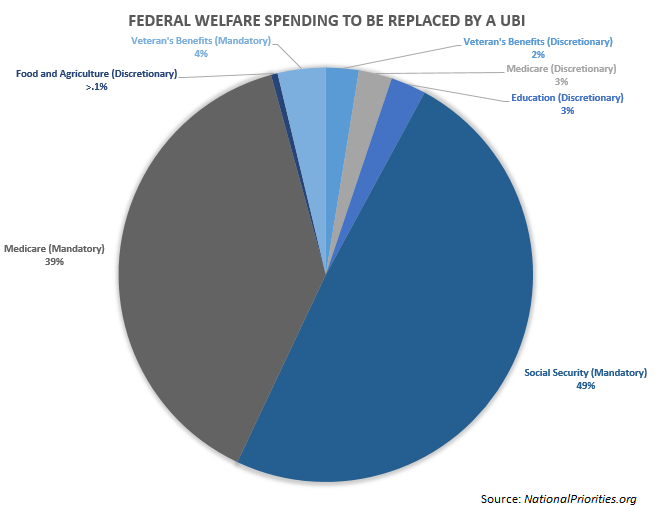
Spending a UBI Could Replace

That’s a total of $2.542 trillion in savings annually, more than enough to fund the proposed BIG with another $300.3 billion to spare that could be used for tax credits for low-income households to use on healthcare,[15] education,[16] retirement,[17] and/or basic necessities like food.[18] Funding the program would be a huge challenge, but it is possible to do it without tax increases.

Additionally, Goldstein ignores the fact that similar proposals, such as Friedman’s negative income tax, would have a much lower cost while having a similar effect. The Niskanen Center’s Samuel Hammond has estimated that a NIT could cost only $182 billion annually.[19] From Hammond’s analysis:

Just how much of a cost difference is there between a UBI and NIT? To get a rough idea, I used the Census population survey’s Annual Social and Economic Supplement, which has the distribution of individuals over the age of 15 by income level in $2,500 intervals (I subtracted retirees). I then calculated the transfer each quantile would receive based on a hypothetical NIT which starts at $5,000 for individuals with zero income and is phased out at a rate of 30%. Multiplying the average transfer by the number of actual individuals in each grouping and summing, I arrived at total cost of $182 billion—roughly the combined budget for SSI, SNAP and EITC.

The Effect of Replacing Welfare with a BIG on Poverty

Goldstein would object to my line of reasoning by saying cutting all that spending would harm the poor and increase the poverty rate. He says as much in his piece:

UBI’s daunting financing challenges raise fundamental questions about its political feasibility, both now and in coming decades.  Proponents often speak of an emerging left-right coalition to support it.  But consider what UBI’s supporters on the right advocate.  They generally propose UBI as a replacement for the current “welfare state.”  That is, they would finance UBI by eliminating all or most programs for people with low or modest incomes.

….Yet that’s the platform on which the (limited) support for UBI on the right largely rests.  It entails abolishing programs from SNAP (food stamps), which largely eliminated the severe child malnutrition found in parts of the Southern “black belt” and Appalachia in the late 1960s, the Earned Income Tax Credit (EITC), Section 8 rental vouchers, Medicaid, Head Start, child care assistance, and many others.  These programs lift tens of millions of people, including millions of children, out of poverty each year and make tens of millions more less poor.

Some UBI proponents may argue that by ending current programs, we’d reap large administrative savings that we could convert into UBI payments.  But that’s mistaken.  For the major means-tested programs — SNAP, Medicaid, the EITC, housing vouchers, Supplemental Security Income (SSI), and school meals — administrative costs consume only 1 to 9 percent of program resources, as a CBPP analysis explains.  Their funding goes overwhelmingly to boost the incomes and purchasing power of low-income families.[20]

Moreover, as the Roosevelt Institute’s Mike Konczal has noted, eliminating Medicaid, SNAP, the EITC, housing vouchers, and the like would still leave you far short of what’s needed to finance a meaningful UBI.  Would we also end Pell Grants that help low-income students afford college?  Would we terminate support for children in foster care, for mental health, and for job training services?

This is by far and away the weakest part of Goldstein’s argument.

First of all, as my analysis above showed, Konczal’s and Goldstein’s idea that eliminating the current welfare state “would still leave you far short of what’s needed to finance a meaningful UBI” is just false. Even a relatively robust UBI of $7,000 a year is doable by significantly cutting current welfare programs.

But more importantly, Goldstein’s assertion that replacing the welfare state with a UBI would increase poverty is fully unwarranted. He seems to take a ridiculously unsophisticated idea that “more means-tested programs immediately reduce welfare.” His assertion that the programs in question “lift tens of millions of people, including millions of children, out of poverty each year and make tens of millions more less poor” is, at best, completely erroneous. For three reasons: first, individuals know better what they need to lift themselves out of the than the government, and these programs assume the opposite. Second, the structure of status quo means-tested programs often creates a “poverty trap” which incentivizes households to remain below the poverty line. Finally, thanks to these first two theoretical reasons, the empirical evidence on the success of the status-quo programs in terms of reducing the poverty rate is, at best, mixed.

The way our current welfare state is structured is it allocates how much money can go to what basic necessities for welfare recipients. So if a household gets $10,000 in welfare a year, the government mandates that, say, $3,000 goes to food, $3,000 goes to healthcare, $3,000 goes to education, and $1,000 goes to retirement.[21] This essentially assumes that all individuals and households have the same needs; but this is simply not the case, elderly people may need more money for healthcare and less for education, younger people may need the exact opposite, and poorer families with children may need more for food and education than other needs. It’s almost as if our current welfare system assumes interpersonal utility function comparisons are possible, or utility functions of poorer people are fairly homogenous but they’re not. It also ignores the opportunity cost of the funding for helping individuals and households out of funding; a dollar spent on healthcare may be more effectively spent on food for a particular individual or household.

In sum, there’s a knowledge problem involved in our current welfare policy to combat poverty: the government cannot know the needs of impoverished individuals, and such knowledge is largely dispersed, tacit, and possessed by the individuals themselves. The chief merit of a UBI is, rather than telling poor people what they can spend their welfare on, it just gives them the money and lets them spend it as they need.

Second, universal programs are superior to means tested programs precisely because the amount of transfer payments received does not decrease as income increases. Our current welfare programs too often make the marginal cost of earning an additional dollar, above a certain threshold, higher than the benefits because transfer payments are cut-off at that threshold. This actually perversely incentivizes households to remain in poverty.[22] For example, the Illinois Policy Institute while analyzing welfare in Illinois found the following:

A single mom has the most resources available to her family when she works full time at a wage of $8.25 to $12 an hour. Disturbingly, taking a pay increase to $18 an hour can leave her with about one-third fewer total resources (net income and government benefits). In order to make work “pay” again, she would need an hourly wage of $38 to mitigate the impact of lost benefits and higher taxes.
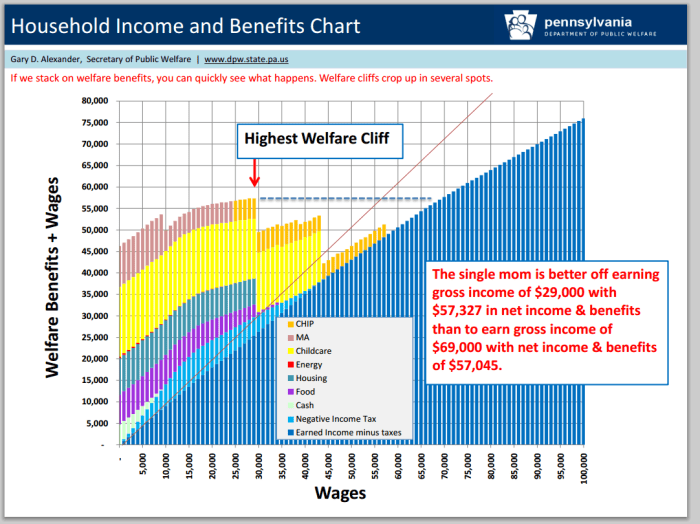
SingleMomWelfareCliffChart

Or consider this chart (shown above) from the Pennsylvania Department of Public Welfare showing the same effect in Pennsylvania

UBI does not suffer from this effect. If your income goes up, you do not lose benefits and so there are no perverse incentives at work here. Ed Dolan has analyzed how the current welfare state with its means-tested benefits is worse in terms of incentivizing work and alleviating poverty extensively. Here’s a slice of his analysis:
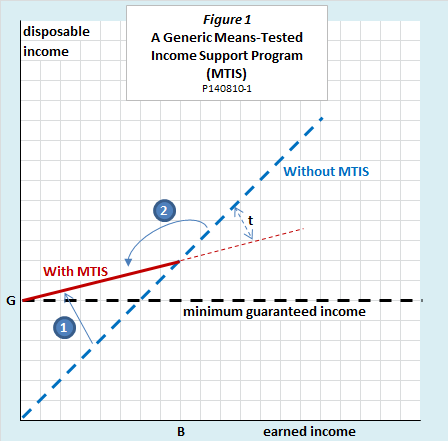
P140810-11

The horizontal axis in Figure 1 represents earned income while the vertical axis shows disposable income, that is, earned income plus benefits. To keep things simple, we will assume no income or payroll taxes on earned income—an assumption that I will briefly return to near the end of the post. The dashed 45o line shows that earned and disposable income are the same when there are no taxes or income support. The solid red line shows the relationship between disposable and earned income with the MTIS policy.

This generic MTIS policy has three features:

A minimum guaranteed income, G, that households receive if they have no earned income at all.

A benefit reduction rate (or effective marginal tax rate), t, indicted by the angle between the 45o line and the red MTIS schedule. The fact that t is greater than zero is what we mean when we say that the program is means tested. As the figure is drawn, t = .75, that is, benefits are reduced by 75 cents for each dollar earned.

A break-even income level, beyond which benefits stop. Past that point, earned income equals disposable income.

When these two factors are taken into account (that individuals know better than the government what they need to get out of poverty and there are significant poverty traps in our welfare state), it is no surprised that the empirical evidence on the effectiveness of these anti-poverty programs is far less rosy than Goldstein seem to think.

After reviewing the empirical literature on the relationship between income and welfare improvements for impoverished households, Columbia University’s Jane Waldfogel concluded “we cannot be certain whether and how much child outcomes could be improved by transferring income to low income families.” The Cato Institute’s Michael Tanner wrote in 2006:

Yet, last year, the federal government spent more than $477 billion on some 50 different programs to fight poverty. That amounts to $12,892 for every poor man, woman, and child in this country. And it does not even begin to count welfare spending by state and local governments. For all the talk about Republican budget cuts, spending on these social programs has increased an inflation-adjusted 22 percent since President Bush took office.

Despite this government largesse, 37 million Americans continue to live in poverty. In fact, despite nearly $9 trillion in total welfare spending since Lyndon Johnson declared War on Poverty in 1964, the poverty rate is perilously close to where it was when we began, more than 40 years ago.

Tanner’s point remains true today. The chart below shows that, despite a massive increase in anti-poverty spending since the war on poverty was declared under Johnson’s “Great Society,” Poverty rates have remained woefully stagnant. In fact, the reduction in poverty that was occurring prior to Johnson’s interventions stopped soon thereafter.
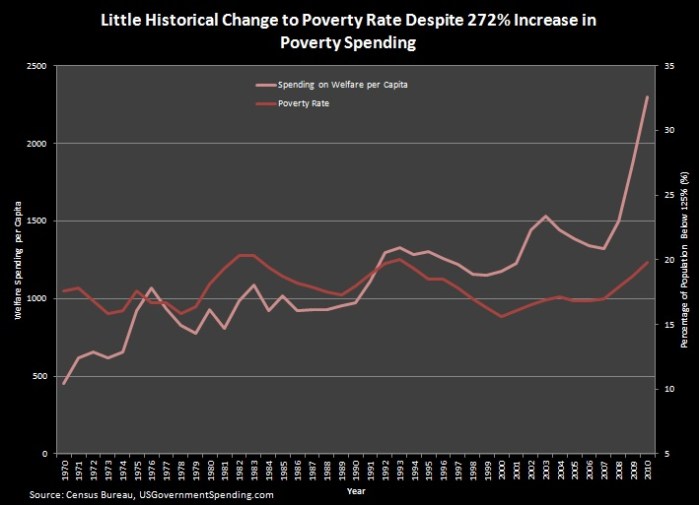
US Poverty Spending

Also, the point is that UBI is a replacement for current welfare benefits. Most households probably would not see a decrease in amount of benefits under a UBI, depending on the specifics of the proposal, and some might even see an increase, contrary to Goldstein’s analysis. Further, they’d be able to actually spend this on what they know they need rather than what government bureaucrats thin they need.

UBI lacks the flaws of the current welfare state, and would likely decrease poverty far more effectively than Goldstein thinks, especially when compared to his favored status-quo.

[1] Though there are some technical differences between Milton Friedman’s proposal for a “negative income tax” and most Basic Income Guarantee proposals, they essentially have the same effect on income. See the Adam Smith Institute’s Sam Bowmen on this point.

[2] See Matt Zwolinski for the “Pragmatic Libertarian Case for a Basic Income,” it should be noted that “pragmatic reasons” here does not refer to my pragmatist philosophical views. Zwolinski has also made a moral case for the basic income on Hayekian grounds that a BIG could reduce coercion in labor negations. I am unsure to what extent I am convinced by this line of reasoning, but it is a valid argument nonetheless.

[3] The Niskanen Center’s Samuel Hammond has made the case that universal transfer programs like a Basic Income cannot be analyzed outside of the tax system that pays for it.”

[4] Or, as my think tank buddies jokingly call it, the “Center for Bigger Budgets.”

[5] Having said that, polls have shown that it is popular across the pond in the Eurozone. The Swiss proposal would call into question this point but it could be argued that the vagueness of the Swiss proposal is why it was turned down not necessarily the spirit of it.

[6] My colleague Ty Hicks of Students for Liberty has made this point well. See also Hayek’s “Intellectuals and Socialism.”

[7] Granted, the Affordable Care Act was not really what most on the left or the right wanted in the first place and has been a disaster.

[8] This number is selected because, according to the CBO, $9,000 is the average amount in means-tested welfare benefits per household for 2006. But that’s for households and a BIG discussed here is for individuals, so it is understandable to make a BIG slightly less than the current average. Goldstein would object that this is far below the poverty line, but BIG is not meant to be a replacement for total income on the labor market at all, so it is unclear why this is an objection in the first place.

[9] This is admittedly a crude and naïve calculation but it is virtually identical to the method Goldstein himself uses to estimate the cost.

[10] All figures for this section are for the 2015 budget and are taken from here.

[11] Goldstein is sure not to be happy with cutting education, and I myself would like to replace this spending with few-strings-attached funding for local education or private school tax vouchers. I’ll address this point more later in this piece.

[12] Much of this is food stamps, which would be rendered obsolete by a BIG anyways. Goldstein would object, more on that in the next section.

[13] Not all of this could be cut, and there would be legal and detailed nuances on how to treat financial obligations for Social Security, veteran’s benefits, and Medicare. The specific legal complexities of mandatory welfare spending are not my areas of expertise, admittedly, and is outside the scope of this paper. I’m just illustrating that it is possible to cut at least some of this spending, perhaps even the majority of it, to fund it.

[14] Many people would object to cutting veterans benefits. First of all, BIG could act in place of these benefits

[15] I have in mind expanding tax-exempt Health Savings Accounts here. I also think funding this by eliminating the employer-based deduction would be a step in the right direction and reduce cost fragmentation in the healthcare market, as Milton Freidman argued.

[16] I have in mind a private school taxpayer voucher system like what is in Sweden.

[17] I have in mind something similar to this proposal to reform social security from the Cato Institute.

[18] I have in mind something like the pre-bates proposed in the Fair Tax.

[19] For this reason, I prefer an NIT to a BIG, but I prefer both to our current welfare state.

[20] This point is Ironic considering the fact that CBPP’s own research shows that government benefits in America overwhelmingly goes to households above the poverty line, in the middle and upper classes. See this chart (source):
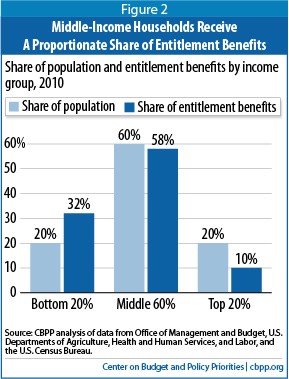
1-SOlzSwsxa08Cno7PiQ9R7A

[21] The real-world numbers are probably different and vary a little bit from household to household, but this is just a hypothetical to illustrate a more general point.

[22] It should be noted, however, that the EITC, and some other programs, is largely free of this defect. This is because the EITC itself is modeled after Friedman’s NIT.

Note: The first chart has been edited since this was initially posted for readability.

Where did Homo Economicus come from?

Over on my Facebook page, I posted a short criticism of both neoclassical and behavioral economic scholarship on rational choice (drawing from a paper I’m working on exploring that topic). Stated a bit polemically,  though homo economicus has largely been dead in neoclassical theory, his spirit still haunts the work of most modern neoclassical scholars. Likewise, though behavioral economists are trying to dig the grave and put the final nails in the coffin of homo economicus, their nightmares are still plagued with the anxieties of his memory.

This led a former colleague from Hillsdale to ask me where I thought homo economicus came from historically. I wrote the following in response (lightly edited for this post):

It could be argued, in a sense, that the protestant Christian aim to complete moral purity and the Enlightenment aim to make man perfect in knowledge in morality (as embodied in Franklin’s virtue ethics) helped give rise to a culture that would be primed for such a model. Within economics, historically it comes from Bentham’s utilitarianism and Jevon’s mathematical extrapolations from Bentham’s psychology. However, I’d say this comes from a deeper “Cartesian anxiety” in Bernstein’s use of the term to make economic a big-T True, capital-C Certain, capital-S Science just like physics (which Jevon’s himself stated was an aim of his work,[1] and has preoccupied economists since the days of JS Mill). If economic science cannot be said to be completely positive and “scientific” like the natural sciences with absolutely falsifiable propositions and an algorithmic means of theory-choice, it is feared, it must be written off as a pseudo-scientific waste of time or else ideology to justify capitalism. If economics cannot make certain claims to knowledge, it must be solipsist and relativist and, again, be another form of pseudo-science or ideology. If economic models cannot reach definitive mathematical results, then they must be relativistic and a waste of time. This is just another example of the extreme Cartesian/Katian/Platonic (in Rorty’s use of the term) either/or: objectivity OR relativism, science OR nonscience, determinate mathematical solutions OR ideological emotional bickering. Homo economicus was erected as a means to be an epistemic foundation to solve all these anxieties and either/ors.

Of course, as any good Deweyan, I think all these either/ors are nonsense. Their understanding of science, as revealed through the so-called “growth of knowledge” literature in postempiricist philosophy of science (ie., the work of Thomas Kuhn, Lakotos, Karl Popper, Paul Feyerabend, Michael Polanyi, Richard Bernstein, Richard Rorty, etc.) has shown that this positivist conception of science, that is science consists of algorithmic theory choice selected based off correspondence with theory-free, brute “facts” of the “external world,” is woefully inaccurate. Dialogical Aristotelian practical reasoning in the community of scientists plays just as much of a role in formulating a scientific consensus as empirical verification. This does not undermine science’s claims to objectivity or rationality, in fact it puts such claims in more epistemically tenable terms.

Further, the desire to make the social sciences just another extension of the natural science, as Hayek shows in the Counterrevolution of Science, and as even positivists like Milton Freidman argue, is a completely misleading urge that has led to some of the worst follies in modern social theory. Obviously, I cheer the fact that “homo economicus is dead, and we have killed him,” but now that we’ve “out-rationalized the rationalizer of all rationalizers,” we must try to re-evaluate our economic theories and methods to, as Bernstein or Dewey would put it, “reconstruct” our economic science.

In short, immenatizing the eschaton in epistemology and philosophy of science created homo economicus.

For the record, you don’t have to be a radical scientific anti-realist like Feyerabend or Rorty to agree with my analysis here.[2] I myself wax more towards Quine than Rorty in scientific matters. However, the main point of philosophy of science since positivism is the exact type of foundationalist epistemology undergirding modern positivist methodology in the mainstream of the economics profession, and the concept of rationality that is used to buttress it, is a naive view of science, natural or social.

Notably, this critique is largely unrelated to much of the Austrian school. Mises’ own conception of rationality is mostly unrelated to homo economicus as he understands rationality to be purposive action, emphasizing that economists first understand the subjective meaning from the point of view of the economic actor him/herself before declaring any action “irrational.”[3] [4]

What are your thoughts on this? Are neoclassical and behavioral economics both still way too influenced by the spirit of homo economicus, or am I off the mark? Is my analysis of the historical conditions that led to the rise of homo economicus right? Please, discuss in the comments.

[1] Consider this quote from Jevon’s magnum opus Theory of Political Economy “Economics, if it is to be a science at all, must be a mathematical science.”

[2] In fact, I doubt anybody mentioned is really a scientific anti-realist, I agree with Bernstein that Feyerabend is best read as a satirist of the Cartesian anxiety and extreme either/or of relativism and objectivism in philosophy of science and think Rorty’s views are more complex than simple scientific anti-realism, but that’s an unrelated point.

[3] Of course, any critique of epistemic foundationalism would apply to Mises, especially his apriorism; after all, Mises did write a book called “Ultimate Foundations of the Social Sciences” and the Cartesian anxiety is strong with him, especially in his later works. Notably, none of this applies to most of Mises’ students, especially Schutz, Machlup, and Hayek.

[4] For a more detailed discussion of Mises and the Austrians on rationality, see my blog post here or this paper by Mario Rizzo. For a more general discussion of the insights of the type of philosophy of science I’m discussing, see Chapter 2 of Richard Bernstein’s excellent 1983 book Beyond Objectivism and Relativism: Science, Hermeneutics, and Praxis.

The Cruel, Conceited Follies of Trump’s Colonialist Foreign Policy

I typically prefer to abstain from writing too extensively on electoral politics. For one, it’s not my area of expertise and I simply don’t enjoy it that much, but also I think the type of issues that come up in electoral politics are a sensationalist distraction from the meaningful policy debates that actually go on in the back rooms of congress and think tanks, as well as the deeper and more important philosophical, economic, and cultural issues that plague our political situation. Thus, I prefer to write in more detail about public policy or more theoretical economic and philosophical issues rather than the day-to-day drudgery of superficial political news. However, the recent discussion on foreign policy on the campaign trail surprisingly has the potential to become at least mildly substantive, so it is in my mind worth analyzing in greater depth. It should be noted that I am far from an expert in foreign policy, so apologies in advance for any errors and if this article as a whole is a farce.

The purpose of this article is to lay out and critically assess Donald Trump’s foreign policy. It is my contention that Trump does have some fairly consistent underlying instincts, if not principles, on foreign policy that may be inferred from his public comments on the issue. This may be characterized by a concerning belief that the ultimate end of foreign policy should be to aggressively promote America’s interests abroad, akin to a radical, new type of Jacksonian colonialism. If I am right about Trump’s underlying views on foreign policy, a Trump presidency would result in disaster. It would mean massive violations of humanitarian rights and would fail to meet the goals even Trump himself is seeking to attain.

Clinton on Trump’s Foreign Policy

Yesterday, Hillary Clinton delivered a major speech ostensibly criticizing Trump’s foreign policy. Unfortunately, most of her speech was more of an attack on the narrative of Trump’s campaign and Trump himself than his actual foreign policy. This is largely because she thinks Trump doesn’t really actually have a foreign policy; his positions, Clinton thinks, are incoherent, ignorant, or just not even positions at all. This is probably the most quoted passage of the speech:

Donald Trump’s ideas aren’t just different — they are dangerously incoherent.
They’re not even really ideas: just a series of bizarre rants, personal feuds, and outright lies. He’s not just unprepared, he’s temperamentally unfit to hold an office that requires knowledge, stability and immense responsibility. This is not someone who should ever have the nuclear codes — because it’s not hard to imagine Donald Trump leading us into a war just because somebody got under his very thin skin.

Clinton’s strongest case against Trump was that he is “temperamentally unfit to hold office.” She makes this case even more persuasively elsewhere in the speech:

Imagine Donald Trump sitting in the Situation Room, making life-or-death decisions on behalf of the United States. Imagine him deciding whether to send your children into battle. Imagine if he had not just his Twitter account at his disposal when he’s angry, but America’s entire arsenal.

Do we want him making those calls – someone thin-skinned and quick to anger, who lashes out at the smallest criticism?

…I’ll leave it to the psychiatrists to explain his affection for tyrants. I just wonder how anyone could be so wrong about who America’s real friends are. But it matters. Because if you don’t know exactly who you’re dealing with, men like Putin will eat your lunch.

I typically don’t find these types of arguments convincing. After all, it doesn’t matter so much the character of public officials as the institutional incentives they face. But in matters of foreign policy problems of temperament and character do matter because the social situation between foreign leaders in diplomacy can often make a huge difference. Bad manners can and have caused wars (eg., there’s an argument to be made that Jefferson’s bad manners towards British diplomat Anthony Merry helped lead to the War of 1812). These points are confirmed by the fact that world leaders are terrified by Trump and how the intelligence community is afraid he could spill security-sensitive confidential information. (Of course, Clinton also has a less-than-optimal track record on the matter of intelligence security).

What is Trump’s Foreign Policy?

However, Clinton is only partially correct in claiming that Trump’s ideas on foreign policy are “incoherent” or that he doesn’t really have a foreign policy at all. It is true that, as with every other issue save immigration and free trade, Trump switches his positions a lot. But underneath the prime facie incoherence is an overarching vision for a foreign policy that is both somewhat coherent and terrifying.

First, a common misconception needs to be clarified about Trump’s foreign policy views. The press commonly treats Trump as if he’s more of a dove on war and foreign intervention than Clinton, citing his recent criticisms of the Iraq War and Libya. This myth is particularly peddled in pro-Trump “libertarian” circles (with an emphasis on the scare quotes). It is widely accepted that Trump’s foreign policy are less interventionist than Clinton’s fairly hawkish views. However, this is decidedly not the case.

Zach Beauchamp has persuasively made the case that Trump is, in fact, more hawkish in some sense than Clinton. The most consistent point that Trump has made for years now is that America should be waging, in Beauchamp’s words, “colonial wars of conquest” for the purpose of taking resources from other countries. Beauchamp notes:

He first debuted this plan in an April 2011 television appearance, amid speculation that he might run for the GOP nomination. In the interview, Trump seemed to suggest the US should seize Iraqi oil fields and just operate them on its own.

“In the old days when you won a war, you won a war. You kept the country,” Trump said. “We go fight a war for 10 years, 12 years, lose thousands of people, spend $1.5 trillion, and then we hand the keys over to people that hate us on some council.” He has repeated this idea for years, saying during one 2013 Fox News appearance, “I’ve said it a thousand times.”

Trump sees this as just compensation for invading Iraq in the first place. “I say we should take it [Iraq’s oil] and pay ourselves back,” he said in one 2013 speech.

As Beauchamp says, “To be clear: Trump’s plan is to use American ground troops to forcibly seize the most valuable resource in two different sovereign countries. The word for that is colonialism.”

This type of colonialism is even more extreme than the colonialism of American imperialism of the early twentieth century, where colonial wars of conquest were typically justified in terms of America’s “manifest destiny” to spread democracy throughout the world that would eventually benefit the conquered, often coaxed in racial terms (as typified by Kipling’s famous poem), rather than explicitly justified by looting natural resources.

Many people alleging Trump’s dovishness point to his recent criticisms of US intervention in Iraq, Syria, and Libya. The idea that Trump is a dove on these issues, however, is largely a myth. The actual record shows that what Trump’s comments over the past decade or so on foreign policy are largely in line with what Beauchamp sees as his colonialism.

As Beauchamp points out, Trump actually supported intervention in Libya at the time and called for even more aggressive intervention than the Obama administration engaged in (which, as a reminder, included Hillary Clinton at that point):

In a March 2011 vlog post uncovered by BuzzFeed’s Andrew Kaczynski and Christopher Massie, Trump full-throatedly endorsed intervening in the country’s civil war — albeit on humanitarian grounds, not for its oil.

“Qaddafi in Libya is killing thousands of people, nobody knows how bad it is, and we’re sitting around,” Trump said. “We should go in, we should stop this guy, which would be very easy and very quick. We could do it surgically, stop him from doing it, and save these lives.” In a later interview, he went further, endorsing outright regime change: “if you don’t get rid of Gaddafi, it’s a major, major black eye for this country.”

Shortly after the US intervention in Libya began in March 2011, Trump criticized the Obama administration’s approach — for not being aggressive enough. Trump warned that the US was too concerned with supporting the rebels and not trying hard enough to — you guessed it — take the oil.

“I would take the oil — and stop this baby stuff,” Trump declared. “I’m only interested in Libya if we take the oil. If we don’t take the oil, I’m not interested.”

What to make, then, of Trump’s more recent comments where he says he “would have stayed out of Libya”? He’s either incoherent, as Clinton claims, or he’s lying. The first possibility has largely been explored and, though plausible, is uninteresting for present purpose. Therefore, I’ll focus here on the latter (and, in my mind, more likely) possibility. I would argue that Trump is engaging in what could be called, in Arthur Melzer’s understanding of Straussian terms, a sort of dishonest perversion of political esotericism. But unlike the political esotericism of early modern political philosophers who sought to make the world more tolerant, Trump seeks the exact opposite ends. He’s recently been hiding his colonialist views in anti-war rhetoric to attract votes from Americans fatigued with perpetual nation-building through the Bush and Obama administrations. In reality, one of the only sincere substantive positions he’s retained throughout the years is a colonialist desire to wage war for oil. He could not be much further from an anti-war candidate.

As for Iraq, Trump has repeated the claim that he opposed the Iraq war from the beginning many times. Just yesterday, in reaction to Clinton’s speech, he repeated this yet again. “Crooked Hillary said, ‘Oh, Donald Trump, his finger on the button,’,” he said. “I’m the one that didn’t want to go into Iraq, folks, and she’s the one that stupidly raised her hand to go into Iraq and destabilize the entire Middle East.”

In reality, Trump himself wanted to stupidly go into Iraq at the time. In a 2002 interview with Howard Stern he said he supported invading Iraq, adding “I wish the first time it was done correctly.” How did he think it should have been done? Though he wasn’t specific in that interview, his later comments suggest he thinks a “correct” invasion of Iraq would be more aggressive and, of course, focus on taking their oil. Despite being sharply critical of the war later in the Bush administration (though note how he critiques the way it was “handled,” not getting involved in the first place), he supported McCain’s position in favor of the Troop Surge when endorsing him in 2008, claiming, though he wanted to pull out as soon as possible, he wanted to pull out with a victory. Even his most recent comments “critical” of the war, when viewed in the context of his overall foreign policy motivations, aren’t really dovish at all. As he said in 2013, “When I heard that we were first going into Iraq, some very smart people told me, ‘Well, we’re actually going for the oil,’ and I said, ‘All right, I get that.’ [But] we didn’t take the oil!”

Recent comments by Trump against the Iraq War, I think, are well explained by his aforementioned dishonest political esotericism. The record shows Trump disagreed with Bush’s Iraq policy because the motivations were too humanitarian and weren’t aggressive enough prior to the surge. Indeed, Trump’s dishonest claim to dovishness on Iraq has been widely proven false in the press (and yes, each different word links to a different source saying the same thing).

Beauchamp points out that Trump’s views on Syria can’t be described as doveish, as he is largely in agreement with Hillary Clinton:

But the two of them support more or less the same military escalation in Syria. Both Clinton and Trump have proposed carving out “safe zones” in the country, which means clearing out a chunk of its territory and protecting it from aggressors.

Trump sees this as the answer to the Syrian refugee crisis — if you can keep the Syrians there, they won’t have to come over here (or to Europe). “What I like is build a safe zone, it’s here, build a big, beautiful safe zone and you have whatever it is so people can live, and they’ll be happier,” he said in a campaign appearance. “I mean, they’re gonna learn German, they’re gonna learn all these different languages. It’s ridiculous.”

Similarly, both candidates have emphasized the need to bomb ISIS in Iraq and Syria — with Trump famously summarizing his policy as “bomb the shit out of” ISIS. But the way in which Trump plans to wage war on ISIS is far more aggressive — and illegal — than anything Clinton proposed.

He goes on to show that Trump endorses killing the families of suspected terrorists and supports torture for detainees, both of which are illegal war crimes. The killing of suspected terrorists’ families, in particular, is far more extreme than anything Clinton’s proposed and a violation of international law.

Trump essentially views other countries in one of two ways, the way he seems to view people: either as enemies to be defeated economically (eg. China and Mexico) and militarily (eg. Lybia and Syria) or assets to be exploited for American interests via colonial conquest (eg. Iraq). Indeed, he combines the worse elements of neoconservative interventionism with the worst elements of isolationism that my fellow Notewriter Brandon Christensen points out. Like isolationists, he opposes international organizations like NATO and the UN, is generally skeptical of alliances, and fiercely opposes trade agreements; but he also supports costly, unnecessary, and unjust foreign wars and efforts to intervene in other countries’ affairs like neoconservatives. He manages to be both an isolationist, thinking the American government should only protect its own interests at the expense of the citizens of other people, and an interventionist, thinking the government should wage unjust wars to that end, at the same time.

Beauchamp notes how Trump’s foreign policy positions can best be described as Jacksonian:

But historically, there are lots of other forms of American hawkishness. Trump fits well with one of those — one that Bard College scholar Walter Russell Mead calls the “Jacksonian tradition,” after President Andrew Jackson.

Jacksonians, according to Mead, are basically focused on the interests and reputation of the United States. They are skeptical of humanitarian interventions and wars to topple dictators, because those are idealistic quests removed from the interests of everyday Americans. But when American interests are in question, or failing to fight will make America look weak, Jacksonians are more aggressive than anyone.

… Unlike neoconservatives or liberal interventionists, who have well-fleshed-out foreign policy doctrines, many Jacksonians think about war and peace more instinctively. “With them it is an instinct rather than an ideology — a culturally shaped set of beliefs and emotions rather than a set of ideas,” Mead writes. Sound familiar?

Of course, Trump is Jacksonian in more ways than just his foreign policy. His general populism and affection for strong-man leadership are very Jacksonian through and through. Indeed, Thomas Jefferson’s criticisms of Andrew Jackson himself could just as easily be leveled against Trump today (and echo Clinton’s words):

I feel much alarmed at the prospect of seeing General Jackson President.  He is one of the most unfit men I know of for such a place.  He has had very little respect for laws and constitutions, and is, in fact, an able military chief.  His passions are terrible.  When I was President of the Senate, he was Senator; and he could never speak on account of the rashness of his feelings.  I have seen him attempt it repeatedly, and as often choke with rage.  His passions are, no doubt, cooler now; he has been much tried since I knew him, but he is a dangerous man.

A Critique of Trump’s Foreign Policy

Besides the obvious criticism made very persuasively by Clinton that Trump is temperamentally unfit to engage in diplomacy, what is wrong with foreign policy? In a word: everything. But for the purposes of this post, I’ll confine my criticism to three points.

First, Trump’s style of Jacksonian foreign policy is largely responsible for most of the humanitarian atrocities committed by the American government. Second, Trump’s economic foreign policy is antithetical to the entire spirit of the liberal tradition; it undermines the dignity and freedom of the individual and instead treats the highest good as for the all-powerful nation-state (meaning mostly the politicians and their special interests) as the end of foreign policy, rather than peace and liberty. Finally, Trump’s foreign policy fails for the same reasons that socialism fails. If the goals of foreign policy are to represent “national interest,” then the policymaker must know what that “national interest” even is and we have little reason to think that is the case, akin to the knowledge problem in economic coordination.

On the first note, Beauchamp quotes Dr. Mead on how the Jacksonian tradition in America has resulted in some of the most atrocious abuses of human rights in American history:

In the last five months of World War II, American bombing raids claimed the lives of more than 900,000 Japanese civilians—not counting the casualties from the atomic strikes against Hiroshima and Nagasaki. This is more than twice the total number of combat deaths that the United States has suffered in all its foreign wars combined…

Since the Second World War, the United States has continued to employ devastating force against both civilian and military targets. Out of a pre-war population of 9.49 million, an estimated 1 million North Korean civilians are believed to have died as a result of U.S. actions during the 1950-53 conflict. During the same war, 33,870 American soldiers died in combat, meaning that U.S. forces killed approximately thirty North Korean civilians for every American soldier who died in action. The United States dropped almost three times as much explosive tonnage in the Vietnam War as was used in the Second World War, and something on the order of 365,000 Vietnamese civilians are believed to have been killed during the period of American involvement.

This is because the Jacksonian view dictates that we should use full force in war to advance our interests and the reasons for waging war are for selfish rather than humanitarian purposes. We have good reason to think human rights under Trump will be abused to an alarming degree, as his comments that we should “bomb the hell out of” Syria, kill the noncombatant families of suspected terrorists, and torture detainees indicate. Trump is literally calling for the US to commit inhumane war crimes in the campaign, it is daunting to think just how dark his foreign policy could get in practice.

As mentioned earlier, many “libertarians” such as Walter Block seem to be under the delusion that Trump’s foreign policy is somehow compatible with the liberal tradition’s aspirations of individual liberty and peace. As he wrote when he endorsed Trump and created the oxymoronically named group “Libertarians for Trump:”

When put in this way, it is clear that The Donald is the most congruent with our perspective. This is true, mainly because of foreign policy.

…We readily concede Mr. Donald Trump is no Ron Paul on foreign policy or anything else for that matter. However, compared to his Republican alternatives, the Donald stands head and shoulders above them. He has said, time and time again, things like “Look at what we did in Iraq. It’s a mess. Look at what we did in Libya. It’s a mess there too. And we’re going to repeat our mistakes in Syria? Not on my watch.” …Yes, future President Trump wants a strong military, but with only a few exceptions, fewer than the other Republican candidates, only to defend our country.

Ignoring the glaring factual inaccuracy that Trump’s criticisms of Iraq and Libya were that we weren’t fierce enough and the main reason why he wants war is not to defend our country but to loot oil, nothing could be further from the truth that Trump’s foreign policy views are anywhere near to congruent with libertarianism.

To reiterate: Trump’s foreign policy views are just a particularly nasty version of imperialism and colonialism. Mises dedicated two entire sections of his chapter on foreign policy in Liberalism: The Classical Tradition to critiquing colonialism and revealing just how contrary these views are to liberalism’s commitment to peace and liberty. In direct opposition to Trump’s assertions that we should go to war to gain another country’s wealth and resources and that we should expand military spending greatly, Mises argues:

Wealth cannot be won by the annexation of new provinces since the “revenue” deprived from a territory must be used to defray the necessary costs of its administration. For a liberal state, which entertains no aggressive plans, a strengthening of its military power is unimportant.

Mises’ comments on the colonial policy in his time are extremely pertinent considering Trump’s calls to wage ruthlessly violent wars and commit humanitarian crises. “No chapter of history is steeped further in blood than the history of colonialism,” Mises argued. “Blood was shed uselessly and senselessly. Flourishing lands were laid waste; whole peoples destroyed and exterminated. All this can in no way be extenuated or justified.”

Trump says the ends of foreign policy are to aggressively promote “our” national interests, Mises says “[t]he goal of the domestic policy of liberalism is the same as that of its foreign policy: peace.” Trump views the world as nations competing in a zero-sum game and there must be one winner that can only be brought about through military conquest and economic protectionism, Mises says liberalism “aims at the peaceful cooperation between nations as within each nation” and specifically attacks “chauvinistic nationalists” who “maintain that irreconcilable conflicts of interest exist among the various nations[.]” Trump is rabidly opposed to free trade and is horrifically xenophobic on immigration, the cornerstone of Mises’ foreign policy is free movement of capital and labor over borders. There is no “congruence” between Trump and any classically liberal view on foreign policy matters in any sense; to argue otherwise is to argue from a position of ignorance, delusion, or to abandon the very spirit of classical liberalism in the first place.

Mises wasn’t the only classical liberal critical of Trump-style colonialist foreign policy. The classical liberal editor of The Nation Edward Lawrence Godkin was also sharply critical of the imperial foreign policy of the progressives and populists in his time. In a 1900 article entitled “The Eclipse of Liberalism,” in which he lamented the decline of the liberal emphasis on limited government, Godkin wrote:

Nationalism in the sense of national greed has supplanted Liberalism. It is an old foe under a new name. By making the aggrandizement of a particular nation a higher end than the welfare of mankind, it has sophisticated the moral sense of Christendom. Aristotle justified slavery, because Barbarians were “naturally” inferior to Greeks, and we have gone back to his philosophy. We hear no more of natural rights, but of inferior races, whose part it is to submit to the government of those whom God has made their superiors. The old fallacy of divine right has once more asserted its ruinous power, and before it is again repudiated there must be international struggles on a terrific scale. At home all criticism on the foreign policy of our rulers is denounced as unpatriotic. They must not be changed, for the national policy must be continuous. Abroad, the rulers of every country must hasten to every scene of international plunder, that they may secure their share. To succeed in these predatory expeditions the restraints on parliamentary, even of party, government must be cast aside. [Emphasis mine]

Though Godkin’s broader arguments against the “inferior races” argument for imperialism may not apply to Trump himself per se, it certainly does apply to some of Trump’s dangerously backward white nationalist supporters (at least one of whom Trump has publicly appointed) who are helping to drive his rise.

It wasn’t just Godkin in the United States, an entire organization was formed to oppose these policies: The American Anti-Imperialist League, which formed specifically in opposition to the Spanish-American War and the annexation of the Philippians and Cuba. Though it was certainly a diverse collection of anti-imperialists with a wide variety of motives, many of them were classical liberals. Their platform emphasized the incompatibility of small government and imperial conquest:

We hold that the policy known as imperialism is hostile to liberty and tends toward militarism, an evil from which it has been our glory to be free. We regret that it has become necessary in the land of Washington and Lincoln to reaffirm that all men, of whatever race or color, are entitled to life, liberty and the pursuit of happiness. We maintain that governments derive their just powers from the consent of the governed. We insist that the subjugation of any people is “criminal aggression” and open disloyalty to the distinctive principles of our Government.

Trump’s incompatibility with classically liberal goals is not of unique interest to libertarians. In many ways, both neoconservatives and liberal interventionists aim for a similar end of peace among nations in foreign policy for which classical liberals aim (or at least, I hope they share such an aim). The three viewpoints just disagree on the best policy means to reach those ends. Trump decidedly does not take peace as the end of foreign policy. He takes the ruthless promotion of America’s economic interests to be the goal, often at the expense of peace and at the expense of the lives of innocent people.

Additionally, even if we take Trump’s nationalist ends as given, the policy means Trump prefers of violent military intervention likely will not be successful for similar reasons to why socialism fails. Christopher Coyne has argued convincingly that many foreign interventions in general fail for very similar reasons to why attempts at economic intervention fail, complications pertaining to the Hayekian knowledge problem. How can a government ill-equipped to solve the economic problems of domestic policy design and control the political institutions and culture of nations abroad?  Coyne mainly has the interventionism of neoconservatives and liberals in mind, but many of his insights apply just as well to Trump’s Jacksonian vision for foreign policy.

The knowledge problem also applies on another level to Trump’s brand of interventionism. Trump assumes that he, in all his wisdom as president, can know what the “national interest” of the American people actually is, just like socialist central planners assume they know the underlying value scales or utility functions of consumers in society. We have little reason to assume this is the case.

Let’s take a more concrete example: Trump seems to think one example of intervention in the name of national interest is to take the resource of another country that our country needs, most commonly oil. However, how is he supposed to know which resources need to be pillaged for the national interest? There’s a fundamental calculation problem here. A government acting without a profit signal cannot know the answer to such a problem and lacks the incentive to properly answer it in the first place as the consequences failure falls upon the taxpayers, not the policy makers. Even if Trump and his advisors could figure out that the US needs a resource, like oil, and successfully loots it from another country, like Libya, there is always the possibility that this artificial influx of resources, this crony capitalist welfare for one resource at the expense of others, is crowding out potentially more efficient substitutes.

For an example, if the government through foreign policy expands the supply of oil, this may stifle entrepreneurial innovations for potentially more efficient resources in certain applications, such as natural gas, solar, wind, or nuclear in energy, for the same reasons artificially subsidizing these industries domestically stifle innovation. They artificially reduce the relative scarcity of the favored resource, reducing the incentive for entrepreneurs to find innovative means of using other resources or more efficient production methods. At the very least, Trump and his advisors would have little clue how to judge the opportunity cost of pillaging various resources and so would not know how much oil to steal from Libya. Even ignoring all those problems, it’s very probable that it would be cheaper and morally superior to simply peaceably trade with another country for oil (or any other resource) rather than waging a costly, violent, inhumane war in the first place.

Of course, I’m probably giving Trump way too much credit in that critique. Chances are, given Trump’s (nonexistent) economic literacy, he is just under the delusion that more resources always mean a better economy no matter what–opportunity costs, resource allocation, and entrepreneurial innovation be damned–and that government policy can be run just like a business.

Not only is it difficult for policy makers to know what the national interest is, as Christensen has argued it is unclear what “national interest” even means to begin with. He defines national interest as “an excuse for a policy or set of policies that should be taken in order to strengthen a state and its citizens (but not necessarily strengthen a state relative to other states…).” He further claims, “There’s no such thing as a national interest.” I’d take it even one step further: the rhetoric of “national interest,” it seems to me, is just an ideology (in the critical theory sense) for the foreign policy elite and their lobbyists to justify using coercive force to advance their arbitrary private interests rather than the (largely indeterminate) interests of the public or the country at large. Even if the “national interest” does have any meaning other than as a rhetorical ideology for the military industrial complex, the only way such a concept could become known is via the spontaneous process of the voluntary interchange of individuals, often time between citizens and non-citizens, and will likely never be known by a single individual mind. At the very least, there’s a public choice problem here: how is Trump realistically to differentiate his personal interests and those of his cronies from those of the general public? Given the fact that Trump likely has narcissistic personality disorder, I don’t have faith that he will.

The only positive potential to foreign policy under a Trump administration is the possibility that he will wisely not intervene in foreign affairs when no argument can be made that such an intervention would be in the national interest or give us oil. But given Trump’s record on the matter, and the arbitrary and elusive nature of the concept of “national interest,” I doubt that this will be a major factor in the way Trump actually implements foreign policy.

Trump vs. Clinton on Foreign Policy: Who is Preferable?

It is clear that underneath the prima facie inconsistencies in Trump’s comments on foreign policy, there is an underlying consistency that he thinks the goal of foreign policy is to quite aggressively promote US interests. This goal is impossible to reach as it represents a naïve understanding of the knowledge public leaders can possess, and generally represents a selfish, reckless, nationalist disregard for human dignity. The means he wants to undertake for this end are unnecessarily cruel and would likely constitute massive human rights violations. They contradict the high (and in my mind correct) aspirations of classical liberals of peace and individual liberty, and they’ll likely fail to accomplish their stated goals.

However, none of this necessarily means that Clinton’s foreign policy will be all that much better. Sure, Clinton’s motives are likely purer, but her record shows that the means she undertakes are uncannily similar to Trump and fail for similar reasons. She’s shown a similar lack of judiciousness in her handling of classified materials, just what the intelligence community fears of Trump. Her record shows her diplomatic skills yield mixed results at best, and she’s widely a progressive interventionist on foreign policy matters whose policies will subvert the liberal goals of peace and individual liberty. It is somewhat ironic that the Democrats have such great opportunity to go after Trump on foreign policy, but have chosen the absolute worst person in their party to make that case as their nominee (akin to Republicans and Romney on ObamaCare in 2012).

Comparing the two candidates point-by-point, therefore, is very difficult. Though there are many underlying consistencies to Trump’s comments on foreign policy and Clinton is still largely right that his stated positions have been somewhat incoherent. Unlike Trump, we have a record of Clinton actually implementing foreign policy and our only knowledge of the Donald’s policies only comes from occasionally off-the-cuff and contradictory remarks about others’ policies. Thus there is a degree of uncertainty as to what Trump’s foreign policies will actually look like and, though I think his comments reveal there is a high probability they will be atrocious, there is a small chance that they could be marginally better than Clinton’s (whose record shows she will implement almost certainly failed foreign policies). Trump’s very concerning comments on foreign policy alone do not make a slam-dunk case that Clinton is preferable on these matters.

Having said that, I’d still argue Clinton’s foreign policy is at least marginally preferable to Trump’s. With Trump we risk not only a fairly high probability of atrocious policies—quite possibly worse than Clinton’s—based off of his comments, we also risk the added problem of regime uncertainty in foreign policy. Also, some of the concrete policies Trump has called for—like torture and the murdering of families—are a cause for serious concern. Further, Clinton is likely to be far more diplomatic and will be less likely to offend other leaders and alienate the US from the world. Her point that Trump is “temperamentally unfit to lead” is very well taken, and was only confirmed by Trump’s response to her speech which in which he largely stuck to the non-substantive screaming of insults in his typical childish fashion. None of this at all means anybody should vote for either candidate as there is a lot more to voting than the issues of foreign policy. For what it’s worth (which is very little), I for one will most likely not be voting in the next election. If I were forced to, it would be for the Johnson/Weld ticket.

Libertarians and Pragmatists on Democracy Part 4: Why Market Anarchism is more Democratic than Democracy

Note: This is the final part of a series on democracy. It is assumed the reader is familiar with part one, defining democracy, part two, summarizing classical liberal perspectives on democracy, and part three, which analyzes how pragmatists conceive of democracy as a broader philosophy. Here, I will argue that a synthesis of libertarian and pragmatist perspectives on democracy will yield an argument in favor of market anarchy.

The insights of classical liberalism, and particularly modern libertarianism, have shown that democracy is likely to lead to a tyranny of an irrational and ignorant majority and public choice theory has shown how it results in awful policies thanks to a number of collective action issues. However, as pragmatists have argued, democracy’s philosophical aspirations to scientific public deliberation, seeking the consent of the governed, valuing the dignity of every individual, and decentralizing political authority to take advantage of dispersed intelligence are still admirable. However admirable these philosophical aspirations are, real-world democracies completely fail to fulfill them.

The natural question is, if not democracy, what political arrangements can live up to the philosophical goals of Dewey and Hook? I think the answer lies in market anarchism. In what follows, I will show how market anarchism could succeed in realizing the aspirations of philosophical democracy where political democracy has failed.

Before we get started, let’s take into account a few minor housekeeping notes. It is assumed that the reader has at least a cursory knowledge of how market anarchism and polycentric law works. If you are not familiar with these concepts I highly recommend watching this video by David Friedman before continuing. Also, I am in no way arguing that any of the thinkers discussed in this series are “really” anarchists unless they’re obviously so such as Huemer. I will not even claim that any of them “should have been” anarchists (with the exception of Hayek). I am simply arguing that if we take into account the insights of their various perspectives, one could plausibly defend market anarchism.

Market Anarchism, Unlike Democracy, Does Rest on the Voluntary Consent of the Governed

As Michael Huemer convincingly has shown, democracy does not actually “rest upon the freely given consent of the governed” as Sidney Hook claims. The bar tab example illustrates that we would not consider majority rule “consent” in any everyday interaction and there is little reason to think it should be any different in the context of political institutions. By contrast, market anarchism is almost by definition based off of consent. This is the primary reason why many deontological market anarchists, such as Murray Rothbard, are market anarchists in the first place and why they oppose the coercive, non-consensual nature of the state. While democracy’s claim to legitimacy is that the governed vote but they are still forced to follow the (unjustified) authority of a state that has the monopoly on force whether they agree or not to, market anarchism is based off of voluntarily consented to contracts between individuals and defense agencies and contracts between those defense agencies and private, voluntary court systems and arbitrators. Further, the content of the laws is agreed to and law becomes a product one buys in voluntarily agreeing to sign up with a defense company, just as one buys a car, a piece of furniture, or any other good.

It is curious that many pragmatist defenses of democracy sound very similar to what many market anarchists and libertarians write. Not just in Sidney Hook’s definition of a democracy as a government that “rests upon the freely given consent of the governed,” but perhaps most strikingly in John Dewey’s 1939 essay “I Believe.” In this essay, Dewey walked back some of his early Hegelian collectivist lines of his early years:

My contribution to the first series of essays in Living Philosophies put forward the idea of faith in the possibilities of experience at the heart of my own philosophy. In the course of that contribution, I said, “Individuals will always be the center and the consummation of experience, but what the individual actually is in his life-experience depends upon the nature and movement of associated life.” I have not changed my faith in experience nor my belief that individuality is its center and consummation. But there has been a change in emphasis. I should now wish to emphasize more than I formerly did that individuals are the final decisive factors of the nature and movement of associated life.

Indeed, throughout the whole essay he emphasizes “the idea that only the voluntary initiative and voluntary cooperation of individuals can produce social institutions that will protect the liberties necessary for achieving development of genuine individuality.” Throughout the essay, he decries (like many left-anarchists do) “state socialism” just as much as he does “state capitalism.” Dewey’s opposition to capitalism is well-known, but what is less known is his opposition to so-called “public collectivism.” His criticisms here could just as easily have been written by someone like Hayek:

Recent events have shown that state socialism or public collectivism leads to suppression of everything that individuality stands for. It is not too late for us in this country to learn the lesson taught by these two great historic movements [ie., the rise of state capitalism and state socialism]. The way is open for a movement which will provide the fullest opportunity for cooperative voluntary endeavor. In this movement, political activity will have a part, but a subordinate one. It will be confined to providing the conditions, both negative and positive, that favor the voluntary activity of individuals.

It is interesting that, like anarchists who favor direct action, he emphasizes that political activity is subordinate to the political movement he sees as necessary.

Of course, there are still notable differences between Dewey and libertarians, he still defends what he calls “functional socialism” in the socialization of medicine and still berates more than many libertarians would be comfortable with (except, of course, for left-anarchists) inequality caused by state capitalism. His vision of a truly individualist society, even in his later years, was one with localized, experimental democratic institutions and economics controlled by those localized governments in a “functional socialist” fashion (as I mentioned earlier, that economic vision is at odds with Dewey’s epistemological commitments).

However, I would argue that it is more than a mere superficial coincidence that Dewey’s criticisms of state capitalism are almost identical to those of market anarchists who decry “crony capitalism,” that his criticisms of state socialism are very similar to some individualist libertarian criticisms, and his overall rhetoric defending democracy on the grounds of “voluntary cooperation of individuals” sounds remarkably similar to many libertarians. This is because, largely, the philosophical ends Dewey seeks in politics are the same as those sought by libertarians, market anarchists, and classical liberals. However, the institutional means he advocates are very different and fail to meet those ends.

There is, conversely, one potential criticism that Sidney Hook would raise at this point: that market anarchism does not really rest upon the freely-given consent of the governed due to its allowance for economic inequality. Hook argued that income inequality undermines consent in democracy and, as a result, economic organization should be controlled by a democratically elected government. There are two points to be made. First of all, when economic organization is controlled by government in democracies it exacerbates the problem of income inequality. Rent-seeking culture arises in which concentrated interests use, through lobbying power, government force to accumulate and protect their wealth. Indeed, as I mentioned earlier,  there have been empirical studies showing how over-regulation lobbied for by those concentrated benefits have regressive effects. Even fairly anti-free market economists such as Joseph Stiglitz have argued that income inequality is not an inevitable result of market institutions, but a result of bad government policies such as corporate welfare.

Second, it is questionable to what degree income inequality would exist in pure market anarchy. Of course, much of the bad inequality experienced under state capitalism is the result of bad policies, but some if it is also just a result of market’s tendencies to disrupt economic distributions (which, as Mises argued in Liberalism: The Classical Tradition is not a bad thing because it allows for luxury markets which can serve as an experimental market for expensive, new goods that one day become popular consumer goods). Some market anarchists, such as Anna Morgenstern, have argued that the type of mass accumulation of capital under capitalism would be impossible under market anarchism. I am unsure to what extent I agree, and a systemic analysis of the economic roots of inequality is outside of the scope of this post. However, suffice it to say that it is an open, empirical question whether purely free markets would result in problematic levels of inequality, as Hook seems to think, and we have some good reasons to think it would not. At the very least, it is clear that the democratic institutions favored by Hook are not a serious solution to the problem.

Market Anarchism, Unlike Democracy, Relies on a Decentralized Process of Political Decision Making

Dewey argued in “Democracy and Educational Administration” that “it is the democratic faith that [the distribution of knowledge and intelligence] is sufficiently general so that each individual has something to contribute and value of each contribution can be assessed only as it enters into the final pooled intelligence constituted by the contributions of all.” He seems to echo Hayek’s knowledge problem critique of socialism when he argues that the democratic faith is based on the wisdom that “no man or limited set of men is [sic] wise enough or good enough to rule others without their consent[.]” As we have seen, democracies tend towards heavily centralized governments that undermine this faith and fail to take advantage of the dispersed knowledge (in Hayekian terms) among individuals in society.

Market anarchy, on the other hand, by definition takes advantage of this feature of dispersed intelligence. Rather than having law be designed by a centralized legislature, law arises out of voluntary market exchanges between individuals and, like common law, the precedent of judges in private courts. Of course, both Dewey and Hayek embraced democratic institutions (in Hayek’s case, as well as free market economic coordination) to take advantage of decentralized knowledge. However, both Dewey and Hayek, particularly the ladder (Dewey never wrote about market anarchism as it did not exist as a unique perspective until almost a decade after his death), failed to appreciate the extent to which a polycentric legal system does this much better. Peter Stringham and Todd Zywicki have noted this tension in Hayek’s thought in particular, as they put it in an abstract for their excellent paper on the issue:

Should law be provided centrally by the state or by some other means? Even relatively staunch advocates of competition such as Friedrich Hayek believe that the state must provide law centrally. This article asks whether Hayek’s theories about competition and the use of knowledge in society should lead one to support centrally provided law enforcement or competition in law. In writing about economics, Hayek famously described the competitive process of the market as a “discovery process.” In writing about law, Hayek coincidentally referred to the role of the judge under the common law as “discovering” the law in the expectations and conventions of people in a given society. We argue that this consistent usage was more than a mere semantic coincidence — that the two concepts of discovery are remarkably similar in Hayek’s thought and that his idea of economic discovery influenced his later ideas about legal discovery. Moreover, once this conceptual similarity is recognized, certain conclusions logically follow: namely, that just as economic discovery requires the competitive process of the market to provide information and feedback to correct errors, competition in the provision of legal services is essential to the judicial discovery in law. In fact, the English common law, from which Hayek drew his model of legal discovery, was itself a model of polycentric and competing sources of law throughout much of its history. We conclude that for the same reasons that made Hayek a champion of market competition over central planning of the economy, he should have also supported competition in legal services over monopolistic provision by the state — in short, Hayek should have been an anarchist.

There is one possibly fatal objection to this line of reasoning, that is also the most substantial objection to market anarchism as a whole: the possibility that market anarchy, like democracy, will eventually lead to a centralized state that undermines its attempt to take advantage of dispersed knowledge. This argument was initially hinted at by Robert Nozick in Anarchy, State, and Utopia in his argument about the “immaculate conception of the state” but was expanded on most convincingly by Tyler Cowen. Ultimately it is an empirical question whether market anarchy would eventually lead to more centralization, and it is outside the scope of this post to analyze that fascinating question in any satisfactory amount of detail. I will say, however, that Bryan Caplan has given more or less convincing reasons why this may not be the case.

Market Anarchism, Unlike Democracy, Values the Dignity of the Individual

One of the features central to the pragmatist “democratic faith” is the belief that “belief that every individual should be regarded as possessing intrinsic worth or dignity[.]” As I argued, the conflation of democratic governments with the “collective will” of the people undermines this faith as political dissenters and individual thinkers become viewed as opponents to “the people.” Indeed, it seems that the type of “public” and “private” collectivisms that Dewey ridiculed in “I Believe” are a result of democratic institutions run amuck.

Market anarchism, meanwhile, suffers from no such issues. Instead, the intrinsic worth of the individual is respected as their free choices and associations is the main driving mechanism for political organization. There is no violation of free speech and free thought by a deliberative government as such a government does not exist in the first place under anarchy, and thus the intrinsic worth and dignity are not found in the “will of the people” as in democracies, but in the sovereign individual’s choice of which defense provider to contract with.

Market Anarchism, Unlike Anarchy, is Scientific and Deliberative

Contrary to Dewey and Hook’s characterization of democracy as a deliberative, intelligent application of the scientific method to social issues, democracy is instead characterized by polarizing populist pandering and rationally ignorant and irrational voters casting meaningless ballots based cultural associations rather than reasoned consideration of policy issues. Market anarchism, meanwhile, does have the deliberative, scientific nature the pragmatists vainly hope democratic institutions could aspire to. While under democracy the cost of casting an informed vote is very high and the benefits very low resulting in massive amounts of rational ignorance, under market anarchism individuals have every incentive to ensure they are informed about the legal rules they are purchasing, so to speak, by contracting with rights defense agencies. Unlike in democracy where the benefits of casting an informed vote are extremely low because your vote has an infinitely small probability of making a difference, under market anarchy the rights defense agency you chose to contract with has immediate and certain impacts upon your life, thus creating a much larger incentive to cast an informed (metaphorical) vote by choosing to purchase the services of a preferred rights defense agency.

Deliberation about legal policy is far more likely to be more reasoned in market anarchy than in democracy. First, because market anarchism is more radically experimental than political democracy. Freedom of speech and of thought in democracy is often likened to a metaphorical “marketplace of ideas,” but in market anarchy it is a literal marketplace in which the ideas are not chosen just by speculation and public deliberation, but actually experimented with and acted upon in practice. Democracy is only “experimental” in a priori public deliberation about policies, but market anarchy is “experimental” in actually applying those policies and assessing their results a posteriori. Under democracy, once a policy is chosen it becomes difficult to assess counterfactually if another potential policy could have yielded better results, thus it is difficult to ascertain which was the superior policy. It is as if scientists in a lab simply talked about the hypothetical results of various hypothetical experiments and chose theories based on their discussions rather than actually testing the theories by actually running the experiments. Because of the polycentric nature of law under market anarchy, multiple policies are taken on at the same time, making it easier to tell which is more desirable in practice rather than simple theoretical deliberation.

Another reason why political deliberation is more likely to be reasoned in market anarchy than democracy is because of the institutional mechanisms for choosing policy. The main way law is “made” in democracy is through legislation voted on by representatives, who are ultimately accountable to the public through general elections. Often, debate on the floor of legislative bodies is anything but reasoned and deliberative, and clearly discussion about elections quickly devolves into mindless partisan bickering, sensationalist “scandals,” and populist rhetorical flair rather than reasoned discussion about policies. In market anarchy, however, law is “discovered” by private arbitrators and judges who are ultimately accountable to the defense firm’s consumers in the marketplace. It is pretty clear that real-world courtrooms tend to have a more elevated level of dialogue than legislative bodies, to say less of public elections, and I fail to see why this would not be the case under market anarchism.

Further, there wouldn’t be a need for partisan bickering and debates that bring down the level of public discourse in market anarchy, for similar reasons why there isn’t nearly as nasty debates about preferences for consumer goods as there are about politics. To use an analogy, in democracy, if we’re voting on what soda to consume, whoever wins the vote gets a monopoly on their preferred soda; so my preference for Coke could possibly eliminate your ability to enjoy Pepsi; but in a market, if I prefer Coke you still can drink Pepsi, meaning we don’t need to bicker about our consumer preferences. It is similar (though clearly not identical because when we’re talking about law it’s quite a bit more consequential) with legal policies: in democracy, if I prefer one set of legal rules to another which you prefer, we must fight over how to vote because the two are mutually exclusive; but in market anarchy, because law is polycentric and not monolithic, they are not mutually exclusive so we don’t need to fight nearly as hard for it. There’s a good reason why debates among consumers for products they prefer (Coke v. Pepsi, Apple v. Windows, Android v. iPhone) rarely get as nasty as debates in democratic politics, because there is room for disagreement at the end of the day in a market that there is not in politics.

Conclusion

Clearly, democracy is far from the ideal method of political organization. As classical liberals throughout history have shown, despite the fact that it may be possible to other political forms such as oligarchy and monarchy, it has a tendency towards the tyranny of the majority and massive collective action problems. However, the philosophical aspirations of the most ardent defenders of democracy are still extremely valuable, even if their preferred institutions fail to deliver. Market anarchism is a reasonable synthesis of these two insights; it has the potential to live up to the aspirations of pragmatist democrats without the major, systemic problems of real working democracies that undermine those aspirations.

John Dewey once said “democratic institutions are no guarantee for the existence no guarantee for the existence of democratic individuals,” what is needed is a better set of institutions that have a higher probability to cultivate Dewey’s idea of “democratic individuals.” Market anarchism appears to be a viable candidate for such a set of institutions.