Trump Is Right!

It is easy to emphasize all that is bad about the new American President. For sure, I think he is a clown who will do a few bad things to the US and the world at large. His protectionist agenda is of course a libertarian nightmare, which will also make the people who elected him worse off. Still, the US President is not a dictator, so some trust in the institutions and the actors that fill them still seems appropriate.

Trump is also plainly right on a number of issues. Foremost, his plea (also in yesterday’s inaugural address) for the partners of the USA, especially in NATO, to contribute in equal measure. This is not new, all recent American Presidents have pointed this out to their European allies. It is simply outrageous to let Mrs Jones from North Dakota pay for the defense of other rich countries, such as my home country of The Netherlands. The Europeans got away with major free riding. Only recently did they start to get their act a little bit together, as the Russian threat is looming again. The defense budgets in almost all European NATO members have decreased drastically since the early nineties, which is plainly immoral if you are in the world’s most important security organization together. So hopefully Trump will pressure them to the max.

He is also right in pointing out that many US foreign interventions have been a disaster. And it is good that he wants some closer scrutiny from now onwards. I am not a great fan of military intervention, although I also do not want to rule them out them perennially (as opposed to many others in the liberal tradition). Many of the interventions over the past few decades have lead to nothing though, and created their own follow-up problems. So it’s pretty good if that same Mrs Jones is not likely to lose her son or daughter at the battlefield in some faraway country.

And of course Trump is right in asserting that the government is not ruling the citizens, but is just a service provider on behalf of the people, and fully accountable to them. Sure this is bit more complicated in practise, but it is the only proper principle.

So in these three respects: hail to the new chief! Hopefully he sticks to them and does not screw up too dramatically at all other policy fields.

The Asian Age

I love Asia. Ever since my student days I have had a keen interest in South East Asia and China, with my course on the Politics of the Asia Pacific at the London School of Economics in the run up to the handover of Hong Kong as a high point. This was followed almost a decade later with four years of living in Manila, with time spend as a freelance journalist covering Philippine politics and society, as well as teaching for three years at the European Studies Program at the elitist Ateneo de Manila University. I also had the opportunity to travel to almost all countries in the region (with the notable exceptions of Laos, Taiwan and the Koreas, but one should keep something to be desired). I admire the resilience of the Asians, their humour, great work ethics, the beauty of their countries, and of course their sumptuous food.

As a classical liberal I always have a keen interest in the economic developments of the region, which to me serve as the prime evidence for the great and positive impacts freeing up economies have. The rise of Asia in essence is the empirical proof that classical liberal ideas work, that capitalism has the capacity to improve the life of millions of people, in a very short term. This despite the imperfect implementation of capitalism throughout the region, so there is much room for further improvement. In this light it is also interesting to see how long economic freedom and political lack of freedom can co-exist. Classical liberal ideas predict, most clearly expressed by Milton Friedman in Capitalism and Freedom, that one follows the other. Economic and political freedom cannot be separated forever (nor forever suppressed together, as the experiences in the former Soviet bloc continue to make clear, even despite Putin’s increasing autocratic rule).

For an international relations observer from Europe, the developments in the Asia Pacific are of particular interest, because the rise of Asia seems to go together with the fall of Europe as a geopolitical player. Or more precisely: the fall of the middle rank European powers, as the European Union itself is a significant player in trade politics only, the only field where it represents all member states and policy is determined at the European level, with a leading role for the European Commission.

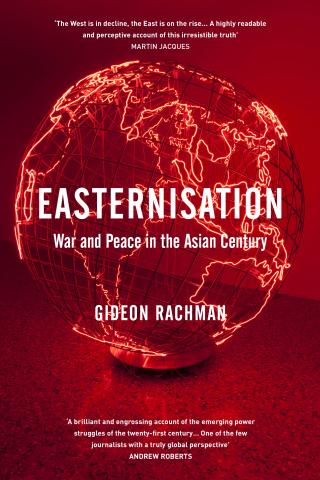
The recent book Easternisation: War and Peace in the Asian Century, by Financial Times journalist Gideon Rachman, deals precisely with this issue.

blog-easternisation

It is a great book, bringing together Rachman’s extensive experience in the US, Asia, and Brussels. Often, books written by journalists lack sound analysis for the mid to long term, and historical perspective. While Easternisation is not an academic tome either, it does provide sufficient deep analysis, especially by tackling developments in all important countries which play a role in the process. It is not just another volume of simply USA or EU bashing, as we have seen before with the huge literature on the alleged Japanese take-over of the US economy.

Rachman’s main argument is that the influence of the West, Europe in particular, has crumbled. This may lead to a major conflict in the Asia Pacific, most notably between China and the US, which also endangers the global economic order. Yet many other conflicts are also building up, in a region which heavily invests in armaments. In short, in the 21st century, ‘rivalries between the nations in the Asia Pacific will shape global politics, just as the struggles between European nations shaped world affairs for over 500 years from 1500 onwards’. I think this is an important message, which should be taken seriously by everybody. Certainly by the Europeans, who are in danger of just inhabiting the world’s largest open air museum within a few decades.  One thing is certain: the Asians will not wait for them to come to terms with the current shift of power.

The ugliness of international politics

What has been widely feared is about the happen, it seems. President Assad’s troops, supported by the Russians, are winning the battle over Aleppo. That is not great from a lot of perspectives. To name just a few: first of all for the civilians, who are killed and bombed continuously. Secondly, the crushing of the rebel forces there means the further weakening of what are ‘natural’ allies of the West, as they are against Assad and against ISIS. Thirdly, this victory (if it all continues this way, of course) strengthens Assad’s position, making it even more unlikely that he will disappear from the scene anytime soon. The only good thing seems to be the further weakening of ISIS.

Like many others, I do not like this development at all. I think Assad is a ruthless murderer of his own people and should therefore be taken to justice, preferably in its most definitive form. I wish the Syrian people all the best and would like them to decide over their own fate in liberty. I also deeply hate ISIS and all that it stands for. And the interference of foreign powers (either Russian, Turkish, Iranian, Western) certainly does not do much good either, although I also think it has been inevitable. Public opinion, perceived and real interests, and the defence of allies all foster these kind of interventions. These are of course just a few of the important variables in an enormously complex war.

So what to do, or aim for, as Western countries? Obviously, most Syrians are better off in a stable situation without war, than with any currently viable alternative. This means that negotiations about cease fires should commence, or at least be fostered, which will then hopefully lead to a permanent settlement. I do not dare to predict how long it will take for this approach to be successful. Yet any alternative is worse. These negotiations, whenever feasible, should have all parties at the table, Assad included. No vetoes against him being part of future talks, as has previously been the case. The man will stay around for a while, and we better get used to the idea. This is surely deplorable, yet inevitable. The situation in Syria shows once again the ugliness of international politics, with very limited roles for international law and justice.

Let it be a lesson for those within the liberal tradition who still think differently.

Classical Liberalism and the Nation State

Barry’s response to my earlier post is another interesting read, yet it is also rather broad brush historical. I think he is erroneous if he claims that ‘it did not occur to classical liberals, on the whole, to question the state system as they knew it’. In fact the founding fathers of classical liberalism, David Hume and Adam Smith, were very much aware of other, often cosmopolitan ideals of world order. Yet they argued that the nation was attached to individual emotion, which could not be the case for entities beyond the nation state. This was also the position of later classical liberals such as Von Mises and Hayek, as I show in Classical Liberalism and International Relations Theory (Palgrave, 2009).  Let me elaborate a little, also in the wider context of international political theory.

Liberalism is the political expression of individualism, yet cooperation of individuals in groups is valued positively. For classical liberals the nation, or the country, is the largest group in society which is the object of human passion, both positive in the sense of national pride and negative in the sense of shame and humiliation. Hume noted that there are few men entirely indifferent to their country, and both he and Adam Smith underlined that humans sympathise more with people to whom they are close than with strangers or foreigners. Feelings for the nation are strong, natural motivational forces for individuals.[i]

This also applies in the age of modern states and nationalism. Despite the atrocities committed in the name of national glory throughout the twentieth century, Mises and Hayek never predicted nor called for the end of the nation state. Mises thought that language was the essence of nationality, and with the fragmentation of the polyglot Austro-Hungarian Empire in mind he argued that multi-language countries were doomed to failure. His solution was an increase in possibilities for individual self-determination and group secession, but not in the expectation that this would lead to a world without sovereign states.[ii] Hayek saw the nation as a prime source of human bonding and individual loyalty, but recognised the negative aspects of nationalism. He valued the nation, but nationalism was a poison,[iii] not least because he saw a strong relation between nationalism and imperialism. After all, it is a small step from thinking good about one’s country to trying to rule and civilise allegedly inferior others. Often, although certainly not in all cases, the nation as a group is politically organised as a sovereign state. In the classical liberal view, states are the most important actors in international relations.

To maximise individual freedom the state should only have a limited number of tasks. The state is an important protector of natural rights, but history has shown that it is also the biggest abuser of these rights. The principle of the rule of law intends to protect the negative liberty of individuals. Classical liberals think the state can best be bound by a combination of constitutions; separation of the legislative, executive and judicial powers; and the limitation of positive law.

In international affairs this means that states should be cautious about concluding and ratifying treaties and other forms of positive law. These are often binding commitments that are very hard to change or to get rid of, with a large possible negative impact on individual freedom. Some international agreements may be useful to smooth the working of the international society of states, or to settle practical matters. But the dangers of overregulation are just as real in world politics as they are in national politics. Besides some specific cross-border issues, the classical liberal rule of thumb is that there is no need for international state action if there is no domestic state task.

Consequently, attempts to build a better world by establishing international organisations and regimes are rejected. Mises and Hayek were strong critics of the League of Nations and its successor the United Nations, and Hayek was a fierce critic of the International Labour Organization. Their main concern was that these and other organisations were taking up tasks they should not perform, just like overactive states in national circumstances. Social constructivism is bad, no matter at what level it is performed.[iv]

In Degrees of Freedom (Transaction, 2015)  I have tried to illuiminate the differences between the different forms of liberalism (and conservatism, also see my earlier post on the differences between them entitled “Let’s clear up the liberal mess”), including their views in international relations. In summary it looks like this:

Liberalism, Conservatism and International Relations

Classical liberalism Social liberalism Libertarianism Conserva

tism.

Nation as limit of individual sympathy Yes No No Yes
State as prime actor in world politics Yes No No Yes
International governmental

institutions/regimes

No Yes No No
Can war be eliminated No Yes Yes No
Does trade foster peace? No Yes Yes No

Source: Edwin van de Haar, Degrees of Freedom. Liberal Political Philosophy and Ideology (Transaction Publishers, 2015).

That also explain partly why Barrry can rightly argue that the ideas of Kant, Mill and to a lesser extent Montesquieu differ from those of Hume, Smith, Mises and Hayek: they are not classical liberals but social liberals.

Notes:

[i] Hume, Treatise,79, 317; Adam Smith, The Theory of Moral Sentiments (Indianapolis: Liberty Fund, 1982), 299; also Edwin van de Haar, ‘David Hume and International Political Theory: A Reappraisal,’ Review of International Studies, 34:2 (April 2008), 225–242.

[ii] Ludwig von Mises, Nation, State, and Economy. Contributions to the Politics and History of Our Time (New York and London: Institute for Humane Studies & New York University Press, 1983), 39–40, 82.

[iii] Friedrich Hayek, Studies in Philosophy, Politics and Economics (New York: Simon and Schuster, 1967), 143.

[iv] Mises, Nation, State and Economy, 90–91; Ludwig von Mises, Omnipotent Government. The Rise of the Total State and Total War (Grove City: Libertarian Pres, 1985), 292–294; Friedrich Hayek, The Road to Serfdom (London: Routledge, 1997), 176.
Classical Liberalism, Cosmopolitanism and Nationalism

In another thought-provoking post on Facebook (does the guy ever write mediocre stuff, I wonder?) Barry raised the question of the relation between classical liberalism, nationalism and cosmopolitanism. He wrote the following:

“On the capture of classical liberal/libertarianism by anti-cosmopolitans. This is very influential at the heart of the ‘leave’ ‘elite’ in the UK, and can only be destructive of classical liberalism/libertarianism. The immediate political consequence of Leave is the elevation of Theresa May to Tory leadership/Prime Minister’s office on a much more ‘Red Tory’, communitarian, corporatist foundation than existed under Cameron. ’To the extent to which the current wave of populism maps into a conflict over national versus transnational identity (Dan Drezner is unconvinced), the problem is not an excess of cosmopolitanism but rather its absence, especially on the conservative, free-market right.”

He seems to take a positive relation between classical liberalism and cosmopolitanism as the default position. Of course Barry did not provide definitions in a FB post, but here I take cosmopolitanism to mean “the idea that all human beings, regardless of their political affiliations, belong to a common moral community. Cosmopolitans often believe that all individuals have the same basic moral status, and tend to downplay the importance or desirability of national political institutions. [They are] opposed to nationalism” (source: Matt Zwolinski (editor), Arguing About Political Philosophy, Routledge, 2009).

I argue that Barry overlooks that classical liberalism combines a cosmopolitan side, with a strong defense of national political institutions (e.g. the state). The cosmopolitan side is perhaps easiest to see, if one takes the idea of free trade as the guiding principle. Free trade is by nature morally neutral for the individuals involved, and has numerous positive economic effects; it fosters cultural exchange as well as innovation and knowledge sharing. In that sense classical liberalism is indeed related to cosmopolitanism.

Yet this stops where the national state comes into play. Classical liberals never predicted any positive political effects of trade (see my earlier notes on this topic) and, just as importantly, they actually favor a strong state, with a limited number of tasks. At the same time, from Hume and Smith onwards to Mises and Hayek, they strongly dislike the idea of transnational political institutions, because these lack any substantial emotional basis which nations do posses. Also, these large political institutions easily become a threat to individual liberty, even more so than national states with too many tasks. So, there is no really no relations between political cosmopolitanism and classical liberalism at all.

There is also no relation between nationalism and classical liberalism. A preference for the national state does not lead to nationalism, which is the vicious and poisonous belief in the superiority of one’s country, often accompanied with a dislike of allegedly inferior neighboring countries or peoples or groups. This is collectivism turned even worse, which is a double ‘no’ from a classical liberal perspective. This said, if patriotism is defined as national pride, then classical liberalism and patriotism can and will go together. There is a fine line between the two sometimes, but patriotism is not violent and dividing, but a binding force between individuals sharing a national state.

The last point is on the European Union. Hayek and Mises have been on record with strong support for a European Federation, primarily as a remedy to war-torn and nationalism-infected Europe. In these circumstances the default position of an international order as a society of states no longer functioned, so there was a need to seek an alternative. Needless to say their federation had little resemblance with the current super state we know as the European Union, which has become a classical liberal nightmare in terms of liberty and property rights violations it commits on a daily basis.

The current EU has some classical liberal traits (the imperfect common market is the single most important one), which is of tremendous use to all European individuals. It is, however, way too cosmopolitan in the bad political way. A likely consequence of Brexit is that this will become even worse, now that the French and their allies will get more room for their collectivist fallacies.

The European Union is Pathetic

So here we are. Prime Minister Cameron got his ‘special deal’ from the rest of the EU leaders. It is pathetic, from both sides. I like the Brits, and admire their great tradition in political thought. Because of their constant doubts about the EU, they are (potentially) the most informed about it, if the enormous flow of publications pro and con is a sign, which have seen the light since the eighties. Therefore, one questions the sincerity of Cameron, who has repeatedly said he will campaign against Brexit. His pathetic result seems a sure vote winner for the No side though. I find it hard to belief that anyone can be seriously convinced to stay in, if his four main results should do the trick.

These four are: a minor semantic thingy (Britain is exempt from striving to a closer union); a complicated procedure for a majority of national parliaments to reject or change intended European regulation (a comparable procedure has been a failure); the possibility to decrease the amount of children allowance for children who do not live in Britain to the purchase power parity level of the country concerned (especially aimed at Eastern Europeans); and finally an emergency break on social security benefits. Great results to build a campaign on…

These results are mostly symbolic, and while symbols are important in politics, it still amounts to little. So the other European leaders were not willing to change much in the way the EU is now run and its enormous amount of laws, rules and legislation. This is by far the saddest of it all. The leaders  let the moment pass to really change the EU, to not only address the British fear and frustration, but also those of the people of many other member states.

This is especially relevant for The Netherlands. On April 6 there is national referendum on the association treaty with Ukraine. The No-camp is leading the polls. If rejected (and the government acts accordingly, which it is not obliged legally), the whole treaty has to be discarded by the EU. We have been in this situation before. In 2005 the French and Dutch populations rejected the EU constitution by large margins. Only to have force fed on their throats a marginally different constitutional treaty a year later. So strange support for the EU had been decreasing for years.

The EU cannot make a fist in foreign politics, not in defense and security affairs, not in the current refugee crisis. It fails to ensure free competition in services, it still wastes billion of euros in subsidies on agriculture, regional support, industrial policies, et cetera. In short: it is a mess, the EU fosters the development of turning itself into an open air museum: admired for its culture, laughed at for its dismal politics and economics. Thanks a lot for the leadership, European Council.

Liberalism and Sovereignty

More than a year ago I promised Jacques a post on sovereignty and while I am not always able to follow up very quickly, I tend to do what I promise. So here it is! Jacques’ main cri de coeur was why (classical) liberals should care about sovereignty at all.

When it comes to the theoretical discussion about sovereignty (the literature is huge), I think there is no better start than the work of international relations theorist Robert Jackson. Or better and broader: any thinking about international relations benefits from this Canadian, former Boston University professor, especially his magnum opus The Global Covenant: Human Conduct in a World of States (Oxford University Press, 2000). But this is a side step.

In his 2008 book Sovereignty: Evolution of an Idea (Polity Press) he argues that:

sovereignty is an idea of authority embodied in those bordered territorial organizations we refer to as states, and is expressed in their various relations and activities, both domestic and foreign. It originates from the controversies and wars, religious and political of sixteenth and seventeenth century Europe. It has become the fundamental idea of authority of the modern era, arguably the most fundamental.

Also in regions where other kinds of arrangements existed before Western imperialism.

It is at the same time both an idea of supreme authority in the state, and an idea of political and legal independence of geographically separate states. Hence, sovereignty is a constitutional idea of the rights and duties of the governments and citizens or subjects of particular states. It is also an international idea of multiple states in relation to each other, each one occupying its own territories and having foreign relations and dealing with others, including peaceful and cooperative relations as well as discordant relations and periodical wars.

Of course a lot of popular and academic discussion follows from this, for example about the particular form of sovereignty (popular, or not), the relation between power and sovereignty, sovereignty and globalization, or if and when sovereignty may be breached to protect others through intervention. Yet here I solely  focus on the relation between sovereignty and liberal political theory.

Concerning the domestic supremacy side of sovereignty a lot has been written by liberals. Most liberals (classical, social, and even libertarian minarchists, such as Ayn Rand or Robert Nozick; see my Degrees of Freedom for the precise definitions) realize some form of state is needed to protect individual rights. A state embodied with sovereignty. At the same time most liberals (social liberals less so, because they favor a relatively large state) recognize the state is also the largest danger to individual freedom. How to balance the two is the perpetual question of liberal political thought, one also without a definitive answer or solution, so far.

Less attention has been given to the international side of sovereignty. There are a number of libertarians, such as the anarcho-capitalist Murray Rothbard, or his intellectual successor Hans-Hermann Hoppe, who think there should not be states, hence no issues of sovereignty exist once their stateless world has materialized (they remain largely silent about how to reach that situation). Yet it seems to me the thinking should not stop there. These same thinkers romanticize the idea of secession, yet seem to overlook that those seceded groups or communities also need to deal with other seceded groups and communities. They are a bit lazy when stating everybody should look after themselves, and only defend themselves in case of attack by others. If everything would be nice and neat among people this might be ok. Yet of course history shows (also in those areas where sovereignty never played a big role before Western imperialism) that people interfere all the time in each others affairs, some rulers may have malign intentions, others belief some parts of the seceded lands belong to their community, let alone issues about religion, et cetera. In short, chances on a peaceful world with the occasional conflict that can be solved by self defense are zero.

Funnily enough, social liberals share the idea of the possibility of a world peace and cosmopolitan harmony. They also favor the abolition of sovereign states, not through secession but through the pooling of sovereignty at the transnational level, with the European Union as an example and a world federation as the ultimate end goal. This seems just as unrealistic, as even the EU is still mainly governed from the member states, as the current refugee crisis and the possible dissolution of the Schengen agreement illustrates. More generally, the pooling of sovereignty proves rather difficult, also in other parts of the world. ASEAN in South East Asia is an example.

More realistic are classical liberals, such as Hume, Smith, and Hayek, who acknowledged an emotional tie between the individual and his country, as well as the constant need to defend individual property rights against invasion by others, through standing armies, diplomacy, some international treaties, the balance of power, et cetera.  Human nature does not allow for starry eyed fantasies about international harmony, let alone international peace. Hence, it is rather normal to care about external sovereignty, as it is foremost a means of protection.  Not the sole means, but an important and fundamental institution of international relations.

Is the European Union Collapsing?

Lately, the European Union (EU) stumbles from crisis to crisis. After a long hot spring dominated by the financial crisis in Greece, we now see the collapse of the system based on the Schengen Treaty, which secures the free movement of people within most countries of the EU. The upheaval is the result of the huge numbers of refugees entering the EU, mostly from Syria, Eritrea and Sudan. It is expected that Germany alone will offer asylum to approximately 1 million people this year. With no end of the refugee wave in sight more and more countries are either closing their borders, building fences, or reintroducing border patrols. The situation in Hungary seems worst, especially in the temporary refugee camps. This weekend we saw footage of guards throwing food into the hungry crowds, just like zoo keepers do when feeding the wild beasts. An absurd lack of civilization.

Both crises have at least two factors in common, namely issues of sovereignty and property rights. Sovereignty is claimed back by European politicians, who previously made arrangements at the European level, yet are now confronted by their electorates who want to end the infringements of their property rights. In the case of Greece it was about (mostly) Northern European leaders who were pressed by public opinion to stop paying for the support of what was seen as an almost bankrupt country. Certainly in Germany and The Netherlands it was seen that Greece made a mess of things which itself needed to sort out (this was the dominant perception, I underline that I do not say this is also the right presentation of all relevant facts). In the current refugee crisis public opinion also welcomes large numbers of people who –again as it is widely perceived- are seen a poor sods fleeing from a terrible war. Yet at the same time the people understand that the refugees, no matter how well educated some of them are, also need to receive all kinds of welfare arrangements and will go through an often hard process of integration into society. This against the background of more than a decade of heated debate about immigration and integration in most (Western) EU countries.

In both questions the politicians eventually tend to back out, by reclaiming national sovereignty. Not directly, as this would be embarrassing. So Greece got its third support package, and in the refugees crisis it is underlined that ‘temporary border patrols’ and even ‘border closings’ are still within the letter of the Schengen Treaty. There is also talk of centralizing the intake of refugees at the European level, instead of the current principle of ‘first country of entry is the country where asylum should be requested. This may well be a good idea given the fact that refugees will  arrive (as the US experience also makes clear). Yet it is hard to predict how the negotiations will end, because there are large objections against the European Commission spreading refugees among the EU member states at its own peril.

The bigger picture however could well reveal that both events mark the end of the movement towards ‘ever closing union’, the old purpose mentioned in the Treaty Of Rome (1957), the most important founding treaty of European integration. That is significant, because if I am right in my assessment it means we are experiencing a real turning point. There are a number of contributing factors, most of which have been identified before, but that does not make them less significant, such as a lack of European identity among the European people, and the desire to accept only a minimum amount of European policy, due to the much stronger desire to make national decisions, which are easier to correct by the electorates. This, by the way, is fully in line with classical liberal thinkers such as Hayek, Hume or Smith.

Does this mean the EU is about to collapse? Hardly likely. The economic basis is still strong and while large the current problems can be paid for and sorted out eventually. Yet if integration stops here it will also mean that the EU will never get a serious common foreign policy or a common defense policy either, both of which have been tried –and failed- over the past decades. So the EU will then only be a ‘super free trade zone’, with a common trade policy, and strong legal apparatus also spreading out over many non-economic issues.  This raises many more issues, but that goes beyond the purpose of this contribution. For one thing: these are once again exciting times in Europe!

Larry Siedentop’s Straw Dog

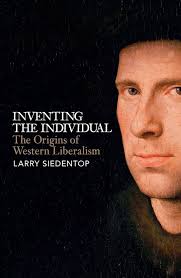
I finally had the chance to finish reading Larry Siedentop’s Inventing the Individual: The Origins of Western Liberalism.

download

It is a great book, and especially informative for those not well-versed in the intellectual history of political ideas within (mainly) Christian thought. The arguments starts with the Ancient traditions, to the early years of Christianity, all the way to the fifteenth century. According to Siedentop (p. 332) the main goal of the book is:

‘to show that in its basic assumptions, liberal thought is the offspring of Christianity. It emerged as the moral intuitions generated by the Christianity were turned against an authoritarian model of the church. The roots of liberalism were firmly established in the arguments of the philosophers and canon lawyers by the 14th and 15th centuries: belief in the fundamental equality of status as the proper basis for a legal system; belief in that enforcing moral conduct is a contradiction in terms; a defense of individual liberty, through the assertion of fundamental or ‘natural rights’ and, finally, the conclusion that only a representative form of government is appropriate for  a society resting on the assumption of moral equality’.

Siedentop clearly succeeds in making this point. As said, the book can be warmly recommended. The question is, however, why does he care about this issue? Siedentop (pp. 334-338) clarifies that he wants to fight the dominant idea that liberalism sprang from the Renaissance, and that liberalism almost equates secularism, or is even anti-religion, at least in the public sphere.

You do not need to be a scholar of the liberal history of ideas to raise more than a few eyebrows here. What liberalism is Siedentop taking up for argument? He is unclear about this, as he does not care to define this liberalism, nor does he provide references to liberal thinkers. That is where the trouble starts.

Undoubtedly there are some modern social-liberals who claim that liberalism is secular and that the state and lawmaking should be strictly neutral in religious terms. Arblaster in The Rise and Decline of Western Liberalism even explicitly refutes any liberal traces before the Renaissance. Unclear is how dominant these voices are, especially outside academia. One thing is certain, these do not comprise classical liberals.

In the Scottish Enlightenment, in many ways the birth grounds of classical liberalism, the place of religion in life, and religion as a source of morality, was discussed. In contrast to most other thinkers, -Smith included- Hume even criticized religion, albeit most openly  after his death in Dialogues concerning Natural Religion. Yet to my knowledge, no thinker actually denied the role of Christianity as a source of  important ideas, certainly not the  role of individuality.

Modern writers, who are more aware of classical liberalism as a tradition do not deny this either. Let me give a few examples.

Hayek in an essay on liberalism (in New Studies in Politics, Philosophy Economics and the History of Ideas) writes that it traces back to classical antiquity and certain medieval traditions. He actually attacks ‘some nineteenth century writers’ who denied ‘that the ancient knew individual liberty in the modern sense’. In his general overview entitled Liberalism, John Gray (then still in his liberal days), also neatly points to the pre-modern and early modern times for the development of liberal ideas as we now know them. David Schmidtz and Jason Brennan pay their due respect to these older sources in A Brief History Of Liberty and the same goes for George H. Smith in The System of Liberty, and David Boaz in The Libertarian Mind.

Of course, none of them made detailed studies of these influences because their books had different purposes than Siedentop’s. Yet all deal with it in a few paragraphs or even a separate chapter, making clear to their readers that (classical) liberalism has older roots then the Renaissance, that there are important Medieval and Ancient thinkers who all left their mark on the development of (classical) liberal thought.

Siedentop wrote a great book, that unfortunately is a straw dog as well: his portrayal of ‘liberalism’ is erroneous, either deliberately or not. It denies the views of the founding and one of the main liberal variants. That is sloppy, to say the least, for such a learned and experienced scholar. With the use of these general terms Siendentop’s attack is simply off target. He should have taken far more time to define the ‘liberalism’ and the liberal scholars subjected by his attack.

Fiscal Watch Dog, The Dutch Way

I still have not found a way to make a living out of international political theory that also satisfies my demands as consumer at numerous markets, not least the housing market. At this moment this means I make a living at the Dutch fiscal watchdog. I recently wrote a piece about in Contemporary Social Science, which can be seen here.

Below is the abstract, drop me a mail if you’re interested in the full text.

CPB Netherlands Bureau for Economic Policy Analysis: Dutch (economic) policy-making

As one of the oldest independent fiscal institutions in the world, the CPB Netherlands Bureau for Economic Policy Analysis (CPB) has a long history of providing evidence for policy-making. Uniquely, its activities include the analysis of election manifestos, the national budget and the coalition agreement, as a derivative from its provision of leading macroeconomic forecasts. This paper analyses the CPB’s role within the Dutch political system, its place in public administration and the different methods it employs to provide evidence for policy-makers. It then focuses on two different types of activities, the costing of election manifestos and ageing studies, using a multi-methods approach to illustrate how the CPB’s influence extends to setting policy agendas and policy targets, and to reveal critical factors for success and failure. Although the CPB model cannot easily be transposed to other countries, a number of general principles can be deduced from it for application elsewhere.

The Fog of Foreign Policy

The Fog of Foreign Policy: Why only ‘least bad’ options are available in Syria, Iraq and other global hotspots

rr4

Sound libertarian analysis, highly recommended!

How about war, Professor Wall?

The Cambridge Companion to Liberalism

There is a lot of truth, insight and wisdom in this Cambridge Companion to Liberalism. But how on earth is it possible that there is no substantial mentioning, let alone analysis, of the political philosophy of liberalism and international relations? At least a weird omission by the editor, Professor Steven Wall, I must say….

Slowly debunking the trade leads to peace fallacy

In 2010 I wrote that economic issues are just another factor in decisions on war or peace. There is nothing to suggest that free trade leads to peace per se (The Liberal Divide over Trade, Peace, and War, International Relations, vol 24, number 2, June 2010).

This is not a particular popular viewpoint, certainly not among classical liberals and libertarians, for reasons written about before at this blog.

So it is nice to read in Dale C. Copeland’s new book Economic Interdependence and War (Princeton University Press 2015), that indeed it all depends upon the situation. Economic factors can just as easily be cause for war, as a cause for refraining from violence. Copeland does not write from the liberal tradition, but if he had, he could have used Adam Smith, David Hume or Friedrich Hayek in support for his argument.

Anyway, the good thing is that the free-trade -leads-to-peace thesis is slowly but surely being debunked. It makes for a better and more mature discussion about international relations, inside and outside liberalism.

Epstein on Rand Paul’s foreign policy views

Published a while ago, still a good read: “Rand Paul’s Fatal Pacifism.”

Let’s clear up the liberal mess

It appears there are as many liberalisms as there are liberals. To name just a few: libertarianism, classical liberalism, bleeding heart liberalism, economic liberalism, political liberalism, social liberalism, high liberalism, minarchism, objectivism, anarcho-capitalism, neoliberalism. And in international relations theory there is for example neoliberal institutionalism, liberal internationalism or embedded liberalism. Clearly this all amounts to a liberal mess. I attempt to sort it out in my forthcoming book Degrees of Freedom. Political Philosophy and Ideology (Transaction Publishers, April 2015).

Getting a decent grasp of liberal political thought does not have to be this complicated. You only need to keep in mind a perennial question in political philosophy: what is the just relation between the state and the individual? Roughly, there are three answers: the state should have (almost) no role in individual life, the state should have a limited role, or the state should have a fairly large role. The liberal variants that are associated with these answers are libertarianism, classical liberalism and social liberalism, respectively. To be sure, these three are not completely mutually exclusive, while the thinkers associated with these do not always neatly fit the categorization.

This is not the right place to discuss the methodological underpinnings in detail. Suffice it to note that the divide is based on the analysis and ranking of the main political concepts in classical liberalism, social liberalism and libertarianism. This method originates in the writings of British political theorist Michael Freeden. Put briefly, every political ideology should be seen as a framework made of a number political concepts, who vary in importance. Accordingly, all three liberal variants have core, adjacent and peripheral concepts. Sometimes the individual concepts overlap, but in total there is significant variation, leading to the three liberal variants.

Classical liberalism originates from the eighteenth century Scottish Enlightenment, not least in in the writings of David Hume and Adam Smith. It is also associated with thinkers such as Ludwig von Mises, Friedrich Hayek, Milton Friedman and James Buchanan. It has a realistic view of human nature, which means that man is seen a mix between rationality and emotion. Individual freedom is the main classical liberal goal, which is best preserved by protection of classical human rights (freedom from), the rule of law in public affairs and reliance on spontaneous ordering processes in society, such as the free market. The classical liberal state is limited, which means it does have to perform or arrange for a number of important public tasks. Besides defense, police and judiciary this mainly concerns a minimal amount of welfare arrangements, some environmental regulation, or other issues that cannot be dealt with through the markets.

Libertarianism and social liberalism both originate from the nineteenth century and they constitute the two contrasting poles of the liberal spectrum. Libertarians think the classical liberals allow the state to grow too big. They favor a stricter protection of individual rights to life, liberty and property which to them ensures a just and good functioning society, where free people will be able to use their talents and cooperate in strictly voluntary ways. Some, like Murray Rothbard or Hans-Hermann Hoppe, argue this society can totally rely on spontaneous order for the provision of all necessary services and therefore want to abolish the state completely. Others, such as Ayn Rand, think there is a need to publicly organize defense, police and judiciary.

The social liberals (liberals in the contemporary American sense), such as John Stuart Mill or John Rawls think the libertarian and classical liberal ideas lead to social injustice. They argue that individual flourishing demands a fuller, positive kind of liberty (rights to), which enables individuals to fully develop themselves. Individuals should be able, especially through education, to learn skills and get knowledge to use their natural talents, at the labor market and elsewhere. Otherwise the idea of liberty is just formal, lacking any practical meaning. Concern for social justice also entails the redistribution of income (through taxation), to ensure a welfare system (social security, public health) that takes care of the less fortunate. This leads to a much bigger role for the state than in the other two liberalisms.

Interestingly, these differences also show up in the liberal views on international relations. Libertarians favor the least active (state) interference in world politics, classical liberals recognize the implications of uneven power distributions and believe in the spontaneous ordering effects of the balance of power, while the social liberals are supporters of international organizations and international law.

Needless to say this is just a very short description of the three liberal variants. Much more can also be said about the reasons to discard the other forms of liberalism that figure in the public debate. Still, in my view, this division into three stands up to critical scrutiny, is methodologically sound and therefore by far the best way to sort the liberal mess.