New issue of Isonomia Quarterly is out

You can read the whole thing here.

Some arbitrage free Byzantine rates of return

Byzantium. The surprising life of a medieval empire – by Judith Herrin

In the economy chapter, apart from the often overlooked hard-ass (gold) and long-ass (700 years) of monetary stability, the author discusses some social aspects of economic life. The Byzantine elites, following on Ancient Rome’s disdain for commercial endeavors, typically opted to invest in three things: Land, administrative offices (which could confer some coin in unofficial ways), and titles in the Court.

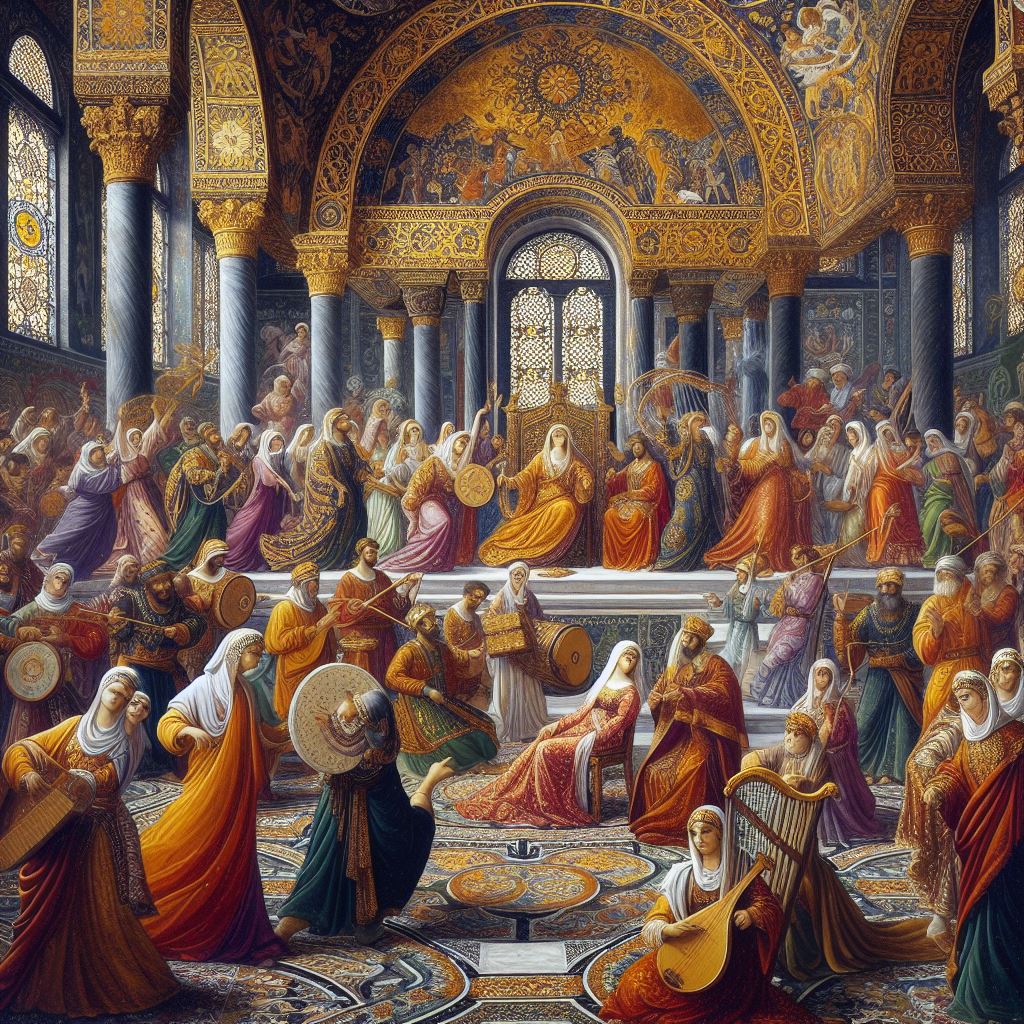
A Byzantine celebration, as copilot imagined it. In the other versions, people were so hardcore eastern orthodox christians that even had halos.

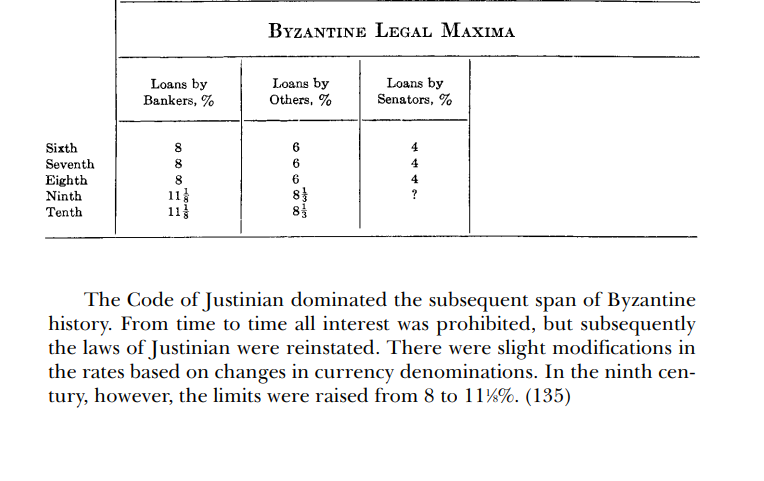
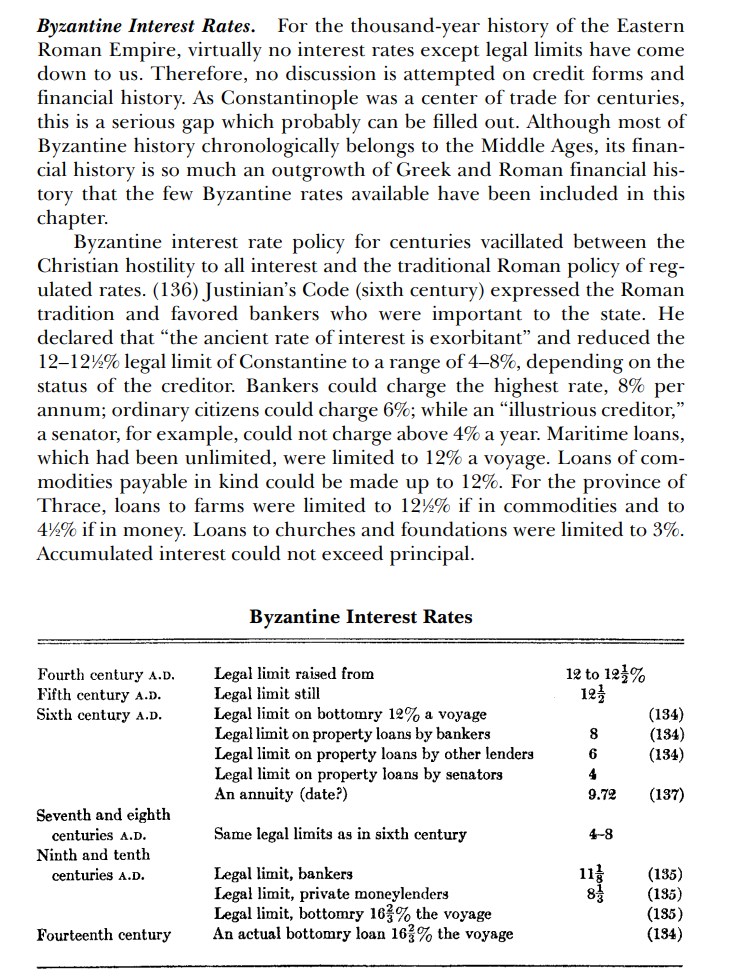
The Court titles had fancy names and came with regular allowances. The more mundane ones had a rate of return of 2.5%- 3.0%, while the higher-ups (like Protospatharios, loosely meaning First Sword Bearer, with responsibilities that oscillated among Chief Bodyguard, Receptionist and Master of Ceremonies) reached 8.3%. Since Byzantines had also inherited Rome’s practise of capping interest rates, we know that a simple citizen could lend at a rate of 6.0% (a banker at 8.0% and a distinguised person like a Senator at 4.0%).

Re: Byzantine interest rates, from the impressive but rather dry, A History of Interest Rates – by Sidney Homer & Richard Sylla

So, it mostly did not make sense to buy a Court title, money-wise. Unless you did manage to land as the Protospatharios, so you could enter a risk-free carry trade of 2.3% and also enjoy lovely red robes with gold lining or white robes and a golden mantle (the latter attire was reserved for eunuchs). Half-joking aside, the titles were not transferable (that is, no secondary market), so you could not probably even get back the initial investment. It turns out, fancy names / clothes/ duties/ company were a major factor, after all. And secondary markets serve a purpose, at least sometimes.

Piece of music

A new bill, currently under public consultation, is poised to introduce quotas, yes, for music:

Greek-Language Music Quota Bill Sparks Controversy (BalkanInsight)

In its proposed form, the bill tinkers with the music lists aired in common areas (lobbies, elevators, corridors etc) of various premises (hotels, traveling facilities, casinos and shopping malls). The programs should consist of a minimum of 45% of either Greek-language songs, or instrumental versions of said songs. The quota leaves out cafes, restaurants and such (thus slinking away from a direct breach of private economic liberty, as interventions like anti-smoking laws in some cases were found as too heavy-handed). The bill also incentivises radio stations to scale up, so to say, the play-time of this kind of songs, by allocating them more advertising time (another thing that is also strictly regulated, obviously), if they comply to some percentage. Finally, there are some provisions regarding soundtracks in Greek movie productions.

There is an international angle in this protectionist instrument (pun intended). Wiki reveals that a handful of countries apply some form or another of music quotas, with France the most prominent among them. The Greek minister also mentioned Australia and Canada in an interview.

The bill aims to protect local music legacy and invigorate modern production, as part of the competent Ministry’s constitutional mandate. But there are some discords, apart from the always funny administrative percentages (and the paraphernalia needed to track who plays what and for how much). What is deemed as eligible Greek music, in the bill’s proverbial ears, misses a tone or two: Foreign-language songs and prototype instrumental compositions, by Greek artists, do not qualify. For example, Greek band VoIC (their latest album’s cover above, source) mix rock with (mostly Greek) folk music, but fall short of the criteria. And given some minister remarks on “Englishisation”, this will be a point of contention.

Bonus tracks:

Cover of a Greek (and Greek-language too!) song, “Misirlou”
Some Russian folk music (especially no34 is excellent) from an indie game (a most fortunate use of local traditional sound)

Dirigisme and Social Polarization.

Friedrich Hayek’s main thesis in “The Road to Serfdom” (1944) consists of postulating that attempts at central planning and dirigisme provoke, through the increasing use of political expediency, a continuous erosion of the political institutions that characterize to democracy and the separation of powers, thus leaving aside, by way of exception, constitutional rules and procedures. Hayek had warned that such a process had occurred in the Weimar Republic and pointed out that England could incur a similar process if it chose dirigisme as an instrument to overcome the post-war crisis.

Hayek himself recalled in various interviews and articles that the message of his book was rarely interpreted with due accuracy, and that, consequently, statements were attributed to him that he had never made, thus blurring the authentic gist of the work. However, this does not prevent “The Road to Serfdom” from being a classic, since, as such, it offers diverse insights as times and geographies vary, to be applied to the analysis of current events or history.

Regarding this last point, it is worth saying that the processes initiated by Argentina in 1946 -whose consequences persist to this day- and by Venezuela in 1998 -still in development today- present traits that make them different from other historical examples of how a country might take a road to serfdom. Throughout the 20th century, it was possible to verify that both the cases of dirigisme in democratic nations and the advent of totalitarian and authoritarian regimes followed profound economic crises, which were in turn consequences, directly or indirectly, of the two World Wars. On the other hand, the aforementioned experiences of Argentina and Venezuela began in quite different scenarios.

But the aim here is not to identify the historical cause of a social and political event, but only to describe a series of circumstances that condition the particular form of manifestation of a phenomenon that is essentially the same: that of dirigisme and the attempt to configure economic central planning. In most of the cases that occurred throughout the 20th century -outside of those mentioned in Argentina and Venezuela- those in charge of implementing dirigiste policies found themselves with devastated economies and societies dismantled by wars. In these situations, both economic dirigisme and the attempts at central planning of the economy acted provisionally -although in a mistaken and deficient way- as organizing principles of social and economic arrangements that were already chaotic, such as the interwar period and the first years of the postwar period.  Subsequently, when in the 1970s it became evident that both economic dirigisme and central planning of the economy were yielding increasing negative net results, the different countries, whether capitalist or socialist, sought their respective ways to liberalize and decentralize their economies, which led to the economic and political processes of the 1980s and 1990s.

On the other hand, the case of Argentina in 1946, as stated, was very different. Argentina had not participated in the war and its economy was robust, despite the difficulties inherent to the international context. Similarly, Venezuela in 1998, despite having a highly discredited political class, had a prosperous economy for decades, in a very favorable international context. In these countries, economic dirigisme sought to be implemented in situations in which civil society was well structured and the private sector economic system was fully operational. Therefore, it is important to point out that both processes of increased government interference in the social and economic life of both countries were accompanied by a fracture in civil society and a growing antagonism and belligerence among different social sectors, promoted from the political system itself.

Several years after “The Road to Serfdom” (1944) was published, Hayek stated in “Rules and Order” (1973) – the first volume of “Law, Legislation and Liberty” – that a legal and political order based on respect for individual freedoms was characterized by functioning as a negative feedback system: each divergence, each conflict, each imbalance, is endogenously redirected by the legal system itself in order to maintain peace between the interactions of the different individuals with each other, defining and redefining through the judicial system -which is characterized by settling intersubjective controversies, specifying the content of the law for each specific case- the limits of the respective spheres of individual autonomy. This is how a rules-based system works, as opposed to a regime in which most decisions regarding the limits of individual freedoms are made at the discretion of government authorities.

  Given that the 20th century mostly offered examples of societies devastated by war, pending reconstruction, perhaps we have lost sight of the effects of economic dirigisme and attempts at central planning of the economy on Nealthy civil societies and fully functioning economies. The cases of the processes initiated by Argentina in 1946 and by Venezuela in 1998 call to think about what their consequences could be for societies with economies with a moderately satisfactory performance. Among these consequences, there will surely be a growing social polarization, in which the different sectors demand their respective participation in the discretionary redistribution of income. These situations therefore acquire the dynamics inherent to positive feedback systems, in which social belligerence escalates and demands increasing levels of government interference and authoritarianism. This is another aspect of the road to serfdom that should begin to be considered in the 21st century.
Second-hand bookstores and the souls of cities

Several years ago, a mentor shared Paul Graham’s 2008 essay ‘Cities and ambition’ as part of helping me evaluate where to pursue my doctorate. Graham’s argument is that cities act like a peer group on an individual: where one lives affects one’s goals, sense of individuality, and ambition. Therefore, one should choose where to live carefully, just as one should choose one’s friends carefully.

Graham pointed out that a city is not only a geographic location, an administrative area, or a convenient location. A city is a collection of individuals who form a group. Groups in turn have a culture, a mentality, a way of doing things. As Graham described it, “[O]ne of the exhilarating things about coming back to Cambridge every spring is walking through the streets at dusk, when you can see into the houses. When you walk through Palo Alto in the evening, you see nothing but the blue glow of TVs. In Cambridge [Massachusetts, the home of Harvard and MIT] you see shelves full of promising-looking books.” Following on Graham’s essay, I propose an additional metric for evaluating a city: the contents of its second-hand bookshops.

When I travel, inevitably I wash up in at least one used bookstore. Sometimes they are independent establishments, sometimes they are specialist stores focused on collectors, sometimes they’re big chains, such as Half Price Books. Like a weathervane, second-hand bookshops point to the state of a city’s intellectual and cultural life.

Big cities, such as New York, Paris, Vienna, or Washington, D.C., have a wide array of types of second-hand bookstores. Generally, one can find a suitably catholic selection: Israel Joshua Singer lives in the same space as Olivia Butler, R. F. Kuang, William Faulkner, or Kingsley Amis. At a level above or below one can find copies of old translations of the Zohar or the Buddhist sutras along with crumbling copies of the Douay-Rheims Bible. What one will probably not find are volumes of esoteric slogans with saccharine cover designs from which religious symbolism is carefully excluded, even if the books are filed under “Christianity.”

A recent visit to St. Louis, a city which despite its problems has a lovely art museum that was buzzing with activity on its free access day (every Friday), led to the requisite visit to a small, second-hand bookstore. It was a charmingly simple establishment but rich with selection. After admiring the contrast between the display of books from the “Childhood of Famous Americans” children’s series placed near Ta-Nehisi Coates’ books, I came away with several volumes of Stefan Zweig’s essays in the original German.

In contrast, a visit to the Half Price Books in a college city which hosts the flagship state university was almost futile. A single volume of Olivia Butler sat alone amongst mishmash of fantasy books. Poetry was non-existent in the poetry section, excluding a college textbook edition of excerpts of Homer. The jewel of the literature section was an incomplete paperback set of Winston Graham’s Poldark series, with covers alluding to the derivative television show. The foreign language section had no books in French, German, or Italian, excluding dictionaries and outdated textbooks, and the Japanese subdivision had only children’s books. Translations of popular manga don’t count toward foreign language credit in such establishments. A request for the writings of Epictetus turned up nothing in the system, but several cartoon books of witches’ spells were prominently displayed at the entrance of the religion and philosophy section. The young adult section overflowed with cheap vampire romances, a fitting start for what was in the more advanced reading sections. Based on the detritus of current residents’ reading, the prognosis for intellectual or cultural life is not good for this college town.