Ron Paul’s Legacy

Ron Paul will not get to speak at the GOP convention, but his legacy will hard to miss over the next decade of American politics. His son is now a Senator in Kentucky, and his Audit the Fed bills have lots of bi-partisan support (in the House anyway; Senators, for some strange reason, seem to like the Federal Reserve an awful lot).

His foreign policy, which initially attracted me to libertarian ideas, is the most important legacy, however. I can tell because the GOP loathes it so much that they won’t give Congressman Paul the time of day they know they need for his support.

From Foreign Policy: Continue reading

Life Under Fatwa

I did once visit Iran when I was 21 years old, during the time of the shah. It was wonderful. I had just graduated from university, and such was the world at that time, 1968, that I was able to drive with a friend from London to South Asia across the world. I mean, try driving across Iran and Afghanistan now! I remember it being a very cosmopolitan, very cultured society. And it always seemed to me that the arrival of Islamic radicalism in that country, of all countries, was particularly tragic because it was so sophisticated a culture — which is not to defend the shah’s regime, which was appalling. But it was one of the tragedies of history that an appalling regime was replaced by a worse one.

From Salman Rushdie.

At first I found his praise for the Obama administration to be typical of Left-wing establishment figures, but then I remembered that Rushdie is an Indian and had probably had to deal with racist legislation in one form or another while growing up. While the period of colonialism (roughly coinciding with the end of the Napoleonic Wars and the beginning of World War I) did indeed open up more places to markets, the Jim Crow-like legal barriers that European states erected no doubt helped to foster part of the suspicious climate that now pervades most globalization skeptics worldwide.

This is a shame for two reasons: Continue reading

One Sure Thing About Globalization – The American Motion Pictures Industry World Hegemony Part 4

[Editor’s note: this lecture was delivered to the Leavey Institute of Santa Clara University in 2003. You can find it reproduced in whole here]

Just another National Specialization

The massive asymmetry in films exports between the US and the rest of the world may be the result of any number of factors. The fact that foreign movies occasionally do well in the US market ( in recent years, “Life is Beautiful”, from Italy, “Amélie”, from France. The first, 1999, Pokemon cartoon from Japan grossed US$85.7 , million, according to WSJ 7/19/02:w11, and, as forecasted by same – “Read my Lips”, also from France, will do well) suggests that public preference, and possibly language barriers, are more likely to be issues than American distribution superiority, for example. Yet, language barriers may be less significant than one would guess. Luc Besson’s “Jeanne d’Arc” (“The Messenger”) released in 1999, purportedly produced in English to make it accessible to the polyglot EU markets and to the US market, registered 3.07 million admissions in the European Union in that year, against, 40 million for American-made “ Star Wars Episode 1”, 23 million for “Tarzan”, almost 21 million for “The Matrix” , and 7.4 million for “American Pie”. Even the obscure, American-made “Patch Adams” did better ( EAO 2001: 100). “The Messenger” flopped so badly in the American market that admissions and revenue figures are hard to find. For 1999 also, only one British production and two UK-US co-productions, all in English of course, figure among the top worldwide 50 admission getters. In Belgium where practically the whole population understands French , French-made movies obtain usually less than 10% market share, against an 80% share for American-made movies. (EAO 2001: 96). Finally, the foreign successes of Indian movies, almost all in languages understood hardly anywhere outside India and not everywhere in India, suggest again that language may be a small constraint. Continue reading

Around the Web

How savage has European austerity (spending cuts) been?

An Invisible Nation: the Gulf’s Stateless Communities

The Moral Limit of Markets Debunked

Keynesian Obstinate Ignorance


One Sure Thing About Globalization – The American Motion Pictures Industry World Hegemony Part 3

[Editor’s note: this lecture was delivered to the Leavey Institute of Santa Clara University in 2003. You can find it reproduced in whole here]

Broken Promises

Harm to the poor on a considerable scale occurs when rich countries suddenly violate the principles of free trade they publicly support, on the main. The US government and those of other post-industrial countries will periodically make a show of vaunting the merits of free trade on stages (such as the World Trade Organization) that guarantee worldwide publicity. These actions must encourage at least some of the most enterprising poor in poor countries to produce for distant markets they are not in a position to understand.

When the governments of rich and large entities, such as the US, Japan and the European Union, suddenly inhibit the free movement of products, those enterprising poor people in poor countries suffer, and suffer disproportionately. Thus, the recent passing of new American farm subsidies legislation (in 2002) makes it difficult or impossible for small farmers in the Sahel area of Africa to compete on the world ‘s cotton markets with American growers (Thurow and Kilman, 2002)(6). The steel tariffs erected by the Bush administration – with the full complicity of Congress – must have similar effect on steelworkers in some of the Third World and Eastern European steel-producing countries.

Neither of these policies nor the broken promises they imply, can be easily defended on moral or rational grounds. Directly, it can probably be shown that the economic actors of poor countries who embraced free trade end up worse off than they would be if they had toed to a more parochial (“autarkic”) line. Indirectly, such breaches of faith by powerful rich countries contribute to the stagnation of the Third World by seeming to prove wrong those who adopted a stance leading most surely to economic development: embracers of production for worldwide markets. (In my experience, well-educated defenders of national economic ”self-sufficiency” rarely care to argue against free trade in principle; instead, they rely on evidence that there is no real free trade but a poisonous international game where the dice are loaded against the poor in poor countries. Sometimes, they have a point.)

The American Motion Pictures Industry’s Hegemony Continue reading

From the Comments: the Unemployment Rate

Dr. Gibson has won the much-cherished gold star I had offered in a previous comment. My question had to do with the green dot in this graph, and Dr. Gibson explained it to perfection. He writes:

The widely followed U3 unemployment rate, as shown in the figure, is the number of unemployed divided by the labor force. The labor force excludes discouraged workers. The labor force participation rate is the labor force size (employed & unemployed) divided by the population. The green dot shows what the U3 rate would be if that ratio had stayed the same since Jan. 2009.

The U6 statistic counts discouraged workers as unemployed. That rate is currently around 15%.

See also: Unemployment: What It Is

From the article Dr. Gibson directs us towards comes some other important information:

Government policies contribute to unemployment above and beyond natural unemployment. The most notorious of these policies are minimum wage laws. These laws make it illegal, effectively, for low-skilled workers to accept employment. Anyone who cannot generate $8 worth of production per hour cannot expect to be paid more than $8. Such unfortunate people might be productive at $6 per hour but are forbidden to accept employment at this rate and are instead condemned to joblessness and all its attendant miseries. This burden falls most heavily on black teenagers, whose unemployment rate (based on those seeking work and excluding those who are in school) is well over 40 percent. The benefits accrue mainly to slightly higher-skilled workers, who have climbed onto the metaphorical ladder leading to better jobs and who are shielded from competition from those excluded by minimum-wage laws […]

Labor unions, as voluntary associations bargaining freely with employers, are unobjectionable. They did a lot of good in the past when working conditions in many places were pretty bad. But now they are granted special privileges by law—basically the privilege to engage in violent or coercive activities. The result is often wage agreements that are above market-clearing levels. Those left out are of course unemployed.

While labor unions can boost their members’ compensation at the expense of non-union workers, higher wages generally and higher living standards are due mainly to increased productivity, which in turn depends on high levels of capital investment. People are more willing to save and invest when they have confidence in the future, and that confidence comes from respect for property rights.

For more on minimum wage laws, see Bad Idea of the Year.

From the Comments: Keynesian Economics and the Stimulus Bill

A recent brouhaha has erupted in the comments thread of Dr. Delacroix’s post on Obama’s bad economic policies. Now, to be sure, the bad economy cannot be put on Obama’s shoulders alone. All he did was sign the stimulus act into law, after all, and I doubt John McCain would have vetoed it.

Let us also not forget about the two foreign wars that George W. Bush charged to the republic’s credit card, either. With that being said, I thought another economic chart would do readers of this blog a favor. From AEI’s blog comes this:

Ta-dah! Utter economic failure.

(h/t Steve Horwitz)

Glass-Steagall and Deregulation: What Went Wrong?

Nothing, really. Consortium members Warren Gibson and Jeffrey Rogers Hummel write in the Freeman on Glass-Steagall and what its repeal in the 1990’s meant for the economic crisis that began in 2008:

The timing of the repeal of Glass-Steagall makes this deregulatory move a convenient scapegoat for the financial crisis. But the crisis began with the housing collapse, a result of government encouragement of unsound lending practices. Financial firms took too much risk with mortgage-backed securities, in part because of moral hazard engendered by government guarantees and partly because bond rating firms were not as independent as was once thought. The limited liability that the investment banks gained when they became corporations may also have amplified moral hazard. There is no good reason to believe that Glass-Steagall, had it remained in effect, would have prevented any of these problems.

I highly recommend this piece. Lots of good history behind the law as well as a very clear explanation of the different types of banking services, what they do, and how they are created.

One Sure Thing About Globalization – The American Motion Pictures Industry World Hegemony Part 2

[Editor’s note: this lecture was delivered to the Leavey Institute of Santa Clara University in 2003. You can find it reproduced in whole here]

Poverty, some International Trends

Now, let’s look for objectionable new facts in the worldwide distribution of income. (It’s too difficult to get international data on wealth.) In the nineteen-fifties, the total of the national incomes of all other countries in the world barely equaled the national income of the US alone (Delacroix, 1974). Today, the US GNP constitutes less than one third of the sum of all countries’ GNPs (World Bank, 2002:4.2), although the US has experienced healthy economic growth since the fifties. It’s true that a number of countries are mired in deep poverty and that some are even regressing. (See below.) It seems to me those are all countries with exceptionally corrupt or tyrannical governments, such as Haiti on the one hand and North Korea, on the other, or stand-alone plutocratically-run former colonies such as the so-called “Democratic Republic of the Congo” (formerly Zaire), or Sierra Leone (where, incidentally, the bulk of the population was almost certainly better off under European colonialism), or that they have especially poor access to current information (because of high illiteracy and other reasons, including government censorship or even deeply entrenched cultural facts [4]), such as Afghanistan (but no hard data are available). By far the worst economic performers in the past ten years are the European countries that have been trying to recover from their cruel experiment in state socialism (“communism”), not the Third World countries.

In spite of loose talk of “globalization” somehow deepening the poverty of the Third World (5), the following countries experienced higher average Gross Domestic Product rates of annual growth than the US (and higher than any Western European country, except one; see below) between 1990 and 2000: Continue reading

Fascism and Socialism: What’s the Connection?

A commentator on EconLog has a great, succinct comment in a thread produced by economist David Henderson’s post on fascism and communism. Long explains the difference between the two:

I think it has always been clear among most objective historians that there is little difference between fascism and communism. My take has always been that “fascism” was the word that leftists use to smear rightism as potentially dictatorial. Rightism *is* potentially dictatorial, but the end result is no different than dictatorial leftism.

That’s one reason among many that I like Mises’ terming fascism “socialism of the German pattern,” and communism “socialism of the Russian pattern.” It’s linguistically a little clunky, but still makes for a great terming of the concepts.

Jacques Delacroix has gone to great lengths to explain this concept as well here at NotesOnLiberty. For more on the similarities (and confusion) between fascism and communism, see Fascism Explained and How ’bout Communism?

Plato, Rousseau and All That Jazz

Rousseau maintains this ideological preference consistently throughout his economic thought. We have seen that he was distressed that the possibility and actuality of shifting occupational roles would lead to inauthenticity. Change and social mobility were so psychologically destructive in his view, that he came to praise the caste system of ancient Egypt because it forced sons to follow their fathers’ occupations.

From Bill Evers in the Journal of Libertarian Studies. The title is “Specialization and the Division of Labor in the Social Thought of Plato and Rousseau.” (h/t Walter Block)

On a side note (and completely unrelated as well), this is possibly the best hip-hop album of all-time. Enjoy!

Department of Oops!

One of the most influential anthropologists to my own way of analyzing global society and how it interacts with each other is Edwin Wilmsen, whose book Land Filled with Flies: A Political Economy of the Kalahari has deeply influenced my thoughts about intercultural (“foreign”) relations (the other two most influential books on me so far have been Peace Pact… and 1491…). I am currently doing a research project and came across the following sentence, which deserves to be deeply pondered by anthropologist and layman alike:

[…] those who have been responsible for formulating and implementing policy towards [the San] have relied on a functionalist equilibrium model derived from ethnography grafted onto a residual colonial construction of a static San social condition […] A key element in this ideology [governing Botswana policy towards the San] is the mystification of [San] uniqueness, a condition that [has] been imposed on them by other, hegemonically dominant ethnic groups.  Among these hegemonically dominant groups – I urge that we not forget this point – are ethnographers, whose work serves as scientific sanction for this mystification.

Wilmsen is a Marxist, and Land Filled with Flies… was written before the collapse of the Berlin Wall, but I nevertheless find his work extremely satisfying. Can anybody see why this is such a powerful critique of collectivism? Admittedly, I have depraved this post of its rich context, but I think readers here at Notes On Liberty are smart and thoughtful enough to find some gems among this deceptive-looking rock pile.

An online profile of Edwin Wilmsen.

Economic Growth in Europe: the Longer View

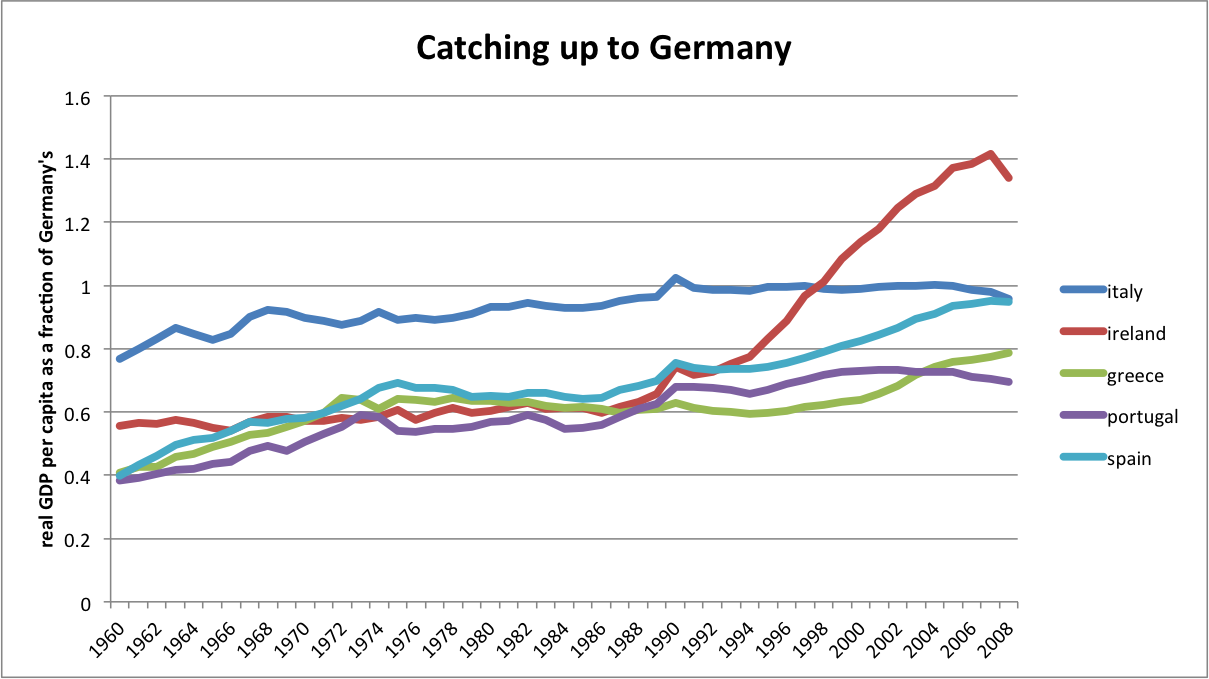
Economist Tyler Cowen has a post up on who has gained most from the Euro (as measured by state), but the economist Angus puts things into perspective:

Ireland, Spain, Portugal and Greece were all growing fast relative to Germany (and France which is not on the graph) well before the introduction of the Euro. Ireland and Spain take off somewhere around 1990 and the intro of the Euro in 2000 does not speed up their trajectory. Portugal actually falls further behind Germany in the Euro era. Greece is the only country of these 5 whose catch-up to Germany accelerates with the intro of the Euro.

Two quick thoughts:

  1. Woah! Look at Ireland!
  2. I’ll bet the acceleration of growth in the 1960’s had to do with the end of World War 2 and its rebuilding efforts.

Taking a broader historical view really puts things into perspective. If the Euro was not the catalyst for the economic growth of the 1990’s, what was? My guess is that the elimination of tariffs and labor restrictions between European states led to the growth. If the Eurozone had not implemented a central bank I think we wouldn’t be looking at all of the political problems now associated with the region.

Angus (who works at Oklahoma University) got his statistics from here. I highly recommend using it in your own studies as well.

One Sure Thing About Globalization – The American Motion Pictures Industry World Hegemony Part 1

[Editor’s note: this lecture was delivered to the Leavey Institute of Santa Clara University in 2003. You can find it reproduced in whole here.]

The word “globalization” is often used as shorthand to suggest that the world as recently shrunk for many purposes (Friedman, 1999). At first blush, this would seem to be good news, facilitating the spread of literacy, the diffusion of useful technologies, and socioeconomic progress, in general. However, a large segment of public opinion, in this country and, apparently, a larger segment in Europe and certain other countries (such as India), takes a jaundiced view of this shrinkage. This view is propagated by numerous websites as well as by professional intellectuals such as Noam Chomsky (who is often heard on National Public Radio). It contains a large anti-American component (Menand, 2002). It is widespread – at various levels of sophistication – in American universities. (1) In recent years, it has been dramatically acted out by rioters in Seattle, Quebec and Genoa, among other places. For left-wing opinion, “globalization” seems to imply that there is something radically new under the sun that is also economically nefarious for the poor and for the weak. For the same left-wing opinion, the word often suggests a sinister plot implicating in turn, “big corporations”, the World Trade Organization, the International Monetary Fund, and other organizations little understood by the general public. (For a broad, business-oriented and mildly liberal classification of the many sins the word “globalization” covers, see Eden and Lenway, 2001.) That new something entails a clandestine hegemony, or hegemonies, of some sort, dedicated to the further “exploitation” of the already poor and weak by the already rich and powerful. In this presentation, I develop the idea that there is little that is both radically new and nefarious,
and that what is new is likely to have largely beneficial effects. I rest my argumentation on readily available, public evidence.

Note: If you don’t think such a perspective on globalization exists, or you believe it’s inconsequential, you may want to stop reading. It is very difficult to find anywhere assertions about globalization displaying at once the following features: Continue reading

Department of Huh?

The dialectic between pragmatics and metapragmatics is the way in which

explicit metapragmatic registers instantiated in metapragmatic discourse encapsulate ideologies of language use and play an obvious role in the institutionalization of discursive mechanisms of society.

This is from Michael Silverstein, a linguistic anthropologist and somebody who I have to read for a degree requirement. Life could be worse, I guess…