Is China running out of cash?

Is China running out of cash?

China Halts Bank Cash Transfers

“The People’s Bank of China, the central bank, has just ordered commercial banks to halt cash transfers.”

Could we be seeing the start of total economic collapse? The answer, ceteris paribus, is yes and the Austrian Business Cycle Theory (ABCT) explains why.

To quote Ludwig Von Mises’ explanation of the final act of the ABCT:

Ludwig von Mises stated that the “crisis” (or “credit crunch“) arrives when the consumers come to reestablish their desired allocation of saving and consumption at prevailing interest rates.[12][

This means that when consumers finally realize that the money they have invested has actually been malinvested in the economy they then seek to acquire as much of their money as possibly from said investments. Most of which take the form of bank deposits.

The linked article reminds us that this is the numerous such time that China has adopted this policy saying:

“So what’s really going on?  This crunch follows similar incidents in June and December of last year.  In June, for instance, the central bank used the excuseof a “system upgrade” to allow banks to shut down their ATMs and online banking platforms.  As a result, they conserved cash and thereby avoided a nationwide meltdown.”

Other instances, such as this one in England where “[s]ome HSBC customers have been prevented from withdrawing large amounts of cash because they could not provide evidence of why they wanted it,” show that this problem may not be contained to China and may be spreading to the international market.

What does Murray Rothbard say will happen when this “credit crunch” inevitably occurs?

Wasteful projects, as we have said, must either be abandoned or used as best they can be. Inefficient firms, buoyed up by the artificial boom, must be liquidated or have their debts scaled down or be turned over to their creditors. Prices of producers’ goods must fall, particularly in the higher orders of production—this includes capital goods, lands, and wage rates […]

this means a fall in the prices of the higher-order goods relative to prices in the consumer goods industries. Not only prices of particular machines must fall, but also the prices of whole aggregates of capital, e.g., stock market and real estate values. In fact, these values must fall more than the earnings from the assets, through reflecting the general rise in the rate of interest return […]

“Since factors must shift from the higher to the lower orders of production, there is inevitable “frictional” unemployment in a depression, but it need not be greater than unemployment attending any other large shift in production. In practice, unemployment will be aggravated by the numerous bankruptcies, and the large errors revealed, but it still need only be temporary […]

Another common secondary feature of depressions is an increase in the demand for money. This “scramble for liquidity” is the result of several factors: (1) people expect falling prices, due to the depression and deflation, and will therefore hold more money and spend less on goods, awaiting the price fall; (2) borrowers will try to pay off their debts, now being called by banks and by business creditors, by liquidating other assets in exchange for money; (3) the rash of business losses and bankruptcies makes businessmen cautious about investing until the liquidation process is over.

With the supply of money falling, and the demand for money increasing, generally falling prices are a consequent feature of most depressions. A general price fall, however, is caused by the secondary, rather than by the inherent, features of depressions.

So is the massive failure of all economies imminent? Well not necessarily because the government can take some steps to prevent the immediate failure.

According to Mises:  

“Continually expanding bank credit can keep the borrowers one step ahead of consumer retribution (with the help of successively lower interest rates from the central bank). In the theory, this postpones the “day of reckoning” and defers the collapse of unsustainably inflated asset prices.[12][14] It can also be temporarily put off by price deflation or exogenous events such as the “cheap” or free acquisition of marketable resources by market participants and the banks funding the borrowing (such as the acquisition of land from local governments, or in extreme cases, the acquisition of foreign land through the waging of war).[15]

The “false” monetary boom ends when bank credit expansion finally stops – when no further investments can be found which provide adequate returns for speculative borrowers at prevailing interest rates”

These steps only “kick the can down the road” and delay the inevitable since “the longer the “false” monetary boom goes on, the bigger and more speculative the borrowing, the more wasteful the errors committed and the longer and more severe will be the necessary bankruptcies, foreclosures and depression readjustment.”

We may be seeing the beginning of the next great depression here but only time will tell.  One thing is certain though, a massive economic readjustment is coming and the central banks of the world have only been aggravating the problem.  When it will hit is anyone’s guess but in this author’s opinion we are either looking at a repeat of the early 30’s or a repeat of the early 40’s and I can only hope we can avoid going through both.

Elephant Poaching: National Tragedy or Tragedy of the Commons?

Elephant Poaching: National Tragedy or Tragedy of the Commons?

Tanzania recently ended a policy of summary execution of elephant poachers predictably due to “a litany of arbitrary murder, rape, torture and extortion of innocent people.”  The prime minister gave a PR response that, for me at least, sums up most government policy saying “The anti-poaching operation had good intentions, but the reported murders, rapes and brutality are totally unacceptable.”

World governments have taken the same measures they always do when individuals consume something that they arbitrarily deem distasteful and simply banned the sale of ivory; a method which has been categorically proved to simply not work.  After all, how easy is it to buy narcotics in America?  Or alcohol in the Middle East?  Or other drugs…in prisons.     

So what is my solution?

As with other commons violations such as over-fishing the answer to the dwindling elephant population is simple.  Privatize it.  Privatize what? You ask.  The elephants of course!  Ivory is a hot commodity in the third world, used for obvious things such as jewelry and decoration and not-so-obvious things like aphrodisiacs and snake-oil like medicines and this demand is not going away any time soon.

Allow promising entrepreneurs to tag, herd, breed, and protect groups of elephants for the purpose of harvesting their ivory, meat, hides, and any other parts of value for later sale throughout Asia and the world.  By doing this you would ensure the existence of these animals for as long as there continues to be demand for them.

Around the Web

This is the 69th installment of ‘Around the Web’. Giggity!

  1. guaranteed income vs. open borders; Economist Kevin Grier weighs the options
  2. How poverty taxes the brain; A sexy-sounding female gives us the low-down
  3. The origins of Northwest European ‘guilt culture’; Evolutionary anthropologists are so, soooo cute
  4. The ‘thoughtful libertarian’ subreddit; Finally!
  5. Is Christmas efficient? Only an economist (Tyler Cowen) could ask such a thing
  6. God, Hayek and the Conceit of Reason; Concise essay by Jonathan Neumann in Standpoint
  7. Milton Friedman’s 1997 musings on a common currency in the European Union: The Euro: From monetary policy to political disunity

Pope Francis: Does An Anti-Capitalist = A Socialist?

The Pope has made his opposition to capitalism clear and his words were scathing…

“Just as the commandment ‘Thou shalt not kill’ sets a clear limit in order to safeguard the value of human life, today we also have to say ‘thou shalt not’ to an economy of exclusion and inequality. Such an economy kills… A new tyranny is thus born, invisible and often virtual, which unilaterally and relentlessly imposes its own laws and rules. To all this we can add widespread corruption and self-serving tax evasion, which has taken on worldwide dimensions. The thirst for power and possessions knows no limits.”

This has led to praise and criticism from the right and the left. People have naturally views this within the right vs left dichotomy. I think it worth pointing out that libertarians of all varieties do not fit anywhere, comfortably, in this one dimensional paradigm, nor aught the Pope be expected to. He has been called a Marxist and had the economic failing of state socialism in Latin America and around the world flagged up, the assumption seems to be that if he is against the present model of capitalism he must be a socialist. The problem is the Pope may have made clear that he is in opposition to our present economic model he has not made clear what else he is against, (socialism) or what he supports.

What he has said on the matter and the clues to what he supports are as follows “I repeat: I did not talk as a specialist but according to the social doctrine of the church. And this does not mean being a Marxist.” The Pope indicates here that his stance on economics is only that which the Church has long-held. That he is simply re-iterating it’s doctrine, the only economic ideology based upon catholic social doctrine is Distributism… It is based on the teachings of Pope Leo XIII in his encyclical Rerum Novarum and Pope Pius XI in Quadragesimo Anno, and it is emphatically opposed to socialism. In the words one who inspired it:

“No one can be at the same time a sincere Catholic and a true Socialist” and “it is gravely wrong to take from individuals what they can accomplish by their own initiative and industry and give it to the community” – Pius XI.

The Popes Francis’s words on capitalism were no less scathing than his predecessor’s in Rerum Novarum. Pope Leo XIII spoke of “misery and wretchedness pressing so unjustly on the majority of the working class” and how “a small number of very rich men” had been able to “lay upon the teeming masses of the labouring poor a yoke little better than that of slavery itself.” And Pope Francis’s use of the term “exclusion” I’d argue meaning exclusion from personal access to property, and the means to produce are a further clue to his distributist leanings.

So what do these distributists profess if they oppose both socialism and capitalism?

According to distributists, property ownership is a fundamental right and the means of production should be spread as widely as possible rather than being centralized under the control of the state (state socialism) or of accomplished individuals (laissez-faire capitalism). Distributism therefore advocates a society marked by widespread property ownership and, according to co-operative economist Race Mathews, maintains that such a system is key to bringing about a just social order. – Wikipedia

In truth we cannot know where the Pope stands on socialism other than what he has said. Until he say’s otherwise I think it’s safe to say there is no reason to suspect he is a socialist, or that his position is anything other than that which the church has long-held.

– Samuel Allen

Pope Francis on Economics

by Fred E. Foldvary

Any statements which deplore “trickle down” economics reveal that the author has not quite yet grasped the heart of economics.

On November 26, 2013, The Vatican press published the apostolic exhortation, “The Joy of the Gospel.” The text was written in Spanish, and its full title in the English translation (converted here from upper case to initial capitals) is “Evangelii Gaudium of the Holy Father Francis to the Bishops, Clergy, Consecrated Persons and the Lay Faithful on the Proclamation of the Gospel in Today’s World.” Besides its religious calls, Pope Francis makes statements about today’s economic problems, and calls for greater economic justice.

One of the aims of this proclamation is to point out “new paths for the Church’s journey in years to come.” One of the questions the Pope seeks to discuss is “the inclusion of the poor in society.” Chapter Two is entitled, “Amid the Crisis of Communal Commitment.” In paragraph 52, Francis writes that “today we also have to say ‘thou shalt not’ to an economy of exclusion and inequality. Such an economy kills… Today everything comes under the laws of competition and the survival of the fittest, where the powerful feed upon the powerless.”

The Pope is wise and correct in seeing the harm done by inequality, but I urge him to see past the appearances to study the underlying reality. What provides the powerful with their might? The state has the ultimate power of force, and by its power to tax, to restrict, to mandate, and to subsidize, the state endows the powerful with the means to feed on the powerless. Market competition as such cannot impose force, and it does not create poverty. In a free society, each person has the power to be employed and pursue happiness. In a truly free market, all are fit to survive, because workers have access to natural opportunities. It is government intervention that stops this access.

Paragraph 54 is the key, widely cited, economic passage. We need to be sure that the English version is true to the original Spanish. In Spanish, Francis wrote, “algunos todavía defienden las teorías del « derrame », que suponen que todo crecimiento económico, favorecido por la libertad de mercado, logra provocar por sí mismo mayor equidad e inclusión social en el mundo.”

The Vatican’s English translation says, “some people continue to defend trickle-down theories which assume that economic growth, encouraged by a free market, will inevitably succeed in bringing about greater justice and inclusiveness in the world.”

The English-edition term “trickle-down theories” is translated from the Spanish, “teoria del derrame.” “Derrame” means a slow leak, hence a trickle, and so the English translation is accurate. The translated term “free market” is more literally “the liberty of the market” in the original Spanish, but the meaning is the same.

As noted by Harvard professor Greg Mankiw in his blog, critics of markets often use the term “trickle down” as a pejorative for the effects of a market economy. There is indeed a trickle down effect, for example, when a tourist resort is built in a location with many poor people, where a few get hired to work to clean rooms and wash dishes. A bit of the wealth of the resort trickles to the local population. But this situation does not confront the issue of why the poverty exists in the first place.

The theory of the free market is not one of “trickle down.” A truly free market is a fountain that gushes up wealth for all. Moreover, economic growth in market economies has indeed raised millions of persons up from poverty. However, the theory of market-driven growth does not claim that growth brings justice. The causation is the opposite: economic justice promotes growth. Moreover, justice and liberty are two faces of the same coin, so if a market has liberty, it must also provide justice.

The Pope continues: “This opinion, which has never been confirmed by the facts, expresses a crude and naïve trust in the goodness of those wielding economic power and in the sacralized workings of the prevailing economic system.”

But the proposition that free markets provide growth that benefits all is not a mere opinion. The proposition is a theory of growth that was first analyzed by the French economists of the 1700s, who concluded that the unhampered market, with free trade, would provide the greatest prosperity for all.

The prescription of the French economists was to abolish taxes on labor and trade, and instead use the surplus of the economy, which is land rent, for public revenue. Adam Smith in his Wealth of Nations brought this theory into classical economics. The American economist Henry George a century later explained in detail how land rent captures the gains from economic progress, and how growth generates inequality and poverty if that rent is not equally shared.

Markets have had various degrees of freedom, but there is no truly free market in the world today. Those who advocate a pure free market do not defend the “prevailing economic system,” but rather, they seek to stop the state’s subsidy of economic powers. The greatest subsidy and economic power is the land rent generated by the public goods provided by government.

The Pope is correct in decrying “the denial of the primacy of the human person” (paragraph 55) and that “Behind this attitude lurks a rejection of ethics” (57). Ethics and the primacy of the human person requires the equal right of each person to pursue happiness without harming others and to keep the earnings of his labor, as recognized by the commandment, “Thou shalt not steal.” Ethics must also respect the equal sharing of the benefits of nature and community, as stated in Ecclesiastes 5:9, “the profit of the earth is for all.”

The heart of economics is the understanding of the root cause of poverty: the forced redistribution of wealth from the working poor to the landed rich. This is caused not by markets but from state policy. It is good that Pope Francis seeks to remedy poverty. His “new path” should be to go more deeply into the economics and politics of maldistribution.

Uruguayan government: “monopoly” on pot

Last week, Uruguay’s government passed legislation to legalize marijuana. While the government will not be growing any cannabis plants (they are leaving that to private cultivators and farmers), the state will be playing a major role in the market… by fixing the price for marijuana at $1 per gram.

The rationale behind this production legalization and price fixing is to limit the amount of marijuana being trafficked into the country (mainly from Paraguay). As many of you may know, the narcotics trafficking business in Latin America is wrought with intense violence and organized crime. By fixing the price at $1 a gram, government officials believe this initiative will drive these traffickers out of business (at least in Uruguay). However, as all government interventions go, we need to ask ourselves, what are the possible unintended consequences lurking around the corner?

The issue I have is not with the legalization of marijuana, but with the price-fixing component of the legislation. Interventions into the market distort information (price) signals, forcing entrepreneurs to work off of incorrect information for their profit and loss calculations. Given that the drug market is already entrenched in these distortions, is this price-fixing component of the legislation a step in the right direction, or does it just complicate matters further?

The incentive structure, given the fixed price, is not the same as it would be in a free market. Any incentive that could have pushed these traffickers to move away from violence if it resulted in greater profits has been removed. Perhaps these violent traffickers will leave the marijuana business in Uruguay, but will they relocate efforts to other countries, or perhaps begin focusing on different illegal narcotics to traffic into Uruguay? If these new freedoms being granted to Uruguayans are coming at the cost of increased violence in other countries as a result of this price-fixing component, should we consider this a success?

The Canons of Economics

by Fred E. Foldvary

A “canon” is a set of items which are regarded by the chiefs of a field to be the accepted elements of the domain. Every religion, for example, has a canon of accepted ideas and documents such as the established books of the Bible. Every scientific field has a canon of propositions and facts accepted as genuine by the experts and by those in authority such as editors of the major journals and most members of the departments of the prominent universities.

The canon of economics consists of the propositions, methods, and historical facts accepted as true and applicable by most scholarly economists. This canon appears in textbooks and in the articles of the prominent journals. The ideas and methods outside the canon are referred to as heterodox economics, in contrast to the mainstream or orthodox canon. There have been articles and organizations about the mainstream and alternative canons, but they have not laid out what the canons consist of. Here is my attempt.

The canon of orthodox neoclassical economics consists of 1) supply and demand; 2) graphical curves of equal utility, inputs, and output; 3) marginal analysis (additional amounts of utility, inputs, outputs); 4) the factors or input variables of capital goods and labor; 5) the price level; 6) equations of production and utility; 7) the government-influenced money supply and the market-based velocity of the circulation of money; 8) economic and accounting profit; 9) market failure and government corrections; 10) equilibrium; 11) maximizing and minimizing within constraints; 12) the premises of subjective values, self-interest, scarcity, unlimited desires, and the uncertainty of the future; 13) the “time preference” for present day good relative to future goods; 14) the trade-off between goods and leisure; 15) the trade-off between equity and efficiency; 16) diminishing marginal utility; 17) diminishing marginal products; 18) theory from mathematical models; 19) econometric testing of hypotheses; 20) the producer and consumer surplus.

Neoclassical economics is divided into several sub-schools for macroeconomic theory. The major schools and their canons are:
1) Keynesian or demand-side economics, with the canons of the consumption function, spending multiplier, and the determination of output from autonomous spending and the multiplier.
2) The Monetarist school, its canon being the equation of exchange: Money times velocity equals the price level times real output, hence monetary inflation generally causes price inflation.
3) The New Classical school with its canon of rational expectations, which makes inflationary policy ineffective.
4) The New Keynesian school with its canon of wages, prices, and interest rates stuck above equilibrium; it accepts New-Classical rational expectations but claims that contracts and other rigid conditions make expansionary policy effective in increasing output.

The heterodox Austrian economic school of thought accepts these elements of neoclassical economics:1, 3, 4, 7, 8, 12, 13, 14, 15, 16, 17, 20. Austrians reject the excessive emphasis on 6, 9, 10, 11, 18, 19. The canons of the Austrian school that have not been absorbed into the mainstream are: 1) the time and interest-based structure of capital goods; 2) market dynamics rather than equilibrium; 3) dispersed knowledge; 4) discrete marginal utility based on diminishing importance; 4) axiomatic-deductive theory (praxeology); 5) entrepreneurship as both discovery and creative reconstruction; 6) free-market money and banking; 7) roundabout production; 8) the market as spontaneous order; 9) the failure of government intervention; 10) the evenly rotating economy that illustrates the role of entrepreneurship in the real world of uncertainty and change.

The Marxist school canon includes 1) class struggle, 2) the labor theory of value; 3) the surplus from labor taken by the capitalists who dominate labor; 4) benefits from socializing wealth.

The Georgist or geo-classical school has these canons: 1) land and its rent as major elements of the economy; 2) the margin of production as the least productive land in use; 3) land speculation and the movement of the margin raising rent and reducing wages; 4) the creation of land rentals from public goods; 5) depressions resulting from land-value bubbles; 6) economic effects of replacing market-hampering market-hampering taxes and subsidies with land-value taxation; 7) the surplus as land rent; 8) the ethics of labor and land; 9) harmony between equity and efficiency, and 10) the social behavioral effects of economic justice.

There is also a school of thought called “public choice,” which has been accepted by neoclassical economics as well as by other schools, as a side branch. Its canon includes: 1) self-interest in politics; 2) the rational ignorance of voters; 3) transfer-seeking and getting due to concentrated interests and spread-out costs; 4) vote trading by representatives; 5) bureaucrats maximizing their power and comfort; 6) the primacy of the median voter; 7) constitutional versus operational choice; 8) clubs that provide collective goods to their members.

The classical economics canon, before it turned neoclassical, included these elements: 1) Say’s law, that production pays factors that enable effective demand; 2) the division of labor; 3) economic growth from unhampered production and free trade; 4) the margin of production as the least productive land in use; 5) population growth pushing the margin to less productive land; 6) the three factors of production as land, labor, and capital goods.

A problem in economics today is that each canon excludes the useful elements of other schools. Economics needs a universalist canon that integrates the best elements from all schools of thought. However, economists disagree on what the canon should be. In my judgment, the most glaring omission in the mainstream canon is the neglect of the Austrian-school time-structure of capital goods, its neglect of the creation of land rent by public goods, and its neglect of the benefits of a prosperity tax shift, the replacement of market-hampering taxes with market-enhancing payments of land rent and pollution charges.

Note: This article first appeared in the Progress Report.

Distribution of Wealth — A Distortion of Focus

A ‘sociology’ paper by LA Repucci

Wealth vs Wages

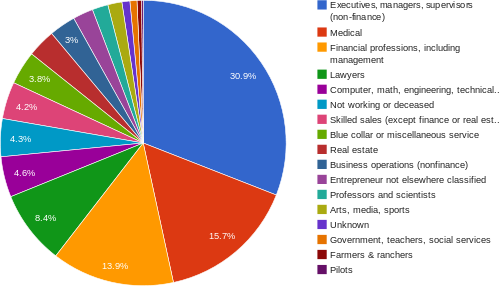
Much hay is made of the distribution of wealth in the modern United States.  Recently, the Occupy movement has protested the accruing affluence of a shrinking number of individuals that constitute the top ‘1%’ of wealthy within the country.  Data suggests that the top 1% of income earners in the country represent a myriad of professions, investments, and financial instruments as revenue streams, with the largest portion (30.9%) represented as the executive/corporate professionals, as shown by graphic 1.1 below:

1.1: Top 1% of Wage Earners by Profession, US.  Source, Wikicommons

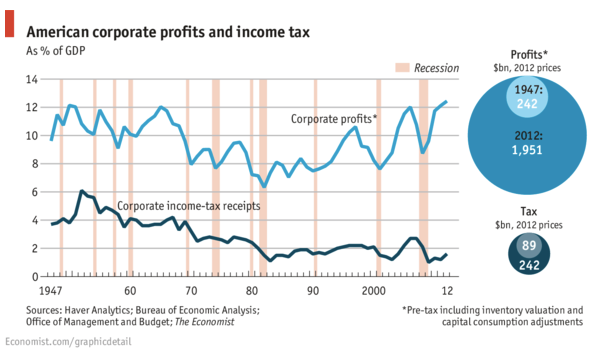
Analyzing the data from this table paints a picture of broad distribution of wage incomes across a myriad of industries, but fails to account for the disproportionately massive amounts of wealth that aren’t generated by salaries at all, nor are they representative of the fact that the wealthiest legal entities within the US aren’t people — they are tax-sheltered corporate entities:

1.2: Corporate Profits vs Tax Liability

The Corporate Model

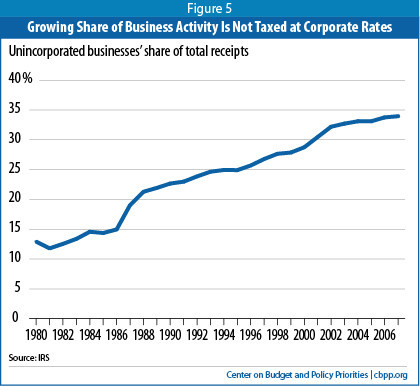
Corporations are paper entities recognized by the state as legal persons.  They exist in order to generate and accrue revenue, and pay stakeholders.  Unlike natural persons, corporate entities are immortal.  Instead of competing on the open marketplace for revenue, the most successful and largest corporations have discovered a way to cut the market out of their revenue streams altogether.  It is simply easier and more cost effective to lobby the state to enact laws that protect their revenue stream and squash market forces than it is to operate within a competitive market.  Progressive, draconian tax structures enacted as a hedge against corporate domination of wealth may be adopted by government in an effort to increase tax revenue from the corporations, but in reality, simply provide further incentive for corporations to allocate resources in an effort to mitigate or outright eliminate their tax liability within the US.  For example, Google, the fastest growing and wealthiest of the new tech giants, pays a majority of it’s taxes in Ireland and Bermuda — nations with a far friendlier income tax policy than the US — and bypass their US tax liability almost entirely due to the so-called ‘loophole’ in the income tax law, resulting in the federal government’s lost tax revenue from one of the largest US corporations in history. This leads increasingly to a larger percentage of individuals, sole proprietors and small-to-mid cap businesses shouldering an increasing burden within the tax structure as shown in 1.3 below.

1.3

The State’s Culpability

The new corporate model of tax evasion coupled with astronomical growth in profits-to-cost relies heavily on the government’s complicit action with regard to tax policy and recognition of corporate person-hood.  It is in a company’s interest to make money — but to ‘saw the ladder off’ below them, they require government cooperation to enact laws that make tax sheltering and corporate personhood possible.  This culture of lobbying and outright appropriation of the legislative process has progressed to the point that there is little differentiation between the state and the corporation.  Insurance companies write health care laws, and banking institutions write tax laws and set monetary policy.  The roots of this collaboration run deep through US history, crystallized notably by the creation of the Federal Reserve Bank in 1913 on Jekyll Island by J.P. Morgan, Paul Warburg and other global-level financiers with the collusion of Senator Nelson Aldrich, who had close ties to both Morgan and Nelson Rockefeller. (Further reading: ‘The Creature from Jekyll Island’ by E.B. White)  The Federal Reserve Act of 1913 was signed into law by then US President Woodrow Wilson, and effectively turned over control of the nation’s monetary policy, issuance of currency, and anti-market fixing of interest rates to a private bank set up as a for-profit corporation called the Federal Reserve Bank, effectively undoing the American Revolution and the work of his predecessor, President Andrew ‘Old Hickory’ Jackson.  The ‘Fed’ as it is known today, continues to be the sole issuer of paper money accepted for the payment of taxes in the US.  While the people remain ‘free’ to trade in whatever currency or barter they choose, all state and federal taxes in the US must be paid in Federal Reserve Notes, giving the Fed a monopoly on currency.

The Corporate-State Combine

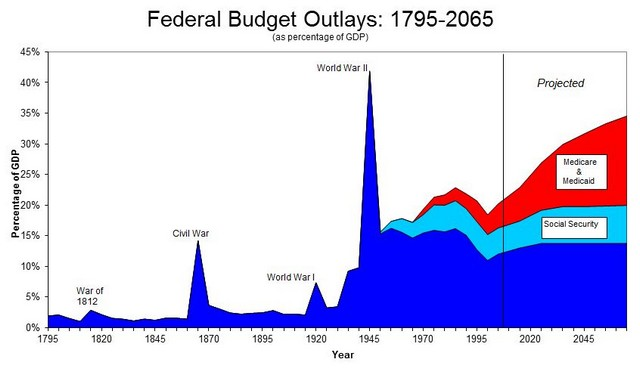
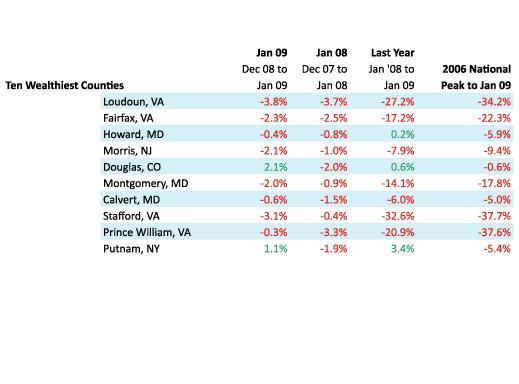
A century of the above-outlined activities of corporate entities have led to an overlap between the banking community and government that often goes understated.  JP Morgan/Chase market their banking services directly to government, as clearly outlined in their marketing materials: https://www.jpmorgan.com/pages/jpmorgan/cb/government. It is no surprise that most of the nominees for president, cabinet members, the Fed and legislators exist in a professional ‘revolving door’ environment that moves them from banking to high office and back over the course of their careers.  For example, both major party candidates for president in the last 20 years have had direct professional ties to JP Morgan and Goldman Sachs.  This ‘partnership’ has led to a century of collusion between government and banking, taking an ever-increasing cut of the total wealth out of the real market, and enriching our legislators to the point that many of the wealthiest counties in the nation now surround Washington DC as evidenced in the data provided.  This corporate-government combine acts as a siphon, sucking wealth out of the population through inflation, currency devaluation and increased tax burden, and enriches the corporate interest through outright gifting (TARP, Stimulus, Bailouts, etc) to the wealthiest of the wealthiest of the 1%.  Warren Buffett, one of the wealthiest men in the world and owner of Berkshire Hathaway Ltd. championed bailouts while his firm received the largest portion of us taxpayer money from the TARP program. Buffett himself pounds the table for higher tax rates, while he and his company manage to ‘limit’ their tax liability and avoid paying taxes owed back to 2002.  Mr. Buffett is a major campaign contributor to our current President, Barack Obama.

Solutions

With the compound factors of massive increases in government spending (roughly $20,000 annually per citizen), and the steady evaporation of corporate tax liability (less than 40% of the total tax base of businesses in the US is covered by large-cap corporations) the problem of the distribution of wealth in the US is starkly apparent.  To identify what is going wrong in the economy is one thing — providing real solutions is another entirely.  Both major political parties offer their version of the fix — the right would suggest cutting government spending on services and lowering the tax base to broaden it and encourage large cap corporate interests to pay their income taxes in-country.  The left advises steeply progressive tax laws on private citizens (one would assume the left would suggest tax reform for large corporations, but the democrat party has been in charge of the tax law for decades with no such legislation to speak of), and consumption and indulgence taxes on goods and services, combined with further devaluation of the dollar through Quantitative Easing (QE) and raising (or outright elimination of) the debt ceiling.

While it would seem that these two paths are the only potential ‘fixes’ to our nation’s distribution of wealth problem, neither of these plans would provide real, permanent relief to the average citizen who is continually squeezed out of the middle of the economy, with an ever-increasing portion of their revenue taken by the state through tax, and devalued by the state through inflation.  Indeed, it would seem that our problem is not ‘distribution of wealth’, but rather, the redistribution of wealth through taxation and devaluation of the dollar.  Looking at the problem from this perspective, the solutions become simpler and multi-fold.

Monetary Policy/END THE FED

Should the Federal government enact law that checks the monopoly power of the Fed to issue currency by accepting in payment of taxes any and all used currencies in the market, the nation would be free to adopt currencies other than the dollar.

Bitcoin, a decentralized crypto-currency, is a notable example of a market solution to the problem of distribution of wealth.  Though Bitcoin has it’s detractors and a relatively small market cap, it’s value has continued to skyrocket on the open market, and is in the early stages of large-scale adoption and public use.  Bitcoin requires no bank or government to ‘mint’ it as a currency, and is freely traded electronically between users with no bank needed.

Similarly, gold and silver have been used for thousands of years the world over as viable hard currencies.  Hard currencies cannot be devalued through running of a printing press like paper currencies, nor through the click of a button like crypto-currencies.  As there is a finite amount of gold and silver in the market, it’s value has a ‘hard floor’ — it is always worth at least it’s value as a raw material.

The fact that the Federal government will only accept Federal Reserve Notes (which, in itself violates the constitutional directive for the US Treasury to mint coin, not a private bank) in payment of taxes effectively gives the FED a monopoly on currency.  The last US President to order the Treasury mint silver certificates was John F. Kennedy.

Commercial Policy/END CORPORATE PERSON-HOOD

Corporations are legal ‘persons’ with the ability to lobby the legislature directly, resulting in tax laws and policies that favor them over natural citizens of the US.  This has resulted in laws being written directly by corporations, including insurance companies’ authorship of the Affordable Healthcare Act.   The insurance companies’ stock has risen by a factor of 2-5 due to the implementation of the law, while the cost of health insurance for the average citizen has skyrocketed.  Ending corporate person-hood would go a long way to ending the power of lobbyists to purchase legislators, and result in elected officials representing the people who elect them.

Tax Policy/END THE TAX

‘Taxes’, ‘tariffs’, or any other name the state wishes to apply, are simply pseudonyms for extortion — that is, the violation of individual property rights through threats of aggressive reprisal.  When private entities such as a thief or mob perform the same action, we rightly call it theft.  It is completely inconsequent what a thief does with your money once he has violated your rights to acquire it, even if he assures you that it is to your personal, direct benefit that he take your property from you by force.  To fix the distribution of wealth, and as well to return to a moral society where one does not live on the property of his neighbor through state-sponsored theft, all taxes should be eliminated.  If a portion of the population would like to provide a service or product to their neighbors, let them do so legitimately through voluntary free association and exchange.  The state spends more than it takes in in taxes, and floats the rest on credit.  This activity has crippled the purchasing power of the dollar, which has lost 99% of its total purchasing power on the market in the 100 years the Fed has controlled the nation’s currency.

Bibliography:

Wikimedia Commons. N.p., n.d. Web. 04 Dec. 2013.

JP Morgan.com “State and Local Government.” N.p., n.d. Web. 06 Dec. 2013.

Cogan, John F. Federal Budget Deficits: What’s Wrong with the Congressional Budget Process. Stanford, CA: Hoover Institution, Stanford University, 1992. Print.

Anti-Tesla bill rejected by Ohio Senate.

On December 3rd, an amendment to Ohio Senate Bill 137 failed to pass. The amendment would have required Tesla Motors to sell its electric cars through a third party rather than directly to consumers. Ohio is number two in auto manufacturing in the midwest and Tesla’s new line of ultra-efficient electric vehicles are a threat to the entire automotive industry. Contrary to what those in Detroit and Ohio would have you think, this is a good thing.

For far too long the automotive unions and automotive industry lobbyists have suckered the individuals in this country into believing they were the backbone of American manufacturing when in fact they were a leech sucking money from more productive uses. For example through the years 2008 to 2011 Ohio granted $80.8 million in subsidies to General Motors, $54.4 million to Ford, and $28.7 million to Chrysler. This is ignoring the billions of dollars spent on the auto bailout last decade which, much like Chrysler bailout in 1980, simply saved failing corporations from their own shoddy business practices. While Tesla gets its own fair share of subsidies any threat to the auto industry is a positive thing for consumers.

Mundane economic speculations: Oil changes

Fair warning: this post isn’t about anything in the news, or even anything particularly liberty related. This is just some economic musings about the motorcycle I just bought. I feel pretty darn free when I ride it, but ultimately this post is just (“just”) economics and just (again with that “just”) for fun.

When I got my bike, the mechanic I bought it from suggested that I get the oil changed every 3000 miles. The owner’s manual suggests 8000 miles. The first number feels a bit like when you leave the dentist’s office (“We’ll see you in two months for your next check up!”). It’s obviously in my mechanic’s interest to have a steady income, and an oil change is an easy job. On a machine that can be replaced for $4000, it’s a much more certain income than if I trash the engine and just buy a new bike. So is he just profit maximizing?

What about Honda’s number? What do they want? If they wanted my bike to last forever, they might say something like 3000 miles, but they also want me to buy a new bike at some point. But that isn’t all they want. They want me to enjoy my bike enough that I buy another Honda. And they want a reputation for selling reliable machines. And they want a healthy used bike market to bring in new riders (like myself… I bought a used Honda Shadow). On the one hand they want my bike to eventually die, but they want it to go in such a way that I’ll go back to them for my next bike. On the other hand, they want their bikes to last longer than their competitors. So it’s some form of oligopolistic competition on a non-price margin.

If it’s a Cournot-Nash equilibrium (and all manufacturers have about equivalent quality), then by suggesting 7000 miles their bikes would last longer, bringing new riders to the Honda fold, but reducing demand for new Hondas. If they suggest 9000 miles, riders will need new bikes sooner, but reduced longevity would reduce demand by a greater amount. The implication: I should change my oil more frequently than 8000 miles.

If it’s a Bertrand equilibrium, then they’ll give it all away to the consumer implying that 8000 maximizes my experience. But then competition among mechanics must be Cournot (unless the conditions in Lubbock are really awful)! When I took my industrial organization class, as a young libertarian economist-in-training, Bertrand was appealing (“companies always have our best interests at heart! See, they strive for the lowest price by assumption!”), but not terribly compelling. There are two lessons here: 1) Bertrand is taking the easy way out of our critics’ questions and will hurt us in the long run (take note fellow econolibertarians!). And 2) static/neoclassical economics, useful though it often is, doesn’t get us far enough: study your Austrian economics!

Sex and Economics (And Karl Marx Too!)

The concept of economic reproduction is emphasized in the Marxian school of economic thought. In Marxist theory, the conditions for production are continuously re-created as a circular flow. The concept of the circular flow of both goods and of factor-inputs was first developed by the French economists of the 1700s, who called their theory of natural economic laws “Physiocracy.” The factors or categories of inputs are land, labor, and capital goods.

From co-editor Fred Foldvary. Do read the whole fascinating article. Many conservatives in the US (as well as libertarians) don’t give Karl Marx the time of day he deserves in order for thoughtful, polite discourse to take place. Many on the Right decry (and rightly so) the various strawmen that Leftists erect when attacking the proponents of private property, personal wealth and international trade, but are we any better when it comes to debunking Leftist arguments? Continue reading

From the Comments: the Unemployment Rate

Dr. Gibson has won the much-cherished gold star I had offered in a previous comment. My question had to do with the green dot in this graph, and Dr. Gibson explained it to perfection. He writes:

The widely followed U3 unemployment rate, as shown in the figure, is the number of unemployed divided by the labor force. The labor force excludes discouraged workers. The labor force participation rate is the labor force size (employed & unemployed) divided by the population. The green dot shows what the U3 rate would be if that ratio had stayed the same since Jan. 2009.

The U6 statistic counts discouraged workers as unemployed. That rate is currently around 15%.

See also: Unemployment: What It Is

From the article Dr. Gibson directs us towards comes some other important information:

Government policies contribute to unemployment above and beyond natural unemployment. The most notorious of these policies are minimum wage laws. These laws make it illegal, effectively, for low-skilled workers to accept employment. Anyone who cannot generate $8 worth of production per hour cannot expect to be paid more than $8. Such unfortunate people might be productive at $6 per hour but are forbidden to accept employment at this rate and are instead condemned to joblessness and all its attendant miseries. This burden falls most heavily on black teenagers, whose unemployment rate (based on those seeking work and excluding those who are in school) is well over 40 percent. The benefits accrue mainly to slightly higher-skilled workers, who have climbed onto the metaphorical ladder leading to better jobs and who are shielded from competition from those excluded by minimum-wage laws […]

Labor unions, as voluntary associations bargaining freely with employers, are unobjectionable. They did a lot of good in the past when working conditions in many places were pretty bad. But now they are granted special privileges by law—basically the privilege to engage in violent or coercive activities. The result is often wage agreements that are above market-clearing levels. Those left out are of course unemployed.

While labor unions can boost their members’ compensation at the expense of non-union workers, higher wages generally and higher living standards are due mainly to increased productivity, which in turn depends on high levels of capital investment. People are more willing to save and invest when they have confidence in the future, and that confidence comes from respect for property rights.

For more on minimum wage laws, see Bad Idea of the Year.

August 15, 1971

People who were alive in 1941 can tell you right where they were on Pearl Harbor day.  I can tell you exactly where I was when I heard that President Kennedy had been shot.  We all remember 9/11.   Another day that I sticks in my memory just as clearly is one that is now remembered by few: Sunday, August 15, 1971.

There was no internet in those days and no cable news channels, so I was mercifully spared the news until the following morning at 8:15 when I opened my motel room door in Huntington Beach and saw the L.A. Times on the doorstep with a headline that said something like “Nixon Imposes Price Controls.”

I was shocked and disgusted for two reasons: though I was employed as an aerospace engineer, I was beginning to learn about free markets, having attended a FEE seminar the year before at which Mises and Hazlitt  – now saints of Austrian economics – lectured.  And I had voted for Nixon in 1968, naively believing the Republicans were the party of free markets.  The following year I signed up with the new Libertarian Party and never looked back on the Republicans until 2008 when Ron Paul ran.

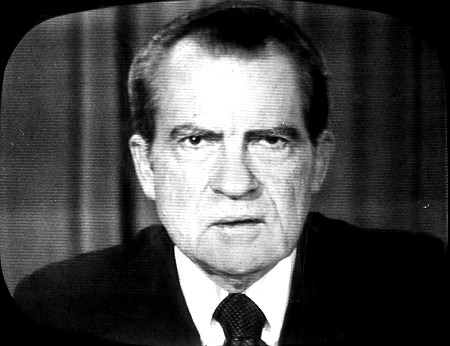
Here is a video recording of Nixon announcing a 90-day “freeze” on prices and wages. Note the Orwellian references to the evils of price controls even as he imposes them.Image

So what was the big emergency that prompted such a drastic response?  Unemployment was running about 6%; price inflation at about 5%.  Nixon’s problem was that an election was coming up in the following year.  He remembered bitterly his narrow loss to Kennedy in the 1960 election which he attributed to a mild recession of that year. Now he was determined to goose the economy and get himself re-elected. Like FDR, Nixon loved dramatic strokes and never mind the consequences. Earlier that year the man who had made his reputation as an implacable anti-communist had made a sudden and dramatic overture to communist China.  So on that sleepy Sunday Nixon delivered another bold stroke, in an end run around the Democratic opposition.  Perhaps it worked: he won 49 states in the 1972 election with considerable help from his bumbling opponent, George McGovern.

His action was quite popular.  The stock market surged that Monday morning and polls showed a 75% approval rate.  But Milton Friedman was right when he predicted “utter failure and the emergence into the open of suppressed inflation.”  Another freeze was imposed in 1973 but this time the damage to the economy became evident.  As explained in the excellent video series “The Commanding Heights,” “ranchers stopped shipping their cattle to the market, farmers drowned their chickens, and consumers emptied the shelves of supermarkets.”  Inflation reached a peak of about 14% before the decade was out and before the powers that be accepted the fact that excessive money creation is the main cause of price inflation. George Schulz, Nixon’s economic advisor and a vigorous opponent of price controls consoled himself with the thought that Nixon had demonstrated dramatically how not to fight inflation.

Nixon wasn’t finished.  During that same Sunday broadcast he slapped a 10% tariff on imported goods, accompanied by some blather about fairness.  More significantly, he ended the Bretton Woods international monetary system.  That arrangement, conceived in 1944, had the U.S. dollar convertible into gold at $35 per ounce, but only for foreign central banks.  Not only could private banks and private citizens not convert their dollars, it was even illegal to own gold (with exceptions for dentists, jewelers, etc.).  I made a point of violating that particular law on principle before the prohibition was lifted in 1974.

In all fairness, the Bretton Woods system was doomed long before that August.  The gold exchange standard had persisted only because of a gentlemen’s agreement that European central bankers would refrain from exercising their redemption rights to any significant degree.  So many new dollars had been created to finance Lyndon Johnson’s war in Vietnam and his “Great Society” at home, and so many of those dollars were parked overseas as a result of trade imbalances, that the U.S. government could not come close to honoring its Bretton Woods obligation in full.  The French under de Gaulle and his gold-bug advisor Jacques Rueff had become increasingly strident about the situation, but in early August the British ambassador showed up with $3 billion to be redeemed, and that may have been the straw that broke the camels back.

So on that same Sunday Nixon slammed the gold window shut (video here)  pushing us out of the frying pan of Bretton Woods, under which numerous wrenching devaluations had wracked international trade, into the fire of floating exchange rates, the system we have now.  The devaluations are gone but the wild swings in currency values, something that was not foreseen by Milton Friedman who was an early advocate of currency markets, are almost as bad.  Now, wonder of wonders, there is resurgent talk of some sort of gold standard.

Reagan tempted me with with some pretty inspiring rhetoric in his 1980 campaign about getting the government off our backs.  Not enough to vote for him, but I was glad he got elected and with the help of Fed chairman Paul Volcker he did break the back of inflation, but he never got spending under control and he didn’t deserve as much credit as he got for the fall of communism, which had been rotten at its core for decades.  But Bush I was terrible and in hindsight Clinton wasn’t all bad, yet I confess I was relieved when Bush II beat Gore in 2000.  I needn’t remind anyone what a disaster GWB was with his wars, his unfunded medicare expansion and his bailouts (OK, thanks for the tax cut).

I’m voting for Gary Johnson who won’t win, and I really don’t care who wins.  Gridlock is the least bad outcome, even if that means the despicable Obama stays in office facing a Republican congress.

Bad Idea of the Year: Raise the Minimum Wage

Who can live on $8 per hour these days? Surely, in a country as rich as ours, no one who is willing and able to work should suffer the indignity of such paltry wages. The solution is simple and obvious: pass a law. If you work, you get at least $10 per hour, period.  Anything less is downright indecent. And so we have a ballot initiative to make this happen in San Jose, California.

It’s anything but simple and obvious if we stop and look and think about what’s happening in the real world. Today I went to a small family-owned sandwich shop near my house. They are very popular and so four young workers, probably students from the nearby college, were jammed in the tiny shop with the two owners. The sandwiches are great but I also enjoy watching them hustle at lunch time. I’m quite certain the helpers were all earning minimum wage but had other sources of income or support. Far more important than their wages, which will quickly be spent, is the work experience that will last them a lifetime – and the confidence that comes from knowing they are earning their money by doing a job in the very best way they can.

The McDonald’s near me employs a few senior citizens, likely at or near minimum wage. They almost certainly have other income. Just being active and involved in productive activity gives their lives meaning and may well enhance their health and longevity.

The sandwich shop operates on thin margins which are being squeezed by rising food prices. If they had to pay their young helpers $2 more per hour they would probably close. But the nearby Safeway store, which has a sandwich bar, would very likely absorb part of the wage increase and pass the rest on to customers, which would be easier to do with their family-owned competitor knocked out. Continue reading