Rent-Seeking Rebels of 1776

Since yesterday was Independence Day, I thought I should share a recent piece of research I made available. A few months ago, I completed a working paper which has now been accepted as a book chapter regarding public choice theory insights for American economic history (of which I talked about before).  That paper simply argued that the American Revolutionary War that led to independence partly resulted from strings of rent-seeking actions (disclaimer: the title of the blog post was chosen to attract attention).

The first element of that string is that the Americans were given a relatively high level of autonomy over their own affairs. However, that autonomy did not come with full financial responsibility.  In fact, the American colonists were still net beneficiaries of imperial finance. As the long period of peace that lasted from 1713 to 1740 ended, the British started to spend increasingly larger sums for the defense of the colonies. This meant that the British were technically inciting (by subsidizing the defense) the colonists to take aggressive measures that may benefit them (i.e. raid instead of trade). Indeed, the benefits of any land seizure by conflict would large fall in their lap while the British ended up with the bill.

The second element is the French colony of Acadia (in modern day Nova Scotia and New Brunswick). I say “French”, but it wasn’t really under French rule. Until 1713, it was nominally under French rule but the colony of a few thousands was in effect a “stateless” society since the reach of the French state was non-existent (most of the colonial administration that took place in French North America was in the colony of Quebec). In any case, the French government cared very little for that colony.   After 1713, it became a British colony but again the rule was nominal and the British tolerated a conditional oath of loyalty (which was basically an oath of neutrality speaking to the limited ability of the crown to enforce its desires in the colony). However, it was probably one of the most prosperous colonies of the French crown and one where – and this is admitted by historians – the colonists were on the friendliest of terms with the Native Indians. Complex trading networks emerged which allowed the Acadians to acquire land rights from the native tribes in exchange for agricultural goods which would be harvested thanks to sophisticated irrigation systems.  These lands were incredibly rich and they caught the attention of American colonists who wanted to expel the French colonists who, to top it off, were friendly with the natives. This led to a drive to actually deport them. When deportation occurred in 1755 (half the French population was deported), the lands were largely seized by American settlers and British settlers in Nova Scotia. They got all the benefits. However, the crown paid for the military expenses (they were considerable) and it was done against the wishes of the imperial government as an initiative of the local governments of Massachusetts and Nova Scotia. This was clearly a rent-seeking action.

The third link is that in England, the governing coalitions included government creditors who had a strong incentives to control government spending especially given the constraints imposed by debt-financing the intermittent war with the French.  These creditors saw the combination of local autonomy and the lack of financial responsibility for that autonomy as a call to centralize management of the empire and avoid such problems in the future. This drive towards centralization was a key factor, according to historians like J.P. Greene,  in the initiation of the revolution. It was also a result of rent-seeking on the part of actors in England to protect their own interest.

As such, the history of the American revolution must rely in part on a public choice contribution in the form of rent-seeking which paints the revolution in a different (and less glorious) light.

James Buchanan on racism

McLean

Ever since Nancy MacLean’s new book came out, there have been waves of discussions of the intellectual legacy of James Buchanan – the economist who pioneered public choice theory and won the Nobel in economics in 1986. Most prominent in the book are the inuendos of Buchanan’s racism.  Basically, public choice had a “racist” agenda.  Even Brad DeLong indulged in this criticism of Buchanan by pointing that he talked about race by never talking race, a move which reminds him of Lee Atwater.

The thing is that it is true that Buchanan never talked about race as DeLong himself noted.  Yet, that is not a sign (in any way imaginable) of racism. The fact is that Buchanan actually inspired waves of research regarding the origins of racial discrimination and was intellectually in line with scholars who contributed to this topic.

Protecting Majorities and Minorities from Predation

To see my point in defense of Buchanan here, let me point out that I am French-Canadian. In the history of Canada, strike that, in the history of the province of Quebec where the French-Canadians were the majority group, there was widespread discrimination against the French-Canadians. For all intents and purposes, the French-Canadian society was parallel to the English-Canadian society and certain occupations were de facto barred to the French.  It was not segregation to be sure, but it was largely the result of the fact that the Catholic Church had, by virtue of the 1867 Constitution, monopoly over education. The Church lobbied very hard  in order to protect itself from religious competition and it incited logrolling between politicians in order to win Quebec in the first elections of the Canadian federation. Logrolling and rent-seeking! What can be more public choice? Nonetheless, these tools are used to explain the decades-long regression of French-Canadians and the de facto discrimination against them (disclaimer: I actually researched and wrote a book on this).

Not only that, but when the French-Canadians started to catch-up which in turn fueled a rise in nationalism, the few public choice economists in Quebec (notably the prominent Jean-Luc Migué and the public choice fellow-traveler Albert Breton) were amongst the first to denounce the rise of nationalism and reversed linguistic discrimination (supported by the state) as nothing else than a public narrative aimed at justifying rent-seeking attempts by the nationalists (see here and here for Breton and here and here for Migué). One of these economists, Migué, was actually one of my key formative influence and someone I consider a friend (disclaimer: he wrote a blurb in support of the French edition of my book).

Think about this for a second : the economists of the public choice tradition in Quebec defended both the majority and the minority against politically-motivated abuses. Let me repeat this : public choice tools have been used to explain/criticize attempts by certain groups to rent-seek at the expense of the majority and the minority.

How can you square that with the simplistic approach of MacLean?

Buchanan Inspired Great Research on Discrimination and Racism

If Buchanan didn’t write about race, he did set up the tools to explain and analyze it. As I pointed out above, I consider myself in this tradition as most of my research is geared towards explaining institutions that cause certain groups of individuals to fall behind or pull ahead.  A large share of my conception of institutions and how state action can lead to predatory actions against both minorities and majorities comes from Buchanan himself!  Nevermind that, check out who he inspired who has published in top journals.

For example, take the case of the beautifully written articles of Jennifer Roback who presents racism as rent-seeking. She sets out the theory in an article in Economic Inquiry , after she used a case study of segregated streetcars in the Journal of Economic HistoryA little later, she consolidated her points in a neat article in the Harvard Journal of Law and Public PolicyShe built an intellectual apparatus using public choice tools to explain the establishment of discrimination against blacks and how it persisted for long.

Consider also one of my personal idols, Robert Higgs who is a public-choice fellow traveler who wrote Competition and Coerciowhich considers the topic of how blacks converged (very slowly) with whites in hostile institutional environment. Higgs’ treatment of institutions is well in line with public choice tools and elements advanced by Buchanan and Tullock.

The best case though is The Origins and Demise of South African Apartheid by Anton David Lowenberg and William H. Kaempfer. This book explicitly uses a public choice to explain the rise and fall of Apartheid in South Africa.

Contemporaries that Buchanan admired were vehemently anti-racist

Few economists, except maybe economic historians, know of William Harold Hutt. This is unfortunate since Hutt produced one of the deepest and most thoughtful economic criticism of Apartheid in South Africa, The Economics of the Colour Bar This book stands tall and while it is not the last word, it generally is the first word on anything related to Apartheid – a segregation policy against the majority that lasted nearly as long as segregation in the South.  This writing, while it earned Hutt respect amongst economists, made him more or less personae non grata in his native South Africa.

Oh, did I mention that Hutt was a public choice economist? In 1971, Hutt published Politically Impossible which has been an underground classic in the public choice tradition. Unfortunately, Hutt did not have the clarity of written expression that Buchanan had and that book has been hard to penetrate.  Nonetheless, the book is well within the broad public choice tradition.  He also wrote an article in the South African Journal of Economics which expanded on a point made by Buchanan and Tullock in the Calculus of Consent. 

Oh, wait, I forgot to mention the best part. Buchanan and Hutt were mutual admirers of one another. Buchanan cited Hutt’s work very often (see here and here) and spoke with admiration of Hutt (see notably this article here by Buchanan and this review of Hutt’s career where Buchanan is discussed briefly).

If MacLean wants to try guilt by (inexistent) association, I should be excused from providing redemption by (existent) association.  Not noting these facts that are easily available shows poor grasp of the historiography and the core intellectual history.

Simply Put

Buchanan inspired a research agenda regarding how states can be used for predatory purposes against minorities and majorities which has produced strong interpretations of racism and discrimination. He also associated with vehement and admirable anti-racists like William H. Hutt and inspired students who took similar positions. I am sure that if I were to assemble a list of all the PhD students of Buchanan, I would find quite a few who delved into the deep topic of racism using public choice tools. I know better and I did not spend three years researching Buchanan’s life. Nancy MacLean has no excuse for these oversights.

Adam Smith: a historical historical detective?

9781107491700

Adrian Blau at King’s College London has an on-going project of making methods in political theory more useful, transparent and instructive, especially for students interested in historical scholarship.

I found his methods lecture, that he gave to Master’s students and went onto publish as ‘History of political thought as detective work’, particularly helpful for formulating my approach to political theory. The advantage of Blau’s advice is that it avoids pairing technique with theory. You can be a Marxist, a Straussian, a contextualist, anything or nothing, and still apply Blau’s technique.

Blau suggests that we adopt the persona of a detective when trying to understand the meaning of historical texts. That is, we should acknowledge

  • uncertainty associated with our claims
  • that facts of the matter will almost certainly be under-determined by the available evidence
  • that conflicting evidence probably exists for any interesting question
  • that interpreting any piece of evidence through any exclusive theoretical lens is likely to lead us to error

To make more compelling inferences in the face of these challenges, we can use techniques of triangulation (using independent sources of evidence together). This could include arguing for an interpretation of a thinker’s argument based on a close reading of their text, while showing that other people in the thinker’s social milieu deployed language in a similar way (contextual), and also showing how helpful that argument was for achieving a political end that was salient in that time and place (motivation).

Continue reading

On Borjas, Data and More Data

I see my craft as an economic historian as a dual mission. The first is to answer historical question by using economic theory (and in the process enliven economic theory through the use of history). The second relates to my obsessive-compulsive nature which can be observed by how much attention and care I give to getting the data right. My co-authors have often observed me “freaking out” over a possible improvement in data quality or be plagued by doubts over whether or not I had gone “one assumption too far” (pun on a bridge too far). Sometimes, I wish more economists would follow my historian-like freakouts over data quality. Why?

Because of this!

In that paper, Michael Clemens (whom I secretly admire – not so secretly now that I have written it on a blog) criticizes the recent paper produced by George Borjas showing the negative effect of immigration on wages for workers without a high school degree. Using the famous Mariel boatlift of 1980, Clemens basically shows that there were pressures on the US Census Bureau at the same time as the boatlift to add more black workers without high school degrees. This previously underrepresented group surged in importance within the survey data. However since that underrepresented group had lower wages than the average of the wider group of workers without high school degrees, there was an composition effect at play that caused wages to fall (in appearance). However, a composition effect is also a bias causing an artificial drop in wages and this drove the results produced by Borjas (and underestimated the conclusion made by David Card in his original paper to which Borjas was replying).

This is cautionary tale about the limits of econometrics. After all, a regression is only as good as the data it uses and suited to the question it seeks to answer. Sometimes, simple Ordinary Least Squares are excellent tools. When the question is broad and/or the data is excellent, an OLS can be a sufficient and necessary condition to a viable answer. However, the narrower the question (i.e. is there an effect of immigration only on unskilled and low-education workers), the better the method has to be. The problem is that the better methods often require better data as well. To obtain the latter, one must know the details of a data source. This is why I am nuts over data accuracy. Even small things matter – like a shift in the representation of blacks in survey data – in these cases. Otherwise, you end up with your results being reversed by very minor changes (see this paper in Journal of Economic Methodology for examples).

This is why I freak out over data. Maybe I can make two suggestions about sharing my freak-outs.

The first is to prefer a skewed ratio of data quality to advanced methods (i.e. simple methods with crazy-data). This reduces the chances of being criticized for relying on weak assumptions. The second is to take a leaf out of the book of the historians. While historians are often averse to advantaged data techniques (I remember a case when I had to explain panel data regressions to historians which ended terribly for me), they are very respectful of data sources. I have seen historians nurture datasets for years before being willing to present them. When published, they generally stand up to scrutiny because of the extensive wealth of details compiled.

That’s it folks.


Can we trust US interwar inequality figures?

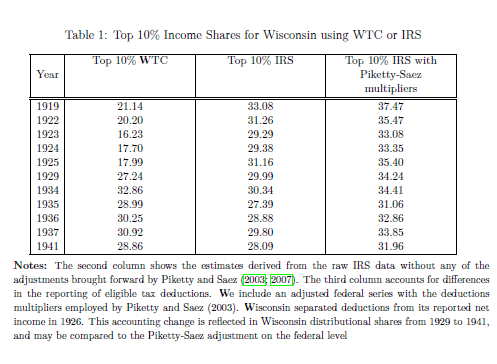
This question is the one that me and Phil Magness have been asking for some time and we have now assembled our thoughts and measures in the first of a series of papers. In this paper, we take issue with the quality of the measurements that will be extracted from tax records during the interwar years (1918 to 1941).

More precisely, we point out that tax rates at the federal level fluctuated wildly and were at relatively high levels. Since most of our inequality measures are drawn from the federal tax data contained in the Statistics of Income, this is problematic. Indeed, high tax rates might deter honest reporting while rapidly changing rates will affect reporting behavior (causing artificial variations in the measure of market income). As such, both the level and the trend of inequality might be off.  That is our concern in very simple words.

To assess whether or not we are worrying for nothing, we went around to find different sources to assess the robustness of the inequality estimates based on the federal tax data. We found what we were looking for in Wisconsin whose tax rates were much lower (never above 7%) and less variable than those at the federal levels. As such, we found the perfect dataset to see if there are measurement problems in the data itself (through a varying selection bias).

From the Wisconsin data, we find that there are good reasons to be skeptical of the existing inequality measured based on federal tax data. The comparison of the IRS data for Wisconsin with the data from the state income tax shows a different pattern of evolution and a different level (especially when deductions are accounted for). First of all, the level is always inferior with the WTC data (Wisconsin Tax Commission). Secondly, the trend differs for the 1930s.

Table1 for Blog

I am not sure what it means in terms of the true level of inequality for the period. However, it suggests that we ought to be careful towards the estimations advanced if two data sources of a similar nature (tax data) with arguably minor conceptual differences (low and stable tax rates) tell dramatically different stories.  Maybe its time to try to further improve the pre-1945 series on inequality.

On the paradox of poverty and good health in Cuba

One of the most interesting (in my opinion) paradox in modern policy debates relates to how Cuba, a very poor country, has been able to generate health outcomes close to the levels observed in rich countries. To be fair, academics have long known that there is only an imperfect relation between material living standards and biological living standards (full disclosure: I am inclined to agree, but with important caveats better discussed in a future post or article, but there is an example). The problem is that Cuba is really an outlier. I mean, according to the WHO statistics, its pretty close to the United States in spite of being far poorer.

In the wake of Castro’s death, I believed it necessary to assess why Cuba is an outlier and creates this apparent paradox. As such, I decided to move some other projects aside for the purposes of understanding Cuban economic history and I have recently finalized the working paper (which I am about to submit) on this paradox (paper here at SSRN).

The working paper, written with physician Gilbert Berdine (a pneumologist from Texas Tech University), makes four key arguments to explain why Cuba is an outlier (that we ought not try to replicate).

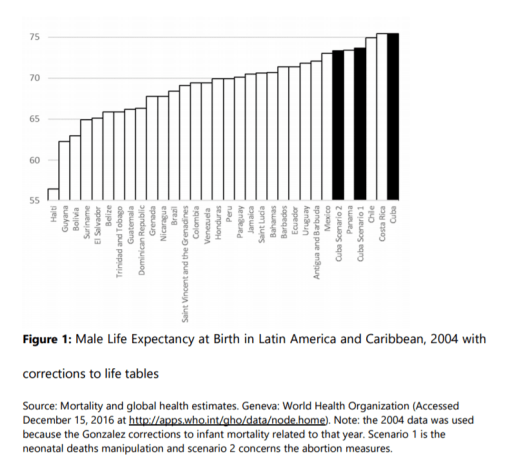
The level of health outcomes is overestimated, but the improvements are real

 Incentives matter, even in the construction of statistics and this is why we should be skeptical. Indeed, doctors are working under centrally designed targets of infant mortality that they must achieve and there are penalties if the targets are not reached. As such, physicians respond rationally and they use complex stratagems to reduce their reported levels. This includes the re-categorization of early neonatal deaths as late fetal deaths which deflates the infant mortality rate and the pressuring (sometimes coercing) of mothers with risky pregnancies to abort in order to avoid missing their targets. This overstates the level of health outcomes in Cuba since accounting for reclassification of deaths and a hypothetically low proportions of pressured/coerced abortions reduces Cuban life expectancy by close to two years (see figure below). Nonetheless, the improvements in Cuba since 1959 are real and impressive – this cannot be negated.

Cuba1.png


Health Outcomes Result from Coercive Policy 

Many experts believe that we ought to try to achieve the levels of health outcomes generated by Cuba and resist the violations of human rights that are associated with the ruling regime. The problem is that they cannot be separated. It this through the use of coercive policy that the regime is able to allocate more than 10% of its tiny GDP to health care and close to 1% of its population to the task of being a physician. It ought also be mentioned that physicians in Cuba are also mandated to violate patient privacy and report information to the regime. Consequently, Cuban physicians (who are also members of the military) are the first line of internal defense of the regime. The use of extreme coercive measures has the effect of improving health outcomes, but it comes at the price of economic growth. As documented by Werner Troesken, there are always institutional trade-offs in term of health care. Either you adopt policies that promote growth but may hinder the adoption of certain public health measures or you adopt these measures at the price of growth. The difference between the two choices is that economic growth bears fruit in the distant future (i.e. there are palliative health effects of economic growth that take more time to materialize).

Health Outcomes are Accidents of Non-Health Related Policies

As part of the institutional trade-off that make Cubans poorer, there might be some unintended positive health-effects. Indeed, the rationing of some items does limit the ability of the population to consume items deleterious to their health. The restrictions on car ownership and imports (which have Cuba one of the Latin American countries with the lowest rate of car ownership) also reduces mortality from road accidents which,  in countries like Brazil, knock off 0.8 years of life expectancy at birth for men and 0.2 years for women.  The policies that generate these outcomes are macroeconomic policies (which impose strict controls on the economy) unrelated to the Cuban health care system. As such, the poverty caused by Cuban institutions  may also be helping Cuban live longer.

Human Development is not a Basic Needs Measure

The last point in the paper is that human development requires agency.  Since life expectancy at birth is one of the components of the Human Development Indexes (HDI),  Cuba fares very well on that front. The problem is that the philosophy between HDIs is that individual must have the ability to exercise agency. It is not a measure of poverty nor a measure of basic needs, it is a measure meant to capture how well can individual can exercise free will: higher incomes buy you some abilities, health provides you the ability to achieve them and education empowers you.

You cannot judge a country with “unfree” institutions with such a measure. You need to compare it with other countries, especially countries where there are fewer legal barriers to human agency. The problem is that within Latin America, it is hard to find such countries, but what happens when we compare with the four leading countries in terms of economic freedom. What happens to them? Well, not only do they often beat Cuba, but they have actually come from further back and as such they have seen much larger improvements that Cuba did.

This is not to say that these countries are to be imitated, but they are marginal improvements relative to Cuba and because they have freer institutions than Cuba, they have been able to generate more “human development” than Cuba did.

Cuba2.png

Our Conclusion

Our interpretation of Cuban health care provision and health outcomes can be illustrated by an analogy with an orchard. The fruit of positive health outcomes from the “coercive institutional tree” that Cuba has planted can only be picked once, and the tree depletes the soil significantly in terms of human agency and personal freedom. The “human development tree” nurtured in other countries yields more fruit, and it promises to keep yielding fruit in the future. Any praise of Cuba’s health policy should be examined within this broader institutional perspective.

On British Public Debt, the American Revolution and the Acadian Expulsion of 1755

I have a new working paper out there on the role of the Acadian expulsion of 1755 in fostering the American revolution.  Most Americans will not know about the expulsion of a large share of the French-speaking population (known as the Acadians) of the Maritimes provinces of Canada during the French and Indian Wars.

Basically, I argue that the policy of deportation was pushed by New England and Nova Scotia settlers who wanted the well-irrigated (thanks to an incredibly sophisticated – given the context of a capital-scarce frontier economy – dyking system) farms of the Acadians. Arguing that the French population under nominal British rule had only sworn an oath of neutrality, they represented a threat to British security, the settlers pushed hard for the expulsion. However, the deportation was not approved by London and was largely the result of colonial decisions rather than Imperial decisions. The problem was that the financial burden of the operation (equal to between 32% of 38% of the expenditures on North America – and that’s a conservative estimate) were borne by England, not the colonies.

This fits well, I argue, into a public choice framework. Rent-seeking settlers pushed for the adoption of a policy whose costs were spread over a large population (that of Britain) but whose benefits they were the sole reapers.

The problem is that this, as I have argued elsewhere, was a key moment in British Imperial history as it contributed to the idea that London had to end the era of “salutary neglect” in favor of a more active management of its colonies.  The attempt to centralize management of the British Empire, in order to best prioritize resources in a time of rising public debt and high expenditures level in the wars against the French, was a key factor in the initiation of the American Revolution.

Moreover, the response from Britain was itself a rent-seeking solution. As David Stasavage has documented, government creditors in England became well-embedded inside the British governmental structure in order to minimize default risks and better control expenses. These creditors were a crucial part of the coalition structure that led to the long Whig Supremacy over British politics (more than half a century). In that coalition, they lobbied for policies that advantaged them as creditors. The response to the Acadian expulsion debacle (for which London paid even though it did not approve it and considered the Acadian theatre of operation to be minor and inconsequential) should thus be seen also as a rent-seeking process.

As such, it means that there is a series of factors, well embedded inside broader public choice theory, that can contribute to an explanation of the initiation of the American Revolution. It is not by any means a complete explanation, but it offers a strong partial contribution that considers the incentives behind the ideas.

Again, the paper can be consulted here or here.

On doing economic history

I admit to being a happy man. While I am in general a smiling sort of fellow, I was delightfully giggling with joy upon hearing that another economic historian (and a fellow  Canadian from the LSE to boot), Dave Donaldson, won the John Bates Clark medal. I dare say that it was about time. Nonetheless I think it is time to talk to economists about how to do economic history (and why more should do it). Basically, I argue that the necessities of the trade require a longer period of maturation and a considerable amount of hard work. Yet, once the economic historian arrives at maturity, he produces long-lasting research which (in the words of Douglass North) uses history to bring theory to life.

Economic History is the Application of all Fields of Economics

Economics is a deductive science through which axiomatic statements about human behavior are derived. For example, stating that the demand curve is downward-sloping is an axiomatic statement. No economist ever needed to measure quantities and prices to say that if the price increases, all else being equal, the quantity will drop. As such, economic theory needs to be internally consistent (i.e. not argue that higher prices mean both smaller and greater quantities of goods consumed all else being equal).

However, the application of these axiomatic statements depends largely on the question asked. For example, I am currently doing work on the 19th century Canadian institution of seigneurial tenure. In that work, I  question the role that seigneurial tenure played in hindering economic development.  In the existing literature, the general argument is that the seigneurs (i.e. the landlords) hindered development by taxing (as per their legal rights) a large share of net agricultural output. This prevented the accumulation of savings which – in times of imperfect capital markets – were needed to finance investments in capital-intensive agriculture. That literature invoked one corpus of axiomatic statements that relate to capital theory. For my part, I argue that the system – because of a series of monopoly rights – was actually a monopsony system through the landlords restrained their demand for labor on the non-farm labor market and depressed wages. My argument invokes the corpus of axioms related to industrial organization and monopsony theory. Both explanations are internally consistent (there are no self-contradictions). Yet, one must be more relevant to the question of whether or not the institution hindered growth and one must square better with the observed facts.

And there is economic history properly done. It tries to answer which theory is relevant to the question asked. The purpose of economic history is thus to find which theories matter the most.

Take the case, again, of asymetric information. The seminal work of Akerlof on the market for lemons made a consistent theory, but subsequent waves of research (notably my favorite here by Eric Bond) have showed that the stylized predictions of this theory rarely materialize. Why? Because the theory of signaling suggests that individuals will find ways to invest in a “signal” to solve the problem. These are two competing theories (signaling versus asymetric information) and one seems to win over the other.  An economic historian tries to sort out what mattered to a particular event.

Now, take these last few paragraphs and drop the words “economic historians” and replace them by “economists”.  I believe that no economist would disagree with the definition of the tasks of the economist that I offered. So why would an economic historian be different? Everything that has happened is history and everything question with regards to it must be answered through sifting for the theories that is relevant to the event studied (under the constraint that the theory be consistent). Every economist is an economic historian.

As such, the economic historian/economist must use advanced tools related to econometrics: synthetic controls, instrumental variables, proper identification strategies, vector auto-regressions, cointegration, variance analysis and everything you can think of. He needs to do so in order to answer the question he tries to answer. The only difference with the economic historian is that he looks further back in the past.

The problem with this systematic approach is the efforts needed by practitioners.  There is a need to understand – intuitively – a wide body of literature on price theory, statistical theories and tools, accounting (for understanding national accounts) and political economy. This takes many years of training and I can take my case as an example. I force myself to read one scientific article that is outside my main fields of interest every week in order to create a mental repository of theoretical insights I can exploit. Since I entered university in 2006, I have been forcing myself to read theoretical books that were on the margin of my comfort zone. For example, University Economics by Allen and Alchian was one of my favorite discoveries as it introduced me to the UCLA approach to price theory. It changed my way of understanding firms and the decisions they made. Then reading some works on Keynesian theory (I will confess that I have never been able to finish the General Theory) which made me more respectful of some core insights of that body of literature. In the process of reading those, I created lists of theoretical key points like one would accumulate kitchen equipment.

This takes a lot of time, patience and modesty towards one’s accumulated stock of knowledge. But these theories never meant anything to me without any application to deeper questions. After all, debating about the theory of price stickiness without actually asking if it mattered is akin to debating with theologians about the gender of angels (I vote that they are angels and since these are fictitious, I don’t give a flying hoot’nanny). This is because I really buy in the claim made by Douglass North that theory is brought to life by history (and that history is explained by theory).

On the Practice of Economic History

So, how do we practice economic history? The first thing is to find questions that matter.  The second is to invest time in collecting inputs for production.

While accumulating theoretical insights, I also made lists of historical questions that were still debated.  Basically, I made lists of research questions since I was an undergraduate student (not kidding here) and I keep everything on the list until I have been satisfied by my answer and/or the subject has been convincingly resolved.

One of my criteria for selecting a question is that it must relate to an issue that is relevant to understanding why certain societies are where there are now. For example, I have been delving into the issue of the agricultural crisis in Canada during the early decades of the 19th century. Why? Because most historians attribute (wrongly in my opinion)  a key role to this crisis in the creation of the Canadian confederation, the migration of the French-Canadians to the United States and the politics of Canada until today. Another debate that I have been involved in relates to the Quiet Revolution in Québec (see my book here) which is argued to be a watershed moment in the history of the province. According to many, it marked a breaking point when Quebec caught up dramatically with the rest of  Canada (I disagreed and proposed that it actually slowed down a rapid convergence in the decade and a half that preceded it). I picked the question because the moment is central to all political narratives presently existing in Quebec and every politician ushers the words “Quiet Revolution” when given the chance.

In both cases, they mattered to understanding what Canada was and what it has become. I used theory to sort out what mattered and what did not matter. As such, I used theory to explain history and in the process I brought theory to life in a way that was relevant to readers (I hope).  The key point is to use theory and history together to bring both to life! That is the craft of the economic historian.

The other difficulty (on top of selecting questions and understanding theories that may be relevant) for the economic historian is the time-consuming nature of data collection. Economic historians are basically monks (and in my case, I have both the shape and the haircut of friar Tuck) who patiently collect and assemble new data for research. This is a high fixed cost of entering in the trade. In my case, I spent two years in a religious congregation (literally with religious officials) collecting prices, wages, piece rates, farm data to create a wide empirical portrait of the Canadian economy.  This was a long and arduous process.

However, thanks to the lists of questions I had assembled by reading theory and history, I saw the many steps of research I could generate by assembling data. Armed with some knowledge of what I could do, the data I collected told me of other questions that I could assemble. Once I had finish my data collection (18 months), I had assembled a roadmap of twenty-something papers in order to answer a wide array of questions on Canadian economic history: was there an agricultural crisis; were French-Canadians the inefficient farmers they were portrayed to be; why did the British tolerate catholic and French institutions when they conquered French Canada; did seigneurial tenure explain the poverty of French Canada; did the conquest of Canada matter to future growth; what was the role of free banking in stimulating growth in Canada etc.

It is necessary for the economic historian to collect a ton of data and assemble a large base of theoretical knowledge to guide the data towards relevant questions. For those reasons, the economic historian takes a longer time to mature. It simply takes more time. Yet, once the maturation is over (I feel that mine is far from being over to be honest), you get scholars like Joel Mokyr, Deirdre McCloskey, Robert Fogel, Douglass North, Barry Weingast, Sheilagh Ogilvie and Ronald Coase (yes, I consider Coase to be an economic historian but that is for another post) who are able to produce on a wide-ranging set of topics with great depth and understanding.

Conclusion

The craft of the economic historian is one that requires a long period of apprenticeship (there is an inside joke here, sorry about that). It requires heavy investment in theoretical understanding beyond the main field of interest that must be complemented with a diligent accumulation of potential research questions to guide the efforts at data collection. Yet, in the end, it generates research that is likely to resonate with the wider public and impact our understanding of theory. History brings theory to life indeed!


The GDP, real wages and working hours of France since the 13th century

Every few years, an economic historian in training spends thousands of hours in archives assembling a long quantitative essay. It’s the work of monks (in fact, when you go far back in history, you also end up working with monks and nuns – which was my case on Canadian economic history). It’s the kind of work that requires patience, attention to details and (did I say it already?) patience.

I did that for my own work on Canadian economic history. For two years, I locked myself in the archives of two religious congregations to collect and transcribe close to a million price and wages information. For these two years, I did not write one single paper. I just collected the data and constituted a list of the papers I could write. However, once its finished, you may party like a sailor fresh off the boat because you end up with a wealth of data to answer hundreds of questions. When I finished my own thing on Canada, I was thrilled as I thought it constituted a great advance in quantitative knowledge (which I could use to assess tougher historical questions).

However, compared to the work of Leonardo Ridolfi, my own work looks like a dwarf (I confess envy here).  Ridolfi spent hundreds of hours assembling a quantitative essay on France’s economy since 1250. This is monumental!  France has generally been a statistical abyss (except for demography and some price series) especially when compared to England. Yet, the country is highly relevant to western economic history. After all, the question of why did the Industrial Revolution take place in Britain is the mirror of asking why it did not happen in France. As a result, Ridolfi’s work fills one of the largest voids in the field of economic history and will end up being one of the most cited dissertations for the next ten years I expect.

He constructed estimates of real wages, prices, incomes and working hours. As such, he provided the widest possible statistical portrait possible which (I wont get into details here) circumvents tons of empirical complications that may limit the quality of each variable taken separately (see for example the manner in which GDP is calculated and the role that estimating working hours plays).

I invite anyone interested in economic history to read his work. But, I will give you the main conclusion I gathered: France was not as poor as many believed. I recently pointed this out in an article which I am trying to get published, but Ridolfi’s work proves my point beyond my wildest expectations. I assembled the most relevant figures below.

Ridolfi.png

On the reversal of fortune, urbanization and Canada

One of the more famous articles of economist Daron Acemoglu is his 2002 article on the reversal of fortunes where he points out that countries colonized by Europeans in 1500 that were relatively rich then are relatively poor now. In the paper, they use urban density as a proxy for economic development at that point in time.

I was not particularly convinced by this because of the issue of ruralization in colonial economies. I am still not convinced in fact. As many scholars interested in American colonial history point out, the country de-urbanized (ruralized) during the colonial era as cities grew at a slower pace than the general population. As such, the share of the US population in rural areas increased. But Jeffrey Williamson and Peter Lindert documented that in 1774, the United States were the richest place in the world (beating England on top of being more egalitarian). 

This is normal. Economies on the frontier had land to labor ratios that were the exact opposite of those in Europe. The opportunity cost of congregating in one area was high given the abundance of land that could be brought under cultivation. This is why the Americas (North America at least) was the Best Poor Man’s Country. As such, areas with low population density are not necessarily poor (even if urbanization is a pretty strong predictor of wealth).

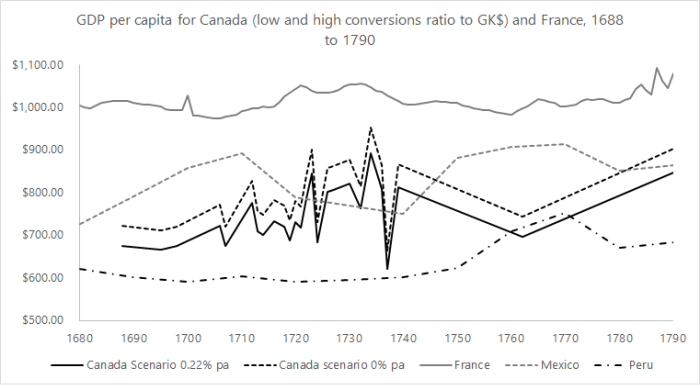
This is where Canada comes in. Today, the country easily fits in the “relatively rich” group. According to the figures 1 and 2 in the work of Acemoglu, Johnson and Robinson, it would have been in the “relatively poor” group well behind countries in Latin America. However, I recently finished compiling the Canadian GDP figures between 1688 and 1790 which I can now compare with those of Arroyo Abad and Van Zanden for Peru and Mexico. With my Canadian data (see the figure below), we can see that Canada was as poor as Latin America around 1680 (the start date of my data).

GelosoGDP.png

So, Canada was a relatively poor country back which was equally poor (or moderately richer) than Latin American countries. Why does that matter to the reversal of fortune story? Well, with the urbanization data, one shows that the non-urbanized of 1500 are the rich of the today. With the GDP data for the 1680s, we see that the more urbanized countries were also poorer than the less urbanized countries.

Now, my argument is limited by the fact that I am using 1680s GDP rather than 1500 GDP. But, one should simply extend the urbanization series to circa 1700 and the issue is resolved.  In any case, this should fuel the skepticism towards the strength of the reversal of fortune argument.

Aggregate measures of well-being, England 1781-1850

I went in the field of economic history after I discovered how much it was to properly measure living standards. The issue that always interested me was how to “capture” the multidimensional nature of living standards. After all, what weight should we give to an extra year of life relative to the quality of that extra year (see all my stuff on Cuba)?

However, I never tried to create “a composite” measure of living standards. I thought that it was necessary, first, to get the measurements right. However, I had been aware of the work of Leandro Prados de la Escosura who has been doing considerable work on this in order to create composite measures (Leandro also influenced me on my Cuba reasoning – see this article).

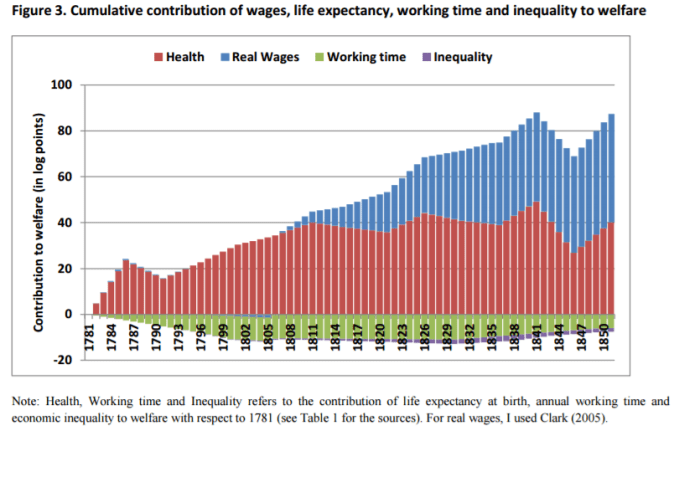
A year ago, I discovered the work of Daniel Gallardo Albarrán from the University of Groningen at the meeting of the Economic History Society (EHS). Daniel’s work is particularly interesting because he is trying to generate a composite measure of well-being at one of the most important moment in history: the start of the British industrial revolution.

Because of its importance and some pieces of contradicting evidence (inequality, stature, amplitude of real wage increases, amplitude of income increases, urban pollution leading to increased mortality risks etc), the period has been begging for some form of composite measure to come along (at least a serious attempt at generating it). Drawing on some pretty straightforward microeconomic theory (the Beckerian in me likes this), Daniel generates this rich graph (see the paper here).

Daniel

The idea is very neat and I hope it will inspire some economic historians to attempt an expansion upon Daniel’s work. I have already drawn outlines for my own stuff on Canada since I study an era when (from the early 1800s to the mid-1850s) real wages and incomes seem to be going up but stature and mortality are either deteriorating or remaining stable while inequality is clearly increasing.

Star Trek Did More For the Cultural Advancement of Women Than Government Policies

The fondest memories of my childhood center on the time I spent with my father watching Star Trek. At the time, I simply enjoyed science fiction. However, as an adult I have often revisited Star Trek (on multiple occasions) and I realized that I had incorporated subconsciously many elements of the show into my own political reasoning.

Not to give too much away about my age, my passion with Star Trek started largely with the Voyager installments. As a result, I ended up seeing Kate Mulgrew as Captain Janeway. And that’s what she was: the captain. I never saw the relevance that she was a woman. A few years ago, I saw her speak at the Montreal Comic-Con (yes, I am that kind of Trekkie) and she mentioned how crucial she thought her role to be for the advancement of women. By that time, I had already started to consider Star Trek as one of the most libertarian-friendly shows ever to have existed. While its economics were strange, its emphasis on tolerance, non-intervention and equality of rights make it hard to argue that it is not favorable to broadly-defined liberal mindset. However, I had not realized how much so until I heard Mulgrew speak about her vision of the role. After all, I had somehow forgotten that Mulgrew was a woman and how novel her role was.

One person who understands how important was this point is Shannon Mizzi who wrote a piece for Wilson Quarterly which I ended up reading while I was still a PhD student. Her core point was that in Star Trek, women were simply professionals. They were rarely seen doing other things than their work. While she argues that this meant that Star Trek played an underappreciated role in the history of women’s advancement, I am willing to go a step further. That step is to assert that the cause of the cultural advancement of women has been better served by Star Trek than by governments. (Please note that I am only considering cultural advancement)

The pre-1900 economic and social history of women would be sufficient in itself to make this point of mine. After all, women were given a lesser legal status by governments. This is both a necessary and sufficient element to assert that, overall, governments have been noxious to women’s advancement over many centuries. One century of legal emancipation would still leave Star Trek as a net positive force. But that would be a lazy argument on my part and I should simply focus on the present day. In fact, thanks to a wealth of data on wage gaps, gender norms and measures of legal institutions, I can more easily back up the claim.

My friend Rosemarie Fike of Texas Christian University is the first person that comes to mind in that regard. Her own doctoral dissertation, Economic Freedom and the Lives of Womenintroduced me to a wide literature on the role of economic freedom in the advancement of women. To be sure, Rosemarie was not the first to try to measure the role of economic freedom (which we should understand as how small and non-interventionist a government is). There had already been some research showing that higher levels of economic freedom were associated with smaller hourly wage gaps between genders and how liberalizing reforms were associated with wage convergence between genders. However, some economists have been arguing that there are other “soft sides” to economic freedom – like in the promotion of cultural equality and norms that promote certain types of attitudes. This is where Rosemarie’s work is most crucial. In a section of her dissertation, she essentially builds up on the work of (my favorite Nobel laureate) Gary Becker regarding preferences and discrimination. Basically, the idea is that free markets will penalize people who willingly discriminate. After all, if an employer refuses to hire redheads for some strange reason, I can compete by hiring the shunned redheads at a lower wage rate and out-compete him. In order to stay in business, the ginger-hating fool has to change his behavior and hire redheads which will push wages up. Its hard to be a racist or misogynist when it costs you a lot of money.

However, if you prevent this mechanism from operating (by intervening in markets), you are making it easier to be bigoted-chauvinistic-male-pigs. As a result, laws that prevent market operations (like the Jim Crow laws did for blacks) enshrine discriminatory practices. Individuals growing up in such environment may accept this as normal and acceptable behavior and strange beliefs about gender equality may cement themselves in the popular imagination. When markets are allowed to operate, beliefs will morph to reflect the actions taken by individuals (see Jennifer Roback’s great story of tramways in the US South as an example of how strong markets can be in changing behavior and see her article on how racism is basically rent-seeking). As a result, Rosemarie’s point is that societies with high levels of economic freedom will be associated with beliefs favorable to gender equality.

But the mirror of that argument is that government policies, even if their spirits have no relation to gender issues, may protect illiberal beliefs. Case in point, women are more responsive to tax rates than men – much more. In short, if you reduce taxes, women will adjust their labor supply more importantly at the extensive and intensive margin than men will. This little, commonly accepted, fact in labor economics is pregnant with implications. Basically, it means that women will work less in high tax environments and will acquire less experience than men will. Since it is also known that differences in the unmeasured effects of experience weigh heavily in explaining the remaining portion of the gender pay gap, this means that high tax rates contribute indirectly to maintaining the small gender pay gap that remains. Now, imagine what would be the beliefs of employers towards women if they did not believe that women are more likely to work fewer hours or drop out of the workforce for some time? Would you honestly believe that they would be the same? When Claudia Goldin argues that changes in labor market structures could help close the gap, can you honestly say that the uneven effect of high tax rates on the labor supply decisions of the different genders are not having an effect in delaying experimentation with new structures? This only one example meant to show that governments may, even when it is not their intent, delay changes that would be favorable to gender equality. There are mountains of other examples going the larger effects of the minimum wage on female employment to the effects of occupational licencing falling heavily on professions where women are predominant.

With such a viewpoint in mind, it is hard to say how much governments helped the cultural advancement of women (on net) over the 20th and 21st centuries . However, Star Trek clearly had a positive net effect on that cultural advancement.  That is why I am willing to say it here: Star Trek did more for the cultural advancement of women than governments did.

Famine and Finance: Credit and the Great Famine of Ireland

41YjUSWp3JL._SX351_BO1,204,203,200_I have recently finished reading Famine and Finance by Tyler Beck Goodspeed. While short, it should have a prominent place on the shelves of economic historians interested (obviously) in Irish history and (less obviously) in Malthusian theory.
Famine and Finance is a study of the response of Irish farmers to the potato blight. As it is known to many, many individuals simply left Ireland. However, where micro-credit was available, Goodspeed finds that farmers adapted by shifting to different types of activities – notably livestock. These areas experienced a smaller decline in population. Basically, where the institution of micro-credit was present, the demographic shock was much less severe. If only for this nuance, the book makes a sizeable contribution to the historiography of Ireland. The methods used are also elegantly simple and provide an interesting road map for anyone interested in studying the responses of local population to environmental shocks.

However, the deeper point comes from it tells us about institutions. In Goodspeed’s story, the amplitude of the collapse of the Irish population in the 19th century depends on the presence of the institution of micro-credit. Basically, the institution determined the amplitude of the shock. Since Ireland’s potato blight is often presented as the textbook case of Malthusian pressures, Goodspeed’s results are particularly interesting. In his chatper titled”Was Malthus Right?”, he shows that when controls for the institution of micro-credit is present, the typical Malthusian variables fail to explain population changes. In other words (i.e.  my words) , Malthusian pressures (the change in population) are in fact institutional failures.

This is a point I have often made elsewhere (see here, here and here and a blog post here). And because Goodspeed backs this point of mine, he has earned himself a place on my shelf of “go-to” books.

The Heights of French-Canadian Convicts, 1780 to 1830

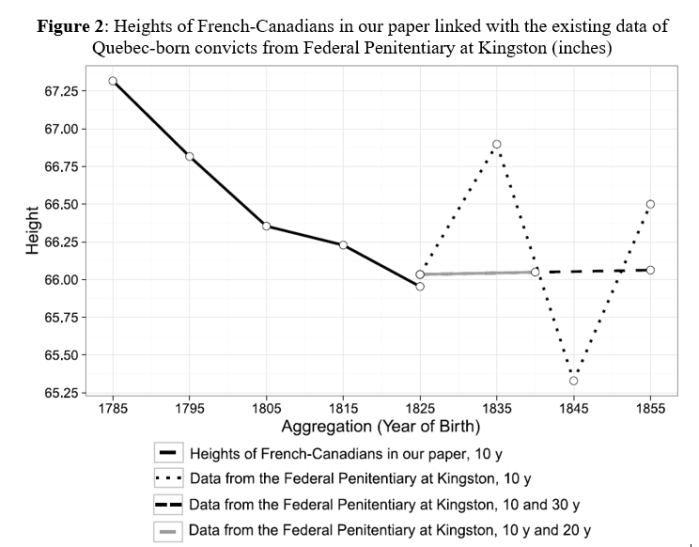
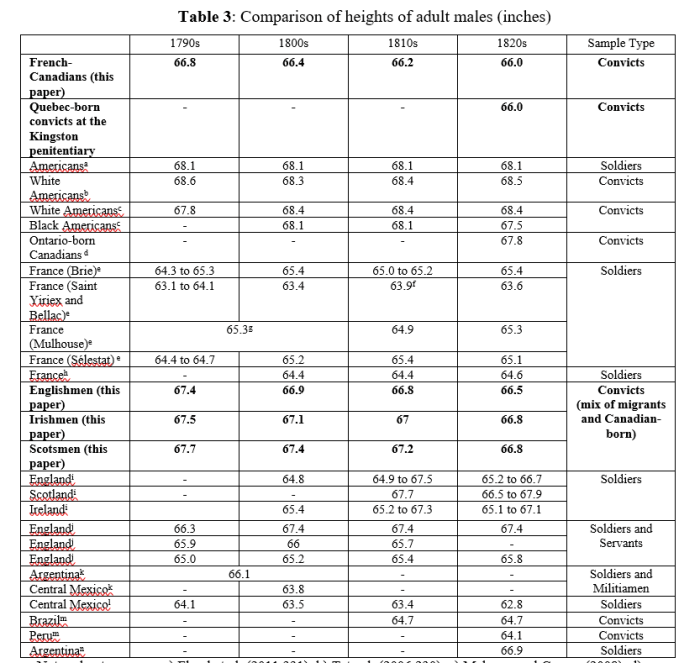
A few days ago, it was confirmed that my article with Vadim Kufenko and Alex Arsenault Morin on the heights of French-Canadians between 1780 and 1830 was accepted for publication in Economics and Human Biology. In that paper, we try to introduce French-Canadians before 1850 to the anthropometric history literature by using the records of the prison of Quebec City. Stature is an important measure of living standards. As it is heavily related to other aspects of health outcomes, it is a strong measure of biological living standards. More importantly, there are moments in history when material living standards and biological living standards move in opposite directions (in the long-run, this is not the case).

We find three key results. The first is that the French-Canadians grew shorter throughout the era when living standards did not increase importantly (and were very volatile). This puts them at odds from other places in North America where increases in stature were experienced up until the 1820s. Furthermore, stature stops falling around 1820 when economic growth picked up. This places the French-Canadians in a unique category in North America since it seems unlikely that they experienced a strong version of the antebellum puzzle (decline in stature with increases in material living standards which is what the US experienced). The second key result is that the French-Canadians are the shortest in North America, shorter even than Black Americans in slavery. However, they are considerably taller than most (save Argentinians) Latin Americans. More importantly, they are considerably taller than their counterparts in France. The third key result is related to the second key result. Today, French-Canadians are noticeably shorter than other Canadians. However, the gap was more important in the late 19th century and early 20th century. Pegged as a “striking exception” within Canada, we do not know when it actually started. Thanks to our work, we know that this was true as far back at the early 19th century.

The working paper (dramatically different than the accepted version) is here and I am posting key results in tables and figures below.  Moreover, I will be talking about anthropometric history and economic history with Garrett Petersen of Economics Detective Radio this Tuesday (I do not know when the podcast will be made available, but you should subscribe to that show anyways).

Heights.png

Table3.png

Household size and growth since 1870 (albeit in Canada)

Two days ago, I posted something on how much we were estimating growth since the 1950s. While organizing another research paper that I am trying to finish, I realized that I could make a follow-up to this based on previous research of mine.

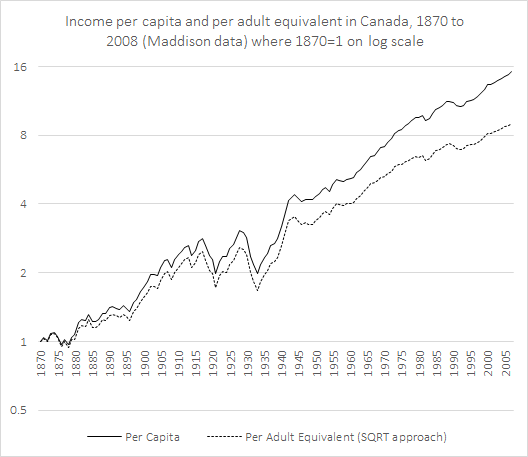
A few months ago, I published (alongside Vadim Kufenko and Klaus Prettner) a short note in Economics Bulletin where we showed that the large differences in household size in Canada that existed up to 1975 led many to overestimate the level of differences between provinces. Moreover, we pointed out that because household size were converging at the same time as incomes, we argued that the rate of convergence from 1945 onwards was slightly overestimated. That paper convinced us to do the same between all the OECD countries (we are assembling the data right now).  But this was an argument about variance, what if we simply plot the “per capita” income of Canada with the “per adult equivalent” income of Canada since 1870.

By using the Maddison dataset combined with the data from my article, it took me a few seconds to get the graph below. What is important to notice in this graph is that, incomes per adult equivalent (measured in 1990 Geary-Kheamis dollars) have increased 40% less than incomes per person. Since adult equivalents are a better measure of living standards (because you capture the economies of scale associated with household size), we can easily say that we have been underestimating the level of improvement in Canada (it is still substantial however).

growthfactors