From the Comments: Asylum Seekers and the Canadian Experience

Dr Amburgey takes some precious time out of his schedule to rebut Dr J:

@Brandon

I can understand your reluctance to yet again engage with Professor Pinocchio’s fact-resistant Islamophobia. However you must give him credit for actually using some real data. Granted the choice of country and time period are idiosyncratic [id est cherrypicked] but anything not pulled straight from his anus is a dramatic change. Should you feel like responding in kind, use this: Canada for the period 2004 – 2013. Top 8 countries of origin for refugees landing in Canada

Columbia – 17381
China – 15344
Sri Lanka – 12326
Pakistan – 10641
Haiti – 7872
Mexico – 6512
India – 4988
USA – 4451

Based on this data Catholicism and Hinduism far outstrip Islam as religions producing sick societies.There is currently no other view that is even modestly supported by anything but ideological intransigence.

Indeed. Only the most ideological of ideologues continue to pretend that Islam is responsible for the problem in the Middle East.

When the Austro-Hungarian empire collapsed, the Holocaust happened. One could argue that, because the state is less efficient on the post-Ottoman world, what we’re witnessing is a process similar to the one we witnessed in the Occident, only in a much more haphazard way.

Mexican immigration and the Open Border: Mexicans Go Home and Mexican Kindness

I just returned from a two-plus weeks stay in Mexico for the second time in less than five months. A couple of comments to add to my previous essay on Mexican underdevelopment. Plus, some unrelated political sociology comments.

In 2009, my friend and I published a long piece on Mexican emigration to the US in the libertarian periodical The Independent Review. (Nikiforov and I are both immigrants to the United States.) The article is entitled, “If Mexicans and Americans Could Cross the Border Freely (pdf),” and the full text is available through a link on this blog. In that article, we argued that we would all be better off if the southern American border were open to crossing by citizens of both countries with no expectation of a change in citizenship for either.

Well, the politicians did not listen to us then and their inattention led to the recent Republican fiasco whereas, President Obama used an executive order to more or less legalize five million illegal aliens, most of them Mexicans whereas, the Republican Senate called him out and ended up caving piteously. (Do you remember or have you already forgotten? Stupidly, Republicans tried to use the threat to de-fund Homeland Security at a time when aggravated terrorism news fill the airwaves.) As often happens, the Republican leadership confused the issue of constitutional principle with the substantive issue of limiting immigration. Myself, I would chose total firmness on the first and flexibility on the second, for fear of ending up the A.H., no matter what the outcome. The Republican leadership lost the constitutional arm wrestling and still ended up the A. H. Congratulations, guys!

Our article was long and intricate as is normal for a scholarly piece. Here are two highlights from that piece on which I wish to comment after my two recent stays in Mexico:

A We argued that Mexicans – who constitute the largest immigrant group to the US – should be given special treatment over other aliens. Several reasons for this: They are our close neighbors; they have been joined to us through NAFTA for now 23 years, insuring that our lives are tightly enmeshed economically. Then, because of a long series of past interactions some may find deplorable, Mexicans tend to make very good immigrants. Two reasons for this superiority, in turn. First, nearly everyone agree that Mexicans (in the US) tend to be very hard workers. Even their direct competitors in the work place tend to assent to this judgment. Second, sociologically, Mexicans make good immigrants because they are astonishingly familiar with our society, including with our institutions, before they set foot on American soil. In particular, Mexicans don’t find perplexing our fundamental constitutional principle of separation of religion and government. (That’s, as opposed to immigrants from other areas I could name.)

Nikiforov and I argued that Mexican citizens should enjoy unimpeded passage into the US, and the freedom to take any job for which they qualify, all without any path to American citizenship because, Mexicans already have a citizenship, that of Mexico. We point out that the European Union has used this model for more than twenty years and experienced few downsides. (The current ferment in Europe about and opposition to immigration does not involve neighbors from the EU, with one single exception I will discuss if someone asks me.)

B We proposed that many Americans would find it comfortable to spend their last years in Mexico because of a specific aspect of Mexican culture, to wit, contemporary Mexicans tend to be sweet in general and considerate to older people in particular.

This is what I found in twice two and half weeks in Puerto Vallarta in the pas five months that is relevant to these issues.

First, on the matter of Mexicans wanting to work in the US but not necessarily wishing to live there, we were much more right than we thought when we wrote about this. The anecdotal evidence is overwhelming that this would work. Everywhere I went in Puerto Vallarta , I bumped into people who knew some English that they had learned in the US, mostly as illegal immigrants here working at undesirable jobs. None of those people had been expelled, deported. All had returned to Mexico under their own power after saving some money. Thus, they had chosen to go home because it’s home, just as we predicted in the article.

One middle-aged man sticks to my mind, a taxi driver. He had stayed in the US (illegally) for several years. He had refrained from visiting with his family in Mexico for stretches of two or three years at a time to avoid being unable to return to the US. You might say that he was trapped in the US for longer periods than he wished because of our immigration laws. He finally decided to go back to Mexico and to his family for good after he had saved enough money to build a house for each of his three daughters. He specified that only one of the daughters was of marriageable age by the time he had the three houses standing. To my mind, this is an exemplary story of emigration/immigration. On my query, the man declared himself satisfied with his choice and with his life since his return from the US.

He was earning, driving a taxi, about 1/5 or less of what he earned in the US doing unpleasant work. He liked his job; he enjoyed returning to his family every evening; he liked the schools; paradoxically, he liked Mexican schools. (This is paradoxical because daily life in Puerto Vallarta, including in the schools is much more relaxed, much more genteel than what prevails in the US except in the most elite neighborhoods. In that part of Mexico, the bloody drug traffic-based blood-thirsty banditry is found strictly in the newspapers. It is not at all apparent in daily life. The quality of this daily life is at the antipodes of the impression of Mexico reaching us through the US media. Gangs are not in the school unlike in Salinas, California, for example.)

On point B, the attractiveness of Mexico to older Americans, I find that I tend to censor myself anytime I write about the topic because I fear appearing to be gushing like a teenage girl. During my last stay, of two and half weeks, I did not meet a single Mexican man, woman or child who was not completely pleasant except two. One was a taxi driver and he was morose but, that’s because he was drunk. (Nobody is perfect.) The second was a female merchant who acted displeased because I tried to bargain down an item in which I was interested. Another merchant – from whom I actually bought and whom I befriended – told me later that my bargaining had been reasonable and that the woman was undergoing a painful divorce. Mexico is not perfect and I may have looked like the woman’s soon-to-be ex-husband. You never know; these things happen.

Absolutely everywhere, my gray beard drew the kind of respectful behavior I don’t expect in the US. (And that I don’t deserve, to be honest!)

I can hear the snickering from here: “Of course, he stays in a tourist ghetto were everyone is occupationally obligated to appear nice.” No, I did not spend all my time there; I was forced to go out and I liked to go out. I found that everyone smiles a lot, including at each other, even among perfect strangers, that everybody ceded passage, that waiting lines are always orderly. Being a formerly great social scientist, I yielded, of course, to the temptation to conduct verbal experiment. Unfailingly, I made everyone I wanted to laugh at the drop of a hat. I mean small children, old ladies and adults of all sexes. (Yes, my Spanish is that good. Eat your heart out or learn to conjugate irregular verbs! Those are your choices. There are no others.)

Issue A and B are joined in the strangest way within my latest short stay in Mexico. Puerto Vallarta in the winter is swarming with Canadians. Their flight from the cold may have a great deal to do with this fact but it has a virtuous side-effect. I suspect many flew in to warm up and ended up warmly loving Mexicans for the reasons I depicted above. They beat Americans at it, in that city, at least. Oh, and the only sullen faces around Puerto Vallarta all belong to them. It became a game of pop-sociology for me: guessing from afar who was American and who was Canadian. It soon become embarrassingly easy: The Americans are the loud ones who say hello and who laugh easily. (Besides, I think the presence of Canadians explains much of the bad food there.)

After this last experience, I am very tempted to start a new racist fad: Speaking ill of and persecuting Canadians. It could be fun and they are not (yet) a federally protected minority.

Privilege in the Classroom

https://i0.wp.com/d268xzw51cyeyg.cloudfront.net/wp-content/uploads/sites/1375/2014/12/636_110711_fx_scolding_finger.jpg

I just finished teaching my intro anthropology course on Thursday afternoon. At the end, the students heartily applauded me.

Every year, between 30% and 100% of my students are indigenous women (I’m never totally sure, because I don’t take a survey, and random chromosomal sorting and centuries-long interbreeding mean that you can be half Ojibwa and look like Cameron Diaz): Cree, Ojibwa, Dakota, Metis — you name it.

My indigenous students are extremely diverse intellectually and culturally. Some of them grew up telling their friends they were Italian in the hopes of avoiding getting called a dirty Indian. Some of them grew up declaring, loud and proud, who they are. Some of them grew up thinking they were of pure French stock, and only later found out the dirty family secret that they were Metis.

220px-Cameron_Diaz_by_David_Shankbone

Some of them are energetically engaged in shamanic rituals. Some of them are fiercely Christian. Some are quiet atheists.

What my students were applauding was that I’d kept a strict classroom environment (so the douchey cellphone-wielding students don’t interrupt us), provided a welcoming discussion environment (so the dedicated students can engage verbally in the class), provided clear evaluation criteria that incentivize learning, entertained them with jokes and anecdotes, and helped them understand interesting phenomena in human nature and their lives.

What I find is that my indigenous students (and everyone else) are fascinated and empowered by my course if I drop hints along the way explaining how their own experience and their family’s history of anarchic indigenous traditions, recent domination by the state, discrimination by everyday racists (and very often, internal cultural breakdown and internalized, self-hating racism) connects to broader phenomena of human nature and cultural diversity.

Throughout the course, I make sure to cover a few cultures that have similar experiences of anarchic tradition and colonial oppression. There are some striking similarities with the once-nomadic Ju/’hoan of southern Africa, for instance.

And when my students eventually start raising their hands to say “Hey, that’s just like on the Indian reserve I grew up on!” Or “Is that like what happened in Canada to the Aboriginal people?” I encourage them enthusiastically: “Yes, that’s exactly right!” By the end of the class, when we actually do talk a bit about North American indigenous cultures, these students are confident and curious enough to engage fully and bring their personal knowledge to bear.

I developed this technique based on the good things I learned from the privilege-oriented leftists I went to grad school with. Actual aggression (especially by states and state-backed corporations) against the indigenous people is one layer of the problem. Hostile racism and other douchey attitudes (especially by state officials and rightists) are another layer. But there’s a subtle, third layer, which is patronizing racism (especially by academics and leftists: “Oh your people are so in tune with nature! So egalitarian!”) and the assumption that only experts have the ability to explain “exotic” cultures. Layers 2 and 3 can be stupefying and degrading even when they aren’t violent.

So if the professor goes into the classroom and (as some of my colleagues do) starts talking right away about how evil Western cultures are and how dignified and beautiful indigenous cultures are, the students can fall prey to that third layer. They never develop their own voice and vision.

If you go in and lay down a bunch of conclusions and facts to memorize for the test, the students never get the incentive do their own intellectual work of asking how their own individual lives connect to the broader themes of academic study. Maybe they adopt the prevalent academic interpretation (capitalism BAD!). Maybe they just shut up and don’t share their vision with the class because they know it’s not “what the teacher wants to hear.” Or maybe they simply decide that they must not really know what their own life means.

So instead, I like to drop some breadcrumbs and let the students do the detective work.

Yes, yes, yes, “privilege” is all around us. And yes, yes, yes, I’m a white dude privileged to teach in this environment. But what makes my classes work, for me and my students, is not some guilt-ridden confession session about privilege, nor some moralizing lessons from me, lecturing them on how valid their life experience is, and lecturing the white students on how privileged they are. Instead, what works is to set up the incentives for my students to study hard and talk lots, and then to set up the clues so they can do the work of connecting the dots on their own.

Furthermore, “privilege” guilt sessions and “antiracist” moralizing have a very high rate of turning off the white folk in class, because they feel (somewhat rightly) that they’re being attacked. So, 9 times out of 10, they lash out or dumb down their own voices and visions. But when I drop the breadcrumbs, the white students can connect the dots too. And because I use fun, discussion-based classes, they can discuss the evidence and discover the truth step by step along with their indigenous peers. Fun is a better motivator of learning than guilt.

I do hope that my teaching leads in the long run to some liberation in the NAP sense. But I am certain it leads to some liberation in the psychological sense of shaking off the subtle, sneaky, racist, collectivist assumptions that tend to sneak into classrooms.

***

Originally published at Liberty.me.

We Can’t Bomb Our Way to Sanity

With Canada still reeling from last week’s unprecedented terror attacks, can we make ourselves safe from the threat of “radicalized” Muslims?

It is now pretty clear that both of Canada’s two terrorist attackers last week were mentally disturbed men. Their acts of violence were not caused by a religion the police can censor or a terrorist organization the military can bomb.

These two men weren’t “radicalized.” They were losing their minds.

Wednesday’s Parliament Hill attacker, Michael Zehaf-Bibeau, was a drug addict who once robbed a McDonald’s in the hope that he could “get to jail to atone for his sins and get clean from a crack addiction.”

In other words, this man suffered mental torment. He decided that by attacking others, he could force them into a response that would cleanse his guilt and silence his troubled mind. When getting locked in a cage didn’t do the trick, Zehaf-Bibeau decided to up the ante and get himself killed.

Monday’s hit-and-run attacker, Martin Couture-Rouleau, apparently underwent a radical personality change two years ago. He lost his car wash business and became alienated from his friends, his father, and his wife. Only later did he convert to Islam, start talking to his horrified friends and family about the redemptive power of suicide terrorism, and then run over two soldiers with his car.

At the time of his car attack, his wife was seeking sole custody of their child because of the changes in her husband’s behavior.

This was not a functional Muslim man who decided to take up arms because he saw some beheading video on YouTube. He was a superficial convert dealing with, at the very least, some serious emotional changes and relationship problems.

The kind of personality transformation Couture-Rouleau apparently underwent seems to be consistent with the onset of schizophrenia, which usually happens in a man’s early 20s. Couture-Rouleau would have been 23 when the changes started.

These men were not good Muslims on the accepted path of proper conduct in their faith communities. Couture-Rouleau’s imam had been meeting with him in an attempt to talk him out of his interest in acts of violence. Zehaf-Bibeau had recently been kicked out of a mosque in British Columbia for his erratic, drug-induced behavior.

These were unstable men living with intense mental and emotional turmoil.

From the point of view of the mentally disturbed person seeking to end his psychological suffering, authentic religious devotion has a downside: you have to keep at it day after day. You pray, you work, and you still have to face your inner demons every morning and every night.

Suicidal violence has the advantage that you only have to do it once.

That these recent attacks have more to do with insanity than with Islam or ISIS may not be convenient for Western governments. It does not provide a shadowy supervillain against whom to defend ourselves. It provides no outlet for the Western public’s fear and anger, and it provides no justification for war. We cannot bomb our way to sanity.

This fact is also not advantageous for ISIS propagandists, who would prefer to congratulate Zehaf-Bibeau and Couture-Rouleau as holy warriors rather than express sympathy for them as mentally ill.

But there’s a plus side for those who prefer peace. The mental instability of last week’s two Canadian terrorists is a reminder of why suicide terrorists are really not that dangerous. The desperate people who usually carry out these attacks are likely not capable of the kind of delicate, slow-moving, secret operation required to set off a dirty bomb or a biological weapon in a Western city.

They have what Ludwig von Mises would call a high “time preference.” They want to end their own suffering and they want to end it now.

These terrorists (if we want to use that word for such tormented souls as Zehaf-Bibeau and Couture-Rouleau) were not actually trying to achieve mass casualties. They were trying to end their own pain and shame.

Suicidal violence with a hastily adopted patina of Islam was just the rope they chose to hang themselves with.

***

Originally published in Anything Peaceful.

From the Comments: Open Borders, Immigration and the Sociology of Gradualism

Dr Delacroix takes issue with my woefully inadequate summary of his work on open borders in the Independent Review. He writes:

Small yet somewhat important correction: In our piece in the Independent Review, Nikiforov and I argue for somewhat more than a guest worker program and our reference is not a to a EU “guest worker program.” (I am not sure whether there is one.) Rather, we argue that little harm would be done and, as we see now, much harm avoided, by simply agreeing that citizens of Canada, the US and Mexico (especially Mexico) can freely move across the common borders of the three countries. including for the long term. What we have seen in the EU for now more than twenty years shows that there is no reason to attach this free movement principle to citizenship.

That you may work, open a business, pay taxes in Mexico does not logically imply that you may vote in Mexican elections. That you may not does not deprive you of any “rights.” As an immigrant into Mexico you knew what you were doing. You moved under your own power. It’s unlikely anyone even invited you. If you crashed the party, you have no moral right to complain that the food is not kosher (or hallal, you decide).

Several years later, I think that the only reason for this insistence on tying residence to citizenship is the Democratic Party’s totalitarian aspirations. Observing the drift in the Obama administration toward non-legality clarified the picture for me, personally. (I am not speaking for my co-author, here. He just spent three years in Russia; I will ask him.)

Historical precedents matter, and a preference for gradualism may make it desirable -in this country- to transition through a somewhat familiar “guest worker program” rather than directly decree open borders for the citizens of the three NAFTA countries.

I am for whatever works but we must keep concepts distinct from each other: A tomato is not really a fruit, not really.

PS I am glad Notes On Liberty publishes my essays (and even my stories) and that it links to my blog. When I grow up, I want a readership like Notes’ readership!

Optimism and Despair in a World of Injustice

The infamous development economist William Easterly recently tweeted that writing about spontaneous order without citing Friedrich Hayek is now “mainstream cool,” while writing about spontaneous order and citing Hayek makes one an ideological extremist. This biting critique of intellectual discourse, a mere 140 characters long, does more than just expose the drastic ideological shortcomings of the modern Left. It highlights the endlessly interesting obstinate ignorance that collectivists of all stripes have historically displayed toward the basic theoretical and moral insights advanced by libertarians.

In a recent Freeman essay by anthropologist Mike Reid, a pattern similar to the one noticed by Easterly emerges in the actions of central planners aiming to preserve the cultural heritage of a number of ethnic groups that have been deprived of their property rights by the very governments now looking to preserve their cultures for them. Reid takes examples from India and Canada and finds that the logic of preserving a specific culture does not hold up to scrutiny.

On the policies of the government of India, Reid writes: Continue reading

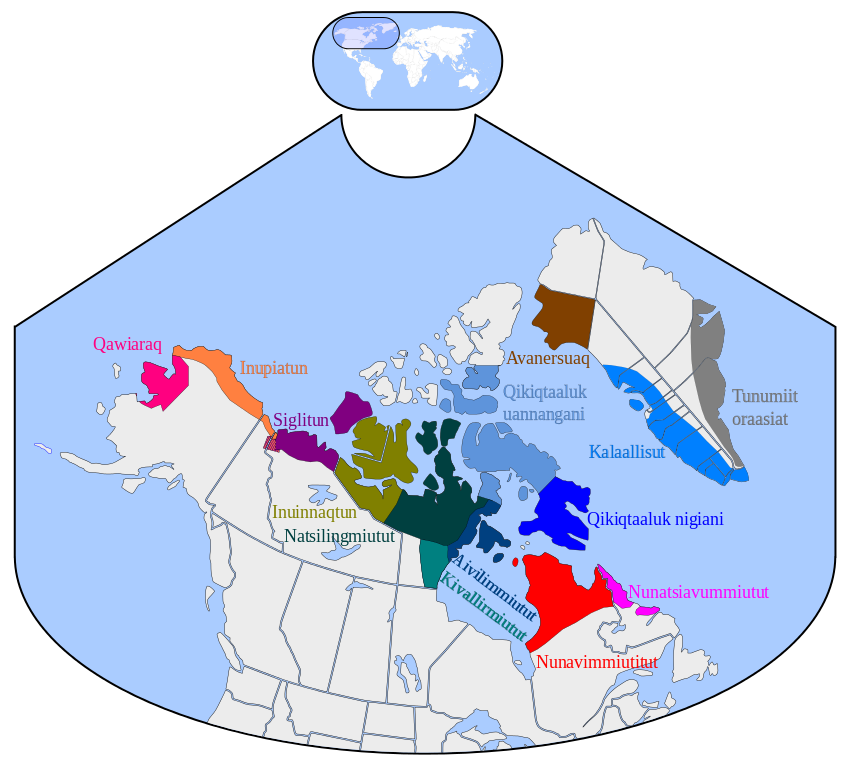
The World of the Inuktitut

Check out this sweet map of the Eskimo world today. It is broken down by linguistic groups. I wonder if these linguistic groups consider themselves ethnically distinct as well as linguistically distinct.

The Eskimo World

Here is a Wiki article on Nunavut, an experiment in Canada with indigenous self-governance (don’t get me started!).

And an article on Danish colonialism in Greenland (possibly gated).

Updated: I changed the title from ‘Eskimo’ to ‘Inuktitut’ because I just learned that the former is used as a pejorative term in Canada and Greenland (like the n-word here in the States). Inuktitut is term preferred by those highlighted in the map above. I’m not politically correct by any means, and in the US the term ‘Eskimo’ doesn’t carry any negative connotations, but being polite and being politically correct are two very different things.

Around the Web

  1. Free Baluchistan! More on secession, this time in Pakistan. I’d highly recommend taking a gander at this one.
  2. The Economist has great article critiquing France’s “new” relationship with Africa. It appears to be just like the old one.
  3. Six Nations passports, issued in Canada for the indigenous, are more than just travel documents. Or are they?
  4. Bacevich has an article at Foreign Policy suggesting that NATO should become an all-European alliance.
  5. More on secession: Welcome to New Bohemia (this time from the Left).

France Does not Export Wines, nor Mexico Guacamole, nor Does the US Import Cars, etc. “National Competitiveness” for the Intelligent Ignorant

It’s national election season again. As always happens in this season, in every developed country, the old battle horse of national competitiveness gets a new coat of shiny paint and is led out by its sparkle-strewn tether to support politicians misconceptions and mis-talks. There is a very widespread misconception that nourishes unreasonable thoughts and false notions on the economy.

Sorry but at this time, in this season, I feel a compulsion to resort to teaching, so, pay attention. There might be a quiz.

The misconception: Countries, (or “nation-states”) such as the US, Canada, Mexico, Belgium, or France don’t compete with each other like soccer teams, for example, compete against each other. In soccer, when one team wins a point, the other team loses a point. When the economy of one country picks up speed however, it is not (NOT) the case that the economy of another country (or of several countries) must slow down. The reverse is true. When the Mexican economy grows, some Mexicans are better able to buy American corn, or American video games, making some Americans richer than would be the case if the Mexican economy stagnated.

The confusion has three sources. The first source is simply ignoring that the producers of one country are also potential customers for the producers of all other countries. Those who compete with American workers, are often also buyers of American-made products. If they are not at the moment, the richer they become, the more likely they are to become buyers. One of the international functions of those who compete with American producers is thus to enrich American producers, perhaps different ones. The relationship may be more indirect. Foreign worker A competes with American worker B and he uses the money he gets from beating B to buy from American worker C. If I am C, my interests are not well lined up with those of my fellow American B. That’s a fact, no matter what politicians say in the language of football. However, if I am American worker C, in the long run, I am better off if fellow American worker B becomes richer than if he does not. For one thing, he will be able to support better equipments, such as schools, from which I will profit. Continue reading