- On belonging to Western civilization Ross Douthat, New York Times
- The deep structure of the Western tradition Nick Nielsen, Grand Strategy Annex
- A patient observation of human beings Asma Afsaruddin, Los Angeles Review of Books
- Populism, liberalism, and authoritarianism Stephen Davies, Cato Unbound
The childishness of the left
Jair Bolsonaro took office as president of Brazil this last January 1. The government has barely begun, but I think we can already observe a little of what the next four years will look like. During the campaign, Bolsonaro made it clear that his government would be “liberal in the economy and conservative in customs.” Here an explanation is necessary for English speakers: in Brazil “liberal” almost always means “classic liberal,” that is, defender of the free market economy. Conservative, at least in the context of Bolsonaro’s speech, is not so different from the sense of the English language: conservatism as an appreciation of the customs and traditions of Judeo-Christian society.
The speeches of the Bolsonaro himself and his ministers already in office follow exactly this tone. Paulo Guedes, chosen to be the “super-minister” of the economy, made it clear in a speech of almost an hour that Brazil’s problem is excess of state. During the last 40 years or more Brazil has treated symptoms, not the causes of its economic backwardness. The speech of Paulo Guedes was a class of economic history of Brazil.
However, what dominated the Brazilian media in recent days was not a speech, but rather a remark by a minister. Damares Alves, the human rights minister, the one who was harshly criticized for saying she saw Jesus when she was in a guava tree, said at an informal moment that “boys wear blue and girls wear pink.” The speech fell on the media and provoked the reaction of Brazilian celebrities. Many “artists” appeared changing colors, men wearing pink and women, blue. What draws attention in this case, besides the difficulty of understanding figures of speech, is the infantilization of the left activists. Damares said that “boys wear blue and girls wear pink,” not that men wear blue and women wear pink.
The minister’s speech fits into a moment Brazil is living. The cultural wing of the left wants to teach that gender is only a social construction, with no connection to biology, and therefore children should be treated as neutral, awaiting their decision as to what gender they want to adopt. Damare’s remark, therefore, refers to the education of children in public schools, not adult men and women. Brazil is a country free enough for adult men and women to wear the colors they want. The identification of many celebrities with the minister’s speech shows that leftist activists have the mental age of kindergarten children.
Afternoon Tea: Fredericke Maria Beer (1916)
By the Austrian painter Gustav Klimt:

This beauty is in a private collection, somewhere on this planet…
Nightcap
- From under the rubble (Solzhenitsyn) David Tubbs, Claremont Review of Books
- ‘I had to guard an empty room’ David Graeber, Guardian
- Regional bipolarity, the new global model Ralph Peters, Strategika
- The origins of the Second Cold War Branko Milanovic, globalinequality
Nightcap
- A good intuitive argument for authority Michael Young, Policy of Truth
- The Cold War’s killing fields Daniel Immerwahr, the Nation
- In defence of Jeremy Corbyn Chris Dillow, Stumbling & Mumbling
- Deeds and ghosts (imperial twilight) Gavin Jacobson, Times Literary Supplement
The Left’s Gospel has no Grace
The Protestant Reformation was started in 1517 by Martin Luther, an Augustinian monk who was revolted about the selling of indulgences by the Roman Catholic Church. The indulgences were on that occasion simply documents sold by Rome that would guarantee access to heaven for those who bought them. Luther understood that the Bible taught something different: salvation is through Christ alone, and can’t be bought or sold. Jesus’ death on the cross was substitutionary: he died in the place of sinners. Those who put their faith (their trust) in this sacrifice are saved from hell. In a nutshell, this is the gospel (the good news) as Luther understood it and as Protestant churches have been understanding it in the past 500 years.
However, for Luther, the Protestant Reformation didn’t begin in 1517. What happened to him in that year was just the culmination of a process that started many years before. Luther was obsessed with the idea of sin. More so than the average person, he understood that as a sinner he could never be considered just by God, no matter how much money he spent on indulgences. The distance between God’s justice and human sin is simply too great. Understandably, instead of loving God, Luther hated him. that’s when he discovered salvation by faith alone. Yes, it is true that our justice can never satisfy God. But it doesn’t have to. We can rely on Jesus’ justice. And that is what for Luther begin the Reformation.
Luther’s idea of salvation by faith alone can easily be mistaken by antinomianism. Antinomianism is the idea that the law has no importance at all, especially for salvation. That is certainly not the case for Luther and other reformers. For them, we are saved by faith alone, but not by a faith that is alone. True faith will always be followed by good works. So, although the good works in themselves do not save, they are part of faith. Nevertheless, Luther’s idea of salvation by faith alone is pretty radical. Can we be sure that faith alone will not fall into antinomianism? Can we be fully confident that this idea will not lead to licentiousness? This debate has been going on for the last 500 years.
In any case, I find it fascinating how the Reformation begin with one unsuspicious monk in an unimportant region of Germany over 500 years ago. The Reformation is part of the modern (re)discovery of the self. Before Luther, other people were trying to reform the Roman Church already. Notoriously, Erasmus was criticizing the excessive pomp of the church and the shortcomings of the official Latin translation of the Bible. However, as important as they could be, these were external things. Luther’s reformation begins as a reform of the self. A someone said, nothing is deeper than a man full of regret. If Luther was simply pointing to the mistakes in the Roman Church, and not to his own sinful nature, his reform wouldn’t produce the change it did.
The problem with the Left, since Rousseau, is that the problems are outside the self. For Rousseau, we are born in chains. Society turns an otherwise noble savage into an egoistic person. For Marx, man is nothing but a soulless homo economicus, trapped into the materialistic engines of history. The New Left believes we are poor victims of advertisement that makes us buy stuff we don’t really need. And that inevitably turns leftists into hypocrites. One can never perform well enough to these standards and is left pointing to the speckle in somebody else’s eye.
Ever since I can remember, one of the most common reasons people give to stay away from churches is the Christians. Churches are full of hypocrites, they say. I can’t really access the veracity of this statement, but one thing I can say is this: salvation by works is a game set to be lost. If your religion says that you obtain salvation by performance, that will inevitably turn you into a hypocrite. Or a cynic. Or both. And will also make you hate anyone outside your religious group.
The problem with the left is that it preaches salvation by works and sets the problems outside the self. The gospel of the left lacks a sense of personal sin and of grace.
Afternoon Tea: Rest on the Flight Into Egypt (1597)
By the Milanese (Italian) painter Caravaggio:
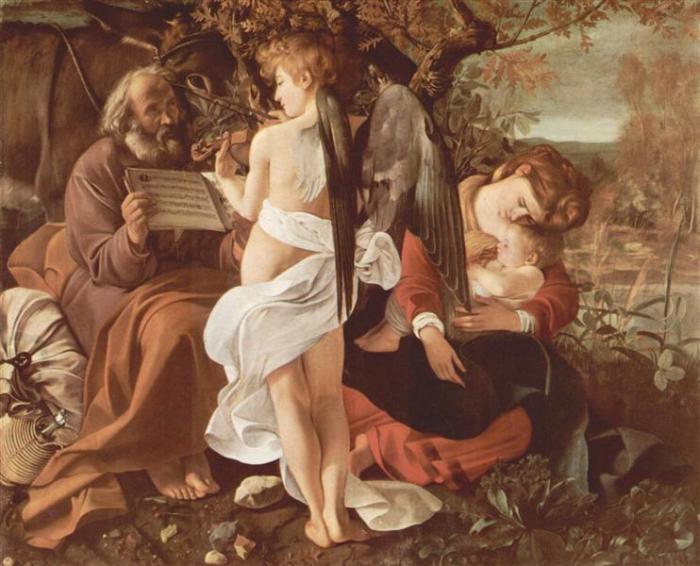
Caravaggio is one of Jacques’ favorites…
Nightcap
- West Coast jazz revival Ted Gioia, City Journal
- Augustine’s Cogito David Potts, Policy of Truth
- Iraq: A failure of ideas Sam Roggeveen, War on the Rocks
- Confucian patriarchy and the allure of communism in China Alan Roberts, Not Even Past
Pres. Trump and Me After Two years
I voted for Donald Trump for two clear reasons. First, his name is not Clinton. Second, he promised to nominate Supreme Court Justices from a published list of conservative judges. I have been amply satisfied on both counts.
Accomplishments
Then, I watched pleasantly surprised as the Trump administration engineered a tax reform that could only improve economic growth. Then, it quickly dismantled hundreds of federal regulations, a strategy that could only benefit entrepreneurship and business activity. Sure enough, there was a sudden rise in Gross Domestic Product growth. I don’t have any proof of causality here but the temporal coincidence is gratifying! At the same time, the unemployment rate – which had been going down even in the waning days of the Obama presidency, it’s true – continued to nosedive. It reached an all-time low for African Americans and for Hispanics. That fact illustrated nicely the basic conservative idea that results count more than intentions. (Remember, that Adam Smith wrote the same in 1776 but who reads Adam Smith nowadays?)
Soon, there was the blessed withdrawal from the comedy of the Paris climate “accord.” Then, there was the abrogation of the weak-kneed, poisonous agreement (not a “treaty) with the totalitarian and aggressive Islamic Republic of Iran. I applauded both with both hands. I was pleasantly surprised later by the initiative toward North Korea although I reserve judgment because nothing much has actually been accomplished on that front, except, possibly (possibly) a better mood. I do think President Trump has gone farther on the road to disarming that kingdom of cruelty and madness than any previous president. Yet, Continue reading
Nightcap
- Fear for the future of classical liberalism John McGinnis, Law & Liberty
- Dying, Death, and Wisdom in an Age of Denial Mary McDonough, Commonweal
- Troll epistemology Jonathan Rauch, National Affairs
- Murray Rothbard was right Justin Raimondo, Antiwar.com
Afternoon Tea: The Three Ages of Woman (1905)
By the Austrian painter Gustav Klimt:

Why Christmas materialism is awesome
It has always struck me as odd that capitalism’s usual defenders abandon it when commercialism seems to be on its best behavior. Every year, we religionists love to rail against Christmas materialism. What a terrible curse–people in the marketplace thinking of others’ interests and needs for once. All the efficiency of the market PLUS good will toward men–why are we complaining, again?
Yet we do. Without fail, twitter feeds and chapel lecterns ring with invectives against Christmas commercialism. The warning voice, though, never seems to strike with precision. The concern seems to be that a focus on stuff gives rise to an idolatrous dethroning of deity. This religious criticism appears to mimic the secular and progressive criticism that commerce somehow defiles us and strips us of virtues like compassion or solidarity.
I don’t buy either of these criticisms, largely for the same reasons: commerce brings people together, builds trust, and fosters goodwill. These benefits are in addition to the efficiencies that market advocates typically emphasize. And these three aspects of commercial exchange are in special abundance during Christmas.
Perhaps the materialism complaint stumbles at the outset by focusing on the largely mythical human calculator that predominates in economic theory–the man focused only on maximization of personal utility. That portraiture does not explain the fact that so much commerce occurs on behalf of someone else–a reality underscored and amplified during holiday shopping. Thus, Christmas supports Amartya Sen’s critique of the rational-man theory: “The purely economic man is indeed close to being a social moron.” He’s the one who gives you lotion samples and leftover hotel shampoo in your stocking. But most of us don’t do that. Instead, the market provides a forum for us to express and cultivate virtue. As Deirdre McCloskey says, “In other words, it’s not the case that market capitalism requires or generates loveless people. More like the contrary. Markets and even the much-maligned corporation encourage friendships wider and deeper than the atomism of a full-blown socialist regime.” I think a simple test proves this point. If you walk about a shopping mall during the Christmas holiday (setting aside for a moment your inner misanthrope), how are people behaving? By and large, there is an overpowering sense of goodwill among people engaged in (shudder) holiday materialism. I’d say this is mostly true at any time of year, but we may as well notice this phenomenon when it stands at its apex.
Beyond just the goodwill generated by the act of commerce, the materialism critique seems to ignore the very purpose of the materialistic behavior being condemned. Shouldn’t we celebrate this key example of how commercialism can enhance friendship through gift-giving? If you’re a religious capitalist, what is there not to like here?
A friend pointed out recently that Christmas giving seems fruitless, since the value-for-value gift exchanges offset each other. He concluded we may as well just keep our money. From an efficiency standpoint, it does seem strange to engage in a transaction cost without any expectation that you’ll achieve a pareto-efficient state of affairs. Samuelsonian economics alone can’t really explain why people engage in this ritual. That’s probably because the ritual is not purely economic. It’s about connection, relationship, and opportunity to think beyond ourselves. In other words, at bottom, it really is not about materialism in the shallow, desiccated sense that these Christmas puritans rail against. Commerce can be about compassion and camaraderie–not just self-interested calculation (though there’s nothing wrong with that either).
I don’t think the Babe of Bethlehem would disagree. After all, Jesus, while no aristocrat, was not a severe ascetic by any means–somewhat of a contrast to his cousin, John the Baptist. Perhaps the most poignant example of his view toward extravagant gift-giving occurs when a woman anoints him with an extremely valuable ointment. His disciples complained of the waste, griping that the ointment should’ve been sold and the proceeds given to the poor. Jesus defended her: “Let her alone; why trouble ye her? She hath wrought a good work on me.” In other words, a materialistic act can still be a virtuous one. In fact, I’d go as far as to say that the vast majority of them are. We need, after all, an earthly vehicle by which to exercise heavenly virtue. The market is well-suited for that role. God can be in a market–he’s that good.
Of course, a post about Christmas and materialism must make obligatory mention of Ebenezer Scrooge. Dickens was no fan of capitalism, but his reformed villain ironically proves a point about Christmas materialism: it’s the lack of virtue in the individual operating in the market, not the market itself, that desiccates the soul. So perhaps I can end with a simple “Scrooge” test: is Scrooge the guy standing back and pointing the finger, or is Scrooge the person that the finger aims at–the mom who braves the crowded mall to plop her kids on Santa’s lap and wraps gifts until 3:00 AM in the morning?
Nightcap
- If Brexit goes ahead, say goodbye to radical redistribution Chris Bertram, Crooked Timber
- The lasting, important influence of Karl Marx Branko Milanovic, globalinequality
- Perverse rationality Nick Nielsen, Grand Strategy Annex
- Scents of heaven: frankincense and myrrh in the Christian realm Timothy Carroll, Aeon
A short note on 2018 and 2019
It’s been quite a year. NOL got lots of love from around the globe, and I’m grateful for every bit of it. I have done a “favorites of 20__” post for the past couple of years but the amount of awesomeness produced at NOL this year was just overwhelming.
I’d brag a bit more about the accomplishments of the Notewriters, but they know how bad ass they are and we’re not passing around a hat for donations or anything like that.
I hope every one of you readers sticks around for 2019, and that you share NOL with friends and enemies alike. I’ve got baby #2 on the way in a couple of weeks (January 11, to be exact), so family and work will continue to take up the bulk of my time. This doesn’t mean you’ll see less of me, but only that I’ll be writing shorter, more intimate posts. The “nightcaps” will continue apace, and “afternoon tea” (on Mondays, Wednesdays, and Fridays) with NOL is getting a facelift. You’ll still get your “eye candy” on Sunday mornings, although it will continue to roll in sporadically.
The shorter, more intimate posts will deal with me as a new individual: as a father, as a monogamous lover, and as a member of a world that continues to surprise, amuse, and sometimes disappoint. I have been reading more books lately, thanks in part to a crappy desk job, and not all of them are fiction. The scholarly work I’ve been devouring (when I have the time) is approached with the following question: why isn’t the idea of a transoceanic federation in here?
I have no idea what the other Notewriters will be bringing to the table in 2019, I only know that whatever they bring will be worth your time (and theirs).
Happy New Year!
Twelve Things Worth Knowing According to Jacques Delacroix, PhD, Plus a Very Few Brain Food Items.
Note: I wish you all a prosperous, healthy, and writerly year 2019. (No wishes for happiness, it will come from all the above.)
I have a French nephew who is super-smart. Not long after graduating from the best school in France, he moved to Morocco where he married a super-smart Moroccan woman. He is so smart that he asked me for my intellectual will before I depart for another planet. It’s below.
Here are my qualifications: I taught in universities for thirty years, including twenty-five years in a business school in Silicon Valley. My doctorate is in sociology. (Please, don’t judge me.) My fields of specialization are Organizational Theory and the Sociology of Economic Development. My degree is from a very good university although I am a French high school dropout. My vita is linked here (pdf). Its academic part is respectable from a scholarly standpoint, no more. There is much additional info in my book: I Used to Be French: an Immature Autobiography, available from me, and on Amazon Kindle, and in my electronic book of memoirs in French: “Les Pumas de grande-banlieue: histoires d’émigration”, also on Amazon Kindle.
1. When the facts don’t fit your perspective you should change …. ? (Complete sentence.)
2. One basic complex idea worth knowing that resists learning: natural selection.
Note: the effective mechanism involved is multi-generational differential reproduction. You don’t understand natural selection until you can put a meaning on all three words.
3. Another basic idea worth knowing, a counter-intuitive one, that also resists learning: the principle of Comparative Advantage: If you are not working at what you do the very best, you are impoverishing me. There is a ten-lesson quick course on my blog to explain this. Look for short essays with the word “protectionism” in the title. A longform version can also be found, here.
4. Taking from the poor is a stupid way to try to become rich when you can invent a new world – like Steve Jobs – and be immensely rewarded for it. Or open a decent restaurant and be well rewarded, or learn welding. There isn’t much you can take from the poor anyway because they are poor. Plus, the bastards often resist!
5. Culture is in the heads (plural). Everything else isn’t “culture.”
6. How a body of people act is not simply the addition of the thinking of its individual human members. (There is a sociology!)
7. Beware those pesky fractions. Quick test: Five years ago, my income was 40% of yours. Now, my income is only 20% of yours. Am I earning less than I did five years ago?
8. Correlation is not causation but there is no causation without some sort of correlation.
9. Statistical significance is significant even if you don’t quite know what it signifies. Find out. It’s not hard.
10. Use statistical estimation methods even if you don’t understand them well. It will improve your reasoning rigor by confronting you brutally with the wrongness of your guesses. And you can only become better at it with practice.
11. There is not text that’s not improved by extirpating from it half of all adjectives and adverbs.
12. Reading is still the most efficient way to improve your comprehension of the world.
It seems to me that if you understand these twelve points inside out, you are well above average in general culture; that’s even true on a global scale.
Below are some intellectual anchoring points of my life. They are subjectively chosen, of course. Don’t lend them too much credence.
My favorite singer-composers: Jacques Brel; the Argentinean Communist Atahualpa Yupanqui. (I can’t help it.)
My favorite instrumental musics: baroque music, the blues.
My favorite painters: Caravaggio (link); Delacroix (Eugene); Delacroix (Krishna).
I don’t have a favorite book because I read all the time without trying to rank books. These three books have made a lasting impression, changed my brain pathways forever, I suspect: Daniel Defoe, Robinson Crusoe; George R. Stewart, Earth Abides; Eric Hoffer, The True Believer: Thoughts on the Nature of Mass Movements.
The only two intelligent things I have said in my life:
“Once you know a woman well vertically, you know nothing about her horizontally.”
“There is not bad book.”
 Notes On Liberty