Timothy C. May, crypto-anarchist hero (1951 – December 15, 2018)

Tim May
Timothy C. May

News has arrived that Timothy May, the founder of the crypto-anarchist movement has died on December 15th, 2018. He has been a hero and inspiration for many in the crypto-anarchist/anarcho-capitalist community for his ideas to spread freedom and privacy through the use of cryptography.

Once an Intel senior engineer, he has written extensively about privacy, cryptography, and internet freedom. Without a doubt, he has been a great influence on the likes of John Perry Barlow (declaration of independence for cyberspace), Nick Szabo (smart contracts and Bitgold), Wei Dai (B-money), and Satoshi Nakamoto – the inventor of Bitcoin and blockchain. He has also contributed extensively to the Cypherpunks electronic mailing list, the same list that Satoshi initially used to spread his Bitcoin whitepaper and to invite cryptographers to join further developments of Bitcoin.

In his Crypto Anarchy and Virtual Communities (1994) paper, May describes Crypto anarchy as

the cyberspatial realization of anarcho-capitalism, transcending national boundaries and freeing individuals to make the economic arrangements they wish to make consensually.

He furthermore writes that

Digital cash, untraceable and anonymous (like real cash), is also coming, though various technical and practical hurdles remain. “Swiss banks in cyberspace” will make economic transactions much more liquid and much less subject to local rules and regulations.

Acknowledging the possible negative sides of crypto anarchism, May sees the development of crypto anarchism as mostly good. He believes that criminal activity within a crypto anarchist community are mostly exceptions and not the rule. He writes,

Is this a Good Thing? Mostly yes. Crypto anarchy has some messy aspects, of this there can be little doubt. From relatively unimportant things like price-fixing and insider trading to more serious things like economic espionage, the undermining of corporate knowledge ownership, to extremely dark things like anonymous markets for killings.

But let’s not forget that nation-states have, under the guise of protecting us from others, killed more than 100 million people in this century alone. Mao, Stalin, Hitler, and Pol Pot, just to name the most extreme examples. It is hard to imagine any level of digital contract killings ever coming close to nationstate barbarism.

Few mainstream news outlets today will write about Timothy May’s death and impact on our world, but for us who aspire to uphold Bitcoin’s initial principle to make (financial) freedom and privacy absolute, he will always be remembered for his inspiring contributions to secure our rights to life, liberty, and property.

Jair Bolsonaro, Maria do Rosário, and the Champinha case

Over a decade ago, in November 2003, Liana Friedenbach, 16 years old (a minor in Brazil law), and Felipe Silva Caffé, 19 years old, were camping in an abandoned farm close to São Paulo.

While they were camping, the couple was found by a group led by Roberto Aparecido Alves Cardoso, aka “Champinha”. Initially, Champinha and his group wanted to steal from the couple. Realizing that they had little to no money, they changed their minds and decided to kidnap Liana and Felipe.

In the first day of captivity, one member of the gang raped Liana. Felipe was killed on the next day with a shot in the back of his head. Liana heard the shot, but the group lied to her saying that her boyfriend was set free. Liana was then raped by other members of the group led by Champinha.

The group never contacted the families asking for a ransom. On the third day, Liana’s family, worried about the lack of contact, called the police, which found the place where the couple was camping, with some of their belongings. Noticing that the police was closing in, Champinha killed Liana with knife strokes.

Champinha, the leader of the group who kidnapped, raped, and murdered Liana, was underage when the crimes happened, and because of that could not be sent to prison. Instead, he was interned in a correction institution.

The crime shocked Brazil. It was answering this crime that Jair Bolsonaro, at the time a congressman, was clamoring for a change in Brazilian law, allowing criminals like Champinha to be prosecuted. Maria do Rosário, a congresswoman from PT, the party of former president and today prisoner Lula da Silva, was opposing Bolsonaro. During their debate, Maria do Rosário called Bolsonaro a raper. Bolsonaro answered “I am a raper? Look, I would not rape you because you don’t deserve it”. Later Bolsonaro explained that he intended to insult Maria do Rosário by saying “even if I was a raper, as you say, I would not rape you because you are too abominable, even for that”.

So that’s it. I hope this helps non-Portuguese speakers who can read English to understand a polemic phrase attributed to Bolsonaro. And I also hope that Brazilian law is changed someday so that justice can be made and criminals like Champinha and his gang get the death penalty for their crimes.

Why Cultural Marxism is a big deal for Brazil, and also for you

I already heard the criticism that cultural Marxism is not a real thing. It’s just a scary word, like neoliberalism, that doesn’t mean anything really. Well, for those who think that way, please pay a visit to Brazil.

When I talk about cultural Marxism, here is what I have in mind: I’m not a specialist in Marx or Marxism by any means, but what I understand is that Marx gravitated towards economic theory in his life. He began his intellectual journey more like a general philosopher but ended more like an economist. A very bad economist. Marx’s economic theory in The Capital is based on the premise of the labor theory of value: things cost what they cost depending on how much work it takes to produce them. Of course, this theory does not represent reality. You take the labor theory of value, Marx’s economic theory crumbles down. That is what Mises explained on paper at the beginning of the 20th century and reality proved throughout it everywhere and every time people tried to put Marxism into practice.

Although Marx’s economic theory didn’t work, Marx’s admirers didn’t give up. In Russia Lenin tried to explain that capitalism survived because of imperialism. Many Marxists working in International Relations make a similar claim. In Italy Gramsci tried to explain that capitalism survived because capitalist elites exercise cultural hegemony. The Frankfurt Schools said the same. It is mostly Gramsci and the Frankfurt School, sometimes collectively called critical theory, that I call cultural Marxism.

Marxism arrived in Brazil mainly in the beginning of the 20th century. Very early then, a communist party was founded there. This communist country was initially very orthodox, following whatever Moscow told them to. However, after WWII and especially after the Military Coup of 1964, Brazilian Marxists started to gravitate towards Gramsci. During the Military Dictatorship, many leftists tried to fight guerrillas, but others simply chose to get into universities, newspapers, churches and other places, and try to overthrow capitalism from there.

In general, I am not a great fan of John Maynard Keynes, but there is a quote from him that I absolutely adore: ““Practical men, who believe themselves to be quite exempt from any intellectual influences, are usually the slaves of some defunct economist”. That’s how I see most Brazilian intellectuals. They are of a superficial brand of Marxism. It would certainly be incorrect to call them Marxist in an orthodox sense, but I understand that they are what Marxism has become: something vaguely anti-establishment, anti-capitalism, in favor of big government and very entitled.

Why is this important for you? Because Brazil is the second largest country in America in population, territory, and economy. That’s why. The economy is a win-win game. An economically free, prosperous Brazil would be good for everyone, not just for Brazilians. But that can only happen if we first defeat the mentality that capitalism is bad and that the state should be an instrument for some vague sort of social justice.

No Country for Creative Destruction

Imagine a country whose inhabitants reject every unpleasant byproduct of innovation and competition.

This country would be Frédéric Bastiat’s worst nightmare: in order to avoid the slightest maladies expected to emerge from creative destruction, all their advantages would remain unseen forever.

Nevertheless, that impossibility to acknowledge the unintended favourable consequences of competition is not conditioned by any type of censure, but by a sort of self-imposed moral blindness: the metaphysical belief that “being” is good and “becoming” is bad. A whole people inspired by W. B. Yeats, they want to be gathered into the artifice of eternity.

In this imaginary country, which would deserve a place in “The Universal History of Infamy” by J.L. Borges, people cultivate a curious strain of meritocracy, an Orwellian one: they praise stagnation for its stability and derogate growth because of the stubborn and incorruptible conviction that life in society is a zero-sum game.

Since growth is an unintended consequence of creative destruction, they reason additionally, then there must be no moral merit to be recognised in such dumb luck. On the other hand, stagnation is the unequivocal signal of the good deeds to the unlucky, who otherwise could suffer the obvious lost coming from every innovation.

In this fantastic country, Friedrich Nietzsche and his successors are well read: everybody knows that, in the Eternal Return, the whole chance is played at each throw of the dice. So, they conclude, “if John Rawls asked us to choose between growth or stagnation, we would shout at him: Stagnation!!!”

But the majority of the inhabitants of “Stagnantland” are not the only to blame for their devotion to quietness. The few and exceptional proponents of creative destruction who live in Stagnantland are mostly keen on the second term of the concept. That is why some love to say, from time to time, “we all are stagnationist” – the few contrarians are just Kalki’s devotees.

These imaginary people love to spend their vacations abroad, particularly in a legendary island named “Revolution”. Paradoxically, in Revolution Island the Revolutionary government found a way to avoid any kind of counter-revolutionary innovation. It is not necessary to mention that Revolution Island is, by far, Stagnantlanders’ favourite holiday destination.

They show their photos from their last vacation in Revolution Island and proudly stress: “Look: they left the buildings as they were back in 1950!!! Awesome!!!” If you dare to point out that the picture resembles a city in war, that the 1950 buildings lack of any maintenance or refurbishment, they will not get irritated. They will simply smile at you and reply smugly: “but they are happy!”

Actually, for Stagnantlanders, as for many others, ignorance is bliss, but their governments do not need to resort to such rudimentary devices as censure and spying to prevent people from being informed about the innovations and discoveries occurring in other countries, as Revolutionary Island rulers sadly do. Stagnantlanders simply reject any innovation as an article of faith!

Notwithstanding, they allow to themselves some guilty pleasures: they love to use smartphones brought by ant-smuggling and to watch contemporary foreign films which, despite being realistic, show a dystopian future to them.

As everything is deteriorated, progress is always a going back to an ancient and glorious time. In Stagnantland, things are not created, but restored. As with Parmenides, they do not believe in movement, but if there has to be an arrow of time, you had better point it to the past.

Moreover, Stagnantland is an imaginary country because it does not only lack of duration, but of territory as well. As the matter of fact, no man inhabits Stagnantland, but it is indeed stagnation that inhabits the hearts of Stagnantlanders. That is how, from dusk to dawn, any territory could be fully conquered by the said sympathy for the stagnation.

Nevertheless, if we scrutinise the question with due diligence, we will discover that the stagnation is not an ineluctable future, but our common past. Human beings appeared very much earlier than civilisation. So, all those generations must have been doing something before agriculture, commerce, and institutions.

Before the concept of creative destruction had been formulated by Joseph Schumpeter, it was needed a former conception about how people are conditioned by institutions: Bernard Mandeville pointed out how private vices might turn into public benefits, if politicians arranged the correct set of incentives. The main issue, thus, should be the process of discovery of such institutions.

That is why the said aversion to competition and innovation is hardly a problem of a misguided sense of justice, but mostly a matter of what we could coin as “bounded imagination”: the difficultly of reason to deal with complex phenomena. Don’t you think so, Horatio?

Peer pressure writ large

Part I

We fight for and against not men and things as they are, but for and against the caricatures we make of them.

~ Joseph A. Schumpeter

One hurdle to public discourse that is underrecognized and must be addressed is the simple fact that individuals in the broader population don’t really know what they want. There is often no clear center of self-awareness. Instead, the peer and peer-driven media substitute for personal and communal identity. On the one hand, this situation has existed throughout history without imperiling the human species. On the other hand, this is an era of mass media and peer influence. Therefore, examining role of the peer and its media, specifically social media, is important in a time of societal disruption and discontent.

In the FuturamaSimpsons crossover episode from November 2014, Homer Simpson tries to explain freemium games to the Futurama crew:

Okay, it starts free, right? Then you visit your friend’s game, and he’s got this awesome candy mansion. […] And you’re like, “99 cents?!” You bet I’d like one!” And that’s why I owe Clash of Candies $20,000.

The cartoon aptly summarizes the real-life effect the prevalence of the peer can have. Naturally, there is great comic potential in these situations, and the Simpsons creators capitalized appropriately. Though it is worth adding that the ongoing theme of Homer Simpson possessing a weak character not only made the above quote plausible, it might be a portent to the real problem.

Ruth Davidson of the Scottish Conservative Party wrote an article titled “Ctrl + Alt + Del. Conservatives must reboot capitalism,” in which she argued that the current capitalist arrangement has failed. Concerning the collapse of middle society towns and villages, in the face of growing prosperity in the metro areas she wrote:

How does a teenager living in a pit town with no pit, a steel town with no steel or a factory town where the factory closed its doors a decade ago or more, see capitalism working for them? Is the route for social advancement a degree, student debt, moving to London to spend more than half their take home pay on a room in a shared flat in Zone 6 and half of what’s left commuting to their stagnant-wage job every day; knowing there is precisely zero chance of saving enough to ever own their own front door?

Or is it staying put in a community that feels like it’s being hollowed out from the inside; schoolfriends moving away for work, library and post office closures and a high street marked by the repetitive studding of charity shop, pub, bookies and empty lot – all the while watching Rich Kids of Instagram on Channel 4 and footballers being bought and sold for more than the entire economy of a third world nation on Sky Sports News?

Not a single person familiar with this impossible choice should be surprised by the rise of the populist right and left, of Donald Trump and Jeremy Corbyn, with their simple, stick-it-to-the-broken-system narrative. This is what market failure piled upon social failure piled upon political failure looks like.

If the goal of government is to ensure that everyone has a job and paycheck, Davidson made some very good points. In fairness to her, the cultural attitude today, both in the US and the UK, does indeed tip toward the idea that it is the responsibility of government ministers, such as Davidson, to create magically a world of stable, predictable work and money. What Davidson caught but then also missed is that much of the desire of the people isn’t about money, jobs, or stability, it’s about “social advancement,” to use her own words.

Anyone who thinks that the workers of the old, idealized industrial world were spared non-material social concerns, or arriviste inclinations, is deluded about the course of social history. Nor, are such concerns a purely feminine pursuit, as the Victorians liked to think, supported in their belief by the works of authors such as Jane Austen, Elizabeth Gaskell, and George Eliot (nom de plume of Mary Ann Evans); William Faulkner, Sinclair Lewis, F. Scott Fitzgerald, and, to a lesser extent, Ernest Hemmingway all made careers out of chronicling male social climbing. There is probably something significant about the fact that the second set of authors were all between-the-Wars Americans, but that will have to be set aside for now.

As Polly Mackenzie of the UK think tank Demos wrote, weighing in on the concept of the “working class identity crisis,”

If you’re one of those people who gets a bit misty eyed about the jobs of the past, how fantastic they were, and how they’ll never be replaced, I can hear you scoffing at the notion that putting stuff in boxes [discussion centered on Amazon as the major employer for the low-skilled, under-educated] could ever be meaningful. Those who hark back to the pit villages and steel towns that gave working men a sense of pride and identity will tell me that putting stuff in boxes isn’t ‘man’s work.’

But those people are wrong about where meaning comes from in the workplace. True, some jobs are meaningful because of the direct impact they have in the world – some people save lives, educate children or create works of art. But there’s no such direct meaning in bashing coal off a rock face. Mining is grueling, physical labour, but if that were enough to create meaning then the warehouse jobs could match it, exhausted limb for exhausted limb.

To borrow the title of Gregg Easterbrook’s book, this is The Progress Paradox: everyone is better off but no one is happier. Mackenzie grasped that societal breakdown isn’t about actual jobs; as she also pointed out, none of the “disenfranchised” workers really want to go back to jobs that cost them health and limbs, and the social respect that they claim they’ve lost never truly existed – name one time in history when a coal miner held equal status to a professor or an artist.

Continuing on the confusing, conflicting perceptions of what people want, Henry Olsen of the Ethics and Public Policy Center in Washington, DC, went to Levittown, PA, and interviewed a wide range of locals in an effort to understand the skeleton of populism.

Greg [a local] put it this way: “Trump is telling them ‘it’s OK to be you.’ The rest of culture is telling them ‘it’s not OK to be you.’”

As Greg told me, whether the message is economic – “you have to go to college to succeed” – or cultural “I like to listen to AC/DC; what’s wrong with that?” – Levittowners and people like them have felt the brunt of elite disdain. In voting for Trump, these blue-collar workers were rebelling against the idea that America is no longer for people like them.

“Levittowners just want a good Christmas for their kids and to go to Jersey Shore for a couple of weeks. They want some acknowledgement that is OK,” Anthony [another local] said. Trump gives them that, and they are willing to overlook nearly everything in exchange.

In conclusion, Olsen wrote:

Rather than viewing global blue-collar discontent through an economic lens, we ought to be looking at populist-backing voters more as people like us, holding similarly cherished identities and hopes. And maybe if we did that, we might all be a bit better off.

It is important to note that according to Olsen, the majority of the local population held Bernie Sanders in equal esteem to Donald Trump. In a broad sense, Olsen’s comments and interviewees echo Davidson and Mackenzie: The good life, rather than simply money, is the fuel behind the average person. The dissonance is that “the good life” varies wildly by perception, not to mention goals.

Consider, for example, the statements uttered by Olsen’s source Greg regarding perceived attitudes on education, economics, and culture. Immediately, it is doubtful that anyone in wider society gives a hoot about any individual’s taste in rock music. In fact, it is more probable that Greg would find the noise issuing from average college dorms and frat houses to be quite recognizable. As a claim for difference and despite, popular culture is a non-starter.

On the success and career side, while the attitude Greg identified certainly exists, it is important to remember that it is the concoction of Americans by and for themselves. The “college-or-nothing” idea is a creation of the peer. The vocational and technical schools which benefited people like Greg didn’t spontaneously close in the decades after World War II; they closed because the market dried up (let’s ignore any correlation to the draft for now) as everyone, flush with post-War prosperity, raced into colleges and universities, regardless of quality or level of preparation. Even now, there are plenty of viable alternatives to obtain skills and commensurate financial independence for the less scholastically inclined. For someone to claim the college-success paradigm as a source of socio-cultural disenfranchisement suggests an ultimate conformity to the pressures of the peer through blind acceptance of a narrow definition of success. The number of fields where it is absolutely true that a person must attend college to succeed are quite few, require specific talents, and are highly specialized. It is not an organic thought for a person with average aspirations and expectations to compare himself to someone in one of these professional areas. Such a comparison only occurs through contact with and shaping of perception by a peer or group of peers.

But, one might argue, how is this possible if the Gregs of the world live their entire lives in circles of people with similar backgrounds and information levels? The answer is through images and the media of imagery. Particularly influential are television and social platforms, such as Instagram, largely because of their capacity to shape perception.

Part II
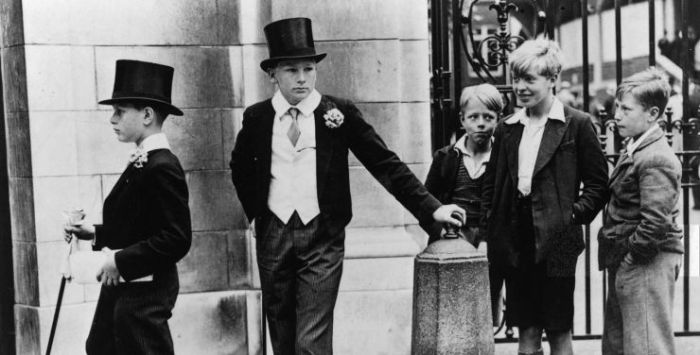
toffsandtoughs_cropped.jpg

This photo is titled “Toffs and Toughs,” taken by photographer Jimmy Sime in London in 1937, and it shows two English public (private for Americans) schoolboys waiting for their parents to come pick them up. The photo has two stories, the actual story, and the one built around it by malcontents. The day after Sime took the photo, the leftist and class-warfare fomenting News Chronicle, which later merged into the modern tabloid Daily Mail, published it underneath the headline “Every Picture Tells A Story,” but then declined to clarify the photo at all, beyond misidentifying the two boys in morning dress as Etonians attending the Eton-Harrow cricket match. Almost simultaneously, American Life magazine picked up the photo and published it with further misidentifications and lack of clarification. The message was clear: the elites ignore or turn their back on the underprivileged and working-class.

The real story of the two “elite princelings” was very different. Both boys, students at Harrow, came from solidly middle-class backgrounds; the only trait that might be interpreted as “elite” about them was that their fathers were Harrovians. The younger boy Peter Wagner (on the far left) came from a family of immigrant tradesmen who had bootstrapped their way up the ladder. By 1937, the Wagners had settled into being a family of scientists and stockbrokers, comfortable, respectable, conventional. Peter served honorably during World War II and then took over his family’s business. The older boy Timmy Dyson (center) came from a professional military family, great of name but lacking means. Born into decidedly ordinary circumstances, he spent his childhood as an army brat. His parents only afforded Harrow because he was an only child. He died suddenly a few months after Sime took the infamous photograph.

Of the three “poor” boys, their realities were also much different from the one implied by the photo. None of them was a street urchin. Since they were playing hooky from school the day of the photo, one can extrapolate that they came from families with sufficient means to keep teenage boys enrolled in school despite living in Depression-era London. The two smaller boys, flanking the tall one, both became successful businessmen, while the taller boy became a civil servant. The three never forgave the media for casting them in the role of impoverished victims, arguing that they all had much richer lives than the photograph showed. Literally richer in the case of the two small boys, who post-War reportedly lived at a level of luxury unknown to “elite” Timmy Dyson.

“Toffs and Toughs” is an interesting study of imagery and the myths and perceptions that it can create and perpetuate. It is not an accident that Ruth Davidson, when discussing the modern young person’s alienation from capitalism, wrote, “all the while watching Rich Kids of Instagram on Channel 4 and footballers being bought and sold for more than the entire economy of a third world nation on Sky Sports News.” These are highly visual media which are also highly ersatz, shaped into the appearance of a cohesive whole through skillful editing.

Sports stars (and musicians, dancers, and artists) are terrible for comparison because becoming one requires herculean efforts and hours of practice. An extension of the 10,000-hour rule is: if someone isn’t willing to put in 10,000 hours to master a skill, he has no right to engage in envious nattering. Rich Kids of Instagram is a British reality TV show that spun off of an eponymous Tumblr thread wherein the purported Instagram photos of the superrich are collected. If one examines the pictures with a critical eye, it becomes apparent that the majority are staged – anyone standing on a pier can take a selfie with a docked yacht; it doesn’t mean that he owns the boat.

In the fourth episode, “From Cradle to Grave,” of Milton Friedman’s Free to Choose, 1980 original, at 32:27, Helen Bohen O’Brian, then Secretary of Welfare for Pennsylvania, astutely observed that people estimated their quality of life based on the people around them. What visual media has done is to bring people like the exhibitionists of Rich Kids of Instagram into people’s lives and present them as if they are in some manner the viewer’s peers. It is as divisive and dishonest as claiming that “Toffs and Toughs” told a “story.” If one considers that Guardian columnist Marina Hyde outed the TV show by revealing that a “rich kid” was not particularly rich, was a former tenant of Hyde’s family, and the place portrayed as the reality starlet’s house was their own property, into which the TV crew had unknowingly broken and entered, the deception is exactly on par with the 1937 one. It is all a pitiful lie, but one which, as Davidson spotted, the vast majority of people see and envy as truth.

In closing, there is one last example to consider. Marc Stuart Dreier, currently in prison for fraud, is an ex-lawyer whose scams were eclipsed only by those of Bernie Madoff. In an interview for the BBC documentary Unraveled, Dreier explained that he wasn’t motivated by greed or desire for the “rich life,” no, he wanted to be someone who socialized with golf and football stars. At the start, he was the embodiment of the American dream – son of an immigrant goes to Yale and Harvard Law – but then he discovered that law was not his métier. He neither enjoyed it, nor was he good at it. Unable to succeed through honest means, he turned to fraud. He wanted to be successful, not for its own sake but for the peer group he hoped to join. The documentary shows repeatedly snippets of Dreier in the guise of lawyer-philanthropist glad-handing footballers and playing with famous golfers, always with cameras there to catch every move. The goal was the visuals, not the reality.

In a battle of the mythic caricatures of Joseph A. Schumpeter, the victim is going to be liberty and responsibility. Today, Schumpeter’s words are truer than ever. Everyone has caricatured everyone else. And at the same time, everyone imagines himself on stage with his peers as the audience. There is no doubt that social media and technology have exacerbated the problem of imagery and the peer – fictional Homer Simpson and his candy mansion and Rich Kids of Instagram – but it is delusional to pretend that it didn’t exist before apps and smart phones. Blaming capitalism for the discontent caused by voyeurism and false expectations is both a logical non sequitur and a very serious peril for liberty. For the sake of preserving freedom, it is important to ask, to demand even, by what metric are the disaffected judging their lives. If it is by the peer, as Bohan O’Brian argued, then it is not a valid metric and should be treated as such.


Rent isn’t a four-letter word

download (3)

Inspired by the publication this week of NYU scholar Alain Bertaud‘s critical new book Order without Design: How Markets Shape Cities (MIT press), Sandy Ikeda‘s pre-book development series Culture of Congestion over at Market Urbanism, and London YIMBY, here is a note on housing reform.

Classical liberals see the economic solution to housing as relatively simple: increase supply to better meet demand. By contrast, the political economy of housing is almost intractably complex. The reason for this is that there are endless externalities associated with new housing: access to light, picturesque landscape, open space and uncongested roads just for starters. These gripes and grievances are the bread and butter of local politics. Unlike consumer product markets, housing cannot be disentangled from these social, political and legal controversies. A successful market-based housing policy must establish institutions that not only encourage housing supply growth but navigate around these problems while doing so.

Policy reform proposals that deliberately favour increasing owner-occupied single-family homes, as tends to be the focus among market liberals in the UK (and to some extent in the US), are currently self-defeating. As justified as they were in the past to achieve a more market-friendly political settlement, they are now a barrier to achieving plentiful, affordable housing. This is because every new homeowner becomes an entrenched interest, a potential opponent to subsequent housing development in their area. They impose more political externalities than renters. I propose we cut the link between support for home ownership and housing supply policies. This would free up policymaking to focus on expanding provision by all available market-compatible means.

This should include greater encouragement of institutional landlords, especially commercial enterprises. Commercial landlords have more incentive and capability to expand supply on estates that they own, while long-term renters (unlike homeowners) have an interest in keeping rental costs low. The lack of private firms dedicated to supplying housing in England compared to much of the rest of the world is startling and yet often overlooked even by friends of free enterprise.

Continue reading

What is ‘Good’? What was Arendt pursuing?

Arendt is not the most consistent or coherent philosopher. Her writings display shades of sentimental as well as stoic rationality. Some might scoff at the progression of her thoughts. But the depth of her emotion is what grants her literature the luminescence that we need in times of moral darkness. The world was left waiting for what could have been a monumental work on political judgement when Arendt passed on before getting a chance to complete the final segment of The Life of Mind. The piece entitled ‘Judgement’ was left with an epigraph:

Victrix causa deis placuit, sed victa Catoni.

Taken from Lucan’s Pharsalia, it translates to ‘the victorious cause pleased the gods, but the defeated one pleases Cato.’ It refers to the Roman philosopher and thinker Cato’s life and beliefs. He chose to commit suicide rather than give in to the faction he thought was ‘wrong’. Thus, what is ‘good’ would remain good even if it is defeated a hundred times. His stoicism and moral stubbornness is perhaps what Arendt wanted us to inculcate as a way of moral disciplining of the mind. But also of relevance is the presumption that there is, in fact, something good that is universal and not subject to fluctuations of regions, religion, class or caste. It is like music? Only humans have the capacity to perceive beats, melody, pitch and a number of other variables that combine to make music as we know it. Irrespective of how isolated or engaged our culture might have been with a globalized world, we carry within us the ability to differentiate good music from bad. What differs is our perception of what is happy from sad. A Balinese music for cremation might sound quite happy and serene to the uninitiated. Similarly, perhaps we possess the capacity to ascertain the ‘good’ pursuits from the bad. While culture, upbringing and circumstances of nature might affect the way we perceive the degree to which we are obligated to act upon the thus discovered moral, no (non-sociopathic) human can deny the existence of the goodness of the moral once confronted with it.

I remember asking my professor once about what he thought was that one universal value in constitutions around the world that need protection from majoritarian attempts at amendment. He answered, without blinking, equality. I knew there was something within the wide array of norms that we associate with equality that I know is a good that commands universality. However, there was enough in the substantive affirmations of equality that had room for reasonable disagreement such that as an unbiased spectator I would not be able to dismiss one side over the other. Perhaps the universal principle requires a Humean recognition or a Kantian deliberation. Either way, that it exists and is worth pursuing is an unquestionable precursor to an Arendtian enquiry into the state of things.

There are some hints as to what she might have thought definitely existed within the set (and let us treat it as a set of values/ideals/principles for nothing if not humility about the extent of our understanding and knowledge) of what is ‘good’. Political freedom features quite prominently into her thought. The freedom to participate in public affairs as equals seems to have a place of prominence for Arendt. Not so much the concept of equality extended to realms outside the political. We are not born equal and cannot and should not try to find a natural occurrence of equality for that would require an unjust comparison of the distinctions and characteristics that distinguish individuals. The last blog post talked about Arendt’s insistence on separating the political from social and personal realms. While identity politics is often engaged to make a case for equality, and Arendt had nothing against the ideal of equality, she believed that it is in the political realm that we needed to affirm the ideal of equality most vehemently and zealously. This is because it affects directly our participation in the political which in turn affects everything about our existence in the world.

A better way to read Arendt is to go meta-psychological on her. Perhaps one of the ‘good’  values within the set is a form of communicative rationality, the desire and pursuance of a method of thinking representatively. And perhaps, just as liberation is a necessary precursor to freedom, so is the engagement of Arendtian judgment to finding that which is ‘good’.

Afternoon Tea: “Confucian Constitutionalism in Imperial Vietnam”

The phantasm of “Oriental despotism” dominating our conventional views of East Asian imperial government has been recently challenged by the scholarship of “Confucian constitutionalism.” To contribute to our full discovery of the manifestations of Confucian constitutionalism in diverse Confucian areas, this paper considers the case of imperial Vietnam with a focus on the early Nguyễn dynasty. The investigation reveals numerous constitutional norms as the embodiment of the Confucian li used to restrain the royal authority, namely the models of ancient kings, the political norms in the Confucian classics, the ancestral precedents, and the institutions of the precedent dynasties. In addition, the paper discovers structuralized forums enabling the scholar-officials to use the norms to limit the royal power, including the royal examination system, the deliberative institutions, the educative institution, the remonstrative institution, and the historical institution. In practical dimension, the paper demonstrates the limitations of these norms and institutions in controlling the ruler due to the lack of necessary institutional independence. At the same time, it also suggests that the relative effectiveness of these norms and institutions could be achieved thanks to the power of tradition. The study finally points out several implications. First, the availability of the constitutional norms and institutions in the tradition is the cultural foundation for the promotion of modern constitutionalism in the present-day Vietnam. Second, the factual material concerning the Vietnamese experiences can hopefully be used for further study of the practice of Confucian constitutionalism in East Asia and further revision of the “Oriental despotism” - based understanding of imperial polity in the region. Third, the findings may also be useful for a more general reflection on pre-modern constitutionalism.

That is from Son Ngoc Bui, a legal scholar at the Chinese University of Hong Kong’s law school. Here is a link.

Populism versus Constitutional Democracy

What is the difference between a conservative and a reactionary? A conservative knows when she has lost.

A conservative respects the status quo for the sake of stability. The reactionary rebels against it. Unfortunately, it is the reactionary impulse within Brexit that now threatens to hem in the liberties of British citizens, and threaten the rights of foreign residents, for a long time to come. A looser but productive relationship that Britain could have had with the European Union was lost, first at Maastricht in 1992, then again at Lisbon in 2007. A conservative recognizes this loss and adapts her politics to the new landscape. The reactionary tries to reconstruct those lost pasts in vain as the chaotic debates in Britain and the increasingly disappointing outcome illustrates.

Does this mean that referendums are bad? Do they only embolden radicals and reactionaries? It depends. If referendums are used to rubberstamp the decisions of a party in power, or as a way of deferring political judgement, then they are useless at best, dangerous at worst. By contrast, if they are part of the fabric of a democracy, and act as a real veto on constitutional change, rather than a populist rallying point, then they can be enormously valuable. They act as an additional check on the political establishment that might be irrationally fixated on some new governance structure. It ensures that every major change carries with it some level of majority support.

Ten years ago, I wrote a monograph Total Recall: How direct democracy can improve Britain. I advocated supplementing representative democracy with a norm or statutory requirement for referendums on constitutional issues and new local initiative powers. I focused on direct democracy in US states that mean that US state elections often involve both voting for representatives and on propositions. Referendums are required for state constitutional changes. In some states, citizens can initiate new legislation through propositions.

There are parallel constitutional requirements in force in parts of Europe, particularly in Switzerland, Norway and Ireland. It is hardly a coincidence that direct democratic mechanisms have slowed down European integration wherever they have had statutory rather than merely advisory force. Ireland had to go to the polls several times to get the ‘right’ answer but at least this meant that a majority of Irish eventually accepted the new EU arrangements. By contrast, Switzerland and Norway, against the wishes of their political establishments, took European integration only so far before settling with generous trade relations and much more limited political integration. The cost-benefit calculus of their arrangements are up for debate, but few would deny their legitimacy. Britain’s future position, by contrast, may turn out to look much worse and all because its people never had the chance to say ‘no’ until long after the facts on the ground changed.

It’s the ability to say ‘no’ that’s important, with the implication that the status quo must still be a viable option. A people cannot be legislators. Mass votes can’t add up to complex judgements to inform actionable law. Hence the Brexit referendum for leaving the EU for an unknown alternative was bound to lead to chaos which, in the long run, may undermine the legitimacy of representative government, let alone popular democracy, rather than strengthen it. There is no status quo ante to return to.

At the time I was writing Total Recall, the spirits of referendums never voted on haunted British politics. Referendums were promised on adopting the Euro and the European Constitution. Both were abandoned when the Government realized they would almost certainly lose. So we stayed out of the Euro but signed what became the Lisbon Treaty. This turned out to be a deadly combination that eventually led to Brexit. The Euro is quite badly managed as an economic scheme. As a political mechanism, however, it binds members of the Euro much closer together. Leaving the European Union, as Britain is doing, is perilous and costly. Leaving the Eurozone would be even more difficult as it would involve establishing a new currency from scratch. If New Labour had been serious about putting Britain in a federal united states of Europe, it should have gone all in with the Euro from the beginning.

So Brexit could have been avoided but not by ignoring majority sentiments. If British referendums were constitutionally mandated rather than the random outcome of internal (in this case, Conservative) party politics; if referendums were required to change the status quo rather than a mechanism for a belligerent minority to relitigate past losses, then, like Switzerland and Norway, we would be in a much better position now.

Will our political leaders learn this lesson for the future? That I doubt.

Afternoon Tea: “Dividing Power in the First and Second British Empires: Revisiting Durham’s Imperial Constitution”

In his Report on the Affairs of British North America, Lord Durham proposed that “internal” government be placed in the hands of the colonists themselves and that a short list of subjects be reserved for Imperial control. Janet Ajzenstat maintains that Durham did not intend to formally restrict the authority of the new colonial legislature by dividing power. This paper argues otherwise: that Durham’s recommendation fell squarely within a tradition of distinguishing between the internal and external affairs of the colony. This was the imprecise but pragmatic distinction that American colonists invoked during the Stamp Act crisis as a means of curtailing imperial authority over internal taxation while maintaining their allegiance to the British Crown. It also was a division that Charles Buller relied upon in a constitution for New South Wales that he proposed prior to sailing to Canada as Durham’s principal secretary. Durham likely was drawing upon this tradition when he made his recommendation, a distinction that began to crumble away almost immediately. In the result, Canadians inherited a robust semblance of self-government, just as colonists during the Stamp Act crisis had desired, but without the need for revolution.

This is from David Schneiderman, a law professor at the University of Toronto. Here is the link.

The Shelf Life of the Self: Arendt on Identity Politics

Demands for separating one’s public and private identities are neither new nor simple. As the argument goes, many a political philosopher have claimed that to engage in worthwhile and productive politics, we must shed our private identities to better see, so to speak, the concerns that need a more universal outlook. Thus, to better communicate and deliberate upon political questions within a polity, say a nation, the citizens need to view themselves as citizens alone sans any group affiliation based on gender, religion, race and caste. This is not to snub the importance of social identities in general but only in so far as they affect our political judgement. On the other hand, the response to such a proposal has predictably highlighted the benefits, both political and moral, that one’s private identity has on their political participation. After all, the walls between the identities are not quite as impervious to each other as the philosophers are making it to be. Our individual selves are more than just a simple addition of our social, cultural and personal experiences. How we think about political dilemmas is often and quite rightly influenced by what we anticipate from a rival social group. A female advocating the freedom to make reproductive choices is not just assessing the positions of the stakeholders involved, as Arendt’s call for ‘enlarged mentality’ would require of her. The said female also has to keep in mind the gender hierarchies at play around her.

Arendt was famously non-feminist. She believed that the transposition of the private and the social identities into our political identities can destroy the very fabric of political communication and thus, political judgement. To resolve political dilemmas facing our society, Arendt believed we needed the exact opposite of what identity politics has to offer. Our private and social selves come with a shelf life. They end where the political begins. According to Arendt, the politicization of personal and social identities brings to the fore a self-defined and accepted discrimination that takes us away from the equality that politics demands of us. To think representatively, we need to not only be treated as but also feel like political equals.

While identity politics does well to highlight a history of suppression, it also contributes to a further strengthening of political cleavages that prevent us from ever going back to the ideal state that was disturbed by the suppression. Identity politics causes harm to inter-sectionalities because it forces us to choose between conflicting identities. But more importantly, it conflates the many dimensions of our self with the identity that we have thus chosen to speak through, politically. This conflation results in a demonization of everything that does not conform to our sense of identity, resulting in a fear of the unknown (of which Martha Nussbaum has talked about in the Monarchy of Fear). In the creation of this battleground, we forget that the other side is human. Just like us. And it is easy to not think about our moral obligations to each other when the enemy has been dehumanized and reduced to a label.

Arendt on identity politics deserves much greater scrutiny. Especially because of the overwhelming reliance of social cleavages but current political leaders. The era of identity politics has given us a society with walls that mask themselves as political ideologies but are nothing more than a refusal to recognize that the other side is human too. An essential step in Arendtian judgement is to accept the inherent and equal worth of each individual, irrespective of their social identity. We would do well to find common grounds in our humanity, first.

Used in classrooms, abused in chatrooms

My God, it’s the end of November. This blog was founded at the beginning of January in 2012. When I started this consortium I just wanted to band together libertarians who already blogged but who didn’t have a large following. I thought that maybe if I could band them together something would come about. I also thought that the San Francisco Bay Area had plenty of smaller voices in the libertarian movement, so I tried to invite people from that part of the world, in the hopes that NOL could be some kind of counterweight to Mises down south and Mercatus back east.

Both efforts obviously failed spectacularly, which is not necessarily a bad thing.

Today, NOL is used in classrooms and abused in chatrooms.

I have been reading much more than writing lately. I have one child running around the flat and another on the way (due date is Jan 14th!). I have been making a rather rough sociocultural transition from city life to suburban/rural life. My wife is working towards her CPA license. I’m working a shitty job, writing for RealClearHistory, blogging here, and shoring up future articles for future academic publication. Some people are ready to write me off as a scholar, but that is foolish of them.

I’ve got something up my sleeve for NOL in 2019, too, but I’m keeping it close to my chest for now. It’s nothing crazy, so don’t go anywhere. Just know that NOL is committed to experimentation and evolution as much as it is to human freedom.

NOL’s newest feature: the Longform Essays

I want to quickly direct your attention to NOL‘s newest feature, the Longform Essays. In them you will find all of the n-part series that the Notewriters have done over the years, but they’ve been put together (by yours truly) into one long essay, for your convenience.

It’s still a work in progress. Jacques’ essays are done. Mary’s four-part essay on The State and education is finished, too. I am slowly, but surely, working on Barry’s and Rick’s essays.

Enjoy!

Eye Candy: the five largest cities in each American state, as constellations

Yup, you read that correctly. Behold:

NOL map 50 states constellations
Click here to zoom

Legal Immigration Into the United States (Part 16): Toward a One-Party System?

There exists a prospect that continued immigration of the same form as today’s immigration could provide the Democratic Party with an eternal national majority. The US could thus become a de facto one-party state from the simple interplay of demographic forces, including immigration. There are three potential solutions to this problem, the first of which is seldom publicly discussed, for some reason. As the European Union has been showing for thirty years or so, residence in a particular country should not necessarily imply citizenship, the exercise of political rights, in the same country. Ten of thousands of Germans live permanently in France and in Spain. They vote in Germany. (In July 2018, a German woman, thus a citizen of the European Union, who had lived and worked in France for 25 years, and with a French citizen son, was denied French citizenship!) This arrangement, separating residency from citizenship, seems to pose no obvious problem in Europe. (Nikiforov and I discussed this solution in our article in the Independent Review.)

Curiously, in the current narrative, there are no loud GOP voices proposing a compromise with respect to some categories of illegal aliens, I mean, legalization without a path to citizenship. This is puzzling because this is precisely what many illegal aliens says they aspire to. Latin Americans and especially Mexicans frequently say they want to work in the US but would prefer to raise their children back home. (See, for example the good descriptive narrative by Grant Wishard, “A Border Ballad” in the Weekly Standard, 3/9/18.) The simple proposition that easy admission could go with no path to citizenship has the potential to transform immigration to the US, to dry up its illegal branch, and to facilitate border control to a great extent. Yet, there is no apparent attempt to wean immigrants away in this fashion from their Democrat sponsors. The GOP does not seem to have enough initiative to try to reach agreement with immigrant organizations on this basis thus by-passing the Democratic Party. Again, the silence concerning this strategy is puzzling.

In early 2018, President Trump seems to be seeking an answer to the problem of a permanent Democratic takeover by combining the two next solutions. First, would come a reduction in the absolute number allowed to immigrate. Fewer immigrants, fewer Demo voters, obviously. Small government conservatives like me, and rational libertarians also, might simply want to favor reduced immigration as the only sure way to avoid a one-party system even as we believe in the economic and other virtues of immigration.

The second conceptual solution consists in the broad adoption of so-called “merit-based” immigration. There is an unspoken assumption that a merit-based system would produce more middle-class immigrants and, therefore more conservatively oriented immigrants. This assumption is shaky at best. The example of  much of the current high-tech Indian immigrants  is not encouraging in this respect. More generally, immigrants with college degrees, for example, might turn out more solidly on the left than the current rural, semi-literates from underdeveloped countries who are also avid for upward mobility. The latter also frequently are religious, a condition the Democratic Party is increasingly apt to persecute, at least implicitly. At any rate, reducing the absolute size of immigration carries costs described throughout this essay and merit-based immigration is no panacea, as explained below. I fear that some significant trade-offs between political and other concerns are going to be implemented without real discussion.

[Editor’s note: in case you missed it, here is Part 15]