Climate crisis or censorship crisis?

Yesterday, the Chair of the U.S. House Select Committee on the Climate Crisis wrote an ominous letter to the CEO of Google. For the second time, the Chair is leaning on Google to police and remove “dangerous climate misinformation” on YouTube. The letter doesn’t threaten direct legal action against Google, but it nonetheless raises serious concern because it runs so counter to the free speech tradition and the value of a robust internet.

According to the Chair, “YouTube has been driving millions of viewers to climate misinformation videos every day, a shocking revelation that runs contrary to Google’s important missions of fighting misinformation and promoting climate action.” The Chair states her own unequivocal commitment to “promoting ambitious federal policy that will … eliminate barriers to action, including those as pervasive and harmful as climate denial and climate misinformation.” It’s hard not to see the veiled threat here.

Note the letter’s subtle casting of the consumers of information as passive actors that must be protected, rather than rational actors who choose what information to consume, a choice they’re entitled to make. She says “YouTube has been driving millions of viewers to climate misinformation” and that Google should “correct the record for millions of users who have been exposed to climate misinformation.” This language strips accountability and action from the viewers, as if they are a captive audience held down and forced to view climate denial videos with eyelid clamps like a scene from A Clockwork Orange. But if that content is promoted and viewed, that’s because there’s a consumer demand for it. The passive language used in the letter exemplifies the paternalism that often lurks behind censorship: for their own welfare, we must protect the public from information they wish to consume.

Note also the absolutism woven into the letter. Google cannot both be committed to climate action and committed to an open culture of public discourse. In the war for humanity’s survival, one priority must dominate above all others.

The letter also relies on the tired tactic of impugning speakers’ motives. Anyone who expresses “climate misinformation” on YouTube just wants “to protect polluters and their profits at the expense of the American people.” It’s impossible for an absolutist to consider that views opposed to her own might be sincerely held. Plus, research has shown that political views frequently do not line up with individual self-interest. Only a shallow thinker or someone with an agenda assumes a political viewpoint is rooted in a selfish motive.

As for the constitutional implications of the letter, there is no question that the federal government cannot impose on Google the duty to remove “climate misinformation” or “climate denial” content. False speech is not exiled from the sanctuary of First Amendment protection. Of course, some false speech can be penalized, such as libel, slander, or fraud. But these are circumstances where there’s some other legally cognizable harm associated with the false statement for which recovery is warranted. There is no general rule that false speech is unprotected.

Government should never be in the position of arbitrating truth. Particularly in the context of hotly debated political controversies, allowing government to label one side as gospel and penalize dissidents opens the door to legally enshrined orthodoxy. As Justice Robert Jackson said 80 years ago: “If there is any fixed star in our constitutional constellation, it is that no official, high or petty, can prescribe what shall be orthodox in politics, nationalism, religion, or other matters of opinion or force citizens to confess by word or act their faith therein.” That’s what the power to ban “climate misinformation” entails.

Indeed, government refereeing of truth will almost always shade toward discrimination against disfavored viewpoints. For example, there is “misinformation” out there on both sides of the climate debate. Those who peddle wild doomsday predictions are just as unhinged as those denying the realities of climate change. Yet the Chair does not propose to censor such misinformation.

When I see such zealous effort to shut someone up, I can’t help but ask myself why the censor is so afraid. The targeting of this speech is likely only draw attention to it. Why worry about the hacks? I’ve always believed what John Milton expressed centuries ago in the Areopagitica: “Let [Truth] and Falsehood grapple; who ever knew Truth put to the worse in a free and open encounter?” Of course, that doesn’t mean that falsehoods lack convincing power, but truth in the end has the edge. Rather than pick the winner in advance, we do much better by letting truth emerge through open debate, bloodied but victorious.


Chinese government idolatry in a time of the coronavirus

I just found this video about some people’s initial responses to the coronavirus in China. The idolatry for the Chinese government, within China, is very remarkable: “Not afraid! We have our government, government can protect us!”

Protecting your privacy: asymmetric cryptography (part 2)

This is the second of four posts in which I discuss cryptography. If you read all four posts, you will understand the differences between symmetric and asymmetric cryptography, why the US government were against the spread of modern cryptography, how it has resulted in the first crypto war between code rebels (techno-libertarians) and the US government, and how you can easily protect your privacy using Pretty Good Privacy (PGP).

The topics of the four posts are:

  1. What is symmetric cryptography;
  2. What is asymmetric (public key) cryptography;
  3. The first crypto war between code rebels and the government;
  4. How to easily use PGP to protect your e-mail communication.

What is asymmetric (public key) cryptography

In my previous post, I mentioned four disadvantages of symmetric cryptography. These disadvantages are:

  1. The secret key must be shared between sender and receiver, before messages can be exchanged safely, preferably over a secure channel.
  2. The secret key is in two separate places.
  3. The sender of the message must trust the receiver that he will not steal or copy the secret key.
  4. It is not scalable for, for example, e-commerce.

Soon after the publication of the Data Encryption Standard (DES), asymmetric (public key) cryptography was invented by the Stanford graduate student, Whitfield Diffie, and Stanford Professor, Martin Hellman. This was a huge revolution within cryptographic research, because up until then it was thought that there should always be a shared secret key for the communication between the sender and receiver. The main question that Diffie and Hellman were trying to solve was: how can you create secure communication over a unsecure channel, when two corresponding people have never had contact with one another and therefore have not yet been able to share secret keys with each other.

The solution, public key cryptography, was introduced by Diffie and Hellman in their paper, ‘New Directions in Cryptography’ (1976). It inspired more cryptographic research outside the circles of secret agencies. Soon after the first publication on public key cryptography, three young Professors at MIT, Ron Rivest, Adi Shamir and Leonard Adleman, developed the now famous RSA public key cryptosystem in 1977.

Merkle Diffie Hellman
Ralph Merkle, Martin Hellman, and Whitfield Diffie. Merkle is known for his invention of Merkle trees, which is a tree-like structure of cryptographic hashes that organizes for example Bitcoin transactions. The public key cryptosystem, as published in ‘New Directions in Cryptography’, is mostly known as the Diffie-Hellman key exchange. Hellman, however, recognizes the contributions of Merkle for the Diffie-Hellman key exchange.
RSA
Adi Shamir, Ron Rivest, and Len Adleman. Inventors of the RSA cryptosystem.

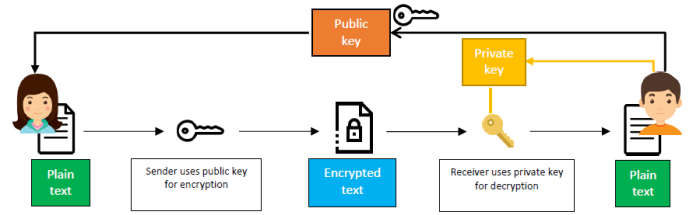
Public key cryptography works as follows. There are two separate keys that correspond mathematically with one another: the public key and the private key. The public key is used to encrypt a message, and can be shared to other people. The private key is used to decrypt a message, and should be kept secret. Public key cryptography is hence a two way function. Just by knowing someone’s public key, it’s not possible to find out the person’s private key.

In our below example,

  1. Alice would like to send a secret love message to Bob.
  2. Bob has a corresponding public an private key, and sends the public key over a unsecure channel to Alice.
  3. Alice uses Bob’s public key to encrypt her secret love message.
  4. Alice sends the secret love message to Bob.
  5. Bob uses the corresponding private key to decrypt the message and finds out that Alice loves him.
Public Key cryptography
Alice and Bob use public key cryptography to exchange secret messages.

Doing so, you can have private correspondence over an unsecure channel. Actually, we’re using public key cryptography all the time. Whenever you see a green padlock in front of the URL bar, it means that the data you enter on the website is first encrypted before it’s sent out.

Digital Signatures

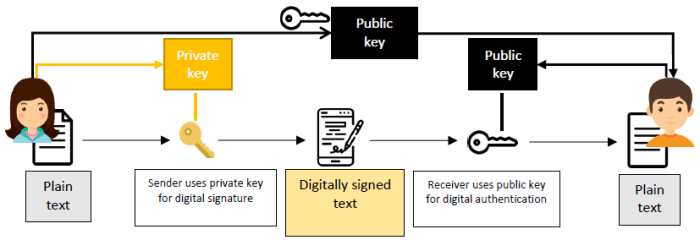
Public key cryptography is not only used for the encryption and decryption of messages, but also for message authentication. If Alice would not have encrypted her message with Bob’s public key, but with her own private key, then the encrypted message can be decrypted with her public key. If you receive a message of John Locke and you’d like to know whether it’s really sent out by Locke, then you could look up his public key and use it to decrypt his message. If the result is plaintext, and assuming that Locke is the only person in the world who possesses the only private key that can produce the encrypted message, you can be sure that the message was sent by Locke. In other words: applying a private key to a message is the equivalent to putting a digital signature.

Digital Signatures
Alice puts a digital signature on her message, and Bob digitally verifies that the message is truly coming from Alice. This is an easy way of using digital signatures. In reality, a text is hashed first with a hash algorithm, before it is encrypted with the private key. Bob then uses Alice’s public key to decrypt the message to retrieve the hash, and compares the resulting hash with the original hash of Alice’s message.

Digital signatures are particularly important, because they provide the following security aspects:

  1. Authentication: it offers proof that the message comes from the right person.
  2. Non-repudiation: we cannot deny that the signee has sent it.
  3. Data integrity: the message cannot be altered after it has been signed.

Diffie and Hellman saw great potential for public key cryptography in the coming digital age. The US secret intelligence, however, were not happy with this development in cryptography and tried to prevent public use of this new cryptosystem. The standoff between privacy advocates of whom many were cryptographers and the US government is known as the first crypto war.

In part three of this series, we will discuss the crypto war. Eventually, at the end of the post series, you will be able to encrypt your e-mails using public key cryptography.

Computational Economics is the Right Perspective

Here’s a vastly oversimplified picture of mainstream economics: We pick some phenomenon, assume all the context into the background, then build a model that isolates only the variables specifically relevant to that phenomenon.

Once you’ve simplified the problem that way, you can usually build a formal mathematical model, make a few more (hopefully) reasonable enough assumptions, and make some strong ceteris paribus claims about your chosen phenomena.

That’s a reasonable enough approach, but it doesn’t shed much light on big picture issues. I’m interested in root causes, and this “reduce things to their component parts” approach doesn’t give enough of a big picture to find those roots.

How do we broaden our perspective? One approach is to return to the more “literary” approach of the pre-Samuelson days. A bit of philosophy of science has me convinced that the primary flaw of such an approach is rhetorical. Written and mathematical arguments leave some assumptions in the background, but the latter is more convincing to a generation of economists trained to be distrustful of natural language (and too trusting of algebra).

As a pluralist, I think we should use as many approaches as we can. Different schools of thoughts allow you to build different imaginary worlds in your mind. But the computational approach isn’t getting enough play. I’d go so far as saying agent based modeling is the right form of mathematics for social science.

What does this mean? In a nutshell, it means modelling processes, simulating those processes, and seeing how interactions between different agents leads to different sorts of outcomes.

A common trope among Emergent Order folks is how ants are individually stupid but collectively brilliant. Neoclassical economics runs into the opposite problem: individually brilliant individuals who get trapped in Prisoners’ Dilemmas.

Computational economics starts with models that are more like ants than homo economicus. Agents are essentially bundles of heuristics/strategies in an out-of-equilibrium world. But these competing (and cooperating) strategies can interact in interesting ways. Each agent is a part of all the other agents’ environment, so the mix of strategies is a function of the success of the strategies which is a function of the mix of strategies in the environment.

In essence, computational economics starts from what the mainline economists have long recognized: human society is a complex, interwoven, recursive process. The world is, essentially, a sort of meta computer with a complex web of programs interacting and evolving. We don’t need to assume in any sort deus ex machina (that’s a bit of an overstatement, but we haven’t got time to explore it this week), we just need replicating entities that can change over time.

Such a view, to my mind, provides an end run around rationality assumptions that can explain the brilliance of entrepreneurship (without making heroes out of the merely lucky) as well as the folly unearthed by Behavioralist economics (without the smugness). We’ve always known it. It’s all just evolution. But the methodology hasn’t made its way into the main stream of economics. If there are any undergrads reading this on their way to a PhD program, let me know in the comments so I can point you in some interesting directions!

Supreme Court hears vital freedom-of-religion case

Today, the Supreme Court heard  the most important case on the intersection of religion and education to arise in decades–Espinoza v. Montana Department of Revenue. A few years back, Montana had passed its first school-choice program, a tax-credit scheme that allowed a small tax credit for donations to scholarship programs that helped kids afford private school.

As in any state, many of Montana’s private schools are religious. Right after the state legislature passed the tax-credit statute, the Montana Department of Revenue promulgated a rule that immediately gutted the program by forbidding students attending religious schools from receiving scholarship money.

The Department based its rule on Montana’s Constitution, which says the legislature can’t “make any direct or indirect appropriation or payment from any public fund or monies . . . for any sectarian purpose or to aid any church, school,” etc. Plenty of states have very similar “no-aid” clauses. Revenue claimed that scholarships for religious students under the tax-credit scheme violated the “no-aid” clause.

It’s worth taking a moment to consider how bizarre this argument is. These scholarships are funded by private donations–the money never enters a public coffer. Yet Revenue thinks such donations would constitute state aid to religion because the donor gets a tiny tax credit (up to $150) for the donation. Underlying this argument is the strange notion that any money the government declines to collect from you is still the government’s money.  This would mean, for instance, that every charitable donation eligible for a tax deduction would likewise constitute a government appropriation. Revenue’s argument has always looked to me like an extremely weak pretext for blatant discrimination against religious students.

So Kendra Espinoza and a few other parents with kids at religious schools sued the Department of Revenue, claiming, among other things, that Revenue’s rule violated their free exercise of religion under the First Amendment. Kendra won at trial, and then lost spectacularly at the Montana Supreme Court. In fact, the Montana Supreme Court did something even worse than the Department of Revenue–it invalidated the entire tax-credit program, such that even students at secular private schools could no longer receive scholarship assistance.

Thankfully, the Supreme Court took up the case, and they heard oral argument today. (My colleagues and I filed an amicus brief with the Court in support of Kendra).

The oral argument transcript shows a Court divided along the typical ideological lines. The liberal justices seemed preoccupied with standing–whether the petitioners had the right to sue. One justice implied that only taxpayers (who have a financial interest because of the tax credit) and schools (who receive the scholarship money) should have the right to sue. This is a weird take, given that families and students are obviously the intended beneficiaries of the scholarship program.

A number of the justices discussed a odd quirk about the Montana Supreme Court’s decision. The basic question they raised is this: since the Montana Supreme Court took the scholarship program away from everyone, are petitioners now being treated equally? But the sole reason the Montana Supreme Court struck down the program was to prevent religious students from receiving scholarship. A government action taken for a discriminatory reason is, well, discriminatory. If the legislature had excluded religious students when it enacted the program, the program would still stand. And if the legislature tried to enact the same program, providing equal treatment to religious and secular students alike, the Court would strike it down. That’s discrimination based on religious status–pretty straightforward.

One justice cited to James Madison’s famous Memorial and Remonstrance Against Religious Assessments, arguing that the founders wouldn’t have wanted public funds flowing to religious schools like this (again no public funds were flowing to Montana religious schools under this program, but why let accuracy get in the way of a good narrative). That’s a terrible misreading of Madison. The Memorial and Remonstrance was an attack on preferential aid to religion, not to a program that provided public benefits to all groups, including religious ones. The difference is vital. Can the government deny churches police protection, fire protection, sewer connections, electrical service, or any other public benefit on the grounds that the government would be providing indirect public funding to religious institutions? Surely not. In fact, that’s exactly what the Supreme Court said in a recent case called Trinity Lutheran, where Missouri denied a church daycare access to a government program that helped renovate playgrounds.

There is a difference between Trinity Lutheran and this case, arguably, which is that here the money goes more directly to religious indoctrination, not something secular like playground materials. But at bottom, public funding is fungible. Providing police protection and other general public benefits obviously makes it easier for a religious institution to fulfill its religious mission.

This case should be an easy one. The government offered a benefit to all private schools. To include religious schools doesn’t “establish” religion. It just treats religious groups equally, as the Constitution requires.

The veil of nostalgia

In article for Worth, titled “A new wealth gap is growing – attention inequality,” authors Joon Yun and Eric Yun of the Yun Family Foundation, an institute dedicated to “transforming the way people think,” argued that “attention inequality” is having a destructive force on society and expressed nostalgia for the days of “monoculture.” They defined this idyllic time as one where all attention was focused on one or two people or groups, e.g. the Beatles, and on no one else. The idea expressed by the Yuns is that the new internet world where everyone may take his best shot at fame is unfair, and a veil that should not have been lifted has been removed. In the meantime, everyone, described as “the heart-broken masses,” wanders through the selection at will, as customers as well as fame-seekers. The Yuns’ complaint is very similar to a running theme in the works of Michel Houellebecq: the free market of choice has created winners and losers and in doing so has destroyed the dreams and self-respect of the last group.

Perhaps the question is whether existing in a world of dreams, one in which a person could feel good about himself using the “might have been” fantasy, is an acceptable burden to thrust upon society. After all, in his short story “The secret life of Walter Mitty [which the Ben Stiller film butchered],” satirist James Thurber’s point was that living in dreams replaces action, allowing people to imagine themselves as people filled with unrecognized abilities. Even Thurber’s picture of the type for whom such an existence is necessary was probably accurate: a passive middle-aged man who had missed opportunities in his youth (implied WWII vet, so both chances to be a military hero and cash in benefits to start a business, further education, etc.) and resents his wife as the cause and the personification of the mediocrity of his existence.

But are we better off with the veil of mediocre monoculture lifted? Is the fact that revelation may not be pleasant for those who discover that they are unappealing to the modern market really a justifiable cause for concern? Is the old world of “monoculture” really something to look back upon with nostalgia?

My former composition and counterpoint teacher was also a concert pianist, who trained at The Juilliard School. While still a student my teacher was signed by a major record label. One of the tidbits I learned from him was that back in “those days (mid-20th century)” practically the only way a young (classical) artist had of obtaining notice was to be at an elite conservatory since that is where the scouts went almost exclusively.

The MO for finding the “latest new thing” made perfect sense for the time period. There was (and still is) a tremendous amount of investment on the part of the label that went into publicity for and grooming of a young artist. Further, in my teacher’s case, the label handled studio and recording expenses, created and booked concert tours, and handled venue costs. The artist did not have to repay the funding; however, total expenses would be deducted from any royalties should he/she become successful. The investment risk meant that going to places where the already-succeeding were clustered was the safest bet for the big labels. There was very little room in the equation for a person who was not already positioned to join the upper professional echelons, or someone who had no insider access.

Was a situation where the major labels acted as gatekeepers and only considered people who fit a certain profile really better than the current one where the internet and digital tools allow artists to perform directly to the audience? The nostalgia for a time of “monoculture” speaks to a yearning for a closed, stratified world. The world where my teacher grew up and worked was a world in which someone with big dreams could imagine himself as simply undiscovered, an unrecognized talent whose gifts would never benefit society. There is some security, a perverse comfort, in such a dynamic. A person never has to confront the idea that maybe he has no talent, maybe his music is not good enough, maybe what he does is something no one finds interesting, perhaps there is no market for him to fill.

The breakup of the “monoculture” has forced average Joe dreamer to confront these possibilities. Instead of only playing and dreaming in his garage, he can now release his own albums on iTunes and Prime Music, upload videos to YouTube and Daily Motion; he can have his own website and create his own publicity. He can wait to see if his work is accepted and if there is an audience for it. The Yun family has argued that the process of exposure and competition is cruel, that it breaks up human contact, that it consigns the vast majority who desire to be part of the “culture” to being part of the “heartbroken masses.” But the real question is: How is average Joe dreamer any better off under the old system? Isn’t a situation in which he at least has a chance to be seen, to make it big, better than one in which he is simply locked out? 

The Blockchain Basics Book has been published and is available for free

Our Blockchain Basics book (Blockchain Basisboek in Dutch) has just been published on January 17th. You can download it here for free. The book will be used in classrooms across more than 8 local universities in the Netherlands. Hopefully, other universities will follow soon.

In this post, I’d like to discuss why I started the initiative to write the ±550 pages book, and what other project I have in mind to further improve blockchain education in the Netherlands.

Blockchain_Basisboek_voor

The current state of blockchain education in the Netherlands

After two months of teaching blockchain at a local Dutch university, October 2018, I realized that blockchain education in the Netherlands (probably in most parts of the world) is still lacking.

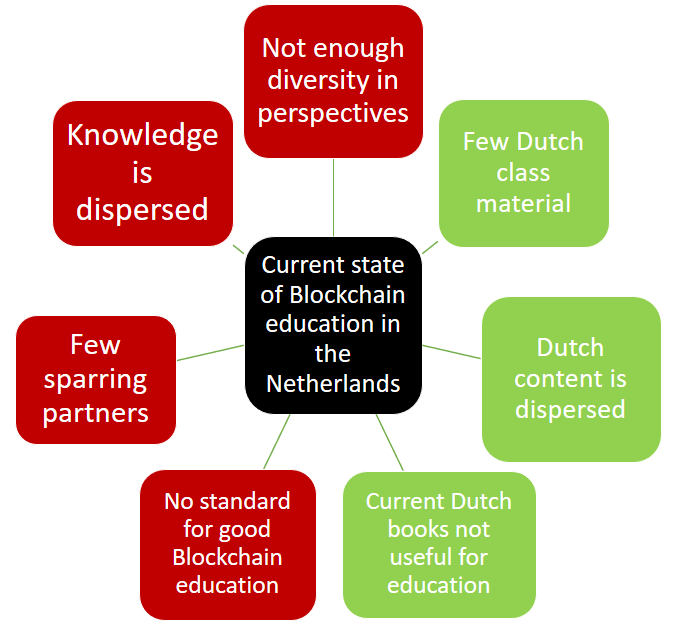
I have identified the following 7 issues with our blockchain education in the Netherlands.

Blockchain education in Netherlands
Issues in the Dutch blockchain education space.

  1. Few Dutch class material. Good blockchain content is mostly written in the English language. My required reading list therefore consists mainly of English material, which proves to be a high barrier for Dutch-speaking students that are not at all familiar with (a) the technology and (b) the technical jargon used in the blockchain space.
  2. Dutch content is dispersed. Good content in Dutch is very dispersed among many different websites.
  3. Current Dutch books are not very useful for educational purposes. The books available on the Dutch market are not comprehensive enough and are not suitable for students.
  4. There is no standard for good blockchain education. Most universities are developing curricula on their own and there’s no standard on what good blockchain education consists of.
  5. Few sparring partners. Most universities don’t share their class materials or experiences teaching blockchain. Fortunately, the Dutch Blockchain Coalition is trying to change this, but we need to put much more effort to do cross-institutional sharing. Many universities also want to develop blockchain education, but lack the expertise. It would be good if these universities jointly develop their blockchain curriculum with other universities and share teachers.
  6. Knowledge is dispersed. Different faculties within a university are developing blockchain education in isolation and have their own blockchain experts who don’t know that some of their colleagues are also working on blockchain. Someone who’s working on the legal side of blockchain may not know that there’s someone at another faculty who is working on the technical or ethical side of blockchain. Bringing knowledge from different people together can lead to interesting and surprising new perspectives.
  7. Not enough diversity in perspectives. Blockchain can be approached from many different perspectives. Most classes only focus on a limited number of perspectives. A business department may heavily focus on blockchain applications and little on the technical side. Not knowing the technical side of blockchain, a business teacher may talk about potential blockchain applications and develop business models that are technically unfeasible.

I wrote the Blockchain Basics book, together with my colleague Arthur Janse, to tackle the first 3 issues (in green).

Main topics of the book

The book comprises three parts:

  1. Part I contains the technical side of blockchain and relevant innovations. Topics that we discuss are Bitcoin, current payment systems, consensus protocols, mining, nodes, forks, cryptography, smart contracts, governance, cryptoeconomics, and self-sovereign identities.
  2. Part II contains the economic and philosophical background of the Bitcoin blockchain. It discusses the different economic schools and in particular how the Austrian School of Economics and libertarianism, crypto-anarchism and cypherpunk have influenced Bitcoin.
  3. Part III contains topics revolving around enterprise blockchain. It discusses decentralized business models and enterprise applications.

What’s next?

While writing the book, I came up with the idea to create an organic community based open access digital knowledge platform that anyone can join for free. I pitched the idea in September 2019 at a Dutch Blockchain Coalition (DBC) event for all universities in the Netherlands. The DBC and other universities responded enthusiastically. Four months later, we have a proposal ready to develop the platform with 6 universities and the DBC.

We would like to use the Blockchain Basics book as the foundation of the platform, and – acknowledging that knowledge is decentralized – give all users the right to add new or revise already existing content. A public reviewing feature and a reputation system will be put in place to make sure that wrong content becomes corrected and to incentivize users to add good content. Students can also submit their Bachelor, Master and PhD dissertations and researchers can submit their papers on the platform. 

I think that the multidisciplinary and cross-institutional cooperation will structurally improve blockchain education in the Netherlands. Doing so, I think we can tackle all the other issues (issues number 4 – 7).

Be Our Guest: “Suing Juul Won’t Solve Anything”

NOL‘s “Be Our Guest” feature is as popular as ever this year. Here’s John Lancaster with the latest:

Peer driven rumors, videos of experimentation, forums, news, and entertainment sources provide nigh infinite opportunities for young ones to pick up on vices. The appeal of vaping would’ve caused widespread exposure through said channels anyway. The most marketing does at that point is convince the willing participants to choose a particular brand rather than take on the act itself.

Juul is a company that sells vapes, which are those cigarette replacements that have been so popular lately. Please, read the rest, and shoot us an email if you want your voice heard!

Nomic-nomics?

Perhaps the coolest thing I’ve found on the Small Internet so far is the game Nomic. From where I found it:

Nomic was invented in 1982 by philosopher Peter Suber. It’s a game that starts with a given set of rules, but the players can change the rules over the course of the game, usually using some form of democratic voting. Some online variants exist, like Agora, which has been running since 1993.

It’s a game that’s about changing the game. Besides offering a tempting recreational opportunity, I think this could be formalized in such a way to make it rival the Prisoners’ Dilemma (PD) in shedding light on the big social scientific questions.

The PD is a simple game with simple assumptions and a variable-sum outcome that lets it work for understanding coordination, competition, and cooperation. One of my favorite bits of social science is Axelrod’s Evolution of Cooperation project. It’s basically a contest between different strategies to an iterated PD (you can play a variation of it here). That the “tit for tat” strategy is so successful sheds a lot of light on what makes civilization possible–initial friendliness, willingness to punish transgressions, and willingness to return to friendliness after punishing these transgressions.

A fantastic extension is to create a co-evolutionary simulation of a repeated PD game. Rather than building strategies and pitting them against each other, we can be totally agnostic about strategies (i.e. how people behave) and simply see what strategies can survive each others’ presence.

The evolutionary iterated PD is about as parsimonious a model of conflict/cooperation as we could make. But there is still a lot of structure baked in; what few assumptions remain do a lot of heavy lifting.

But if the structure of the game is up for grabs, then maybe we’ve found a way to generalize the prisoners’ dilemma without assuming on extra layers of complexity.

Of course, the parsimony of the model adds complexity to the implementation. Formalizing Nomic presents a formidable challenge, and getting it to work would surely create a new

But even if it doesn’t lend itself to simulation, it strikes me as the sort of exercise that ought to be happening in classrooms–at least in places where people care about building capacity for self governance (I’ve heard such places exist!).

Let’s play!

A bit of stage setting, then let’s start a game in the comments section. I get the impression that this game is nerdier than Risk, so you’ve been warned (or tempted, as the case may be).

The basic premise is that are mutable rules and immutable rules (like Buchanan’s view of constitutions). Players take turns to propose rule changes (including transmuting rules from a mutable to an immutable state). As part of the process, we will almost surely redefine how the game is won, so the initial rule set starts with a pretty boring definition of winning.

We’ll use Peter Suber’s initial rules with some variations to suit our needs. The rules below will be (initially) immutable.

117. Each round will happen in a new comment thread. A new round cannot start until the rule change proposed in the previous round has been voted on. If technical problems result in having to start a new comment thread, that thread should include the appropriate reference number and it will be understood to be part of the same comment thread.

I will take the first move to demonstrate the format in the comments section.

118. The final vote count will be determined after 24 hours of silence. Players may discuss and cast votes, and change their votes. But after 24 hours of no new comments, the yeas and nays will be tallied and the outcome determined accordingly. In cases requiring unanimity, a single nay vote is enough to allow a player to start a new round without waiting the full 24 hours. The final vote will still occur (for purpose of calculating points) after 24 hours of silence.

Despite being numbered 118, this rule will take priority over rule 105.

119. Anyone who is eligible to comment is eligible to play. If it is possible to start a new round, anyone may start that round. In the event that two people attempt to start a round at the same time (e.g. Brandon and I post a comment within a couple minutes of each other) priority will be given to whichever was posted first and the second comment will be voided.

120. The game will continue until someone wins, or everyone forgets the game, in which case the winner will be the last person to have had their comment replied to.

Protecting your privacy: symmetric cryptography (part 1)

In my previous post, I discussed the decline of internet freedoms around the world. While writing the post, I realized that I should follow-up on the topic and discuss how we can use cryptography to protect our communication from surveillance by governments and corporations.

This is the first of four posts in which I discuss cryptography. If you read all four posts, you will understand the differences between symmetric and asymmetric cryptography, why the US government were against the spread of modern cryptography, how it has resulted in the first crypto war between code rebels (techno-libertarians) and the US government, and how you can easily protect your privacy using Pretty Good Privacy (PGP).

The topics of the four posts are:

  1. What is symmetric cryptography;
  2. What is asymmetric (public key) cryptography;
  3. The first crypto war between code rebels and the government;
  4. How to easily use PGP to protect your e-mail communication.

What is symmetric cryptography

The use of cryptography is more than 4,000 years old. A classic example of symmetric cryptography is the Caesar cipher. It was used by Julius Caesar for his private correspondence with his generals.

The principle of the Caesar cipher is simple. The receiver of the message has to replace each letter with another letter, some number of fixed positions down the alphabet. If a Caesar cipher, for example, makes use of a rotation of three to the left,

  • A in the encrypted text becomes X
  • C becomes Z
  • E becomes B
  • etc…

Caesar cipher
Caesar cipher: rotation of three to the left.

A Caesar cipher, compared to modern encryption methods, can be easily deciphered. You can for example make a frequency analysis of letters and see whether the letters in the encrypted text resemble typically Dutch or English writing. Also, each letter in the encrypted text only has 26 possibilities in the decrypted text, including itself. You can also make a table in which you write down the text and let a computer replace each letter with all 26 possibilities.

Up until the 1970s, cryptographers made use of this type of cryptography – also known as symmetric cryptography.

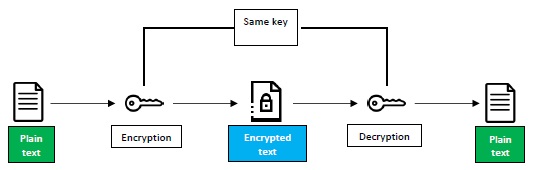
With symmetric cryptography, there is one key (the secret key) that is used for encrypting and decrypting the message. It’s therefore necessary for the sender of the message to share the secret key with the party he would like to correspond with.

The Caesar cipher is considered to be symmetric cryptography, because knowing the exact rotation (secret key) that is used to encrypt the message, you do also know how to decrypt the message.

Symmetric cryptography
Symmetric cryptography. One key (the secret key) is used for the encryption and decryption of messages.

Disadvantages of symmetric cryptography

There are several disadvantages to symmetric cryptography.

The first disadvantage is that the secret key has to be shared between the sender and receiver for messages to be exchanged privately. Sending the secret key over an unprotected communication channel is not recommended. In the next post, we will see how asymmetric (public key) cryptography allows us to send the encryption key safely over unprotected communication channels, while keeping the decryption key safely in our own possession.

The second disadvantage is that the secret key is now on two different locations. Thus, there are now two points of attack.

The third disadvantage is that the sender has to trust the receiver that he will not steal or copy the key or give it to someone else. It’s comparable to sharing the keys to your apartment: you also have to trust the other person not to steal your key, or copy your key, or give the key to another person.

The fourth disadvantage is limited scalability. Assuming that we’d like to communicate with a great number of parties, and that we’d like to provide each party with a different secret key for security reasons, we’d need to maintain a database of secret keys. For this setup to be user friendly in an environment like the internet, it would probably require an infrastructure of specialized distribution centers that generate secret keys each time two parties would like to initiate a private conversation. As these distribution centers would hold many secret keys, it would be a honey pot for hackers.

An example of symmetric cryptography is the Data Encryption Standard (DES), which was released on the market in 1975. It was developed by IBM, and was primarily meant to protect electronic communication between large financial organizations. Up until DES, cryptography was mainly a field for governments’ secret intelligence agencies to protect state communication. When the DES was released, it was received very well by cryptographers, until people found out that the National Security Agency (NSA) was involved with the development of the encryption key and purposefully influenced IBM to limit the key sizes from 64 bits to 56 bits. With 56 bits, there are 2^56 possible key combinations. This is considerably less than 64 bits keys. It is therefore much easier to break the encryption. Cryptographers believed that it would just be a matter of time before someone would find the right keys through a brute force search – meaning that you are trying all possible key combinations to find the right one.

Symmetric cryptography was the way cryptography was done until 1976 when two young researchers from Stanford University, Whitfield Diffie and Martin Hellman, invented asymmetric or public key cryptography.

Both researchers were discontent with DES, and Hellman even addressed a letter to the Secretary of Commerce, Elliot Richardson, saying:

I am writing to you because I am very worried that the National Security Agency has surreptitiously influenced the National Bureau of Standards [NBS] in a way which seriously limit the value of a proposed standard, and which may pose a threat to individual privacy. I refer to the proposed Data Encryption Standard. … I am convinced that NSA in its role of helping NBS design and evaluate possible standards has ensured that the proposed standard is breakable by NSA.

In my next post, I will discuss how public key cryptography works. Eventually, at the end of the post series, you will be able to encrypt your e-mails using public key cryptography.

Sunday Poetry: Gender Equality where it matters? The Scandinavian Unexceptionalism

Deja-Vu! Social Democrats once again bring up the topic of “Democratic Socialism” to cure all of the evils of the world. Once again, the Scandinavian countries (Sweden, Finnland, Denmark and Norway) are used as an example of how “a third way Socialism” can work. Although I still would consider myself young, I have already lost all of my stamina to engage in the same debates all over again until they pop up again a few months after.

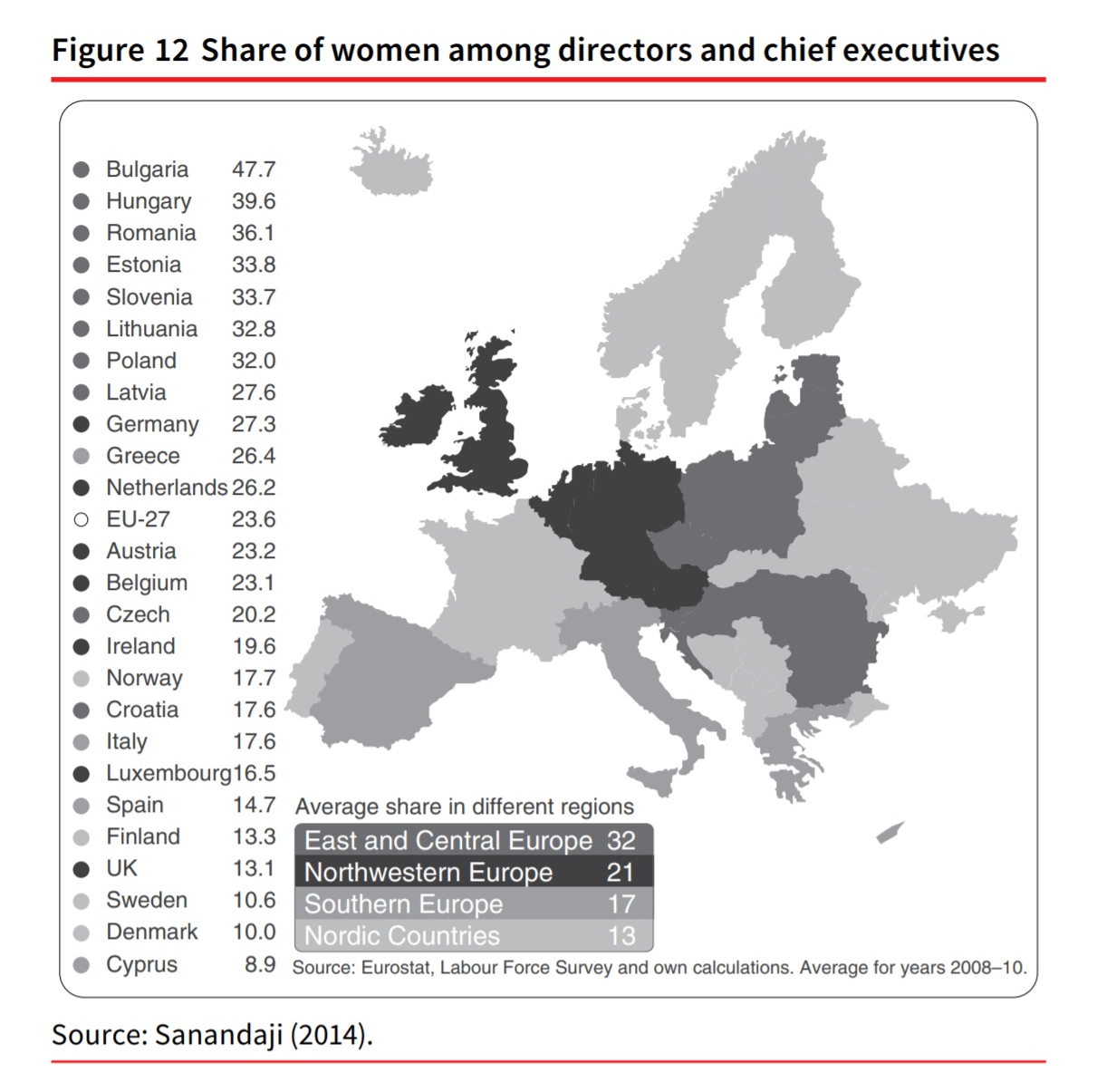
So, instead of pointing out the fallacy in labelling the Scandinavian countries moderately socialist (Nima Sanandaji, for example, does an excellent job in doing so), I want to look at one aspect in particular: The myth of peak emancipation of woman in the labour market in these countries. So apologies for neglecting Poetry once again for the sake of interesting information. Have a look at the following graphic and the remarks by Sanandaji:

“Some boards in Nordic nations are actively engaged in how the companies they represent are run. Others have a more supervisory nature, meeting a few times a year to oversee the work of the management. The select few individuals who occupy board positions – many of whom reach this position after careers in politics, academia and other non-business sectors – have prestigious jobs. They are, however, not representative of those taking the main decisions in the business sector. The important decisions are instead taken by executives and directors. Typically individuals only reach a high managerial position in the private sector after having worked for a long time in that sector or successfully started or expanded a firm as an entrepreneur. The share of women to reach executive and director positions is the best proxy for women’s success in the business world. Eurostat has gathered data for the share of women among ‘directors and chief executives’ in various European countries between 2008 and 2010. The data show that Nordic nations all have low levels of women at the top of businesses. In Denmark and Sweden, only one out of ten directors and chief executives in the business world are women. Finland and the UK fare slightly better. Those Central and Eastern European countries for which data exist have much higher representation.

sanandaji.png

[…]

A key explanation lies in the nature of the welfare state. In Scandinavia, female-dominated sectors such as health care and education are mainly run by the public sector.
A study from the Nordic Innovation Centre (2007: 12–13) concludes: Nearly 50 per cent of all women employees in Denmark are employed in the public sector. Compared to the male counterpart where just above 15 per cent are employed in the public sector. This difference alone can explain some of the gender gap with respect to entrepreneurship. The same story is prevalent in Sweden. The lack of competition reduces long-term productivity growth and overall levels of pay in the female-dominated public sector. It also combines with union wage-setting to create a situation where individual hard work is not rewarded significantly: wages are flat and wage rises follow seniority, according to labour union contracts, rather than individual achievement. Women in Scandinavia can, of course, become managers within the public sector, but the opportunities for individual career paths, and certainly for entrepreneurship, are typically more limited compared within the private sector.

If you are interested in the whole book, it is completely available online for free.

I wish you all a pleasant Sunday.

The fight to preserve the internet as a tool of liberty

What’s the state of our internet freedoms around the world? Freedom House (2019) has recently released a report entitled ‘Freedom on the Net 2019‘.

According to the report, more than 3.8 billion people still have no access to the internet, but

  • 71% of those who have access do live in countries where individuals have been arrested and thrown in jail for posting political, social or religious content;
  • 65% live in countries where individuals have been attacked or killed for their online activities;
  • 59% live in countries where authorities use online commentators to manipulate online discussions;
  • 33 out of 65 countries that were assessed have seen their internet freedoms decline over past year.

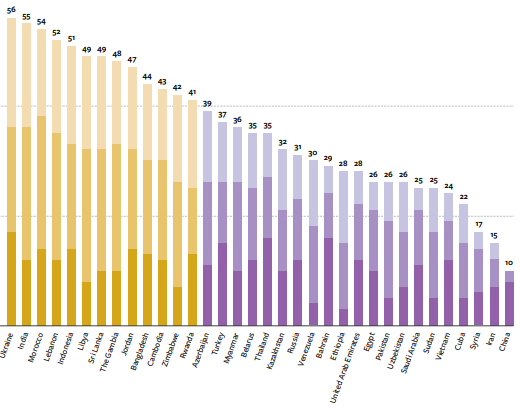
The greatest declines in internet freedoms happened in Sudan, Kazakhstan, Brazil, Bangladesh and Zimbabwe. For the fourth consecutive year, China has been the greatest abuser of internet freedoms, and although the United States is still scoring well, they have been on decline for three consecutive years.

The ranking from most to least free is as follows:

FOTN 3

FOTN 4

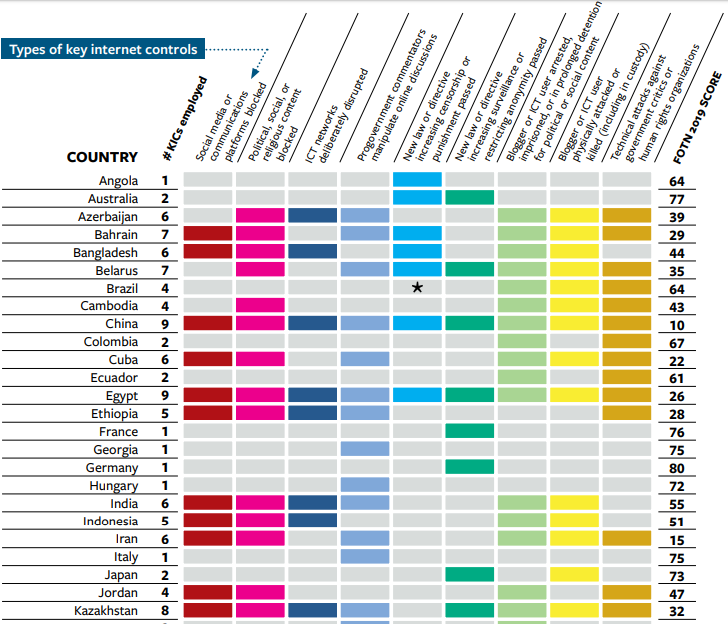
The report scores the countries, based on the internet controls that are in place:

FOTN 1

FOTN 2

Governments hold more technological capabilities than ever before to surveil their citizens. They make use of bots to manipulate social media and big data analyses to surveil citizens. See for example this.  In August 2018, Le Dinh Luong has been sentenced to jail for 20 years in Vietnam for addressing and posting about human rights abuses on social media in the country. In March 2019, an Uyghur Muslim was stopped and interrogated for three days, because not HE but someone ELSE on his WeChat contact list had checked in from Mecca.

What was once a liberating technology has now become a conduit for surveillance and electoral manipulation. What can we do to protect our internet liberties?

A happy ten-year anniversary to the case people love to hate

This month marks the ten-year anniversary of one of the most despised and misunderstood Supreme Court cases: Citizens United v. Federal Election Commission.

I love Citizens United. It stands as perhaps the most important First Amendment decision of the last decade. Yet it’s come to symbolize the illicit marriage between money and power, while what actually happened in the case is largely an afterthought. I remember encountering an enraged signature-gatherer outside a Trader Joe’s a few years ago who was engaged in one of the many campaigns to amend the Constitution to put an end to Citizens United. I thought he might have a coronary when I told him that it was one of my favorite Supreme Court decisions. I deeply regret not asking him if he could rehearse for me the facts of the case. Maybe he would’ve surprised me.

So what did Citizens United actually say? The law at issue banned corporations from using general treasury funds for electioneering, with civil and criminal penalties for corporations that spent money to speak on pressing political issues of the day. The Supreme Court said that a small-time political organization (that happened to be incorporated), Citizens United, could not be banned from publishing a film critical of a presidential candidate. It’s hard to find speech of a higher order of significance than that.

Citizens United held that government cannot ban political expenditures just because people choose to speak through the corporate form. This is a classic example of an old rule–government cannot censor speech based on the identity of the speaker.

Much of the fury over Citizens United is premised on a guttural abhorrence for the corporation. But corporations are just groups of people who have chosen to organize through a particular structure. And most don’t realize that the law at issue in Citizens United also banned unions from using general treasury funds for electioneering communications.

Much of the popular criticism of the case that I’ve seen seems to believe that Citizens United was the first case to establish that corporations had First Amendment rights. It wasn’t. In fact, not even the dissenters in the case would’ve held that corporations lack such rights. That was an uncontroversial and settled matter. And it should be obvious as to why. If corporations don’t have First Amendment rights, then the New York Times doesn’t have First Amendment rights, along with many other media organizations. (I’ve heard the excuse that freedom of the press would still protect media organizations independently, which is a misunderstanding of the freedom of the press, which doesn’t offer greater speech protections to media than non-media).

Citizens United gets a bad break, and I wish it a happy anniversary.

My Back to the Land Movement

Of course there’s no such thing as a Golden Age–some forgotten time in the medium-past where things were unambiguously better. The past is full of backwards savages and hard living. And even so, you can’t go home.

But I’ve got this suspicion that back in my day the Internet was better. It didn’t take itself too seriously, and so was actually worth while. But at some point in the last decade (maybe earlier) things changed for the worse. The Internet, like all the rest of the world, just isn’t what it could be–what it should be!

I’m being at least a little hipstery here–it was cool before it was cool, but now it’s uncool because it’s popular. But the truth is, the crappiness that is Facebook is just a reflection of a large swath of consumers. And I’m allowed to opt out.

Sitting on the Internet at the start of 2020, I feel like I’m sure I would have in 1970. Everything is bullshit and I don’t want anything to do with it. I want to buy a school bus and drive to some part of the country nobody cares about and start a farm. Of course the truth is, I really have no business going back to the land. I’ve taken up gardening as a hobby and learned that it’s hard.

But I do have this imagined past on the Internet I can attempt to go back to. I’m going to make an effort to return to the Internet of the early 2000’s. The Internet that Craigslist (for example) still protects–simple, excellent, and not trying to eat the world.

Don’t get me wrong, I’m still going to use the Big Corporate Internet. I’m only imagining my packets being sent via artisinal servers lovingly tended to by ye olde sysadmin.

What made the Small Internet great was the artisinal content. Weird stuff made and shared by weird people. That stuff is still out there. The Big Internet filters still capture it sometimes. But the marketers have gotten to the filters that used to serve us so well. Reddit just isn’t the same as a Conde Nast property.

One move I’ve made is to join MetaFilter, a social media site that goes back to 1999! So far it’s been a delightful place (without sucking me in the way Reddit used to). Hitting the random button brought me Where’s Wallace–an homage to The Wire, which is still worth re-watching. A more recent post introduced me to an excellent advent calendar that brought more new and weird things across my radar.

Why should this experiment matter?

Partly this is an act of civil society. It’s not all markets and government out there. We’ve got this space to share and improve our public spaces. The Internet is one of those spaces and my Small Internet project is sort of like making an effort to walk through my neighborhood instead of just going back and forth from the freeway.

It’s also an exercise in questioning implicit assumptions in how I engage with this part of the world.

I like Stephen Wolfram‘s notion of exploring the computational universe for useful programs. You don’t even need to take a metaphorical leap in applying the idea to media consumption habits. There’s a lot more “content” (facts, opinions, entertainment, editorial judgement, comments sections, provocations, etc.) out there than I can (or want to) deal with. So I have to choose some sort of filter. Once upon a time, Facebook was a great filter, then Reddit, but now I want to try something different.

I don’t exactly know what I’m looking for yet. But I’m going to wander off into the computational universe in search of a better Internet, less encumbered with the interests of behemoths and more closely tied with serendipity, good humor, and those weird human things that made the back-in-my-day-Internet so much better.

A blatant campaign-finance boondoggle

The City of Seattle is poised to pass a plainly unconstitutional campaign-finance law later this month. The bill would limit contributions to political action committees that are not controlled by or connected to a candidate to $5000 per election cycle. The Ninth Circuit Court of Appeals, which would govern the outcome of any litigation, has already said several times that limiting contributions to independent PACs (meaning independent of a candidate’s campaign) violates the First Amendment.

The rationale is pretty straightforward. Any limit on political spending is a limit on speech, so it must satisfy the First Amendment. In Buckley v. Valeo, the United States Supreme Court said that contribution limits directly to candidates are usually okay because they (arguably) reduce the likelihood of corrupt quid pro quo exchanges between candidates and donors. But Buckley struck down limits on independent expenditures (meaning expenditures that aren’t donated to a candidate but speak independently for or against a candidate). Independent expenditures, unlike direct contributions, are not coordinated or controlled by the candidate, so there is less of a risk that an independent expenditure is actually an illicit quid pro quo. Since limits on independent expenditures restrict speech without actually doing anything to prevent corruption, they violate the First Amendment.

Contributions to PACs that engage in independent expenditures are basically the same as independent expenditures–there isn’t a direct connection to a candidate, so there simply is no genuine risk of corruption. The City of Seattle probably knows this, and they either don’t care or they hope to change the state of the law. I look forward to the forthcoming judicial rebuke.

Really, I find the entire premise behind limits on either contributions or expenditures to be highly dubious. While there are no doubt a few instances where a contribution to a candidate is given in direct exchange for some future favor once the candidate wins office, the vast majority of contributions are not that. They’re donations to support a candidate because his platform reflects the donor’s policy preferences. Most corrupt exchanges of money, when they do occur, almost certainly occur under the table and outside the context of highly regulated campaign contributions. Thus, contribution limits penalize a wide range of legitimate political speech to get at a vanishingly small (and unknowable) number of malefactors.

Defenders of campaign-finance laws tend to emphasize the huge amount of political spending as per se evidence of the need for reform. (When you compare the amount of political spending to other spending in the economy, it becomes quite clear that the amount of money in electoral politics simply isn’t that much). This claim that money in elections is fundamentally bad has always struck me as bizarre. That money is spent by both sides on political speech that informs the public. Why should we assume that this is a bad thing? Of course all political speech has a partisan aim–to convince voters to vote for so-and-so. But the information hardly compels voters to do so. At the end of the day, it seems much better to have a public informed by politically motivated communications than to have less information.

Campaign-finance advocates also like to point out that candidates who receive the most money tend to win. Again, it isn’t obvious why this is a bad thing. It seems rather obvious that popular candidates will attract both dollars and votes, not because they get lots of money, but because they’re popular. This is a classic failure to acknowledge the difference between correlation and causation. To date, no significant evidence has surfaced demonstrating that dollars cause votes.

And what about the concern over undue influence? Of course, politicians may be responsive to high-dollar donors. But again, this is a correlation issue. The NRA gives money to candidates who support the NRA’s  policy preferences. When the candidate reaches office and fights gun control, is it because of the NRA’s support, or was the NRA’s support prompted by the candidate’s pre-existing policy platform? Over and over, the deeply felt convictions of campaign-finance advocates seem to rest on a house of cards.

In any case, even if risk of quid pro quo corruption is a valid reason to restrict speech, Seattle’s bill goes well beyond that rationale. PACs engage in core political speech, as do the individuals who donate to them. That speech merits protection.