Broken Incentives in Medical Innovation

I recently listened to Mark Zuckerberg interviewing Tyler Cowen and Patrick Collison concerning their thesis that the process of using scientific research to advance major development goals (e.g. extending the average human lifespan) has stagnated. It is a fascinating discussion that fundamentally questions the practice of scientific research as it is currently completed.

Their conversation also made me consider more deeply the incentives in my industry, medical R&D, that have shaped the practices that Cowen and Collison find so problematic. While there are many reasons for the difficulties in maintaining a breakneck pace of technological progress (“all the easy ideas are already done,” “the American education system fails badly on STEM,” etc), I think that there are structural causes that are major contributors to the great slowdown in medical progress. See my full discussion here!

Departments of Higher Education should have mystery shoppers

As you know, I teach at a SUNY campus. As you can imagine, the views I express here are only my own and certainly not those of any authority figure in the bureaucracy I live in or the higher ed industry more broadly. My union would be mortified.

In my opinion–coming from a limited perspective within the sausage factory–the problem we’re facing is that universities are good at education and bad at credentialing (at least when there’s a significant demand for the signal value of a degree). This has lead to a host of problems–Baumol disease, growing administrative expense, all sorts of cultural unsavoriness, declining standards, grade inflation, etc.

Education just happens. You can’t plan for it. You don’t do x amount of philosophy and then you’re enlightened. But a navel-gazing, consequence free environment with a culture of inquiry is a fine place for education to happen.

Credentialing on the other hand is a common pool with the usual problems. It doesn’t have to interrupt the educational component of the university, but when actors in this setting follow the basic economic logic of their situation enrollments (and budgets) expand and the nature of the good produced by schools shifts from unquantifiable to commodity.

In such a setting there is a strong case to be made for regulation. At the very least to manage the common pool resource of the signal value of a bachelor’s degree, but more ideally to ensure students aren’t simply learning to minimize cost while navigate a bureaucracy.

Of course, NOL readers know that regulation is never easy and comes with many problems of its own. In fact, many of the problems I see in the industry are the natural bureaucratic outcome of such regulation (particularly as I sit here avoiding the work I’ve got to do making my tenure packet more closely resemble a checklist version of the guidelines my campus gave me. God I hate this!). For a taste of how this mess is currently killing the goose that laid the golden eggs, check out BadAssessment.

How do we improve the regulatory quality? Mystery Shoppers!

My industry is disciplined through:
* direct state regulations,
* marginal nudges through strings-attached financing,
* “self”-regulation through quasi-public regional accreditation and much-less-public discipline-specific accreditation,
* direct consumer experience,
* U.S. News (and similar) rankings, and
* Peter Theil and other critics complaining about how the education system is broken.
My proposal could be done at any of these levels, but to my knowledge is only actually done at the statistically invalid level of direct consumer experience.

Governments could invent many students and their traits and send copies of these students to a sample of online programs. Teams would manage sets of students and gather data. With several of these students taking different paths through each school the agency could learn something useful about the school as a whole–is it a degree mill? How does the actual student experience compare to other schools? Are there pitfalls that might put vulnerable groups at a disadvantage?

Peter Theil could do it more aggressively and generate an upper-bound estimate on the bullshit in the industry.

The College Board or U.S. News would probably turn it into a new costly margin of competition between schools, but that’s probably an improvement over what we’ve got now.

To my knowledge, nobody is doing this. In my opinion, given the stakes and the size of the industry, it’s worth approaching this from many directions. Mystery shoppers would certainly be a more direct evaluation than the hundreds of pages of sacrificial paperwork we’re currently using.

More campaign-finance fiction

Today, Jacobin reports on Bernie Sanders’ proposal to give each American a $50-$200 voucher to spend on politicians’ political campaigns. I’m the lead counsel challenging a similar voucher program in Seattle, so I have some feelings on this subject.

The article opens with this classic ipse dixit: “Everyone knows that rich people skew our political priorities through big-money donations to candidates.” Really? I didn’t know that. But of course this is the big assumption behind so much campaign-finance hype, one that is vague and unprovable, like all good political rhetoric.

My first question here would be an attempt to resolve an ambiguity: what does “skew” mean? Where’s the magical baseline of “unskewed” political priorities? That baseline does not and never has existed. This opening line also fails to account for causation. That is, do donations influence eventual votes, or are both donations and votes attracted to candidate strength? I’ve yet to see a convincing argument that donations have ever “bought” a major federal election.

The article also seems to assume, as many do, that liberal politicians are the ones losing out in the big-donor world. This just isn’t so. Candidates from across the political spectrum receive plenty of cash. Heck, Hillary outspent Trump 3 to 1 in 2016. If she was hoping her donors would “buy” her the election, she was sorely disappointed.

The article also parrots the frequent refrain about our “broken” campaign-finance system. Again, compared to what? Where’s the unbroken system and what does it look like? At the end of the day, politicians need to figure out how to appeal to voters with all that money. How are our politics “skewed” if both parties are receiving plenty of funding with which to present a message that draws votes?

As for the actual voucher proposal, I think most Americans would rather keep their $50-$200 dollars and spend it on something other than a politician, but that’s just a hunch.

Ban on inquiries into wage history upheld

I haven’t read the decision in much depth yet, but the Third Circuit Court of Appeals this week upheld a Philadelphia ban on employer inquiries into job applicants’ wage history.

This is part of a troubling trend. More and more governments are banning inquiries into information that they don’t want people to use. Seattle and other cities have begun banning criminal background checks by landlords. Portland is set to pass a law that bans landlords from asking about a person’s immigration status. Other municipalities have passed and likely will pass more laws banning inquiries into wage history. The Third Circuit opinion will make it much harder to challenge this kind of speech restriction.

The Third Circuit decision held that the wage inquiry ban should be subject to the “commercial speech” test. In First Amendment jurisprudence, courts are more forgiving of restrictions on commercial speech than other types of speech. This doctrine, however, is meant to be reserved for advertisements, not any speech that happens to be related to a possible transaction. Here, the Third Circuit extended the rule to include questions asked in the context of an anticipated transaction–an employment contract. This is an unfortunate expansion of a doctrine that arguably shouldn’t exist at all. The First Amendment doesn’t distinguish between commercial and other types of speech, and neither should the courts.

The problem of value in regulatory takings

Regulatory takings law is a mess. The Fifth Amendment promises: “nor shall private property be taken for public use, without just compensation.” This constitutional mandate encompasses direct acquisition of property, government action that damages or restricts property, and regulation of property that effectively results in a taking. Defining what constitutes a regulatory taking has vexed the courts for decades.

I believe much of the trouble comes from the Supreme Court’s fixation on loss of value. The primary test for a regulatory taking looks to reasonable investment-backed expectations dashed by the regulation (i.e., I’d amassed resources and did a lot of footwork to build a house, but a new shoreline buffer prohibits construction), the resulting economic loss, and the character of the government action.

Examining value creates intractable line-drawing problems and fails to establish a predictable rule. How much loss of value is too much? As one might expect, courts come out with wildly different answers, though all of them tend to lean toward not requiring compensation. A Massachusetts court, for example, recently held that a regulation that forbade any development on a parcel of land and resulted in a 91.5% loss of property value was not a taking that requires the government to compensate the property owner.

Hence, no one going into court with a takings claim really has any way to predict what a court might do, though it’s safe to guess that the result will be bad. Courts are reluctant to draw a line in the sand, so they just hand wins to the government. This is not to say that loss of value is wholly irrelevant, of course, but it’s more relevant to the question of how much compensation is due, not whether a taking has occurred in the first place.

Takings law doesn’t have to be this way. In fact, nineteenth-century takings law took a totally different approach. Early courts looked to the burden on the property interest, not the loss of economic value. Most fledgling regulatory takings law developed in the state courts, for two reasons: the Fifth Amendment wasn’t applied against the states until the Fourteenth Amendment was ratified in 1868, and the federal government in the nineteenth century wasn’t much in the business of regulating land.

The early state cases didn’t even consider economic loss in their approach to what constitutes a taking. For instance, in Woodruff v. Neal, an 1859 Connecticut case, a government granted ranchers licenses to graze their cattle on public rights of way that crossed over private land. The private landowners sued for a taking and won because their property rights included rights over the “herbage” that the cows ate. The economic loss had to have been puny, but the court didn’t even bother addressing this, probably because they saw economic loss as pertinent only to the question of compensation due.

Most of the other regulatory takings cases of that time period involved riparian rights–wharfage rights and so on. So it was with one of the United States Supreme Court’s early forays into regulatory takings–a case where, like the state cases that preceded it, did not even bother to mention loss of value. The case was Yates v. Milwaukee (1870). Yates owned land adjacent to a river and had built a wharf that extended out into the water. The city didn’t like his wharf, so they declared it a nuisance and sought to tear it down. Yates argued this was a regulatory taking, and the Supreme Court agreed. They didn’t bother to mention how much the loss of the wharf would cost Yates. They just held that access to a river was among the rights held by owners of a riverbank. The city had destroyed that right, so a taking occurred and compensation was due.

Strangely, seven years later, the Supreme Court started to retreat from regulatory takings altogether and didn’t really return to the doctrine until the early twentieth century. Much later, when the Supreme Court thought up its value-based regulatory takings test in a 1978 case called Penn Central v. City of New York, the Court completely ignored Yates and all the many non-value-based takings cases in the state courts of the nineteenth century. In fact, the Court seemed to believe that regulatory takings law was a twentieth-century creation that began with a 1920 case called Pennsylvania Coal Co. v. Mahon. This bizarre blindness to the real history of regulatory takings law has resulted in an incomprehensible labyrinth of takings jurisprudence. The Supreme Court could learn a few lessons from the state courts of two centuries ago.

Climate crisis or censorship crisis?

Yesterday, the Chair of the U.S. House Select Committee on the Climate Crisis wrote an ominous letter to the CEO of Google. For the second time, the Chair is leaning on Google to police and remove “dangerous climate misinformation” on YouTube. The letter doesn’t threaten direct legal action against Google, but it nonetheless raises serious concern because it runs so counter to the free speech tradition and the value of a robust internet.

According to the Chair, “YouTube has been driving millions of viewers to climate misinformation videos every day, a shocking revelation that runs contrary to Google’s important missions of fighting misinformation and promoting climate action.” The Chair states her own unequivocal commitment to “promoting ambitious federal policy that will … eliminate barriers to action, including those as pervasive and harmful as climate denial and climate misinformation.” It’s hard not to see the veiled threat here.

Note the letter’s subtle casting of the consumers of information as passive actors that must be protected, rather than rational actors who choose what information to consume, a choice they’re entitled to make. She says “YouTube has been driving millions of viewers to climate misinformation” and that Google should “correct the record for millions of users who have been exposed to climate misinformation.” This language strips accountability and action from the viewers, as if they are a captive audience held down and forced to view climate denial videos with eyelid clamps like a scene from A Clockwork Orange. But if that content is promoted and viewed, that’s because there’s a consumer demand for it. The passive language used in the letter exemplifies the paternalism that often lurks behind censorship: for their own welfare, we must protect the public from information they wish to consume.

Note also the absolutism woven into the letter. Google cannot both be committed to climate action and committed to an open culture of public discourse. In the war for humanity’s survival, one priority must dominate above all others.

The letter also relies on the tired tactic of impugning speakers’ motives. Anyone who expresses “climate misinformation” on YouTube just wants “to protect polluters and their profits at the expense of the American people.” It’s impossible for an absolutist to consider that views opposed to her own might be sincerely held. Plus, research has shown that political views frequently do not line up with individual self-interest. Only a shallow thinker or someone with an agenda assumes a political viewpoint is rooted in a selfish motive.

As for the constitutional implications of the letter, there is no question that the federal government cannot impose on Google the duty to remove “climate misinformation” or “climate denial” content. False speech is not exiled from the sanctuary of First Amendment protection. Of course, some false speech can be penalized, such as libel, slander, or fraud. But these are circumstances where there’s some other legally cognizable harm associated with the false statement for which recovery is warranted. There is no general rule that false speech is unprotected.

Government should never be in the position of arbitrating truth. Particularly in the context of hotly debated political controversies, allowing government to label one side as gospel and penalize dissidents opens the door to legally enshrined orthodoxy. As Justice Robert Jackson said 80 years ago: “If there is any fixed star in our constitutional constellation, it is that no official, high or petty, can prescribe what shall be orthodox in politics, nationalism, religion, or other matters of opinion or force citizens to confess by word or act their faith therein.” That’s what the power to ban “climate misinformation” entails.

Indeed, government refereeing of truth will almost always shade toward discrimination against disfavored viewpoints. For example, there is “misinformation” out there on both sides of the climate debate. Those who peddle wild doomsday predictions are just as unhinged as those denying the realities of climate change. Yet the Chair does not propose to censor such misinformation.

When I see such zealous effort to shut someone up, I can’t help but ask myself why the censor is so afraid. The targeting of this speech is likely only draw attention to it. Why worry about the hacks? I’ve always believed what John Milton expressed centuries ago in the Areopagitica: “Let [Truth] and Falsehood grapple; who ever knew Truth put to the worse in a free and open encounter?” Of course, that doesn’t mean that falsehoods lack convincing power, but truth in the end has the edge. Rather than pick the winner in advance, we do much better by letting truth emerge through open debate, bloodied but victorious.

Supreme Court hears vital freedom-of-religion case

Today, the Supreme Court heard  the most important case on the intersection of religion and education to arise in decades–Espinoza v. Montana Department of Revenue. A few years back, Montana had passed its first school-choice program, a tax-credit scheme that allowed a small tax credit for donations to scholarship programs that helped kids afford private school.

As in any state, many of Montana’s private schools are religious. Right after the state legislature passed the tax-credit statute, the Montana Department of Revenue promulgated a rule that immediately gutted the program by forbidding students attending religious schools from receiving scholarship money.

The Department based its rule on Montana’s Constitution, which says the legislature can’t “make any direct or indirect appropriation or payment from any public fund or monies . . . for any sectarian purpose or to aid any church, school,” etc. Plenty of states have very similar “no-aid” clauses. Revenue claimed that scholarships for religious students under the tax-credit scheme violated the “no-aid” clause.

It’s worth taking a moment to consider how bizarre this argument is. These scholarships are funded by private donations–the money never enters a public coffer. Yet Revenue thinks such donations would constitute state aid to religion because the donor gets a tiny tax credit (up to $150) for the donation. Underlying this argument is the strange notion that any money the government declines to collect from you is still the government’s money.  This would mean, for instance, that every charitable donation eligible for a tax deduction would likewise constitute a government appropriation. Revenue’s argument has always looked to me like an extremely weak pretext for blatant discrimination against religious students.

So Kendra Espinoza and a few other parents with kids at religious schools sued the Department of Revenue, claiming, among other things, that Revenue’s rule violated their free exercise of religion under the First Amendment. Kendra won at trial, and then lost spectacularly at the Montana Supreme Court. In fact, the Montana Supreme Court did something even worse than the Department of Revenue–it invalidated the entire tax-credit program, such that even students at secular private schools could no longer receive scholarship assistance.

Thankfully, the Supreme Court took up the case, and they heard oral argument today. (My colleagues and I filed an amicus brief with the Court in support of Kendra).

The oral argument transcript shows a Court divided along the typical ideological lines. The liberal justices seemed preoccupied with standing–whether the petitioners had the right to sue. One justice implied that only taxpayers (who have a financial interest because of the tax credit) and schools (who receive the scholarship money) should have the right to sue. This is a weird take, given that families and students are obviously the intended beneficiaries of the scholarship program.

A number of the justices discussed a odd quirk about the Montana Supreme Court’s decision. The basic question they raised is this: since the Montana Supreme Court took the scholarship program away from everyone, are petitioners now being treated equally? But the sole reason the Montana Supreme Court struck down the program was to prevent religious students from receiving scholarship. A government action taken for a discriminatory reason is, well, discriminatory. If the legislature had excluded religious students when it enacted the program, the program would still stand. And if the legislature tried to enact the same program, providing equal treatment to religious and secular students alike, the Court would strike it down. That’s discrimination based on religious status–pretty straightforward.

One justice cited to James Madison’s famous Memorial and Remonstrance Against Religious Assessments, arguing that the founders wouldn’t have wanted public funds flowing to religious schools like this (again no public funds were flowing to Montana religious schools under this program, but why let accuracy get in the way of a good narrative). That’s a terrible misreading of Madison. The Memorial and Remonstrance was an attack on preferential aid to religion, not to a program that provided public benefits to all groups, including religious ones. The difference is vital. Can the government deny churches police protection, fire protection, sewer connections, electrical service, or any other public benefit on the grounds that the government would be providing indirect public funding to religious institutions? Surely not. In fact, that’s exactly what the Supreme Court said in a recent case called Trinity Lutheran, where Missouri denied a church daycare access to a government program that helped renovate playgrounds.

There is a difference between Trinity Lutheran and this case, arguably, which is that here the money goes more directly to religious indoctrination, not something secular like playground materials. But at bottom, public funding is fungible. Providing police protection and other general public benefits obviously makes it easier for a religious institution to fulfill its religious mission.

This case should be an easy one. The government offered a benefit to all private schools. To include religious schools doesn’t “establish” religion. It just treats religious groups equally, as the Constitution requires.

Nomic-nomics?

Perhaps the coolest thing I’ve found on the Small Internet so far is the game Nomic. From where I found it:

Nomic was invented in 1982 by philosopher Peter Suber. It’s a game that starts with a given set of rules, but the players can change the rules over the course of the game, usually using some form of democratic voting. Some online variants exist, like Agora, which has been running since 1993.

It’s a game that’s about changing the game. Besides offering a tempting recreational opportunity, I think this could be formalized in such a way to make it rival the Prisoners’ Dilemma (PD) in shedding light on the big social scientific questions.

The PD is a simple game with simple assumptions and a variable-sum outcome that lets it work for understanding coordination, competition, and cooperation. One of my favorite bits of social science is Axelrod’s Evolution of Cooperation project. It’s basically a contest between different strategies to an iterated PD (you can play a variation of it here). That the “tit for tat” strategy is so successful sheds a lot of light on what makes civilization possible–initial friendliness, willingness to punish transgressions, and willingness to return to friendliness after punishing these transgressions.

A fantastic extension is to create a co-evolutionary simulation of a repeated PD game. Rather than building strategies and pitting them against each other, we can be totally agnostic about strategies (i.e. how people behave) and simply see what strategies can survive each others’ presence.

The evolutionary iterated PD is about as parsimonious a model of conflict/cooperation as we could make. But there is still a lot of structure baked in; what few assumptions remain do a lot of heavy lifting.

But if the structure of the game is up for grabs, then maybe we’ve found a way to generalize the prisoners’ dilemma without assuming on extra layers of complexity.

Of course, the parsimony of the model adds complexity to the implementation. Formalizing Nomic presents a formidable challenge, and getting it to work would surely create a new

But even if it doesn’t lend itself to simulation, it strikes me as the sort of exercise that ought to be happening in classrooms–at least in places where people care about building capacity for self governance (I’ve heard such places exist!).

Let’s play!

A bit of stage setting, then let’s start a game in the comments section. I get the impression that this game is nerdier than Risk, so you’ve been warned (or tempted, as the case may be).

The basic premise is that are mutable rules and immutable rules (like Buchanan’s view of constitutions). Players take turns to propose rule changes (including transmuting rules from a mutable to an immutable state). As part of the process, we will almost surely redefine how the game is won, so the initial rule set starts with a pretty boring definition of winning.

We’ll use Peter Suber’s initial rules with some variations to suit our needs. The rules below will be (initially) immutable.

117. Each round will happen in a new comment thread. A new round cannot start until the rule change proposed in the previous round has been voted on. If technical problems result in having to start a new comment thread, that thread should include the appropriate reference number and it will be understood to be part of the same comment thread.

I will take the first move to demonstrate the format in the comments section.

118. The final vote count will be determined after 24 hours of silence. Players may discuss and cast votes, and change their votes. But after 24 hours of no new comments, the yeas and nays will be tallied and the outcome determined accordingly. In cases requiring unanimity, a single nay vote is enough to allow a player to start a new round without waiting the full 24 hours. The final vote will still occur (for purpose of calculating points) after 24 hours of silence.

Despite being numbered 118, this rule will take priority over rule 105.

119. Anyone who is eligible to comment is eligible to play. If it is possible to start a new round, anyone may start that round. In the event that two people attempt to start a round at the same time (e.g. Brandon and I post a comment within a couple minutes of each other) priority will be given to whichever was posted first and the second comment will be voided.

120. The game will continue until someone wins, or everyone forgets the game, in which case the winner will be the last person to have had their comment replied to.

A happy ten-year anniversary to the case people love to hate

This month marks the ten-year anniversary of one of the most despised and misunderstood Supreme Court cases: Citizens United v. Federal Election Commission.

I love Citizens United. It stands as perhaps the most important First Amendment decision of the last decade. Yet it’s come to symbolize the illicit marriage between money and power, while what actually happened in the case is largely an afterthought. I remember encountering an enraged signature-gatherer outside a Trader Joe’s a few years ago who was engaged in one of the many campaigns to amend the Constitution to put an end to Citizens United. I thought he might have a coronary when I told him that it was one of my favorite Supreme Court decisions. I deeply regret not asking him if he could rehearse for me the facts of the case. Maybe he would’ve surprised me.

So what did Citizens United actually say? The law at issue banned corporations from using general treasury funds for electioneering, with civil and criminal penalties for corporations that spent money to speak on pressing political issues of the day. The Supreme Court said that a small-time political organization (that happened to be incorporated), Citizens United, could not be banned from publishing a film critical of a presidential candidate. It’s hard to find speech of a higher order of significance than that.

Citizens United held that government cannot ban political expenditures just because people choose to speak through the corporate form. This is a classic example of an old rule–government cannot censor speech based on the identity of the speaker.

Much of the fury over Citizens United is premised on a guttural abhorrence for the corporation. But corporations are just groups of people who have chosen to organize through a particular structure. And most don’t realize that the law at issue in Citizens United also banned unions from using general treasury funds for electioneering communications.

Much of the popular criticism of the case that I’ve seen seems to believe that Citizens United was the first case to establish that corporations had First Amendment rights. It wasn’t. In fact, not even the dissenters in the case would’ve held that corporations lack such rights. That was an uncontroversial and settled matter. And it should be obvious as to why. If corporations don’t have First Amendment rights, then the New York Times doesn’t have First Amendment rights, along with many other media organizations. (I’ve heard the excuse that freedom of the press would still protect media organizations independently, which is a misunderstanding of the freedom of the press, which doesn’t offer greater speech protections to media than non-media).

Citizens United gets a bad break, and I wish it a happy anniversary.

A blatant campaign-finance boondoggle

The City of Seattle is poised to pass a plainly unconstitutional campaign-finance law later this month. The bill would limit contributions to political action committees that are not controlled by or connected to a candidate to $5000 per election cycle. The Ninth Circuit Court of Appeals, which would govern the outcome of any litigation, has already said several times that limiting contributions to independent PACs (meaning independent of a candidate’s campaign) violates the First Amendment.

The rationale is pretty straightforward. Any limit on political spending is a limit on speech, so it must satisfy the First Amendment. In Buckley v. Valeo, the United States Supreme Court said that contribution limits directly to candidates are usually okay because they (arguably) reduce the likelihood of corrupt quid pro quo exchanges between candidates and donors. But Buckley struck down limits on independent expenditures (meaning expenditures that aren’t donated to a candidate but speak independently for or against a candidate). Independent expenditures, unlike direct contributions, are not coordinated or controlled by the candidate, so there is less of a risk that an independent expenditure is actually an illicit quid pro quo. Since limits on independent expenditures restrict speech without actually doing anything to prevent corruption, they violate the First Amendment.

Contributions to PACs that engage in independent expenditures are basically the same as independent expenditures–there isn’t a direct connection to a candidate, so there simply is no genuine risk of corruption. The City of Seattle probably knows this, and they either don’t care or they hope to change the state of the law. I look forward to the forthcoming judicial rebuke.

Really, I find the entire premise behind limits on either contributions or expenditures to be highly dubious. While there are no doubt a few instances where a contribution to a candidate is given in direct exchange for some future favor once the candidate wins office, the vast majority of contributions are not that. They’re donations to support a candidate because his platform reflects the donor’s policy preferences. Most corrupt exchanges of money, when they do occur, almost certainly occur under the table and outside the context of highly regulated campaign contributions. Thus, contribution limits penalize a wide range of legitimate political speech to get at a vanishingly small (and unknowable) number of malefactors.

Defenders of campaign-finance laws tend to emphasize the huge amount of political spending as per se evidence of the need for reform. (When you compare the amount of political spending to other spending in the economy, it becomes quite clear that the amount of money in electoral politics simply isn’t that much). This claim that money in elections is fundamentally bad has always struck me as bizarre. That money is spent by both sides on political speech that informs the public. Why should we assume that this is a bad thing? Of course all political speech has a partisan aim–to convince voters to vote for so-and-so. But the information hardly compels voters to do so. At the end of the day, it seems much better to have a public informed by politically motivated communications than to have less information.

Campaign-finance advocates also like to point out that candidates who receive the most money tend to win. Again, it isn’t obvious why this is a bad thing. It seems rather obvious that popular candidates will attract both dollars and votes, not because they get lots of money, but because they’re popular. This is a classic failure to acknowledge the difference between correlation and causation. To date, no significant evidence has surfaced demonstrating that dollars cause votes.

And what about the concern over undue influence? Of course, politicians may be responsive to high-dollar donors. But again, this is a correlation issue. The NRA gives money to candidates who support the NRA’s  policy preferences. When the candidate reaches office and fights gun control, is it because of the NRA’s support, or was the NRA’s support prompted by the candidate’s pre-existing policy platform? Over and over, the deeply felt convictions of campaign-finance advocates seem to rest on a house of cards.

In any case, even if risk of quid pro quo corruption is a valid reason to restrict speech, Seattle’s bill goes well beyond that rationale. PACs engage in core political speech, as do the individuals who donate to them. That speech merits protection.

Hyperinflation and trust in Ancient Rome

Since it hit 1,000,000% in 2018, Venezuelan hyperinflation has actually been not only continuing but accelerating. Recently, Venezuela’s annual inflation hit 10 million percent, as predicted by the IMF; the inflation jumped so quickly that the Venezuelan government actually struggled to print its constantly-inflated money fast enough. This may seem unbelievable, but peak rates of monthly inflation were actually higher than this in Zimbabwe (80 billion percent/month) in 2008, Yugoslavia (313 million percent/month) in 1994, and in Hungary, where inflation reached an astonishing 41.9 quadrillion percent per month in 1946.

The continued struggles to reverse hyperinflation in Venezuela are following a trend that has been played out dozens of times, mostly in the 20th century, including trying to “reset” the currency with fewer zeroes, return to barter, and turning to other countries’ currencies for transactions and storing value. Hyperinflation’s consistent characteristics, including its roots in discretionary/fiat money, large fiscal deficits, and imminent solvency crises are outlined in an excellent in-depth book covering 30 episodes of hyperinflation by Peter Bernholz. I recommend the book (and the Wikipedia page on hyperinflations) to anyone interested in this recurrent phenomenon.

However, I want to focus on one particular inflationary episode that I think receives too little attention as a case study in how value can be robbed from a currency: the 3rd Century AD Roman debasement and inflation. This involved an iterative experiment by Roman emperors in reducing the valuable metal content in their coins, largely driven by the financial needs of the army and countless usurpers, and has some very interesting lessons for leaders facing uncontrollable inflation.

The Ancient Roman Currency

The Romans encountered a system with many currencies, largely based on Greek precedents in weights and measures, and iteratively increased imperial power over hundreds of years by taking over municipal mints and having them create the gold (aureus) and silver (denarius) coins of the emperor (copper/bronze coins were also circulated but had negligible value and less centralization of minting). Minting was intimately related to army leadership, as mints tended to follow armies to the front and the major method of distributing new currency was through payment of the Roman army. Under Nero, the aureus was 99% gold and the denarius was 97% silver, matching the low debasement of eastern/Greek currencies and holding a commodity value roughly commensurate with its value as a currency.

The Crisis of the Third Century

However, a major plague in 160 AD followed by auctions of the imperial seat, major military setbacks, usurpations, loss of gold from mines in Dacia and silver from conquest, and high bread-dole costs drove emperors from 160-274 AD to iterative debase their coinage (by reducing the size and purity of gold coins and by reducing the silver content of coins from 97% to <2%). A major bullion shortage (of both gold and silver) and the demands of the army and imperial maintenance created a situation where a major government with fiscal deficits, huge costs of appeasing the army and urban populace, and diminishing faith in leaders’ abilities drove the governing body to vastly increase the monetary volume. This not only reflects Bernholz’ theories of the causes of hyperinflations but also parallels the high deficits and diminishing public credit of the Maduro regime.

Inflation and debasementFigure 1 for Fiat paper
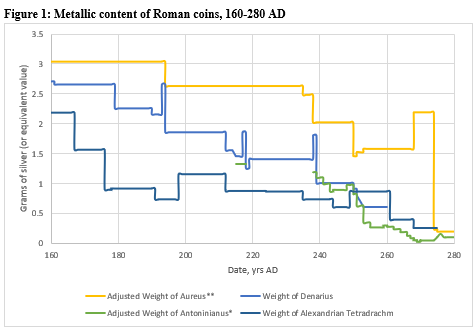
Unlike modern economies, the Romans did not have paper money, and that meant that to “print” money they had to debase their coins. The question of whether the emperor or his subjects understood the way that coins represented value went beyond the commodity value of the coins has been hotly debated in academic circles, and the debasement of the 3rd century may be the best “test” of whether they understood value as commodity-based or as a representation of social trust in the issuing body and other users of the currency.
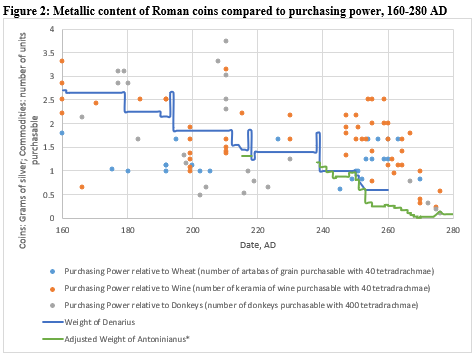
Figure 2 for Fiat paper

Given that the silver content of coins decreased by over 95% (gold content decreased slower, at an exchange-adjusted rate shown in Figure 1) from 160-274 AD but inflation over this period was only slightly over 100% (see Figure 2, which shows the prices of wine, wheat, and donkeys in Roman Egypt over that period as attested by papyri). If inflation had followed the commodity value of the coins, it would have been roughly 2,000%, as the coins in 274 had 1/20th of the commodity value of coins in 160 AD. This is a major gap that can only be filled in by some other method of maintaining currency value, namely fiat.

Effectively, a gradual debasement was not followed by insipid ignorance of the reduced silver content (Gresham’s Law continued to influence hoards into the early 3rd Century), but the inflation of prices also did not match the change in commodity value, and in fact lagged behind it for over a century. This shows the influence of market forces (as monetary volume increased, so did prices), but soundly punctures the idea that coins at the time were simply a convenient way to store silver–the value of the coins was in the trust of the emperor and of the community recognition of value in imperial currency. Especially as non-imperial silver and gold currencies disappeared, the emperor no longer had to maintain an equivalence with eastern currencies, and despite enormous military and prestige-related setbacks (including an emperor being captured by the Persians and a single year in which 6 emperors were recognized, sometimes for less than a month), trade within the empire continued without major price shocks following any specific event. This shows that trust in the solvency and currency management by emperors, and trust in merchants and other members of the market to recognize coin values during exchanges, was maintained throughout the Crisis of the Third Century.

Imperial communication through coinage

This idea that fiat and social trust maintained higher-than-commodity-values of coins is bolstered by the fact that coins were a major method of communicating imperial will, trust, and power to subjects. Even as Roman coins began to be rejected in trade with outsiders, legal records from Egypt show that the official values of coins was accepted within the army and bureaucracy (including a 1:25 ratio of aureus-to-denarius value) so long as they depicted an emperor who was not considered a usurper. Amazingly, even after two major portions of the empire split off–the Gallic Empire and the Palmyrene Empire–continued to represent their affiliation with the Roman emperor, including leaders minting coins with their face on one side and the Roman emperor (their foe but the trusted face behind Roman currency) on the other and imitating the symbols and imperial language of Roman coins, through their coins. Despite this, and despite the fact that the Roman coins were more debased (lower commodity value) compared to Gallic ones, the Roman coins tended to be accepted in Gaul but the reverse was not always true.

Interestingly, the aureus, which was used primarily by upper social strata and to pay soldiers, saw far less debasement than the more “common” silver coins (which were so heavily debased that the denarius was replaced with the antoninianus, a coin with barely more silver but that was supposed to be twice as valuable, to maintain the nominal 1:25 gold-to-silver rate). This may show that the army and upper social strata were either suspicious enough of emperors or powerful enough to appease with more “commodity backing.” This differential bimetallist debasing is possibly a singular event in history in the magnitude of difference in nominal vs. commodity value between two interchangeable coins, and it may show that trust in imperial fiat was incomplete and may even have been different across social hierarchies.

Collapse following Reform

In 274 AD, after reconquering both the Gallic and Palmyrene Empire, with an excellent reputation across the empire and in the fourth year of his reign (which was long by 3rd Century standards), the emperor Aurelian recognized that the debasement of his currency was against imperial interests. He decided to double the amount of silver in a new coin to replace the antoninianus, and bumped up the gold content of the aureus. Also, because of the demands of ever-larger bread doles to the urban poor and alongside this reform, Aurelian took far more taxes in kind and far fewer in money. Given that this represented an imperial reform to increase the value of the currency (at least concerning its silver/gold content), shouldn’t it logically lead to a deflation or at least cease the measured inflation over the previous century?

In fact, the opposite occurred. It appears that between 274 AD and 275 AD, under a stable emperor who had brought unity and peace and who had restored some commodity value to the imperial coinage, with a collapse in purchasing power of the currency of over 90% (equivalent to 1,000% inflation) in several months. After a century in which inflation was roughly 3% per year despite debasement (a rate that was unprecedentedly high at the time), the currency simply collapsed in value. How could a currency reform that restricted the monetary volume have such a paradoxical reaction?

Explanation: Social trust and feedback loops

In a paper I published earlier this summer, I argue that this paradoxical collapse is because Aurelian’s reform was a blaring signal from the emperor that he did not trust the fiat value of his own currency. Though he was promising to increase the commodity value of coins, he was also implicitly stating (and explicitly stating by not accepting taxes in coin) that the fiat value that had been maintained throughout the 3rd Century by his predecessors would not be recognized going forward by the imperial bureaucracy in its transactions, thus signalling that for all army payment and other transactions, the social trust in the emperor and in other market members that had undergirded the value of money would now be ignored by the issuing body itself. Once the issuer (and a major market actor) abandoned fiat currency and stated that newly minted coins would have better commodity value than previous coins, the market–rationally–answered by moving quickly toward commodity value of the coins and abandoned the idea of fiat.

Furthermore, not only were taxes taken in kind rather than coin, but there was widespread return to barter as those transacting tried to avoid holding coins as a store of value. This pushed up the velocity of money (as people abandoned it as a store of value and paid higher and higher amounts for commodities to get rid of their currency). The demonetization/return to barter reduced the market size that was transacted in currency, meaning that there were even more coins (mostly aureliani, the new coin, and antoniniani) chasing fewer goods. The high velocity of money, under Quantity Theory of Money, would also contribute to inflation, and the unholy feedback loop of decreasing value causing distrust, which caused demonetization and higher velocity, which led to decreasing value and more distrust in coins as stores of value kept this cycle going until all fiat value was driven out of Roman coinage.

Aftermath

This was followed by Aurelian’s assassination, and there were several monetary collapses from 275 AD forward as successive emperors attempted to recreate the debased/fiat system of their predecessors without success. This continued through the reign of Diocletian, whose major reforms got rid of the previous coinage and included the famous (and famously failed) Edict on Maximum Prices. Inflation continued to be a problem through 312 AD, when Constantine re-instituted commodity-based currencies, largely by seizing the assets of rich competitors and liquidating them to fund his army and public donations. The impact of that sort of private seizure is a topic for another time, but the major lesson of the aftermath is that fiat, once abandoned, is difficult to restore because the very trust on which it was based has been undermined. While later 4th Century emperors managed to again debase without major inflationary consequences, and Byzantine emperors did the same to some extent, the Roman currency was never again divorced from its commodity value and fiat currency would have to wait centuries before the next major experiment.

Lessons for Today?

While this all makes for interesting history, is it relevant to today’s monetary systems? The sophistication of modern markets and communication render some of the signalling discussed above rather archaic and quaint, but the core principles stand:

  1. Fiat currencies are based on social trust in other market actors, but also on the solvency and rule-based systems of the issuing body.
  2. Expansions in monetary volume can lead to inflation, but slow transitions away from commodity value are possible even for a distressed government.
  3. Undermining a currency can have different impacts across social strata and certainly across national borders.
  4. Central abandonment of past promises by an issuer can cause inflationary collapse of their currency through demonetization, increased velocity, and distrust, regardless of intention.
  5. Once rapid inflation begins, it has feedback loops that increase inflation that are hard to stop.

The situation in Venezuela continues to give more lessons to issuing bodies about how to manage hyperinflations, but the major lesson is that those sorts of cycles should be avoided at all costs because of the difficulty in reversing them. Modern governments and independent currency issuers (cryptocurrencies, stablecoins, etc.) should take lessons from the early stages of previous currency trends toward trust and recognition of value, and then how these can be destroyed in a single action against the promised and perceived value of a currency.

The mythology of Lochner v. New York

In the highly competitive world of most misunderstood Supreme Court decisions, Lochner v. New York sits high on the list. The reason is simple enough: it has undergone a transcendent ascent to the world of abstraction, where it now embodies the platonic essence of a black-robed cadre of old, straight, white men hankering to smash the plebeian’s face in the dirt.

Yesterday, the Intelligencer–a publication of New York Magazine–dragged out these old tropes with the galumphing rhetoric typical of someone simply parroting a battered playbook with no real concern for its accuracy. The article is entitled, “Conservatives Want a ‘Republic’ to Protect Privileges.” Its basic premise is to push back against the anti-democratic tendencies of those who oppose direct, untrammeled democracy.

The article lists several “limitations on democracy to justify and even expand privilege.” The second references the conservative legal movement’s supposed attempt to resurrect the “Lochner era,” in order to protect the wealthy from democratic majorities.

First, off, it’s wrong to say that the “conservative legal movement” wants to revive Lochner. Both progressive and conservative jurists are generally united in their rejection of Lochner. Robert Bork, a thoroughly majoritarian conservative, railed against the case, as did Justice Antonin ScaliaGranted, this is because the conservative legal movement, sadly, has largely embraced the progressive juridical project of the 30’s, which was devoted to weakening the judiciary in order to shove the New Deal down the nation’s throat.

Second, Lochner‘s many detractors almost never grapple with the facts of the case. As a result, they frequently misunderstand it. Here’s what actually happened. In the early 1900’s, New York enacted a nitpicky law that saddled bakeries with an avalanche of finite requirements–limits on ceiling heights, limits on the kind of floor, and the demand to whitewash the walls every three months, among other things. But the provision dealt with in Lochner was this: “No employee shall be required or permitted to work in a biscuit, bread or cake bakery or confectionary establishment than 60 hours in one week or more than 10 hours in any one day.”

A Bavarian immigrant named Joseph Lochner who owned a Utica bakery was criminally indicted for violating this law. Aman Schmitter, another immigrant, lived with his family above the bakery and worked for Joseph. Aman happily worked over sixty hours a week in order to care for his family and increase his skills, and he said so in a sworn affidavit.

It is undisputed that New York’s law was not about health, safety, or protecting workers, though New York tried to say so at the time. Rather, New York passed the law at the behest of powerful bakeries and baker unions in a patent attempt to crush small, family-owned bakeries that relied upon flexible work schedules. It gets worse–the law intentionally targeted immigrant bakeries in particular, which tended to be of the small variety that leaned on overtime. The state’s legal brief contained a detestable line that progressives today would certainly associate with Trump: “there have come to [New York] great numbers of foreigners with habits which must be changed.” This is the law that progressives who hate Lochner are defending.

In a 5-4 decision, the Supreme Court thankfully struck down this law that was passed to serve the powerful and crush a weak immigrant population. Put that way, it seems startling that anyone today would wish to stand up for this piece of anti-immigrant, protectionist garbage.

But then again, Lochner is no longer about Lochner. It’s about rejecting a mythical “Lochner era.” Progressives believe that Lochner represented an entire ecosystem of turn-of-the-century jurisprudence in which corrupt judges were smothering the will of the people wholesale. Turns out that era never existed. Law professor David Bernstein has examined old court records concerning state exercises of their police power during that time period and found that there simply was no lengthy period in which courts were whack-a-moling every piece of social legislation that dared to lift its head.

To the extent that courts of that era did strike down social legislation under the liberty of contract, they did so not to serve the wealthy, but to protect weak minorities–which is of course why robust judicial review exists in the first place. For instance, the Illinois state supreme court struck down a deeply misogynistic law limiting women’s maximum work hours. The Court used the same liberty-of-contract reasoning as Lochner, arguing that women “are entitled to the same rights under the Constitution to make contracts with reference to their labor as are secured thereby to men.” And in Bailey v. Alabama, the wicked Lochner Court struck down a Jim Crow law that created a presumption of fraud when a worker quit after getting an advance payment. The law was aimed at penalizing black workers–an attempt essentially to revive peonage. Do progressives really want to own up to disagreeing with these “Lochner era” precedents? Somehow I doubt it.

Lochner did not, as Lochner‘s enemies love to claim, replace the legislature’s judgment with the judgment of the Court. Instead, the Court was willing to look skeptically at the legislature’s motives and demand that the legislature do its work and show that a law burdening a basic right is necessary. The New York law failed that test spectacularly.

Of course, Lochner‘s legacy does demand that courts counter democratic will when it conflicts with fundamental rights. Alexander Bickel famously called this the counter-majoritarian difficulty, something that has preoccupied the judiciary for a century. If you really care about minorities, though, you might consider Judge Janice Rogers Brown’s insight: “But the better view may be that the Constitution created the countermajoritarian difficulty in order to thwart more potent threats to the Republic: the political temptation to exploit the public appetite for other people’s money–either by buying consent with broad-based entitlements or selling subsidies, licensing restrictions, tariffs, or price fixing regimes to benefit narrow special interests.”

In any case, if progressives continue to take a polly-anna view of unfettered democracy despite the evidence, they should at least bother to get the facts right on Lochner.


Be Our Guest: “Of Monies and Juries and Freedoms”

Be Our Guest is a new, experimental series at NOL. Basically, NOL is invite-only but you can, and should, submit your thoughts to us. The latest piece is by Michalis Trepas, a Greek national working in the financial sector. An excerpt:

The judicial system was reluctant to intervene, out of respect of the separation of powers (according the Weimar Constitution, currency matters were reserved for the parliament). So, at first, the courts upheld the nominalistic principle and refused to accept a revalorisation of debts. But then, something began to change in the courts’ reasoning. The currency’s slide prior to 1921 could be attributed to the conditions of the “war economy”, whose burden was to be shared by everyone in the country. The unrestrained fall thereafter, the courts said, was a monetary phenomenon, punishing “blindly and unpredictably” only the creditor class.

If you cannot guess by now what Michalis is writing about, read on! If you have figured out what the subject of his piece is about, read on, as it only gets more interesting.

There are cultural and geopolitical considerations to think about here, too, in regards to Greece and Germany and financial markets and constitutionalism.

Mass shooting in perspective

Each of the past few years, about 35,000 Americans died in traffic accidents. This fact should be taken into account when considering recent massacres of civilians. I was wondering if anyone else would be cold hearted enough to go that way. So I waited a few days to comment on the massacres in Gilroy, El Paso, and Dayton, to avoid duplicating others’ commentaries. Plus, I have technical difficulties associated with my current location. Please, comment or wave if you see this.

Of the approximately 35,000 victims about half died in accidents involving alcohol. I will assume, against my thesis, that only 10,000 people each year died indirectly or directly because someone drank too much alcohol and drove.

How to count victims of mass shootings has become – strangely enough- controversial. Nevertheless, I am quite certain that shootings, specifically, of strangers for other than greed, or jealousy, or disappointed love have not caused 10,000 deaths in any of the past few years, not even close.

Do you agree; do you see where I am going?

So drunk drivers kill many more people – about 10,000 annually – than mass shooters. The victims of the ones are just as dead as the victims of the others; the loss and grief associated with the ones must be similar to those associated with the others. The deaths from one cause seem to me to be as meaningless as the deaths from the other. (That’s by contrast with the death of a firefighter in the line of duty, for example.)

A rational collective response should give priority to the avoidance of the many deaths from drunk driving over the much fewer deaths caused by mass assassins. Yet, the public reactions of the left are exactly the reverse of those rational expectations. In part, this inversion of priorities is due to the magnification the media affords mass shootings but not the slow massacre on the roads. In part, it may be due to the sometimes concentrated nature of the death tolls by mass shooting. This explanation, however, has only limited value because the small death toll at the Gilroy Garlic Festival, for example, was given much more publicity than is conceivable for any drunk driving accident with three lethal casualties.

This irrational ordering of priorities is made all the more puzzling by the fact that it would be much easier to reduce the number of deaths from drunk driving than by domestic mass shootings. Two reasons. First, people in jail can’t kill anyone with a car. The second reason is a little more subtle; bear with me.

Drunk drivers fall into two main categories, alcoholics who think they have to drive, and self-indulgent slobs. My intuition is that there are many more of the latter than of the former (especially among the young, who are overrepresented in car accidents) but I don’t have any figures. Self-indulgent slobs are capable of rational calculus. If the relevant punishment is severe enough and certain enough, they will become less self-indulgent. I used to be one of them. When the penalty for drunk driving went from about $100 to several thousand during my lifetime, I discovered that I could take a taxi, or pay a friend to drive me back, or drink at home. The quality of my life declined but it was worth it. It’s likely that my fear of heavy punishment saved someone’s life over the long run.

So, a credible remedial scheme is simple: withdrawal of driver’s license for a long period on the first offense associated with heavy fines for driving without a license. A significant jail term without possibility of parole would punish each subsequent infraction. Again, imprisoned drivers don’t kill anyone through their drunk driving. That’s a valid reason in itself to keep them locked up for a long time. It’s probably also economically reasonable.

So, I wonder why is there not a passionate public outcry on the political left and among its media partners in favor of a nation-wide remedial endeavor of the kind I just described?

Drunk driving kills many more Americans than do criminal mass shootings of the Gilroy, El Paso, and Dayton kind. This, although suppressive remedies to drunk driving are conceptually straightforward. My friend Vernon Bohr pointed out in a comment on Facebook that accidental drownings of children alone claim more lives of all categories of Americans than do mass shootings. There are better priorities.

The indifference of the left to those more important preventable causes of mortality as compared to its display of strong collective emotion with respect to sudden death by shooting seems strange, on the surface. This strong emotion is usually, almost always associated with urgent calls for some sort of federal gun control.

The contrast is made all the more striking by the following legal facts: First, the regulation of behavior that is potentially harmful to others – such as driving automobiles – falls squarely within the purview of state legislatures, primarily, of Congress, secondarily. Number two, driving is nowhere a right, except by default. Possessing weapons, by contrast, is a right explicitly guaranteed by the US Constitution, and twice reaffirmed by the US Supreme Court.

So, why would the considerable emotional and political resources of the left, aptly guided by the mass media, be expanded on the deaths of comparatively few, on a problem that is difficult to understand, one whose resolution would also encounter strong legal obstacles? Why this relentless emphasis when there are obvious, bigger, more rational objects of collective compassion?

I am thinking of two answers. One, the unpredictability of shooting events make them seem more disruptive than the somewhat routinized highway deaths, including by drunk drivers. The logical implication of this explanation is that if mass shootings became more frequent, they would appear more routine, and thus, less disruptive, and less deserving of left-wing attention. Note that there is a long way to go between the few hundred annual casualties by mass killings, and the 10,000 I attribute to drunk driving alone.

Thus, mass shootings garner both attention and emotion – including on the left – precisely because they are comparatively rare. If this were correct, attention and emotion would diminish with an increased frequency of such events. That is not a trend I observe. Others may see it.

Two, the left, and its media component, may focus on mass shootings in preference to making more rational choices, not in spite of the legal obstacles in their path but because of them. In this perspective, the focus on mass shootings may not be an exercise in misguided compassion, but a means to a higher end.

Americans are, on the whole, much attached to their Constitution. Modifying it is an arduous and uncertain task. Shortcuts to this effect are much appreciated. It would be difficult to find a more effective shortcut than the guided emotionalism the left supplies on the occasion of each mass shooting perpetuated by an American who is not also a violent jihadist. The spectacle of perfectly innocent victims, including children, cut down by someone seemingly exercising his constitutional right to bear arms must be the most formidable nonrational argument against that constitutional right. It can be mustered to sidestep collective choices – such as further reductions in deaths by drunk drivers – that would make the most sense from the standpoint of simple compassion. Thus, a one tenth reduction in deaths by drunk driver, and the corresponding shrinking of human misery, would do about twice more good than would the total (total) elimination of mass shootings.

The outburst of emotionalism expertly guided by the media we witnessed following three civilian mass shootings in quick succession is not about compassion, it’s about power. Every reduction in the autonomy of individuals increases the power of government, of those who are in charge of it through legitimate political means, and of the permanent bureaucracy.

Incidentally, I suspect there must be libertarian solutions to the vast and continuing problem of death by drunk driver, solutions that don’t involve putting people in jail. I don’t know what those are. I would like to hear about them.

Link: The Most Controversial Tree in the World

https://psmag.com/ideas/most-controversial-tree-in-the-world-gmo-genetic-engineering

Tending an ecosystem is hard. With all the interconnections it’s impossible to do just one thing. We should absolutely be skeptical of calls to engineer the environment from the top down, but we should also recognize that we’ve already been unintentionally doing so.

To me, the linked article raises interesting questions about the sort of common law restrictions on GMO that seem reasonable. Default infertility seems like an efficient Coasian compromise for industrial GMO. But the case of the American chestnut seems like an exciting opportunity to reverse an ecological tragedy.

This case seems like a good polar opposite to Jurassic Park on the spectrum of GMO threat/promise.