What should universities do?

The new semester is here so it’s time for me to figure out what the hell I’m supposed to be doing in the weird world of modern American university life. Roughly speaking, the answer is going to be “do the stuff that professors do to help universities do what universities do.” So what do universities do? What are they supposed to do?

Universities occupy a few different niches in society. I’m usually tempted to think of universities like a business. And in that framework, I justify my salary by providing something of value to those students. At my school, something like 90% of the operating budget comes out of students’ pockets.

But that’s an overly narrow view. Students pay to go to school because they expect they’ll get value from it, but they also go to school because them’s the rules–if you want to enter adult society, university is the front gate. In this framework, I justify my salary by serving as a gatekeeper. Even though it’s students paying, the (nebulous) principal I’m obliged to is the collection of people already inside the walls.

But wait! There’s more! Universities are (in no particular order):

  • A repository of knowledge,
  • A generator of new knowledge,
  • A place people go to learn,
  • A place people go to prove themselves,
  • A place people make friends and have fun (in a way that may be hard to replicate),
  • A business (engaging in mutually beneficial exchange),
  • A special interest group,
  • An institution that holds a particular (privileged) position in a wider cultural landscape.

Any one of these functions is a can of worms in its own right. When we start to consider tradeoffs between each function (and the many less visible functions I’ve surely missed), it gets downright intractable. I’m going to focus on the student-focused aspects of university life.

The mainstream view:

University is a place students get educated. This education helps them get jobs because employers value it. Students might also learn things that help them be better citizens.

The mainstream view doesn’t seem far off from what I’ve got in mind until you get your hands dirty and start disentangling what that view says. Here are three big problems inherent in that mainstream view:

  1. The education-for-job myth.
  2. The definition problem.
  3. The one-size-fits-all problem.

The Job-training myth

We’re told that students go to school to learn valuable skills. I think that’s true, but not in the usual way. Any specific skills students learn in school are a) incredibly general, or b) out of date. My students might learn some interesting ways of looking at the world (general knowledge), but a lot of what I teach is completely useless in the workforce (“Johnson, draw me a demand curve, stat!”). But students do learn valuable skills incidentally. They learn to manage their time (ideally), how to be conscientious, and in general they’re socialized so that they can fit in with adult society.

Lately I’ve been thinking of college as a form of upfront consulting. Instead of going to school when you’ve got a specific problem to solve, go when you’re young and have nothing better to do. Since you’re getting the consulting before you know what sort of problems you’ll face in the future, we couldn’t possibly give you exactly the right bundle of knowledge.

College exposes students to lots of different ideas that might combine in unexpected ways. Your class in underwater basket weaving might seem like a waste of time until some day 30 years later you are trying to solve some problem that turns out to make a lot more sense if you think of it like wet wicker (I’m looking at you civil engineers!).

Some of what I (and my colleagues) do helps prepare students for their careers, but mostly I’m trying to help them be better–better thinkers, better able to understand and appreciate, better able to enjoy life.

The definition problem

The word “Education” means a lot of things to a lot of people. More often than not, people use the word without being clear about what they mean. Often it means “job training.” Sometimes it means “enlightening.” Other times it means “making you agree with me.” In practice, it means surviving enough classes that you get a piece of paper indicating as much.

It should be recognized as a vague and nebulous word instead of being pigeonholed. It isn’t a binary state (I was ignorant, now I’m educated). It’s helpful to think of people as being more or less educated, but the state of your education isn’t something we can really objectively compare to my state of education.

There are lots of important but nebulous things in our lives: health, happiness, moral worth. Their vagueness makes them difficult, but it isn’t going away.

It isn’t hard to convince people that education is nebulous, but it is hard to get people to behave as though they really understand that.

Homogenization and commodification

Once people start thinking of education as some objective thing we can pull off a shelf and give to someone, we run into the real problems. This unexamined view leads to bureaucracies that attempt to standardize and commodify education.

Don’t get me wrong, I get why people would try to do this. We want everyone to get education (and moral training, and good health, and…). And as long as we’re worried about that, we’re going to worry about making sure everyone gets the best education possible. But “the best” gives the false impression that there’s one right answer.

A top-down approach isn’t the right way to achieve the goal of widespread education. Attempting to systematically scale up education provision kills the goose that lays the golden eggs. We should fight against attempts to commodify university (which currently happens via accreditation-as-gateway-to-subsidy and the general expansion of bureaucracy through administration).

So what should universities do?

There are different margins on which we can justify our existence, but it’s not obvious how to balance our tasks: teaching, researching, advocating, etc.. Given the high degree of uncertainty, I’d argue for pluralism… different schools (and professors) should be trying different things. As universities adapt to the future, it’s important that they don’t all try to adapt in the same way at the same time.

I think a big part of the problem is that we’ve been too successful at rent seeking. All money/privilege/goodies comes with strings attached, and more money comes with more strings. We’re always going to get a little tangled up in those strings, but in the last couple generations we’ve hamstrung ourselves. Accreditation and assessment have become the most important things a modern university does, which distracts from our more fundamental goals.

A bottom up approach doesn’t mean less education, just different education. A more modest education system would change the mix of costs and benefits faced by stakeholders. Employers might rely less on degree signalling, which means hiring managers and potential employees exercising more judgement in sending and evaluating quality signals. I don’t know exactly what would happen, but flexibility is valuable for the nebulous goals universities are supposed to be pursuing.

But at the moment we seem to be in an equilibrium. Students are expected to go to school, schools are expected to deliver on promises they can’t really fulfill, and we go through the motions of keeping schools accountable in a way that basically misses the point.

So what will I do this semester? I’m going to keep talking about interesting stuff to students. I’m going to keep working towards getting tenure. But I’m also going to quietly subvert attempts to commodify university.
 

Can you manage what you can’t measure?

Disclaimer: I’m not a macroeconomist, but I play one in Principles classes. Feel free to point out my errors in the comments.

Economics is filled with imperfect measures of important concepts. GDP, unemployment rates, and price indices all have significant flaws. Measures of entrepreneurship are even worse.

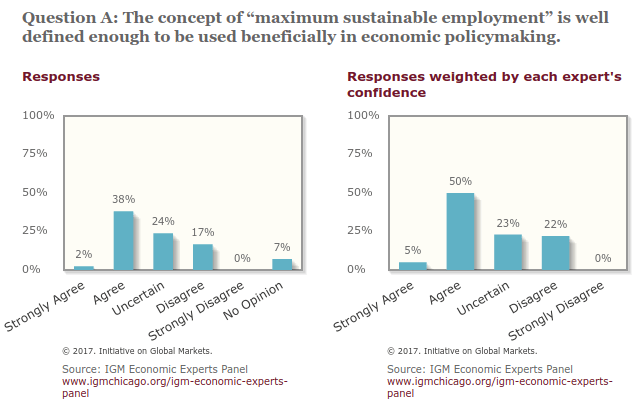
The Chicago Booth IGM Experts’ Panel recently posted an interesting result about the problems with unemployment:

IGMChicago_EmploymentandtheUSEconomy

The question is: “The concept of “maximum sustainable employment” is well defined enough to be used beneficially in economic policymaking.”

That’s 42 economists asked, 34 with an opinion (including “uncertain”), and about half of the sentiment is positive. And that sounds about right to me. I read this question as “can we engage in macroeconomic policy that doesn’t do long-run harm?” And if I were to describe my opinion probabilistic, it would look like these results. We could probably do “good policy” with a low degree of precision (i.e. useful enough for severe situations) if 1) we magically didn’t have to deal with political squabbling and 2) explicitly limited our goals to the short run.

Respondents agreeing emphasize that it’s “good enough.” But what does that mean? What level of precision and control are we looking at here?

Here’s the basic situation: given the underlying economic reality (everyone’s individual preferences, capabilities, knowledge, etc.) it makes sense to have some limited number of unemployed people at any given time. Unemployment rate is a measure of “how far are we from 0,” not, “how far are we from the ideal level?” That raises the following questions:

  • How accurately can we know what’s going on in the world?
  • How accurately can we know what’s supposed to be going on in the world?
  • How precisely can we affect the world?

The aggregate macroeconomic theory and empirics of the 1960’s were seriously imprecise. Trying to target macroeconomic policy would be like doing eye surgery with a hand grenade. In that sort of world, your best medicine is probably chicken soup and bed rest.

Here in the present we have much better data and computation. And it’s going to get better. Facebook already has data precise enough to track the exact effects of policy down to the individual level.

But think about a precise outcome and imagine what sort of policy would be required to get there. Let’s say our outcome is “get Rick to buy a new car.” Some mix of low interest rates, the right set of subsidies, and ideal circumstances might move things in that direction. But that sort of surgical outcome is just never going to be possible through legitimate macroeconomic policy (and definitely not monetary policy*). The size of the problem just means that Butterfly Effect problems will prevent macroeconomic policy from having household-level precision, even if the data could (in principle) measure the effect.

Less precise outcomes seem plausible (e.g. “get middle class households in the north east to buy 30-60,000 new cars”), but not without making a lot of second order problems. It’s not so much a “middle of the road leads to socialism” situation as a multiplier effect from a convergent series. Push a billion over there, create big distortions, follow those up with medium distortions, and finally let small remaining problems fizzle out on their own. Throw in public choice issues and it seems obvious that the efficiency cost of precise interventions won’t scale up nicely.

We’re now in a world where our theoretical and empirical tools are more precise than our implementation tools. We’re no longer trying to do surgery with a hand grenade. But that doesn’t mean we’ve got a laser scalpel either. It’s more like we’ve got we’ve got laser-like measuring tools but our implementation tools are blunt objects. If we aren’t careful, we’ll spend our time swatting flies with sledge hammers.

All told, it seems possible that we could engage in fairly targeted macroeconomic policy. But as the scale increases, the marginal cost will rise rapidly (maybe less so with the right institutions). Better timing might increase the effectiveness of each dollar spent*, but overall, it seems like things have to be really bad before the government should consider anything too ambitious.

Manage an economy’s economic health using imperfect measures like unemployment rate is about like trying to manage your physical health using heart rate and body mass index figures. Can we do “good enough”? Only to a limited extent. We could stop eating garbage and get some exercise. But there isn’t some magic combination of vitamins and crystals that will stop cancer. Anyone who tells you otherwise is a) trying to sell you something and b) trying to convince themselves they’re in control of the uncontrollable.

In terms of macroeconomic policy, we should start by caring about fundamentals (i.e. long run economic development) and be skeptical of people promising to control the business cycle.


*And let’s face it, we aren’t likely to get decent macroeconomic policy (in terms of efficiency, timing, and appropriateness of policy to circumstances) out of Congress until there’s a serious cultural shift.

The Dictator’s Handbook

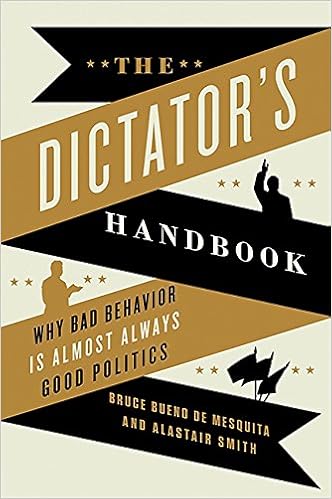
I recently pointed you towards a book that has turned out to be a compelling and interesting read.

At the end of the day, it’s a straightforward application of public choice theory and evolutionary thinking to questions of power. Easy to understand theory is bundled with data and anecdotes* to elucidate the incentives facing dictators, democrats, executives, and public administrators. The differences between them are not discrete: they all face the same basic problem of compelling others’ behavior while facing some threat of replacement.

Nobody rules alone, so staying in power means keeping the right people happy and/or afraid. All leaders are constrained by their underlings. These underlings are necessary to get anything done, but they’re also potential rivals. For Bueno de Mesquita and Smith the crucial facts of a political order are a) how big a coalition (how many underlings) the ruler is beholden too and b) how replaceable the members of that coalition are.

The difference between liberal and illiberal orders boil down to differences in those two parameters. In democracies with a larger coalition and less replaceable coalition members, rulers behave better.


I got a Calculus of Consent flavor from Dictator’s Handbook. At the end of the day, collective decision making will reflect some version of “the will of the people… who matter.” But when we ask about the number of people who matter, we run into C of C thinking. Calling for bigger coalitions is another way of calling for an approach to an effective unanimity rule (at least at the constitutional stage).

In C of C the question of the optimal voting rule (majority vs. super majority vs. unanimity) boils down to a tradeoff between the costs of organizing and the costs of externalities imposed by the ruling coalition. On the graph below (from C of C) we’re comparing organization costs (J) against externality costs (I) (the net costs of the winning coalition’s inefficient policies). The idea is that a unanimity rule would prevent tyranny of the majority (i.e. I is downward sloping), but that doesn’t mean unanimity is the optimal voting rule.

Figure 18.  Click to open in new window.

But instead of asking “what’s efficient” let’s think think about what we can afford out of society’s production, then ask who makes what decisions. In a loose sense, we can think of a horizontal line on the graph above representing our level of wealth. If we** aren’t wealthy enough to organize, then the elites rule and maximize rent extraction. We can’t get far up J, so whichever coalition is able to rule imposes external costs at a high level on I.

But I‘s height is a function of rent extraction. Rulers face the classic conundrum of whether to take a smaller piece of a larger pie.

The book confirms what we already know: when one group can make decisions about what other groups can or must do, expect a negative sum game. But by throwing in evolutionary thinking it shed light on why we see neither an inexorable march of progress nor universal tyranny and misery.

As you travel back in time, people (on average) tend to look more ignorant, cruel, and superstitious. The “default state” of humanity is poverty and ignorance. The key to understanding economics is realizing that we’ve bootstrapped ourselves out of that position and we aren’t done yet.

The Dictator’s Handbook helped me realize that I’d been forgetting that the “default state” of political power is rule by force. The liberalization we’ve seen over the last 500 years has been just the first part of a bootstrapping process.

Understanding the starting point makes it clear that more inclusive systems use ideas, institutions, capital, and technology to abstract upward to more complex levels. Something like martial honor scales up the exercise of power from the tribe (who can The Chief beat up) to the fiefdom (now the Chief has sub-chiefs). Ideology and identity can tie fiefdoms into nation-states (now we’ve got a king and nobility). Wealth plus new ideologies create more inclusive and democratic political orders (now we’ve got a president and political parties). But each stage is built on the foundation set before. We stand on the shoulders of giants, but those giants were propped up by the non-giants around them.

Our world was built by backwards savages. The good news is that we can use the flimsier parts of the social structure we inherited as scaffolding for something better (while maintaining the really good stuff). What exactly this means is the tricky question. Which rules, traditions, organizations, and processes are worth keeping? How do we maintain those? How/when do we replace the rest? And what does “we” even mean?

Changing the world involves uncertainty. There are complex interrelations between every part of reality. And the knowledge society needs is scattered through many different minds. To make society better, we need buy-in from our neighbors (nobody rules alone). And we need to realize that the force we exert will be countered by an equal and opposite force some plural, imperfectly identifiable, maybe-but-probably-not equal, and only-mostly-opposite forces. There are complex and constantly shifting balances between different coalitions vying for power and the non-coalitions that might suddenly spring into action if conditions are right. Understanding the forces at play helps us see the constraints to political change.

And there’s good news: it is possible to create a ruling coalition that is more inclusive. The conditions have to be right. But at least some of those conditions are malleable. If we can sell people on the right ideas, we can push the world in the right direction. But we have to work at it, because there are plenty of people pitching ideas that will concentrate power and create illiberal outcomes.


*I read the audiobook, so I’m basically unable to vouch for the data analysis. Everything they said matched the arguments they were making, but without seeing it laid out on the page I couldn’t tell you whether what they left out was reasonable.

**Whatever that means…

What classes are worth subsidizing?

A friend of mine has a great phrase that captures what’s wrong with about 1/3 of the population. They’re “people who would make good Nazis.” These are the obedient people who are ready to follow orders without thinking without having sufficiently high standards for whose orders they’ll follow.

My question is “what can I do to help my students not fall into this category?” The trouble is that these folks aren’t drawn to intellectual arguments. I need to get them in a more visceral way. I think the answer is art. These kids need to be watching TV shows and movies/shows like Donnie Darko and The Handmaid’s Tale (tell me your favorites in the comments!). They need something that will grab them by the lapels, shake them, and shout “question authority!”

Pragmatic folks (the sort of people who are normally excited to hear what a libertarian economist has to say) would usually think that schools should focus on pragmatic things. It’s certainly a good idea for kids to leave school with some ideas about how to manage their personal finances and research important issues. But the economic justification for subsidies rarely favors such pragmatic topics. Petroleum engineers don’t need their schooling subsidized because they’ll end up getting paid enough to pay off their student loans.

I like to think of myself as a pragmatic person*, but I’m increasingly coming around to the idea that art is worth subsidizing. Even (perhaps) if that means giving money to ridiculous people who argue incoherently against freedom.

Bildergebnis für ned flanders parents

As subsidies go, art is cheap. You don’t need to build anything as complicated as a particle accelerator. You just need to grab some kid out of the nearest Starbucks and give them a few bucks to make something.

You’ll end up paying for a lot of garbage, but life is full of waste (I’d bet good money that any good project involves a good amount of unrealized potential savings that are only obvious after the fact). For that matter, you’ll almost certainly do some degree of harm. If we threw money at art departments (the way we did with STEM departments during the cold war) the money spent on Che shirts could easily fuel the western hemisphere by attaching a generator to Guevara’s spinning corpse.

And the benefits will be vague and arguable. I’m not in the business of selling bonafide snake oil; this idea isn’t a magical cure-all.

In fact, the more you try to measure the benefits, the less benefit you might get. If we could measure important but intangible things like decency and thoughtfulness, we’d already have those things. But when we try to come up with proxies for important things, those proxies quickly become bad proxies. All the more so if we try to reward people for measurable achieving our goals. Funding should be unconditional (and focused on production rather than selection) if we want to avoid funding propaganda. We almost certainly will be funding propaganda, but if humanity is really worth saving, it’s a baby/bathwater tradeoff.

I’ve just spent three paragraphs convincing you that this might be a terrible idea. But I still think the net benefits could justify the cost. Imagine some imperfect estimate of the impact and an even more imperfect measure of the value created. What will we get out of this (on average)? In a word: more. More novels, web comics, paintings, podcasts, and films.

And with more art, there’s more cream to rise to the top. The best art typically encourages thoughtfulness and empathy. This is a “let a thousand flowers bloom” approach that would (at relatively low cost) saturate the public sphere with enough semi-thoughtful stuff to force usually-thoughtless people to think more clearly about the world around them.

If** we can subsidize free thought, this is how we’ll do it. And if it’s possible, it’s worth doing in a world where we clearly have too many people who would make good Nazis.


*If that was really true I’d work in a bank.

**Do I really think this would work? I’m not remotely sure. But I think it’s an idea worth discussing. I teach economics because I hope the marginal return (in terms of improving the “civic quality” of my students) is high. But it feels Sisyphusian at times, and some students are clearly not ready to get it. I worry that they’ll go out into the world ready to follow any maniac’s orders. In terms of the stability of a free and peaceful society, doing something about those people seems important.

Words on the Move

I just listened to a recent(ish) episode of Econ Talk: John McWhorter on the Evolution of Language and Words on the Move.

I particularly enjoyed this episode because:

  1. Emergent order (duh!).
  2. It shed new light (for me) on a category of words that serve a function but don’t really mean anything. “Well” doesn’t really mean anything. Well, sometimes it means a hole filled with water, but in this sentence I’m using it as a “pragmatic.” Other pragmatics like eh, and huh feel like filler, but they’re really a part of oral communication where the speaker can casually and non-disruptively check in with the listener. Pretty cool, huh?
  3. And the discussion of accents was interesting in light of an experience I had just the other day. I’ll get to that at the bottom, but let me set the stage…

I’ve been particularly aware of my own accent since a young age because kids have always been quick to point out how different I’ve always sounded. At around age 7 I moved from the prairies to southern Ontario and I remember some kid asking me if I was British. They might have been picking up on regional variation in the Canadian accent, or it might be that my accent was affected by the movies and TV shows I had watched to that point (I suspect watching Monty Python at a young age deeply affected me).

Later (aged 17) I moved from Canada to Texas where I worked very hard to ditch my Canadian accent and gain some Southern drawl. When I moved to California I kept trying to lose the Canadian parts of my accent but gave up on trying to gain the drawl. When I moved to Boston I picked up some affectations that now makes me stand out on Long Island. I drink kahfee instead of quofee, but since I never did like the mwahll, my pronunciation of “mall” is probably the slightly-off version I would have picked up in my youth.

The other day I was talking to a student and noticed something especially bizarre–as our conversation moved from seafood (note to self: soak calamari in buttermilk for 3 days) to boar hunting I found myself involuntarily moving back into my Texas voice! (You’ve probably already guessed that this was an econometrics student.) I have zero experience with hunting, but I had to suppress this reflexive change in my accent. Somehow, all the automatic processes in my brain have lined up in such a way that made it clear that not only do I have a lot of tacit knowledge, but I even have unseen triggers for how I communicate.

Rules for Rulers

Watch to the end for details about the book (by Bruce Bueno de Mesquita and Alastair Smith) this video is based on.

  1. I think readers of NoL will enjoy this nicely condensed public-choice-y analysis of the constraints involved in operating (and thus changing) a government.
  2. The audiobook is available on Overdrive, so you can borrow it from your library. I’m just started listening to it and I’m enjoying it immensely.
  3. I suddenly found myself as the benevolent dictator of some country. My long-term objective is to shape my society into a libertarian utopia. Here’s my plan to deal with the constraints discussed in the video: all of my advisors are required to play devil’s advocate when I propose some change. Yes-men will be summarily executed. Assuming I stay benevolent but also ruthless, does my devil’s advocate scheme work out? Please discuss in the comments. Anyone who doesn’t earnestly try to poke holes in my idea will be sent to the work camps.

A long read

According to Instapaper this article at Wait But Why is a “139 minute read.” And it was time well spent.

It’s about a new Elon Musk venture, Neuralink, but there’s plenty non-Musk stuff in there of interest. I’m agnostic on whether Elon Musk is or isn’t the next coming of the (anti-) Christ. What’s really interesting is the background material this article gives, building up a highly entertaining natural history of knowledge. The section below really captures the main thrust of that story, but it’s worth reading anyways.

minimal tribal knowledge growth before language

And this:

That leads into a discussion of how brains work, that “soft pudding you could scoop with a spoon.” Here are some excerpts:

I’m pretty sure that gaining control over your limbic system is both the definition of maturity and the core human struggle. It’s not that we would be better off without our limbic systems—limbic systems are half of what makes us distinctly human, and most of the fun of life is related to emotions and/or fulfilling your animal needs—it’s just that your limbic system doesn’t get that you live in a civilization, and if you let it run your life too much, it’ll quickly ruin your life.

And…

Which leads us to the creepiest diagram of this post: the homunculus.

The homunculus, created by pioneer neurosurgeon Wilder Penfield, visually displays how the motor and somatosensory cortices are mapped. The larger the body part in the diagram, the more of the cortex is dedicated to its movement or sense of touch. A couple interesting things about this:

First, it’s amazing that more of your brain is dedicated to the movement and feeling of your face and hands than to the rest of your body combined. This makes sense though—you need to make incredibly nuanced facial expressions and your hands need to be unbelievably dexterous, while the rest of your body—your shoulder, your knee, your back—can move and feel things much more crudely. This is why people can play the piano with their fingers but not with their toes.

Second, it’s interesting how the two cortices are basically dedicated to the same body parts, in the same proportions. I never really thought about the fact that the same parts of your body you need to have a lot of movement control over tend to also be the most sensitive to touch.

Finally, I came across this shit and I’ve been living with it ever since—so now you have to too. A 3-dimensional homunculus man.17

This is too far outside my area of specialization to say, but it’s certainly an entertaining read that seems to fit with what I know about these topics (although the section on neurology could be made up as far as I know).

From there it builds up to the moon shot idea Musk apparently has in mind: building the core technology for a high bandwidth mind-computer interface. This would be the ultimate logical extreme of a trend towards better interfaces that’s been going on since before punch cards. If you think over the natural history of knowledge, it becomes clear that this idea is ultimately just a few dozen steps further down a path we’ve been on for billions of years.

And the implications of taking it that far are profound. The pros and cons of that power are huge. Consider how much more powerful your brain is with paper and pencil than without. Or a computer. Or a computer with a GUI and a copy of Excel. Once you can plug into your computer Matrix-style, all those awesome hot keys that let you zip through your computer like a pro will be like roller skates next to a rocket sled. And the two-way link would mean we could genuinely exercise some self control… for example,  by running a computer program that zaps you when you eat too much chocolate cake.

Readers of this blog will hear Hayek warning you! Such a device gives you a lot of power to manipulate a complicated thing in ways we may never be able to understand.

But this type of personal power might be a necessary bulwark against government or corporate power. Network externalities have already locked us in to Google and Facebook. A Byzantine government has created rent-seeking opportunities that puts enormous power in the hands of the politically connected. The NSA is terrifying. And machine learning will continue to get better, giving those entrenched players even more ability to understand and manipulate large numbers of people. (I’m not endorsing this forecast, just listing it as a possibility.)

In any case, even if Neuralink is just an April Fool’s joke I missed out on till now, this article provides a theory of knowledge that’s well worth reading.

In the near future I’ll argue why you need such a theory of knowledge. Stay tuned.

A quick rant on NY’s Excelsior Scholarship

Long Island Business News had a cover story last week: “Free for all?

And the answer is no.

NoL readers don’t need to be reminded that there ain’t no such thing as a free lunch. But I want to focus on the “for all” aspect. And the answer there is also no. This is a program that benefits the middle class and simply won’t be available for the poorest kids in the state.

There are a lot of different programs for paying for schooling costs, and I don’t want to get bogged down in specifics. So here’s (roughly) how this new program works: full time students whose family income is below (approximately) the 75th percentile get more money for school. That money goes away if they stop meeting those criteria.

This is not going to be helpful to poor students who don’t have to resources necessary to go to school full time. It sounds inclusive, but they might as well make the income requirement family income between the 60th and 75th percentile.

In the best case scenario, we might end up getting a positive return on this program (generating more tax revenues from more productive workers). But we still have to ask about what alternatives were possible.

Here are three problems with that outcome:

  1. If those kids were going to go to school anyways, then we’re just creating a common pool problem where costs and benefits aren’t compared by the relevant decision makers.
  2. If some of those kids weren’t going to go to school otherwise, then we’ve increased the pressure on poor kids to get a college degree without helping them out. And if we’re thinking of this like an investment, the returns would be higher on getting more poor kids to go through school.
  3. If this program doesn’t have a return on investment high enough to offset the costs, then that budget line has to compete with some other program (tax returns would be nice, or investment in infrastructure, or something else).

I don’t expect any legislation to solve the problem once and for all. But this program is more likely to make the underlying problems worse, at the expense of poor people, and with little net gain. Not only is this bad economics, it’s not even in line with the more honorable goals of progressives. It’s simply a way for politicians to buy votes with other people’s money.

Minarchism, Anarchism, and Democracy: A Shared Challenge

Minarchism–basically as small a government as we can get away with–is probably the most economically efficient possible way to organize society. A night watchman state providing courts of last resort and just enough military to keep someone worse from taking over.

The trouble (argues my inner anarchist) is that if we’ve got a government–an organization allowed to force/forbid behaviors–we’re already on the slippery slope to abuse of powers through political trading. Without an entrenched culture that takes minarchism seriously it’s only a matter of time before a) the state grows out of control and you’re no longer in a minarchist Utopia, or b) a populace unwilling to do their part allows violent gangs to fill the power vacuum.

Having a government at all is a risky proposition from the perspective of someone worried about the abuse of that power. Better not to risk it at all.

Anarchism relies on the right culture in a similar way. This is clear to critics of anarchism (basically it’s just the minarchists who are willing to take anarchists seriously at all) and is the crux of an important argument against anarchism. Without the right culture, what’s to stop people from just creating some new government? Nothing at all.

In fact, we face the same problem in the military-industrial-nanny-state complex of our imperfect real world. For any government–or lack of government–to work, the ideological framework of the people living in that society has to line up properly. To the extent people are ignorant, distracted, short-sighted, biased, or mean-spirited, we get governance that reflects those flaws.

If we want to live in a better world, we can argue all day about what sort of government we do or don’t want. But ultimately we have to work on improving the culture, because the median voter is still in charge.

The language of the economy: prices

50 Things That Made the Modern Economy is looking for a 51st thing. Below is the email I sent them.

Continue reading

Cycling in Amsterdam

I just got back from a week in London and a week in Amsterdam. Probably the most striking thing I encountered was the wonderful dutch cycling culture. Any transit system involves some implicit negotiation between motorists, pedestrians, and others. On Long Island the motorists won. In Amsterdam, cyclists won.

I’m on a bit of a Dutch cycling high, despite only spending about 2 hours on 2 wheels while in Amsterdam. The dutch take their bicycles seriously and they shape their environment to that end. The Airbnb I stayed at had frontage on a bicycle road but no direct access to a motorway. I’m not 100% on this, but I think the Netherlands’ liability laws make the faster vehicle strictly liable for accidents which serves as an implicit subsidy for bikes.

100_4514
A typical Dutch cycle path

Here are some things I like about this culture:

  • The engineering. I really like the way they do bike locks… nearly every bike has a built in lock that disables the rear wheel. Most of these locks also have a chain to lock the bike to a fence, but that chain locks with the same key for the rear wheel.
  • It encourages enough density to get people interacting with each other, but still expands your plausible travel distance. They’ve got a nice balance between closeness and congestion.
  • It’s easier on the environment (excluding the costs of building bikes and bike roads).
  • Light physical exercise feels great.
  • The infrastructure involved in managing bike traffic is pretty minimal. Speeds are slow enough that human judgement works well outside of the busiest areas.

Why should libertarians care? Well, most of them probably have better things to focus on. But those of us living in or near dense cities, this is an example of a way of life that fits nicely with our broader goal of a peaceful, prosperous, liberal order. If Manhattan tried to be more like Amsterdam it could be a huge boon (I think… based on my preferences and zero scientific analysis) to human flourishing.

Some Thoughts on Best of Enemies

I’ve been making an unnatural effort to stay abrest of American politics the last few months and I’m reaching the end of my rope. A while back I added Best of Enemies: Buckley vs. Vidal to my queue, and now seemed like a good time to watch it. I don’t know much about either but based on some vague recollection of offhanded comments by older professors, I expected I would be watching political discussion with class and/or depth.

I would not. 

While both are eloquent and poetical, neither seemed to offer much more than insults for each other. Their bickering was entertaining. But it was not enlightening. They were a fancier version of a modern poli-tainmemt show. 

The world’s definitely going to hell in a hand basket, but it always has been.

Update: I just finished the movie. The producers have a clear message: Buckley/Vidal was the beginning of the end. They are ending the documentary with clips of both men expressing skepticism at the wisdom of their now famous 1968 debates.

Vidal (in the 10th debate):

I think these great debates are absolutely nonsense. The way they’re set up, there’s almost no interchange of ideas, very little, even, of personality. There’s also the terrible thing about this medium that hardly anyone listens. They sort of get an impression of somebody, and they think that they’ve figured out just what he’s like by seeing him on television. 

Buckley (in some other context):

Does television ruin America? There is an implicit conflict if interest between that which is highly viewable and that which is highly illuminating.

There’s also a clip from this gem:

Update 2: I fixed some grammar and missing words after initially posting… Still figuring out the Android app for WordPress…

AI: Bootleggers and Baptists Edition

“Elon Musk Is Wrong about Artificial Intelligence and the Precautionary Principle” – Reason.com via @nuzzel

(disclaimer: I haven’t dug any deeper than reading the above linked article.)

Apparently Elon Musk is afraid of the potential downsides of artificial intelligence enough to declare it “a rare case where we should be proactive in regulation instead of reactive. By the time we are reactive in AI regulation, it is too late.”

Like literally everything else, AI does have downsides. And, like anything that touches so many areas of our lives, those downsides could be significant (even catastrophic). But the most likely outcome of regulating AI is that people already investing in that space (i.e. Elon Musk) would set the rules of competition in the biggest markets. (A more insidious possible outcome is that those who would use AI for bad would be left alone.) To me this looks like a classic Bootleggers and Baptists story.

Trump Jr.

Last school year I had to deal with a pair of students (Tweedledee and Tweedledum) I caught cheating on a takehome final. When confronted with the evidence, each insisted that it was the other’s fault, and that only that other student should face any consequences.

Bear in mind that if they complete their degrees, they would be in the top 30% of the population in terms of educational attainment. In today’s world, that basically means they’re among the best and brightest, they’re high status, and they’re “the future”. If we could meaure status on a linear scale, getting a college degree still pushes you high up on that scale. 

At the time I figured that they were at least towards the bottom of that top 30%. Certainly, I still hope they’ll grow out of it. Unfortunately, Draco Malfoy’s Junior’s latest scandal shows that being bad at cheating isn’t the social hinderance we might have hoped for.

Related link: http://reason.com/blog/2017/07/13/how-trump-apologists-will-defend-the-ind

Immigration and States’ Rights

Bryan Caplan (arguing the affirmative) and Christopher Wellman recently debated whether immigration is a human right.

Wellman won the debate according to audience votes, but I think his argument was significantly weaker. He made confused arguments that, when given second thought lend credence to Caplan’s position. But through hand waving he transitioned to “and therefore states’ rights!” I am far from convinced that state’s rights are valid, but I do want to explore an interesting issue he raised: the moral weight of collective phenomena.

Markets generate economic information more intelligently than any individual participant. Competition and collaboration in cultural spaces generate more and better art than any individual on their own. Society is the outcome of individual choices, but the collective is something apart from those individuals.

We have various collectives (e.g. cultural regions, markets, local communities, families, national identities, sports fandom, science, etc.), many of which are special. They provide club goods (sometimes club bads), and require the support of their members. These networks exhibit emergent properties–the whole is more than the sum of its parts.

So surely those members should have some say in the management of the collective?

This is where Wellman went off track. Yes, these collectives are important. Yes, they require some form of governance. But that doesn’t unambiguously imply involvement of government.

Consider an excellent example Wellman gives: families. Families are an essential part of the structure of society and one we are each deeply familiar with. If there’s a collective entity with moral weight, surely it’s the family.

Wellman posed the hypothetical around the 32:45 mark: what if he returned home and found that his wife had unilaterally adopted a new child? Clearly this is freedom of association run amok! But the example doesn’t imply the need for state involvement; it implies the need for couples therapy! If he and his wife together decide to adopt, then the question remains, “why should the government have a say in this?” Currently it does, which means that whatever the median voter is cool with is acceptable, even if that means preventing this adoption that clearly doesn’t affect them. That seems untenable unless we have strong evidence that adoptions tend to create large negative spillovers.

The moral weight of a family doesn’t imply either state involvement or democratic decision making. Members can be added to a family through birth or marriage. The decision is made by the one or two individuals most directly involved (perhaps with some role for other family members). And those decisions are made non-coercively. Parents may intervene to prevent teenage Romeos and Juliettes from getting married, but adults are basically allowed to make their own decision.

I’m guessing here, but I’d bet that 90% of people would agree that the way we do freedom of association in families is basically the right way to do things.

Polycentrism!

The scope of a family does not fit neatly into the boxes drawn on a map, nor do most other collective phenomena. Red Sox Nation isn’t just Boston. Regional cultures overlap. Languages cross borders.

We want the collective decision making institutions to reflect the area of spill-overs. Decisions affecting a family should be made within the family. I shouldn’t be directly involved in decisions about how to provide local public services in San Diego. Global spillovers justify global decision making, but local spillovers don’t.

When it comes to immigration, we have to ask:

  1. What collectives will they affect? (certain labor markets, local communities)
  2. Are they likely to create large negative spillovers?
  3. What is the current form of institutions governing those collectives?

There are high stakes for many potential immigrants (especially those coming from places typical Americans are most afraid of), so we should probably go a step further: if there’s a solution to some potential spillover problem that isn’t significantly more costly than immigration restrictions, we should feel obliged to use that solution. For example, it should be easier to come here to live and work than it is to get welfare benefits (although getting that policy to work raises a host of other questions).

Rights imply action

Let’s agree on this: there are collective phenomena that are special. We want to take care of these phenomena which means figuring out the appropriate form of governance for each case.

Wellman gives another family example that blows his own argument out of the water: what if he was put in an arranged marriage? This would deny him important scope for self-determination. And therefore (he argues) states, being important collective phenomena, have a right to self-determination.

How did the audience not notice this?! Immigration restrictions deny me choice over who to voluntarily associate with and so deny me scope for self-determination.

Even if it feels weird from a rational-individualist perspective, there is something special about (e.g.) a country. But that doesn’t mean we should abandon methodological individualism. We know that only individuals make choices, even if they make those choices for the sake of collectives. A collective can have moral weight but still lack the ability to choose. To my mind, this kills the idea of states’ rights (as in “right to do x” or “right to self-determination”) in general.

What we’re left with is the original question: how do we manage the collective? What decisions do we make collectively, and what do we decide piecemeal?

For many (most?) collectives, including the most important ones, we allow freedom of (dis)association and leave the state out of it. Wellman did not answer the question of “why should immigration be different?” I suspect there are strong arguments to be made, but the closest I heard in this debate is that we can think of this as a question of governance, and that government sometimes provides governance.

As Wellman points out (around the 30:00 mark) there is (sometimes) a tension between rules favoring individual freedom and rules requiring collective decision making. There are plenty of examples of scenarios where we uncontroversially prefer to limit some individual rights–we do this automatically with negative rights by denying you the freedom to murder in support of your right to life.

It’s not clear to me that the expected effects of immigrants are widespread enough to justify as sweeping a policy as “only the following people are allowed in these particular thousands of square miles.” For immigration (but not access to the welfare state), the presumption of liberty seems the way to go.

tl;dr: We have various collective goods that are special (e.g. the “character” of a community). This calls for some form of governance to allow the individuals directly involved to manage collective goods. This frequently calls for constraints on individual freedoms for the benefit of the community, but that doesn’t mean that the special collective identity of a country justifies a presumption of closed borders.

The debate over whether the nation state is violating human rights by restricting immigration (with caveats made for “obviously” reasonable restrictions like keeping out known murderers) is not closed by pointing out that there is a collective good associated with the nation state. States can be special without having states’ rights.