The long-run risks of Trump’s racism

hayekvstrump

This week, the United States and much of the world has been reeling from Trump’s xenophobic statements aimed at four of his Democratic opponents in Congress. But the U.S. economy continues to perform remarkably well for the time being and despite his protectionist spasms, Trump is widely considered a pro-growth, pro-business President.

This has led some classical liberals to consider Trump’s populist rhetoric and flirtations with the far right to be a price worth paying for what they see as the safest path to keeping the administrative state at bay. Many classical liberals believe the greater risk to liberty in the U.S. is inevitably on the left with its commitment to expanding welfare-state entitlements in ways that will shrink the economy and politicize commercial businesses.

In ‘Hayek vs Trump: The Radical Right’s Road to Serfdom’, Aris Trantidis and I dispute this complacency about authoritarianism on the right. In the article, now forthcoming in Polity, we re-interpret Hayek’s famous The Road to Serfdom in light of his later work on coercion in The Constitution of Liberty.

We find that only certain forms of state intervention, those that diminish the rule of law and allow for arbitrary and discriminatory administrative oversight and sanction, pose a credible risk of turning a democratic polity authoritarian. A bigger state, without more discretionary power, does not threaten political liberty. Although leftwing radicals have in the past shown disdain for the rule of law, today in the U.S. and Europe it is the ideology of economic nationalism (not socialism) that presently ignores democratic norms. While growth continues, this ideology may appear to be compatible with support for business. But whenever the music stops, the logic of the rhetoric will lead to a search for scapegoats with individual businesses in the firing line.

Several countries in Europe are much further down the 21st road to serfdom than the U.S., and America still has an expansive civil society and federal structures that we expect to resist the authoritarian trend. Nevertheless, as it stands, the greatest threat to the free society right now does not carry a red flag but wears a red cap.

Here is an extract from the penultimate section:

The economic agenda of the Radical Right is an extension of political nationalism in the sphere of economic policy. While most Radical Right parties rhetorically acknowledge what can be broadly described as a “neoliberal” ethos – supporting fiscal stability, currency stability, and a reduction of government regulation – they put forward a prominent agenda for economic protectionism. This is again justified as a question of serving the “national interest” which takes precedence over any other set of values and considerations that may equally drive economic policy in other political parties, such as individual freedom, social justice, gender equality, class solidarity, or environmental protection. Rather than a principled stance on government intervention along the traditional left-right spectrum, the Radical Right’s economic agenda can be described as mixing nativist, populist and authoritarian features. It seemingly respects property and professes a commitment to economic liberty, but it subordinates economic policy to the ideal of national sovereignty.

In the United States, President Trump has emerged to lead a radical faction from inside the traditional right-wing Republican Party on a strident platform opposing immigration, global institutions, and current international trade arrangements that he portrayed as antagonistic to American economic interests. Is economic nationalism likely to include the type of command-and-control economic policies that we fear as coercive? Economic nationalism can be applied through a series of policies such as tariffs and import quotas, as well as immigration quotas with an appeal to the “national interest.”

This approach to economic management allows authorities to treat property as an object of administration in a way similar to the directions of private activity which Hayek feared can take place in the pursuit of “social justice.” It can take the form of discriminatory decisions and commands with a coercive capacity even though their authorization may come from generally worded rules. Protectionism can be effectuated by expedient decisions and flexible discretion in the selection of beneficiaries and the exclusion of others (and thereby entails strong potential for discrimination). The government will enjoy wide discretion in identifying the sectors of the economy or even particular companies that enjoy such a protection, often national champions that need to be strengthened and weaker industries that need to be protected. The Radical Right can exploit protectionism’s highest capacity for partial discriminatory applications.

The Radical Right has employed tactics of attacking, scapegoating, and ostracizing opponents as unpatriotic. This attitude suggests that its policy preference for economic nationalism and protectionism can have a higher propensity to be arbitrary, ad hoc and applied to manipulate economic and political behavior. This is perhaps most tragically demonstrated in the case of immigration restrictions and deportation practices. These may appear to coerce exclusively foreign residents but ultimately harm citizens who are unable to prove their status, and citizens who choose to associate with foreign nationals.


Blockchain Distributed Governance

Blockchain-Funds

This is a cross-post from the blog of the Centre for the Study of Governance & Society at King’s College London.

Over the last two decades online services have transformed from a product of a multitude of enterprises to being dominated by a handful of corporate-owned platforms such as Apple, Microsoft, Facebook, Google and Amazon. They specialize in connecting media producers to users. These are often mutual interactions with users both producing and consuming content. These platforms play an increasing role governing commercial exchange, as well as civil discussion, with plausibly pernicious implications for liberal democracy. As I propose in a recent paper ‘Markets for Rules’, blockchains offer a promising solution to this danger by helping to displace corporate ownership in favor of common platforms sustained by users themselves.

Corporate concentration has produced enormous efficiencies and innovations, improving user experiences and boosting investment in hardware and infrastructure. But it has also had several bad consequences. These enterprises face extremely low marginal costs and network effects whereby additional users add value to an existing user-base. Some of these effects are explained by these platforms’ business models of collecting personal data to target advertising more effectively at customers. The more interactions on a single platform users have with each other, the more useful the data for advertisers. The result is overwhelming returns to scale and a winner-takes-all competition for profits.

This has troubling implications for economic inequality, especially if we end up with a handful of corporations taking a bite out of every conceivable transaction. Of greater concern is the way owners exert control over who can join and what people are allowed to do on their platforms. Content producers can be demonetized or banned, effectively denying them access to a user-base or revenue. Online sellers can find themselves frozen out of a platform payment system without legal remedies. Controversial or unpopular producers survive at the whim of executives or, at best, a patchily enforced official policy.

This reliance on private governance is a problem for consumers, producers and ultimately citizens. But it is also a challenge for executives who find themselves mediating acrimonious personal disputes and political debate. With all the data in the world, they struggle to judge consistently what belongs on their platforms. The fact that these corporations have ended up functioning as unofficial censors and wielders of sanctions has led some commentators to propose regulating these platforms as public utilities or, more radically, nationalizing them so that access to them is decided democratically. These solutions have their own perils because any centralized system of monopoly control, whatever the underlying democratic credentials, can produce authoritarian outcomes. Liberal democracies up until now have been sustained by an independent civil society constituted by overlapping and competing spheres of governance, not the monopoly of either democratic or corporate government.

The prosecution of the CEO and founders of Backpage, who failed to exclude sex workers from their platform, illustrates the reliance of these private enterprises on government support on controversial policy issues even in relatively free societies. The combination of privately-developed data-collecting networks with over-arching state control is arguably reaching a nadir in China which is rolling out an unaccountable surveillance system of ‘social credit’ that can identify political dissidents and automatically exclude them from significant spheres of civil society.

Is there a way that blockchains can help navigate around the centralising and authoritarian impetus of technology-facilitated governance? Blockchains emerged from two pre-existing technologies – public ledgers and asymmetric cryptography – to produce a way of sharing data across a network that is resistant to manipulation by unauthorized actors. Initially conceived as offering alternatives to state-backed currencies, blockchains are now used to build decentralized autonomous organizations (DAOs) and dapps (decentralized apps). They can supply similar functions as corporate platforms but without an overall owner.

These systems are sustained by rewarding network participants with tokens (through completing intensive computing processes called mining). Tokens are convertible into ordinary currency, albeit currently at volatile rates. The entrepreneurs that build these platforms typically reward themselves and investors a large stake in those tokens but once the network is launched, they do not have control over how it is utilized. The rules of each network are self-enforcing. These rules can be changed, either through the original (or new) developers launching a rule-set that others may choose to switch over to (a fork). Alternatively, the rule-sets might contain provision for amendment. Such amendment schemes are, of course, open to manipulation as is the case for all political processes. Nevertheless, what these schemes offer is a way of interacting and exchanging at large distances without an overarching ruler. Instead, conduct is permitted on the basis of fixed rules enforced mechanically by people’s decisions to participate in the system. One way of looking at these schemes is that they have decentralized properties of communal norms, combined with the possibility of more deliberate design and experimentation of more formal rules and institutions. I call this common government.

The implications of this new technology and kind of governance might turn out to be very far-reaching, approaching that of the development of the Internet itself or even the printing press. But what could it mean for familiar Internet platforms in the medium-term? First, participating in mutual platforms might better align the incentives of users and platform designers. Right now, platform owners rely on squeezing as much data out of users as possible in order to sell it on to advertisers and to sell additional services. Mutual platforms, without responsibilities to shareholders, can experiment with different funding models. Individual users might elect to sell access to their profile to advertisers but the data itself can be made more secure as it will be a property of an encrypted network rather than a profile stored in a central private database. Privacy can be better assured than private management with public regulation.

Second, the networks can be more robust both to natural and political perturbations. Under decentralized protocols, ordinary users help store and serve content to each other. With the addition of blockchains, these users can be compensated for making their idle computer resources available for network use. This means that data doesn’t have to travel so far as is currently the case from host to user and the network as a whole can better cope with outages from particular nodes without data loss. Without a central controller, there is no particular agent that a government can coerce or punish for allowing specific interactions over a platform. Governments would then face the more difficult choice of permitting or prohibiting Internet communications altogether. It is thus more robust against arbitrary government censorship and manipulation of trade.

The relationship between users on a platform is mutual. The relationship between users and platform owners, however, is presently hierarchical – a private dynamic that government agencies can exploit. What blockchains may eventually permit is the provision of relatively efficient networks reliant neither on a single public agency nor private owner.

Learn more about Nick’s work here.

Britain’s Pornographer and Puritan Coalition

D1dm1BuWkAAYreQ

Brexit isn’t the only ridiculous thing happening in the United Kingdom. In April, the British government is rolling out statutory adult verification for pornography websites and content platforms. This requires all adult content providers to have proof of age or identity for all their users, whether a passport or a credit card (or more ludicrously a ‘porn pass’ that Brits wishing to browse anonymously will have to buy from local newsagents). The government plans to require internet service providers to block pornography websites that are not in compliance with adult verification once the system is in place. For those with university institutional access, Pandora Blake has written a timely explanation and critique published in Porn Studies: ‘Age verification for online porn: more harm than good?’.

Technical challenges with rolling out the system have led the dominant pornography search platform owner, MindGeek, to develop proprietary solution, AgeID, in cooperation with regulators. This cooperation between the dominant commercial pornography platform supplier and a Conservative government publicly intent on restricting access to pornography might appear surprising. However, it can be explained by a particular pattern of regulatory capture identified in public choice theory as a Bootlegger and Baptist coalition. Bruce Yandle observed that throughout the 20th century, evangelical Christians in the United States agitated for local restrictions on the sale of alcohol with the avowed aim of reducing consumption but with the secondary effect of increasing demand for alcohol for illegal bootleggers. Hence both interest groups, apparently opposed in moral principle came to benefit in practice. We now have a classic British case study. In this case, MindGeek is not acting as a literal bootlegger. It intends to be fully legally compliant with the filtering regime. However, the law will block all non-compliant competitors without a comparable verification system. They can gain a competitive advantage with a proprietary technical solution to the barrier introduced by the government.

Introducing identity verification systems has high fixed costs and low marginal costs. It is costly to develop or implement but easy to scale once integrated. The larger the pornography enterprise, the more easily these costs can be absorbed without the risk that it will not be worthwhile to serve the British market. For many smaller international pornography websites, without in-house legal advice or technical expertise, it might prove uneconomical to serve British users directly. So MindGeek’s platforms could become the least-cost legal gatekeeper between small enterprises producing pornographic content and the British public. The government is raising transaction costs to accessing pornography in a way that impacts larger and smaller platforms asymmetrically and favors one dominant platform in particular.

Both the premise of this policy and its likely impact on the market for pornography is unpromising. At its most benign, this could be a characterized as a ‘nudge’ against the consumption of pornography and reducing access of inappropriate content to minors. But these limited benefits have costs for both producers and consumers. On the consumption side, it increases risks to data security and privacy because it will plausibly tie records of pornographic access to verified identities, with a clear likelihood of being to infer an individual’s sexuality from private browsing. This could represent a particular vulnerability for LGBTQ identifying individuals who live in communities where there is still stigma attached to minority sexual orientations.

On the supplier side, it takes what already appears to be a market with strong tendencies towards a winner-takes-all model, and then augments it so that a dominant platform has a legally enforceable competitive advantage over potential rivals in the market. Ultimately, it threatens to further strengthen the bargaining position of a single corporate pornography platform against the sex workers who supply their content.

It’s no longer the economy, but we are still stupid

Motivated Reasoning, Public Opinion, and Presidential Approval‘, an interesting new paper forthcoming in the journal Political Behavior (summarized here), by Kathleen M. Donovan, Paul M. Kellstedt, Ellen M. Key, Matthew J. Lebo finds that support for sitting presidents has become increasingly misaligned with national economic expectations. Rather than being a sign of voters realizing that presidents play little role determining economic performance, they attribute this to increased partisan polarization.

I think this is a compelling account. All I would add is a potential causal mechanism. My current favorite dimensions for analyzing democratic trends in the developed world is demography. Voters are ageing. When retired, they tend to have much less direct involvement with the productive economy than when they were working. On average, the elderly are quite rich and living off entitlements they have acquired during their working lives. So they are both less reliant on current economic opportunities and less knowledgeable of them. This means their personal costs of partisanship, relative to good policy, is lower than it used to be. And this is what lets all the culture-war nonsense creep into people’s decision functions.

Obscenity law liberalised

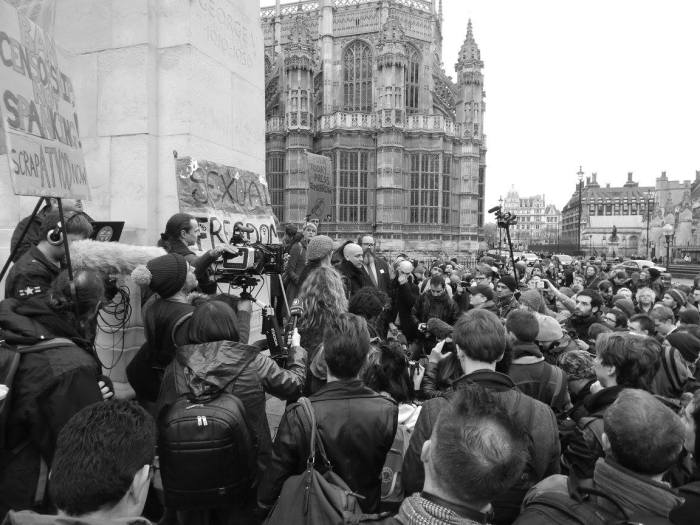
2014 Protest outside parliament for sexual expression. Photo by BeeMarsh BeePhoto
December 2014 Protest outside parliament against sex censorship. Photo by BeeMarsh BeePhoto

This is a cross-post from my contribution to the Adam Smith Institute blog.

Last week the Crown Prosecution Service published updated guidance for prosecutions under the Obscene Publications Act (1959). Legal campaigning has brought about a big change: the liberal tests of harm, consent and legality of real acts are now key parts of their working definition of obscenity. The CPS explain:

… conduct will not likely fall to be prosecuted under the Act provided that:

  • It is consensual (focusing on full and freely exercised consent, and also where the provision of consent is made clear where such consent may not be easily determined from the material itself); and
  • No serious harm is caused
  • It is not otherwise inextricably linked with other criminality (so as to encourage emulation or fuelling interest or normalisation of criminality); and
  • The likely audience is not under 18 (having particular regard to where measures have been taken to ensure that the audience is not under 18) or otherwise vulnerable (as a result of their physical or mental health, the circumstances in which they may come to view the material, the circumstances which may cause the subject matter to have a particular impact or resonance or any other relevant circumstance).

Continue reading

John Rawls had good reason to be a reticent socialist and political liberal

31u2bmz6ytl._sx312_bo1,204,203,200_

John Rawls: Reticent Socialist by William A. Edmundson has provoked a renewed attempt, written up in Jacobin and Catalyst, to link the totemic American liberal political philosopher with an explicitly socialist program to fix the problems of 21st century capitalism, and especially the domination of the political process by the super-rich. I found the book a powerful and enlightening read. But I think it ultimately shows that Rawls was right not to weigh his philosophy down with an explicit political program, and that socialists have yet to respond effectively to James Buchanan’s exploration of the challenges of non-market decision-making – challenges that bite more when states take on more explicit economic tasks. The large-scale public ownership of industry at the core of Edmundson’s democratic socialism is plausibly compatible with a stable, liberal political community in some circumstances but it is unclear how such a regime is supposed to reduce the scope of social domination compared with a private-property market economy in similar circumstances once we look at public institutions with the same skeptical attention normally reserved for private enterprise. A draft review is below.

Continue reading

Rent isn’t a four-letter word

download (3)

Inspired by the publication this week of NYU scholar Alain Bertaud‘s critical new book Order without Design: How Markets Shape Cities (MIT press), Sandy Ikeda‘s pre-book development series Culture of Congestion over at Market Urbanism, and London YIMBY, here is a note on housing reform.

Classical liberals see the economic solution to housing as relatively simple: increase supply to better meet demand. By contrast, the political economy of housing is almost intractably complex. The reason for this is that there are endless externalities associated with new housing: access to light, picturesque landscape, open space and uncongested roads just for starters. These gripes and grievances are the bread and butter of local politics. Unlike consumer product markets, housing cannot be disentangled from these social, political and legal controversies. A successful market-based housing policy must establish institutions that not only encourage housing supply growth but navigate around these problems while doing so.

Policy reform proposals that deliberately favour increasing owner-occupied single-family homes, as tends to be the focus among market liberals in the UK (and to some extent in the US), are currently self-defeating. As justified as they were in the past to achieve a more market-friendly political settlement, they are now a barrier to achieving plentiful, affordable housing. This is because every new homeowner becomes an entrenched interest, a potential opponent to subsequent housing development in their area. They impose more political externalities than renters. I propose we cut the link between support for home ownership and housing supply policies. This would free up policymaking to focus on expanding provision by all available market-compatible means.

This should include greater encouragement of institutional landlords, especially commercial enterprises. Commercial landlords have more incentive and capability to expand supply on estates that they own, while long-term renters (unlike homeowners) have an interest in keeping rental costs low. The lack of private firms dedicated to supplying housing in England compared to much of the rest of the world is startling and yet often overlooked even by friends of free enterprise.

Continue reading

Populism versus Constitutional Democracy

What is the difference between a conservative and a reactionary? A conservative knows when she has lost.

A conservative respects the status quo for the sake of stability. The reactionary rebels against it. Unfortunately, it is the reactionary impulse within Brexit that now threatens to hem in the liberties of British citizens, and threaten the rights of foreign residents, for a long time to come. A looser but productive relationship that Britain could have had with the European Union was lost, first at Maastricht in 1992, then again at Lisbon in 2007. A conservative recognizes this loss and adapts her politics to the new landscape. The reactionary tries to reconstruct those lost pasts in vain as the chaotic debates in Britain and the increasingly disappointing outcome illustrates.

Does this mean that referendums are bad? Do they only embolden radicals and reactionaries? It depends. If referendums are used to rubberstamp the decisions of a party in power, or as a way of deferring political judgement, then they are useless at best, dangerous at worst. By contrast, if they are part of the fabric of a democracy, and act as a real veto on constitutional change, rather than a populist rallying point, then they can be enormously valuable. They act as an additional check on the political establishment that might be irrationally fixated on some new governance structure. It ensures that every major change carries with it some level of majority support.

Ten years ago, I wrote a monograph Total Recall: How direct democracy can improve Britain. I advocated supplementing representative democracy with a norm or statutory requirement for referendums on constitutional issues and new local initiative powers. I focused on direct democracy in US states that mean that US state elections often involve both voting for representatives and on propositions. Referendums are required for state constitutional changes. In some states, citizens can initiate new legislation through propositions.

There are parallel constitutional requirements in force in parts of Europe, particularly in Switzerland, Norway and Ireland. It is hardly a coincidence that direct democratic mechanisms have slowed down European integration wherever they have had statutory rather than merely advisory force. Ireland had to go to the polls several times to get the ‘right’ answer but at least this meant that a majority of Irish eventually accepted the new EU arrangements. By contrast, Switzerland and Norway, against the wishes of their political establishments, took European integration only so far before settling with generous trade relations and much more limited political integration. The cost-benefit calculus of their arrangements are up for debate, but few would deny their legitimacy. Britain’s future position, by contrast, may turn out to look much worse and all because its people never had the chance to say ‘no’ until long after the facts on the ground changed.

It’s the ability to say ‘no’ that’s important, with the implication that the status quo must still be a viable option. A people cannot be legislators. Mass votes can’t add up to complex judgements to inform actionable law. Hence the Brexit referendum for leaving the EU for an unknown alternative was bound to lead to chaos which, in the long run, may undermine the legitimacy of representative government, let alone popular democracy, rather than strengthen it. There is no status quo ante to return to.

At the time I was writing Total Recall, the spirits of referendums never voted on haunted British politics. Referendums were promised on adopting the Euro and the European Constitution. Both were abandoned when the Government realized they would almost certainly lose. So we stayed out of the Euro but signed what became the Lisbon Treaty. This turned out to be a deadly combination that eventually led to Brexit. The Euro is quite badly managed as an economic scheme. As a political mechanism, however, it binds members of the Euro much closer together. Leaving the European Union, as Britain is doing, is perilous and costly. Leaving the Eurozone would be even more difficult as it would involve establishing a new currency from scratch. If New Labour had been serious about putting Britain in a federal united states of Europe, it should have gone all in with the Euro from the beginning.

So Brexit could have been avoided but not by ignoring majority sentiments. If British referendums were constitutionally mandated rather than the random outcome of internal (in this case, Conservative) party politics; if referendums were required to change the status quo rather than a mechanism for a belligerent minority to relitigate past losses, then, like Switzerland and Norway, we would be in a much better position now.

Will our political leaders learn this lesson for the future? That I doubt.

Evidence-based policy needs theory

This imaginary scenario is based on an example from my paper with Baljinder Virk, Stella Mascarenhas-Keyes and Nancy Cartwright: ‘Randomized Controlled Trials: How Can We Know “What Works”?’ 

A research group of practically-minded military engineers are trying to work out how to effectively destroy enemy fortifications with a cannon. They are going to be operating in the field in varied circumstances so they want an approach that has as much general validity as possible. They understand the basic premise of pointing and firing the cannon in the direction of the fortifications. But they find that the cannon ball often fails to hit their targets. They have some idea that varying the vertical angle of the cannon seems to make a difference. So they decide to test fire the cannon in many different cases.

As rigorous empiricists, the research group runs many trial shots with the cannon raised, and also many control shots with the cannon in its ‘treatment as usual’ lower position. They find that raising the cannon often matters. In several of these trials, they find that raising the cannon produces a statistically significant increase in the number of balls that destroy the fortifications. Occasionally, they find the opposite: the control balls perform better than the treatment balls. Sometimes they find that both groups work, or don’t work, about the same. The results are inconsistent, but on average they find that raised cannons hit fortifications a little more often.

A physicist approaches the research group and explains that rather than just trying to vary the height the cannon is pointed in various contexts, she can estimate much more precisely where the cannon should be aimed using the principle of compound motion with some adjustment for wind and air resistance. All the research group need to do is specify the distance to the target and she can produce a trajectory that will hit it. The problem with the physicist’s explanation is that it includes reference to abstract concepts like parabolas, and trigonometric functions like sine and cosine. The research group want to know what works. Her theory does not say whether you should raise or lower the angle of the cannon as a matter of policy. The actual decision depends on the context. They want an answer about what to do, and they would prefer not to get caught up testing physics theories about ultimately unobservable entities while discovering the answer.

Eventually the research group write up their findings, concluding that firing the cannon pointed with a higher angle can be an effective ‘intervention’ but that whether it does or not depends a great deal on particular contexts. So they suggest that artillery officers will have to bear that in mind when trying to knock down fortifications in the field; but that they should definitely consider raising the cannon if they aren’t hitting the target. In the appendix, they mention the controversial theory of compound motion as a possible explanation for the wide variation in the effectiveness of the treatment effect that should, perhaps, be explored in future studies.

This is an uncharitable caricature of contemporary evidence-based policy (for a more aggressive one see ‘Parachute use to prevent death and major trauma related to gravitational challenge: systematic review of randomised controlled trials’). Metallurgy has well-understood, repeatedly confirmed theories that command consensus among scientists and engineers. The military have no problem learning and applying this theory. Social policy, by contrast, has no theories that come close to that level of consistency. Given the lack of theoretical consensus, it might seem more reasonable to test out practical interventions instead and try to generalize from empirical discoveries. The point of this example is that without theory empirical researchers struggle to make any serious progress even with comparatively simple problems. The fact that theorizing is difficult or controversial in a particular domain does not make it any less essential a part of the research enterprise.

***

Also relevant: Dylan Wiliam’s quip from this video (around 9:25): ‘a statistician knows that someone with one foot in a bucket of freezing water and the other foot in a bucket of boiling water is not, on average, comfortable.’

Pete Boettke’s discussion of economic theory as an essential lens through which one looks to make the world clearer.

Some Friday links

Actually, Curbing Uber Won’t Relieve Heavy Traffic (Liya Palagashvili, Professor at SUNY, in the New York Times)

CoinFund Is In The Heart Of The Blockchain Revolution (Alisa Cohn’s profile of Jake Brukhman and Alex Felix in Forbes)

The fatal conceit: the hubris of India’s planners (Shruti Rajagopalan, Professor at SUNY, in LiveMint)

Sovereign Entrepreneurship (Alex Salter , Professor at TTU at the Center for Innovative Governance Research)

The promise and peril of blockchain distributed governance

neoliberalthoughtcollective

I was very fortunate to learn that my essay ‘Markets for rules‘ has won the Mont Pelerin Society’s 2018 Hayek essay competition for young scholars (one of the perks of academia is being defined as young well until your 30s). I am now looking forward to presenting at MPS’s famous conference, originally organised by F.A. Hayek to build the post-war intellectual case for liberalism.

The essay is an attempt to explain the governance possibilities of blockchain technology through the lens of new institutional economics and more specifically private governance. Blockchains allow people to develop rules that can then be enforced autonomously by the participants that use them without further central direction. This could allow communities to rely more on common rules and less on formal coercive authorities to achieve widespread social cooperation. I am cautiously optimistic about the technology (it could also turn into a dystopian nightmare) though not any particular currently existing blockchain.

Here is the abstract: Classical liberals seek the paradoxical: government powerful enough to protect individuals from preying off each other, but limited enough to prevent it becoming a fierce predator itself. The emergence of blockchain technology heralds a potential revolution in our collective capacity to implement limited government. Blockchains offer a more secure and transparent way of implementing rules while permitting individual choice between rulesets that can co-exist at the same time and place. What this could ultimately mean is that a great deal of what we have traditionally conceived to be governance might be disintermediated from the territorially defined monopolistic coercive authorities that classically define states.

Battling Time and Ignorance: Mario Rizzo at 70

Last week my friend and colleague Mario Rizzo, a scholar central to the revival of  contemporary Austrian economics, turned 70. This occasion prompted a spontaneous outpouring of praise for his work, as well as messages of gratitude for his support of students and fellow academics over his decades as an intrepid professor with his home firmly at NYU. They are collected over at ThinkMarkets. Jeffrey Tucker has written an excellent summary of Mario’s intellectual contributions at the American Institute for Economic Research. Below is a segment of my birthday message:

In my home, the United Kingdom, classical liberal thought has until recently been virtually unheard within much of academia. As a student and think-tank researcher ravenous for liberal approaches to public policy, I gorged on Mario’s blog posts from ThinkMarkets. Together with Marginal Revolution and Cafe Hayek, ThinkMarkets was a critical lifeline for me facing an intellectual world dominated by various visions of authoritarianism and only slightly more benign variants of paternalism.

Thanks to Mario’s selfless contributions to the revival of Austrian economics, that intellectual world is changing, even in the UK. His co-founding of the Society for the Development of Austrian Economics and hosting the Program on the Foundations of the Market Economy at NYU has provided support and inspiration for countless young scholars.

I am very fortunate to be among that multitude.

IMG_5104


Paul Romer, the World Bank and Angus Deaton’s critique of effective altruism

220px-Paul_Romer_in_2005

Last week Paul Romer crashed out of his position as Chief Economist at the World Bank. He had already been isolated from the rest of the World Bank’s researchers for criticizing the reliability of their data. It seems there were several bones of contention, including the accusation that Chile’s current social democratic government falsified data contributing to some of its development indicators. Romer’s allergic reaction to the World Bank’s internal research processes has wider implications for how we think about policy research in international NGOs.

Continue reading

In memory of Christie Davies: defender of the right to joke

ChristieDavies

As we approach the end of 2017, I remember this year’s sad passing of Christie Davies. Davies was a rare academic beast: a classical liberal sociologist. Despite representing a minority perspective in his discipline, he was able to thrive and leave a mark that will continue to influence scholars for generations.

Continue reading

Make neo-Nazis flop off Broadway: public choice and Tina Fey’s sheetcaking

tumblr_n2evlqgunn1sbf1mqo4_500

A week ago a white supremacist rally in Charlottesville protesting the taking down of Confederate Memorial statues turned fatally violent. Other protests were due to take place this weekend in multiple U.S. cities, including New York (now postponed). How should citizens and public authorities deal with this upsurge in violent neo-Nazi protest? I am with Tina Fey on this one: don’t show up, have some cake, and encourage the NYPD to prevent violence.

Some on the left have tried opportunistically and mistakenly to associate Virginian school public choice scholarship with the far-right. This is a sadly missed opportunity because James Buchanan’s theory of club goods helps explain how far-right street protests emerge and suggest how authorities might best subdue them. I draw on John Meadowcroft’s and Elizabeth Morrow’s analysis of the far-right English Defence League (EDL).

Continue reading