Senate Democrats want Crazies with Guns out in the Street

You may have heard or read somewhere that there is a Senate amendment to ObamaCare that prohibits the government from registering guns and ammunition.

Well, the amendment (3276, Sec. 2716) is real, but what it says, as any fact-checking site worth its salt will tell you, is slightly different. It just says that certain other provisions in ObamaCare shall not be construed as the authority to do this. It is not an actual ban on doing it.

Ironically, all the liberals whining about guns and mental health and how Republicans hate sick people and want the insane to run through the streets heavily armed is turned upon its head. Continue reading

Maps in History

I’m thinking of starting a new project of putting up maps that I think will help to enhance my own perception of history and the struggle between power and liberty. Hopefully it catches on. I’ll probably have a small vignette to go along with some of the maps, some of the time. At least I hope to. This’ll help me clarify my own thoughts and perhaps even help to clarify the thoughts of others. So without further adieu: Continue reading

Porn Preferences in China

I’ve always said you can tell a lot about a culture by their sexual mores (Montesquieu would agree!). From Shanghaiist:

That Japanese porn, both gay and straight, is more popular than anything else is perhaps not surprising. Very little pornography is produced within mainland China (though some is), and China’s obsession with AV stars is well known. What’s interesting is the racial homogeneity of the top 10. Chinese porn watchers don’t appear to be very interested in anyone not of asian heritage, a mild xenophobia that’s shared with Korea and Japan, both of which also prefer to watch asians getting fucked or doing the fucking.

Pardon their French. There is more:

Of China’s neighbours, only India and Kazakhstan search for members of other races getting their sex on.

Do read the whole thing. There is a link at the end to a Buzzfeed article showing the top porn searches for all countries.

NotesOnLiberty featured on RealClearHistory

Last month NotesOnLiberty was featured on the RealClearHistory website. Forgot to mention it here before. Thanks for all your thoughts and participation folks! You can find the week we were featured (1st week of February) here.

Global Warming: So?

Le Figaro on-line is showing beautiful photographs of traditional Brittany houses with slate roofs covered with snow. (Le Figaro is one of the big French dailies. I read it every day.) The pictures are notable because Brittany is a peninsula with seas on three sides. There are even outdoors palm trees there. It’s almost never cold. Much of Europe and much of the US , including the Deep South, are experiencing one of the coldest winters on record.

I know this is meaningless with respect to the global warming hypothesis. A few data points don’t a long-term trend make, or unmake. I would refrain from mentioning this especially cold winter if climate-change cultists did no comment on the warm winter in California. It’s true that my rose bush is 25% abloom and that some of my tomatoes from last June are still more or less ripening. By the way, if that’s global warming, I am sorry it’s a religious hoax. I like it.

The global warming world view is wrong in its whole and in its parts as well. Let’s assume (“assume”) that every measurement of the alarmists and every numerical implication is correct. Then, what? It turns out we would still have much less than a global catastrophe on our hands. We would be facing a series of medium-sized problems all of which have solutions we could deal with.

For a sober article on the economic and social consequences of climate change if the cultists climate predictions were, in fact, correct, see “Socioeconomic Impacts of Global Warming are Systematically Overestimated.”

Around the Web

  1. Rumors of Chavez’s importance have been greatly exaggerated.
  2. Central banking: doomed to fail?
  3. Carl Menger and the Nature of Value.
  4. Truth, treachery, and genetically modified foods.
  5. The Law of Demand is a Bummer and The Myopic Empiricism of the Minimum Wage (the minimum wage debate).
  6. The Man Who Sells the Moon.

Glenn Greenwald on the Hypocrisy of the Left

Writing in the Guardian:

Meanwhile, a large bulk of the Democratic and liberal commentariat – led, as usual, by the highly-paid DNC spokesmen called “MSNBC hosts” and echoed, as usual, by various liberal blogs, which still amusingly fancy themselves as edgy and insurgent checks on political power rather than faithful servants to it – degraded all of the weighty issues raised by this episode by processing it through their stunted, trivial prism of partisan loyalty. They thus dutifully devoted themselves to reading from the only script they know: Democrats Good, GOP Bad.

Greenwald, a Leftist himself, is of course writing about the vitriolic attacks from the Left on Rand Paul’s filibuster the other day. There is more (it’s Greenwald after all):

That phrase – “engaged in combat” – does not only include people who are engaged in violence at the time you detain or kill them. It includes a huge array of people who we would not normally think of, using common language, as being “engaged in combat”.

Indeed, the whole point of the Paul filibuster was to ask whether the Obama administration believes that it has the power to target a US citizen for assassination on US soil the way it did to Anwar Awlaki in Yemen. The Awlaki assassination was justified on the ground that Awlaki was a “combatant”, that he was “engaged in combat”, even though he was killed not while making bombs or shooting at anyone but after he had left a cafe where he had breakfast. If the Obama administration believes that Awlaki was “engaged in combat” at the time he was killed – and it clearly does – then Holder’s letter is meaningless at best, and menacing at worst, because that standard is so broad as to vest the president with exactly the power his supporters now insist he disclaimed.

Read the whole thing.

Rand Paul for President!

By now everyone knows about Rand Paul’s thirteen-hour filibuster on the Senate floor. He succeeded in his short-term goal, as Attorney General Holder finally produced a memo affirming that the President has no right to murder American citizens who are not engaged in hostilities against the U.S. Senator Paul drew more support from colleagues than I would have expected, including Senator Minority Leader McConnell and Democratic Senator Wyden of Oregon.

But it’s not just his short-term success that has me excited. This might just be the start of a couple of very favorable longer-term outcomes.

First is the prospect that RP may run for President in 2016. He has dropped hints to that effect. He is an attractive candidate for libertarians because of his generally solid stands for economic liberty, civil liberties and non-interventionism. OK, maybe he’s a bit more conservative than some of us would like, and he endorsed Romney last year. And by traditional standards, he’s young and inexperienced.

Yet he just might be electable. He should be able to draw on the army of Ron Paul supporters who are mostly young and energetic. By 2016 the Obama administration will be in shambles and the Democratic candidate will have to distance himself from Obama. A minority party could emerge and siphon off Democratic votes. People will be looking for a fresh face, and Rand Paul does have a boyish, fresh face which doesn’t hurt. And he’s a bit less caustic and perhaps a bit more articulate than his dad.

Best of all, he could be the catalyst for a realignment of politics in this country. One side would be centered on the libertarian principles just mentioned: economic freedom, civil liberties, international peace. The first principle would attract some fellow travelers from the right and the other two would attract some from the left. On the other side would be statists of various stripes including “progressives,” who should be classified as fascists, as well as bloodthirsty warmongers like Senator McCain.

The political realignment just outlined will be familiar to anyone acquainted with the World’s Smallest Political Quiz, formerly called the Nolan chart. Millions of people have taken the quiz, and it has gained considerable respect (“The Quiz has gained respect as a valid measure of a person’s political leanings,” says the Washington Post.)

A lot can happen between now and then. RP’s rising start could fade. He could get co-opted by the Republican establishment. We’ve been disappointed before and it could happen again. But the idea does give one hope. Rand Paul for President, Gary Johnson for Vice President?

(Footnote for anyone shocked by the f-word: There are two aspects to fascism. The economic aspect leaves ownership of the means of production under nominal private ownership but with the government calling all the shots. That describes the program of the “progressives” to a tee. The other aspect is racism or nationalism, echoes of which are seen these days in the forms of affirmative action, multiculturalism, and “diversity” programs.)
The Volcker Rule

Paul Volcker is a man of considerable stature, and not just because he’s six feet, seven inches tall. He gained a reputation for courage and plain talk as chairman of the Federal Reserve System under Presidents Carter and Reagan because he broke the back of the 1970s inflation. He did so by (mostly) sticking to a tight monetary policy even though that meant sky-high interest rates and sharp back-to-back recessions before the economy could enter its vigorous recovery. Now 84, he has enjoyed a comeback in recent years as an adviser to President Obama. His Volcker Rule, prohibiting proprietary trading by banks, was heralded as one way of preventing a repeat of the recent financial crisis, and it became part of the Dodd-Frank Act signed into law in July 2010.

Dodd-Frank’s full title, incidentally, is the Wall Street Reform and Consumer Protection Act. Like most current legislation its name reflects hoped-for outcomes, not its actual provisions. Reading the act (the PDF is available here) is not for the faint of heart. There are 16 titles consisting of 1,601 sections for a total of 848 dense pages. Only a lawyer could love sentences like this:

Any nonbank financial company supervised by the Board that engages in proprietary trading or takes or retains any equity, partnership, or other ownership interest in or sponsors a hedge fund or a private equity fund shall be subject, by rule, as provided in subsection (b)(2), to additional capital requirements for and additional quantitative limits with regards to such proprietary trading and taking or retaining any equity, partnership, or other ownership interest in or sponsorship of a hedge fund or a private equity fund, except that permitted activities as described in subsection (d) shall not be subject to the additional capital and additional quantitative limits except as provided in subsection (d)(3), as if the nonbank financial company supervised by the Board were a banking entity.

Volcker initially outlined his proposal in a three-page memorandum. It came to life as Section 619 of Dodd-Frank, expanded to 11 dense pages. This section is supposed to prevent banks from buying and selling securities for their own accounts, in contrast to brokering customer trades. It also prohibits banks from holding interests in hedge funds or private equity funds or from sponsoring such funds. These prohibitions are supposed to lessen the need for future bailouts like those that were provided to financial institutions in 2008 and 2009. Continue reading

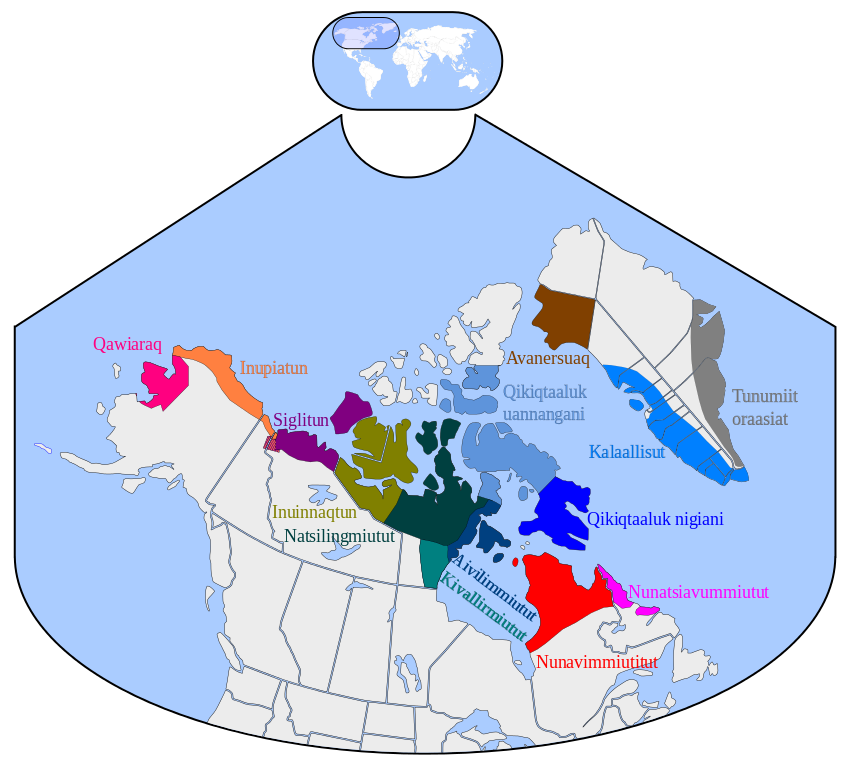
The World of the Inuktitut

Check out this sweet map of the Eskimo world today. It is broken down by linguistic groups. I wonder if these linguistic groups consider themselves ethnically distinct as well as linguistically distinct.

The Eskimo World

Here is a Wiki article on Nunavut, an experiment in Canada with indigenous self-governance (don’t get me started!).

And an article on Danish colonialism in Greenland (possibly gated).

Updated: I changed the title from ‘Eskimo’ to ‘Inuktitut’ because I just learned that the former is used as a pejorative term in Canada and Greenland (like the n-word here in the States). Inuktitut is term preferred by those highlighted in the map above. I’m not politically correct by any means, and in the US the term ‘Eskimo’ doesn’t carry any negative connotations, but being polite and being politically correct are two very different things.

More on Rand Paul’s Filibuster

Anthony Gregory explains its importance in this short video.

Religion or Institutions? An Ongoing Dialogue

Dr. Delacroix and I are continuing our back-and-forth over at Facts Matter. My latest volley:

Religion is often such an important part of a given culture that it is commonly treated separately giving the false impression that it’s a different subject in its own right [Dr. Delacroix]

This is true up to a point. Once a society adopts one of the “great religions” as their own, though, the cultural-religious blend disappears and two distinct categories arise. Small tribes with their parochial animist beliefs are one thing, but large nations sharing a holy book are quite another.

As it stands, the stonings of women in Saudi Arabia are political acts, not cultural ones. Thus the Saudis (or their enemies) are using religious undertones to their political advantage. The violence and backwardness of the region – which I readily admit is prevalent – goes back to institutions and their political and economic ramifications.

The lack of books in the Arab world is another case in point. During the late Ottoman era, and during the era of European imperialism, Arabs gobbled up books left and right. Once Arab socialism and other anti-colonial movements began to isolate their societies, the demand for books was severed.

What do you think would happen if the states of Iraq and Egypt, for example, suddenly lifted their controls on trade, universities, the press and the internet? Would Arab culture or Islam hinder the thirst for knowledge in the citizens of these countries?

Cue Marvin Harris.

Research Readings

I’m trying to get through the rest of Eugene Rogan’s The Arabs: A History and Steven Gregory’s Devil Behind the Mirror for classes, but I’ve also stumbled across what looks to be a pretty fascinating research paper on neoliberalism by a political scientist at a university in Canada. The abstract:

This article examines and theorizes neoliberal ideas related to the scale as pects of multilevel governance. It argues that neoliberalism contains a self conscious normative project for multilevel governance which is consistent across the federal, regional and global levels. It further argues that the underlying logic of this project can be usefully theorized through various critical understandings of the separation of the economic and the political in neoliberalism and, in particular, through Stephen Gill’s concept of new constitutionalism. To demonstrate these points, the article draws on the normative work of neoliberal organic intellectuals – including Hayek, Friedman, Buchanan and various neoliberal think tanks – on ‘market-preserving federalism’ and the more recent extrapolation of these ideas to the regional and global levels.

The full article is here, but it is probably gated. *sigh* It’ll be interesting to see what the author comes up with. I’ll keep y’all posted.

Cutting the Three Lifelines in Full Daylight; Boy Rape from Unexpected Quarters

I would never have thought that one can become bored with emergencies. It sounds like a contradiction in terms. Yet, here I am. I am bored with the procession of disasters that hit us every other day as a result of Obama administration actions or pronouncements. Also, I am not man enough to pay as much attention as I did a year ago. I have indignation fatigue. I should be energized by the thought of the unfairness of the crushing burden the Obama spending is placing on young people. I don’t feel it much because the young voted overwhelmingly from Obama and it seems they are the most obdurate about waking up from the dream. The ungenerous thought that they made their bed and they should lie in it dominates my reactions.

About indignation fatigue: The powers may have planned it that way. If a boxer gets punched fifty times in three minutes, he does not feel the pain as clearly as when the blows come every thirty seconds. Be it as it may, the new dispensation forces me to be more selective in what I expose myself to. Also, in what I write and what I talk about on the radio (“Facts Matter” KSCO radio Santa Cruz, Sundays 11am to 1pm, available on-line in real time.)

The recipes for sabotaging a modern, advanced capitalist economy such as this one are similar to the formulas to control it. I say, “such as this one” because I think that what I am saying below would apply equally to Germany, or to Japan, or to Finland. It would be the same play-book. This short essay is not about American exceptionalism, a political and a moral concept. It’s about the nuts and bolts of the only economic system that has brought prosperity to huge numbers, capitalism. Continue reading

Seeking Recommendations

I recently figured out how to download academic journal articles from a number of databases. I’m NOT interested in selling them, copying them, or making them available to the general public, but I would like any recommendations you’d have on reading over Spring Break.

Right now I’ve got a bunch of stuff by Frank Knight and James Buchanan I’m trying to get through. Wallerstein, Wolf and Wilmsen are next on my list.

I’d appreciate it!

Update: I’ve linked to a bunch of different sites that have open access to a number of libertarian-ish journal articles over the years. Hope you enjoy! (h/t Patrick Peterson)

All of the work is generously available for the public to read and even download, so get to it folks!