Minimum Wages: Short rejoinder to Geloso

A few days ago I posted here at NOL a short comment on some reaction I’ve seen with regards to Seattle’s minimum wage study. Vincent Geloso offers an insightful criticism of my argument. Even if his point is quite specific (or so it seems to me), it offers an opportunity for some clarification.

But first, what was my argument? My comment was aimed at a specific point raised by advocates of increasing minimum wages. Namely, that even if Seattle’s study shows an increase in unemployment, a study with a larger sample may say otherwise. My point is that the way I’ve seen this criticism raised is missing the economic insight of minimum wage analysis, namely that jobs will be lost in less efficient employers and employees first. So far so good. The problem Geloso points out is with my example. I refer to McDonald’s as the efficient employers fast food chain (think of economics of scale) and as less efficient employers the neighborhood family-run little food place (neighborhood’s diner).

Geloso correctly argues that different employers react in different ways. It is expected, for instance, that a larger employer such as a fast-food chain would have more options to make a marginal adjustment when there is an increase in minimum wages. Of course, I agree, but the point I’m rising is about where jobs will be lost first (not the specific mechanism in each employer). Geloso flips my example and argues that a small diner has more (in relative terms) to lose by letting go one out of two employees than a fast food joint that has to let one employee go among maybe ten thousand. By letting one employee go, the small employer loses a larger share of its output. Therefore a small employer would be more inclined to keep all of his labor force and cut costs on another front (less hours work in average doesn’t cut it, that’s like a shared unemployment that would also cut output down).

A large employer like a fast food chain, however, can let one out of ten thousand employees go because the loss in output is not that significant. I have two issues with this example. The first one is that a fast food chain is facing the increase in minimum wage ten thousand times, not two. To cut even the rise in cost, the firm fast food chain has to cut down its labor force 15% (1,500 employees.) But I think the problem with this example does not end here. If it were the case that small diners don’t cut employment but fast food chains do, then we should see more unemployment in larger employers than in small neighborhood diners.

A second point I want to make is with Geloso’s argument that the study is about focusing “like a laser” on one out of multiple channels in the group most likely to respond in that manner (unemployment?). That the study, as long as the focus is on unemployment, should focus on the less efficient employers (and employees) first, and not just look at the unaffected employers because that’s where we just happen to have better statistics for is my point. There are two options. The first option is that what matters is focusing on the channel the increase in cost will be managed by employers. But this is neither a focus on unemployment nor on the criticism I’m replying to. Option number two, that the study should focus on the employers “most likely” to reduce unemployment, which is actually my point regardless of how many “channels” are included in the sample.

Minimum Wages: Where to Look for Evidence

A recent study on the effect of minimum wages in the city of Seattle has produced some conflicted reactions. As most economists expected, the significant increase in the minimum wage resulted in job losses and bankruptcies. Others, however, doubt the validity of the results given that the sample may be incomplete.

In this post I want to focus just one empirical problem. An incomplete sample in itself may not be a problem. The issue is whether or not the observations missing from the sample are relevant. This problem has been pointed out before as the Russian Roulette Effect, which consists in asking survivors of the increase in minimum wages if the increase in minimum wages have put them out of business. Of course, the answer is no. In regards to Seattle, a concern might be that fast food chains such as McDonald’s are not properly included in the study.

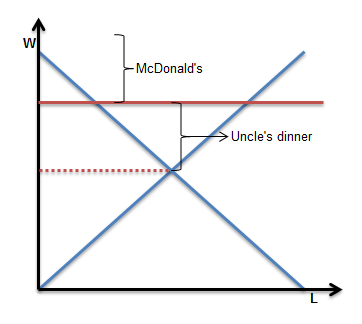
The first reaction is, so what? Why is that a problem? If the issue is to show that an increase of wages above their equilibrium level is going to produce unemployment, all that has to be shown is that this actually happens, not to show where it does not happen. This concern about the Seattle study is missing a key point of the economic analysis of minimum wages. The prediction is that jobs will be lost first among less efficient workers and less efficient employers, not equally across all workers and employers. More efficient employers may be able to absorb a larger share of the wage increase, to cut compensations, delay the lay-offs, etc. This is seen by the fact that demand is downward sloping and that a minimum wage above its equilibrium level “cuts” demand in two. Some employers are below the minimum wage (the less efficient ones) and others are above the minimum wage (the more efficient ones.) Let’s call the former “Uncle’s diner” and the latter “McDonald’s.” This how it is seen in a demand and supply graph:

minimum wage

Surely, there is some overlapping. But the point that this graph is making is that looking at the effects minimum wage above the red line is looking at the wrong place. A study that is looking for the effect on employment needs to be looking at what happens with below the red line. This sample, of course, has less information available than fast food chains such as McDonald’s; this is a reason why some studies focus on what can be seen even if the effect happens in what cannot be seen (and this is a value added of the Seattle study.)

This is why it is important to ask: “what do minimum wage advocates expect to find by increasing the sample size?” To question that minimum wages increase unemployment, then the critics also needs to focus on the “Uncle’s diner” part of the demand curve. If the objective is to inquire about something else, than that has no bearing on the fact that minimum wage increases do produce unemployment in the minimum wage market and at the less efficient (and harder to gather data) portion of it first.

PS: I have a previous post on minimum wages that can be found here.

Simple economics I wish more people understood

Economics comes from the Greek “οίκος,” meaning “household” and “νęμoμαι,” meaning “manage.” Therefore, in its more basic sense, economy means literally “rule of the house.” It applies to the way one manages the resources one has in their house.

Everyone has access to limited resources. It doesn’t matter if you are rich, poor, or middle class. Even the richest person on Earth has limited resources. Our day has only 24 hours. We only have one body. This body starts to decay very early in our lives. Even with modern medicine, we don’t get to live much more than 100 years.

The key of economics is how well we manage our limited resources. We need to make the best with the little we are given.

For most of human history, we were very poor. We had access to very limited resources, and we were not particularly good at managing them. We became much better in managing resources in the last few centuries. Today we can do much more with much less.

Value is a subjective thing. One thing has value when you think this thing has value. You may value something that I don’t.

We use money to exchange value. Money in and of itself can have no value at all. It doesn’t matter. The key of money is its ability to transmit information: I value this and I don’t value that.

Of course, many things can’t be valued in money. At least for most people. But it doesn’t change the fact that money is a very intelligent way to attribute value to things.

The economy cannot be managed centrally by a government agency. We have access to limited resources. Only we, individually, can judge which resources are more necessary for us in a given moment. Our needs can change suddenly, without notice. You can be saving money for years to buy a house, only to discover you will have to spend this money on a medical treatment. It’s sad. It’s even tragic. But it is true. If the economy is managed centrally, you have to transmit information to this central authority that your plans have changed. But if we have a great number of people changing plans every day, then this central authority will inevitably be loaded. The best judge of how to manage your resources is yourself.

We can become really rich as a society if we attribute responsibility for each person on how we manage our resources. If each one of us manages their resources to the best of their knowledge and abilities, we will have the best resource management possible. We will make the best of the limited resources we have.

Economics has a lot to do with ecology. They share the Greek “οίκος” which, again, means “household.” This planet is our house. The best way to take care of our house is to distribute individual responsibility over individual management of individual pieces of this Earth. No one can possess the whole Earth. But we can take care of tiny pieces we are given responsibility over.

Immigration and Jobs – Reprise

A good op-ed in the March 24 issue of the Wall Street Journal by Mark Krikorian forces me to go back to one of my recent postings on immigration: “Immigration and Jobs.”

Krikorian is executive director of the Center for Immigration Studies in Washington D.C. Mr Krikorian accuses everyone in America of “not facing the facts” about current and recent immigration. He insists that some questions must be posed instead of skirted. I agree, of course, but I don’t know that it’s true that people are not facing the facts. I think instead that many busy and fair people are hearing contradictory statements and that they don’t have a good framework to think things through. Krikorian states that he rests his case on an authoritative study by the National Academies of Science, Engineering and Medicine. The academies are a respected source. I take it seriously if Krikorian reports accurately. (Be aware that I have not read the study in question.)

Krikorian’s most troubling assertion is as follows: All Americans benefit from immigrants being in the US. This benefit is entirely extracted from the higher wages Americans competing with immigrants would receive absent wage lowering immigrants’ competition. In other words: Americans who compete with immigrants receive lower wages than they should; everyone else benefits from these lower wages.

I think that’s obviously overstating the case. There must be at least one immigrant generating product (GDP) that would not otherwise exist in the American economy. Maybe, there are two. One is in Silicon Valley, inventing a product – like the personal computer forty years ago – that will eventually cause the employment of thousands, or millions. The second is in Kansas, saving from demolition a beat-down hotel that provides immediate employment for two-to–four minimum wage-earning maids. (Both entrepreneurs are Indians, obviously). In general, immigrants might benefit all by offering additional, or better, services than do the native born. I develop this thesis below.

Krikorian seems to be operating from a standpoint where the work pie to be shared by Americans and by immigrants is of a permanently fixed size. This erroneous perspective, in turn, may well come from a respectable desire to stick close to research findings. Research that also (also) takes into account immigrants’ contribution to increasing the size of the pie is doable but it’s more difficult to perform and to integrate with previous findings than research that relies on a static representation of reality.

Let me admit that I don’t have any numbers at my disposal and that any reasonably credible set of numbers could blow out of the water everything I am going to say below.

First, it’s obvious that there are currently many unfilled jobs in the US. Organized labor and anti-immigration spokespeople will argue that all those jobs would be filled if the wages offered were high enough. I am skeptical of this argument for two reasons. First, Silicon Valley employers affirm vigorously that they just don’t find enough would-be employees with the required skills, at any price. I tend to believe them to some extent because they evidently spend energy and resources raiding each other for expensive existing personnel. This kind of practice suggests true, absolute scarcity. I have mentioned in one of the companion essays the difficulty farmers encounter in recruiting pickers even when they offer wages significantly superior to both the minimum wage and to the going wage in my job-poor area. I would argue that their difficulties are rooted in the same problem facing Silicon Valley employers: a shortage of local competence. Picking strawberries, for example, is not easy at all. And it requires a certain attitude, or fortitude, that is not common anymore among Americans, as I have argued elsewhere.

Second, presented below, a forbidden argument. But I must make a disclosure before I move to it: I am one of the 43 million foreign-born people now living in the US. I studied in the US and I was permanently admitted on a variant of a B1 visa. I had a main career as a university professor. I don’t believe that an extra teaching position was ever added in any university to accommodate me. (It happens for some foreigners, a very few, of star quality, like Einstein; I wasn’t one of them, let’s face it.) Of course, to obtain any university position, I had to possess the same credentials as native-born Americans who also wanted the position. (That’s right, there is no affirmative action track for white Europeans!) Good university positions are surprisingly competitive to obtain; earning tenure is even more competitive. Every position I obtained, I got from winning against similarly situated native-born.

Each time, I won the gold, if you will. This simple fact would seem to suggest that I was at least slightly better in conventional terms than those native-born who did not get the position. This fact implies at minimum that had I not competed for the position my students would have been served at best by a silver medalist. (I choose the Olympics language on purpose, from a surfeit of honesty. It’s not absurd to argue that the quality difference between the gold and the silver winners is insignificant or even accidental: On a different day, with a different wind, perhaps, the silver winner would have won the gold. But there is more.)

Like many but not all immigrants, I grew up in a language different from English, French in my case. So. I had to achieve the same credentials as my competitors in what was for me a second language. Forgive me for seeming to brag but doesn’t this indicate an intellectual competence over and above what the formal credentials express? If you doubt this shameless assertion, ask yourself how many native-born Americans are able to teach anything – besides the English language – in any francophone university anywhere. And I am not an extreme case of talent among immigrants to the US. I know a man, a distinguished biological scientist, who grew up in the African language Wolof, went to secondary school in French, to college and graduate school in English. Would you guess he possesses a certain mental nimbleness uncommon among determined monolinguals?

I will reluctantly take another step. I do it reluctantly because it is sure to lose me some friends. I will use my own case as an immigrant for an example because it’s the case I know best. It’s about the cultural endowment we carry around over and above, or aside from mastery of a foreign language.

Let me say right away that I don’t contend that I enjoy a 100% understanding of American culture, even after fifty years. I don’t understand the rules of baseball, for example. I never bothered to learn because the game seems boring. Yet, I must be conversant with a lot of national culture, just for having acquired my professional credentials and, even more so, for navigating everyday life in my society of adoption. The point is that the acquisition of another culture does not entail a one-for-one exchange, like changing clothes, for example. Much, most of what the immigrant brings with him, he retains, as one might easily assume. When I was learning American culture, I was not leaving French culture behind with the hat-check girl.

The first thing that immigrants, those who immigrate as adults, keep is mastery of their native language. This may sound mysterious to a monolingual person. It’s true that one can become “rusty” in a language one does not use. The quality of self-expression, for example, may deteriorate over time spent abroad. Yet, it’s very unlikely that an immigrant will lose the ability to watch the news in his native language, or to read a newspaper. So, I follow the news in English, of course, but also in French, some of the time. The reporting of the same events do not overlap perfectly, far from it. So, I am learning things I probably would not learn if I knew no French. (That’s in addition to carrying in my head much disorderly information from my society of origin. More below.) In my job as a teacher and as a scholar, I was routinely able to draw on broader information than did my native-born colleagues. I wouldn’t say (although I am tempted) that I had twice as large a store of information at my fingertips as they did but that I had definitely more than they.

So, in fact, I am arguing – with little embarrassment – that I must have been a better teacher and scholar than most (not all) of my native-born colleagues with similar credentials by virtue of being an immigrant.* There may be no metrics allowing an assessment of this outrageous claim. That’s because what college professors actually do is so mysterious. (Another story.)

It’s also true that to measure accurately the added work value of immigrants you have to find a way to factor in laziness, which varies much among individuals. In my case, I suspect strongly that if I had been native born, I could not have had the normal academic career I enjoyed, given my above-average level of laziness. In other words, the informational advantage associated with being a bilingual immigrant may have paid the fare for my laziness. Had I been the same person, with the same formal credentials, except less lazy, however, my presence would have much benefited American society. This detour supports my main argument of course: It does not make much sense to deny that competent bilingualism adds to normally credentialed efficacy. This is true in an occupation such as university teaching. It’s true though possibly to a lesser extent, for a plumber who will, at least, be a better citizen than a comparably situated monolingual. This is all common sense. No hard data are needed to give this scenario credence although hard figures might destroy it.

It should be fairly clear that a second language is like another tool in one’s personal toolbox. Immigrants have yet more, other additional tools that may be more elusive, more difficult to describe. I am giving it a try. All of us approach new situations through a filter that is made up partly of our past experiences, through the colander of past experiences if you will. Many of the experiences that compose the sifting device are repetitive, partly superfluous: The tenth car accident you witness does not have the same power to influence your driving as the first. There is often an excess of material in the sifter. This means that whatever the sifting process accomplishes would be accomplished as well, or nearly as well, on the basis of fewer past experiences.

My experiences in my society of origin do not perfectly duplicate those of a similarly situated native-born American. For example, I lived through a school system that was much more authoritarian than he experienced. I take from this the strong impression that my experiences in my society of origin adds to my experiences in my society of choice to give me a better sifter than what exists among the native-born population. It does this in a non-repetitive way (unlike, say, the 9th car accident.) I don’t mean that I have twice as large a sifter as they do but perhaps that I have 125% of what they carry in their heads.

This second extra tool in my tool box is factually associated with the first, bilingualism, but it’s not the same thing. An Australian, with a perfect command of English and perfectly innocent of knowledge of another language would carry the same extra tool as I do. The advantage gained through this second tool is difficult to express. It’s tacit. (I have never read anything about the topic.) I believe that my experience of another society – again, independently of bilingualism – acts like a second pair of glasses. I think I am able to watch events and people from one perspective, and then, to some extent, from a second perspective. I suspect it does not give me extra-depth but an edge in exercising common criticality. Possibly, it acts like a few IQ points that would be added to my measured IQ. Again, this thesis is very exploratory, supported by no real numbers. I must add that this second tool associated with being an immigrant is free from the effects of education. I think I have observed the expected extra resourcefulness among Mexican immigrants I knew to be semi-literate (in Spanish) performing ordinary manual jobs, in construction and in repair work, for example.

In conclusion: I and hundreds of other immigrants I have observed contribute to the society in which we live over and above the contributions of the native-born. Thus, we add to the general well-being even if we are paid exactly the same as the native-born.

The above is a short string of arguments in favor of immigration. None of it is a call for open borders. I subscribe to the lifeboat view of immigration. Too numerous immigrants could easily sink the boat that made them swim to developed societies in the first place. (According to retired foreign service officer Dave Seminara’s review of relevant studies – that I have not read – 150 million people world wide would like to move to the US, including 34% of Mexicans.) In addition, there are non-economic arguments against large-scale immigration that I support although they may be even more difficult to describe than what I tried to explain above. My analysis supports instead an active stance to design immigration policies that make rigorously the conceptual distinction between immigrants we need and immigrants in need. This distinction is not inimical to any refugee policy whatsoever; perhaps, the reverse is true.


* Please, don’t try to factor in a putative superior European education brought to the job of being an American academic as an alternative explanation. I am a French high school dropout.

How dairy farmers unions in Canada are distorting the facts about supply management

Under heat recently as President Trump has criticized supply management in Canada and retaliated against it, the different provincial associations representing dairy farmers have moved on the offensive. To promote the virtues of this system meant to reduce production in order to prop up prices through the use of trade tariffs, production quotas and price controls (how can we call those virtues), these unions have produced numerous infographics to make their case. It is even part of what they dub their These-infographics-show-that-diary-prices-are-lower-in-Canada-than-elsewhere, that milk is still a cheap drink relative to other type of drinks and those prices, supposedly, increase more slowly than elsewhere. All of these graphics are dishonest and must be dismantled.

The most egregious of these infographics – present in the “lobby day kit” – shows the price of milk in Australia (1.55 CAD), Canada (1.45 CAD) and New Zealand (1.65 CAD). They are seemingly using 2014 prices. First of all, they use data that conflicts massively with the reports of Statistics Canada that suggest that milk prices hover between 2.33$ to 2.48$ per liter.  Their data is provided by AC Nielsen but no justification is presented as to why they are better than Statistics Canada. The truth is that it is not better. Participants in Nielsen surveys come from a self-selected pool of storeowners who wish to participate and are then selected by Nielsen to be part of the data collection. Then, they can record prices. It should be mentioned that not all regions of Canada are covered in the data. Although the Nielsen data does have some uses (especially with regards to market studies), it hardly measures up Statistics Canada when comes the time to evaluate price levels. This is because the government agency collects information from all regions and tries a broader sweep of retailers in order to create the consumer price index.

But an even larger problem is that, in their comparison of prices, they don’t mention that New Zealand taxes milk. In New Zealand, all food items are subjected to sales tax, which is not the case in Canada and Australia. Hence, when they compare retail prices, they are comparing prices that exclude taxes and prices that include taxes. One would like to find if they acknowledge this fact in the methodological mentions, but there are none!

Using prices available at Numbeo.com and Expatisan.com and the exchange rates made available by the Bank of Canada, we can correct for this problem of theirs. Simply changing prices source leads to a massively different result with regards to Australia whose milk prices are lower than in Canada. Secondly, once we adjust for the sales tax in New Zealand, we find that prices in New Zealand are lower than in Canada. In fact they are lower than in one of Canada’s cheapest market, Montreal (let alone Toronto or Vancouver).  So the infographic they show in order to lobby governments is a fabrication.

Table 1: The real price of milk

Using Numbeo.com (regular milk)
Unadjusted Adjusted for taxes
 Australia  $           1.59  $                 1.59
 New Zealand  $           2.26  $                 1.97
 Canada  $           1.99  $                 1.99
 Using Expatisan.com (whole milk)
 Unadjusted  Adjusted for taxes
 Sydney  $           1.82  $                 1.47
 Wellington  $           2.42  $                 2.10
 Montreal  $           2.87  $                 2.87

Source: Numbeo.com and Expatisan.com, consulted May 16th 2014 and the Bank of Canada’s currency converter. Note: using the Statistics Canada price would make Canada’s situation even worse by comparison.

This is part of a pattern of deceit since they also massage data for numerous other graphs that are presented to Canadians in efforts to convince them of the virtues of supply management. One other example is an infographic that presents a figure of nominal milk prices in Australia before and after the abolition of supply management. Given that prices seem more volatile after 2000 and that they increase more steeply, they try to make us believe that liberalization was a failure. This is not the case. Any sensible policy analyst would deflate nominal prices by the general price index to control for inflation. When one does just that using the data from the Australian Bureau of Statistics, one sees that real prices stabilized in the first ten years of deregulation after increasing roughly 15% in the decade prior. And since 2010, real prices have been falling constantly.

Other examples abound. In one instance, the Quebec union of dairy farmers circulated an infographic meant to show that nominal prices for dairy products increased faster in the United States than in Canada. Again, they omit inflation. Since 1990 (their own starting date), prices of dairy products have risen more slowly than inflation – indicating a decline in real prices. In Canada, the opposite occurred – inflation increased more slowly than dairy prices indicating an increase of the real price.

The debate around supply management is complicated. The policy course to adopt in order to improve agricultural productivity and lower prices for Canadians is hard to pinpoint. But whatever position one may hold, no one is well-served by statistical manipulations offered by the unions representing dairy farmers.

Minimum wages: The economist as a psychologist

Both Ludwig von Mises and F.A. Hayek are known for arguing that there is no such thing as a good economist who is only an economist. For these two thinkers, a good economist-as-scientist also needs to know history, philosophy of science, ethics, and physics. Mises and Hayek are thinking of what an economist-as-scientist should be familiar with and have some minimum knowledge beyond his discipline.

I would add that the economist as public educator, that is, when the economist talks as an economist to non-economists, also needs some awareness of psychology. I may not be using the term “psychology” in the most proper way, but I mean the awareness to understand what the interlocutor feels and needs and then figure out how to communicate economic insights in a way that will not be automatically (emotionally or psychologically) rejected; how to make someone accept an economics outcome they do not want to be true. How to break the bad news with empathy? This is a challenge I try to get my students to understand as one day they, too, will be economists out of the classroom in the real world.

A few days ago I found myself unexpectedly in the “psychologist” position. Only seconds after meeting for the first time two persons dropped the question: “So, what do you think about increasing the minimum wages, should we do it?” I knew nothing about these two individuals, and the only thing they knew about me was that I’m an economics professor. The answer to such a question is an Econ 101 problem: if you increase the minimum wage (above the equilibrium price) some lucky workers will get a wage increase at the expense of other ones loosing their jobs.

The first question I asked myself was “what do these two nice ladies actually want, the analytical/scientific answer, or do they want instead the ‘professor’ to confirm their bias?” This might be a delicate discussion since they may well have a loved one in the minimum wage market.

The first thing to get out of the way is that my answer as an economist is not ideologically driven or does not respond to secret political agendas. How can that be made clear? One way is to show the economics profession’s consensus on the subject from an impersonal position. I explained to them that any economics textbook from any author from any country in the world used in any university would say the same thing: “If you put the price of labor above its equilibrium (a minimum wage), it will produce a disequilibrium (unemployment). You cannot fix the price outside equilibrium and at the same time remain in equilibrium.” Yes, as Ben Powell reminds us, even Paul Krugman agrees on this. By mentioning a worldwide consensus there is no room for ideological or political agendas. It is important to mention that economics is not always about politics. The economic analysis of minimum wages has nothing to do with being a Democrat or a Republican; the political position of each party may differ, but those are not economic analyses, those are political strategies.

The next step was to deal with the issue that if such a consensus exists, why are there mentions of studies showing no harmful effects of increases in minimum wages. This is no mystery either. A well known reason of why an increase in minimum wages does not increase unemployment is because in fact there is no such increase. The politician may say he is increasing the minimum wage, but he does not say that the minimum wage is being located just above the equilibrium level and therefore he is not doing much. Another reason is to look at the effect of a minimum wage increase in a small location where low skilled workers can get another job in the next town without the need to move and therefore they will not show up as unemployed. This is another case of an ineffective increase in minimum wages. Or maybe the minimum wage increases but a benefit goes down. The total compensation to the employee does not change, its composition does.

But can the economist show his claim? Is there more clear evidence that the effects of increasing minimum wages does do harm than the complicated cases where there are no harmful effects? Again, I went geographically large. First, I compared the U.S. with Europe, which has higher minimum wages with respect to the U.S. In Europe you find higher unemployment rates, higher unemployment in the youth population, and also higher long-term unemployment. Second, I brought the case of the U.S. Fair Labor Standard Act of 1938, which fixed the minimum wage at 25 cents per hour. This law included Puerto Rico where the many workers were earning between 3 to 4 cents. Bankruptcies and unemployment skyrocketed. It was in fact unions who asked Congress to make an exception for Puerto Rico, which took two years to consider. For two years people in Puerto Rico were forced to work in the black market or fail to make a minimum income. Want more cases? See here. “See,” the psychologist says, “minimum wages are very dangerous; you can seriously harm yourself. Is that a bet you really want to make?”

Two issues remain to be explained after dealing with these three problems, (1) objection to minimum wage increases is not (necessary) an ideological or political position, (2) studies that deny the effect are doubtful for easy reasons to understand, and (3) if you look at a sample broad enough the economist’s prediction is right there.

First, when an economist objects to an increase in minimum wages it does not mean we do not want wages to go up. We are just saying that a minimum wage increase is not the right way to do it. I wish it were so easy, but the laws of demand and supply inform otherwise. I guess most economists would advocate for minimum wages if their negative effects were not real. Second, explain Milton Friedman’s lesson that a policy is valued by its results, not by its intentions. The economist objects because of the unintended effects of fixing the price of labor outside equilibrium, not because we wouldn’t like to see real wages increasing.

Immigration and Jobs

A couple of thoughts about immigration. It seems that there is a widespread belief in the US that immigrants take jobs from Americans. It makes superficial sense if you also assume that the number of jobs to be filled is fixed and that just about anyone can do any kind of work.

Both assumptions are mostly false. Here is an example that illustrates why.

I keep hearing native-born Americans trained in various high-tech fields who claim that they are unemployed because of competition from low-cost H1B visa holders. H1B visas go to foreigners with skills deemed to be needed by the American economy. A large number of H1B visa holders are from India and many are from China; they also come from a wide variety of other countries, including Russia, France, Bulgaria, etc. The implicit affirmation is that were such visas stopped completely, those who complain would step right into the vacant jobs.

Two things. First the claim that foreign H1B visa holders work for less is largely unsubstantiated although it should be easy to investigate such abuse. Second, I think it’s illegal to pay H1B holders less than Americans. Why would many employers risk a distracting lawsuit? Of course, a few might because there are irrational people everywhere.

Next and last: Hundreds of thousands of high-tech jobs are going begging as I write. Are employers so vicious that they would rather have the work not done at all than to give it to a credentialed American? Or is it more likely that the unemployed native-born high-tech workers have skills that do not match demand? If the second supposition is correct, ending the H1B visa program would cause even more high-tech positions to remain empty. Of course, this would have a negative effect on everyone, on every American’s prosperity.

Missing from this narrative: the possibility that high power, accelerated re-training programs would bring unemployed Americans the skills the high-tech sector requires.

I have to begin a confession that’s going to make me even more unpopular locally than I already am. I mean unpopular among my conservative friends. I taught in an MBA program in the middle of Silicon Valley for 24 years, two quarters each year. It was an evening program squarely directed at the ambitious hard-working. During that span of time, I must have had 150 students from India. I remember only one who was a bad student. I was intrigued, so I made inquiries. Sure enough, he had an Indian first name and last name, and the corresponding appearance but he was born in the US.* I cannot report so glowingly about other, non-Indian students that sat in my classroom through the years.

This little narrative proves nothing, of course. Consider it food for thought. Do it especially if you voted for Pres. Trump – as I did.

Reminder: H1B visas are awarded to individuals with an occupational qualification deemed to be in short supply in the US. Right now, it’s likely that most of those who get an H1B are trained in some IT area but that’s not all. For a long time, farriers from everywhere could easily get one. (If you don’t know what a farrier is, shame on you and look it up.)

There are other – presumably non-specialized – categories of immigrants who are widely suspected of taking jobs from Americans. The truth is not always easy to discern, not even conceptually. Five or six miles from where I live in Santa Cruz, there are growers who are tearing off their hair. Their problem is that they can’t figure out who is going to pick the crops they are now putting into the ground. As I have said repeatedly, the Mexicans they counted on in years past have largely stopped coming.

A quarter of a mile from where I live, and in the same direction, there are dozens of perfectly healthy US-born Americans who are working as “sales associates.” The apparent conceptual issue is this: sales associates earn $10/hr while a moderately experienced crop picker earns $15. The question arises of why we don’t see a full exodus from the sales positions to jobs that pay 50% more?

I think it’s lazy to call the US-born sales associates “lazy.” The reality is that the Mexicans who came, and are still coming, to pick vegetables and fruits in California overwhelmingly came from a rural population. They were reared under conditions where almost everyone around them labored in the fields. When they arrive in the US – legally through family reunion – or illegally, they are ready to take picking jobs. They then just do here more or less the same work they would do at home but for five times the pay or more.

In American society that kind of population disappeared several generations ago through mechanization and, of course, through the importation of foreign labor, precisely. Native-born Americans won’t do the work because it’s alien to their background. I think US-born people of Mexican ascendancy whose parents labored in the field won’t do the work either. Their parents do what they can to make their own work experience alien to their children. I am not surprised, that’s another expression of the American dream. It’s  what many would do back in Mexico but then, why emigrate?

I am pretty sure that any immigration reform should include a temporary agricultural program, a sort of H1A ( “A” for “Agriculture”) visa. It would allow foreigners to come to the US legally, just to work in the fields and for a set period only. It would not lead to permanent residency, nor, of course, to citizenship. Such a program existed between the forties and the early sixties, if memory serves. It was called the “Bracero program.” I don’t know why it was terminated. (Perhaps a reader can tell us.)

Mexicans would be the first to take advantage of such a program. As Mexico’s economy develops, they may be replaced by Central Americans and, eventually, by Africans. Such a program would sidestep the kind of assimilation problem France, for example, is facing right now with its North African population.

PS Personally, I think Mexicans make good immigrants to the US. I would bet than in ten years we will be begging them to come.


* Disclosure: I am married to an Indian woman. She is not in high-tech unfortunately.

On Sugary Drinks, Taxes and Demand Curves

A few days ago, I discovered a blog post on the website of Jayson Lusk (a very good agricultural economist whose work has often guided some of my own economic history research given that most economic history is also agricultural history). The post relates to a study of the implementation of a sugary drink tax in Berkeley to fight obesity.

Obviously, a tax will reduce the consumption of any good. That is pretty axiomatic and all that we need to know is how much. In other words, how elastic is demand. If all things are held constant, the quantity consumed relative to the price change will give you that measure.* However, the study that Lusk pointed too basically shows that we often do not hold everything constant.

The authors of the study point out that when tax is passed, there is generally a debate that occurs beforehand. This generates publicity about the issue. This alters the behavior of consumers because they face more information. This is an effect that must be isolated from that of the tax itself.  That is what the authors do in their papers and they find that a reduction of soft drinks consumption did occur during the campaign and after the tax was adopted but before it was implemented (they rely on on-campus sales of soft drinks at a “major university” which we can assume is UC-Berkeley). Thus, the reduction in consumption preceded the price change. Lusk himself found something similar in a case related to animal welfare. Using a Californian electoral proposition regarding animal welfare in the production of eggs, he found that the publicity surrounding the proposition changed consumer behavior.

Lusk, rightly in my opinion, points out this suggests that information-based policies are probably more efficient than heavy-handed measures like taxes.

But I think there is a deeper point to make. When you inform consumers, you don’t only change the location of the demand, you also change the slope of the curve. If a consumer is made aware of the costs (and benefits) of his consumption that he had not previously considered, he may become more sensitive to the price. Informing people about the ill-effects of sweet drinks might make them more sensitive to the price they pay. Imagine that the information campaign during the Berkeley vote on the tax caused consumption to become more elastic. That means that the tax’s effects is being amplified by the information effect from the publicity. Had the tax been imposed as a surprise, the effect would have been smaller. Basically, Lusk’s presentation of the argument is understating the effects of information-based policies.


* On a tangential point, I would like to remind that people can reduce their consumption of soft drinks without changing their total calorific intake. Indeed, if I am taxed when I consume a soft drink, I can switch to coffee with cream. Thus, pundits often confuse a reduction in soft drinks consumption after a tax as a step in favor of reducing obesity.

Fight for your economic right to party

pubestablish.jpg

Two months ago, London’s iconic Fabric nightclub was shut-down by Islington Council on the dubious grounds that it had failed to adequately search club-goers for drugs. Fabric, a sprawling multi-level concrete venue, is dear to the heart of many Londoners. Its dramatic closure came as a shock. David Nutt blamed our hypocritical drug laws, while others spied conspiracies to turn the venue over to housing developers. In response to the public outcry, this month, London Mayor Sadiq Khan has appointed Amy Lamé as ‘night tzar’ (some use the even grander title Night Mayor) with the task of reviving London’s nightlife and especially trying to save venues like Fabric.

Tzars sound great in theory but tend to fail in practice. They are meant to break-up bureaucratic silos and join-up policymaking so that it conforms to a grand plan in a particular policy area. Rather than following rules regardless of outcomes, they have an outcome that the executive asks them to pursue remorselessly. However, I argue that this is precisely the opposite of what you want if your goal is a sustainable, thriving night-life culture. London night-life has suffered because of its politicization, not from a lack of it. The answer is strong rights for entrepreneurs to provide entertainment to willing consumers. This means reforming of government powers to license venues and prohibit development on arbitrary grounds. While ending drug prohibition is of deep importance, here the drug-use excuse was the face of a more pernicious power that local governments have to shut down successful businesses on arbitrary grounds.

In the United Kingdom, land development and property-use decisions have essentially been nationalized since 1947. While building still takes place, it only happens following detailed, expensive consultation with local planning authorities with significant input from local residents. As a result, the supply of building amenities has become unmoored from demand. The most noticeable impact has been rising house prices and rents in areas where the economy is growing. This is a boon to landlords lucky enough to own property in areas of high demand. But it causes those without property to suffer significantly higher living costs. It has led to bizarre developments such as it being easier to open a new golf course in the South-East than to start a new housing development.

While the majority of people feel the strain primarily through higher rents, less visible is the impact on businesses who are equally constrained by planning laws. They struggle to find suitable buildings for their commercial activities. Competitors and local residents can use the planning process to block new construction or changes to lawful uses for particular venues. Businesses lack legitimate expectations about where they will be allowed to expand. Those that do succeed need to invest heavily in lobbying and legal support. The result is that people end up travelling further to get to shops and to their places of work.

Club venues face a number of additional biases in this process. Local officials are more likely to be blamed for noise and crime associated with clubs but not praised for their fun and economic benefits. This fosters risk-aversion amongst local policymakers. At the same time, club-goers may outnumber local residents but most are not able to vote in local council elections. Residents might well have originally moved into a central London location precisely to experience fun, exciting nightlife. But once there, perhaps especially as they get a little older, their priorities change. They realize that they may want to live in an exciting city, but just so long as their particular neighborhood is a little less exciting. Rather than move to a quieter area, they express their preferences through the political process and demand that venues that have been around a lot longer than they have be closed.

Unfortunately, if too many residents in the city come to the same conclusion, you end up shutting down historic clubs on the slightest pretext. When it comes to hosting unlawful activities, businesses can be presumed guilty, with no secure way of ever proving their innocence.

In this context, having a tzar is an understandable response as a counter-balance to the call of the NIMBYs. But it doesn’t solve the core problem which is a system that cannot adequately represent revelers but augments complaints. The tzar can champion venues but will be silenced once these entrenched interests turn up the noise. Instead, we need a system that recognizes the presumptive right of businesses to market entertainment to willing consumers. Only provable nuisance should be cause to fine or eventually close venues. Once established, entertainment venues should not have to regularly prove their social worth to a licensing committee (the fact that they have willing customers is sufficient warrant for that).

Most importantly, complaints from recent arrivals against historic venues that have always hosted loud parties should be discounted. This works in a fashion in Tokyo, where mixed development is widely permitted (no one stops people from taking up residence in an otherwise commercial district) but without any assumption that those residents can then alter the make-up of their community through the political process.

A vision for environmentalists

The sun is setting and people start settling in for bed instead of staying up late and watching TV. As fast as battery technology advances, it’s imperfect so we deal with it by using less electricity at night. Similarly, on windy days, people stay inside, but leave once the wind calms down and it’s nicer to be outside. This is a world where people are in tune with the weather and adjust their behavior accordingly.

How can we get such a world? Education won’t be enough (though it will be necessary) because, let’s face it, people are creatures of habit, and lazy people (i.e. 80%+ of the population) would rather leave any given habit alone. We could try to mandate behavior, but that will be costly and the Law of Unintended Consequences promises ironic blow-back.*

Luckily there’s a fairly simple way to effectively nudge people in the direction we (environmentalist-types) would like to see: flexible prices! In a world where a lot of electricity is generated by solar and wind** market determined prices would automatically encourage people to conserve resources and set the pace of their lives to match natural rhythms. Will it be enough? Probably not, but it will certainly be an essential step in the right direction.


* I recently came across the following in The Complete Walker:

I’m tempted to suggest they [trowels] be made obligatory equipment for everyone who backpacks into a national park or forest. I resist the temptation, though–not only because (human nature being what it is, thank God) any such ordinance would drive many worthy people in precisely the undesired direction but also because blanket decrees are foreign to whatever it is a man goes out into wilderness to seek, and bureaucratic decrees are worst of all because they tend to accumulate and perpetuate and harden when they’re administered, as they so often are, by people who revel in enforcing petty ukases. Anyways, a rule that’s impossible to enforce is a bad rule. (p. 698)

** Obviously the likelihood of such a world is a whole ‘nuther can of worms. Let’s leave that for another post.

Garbage could be beautiful

And I don’t mean in the artistic sense, though that’s an option and one that sheds light on the larger question of what to do with garbage. I recently heard a podcast on garbage incineration; how it’s widespread in Europe as a way to generate electricity and reduce the need for landfills. The discussants were wondering why America doesn’t do more of that and concluded that progress was barred by a combination of NIMBYism and the fervor of recycling enthusiasts. Whether you agree with the producer of that segment or not, they are certainly correct that this industry is stagnant, and this rigidity results in plenty of unnecessary inefficiencies. But I think the real low hanging fruit is in waste collection.

The other day I saw a garbage truck and it struck me that the institution of “garbage day” is just a hold-over from the days before apps and algorithms were available to efficiently route garbage trucks to where they’re needed. For that matter, the trucks could be different; the service level could be different, and surely resources could be saved.

There are plenty of ways garbage could be picked up, and they could all coexist next to one another. Different towns and different neighborhoods

This sort of competition would be beautiful. The results would be better service, less room for corruption, clean trucks taking away your garbage when it’s necessary and saving resources* in the process. Rich neighborhoods would have sleek electric wagons grabbing their trash cans from the side of the garage in the middle of the night. In poor and rural neighborhoods something more like Uber would give the out-of-work construction worker a  way to pay for his truck.

The problems are surely due to regulations that limit innovation and competition. So, how could we open up this market? Debate and committees is the correct response, but it’s not the only one. “If I were a Silicon Valley millionaire,” I thought while driving past that truck, “I could change this, and probably make a buck doing it.”

So here’s the exciting part: A wealthy libertarian-type benefactor (or even a non-profit funded through a Kickstarter campaign (don’t forget to comment on this article!) could make a bet with the mayor of some city (which would need certain features to be a viable first candidate) that privatization would work. The bet goes like this:

  1. Pass legislation that opens up genuine competition in trash collection in one year.
  2. Private garbage companies spring into existence and do a better job at a better price (as determined by a study we will pay for by a consultant you will pick).
  3. If (2) does not happen, we will pick up the tab at your current provider for one year.

Obviously, our first hurdle is structuring the bet property to avoid problems like Waste Management from abusing their position. And that’s probably a big problem. But here’s the thing: if someone can figure this out, and motivate the right people to contribute, it will:

  1. Make it easier for an electorate/politicians to face the risk that something will go horribly wrong, and
  2. Create a profit opportunity for the (probably) tech billionaire backing this.

Opening up waste collection to competition allows for the possibility of the next Uber or AirBnB being in the garbage business. And for that matter, this betting approach might be used for other industries. For Uber to use this approach would be even easier. They would have to pay for a study on transportation in some city, and could offer to bet some lump sum to the city if competition doesn’t work.

*”Saving resources” has practically become a verbal tic with me. I use it as a synonym for the much less evocative “reducing costs.”

A proposal to help curb grade inflation.

I have a stack of midterms I’m procrastinating grading, but I’m not simply going to babble on about some minor nuisance in my own life, I’m going to expound on a modest, but promising intervention into the problem of grade inflation which, I believe, costs us millions of dollars every year.

Here’s the basic problem: schools serve a mix of roles, including signaling, human capital formation, and pure consumption. Unfortunately, universities face a problem of grade inflation. I have encountered many students who were very angry that I should even dare to suggest that a C is an acceptable grade. This, despite the fact that C has never been sold as anything but “average- simple, common, adequate but ordinary”.

And why is grade inflation a problem? It makes the signal of a college degree less meaningful. And the result is that students have to pile on ever more credentials at ever more selective institutions to prove themselves. It also leads to students turning school into a GPA maximization game rather than an intellectual pursuit. For top students this isn’t a real problem, but for the rest it may be costly. So here’s my proposal…

Maybe we should be describing the grade distribution as being like the Fahrenheit scale… 73 is just about right; sure it’s a few degrees off, but it’s close enough for government work. 93 Is about as hot as you’d ever really want it to be. Any hotter is superfluous, and besides, this school doesn’t give A+’s. The 90’s are hot; exceptionally so, but the 80’s are pretty warm. Once in a while an 85 degree day can be quite nice, But you don’t really even want too many 80+ grades on your transcript. This is related to a fact that always amazes my students: in econ grad school an A means you over-invested in a class and wasted energy that could have been spent on advancing your dissertation. Too many B’s for a typical undergrad means that they aren’t doing enough intellectual, spiritual, social, and personal exploration outside of class. So what about F’s and D’s? Well, the analogy might fall apart here, but I don’t think we need to sell students on going for F’s, although I think one or two would probably build character.

I think that if this description spread through high schools and colleges then we might just calm the students and parents down a bit. Doing that might just allow us all to slow down enough that the students might actually learn something and retain it.

Could there be a college bubble?

The essence of a bubble is that you can flip an asset one more time before the bubble bursts. Most people know it will burst, but as long as prices are still rising, we might be able to fleece one more sucker. But we have to get the timing right or we might be that sucker.

But what about college? I can’t sell my degree (and there are other things that Jon Lajoie can’t do with it, but that’s neither here nor there), so I can’t flip it. But I can get rents on it. I give up $100,000 to get a degree with a present value of $300,000, and I feel peachy-keen. That’s a recipe for increased demand leading to higher tuition, sure, but could there be a bubble?

Let’s start with equilibrium so we have a counterfactual. Basic supply and demand here: higher incomes for college grads increase demand, and increased demand increases prices. In equilibrium the marginal student’s value of the degree will be equal to or greater than the opportunity cost of getting the degree.The student’s value is the benefit of cool college parties, mind/horizon expansion, reduced expected unemployment in the future, and higher expected income. Their opportunity cost is tuition, loan interest, stress from doing homework, and time not spent working. The question of going to school is different for different students; some will enjoy college more, will get more out of it, will have an easier time of it, etc. And the financial return isn’t the only relevant variable. At this point I’m thinking that maybe the current market is actually pretty sensible… we can ask questions about the sustainability of subsidies, but given everything, it’s likely that the students going to school are making the right choice, as are the ones who don’t go. Mistakes will be made, but it isn’t necessarily the case that there are systemic, wide-spread mistakes.

Now let’s think about what it might mean for the bubble to burst. First off, there would have to be a bubble: too many people paying too much to be in school; too little incentive for any individual to change their behavior. Then all at once, there is a flood away from the market, and recent grads are left holding the bag. During the bubble, I can get financing for my degree and I can reasonably expect (even if I see that there’s a bubble) that I will come out ahead, as long as I jump ship soon enough. Let’s say that during the bubble, I pay $10k to get a degree and I earn an extra $1k per year (and lets also assume, for simplicity’s sake, that we don’t have to worry about discounted values… a bird in the hand is worth one in the bush). My behavior is rational as long as I expect to keep getting that extra grand for the next 10+ years. So our bubble has a weirder time dimension than, for example, a beanie baby bubble where I can buy and sell rapidly.

Also, our bubble requires that my income is inflated compared to it’s post-bubble level. That would certainly be the case for me as an academic; if that bubble bursts, my income will drop. Will that be true of someone getting a business degree? American employers are keen to hire people with degrees, and so there’s a de facto licensure system. The assumption is that if you don’t have a degree there must be something wrong with you. As long as everyone holds this assumption then all would/could-be students will have to get a degree. But if no degree means ‘idiot’, that doesn’t mean that degree means ‘genius.’ Employers could well figure out a better vetting procedure, and students could get sick of undergoing the opportunity cost of attending school. But if this is a gradual change, then ‘bubble’ doesn’t seem like the right word. Even if the change in hiring practices is instant, the change in the labor market won’t be. If every 30 year old has a degree and suddenly degrees become unimportant, companies won’t rush out to replace them with 20 year-olds. The supply of lightly-experienced, qualified workers won’t change in the short run unless there’s a reserve army of qualified but un-credentialed labor currently in limbo as baristas.

So is there a bubble? It certainly seems like enrollments don’t reflect underlying realities. It also seems like there are profit opportunities for entrepreneurs able to improve hiring procedures; placement services could vouch for a candidate’s abilities, employers could accept non-college interns and hire from that pool, would-be students could become self-employed. I think the market is far away from equilibrium. But I’m doubtful that re-equilibration will happen rapidly. There isn’t room to “burst” a bubble, so much as there is room to avoid wasting a lot of 18-24 year-olds’ time.

Inequality Unexplained

There is a new economics documentary film that stars Robert Reich, former Secretary of Labor under President Clinton and now a professor at the Goldman School of Public Policy at the University of California at Berkeley. The film, Inequality for All,  directed by Jacob Kornbluth, won a U.S. Documentary Special Jury Award and has been shown nation-wide.

Unfortunately, Robert Reich has not explained why the US has had an increasing inequality of income. Neither in the film nor in his writings and interviews does he examine the cause. Without the elimination of the cause, there can be no remedy. As usual in documentaries of social problems, most of the film just describes and tells stories about the inequality.

Inequality for All is typical of welfare-state presentations in jumping to governmental responses that only treat the symptoms and effects. Reich advocates a higher minimum wage without any analysis what determines wages in a market economy.

Most basically, in a free market, ordinary workers are paid what economists call the “marginal product,” or what an extra worker contributes to output. If a worker adds $10 each hour to total output, then that is what he is paid, and that is what he is worth to the company. If the company pays him any less, say $8, that provides an opportunity for a similar company to offer $9 and get the $10 worth of output, so competition will drive the wage up to the worker’s contribution, his marginal product.

A minimum wage forces the firm to pay more than the worker’s marginal product. The firm will not hire a worker who costs more than he is worth. The reason that workers are not all dismissed is the law of diminishing returns. In a farm or factory, if there are only a few workers, each worker’s marginal product is high, because there is a lot of land and machines, and few workers. As workers are added, each extra worker contributes less extra output. Workers are hired up to the quantity for which the wage equals the marginal product.

The minimum wage acts like a tax on labor that forces the firm to reduce the number of workers employed to that level where the higher marginal product equals the required wage. In some cases, the firm will also respond by reducing benefits such as medical insurance such as by hiring part-time instead of full-time labor.

Many firms in competitive industries respond to the higher minimum wage as they would to a higher tax. They pass on some of the costs to the customers. The higher price reduces sales, production, employment, and income.

The minimum wage is lethal to the economy as it acts as an extra tax on employment on top of payroll taxes, unemployment taxes, workers insurance taxes, and the income tax on the profits of the firm. All these taxes reduce employment and reduce the take-home pay of the worker.

Henry George stated in his 1883 book Social Problems that “There is in nature no reason for poverty.” Poverty is caused not by any lack of natural resources but by human institutions that deprive workers of the ability to buy what they produce. The institution with the power to impose this intervention is government. The totality of restrictions, mandates, taxes, and subsidies reduces enterprise and takes away much of the product of labor. Then impoverished workers need the welfare state to provide the necessities of life.

The ideology of welfare statists makes them only think of governmental aid and reject the idea that governmental intervention is the source of the problem. They sneer at “free market fundamentalism.” They don’t understand the fact that taxes on labor redistribute wealth from workers to landowners as government taxes wages to pay for public goods that generate higher rent and land value. They don’t understand that the worker-tenant pays twice for the public goods of government, once by having half his wage taxed away, and a second time in the higher housing rental he pays because greater governmental services increase locational rents.

The effective remedy for poverty is to remove all punitive taxes and land-value subsidies. We can remove subsidies to the landed interests by having them pay back the rent generated by useful public goods such as roads, schools, and security. Without taxes on labor and enterprise, the cost of labor is lower to employers, while the worker’s take-home pay is higher. The replacement of wage taxes with land value taxes would reduce economic inequality while also increasing the productivity of the economy.

Of course the elimination of poverty also has to include better education, and that can be accomplished with vouchers, payments not to schools but to parents. A voucher is a ticket that a parent could use to send his children to the best schools. It provides an incentive for educators to produce better schools. It is not a panacea, because the home and neighborhood environment are also important, but it would shift the incentives towards better schooling.

It is not only unfortunate but astonishing that a leading professor of public policy who cares about the poor would not make the prosperity tax shift, replacing wage taxes with land value taxes, the core of his policy proposal. I suspect his response would be that while this is a good idea, it is politically unfeasible, while raising the minimum wage has political support. But the reason it is politically unfeasible today is precisely that leading reformers such as Robert Reich refuse to bring the effective remedy to public attention in the ultimately futile effort to advocate policies with the least current political resistance.

Much of the gains from economic growth and welfare get captured by higher rent and land value. Raising the minimum wage is futile because if all workers get a substantially higher minimum wage, their landlords will be able to raise their housing rentals by the amount of their greater ability to pay, and the landed interests will end up with the gains. Why do you think that housing costs have been escalating while wages stagnate?

See the Cat: The Heart of Economics in One Story

A man was walking down a shopping street and came to a store window where there was a big drawing full of lines and squiggles. A sign by the drawing asked, “Can you see the picture?”

All the man could see was a chaos of lines going every which way. He stared at it and tried to make out some kind of design, but it was all a jumble. Then he saw that some of the lines formed ears, and whiskers, and a tail. Suddenly he realized that there was a cat in the picture. Once he saw the cat, it was unmistakable. When he looked away and then looked back at the drawing, the cat was quite evident now.

The man then realized that the economy is like the cat. It seems to be a jumble of workers, consumers, enterprises, taxes, regulations, imports and exports, profits and losses – a chaos of all kinds of activities. Here are fine houses and shops full of goods, but yonder is poverty and slums. It doesn’t make any sense unless we understand the basic principles of economics. Once we have this understanding, the economy becomes clear – we see the cat instead of a jumble. We then know the cause of poverty and its remedy. But since most folks don’t see the cat, social policy just treats the symptoms without applying the remedies that would eliminate the problem.

What is this economics cat? It starts with the three factors or resource inputs of production: land, labor, and capital goods. Land includes all natural resources and opportunities. Labor is all human exertion in the production of wealth. Capital goods are tools (such as machines and buildings) used to produce wealth. The owners of land get rent, workers get wages, and the owners of capital goods get a capital return.

Picture an unpopulated island where we’re going to produce one good, corn, and there are eleven grades of land. Continue reading