Methodological Individualism

I am just now rereading Ludwig von Mises’s magnum opus, Human Action.  What a joy it is to get reacquainted with Mises’s masterful work and to use it as a benchmark to gauge my own intellectual odyssey since first reading it more than 40 years ago.

Early on the reader encounters the term “methodological individualism.”  This mouthful may seem at first to be some abstruse epistemological concept that can be forgotten once the foundations for Mises’s economics have been established.  On the contrary, revisiting Mises has made me realize just how thoroughly I have internalized the concept and what a big difference it has made in my thinking about political and economic controversies.

Let’s start with what methodological individualism is not.  It has nothing to do with “rugged individualism.”  It is not ideology at all.  It is a term that describes the essential nature of human thought and action.  It is a bedrock principle on which Mises grounds his entire exposition of economics.

“The Hangman, not the state, executes a criminal.”  This is Mises’s pithy summary of methodological individualism.  Mises does not deny that the hangman acts under the influence of his relationships to others in society.  He is an employee or a servant of some penal system and is obliged to carry out executions when so ordered. He may fear consequences if he fails to act as ordered.  He may have a family that he provides for.  He may wish to secure his place in Heaven. None of these conditions alters the basic sequence of events: The hangman ponders the action he is set to perform, thinking carefully or hardly at all.  He believes his best choice is to pull the rope that opens the chute.  He causes his arm to move and the deed is done. Continue reading

Credit Booms Gone Wrong

Recent research by economists Moritz Schularick and Alan M. Taylor have confirmed the theory that economic booms are fueled by an excessive growth of credit. They have written a paper titled “Credit Booms Gone Bust: Monetary Policy, Leverage Cycles and Financial Crises, 1870–2008“, published by the National Bureau of Economic Research.

A major cause of the Great Depression was a credit boom, as analyzed by Barry Eichengreen and Kris Mitchener in their paper, “The Great Depression as a credit boom gone wrong” (BIS Working Paper No. 137). Eichengreen and Mitchener cite Henry George’s Progress and Poverty as providing an early theory of booms and busts based on land speculation. They also credit the Austrian school of economic thought, which in the works of Friedrich Hayek and Ludwig von Mises, had developed a theory of the business cycle in which credit booms play a central role. Henry George’s theory of the business cycle is complementary to the Austrian theory, as George identified the rise in land values as the key role in causing depressions.

An expansion of money and credit reduces interest rates and induces a greater production and purchase of long-duration capital goods and land. The most important investment and speculation affected is real estate. Much of investment consists of buildings and the durable goods that go into buildings as well as the infrastructure that services real estate. Much of the gains from an economic expansion go to higher land rent and land value, so speculators jump in to profit from leveraged speculation. This creates an unsustainable rise in land value that makes real estate too expensive for actual uses, so as interest rates and real estate costs rise, investment slows down and then declines. The subsequent fall in land values and investment reduces total output, generates unemployment, and then crashes the financial system.

We can ask whether this theory is consistent with historical evidence. One strand of evidence is the history of the real estate cycle, which has been investigated by the works of Homer Hoyt, Fred Harrison, and my own writings. Another strand is the history of credit booms, as shown by Schularick and Taylor, who assembled a large data set on money and credit for 12 developed economies 1870 to 2008. They show how credit expansions have been related to money expansions, and how financial innovations have greatly increased credit. Because economic booms are fueled by credit expansion, Schularick and Taylor note that credit booms can be used to forecast the coming downturn.

Followers of Henry George have focused on the real estate aspect of the boom and bust, while the Austrian school has focused on credit, interest rates, and capital goods. A complete explanation requires a synthesis of the theories of both schools, but these recent works on credit booms have not recognized the geo-Austrian synthesis. In order to eliminate the boom-bust cycle, both the real side (real estate) and the financial side (money and credit) need to be confronted.

Current Austrian-school economists such as Larry White and George Selgin have investigated the theory and history of free banking, the truly free-market policy of abolishing the central bank as well as restrictions on banking such as limiting branches and controlling interest rates. In pure free banking, there would be a base of real money such as gold or a fixed amount of government currency. Banks would issue their own private notes convertible into base money at a fixed rate. The convertibility and the competitive banking structure would provide a flexible supply of money along with price stability. The banks would associate to provide one another with loans when a bank faces a temporary need for more base money, or a lender of last resort.

Both the members of the Austrian school and the economists who have studied credit booms have not understood the need to prevent the land-value bubble by taxing most of the value of land. That would stop land speculation and eliminate the demand for credit by land buyers.

But the credit-bubble theorists have not understood that financial regulation and rules for central banks cannot solve the financial side of credit bubbles. Credit booms always go wrong. As the Austrians have pointed out, there is no scientific way to know the correct amount of money or the optimal rates of interest. Only the market can discover the rate of interest that balances savings and borrowing, and only the market can balance money supply with money demand.

Thus the remedy for the boom-bust cycle is both land value taxation and free banking. Land speculation would not be as bad without a credit boom, but will still take place as land values capture economic gains and land speculators suck credit away from productive uses. But also, a credit boom with land-value taxation will still result in excessive construction and the waste of resources in fixed capital goods, reducing the circulating capital need to generate output and employment, as Mason Gaffney has written about.

Economic bliss requires both the public collection of rent and a free market in money.

[Editor’s note: this essay first appeared on Dr. Foldvary’s blog, the Foldvarium, on April 4 2010]

Around the Web

Marxists’ Apartment A Microcosm of Why Marxism Doesn’t Work. From the Onion.

Slavic Feminists in Paris (Not Safe for Work)

Is Peronism back in Argentina? Pay attention to the Left’s rhetoric

The Myth of the Failure of Capitalism, 1932 edition

Breakfast Spoiled by “Liberal” Paean

This morning’s Wall Street Journal had an op ed piece (may be gated) by one Alan Colmes whose book “Thank the Liberals for Saving America” is just now coming out.  It’s a paean to the “liberal” policies of Lyndon Johnson and his successors, featuring a big photo of LBJ and Lady Bird under a “great society” banner.  I had to turn the page quickly as I was in the middle of breakfast, but have now reopened and read the whole thing.  Since the chances of the Journal publishing a rebuttal from me are essentially nil, I decided to inflict my response on my readership.  Both of you.

The piece brought back memories of the visceral disgust I used to feel at the sight of LBJ when he was in office even though I wasn’t much attuned to politics in those days.  I would be hard pressed to say who’s worse, Obama or Johnson.

To begin with, Johnson was a blatant criminal.  He and his wife got rich by manipulating radio and television licenses in Texas.  He stole the primary election in 1948 which got him into the Senate.  He may have been complicit in stealing Texas electoral votes in 1960.

But what of the article?  Most of it is a recitation of the accomplishments of “liberal” programs including food stamps, health care, bailouts, marriage equality, and women’s rights.  In essence, he tells us that the beneficiaries of “liberal” welfare programs benefited from them, and they’re not all lazy bums.

Well, duh.  This is the sort of shallow thinking that characterizes “liberal” discourse.  No recognition of short-term or long-term consequences.  No acknowledgement of public-choice insights into the perverse incentives of welfare administrators whose primary motive is to retain and expand their empires.

An overlooked consequence: the erosion of incentives to take responsibility for one’s own life; instead these programs have instilled a world-owes-me-a-living attitude which by now spans multiple generations of welfare recipients.

An overlooked consequence: the massive buildup of debt.

An overlooked consequence: the loss of personal freedom that must follow the loss of economic freedom as Hayek so eloquently showed in “The Road to Serfdom.”

An overlooked consequence: the insight of Mises that interventions invariably lead to outcomes contrary to the intentions of the intervenors, who then call for yet more interventions.  In our mixed economy, a blend of free markets and government force, markets take the blame for every problem.  And so the market takes the blame for everything.  As Jeff Hummel says, market failures are to be cured by more government; government failures are to be cured by more government.

Thanks to the “liberals” and the conservatives who have failed to mount a principled opposition in domestic affairs, and thanks to both parties who have launched disastrous foreign wars, we are hurtling toward an American brand of fascist dictatorship.

Quick Question

I was hoping somebody out there could answer for me. Why is Ludwig von Mises such a bad ass? From the foreign policy section of Liberalism:

The right of self-determination works to the advantage only of those who comprise the majority. In order to protect minorities as well, domestic measures are required, of which we shall first consider those involving the national policy in regard to education.

In most countries today school attendance, or at least private instruction, is compulsory. Parents are obliged to send their children to school for a certain number of years or, in lieu of this public instruction at school, to have them given equivalent instruction at home. It is pointless to go into the reasons that were advanced for and against compulsory education when the matter was still a live issue. They do not have the slightest relevance to the problem as it exists today. There is only one argument that has any bearing at all on this question, viz., that continued adherence to a policy of compulsory education is utterly incompatible with efforts to establish lasting peace.

The inhabitants of London, Paris, and Berlin will no doubt find such a statement completely incredible. What in the world does compulsory education have to do with war and peace? One must not, however, judge this question, as one does so many others, exclusively from the point of view of the peoples of Western Europe. In London, Paris, and Berlin, the problem of compulsory education is, to be sure, easily solved. In these cities no doubt can arise as to which language is to be used in giving instruction. The population that lives in these cities and sends its children to school may be considered, by and large, of homogeneous nationality. But even the non-English-speaking people who live in London find it in the obvious interest of their children that instruction is given in English and in no other language, and things are not different in Paris and Berlin.

However, the problem of compulsory education has an entirely different significance in those extensive areas in which peoples speaking different languages live together side by side and intermingled in polyglot confusion. Here the question of which language is to be made the basis of instruction assumes crucial importance. A decision one way or the other can, over the years, determine the nationality of a whole area. The school can alienate children from the nationality to which their parents belong and can be used as a means of oppressing whole nationalities. Whoever controls the schools has the power to injure other nationalities and to benefit his own.

I’m going to keep reading (you should too) and hopefully write up a little sum-sum about what I’ve learned soon.

Libertarians and World Government

I’ve been doing a little bit of side reading on capitalism and charity and I came across some of Ludwig von Mises’s writings on foreign policy. I’ll have a longer post on his foreign policy arguments in the future (promise!) but for now lemme just say it falls roughly in line with many other classical liberals.

One interesting tidbit about classical liberals like Mises, Hayek, and Adam Smith is that they were actually very much in favor of some kind of world governing body that would be able to standardize laws and further erode the arbitrary borders drawn up by statesmen over the course of centuries. However, they were much more realistic about the practicality of such an endeavor, as well as suspicious of other kinds of international government being espoused by various thinkers (in Smith’s time, this was done by despots and Popes [same thing!], and in Hayek’s and Mises’s time this was done by despots and socialists [again, same thing!]).

This realism should not be confused, though, with opposition to an international governing body charged with codifying a standard, minimum set of global laws concerning trade, private property, individual rights, and, of course, peace.

Again, I’ll have a longer post explaining the foreign policy arguments of classical liberals in the near future, but for now this juicy little tidbit is all I can offer y’all. You can find Mises’s musings on foreign policy in his book Liberalism (available to read for free at mises.org).

An Ominous Expansion of Eminent Domain

A new assault on private property is in the works and it hasn’t gotten much attention – yet.  Needless to say, it goes by an Orwellian name, in this case the “Homeownership Protection Act.”  As summarized recently by Kathleen Pender in the San Francisco Chronicle, the scheme has been hatched by two cities in San Bernardino County and has not taken effect yet but is under serious consideration.  A new agency called a “Joint Powers Agreement” would be formed to do the dirty work.

The idea is to use the power of eminent domain to seize mortgages – not houses but mortgages owed to lenders by homeowners who have defaulted or are under water.  Using Ms. Pender’s example, suppose there is a $300,000 mortgage on a house worth $200,000.  The agency decides the mortgage balance should be $190,000 which would leave the homeowner with $10,000 in equity.  It seizes the mortgage and compensates the mortgage holder in an amount such as $170,000.  A new mortgage in the amount of $190,000 is then issued by a private firm which would reimburse the agency some lesser amount, say $180,000.  Thus the private firm pockets $10,000 up front and the agency another $10,000. One such firm, Mortgage Resolution Partners, has already been formed in San Francisco for this purpose.

There are some technical questions.  How is the house value determined?  By appraisers, presumably, but we saw in the housing bubble how useless their numbers were.  And what if the mortgage had been securitized, i.e., put into a mortgage-backed security?  The Federal Reserve holds a lot of these securities.  What if a local government entity tried to seize a mortgage that was ultimately owned by the Fed?  Wouldn’t that be fun?

Technical questions aside, the whole idea portends a massive new assault on private property by ravenous politicians and bureaucrats and their private co-conspirators.

Eminent domain has generally been understood as a way of solving holdout problems when a “public” project is proposed.  Such projects typically require acquisition of property from a number of owners and can’t be built at all unless and until all owners are willing to sell.  A single holdout can ruin the project.  Thus eminent domain has almost always been used to seize real property (land and buildings) as opposed to personal property such as mortgages.  (Private solutions to holdout problems have been proposed.)

The only ultimate limitation on the use of eminent domain is a clause in the Fifth Amendment to the U.S. Constitution which says “nor shall private property be taken for public use without just compensation.”  That clause is of course wide open to varying interpretations of “public use” and “just compensation.”

A landmark Supreme Court 5-4 decision in 2005 held that the City of New London could seize a modest house owned by Suzette Kelo and hand it over to a private developer.  The house and surrounding buildings were seized and destroyed but the project went bust and the land is still vacant.  This was a significant extension of the notion of “public use.”  Justice Stevens in his decision to uphold the City noted that “a public purpose will often benefit individual private parties.”

Indeed.  Can there ever be a public project that does not benefit some private party?  Any public project necessarily diverts resources to some private party such as a contractor or neighbors whose property values are enhanced.  Turning the proposition around, almost any private project throws off some public benefits.  Kelo opened the door to conspiracies of private developers and public officials to launch almost any sort of assault on anyone’s private property.

The “just compensation” clause is also gravely problematic.  Suzette Kelo loved her little pink house.  Its market value wasn’t nearly enough to compensate for the emotional loss she suffered when she was kicked out.  Values, as distinct from prices, are subjective and are revealed by voluntary transactions.

In addition to the obvious grave immorality of this latest assault on private property, consider the incentive problems that it raises.  Future savers will be reluctant to invest their savings in mortgages or financial products containing mortgages knowing they could be expropriated.  Homeowners will find loans harder to get, thanks to the “Homeowner Protection Act.”  (Echoes of Ludwig von Mises: government interventions invariably make things worse for their ostensible beneficiaries.) There will be a marginal shift away from saving toward consumption.  Economic growth will be marginally slowed, for which politicians will blame the free market and plump for yet more expansions of government power.

Should the San Bernardino project go forward, it will be very likely to end up at the Supreme Court.  The Kelo and Obamacare decisions do not bode well for the result.

August 15, 1971

People who were alive in 1941 can tell you right where they were on Pearl Harbor day.  I can tell you exactly where I was when I heard that President Kennedy had been shot.  We all remember 9/11.   Another day that I sticks in my memory just as clearly is one that is now remembered by few: Sunday, August 15, 1971.

There was no internet in those days and no cable news channels, so I was mercifully spared the news until the following morning at 8:15 when I opened my motel room door in Huntington Beach and saw the L.A. Times on the doorstep with a headline that said something like “Nixon Imposes Price Controls.”

I was shocked and disgusted for two reasons: though I was employed as an aerospace engineer, I was beginning to learn about free markets, having attended a FEE seminar the year before at which Mises and Hazlitt  – now saints of Austrian economics – lectured.  And I had voted for Nixon in 1968, naively believing the Republicans were the party of free markets.  The following year I signed up with the new Libertarian Party and never looked back on the Republicans until 2008 when Ron Paul ran.

Here is a video recording of Nixon announcing a 90-day “freeze” on prices and wages. Note the Orwellian references to the evils of price controls even as he imposes them.Image
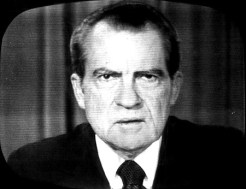
So what was the big emergency that prompted such a drastic response?  Unemployment was running about 6%; price inflation at about 5%.  Nixon’s problem was that an election was coming up in the following year.  He remembered bitterly his narrow loss to Kennedy in the 1960 election which he attributed to a mild recession of that year. Now he was determined to goose the economy and get himself re-elected. Like FDR, Nixon loved dramatic strokes and never mind the consequences. Earlier that year the man who had made his reputation as an implacable anti-communist had made a sudden and dramatic overture to communist China.  So on that sleepy Sunday Nixon delivered another bold stroke, in an end run around the Democratic opposition.  Perhaps it worked: he won 49 states in the 1972 election with considerable help from his bumbling opponent, George McGovern.

His action was quite popular.  The stock market surged that Monday morning and polls showed a 75% approval rate.  But Milton Friedman was right when he predicted “utter failure and the emergence into the open of suppressed inflation.”  Another freeze was imposed in 1973 but this time the damage to the economy became evident.  As explained in the excellent video series “The Commanding Heights,” “ranchers stopped shipping their cattle to the market, farmers drowned their chickens, and consumers emptied the shelves of supermarkets.”  Inflation reached a peak of about 14% before the decade was out and before the powers that be accepted the fact that excessive money creation is the main cause of price inflation. George Schulz, Nixon’s economic advisor and a vigorous opponent of price controls consoled himself with the thought that Nixon had demonstrated dramatically how not to fight inflation.

Nixon wasn’t finished.  During that same Sunday broadcast he slapped a 10% tariff on imported goods, accompanied by some blather about fairness.  More significantly, he ended the Bretton Woods international monetary system.  That arrangement, conceived in 1944, had the U.S. dollar convertible into gold at $35 per ounce, but only for foreign central banks.  Not only could private banks and private citizens not convert their dollars, it was even illegal to own gold (with exceptions for dentists, jewelers, etc.).  I made a point of violating that particular law on principle before the prohibition was lifted in 1974.

In all fairness, the Bretton Woods system was doomed long before that August.  The gold exchange standard had persisted only because of a gentlemen’s agreement that European central bankers would refrain from exercising their redemption rights to any significant degree.  So many new dollars had been created to finance Lyndon Johnson’s war in Vietnam and his “Great Society” at home, and so many of those dollars were parked overseas as a result of trade imbalances, that the U.S. government could not come close to honoring its Bretton Woods obligation in full.  The French under de Gaulle and his gold-bug advisor Jacques Rueff had become increasingly strident about the situation, but in early August the British ambassador showed up with $3 billion to be redeemed, and that may have been the straw that broke the camels back.

So on that same Sunday Nixon slammed the gold window shut (video here)  pushing us out of the frying pan of Bretton Woods, under which numerous wrenching devaluations had wracked international trade, into the fire of floating exchange rates, the system we have now.  The devaluations are gone but the wild swings in currency values, something that was not foreseen by Milton Friedman who was an early advocate of currency markets, are almost as bad.  Now, wonder of wonders, there is resurgent talk of some sort of gold standard.

Reagan tempted me with with some pretty inspiring rhetoric in his 1980 campaign about getting the government off our backs.  Not enough to vote for him, but I was glad he got elected and with the help of Fed chairman Paul Volcker he did break the back of inflation, but he never got spending under control and he didn’t deserve as much credit as he got for the fall of communism, which had been rotten at its core for decades.  But Bush I was terrible and in hindsight Clinton wasn’t all bad, yet I confess I was relieved when Bush II beat Gore in 2000.  I needn’t remind anyone what a disaster GWB was with his wars, his unfunded medicare expansion and his bailouts (OK, thanks for the tax cut).

I’m voting for Gary Johnson who won’t win, and I really don’t care who wins.  Gridlock is the least bad outcome, even if that means the despicable Obama stays in office facing a Republican congress.