- Explaining the Japan-Korea dispute Matsuda & Park, War on the Rocks
- Mosul and the fall of the Caliphate David French, National Review
- Technology and madness in computational capitalism Leonid Bilmes, Los Angeles Review of Books
- Indian nations and colonial ambitions along the Mississippi Jacob Lee, Origins
geopolitics
Nightcap
- How American anthropology redefined humanity Louis Menand, New Yorker
- China’s new Great Wall rises in the heart of Europe Katsuji Nakazawa, Asian Nikkei Review
- Chile: neoliberalism’s poster boy falls from grace Branko Milanovic, globalinequality
- Turkey rejects German-NATO plan, cozies up to Russia Laura Kayali, Politico
The North Syria Debacle as Seen by One Trump Voter
As I write (10/22/19) the pause or cease-fire in Northern Syria is more or less holding. No one has a clear idea of what will follow it. We will know today or tomorrow, in all likelihood.
On October 12th 2019, Pres. Trump suddenly removed a handful of American forces in northern Syria that had served as a tripwire against invasion. The handful also had the capacity to call in air strikes, a reasonable form of dissuasion.
Within hours began an invasion of Kurdish areas of Syria by the second largest army in Europe, and the third in the Middle East. Ethnic cleansing was its main express purpose. Pres Erdogan of Turkey vowed to empty a strip of territory along its northern border to settle in what he described as Syrian (Arab) refugees. This means expelling under threat of force towns, villages, and houses that had been occupied by Kurds from living memory and longer. This means installing on that strip of territories unrelated people with no history there, no housing, no services, and no way to make a living. Erdogan’s plan is to secure his southern border by installing there a permanent giant refugee camp.
Mr Trump declared that he had taken this drastic measure in fulfillment of his (three-year old) campaign promise to remove troops from the region. To my knowledge, he did not explain why it was necessary to remove this tiny number of American military personnel at that very moment, or in such haste.
Myself, most Democrats, and a large number of Republican office holders object strongly to the decision. Most important for me is the simplistic idea that
Nightcap
- The empty seat on a crowded Japanese train Baye McNeil, Japan Times
- Interstellar conversations Caleb Scharf, Scientific American
- Donald Trump is a weak man in a strongman’s world Ross Douthat, New York Times
- The Poland model: left-wing economic policy and right-wing social policy Anna Sussman, the Atlantic
A short note on Ethiopia and the African continent
Introduction
Ethiopian Prime Minister Abiy Ahmed was awarded the 2019 Nobel Peace Prize. He is the 12th winner from Africa. The Nobel Committee stated that Abiy had been awarded the Nobel for his efforts towards resolving the border conflict with Eritrea (in September 2018, Abiy and Eritrean President Isaias Afwerki signed a peace deal in Jeddah).
A border war in the years between 1998 and 2000 had resulted in the deaths of 100,000 people, and was responsible for the displacement of over one million people and the splintering of many families. The agreement has helped in reducing tensions between both countries and has led to a number of other important steps; it has paved the way for air connectivity (Ethiopian Airlines resumed its flight from Addis Abbaba to Asmara, the capital of Eritrea after two decades), resumption of communications between both countries (telephone lines had been disconnected in 1998), reduction of military hostilities, and most importantly reuniting of families.
Abiy’s reaction
While reacting to the Nobel Committee’s decision, the Ethiopian Prime Minister said that this reward was not merely for Ethiopia, but the whole of Africa, and hoped that leaders in the region would work towards peace-building.
Said the Ethiopian PM:
…It is a prize given to Africa, given to Ethiopia, and I can imagine how the rest of Africa’s leaders will take it positively to work on the peace-building process in our continent.
It would be pertinent to point out that, in recent years, the outside world has begun to take note of Ethiopia for its economic progress – in spite of numerous political challenges.
In recent years — almost a decade — the country’s economic growth has been a whopping 10% according to International Monetary Fund (IMF) estimates. In 2018, Ethiopia’s growth was estimated at well over 8% (8.5), and was the fastest growing economy in Africa. One of the key factors for Ethiopia’s impressive economic performance has been the shift from the agricultural sector to the industry & service sector and favourable demographics.
Reforms introduced by Abiy Ahmed: Political Sphere
Abiy’s election has generated immense hope, as he has seemed genuine in his commitment to political and economic reforms. During his tenure, a number of political prisoners have been released. There is also a reasonable amount of press freedom. There have been no arrests of journalists ever since he has taken over (2018 was the first year since 2004 when not a single journalist was arrested).
Abiy’s reforms – both political and economic – are significant because in many countries which have made economic progress, leaders have exhibited authoritarian tendencies. In many countries with economic promise, leaders have also failed to bite the bullet, as far as big bang economic reforms are concerned. Abiy, on the other hand, has reiterated his commitment to reforms.
Reforms introduced by Abiy Ahmed: Economic Sphere
In September 2019, Abiy unveiled his vision for economic reform titled ‘Home-Grown Economic Reform,’ which focuses on drawing greater public sector participation, reducing debts, and enhancing foreign exchange reserves. While speaking on the occasion of the launch of the roll out of his government’s agenda, Abiy emphasized on the fact that this approach is holistic: pro-job, pro-growth, and pro-inclusivity.
Privatization of a number of state run enterprises, such as Ethiopian Airlines, Ethiopian Electric Power Corporation, and the sole telecom provider, EthioTelecom, has also been high on the agenda of Abiy ever since he has taken over.
Challenges
This is not to say that all is well in Ethiopia. In June 2019, Ethiopia faced two attacks, one in the Amhara regional capital of Bahir Dar and the other in the federal capital of Addis Ababa. While Abiy has made efforts towards reducing acrimony in the country’s polity, there are still numerous ethnic divisions, and a large number of political players are seeking to cash in on these schisms.
Expectations from Abiy are sky high, and the country faces numerous debts. While his agenda for reforms is well-intentioned, and does represent a significant break from the past, it is rather ambitious and it remains to be seen whether stakeholders involved in the implementation will be in sync with the PM.
Africa no longer the Dark Continent
For very long, many Western commentators have consistently adopted a patronizing approach towards Africa. The Nobel Award to the Ethiopian PM comes at an interesting time. At a time when the whole world is becoming insular, 54 African countries have signed the AfCTA (African Continental Free Trade Area) agreement. AfCTA. This is the world’s largest free trade agreement since the World Trade Organisation).
AfCTA is a crucial step towards strengthening intra-regional trade linkages and overall connectivity. AfCTA has the potential of connecting over 1 billion people, creating a bloc worth over an estimated $3 billion and pushing intra-Africa trade by up to 15-25% by 2040 (as of 2018, intra-regional trade was less than 20%).
It would be pertinent to point out that the Ethiopian PM has on repeated occasions reiterated his commitment to Pan-Africanism, and has been one of the most fervent backers of AfCTA.
Africa is also being viewed as the world’s next manufacturing hub (China has already moved in a big way, though of course many countries are looking to other alternatives). Political stability and investor-friendly policies of course are imperative.
Conclusion
One hopes that other leaders in Africa follow Abiy’s footsteps in focusing on economic and political changes which could pave the way for sustainable growth and prosperity.
For long the world’s attention has been driven by a Western narrative, but in recent years Africa along with Asia has begun to draw attention due to high economic growth rates. If Africa can get its act together, and growth in countries like Bangladesh and Vietnam is sustained, we could witness the rise of new Non-Western groupings (consisting of developing countries from different regions). Such groupings will not be driven by geopolitical compulsions, geographic proximity, or sheer size, but by economic consideration and could play a pivotal role in shaping a new narrative, while promoting globalization, connectivity and free trade.
Turkey, Syria, the Kurds, and the American Foreign Policy Establishment
Donald Trump pulled the US out of Syria, and Turkey brutally pounced on the Kurds. What a mess.
I have just two quick notes on the subject: 1) the American Foreign Policy Establishment has upset me for many years now, mostly because they are liars. The allegations of American betrayal in regards to our Kurdish allies are simply not true. If the Kurds were truly American allies, then the hawks would have gone out of their way to call for a Kurdish state in the region (something some Kurds have been trying to found for a long time). This has not happened in the 50 or 60 years that the United States has been deeply involved in the Levant. Have you heard hawkish politicians in the US call for an independent Kurdish state? Instead, Washington’s Foreign Policy Establishment has been content to use the Kurds as pawns against its Persian and Ba’athist enemies. Once the Kurds outlived their usefulness, they were abandoned by the American Foreign Policy Establishment, ironically in the name of state sovereignty.
2) The Kurds should have known better by now that their only friends are the mountains. I don’t know why they thought they could hold Syria. I don’t know why they thought they could trust Washington. My best guess is that geopolitics is hard to do when you’re as politically decentralized as the Kurds, and there was simply no overall game plan for going to war alongside the Americans, except to maybe slaughter some Arabs and Turks and build rapport with Washington for an eventual Kurdish state.
One last note: Not only is Turkey slaughtering Kurds, but Iran is calling for Turkey to stay out of Syria. The Russians are still there, too. The withdrawal of American troops from Syria means that Russia, Turkey, Iran, Syria, and several non-state actors will now fight for control of the Levant. Having Moscow bogged down in the Levant bodes well for peace in Europe for the time being. A Turkish-Persian small war would likewise give the West a breather, at least militarily. If anti-refugee parties in Europe thought the first wave of refugees was unbearable, they’re in a for a world of surprise now. The bloodshed that will result from the world’s hegemon leaving a power vacuum will likely make Europe’s populist parties even more popular.
Iran-US tensions: Why Tokyo and New Delhi should arbitrate (But will they?)
After the drone attacks on Saudi oil facilities
Iran’s ties with the rest of the world, especially Washington, have witnessed some interesting developments in recent weeks. While there was a possibility of a thaw between Washington and Tehran after the G7 Summit (held in August 2019 at Biarritz, France) with both sides making the right noises.
Tensions between both countries have risen yet again after two oil facilities, Abqaiq and Khurais, of Saudi Aramco (a Saudi state-run company) were attacked by drones and missiles on September 14, 2019. The Houthis of Yemen have claimed responsibility for the attack, though the Saudis and the US blamed Iran. US President Donald Trump warned of retaliatory action against Iran (the US also sent troops to the Gulf to prevent further escalation), while US Secretary of State Mike Pompeo described the attack as an ‘act of war’.
Iranian reactions to US statements
If one were to look at Iranian reactions to US statements, Iranian Foreign Minister Javad Zarif, in an interview on September 19, stated that if the US or Saudi Arabia launched a military attack on Iran, in retaliation for the strikes on the Saudi oil facilities, he did not rule out an ‘all out war’. Zarif did say that Iran wanted to avoid conflict and was willing to engage with Saudi Arabia and the United Arab Emirates.
On September 22, the anniversary of Iraq’s invasion of Iran, Iranian President Hassan Rouhani warned against the presence of foreign troops in the Gulf, saying that this would lead only to more apprehensions and insecurities. The Iranian President also stated that Tehran had extended its hand of friendship towards countries in the region for maintenance of security in the Gulf, as well as the Strait of Hormuz. On the same day, Zarif made a much more measured statement, arguing that Tehran wanted to make September 22 a day of peace not war. Referring to Saddam Hussein’s invasion in 1980, he stated that this act, which received support of global powers, has been one of the reasons for turmoil in the region. Hours before Rouhani’s speech, Zarif, in an interview with the American media company CNN, stated that Iran was ready for a re-negotiated deal, provided Donald Trump lifted economic sanctions. The Foreign Minister made a telling remark:
We continue to leave the door open for diplomacy. In the meantime, our campaign for economic pressure will continue.
Rouhani had expressed his openness towards meeting Trump on the sidelines of the United Nations General Assembly (UNGA). Hours before his speech, one of his spokespersons stated that Tehran was willing to give commitments with regard to not expanding its nuclear program, provided the US lifted sanctions. During his speech, Rouhani made it clear that while he was willing to engage with the US, he would not do so under any sort of pressure, and Tehran would only engage with Washington if the US-imposed economic sanctions are removed. Rouhani dubbed these sanctions as economic terrorism.
Statement (and remarks) issued by France, the UK, and Germany with regard to the attack on Saudi’s oil facilities
What was significant, however, was the statement issued on September 23 by the UK, Germany, and France that Tehran was responsible for the attack on the oil facilities run by Aramco. The three countries, which have been firmly backing greater engagement with Iran, and have been so far critical of Trump’s approach, in a statement held that Iran was responsible for the attacks, and that these could lead to greater conflict in the region. The statement issued by the three countries did make the point that these countries supported the Iran and P5+1 nuclear agreement/JCPOA (Joint Comprehensive Plan of Action), asking Tehran to comply with the deal and adhere to the commitments.
Significantly, British PM Boris Johnson spoke in favor of Trump renegotiating the JCPOA, while French President Emmanuel Macron stated, in a conversation with reporters, that he was not ‘married to the JCPOA’. German Chancellor Angela Merkel, while speaking in favor of talks between Tehran and Washington, stated that Tehran’s conditionality of sanctions being lifted before talks take place was unrealistic.
Why France’s statement was especially surprising
Statements made by Macron came as a surprise, given that he has played a pivotal role in keeping the JCPOA intact and differed with Trump’s approach towards Tehran. Apart from fervently supporting the JCPOA, the UK, Germany, and France had also set up a Special Purpose Vehicle (SPV) to circumvent sanctions from Iran. This move had been criticized by senior officials of the Trump Administration, including Mike Pence, John Bolton, and Pompeo.
Macron also attempted to organize a meeting between Zarif and G7 Ministers on the sidelines of the G7 Summit held at Biarritz (the French President did meet Zarif, with G7 leaders giving him a go ahead to negotiate with Iran). A statement made by Trump, where he stated that he was willing to meet with Rouhani and described Iran as a country of great potential, raised hopes of possible engagement with Iran. Trump in his usual style did put forward conditionalities, and did state that he was not party to a joint statement by G7 on Iran.
It would be pertinent to point out that Macron even attempted a meeting between Rouhani and Trump on the sidelines of the UNGA meeting, though this did not work out. The French President did meet with the Iranian President on the sidelines of the UNGA. A tweet by the Iranian representative to the UN stated that apart from bilateral relations, Macron and Rouhani discussed ways in which the JCPOA could be saved.
Trump’s approach towards Iran: Back to square one?
The removal of John Bolton, a known Iran hawk, as National Security Adviser also raised hopes with regard to US engagement with Iran. In fact, Bolton’s approach vis-à-vis Iran was cited as one of the main reasons for growing differences between Bolton and Trump.
The attacks on the oil facilities have made Trump more aggressive
The attack on Saudi facilities however acted as a spoiler, and has given Trump the opportunity to act aggressively and put more pressure on France, Germany, and the UK to adopt a tough stance vis-à-vis Iran. Washington has already imposed sanctions on Iran’s Central Bank, and while Iran has warned of retaliations in case there is any sort of military action, US cyber attacks on Iran can not be ruled out. At the UNGA, Trump attacked Iran by saying it is a security threat to ‘peace-loving nations’. The US President also said that there was no chance of lifting sanctions as long as Tehran’s ‘menacing’ behavior continued.
With the UK, Germany, and France also backing US claims with regard to Iran being responsible for the attacks on Saudi oil facilities, Trump has become further emboldened.
Role of countries like Japan and India
While the reactions of European countries and the UK are important, one country, which has been very cautious in its reaction, has been Japan. Japan’s Defence Minister Toro Kono, in fact, stated that ‘We are not aware of any information that points to Iran’.
Japan has close economic ties with Iran. Earlier, Shinzo Abe had made efforts to intervene between Iran and the US. Abe, who visited Iran in June 2019, met with Iran’s supreme leader, Ayatollah Ali Khamenei, stating that it was a major step toward peace. The Japanese PM had also sought the release of US citizens detained by Iran.
Interestingly, Brian Hook, US Special Envoy to Iran, while alluding to Japan, China, and other Asian countries, stated that countries must not shy away from unequivocally acknowledging that Iran was responsible for the September 14th attack on Saudi oil facilities. Hook gave the example of the UK, France, and Germany. He also sought Asian participation, especially Japan and South Korea, in Washington’s maritime initiative to protect oil shipments through the Strait of Hormuz.
It would be important to point out that Japan, which has close economic ties with Iran, has already started looking at other sources of oil given the situation in the Middle East.
It is not just Japan. Even India would not like escalation of conflict with Iran, though so far it has stayed out. While New Delhi is looking to various sources for its oil needs (during Modi’s recent visit, one of the issues high on the agenda was closer energy ties with the US), the Chabahar Port, in which New Delhi has invested, is of strategic importance. Some recent statements from the Iranian side suggest a growing impatience with New Delhi, not merely due to toeing the US line with regard to the importation of oil from Iran (India had stopped buying oil from Iran, after the US removed the temporary waiver which it had given), but also slow progress on the Chabahar Port.
During the G7 Summit, Macron had urged the US to allow India to import oil from Iran, while Modi, during his meeting with Trump, also is supposed to have raised the Iran issue. While India has not made any statement with regard to the attack on Saudi oil facilities, Indian Foreign Secretary Vijay Gokhale visited Iran days after the attack (a number of issues, such as the progress of the Chabahar Port, and issues pertaining to trilateral connectivity between India, Afghanistan, and Iran, were discussed). The Indian PM also met with the Iranian President on the sidelines of the UNGA. Both of them are supposed to have discussed issues of bilateral and regional importance.
Conclusion
It is time that countries which have close ties with the US and robust economic engagement with Iran find common ground, rather than speaking in different voices. While at the G7 meeting, there was an opportunity for the same, but this was short lived. This is essential, not just for economic and strategic purposes, but also to ensure that Iran does not become totally dependent upon China. Beijing’s recent commitments of investing over $400 billion in Iran are a clear indicator of the point that, as a result of economic isolation, Tehran is left with limited options, and is tilting towards Beijing.
China has not just made important commitments in oil and infrastructure projects, but Beijing will also be stationing its troops to protect it’s investments in the oil sector. It is not just European countries (Germany, France and the UK) but countries like Japan and India, which should be wary of the growing proximity between Tehran and Beijing. New Delhi and Tokyo would be advised to work in tandem, to get both Washington and Iran to moderate their stance. While this is no mean task, given Trump’s unpredictability it is absolutely imperative.
Nightcap
- The ongoing chess match between Iran and Israel Saeid Jafari, Al-Monitor
- Britain’s not-so-evil empire Daniel Bring, Modern Age
- “The point is not to win, though.” Rick Repetti, Quillette
- Exposing capitalism’s blind domination Lambert Zuidervaart, Footnotes to Plato
Nightcap
- Israel’s un-Machiavellian Prince Ben-zion Telefus, Duck of Minerva
- Macron’s Iranian G7 gamble Herszenhorn & Momtaz, Politico
- Why the French love to say ‘no’ Sylvia Sabes, BBC
- An ah-hah moment while shopping David Henderson, EconLog
Hong Kong protests: justified but futile in the end
The world is closely watching the developments in Hong Kong. Brave youngsters are testing the limits and patience of the Hong Kong authorities, first protesting against the extradition law, enabling Hong Kong citizens to be sent to China in case of serious allegations, and now with much broader demands for several kinds of liberties. Anybody with who cares for personal and political freedom can only watch in great sympathy, knowing that this is a modern day version of a number of small Davids against the towering power of the Chinese autocratic Goliath, with the Hong Kong authorities as its stumbling middle man.
I happened to be in Hong Kong for a few days, just for touristic purposes, in the first half of the past week. Arriving from mainland China on Monday, we encountered the protests a number of times. The protests caused major traffic jams, making it impossible to leave the train station in the regular way. Yet a small detour on the metro sufficed to reach our hotel. Later that night, we tried to reach one of the night markets, which turned out to be impossible: not only had the traders already packed their stuff, because a prominent protest location was just around the corner, students had also blocked the road and made sure our taxi returned nicely to where it came from.
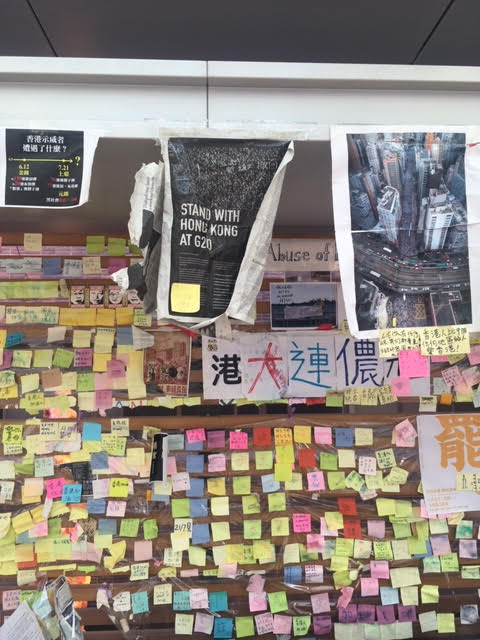
In the hotel we could watch live footage from confrontations between the police and the protesters, with the latter throwing stones and rocks against a police station just a few hundred meters from our hotel in Kowloon City. At times, it seemed there were as many journalists as there were protesters, which is of course an encouraging sign from the perspective of press freedom. The next day we went to Hong Kong University, but only the Student Union was in full protest mode, there were no visible signs of other unrest at the campus.


There were lots of protests at night though, as the coverage in the main Hong Kong quality paper South China Morning Post made clear.
One of the main questions this week was whether the Chinese army or police force would interfere. The local Chinese army commander hinted at it, while about 12,000 policemen gathered in nearby Shenzhen, just across the border in the mainland. The Hong Kong authorities, notably executive leader Carrie Lam and several police commanders, emphasized they were perfectly capable of handling this situation themselves. Given the developments in the past months one can question this, but the hesitation of Beijing to interfere is comprehendible. They do not want unrest, in the wake of the 70th anniversary of the People’s Republic later this year, while they know that direct action will make it impossible to get realigned with Taiwan in the foreseeable future, which has been a main goal of any Chinese leader since Mao, current leader Xi Jinping in particular.
Lam hinted at a press conference that the protests only foster the quick termination of the ‘one country two systems’ situation, agreed as part of the handover Treaty with the British in the nineteen eighties. One of the important elements is that Hong Kong keeps its own liberal laws and regulations for the first 50 years after the transfer of sovereignty in 1997.
Earlier protests died down, without much change achieved, mainly because the protesters did not succeed in broadening their movement to the wider public in Hong Kong. Although there was a supporting demonstration of public servants last Friday, this may happen again. On Wednesday, small traders already complained about the income they lose due to all the protests. And there are the mysterious groups of men in white t-shirts who beat up the protesters.
However, in the midterm, the protests will be futile. In the end this is an internal Chinese issue. Sure enough, there will be international protests, and depending on the outcome of the current crisis, perhaps also economic sanctions against China, if it just ends the protests by police or army action. These international protests are mainly symbolic though. Economic sanctions are the instruments of the impotent, not the powerful. Never have they worked to change a regime, or to make live very miserable for the leaders of a country. They do hit the population, but his and her concerns are easily overlooked in the international arena. The sad but undeniable truth is that no foreigner is going to die for Hong Kong. The great powers will treat this an internal Chinese affair. The USA already said so. No foreign power will intervene in China if the terms of the Sino-British Treaty are tampered with. At present, it is far more likely that Hong Kong will lose its special status, perhaps also earlier than the 50 years agreed, than that China will change into the liberal direction. The world may protest, but in the end the Chinese will have their way.
More tariffs on Vietnam would be great news for China
There is a clear consensus with regard to the fact that Vietnam has been one of the economic success stories of recent years.
The country has witnessed robust economic growth (GDP growth rate for 2018 was estimated at 7.15%, while the growth rate for 2019 is estimated at 6.6%) and has been successful in poverty reduction. Foreign Direct Investment (FDI) for the first five months of 2019 reached a four year high of over $16 billion (a year on year increase of over 69%).
If one were to look at a sectoral break up of the FDI, manufacturing and processing came right on top, receiving over $10 billion.
US appreciation for Vietnam’s economic achievements
US President Donald Trump, who recently imposed tariffs on steel imported from Vietnam, stated at the APEC CEO Summit in 2017 that:
Today, an opening Vietnamese economy is one of the fastest-growing economies on Earth. It has already increased more than 30 times over, and the Vietnamese students rank among the best students in the world.
In 2019, on the sidelines of his Summit with North Korean leader Kim Jong Un, the US President, while acknowledging Vietnam’s progress, stated that North Korea could emerge as another Vietnam if it denuclearized.
US Secretary of State Mike Pompeo had made a similar point while addressing a meeting of the US-Vietnamese business community in 2018.
Increasing FDI and factors which have contributed to it
It would be important to point out that FDI in Vietnam is also not restricted to any one particular region or city. While Hanoi (the Vietnamese capital), which drew well over $2.7 billion, and Bin Doung province in South Vietnam, are on top, North Vietnam too, is managing to draw significant investments. The shipping hub of Haiphong has witnessed significant economic growth since, after the imposition of US tariffs, a number of Chinese companies have shifted to the Shenzhen-Haiphong Economic and Trade Cooperation Zone.
Economic reforms (dubbed as Doi Moi) which began in 1986 have played a crucial role in Vietnam’s economic success. The main advantages which Vietnam has over its competitors are relatively low labor costs (though the country has witnessed a significant year on year growth in minimum wages between 2015 and 2019), increasing consumption as the result of a burgeoning middle class (currently 13% of its total population; it is estimated, by the World Bank, that in 2026 over one quarter of Vietnam’s population will be part of the middle class), and its geographical location.
Vietnam a beneficiary of the US-China Trade war and the CPTPP
Vietnam has benefited significantly from the US-China Trade war. A number of companies have shifted manufacturing operations from China to Vietnam, and others like Apple (which plans to shift anywhere between 15% and 30% of it’s iPhone production), Microsoft, Amazon, Sony, Nintendo, and Dell are likely to shift in a big way to Vietnam.
The Southeast Asian country is also gaining significantly by being part of the CPTPP. Exports to both Japan and Canada have risen significantly in the first quarter of 2019, if one were to look at the year on year figures.
US-Vietnam ties
In the past two decades ties between the US and Vietnam have improved significantly. The foundations were laid by Bill Clinton; during his first tenure, the Vietnam Foreign Ministry opened its office in Washington DC (1993), and the US State Department opened its office in Hanoi in the same year. Similarly, the US lifted its trade embargo on Vietnam in 1994. Vietnam also figured importantly in Obama’s ‘Pivot to Asia’ and was part of the Trans Pacific Partnership (TPP) that the US abandoned.
US President Donald Trump has given mixed signals on Vietnam. Trump has, though, referred to the geopolitical relevance of Vietnam, and it is for this reason that the US President articulated his vision for a free and open Indo-Pacific in Vietnam in 2017 (while speaking at the APEC CEO Summit at Da Nang).
In March 2018, U.S. Navy aircraft carrier USS Carl Vinson visited the port city of Da Nang for the first time since the end of the Vietnam war in 1975. Former Defence Secretary Jim Mattis visited Vietnam twice in 2018, and reiterated on both visits the increasing relevance of the Washington-Hanoi relationship.
The fact that the US President chose Hanoi for his 2nd summit with North Korean leader Kim Jong Un was significant not just in terms of symbolism, but also in sending a message that the Southeast Asian country was strategically relevant. During his visit in 2019, Trump of course praised Vietnam for its economic success, but a number of trade deals (Boeing inked a deal of over $12 billion to sell 100 planes to Vietnamese budget carrier, Viet Jet, for example) were also arranged.
Imposition of Trade Tariffs
As a result of trade wars, Vietnam’s exports to US have also witnessed a sudden rise. Exports for the period January-June 2019 rose 27.4% year on year. The US trade deficit with Vietnam for the first six months was estimated at $25.3 billion (in 2018, this was $40 billion).
US has recently imposed tariffs of 456% on certain steel products which were imported from Vietnam. According to the US Commerce Department, certain corrosion resistant steel products and cold-rolled steel which were supposed to be manufactured in Vietnam actually underwent only minor processing in the Southeast Asian country, but used substrate of Taiwanese and South Korean origin (duties on these South Korean and Taiwanese products had been imposed in 2015 and 2016 respectively).
Imposition of tariffs by the US is not likely to end here. There are strong indicators that the US could impose further tariffs on Vietnam, citing the reason that a number of Chinese goods are rebranded there to avoid tariffs (this is dubbed as transshipment). Trump had made some harsh remarks, including in an interview with Fox News:
Vietnam is almost the single worst — that’s much smaller than China, much — but it’s almost the single worst abuser of everybody.
It remains to be seen as to what impact the imposition of tariffs will have not just on Vietnam’s economy (the increase in bilateral trade and exports), but also on the bilateral relationship which has witnessed significant improvement due to the efforts of successive US Presidents. Vietnam’s growth and prosperity is also important from a strategic perspective, as it is one of the countries which has been strengthening defense ties with the US, Japan, and India. While Vietnam does have robust economic ties with China, it also has serious differences over the South China Sea (only recently, tensions between both countries had escalated when a Chinese survey ship and coastguard vessels had entered disputed waters near the Spratly Islands).
Conclusion
Vietnam provides a good lesson for many other countries. It has stuck to the basics, and so far has been very astute in balancing out economic relationships between China and other countries. Vietnam’s real test lies in how it deals with Trump’s unpredictability, and deals with the turbulence resulting out of Trump’s brash decisions. If the US President actually slaps more tariffs on Vietnam, not only will it have an adverse impact on bilateral ties and undo all the good work of previous US and Vietnamese administrations, but fissures between Hanoi and Washington will also have an adverse impact on efforts towards promoting a Free and Open Indo Pacific. On the other hand, Beijing, the biggest loser of the China-US trade war, would certainly not mind tensions between Washington and Hanoi (which has been a big beneficiary of the trade war).
Italy and the Belt and Road Initiative
There has been a growing scepticism with regard to the Belt and Road Initiative (BRI) project in many quarters, due to the lack of transparency with regards to terms and conditions as well as the economic implications for countries which are part of the project. A report published in April 2018 by the Center for Global Development (CGD) in Washington flagged 8 countries (including Pakistan, Maldives, Laos, and Djibouti) where the level of debts are unsustainable.
Apart from the red flag raised by a number of researchers, the removal of Pro-China leadership in countries like Malaysia, Maldives, and Sri Lanka has also resulted in problems with the BRI project, and China’s economic dealings (which are clearly skewed in favour of Beijing) with other countries is drawing more attention.
The most vocal critic of China’s economic links has been Malaysian Prime Minister Mahathir Mohamad. During a visit to China in August 2018, Mahathir, alluded to China’s trade relations with poorer countries as ‘a new version of colonialism’. Mahathir later on denied that his statement was targeted at China or the BRI. The fact is that the Malaysian Prime Minister did scrap projects estimated at well over $20 billion (which includes a rail project, East Coast Link, as well as two gas pipelines).
Top officials in the Trump Administration, including US Vice President Mike Pence, have also been critical of the BRI project for a variety of reasons. The major criticism from US policy makers has been the economic ‘unsustainability’ of the project as well as the point that the project is skewed in favour of China.
Italy to join BRI Continue reading
Nightcap
- Richard Rorty’s political turn Alan Malachowski, Aeon
- Empathy in political discourse Zak Woodman, NOL
- Stuck between Berlin and Moscow Iulia-Sabina Joja, American Interest
- Stuck between Berlin and Paris Posaner, Gurzu, and Tamma, Politico EU
The nature of the China-US-Vietnam economic triangle
While addressing a joint press conference in Hanoi, after his summit with North Korean Leader Kim Jong Un, US President Donald Trump spoke not just about the Summit, but also the current state of US-China relations. Trump criticised his predecessors for not doing enough to address the trade imbalance with China, while also making the point that he was all for China’s economic progress and growth, but not at the cost of the US.
If one were to look beyond the Summit in terms of the US-Vietnam economic relations, top US companies – Boeing and General Electric – sealed some important deals.
Given the focus of Trump’s visit (which was the Summit with Kim), perhaps these deals did not draw the attention they ought to have. The fact is that the US has begun to recognise Vietnam’s economic potential, as well as its geopolitical significance in Asia. This long note will give a backgrounder to Vietnam’s economic growth story in recent years, highlight some of it’s key strategic relationships, and then examine the nature of the China-US-Vietnam economic triangle.
Vietnam’s growth story: The key reasons Continue reading
The American objective of isolating Iran continues to be a failure
Recent days have been witness to important events; The Middle East Conference at Warsaw, co-hosted by Poland and the US State Department on February 13 & 14, and the Munich Conference. Differences between the EU and the US over dealing with challenges in the Middle East, as well as Iran, were reiterated during both these events.
The Middle East Conference in Warsaw lacked legitimacy, as a number of important individuals were not present. Some of the notable absentees were the EU Foreign Policy Chief, Federica Mogherini, and the Foreign Ministers of Germany, France, and Italy. Significantly, on February 14, Iranian President Hassan Rouhani, Russian President Vladimir Putin, and Turkish President Recep Tayyip Erdogan met in Sochi, Russia to discuss the latest developments in Syria and how the three countries could work together.
Personalised aspect of Trump’s Diplomacy
In addition to the dissonance between EU and US over handling Iran, the dependence of Trump upon his coterie, as well as personalised diplomacy, was clearly evident. Trump’s son-in-law and Senior Aide, Jared Kushner, spoke about the Middle East peace plan at the Warsaw Conference, and which Trump will make public after elections are held in Israel in April 2019. The fact that Netanyahu may form a coalition with religious right wingers could of course be a major challenge to Trump’s peace plan. But given his style of functioning, and his excessive dependence upon a few members within his team who lack intellectual depth and political acumen, this was but expected.
EU and US differences over Iran
As mentioned earlier, the main highlight of both events was the differences over Iran between the EU and Israel, the US and the GCC (Gulf Cooperation Council) countries. While Israel, the US, and the Arabs seemed to have identified Iran as the main threat, the European Union (EU), while acknowledging the threat emanating from Iran, made it amply clear that it disagreed with the US method of dealing with Iran and was against any sort of sanctions. US Secretary of State Mike Pompeo went to the degree of stating that the goal of stability in the Middle East could only be attained if Iran was ‘confronted’.
The EU differed not just with the argument of Iran being the main threat in the Middle East, but also with regard to the methods to be used to deal with Iran. The EU, unlike the US, is opposed to the US decision to get out of the Joint Comprehensive Plan of Action (JCPOA) and is all for engaging with Iran.
At the Warsaw Conference Vice President Mike Pence criticised European Union member countries for trying to circumvent sanctions which were imposed by the US. Pence was referring to the SPV (Special Purpose Vehicle) launched by Germany, France, and Britain to circumvent US sanctions against Iran. The US Vice President went to the extent of stating that the SPV would not just embolden Iran, but could also have a detrimental impact on US-EU relations.
US National Security Adviser John Bolton has, on earlier occasions, also spoken against the European approach towards the sanctions imposed upon Iran.
Differences at Munich Conference
The differences between the US and the EU over Iran were then visible at the Munich Conference as well. While Angela Merkel disagreed with Washington’s approach to the Nuclear Deal, she agreed on the threat emanating from Iran but was unequivocal about her commitment to the JCPOA. While commenting on the importance of the Nuclear Agreement, the German Chancellor said:
do we help our common cause… of containing the damaging or difficult development of Iran, by withdrawing from the one remaining agreement? Or do we help it more by keeping the small anchor we have in order maybe to exert pressure in other areas?
At the Munich Conference too, the US Vice President clearly flagged Iran as the biggest security threat to the Middle East. Pence accused Iran of ‘fueling conflict’ in Syria and Yemen, and of backing Hezbollah and Hamas.
GCC Countries at the Warsaw Conference
It is not just the US and Israel, but even representatives of the GCC which took a firm stand against Iran. (A video leaked by Israeli Prime Minister Benjamin Netanyahu revealed this.)
Bahraini Foreign Minister Khaled bin Ahmed Khalifa went to the extent of stating that it is not the Israeli-Palestinian Conflict but the threat from Iran which poses the gravest threat in the Middle East. Like some of the other delegates present at the Warsaw Conference, the Bahraini Foreign Minister accused Iran of providing logistical and financial support to militant groups in the region.
Similarly, another clip showed the Saudi Minister of State for Foreign Affairs (Adel al-Jubeir) saying that Iran was assisting and abetting terrorist organisations by providing ballistic missiles.
Iran was quick to dismiss the Middle East Conference in Warsaw, and questioned not just its legitimacy but also the outcome. Iranian President Hassan Rouhani stated that the conference produced an ‘empty result’.
US allies and their close ties with Iran
First, the US cannot overlook the business interests of its partners not just in Europe, but also in Asia such as Japan, Korea, and India. India for instance is not just dependent upon Iran for oil, but has invested in the Chabahar Port, which shall be its gateway to Afghanistan and Central Asia. New Delhi in fact has taken over operations of the Chabahar Port as of December 2018. On December 24, 2018, a meeting – Chabahar Trilateral Agreement meeting — was held and representatives from Afghanistan, Iran, and India jointly inaugurated the office of India Ports Global Chabahar Free Zone (IPGCFZ) at Chabahar.
The recent terror attacks in Iran as well as India have paved the way for New Delhi and Tehran to find common ground against terror emanating from Pakistan. On February 14, 2019, 40 of India’s paramilitary personnel were killed in Kashmir (India) in a suicide bombing (the dastardly attack is one of the worst in recent years). Dreaded terror group Jaish-E-Muhammad claimed responsibility. On February 13, 2019, 27 members of Iran’s elite Revolutionary Guards were killed in a suicide attack in the Sistan-Baluchistan province which shares a border with Pakistan. Iran has stated that this attack was carried out by a Pakistani national with the support of the Pakistani deep state.
Indian Foreign Minister Sushma Swaraj met with Iranian Deputy Foreign Minister Seyed Abbas Aragchchi en route to Bulgaria. In a tweet, the Iranian Deputy Foreign Minister stated that both sides had decided to strengthen cooperation to counter terrorism, and also said that ‘enough is enough’. This partnership is likely to grow, in fact many strategic commentators are pitching for an India-Afghanistan-Iran security trilateral to deal with terrorism.
Conclusion
So far, Trump’s Middle Eastern Policy has been focused on Iran, and his approach suits both Saudi Arabia and Israel but it is being firmly opposed by a number of US allies. It is important that the sane voices are heard, and no extreme steps are taken. As a result of the recent terror attack in Pulwama, geopolitical developments within South Asia are extremely important. Thus, the US and GCC countries will also need to keep a close watch on developments in South Asia, and how India-Pakistan ties pan out over the next few weeks. New Delhi may have its task cut out, but will have no option but to enhance links with Tehran. Trump needs to be more pragmatic towards Iran and should think of an approach which is acceptable to all, especially allies. New Delhi-Tehran security ties are likely to grow, and with China and Russia firmly backing Iran, the latter’s isolation is highly unlikely.
 Notes On Liberty