Slowly debunking the trade leads to peace fallacy

In 2010 I wrote that economic issues are just another factor in decisions on war or peace. There is nothing to suggest that free trade leads to peace per se (The Liberal Divide over Trade, Peace, and War, International Relations, vol 24, number 2, June 2010).

This is not a particular popular viewpoint, certainly not among classical liberals and libertarians, for reasons written about before at this blog.

So it is nice to read in Dale C. Copeland’s new book Economic Interdependence and War (Princeton University Press 2015), that indeed it all depends upon the situation. Economic factors can just as easily be cause for war, as a cause for refraining from violence. Copeland does not write from the liberal tradition, but if he had, he could have used Adam Smith, David Hume or Friedrich Hayek in support for his argument.

Anyway, the good thing is that the free-trade -leads-to-peace thesis is slowly but surely being debunked. It makes for a better and more mature discussion about international relations, inside and outside liberalism.

Around the Web

  1. Beyond Authenticity: ISIS and the Islamic Legal Tradition
  2. Le Corbusier’s Visions for Fascist Addis Ababa
  3. What can the Left learn from Friedrich Hayek?
  4. Assassins of the Mind
  5. How Argentina ‘Suicides’ the Truth

So you think war can be eliminated?

You might be one of those libertarians, or you belong to some other creed, who think war can be eliminated. For example through international trade, the better use of our ratio, or more influence for regular people on foreign policy decisions. In my own work I have tried to make clear all of these claims are false, and many related ones as well. This is all in the writings of Hume, Smith, Hayek or Rand. The base line is that in human nature reason cannot overcome the emotions, at least, not with all people, at all times. This means that conflict is one of the perpetual characteristics of human action, both in domestic and international settings.

In the unlikely case you do not want to take my word for it, read this book. Coker is a professor of International Relations at the London School of Economics and Political Science, specializing in the study of war. In this short but powerful book, he clearly sets out the different reasons why war will not be eliminated, providing evolutionary, cultural, technological, geopolitical and a number of other reasons. Buy it, and your world view and view of human nature will be even more aligned to the great classical liberals.

http://www.amazon.com/Can-War-Eliminated-Christopher-Coker/dp/0745679234/ref=sr_1_1?ie=UTF8&qid=1424447372&sr=8-1&keywords=can+war+be+eliminated

A Humble Creed

I’m talking about substance, not style. Regrettably, someone could display arrogance while insisting that neither he nor anyone else could possibly know enough to plan other people’s lives. However off-putting that style, it does not change the fact that the position embodies a fundamental humility. There are inherent limits to any individual’s knowledge, and therefore government social engineering, which requires the use of aggressive force, must fail.

To put it succinctly, libertarianism has humility baked in at the most fundamental level.

Humility is not to be conflated with radical doubt, however. One can be humble while also believing it is possible to know things. And some things, including the nature and market implications of human action, can be known conceptually. One can know, for example, that intelligently planning an economy or even a particular market is beyond anyone’s, including one’s own, capacities.

This is from the one and only Sheldon Richman, writing for the FFF. Check out the rest. (h/t Warren G)

NOL‘s own tagline, “Spontaneous thoughts on a humble creed,” comes from this same recognition. I first came across the argument that libertarianism is a “humble creed” in F.A. Hayek’s The Constitution of Liberty. Hayek’s simple but hard-to-see point was what sold me on libertarianism actually.

Hayek on Human Rights Day

It turns out it’s Human Rights Day today! I came across a call on Twitter: “Don’t fight for your rights. Fight for equal rights.” This reminded me of an argument from Hayek: “If we knew how freedom would be used, the case for it would largely disappear…. the importance of our being free to do a particular thing has nothing to do with the question of whether we or the majority are ever likely to make use of that particular possibility… The freedom that will be used by only one man in a million may be more important to society and more beneficial to the majority than any freedom that we all use.

This thought entered my brain when I was in a Constitution of Liberty reading group back in San Jose and has been percolating ever since. It has profound implications for how we think of freedom as a concept, and especially for how we should think about the sorts of liberties we want to support. I think the second part is obvious: even if I don’t need the freedom to own a business (for example), I’m far better off in a world where immigrants are allowed to start businesses like eBay. The same is true for more controversial liberties… we simply don’t know who ought to have the rights necessary to transform the world, and we don’t know what those rights are. So we should be prepared to err on the side of giving “too many” people “too many” liberties.

The first part (the implications for how we think of freedom as a concept) is a bit trickier. Hayek is arguing that the rights we all have aren’t terribly important. That is, it’s the marginal rights that matter. We all have the right to life. It’s important, but it’s not going anywhere anyways. If we want to improve the future, we need to keep an eye to things within our control; we could revoke the right to life (you know what I mean… that other thing is a whole different can of worms and you should write your own blog post about it…), but that’s not even on the table. What we need to be concerned with is those rights that we could conceivably lose because they don’t seem that important.

For example: women should be allowed to sign contracts, own property, and start businesses. We all know that to be the case based on our sense of fairness. But Hayek bolsters that argument: we should want that set of rights to be held by as many people as possible regardless of sex and possibly even regardless of species (District 9 and Planet of the Apes are two movies that would be very different if we attached rights to sentience rather than humanity). We don’t want rights to only go to people we care about, we want them to go to people who can use those rights to make the world better.

Human Nature, War and Armed Conflict

The list of ongoing armed conflicts in the worlds is long (see, for example, here) and has been long for centuries. There are many websites and research institutes that keep track of their number, the parties involved, the main issues, et cetera. There are many different definitions of war and armed conflict. Here, wars are simply defined as armed conflicts with participation of one or more states whose sovereignty is internationally recognized, whereas armed conflicts do not require state involvement. Armed conflicts have always been around in great numbers, often state-sponsored, for example the numerous and seemingly never ending conflicts in the Middle East, or recently in Northern Africa following the so-called Arab Spring. The recent collapse of Libya into civil war may serve as evidence.

The number of interstate wars dramatically decreased after the end of the Cold war, giving stimulus to loads of academic papers about democratic or liberal peace. Yet this era might well be over, given the situation in the Ukraine, but also many explosive situations in North-East Asia and South-East Asia.

Academic research resulted in a long and varied list of possible causes for wars and armed conflicts.  Think for example of geopolitical factors (land, borders), natural resources (oil, gas, mines), population related issues (minorities of other countries living in a particular area, people demanding  their own country), religious conflicts, the protection of one’s own people abroad, global political reasons (participation is war as a consequence of an alliance, or to preserve the balance of power), humanitarian reasons (genocide), et cetera. In contrast to popular belief, wars and conflicts are often multicausal, so there is not just a single but a number of reasons for their initiation and continuation.

War and conflict are the result of human action. Despite all the peace talks and agreements, treaties, other forms of international law, arbitration, the work of international organizations, and the pre-emptive actions by great powers in world politics, war and armed conflicts have never been eradicated. So it seems fair to assume this has something to do with human nature as well. Here the literature is much smaller, perhaps as a consequence of the dominant belief (at least in the Western world) in rational human beings capable to overcome war and armed conflict. As a matter of fact international relations as an academic discipline owes much of its origin to this idea. After the First World War many academic positions and departments were established, with the explicit aim to search for ways to prevent such disasters from happening again. Unsurprisingly, without much result.

The ‘human are guided by rationality thesis’ has been defended by many liberals in the American tradition (also known as social liberals or high liberals) and some libertarians as well. In fact most liberal IR theories are based on this idea. However, the idea that that human beings and conflict cannot be separated has been prominent in the writings of classical liberals such as Hume, Smith, Hayek and Mises, but also by Ayn Rand.  Interestingly, for this latter position there is now increasing evidence from other academic disciplines, such as psychology and neurosciences. For example the famous book Thinking Fast and Slow by Daniel Kahneman, or more specifically War and Human Nature by Stephen Peter Rosen, Thayer’s Darwin and International Relations, or Donelan’s Honor in Foreign Policy.

While much more work needs to be done in this field, it is safe to conclude that liberals should not think about how to abolish war. Instead, the relevant question is how to deal and limit the inevitable occurrence and continuance of war and armed conflicts.

Around the Web

  1. Stiglitz and Toward a Theory of the Rent-Seeking Society
  2. The Truth About Our Libertarian Age; Straw men like this explain why libertarianism will continue to grow stronger.
  3. The Return of Karl Polanyi; Another article full of straw. See if you can spot the piles.
  4. What is the optimal number of immigrants to allow into the US? This is as close to a libertarian answer as you can get.
  5. Hayek and the Intellectuals

A Liberal: To Be or Not To Be (Happy #LiberalismDay!)

What’s in a name?

Dan Klein and Kevin Frei recently decided to launch a campaign dedicated to spreading awareness about the original meaning of the word ‘liberal’. At first I was a bit ambivalent about the project because a) I don’t mind using the term ‘libertarian’ to describe myself or the policies I favor, and b) I am normally very careful about classifying Leftists as such, rather than referring to them as ‘liberals’. In my mind, I’m doing everything right so why on earth should I spend time on really driving home a semantic point?

As I was thinking about this issue, Dr Gibson sent me an email of an interview Dan Klein gave with the London-based Adam Smith Institute. Here is how Dr Klein debunked my thoughts on semantics:

The word liberal is powerful. It relates to liberty and toleration, reflected in to liberalize. Words have histories that a generation or two cannot undo. A word has cognates and connotations that make our language cohere, more than we know, more than dictionary definitions can tell.

We need a wider understanding of the semantic changes of the 1880-1940 period. In a way, semantic issues are the momentous issues of our times; semantics tell who and what we are, our selfhood; they condition how we justify our everyday activities.

I can’t argue with this, so instead I have been asking myself how I can go about identifying myself as a liberal rather than a libertarian, and what exactly is the difference between a liberal and a libertarian if the semantics fight is one that should occur between individualists and collectivists (Jesper answers this second question quite well, by the way).

In a way, #LiberalismDay makes Will Wilkinson’s old essay on “bleeding-heart libertarianism” much more pertinent than ever before. Maybe I’m just a plain ole’ liberal, especially if the definition of libertarian being put forth by some individuals in our quadrant continues to gain traction. Maybe most of us are just plain ole’ liberals.

At the end of the day, and after thinking about this for quite some time, I think I’ll try to refer to myself as a liberal for the next little while. After all, as Klein and Frei point out, the term ‘liberal’ has increasingly come to mean the continued “governmentalization”of society so referring to myself as a ‘liberal’ while advocating policies that don’t conform to American conceptions of the term is basically an affront to the theft of the word in the first place.

Calling myself a ‘liberal’ while advocating for more restriction upon the state sounds better and better as I talk myself into it.

I know, I know, I didn’t explain how or why the term ‘liberal’ morphed into what it has here in the States. I outsource to F.A. Hayek on this matter (pdf).

Here are some more thoughts on #LiberalismDay (many of them do a great job of explaining the ‘how’ and the ‘why’ as well):

Hayekian Environmental Policy

Just as decentralized knowledge implies economic non-intervention, so too it implies environmental non-intervention.

One of the contributions to economics made by the Austrian-school economist Friedrich Hayek is the theory of scattered knowledge. In his famous article, “The use of knowledge in society,” Hayek analyzed how the knowledge needed for economic activity by consumers, producers, legislators, and bureaucrats is dispersed, tacit, and ever-changing. Sellers of goods can conduct surveys to find out what people want, but such data collection reveals only a small fraction of the subjective desires of buyers. The knowledge of how to produce goods is decentralized among the firms, each of which has its own local knowledge of the costs and the demand for its goods.

Much of the knowledge about goods is tacit, not written down. A label can list the ingredients, but it will not tell the buyer about how good it will taste, and does not reveal the full story about the nutritional benefits and harmful effects. A government bureaucrat cannot know all the details about the way a company handles its goods. The biggest and fastest computers cannot be programmed to know everything the economy is doing. The supplies and demands for goods are dynamic, always changing, like the weather, so that even when knowledge is gathered and analyzed, it soon becomes obsolete.

The Hayekian knowledge problem is one reason the Austrian school of economic thought concludes that only a truly free market can effectively apply the relevant knowledge. Government officials who try industrial policy, the promotion of some goods at the expense of others, often fail. For examples, subsidies to energy from the wind end up wasting resources, as a uniform policy cannot be applied to suit local conditions, and the full effects (such as windmills killing birds) are not known in advance, resulting in bad unintended consequences.

The natural environment, everything apart from human action, is too complex for human beings to fully understand it. As with economic knowledge, the data needed to understand human effects on the environment is both global and local. The knowledge of environmental conditions is tacit, and changing. The ecologies of the earth, like the economies, have interconnected elements with feedback loops. Kill the mountain lions, and the deer multiply, eat up the vegetation, and then the rains wash away the soils.

The Hayekian perspective on global climate change as well as local impacts is to admit that we don’t know the full effects of human activity, but we do know that interference with long-established interconnections can be deadly. The policy implication is that we should minimize unnecessary human interference with the natural environment. Any human presence displaces the natural presence, as a farm replaces meadows and forests. But it is excessive to burn down large areas of rain forests in order to have a few years of crops until the soil nutrients are depleted.

The optimal application of the knowledge issue is to understand that we can apply some general knowledge but not specific knowledge. For example, we know that emissions from power plants, factories, and vehicles have bad effects. Costs are ultimately subjective, but some costs, such as lost income and resources, can be quantified. We cannot precisely measure the social cost of pollution, but by comparing places with various amounts of pollution, and the various rates of diseases in those places, we can obtain some estimates of the ill effects. Policy can therefore require a payment for emissions that invade others’ property. To do nothing is to declare a price of zero, which is less accurate than the positive price obtained by statistical means.

The Hayekian policy for emissions is therefore a payment for the estimated damage. A pollution charge requires less knowledge than detailed regulations such as engine requirements, gasoline additives, and smog tests. The emissions charge would not be based on uncertain climate changes, but on the proposition that human interventions into the atmosphere and oceans could be catastrophic. The probabilities are uncertain, but what we do know is that a small probability times a huge cost equals a substantial present value. Because the earth’s environment is a balance of water and air temperatures, cycles of carbon emissions and absorptions, feedback loops, and substances such as the ozone layer, the probability that human interventions are harmful is much greater than the chance that they are beneficial. The mutual relationship of wolves, deer, and vegetation imply that killing off either the wolves or the deer will have bad effects.

The knowledge problem implies that policy has to confront the environmental issue rather than ignore it, because human activity is inherently environmentally interventionist. In some cases, intervention can help the environment, such as with artificial coral reefs. But large interventions such as deliberately dumping iron compounds into the ocean should be avoided.

The Austrian school of economic thought is critical of central planning due to its absence of economic calculation via market prices, and due to the knowledge problem. But the absence of pollution charges itself implies mispricing and the presumption that we know nothing about the effects of emissions. Given today’s highly regulated economy, the implication of Hayek’s thought on knowledge is to replace regulations and emissions trading schemes with the requirement to pay the estimated social costs. Firms (and their customers) can then either pay that cost or else avoid that cost by polluting less. To be most effective, pollution charges would need to be applied globally.

Some free-market economists respond to the pollution issue by stating that property rights are sufficient to solve the problem. But any negotiation or lawsuit to compensate others for negative external effects necessarily requires an objective estimate of the damages. A complete prohibition of an external effect, whether of emissions or noise or visual effects, imposes a cost on the emitter. Tort law, with transferable lawsuits, as well as arbitration and mediation, could replace governmentally enacted pollution levies when the victims can be identified, but there is no avoiding some objective estimate of costs. And where torts are not effective, an international agreement on pollution charges would be warranted.

How to value international law as a classical liberal

I live in the ‘City of International Peace and Justice’ according to the city marketing of the municipality of The Hague. There is some truth in it, as the International Court of Justice, the International Criminal Court and temporary courts such as the International Criminal Tribunal for the former Yugoslavia are all located within the city limits. Yet the supposed relation between peace and justice is of course non-sensical. These international legal institutions may sometimes foster individual and sometimes even county-level justice, yet they have nothing to do with peace. History shows that punishing one war criminal does not prevent others to commit crimes against humanity, and settling a border dispute between two countries does not external effects elsewhere.

This is no surprise to classical liberals, as it confirms to their view on human nature, where emotions ultimately master rationality. This ensures international conflict and war are and will always be a feature in world politics. The most relevant question in international relations is not ‘how can we get rid of international violence and create a peaceful world’, but ‘how can we deal with the inevitable conflict that will be present?’. Perpetual peace is not attainable, perpetual war the norm, although luckily not of all people against all, all of the time. The value of international law is that it is one of the instruments that may channel or once in a while even prevent international conflict.

From a classical liberal perspective, international law is an expression of the common norms in the society of states, although without ultimate arbiter. Like law in domestic politics, international law must be restricted to the protection of the individual natural rights. And as in domestic politics, this has not been the case. International law has also exploded, while in many instances international law takes precedence in domestic legal order, which makes it even more important to limit its expansion.

For example, already Mises and Hayek objected to the explosion of positive international law, including the related establishment of international governmental organizations that occurred from the late nineteenth century onward. For classical liberals most international organizations, often created by governments of non-liberal persuasion, are attempts at constructivism at the international level. Mises and Hayek were also among the first to warn against the extended number of tasks of the League of Nations and both rejected the way the United Nations was set up. Hayek in particular warned against the inclusion of social and economic rights in the Universal Declaration on Human Rights and was very critical of the International Labor Organization.

Consequently, classical liberals should favor the abolition of international governmental organizations with tasks that extend beyond the principles of the limited state, spontaneous order, and the protection of individual natural rights. This is not a call for isolationism as there is also common sense in some international state cooperation and sometimes even a need for an international bureaucracy. I propose as a rule of thumb: if there is no need for state interference domestically, there is no need for international state action either. The exceptions are some tasks that follow specifically from international circumstances. Without going into details, this principle may, for example, lead to classical liberal support for aforementioned International Criminal Court and the special UN war tribunals, as the best way to punish people who infringed natural rights. But it may also call for the abolition of organizations that interfere with free markets and capitalism, such as the World Bank, the ILO, and the International Monetary Fund.

In short: some international law is beneficial, but most constitutes unwanted international constructivism.

Hume and Humboldt

Divergent dichotomies are not unusual to be found in Hayek’s writings. Besides the essay “Two Types of Mind”, we have his 1945 lecture “Individualism: True and False” on the difference between the British Enlightenment and the Continental Rationalism. Grounded in Edmund Burke’s Appeal from the New to the Old Whigs, Hayek traces the origin of true individualism to Bernard Mandeville, David Hume, Josiah Tucker, Adam Ferguson, Adam Smith and Edmund Burke himself. The XIX Century adds Lord Acton and Alexis de Tocqueville to the list. On the other hand, Hayek states that Jean Jacques Rousseau exemplifies the Rationalist individualism, which postulates isolated and self-contained individuals –whereas, for the former, the individual is determined by his existence in society. The “true variant” of individualism is the notion of “subject” of Hume’s philosophy: the outcome of repetitions, expectancies and habits. Finally, Hayek concludes his lecture with the censure to the German type of individualism, rooted in Wolfgang v. Goethe and Wilhelm v. Humboldt: the individualism expressed in the original development of the personality and defended in J. S. Mill’s On Liberty.

Notwithstanding in this 1945 lecture Hayek claims that this German individualism of self-development has nothing to do with what he regards as true individualism and it is “an obstacle to the smooth working of an individualistic system,” much later, in Law, Legislation, and Liberty, he will restate his opinion on Wilhelm v. Humboldt’s legacy.

This reconsideration of the value of liberty as the development of the unique and particular character of an individual will be acknowledge not only regarding legal theory but as well in his 1976 proposal of denationalization of currency. In his late writings, Hayek will endorse the development of the originality of character as an important trait for the competition to work as a discovery process.

The key to understand his shift onto this new type of individualism is closely related to Hayek’s involvement into the ideas of cultural evolution. The “true individualism” was important to state how a society can achieve certain order. The “Humboldt’s individualism” is needed to explain the dynamic of the evolution of that order. Hume’s notion of subject is related to the ideas of integration and convergence, to how an order may emerge. Humboldt’s ideal of self-development of the unique and original character of each individual implies differentiation and divergence. These two traits are the key to the adaptation to the changes in the environment that defines the notion of blind evolution. A social and political system that assures the development of differences has keen aptitudes to survive to the changes in its environment. At the level of the “true individualism”, individuals are made of institutions, repetitions and expectancies. But at the level “Humboldt´s individualism”, successful institutions are made of differences, divergent series of facts and adaptation.

(Originally published in http://www.fgmsosavalle.blogspot.com)

Normas, decisiones y complejidad

Hace pocos días, se publicó en el sitio americanscientist.org un ambicioso artículo sobre el concepto de lo aleatorio. El autor, Scott Aaronson, trataba de elucidar bajo qué criterio podíamos distinguir una serie aleatoria de números de otra serie de números ordenados conforme cierto patrón, difícil de determinar, pero estructurante al fin de un orden en la serie. En otras palabras, si una computadora arrojaba “aleatoriamente” un número “9” y luego otro número “9” y luego otro y otro, ¿estábamos ante el resultado del azar, que se juega en cada nueva jugada, o ante un patrón que podía expresarse en una fórmula? ¿Si de repente apareciera en la serie un número 4, eso confirmaría el azar, o nos indicaría que nos encontramos ante un patrón más complejo?

Aaronson propone en el referido artículo, como criterio identificatorio de un número aleatorio, la característica de no ser susceptible de reducción a un algoritmo más simple. La explicación aparece como plausible y tiene un gran poder de seducción. Sin embargo, desde nuestro punto de vista, tal conceptualización no permite distinguir azar de complejidad. Friedrich A. Hayek se inspiró en Kurt Gödel para proponer, como caracterización de un fenómeno complejo, aquél sobre el que, en atención a la heterogeneidad de sus elementos, ninguna teoría puede ofrecer su descripción completa, es decir, que no puede expresarse en un algoritmo más simple.

La noción de fenómeno complejo tiene sus raíces en el empirismo de David Hume: las relaciones entre los términos (una serie de números, por ejemplo) no se encuentran en los términos mismos, si no que son atribuidas por el sujeto (en nuestro ejemplo, le adjudicamos un patrón a aquella serie de números.) Desde el momento en el que el conocimiento general no proviene de los hechos si no que es atribuido a los mismos, tal conocimiento general no nos permitirá agotar el conocimiento de lo particular. En otras palabras, siempre habrá un elemento empírico en toda teoría.

Para continuar con nuestro ejemplo: podemos enunciar un patrón que explique la sucesión de una serie de números, pero estamos expuestos a que aparezca un nuevo número en la serie que nos obligue a revisar nuestra teoría. Cuando aparece un nuevo acontecimiento que se escapa a nuestras expectativas, lo que hacemos es reajustar la noción de orden que le atribuimos a la realidad. Lo que hace que una serie de acontecimientos configure un orden o estructura, y no sea caótica o aleatoria no es, por consiguiente, que las expectativas en torno a los acontecimientos siempre se cumplan, si no que exista un rango de acontecimientos que nunca se verifique, en otras palabras: que determinadas expectativas sean sistemáticamente frustradas.

Igualmente, la confusión entre azar y complejidad puede ser fecunda y arrojar más luz sobre la naturaleza de la segunda. Por ejemplo, Nicolás Maquiavelo culminaba “El Príncipe” con la afirmación de que la iniciativa era la virtud fundamental del político, ya que la fortuna tendía a favorecer más al arriesgado que al cauto. En términos poblacionales, vemos más hombres de éxito con iniciativa que sin ella ya que, para resultar exitosos, se tuvieron que conyugar dos situaciones: la decisión de asumir riesgos y que la oportunidad favorable efectivamente se haya presentado. En el conjunto de políticos sin éxito encontraremos a los cautos y también a los arriesgados (que no tuvieron suerte). Va de suyo que podemos sustituir “fortuna” por “complejidad” sin perder mucho del sentido de la idea.

Asimismo, The Economist publicó la semana pasada un interesante artículo sobre la relación entre la estructura del azar y laestructura de las decisiones. Todo parece indicar que efectivamente existen buenas y malas rachas, pero ello no se debe al azar si no a la estructura de decisiones que se toman frente a una situación difícil o imposible de comprender. Un jugador tiene a la suerte de su lado cuando, luego de ganar la primera apuesta, en las sucesivas va reduciendo su exposición al riesgo. Correlativamente en este caso, a menores riegos, menores ganancias pero también menores pérdidas, con lo que el resultado neto de todo el conjunto de jugadas es positivo. Paralelamente, si un jugador pierde en su primera apuesta, incrementar el riesgo de las sucesivas con la idea de compensar la primera pérdida sólo lo llevará a la ruina. En síntesis, una muy buena estrategia para lidiar con el riesgo es actuar como un sistema de retroalimentación negativa: a cada desvío del promedio estándar, responder con mayor moderación. Después de todo, la comparación con un sistema de retroalimentación negativa era la caracterización que F. A. Hayek hacía de la función del derecho y de todo sistema normativo en general, aportando mayor estabilidad y mejores resultados netos.

Publicado originariamente en http://www.ihumeblog.blogspot.com.ar , el blog institucional de la Fundación Instituto David Hume (www.ihume.org), de Buenos Aires, Argentina.

The concept of “dispersed knowledge” should be a commonplace!

I dare to state that the world would be a better place to live in if the concept of “dispersed knowledge” were a commonplace. Perhaps it is an elusive idea and that is why every now and then political intervention regards itself as the saviour from the “chaos of the market”.

But what most people are used to call “chaos” is, in fact, “complexity”. Every single rational agent is an administrator of the bits of information gathered by him from the limited range of his experience, using devices of perception, such as senses, social values, norms, and technologies. The said devices are mostly common to other agents and thus contribute to make the compatibility of several individual plans, the most of them unknown to each other, possible –and the stability of the social order rests on the degree of such compatibility.

As we said, social spontaneous conventions as language, monetary economy, trade, morals, and law systems –along with many others- are devices used by the these agents to cope with the complexity of an order of things built on a framework of plans of multiple individuals, most of them yet undiscovered. It is a complex order of facts, but it is an order still: spontaneous conventions make of the multiple bits of information from the different individual plans a coordinated set of resources applied to carry out the most of them. It is a complex system of coordination of knowledge, with gaps and perturbations, but it is a system that can deal with a higher amount of information than any individual or committee would be able to do.

Since our concept of rationality is mostly instrumental, regarding as “rational” a set of resources deliberately applied to attain a known aim, it is easy to consider the complex order resulting from spontaneous coordination of individual plans as “irrational” -and this charaterisation gains strength with every new crisis. At this point, what we have to notice is that the net benefits rendered by the extended society –i.e.: the spontaneous coordination of the dispersed knowledge from multiple individual plans and institutions- are higher than what any other alternative system of organization of human beings could bring about. The consequence of the argument is that dispersed knowledge is both a burden to central planning and lever to the open society.

We know that almost the whole work of F. A. Hayek is devoted to this quest, but if I had to choose a single paper that keeps the kernel of this philosophy I would choose “The Use of Knowledge in Society”. This would be a good starting point to make the idea of “dispersed knowledge” part of our cultural background, like heliocentrism or Gödel’s theorem.

Originally published on http://www.fgmsosavalle.blogspot.com

Useful neoconservative insights

It is not common for liberals to praise neoconservative thinkers. Regardless if this concerns domestic politics or international affairs.  While this normally makes a lot of sense, sometimes the liberals are clearly at fault. I recently re-read two of Robert Kagan’s most famous books: Paradise and Power: America and Europe in the New World Order (2003) and The Return of History and the End of Dreams (2008). The power of Kagan’s analysis struck me again in these two concise books, predominantly his balanced treatment of the enduring and dominant role of power in world politics. This is something not many liberals are keen to accept, the classical liberals excepted, most notably Hume, Smith and the certainly the hawkish Hayek.

In the light of the topical situation in Eastern Europe, let me quote a few lines from The Return of History.

  • ‘One of the geopolitical fault lines runs along the western frontier of Russia, [Ukraine included] with Russia on one side, and the European Union and the United States on the other. Instead of an anticipated zone of peace, western Eurasia has once again become a zone of competition.’
  • ‘If Russia was where history most dramatically ended two decades ago, today it is where history has most dramatically returned. Russia’s turn toward liberalism at home stalled and then reversed, and so has its foreign policy […….] Great power nationalism has returned to Russia and with it traditional great power calculations and ambitions.’
  • ‘Contrary to the dismissive views of many in the West, Russia is a great power, and it takes pride in being a force to be reckoned with on the world stage.’
  • ‘its oil and gas wealth has allowed Moscow to increase defense spending by more than 20 percent annually over the past three years’.
  • ‘This new sense of power today fuels Russian nationalism. It also stirs up deep resentment and feelings of humiliation […] such as acceptance of NATO enlargement, the withdrawal of troops from former Soviet republics and the ceding of independence to Ukraine, Georgia and the Baltic states.’

Recall this was in 2008 and it just a very brief selection. There was not much the liberals (of all persuasions) could have added to this. Liberals generally lack realistic let alone original views on world politics. That is simply not good enough, if they have intentions to widens the appeal of liberal thought. An embrace of neoconservative insights such as Kagan’s would be a good start.

Energy Primer for Libertarians (or anyone else)

One of these days Brandon’s going to kick me off this blog for posting notes that aren’t “on liberty.” But maybe he’s not looking. I’ll take a chance.

This piece is about energy and on second thought, it is relevant to libertarians. We need to know what we’re talking about when we enter into controversies on current topics like energy. Insights into how markets work are crucial, of course, but not sufficient. We should arm ourselves with a few facts and Lord knows, maybe even a little understanding of basic physics.

I base my remarks on an excellent chart produced by (gasp!) a government agency, Lawrence Livermore National Laboratory. It appears here but if it’s illegible please find a better copy here.  Blame Brandon for squeezing our posts into a narrow column!Image
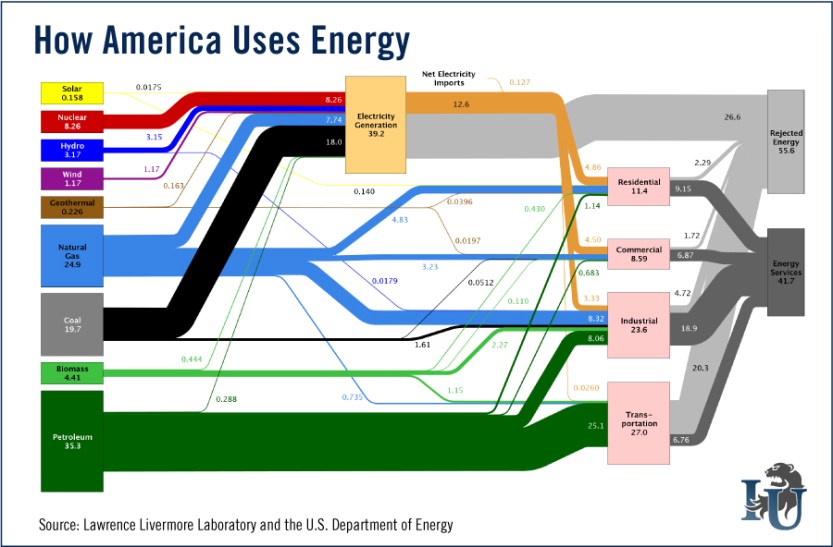
We see energy sources on the left. A couple of facts stand out. At the top, notice that solar and wind are negligible. The yellow line representing solar may be thinner than a single pixel on your monitor and therefore invisible. Geothermal is on the radar, but barely; same for biomass (wood chips, organic leftovers, corn used for ethanol instead of feeding people) that can either be burned or processed into methane or ethanol. Our three main sources are, and will be for the foreseeable future, petroleum, coal and natural gas.

At the top center we see electricity generation. We don’t consume electricity directly except maybe for executing criminals. We use it to power devices in the four broad categories shown on the right: residential, commercial, industrial, transportation.

Notice the fat grey line coming out of the electricity generation box called “rejected energy.” It tells us that about two thirds of the energy coming into power plants goes up in smoke or steam or other waste heat rather than electricity. That sounds like a terrible loss and indeed, there is always room for efficiency improvements at the margin. But, boys and girls, there’s something called the Second Law of Thermodynamics which puts an iron limit on how much energy in a particular situation is available to do useful work. In other words, a certain amount of the “waste” represented by that fat gray line is inevitable. It would be great if the good people at LLL could supply that calculation, but I suspect that reliable estimates of the necessary data would be difficult to come by.

Look at the residential box on the right. It only represents 11% of energy consumption meaning that relative to the big picture, home energy efficiency measures like insulation, solar panels, etc. can never do much for the big picture. I say this too keep things in perspective, not to deny the possibilities for cost-effective marginal improvements in many homes.

If your monitor resolution allows it, you’ll see a tiny orange line running from electricity generation to transportation. That means electric vehicles are, and for some time will be, utterly insignificant, though again, marginally beneficial in very special situations.

Another fat gray line comes out of transportation. When you burn gasoline, most of the energy goes out the tailpipe or the radiator; only a little ends up as kinetic energy and even that ends up as waste heat when you apply the brakes. (In the long run, it all ends up as waste heat. Look up “heat death” on Wikipedia.)

The overall message of this chart is: if we want to maintain anything like our present industrial civilization with its abundant heat/cooling, light, transportation, etc., we’d better keep the present main sources going – petroleum, coal, natural gas, nuclear because renewable energy sources are advancing only slowly and in many cases (wind and ethanol, especially), uneconomically. The stakes couldn’t be higher – significant losses of energy, more than anything short of nuclear war, will make life nastier, more brutish, and shorter.

How to decide which energy R&D projects deserve scarce resources? Solyndra, anyone? No, central planning of energy is just as much a disaster as any other form of central planning or maybe more so. Energy is a highly specialized field. A biomass expert, for example, may be ignorant of nuclear fusion. A transformer guy may know nothing of transmission line losses. I suspect there are dozens or hundreds of subspecialties within the biomass field. Knowledge, as Hayek taught us, is dispersed and often tacit. We need to let all these specialists use their particular knowledge and facilities to experiment around the edges, comparing present or expected future marginal costs and benefits. Other than an occasional nice chart like you see here, the Energy Department just gets in the way. (To see a boondoggle that dwarfs Solydra, google “national ignition facility.”)

Speaking of costs and benefits, one of these days I’ll comment on the strange notion that energy accounting – a perfectly legitimate engineering practice – should be used to judge the economic value of energy projects. Tallies of income/expenses and assets/liabilities, should, say proponents, be carried out not in dollars but in energy units (joules or BTUs.) Why is this wrong? Because the economic value of a joule depends on time and place and most critically, people’s ability to make good use of it. In fact, natural resources aren’t resources at all until and unless someone figures out how to make good use of them.  More generally, value never inheres in physical objects and materials but only in the minds of people who believe those objects and materials can help satisfy wants, theirs or others’.

Postscript: The oceans store unimaginable amounts of thermal energy. You can calculate this yourself: using your favorite system of units, just multiply the volume of water by its mass density by its specific heat at constant pressure. You’ll discover that if we were willing to lower the ocean temperature by a thousandth of a degree per year, we would have abundant energy from now till Kingdom Come. Try this idea on a “progressive” friend sometime, keeping the answer momentarily in your back pocket: the Second Law forbids it. Stated differently, even with perfect technology, you would have to put more energy into the conversion process than the usable energy end product.