The Deleted Clause of the Declaration of Independence

As a tribute to the great events that occurred 241 years ago, I wanted to recognize the importance of the unity of purpose behind supporting liberty in all of its forms. While an unequivocal statement of natural rights and the virtues of liberty, the Declaration of Independence also came close to bringing another vital aspect of liberty to the forefront of public attention. As has been addressed in multiple fascinating podcasts (Joe Janes, Robert Olwell), a censure of slavery and George III’s connection to the slave trade was in the first draft of the Declaration.

Thomas Jefferson, a man who has been criticized as a man of inherent contradiction between his high morals and his active participation in slavery, was a major contributor to the popularizing of classical liberal principles. Many have pointed to his hypocrisy in that he owned over 180 slaves, fathered children on them, and did not free them in his will (because of his debts). Even given his personal slaves, Jefferson made his moral stance on slavery quite clear through his famous efforts toward ending the transatlantic slave trade, which exemplify early steps in securing the abolition of the repugnant act of chattel slavery in America and applying classically liberal principles toward all humans. However, this very practice may have been enacted far sooner, avoiding decades of appalling misery and its long-reaching effects, if his (hypocritical but principled) position had been adopted from the day of the USA’s first taste of political freedom.

This is the text of the deleted Declaration of Independence clause:

“He has waged cruel war against human nature itself, violating its most sacred rights of life and liberty in the persons of a distant people who never offended him, captivating and carrying them into slavery in another hemisphere or to incur miserable death in their transportation thither.  This piratical warfare, the opprobrium of infidel powers, is the warfare of the Christian King of Great Britain.  Determined to keep open a market where Men should be bought and sold, he has prostituted his negative for suppressing every legislative attempt to prohibit or restrain this execrable commerce.  And that this assemblage of horrors might want no fact of distinguished die, he is now exciting those very people to rise in arms among us, and to purchase that liberty of which he has deprived them, by murdering the people on whom he has obtruded them: thus paying off former crimes committed against the Liberties of one people, with crimes which he urges them to commit against the lives of another..”

The second Continental Congress, based on hardline votes of South Carolina and the desire to avoid alienating potential sympathizers in England, slaveholding patriots, and the harbor cities of the North that were complicit in the slave trade, dropped this vital statement of principle

The removal of the anti-slavery clause of the declaration was not the only time Jefferson’s efforts might have led to the premature end of the “peculiar institution.” Economist and cultural historian Thomas Sowell notes that Jefferson’s 1784 anti-slavery bill, which had the votes to pass but did not because of a single ill legislator’s absence from the floor, would have ended the expansion of slavery to any newly admitted states to the Union years before the Constitution’s infamous three-fifths compromise. One wonders if America would have seen a secessionist movement or Civil War, and how the economies of states from Alabama and Florida to Texas would have developed without slave labor, which in some states and counties constituted the majority.

These ideas form a core moral principle for most Americans today, but they are not hypothetical or irrelevant to modern debates about liberty. Though America and the broader Western World have brought the slavery debate to an end, the larger world has not; though countries have officially made enslavement a crime (true only since 2007), many within the highest levels of government aid and abet the practice. 30 million individuals around the world suffer under the same types of chattel slavery seen millennia ago, including in nominal US allies in the Middle East. The debates between the pursuit of non-intervention as a form of freedom and the defense of the liberty of others as a form of freedom have been consistently important since the 1800’s (or arguably earlier), and I think it is vital that these discussions continue in the public forum. I hope that this 4th of July reminds us that liberty is not just a distant concept, but a set of values that requires constant support, intellectual nurturing, and pursuit.

For more underrecognized history surrounding the founding of America, see my Before the Fourth series!

James Cooley Fletcher

At the beginning of the 19th century there was almost no vestige of Protestantism in Brazil. From the 16th century the country was colonized basically only by Portuguese, who resisted the advance of Protestantism during the same period. Huguenots and Dutch Reformers tried to colonize parts of Brazil in the 16th and 17th centuries, but with little or no lasting effects. Only after the arrival of the Portuguese royal family in 1808 did this picture begin to change.

First came the English Anglicans. England rendered a great help to Portugal in the context of the Napoleonic Wars, and thus the subjects of the English crown gained religious freedom on Brazilian soil. This freedom soon extended to German Lutheran immigrants who settled mainly in the south of the country from the 1820s. However, it was only with the American missionary work, from the 1840s and 1850s, that Protestantism really began to settle in Brazil.

James Cooley Fletcher was one of the people who contributed most to the establishment of Protestantism in Brazil. Quoted frequently by historians, he is, however, little understood by most of them and little known by the general public. Born April 15, 1823 in Indianapolis, Indiana, he studied at the Princeton, Paris, and Geneva Seminary between 1847 and 1850 and first came to Brazil in 1852. In 1857 he published the first edition of The Brazil and the Brazilians, a book which for many decades would be the main reference regarding Brazil in the English language.

Fletcher first came to Brazil as chaplain of the American Seamen’s Friend Society and a missionary of the American and Foreign Christian Union. However, shortly after his arrival in the country, he made it his mission to bring Protestantism to the Brazilians. His performance, however, would be indirect: instead of preaching himself to the Brazilians, Fletcher chose to prepare the ground for other missionaries. For this he became friends with several members of the Brazilian elite, including Emperor Dom Pedro II. Through these friendships, he managed to influence legislation favorable to the acceptance of Protestantism in Brazil.

Although Fletcher anticipated and aided missionaries who would work directly with the conversion of Brazilians to Protestantism, his relationship with these same missionaries was not always peaceful. Some of the missionaries who succeeded Fletcher were suspicious of him because of his contacts with Brazilian politicians. It is true, Fletcher had an agenda not always identical with that of other missionaries: while others wished to focus only on the conversion of Brazilians, he understood that Protestantism and liberalism were closely linked, and that the implementation of the first in Brazil would lead to the progress propelled by the second. For this very reason, Fletcher had no problem engaging in activities that at first glance would seem oblivious to purely evangelistic work. He promoted, for example, the immigration of Americans to Brazil, the establishment of ship lines linking the two countries, the end of slavery in Brazil and commercial freedom.

James Cooley Fletcher is generally little remembered by Brazilian Protestants, although he has contributed decisively to the end of the Roman Catholic monopoly in the country. He is also little remembered by historians, but this should not be so. Fletcher was one of the people who contributed most to the strengthening of religious freedom in Brazil, and also to a combination of religious, political, and economic beliefs. It was precisely because of his religious beliefs that he believed in the political and economic strength of liberalism to transform any country, including Brazil.

Foreign Policy in the Liberal Tradition: The Real Story

Over at the Niskanen Center, Matthew Fay wrote a blog entitled “Thinking about Libertarian Foreign Policy.” Brandon was so nice to point this out to me.

Fay’s main point is that, apparently contrary to what some libertarians think (Fay leaves them unnamed, no references either), there is big divide between the foreign policy pronouncements of Donald Trump and libertarian views on foreign policy. So far, so good. I have no dispute with that.

Yet Fay’s blog post is seriously lacking at other points. The main one, and the focus of this post, is that he mixes up different views on international relations within the liberal tradition at large, which is in some way not so surprising because he appears to be ignorant of those differences to begin with (at least in this piece). That is not very comforting for those concerned with this issue, as the Niskanen Center is about to start a larger project on foreign policy. Should it indeed be born in neglect and oversight, it won’t add much to our knowledge, I am afraid.

Conceptual mess

Fay’s essay gets off to a false start as he fails to properly introduce “libertarian.” He then continues to use this label for all kinds of theoretical ideas, originating from both liberal political thought, and international relations theory. To make things worse, Fay routinely claims that there is one unified libertarian position on foreign policy.

This is erroneous, as classical liberalism, libertarianism, and social liberalism all have partly different views on the matter. The various thinkers associated with those different liberalisms have different views on domestic and international politics. Any meaningful analysis on foreign policy from a libertarian or other liberal position should acknowledge that, and use it to the reader’s advantage. It is impossible and perhaps even deceiving to enter into a topical debate when your own position is a conceptual mess. This applies to all debates, academic and otherwise.

Proper conceptual approach

So what should Fay have done instead? Simply acknowledge there is more to liberal thought on international relations, and work from there.

To keep this blog to a readable length, I will just present these differences very briefly. My presentation is based on the writings of the British political theorist Michael Freeden. He argues that every political ideology (and liberalism is one of them) should be seen as a framework (which he calls morphology) composed of a number of political concepts. These concepts vary in importance while their meaning is contested within the ideology. It is possible to distinguish core, adjacent, and peripheral concepts, which together make a unique set of political ideas. While some of the individual concepts overlap, there is significant variation between the frameworks. This enables the distinction between different liberal variants, which are still part of the larger liberal family.

For example, the concept of liberty is key to all liberal variants, but liberty has different meanings. Isaiah Berlin’s famous divide between positive and negative liberty is relevant here. The latter can be defined as ‘the freedom from interference by others’, the first ‘the freedom to fully enjoy one’s rights and liberties’, which often demands some support of the state. Classical liberalism is associated with the negative conception and social liberalism with the positive meaning. Yet the meaning of negative liberty may be further contested. The protection from interference by others may be taken as absolute, which is far more stringent than the classical liberal interpretation, which does allow for compulsory taxation of individuals to pay for public services. Now we are entering the libertarian domain, which is in itself divided into those who hold an absolute idea of negative liberty (the anarcho-capitalists), and those who permit a minimal infringement of property rights to pay for police, external defense, and the judiciary (the minarchists). This is also why conservatism is not as closely related to the liberal family as is sometimes thought. For conservatives, individual liberty is not a core concept at all.

Applied to liberalism and conservatism is comes to this:

Table 1: The Morphology of Liberalism and Conservatism

Classical Liberalism Social Liberalism Libertarianism Conservatism
Core concepts Negative freedom, realistic view of human nature, spontaneous order, limited state Positive freedom, positive view of human nature, social justice as self-development, extended state Negative freedom, realistic view of human nature, spontaneous order, natural law including strict defense of property rights Realistic view of human nature, organic change, human order with ‘extra-human’ origins, counter movement
Adjacent concepts Natural law, rule of law/constitutionalism Modern human rights, rule of law and neutral state, social contract (Mill: utilitarianism) Minarchism: minimal state, rule of law Groups/family, hierarchy, active state, sometimes: spontaneous order
Peripheral concepts Social justice, strict defense of property rights, democracy, utilitarianism Property rights, spontaneous order Social justice Individual (property) rights, freedom

Source: Edwin van de Haar, Degrees of Freedom. Liberal Political Philosophy and Ideology (Transaction Publishers, 2015).

Liberalism and international relations

Interestingly, yet of course completely logical, these differences also translate to views on foreign policy and international relations:

Table 2: Liberalism, Conservatism, and International Relations

Classical liberalism Social liberalism Libertarianism Conservatism
Nation as limit of individual sympathy Yes No No Yes
State as prime actor in world politics Yes No No Yes
International governmental

institutions/regimes

No Yes No No
Can war be eliminated No Yes Yes No
Does trade foster peace? No Yes Yes No

Source: Edwin van de Haar, Degrees of Freedom. Liberal Political Philosophy and Ideology (Transaction Publishers, 2015).

So, in contrast to Fay’s approach, it is not so simple to claim all kinds of concepts and ideas for just one liberal label. There is far more to it. I shall leave it at this for the moment, but for those wanting to read more about this, see my longer essay at libertarianism.org, or my books Degrees of Freedom and Classical Liberalism and International Relations Theory.

What is Wrong with Income Inequality? Five Reasons to be Concerned

I sometimes part ways with many of my libertarian and classical liberal friends in that I do have some amount of tentative concern for income/wealth inequality (for the purposes of this article, the otherwise important economic distinction between the two is not particularly relevant since the two are strongly correlated with each other). Many libertarians argue that inequality ultimately doesn’t matter. There is good reason to think this drawing from the classic arguments of Nozick and Hayek about how free exchange in a market economy can often interrupt preferred distributions.

The argument goes like this: take whatever your preferred distribution of income is, be it purely egalitarian or some sort of Rawlsian distribution such that the distribution benefits only the worst off in society. Assume there is one individual in the economy who has some product or service everyone wants to buy (in Nozick’s example it was Wilt Chamberlain playing basketball), and let everyone pay a relatively small amount of income to that one individual. For example, assume you have a society with 10,000 people all who start off with an equal endowment of $5 and all of them decide to pay Wilt Chamberlain $1 to watch him play basketball. Very few people would object to those individual exchanges, yet at the end Wilt Chamberlain ends up with $10,005 dollars and everyone else has $4, and our preferred distribution of income has been grossly upset even though the individual actions that led to that distribution are not objectionable. In other words, allowing for free exchange precludes trying to construct an optimal result of that free exchange (a basic consequence of recognizing spontaneous order).

Further, these libertarians argue, it is more important to ensure that the poor are better off in absolute terms than to ensure they are better off relative to their wealthier peers. Therefore, if a given policy will increase the wealth of the wealthiest by 10% and the poorest by 5%, there is no reason to oppose this policy on the grounds that it increases inequality because the poor are still made richer. Therefore, it is claimed, we should focus on policies that improve economic growth and the incomes of the poor and be indifferent as to its impact on relative inequality, since those policies are strongly correlated with bettering the economic conditions of the poor. In fact, as Mises Argued in Liberalism and the Classical Tradition, a certain amount of inequality is necessary for markets to function: they create a market for luxury goods that can be experimented and developed into future mass-consumption goods everyone can consume. Not everyone could afford, for an example, an IPod when it first came out, however today MP3 players are cheap and plentiful because the very wealthy were able to demand it when it was very expensive.

I agree with my libertarians in thinking that this argument is largely correct, however I do not think it proves, as Hayek argued, that social justice (understood in this context as distributive justice) is a “mirage” or that we should be altogether unconcerned with wealth or income distributions. All this argument does is mean that there is no overall deontological theory for an ideal income distribution, but there still might be good consequentialist reasons to think that excessively unequal distributions can impact many of the things that classical liberals tell us to worry about, such as the earnings of the poor, more free political economic outcomes, or overall economic growth. Further, even on Nozick’s entitlement theory of justice, we might oppose income inequality if it arises through unjust means. Here are five reasons why libertarians and classical liberals should be concerned about income inequality (note that they are mostly empirical reasons, not claims about the nature of justice):

1) Income Inequality as a Result of Rent Seeking

Certain government policies result in uneven income distribution. For an example, a paper by Patrick MacLaughlin and Lauren Stanley at the Mercatus Center empirically analyze the regressive effects of regulatory policy. Specifically, Stanley and MacLaughlin find that high barriers to entry create barriers to entry which worsens income mobility. Poorer would-be entrepreneurs cannot enter the market if they must, for an example, pay thousands of dollars for a license, or spend a large amount of time getting costly education and certifications to please some regulatory bureaucracy. This was admitted even by the Obama Administration in a recent report advising reform of occupational licensing laws. As basic public choice theory teaches, regulators are subject to regulatory capture, in which established business interests lobby regulators to erect barriers to entry to harm would-be competitors. Insofar as inequality is a result of such rent-seeking, libertarians have an obvious reason to oppose it.

Many other policies can worsen inequality. When wealthy corporations receive artificial monopolies from policies such as excessive intellectual property laws, insulating them from competition or when they gain wealth at the expense of poorer taxpayers through improper subsidies. When the government uses violent policing tactics to unequally enforce drug laws against poorer communities, or when it uses civil asset forfeiture to take the property of the worst off. When the government uses eminent domain to take the property of disadvantaged individuals and communities in the name of public works projects, or when they implement minimum wage laws that displace low-skilled workers. Or, if the structure of welfare benefits discourages income mobility, which also worsens inequality. There are a myriad of bad government policies which benefit the rich and exploit the poor, some of which are a direct result of rent-seeking on behalf of the wealthy.

If the rich are getting richer, or if the poor are stopped from becoming wealthier, as a result of government coercion, even Nozick’s entitlement theory of justice calls for us to be skeptical of the resulting income distribution. As Matt Zwolinski argues, income distributions are not only a result of, pace Nozick, a result of the free exchanges of individuals, but they are also a result of the institutions in which those individuals exchange. Insofar as inequality is a result of unjust institutions, we have good reason to call that inequality unjust.

Of course, that principle is still very hard to empirically apply. It is hard to tell how much of an unequal distribution is a function of bad institutions and how much is a function of free exchange. However, this means we can provide very limited theories of distributive justice not as constructivist attempts to mold market outcomes to our moral desires, but as rough rules of thumb. If it is true that unequal distributions are a function of bad institutions, then unequal distributions should cause us to re-evaluate those institutions.

2) Income Inequality and Government Exploitation
Of course, many with more Marxist inclinations will argue that any amount of economic inequality will inherently result in class-based exploitation. There are very good, stand-by classical liberal (and neoclassical economic) reasons to reject this as Marxian class analysis as it depends on a highly flawed labor theory of value. However, that does not mean there is not some correlation between some notion of macro-level exploitation of the worst-off and high levels of inequality which libertarians have good reason to be concerned about, for reasons closely related to rent-seeking. Those with a high amount of economic power, particularly in western democracies, are very likely to also have a strong influence over the policies set by the government. There is reason to fear that this will create a class of wealthy people who, through political rent-seeking channels discuss earlier, will control state policies and institutions to protect their interests and wealth at the expense of the worst-off in society. Using state coercion to protect oneself at the expense of others is, under any understanding of the term, coercion. In this way, income inequality can beget rent-seeking and regressive policies which lead to more income inequality which leads to more rent-seeking, leading to a vicious political-economic cycle of exploitation and increasing inequality. In fact, even early radical classical liberal economists applied theories of class analysis to this type of problem.

3) Inequality’s Impacts on Economic Growth

There is a robust amount of empirical literature suggesting that excessive income inequality can harm economic growth. How? The Economist explains:

Inequality could impair growth if those with low incomes suffer poor health and low productivity as a result, or if, as evidence suggests, the poor struggle to finance investments in education. Inequality could also threaten public confidence in growth-boosting policies like free trade, says Dani Rodrik of the Institute for Advanced Study in Princeton.

Of course, this is of special concern to consequentialist classical liberals who claim we should worry mostly about the betterment of the poor in absolute terms, since economic growth is strongly correlated with bettering living standards. There is even some reason for these classical liberals, given their stated normative reasons, to (at least in the short-term given that we have unjust institutions) support some limited redistributive policies, but only those that are implemented well and don’t worsen inequality or growth (such as a Negative Income Tax), insofar as it boosts growth and helps limited the growth of rent-seeking culture described with reasons one and two.

4) Inequality and Political Stability

There is further some evidence that income inequality increases political instability. If the poor perceive that current distributions are unjust (however wrong they may or may not be), they might have social discontent. In moderate scenarios, (as the Alsenia paper I linked to argue) this can lead to reduced investment, which aggravates third problem discussed earlier. In some scenarios, this can lead to support for populist demagogues (such as Trump or Bernie Sanders) who will implement bad policies that not only might harm the poor but also limit individual liberty in other important ways. In the most extreme scenarios (however unlikely, but still plausible), it can lead to all-out violent revolutions and warfare. At any rate, libertarians and classical liberals concerned with ensuring tranquility and freedom should be concerned if inequality increases.

5) Inequality and Social Mobility

More meritocratic-leaning libertarians might say we should be concerned about equal opportunities rather than equal outcomes. There is some evidence that the two are greatly linked. In particular, the so-called “Great Gatsby Curve,” which shows a negative relationship between economic mobility and income inequality. In other words, unequal outcomes can undermine unequal opportunities. This can be because higher inequality means unequal access to certain services, eg. Education, that can enable social mobility, or that the poorer may have fewer connections to better-paying opportunities because of their socio-economic status. Of course, there is likely some reverse causality here; institutions that limit social mobility (such as those discussed in problem one and two) can be said to worsen income mobility intergenerationally, leading to higher inequality in the future. Though teasing out the direction of causality empirically can be challenging, there is reason for concern here if one is concerned about social mobility.

The main point I’m getting at is nothing new: one need not be a radical leftist social egalitarian who thinks equal economic outcomes are necessarily the only moral outcomes to be concerned on some level with inequality. How one responds to inequality is empirically dependent on the causes of the problems, and we have some good reasons to think that more limited government is a good solution to unequal outcomes.

This is not to say inequality poses no problem for libertarians’ ideal political order: if it is the case that markets inherently beget problematic levels of inequality, as for example Thomas Piketty claims, then we might need to re-evaluate how we integrate markets. However, there is good reason to be skeptical of such claims (Thomas Piketty’s in particular are suspect). Even if we grant that markets by themselves do lead to levels of inequality that cause problems 3-5, we must not commit the Nirvana fallacy. We need to compare government’s aptitude at managing income distribution, which for well-worn public choice reasons outlined in problems one and two as well as a mammoth epistemic problem inherent in figuring out how much inequality is likely to lead to those problems, and compare it to the extent to which markets do generate those problems. It is possible (very likely, even) that even if markets are not perfect in the sense of ensuring distribution that does not have problematic political economic outcomes, the state attempting to correct these outcomes would only make things worse.

But that is a complex empirical research project which obviously can’t be solved in this short blog post, suffice it to say now that though libertarians are right to be skeptical of overarching moralistic outrage about rising levels of inequality, there are other very good empirical reasons to be concerned.

The Asian Age

I love Asia. Ever since my student days I have had a keen interest in South East Asia and China, with my course on the Politics of the Asia Pacific at the London School of Economics in the run up to the handover of Hong Kong as a high point. This was followed almost a decade later with four years of living in Manila, with time spend as a freelance journalist covering Philippine politics and society, as well as teaching for three years at the European Studies Program at the elitist Ateneo de Manila University. I also had the opportunity to travel to almost all countries in the region (with the notable exceptions of Laos, Taiwan and the Koreas, but one should keep something to be desired). I admire the resilience of the Asians, their humour, great work ethics, the beauty of their countries, and of course their sumptuous food.

As a classical liberal I always have a keen interest in the economic developments of the region, which to me serve as the prime evidence for the great and positive impacts freeing up economies have. The rise of Asia in essence is the empirical proof that classical liberal ideas work, that capitalism has the capacity to improve the life of millions of people, in a very short term. This despite the imperfect implementation of capitalism throughout the region, so there is much room for further improvement. In this light it is also interesting to see how long economic freedom and political lack of freedom can co-exist. Classical liberal ideas predict, most clearly expressed by Milton Friedman in Capitalism and Freedom, that one follows the other. Economic and political freedom cannot be separated forever (nor forever suppressed together, as the experiences in the former Soviet bloc continue to make clear, even despite Putin’s increasing autocratic rule).

For an international relations observer from Europe, the developments in the Asia Pacific are of particular interest, because the rise of Asia seems to go together with the fall of Europe as a geopolitical player. Or more precisely: the fall of the middle rank European powers, as the European Union itself is a significant player in trade politics only, the only field where it represents all member states and policy is determined at the European level, with a leading role for the European Commission.

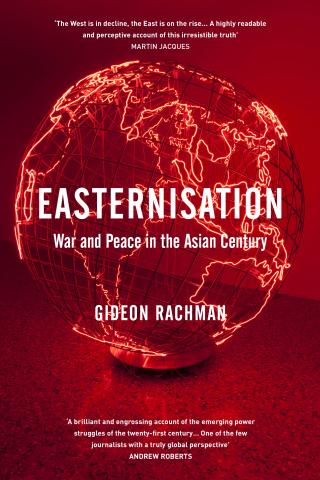
The recent book Easternisation: War and Peace in the Asian Century, by Financial Times journalist Gideon Rachman, deals precisely with this issue.

blog-easternisation

It is a great book, bringing together Rachman’s extensive experience in the US, Asia, and Brussels. Often, books written by journalists lack sound analysis for the mid to long term, and historical perspective. While Easternisation is not an academic tome either, it does provide sufficient deep analysis, especially by tackling developments in all important countries which play a role in the process. It is not just another volume of simply USA or EU bashing, as we have seen before with the huge literature on the alleged Japanese take-over of the US economy.

Rachman’s main argument is that the influence of the West, Europe in particular, has crumbled. This may lead to a major conflict in the Asia Pacific, most notably between China and the US, which also endangers the global economic order. Yet many other conflicts are also building up, in a region which heavily invests in armaments. In short, in the 21st century, ‘rivalries between the nations in the Asia Pacific will shape global politics, just as the struggles between European nations shaped world affairs for over 500 years from 1500 onwards’. I think this is an important message, which should be taken seriously by everybody. Certainly by the Europeans, who are in danger of just inhabiting the world’s largest open air museum within a few decades.  One thing is certain: the Asians will not wait for them to come to terms with the current shift of power.

Reply to ‘Classical Liberalism, Cosmopolitanism and Nationalism’

I write in reply to Edwin van de Haar’s post ‘Classical Liberalism, Cosmopolitanism and Nationalism’, which contains some generous remarks about my social media posts while putting forward a view different from my own about the role of the nation state. Edwin argues that the nation state is foundational to classical liberalism in that post. I have previously argued for the benefits of the United Kingdom staying in the European Union, just before the referendum which has put the UK on the path to leaving.

I will start with the doctrinal issues of how far classical liberalism might be considered as something that is embedded in the emergence of the nation state as we know it. It is true that classical liberalism arose as the nation state emerged and consolidated and it did not occur to classical liberals, on the whole, to question the state system as they knew it. That is a system defined in early modern natural law and contractual theory about law and state as one of a very unified system of sovereignty in a world of ‘a state of nature’, anarchy, or lawlessness between states.

We have to note at least one major deviation in the familiar list of classical liberal authors, which is Immanuel Kant, thinking of his essays ‘Idea for a Universal History with a Cosmopolitan Purpose’ (1784) and ‘Perpetual Peace: a philosophical sketch’ (1795), which do not question the internal  sovereignty of states, but does argue for a law governed set of relations between states with a global institution of some sort to prevent republics going to war with each other.

We should consider John Stuart Mill’s thoughts on federal states in Considerations on Representative Government (1861), particularly chapter XVII, ‘Or Federal Representative Governments’ which looks at the possibility of a state with decentralised decision making functions. A nation state can be federalised, at least in principle, but what are the components of the federation other then sub-nations, where the population may even regard them as nations within the state. Mill was building on the experience of the United States since the constitution of 1787, and Switzerland, particularly since the federal constitution of 1848.

The United States and Switzerland did not come out of nowhere. The US consolidated the links between thirteen colonies of Great Britain while federal Switzerland built on the Swiss Confederation and its links with places like Geneva which were associated with the confederation, but were not part of it until the restructuring of European states in the Napoleonic period. The point here is that modern states may be federal as well as unitary states and that includes continuity with pre-modern links between at last partly self-governing regions-nations. We could even say that kind of state of associated states was the Medieval norm.

The example, and even idealisation, of this Medieval structure enters classical liberalism via Montesquieu’s The Spirit of the Laws (1748), along with the work of Swiss jurists of the time, particularly in Berne. Montesquieu was building on the experience of the kind of medieval and early modern monarchy where he thought there was liberty, moderation in government, distinguishing it from tyranny. In such situations different laws and assemblies for towns and for historic regions was quite normal under the monarchy. In so far as such states, like France, were tending to evolve in states based on the absolute sovereignty of the centre, in the formation of what we call a nation state, Montesquieu saw the danger of despotism.

The historical experience that Montesquieu was drawing on was the way that Medieval monarchies were constructed through assembling  patch work of  the monarch’s personal domains, regions with their own lords and institutions, and church domains, along with increasingly self-governing towns. He also looked at the antique experiences of allying republics in a federation, which he thought was preserved in the Netherlands and Switzerland of his time. Germany, which at that time was a kind of federal/confederal empire of very varied forms of sub-imperial sovereign units including princes with lands outside the Empire, was also a form of federation for Montesquieu.

If we go back to the German history of the century before Montesquieu, the idea of the modern nation state is strongly associated with the Treaty of Westphalia (1648), which ended the Thirty Years war, focused on Germany, but drawing in most of Europe. ‘Westphalian state system’ has become a label for an internal system of states which are completely sovereign internally and face each other as equal legal personalities with no higher instance of sovereignty or collective instrument for enforcing the laws of nations, which do have some basis in the natural law doctrines of the time, and earlier.

The trouble with this understanding of Westphalia is that though it has some truth for Europe outside the German Empire (officially known as the Holy Roman Empire), it is very misleading for the Empire, and therefore for those European powers, including Sweden and Denmark, which had land within the Empire. The princes, cities and other territorial units within the Empire were under the legal authority of the Emperor, who largely served as a judge of interstate disputes though with far greater powers in the lands of the Habsburg family (consolidated as the Austrian Empire in the Napoleonic era) which always had the Emperor, though the Emperor was legally an elective office. The Habsburgs land extended outside the Empire into central Europe so the Westphalian system of Imperial authority brought in other European nations and extended outside the Empire strictly speaking.

Westphalia modified a system rooted in the Middle Ages of Germany as a middle European federation or confederation, drawing in other parts of Europe and therefore anchoring a European system of some kind. Periods of dominance by France or Spain complicate this story, but French claims always overlapped with Imperial claims and the peak of Spanish power was when the Spanish monarchy was from the same family as the German Emperors.

The Napoleonic era disrupted these arrangements severely, but we can see Napoleon as trying to revive the original Empire of the Romans under Charlemagne in the ninth century, which united France, Germany and neighbouring territories under a Frankish over-king. Charlemagne was know as ‘father of Europe’ in his time, perhaps more in connection with Europe as Christendom and his wars against Muslims in Spain, then with Europe as we might think of it now, but this is part of the story of what it is for there to be a Europe and a European system. Coronation by the Pope and recognition of the Frankish kingdom as heir to ancient Rome connects the medieval German Empire with the first great European political system, the Roman Empire.

The aftermath of the Napoleonic period in Germany was a confederation, which again included those European powers (the United Kingdom was one) which had lands in Germany. This evolved into the German Empire founded in 1871, which was itself an extraordinary mixture of Greater Prussia, federation, democracy, aristocracy, monarchy, and so on. It was more of a nation state than German predecessor systems in that it was a sovereign unified part of the international state system. The size and growing economic power of the Kaiserreich, incorporating Polish, French and Danish speaking areas, made it a destabilising force in Europe. Too big for the security of other European states, too small to anchor a European system.

The First World War and the Second World War were both consequences of this unstable system. The European Union is in large part an attempt to solve the problem by creating a European system which Germany anchors, though since unification the dominance of Germany has become an issue again. Whatever the problems, the EU provides a better framework for structuring a European system in which Germany is both contained and can exert influence in a consensual manner.

Returning to the issue of the nation state, Germany was never a nation state in the strictest sense of a very unitary state with a single language and ethnicity. France has usually been taken as the model of the nation state ‘strictly speaking’, but even so it has only been a country of speakers of standard French since the late nineteenth century. As it is now, it includes speakers of Breton, Basque, Occitan and Alsace German. Corsica has special status and Alsace-Lorraine also has some special arrangements in recognition of its specificities.

The European world before the First World War was more of a Europe of multi-national Empires than nations, with four Empires (German Hohenzollern, Austrian Habsburg, Turkish Ottoman, Russian Romanov) dominating the centre and east. Spain in practice has always been an extended Castille in which other regions-nations have played variable distinct roles. The United Kingdom never completely integrated as a nation state; even at the peak of integration in the nineteenth century, Scotland kept its own legal, state church and educational system and since then in a rather complicated way the UK has become more loosely integrated and may lose Scotland in a few years.

Even with the imminent departure of the UK from the EU, Europe continues to be a political system, not just an aggregate of nation states. The larger European states are not nation states in the strictest sense. Even without the EU, European states accept various kinds of obligation with regard to north Atlantic security and global trade which limit sovereignty. The UK will negotiate some kind of membership of the internal market of the EU and its passport union aspect, as well as participation in various EU schemes. It will therefore continue to be part of a European system anchored by Germany.

Ever since the Romans, Europe has needed a European system of some kind, and the German anchor schemes going back to 800 have recognised the Roman precedent. In reality there has never been a Europe of nation states and the periods closest to that model ended in catastrophic wars. Disaggregation of the European system as it is now may not result in war, but it has the potential to unleash trade wars, protectionism, competitive currency devaluation, erosion of chances to live, work, and study abroad, associated labour market sclerosis, destabilising struggles for political-diplomatic dominance, and an incapacity to ally in order to deal with global and strategic issues affecting Europe, including migration flows, Russian expansionism, and Middle Eastern conflict and terror.

(more on the consequences of the UK leave referendum soon)

The Cruel, Conceited Follies of Trump’s Colonialist Foreign Policy

I typically prefer to abstain from writing too extensively on electoral politics. For one, it’s not my area of expertise and I simply don’t enjoy it that much, but also I think the type of issues that come up in electoral politics are a sensationalist distraction from the meaningful policy debates that actually go on in the back rooms of congress and think tanks, as well as the deeper and more important philosophical, economic, and cultural issues that plague our political situation. Thus, I prefer to write in more detail about public policy or more theoretical economic and philosophical issues rather than the day-to-day drudgery of superficial political news. However, the recent discussion on foreign policy on the campaign trail surprisingly has the potential to become at least mildly substantive, so it is in my mind worth analyzing in greater depth. It should be noted that I am far from an expert in foreign policy, so apologies in advance for any errors and if this article as a whole is a farce.

The purpose of this article is to lay out and critically assess Donald Trump’s foreign policy. It is my contention that Trump does have some fairly consistent underlying instincts, if not principles, on foreign policy that may be inferred from his public comments on the issue. This may be characterized by a concerning belief that the ultimate end of foreign policy should be to aggressively promote America’s interests abroad, akin to a radical, new type of Jacksonian colonialism. If I am right about Trump’s underlying views on foreign policy, a Trump presidency would result in disaster. It would mean massive violations of humanitarian rights and would fail to meet the goals even Trump himself is seeking to attain.

Clinton on Trump’s Foreign Policy

Yesterday, Hillary Clinton delivered a major speech ostensibly criticizing Trump’s foreign policy. Unfortunately, most of her speech was more of an attack on the narrative of Trump’s campaign and Trump himself than his actual foreign policy. This is largely because she thinks Trump doesn’t really actually have a foreign policy; his positions, Clinton thinks, are incoherent, ignorant, or just not even positions at all. This is probably the most quoted passage of the speech:

Donald Trump’s ideas aren’t just different — they are dangerously incoherent.
They’re not even really ideas: just a series of bizarre rants, personal feuds, and outright lies. He’s not just unprepared, he’s temperamentally unfit to hold an office that requires knowledge, stability and immense responsibility. This is not someone who should ever have the nuclear codes — because it’s not hard to imagine Donald Trump leading us into a war just because somebody got under his very thin skin.

Clinton’s strongest case against Trump was that he is “temperamentally unfit to hold office.” She makes this case even more persuasively elsewhere in the speech:

Imagine Donald Trump sitting in the Situation Room, making life-or-death decisions on behalf of the United States. Imagine him deciding whether to send your children into battle. Imagine if he had not just his Twitter account at his disposal when he’s angry, but America’s entire arsenal.

Do we want him making those calls – someone thin-skinned and quick to anger, who lashes out at the smallest criticism?

…I’ll leave it to the psychiatrists to explain his affection for tyrants. I just wonder how anyone could be so wrong about who America’s real friends are. But it matters. Because if you don’t know exactly who you’re dealing with, men like Putin will eat your lunch.

I typically don’t find these types of arguments convincing. After all, it doesn’t matter so much the character of public officials as the institutional incentives they face. But in matters of foreign policy problems of temperament and character do matter because the social situation between foreign leaders in diplomacy can often make a huge difference. Bad manners can and have caused wars (eg., there’s an argument to be made that Jefferson’s bad manners towards British diplomat Anthony Merry helped lead to the War of 1812). These points are confirmed by the fact that world leaders are terrified by Trump and how the intelligence community is afraid he could spill security-sensitive confidential information. (Of course, Clinton also has a less-than-optimal track record on the matter of intelligence security).

What is Trump’s Foreign Policy?

However, Clinton is only partially correct in claiming that Trump’s ideas on foreign policy are “incoherent” or that he doesn’t really have a foreign policy at all. It is true that, as with every other issue save immigration and free trade, Trump switches his positions a lot. But underneath the prime facie incoherence is an overarching vision for a foreign policy that is both somewhat coherent and terrifying.

First, a common misconception needs to be clarified about Trump’s foreign policy views. The press commonly treats Trump as if he’s more of a dove on war and foreign intervention than Clinton, citing his recent criticisms of the Iraq War and Libya. This myth is particularly peddled in pro-Trump “libertarian” circles (with an emphasis on the scare quotes). It is widely accepted that Trump’s foreign policy are less interventionist than Clinton’s fairly hawkish views. However, this is decidedly not the case.

Zach Beauchamp has persuasively made the case that Trump is, in fact, more hawkish in some sense than Clinton. The most consistent point that Trump has made for years now is that America should be waging, in Beauchamp’s words, “colonial wars of conquest” for the purpose of taking resources from other countries. Beauchamp notes:

He first debuted this plan in an April 2011 television appearance, amid speculation that he might run for the GOP nomination. In the interview, Trump seemed to suggest the US should seize Iraqi oil fields and just operate them on its own.

“In the old days when you won a war, you won a war. You kept the country,” Trump said. “We go fight a war for 10 years, 12 years, lose thousands of people, spend $1.5 trillion, and then we hand the keys over to people that hate us on some council.” He has repeated this idea for years, saying during one 2013 Fox News appearance, “I’ve said it a thousand times.”

Trump sees this as just compensation for invading Iraq in the first place. “I say we should take it [Iraq’s oil] and pay ourselves back,” he said in one 2013 speech.

As Beauchamp says, “To be clear: Trump’s plan is to use American ground troops to forcibly seize the most valuable resource in two different sovereign countries. The word for that is colonialism.”

This type of colonialism is even more extreme than the colonialism of American imperialism of the early twentieth century, where colonial wars of conquest were typically justified in terms of America’s “manifest destiny” to spread democracy throughout the world that would eventually benefit the conquered, often coaxed in racial terms (as typified by Kipling’s famous poem), rather than explicitly justified by looting natural resources.

Many people alleging Trump’s dovishness point to his recent criticisms of US intervention in Iraq, Syria, and Libya. The idea that Trump is a dove on these issues, however, is largely a myth. The actual record shows that what Trump’s comments over the past decade or so on foreign policy are largely in line with what Beauchamp sees as his colonialism.

As Beauchamp points out, Trump actually supported intervention in Libya at the time and called for even more aggressive intervention than the Obama administration engaged in (which, as a reminder, included Hillary Clinton at that point):

In a March 2011 vlog post uncovered by BuzzFeed’s Andrew Kaczynski and Christopher Massie, Trump full-throatedly endorsed intervening in the country’s civil war — albeit on humanitarian grounds, not for its oil.

“Qaddafi in Libya is killing thousands of people, nobody knows how bad it is, and we’re sitting around,” Trump said. “We should go in, we should stop this guy, which would be very easy and very quick. We could do it surgically, stop him from doing it, and save these lives.” In a later interview, he went further, endorsing outright regime change: “if you don’t get rid of Gaddafi, it’s a major, major black eye for this country.”

Shortly after the US intervention in Libya began in March 2011, Trump criticized the Obama administration’s approach — for not being aggressive enough. Trump warned that the US was too concerned with supporting the rebels and not trying hard enough to — you guessed it — take the oil.

“I would take the oil — and stop this baby stuff,” Trump declared. “I’m only interested in Libya if we take the oil. If we don’t take the oil, I’m not interested.”

What to make, then, of Trump’s more recent comments where he says he “would have stayed out of Libya”? He’s either incoherent, as Clinton claims, or he’s lying. The first possibility has largely been explored and, though plausible, is uninteresting for present purpose. Therefore, I’ll focus here on the latter (and, in my mind, more likely) possibility. I would argue that Trump is engaging in what could be called, in Arthur Melzer’s understanding of Straussian terms, a sort of dishonest perversion of political esotericism. But unlike the political esotericism of early modern political philosophers who sought to make the world more tolerant, Trump seeks the exact opposite ends. He’s recently been hiding his colonialist views in anti-war rhetoric to attract votes from Americans fatigued with perpetual nation-building through the Bush and Obama administrations. In reality, one of the only sincere substantive positions he’s retained throughout the years is a colonialist desire to wage war for oil. He could not be much further from an anti-war candidate.

As for Iraq, Trump has repeated the claim that he opposed the Iraq war from the beginning many times. Just yesterday, in reaction to Clinton’s speech, he repeated this yet again. “Crooked Hillary said, ‘Oh, Donald Trump, his finger on the button,’,” he said. “I’m the one that didn’t want to go into Iraq, folks, and she’s the one that stupidly raised her hand to go into Iraq and destabilize the entire Middle East.”

In reality, Trump himself wanted to stupidly go into Iraq at the time. In a 2002 interview with Howard Stern he said he supported invading Iraq, adding “I wish the first time it was done correctly.” How did he think it should have been done? Though he wasn’t specific in that interview, his later comments suggest he thinks a “correct” invasion of Iraq would be more aggressive and, of course, focus on taking their oil. Despite being sharply critical of the war later in the Bush administration (though note how he critiques the way it was “handled,” not getting involved in the first place), he supported McCain’s position in favor of the Troop Surge when endorsing him in 2008, claiming, though he wanted to pull out as soon as possible, he wanted to pull out with a victory. Even his most recent comments “critical” of the war, when viewed in the context of his overall foreign policy motivations, aren’t really dovish at all. As he said in 2013, “When I heard that we were first going into Iraq, some very smart people told me, ‘Well, we’re actually going for the oil,’ and I said, ‘All right, I get that.’ [But] we didn’t take the oil!”

Recent comments by Trump against the Iraq War, I think, are well explained by his aforementioned dishonest political esotericism. The record shows Trump disagreed with Bush’s Iraq policy because the motivations were too humanitarian and weren’t aggressive enough prior to the surge. Indeed, Trump’s dishonest claim to dovishness on Iraq has been widely proven false in the press (and yes, each different word links to a different source saying the same thing).

Beauchamp points out that Trump’s views on Syria can’t be described as doveish, as he is largely in agreement with Hillary Clinton:

But the two of them support more or less the same military escalation in Syria. Both Clinton and Trump have proposed carving out “safe zones” in the country, which means clearing out a chunk of its territory and protecting it from aggressors.

Trump sees this as the answer to the Syrian refugee crisis — if you can keep the Syrians there, they won’t have to come over here (or to Europe). “What I like is build a safe zone, it’s here, build a big, beautiful safe zone and you have whatever it is so people can live, and they’ll be happier,” he said in a campaign appearance. “I mean, they’re gonna learn German, they’re gonna learn all these different languages. It’s ridiculous.”

Similarly, both candidates have emphasized the need to bomb ISIS in Iraq and Syria — with Trump famously summarizing his policy as “bomb the shit out of” ISIS. But the way in which Trump plans to wage war on ISIS is far more aggressive — and illegal — than anything Clinton proposed.

He goes on to show that Trump endorses killing the families of suspected terrorists and supports torture for detainees, both of which are illegal war crimes. The killing of suspected terrorists’ families, in particular, is far more extreme than anything Clinton’s proposed and a violation of international law.

Trump essentially views other countries in one of two ways, the way he seems to view people: either as enemies to be defeated economically (eg. China and Mexico) and militarily (eg. Lybia and Syria) or assets to be exploited for American interests via colonial conquest (eg. Iraq). Indeed, he combines the worse elements of neoconservative interventionism with the worst elements of isolationism that my fellow Notewriter Brandon Christensen points out. Like isolationists, he opposes international organizations like NATO and the UN, is generally skeptical of alliances, and fiercely opposes trade agreements; but he also supports costly, unnecessary, and unjust foreign wars and efforts to intervene in other countries’ affairs like neoconservatives. He manages to be both an isolationist, thinking the American government should only protect its own interests at the expense of the citizens of other people, and an interventionist, thinking the government should wage unjust wars to that end, at the same time.

Beauchamp notes how Trump’s foreign policy positions can best be described as Jacksonian:

But historically, there are lots of other forms of American hawkishness. Trump fits well with one of those — one that Bard College scholar Walter Russell Mead calls the “Jacksonian tradition,” after President Andrew Jackson.

Jacksonians, according to Mead, are basically focused on the interests and reputation of the United States. They are skeptical of humanitarian interventions and wars to topple dictators, because those are idealistic quests removed from the interests of everyday Americans. But when American interests are in question, or failing to fight will make America look weak, Jacksonians are more aggressive than anyone.

… Unlike neoconservatives or liberal interventionists, who have well-fleshed-out foreign policy doctrines, many Jacksonians think about war and peace more instinctively. “With them it is an instinct rather than an ideology — a culturally shaped set of beliefs and emotions rather than a set of ideas,” Mead writes. Sound familiar?

Of course, Trump is Jacksonian in more ways than just his foreign policy. His general populism and affection for strong-man leadership are very Jacksonian through and through. Indeed, Thomas Jefferson’s criticisms of Andrew Jackson himself could just as easily be leveled against Trump today (and echo Clinton’s words):

I feel much alarmed at the prospect of seeing General Jackson President.  He is one of the most unfit men I know of for such a place.  He has had very little respect for laws and constitutions, and is, in fact, an able military chief.  His passions are terrible.  When I was President of the Senate, he was Senator; and he could never speak on account of the rashness of his feelings.  I have seen him attempt it repeatedly, and as often choke with rage.  His passions are, no doubt, cooler now; he has been much tried since I knew him, but he is a dangerous man.

A Critique of Trump’s Foreign Policy

Besides the obvious criticism made very persuasively by Clinton that Trump is temperamentally unfit to engage in diplomacy, what is wrong with foreign policy? In a word: everything. But for the purposes of this post, I’ll confine my criticism to three points.

First, Trump’s style of Jacksonian foreign policy is largely responsible for most of the humanitarian atrocities committed by the American government. Second, Trump’s economic foreign policy is antithetical to the entire spirit of the liberal tradition; it undermines the dignity and freedom of the individual and instead treats the highest good as for the all-powerful nation-state (meaning mostly the politicians and their special interests) as the end of foreign policy, rather than peace and liberty. Finally, Trump’s foreign policy fails for the same reasons that socialism fails. If the goals of foreign policy are to represent “national interest,” then the policymaker must know what that “national interest” even is and we have little reason to think that is the case, akin to the knowledge problem in economic coordination.

On the first note, Beauchamp quotes Dr. Mead on how the Jacksonian tradition in America has resulted in some of the most atrocious abuses of human rights in American history:

In the last five months of World War II, American bombing raids claimed the lives of more than 900,000 Japanese civilians—not counting the casualties from the atomic strikes against Hiroshima and Nagasaki. This is more than twice the total number of combat deaths that the United States has suffered in all its foreign wars combined…

Since the Second World War, the United States has continued to employ devastating force against both civilian and military targets. Out of a pre-war population of 9.49 million, an estimated 1 million North Korean civilians are believed to have died as a result of U.S. actions during the 1950-53 conflict. During the same war, 33,870 American soldiers died in combat, meaning that U.S. forces killed approximately thirty North Korean civilians for every American soldier who died in action. The United States dropped almost three times as much explosive tonnage in the Vietnam War as was used in the Second World War, and something on the order of 365,000 Vietnamese civilians are believed to have been killed during the period of American involvement.

This is because the Jacksonian view dictates that we should use full force in war to advance our interests and the reasons for waging war are for selfish rather than humanitarian purposes. We have good reason to think human rights under Trump will be abused to an alarming degree, as his comments that we should “bomb the hell out of” Syria, kill the noncombatant families of suspected terrorists, and torture detainees indicate. Trump is literally calling for the US to commit inhumane war crimes in the campaign, it is daunting to think just how dark his foreign policy could get in practice.

As mentioned earlier, many “libertarians” such as Walter Block seem to be under the delusion that Trump’s foreign policy is somehow compatible with the liberal tradition’s aspirations of individual liberty and peace. As he wrote when he endorsed Trump and created the oxymoronically named group “Libertarians for Trump:”

When put in this way, it is clear that The Donald is the most congruent with our perspective. This is true, mainly because of foreign policy.

…We readily concede Mr. Donald Trump is no Ron Paul on foreign policy or anything else for that matter. However, compared to his Republican alternatives, the Donald stands head and shoulders above them. He has said, time and time again, things like “Look at what we did in Iraq. It’s a mess. Look at what we did in Libya. It’s a mess there too. And we’re going to repeat our mistakes in Syria? Not on my watch.” …Yes, future President Trump wants a strong military, but with only a few exceptions, fewer than the other Republican candidates, only to defend our country.

Ignoring the glaring factual inaccuracy that Trump’s criticisms of Iraq and Libya were that we weren’t fierce enough and the main reason why he wants war is not to defend our country but to loot oil, nothing could be further from the truth that Trump’s foreign policy views are anywhere near to congruent with libertarianism.

To reiterate: Trump’s foreign policy views are just a particularly nasty version of imperialism and colonialism. Mises dedicated two entire sections of his chapter on foreign policy in Liberalism: The Classical Tradition to critiquing colonialism and revealing just how contrary these views are to liberalism’s commitment to peace and liberty. In direct opposition to Trump’s assertions that we should go to war to gain another country’s wealth and resources and that we should expand military spending greatly, Mises argues:

Wealth cannot be won by the annexation of new provinces since the “revenue” deprived from a territory must be used to defray the necessary costs of its administration. For a liberal state, which entertains no aggressive plans, a strengthening of its military power is unimportant.

Mises’ comments on the colonial policy in his time are extremely pertinent considering Trump’s calls to wage ruthlessly violent wars and commit humanitarian crises. “No chapter of history is steeped further in blood than the history of colonialism,” Mises argued. “Blood was shed uselessly and senselessly. Flourishing lands were laid waste; whole peoples destroyed and exterminated. All this can in no way be extenuated or justified.”

Trump says the ends of foreign policy are to aggressively promote “our” national interests, Mises says “[t]he goal of the domestic policy of liberalism is the same as that of its foreign policy: peace.” Trump views the world as nations competing in a zero-sum game and there must be one winner that can only be brought about through military conquest and economic protectionism, Mises says liberalism “aims at the peaceful cooperation between nations as within each nation” and specifically attacks “chauvinistic nationalists” who “maintain that irreconcilable conflicts of interest exist among the various nations[.]” Trump is rabidly opposed to free trade and is horrifically xenophobic on immigration, the cornerstone of Mises’ foreign policy is free movement of capital and labor over borders. There is no “congruence” between Trump and any classically liberal view on foreign policy matters in any sense; to argue otherwise is to argue from a position of ignorance, delusion, or to abandon the very spirit of classical liberalism in the first place.

Mises wasn’t the only classical liberal critical of Trump-style colonialist foreign policy. The classical liberal editor of The Nation Edward Lawrence Godkin was also sharply critical of the imperial foreign policy of the progressives and populists in his time. In a 1900 article entitled “The Eclipse of Liberalism,” in which he lamented the decline of the liberal emphasis on limited government, Godkin wrote:

Nationalism in the sense of national greed has supplanted Liberalism. It is an old foe under a new name. By making the aggrandizement of a particular nation a higher end than the welfare of mankind, it has sophisticated the moral sense of Christendom. Aristotle justified slavery, because Barbarians were “naturally” inferior to Greeks, and we have gone back to his philosophy. We hear no more of natural rights, but of inferior races, whose part it is to submit to the government of those whom God has made their superiors. The old fallacy of divine right has once more asserted its ruinous power, and before it is again repudiated there must be international struggles on a terrific scale. At home all criticism on the foreign policy of our rulers is denounced as unpatriotic. They must not be changed, for the national policy must be continuous. Abroad, the rulers of every country must hasten to every scene of international plunder, that they may secure their share. To succeed in these predatory expeditions the restraints on parliamentary, even of party, government must be cast aside. [Emphasis mine]

Though Godkin’s broader arguments against the “inferior races” argument for imperialism may not apply to Trump himself per se, it certainly does apply to some of Trump’s dangerously backward white nationalist supporters (at least one of whom Trump has publicly appointed) who are helping to drive his rise.

It wasn’t just Godkin in the United States, an entire organization was formed to oppose these policies: The American Anti-Imperialist League, which formed specifically in opposition to the Spanish-American War and the annexation of the Philippians and Cuba. Though it was certainly a diverse collection of anti-imperialists with a wide variety of motives, many of them were classical liberals. Their platform emphasized the incompatibility of small government and imperial conquest:

We hold that the policy known as imperialism is hostile to liberty and tends toward militarism, an evil from which it has been our glory to be free. We regret that it has become necessary in the land of Washington and Lincoln to reaffirm that all men, of whatever race or color, are entitled to life, liberty and the pursuit of happiness. We maintain that governments derive their just powers from the consent of the governed. We insist that the subjugation of any people is “criminal aggression” and open disloyalty to the distinctive principles of our Government.

Trump’s incompatibility with classically liberal goals is not of unique interest to libertarians. In many ways, both neoconservatives and liberal interventionists aim for a similar end of peace among nations in foreign policy for which classical liberals aim (or at least, I hope they share such an aim). The three viewpoints just disagree on the best policy means to reach those ends. Trump decidedly does not take peace as the end of foreign policy. He takes the ruthless promotion of America’s economic interests to be the goal, often at the expense of peace and at the expense of the lives of innocent people.

Additionally, even if we take Trump’s nationalist ends as given, the policy means Trump prefers of violent military intervention likely will not be successful for similar reasons to why socialism fails. Christopher Coyne has argued convincingly that many foreign interventions in general fail for very similar reasons to why attempts at economic intervention fail, complications pertaining to the Hayekian knowledge problem. How can a government ill-equipped to solve the economic problems of domestic policy design and control the political institutions and culture of nations abroad?  Coyne mainly has the interventionism of neoconservatives and liberals in mind, but many of his insights apply just as well to Trump’s Jacksonian vision for foreign policy.

The knowledge problem also applies on another level to Trump’s brand of interventionism. Trump assumes that he, in all his wisdom as president, can know what the “national interest” of the American people actually is, just like socialist central planners assume they know the underlying value scales or utility functions of consumers in society. We have little reason to assume this is the case.

Let’s take a more concrete example: Trump seems to think one example of intervention in the name of national interest is to take the resource of another country that our country needs, most commonly oil. However, how is he supposed to know which resources need to be pillaged for the national interest? There’s a fundamental calculation problem here. A government acting without a profit signal cannot know the answer to such a problem and lacks the incentive to properly answer it in the first place as the consequences failure falls upon the taxpayers, not the policy makers. Even if Trump and his advisors could figure out that the US needs a resource, like oil, and successfully loots it from another country, like Libya, there is always the possibility that this artificial influx of resources, this crony capitalist welfare for one resource at the expense of others, is crowding out potentially more efficient substitutes.

For an example, if the government through foreign policy expands the supply of oil, this may stifle entrepreneurial innovations for potentially more efficient resources in certain applications, such as natural gas, solar, wind, or nuclear in energy, for the same reasons artificially subsidizing these industries domestically stifle innovation. They artificially reduce the relative scarcity of the favored resource, reducing the incentive for entrepreneurs to find innovative means of using other resources or more efficient production methods. At the very least, Trump and his advisors would have little clue how to judge the opportunity cost of pillaging various resources and so would not know how much oil to steal from Libya. Even ignoring all those problems, it’s very probable that it would be cheaper and morally superior to simply peaceably trade with another country for oil (or any other resource) rather than waging a costly, violent, inhumane war in the first place.

Of course, I’m probably giving Trump way too much credit in that critique. Chances are, given Trump’s (nonexistent) economic literacy, he is just under the delusion that more resources always mean a better economy no matter what–opportunity costs, resource allocation, and entrepreneurial innovation be damned–and that government policy can be run just like a business.

Not only is it difficult for policy makers to know what the national interest is, as Christensen has argued it is unclear what “national interest” even means to begin with. He defines national interest as “an excuse for a policy or set of policies that should be taken in order to strengthen a state and its citizens (but not necessarily strengthen a state relative to other states…).” He further claims, “There’s no such thing as a national interest.” I’d take it even one step further: the rhetoric of “national interest,” it seems to me, is just an ideology (in the critical theory sense) for the foreign policy elite and their lobbyists to justify using coercive force to advance their arbitrary private interests rather than the (largely indeterminate) interests of the public or the country at large. Even if the “national interest” does have any meaning other than as a rhetorical ideology for the military industrial complex, the only way such a concept could become known is via the spontaneous process of the voluntary interchange of individuals, often time between citizens and non-citizens, and will likely never be known by a single individual mind. At the very least, there’s a public choice problem here: how is Trump realistically to differentiate his personal interests and those of his cronies from those of the general public? Given the fact that Trump likely has narcissistic personality disorder, I don’t have faith that he will.

The only positive potential to foreign policy under a Trump administration is the possibility that he will wisely not intervene in foreign affairs when no argument can be made that such an intervention would be in the national interest or give us oil. But given Trump’s record on the matter, and the arbitrary and elusive nature of the concept of “national interest,” I doubt that this will be a major factor in the way Trump actually implements foreign policy.

Trump vs. Clinton on Foreign Policy: Who is Preferable?

It is clear that underneath the prima facie inconsistencies in Trump’s comments on foreign policy, there is an underlying consistency that he thinks the goal of foreign policy is to quite aggressively promote US interests. This goal is impossible to reach as it represents a naïve understanding of the knowledge public leaders can possess, and generally represents a selfish, reckless, nationalist disregard for human dignity. The means he wants to undertake for this end are unnecessarily cruel and would likely constitute massive human rights violations. They contradict the high (and in my mind correct) aspirations of classical liberals of peace and individual liberty, and they’ll likely fail to accomplish their stated goals.

However, none of this necessarily means that Clinton’s foreign policy will be all that much better. Sure, Clinton’s motives are likely purer, but her record shows that the means she undertakes are uncannily similar to Trump and fail for similar reasons. She’s shown a similar lack of judiciousness in her handling of classified materials, just what the intelligence community fears of Trump. Her record shows her diplomatic skills yield mixed results at best, and she’s widely a progressive interventionist on foreign policy matters whose policies will subvert the liberal goals of peace and individual liberty. It is somewhat ironic that the Democrats have such great opportunity to go after Trump on foreign policy, but have chosen the absolute worst person in their party to make that case as their nominee (akin to Republicans and Romney on ObamaCare in 2012).

Comparing the two candidates point-by-point, therefore, is very difficult. Though there are many underlying consistencies to Trump’s comments on foreign policy and Clinton is still largely right that his stated positions have been somewhat incoherent. Unlike Trump, we have a record of Clinton actually implementing foreign policy and our only knowledge of the Donald’s policies only comes from occasionally off-the-cuff and contradictory remarks about others’ policies. Thus there is a degree of uncertainty as to what Trump’s foreign policies will actually look like and, though I think his comments reveal there is a high probability they will be atrocious, there is a small chance that they could be marginally better than Clinton’s (whose record shows she will implement almost certainly failed foreign policies). Trump’s very concerning comments on foreign policy alone do not make a slam-dunk case that Clinton is preferable on these matters.

Having said that, I’d still argue Clinton’s foreign policy is at least marginally preferable to Trump’s. With Trump we risk not only a fairly high probability of atrocious policies—quite possibly worse than Clinton’s—based off of his comments, we also risk the added problem of regime uncertainty in foreign policy. Also, some of the concrete policies Trump has called for—like torture and the murdering of families—are a cause for serious concern. Further, Clinton is likely to be far more diplomatic and will be less likely to offend other leaders and alienate the US from the world. Her point that Trump is “temperamentally unfit to lead” is very well taken, and was only confirmed by Trump’s response to her speech which in which he largely stuck to the non-substantive screaming of insults in his typical childish fashion. None of this at all means anybody should vote for either candidate as there is a lot more to voting than the issues of foreign policy. For what it’s worth (which is very little), I for one will most likely not be voting in the next election. If I were forced to, it would be for the Johnson/Weld ticket.
Libertarians and Pragmatists on Democracy Part 3: Pragmatists on Democracy as a Way of Life

eNote: This is part of a series on democracy. It is assumed the reader is familiar with part one, defining democracy, and part two, summarizing classical liberal perspectives on democracy. In this section, we’ll analyze how pragmatists conceive of democracy as a broader philosophy. The final post will argue that a dialectical synthesis of libertarianism and pragmatism on democracy will yield an argument in favor of market anarchy.

As classical liberals have pointed out throughout history, particularly in since the mid-nineteenth century, democracy as a system of political decision-making can be extremely dangerous to individual liberty and social prosperity. It could lead to tyranny of the majority, it may be characterized in practice as the rule of the ignorant and irrational and yield awful policy, and it leads to a reification of the state as the just “voice of the people” which can cause further tyranny. For these reasons, there is a very strong argument from moving away from constitutions which rely primarily on democratic means for decision making for the protection of individual liberty. The natural question is: what is our current democratic regime to be replaced with?

To answer this question, perhaps it is worth examining what is admirable in democracy. Thus far, I have mostly been referring to democracy in the second sense mentioned in the introductory section (henceforth referred to, for want of a better term, political democracy), as a means of political decision making. However, there is also the fourth sense which, although related, is distinct from political democracy which may be called philosophical democracy. To further explore this meaning of democracy, and perhaps give an answer to the aforementioned question, it is worth engaging with the thought of some of the most strident defenders of democracy: the American pragmatists.

Pragmatists on Philosophical Democracy

The writings of John Dewey and Sidney Hook are exemplars of philosophical democracy (though certainly others in this tradition are as well). Dewey, in his 1888 essay “The Ethics of Democracy,” specifically argues against Henry Maine’s view that “democracy is only a form of government.” Dewey explicitly defines democracy as a much broader “way of life,” as he says in his 1937 work “Democracy and Education:”

Democracy is much broader than a special political form, a method of conducting government, of making laws, and carrying on government administration by means of popular suffrage and elected officials. It is that, of course. But it is something broader and deeper than that. The political and governmental phase of democracy is a means, the best means so far found, for realizing ends that lie in the wide domain of human relationships and the development of human personality. It is, as we often say, though perhaps without appreciating all that is involved in the saying, a way of life, social and individual. The keynote of democracy as a way of life may be expressed, it seems to me, as the necessity for the participation of every mature human being in the formation of the values that regulate the living of men together: which is necessary from the standpoint of both the general social welfare and the development of human beings as individuals.

Indeed, Dewey’s emphasis on how democracy allows for participation in the formation of social values is a common thread throughout his entire political philosophy. In his earlier days, he was deeply influenced by the Hegelian notion of society as a “social organism” (although, in his later work he became a bit more cautious about the collectivist and possible authoritarian implications of this doctrine; see his 1939 essay “I Believe”). In 1888, he argued that democracy, by allowing participation of all, “approaches most nearly the ideal of all social organization; that in which the individual and society are organic to each other.” He explains:

In every other form of government there are individuals who are not organs of the common will, who are outside of the political society in which they live and are, in effect, aliens to that which should be their own commonwealth. Not participating in the expression of the common will, they do not embody themselves. Having no share in society, society has none in them.

…The government is not made up of those who hold office, or who sit in the legislature. It consists of every member of political society. And this is true of democracy, not less, but more, than of other forms. The democratic formula that government derives its powers from the consent of the governed…means that in democracy, at all events, the governors and the governed are not two classes, but two aspects of the same fact—the fact of the possession of a unified and articulate will.

Thus, Dewey argues that “Democracy, in a word, is a social, that is to say, an ethical conception, and upon its ethical significance is based its significance as governmental.”

Dewey expands upon the sense in which Democracy is an “ethical conception” in his much later work “Creative Democracy: The Task Before Us,” in which he characterizes democracy as a “personal way of individual life” (his emphasis). In this sense, democracy is not only to be found in institutions but in “free gatherings of neighbors on the street corner to discuss back and forth what is read in uncensored news of the day, and in gathering of friends in living rooms of houses and apartments to converse freely with one another.”

The sense in which democracy is a personal way of life is characterized by what Dewey calls the “democratic faith.” There are two elements to this democratic faith, one is faith in “the possibilities of human nature.” That is, faith that “every human being, independent of the quality or range of his personal endowment, has the right to equal opportunity with every other person for the development of whatever gift he has.” Second, is a “faith in the capacity for human beings for intelligent judgment and action if proper conditions are fostered.” These two faiths combine to make democracy an overarching philosophy that characterized by “belief in the ability of human experience to generate the aims and methods by which further experience will grow in ordered richness.” It can be seen, then, how these faiths may be found in not so much the political institution of democracy but in every day deliberative discussion and face-to-face encounters like neighbors and friends discussing news.

Sidney Hook in his 1938 essay “The Democratic Way of Life” further expands on the ethical character of democracy as a personal way of life. He argues that there are “three related values which are central to democracy as a way of life.” Those are the “belief that every individual should be regarded as possessing intrinsic worth or dignity,” the “belief in the value of difference, variety and uniqueness,” and, to mediate between such values, a belief in “the method of intelligence, of critical scientific inquiry.”

In regards to that last value, it could be said that for Dewey and Hook participatory democracy is not only a “way of life” or an “ethic,” but also a social epistemology. He argues in “Democracy and Education” that, although intelligence is unevenly distributed among individuals, “it is the democratic faith that it is sufficiently general so that each individual has something to contribute and value of each contribution can be assessed only as it enters into the final pooled intelligence constituted by the contributions of all.” He says in Liberalism and Social Action that rapid changes in society “have to be directed” and “controlled that it will move in some end in accordance with the principles of life, since life itself is development.” For Dewey, taking advantage of the dispersed intelligence through the democratic process is essentially the application of the scientific method to political problems. Indeed, the idea of democratic experimentalism comes to the forefront in this philosophical conception of democracy precisely because of Dewey’s epistemological commitments to the scientific method.

Thus, democracy in this pragmatist sense is a personal philosophy and social epistemology that accepts scientific deliberation, humanism, and pluralism as necessary conditions for growth of individuals and society as a whole.

Dewey on Political Democracy

Of course, the pragmatists not only conceived of democracy as a way of life but defended democratic institutions. What is striking about this is how Dewey characterizes political democracy as a means to the aspirations of philosophical democracy rather than an end itself. Indeed, he writes in “Democracy and Administration” that the institutions of political democracy “are not a final end and a final value. They are to be judged on the basis of their contribution to end.” The end here, of course, is the extent to which it allows individuals to participate in the formation of social values and the defense of liberty necessary for such participation.

Recall that in The Constitution of Liberty Hayek also conceived of political democracy as an end, and there is a striking similarity between Dewey and Hayek on this point. One may be tempted to say that the ends they are seeking are entirely different as Hayek is seeking individual liberty. However, this is not necessarily the case, as Dewey argued in Liberalism and Social Action that the end of liberalism is “a social organization that will make possible the effective liberty and opportunity for personal growth in mind and spirit of all individuals.”

To be sure, Dewey’s and Hayek’s conceptions of what constitutes liberty are very different: Hayek specifically cites Dewey as conceptually confusing “power” with “liberty” for accepting a positive rather than negative conception of liberty. For Hayek, liberty simply means “the absence of coercion.” For Dewey, liberty means “the liberation of individuals so that realization of their capacities may be the law of their life.” However, what at first seems to be two contradictory beliefs in liberty are not necessarily contradictory. One may say, with Dewey, that positive liberties are necessary so that individuals may grow in mind and spirit and participate in the formation of social values, but agree with Hayek that a necessary prerequisite for such liberties is absence of coercion. Indeed, this defense of negative liberty for the sake of positive liberty is precisely the stance many modern neoclassical liberals take, most notably Jason Brennan and David Schmidt. Thus, Dewey’s and Hayek’s views on democracy as a means to the end of liberty are quite possibly complementary. (This is not to be confused with claiming they really said the same thing, which they clearly did not.)

Dewey defends democracy as the most effective means to this end on the basis that “no man or limited set of men is [sic] wise enough or good enough to rule others without their consent[.]” Political democracy is understood by the pragmatists, as Sidney Hook says, to be a society “where the government rests upon the freely given consent of the governed.” This consent (which Hook acknowledges is not in complete existence in reality) is given through voting.


Criticisms of the Pragmatist Incorporation of Political Democracy

The pragmatist conception of philosophical democracy is certainly admirable from a classical liberal standpoint. Its emphasis on dispersed knowledge, its call for liberal tolerance of diversity, its humanistic respect for the dignity of every individual, and its use of a broadly scientific (though not scientistic) approach to social issues are all well in line with classical liberalism’s goals. However, clearly the incorporation of political democracy as the political ideal by the pragmatists would irk many classical liberals and especially modern libertarians. In fact, I would argue that political democracy in practice is somewhat antithetical to the philosophical aspirations of the pragmatists.

There are four ways in which political democracy undermines the aspirations of philosophical democracy. First, in no meaningful sense could it be said that political democracy has the consent of the governed. Second, political democracy in practice is in no meaningful sense actually an application of intelligence and the scientific method to political issues in practice. Third, the centralization of political authority and planning in democracies undermines Dewey’s point that intelligence is distributed throughout society (particularly in his extremely interventionist views on economics). Finally, the democratic process undermines the mutual respect of individual human dignity philosophical democracy exalts.

Both Dewey and Hook argue that political democracy’s legitimacy and its epistemic superiority rest on its ability to take the freely given consent of the governed through the electoral process. Dewey is, at best, vague on what this means, but Hook is a bit more explicit in “The Democratic Way of Life:”

In saying that government rests upon the “consent” of the governed, it is meant that at certain fixed periods its policies are submitted to the governed for approval or disapproval. By “freely given” consent of the governed is meant that no coercion, direct or indirect, is brought to bear upon the governed to elicit their approval or disapproval. A government that “rests upon” the freely given consent of the governed is one that in fact abides by the expression of this approval or disapproval.

Hook gives three conditions of how this consent must be reached. First, the method of giving consent must not be obstructed (in this case, free elections without coerced voting). Second, there can be no economic threats to political dissenters, so the economic policy must be controlled through political means. Third, there can be no monopoly in education or the press. I argue, though the third may be reached in political democracy, the first two are nearly impossible to be achieved in political democracies.

On the first point, it is highly dubious that voting is truly a method of consent in the first place. Michael Huemer in The Problem of Political Authority identifies three arguments that are typically given to claim democracy has the consent of the governed. First, “naïve majoritarianism,” which believes that if all vote or have the opportunity to vote in an election the majority has just authority to govern as they please. Second, deliberative democracy, which holds that if participants can publicly reason about their proposals, have an equal voice, and a consensus can be aimed at, the resulting consensus or majority vote is just. Third, equality from authority which holds that treating others as equals means we must respect democratic decisions. Though neither Hook nor Dewey explicitly explain why they think a vote constitutes consent, it is safe to say that their beliefs fall somewhere between naïve majoritarianism and deliberative democracy, thus it is worth rehashing Huemer’s arguments against those views. (The equality argument is mostly irrelevant for present purposes.)

Against naïve majoritarianism, Huemer asks us what if such a principle were applied to everyday situations through a thought experiment of a number of friends trying to decide who pays for the tab in bar. Imagine that, against your wishes, everyone among your friends says they should take a vote on who should pay for the bar tab, and they happen to choose you. Are you morally obligated to pay the tab? Do your friends have the right to forcibly take your money away from you and pay the tab? Our intuition says no and that this isn’t really consensual, so why, Huemer asks us, is it any different with political institutions?

The more interesting argument Huemer takes up is Joshua Cohen’s conception of deliberative democracy, which certainly bears some similarity to the pragmatists. Huemer characterizes Cohen’s notion of deliberative democracy as bearing the following features:

  1. Participants take their deliberation to be capable of determining action and to be unconstrained by any prior norms
  2. Participants offer reasons for their proposals, with the (correct) expectation that those reasons alone will determine the fate of the proposals.
  3. Each participant has an equal voice.
  4. The deliberation aims at consensus, however if consensus is not achieved, it is decided by voting.

First of all, as Huemer notes, there is little reason why deliberation in democratic institutions should legitimize the claim that participants have consented to the results. If we return to the bar tab example, imagine if we just added the stipulation that before the vote was taken everyone gives you reasons and arguments about why you should pay the tab, fail to convince you, and still vote that you pay for it. Nothing changes in terms of your consent to their taking your money. Indeed, the fact that government coercion involves deliberation is irrelevant to whether that coercion was consented to.

However, there is a second reason why the argument for political authority from deliberative democracy fails, and this brings me to my second argument against the application of political democracy for the ends of pragmatist philosophical democracy. Dewey and Hook, as well as Cohen, act as if democratic discourse is actually deliberative as if reasons are actually given, as if everyone participates in the process. Dewey likens this process to the scientific method, holding that it is the “intelligence” that can control and direct changes in society.

This is decidedly not the case in any actual modern democracy. As public choice theorists note, the incentives facing voters is not to apply their intelligence and knowledge to voting, they instead vote as rationally ignorant. Further, contrary to Dewey’s democratic faith in the ability of people to make good decisions voting, they are systemically biased and irrational, as Bryan Caplan argued in The Myth of the Rational Voter. The result is not the controlled, experimental, scientific deliberation and discourse the pragmatists describe, but rule of an ignorant, irrational majority. How one can look at the cacophonic caterwauling in political discourse, the superficial pomp and circumstance of the electoral process, the irrational partisanship that low-information ideological voters possess, and the sensationalism of media coverage and call it “deliberative” or “intelligent” in any sense is quite beyond me. It seems that democracy is more like cheap pornography than science and deliberation, deliberative democracy and intelligence in the scientific method of actual democratic institutions is a myth.

Further, the idea that everyone has an equal say in any existing democracy is, at best, absurd. A fraction of the population votes and their votes are controlled by an even smaller fraction of the population in the press, policy research, and who controls campaign ads. The actual policies are not controlled by elections, but by backroom deals and bureaucracies in modern democracies. As public choice theory teaches us, this makes policy in democracy the whim of special interests who contribute to the politician’s campaigns, who engage in rent-seeking and regulatory capture, not the majority and this certainly undermines the idea that anyone has an equal say in political democracies.

Hook has another condition of consent for political democracies, that there is no indirect economic coercion. He elaborates on this point:

There are less obvious but no less effective ways of coercively influencing the expression of consent. A threat, for example, to deprived the governed of their jobs or means of livelihood, by a group which has the power to do so, would undermine a democracy even if its name were retained. In fact, every overt form of economic pressure, since it is experienced directly by the individual and since so many other phases of his life are dependent upon economic security, is an overt challenge to democracy…Where it cannot influence the expression of consent, it may subvert or prevent its execution. This is particularly true in modern social instruments of production, necessary for the livelihood of many, are privately own by the few…Genuine political democracy, therefore, entails the right of the governed, through their representatives, to control economic policy.

My strong disagreement with Hook here brings me to my third point, that political democracy’s tendencies towards centralization are antithetical to Hook and Dewey’s arguments that philosophical democracy acknowledges and takes advantage of the dispersed intelligence among individuals. Anyone schooled in public choice theory immediately sees the problem with Hook’s analysis that government policy controlling economics is necessary to reduce indirect economic coercion. As the concept of “concentrated benefits, dispersed cost” shows, the reality is that when policy is controlled by the government in democracies a select few special interests have the incentive to use government policy to their ends at the expense of the public good. In other words, what Hook calls “economic democracy” is undemocratic in every way due to the public choice problems embedded in the democratic process for selecting economic policy. Further, Hook’s point about unequal distribution of wealth needing to be subverted by state intervention is far off the mark; that exact state intervention is what causes such centralization of wealth in the first place.

But this brings me to my broader point about how political democracy is inconsistent with Dewey’s assertion that “it is the democratic faith that it is sufficiently general so that each individual has something to contribute and value of each contribution can be assessed only as it enters into the final pooled intelligence constituted by the contributions of all[.]” Political democracy has resulted in the centralization of decision making into ever larger governments by an increasingly elite group of bureaucrats, politicians, and special interests. This is not taking advantage of the intelligent contributions of each individual.

Further, Dewey’s general views on economic policy and favoring for big government that were bordering on socialism at times and were definitely in favor of progressive state intervention, are at odds with his broader epistemic commitments which are closely linked to philosophical democracy. This may be seen by directly comparing Dewey on these points with Hayek.

In a great paper entitled “Hayek’s Challenge to Dewey,” Alan Reynolds points out that both Hayek and Dewey have very similar epistemic views and both derive their political views from their respective epistemologies. However, Hayek’s and Dewey’s respective visions of liberalism are very different. Hayek counts himself in the old classical liberal tradition which seeks limited government to maximize individual negative liberty, while Dewey, despite acknowledging this older liberalism’s success at progress in the past, sees classical liberalism as an obstacle in Liberalism and Social Action and says it should be replaced with a “renascent liberalism” that embraces large government policies to guarantee positive liberties.

Yet, as Reynolds notes, both Hayek and Dewey have similar epistemologies, and his analysis is worth quoting at length on this point:

Dewey constantly argues that the philosophical tradition, starting with Plato but achieving its sharpest articulation with Descartes, portrayed humans as fundamentally rational beings, whose rationality has a single universal structure and is capable of detaching itself from experience to grasp universal truths.  Dewey instead puts forward a radically different view, in which knowledge is fallible, limited, social, embodied, and contextual.  He argues against the “old notion that intelligence is a ready-made possession of individuals.”   This view is a “purely individualistic notion of intelligence” that fails to recognize the social character of intelligence.   Knowledge, for Dewey, is not primarily acquired and developed in detachment from social interactions, but is embodied in them.  We live “in an environment in which the cumulative intelligence of a multitude of cooperating individuals is embodied.”   This means that knowledge is much broader than the articulation of it found in the philosophical tradition.  Dewey’s conception of knowledge, according to Posner, “includes tacit (‘how to’) knowledge as well as the articulate knowledge acquired by formal reasoning and systematic empirical methods, for both are useful.”   Knowledge is not confined to the articulate and explicit, but includes the knowledge weaved into the emotions, common sense, know-how, and intuition.   This broader sense of knowledge is not reducible to the articulate and explicit.

…Hayek’s vision of epistemology similarly deflates the pretensions of human rationality and broadens out our notion of knowledge to include those practical aspects of our know-how that remains unthematized (and possibly unthematizable).  Hayek offers a distinction between two opposing conceptions of “the place which reason plays in human affairs.”   There is the Enlightenment (and specifically Cartesian) view that “assumes that Reason, with a capital R, is always fully and equally available to all humans and that everything which man achieves is the direct result of, and therefore subject to, the control of individual reason.”   In contrast to this rationalist epistemology, he offers what he refers to as his evolutionist, “antirationalist approach,” which “regards man not as a highly rational and intelligent but as a very irrational and fallible being, whose individual errors are corrected only the course of a social process, and which aims at making the best of a very imperfect material.”   Human reason is able to provide the on-the-ground knowledge that helps to navigate particular contexts and situations – and this knowledge will be overwhelmingly what we might call “practical knowledge,” or know-how, which is not easy to formalize into know-that type information.  It is false (and potentially dangerous) to view humans as beings that are specially equipped to access universal truth via universal reason; contrarily, we are creatures that can navigate certain kinds of situations via practical problem-solving.  A great deal of this knowledge is “tacit, inarticulable, and therefore uncommunicable.”   In this view, “man has achieved what he has in spite of the fact that he is only partly guided by reason, and that his individual reason is very limited and imperfect.”   This rejection of Cartesian-inspired rationalism, and defense of an anti-rationalistic, fallibilist epistemology, is central to Hayek’s picture of the individual and the limits of knowledge.

Unlike Dewey, Hayek continually applies this critique of a hyper-inflated view of reason to government policy where Dewey stops short. Hayek’s point that our knowledge is inarticulate, incomplete, and fallible means that no man or group of men possess the knowledge to design an economy. Instead, we must rely on the decentralized decision making of the price system, on the spontaneous order of markets to allocate resources. Any attempts to design, plan, or control an economy are destined to fail due to this fundamental knowledge problem so closely linked to Hayek’s critique of Enlightenment rationalism that Dewey shares. Reynolds comments:

This assumption that socialist planning is possible and desirable relies, I argue, on the following moves on Dewey’s part: (1) Dewey throws out bad Enlightenment “Reason” and puts in its place the notion of “intelligence;” and (2) although “intelligence” does not harbor the pretenses of coming into contact with absolute truth like “Reason” does, it is still powerful enough to be capable of successfully planning and guiding the economy.  While Hayek joins Dewey in step (1) (deflating the pretensions of Reason), Hayek would rightly be concerned with step (2).  For Hayek, the shift from Enlightenment “Reason” to fallible “intelligence” should make us far more skeptical about the possibility and desirability of economic planning.  If Deweyans took Hayek seriously, they might find themselves in agreement with Richard Rorty when he asks the Left to “stop talking about the ‘anticapitalist struggle,’” and content itself with “sticking to small experimental ways of alleviating misery and overcoming injustice.”

It is a little strange, however, that Dewey failed to anticipate this Hayekian challenge. He does acknowledge in Liberalism and Social Action does acknowledge the very Hayekian point that “society in general is served by the unplanned coincidence of the consequences of a vast multitude of efforts put forth by individuals without reference to any social end” as a “new formulation” in classical liberalism. Further, his criticisms of aristocracy and the progressive tendency to over-rely on technocratic experts for government administration come close to Hayekian knowledge problem critiques of socialism at times. However, Dewey’s excessive focus on the historical abuses of early industrial state capitalism blinded him to the potential for markets to be a spectacular coordinating mechanism.

Getting off the topic of economics and back to democracy, it is clear that political democracy’s tendency to centralize everything and apply a one-size-fits-all approach to social problems based off of majority rule are at odds with the social epistemology of Deweyan philosophical democracy.

The final reason why political democracy fails to meet the end of philosophical democracy is it undermines the democratic faith in the dignity of humans, and deliberative discussion and hermeneutical openness to opposing opinions necessary for such a faith. Turn on cable news while covering a political issue or read the comments of the majority of internet political forums and you’ll be hard-pressed to find any examples of people respecting the dignity of “the other side.” Indeed, Jonathan Haidt notes in The Righteous Mind that political discussion tends to go ugly do to the way our minds process morality. Michael Huemer notes just how irrational political discourse in modern democracies can so often get. This bodes ill for any political project that seeks to use outright public debate (as opposed to dialogue) to be “deliberative,” especially pragmatist democracy.

Yet there’s another sense in which modern political democracy completely undermines the dignity of the human person. Modern democracies lead to a false identification of the state with “the will of the people,” a false identification Dewey himself bought in his earlier writings though repudiated after the rise of totalitarianism. Any individual who goes against the state, then, is going against “the people,” all of humanity. Often times, these people are written off with such labels as “unpatriotic,” “irrational,” “anti-democratic” (in the first sense as a meaningless insult) and the sort. That seems completely contrary to respecting the dignity of each individual, and to openness in dialogue and deliberation with other opinions that Dewey wants to embrace.

As we have seen, on almost every aspect political democracy fails to deliver the promises of philosophical democracy extolled by the pragmatists. Dewey himself did acknowledge in a later essay entitled “I Believe” that “democratic institutions are no guarantee for the existence no guarantee for the existence of democratic individuals.” Further, he insists that democratic institutions are a means to the philosophical ends and “are to be judged on the basis of their contribution to end[.]” It seems that it is not inconsistent, in light of recent evidence from public choice theory and experience, to oppose political democracy from a pragmatist perspective yet still embrace Dewey’s broadly “democratic” philosophical commitments.

Of course, Dewey would reject completely separating the means of democracy from the intended ends. As he wrote in an essay called “Democracy is Radical,” “The fundamental principle of democracy is that the ends of freedom and individuality for all can be attained only by the means that accord with those ends.” Further, he was immensely critical of Trotsky and revolutionary radicals for their attitude that the means justify the ends.

What is needed, then, is an alternative set of political institutions to democracy that can approximate the pragmatist philosophical aspirations of humanism, pluralism, open dialogue and serious scientific inquiry that are also consistent with individuality and liberty. In the next post, I will argue that this set of institutions can likely be found in market anarchism with a polycentric legal system.

Why Don’t Tribes Transition to Market Defense?

Ongka
Ongka, a “big man” of the Kawelka tribe. Image from http://www.stewartstrathern.pitt.edu/

Watch almost any anthropological film about a newly discovered “isolated tribe,” and you’re likely to see at least one “tribesman” wearing a t-shirt.

People in bands and tribes and chiefdoms — who have since time immemorial handled most of their economic transactions for food, clothing, and shelter through traditional economies of gift exchange and family sharing — eagerly become buyers and sellers for products on the global market as soon as they get the chance.

They grow coffee beans or trap furs, and they use the money to buy firearms, machetes, cell phones, and jean shorts. In other words, they jump right in to the market. And usually, the tendrils of global trade have arrived way before the anthropologists and their film crews.

But people in the same bands, tribes, or chiefdoms seem to hang on to their family and gift-based economies for political, military, and legal services.

They do not jump to create or hire market solutions (mercenaries, defense corporations), and they instead eventually transform — by hook or by crook — into a state or into a people subjugated by a state.

Why does this happen? Why do we get states for defense and markets for everything else?

Let me back up and explain my terms:

In the examples I’m familiar with, humans use one of four main methods to organize law enforcement and military protection:

1. Kin-based. Your extended family (a “band,” “clan,” or a “lineage”) and maybe an alliance of intermarried and neighbouring extended families (a “tribe” or a “village”), protects you. You are technically free to leave the family or the village, but that could leave you without protection unless you are marrying into a new one.

Examples: Cree, Tahltan, Ju/‘hoansi

2. Prestige-based. A famous leader (a “big man” or “chief”) and his warriors protect you in return for material gifts and social deference. You can pull your support from the leader — more easily if he’s just an informal “big man” and less easily if he’s a formal “chief.” And there are usually other nearby leaders or aspiring leaders who would happily accept your patronage.

Examples: Yanomamo, Kawelka, Trobriander

Systems #1 and #2 are often blended together, as in the Trobriander case, where each man’s connections to the chief are determined partly by family relatedness and partly by gift exchange.

3. State-based. A compulsory ruler (a “king” or “president”) and his warriors protect you in return for taxes and/or labor. You are never free to pull your support, although you are sometimes free to leave through emigration.

Examples: Aztec Empire, Canada, People’s Republic of China

4. Market-based. A private enterprise (a “defense contractor”) protects you in return for money. You are free to pull your support and choose another contractor, or go without.

Example: Detroit’s Threat Management Center

Now, we could also sketch out the same 4 methods for the basic kinds of economic exchange people do for food, shelter, and all the other goods and services in life besides defense. People can give and receive the things they want and need through #1 family networks, #2 prestige-oriented gift exchange, #3 state redistribution, and #4 markets.

What I see throughout the world in the last 500 years is that as globalisation advances, people in all or almost all cultures eagerly take their systems of food, shelter, etc. out of systems #1 and #2 and go into system #4. In other words, people in bands, tribes, and chiefdoms all over the world desperately want the metal tools, firearms, t-shirts, cell-phones, and everything else that the market offers, and so they find ways to sell goods or services and thus money that lets them buy that stuff.

For instance, hunter-gatherers who once collected food to share with their family now collect furs to sell internationally, or instead serve as bush guides to wealthy tourists from foreign cultures.

But people almost never eagerly or rapidly take their law and defense systems out of kin and prestige and into markets.

Instead, they tend to hang on to kin or prestige-based methods of law enforcement and warfare until they (a) get conquered by a state or (b) organize themselves as a state (whether to fend off would-be conquerors or to become conquerors themselves).

So in highland Papua New Guinea for instance, the Dani and the Kawelka were happy to grow coffee beans and other crops to put on the market by the 1970s. But they didn’t start hiring mercenaries for defense. Instead, they stuck to their big men and their tribes until their military organizations were absorbed into state militaries or turned into paramilitary movements aiming to create or seize control of a state.

Markets became the center of food production. States became the center of defense production.

Later on, after states have arrived as military organizations, sometimes they start expanding and controlling parts of the economics of food, shelter, education, etc., through compulsory redistribution.

Conversely, shifts to market-based defense seem to occur after a society has already had state-based defense — like in Moresnet or Kowloon (PDF). And the market organizations arise when, for some reason, the state-based defense system relaxes or collapses.

Why does this bifurcated trend keep happening?

Why do people in these societies transition into markets for most goods and services but states for law and war?

Do state-based militaries and police forces simply outcompete (or outfight) market ones?

Am I missing major counterexamples, or even misunderstanding my own examples?

So you think war can be eliminated?

You might be one of those libertarians, or you belong to some other creed, who think war can be eliminated. For example through international trade, the better use of our ratio, or more influence for regular people on foreign policy decisions. In my own work I have tried to make clear all of these claims are false, and many related ones as well. This is all in the writings of Hume, Smith, Hayek or Rand. The base line is that in human nature reason cannot overcome the emotions, at least, not with all people, at all times. This means that conflict is one of the perpetual characteristics of human action, both in domestic and international settings.

In the unlikely case you do not want to take my word for it, read this book. Coker is a professor of International Relations at the London School of Economics and Political Science, specializing in the study of war. In this short but powerful book, he clearly sets out the different reasons why war will not be eliminated, providing evolutionary, cultural, technological, geopolitical and a number of other reasons. Buy it, and your world view and view of human nature will be even more aligned to the great classical liberals.

http://www.amazon.com/Can-War-Eliminated-Christopher-Coker/dp/0745679234/ref=sr_1_1?ie=UTF8&qid=1424447372&sr=8-1&keywords=can+war+be+eliminated

Why Republican Libertarianism? IV

(This text was written for the European Students for Liberty Regional Conference in Istanbul at Boğaziçi University. I did not deliver the paper, but used it to gather thoughts which I then presented in an improvised speech. As it was quite a long text, I am breaking it up for the purposes of blog presentation)

(I took a break from posting this over the holiday period when I presume some people are checking blogs, rss feeds, and the like, less than at other times of the year. Catch up with the three previous posts in the series, if you missed them, via this link.)

The most important advice Machiavelli gives with regard to maintaining the state, is to respect the lives and honour of subjects, refrain from harassing women, avoid bankrupting the state with lavish expenditures, uphold the rule of of law outside the most extreme situations,  and concentrate on military leadership, which is to turn monarchy into a hereditary command of the armies, a republican idea, if the monarch withdraws from other areas of state business and certainly from law making. That is certainly how John Locke, at the beginning of classical liberalism saw the role of kings.

It is true that unlike antique thinkers, Machiavelli does not see human nature as essentially ‘good’, at least when guided by reason and law. What those thinkers meant by good was a life of self-restraint difficult to make compatible with commercial society. Machiavelli understood the benefits of commercial society compared with feudalisms, and though there was an element of antique nostalgia in his thinking, he understood like the political economists of the eighteenth century that public goods come from self-interest, softened but not eliminated, by some sense of our connections and obligations to others.

Machiavelli’s longest book on political thought is The Discourses, a commentary on the Roman historian Livy’s account of the earlier periods of Roman history, covering the early kings and the republic. Here Machiavelli makes clear beyond any doubt that his model state was a republic and though it was Rome rather than Athens, he takes the original step of seeing Rome as great not because of Order, but because of the conflicts between plebeians and patricians (the poor or at least non-noble masses and the aristocracy), which resulted in a democratisation process where the plebeians learned to think about the common good and where everyone shared in a constructive competitiveness which developed individual character through civic conflict under law (well a large part of the time anyway). His view of the republic requires both a sphere of common political identity and action and a competitive non-conformist spirit.

Machaivelli’s republican hopes for Florence, and even the whole of Italy, were dashed by the Medici princes and a period of conservative-religious princely absolutism under foreign tutelage in Italy, but his ideas lived on and not just in the one sided stereotypes. He had an English follower in the seventeenth century, James Harrington, author of Oceana. Harrington hoped for republic in England, though a more aristocratic one that Machiavelli tended to advocate, and was too radical for his time, suffering imprisonment during the rule of Oliver Cromwell, the leader of a republican revolution who became a new king in all but name. There was a British republic, or commonwealth, after the Civil War between crown and parliament, lasting from 1649 to 1652, which was then not exactly absolved but became a less pure republic when Cromwell became Lord Protector.

Even so the republican poet, John Milton, served Cromwell as a head of translation of papers from foreign governments. Milton is more famous as a poet than as a political thinker, nevertheless he wrote important essays on liberty, drawing on antique liberty in Greece and Rome, as well his republican interpretation of the ancient Jewish state (important to Milton as a deep religious believer whose most famous poems are on Biblical stories). Milton helped change English literary language, almost overshadowing the ways that he furthered republican political ideas and did so on the basis of an Athenian model of law and free speech. His defence of freedom of printing, Areopagotica is named in honour of the central court of Athenian democracy (though with older roots) and draws on the idea of a republic based on freedom of speech and thought. Both Milton and Harrington were major influence on the Whig aristocratic-parliamentary liberalism of the eighteenth century and early nineteenth and so feed directly into classical liberalism in practice and the defence of liberty of speech and thought to be found in Mill’s On Liberty.

The development of classical liberalism and the libertarian thought of the present come out of the republicanism of antiquity and the early modern period. There is a strand of thought within libertarianism which is anti-politics or only minimally willing to engage with politics as a part of communal human life. However, the parts of the world where liberty is most flourishing, if far short of what we would wish for, are where there ‘republics’ in the original sense, that is political power is shared between all citizens, regardless of the issue of whether a royal family provides a symbolic head of state.

On the whole, historically commerce has been linked with the existence of republics, even within monarchist medieval and early modern England the City of London was a partly autonomous city republic focusing resistance to royal power as it protected its commercial gains from state destruction. Despotism, and the state that plunders civil society, wish for a depoliticised atomised society. Republican politics can go wrong, but the answer is republican reform, republics with less of the aspects of absolutist monarchy and traditionalist power structure, not an idealisation of states which exist to preserve and reinforce forms of authority obnoxious to open markets, individuality, equality before the law, and the growth of tolerance for forms of living not so well recognised by tradition.

Why Republican Libertarianism? II

(This text was written for the European Students for Liberty Regional Conference in Istanbul at Boğaziçi University. I did not deliver the paper, but used it to gather thoughts which I then presented in an improvised speech. As it was quite a long text, I am breaking it up for the purposes of blog presentation)

We can confirm Arendt’s sense that ancient Athenian democracy was not concerned with collective confiscation of private economic goods, by looking at the most famous political speech of ancient Greece. That is the funeral oration delivered by Pericles in the midst of the Peloponnesian War between democratic Athens and oligarchic-militaristic Sparta. Pericles states that in Athens there is no shame in poverty, only in not struggling with poverty (clearly referring to an individual struggle), and that poverty is no barrier to a place in political life. Pericles also refers to the greater tolerance of the different characteristics of other citizens in Athens compared with Sparta, and that bravery of the Athenian soldiers he mourns, so though the Athenian society does not put the military life as much at the centre as Sparta, it can show just as much courage in war.

As we can see, republicanism is the most historically situated form of political theory, aiming for continue a way of thinking about political community that goes back to Aristotle in fourth century BCE Athens. It was the tradition that runs through Aristotle, Polybius and Cicero in antiquity which informed the understanding of liberty in the classical liberals, in Locke, Hume, Smith, Montesquieu, Tocqueville, Constant, de Stael, J.S. Mill, and so on.

Their understanding also included the idea that there were differences between ancient and modern societies, particularly the greater emphasis on commerce in modern societies, which modified the understanding of liberty so that the liberty pursed by the moderns would be and should be different from the liberty pursued by the ancients, as summarised by Benjamin Constant in his speech ‘The Liberty of the Ancients Compared with that of the Moderns’ (1816).

However, Constant did not argue for a complete opposition between the two. He noted the commercial life of ancient Athens and its greater cultural openness than many ancient states. So that though Athens still shared in the tendency of ancient states to  impose conformity to officially defined religion and manners, it was less extreme than many. The republic of Carthage, defeated by Rome in the Punic Wars of the third and second centuries BCE, has also been mentioned by some as an ancient republic in which sea trade was at the centre of life, and since ships were the best means of trade in antiquity, that meant it was one of the commercial republics of antiquity. Montesquieu in particular noted that Carthage shared republican political forms with Rome, in which a citizen assembly governed the city in co-operation with an oligarchic-aristocratic council (the Senate in the case of Rome), but had a different attitude to trade and commercial life.

So though the classical liberals emphasised the differences between ancient and modern liberty, they did not simply reject ancient liberty, and did not reject the republican tradition. They found the centrality of war to ancient life, the relatively static political economy and commercial life, and the attempts of the state to enforce virtue to be different from what they hoped for from modern liberty.  The classical liberals also saw liberty growing in ancient republics and thought there was some link between the conditions of liberty and a public culture of shared concerns between citizens.

The laws and institutions necessary to liberty require some support from a feeling of citizenship and joint political enterprise. The need to replicate the solidarity of ancient societies based on preparedness for war is one of the reasons that Smith gives for advocating some public role in promoting education, though with a preference for most education to be provided by private institutions rather than the state.

It is useful to look at the views of the apparent greatest classical liberal defender of monarchy, Montesquieu, to see the importance of the ancient republican tradition for modern liberalism. Montesquieu suggests that a monarchy of the kind that existed in France in the eighteenth century is good for commerce and liberty where it rests on institutions that have some independence of the monarchy such as law courts and a land owning aristocracy.

However, the legal tradition he though guaranteed such liberty in France, is something he traced back to the German invaders of ancient Gaul during the collapse of the Roman Empire in the west. They brought the customary laws of tribes in the German forests which where essentially republics as kings existed to lead in war and relied on popular support. Montesquieu is a bit more ambiguous than this in his description of the ancient Germans, as he is generally an ambiguous thinker with regard to his views on monarchies and republics, and which are the best for liberty.

He recognised both a law governed ‘moderate’ forms of government opposed to despotism. He recognises the commercial capacities of the Athenian and Carthaginian republics. For his own time, he recognises England as a disguised republic (in the eighteenth century, Great Britain was essentially an oligarchic-aristocratic republic with a very constrained monarchy) which has a leading role in the era with regard to liberty and commerce. Montesquieu’s main criticisms of England relate to missing some aspects of a culture or honour and aristocratic courtesy, rather than any criticism of substance.

How to value international law as a classical liberal

I live in the ‘City of International Peace and Justice’ according to the city marketing of the municipality of The Hague. There is some truth in it, as the International Court of Justice, the International Criminal Court and temporary courts such as the International Criminal Tribunal for the former Yugoslavia are all located within the city limits. Yet the supposed relation between peace and justice is of course non-sensical. These international legal institutions may sometimes foster individual and sometimes even county-level justice, yet they have nothing to do with peace. History shows that punishing one war criminal does not prevent others to commit crimes against humanity, and settling a border dispute between two countries does not external effects elsewhere.

This is no surprise to classical liberals, as it confirms to their view on human nature, where emotions ultimately master rationality. This ensures international conflict and war are and will always be a feature in world politics. The most relevant question in international relations is not ‘how can we get rid of international violence and create a peaceful world’, but ‘how can we deal with the inevitable conflict that will be present?’. Perpetual peace is not attainable, perpetual war the norm, although luckily not of all people against all, all of the time. The value of international law is that it is one of the instruments that may channel or once in a while even prevent international conflict.

From a classical liberal perspective, international law is an expression of the common norms in the society of states, although without ultimate arbiter. Like law in domestic politics, international law must be restricted to the protection of the individual natural rights. And as in domestic politics, this has not been the case. International law has also exploded, while in many instances international law takes precedence in domestic legal order, which makes it even more important to limit its expansion.

For example, already Mises and Hayek objected to the explosion of positive international law, including the related establishment of international governmental organizations that occurred from the late nineteenth century onward. For classical liberals most international organizations, often created by governments of non-liberal persuasion, are attempts at constructivism at the international level. Mises and Hayek were also among the first to warn against the extended number of tasks of the League of Nations and both rejected the way the United Nations was set up. Hayek in particular warned against the inclusion of social and economic rights in the Universal Declaration on Human Rights and was very critical of the International Labor Organization.

Consequently, classical liberals should favor the abolition of international governmental organizations with tasks that extend beyond the principles of the limited state, spontaneous order, and the protection of individual natural rights. This is not a call for isolationism as there is also common sense in some international state cooperation and sometimes even a need for an international bureaucracy. I propose as a rule of thumb: if there is no need for state interference domestically, there is no need for international state action either. The exceptions are some tasks that follow specifically from international circumstances. Without going into details, this principle may, for example, lead to classical liberal support for aforementioned International Criminal Court and the special UN war tribunals, as the best way to punish people who infringed natural rights. But it may also call for the abolition of organizations that interfere with free markets and capitalism, such as the World Bank, the ILO, and the International Monetary Fund.

In short: some international law is beneficial, but most constitutes unwanted international constructivism.

Right-wing Marxists and the libertarian’s lament

Daniel McCarthy, the editor of The American Conservative, has a post up on the current “liberal” (Leftist) misreadings of how politics actually works:

Politics is just magic to [Leftists]. (Some of this comes of drawing the wrong lessons from Alinsky and Gramsci—wrong lessons the activist right is now busy committing to memory.)

The “lessons from Alinksy and Gramsci” that the Right is currently incorporating into its political program are none other than the tactics Leftists used during the heyday of communism to gain political power in the West.

Unfortunately, I think the Right is making a big mistake by copying a program that has failed the Left. Has it failed the Left? Or is communism an inevitable failure and tactics had nothing to do with it?

Governance is affected by movements. Does the Right want to be the new authoritarians? They’ve always been less authoritarian than the Left, but I see this changing especially if the Right continues to borrow tactics and ideas from the communist Left.

What is interesting is to watch how this all plays out. The Left’s playbook consists of delegitimizing people rather ideas or institutions. This leads to misdirected anger and makes it easier for opposition movements to seize the levers of power. It worked in the Anglo-American world, to a large extent (look at our educational systems, for example; they’re run by Marxists), but never more than superficially. Everybody knows, for example, which institutions have been captured by the Left. They know which institutions are Left-wing and which ones are not.

Why Rightists would want to copy this failed tactic is beyond me. The strength of classical liberalism has always been the resounding truth within its creed. It is truth that we march into battle with, not cheap tricks or ploys from the gutter.

It seems to me that the Right’s embrace of communist tactics comes mostly from one influential group of people in the US: conservative intellectuals with cultural ties to the Catholic or Mormon churches. To me I find this very weird, and while weirdness is definitely something I appreciate in my personal life I truly hope these tactics don’t trickle into the intellectual wing of the libertarian quadrant.

The spectacle of conservative intellectuals mimicking their Cold War adversaries two decades after winning – outright – the war of ideas is pathetic. You know where the ‘comments’ section is!

Is there such thing as Conservative Liberalism?

A friend sent me an email expressing confusion at the idea of Conservative Liberalism, which is apt because it combines two frequently misused words in a confusing way. Let me offer my views/definitions of important political terms to shed some light on this. This post will almost certainly raise more questions than it answers so disagree with me in the comments!

Hayek contrasted conservatism with liberalism and socialism, though a restatement would replace socialism with interventionism. My views are roughly in line with Hayek’s on what these terms mean, with an important caveat (below).

Conservatism is a support for the status quo, and is inherently anti-radical. But that status quo is a historical phenomenon and so conservatism isn’t per se pro- or anti-liberalism. So Conservative Liberalism is possible, just not in America today.

Liberalism is almost synonymous with goodness. It’s a big concept and trying to describe it adequately requires a whole library. All forms of liberalism are essentially concerned with freedom (from the latin Liber, i.e. liberty).

Interventionism is a belief that the government can usefully intervene in society and/or the market. Be that outlawing homosexuality or regulating hotels, this view has a distinctly illiberal flavor, though it’s essentially an orthogonal concept.

Hayek describes these categories as though distinct ideal types and with good reason. There are recurrent divisions along these lines that support thinking of politics in three dimensions, and lead to the formation of three groups (libertarians, conservative Republicans, and liberal [though not classically so] Democrats in the U.S., and similar factions elsewhere). However, I think it makes more sense to think of these as dimensions than ideal types. This adds some vagueness and makes it more difficult to put people in boxes. There can be Conservative Liberals (just not following the last few increasingly illiberal decades), and modern liberals can be understood as being descendant from classical liberal. Ideally everyone would be happy with this vagueness and instead of using labels as short-hand we’d discuss these sorts of things in depth.

But alas, it’s not so easy and even three dimensions is too many for most people, so we’ve got Left and Right wings. Us versus them! Good and evil! Which puts libertarians in the awkward position of not quite fitting in with Democrats on the left or Republicans on the right. I think the Nolan Chart is a step in the right direction. It makes Libertarians (top of the chart!) equidistant from left and right, but not really centrist either. It strips out political labels and gets to the principles at hand. And it’s ahistorical so it leaves room for radicalism and conservatism.

But then we’re left with a tricky situation because we’ve just eliminated an important dimension! And that leads to confusion when we discuss left and right because the ideas aren’t quite as simple as just particular bundles of policies, and that’s especially obvious in a two dimensional graph. If someone asks a libertarian if they’re left or right they should respond “freedom top!” and a neo-con should respond “power bottom!” I view Leftism as being an approach that is radical (i.e. anti-status quo) and Rightism as being pro-established interests. But it isn’t as simple as that either because the historical origins of the terms, and every day practice involves self-identification. The Tea Party is definitely in the Right but their views are typically radical (either radically small-government-liberal, or radically socially-conservative). There are right-wingers who are pro-market (a liberal position) and those who are pro-business (a pro-established interest position)

So what’s the solution? Libertarians would probably like to see an accurate taxonomy that accounts for a wide variety of political and moral dimensions, but left/right has adequate for many for so long. I think the Nolan Chart is a good first step to breaking this false dichotomy, but I also think that using terms like classical liberal is a good choice when it invites conversation with people who aren’t familiar with these ideas. And Conservative Liberalism? It’s a paradoxical term that would also invite discussion, but it’s irrelevant since in the current historical context, the status quo is illiberal.