Battling Time and Ignorance: Mario Rizzo at 70

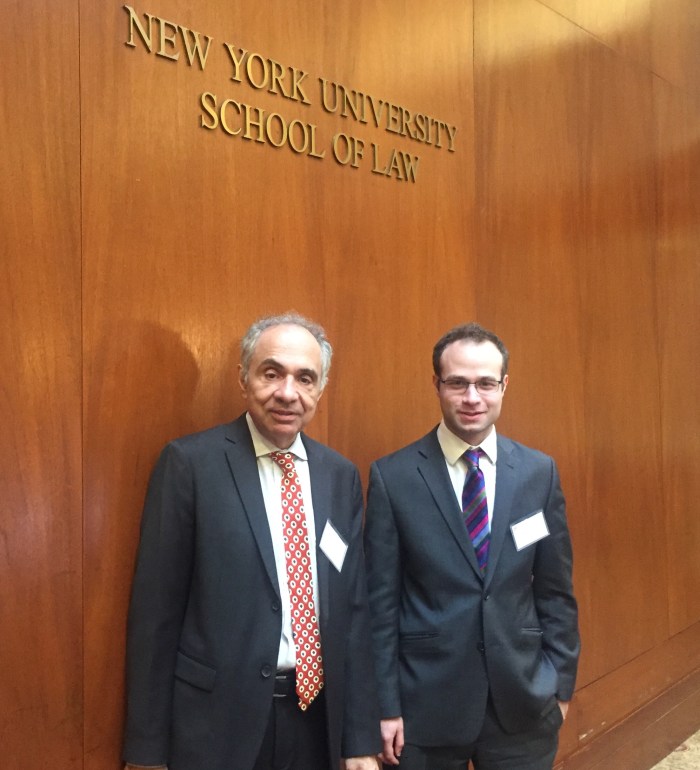
Last week my friend and colleague Mario Rizzo, a scholar central to the revival of  contemporary Austrian economics, turned 70. This occasion prompted a spontaneous outpouring of praise for his work, as well as messages of gratitude for his support of students and fellow academics over his decades as an intrepid professor with his home firmly at NYU. They are collected over at ThinkMarkets. Jeffrey Tucker has written an excellent summary of Mario’s intellectual contributions at the American Institute for Economic Research. Below is a segment of my birthday message:

In my home, the United Kingdom, classical liberal thought has until recently been virtually unheard within much of academia. As a student and think-tank researcher ravenous for liberal approaches to public policy, I gorged on Mario’s blog posts from ThinkMarkets. Together with Marginal Revolution and Cafe Hayek, ThinkMarkets was a critical lifeline for me facing an intellectual world dominated by various visions of authoritarianism and only slightly more benign variants of paternalism.

Thanks to Mario’s selfless contributions to the revival of Austrian economics, that intellectual world is changing, even in the UK. His co-founding of the Society for the Development of Austrian Economics and hosting the Program on the Foundations of the Market Economy at NYU has provided support and inspiration for countless young scholars.

I am very fortunate to be among that multitude.

IMG_5104


Crediting Co-Authorship

“… Who worked with you”

“Didn’t you know? It was Tamwile Elar. He worked out the theory that made the device possible and I designed and build the actual instrument.”

“Does that mean he took the credit, Dr. Monay?”

“No, no. You mustn’t think that. Dr. Elar is not that kind of man. He gave me full credit for my share of the work. In fact, it was his idea to call the device by our names – both our names – but he couldn’t.”

“Why not?”

“Well, that’s Professor Seldon’s rule, you know. All devices and equations are to be given functional names and not personal ones – to avoid resentment.”

-Forward the Foundation, Isaac Asimov

Most of my research is co-authored. As I noted in my previous post, I strongly believe that science is a collaborative enterprise. I of course have a few solo authored working papers, mainly those that I hope to include in my dissertation, but for the most part my work is with others. A problem with this is deciding how to credit the paper. Who gets the prized first author spot? Is it the most senior member of the team? The person who came up with the initial idea? The former RA who got upgraded to co-author status to avoid having to pay them? All of these can be tricky and can lead to resentment among co-authors.

I’ve seen various alternative arrangements to try to side step the issue. There are those who list co-authors by alphabetical order or alternate first authorship (Landgrave & Christensen 2015, Christensen & Landgrave 2016, etc etc). A few, like my grand advisor, combine their names with frequent co-authors (e.g. McNollgast). As cool as Christgrave sounds, I think these alternatives ultimately fall short because they continue to personalize science. It’s not clear to me what the benefit of this is. Not only does this lead to resentment among co-authors but it, I think, slows down the revision process as people mis-interpret critic on a given idea as a personal attack.

It is entirely possible, for example, to dislike JM Keynes’ work but to be indifferent or even warm towards the man himself. Likewise, it is possible to praise someone’s work, but find them to be personally awful.

Would it not be better to refer to papers by institutions or ‘labs’? Coase’s theory of the firm would, for example, be referred to as LSE 1937, as opposed to Coase 1937.

Thoughts? Comments? As always, write in the comments section!

#microblogging

Should The Academic “We” Be Ditched?

“Only kings, presidents, editors, and people with tapeworms have the right to use the editorial ‘we’.” – Mark Twain

When writing academically I use the “we” pronoun. I do so for a variety of reasons, but I am starting to rethink this practice. This may seem like a silly topic, but a quick google shows that I’m not the only one who thinks about this: link 1, link 2.

My K-12 teachers, and even my undergraduate English professor, constantly told me that I was prone to writing in a stream of consciousness. My writing, they argued, contained too much of my personality. They pointed out my constant use of “I”s of example of this. I I was, in general, an awful English student. In 12+ years of schooling, I rarely used the five page paragraph structure that American school children are indoctrinated with. I first adopted the use of the academic “we” in an attempt to force myself to distinguish between personal forms of writing, such as when I write on blogs, where these eccentricities could be tolerated and technical writing.

While that was my initial motivation for using the “we”, I also found the pronoun a way to emphasize the collaborative nature of science. I have several single authored papers, but I would be lying if I said that any of them were developed in a vacuum divorced from other’s feedback. Getting feedback at a conference or brown bag workshop may not merit including someone as a co-author, but I feel it strange to use “I” academically in this context. For anyone who disagrees with me – I ask that you compare a paper before and after submitting it to the review process. One may hate reviewer #2 for insisting on using an obscure estimation technique, but it cannot be denied that they shaped the final version of the paper. Again, I’m not saying we should add reviewers as co-authors, but isn’t using ‘we’ a simple way of acknowledging their role in the scientific process?

I admit, I also enjoy using the academic “we” in part because of its regal connections. King Michelangelo has a nice ring to it, no?

There are downsides to the use of the academic “we”. On several occasions I’ve had to clarify that I was the sole author of a given paper. What do NOL readers think? Do you use the academic “we”?

#microblog

Low-Quality Publications and Academic Competition

In the last few days, the economics blogosphere (and twitterverse) has been discussing this paper in the Journal of Economic PsychologySimply put, the article argues that economists discount “bad journals” so that a researcher with ten articles in low-ranked and mid-ranked journals will be valued less than a researcher with two or three articles in highly-ranked journals.

Some economists, see notably Jared Rubin here, made insightful comments about this article. However, there is one comment by Trevon Logan that gives me a chance to make a point that I have been mulling over for some time. As I do not want to paraphrase Trevon, here is the part of his comment that interests me:

many of us (note: I assume he refers to economists) simply do not read and therefore outsource our scholarly opinions of others to editors and referees who are an extraordinarily homogeneous and biased bunch

There are two interrelated components to this comment. The first is that economists tend to avoid reading about minute details. The second is that economists tend to delegate this task to gatekeepers of knowledge. In this case, this would be the editors of top journals. Why do economists act as such? More precisely, what are the incentives to act as such? After, as Adam Smith once remarked, the professors at Edinburgh and Oxford were of equal skill but the former produced the best seminars in Europe because their incomes depended on registrations and tuition while the latter relied on long-established endowments. Same skills, different incentives, different outcomes.

My answer is as such: the competition that existed in the field of economics in the 1960s-1980s has disappeared.  In “those” days, the top universities such as Princeton, Harvard, MIT and Yale were a more or less homogeneous group in terms of their core economics. Lets call those the “incumbents”. They faced strong contests from the UCLA, Chicago, Virginia and Minnesota.  These challengers attacked the core principles of what was seen as the orthodoxy in antitrust (see the works of Harold Demsetz, Armen Alchian, Henry Manne), macroeconomics (Lucas Paradox, Islands model, New Classical Economics), political economy (see the works of James Buchanan, Gordon Tullock, Elinor Ostrom, Albert Breton, Charles Plott) and microeconomics (Ronald Coase). These challenges forced the discipline to incorporate many of the insights into the literature. The best example would be the New Keynesian synthesis formulated by Mankiw in response to the works of people like Ed Prescott and Robert Lucas. In those days, “top” economists had to respond to articles published in “lower-ranked” journals such as Economic Inquiry, Journal of Law and Economics and Public Choice (all of which have risen because they were bringing competition – consider that Ronald Coase published most of his great pieces in the JL&E).

In that game, economists were checking one another and imposing discipline upon each other. More importantly, to paraphrase Gordon Tullock in his Organization of Inquiry, their curiosity was subjected to social guidance generated from within the community:

He (the economist) is normally interested in the approval of his peers and and hence will usually consciously shape his research into a project which will pique other scientists’ curiosity as well as his own.

Is there such a game today? If in 1980 one could easily answer “Chicago” to the question of “which economics department challenges that Harvard in terms of research questions and answers”, things are not so clear today. As research needs to happen within a network where the marginal benefits may increase with size (up to a point), where are the competing networks in economics?

And there is my point, absent this competition (well, I should not say absent – it is more precise to speak of weaker competition) there is no incentive to read, to invest other fields for insights or to accept challenges. It is far more reasonable, in such a case, to divest oneself from the burden of academia and delegate the task to editors. This only reinforces the problem as the gatekeepers get to limit the chance of a viable network to emerge.

So, when Trevon bemoans (rightfully) the situation, I answer that maybe it is time that we consider how we are acting as such because the incentives have numbed our critical minds.

A Sex Fiend

Like many others, I find the current collective hysteria about sexual harassment a bit overwhelming. Around November 22nd or 23rd, a woman came on FB proclaiming that she was willing to hurt the completely innocent to combat the scourge of harassment of women. She mentioned it was part of the struggle against the “patriarchy.” She said she was willing to “pay the price,” (meaning hurting any number of innocent men). The exchange that followed demonstrated that she was not acting sarcastic. If I were the dramatic kind of guy, I would say this it the beginning of the end of civilization, also a good argument in favor of a now non-existent patriarchy. (Non-existent in the US. Explanations on request.)

Since the repulsive Harvey Weinstein began disgracing the pages of newspapers daily, I have been trying to inject little shots of rationality into the brouhaha. I know it’s not much but if half of all rational people – especially women – do the same I believe we will have a significantly calming effect. Given the overpowering nature of the media excitement, I don’t have the courage to develop an overall strategy of rationality injections. Instead, I do a little bit of this and a little bit of that according to my mood and according to my availability on a particular day. Sometimes the relevance of my intervention to the current situation may seem only tangential. I assure you it’s worth thinking about it though (if you have time).

My main reaction to all of the horror stories in the media is this: Even if they are all 100% true, these stories tell only part of the larger story; they exist in a vacuum. The relationships (plural) between men and women are complex and often conducted at an infra-conscious level. A new fact for our species as a whole is that they are often enacted between perfect strangers. Not long ago, it practically never happened. People had plenty of occasions to find out about one another before anybody made a move. No more. Here is a true story about all this.

A long time ago, I am at an academic meeting in Chicago. I am still a fairly new academic but not a total novice. American university professors are supposed to be actively engaged in scholarship (“research”). Many actually are. Periodically, college professors in their several disciplines get together at academic meetings to present their research papers to one another – sometimes to a nearly empty room. They listen to one another and sometimes, they argue. It’s well understood though that the main function of this custom is to network rather than to spread knowledge. Normally, your employing university pays your way entirely. Such meetings are one of the fringe benefits of academia.

After delivering my own paper, I head for the coffee shop of the hotel where the meeting is being held. It’s about 3PM and I need a pick-me-up. The place is not crowded but most tables are occupied. I find one next to a table where a youngish woman is sitting alone before what appears to be a formal tea-set. As I sit down, I say “Hello” politely. She answers the same way. That’s the established custom at academic meetings: We are not strangers even if we are. My saluting her does not mean I am trying to pick her up, I know and she knows. She is in her early thirties, a very short, slight and pretty women with dark hair and black eyes.

After I order, I introduce myself as one does in such meetings and I ask what’s her specialty and where she comes from. She is a historian employed by a university about which I know little. I am a sociologist at a big Midwestern university. She has a light foreign accent I can’t place. I have a foreign accent not so hard to place, I guess. She asks me if I am French. She is a Lebanese Christian herself. It turns out her people and the French go way back. Her native language is Arabic but her English is perfect. She starts talking about her research and I about mine. We discover that we have earned our doctoral degrees from the same university, within two years of each other. We guess we never crossed paths because we were both studious and we used different ends of the main library there, in accordance with our respective disciplines.

What follows is a conversation of about one hour that should have been recorded for posterity. It was a model of gracious intellectual interchange between two cultured people who have enough in common to be able to communicate untrammeled, but with enough differences that they may yet be interesting to each other. We had much to discuss beside our scholarship, including the little-explored experience of middle-class immigrants to the US. The whole conversation stayed on the highest plane you can think of, no levity, no small talk, no useless words. This interchange might even have been enough by itself to justify the mind-boggling expense of academic meetings. It may have been the best conversation I had had, and have had in my life.

All the while, my new acquaintance has been drinking tea. With a lull in the conversation, she excuses herself to go to the restroom. When she returns, as she is slipping back into her seat, she looks straight a me and she says,

“I want you to know there is zero chance I will have sex with you.”

If I had not been sitting down, I would fallen backward from being embarrassed for her. I was so amazed, it took me several seconds to reply, “I was just thinking the same.” Immediately, I regret my retort because, with its devious ambiguity, it’s impossibly rude. I do what I can by way of friendly noises, to make up for it. Then, we say goodbye. The academic meeting is coming to an end the next day; we don’t bump into each other again. Two years later, we did meet again. But, that is another story, obviously.

What’s your point, you may ask? I don’t know, you tell me, especially if you are a woman.

In Praise of Academia

This week I got the happy news that my article on Ayn Rand’s views on international relations was accepted for publication. Once it is posted ‘online first’, I shall write a bit about its content. For now I would like to make a two other points, though.

One of the reason for my happiness is that this article took an exceptional time to get accepted. I started working on it in 2010, doing the initial reading (in this case all published works of Ayn Rand). The actual drafting started in 2011, I solicited commentary, and came to an acceptable first version in 2013. To be sure: I did not work on the paper on a full time basis, and there were many other distractions, not least my day time job, other academic projects, and family affairs. Still, the article kept nagging in the back of my head, perhaps not daily, but certainly on a weekly basis. I got the first few rejections by journals in 2013, then again a few in 2015, and another one this summer. So reason enough to be happy to get accepted and all the more exciting to see it through the production phase in the coming months, with actual printed publication still in the somewhat distant future.

I am not writing this to congratulate myself in public. My reason for this blog is to show young (aspiring) scholars, that it is completely normal to work on a project for ages, and to get rejected a few times. Yet the reward is sweet. As long as you persevere, are ready to change and edit your text, overcome your anger when you get unjust blind reviews (and believe me: writing on Rand regularly solicits angry, malicious and/or erroneous responses, also from editors and reviewers of high ranked reputed journals), and keep the faith in the possible value of your modest contribution to the world’s knowledge base.

This is a lesson I learned from experience in the past decade or so. But early on, I also greatly benefitted from one of the best and useful guides to PhD research and academic life I have ever come across: LSE professor Patrick Dunleavy’s Authoring a PhD. It realistically describes what to expect of academic life, it’s ups and also it’s downs. So get it, if you are still unsure what to expect of academic life.

The other remark I would like to make is about the unique and open character of academic publishing. It is really great, as a part-time academic, to be able to get published in reputable journals. I am sure the editors of journals and presses are more keen to see academics from highly reputed universities submitting papers and book manuscripts. Yet they first and foremost value content. If you have something interesting to say, and live up to the academic standards, you will get the same chance and treatment as everybody else. That is pretty unique, compared to many other professions.

So: academia be praised!

Some thoughts on the ivory tower; part 1: discrimination

I entered academia in 2009 when I started my bachelor’s degree and began graduate studies in 2014 when I entered a master’s program. I have been in the ivory tower in some form for almost a decade. Others have spent much more time in the tower than I, but I am hardly a newcomer. I hope then that I can offer thoughts on discrimination and mental health in the ivory tower.

In the past few years I have noted an increased self-aware discussion on the lack of diversity, both in terms of phenotype and ideology, in the ivory tower. The tower is full of center-left white men. I have seen various formal (e.g. #womenalsoknowstuff ) and informal groups groups advocate for greater inclusion in the tower. For the record there are non-leftist groups involved in this as well. CU Boulder has a program to increase conservative intellectuals. The Institute of Humane Studies (IHS) essentially serves to advocate for classical liberals in the tower. 

There is nothing wrong with these goals. Women also knows stuff tries do this by advertising the work of female scholars. IHS does it by inviting classical liberals to book discussions – and providing beer. Both approaches sound sensible to me. My concern is that ultimately the pipeline isn’t being fixed. Not really. Both approaches help those who managed to enter, at minimum, graduate school but do little to help solve more structural reasons for why there respective groups are rare in the tower.

Why are there so few women and classical liberals (and especially so few classical liberal women!) in academia? It’s partly cultural and partly institutional.

Minorities get made fun of in academia. Academics like to think of themselves as cosmopolitan, but it’s a big lie. A recent undergrad thesis by a Berkeley student looked at misogynistic discussions on an online forum frequented by economists. I disagree with the research design of the paper, but I believe the general argument that the tower is filled with misogyny. I also believe it’s filled with dislike for conservatives, Christians, atheists, whites, blacks, Arabs, Chinese, etc.

I don’t think the tower is unique in this. Human beings divide themselves by groups and I don’t see why that will ever change. I think the academy is just a bit whiter and a bit more lefty because of sorting effects. You can see this happening even within the tower. Classical liberals sort into economics – how many classical liberal anthropologists do you know? Not counting NoL’s chief editor? Some minorities sort into ethnic studies. How many black game theorists do you know? Native American psychometricians?

What can we do? I’m not sure. We can improve the pipeline so that grad students, and eventually faculty, get more diverse. However I suspect the sorting problem will remain. Superficially we will have more diversity, but is it really diversity if we’re sorted by discipline and subfields? Should we force new classical liberals to enroll in sociology grad programs? I don’t know. Maybe we should give up on diversity all together and focus on abolishing the state. Maybe? Who knows? What do you  all think?

By the way if you want to know what true cosmopolitanism is, visit an inner city. True cosmopolitanism is seeing blacks, Mexicans and Koreans eating pupusas made by a Honduran. Everything else is a GAP commercial concoted by HR people.

When Should Intellectuals be held Accountable for Popular Misrepresentations of their Theories?

Often an academic will articulate some very nuanced theory or ideological belief which arises out of a specialized discourse, and specialized background knowledge, of their discipline. It is not too surprising that when her theory gets reprinted in a newspaper by a non-specialist journalist, taken up by a politican to support a political agenda, or talked about on the street by the layman who doesn’t possess specialized knowledge, the intellectual’s theory will be poorly understood, misrepresented, and possibly used for purposes that are not only not justified but the exact opposite of her intentions.

This happens all the time in any discipline. Any physicist who reads a You Tube thread about the theory of relativity, an economist who opens a newspaper, biologist who reads the comments section of a Facebook post on GMOs, psychologist who hears jokes about Freud, or philosopher who sees almost any Twitter post about any complex world-historical thinker knows what I’m talking about. Typically, it is assumed that a popularizer or layperson who misunderstands such complex nuanced academic theories always must be answerable to their most intellectually responsible, academic articulation. It is usually assumed that an intellectual theorist should never be concerned with the fact that her theories are being misunderstood by popular culture, and certainly, she shouldn’t change a theory just because it is being misunderstood.

For many disciplines in many contexts, this seems to be true. The theory of relativity shouldn’t be changed just because most people do not possess the technical knowledge to understand it and popularizers often oversimplify it. Just because people do not understand that climate change means more than rising temperatures doesn’t mean it is not true. The fact that some young earth creationist thinks that the existence of monkeys disproves revolution doesn’t mean an evolutionary biologist should care.

Further, it’s not just natural sciences to which these apply, but also the social sciences. Just because methodological individualism is often misunderstood as atomistic, reductive ethical individualism doesn’t mean economists should abandon it any more than people’s various misunderstandings of statistical methods mean scientists should abandon those methods. Likewise, the fact that rational choice theory is misunderstood as meaning people only care about money, or that Hayek’s business cycle theory is misunderstood as meaning only central banks can cause recessions, or that a Keynesian multiplier is misunderstood as meaning that all destructive stimulus is desirable because it equally increases GDP does not mean that economists who use them should abandon those theories based on non-substantive criticisms based on over simplified or straw man misunderstandings of those theories.

On the other hand, there are other times where it seems that popular misunderstandings of some academic writings do matter. Not just in the sense that a layperson not understanding science leads them to do unhealthy things, and therefore the layperson should be educated on what scientific theories actually say, but in the sense that popular misunderstandings point out some deficiencies in the theory itself that the theorist should correct.

To take an example (which I’m admittedly somewhat simplifying) from intellectual history. Early in his career John Dewey advocated quasi-Hegelian comparisons of society to a “social organism.” For example, in an 1888 essay he defended democracy because it “approaches most nearly the ideal of all social organization; that in which the individual and society are organic to each other.” Though Dewey never meant such metaphors to undermine individuality and imply some form of authoritarian collectivism, he did want to emphasize the extent to which individuality was constituted by collective identifications and social conditions and use that as a normative ideological justification for democratic forms of government.

By 1939, after the rise of Bolshevism, fascism, and various other forms of Hegelian-influenced illiberal, collectivist, authoritarian governments, he walked back such metaphors saying this:

My contribution to the first series of essays in Living Philosophies put forward the idea of faith in the possibilities of experience at the heart of my own philosophy. In the course of that contribution, I said, “Individuals will always be the center and the consummation of experience, but what the individual actually is in his life-experience depends upon the nature and movement of associated life.” I have not changed my faith in experience nor my belief that individuality is its center and consummation. But there has been a change in emphasis. I should now wish to emphasize more than I formerly did that individuals are the final decisive factors of the nature and movement of associated life.

[…] The fundamental challenge compels all who believe in liberty and democracy to rethink the whole question of the relation of individual choice, belief, and action to institutions, and to reflect on the kind of social changes that will make individuals actually the centers and the possessors of worthwhile experience. In rethinking this issue in light of the rise of totalitarian states, I am led to emphasize the idea that only the voluntary initiative and voluntary cooperation of individuals can produce social institutions that will protect the liberties necessary for achieving development of genuine individuality.

In other words, Dewey recognized that such a political theory could be easily misunderstood and misapplied for bad uses. His response was to change his emphasis, and his use of social metaphors, to be more individualistic since he realized that his previous thoughts could be so easily misused.

To put a term to it, there are certain philosophical beliefs and social theories which are popularly maladaptive, that is regardless of how nuanced and justifiable it is in the specialized discourse of some intellectual theorist they will very often be manipulated and misused in popular discourse for other nefarious purposes.

To take another example, some “white nationalist” and “race realist” quasi-intellectuals make huge efforts to disassociate themselves with explicitly, violently racist white supremacists. They claim that they don’t really hate non-whites and want to hurt them or deprive them of rights, just that they take pride in their “white” culture and believe in (pseudo-)scientific theories which purport to show that non-whites are intellectually inferior. It is not very surprising, to most people, that in practice the distinction between a “peaceful” race realist and a violently racist white supremacist is extremely thin, and most would rightly conclude that means there is something wrong with race realism and race-based nationalist ideologies no matter how much superficially respectable academic spin is put on them because they are so easily popularly maladaptive.

The question I want to ask is how can we more explicitly tell when theorists should be held accountable for their popularly maladaptive theories? When does it matter that public misinterpretation of a somewhat specialized theory points to something wrong with that theory? In other words, when is the likelihood of a belief’s popularly mal-adaptivity truth-relevant?  Here are a few examples where it’s a pretty gray area:

  1. It is commonly claimed by communitarian critics of liberalism that liberalism reduces to atomistic individualism that robs humanity of all its desire for community and family and reduces people to selfish market actors (one of the original uses of the term “neoliberal”). Liberals, such as Hayek and Judith Shklar, typically respond by saying that liberal individualism, properly understood, fully allows individuals to make choices relevant to such communal considerations. Communitarians sometimes respond by pointing out that liberalism is so often misunderstood publicly as such and say that this shows there is something wrong with liberal individualism.
  2. It is claimed by critics of postmodernism and forms of neo-pragmatism that they imply some problematic form of relativism which makes it impossible to rationally adjudicate knowledge-claims. Neo-pragmatists and postmodernists respond by pointing out this is misunderstanding their beliefs, the idea that our understanding of truth and knowledge isn’t algorithmically answerable to correspondence doesn’t mean it’s irrational, postmodernism is about skepticism towards meta-narratives not skepticism towards all rational knowledge itself, and (as Richard Bernstein argued) these perspectives often make hardcore relativism as incoherent as hardcore objectivism. The critic sometimes responds by citing examples of lay people and low-level academics using this to defend absurd scientific paradigms and relativistic-sounding theories of morality or epistemology and this should make us skeptical of postmodernism or neo-pragmatism.
  3. Critics of Marxism and socialism often point out that Marxism and socialism often transform into a form of authoritarianism, such as in the Soviet Union or North Korea. Marxist and socialists respond by saying that all these communist leaders misused Marxist doctrine, Marx doesn’t really imply anything that would lead of necessity to authoritarianism, and socialism can work in a democratic, more free context. The critic (such as Don Lavoie) will point out that the institutional incentive-structure of socialism ncessarily require a sort of militarism due to the economic incentives faced by socialist governments regardless of the good intentions of the pure intentions of the socialist theorist, in other words they claim that socialism is inherently popularly maladaptive due to the incentives it creates. The socialist still thinks this isn’t the case and, regardless, the fact that socialism has turned authoritarian in the past was because it was in the hands of irresponsible revolutionaries/popularizers and that isn’t relevant to socialism’s truth.
  4. Defenders of traditional social teachings of Christianity with respect to homosexuality claim there is nothing inherently homophobic about the idea that homosexual acts are a sin. In the spirit of “Love the sinner, hate the sin,” they claim that being gay isn’t a sin but homosexual acts are the sin. Christians should show love and compassion for gay people, they say, while still condemning their sexual behavior. Secular and progressive Christian critics respond by pointing out how, in practice, Christians do often act very awfully towards gay people. They point out it is very difficult for most Christians who believe homosexual acts are sinful to separate the “sin” from the “sinner” in practice regardless of the intellectually pure intentions of their preacher, and that such a theological belief is often used to justify homophobic cruelty. Since you will judge a faith by its fruits (a pretty Christian way of saying that popular mal-adaptivity is truth-relevant), we should be skeptical of traditional teachings on homosexuality. The traditionalist remains unconvinced that this matters.

It is important to distinguish between two questions: whether these beliefs are popularly maladaptive empirically (or, perhaps, just very likely to be) and whether the possibility of them being popularly maladaptive is relevant to their truth. For example, a liberal could respond to her communitarian critic by pointing out empirical evidence that individuals engaging in market exchange in liberal societies aren’t selfish and uncaring about their communities to undermine the claim that their individualism is popularly maladaptive in the first place. But that response is different from a liberal saying that just because their individualism has been misunderstood means that they shouldn’t care about it.

We should also distinguish the question of whether beliefs are likely to be maladaptive from whether their mal-adaptivity is truth-relevant. For example, it is conceivable that a popularized atheism would be extremely nihilistic even if careful existentialist atheists want to save us from nihilism. An atheist could say that appears unlikely since most non-intellectual atheists aren’t really nihilists (which would answer the former question), or by saying that people’s misunderstanding of the ethical implications of God’s non-existence is not relevant to the question of whether God exists (which would answer the latter question). For now, I am only concerned with when maladaptivity is truth-relevant.

There are a couple of responses which seem initially plausible but are unconvincing. One potential response is that positive scientific theories (such as evolution and monetary economics) do not need to worry about whether they are likely to be popularly maladaptive, but normative moral or philosophical theories (such as liberal individualism or theological moral teachings) do not.

However, this confuses the fact that scientists do often make normative claims based on their theories which seem irrelevant to their popular interpretation. For an instance, it’s not clear that a monetary economist, who makes normative policy conclusions based on their theories, should care if the layman does not understand how, for example, the Taylor Rule, Nominal Income Target, or Free Banking should work. Further, there are philosophical theories where popular maladaptively doesn’t seem to matter; for example, Kantians shouldn’t really fret if an introductory student doesn’t really grasp Kant’s argument for the synthetic a priori, and analytic philosophers shouldn’t care if most people don’t understand Quine’s objections to the analytic/synthetic distinction.

I’m unsure exactly how to answer this question, but it seems like answering it would clear up a lot of confusion in many disagreements.
When to list working papers?

I have been updating my CV the past weekend and as a process have spent more time than I should have looking at other’s CV for reference. The experience has reminded me of two things, (1) I do not share other’s infatuation with latex and (2) I despise how working papers are listed.

My primary concern with many CVs is that some people list working papers along with peer reviewed published papers. I cannot help but feel this is weaseling. This is not aided when people list “revise and resubmits” along with actual publications. An R&R is not a publication. By all means it is a good sign that a paper will get published, but it is not a publication.

My second concern is that people list working papers, but offer no link to a draft copy. In the absence of a readily accessible draft, how am I to know if someone has a ‘real’ working paper or simply some regression results on a power point? I am especially irked when I contact an author asking for a draft of their working paper and am told that no such draft exists.

I’m still a graduate student, but if I am to be humored I think academia would benefit if it became the norm to list working papers (and R&Rs) in a separate section and if it were required to upload a draft on SSRN (or whatever your preferred depository is).

Likewise I think it best to list book reviews and other non-peer reviewed materials separately. I was surprised the other day to find people who listed op-eds in local newspapers or blog posts under publications. Don’t get me wrong – I think some blog posts (especially those on a certain site) are great reads! But peer reviewed publications they are not.

Does this sound reasonable?

BC’s weekend reads

  1. on BBC bias | fake news and political entrepreneurship
  2. Leftist hypocrisy at its finest | goose pimples and hypocrisy
  3. classical liberals and libertarians are asking the wrong question about sovereignty | myths of British sovereignty and isolation (XII)
  4. 4 reasons why the academy will remain mostly unwelcoming to the Right | Carlos Castaneda’s fraudulent scholarship
  5. Soviet ice cream | the economics of hard choices

What is the optimal investment in quantitative skills?

As I plan out my summer plans I am debating how to allocate my time in skill investment. The general advice I have gotten is to increase my quantitative skills and pick up as much about coding as possible. However I am skeptical that I really should invest too much in quantitative skills. There are diminishing returns for starters.

More importantly though artificial intelligence/computing is increasing every day. When my older professors were trained they had to use IBM punch cards to run simple regressions. Today my phone has several times more the computing power, not to mention my PC. I would not be surprised if performing quantitative analysis is taken over entirely by AI within a decade or two. Even if it isn’t, it will surely be easier and require minimal knowledge of what is happening. In which case I should invest more heavily in skills that cannot be done by AI.

I am thinking, for example, of research design or substantive knowledge of research areas. AI can beat humans in chess, but I can’t think of any who have written a half decent history text.

Mind you I cannot abandon learning a base level of quantitative knowledge. AI may take over in the nex decade, but I will be on the job market and seeking tenure before then (hopefully!). 

Some Comments on the Latin America Liberty Forum 2017

The Latin American edition of the Liberty Forum took place in Buenos Aires, Argentina, last week. From almost all of the addresses delivered by the speakers, the attendees could single out two main patterns. The first one: a shift from mere utilitarianism to the acknowledgement of the importance of emotions and moral values in the defense of individual liberties. In this sense, the legacy of David Hume was present and I celebrate it. Moreover, we could expect that in a few years’ time we would get rid of an argumentation exclusively articulated in terms of instrumental reason and recover a sense of a substantive raison d’être of the case for liberty.

The second pattern the audience could guess from the speeches concerns the role of education in the formation of public opinion on liberty. Almost everyone agreed on the strong influence of education over the political ideas held by the citizenship. If you look up the state of the opinion, both in academia and the general public, the rest of the conclusions will follow…

Nevertheless, I consider the importance of academia and education in the articulation of public discourse to be overestimated. After all, what educational institutions of every sorts and levels provide to their pupils are adaptive devices to get -or remain- inserted into society. All that the educational system could do to change public opinion is make marginal contributions to be achieved only in the long term.

Since the public opinion is in the short run almost autonomous, the main matter refers to where it dwells. The television? The blogosphere? The radio? The public parks? (In Ancient Rome, by the way, people were very fond of the graffitis). Perhaps it could be a combination of all of them.

They -including education- are stages of the process of production of public opinion –superior stages, to express it in Austrian Economics terms. And if one takes Austrian Economics seriously, one will have to admit that the value of the superior goods is determined by the value of the final good -and not otherwise.

Who needs a list of progressive professors?

Turning Point USA has a new list out of progressive professors. The list has already begun to be attacked as signaling the rise of a new era of McCarthyism where academics will be prosecuted for anti-American discourse.

I agree that the list should be attacked in so far that it tries to define what is acceptable discourse in academia. Academia should be a place where ideas, no matter how absurd or controversial, can be discussed and this list doesn’t help that goal.

There may be a limited place for safe places. Recently I’ve been willing to accept ‘safe places’ in those cases where individuals genuinely cannot handle certain ideas being discussed. There’s no point in, for example, attending the university’s Jewish student club and claiming that the Holocaust didn’t happen. There’s no point in going to a support meeting of transsexuals and claiming they’re going to hell. Etc etc. Emphasize on the limited though. I am willing to hold my tongue in support group settings, but that’s it.

That said the list, and the response to it, are funny in several ways.

Turning Point USA crafted the list to indicate professors who have been documented attacking conservatives. One professor barged into a Republican student and shouted profanity. I can see a point in the list if it listed only those professors who had a reputation for encouraging an environment of hostility – there is a different between being able to discuss radical ideas and yelling fire in a theater. I’m not so clear why Holocaust deniers are listed though. I don’t agree with such individuals, but if they only express the ideas I see no reason to avoid them. If Turning Point USA is serious about promoting a culture where conservative ideas can be freely discussed in academia it must be willing to protect the Holocaust deniers. Does Turning Point USA not realize the absurdity of trying to, on one hand, create a safe place for Judeo-Christian conservatives, and promoting the right of conservative ideas to be discussed in academia

What I find funny about progressives talking about the need for universities to tolerate their own ‘radical’ speech (what’s radical about wanting more government?), they themselves are intolerant to conservatives. Consider this: I’m a double minority – an illegal alien libertarian. Which of these two identities do you think is more cumbersome in academia?

After the election of Trump several members of the academic community assured me that I would be protected if need be. Yesterday the President of the University of California system released an op-ed defending the undocumented student community. Earlier today she announced that the UCs, including its police force, would refuse to cooperate with any deportation efforts.

In comparison as a libertarian I am often advised to keep quiet about my political views. At minimum I should try to avoid researching things that make it clear that I diverge from the rest of academia in political thought. Otherwise I will have a hard time getting my research published or be cut off from the social networks needed in the job market. On occasion I have found myself ostracized socially for voicing dissent on things like the minimum wage or affirmative action. I’m not alone in this.

In an ideal world I should be able to be an illegal alien, a Holocaust denier*, homosexual, and a devout Muslim** without feeling the need to suppress my view points. Academia should be a safe place for ideas no matter how radical.

Thoughts, comments?

*I’m not a Holocaust denier.
**I’m not a Muslim either.

“Apparently they have been whispering while others have been shouting obscenities and interrupting guest speakers.”

This is an observation found in the ‘comments’ threads of economist Mark Perry’s blog, Carpe Diem, on a post he did about the reaction of students at the University of Michigan-Ann Arbor to their president’s remarks about Donald Trump.

(I’m not going to summarize it here, because you are all probably familiar with this storyline. You can read Perry’s whole post here.)

I wanted to highlight that this comment basically summed up my political experience on campus. I am by no means a conservative, but there was no way in hell I was going to pipe up in class discussions on alternative understandings of “neoliberalism” or even play the role of contrarian. Doing so would have hurt my GPA. It would have resulted in a loss of social standing. It would have invited accusations that I was racist, or sexist, or – gasp! – conservative.

So instead I started this blog and talked about sports or homework with my peers.

My guess is the guy who left this comment was a libertarian or conservative in college back in the 70s or 80s. Michelangelo recently blogged about his experience on campus, but has anyone else found that this is the norm on campuses in the West?

I understand that conservative and libertarian groups like to get obnoxious sometimes, by carrying out public demonstrations like “affirmative action bake sales” or whatever, but the fact that these don’t work (they do help promote a culture of toleration on campuses, albeit in an indirect manner, so I guess I should be thankful for that, but if this is the case then the drum-beating and chanting done by Leftists on campus does the same thing for me in this regard) in convincing the other side of their wrongness suggests that the quiet whisperers are the better thinkers.

Does academia have a diversity problem?

As those of you who have me on Facebook may know, I’ve spent the past few months running around in a Trump costume at various comic conventions. I did so for the simple reason that I found it humorous for a Mexican to be running around as Trump. To my surprise the experience was surprisingly enlightening.

When dressed in Trump I got a range of reactions from people wanting a comedic photo with/of me, being attacked by a pair of Hispanics dressed as ‘cholo’ Mario and Lugio, and Bernie supporters saying they hated my guts until I explained I didn’t support Trump.

Yesterday though, when dressed as Trump for Halloween, I got the strangest reaction when walking around my university campus. A meek boy came up to me and asked me if I identified as a Republican, I responded that I did but that I had actually supported Jeb in the primaries*, and his eyes light up. He began to shake my hand and talk about how great it was to find someone else after looking for so long.

The incident really hit home for me since I recall my own undergraduate years of feeling politically isolated from my peers. I had resigned myself to biting my tongue whenever politics were discussed. This didn’t work though since I was often in social sciences and my leanings quickly showed when we had freedom to elect subjects for our assignments. So I just kept shut and tried to produce as bland as possible papers so that I wouldn’t be singled out.

This didn’t change until I discovered there were a few conservative/libertarian professors sprinkled across the university. I didn’t become a chatter box in their classes, but I felt an immense weight off my shoulders knowing that I could voice an opinion outside the mainstream Democratic party line and not have to defend myself from claims of being a racist one-percenter.

Unfortunately, as Landberg et al.’s recent paper shows, there just aren’t many non-Democratic professors in academia. Does academia have a diversity problem? Yes it has an intellectual diversity problem, but its not clear what can be done about it.

Thoughts? Have others had similar experiences?

*This is of course relative to my disdain for the Democratic Party.