We visited Moscow twice, in late 2010 and mid-2011. I remember a clean, buzzing – if a bit intimidating – metropolis, rich in signature sites. I thought to share that where we stayed, Ukraine was all over: Across the street was located the Hotel Ukraina, one of the “Seven Sisters” (skyscrapers of the Stalinist era). Ukrainskyi bulvar, a pedestrian walkway run along our block. It featured a small park with a statue of writerLesya Ukrainka. Down the green walk was the Kiyevski railway terminal, a badass station (it was in good company, I prefer no 5, Yaroslavsky station) that serviced metro lines and trains to the Ukrainian capital (Kiyv/ Kiev, see relevant link below).
Here be few links on the Ukrainian front, not of the “latest headline” kind. The discourse at least here in Greece is polarized, and geographically we are close enough that the infamous Chernobyl disaster haunted our parents when we were kids.
On Anders Chydenius. The Governor of Bank of Finland in a 2019 speech outlined his work, to stress the “joint Nordic and American societal heritage, which is fundamentally linked to economic liberalism and the market economy”.
The MPS encourages members to share this announcement with any eligible and interested individuals (see Rules of Eligibility and Submission Guidelines below), who would like to submit an essay and receive consideration for a Fellowship to attend the meeting:First prize: $2500 cash award + travel grant*Second prize: $1500 cash award + travel grant*Third prize: $1000 cash award + travel grant**Travel grant includes coach class airfare, registration fee, and most meals. Hotel, other food, and other expenses will be the responsibility of the attendee.
The essays will be judged by an international panel of three members of the Society. Essays structured as a professional scholarly journal article are especially encouraged. Contest ThemeThe MPS welcomes submissions addressing the following questions related to the meeting theme:What type of international order is most conducive to the preservation of liberalism?What is the appropriate role for the subsidiarity principle and/or secession?What cultural domestic underpinnings are necessary for successful international orders?How does trade policy relate to and/or influence the larger institutional international order?Submissions may also address one or both of the following quotes from Hayek.
“An international authority which effectively limits the powers of the state over the individual will be one of the best safeguards of peace. The international Rule of Law must become a safeguard as much against the tyranny of the state over the individual as against the tyranny of the new super-state over the national communities. Neither an omnipotent super-state, nor a loose association of ‘free nations’, but a community of nations of free men must be our goal.” – Hayek, Friedrich (1944, 1976) The Road To Serfdom. Routledge & Kegan Paul. p. 175.
“Since it has been argued so far that an essentially liberal economic regime is a necessary condition for the success of any interstate federation, it may be added, in conclusion, that the converse is no less true: the abrogation of national sovereignties and the creation of an effective international order of law is a necessary complement and the logical consummation of the liberal program.” – Hayek, Friedrich (1939) The Economic Conditions of Interstate Federalism, reprinted in Individualism and Economic Order (1949, 1976). Routledge & Kegan Paul. p. 269.
More information on the conference theme can be found here: About MPS Oslo 2022.
Rules of Eligibility and Submission GuidelinesThe Hayek Essay Contest is open to all individuals 36 years old or younger. Entrants should write a 5,000 word (maximum) essay. Essays are due on Tuesday, May 31, 2022 and the winners will be announced on Thursday, June 30, 2022.Essays must be submitted in English only. Electronic versions should be sent to: MPS Young Scholars Program Committee. Authors of winning essays must present their papers at the General Meeting to receive their award.Download the Contest Announcement as a PDF Document: 2022 MPS Hayek Essay Contest.
A twisted adaptation of the classic example of economic externalities: Golf club instead of serene houses, home day care in the place of noisy industrial unit.
After French President Emmanuel Macron’s visits to Ukraine and Russia, German Chancellor Olaf Scholz embarked on visits to Ukraine and Russia as well. Scholz had visited the US last week and discussed the Ukraine issue with Biden.
The timing of Scholz’s visits to Ukraine and Russia were important, given that the Biden administration has said that Russia could attack Ukraine at any point in time (significantly, only last week, Putin had assured Macron that Russia had no plans of escalating conflict, and would not like to escalate tensions). In a media interaction on Monday, Pentagon Spokesperson John Kirby had said:
This is a military that, that continues to grow stronger, continues to grow more ready. They’re exercising, so we believe that he has a lot of capabilities and options available to him should he want to use military force.
The US has pulled out its diplomatic staff from Ukraine, while EU and NATO member states, including Germany, have urged their citizens to leave Ukraine.
Economic repercussions
The US and other members of the G7 have issued a stern warning to Russia, saying that it would face strong economic repercussions if Moscow invades Ukraine. During his conversation with Vladimir Putin, on February 12, 2022, Biden had conveyed that any aggression by Russia would result in strong measures, and G7 Finance Ministers also reiterated the same in a statement on Monday, February 14, 2022.
It would be important to point out that apprehensions with regard to a Russian invasion of Ukraine have also impacted global markets and oil prices. European indexes, including the UK’s FTSE 100, Germany’s Dax, and France’s CAC 40, dropped significantly on Monday, February 14, 2022, along with US and Indian markets. Apart from this, crude prices went up to a seven-year high, crossing $95 a barrel.
Differences between the US and France and Germany
One of the reasons cited for Russia’s aggressive stance is US support for Ukraine’s membership in NATO. France and Germany have, however, differed with the US on this issue. In 2019, then Ukrainian President Petro Poroshenko signed a constitutional amendment which made a commitment towards making Ukraine a member of both the EU and NATO.
During his visit to Ukraine, Chancellor Scholz said that membership is not such an important issue, and that it was “strange that Russia makes this the subject of major political problems.”
The Ukrainian President, Volodymyr Zelenskiy, also said that for Ukraine, “NATO membership is not the absolute goal.”
It would be pertinent to point out that Ukraine’s Ambassador, Vadym Prystaiko, in a media interview, had made remarks indicating that Ukraine may consider giving up its stand of joining NATO, in order to avoid war, but later denied the same.
Before embarking upon his visits to Ukraine and Russia, Scholz had warned that Germany would be compelled to impose sanctions, and that the Nord Stream 2 Project, which runs from Western Siberia to Germany, would be shelved (Russia accounts for 40% of Germany’s energy supplies). During Scholz’s US visit, Biden had also said that if tensions rise then the $11 billion project owned by Gazprom would not go ahead. Said Biden:
The notion that Nord Stream 2 is going to go forward with an invasion by the Russians — that’s not going to happen.
The role of both France and Germany has been important; while on the one hand they have kept the channels of communication with Putin open, and conveyed the reservations of the US and its allies, on the other their stand vis-à-vis Ukraine membership in NATO is different.
Biden’s focus on working with allies has been beneficial, but at the same time the reality is that there are differences between the approach of the EU and the US vis-à-vis the Ukraine issue. EU countries, especially Germany, can not overlook their economic interests and the logic of geography. It is not just France and Germany, but many other allies which would be concerned over escalation of conflict and the likely economic consequences – specifically the rise in oil prices.
I had sensed this in training modules, but couldn’t quite put my finger on it. A good instructor, apart from presentation skills, should also provide just the right amount (sic) of context.
Chinese President Xi Jinping and Russian President Vladimir Putin met on February 4, 2022 (this was the 38th meeting between both of them after 2013). Putin and Xi met hours before the opening ceremony of the Beijing Winter Olympics. Putin was in China to attend the Olympics and his presence was important in symbolism given that a number of countries – including the US, the UK, Australia, and India announced a diplomatic boycott of the games.
Both sides forcefully pitched for further enhancing their bilateral relationship and referred to the need for a ‘no limits partnership.’ Putin and Xi are also supposed to have agreed on the need for finding common ground in areas like artificial intelligence, technology, and climate change. A statement issued by the Kremlin after the meeting between Xi and Putin said that Beijing was opposed to the US aim of expansion of NATO in Eastern Europe (both Xi and Putin argued that NATO was promoting a ‘cold war’ ideology). During the meeting, Putin also made it clear that Russia endorsed China’s stand on Taiwan and opposed Taiwanese independence in any form. The Russian President was critical of the US for creating blocs in the Indo Pacific. Both sides expressed concern with regard to the Australia-UK-US (AUKUS) security partnership.
The joint statement made two interesting points; first, that the China-Russia relationship is ‘superior to political and military alliances of the cold war era’ and second, that both Moscow and Beijing were firmly committed to multilateralism.
US-Russia-China triangle
The steady deterioration between the US and both Russia and China have resulted in Moscow-Beijing relations further strengthening in recent years.
A number of US strategic analysts have argued that Washington needs to work with Moscow and find common ground on certain global issues, and to ensure that Moscow is not compelled to move closer to Beijing.
There has been high level engagement between both sides in recent months, and they have found some common ground on the Iran nuclear issue/JCPOA (Joint Comprehensive Plan of Action). After his meeting with Russian Foreign Minister Sergey Lavrov in Geneva last month, US Secretary of State Antony Blinken had said that Iran nuclear deal was an example of how Washington and Moscow could work together. The threat of a Russian invasion of Ukraine have ensured that ties between US and Russia remain strained in spite of high level interactions between both sides.
Russia-China ties and the impact of US sanctions
A day before the meeting between Xi and Putin, Russian Foreign Minister Sergey Lavrov and his Chinese counterpart had met and are supposed to have discussed a number of issues, including Ukraine and Afghanistan. In response to the meeting, officials in the Biden administration had stated that a close economic relationship with China would not be enough for Russia to face the impact of US sanctions. Ned Price, Spokesperson of the US State Department, also warned Chinese companies in case attempts were made to circumvent US sanctions:
We have an array of tools that we can deploy If we see foreign companies, including those in China, doing their best to backfill U.S. export control actions, to evade them, to get around them.
Russia-China economic relations
There has been a growing thrust in both Moscow and Beijing on strengthening economic relations. After the meeting between Xi and Putin a number of trade and energy related deals were signed. Russia’s Rosneft also signed a 10-year deal with China’s state-owned CNPC to continue supplying 200,000 b/d of crude to China via Kazakhstan (shipments will flow from Kazakhstan’s Atasu-Alashankou pipeline to refineries in northwest China).
Will China support Ukraine at the cost of economic ties with the EU?
While it is true that in the current global world order, Russia-China relations are likely to further strengthen, there is also a belief that China may extend support to Russia on the Ukraine issue – only to a certain point — because Beijing shares close economic links with Europe and the US. While trade between China and the EU and US account for a significant percentage of China’s total trade, trade with Russia accounts for only 2% of China’s total trade. At a time when China’s growth rate is slowing down considerably due to a number of reasons – such as some of Xi Jinping’s economic policies seeking to prevent ‘disorderly expansion of capital,’ a serious real estate crisis, and a drop in consumer spending – China would not like its economic links with the EU to be adversely affected. Apart from this, as mentioned earlier, the US has warned China that it will be affected by the economic and security challenges arising out of any further Russian aggression vis-à-vis Ukraine.
In conclusion, while there is no doubt that Russia-China bilateral ties, which are already robust, are likely to expand in a number of areas. And in a changing global world order there is likely to be growing convergence on important geopolitical issues. It is important, however, to bear in mind that interests are not always identical and China’s economic interests – especially its economic links with the EU – are important in this context.
Our initial experiment added 29 states to the union in 2025. After a few decades of relative success (the entire world grew economically from 2025 to 2045), the bicameral Congress of free states was willing to accept several new members, who in turn were willing to trade their sovereignty for two seats in the Senate. The polities that joined the federation of free states in the second peaceful geographic expansion of the Philadelphian federal order were varied, but only somewhat predictable. The Madisionian compound republic rearranged the map once again. Here is what it looks like in 2045:
The red places were “states” in 2025, the orange places are new “states” in 2045.
As you can see, most of the expansion came in North America, East Asia, and West Africa. The experience of Canaan, England, and Wales hasn’t been bad, but enough nationalist-secessionist sentiments remain in these three “states” that none of their neighbors thought that giving up their sovereignty for Senate seats was worth it. All three economies grew, and peace finally came to Canaan, but if peace, wealth, and security from predation were the only things that people wanted then we wouldn’t be people. We’d be something else entirely. People want freedom, and the compound republic – the federation of free states – did not yet show in 2045 it was capable of extirpating the menace of nationalism from human existence.
The success of the ranching states of Mexico – Coahuila, Tamaulipas, and Nuevo León – within the United States prompted several more Mexican states to apply for statehood, but the pushback against too many states joining the union was stern. Yucatán and Chihuahua were added as is, giving the Senate four more seats, but the states of Zacatecas, Durango, and San Luis Potosí had to combine into one state (they called it San Luis Potosí, and it’s about the size of Nevada) in order to join the Philadelphian world order.
The prairie provinces of Canada also did well for themselves since 2025. So well, in fact, that five more provinces applied to join. However, Congress did not want to add five more states with such sparse populations, so the Atlantic provinces of Nova Scotia, Prince Edward Island, New Brunswick, Newfoundland, and Labrador merged to become a state that they called Nova Scotia, a massive landmass with enough people for only one or maybe two representatives. By the way, from 2025 to 2045, several old American states — Washington, Oregon, and Vermont – all held referendums on whether to leave the Madisonian republic and join Canada (or go it alone), but the referendums have proved to be unsuccessful.
Liberia’s success in the American federation is perhaps the most encouraging progress of all. Crime rates skyrocketed once Liberia joined the union, but this only shows how the American legal system does such a wonderful job of protecting property rights. Violent crime dropped, but crimes involving property rights reached an all-time high, which means that property rights in Liberia are finally being protected by a state strong enough to do so. The GDP (PPP) per capita of Liberia quadrupled from 2025 to 2045. Several neighboring states took notice, but only one, Sierra Leone, joined the federation outright.
Several Nigerian and Ghanaian polities joined the republic. All of the polities started out as administrative units within Ghana and Nigeria, and there were too many that wanted to join. So, they borrowed from San Luis Potosí’s playbook and merged with each other before applying for statehood as larger polities. From Nigeria, the states of Oyo (made up of five Nigerian states), Biafra (made up of eight states), Benin (made up of four states), and Bayelsa (three states) all joined. The states are all from the south of Nigeria.
Ghana sent three states to the republic: Ashanti (made up of five Ghanaian provinces), Volta (made up of three provinces), and Cape Coast (three provinces). The 11 provinces that made up the three new states were all from Ghana’s south. It should be noted the the Ashanti region had a relatively strong sense of nationalism when it applied for membership to the federation, and that the extirpation of this nationalism in exchange for self-government in a compound republic was not a problem for its inhabitants.
Colombia and Panama. The Caribbean experience has had less of a “wow factor” than Liberia or Mexico. Economic growth in Antilles was a little bit better than the regional average, but not by much. The big change was demographics, as many seniors from the original 50 states moved to Antilles, and many young people from Antilles moved to the original 50 states. The crime rate was similar to that of Liberia, too, with violent crimes dropping but property crimes increasing a little bit. Most of the countries in Central America (sans Costa Rica) and all of the Pacific countries in South America applied for membership in one form or another. However, only four states were added in 2045: three from Colombia and the whole of Panama. The four states got together and pulled out a map of 19th century Gran Colombia to put together a plan for federation. Isthmo (Panama), Cundinamarca (made up of eight Colombian states), Magdalena (made up of six states), and Cauca (five states) all joined the federation of free states.
Things went so well in East Asia and the Pacific that the entire country of Vietnam applied lock, stock, and barrel. Like Japan, South Korea, and the Philippines in 2025, Vietnam had too many states for the federation so six regions joined instead: Bắc Trung Bộ, Bắc Bộ, Tây Nguyên, Đông Nam Bộ, Tây Nam Bộ, and Đồng Bằng Sông Hồng. The Vietnamese now enjoy the military and economic benefits that come with being federated with the compound republic of the United States.
Further thoughts
The Canadian and West African states are the only ones with English-language speakers. Nevertheless, English continues to be employed as the lingua franca of the federated polity. This has produced a class division between those who can speak English and those who cannot, and eventually English will be spoken by nearly everybody in the polity (now numbering just over one billion souls), but the native languages are unlikely to disappear. They’ll continue to evolve on their own lines, and most people in the federation will simply be able to speak more than one language. The English of the Constitution and Bill of Rights will no doubt become antiquated as English evolves, but it’s already pretty antiquated today (2022) and there’s been no real challenge in 250 years to English’s status as the lingua franca of the republic.
Reactions to the compound republic from other states
Perhaps the most interesting aspect of the United States’ decision to apply federation to its foreign policy is the reaction of other states. The Russians, who it could be argued had an alternative to the Westphalian order in the 19th century (and this is why it pursued its own foreign policy agenda throughout the Cold War, rather than for the exportation of the Revolution), are still doing what they’ve been doing since 2000: recognizing small states along their vast border and slowly chipping away at the losses of their empire. States such as Donetsk, South Ossetia, and Crimea are recognized as states by Russia, Belarus, and, say Kazakhstan, but in 2045 the compound republic decided to build upon its foreign policy of federation by recognizing these claims to independence. This means that post-Soviet states like Ukraine and Georgia lose territory, but it doesn’t necessarily make Russia stronger and it doesn’t mean freedom is in decline. Out of two states (in this example), five now exist, and there’s nothing to suggest that they won’t lean on the compound republic rather than the Russian Federation.
The CCP turned inward, especially once the compound republic called its bluff on Taiwan. Like Russia, it has been argued that an alternative state system to Westphalia existed prior to 19th century European imperialism. The Belt and Road Initiative was supposedly part of the Tianxia state system, but regardless of whether or not you buy this argument (I don’t), China’s expansion ceased once Japan, South Korea, and Taiwan joined the Philadelphian union. The CCP became even more repressive and paranoid. The non-Han grew more despondent, and the non-Mandarin speaking Chinese, especially those living along the wealthy seaboard of the South China Sea, grew angry.
The Europeans and their interstate system continued to try to keep the Westphalian European Union alive, but without the abrogation of state sovereignty, the EU continued to be ineffectual. The French, taking a page from the American playbook, revived an old effort to federate with its former colonies. The French continued to adhere to a Westphalian logic in this effort, and the French Union floundered as badly as the European Union. The key to Madisonian compound republic’s success has been its abrogation of state sovereignty (which is “traded” for seats in the Senate). Portugal reached out to Brazil and Angola to discuss a Lusophone federation, and ties became closer, but Westphalian sovereignty trumped all discussions of cooperation and the Portuguese found themselves in the same situation as the French: members of two ineffectual confederations that are built upon Westphalian nation-state sovereignty.
The remnants of the British and Spanish Empires (Peru, Argentina, Australia, India, Pakistan, Sri Lanka, New Zealand, Iraq, Egypt, Saudi Arabia, the British Caribbean, etc.) continued along the same path as the Europeans. Economic growth continued at its slow pace, but compared to the societies living within the compound republic, it was becoming clear that the Westphalian remnants were losing ground, especially in regards to liberty, equality under the law, and democratic governance.
In 2045, the American republic added 22 more states, making the federation a conglomerate of 101 “states” and the District of Columbia. Liberty is on the rise, and despotism is getting cornered.
About one of the many similar monuments around the world. If you ‘ve been in Athens, Greece, you have probably visited it. An excerpt:
Such controversies, however, underscore the importance of how public space is designed – in terms of both architecture and art – and not just with regard to how it helps form relationships and movements, or determine how a city is viewed, but also in how it contributes to the creation of collective memory and identity. To the manner, in short, that the central authority and society of any given era chooses to cast its relationship to the past and to address the future.
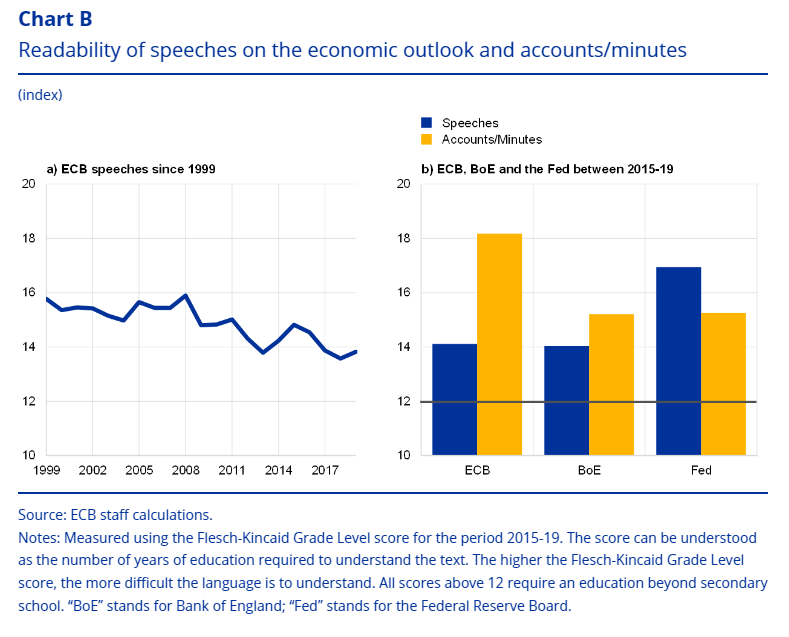
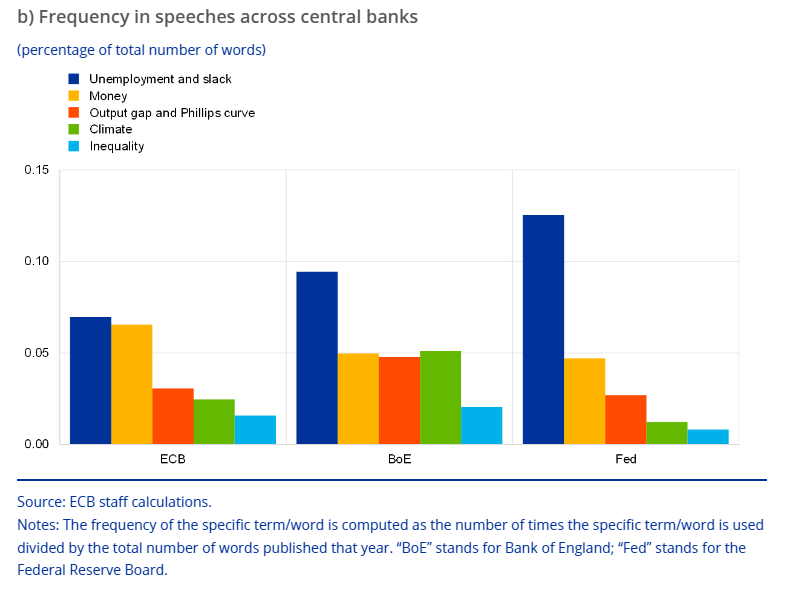
To close this, a couple of neat graphs from the European Central Bank. The first one shows a measure of central bank messages’ clarity , the lower the number, the better. The second graph demonstrates the frequency (a proxy for significance) of some buzzwords. As old Korean masters comment when comparing various strands of their art, the major central banks are “same, same, a little different“.
Iranian Foreign Minister Hossein Amir Abdollahian met with Chinese Foreign Minister Wang Yi on Friday, January 14, 2022, in the city of Wuxi, in China’s Jiangsu province. Both of them discussed a gamut of issues pertaining to the Iran-China relationship, as well as the security situation in the Middle East.
A summary of the meeting, published by the Chinese Foreign Ministry, underscored the point that the Foreign Ministers of Iran and China agreed on the need for strengthening bilateral cooperation in a number of areas under the umbrella of a 25-year agreement known as “Comprehensive Cooperation between the Islamic Republic of Iran and the People’s Republic of China.” This agreement had been signed between both countries in March 2021 during the Presidency of Hassan Rouhani, but the Iranian Foreign Minister of the new Raisi government announced the launch of the agreement on January 14, 2022.
During the meeting there was a realization of the fact that cooperation between both countries needed to be enhanced not only in areas like energy and infrastructure (the focus of the 25-year “comprehensive cooperation agreement” was on infrastructure and energy), but also in other spheres like education, people-to-people contacts, medicine, and agriculture. Iran also praised the Belt and Road Initiative (BRI) and said that it firmly supported the One China policy.
China-US and the Iran nuclear deal
The timing of this visit is interesting, as Iran is in talks with other signatories to the JCPOA/Iran nuclear deal 2015 (which includes China) for the revival of the 2015 agreement. While Iran has asked for removal of economic sanctions which were imposed by the US after it withdrew from the JCPOA in 2018, the US has said that time is running out, and it is important for Iran to return to full compliance to the 2015 agreement. US Secretary of State Antony Blinken said in an interview: “Iran is getting closer and closer to the point where they could produce on very, very short order enough fissile material for a nuclear weapon.” The US Secretary of State also indicated that if the negotiations were not successful the US would explore other options along with other allies.
During the course of the January 14 meeting Wang Yi is supposed to have told his Iranian counterpart that while China supported negotiations for the revival of the Iran nuclear deal 2015, the onus for revival was on the US since it had withdrawn in 2018.
The visit of the Iranian Foreign Minister to China was also significant because Foreign Ministers of four Gulf Cooperation Council (GCC) countries – Saudi Arabia, Kuwait, Oman, and Bahrain — and the Secretary General of the GCC (Nayef Falah Mubarak Al-Hajraf) were in China from January 10-14, 2022, with the aim of expanding bilateral ties – especially with regard to energy cooperation and trade. According to many analysts, the visit of GCC officials to China was driven not just by economic factors, but also the growing proximity between Iran and Beijing.
In conclusion, China is important for Iran from an economic perspective. Iran has repeatedly stated that if the United States does not remove the economic sanctions it has imposed, it will focus on strengthening economic links with China (significantly, China has been purchasing oil from Iran over the past three years in spite of the sanctions imposed by the US). The Raisi administration has repeatedly referred to an ‘Asia-centric’ policy which prioritises ties with China.
Beijing is seeking to enhance its clout in the Middle East as US ties with certain members of the GCC, especially the UAE and Saudi Arabia, have witnessed a clear downward spiral in recent months (the US has been uncomfortable with the use of China’s 5G technology by the UAE and the growing security linkages between Beijing and Saudi Arabia). One of the major economic reasons for the GCC gravitating towards China is Washington’s thrust on reducing its dependence upon GCC for fulfilling its oil needs. Beijing can utilize its good ties with Iran and the GCC and play a role in improving links between both.
The geopolitical landscape of the Middle East is likely to become more complex, and while there is not an iota of doubt that American influence in the Middle East is likely to remain intact, China is fast catching up.
[I]t may be worth reflecting on where we need to draw the line between the choice-maximizing nudges of libertarian paternalism, and the creeping acceptance among policy makers that the state should use its heft to influence our lives without the accountability of legislative and parliamentary scrutiny.
There’s a new book coming out that y’all should read: Development with Dignity: Self-determination, Localization, and the End to Poverty. Here’s the link. Here’s the description:
At a time when the global development industry is under more pressure than ever before, this book argues that an end to poverty can only be achieved by prioritizing human dignity.
Unable to adequately account for the roles of culture, context, and local institutions, today’s outsider-led development interventions continue to leave a trail of unintended consequences, ranging from wasteful to even harmful. This book shows that increased prosperity can only be achieved when people are valued as self-governing agents. Social orders that recognize autonomy and human dignity unleash enormous productive energy. This in turn leads to the mobilization of knowledge-sharing that is critical to innovation and localized problem-solving. Offering a wide range of interdisciplinary perspectives and specific examples from the field showing these ideas in action, this book provides NGOs, multilateral institutions, and donor countries with practical guidelines for implementing “dignity-first” development.
Compelling and engaging, with a wide range of recommendations for reforming development practice and supporting liberal democracy, this book will be an essential read for students and practitioners of international development.
It’s by Tom Palmer (one of my favorite scholars) and Matt Warner. Again the link is here.

 Notes On Liberty