Atomistic? Moi?

I have written a brief paper entitled ‘Hayek: Postatomic Liberal’ intended for a collection on anti-rationalist thinkers. For the time being, the draft is available from SSRN and academia.edu. Here are a couple of snippets:

Hayek offers a way of fighting the monster of Rationalism while avoiding becoming an inscrutable monster oneself. The crucial move, and in this he follows Hume, is to recognize the non-rational origins of most social institutions, but treating this neither as grounds for dismissal of those institutions as unsound, nor an excuse to retreat from reason altogether. Indeed, reason itself has non-rational, emergent origins but is nevertheless a marvelous feature of humanity. Anti-rationalist themes that appear throughout Hayek’s work include: an emphasis on learning by processes of discovery, trial and error, feedback and adaptation rather than knowing by abstract theorizing; and the notion that the internal processes by which we come to a particular belief or decision is more complex than either a scientific experimenter or our own selves in introspection can know. We are always, on some level, a mystery even to ourselves…

Departing from Cartesian assumptions of atomistic individualism, this account can seem solipsistic. When we are in the mode of thinking of ourselves essentially as separate minds that relate to others through interactions in a material world, then it feels important that we share that world and are capable of clear communication about it and ourselves in order to share a genuine connection with others. Otherwise, we are each in our separate worlds of illusion. From a Hayekian skeptical standpoint, the mind’s eye can seem to be a narrow slit through which shadows of an external world make shallow, distorted impressions on a remote psyche. Fortunately, this is not the implication once we dispose of the supposedly foundational subject/object distinction. We can recognize subjecthood as an abstract category, a product of a philosophy laden with abstruse theological baggage… During most of our everyday experience, when we are not primed to be so self-conscious and self-centered, the phenomenal experience of ourselves and the environment is more continuous, flowing and irreducibly social in the sense that the categories that we use for interacting with the world are constituted and remade through interactions with many other minds.

“Return to the Bronze Age… national nudism”

It seems that the alt-right (have we normalized it past the point of quotation marks?) is seriously studied almost exclusively by the political left, and demsoc journalists of the Vice variety, who will study anything edgy. This is a shame, because the alt-right was a point on the political axes chart that has grown to a blob, with its own online mythos, layered culture, and, recently, mass shooters.

The alt-right is an interesting group to study. I’m as interested in them as the Posadists, and agree with them about as much. They are no friends of liberty, so, given the 2016-and-on talk of toxic forces latching onto libertarian institutions, it seems appropriate that the libertarian mind analyze more thoroughly just what the deal is – rather than having the left stoke a pipeline theory ad infinitum.

I’m reading a recent work that is very popular among the alt-right (and other groups), and, in fairness, I do not know whether or not it is “deplorably” alt-right yet. Bronze Age Mindset came out last year and caught mainstream media attention this year, written by an irreverent anonymous author who, like any modern philosopher, has highly public blue thumbs. It’s about some sort of modern scourge, a return to greatness (a familiar theme by this point), and sex politics, I think.

It feels peculiar pausing my ongoing reading – Feyerabend, Land and Krafft-Ebing – for a piece that seems like a 200-page version of Real Social Dynamics, but the alt-right is here, it is, I still think, growing, and I don’t yet think we’ve seen the worst it will do, unfortunately.

If Bronze Age Pervert is one of the in-house philosophers of the alternative right, we should treat his work with the same critical stewardship. I’ll post a review when I’m finished with it.

Thoughts on ‘For Method’

Our project hasn’t seen much public-facing action, but it’s still happening. For my part, I have (so far) read Lakatos’s lectures that were meant to form the basis for his joint project with Feyerabend.

Before I jump into it, let me start with my favorite quote:

The social sciences are on a par with astrology, it is no use beating about the bush. (Funny that I should be teaching at the London School of Economics!)

Imre Lakatos, p. 107 For and Against Method

These lectures were an entertaining evisceration of some old (and still prevalent) superstitions about the functioning of science, plus Lakatos’s own view on how science actually works. I think his picture (which I’ll describe below) is a pretty good one, but doesn’t actually solve the demarcation problem.

The Big Question (TBQ) is this: how do we separate good science from bad? Lakatos presents three main schools of thought (besides his own):

  1. Demarcationism — a set of schools of thought that share a belief in something like an objective answer to TBQ.
  2. Authoritarianism — the belief that there are some people who can identify good science, but can’t necessarily enunciate their positions.
  3. Anarchism — which argues (according to Lakatos) that there is no good or bad science.

He quickly rejects the various flavors of Demarcationism. These schools of thought are either logically impossible (e.g. inductivism), inconsistent with the history of science, and/or too subjective. They’re popular caricatures of science–cartoons with heroic scientists battling ignorance, limited only by funding. But they aren’t true.

For example, Falsificationism (which is alive and well, half a century later, in the minds of many practicing scientists) tells us that scientists are only swayed by disconfirmatory evidence. But in practice scientists tend to ignore anamolies (i.e. disconfirmatory evidence) with the hope that they’ll be explained away later–and they tend to be swayed by confirmatory evidence in spite of Falsificationist priors.

All told, Demarcationists run into the problem of not being able to come up with a theory that doesn’t make significant errors such as classifying Newton as bad science.

On the far side of the spectrum are anarchists. Far from believing in any formula, criteria, or line in the sand, they say TBQ misses the point entirely. There isn’t such thing as “good” science or “bad” except from the perspective of whatever the current orthodoxy says. For the objective-truth-seeking philosopher, science ultimately boils down to “anything goes!”

For Lakatos, the anarchists have basically surrendered in the face of the demarcation problem. But it’s not clear to me that Lakatos hasn’t joined them. He’s got his progression criterion (more on that later), but can we really pin that down in any objective way? Motterlini seems to think Feyerabend thought Lakatos was really an anarchist after all, and I’m inclined to agree based on what (little) I’ve seen. Lakatos offers heuristics, but makes no guarantees that any formula will work reliably.

Let me come back to Authoritarianism after describing Lakatos’s theory of research programs.

A research program is (if I’m understanding this correctly) basically a mix of scientific framework and community. Austrian Economics is a research program comprised of a common theoretical view (with some disagreements), a network of citations, and a social network across space and backwards through time. Austrian Econ contains smaller programs within it: entrepreneurship, political economy, history of thought, capital theory, etc.

Any given research program (RP) may look relatively “good”(ish) or “bad” at any given time, but the future is always uncertain. I wouldn’t bet money on it, but how am I to prove that astrology won’t turn out to be true at some point? It’s the Grue problem writ large.

What we can evaluate is whether an RP is “progressing” or “degenerating.” In the former case it’s gaining predictive power. In the latter case it’s turning into an ad hoc mess in the face of evidence.

It’s up to individual scientists to make the entrepreneurial [my word, not his] decision to invest some effort in whichever program they think is promising. The natural move would be to join a progressing RP. But there might be an opportunity to save a degenerating RP.

In other words, Lakatos wants to describe what science is doing, but he wants to avoid making value judgements about unknown futures. Rather than draw a demarcation line he instead offers a way to ask if a RP is going in the right direction (right now or retrospectively).

Let’s digress a minute and consider objective reality. Putting aside Cartesian skepticism, it seems reasonable to take the existence of an objective universe as a basic axiom. But just as surely, that objective universe has far more complications than humanity will ever be able to fully account for. The universe has more dimensions than us; what did you expect? In considering science’s ability to grasp objective reality, we have to understand that there’s always going to be some degree of (radical) uncertainty, even at the best of times.

“Good” science is that science that gets us closer to capital-T Truth. But we’ll never be in the omniscient position necessary to conclusively judge a bit of science as actually being good or not.

I think Lakatos and I share a sense that there is this objective reality that we can move towards. I think we also share an understanding that this objective reality is fundamentally inaccessible. I also share his position that the demarcationists are wrong. But I’m not ready to give up on the anarchists or the authoritarians.

Authoritarians basically argue that although there is good and bad science and that they can identify them even if they can’t explain how. Lakatos deals mostly with the uglier side of this school of thought, but misses a nicer side. That nicer version, ironically, includes him telling us things like astronomy is more valid than astronomy. To be fair, he hedges by acknowledging that the future is always uncertain… maybe in 1000 years astrology switches from a degenerating body of knowledge to a progressive one.

Hayek’s notion of tacit knowledge applies to scientific knowledge. The tacit knowledge of scientists allows them to tell future scientists things like “don’t even bother with alchemy.”

Still, just because you know something, doesn’t mean it’s right. We all “know” that Roman soldiers spoke with English accents because that’s how they’ve always been portrayed in movies. Try imagining Gladiator with Italian accents; it doesn’t work!

Sometimes authorities give us useful advice like distinguishing between astronomy and astrology. But sometimes they turn out to be wrong (after encouraging us to pursue eugenics in the meantime).

Authority is a useful guidepost, and represents the (current) structure of knowledge. I am not willing to give up my own authority because when it comes to economics, I know it’s not a matter of “anything goes!”

Reading Lakatos, I can’t quite settle on a camp between the anarchists and authoritarians. The anarchists are literally correct, but the authoritarians are able to actually make bets on a reality I think exists.

We’re all in the position of the blind men and the elephant. When someone tells me an elephant is like a tree, I think it behooves me to a) accept that as evidence about what the world is like, and b) take it with a grain of salt. The bumper sticker version of my stance might be “the Truth is out there… and its bigger than you think.”

So what about Lakatos? It’s all a bit rusty at this point so please push back in the comments. But here’s my tl;dr:

  • Don’t trust anyone who tells you they’ve got the formula for “good science.”
  • The way science actually works (as opposed to the mythology we’re taught in high school science) is that RP’s build up complex bodies of knowledge around a few core postulates. Normal science is concerned with attacking the knowledge that isn’t in that core.
  • Scientific progress (e.g. the shift from Newtonian to Einsteinian physics) isn’t an Occam process… we’re not eliminating anomalies, but changing the set of anomalies we deal with.
  • The mark of bad science is adding ad hoc theory that hand-waves away anomalies but doesn’t generalize to describing novel facts (if Nasim Taleb were in the audience, he’d be shouting via negativa! right now)

What Albert Camus taught us about freedom

The French-Algerian author and philosopher Albert Camus is unarguably one of the most read and thought-provoking intellectuals of the 20th century. Although he mainly gained attention through his philosophical theory of the absurd, which he carefully and subconsciously embedded in his novels, Camus also decisively contributed significant ideas and thoughts to the development of freedom in the post Second World War era. That is why I want to present you five little known things we still can learn from Albert Camus’ political legacy.

  • Oppose every form of totalitarianism

After the Second World War, socialism spread across Eastern Europe and was proclaimed the alternative draft to capitalism, which was regarded to be one of the reasons for the rise of fascism in Germany. On the other side, socialism was believed to bring about freedom for everybody in the end. Even though many intellectuals at first were attracted by the socialist ideology, Camus instantly saw the dangers of its predominant “the ends justify the means” narrative. He justifiably considered the vicious suppression of opposing views in order to obtain total freedom in the future as an early shibboleth for totalitarianism.

To achieve self-realization, an individual needs personal freedom, which is one of the first victims of totalitarian despotism. Thus, Camus vigorously fought against right or left authoritarian proposals – and for individual liberty, which lead to his conclusion: “None of the evils that totalitarianism claims to cure is worse than totalitarianism itself”.

  • A diverse Europe

If one thing is for sure, then it is Camus’ unbroken love for Europe. However, his conception of Europe does not portray the continent as a possible source for collectively controlled industry, military or thoughts. In contrast, he depicts Europe as an exciting intellectual battlefield of ideas, in which for 20 centuries people revolted “against the world, against the gods, and against themselves.” Thus, European people are unified through shared ideas and values rather than divided by borders.

That is why he forecasts the emergence of an unideological Europe populated by free people and based on unity and diversity already in 1957. Although he felt a strong love for his homeland France, he notes that an expansion of the realm he defines as “home” does not necessarily affects his love in a negative way. That is why he later on even argued for the “United States of the world.”

  • Nihilism is not a solution

In “A letter to a German friend” Camus remarks certain similarities between him and the Nazis regarding their philosophical starting point. They both reject any intrinsic, predetermined meaning in this world. However, the Nazis derive an arbitrariness of defining moral categories such as “good” and “evil” as well as a human subjugation to their animal instincts from this perception. Thus, it is allowed to murder on behalf of an inhuman ideology.

Contrary, Camus insisted that this nihilism leads to self-abandonment of humanity. In turn, he argues that we must fight against the unfairness of the world by creating our own meaning of life in order to achieve happiness. If there is no deeper meaning in our existence, every person has to seek happiness in his or her own way. When we accept our destiny, even if it devastating at first glance as he describes it in “The myth of Sisyphus”, we can pursue our own goals and therefore fulfil our personal meaning of life.

  • Total artistic freedom

Considering his artistic background, Camus’ conception of the value of freedom is quite interesting. Classical liberalist such as Locke and Mill regard freedom as the state of nature: The man is born free and thus freedom is the natural state of any person. Liberty for Camus instead is a necessary condition to fulfil every personal perception of the meaning of life. That is why he particularly emphasizes the invaluable worth of liberty for humanity: When people are not free, they cannot pursue their own meaning of life and thus achieve happiness in an unfair world.

Considering the immense value art personally has for Camus, it certainly reflects a major component in his personal equation towards fulfilment, alongside other interests such as sports and love. Hence, it is not surprising that he was a lifelong supporter of total artistic freedom, which prevents nobody from obtaining happiness through individual perceptions of art. That is why he famously concludes “Without freedom, no art; art lives only on the restraints it imposes on itself and dies of all others.”

  • Abrogate the death penalty

In the chilling essay “reflections on the Guillotine” Camus insists on the abolishment of the death penalty. Apart from different scientific arguments such as low efficiency and a non-existing deterrence-effect, Camus also points out the general moral fragility of the death penalty: He is deeply worried by the state privilege of deciding over life and death. This privilege is exploited through the death penalty, which solely is a form of revenge. On the contrary, it is only triggering an unbearable spiral of violence instead of preventing it. Alternatively, he argues for being set at labour for life as maximal punishment.

Albert Camus was not an Anarcho-capitalist nor was he a libertarian. Nevertheless, he regarded individual freedom as an essential element of society and examined the inseparable relation between freedom and art. Every true work of art increased the inner freedom of its admirer and thus free art gives scope for individual happiness. One can never solely serve the other – they presuppose each other. Because of his artistic and philosophical roots, Camus provides an unusual moral argument for individual liberty, which makes him worth reading even today.

The Case for Constructivism in IR Pt. 2

After a not so short break I took from blogging in which I submitted my Bachelor Thesis and took some much-needed vacations, I finally got my hands back on writing again. Before opening up something new, I first need to finish my Case for Constructivism in IR.

In my first post, I described how constructivism emerged as a school of thought and how the key concept of anarchy is portrayed. In this part, I want to discuss power and the differences between moderate constructivism, radical constructivism and poststructuralism.

The social construction of… everything? Where to draw the line.

The connection between moderate constructivism and radical constructivism is more of a flowing transition than a sharp distinction. Scholars have further developed the idea of social constructivism and expanded it beyond the realms of the international system. Not only the international system but also states, tribes and nations are socially constructed entities. Thus taking “states” as given entities (as moderate constructivist do) in the international system neglects how national identities are constructed. Why do nations act so differently although they are subjugated to the same international system? The implications of these findings have been the subject of many influential works, notably Francis Fukuyama’s latest book “Identity” or Samuel Huntington’s “Clash of Civilization”.

The most important component which radical constructivist brought into consideration was language. The linguistic turn induced by Ludwig Wittgenstein disrupted not only philosophy but all social sciences. For decades language has been portrayed as a neutral mean to communicate between the human species which evolved from spontaneous order. Wittgenstein dismantled this image and explained why we so often suffer from linguistic confusion. Friedrich Krachtowil further applied Wittgenstein’s findings to social sciences by dividing information into three categories: Observational (“brute”), mental and institutional facts. All these three dimensions need to be taken into account in order to understand a message. The institutional setting of spoken words directly builds a bridge between speaking and acting (speech act theory). If I say, let’s nuke North Korea, I might get a weird look on the streets, but nothing significant will happen. On the other hand, if the president of the USA says the same, the institutional setting has changed, and we might have a problem with the real-world implications of this statement. The social construction of the institutional setting is highlighted by paying special interest to language as a mean of human interaction. However, how far one can go with analyzing the results of a socially constructed language without losing the bigger picture out of sight remains a difficult task.

While the radical constructivists first established a connection between language and physical action, the poststructuralists sought to discover the immanent power structures within social constructs. Michel Foucault (one of the most prolific sociologists of the 20th century with some neoliberal influence) brought the discourse and moreover discursive action into perspective, whilst Derrida or Deleuze focused more on the deconstruction of written texts. Contrary to many poststructuralists, moderate constructivists avoid being constantly fooled by Maslow’s Hammer: While it is irrefutable that power relations play a vital role in analyzing social structures, an exceedingly rigid focus on them conceals other driving forces such as peaceful, non-hierarchical cooperation for example.

Why Constructivism at all?

Moderate Constructivism puts special emphasis on the institutional setting in which certain behaviour is incentivized. This setting, however, is subject to permanent changes and perceived differently by every subjective actor in the international system. Thus, the driving problem of IR remains a coordination problem: Instead of simple state interest directed to maximize their share of the Balance of Power (as Hans Morgenthau, the father of modern IR theory, proclaimed), we must now coordinate different institutional settings in the international system resulting in a different understanding of key power resources. None of the traditional IR schools of thought hypothesizes that ontology may be subjective. Moderate constructivism manages to integrate a post-positivist research agenda without getting lost in the details of language games (like radical constructivist) or power analytics (like poststructuralists).

Against Ideology

Since first dipping my feet (brain?) into philosophical waters I’ve realized that the world has more dimensions than my mind. Many more. Which means insisting on a consistent philosophy is, in all likelihood, a recipe for disaster.

This isn’t to say I’ve got an inconsistent philosophy, or that I’m ready to throw up my hands and say “anything goes!“. But like a good bridge, my philosophy is full of tensions.

I can’t derive everything back to the Harm Principle (a principle I like), recognition of subjective values (which I’m on board with), or some notion of a social utility function (which I do like as a rhetorical crutch or skyhook, but am unwilling to take with me more than arm’s length from the whiteboard).

Instead, I’ve got a smorgasbord of mental tools–ethical notions (“don’t kill people!”), social science models (prisoners’ dilemma, comparative advantage)–that I try to match appropriately to the situation.

This puts me in the unfortunate position of requiring a great deal of humility. But as it will say on my tombstone: worse things have happened to better people…

I approach the world with libertarian priors. At the end of the day, I’m a left-libertarian anarchist. But Jonathan Haidt’s work has convinced me that my priors say more about me than the world. To be sure, libertarianism brings something important to the table, but so do other views.

Recognizing the importance of ideological pluralism lets me use my ideology like a lever instead of a bat–a tool instead of a weapon. And hey, what’s more libertarian than pluralism?!

As a centuries-long-run prospect for a meta-utopia I’m still staunchly libertarian. Go back in time 500 years and you’ll be told democracy is a pipe dream. I think we’re in a similar moment for the ideas of radical freedom, self-determination, and decentralization of power I’d really like to see put into practice. But imagine going back in 500 years, convincing everyone you’re a powerful wizard, then implementing democracy all at once. I don’t think it’d work out very well. Hell, I’m not even sure about going back in time 3 years to run that experiment! Similarly, flipping the An-Cap switch tomorrow would probably be 100 steps forward, 1000 steps back. Without the appropriate culture in place, good ideas are likely to backfire.

Still, I’m a libertarian anarchist by default and want to see the world move in that direction. But in the short-medium run I refuse to be dogmatic.

I get a lot out of my ideological priors, but I get more by refusing to slavishly follow them at all costs. Yes, the greatest good will be served in an anarcho-capitalist world (I think). But it’s a long trip from here to there. Sustaining that equilibrium will require a cultural shift that hasn’t happened yet–and ignoring those informal institutions is likely to lead to something more like feudalism than utopia. In the mean time, I say move towards greater freedom and avoid getting bogged down in partisanship.


So I’ve got a long-run goal: radical federalism and maximal freedom. But how do we get there? What are the short- and medium-run goals?

Simply to make things better while encouraging people to engage in voluntary interactions that create value, especially by building up social capital networks.

My Austrian-subjectivist priors are in tension with my rationalist-utilitarian instinct. But I think we find a way out by considering policy effects on future generations. Tyler Cowen suggests pursuing policy that promotes long run economic growth.

The big caveat is that although GDP is the best available metric to pursue, GDP is an imperfect measure. Figuring out “GDP, properly understood” adds a layer of complexity that makes policy evaluation all the more difficult. Which is part of the controversy with my recent posts on pollution taxes.

For example, after the end of slavery, total leisure time increased which would decrease measured GDP. But clearly a proper accounting of productivity would discount the initially higher GDP by the cost of forced labor. Similarly, we have to refine our notion of measured* economic well-being to account for things left out of the old methods–like household consumption, leisure, black markets (side note: the war on drugs is a waste!), human capital**, and ecological assets that fall outside the private property system.

Addendum for the left: what’s best for the world’s poorest people is a worthy addition to Cowen’s policy. And it’s an addition that also tends to push us towards libertarian arguments (like liberalization of immigration policy).


Unfortunately, I’m a rationalist by default which means I have to work at my epistemic humility. I’m constantly tempted to see the world as more legible than it really is. I have to keep reminding myself that I don’t know could fill a library. But the world is much more complex than any functional team of smart people could handle, let alone a lone economist–even if he happens to be one of few who really do get it.

One of my favorite arguments is the Austrian-libertarian point that “if we knew what people would do with their freedom, we wouldn’t need it.” For example, the reason to allow someone to start new businesses isn’t because we know that it’s going to make things better. Instead, it’s because market innovation depends on decentralized, crowd-sourced experimentation. We don’t say “oh, this Steve Jobs guy is about to improve our lives,” because if we could do that (we can’t) then we could instead find a less costly way to get the same outcome (we can’t do that either). 

This line of reasoning also applies to policy. There are some easy cases–there’s plenty of low-hanging fruit in occupational licensing. But society is a complex system, so you can’t do just one thing. Any one policy change ripples through the system and creates unintended consequences. 

Don’t get me wrong, I’m not saying we should do nothing. But my conservative friends are right that we shouldn’t go too fast. In any case, we’ve got more tensions that require me to listen to a wider range of ideological voices due to my cognitive limits.


A particularly interesting policy question is to what extent we should (not) take account of the impacts of American (Canadian, European, Chinese, etc., etc.) policy on non-Americans.

Here we find another tension. On the one hand, surely being accidentally born into a particular geography doesn’t give you greater moral weight than others. On the other, even if we want American policy to help Haitians, there’s a knowledge problem exacerbated by distance.

I think the appropriate response is a friendly and open federalism. Local issues should be handled locally. We should be neighborly. We should resist the temptation to centralize power. 

But we should also take advantage of large-scale governance structures (private or public) to deal with large-scale issues. Match the scale of governance to the scale of the relevant externalities.

The downside of this approach is that some locales will do terrible things. “States’ rights” is a bad argument for slavery (or for anything else). But stepping in to make things better isn’t an unambiguous improvement. If there’s one thing to learn from America’s adventures in statecraft*** it’s that you can’t just force a country to be free.

Given that, we should be more open to accept the world’s huddled masses yearning to breathe free. Historically, our record is far from spotless. But there have also been humanitarian successes in moving people away from tyranny

We have a moral obligation to at least consider the well-being of everyone around the globe. And the lowest hanging fruit for actually making a positive difference is opening up our borders. Not to say there’s a simple answer, but the answer lies in the direction of freedom of movement.


How should we (according to me) go about deciding questions of public policy? We should opt to encourage the creation of value and reduction of costs (i.e. economic growth). But we should do so carefully and with open minds.

GDP growth is a worthy goal, but not for it’s own sake. John Stuart Mill wrote

“How many of the so-called luxuries, conveniences, refinements, and ornaments of life, are worth the labour which must be undergone as the condition of producing them?… In opposition to the ‘gospel of work,’ I would assert the gospel of leisure, and maintain that human beings cannot rise to the finer attributes of their nature compatibly with a life filled with labour.”

Mindless insistence on measurable output overlooks important things like going to your kid’s little league game, grabbing a beer with friends, or quiet contemplation. And even if the people arguing for protecting the environment seem a bit silly, we’re wrong to ignore the importance of environmental externalities in affecting our standard of living. All of which is to say, Cowen is right that we need to carefully consider the shortfalls of how we measure economic growth, all while encouraging it.

Perhaps most importantly, we should relish a tension between consequentialism and principles. There are plenty of low-hanging fruits for libertarianism, but if we want to get the most out of this metaphorical tree we need to let a fear of bad outcomes encourage us to invest in civil society, informal institutions, and rich social networks so that freedom can expand without costing us inhumanity. I want to see the welfare state ended, but I’m willing to wait while we start by reducing barriers to entrepreneurship. I want to see taxes go away, but I’m willing to see a less-bad tax replace an egregious one.

We should reject the dogmatism that too often leads us to over-prioritize ideological purity. First, such purity can trap us in local optima (metaphor: a self-driving car programmed to never go east sounds like a good way to get from NYC to LA… till it gets stuck in a cul de sac somewhere). Second, that purity is an illusion. God’s true ethical system simply isn’t available to us–it’s more complex than our brains are–so why worry?


Post script: don’t take this to be an argument against libertarianism. Or a call to prioritize “pragmatism” over ideology or any other political values. I’m not trying to make a definitive argument abolishing ideology, I’m just gently pushing back. The key word here is tension. We can’t have tension between A and B if we get rid of A.


*Here’s another tension: I don’t believe we can actually measure economic well-being. I think we can make educated guesses based on well-thought out studies of observable proxy variables, but I believe in the impossibility of interpersonal utility comparison.

**A major pet peeve of mine is the conflation of education and schooling. Education, properly understood, is simply not measurable. We might find some clever proxy variables (for example, the Economic Complexity Index is my current favorite metric for productive capability–which overlaps capital and human capital accumulation).

***That’d be a good title for a comic book! If you know the right historian and/or international relations scholar, put them in touch with Zach Weinersmith!

The Philosophy and Ethics behind Blockchain (smart talk)

I have recently given a 7-minute smart talk on “the Philosophy and Ethics behind Blockchain” at the Saxion Smart Solutions Festival. The talk is intended for laymen who are interested in the intersection of Philosophy and Blockchain.

What follows is a video and transcript of the talk.

Purpose of my Smart Talk

The purpose of this smart talk is four-fold:

  1. Firstly, I contend that philosophy matters if we would like to understand the practical and social implications of Blockchain;
  2. I then give a brief description of Crypto-Anarchism, a philosophy that together with the Cypherpunk movement have deeply influenced the Blockchain space from its early beginnings;
  3. This is then followed by a description of the essence of the Bitcoin Blockchain. I also make a comparative analysis between the Bitcoin Blockchain and Crypto-Anarchism;
  4. Finally, I will conclude that the Blockchain space is moving towards the development of products that are very well in line with its initial philosophy. These products are Distributed Autonomous Organizations or DAOs in short.

Why Philosophy Matters

I believe that in order to understand something, and to understand where it’s going to we have to understand where it’s coming from. In other words, if we want to understand the practical and social implications of Blockchain, we cannot dismiss the philosophy that has given birth to it.

What is the Crypto-Anarchist and Cypherpunk philosophy?

The invention of Blockchain has a long and very intriguing history. Blockchain was invented in 2008 by Satoshi Nakamoto, a mysterious person or group of people whose real identity until this day has always been concealed. Although Blockchain was invented in 2008, we also know that Satoshi was heavily influenced by crypto-anarchists and cypherpunks.

In 1992, a crypto-anarchist called Timothy May invited a group of cryptographers, mathematicians, engineers, and others concerned with our liberties for a meeting. Their goal was to think of ways to protect

  1. their privacy,
  2. their political freedom,
  3. and their economic freedom through the use of cryptography.

Cryptography is the science or practice of making information unintelligible. It is a means to protect your communication. For example, if you make a purchase on a webshop you actually don’t send a message to the payment service provider that includes your name, your product Y, the amount X and the time Z. What you send is a message that is scrambled into something unintelligible so that whenever a person intercepts the message – for example a malicious hacker – will not be able to understand it.

Crypto-anarchists and cypherpunks are practical idealists so they developed real-life applications that supported their ideals. They developed such things as untraceable e-mail, untraceable payments. They discussed ideas of anonymous markets, self-enforcing smart contracts, secure messaging etc. Most of the technical elements that form the foundation of Bitcoin and the Bitcoin Blockchain were already developed by this group of people.

This group of people that came together in 1992 are known as Cypherpunks. I am sure that most people know at least one person from that group. The Dutchman Robert Gonggrijp (founder of XS4ALL) was part of this group as well as Julian Assange (founder of Wikileaks).

An important question we have to raise here is:

“What are Crypto-anarchists and Cypherpunks and what do they want?”

In the words of Timothy May (1994),

“Crypto-anarchy is the cyberspatial realization of anarcho-capitalism (libertarian anarchism)… Digital cash, untraceable and anonymous (like real cash), is also coming, though various technical and practical hurdles remain… For libertarians, strong crypto provides the means by which government will be avoided.”

Working in the same philosophical tradition as John Locke. The crypto-anarchists are also strict contractarians. They believe that two parties should be allowed to engage in any social and economic activity as long as both parties agree on the said activity. In other words, they believe that every social interaction should be legitimate as long as it happens voluntarily and without coercion. They are very skeptical of centralized institutions, such as governments as – according to them – governments are monopolistic coercive institutions. They want governments to be limited, and preferably non-existent. Crypto-anarchists don’t equate anarchism with disorder. They believe that within an anarchist society – thus one without a government – rules and regulations will emerge naturally from the ground up.

“And what are cypherpunks?”

Cypherpunks are activists who are also very skeptical of centralized institutions like governments. They use cryptography as the means to preserve the freedoms they deem important.

Let’s sum up what they want.

Crypto-anarchists/Cypherpunks
Transparency: Transparency of governments
Voluntaryism: Voluntaryist social and economic interactions
Privacy: Privacy for everyone
Propertarian: Strict property rights
Free markets: No institutional monopoly of money production
Decentralization: Decentralization of power. Social order happens from the bottom-up

Overview of the workings of the Bitcoin Blockchain

Now, let’s take a look at what a Blockchain is and see how it’s related to Crypto-anarchism and Cypherpunk. The most basic explanation of Blockchain is that it is a database, distributed among a network of computers so that every computer has an exact copy of this database. Every computer on the network – also called a node – verifies every mutation of the database. When someone tries to insert malicious data into the Blockchain, the network will easily discover it. In order to hijack the database, you need to be able to hijack a majority of the nodes on the network.

This is in stark contrast with traditional, centralized networks that contain a central server. The relationship between the central server and the connected devices is called a client-server relationship. However, one could also refer to it as a master-slave relationship. The central server has an administrator. This administrator can determine who Is adding what content to the database, he stores your password, your username etc. In such a network, you have to trust the administrator that he acts properly. These type of networks are very prone for corruption, censorship and attacks. In order to attack this centralized network, all you have to do is attack this central server. Therefore, we also say that it has a single point of failure (SPOF).

This is the most basic explanation of what Blockchain is and how its contrasts with centralized networks – but it’s also a boring explanation. A question I’d like us to explore is:

“What is the essence of Blockchain?”

The essence of Blockchain, I beleive, is that it creates trust in a network of unknown participants. It is an elegant solution to the possible corruption of digital networks. In its essence, it is a technology against censorship and corruption of digital networks. There is no need to appeal to authority, because rules are set by consensus, reached through active discussions and persuasion instead of coercion.

In this sense, the Bitcoin Blockchain perfectly matches the philosophy of Crypto-anarchism and Cypherpunk.

Comparison between Crypto-Anarchism and the Bitcoin Blockchain

Crypto-anarchists/Cypherpunks Bitcoin Blockchain
Transparency: Transparency of governments Transparency: Blockchain is open source and transparent. Everyone can look into the source code and follow every transaction.
Voluntaryism: Voluntaryist social and economic interactions Voluntaryism: Everyone is free to join and leave the network. Everyone is allowed to use Bitcoin, and not coerced into using it.
Privacy: Privacy for everyone Privacy: Anyone, anywhere can create a Bitcoin wallet without having to provide private information. Bitcoin addresses are pseudonymous and its encouraged to use a different Bitcoin address for every transaction.
Propertarian: Strict property rights Propertarian: When you own your private key of your wallet, no one can take it away from you.
Free markets: No institutional monopoly of money production Free markets: Introduces competition in money production.
Decentralization: Decentralization of power. Social order happens from the bottom-up Decentralization: Blockchain is copied and distributed over a large network of computers. There’s no need to appeal to authority to participate or to make transactions. In that sense, it is radically neutral. Everyone on the network, no matter whether you are a king or humble civil servant, is treated the same and according to pre-specified consensus rules.

What types of applications can we look forward to

Knowing where Blockchain came from. What can we say about the types of applications they would like to build? What types of applications can we look forward to in the future that hold true to this anti-censorship/anti-corruption philosophy of the Crypto-anarchists and Cypherpunks?

The ultimate types of application for them are Distributed Autonomous Organizations or DAOs for short. These are organizations, that don’t have a single point of decision-making. They have no board of directors, no select group of owners that have exclusive ownership rights, no one executive that directs the organization. These organizations, instead, are open and inclusive for anyone. They are ruled by machine consensus and not by the whims of a small group of people.

There are already DAOs. Bitcoin was the first DAO. There is no Bitcoin company, no Bitcoin executive. If you think about DAOs, imagine a Facebook without a Facebook CEO, a YouTube without a YouTube company, and an investment fund without a fund manager.

The case for Constructivism in IR

Part one: The fourth debate and the origins of Constructivism

Recently there has been a surge in blogpost dealing with International Relation (IR) theory on this blog. Dr. Rosi stated that he thinks the paradigm of Realism best explains world politics. On the other side, Dr. van de Haar has proven to be an expert in the liberal tradition of IR, putting forward nuanced explanations of different subcategories of liberalism and even making a distinction between liberal and libertarian IR theory (As an IR undergrad I can say, this is not a very common thing to do). Although it seems like kind of a mismatch in the first place, that an undergrad tries to argue against two scholars who have spend a significant time of their life doing research in this particular subject, I at least want to try making a convincing case for Constructivism in world politics. However, I do not want to boil down such a diverse and heterogeneous tradition of thought into a few hundred words, which why I try to do this as a series. After describing the historical circumstances of its emergence, I’d like to summarize the key point of constructivist philosophy and then conclude how this school of thought has developed since.

Constructivism – The origins

While the origins of Liberalism and Realism can be traced back to the beginnings of the 20th century, Constructivism is a quite new school of thought emerging after the end of the cold war in 1990. Looking back, this was one of the most interesting and turbulent times for IR scholars. The peaceful collapse of the soviet union left structural realists and neorealist puzzled: How could the security dilemma be solved peacefully? The end of the cold war caused the theoretical hegemony of neorealism to wane. Contrary, Liberalism as IR theory regained interest culminating in the liberal manifesto of Francis Fukuyama, who proclaimed a bloomy future for liberal democracy by conflating Hegel’s historical dialectics with democratic peace theory.

Simultaneously, the inter-paradigm debate (or arguably the 3rd big debate in IR) had gained momentum and showed that IR scholars saw a significant barrier in the neorealist – neoliberal distinction inhibiting actual research progress. Instead, it became clear, that scholars looked for a via media approach which would focus on predictions and results instead of a sharp theoretical distinction, leading to the so-called Neo-Neosynthesis. Keeping the end of the third big debate of International Relations in mind, it becomes more clear how the fourth big debate unfolded.

Since the 1980’s scholars began to question the positive research agenda as well as their limited methods to explain world politics. Yosef Lapid, Friedrich Krachtowil and Richard K. Ashely published excellent works which directly attacked the determinism of traditional IR Theory. During the next ten years, the criticism got harsher and harsher. Scholars feared a fallback into another sharp distinction of radical constructivist and traditional IR schools – the issue that once sparked the inter-paradigm debate.

In 1992 Alexander Wendt published his well-known paper “Anarchy Is What The States Make Of It”, which eventually became a (or maybe: the first?) catch-phrase in IR. If I would have to choose one essay in order to understand IR after 1990, It certainly would be this one. With this essay, Wendt effectively tries to build a bridge between the newly emerging tradition (radical constructivism) and the traditional schools of thought (namely: liberal institutionalist).

In Order to differentiate Constructivism from other IR schools of thought, it is useful to recall how they conceptualize anarchy. Although we firstly might associate anarchy with total chaos, it basically just describes the absence of a centralized authority, which basically all main schools agree on as state of the art in world politics. However, the conceptualization of anarchy is the key to the distinction of these schools of thought.

Power and the construction of anarchy

Contrary to the deterministic construction of anarchy in Realism, Liberalism and Marxism, Constructivism introduced anarchy as a dynamic variable in the international system. As stated in the title, “Anarchy is what the states make of it” refutes anarchy as an axiom from which we can derive theories. Instead, Alexander Wendt pronounces the vital moment of the “first contact” between states from which in a process of ego-alter construction an anarchic international system is constituted. The key is that the intersubjective perception of the “other” determines whether we are friendly, hostile or neutral towards another state. Hence, anarchy operates not every time in the same way. Wendt instead distinguishes at least three kinds of anarchy:

  • Hobbesian anarchy – States perceive each other as predator, no international cooperation
  • Lockesian anarchy – States perceive each other as neutral, constant adjustment of the balance of power operates as a regulatory principle
  • Kantian anarchy – States perceive each other as beneficial allies, international cooperation becomes possible and international organizations emerge.

In the real world, we can observe (at least in Europe) how the international system went through all of these stages: The pre-1648 Europe basically was a Hobbesian playground until the peace of Westphalia manifested a respected international system of sovereign nation-states from which we got into Lockesian anarchy. In the early 20th century the globalization began to gain momentum and suddenly international organizations and institutions began to flourish, hence heralding Kantian anarchy. this development, of course, does not prevent states from states self-interested behaviour, but it puts effective constraints on such acts by complex interdependent relation. Although I do not share the optimism (?!) of scholars to whom this development indicates a future transcendence into a Kantian-like world state, it is nonetheless remarkable how humankind has “tamed” (or at least constrained) anarchy in the international system.

This development goes hand in hand with the conceptualization of power. In the eyes of realists, power is determined by brute factors revolving mostly around military force. It was not until Joseph Nye and Robert Keohane introduced the complex interdependence theory that soft factors such as culture, ideology and identity of states were considered to be influential to international politics. The wide concept of power was subject to constant changes due to a process of “complex learning”. State identities are not stable but rather fluently dependent on institutional changes. Thus, states are able to learn and adapt to their political environment. Early constructivist (or moderate constructivist)  thought sought to build a bridge between liberals, who were convinced that state identities were not stable but could change due to institutional changes, and early radical constructivist thoughts, who clearly despised the positivist research agenda of traditional IR schools.

When we analyze power in the real world today, it becomes clear that a narrow focus on military force fails to capture real power politics. What is more dangerous for the US, 50 nuclear missiles in North Korea or 50 nuclear missiles in Canada? What is perceived to undermine western values in a more significant way: 50 Buddhist preachers or 50 imams? Power cannot only be measured in quantitative ways but one rather has to take soft factors into consideration and put the brute facts into a cultural context.

To conclude my first takes:
Traditional schools of thought in IR fail to recognize anarchy and power as heterogeneous and dynamic variables. Constructivism points out this blind spot and seeks to connect new concepts with a post-positivist ontology, epistemology and methodology.

In the next part of the series, I want to differentiate moderate Constructivism from Radical Constructivism, Postmodernism and Poststructuralism and demonstrate what new fields of research have opened up in the course of a constructivist approach.

“Foucault’s Pendulum”: Social Scholarship, Ideology, and Libertarian Temptations

I'm no prophet. My job is making windows where there 
were once walls.
― Michel Foucault

Martin Luther, a German Augustinian monk, is credited with triggering a profound spiritual movement in the minds of early modern Europeans.  Luther, who was an extremely pious Catholic, eventually became a reluctant rebel by channeling the frustrations of the faithful over their inability to reach out directly to God within the then existing church matrix.  The Protestant Reformation, which he helped unleash, developed in opposition to the powerful institutions and guidelines of the Roman Catholic Church that acted as a gatekeeper to the sacred knowledge.  The reformation movement decentered and fragmented the once powerful Catholic ideology and bureaucracy, eventually shifting the minds of people toward the individual interpretation of Scripture.

In its condemnation of Luther, the papal court compared his heresy with that of Jan Hus.  One hundred years prior to Luther, this religious dissenter from Bohemia had been burned at the stake for essentially advocating the same things that were later ushered in by the Protestants.  Puzzled by the comparison, Luther, who had never heard about Hus, went to a library to research what the Bohemian had been up to.  Stunned by the obvious similarities between Hus’s and his own ideas, the rebellious German monk allegedly exclaimed, “Yes, I am a Hussite.”[1]  This historical anecdote was on my mind while I was following a recent debate about how and why, at the end of his life, Michel Foucault (1926-1984) – a 20th-century philosophical giant of a French-Jewish extraction and, simultaneously, one of the intellectual gurus of the modern left – became interested in “neoliberalism.”[2]

F_Wire

Foucault’s intention to explore the ideas of individual liberty and free enterprise – the process which led him to discovering for himself the writings of modern libertarian and libertarian-leaning thinkers, particularly F. A. Hayek (1899-1992), Ludwig von Mises (1881-1973), Wilhelm Röpke (1899-1966), Milton Freedman (1912-2006), and Gary Becker (1930-2014).  As the intellectual historian James Miller has informed us, the outcome of those insights was that Foucault implicitly came to defend “the value of a libertarian kind of liberalism.”[3] Continue reading

For and/or Against Method, initial miscellany

The past couple weeks I’ve been accumulating material related to our fledgling summer reading group. First I got For and Against Method, realized it was more for than against so I ordered the third edition of Against Method and also found the (apparently much shorter) first edition online.

I’m currently dipping my toes into For and Against, reading Lakatos’s lectures at LSE on the scientific method. I was expecting to be more interested in Feyerabend’s perspective, but so far I’m pleasantly surprised. Lakatos is an interesting guy, and the conversational tone of the (transcribed) lectures is delightful.

I’m not sure how we plan to do this reading group, so, anarchist that I am, I’m going to randomly lash out until something sticks! Here are some initial thoughts from Lakatos’s first two lectures:

  • Around pp. 24-25 he lays out the demarcation problem: we want a (set of) method(s) to separate good and bad science. Presumably, our method should stand up to its own scrutiny. If our method is L(t), taking theory t and returning “good” or “bad”, then L(L) should return “good”. To me, this looks Gödelian.
  • p. 26: “I remember when back in my Popperian days I used to put this question to Marxists and Freudians: ‘Tell me, what specific historical or social events would have to occur tin order for you to give up your Marxism?’ I remember that this was usually accompanied by either stunned silence or confusion. But I was very pleased with the effect.

    “Much later I put the same question to a prominent scientist, who could not give any answer because, he said, ‘of course anomalies always spring up, but somehow sooner or later we always solve them.’ This is why, according to Feyerabend, who follows in Popper’s footsteps, all these criteria for intellectual honesty have one and the same function: they are empty rhetoric to frighten school children.” [emphasis my own]
    • Anyone here know something about rhetoric and the Greeks? Personally, I’m drawn to the notion that it’s all basically rhetoric. The term I prefer, though, is bullshit. Don’t get me wrong, by BS I don’t mean “wrong” or “bad” (per se). And for that matter, I don’t quite mean rhetoric either. It’s something like the sort of communication that goes on during a poker game.
      • You might be able to see that I’m going to be naturally sympathetic to Feyerabend who, apparently, preferred to think of himself as an entertainer than an academic philosopher. That’s part of the reason I’m reading Lakatos first. But I’m happy to see that a) Lakatos has a sense of humor, and b) He’s got a character endorsement from Feyerabend.
    • There’s good BS and bad BS. Bad BS leads to things like advertising campaigns and college accreditation schemes. Good BS leads to open minded learning. Good BS is what happens between grad students in a good program after midnight.
    • Good BS isn’t arbitrary, but it isn’t too tightly bound to reality either. You can’t send an astronaut to space on good BS, but you probably need good BS to come up with the idea in the first place.
    • I’m a materialist at the end of the day, and I believe in an objective external universe (though I can’t reject a Cartesian evil genius). But my map of that universe is highly impressionistic. I think anyone who’s map is more precise is either fooling themselves, or highly specific (i.e. they’re missing out on something).
    • Currently, I’m thinking rhetoric is for strangers and BS is for friends.
  • Lakatos talks about three basic groups: Militant positivists, anarchists, and elitist authoritarianism.
    • The positivists would be right if they were omniscient. In principle we could come up with theories that perfectly aligned with reality. And we could come up with a theory of theories that neatly separated the good from the bad. But the universe is more complex than our finite minds can handle.
      • Did you hear the one about the economist who was told about the latest brilliant new business? His response: “sure it works in practice, but does it work in theory?”
    • Lakatos’s view of the anarchists is that different theories are essentially all at the same level, but some get more support and others get less.
    • According to the elitists “there is a demarcation, but there are no demarcation criteria.”
    • I’m basically an elitist-anarchist with a heavy dose (I hope) of humility. There are better and worse theories (it’s not quite “anything goes”), and often (but not always) the elite are in the right position to pass (fallible) judgement. If a professional economist (ahem) says “Theory X is stupid”, then odds are good they’re correct. But it’s not guaranteed. Not even if all economists agree.
  • There’s no easy way out. Some science is good and some is bad, and there’s no algorithmic way to distinguish them.
    • It’s like the historians’ joke: “What was the outcome of WWII? Too soon to say.” We can extend the metaphor all the way back. It’s too soon to declare any specific outcome to the Big Bang. It’s surely the case that there will be some outcome (according to my materialist, even LaPlacian, priors), but predicting that outcome would require a computer bigger and more powerful than the universe.
  • Fundamentally, distinguishing good and bad science requires going out on a limb, taking a risk, making a judgment. All theories will ultimately be tested against objective reality, but nature isn’t always great about sharing her data and our methods (especially our language, which places the ultimate constraints on our ability to share and accumulate knowledge) prevent us from getting to 100%.

My understanding is that Lakatos will be building up to some notion of a more-or-less objective way to demarcate good and bad science. I believe there is good and bad science, but I’m skeptical of humanity’s ability to draw any sort of hard line separating the two. I think the evaluation of science is more like the evaluation of art than the evaluation of competing answers to a well defined mathematical question.

Sometimes science is more art than science…

Tying this in to my wheelhouse: science (as LaVoie has repeatedly told us) is in a similar position to market enterpreneurship (and also ants, which are amazing) and the Austrian insights apply: this is the sort of stuff that fundamentally only works in a decentralized, anarchic fashion. The ant queen is not actually a central planner. Entrepreneurship is decentralized social learning that central planning is no substitute for. And science is not so comprehensible that we’ll ever find some way to automate approval of grant proposals.

Learning is hard because we’re finite beings staring into an infinite abyss.

History and Philosophy of Science

Disclaimer: I’m not a philosopher of science by training, but I occasionally play one in the classroom.

The above playlist is* an excellent overview to the issues surrounding the question, “How do you know?”

I first stumbled into the topic of the philosophy of science (PS) as an undergrad at San Jose State. I was required to take an upper-division general elective class from a list of what seemed like tree-hugging indoctrination courses. I don’t remember what the other options were, but this class was probably the most important class I’ve ever taken.

This spring I taught “Modern Economic Theory” which I twisted into a mix of PS and History of Economic Thought. The biggest lesson I wanted to convey was: there are no right answers, there are lots of wrong answers, and our task is to seek the less wrong answers.

From my syllabus:

I hope to convince you of two big ideas:
1. There are no “right answers” but there are plenty of wrong answers.
2. What we know about the world rests on a foundation of received wisdom. And that foundation isn’t always as solid as we’d hope.

The video playlist above does a nice job of shedding light on how and which science is difficult. There is surely some objective truth to the universe, but it’s bigger than we can fit in our limited brains. Trying to understand our universe requires a heavy dose of humility, lest we impose grand plans that make things worse.


*As far as I know… a) See the disclaimer at the top. b) There’s an inescapable irony here. Science is fundamentally about uncertainty, so even if I was a philosopher of science, I wouldn’t be in a position to guarantee anything. See Feyerabend for more details.

Epistemological anarchism to anarchism

I’ve been working on a paper — since I’ve long tabled the idea of a future in academia, or scholarship, I have only a few projects I want to get done in substitution — to expand the work of Paul Feyerabend into a political philosophy. Feyerabend’s primary discipline was the philosophy of science and epistemology, where he considered his central thesis to be “methodological” or “epistemological anarchism.”

His dialogues, essays, and lengthier expositions of (sometimes called) “epistemological Dadaism” can be roughly summed up as

For any scientific conclusion C, there is no one route from empirical premises P.

“Scientific” here being widely inclusive and contemporary with social standards, as a function of Feyerabend’s opposition to positivism. The hubbub of observation statements, empirical tests, auxiliary hypotheses, inferences, axioms, etc. that govern a research programme are only one possible set of multiple that have historically yielded similarly sanctified discoveries. For any B, there is no single route from A. Describing the scientific method as a route of Popperian falsification, for instance, cuts out Galileo, or cuts out Einstein, he would argue.

Feyerabend swore off the doctrine of political anarchism as a cruel system, although he was often inspired by revolutionary anarchists like Bakunin. Even still, his philosophy lends support for social power decentralization in general — even with sometimes grotesque deviations like his support for government suppression of academic inquiry.

I’ll be working on the paper on this, but in lieu of that, I think the primary connection between Feyerabend’s work on epistemology and a potential work in political science is the support of his epistemological thesis — for any scientific conclusion C, there is no one route from empirical premises P — for a broader methodological statement, namely, that for any outcome C, there is no one route from starting point A. For politics, this could mean:

For any social-organizational outcome O, there is no one route from given state of nature N.

Where “route” can clearly apply to ranges of government involvement, or zero government involvement. Feyerabend’s writings do not support this liberal of a reading in general, but in a constrained domain of social organization and especially knowledge-sharing (he was keen on dissolving hierarchies for their disruption of information), there might be a lot of connection to unearth.

This is, again, part of a larger project to bring Feyerabend more into the liberty spectrum — his writings are hosted on marxists.org, after all — or at least on the radar for inspiration. I’ll be posting more, and hopefully defending it, in the future.

Liberalism in International Relations

Besides Realism, Liberalism is one of the greatest schools of knowledge in International Relations. Just like Realism, it is not easy to define Liberalism, for liberals come in many shapes and colors. However, I believe we can point to some core characteristics of liberals in International Relations.

One of the difficulties we find when discussing liberalism in International Relations is the same difficulty we have with Liberalism in general. Different from Marxism, for example, Liberalism is a very broad intellectual tradition, with many different thinkers. Sometimes I ask my students “who is the most important Marxist thinker?”. I hope they will answer Marx! And then I ask “who is the most important liberal thinker?”. Besides that, Liberalism went through a major transformation between the 19th and 20th centuries. One of the ways to make a distinction between the old and the new liberalism is to talk of classical liberalism and modern liberalism. Classical liberalism is very similar to what we call conservatism (or even Realism!). Modern Liberalism is often associated with the Democratic Party in the US.

In any case, I believe that the central tenet of liberalism is the defense of liberty. Liberals (especially classical liberals) believe that if individuals are set free from outside constraints, the natural result is progress. In other words, Liberals have great faith in the possibility of change – positive change. This contrasts with the general pessimism of Realists.

In very practical terms, although they agree with Realists that the International System is anarchic, Liberals see more space for cooperation between states towards a more pacific and prosperous World. Where Realists see competition, Liberals see at least the potential for cooperation. One of the ways that states can cooperate with one another is through shared values. These values can be fleshed into international organizations, such as the UN or the WTO.

In sum, liberals agree on a lot with Realists but have much more hope for international cooperation. I must say that I really want them to be right, but think that they are wrong. Realists seem to have a very strong point when they show how much the anarchy in the international system stops greater cooperation. And Liberals themselves are not waiting for a World government that will somehow solve that. I’m not saying that cooperation and progress are impossible or that they are undesirable. I’m just saying that I’m not convinced that they can happen the way Liberal Theory of International Relations describes.

The nonexistent moral decay of the west

Humankind’s struggle with moral is of course nothing new, it rather inherent to our nature to revolt against the meaningless world and the manmade system of reason. Furthermore, moral values vary over a specific period of time swinging from rather high moral standards to very low ones. Regarding morality as an abstract compass guiding our thought, goals and behaviour, Economist, in general, are not known for dealing in depth with the metaphysical reason behind our behaviour yet they explore and explain human actions through our surrounding incentives, which also structure and direct our action. Economist such as Daron Acemoglu & James Robinson or William J. Baumol have explored these changes in human behaviour through changing incentive structures thoroughgoingly.

However, folks mourning the moral decline of today’s west often fail to provide concrete evidence for their argument. They either cherry-pick events or legislatures to infer a macro trend inductively or they lose themselves in difficult language trying to somehow save their argument by making it incomprehensible. I cannot help feeling that mourning the moral decay of the west has somehow become a shibboleth for eloquently expressing the “Things used to be way better back then” narrative. However, I admit that there were probably a couple of sociological papers who have covered this issue very well which I am unaware of. Contrary, the public debate was dominated by a few grumpy intellectuals holding the above-named attitude. I was recently provided with a very concrete set of indicators to measure moral decline while digging through Samuel P. Huntington’s infamous classic “The clash of civilization” from 1996. He states that there are five main criteria which indicate the ongoing decline of moral values in the West. [1]

After being provided with a concrete framework to quantify the moral decline of the west, I was keen to see how the moral decline of the west has developed in the 20 years since the book has first been published in 1996. Although I also take issue with some of these indicators to measure moral decline, I avoid any normative judgement in the first part and just look at their development over time. Furthermore, since Samuelson himself mostly takes data from the USA representing the West, I might as well do so too for the sake of simplicity. So, let’s see what happened to moral values in the West in the last years by checking each of Huntington’s indicator one by one.

1. Increasing antisocial behaviour such as acts of crime, drug use and general violence

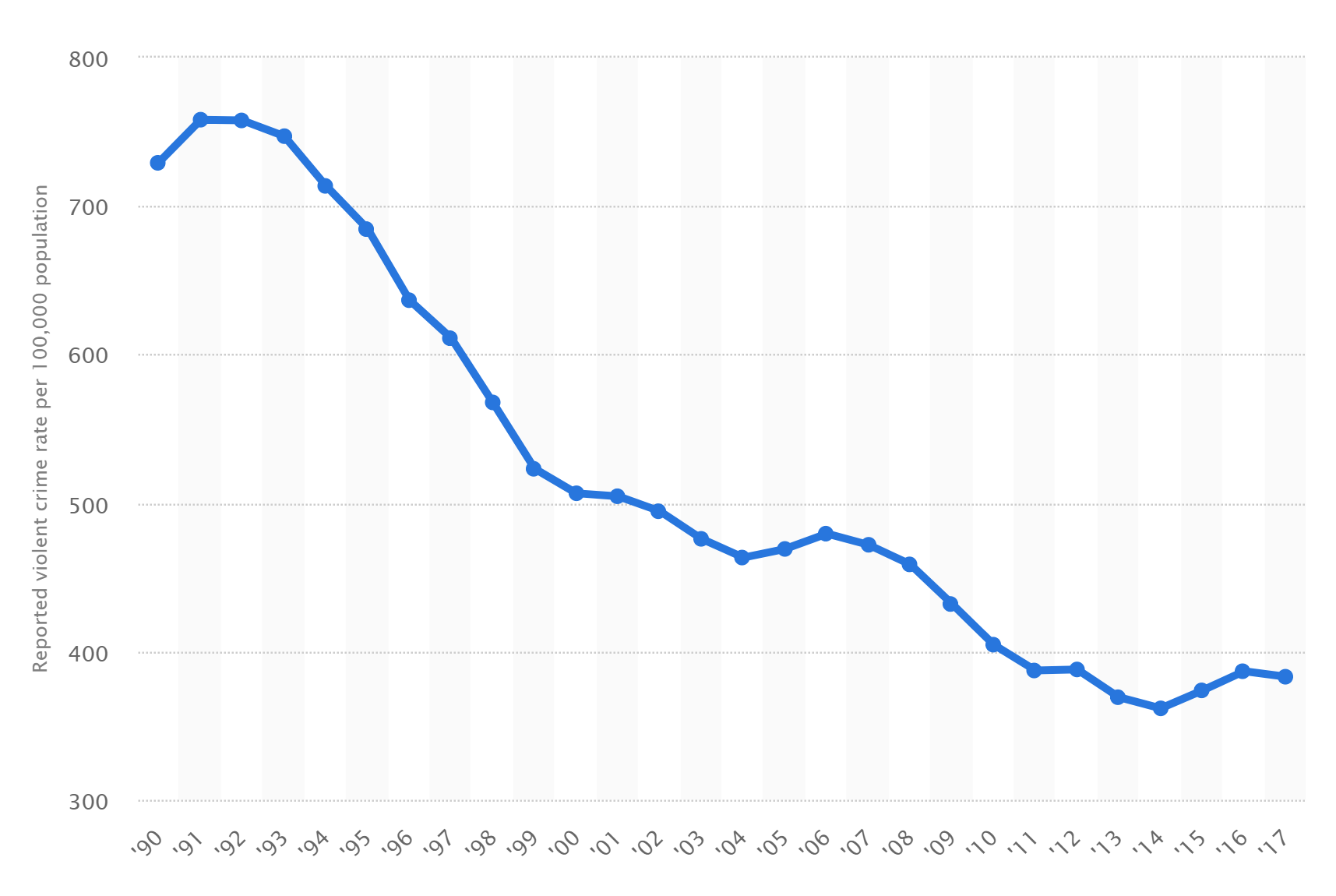
Apart from the global long-term trend of declining homicides, we can also observe a recent downward trend in the reported violent crime rate since 1990 in the USA. Scholars agree that the crime rate is in an extreme decline. Expanding the realm towards Europe, you will see similar results (see here).

1Source: Statista

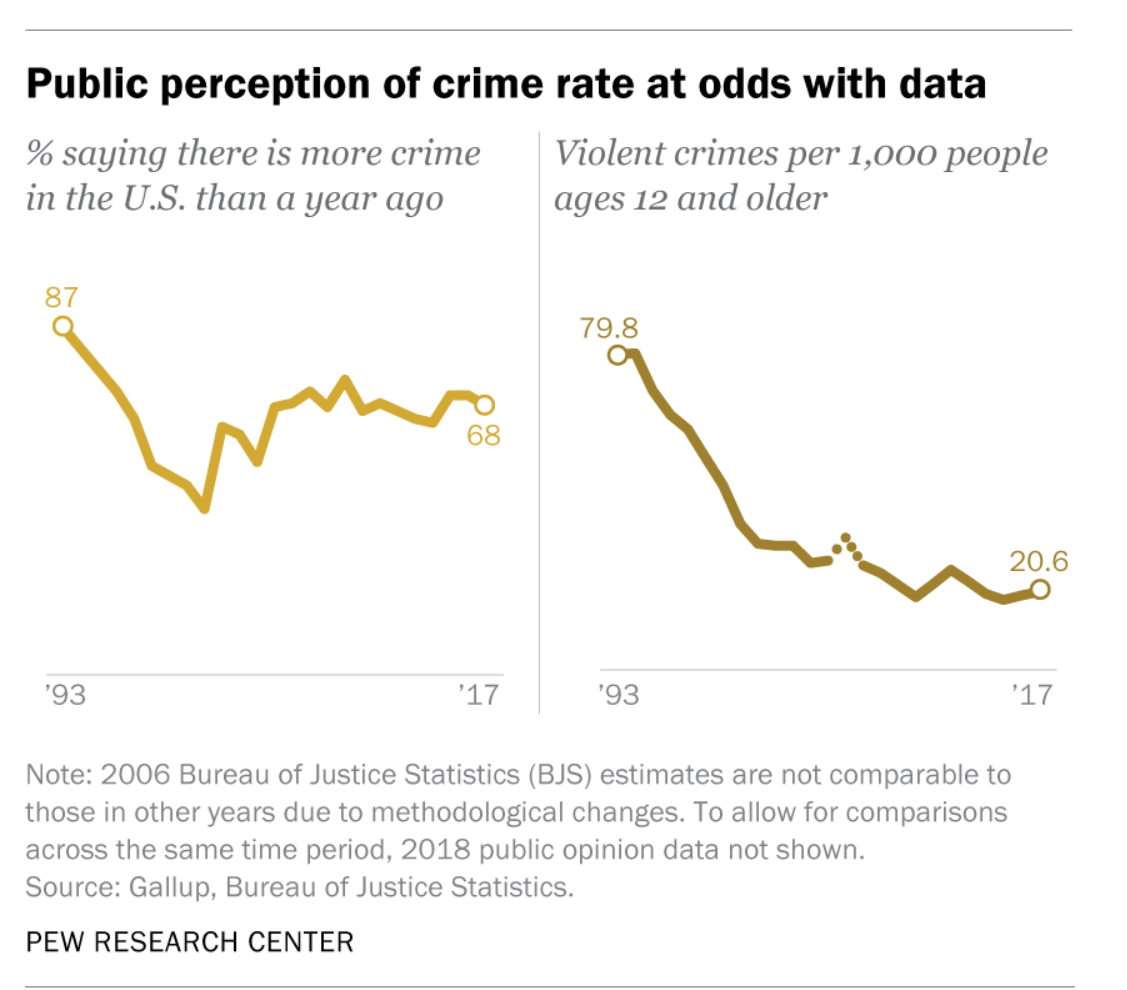
Despite these trends, the public (as well as some intellectuals as well I assume) vastly still holds a distorted perception of the crime rate. The sharp decline in actual crimes strongly contradicts the fact that a majority of the people still uphold the myth of increasing crime rates.

2

Source: Pew Research Center

Regarding drug use in the USA, it is important to mention that the absolute amount of illicit drugs consumed has slightly gone up since 1990. This development is mostly driven by an increasing  consumption of marijuana: Use of most drugs other than marijuana has stabilized over the past decade or has declined., states the National Institute on drug abuse in 2015.

Contrary, the number of deadly injections are increasing. However, the share of the population with drug use disorders has remained on the same level of 5.3% over the last 20 years.

2. Decay of the family resulting in increasing divorce rates, teenage motherhood and single parents

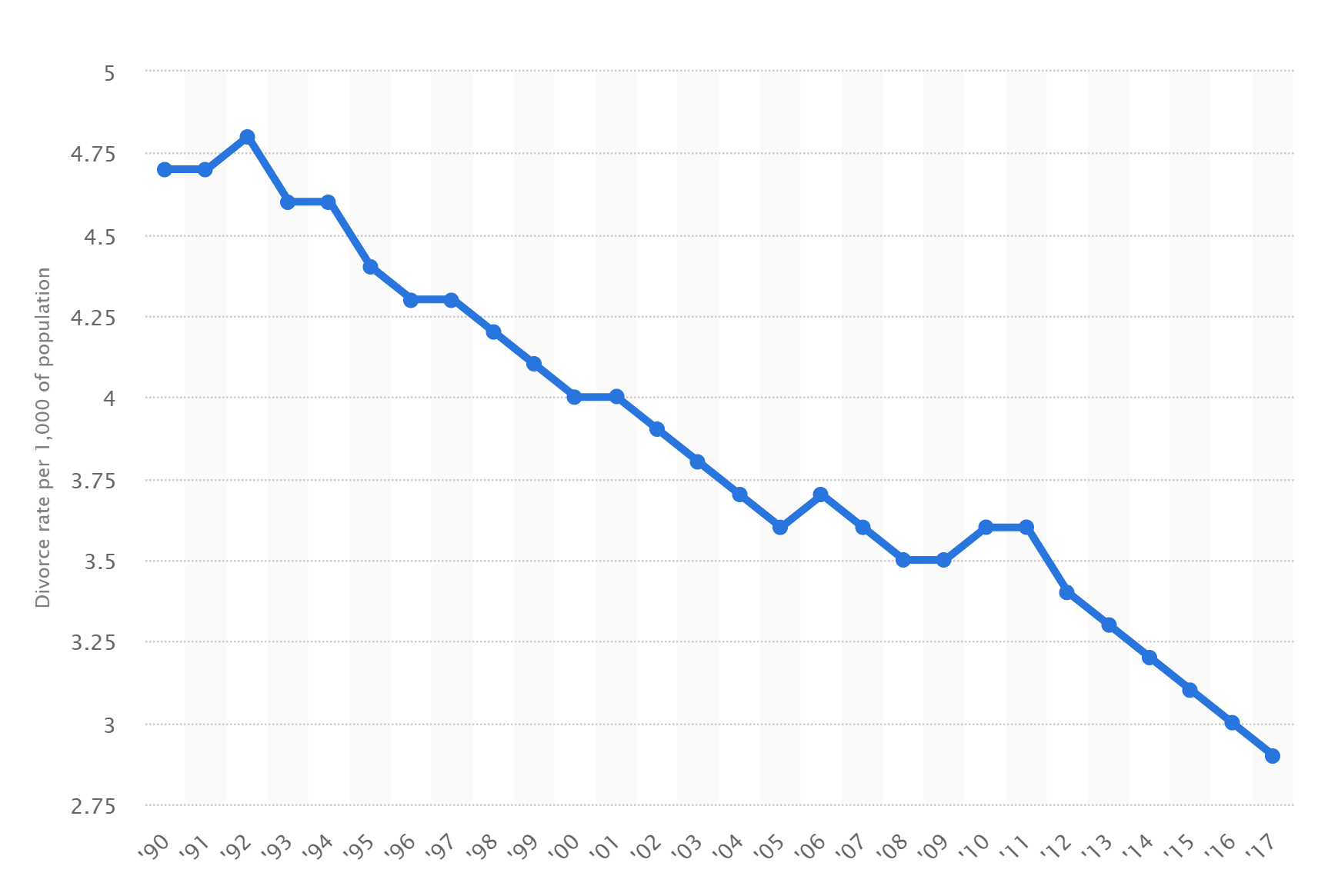
It is hard to measure the “Decay of the family” itself. Luckily, Huntington further concretizes his claim by naming some of the measurable effects. There is nothing much to do to refute these statement except for looking at the following graphs.

a) Firstly, the divorce rate is sharply declining.

3

Source: Statista

b) Second, teenage pregnancy rates are also dropping since 1990.

4Source: National Vita Statistics Report

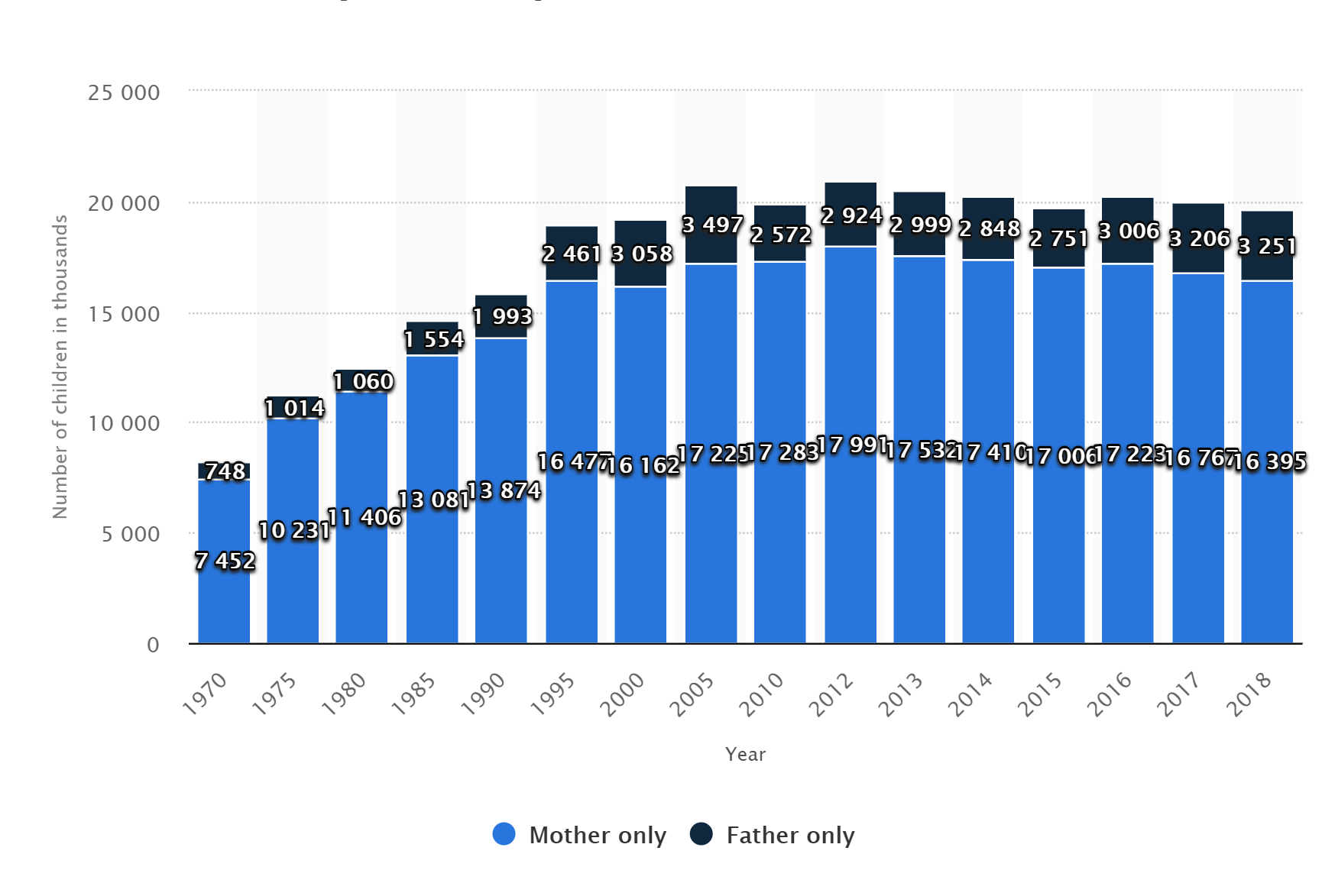
c) Third, the number of Americans living in single parenthood is not increasing drastically since 1990.

5Source: Statista

I often take issue when (especially conservative) scholars mourn the declining importance of family. Even if there are certain indicators which would back up Huntington’s claims, he does not name them himself. While it is indeed true that “family” as an institution is undergoing changes, there is no evidence (at least named by Huntington) to back up the claim of a decline of its importance.

3. Declining “social capital” and voluntarism leading to less trust.

It is indeed true, that the adult volunteering rate declined from early 2000 to 2016 from 27.4% to 24.9%. Interestingly, it recently bounced back to a new high in 2018, hitting the 30% target. Really the only point where one must agree to Huntington’s claim is the decrease of interpersonal trust as well as trust in public institutions. This trend is indeed very worrisome considering that trust is a major factor for flourishing societies.

4. The decline in work ethic

The research here is a little bit tricky and points in both directions. Although there has been wide academic coverage of the millennial work ethic scholars could not find a consensus on this issue. Its is especially difficult to extract the generational influence from other key determinants of work ethic, such as position or age. Academics warn to mistake the ever-ongoing conflict between young vs. old with the Boomer vs. Millenial conflict. I haven’t settled my opinion on this one. These Articles from Harvard Business Review and Psychology Today provide a good overview of both sides of the medal.

5. Less general interest in Education

This indicator is particularly interesting for me because as a member of the 90’ generation, I have experienced quite the opposite in Germany. But let’s have a look at the data.

Despite ranking only in the middle in a global country comparison, the US students still made a huge leap in terms of maths and reading proficiency, which only slowed down in 2015:

6

Source: Pew Research Center

Furthermore, the overall educational level of the USA continues to rise, resulting in the fact that  “the percentage of the American population age 25 and older that completed high school or higher levels of education reached 90% [for the first time ] in 2017.” Contrary, there are still major differences when one looks at features like race or parent household (See here), but the overall trajectory of the educational level is sloping upwards.

What do these criteria measure?

As you can see, there is little to no evidence to empirically back up the claim of western moral decay. Furthermore, while many case studies have shown that lack of interpersonal trust, lack of education or a declining work ethic can pose a great threat to society, I refuse to see a connection (a no known to me study disproves me here) between (recreational) drugs consumption, alternative family models, increasing hedonism and moral decline. Thus I believe that many advocates of the moral decay theory regard it as an opportunity to despise developments they personally do not like. I do not imply that everyone arguing for the moral decline of the west is unaware of the global macro-trends which heavily improved our life, but I highly doubt their assumption, that we are currently in a short-to-medium term “moral recession”. Even when one upholds the very conservative statements such as drug consumption adding to moral decline, is hard to argue that we are currently witnessing a moral decay of the west. Contrary, It may be true that Huntington has observed something different in the period before publishing “The clash of civilization” in 1996. Of course, I myself witness the ongoing battle against norms on the increasing hostility towards the intellectual enemy in the west, but one should always keep in mind the bigger picture. Our world is getting better – in the long- and in the short-run; There is no such thing as a moral decline of the West.


[1] Huntington, Samuel P. (2011): Kampf der Kulturen. Die Neugestaltung der Weltpolitik im 21. Jahrhundert. Vollst. Taschenbuchausg., 8. Aufl. München: Goldmann (Goldmann, 15190). P. 500

Let’s Find Out – or: the Power of Reference

The core message of a number of books I’ve recently had the great pleasure to read has been fairly simple. Have a look. Check it out. Put your numbers in perspective. In a world awash with statistics and cognitive biases imploring us to cheer mindlessly for our own team, having the skill and wherewithal to step back and carefully ask: “can this really be so?” is golden.

One of recently passed celebrity professor and YouTube phenomenon Hans Rosling’s most profound advice for countering misinformation about the state of the world is precisely this: put all numbers in perspective. Never accept unaccompanied numbers – never believe the numerator without checking the denominator. What matters, as Bryan Caplan never ceases to emphasize as the GMU Economics creed, “are statistics, not emotions – and arguments, not stories.”

But, a statistic may never be left alone, Rosling maintains, but always compared to other relevant numbers. What share of its total category does this statistic represent? What was it last year, 5 or 10 or 20 years ago? Is there some self-evident change in associated behavior that is relevant or ought to explain it? A century ago street cars used to kill and injure hundreds of people every year, but since very few American cities make use of street cars today, the casualty is fortunately much lower. If we keep in mind that miles travelled by cars far outnumber miles travelled by street cars, reporting the number of street car deaths – while probably correct – entirely miss the point when discussing traffic safety. In How Not To Be Wrong, Mathematics professor Jordan Ellenberg quipped

Dividing one number by another is mere computation ; knowing what to divide by what is mathematics.

Here’s another example. If I told you about 23 000 individual deaths and spent a brief 10 second on each of them, going through the list would take me almost three days. On a personal level like that, 23 000 deaths is an absurd, insane, catastrophe-style event that few people are emotionally equipped to handle – essentially the size of my hometown, wiped out in a single year. If I told you those 23 000 deaths were due to antibiotic resistant diseases in the U.S. last year, the pandemic scenarios working through your mind quickly escalate. That many! Let’s find the nearest bunker!

If I then told you that cancer and heart diseases (each!) claim the lives of about 20x that, the fear of lethal apocalyptic germs consuming the world ought to quickly recede. Oh.

Here’s another example. It is entirely correct to point out that the number of people killed in worldwide airplane accidents in 2018 (556 people) was much higher than the year before (44 people) and the year before that (325 people). Would one be excused for believing that air travel is getting more risky and dangerous? Forbes, for instance, ran a roughly accurate story claiming that airline fatalities increased by 900%.

Not in the slightest. The number of fatalities from air travel has been falling for decades, all while the number of flights and miles travelled have increased exponentially, meaning that the per-flight, per-mile or per-passenger risk of death has kept dropping. Not to mention that alternative modes of travelling like driving is magnitudes more dangerous.

While Rosling teaches us to figure out what the base rate is, i.e. putting our statistic into appropriate perspective, one of Philip Tetlock’s tricks for becoming a ‘Superforecaster’ is to use Bayesian updating of one’s beliefs. This picks up precisely where Rosling’s idea left off. Once we know where to start, we have to amass more information, numbers and observations from other points of view – Bayesian updating is a popular method to incorporate and synthesize new information with the old.

In short “Calculation, like logic, is your friend” (Landsburg 2018: 44). Statistics matter and numbers can deceive. In order to better understand our realities and see through mistakes that others make – either intentionally to deceive or persuade, or unintentionally through ignorance – we must embrace the core message of people like Ellenberg, Tetlock, Duffy, Rosling or Pinker.

Always Be Comparing Thy Numbers. Never accept an unaccompanied statistic. Never trust numerators without denominators.