Why a Nexit would be good for the Netherlands

Past Friday, 51.9% of the British have voted to leave the European Union against 48.1% of those who have voted to remain. The details of the EU referendum can be found on BBC’s EU referendum page. Although it is still unclear what shape the relationship between Britain and the EU will take, I expect that the Brexit will offer good economic opportunities for Britain provided that they can reach free trade agreements with all nations within the EU and provided that they will continue to open up their markets for free trade with other countries outside of the EU.

An Exit of the Netherlands, or a Nexit, will have more consequences than a Brexit as the Netherlands are also participants in the European Monetary Union. A Nexit could therefore lead to an end of the Euro. An analysis of the EU is a political analysis and as politics is always complemented by power, this analysis should hence incorporate insights on power struggles and competing visions. Each country has its own interests within the EU, just like any politician within the EU has his own special interests that he is serving. Participation in the EU is often represented as an exercise of solidarity and political appeasement, however it is still politics with politicians’ usual desire for self-enrichment.

There have always been two competing visions of the EU. The first one is a classical liberal vision, led by German speaking Christian democrats Schuman (France), Adenauer (Germany) and Alcide de Gasperi (Italy) with the Treaty of Rome (1957) as the greatest achievement of this classical liberal vision for Europe. The Treaty sought to deliver the following four freedoms: free movement of goods, freedom of movement for workers, the right of establishment and freedom to provide services, and free movement of capital. The other vision was a socialist vision led by mainly French politicians, such as Jacques Delors and François Mitterrand whose goal was to create a supranational state.

Treaty of Rome signed
Treaty of Rome.

Classical liberal vision
The first vision promotes political competition between the EU’s member states by opening up borders. When a person is discontent with the excessive taxes in his country, he could leave his country for another. Competition between member states would lead to smaller governments, lower taxes, and political respect for people who would want to pursue their individual freedoms in another member state. It would represent a return to the political model that was prevalent in Europe from the Middle Ages to the 19th century when different political systems coexisted independently. There were independent cities or city states in Flanders, Germany and Northern Italy. There was the kingdom of Bavaria, the republic of Venice, and small city states like Ghent and Bruges embraced their autonomy. The German writer and poet Johann Wolfgang von Goethe (1749-1832) had expressed the beauty of such a political system as follows when he discussed a Germany that was still splintered in 39 independent states:

“I do not fear that Germany will not be united; … she is united, because the German Taler and Groschen have the same value throughout the entire Empire, and because my suitcase can pass through all thirty-six states without being opened. … Germany is united in the areas of weights and measures, trade and migration, and a hundred similar things. … One is mistaken, however, if one thinks that Germany’s unity should be expressed in the form of one large capital city, and that this great city might benefit the masses in the same way that it might benefit the development of a few outstanding individuals. … What makes Germany great is her admirable popular culture, which has penetrated all parts of the Empire evenly. And is it not the many different princely residences from whence this culture springs and which are its bearers and curators? … Germany has twenty universities strewn out across the entire Empire, more than one hundred public libraries, and a similar number of art collections and natural museums; for every prince wanted to attract such beauty and good. Gymnasia, and technical and industrial schools exist in abundance; indeed, there is hardly a German village without its own school. … Furthermore, look at the number of German theaters, which exceeds seventy. … The appreciation of music and song and their performance is nowhere as prevalent as in Germany, … Then think about cities such as Dresden, Munich, Stuttgart, Kassel, Braunschweig, Hannover, and similar ones; think about the energy that these cities represent; think about the effects they have on neighboring provinces, and ask yourself, if all of this would exist, if such cities had not been the residences of princes for a long time. … Frankfurt, Bremen, Hamburg, Lübeck are large and brilliant, and their impact on the prosperity of Germany is incalculable. Yet, would they remain what they are if they were to lose their independence and be incorporated as provincial cities into one great German Empire? I have reason to doubt this.”[1]

In addition to the advancement of political competition, the vision also promotes economic competition. A German employee would not be obstructed from working in France anymore, a Dutchman would not be taxed by the government if he transfers money from a Dutch to a Spanish bank or when he decides to buy stocks on the Italian equity market. Nobody would withhold a Belgian brewery from selling beer in other countries within the European free trade area.

Socialist vision
The second vision promotes a European central state that holds the power to enact more regulations, redistribution of wealth, and harmonization of legal systems within the whole Union. A strong central political body is to coordinate such efforts. The consequence is that its member states would increasingly have to give up their sovereignty. This is clearly visible from the political events in Greece and Ireland during the financial crisis of 2008 when Brussels demanded from Greece and Ireland how they should deal with their deficits and what austerity measures they should take. The socialist vision of Europe is an ideal for the political class, bureaucrats, interest groups and the subsidized sectors that want a powerful central state for their self-enrichment. Political competition among its member states, something that the classical liberals supported, should be eliminated. Doing so, Europe becomes less democratic and political power is increasingly shifted into the hands of bureaucrats and technocrats in Brussels. Historically, such plans for concentrated political power had been realized by such figures as Charlemagne, Napoleon and Hitler. The difference with our times is that the creation of a modern European superstate does not directly require military means. The introduction of new institutes like the European Central Bank, a common currency like the Euro, and extended power of the European Commission would suffice. Similar socialist intentions were already visible from the start of the European integration in the European vision of Jean Monnet, the intellectual father of the European community. Fearing an independent and emerging Germany after the second World War, an integration of Germany into Europe was considered to be a good thing. Next to that, the French wanted to have control over the Rühr area and they wanted to keep other vital German resources out of solely German hands. After losing her colonial powers in Indochina and Africa, the French ruling elite were also looking for new influence and pride which they eventually found in the European community.[2] The French premier in 1950 had for example proposed a plan to install a European army under the leadership of the French.

Why it is good for the Netherlands to leave the European Union
I believe that the EU should never have had more ambitions than the free trade zone that requires no supranational institutes, except for a European Court of Justice that is restricted to supervising conflicts between the member states and guaranteeing the four freedoms. The EU has become so far removed from the classical liberal vision of political and economic competition that it is not worthwhile anymore for the Netherlands to participate. It has declined into a malignant cartel of states that can tell its members with whom and how they should conduct their trade. A good example were the quotas and import levies on Chinese solar panels in 2013 under the disguise of ‘anti-dumping’ measures. Several countries like the Netherlands and Germany had first opposed to these measures as they would like to maintain good relationships with China. Nonetheless, the European Committee, apparently under influence of solar panel lobbyists like those of the German producer Solarworld AG, introduced ‘anti-dumping’ measures. The eventual winners of such measures are European solar panel producers and its victims are the European people that simply want to buy cheap solar panels. Another example are the sanctions that the EU had imposed on Russia since the Ukrainian conflict – a conflict that was provoked by American imperialists and NATO.[3] The deteriorating trade relationships between the EU and Russia is also detrimental to the wealth of ordinary European citizens. Another recent example is the prohibition of high-powered vacuum cleaners and possible future bans on other energy appliances such as kettles and hairdryers in order to reach environmental targets.[4] Those who profit from such measures are mainly large legacy organizations such as Bosch and Siemens that have enough capital to meet the strict EU regulations.

Another reason why a Nexit would be good for the Netherlands is that it offers an opportunity to extricate oneself from the Euro and the implicitly pledged financial aid when a future financial crisis will tear through Europe.

The tragedy of the Euro
The introduction of the Euro has proven to be a huge mistake, because it has enabled fiscally irresponsible governments of such countries like Portugal, Italy, Greece, Spain etc. to conduct unsustainable economic policies. In the past, when these states had their own currency, their governments had to finance their budget deficits through the sales of government bonds which resulted in higher government debts. The higher government debts manifested itself in higher interest rates on their government bonds, and a greater money supply would lead to devaluations of their currencies.

To illustrate how the process of government bonds financing works in the European Monetary Union, we could look at the development of 10-year government bonds. The graph below shows the interest rates that governments have to pay to the financiers of their 10-year government bonds from 1995 to 2011:

Development in Interest Rates on 10-year Government Bonds
Interest rates on 10-year government bonds from 1995-2011.

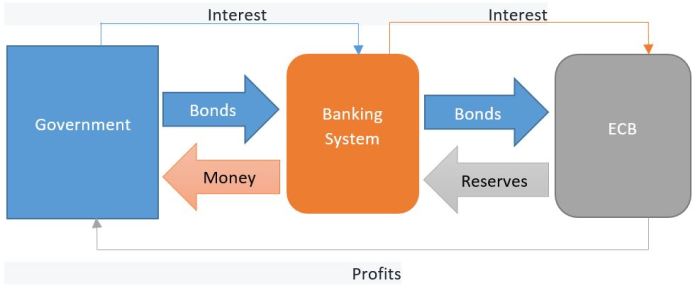
The y-axis represents the rates of interest that an investor receives from 10-year government bonds. Countries that are economically stronger and fiscally more conservative are rewarded with lower interest rates due to the smaller risk that these governments will not pay back their loans. In the case of Germany, a country with traditionally a stronger economy, a more conservative Bundesbank, and a fiscally more responsible government than many other European nations, investors received 7.5% interest on their 10-year government bonds in 1995. Greek government bonds had a yield of 18% in 1995. 1995 was the year in which the European Committee had announced that the Euro would arrive in 2002. Interest rates on government bonds consequently converged in the following years. At the end of 1997 all rates of interest on Portuguese, Irish, Spanish, Italian, French and German 10-year government bonds were more or less equal despite the fact that many of the governments of these countries still spent more than they received in tax incomes. The consequence of sharing a common currency with fiscally more responsible countries like Germany and the Netherlands is that fewer price signals in the form of higher interest rates on government bonds of fiscally irresponsible governments emerge. Irresponsible governments can issue government bonds to the banking sector that transfer these bonds as collateral to the ECB in return for loans. The interest rate that banks pay for the loans of the ECB are issued as profits to their governments. This is in short how ‘seigniorage’, the profits derived from money creation when the costs of money production and the distribution of money are lower than the value of money itself, is created.

Sovereign debt financing in EMU
Sovereign debt financing in the European Monetary Union.

This process leads to inflation, but the costs of inflation in the EMU are not solely borne by the respective country that issues the government bonds, but by all countries that participate in the EMU. A country like Spain can for example issue government bonds that traditionally would correspond with 10% inflation. However, when other countries like the Netherlands and Germany issue an amount of bonds that corresponds with 5% inflation, Spain benefits from seigniorage as the inflation created by Spain is higher and borne partly by the Netherlands and Germany. A Euro in this regard is beneficial for fiscally irresponsible governments. It is actually a “Tragedy of the commons”. Abusing the Euro in this way is exactly what countries like Portugal, Italy, Ireland, Greece, Spain and France have done. This works until a financial crisis shows how insolvent the governments of these countries actually are. That has happened in 2008, the moment when interest rates on European government bonds started diverging. The ECB had even decided to buy up Greek government debts in May 2010 in order to lower the interest rates on Greek government bonds. In June 2010, a temporary European Financial Stability Facility (EFSF) was founded with guarantees of up to €440 billion to combat the European sovereign debt crisis. It has provided financial assistance to Ireland, Portugal and Greece. The EFSF was later replaced by the European Stability Mechanism (ESM) in October 2012 with a total described capital of around €700 billion of which the Netherlands has pledged €40 billion in capital participation. The Dutch prime minister, Mark Rutte, had promised the Dutch in 2011 that the Netherlands would receive back the money it has loaned out to Greece in May 2010.[5] The total sum that was loaned to Greece by the Dutch was €3.2 billion. However, in 2012 when the Netherlands loaned out €14.5 billion of the second financial aid package of €130 billion that was pledged by Europe and the IMF to Greece, the Dutch minister of Finance, Jeroen Dijsselbloem, admitted that the Netherlands were losing money. Rutte also admitted that he could not guarantee that the Dutch loans to the Greeks would not be forgiven.[6] Three years later, on July 13 2015, the Netherlands loaned out another €22.6 billion to Greece.[7] It has become clear that such financial pledges of the Netherlands to fiscally irresponsible governments like that of Greece are not beneficial for the Dutch. Even in the long run it is not beneficial for the EU as it supports and prolongs a socialist European system that is deeply rotten to its core and destined to fail. What the EU needs is a radical return to decentralization and political competition.

The EU has become a sinking ship. It appears to me that the Netherlands should leave the Union as soon as possible. I do not see how Europe can maneuver itself safely through the next financial crisis that is at the point of breaking out as more banks are on the brink of collapse.[8] I also expect greater centralization of political power within the EU and a greater loss of individual member countries’ sovereignty. On June 27, 2016, the Polish media had reported that France and Germany were taking matters into their own hands and are using the Brexit to unveil their plan to morph the continent’s countries into one giant superstate. Under their radical proposals,

“EU countries will lose the right to have their own army, criminal law, taxation system or central bank, with all those powers being transferred to Brussels.”[9]

Conclusion
A sensible Netherlands would leave the European Union and the European Monetary Union in order to preserve political and economic sovereignty. They would have free trade agreements with all countries within and outside of the EU. EenVandaag, a popular Dutch TV programme, had published the results of their 27,000 large online poll on Sunday June 26, 2016 in which 54% of the Dutch would like to hold a referendum about the Netherlands’ participation in the EU. 48% of the poll wanted the Netherlands to leave the EU against 45% who would like to remain in the EU.[10] In the meantime, the Remain camp will continue their nauseating snobbery accusing the Leave camp of being racist, nationalistic, isolationist or simply ignorant.

References
Bagus, P. (2010). The Tragedy of the Euro.

BBC. (2016). EU referendum: The result in maps and charts.

China Courant. (2014). Mogelijk nieuwe straffen voor producenten Chinese zonnepanelen.

Dijkstra, M. (2015). Griekse crisis: wat heeft het allemaal gekost?

DutchNews.nl. (2016). Dutch PM rejects referendum calls: not in the Netherlands’ interest.

Fullfact.org. (2016). First they came for the vacuum cleaners: will it be kettles next?

Gutteridge, N. (2016). European SUPERSTATE to be unveiled: EU nations ‘to be morphed into one’ post-Brexit.

Hoppe, H.H. (2001). Democracy the god that failed.

Judt, T. (2006). Postwar: A History of Europe Since 1945.

McMurtry, J. (2016). Ukraine, America’s “Lebensraum”. Is Washington prepared to wage war on Russia?

NOS. (2011). Rutte verwacht Grieks geld terug.

NU.nl. (2012). Rutte geeft verbreken verkiezingsbelofte toe.

Zerohedge.com. (2016). Deutsche Bank tumbles near record lows as yield curve crashes.

Footnotes
[1] From Johann Peter Eckermann’s Conversations with Goethe (1836-1848).

[2] Tony Judt writes in Postwar: A History of Europe Since 1945 (2006) that “[U]nhappy and frustrated at being reduced to the least of the great powers, France had embarked upon a novel vocation as the initiator of a new Europe” (p. 153). He also writes that “[F]or Charles de Gaulle, the lesson of the twentieth century was that France could only hope to recover its lost glories by investing in the European project and shaping it into the service of French goals (p. 292).”

[3] See for example Prof. John McMurtry’s “Ukraine, America’s ‘Lebensraum’. Is Washington prepared to wage war on Russia?” for an analysis how Washington had provoked the Ukrainian conflict with Russia.

[4] See “First they came for the vacuum cleaners: will it be kettles next?”

[5] See “Rutte verwacht Grieks geld terug” (2011). http://nos.nl/artikel/275035-rutte-verwacht-grieks-geld-terug.html

[6] See “Rutte geeft verbreken verkiezingsbelofte toe” (2012). http://www.nu.nl/algemeen/2968363/rutte-geeft-verbreken-verkiezingsbelofte-toe.html

[7] See “Griekse crisis: wat heeft het ons allemaal gekost?” http://www.elsevier.nl/economie/article/2015/07/griekse-crisis-wat-heeft-het-ons-allemaal-gekost-2657386W/

[8] See for example “Deutsche Bank tumbles near record lows as yield curve crashes.” http://www.zerohedge.com/news/2016-06-13/deutsche-bank-tumbles-near-record-lows-yield-curve-crashes

[9] See “European SUPERSTAT to be unveiled: EU nations ‘to be morphed into one’ post-Brexit.” http://www.express.co.uk/news/politics/683739/EU-referendum-German-French-European-superstate-Brexit

[10] See “Dutch PM rejects referendum calls: not in the Netherlands’ interest.” http://www.dutchnews.nl/news/archives/2016/06/92520-2/

The minimum wage still bites

Politicians, pundits and activists jumped on a new literature that asserts that there no negative effects of substantial increases of the minimum wage on employment. Constantly, they cite this new literature as evidence that the “traditional” viewpoint is wrong. This is because they misunderstand (or misrepresent) the new literature.

What the new literature finds is that there could be no significant negative effects on employment. This is not the same as saying there are no negative effects overall. In fact, it is more proper to consider how businesses adjust to different-sized changes by using various means. Once, the minimum wage is seen in this more nuanced light, the conclusion is that it still bites pretty hard.

The New Minimum Wage Literature

Broadly speaking, the new literature states that there are minimal employment losses following increases in the minimum wage. It was initiated twenty years ago by the works of Alan Krueger and David Card who found that, in Pennsylvania and New Jersey, a change in the minimum wage had not led to losses in employment. This caused an important surprise in the academic community and numerous papers have found roughly similar conclusions.

These studies imply that the demand for labor was quite inelastic – inelastic enough to avoid large losses in employment. This is a contested conclusion. David Neumark and William Wascher are critical of the methods underlying these conclusions. Using different estimation methods, they found larger elasticities in line with the traditional viewpoint. They also pointed out Card and Krueger’s initial study had several design flaws. With arguably better data, they reversed the initial Card and Krueger conclusion.

These critics notwithstanding, let us assume that the new minimum wage literature is broadly correct. Does that mean that the minimum wage is void of adverse consequences? The answer is a resounding no.

This is because of an important nuance that has been lost on many in the broader public. In a meta-analysis of 200 scholarly articles realized by Belman and Wolfson, there are no statistically discernable effects of “moderate increases” on employment. The keyword here is “moderate” because the effects of increases in the minimum wage on employment may be non-linear. This means that while a 10% increase in the minimum wage would reduce teen employment by 1%, a 40% increase will reduce teen employment by more than 4%. A recent study by Jeremy Jackson and Aspen Gorry suggests as much: the larger the increase of the minimum wage, the larger the effects on employment.

If labor costs increase moderately, the strategy to reduce employment may be relatively inefficient. The increase of labor costs needs to reach a certain threshold before employers choose to fire workers. Below such a threshold, employers may use a wide array of mechanisms to adjust.

Adjustment channels

Employers on their respective markets face different constraints. This diversity of constraints means that there is no “unique” solution to greater labor costs. For example, if the demand for one’s products is quite inelastic, labor costs can be passed on to consumers through an increase in prices. While this may not necessarily hurt workers at the minimum wage, it impoverishes other workers who have fewer dollars left to spend elsewhere. This is still a negative outcome of the minimum wage – its just not a negative outcome on the variable of employment.

In other cases, employers might reduce employment indirectly by reducing hours of work. This is an easy solution to use for employers who cannot, for a small increase in labor costs, afford to fire a worker. Even Belman and Wolfson – who are sympathetic to the idea of increasing the minimum wage – concede that increases in the minimum wage do lead to moderate decreases in labor hours. More skeptical researcher, like Neumark and Wascher, find that the effects on hours worked is much larger. Again, the variable affected is not employment measured as the number of people holding a job. However, a reduction in the number of hours worked is a clearly a perverse outcome.

Another effect is that employers might reduce expenses associated with their workers. Even Card and Krueger, in their book on the minimum wage, recognize that employers may opt to cut on things like discounted uniforms and free meals. An employer facing a 5% increase in the minimum wage will see his labor costs increase, but firing an employee means less production and lower revenues. Thus, firing may not be an option for such a small increase. However, cutting on the expenses associated with that worker is an easy option to use. This means fewer marginal benefits and on-job training. Employers adjust by altering the method of compensation.  For example, economist Mindy Marks estimated that a 1$ increase of the minimum reduced by 6.2% the probability that a worker would be offered health insurance.  Again, employers adjust and the effects are not seen on employment. Nonetheless, these are undisputedly negative effects.

The effect may also be observed on the type of employment. Employers may decide to substitute some workers by other types of workers. Economist David Neumark pointed that, subsumed in the statistical aggregate of “labor force” is a shift in its shift. In his article, written for the Employment Policies Institute, he stated that “less skilled teens are displaced from the job market, while more highly skilled teens are lured in by higher wages (even at the expense of cutbacks in their educational attainment)”. Another example could be that a higher minimum wage induces retired workers to return to the labor force. Employers, at the sight of a greater supply of experienced workers, prefer to hire these individuals and fire less-skilled workers. In such case, “total employment” does not change, but the composition of employment is heavily changed. The negative effects are clear though: less-skilled workers are not allowed to acquire new skills through experience.

Conclusion

None of these adjustment mechanisms in response to “moderate increases in the minimum wage” are desirable. Yet, all of these channels would allow us to conclude that there are no effects on employment. To misconstrue the ability of employers to select multiple channels of adjustments other than reducing employment as the proof that the minimum wage has no negative effects is perverse in the utmost. The statement that “moderate increases in the minimum wage has no statistically significant effects on employment” is merely a positive scientific statement with no normative implications whatsoever. If anything, the multiple adjustment mechanisms suggest that the minimum wage still hurts and that is both a positive and normative statement.

The Case for the UK staying in the EU

Leaving the European Union would not be a gain for liberty in the United Kingdom. This is true as a matter of general principles and is reinforced by the nature of the Leave campaign which has targeted sections of the population hostile to immigration, open markets, and free trade. Much of the Leave campaigning which has not appealed to such base arguments has at the very least appealed to a version of populist democratic sovereignty at odds with the restraints on government and the state at the heart of classical liberal and libertarian thought.

Even if we try to separate some pure classical liberal version of the Leave campaign from the crudity of the campaign, as some natural supporters of leave wish had happened to the extent they ate voting for Remain rather than go along with such an obnoxious campaign, we are still left with the question of why it liberty advocates should support Leave.

I have sometimes seen references to national sovereignty as a classical liberal doctrine. If this means never sharing sovereignty at a transnational level, then it is simply a false claim. Immanuel Kant advocated a world federation to prevent war. Kant is not often put at the centre of the history of classical liberal thought. His ideas about political institutions, individual rights, and the limits of government certainly belong in the classical liberal sphere. We should distinguish between what Kant said and what later German Idealists said, a rather big issue, and appreciate how close he is to the way of thinking of Montesquieu and Smith and even advances upon them in showing a clearer understanding of the role of representative assemblies in modern politics.

More recently F.A. Hayek advocated federation between liberal democracies. The creation and evolution of the European Union has been and continues to be supported by European political parties of a classical liberal persuasion, those liberal parties which remained most true to the principles of their nineteenth century founders and precursors. Thinkers on the left, like Albert Camus and George Orwell, known for their particular commitment to liberty and their opposition to an authoritarian state were enthusiasts for European integration. Many conservatives of the more free market and limited government sort like Ludwig Erhard (founder of Germany’s post-war, post-Nazi market economy) and John Major (UK Prime Minister from 1990 to 1997, who went further than Margaret Thatcher in privatisation and deregulation) have been and are advocates of the European Union.

The unrestrained sovereignty of the nation-state is not only not an inherently liberal idea, it is dangerous to liberalism. There is nothing illiberal in transnational rules and institutions that restrain states from violence against their own citizens, attacks on individual rights, economic protectionism, and market rigging. The European Union is particularly successful with regard to the economic and market issues at the national level.  It adds huge institutional weight to the work of the Council of Europe which promotes human rights through its court in Strasbourg. The existence of the European Court of Justice is of profound importance in ensuring that national governments and peoples are accustomed to regarding the decisions of nation states as subordinate to and accountable to a judicial process enforcing transnational laws.

The EU is open to a great deal of criticism with regard to its tendencies towards over-regulation, but this represents the median attitude of the member governments, not an imposition on the nation-states of Europe. Since the UK economy is at the more free market deregulated end of the European Union, there is some plausibility in saying the UK might go further down that road if it left the EU. However, before it joined the EU it was looking less market oriented than the EU states of the time. The period during which the UK has moved from the more statist to the more limited state end of the European nations has been during the period of EU membership. The precedents do not favour the UK becoming more classically liberal because it leaves the EU and the Leave campaign has appealed to the most insular, nationalist, anti-immigrant, anti-foreigner, and anti-free trade sections of the UK population.

It is possible to imagine the UK as a more libertarian kind of place in the EU, but a much more plausible use of the liberal imagination is to think of ways in which the UK can work with allies in the EU for a a less regulatory and centralised EU. This has already worked as in the adoption of the European Single Market and the diminishing role of the European Commission, the ‘bureaucratic’ part of the EU. The Commission employs as many bureaucrats as the larger local government units in the UK and is tiny compared with any national bureaucracy. Its members are nominated by national governments subject to confirmation of the European Parliament. Power has shifted from the Commission to the bodies in which national government representatives meet, the European Council and the Council of the European Union.

The Leave campaign in the UK, including self-styled free marketers in the Conservative Party, is committed to leave the Single Market as well as the European Union itself, in large part to terminate free movement of EU citizens across its borders. The reasoning offered to prevent this movement of human capital is in terms of anti-foreigner sentiment. This is not something than can be recognised as a pro-liberty program. The pro-liberty choice is to keep free movement of goods, investment, and labour within the EU while working to reform the more interventionist tendencies of the European Union, to stymie the regulatory drift which started hitting industrial market economies decades before the EU was created and which cannot be solved by smashing up the EU.

Muddy thinking on child care

Five Thirty Eight had a disappointing discussion of an interesting issue: the cost of child care for working parents. The basic issue is that kids are expensive in time and money. Unfortunately, the discussion mostly revolved around questions of how to engage in economic engineering by government in order to expand access to child care and parental leave.

The hosts see these policies as having costs and benefits, and they see the value in studying alternatives empirically, but they miss an important issue: providing these sorts of goods doesn’t require screwing up markets by adding an extra layer of complexity to the tax code. If these goods are worth providing (that’s another couple of cans of worms) then just give money to new parents. Better yet, move to a basic income guarantee.

Another important point they miss is that if some good is difficult to get, it’s worth figuring out what to do about the root problem rather than just throwing money at the issue and hoping someone will figure out the important stuff later.

We don’t have to ruin markets to do charity

This post is for Democrats and Republicans, not libertarians. Let’s take it for granted that we want to help poor people and we’re willing to use the coercive power of government to do so.* The trouble with the interventions below is so troubling that we don’t even have to bother about having a deep philosophical debate. I’m not trying to change your destination, I’m just trying to get you to get out of that explosive Ford Pinto.


Minimum wage, water pricing, education, and just about all of American health care finance involves distorting markets to give charity and/or gifts. Essentially, they change rules so that group X pays Y instead of Z with the hope that X can afford it and Z can do more good with the money than Y. But this indirect giving has serious flaws.

Take the case of the minimum wage: it’s supposed to help the working poor by making their boss and consumers pay a bit more for their services. Of course it might simply be to help interest groups, and that further raises the burden of proof for those who would prefer a minimum wage to less invasive alternatives.

So what is this less invasive alternative? Cash transfers. We’ve already got some imperfect versions of this. School vouchers, food stamps, and a host of other welfare programs. What I want to see is a simpler version that takes the best features of these programs to eliminate the problems created by market interventions.

The economics of this proposal are simple and important. Prices are essential to help people use resources wisely. Interfering with the market process makes those prices less effective at communicating information about value and opportunity cost. And with an interconnected markets, a small price control can lead to worse decisions being made all across an economy.

Simple economics tells us that if we impose a minimum wage (or give special tax treatment to XYZ, or whatever) then something’s got to give. It might be higher unemployment, it might be worse working conditions, or it might simply be that rich people are a little less rich than before.

(It’s worth remembering that rich people are people too; even lawyers. They can do good and bad things, and those actions determine their moral quality, not their wealth per se… we don’t want to redistribute wealth for its own sake, we want to do so if/because we think it will do some good. The hope is that the harm of a few bucks out of your pocket does more good for the poor people who get that cash. And no, it’s not possible for “corporations” to suffer; corporations aren’t people, but they are owned by people.)

Consider the case of feeding the poor. It’s not hard (even for non-economists) to imagine how imposing price controls on food could lead to shortages. If there’s one thing we learned from socialism, it’s that bread lines are bad. Food stamps are a much simpler and targeted solution.

We should prefer straightforward transfers over market intervention because it will do more good at less cost. More importantly, it is humbler–distorting markets requires a lot of information, transfers don’t.

Transferring money rarely jives well with American intuition, and that brings up an important bundle of issues: responsibility and social engineering.

Republicans, for all their talk about the importance of individual responsibility, seem unwilling to let the poor exercise it themselves. They’re sure that enough poor people will abuse the system that some bureaucrat needs to exercise responsibility for them. Similarly, Democrats want to ensure the dignity of the poor, but how is anyone supposed to remain dignified while navigating labyrinthine bureaucracy?

The left should like cash transfers because they can help those we want to help, and take advantage of the information available to those with intimate knowledge of their context. The right should like it because it can replace a series of bloated bureaucracies while returning responsibility to the poor. Everyone should like that it will be cheaper and more effective than what we’ve currently got while creating better prospects for long-run economic growth.

We should absolutely debate whether specific transfers are a good idea (particularly middle-income to middle-income transfers like higher ed subsidies, mortgage interest subsidies, etc.), but for those programs we ultimately take on, we shouldn’t shoot ourselves in the foot by trying to do good by screwing up markets.


*As an economics professor I get to see what economic superstitions recent high school grads have. I’m struck with the confusion between the health of government and the health of the country a government is supposed to be helping. A related pair of confusions is that what a government can do, it should do; and if something isn’t already happening, and might be nice, government should make it so.

Missing from these superstitions is that the fundamental feature of government is force. What differentiates government from any other non-profit organization, is that charities and associations can’t put you in jail if you choose not to behave as they see fit. But for the sake of clarity, let’s put aside that issue and just focus on how the government can help the poor.

Would a Universal Basic Income Increase Poverty?

Switzerland has recently overwhelming voted against a proposal that would establish a universal income guarantee (sometimes called a “basic income guarantee” or the similar Friedman-influenced “negative income tax”[1]). Though I myself am a supporter of BIG as a nth best policy alternative for pragmatic reasons,[2] I’m unsure if I myself would have voted for this specific policy proposal due to the lack of specifics. A basic income is only as good as the welfare regime surrounding it (which preferably would be very limited) and the tax system that funds it.[3] However, the surprising degree of unpopularity of the proposal—with 76.9% voting against—was quite surprising.

The Swiss vote has renewed debate in the more wonkish press and blogosphere, as well as in think tanks, about the merits and defects of a Basic Income Guarantee here in the States. For example, Robert Goldstein of the Center on Budget Policy and Priorities[4] has a piece arguing that a BIG would increase poverty if implemented as a replacement for the current welfare state. His argument covers three points:

  1. A BIG would be extremely costly to the point of being impossible to fund.
  2. A BIG would increase the poverty rate by replacing current welfare programs like Medicaid and SNAP.
  3. A universal welfare program like a BIG—as opposed to means-tested programs—is politically impossible right now due to its unpopularity.

For this post, I’ll analyze Goldstein’s arguments in detail. Overall, I do not find his arguments against a BIG convincing at all.

The Political Impossibility of a BIG

Goldstein writes:

Some UBI supporters stress that it would be universal.  One often hears that means-tested programs eventually get crushed politically while universal programs do well.  But the evidence doesn’t support that belief.  While cash aid for poor people who aren’t working has fared poorly politically, means-tested programs as a whole have done well.  Recent decades have witnessed large expansions of SNAP, Medicaid, the EITC, and other programs.

If anything, means-tested programs have fared somewhat better than universal programs in the last several decades.  Since 1980, policymakers in Washington and in a number of states have cut unemployment insurance, contributing to a substantial decline in the share of jobless Americans — now below 30 percent — who receive unemployment benefits.  In addition, the 1983 Social Security deal raised the program’s retirement age from 65 to 67, ultimately generating a 14 percent benefit cut for all beneficiaries, regardless of the age at which someone begins drawing benefits.  Meanwhile, means-tested benefits overall have substantially expanded despite periodic attacks from the right.  The most recent expansion occurred in December when policymakers made permanent significant expansions of the EITC and the low-income part of the Child Tax Credit that were due to expire after 2017.

In recent decades, conservatives generally have been more willing to accept expansions of means-tested programs than universal ones, largely due to the substantially lower costs they carry (which means they exert less pressure on total government spending and taxes).

I agree that Goldstein is right on this point: universal welfare programs are extremely unpopular right now, like the Swiss vote shows. I imagine that if a proposal were on the ballot in the States the outcome would be similar.[5] However, this is no argument against a Basic Income. Advocating politically unpopular though morally and economically superior policies is precisely the role academics and think tank wonks like Goldstein should take.

If something is outside the Overton Window of Political Possibilities, it won’t necessarily be so in the future if policymakers can make the case for it effectively to voters and the “second-hand dealer of ideas” in think tanks and academia get their ideas “in the air,” so to speak.[6] It wasn’t that long ago that immigration reform or healthcare reform seemed politically impossible due to its unpopularity, yet the ladder has popular support and the former was actually accomplished.[7]

If anything, the unpopularity of a BIG is precisely why people like Goldstein should advocate for the policy.

The Fiscal Costs of Funding a Basic Income Guarantee

Goldstein points out, rightly, that a Basic Income Guarantee would be extremely expensive:

There are over 300 million Americans today.  Suppose UBI provided everyone with $10,000 a year.  That would cost more than $3 trillion a year — and $30 trillion to $40 trillion over ten years.

This single-year figure equals more than three-fourths of the entire yearly federal budget — and double the entire budget outside Social Security, Medicare, defense, and interest payments.  It’s also equal to close to 100 percent of all tax revenue the federal government collects.

Or, consider UBI that gives everyone $5,000 a year.  That would provide income equal to about two-fifths of the poverty line for an individual (which is a projected $12,700 in 2016) and less than the poverty line for a family of four ($24,800).  But it would cost as much as the entire federal budget outside Social Security, Medicare, defense, and interest payments.

Where would the money to finance such a large expenditure come from?  That it would come mainly or entirely from new taxes isn’t plausible.  We’ll already need substantial new revenues in the coming decades to help keep Social Security and Medicare solvent and avoid large benefit cuts in them.  We’ll need further tax increases to help repair a crumbling infrastructure that will otherwise impede economic growth.  And if we want to create more opportunity and reduce racial and other barriers and inequities, we’ll also need to raise new revenues to invest more in areas like pre-school education, child care, college affordability, and revitalizing segregated inner-city communities.

Of course, Goldstein is right that a BIG would be fairly expensive and we are already having serious issues funding our existing welfare state. However, he grossly oversells the difficulty in funding it. In particular, it is not necessary to raise taxes to pay for it or for current welfare expenditures.

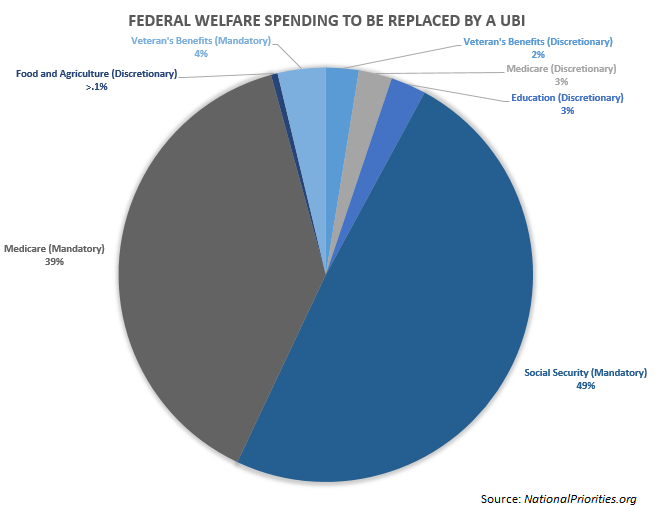
Goldstein likely gets the $10,000 figure from Charles Murray’s proposal for a BIG. Personally, I’m no fan of Murray’s proposal as it goes too far and he proposes financing it by increasing payroll taxes, which are economically inefficient. However, let’s assume that the relevant proposal is around $7,000 dollars.[8] Multiplying that by the US population of 320 million makes for a total cost $2.24 trillion per year.[9] This could be paid for by using the BIG to replace the following current welfare programs and cutting discretionary spending:[10]

  1. $65.32 billion annually in discretionary spending on Veteran’s benefits
  2. $66.03 billion in discretionary spending on Medicare and other healthcare benefits
  3. $69.98 billion in discretionary spending for education.[11]
  4. $13.13 billion in discretionary spending for food and agriculture (eg., SNAP).[12]
  5. $1.25 trillion in mandatory spending for Social Security.[13]
  6. $985.74 billion in mandatory spending for Medicare and Healthcare.
  7. $95.3 billion in mandatory spending for veteran’s benefits.[14]

Spending a UBI Could Replace

That’s a total of $2.542 trillion in savings annually, more than enough to fund the proposed BIG with another $300.3 billion to spare that could be used for tax credits for low-income households to use on healthcare,[15] education,[16] retirement,[17] and/or basic necessities like food.[18] Funding the program would be a huge challenge, but it is possible to do it without tax increases.

Additionally, Goldstein ignores the fact that similar proposals, such as Friedman’s negative income tax, would have a much lower cost while having a similar effect. The Niskanen Center’s Samuel Hammond has estimated that a NIT could cost only $182 billion annually.[19] From Hammond’s analysis:

Just how much of a cost difference is there between a UBI and NIT? To get a rough idea, I used the Census population survey’s Annual Social and Economic Supplement, which has the distribution of individuals over the age of 15 by income level in $2,500 intervals (I subtracted retirees). I then calculated the transfer each quantile would receive based on a hypothetical NIT which starts at $5,000 for individuals with zero income and is phased out at a rate of 30%. Multiplying the average transfer by the number of actual individuals in each grouping and summing, I arrived at total cost of $182 billion—roughly the combined budget for SSI, SNAP and EITC.

The Effect of Replacing Welfare with a BIG on Poverty

Goldstein would object to my line of reasoning by saying cutting all that spending would harm the poor and increase the poverty rate. He says as much in his piece:

UBI’s daunting financing challenges raise fundamental questions about its political feasibility, both now and in coming decades.  Proponents often speak of an emerging left-right coalition to support it.  But consider what UBI’s supporters on the right advocate.  They generally propose UBI as a replacement for the current “welfare state.”  That is, they would finance UBI by eliminating all or most programs for people with low or modest incomes.

….Yet that’s the platform on which the (limited) support for UBI on the right largely rests.  It entails abolishing programs from SNAP (food stamps), which largely eliminated the severe child malnutrition found in parts of the Southern “black belt” and Appalachia in the late 1960s, the Earned Income Tax Credit (EITC), Section 8 rental vouchers, Medicaid, Head Start, child care assistance, and many others.  These programs lift tens of millions of people, including millions of children, out of poverty each year and make tens of millions more less poor.

Some UBI proponents may argue that by ending current programs, we’d reap large administrative savings that we could convert into UBI payments.  But that’s mistaken.  For the major means-tested programs — SNAP, Medicaid, the EITC, housing vouchers, Supplemental Security Income (SSI), and school meals — administrative costs consume only 1 to 9 percent of program resources, as a CBPP analysis explains.  Their funding goes overwhelmingly to boost the incomes and purchasing power of low-income families.[20]

Moreover, as the Roosevelt Institute’s Mike Konczal has noted, eliminating Medicaid, SNAP, the EITC, housing vouchers, and the like would still leave you far short of what’s needed to finance a meaningful UBI.  Would we also end Pell Grants that help low-income students afford college?  Would we terminate support for children in foster care, for mental health, and for job training services?

This is by far and away the weakest part of Goldstein’s argument.

First of all, as my analysis above showed, Konczal’s and Goldstein’s idea that eliminating the current welfare state “would still leave you far short of what’s needed to finance a meaningful UBI” is just false. Even a relatively robust UBI of $7,000 a year is doable by significantly cutting current welfare programs.

But more importantly, Goldstein’s assertion that replacing the welfare state with a UBI would increase poverty is fully unwarranted. He seems to take a ridiculously unsophisticated idea that “more means-tested programs immediately reduce welfare.” His assertion that the programs in question “lift tens of millions of people, including millions of children, out of poverty each year and make tens of millions more less poor” is, at best, completely erroneous. For three reasons: first, individuals know better what they need to lift themselves out of the than the government, and these programs assume the opposite. Second, the structure of status quo means-tested programs often creates a “poverty trap” which incentivizes households to remain below the poverty line. Finally, thanks to these first two theoretical reasons, the empirical evidence on the success of the status-quo programs in terms of reducing the poverty rate is, at best, mixed.

The way our current welfare state is structured is it allocates how much money can go to what basic necessities for welfare recipients. So if a household gets $10,000 in welfare a year, the government mandates that, say, $3,000 goes to food, $3,000 goes to healthcare, $3,000 goes to education, and $1,000 goes to retirement.[21] This essentially assumes that all individuals and households have the same needs; but this is simply not the case, elderly people may need more money for healthcare and less for education, younger people may need the exact opposite, and poorer families with children may need more for food and education than other needs. It’s almost as if our current welfare system assumes interpersonal utility function comparisons are possible, or utility functions of poorer people are fairly homogenous but they’re not. It also ignores the opportunity cost of the funding for helping individuals and households out of funding; a dollar spent on healthcare may be more effectively spent on food for a particular individual or household.

In sum, there’s a knowledge problem involved in our current welfare policy to combat poverty: the government cannot know the needs of impoverished individuals, and such knowledge is largely dispersed, tacit, and possessed by the individuals themselves. The chief merit of a UBI is, rather than telling poor people what they can spend their welfare on, it just gives them the money and lets them spend it as they need.

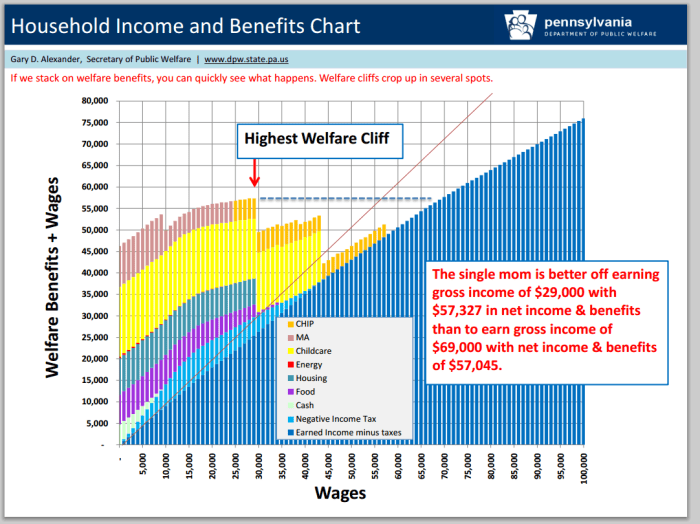
Second, universal programs are superior to means tested programs precisely because the amount of transfer payments received does not decrease as income increases. Our current welfare programs too often make the marginal cost of earning an additional dollar, above a certain threshold, higher than the benefits because transfer payments are cut-off at that threshold. This actually perversely incentivizes households to remain in poverty.[22] For example, the Illinois Policy Institute while analyzing welfare in Illinois found the following:

A single mom has the most resources available to her family when she works full time at a wage of $8.25 to $12 an hour. Disturbingly, taking a pay increase to $18 an hour can leave her with about one-third fewer total resources (net income and government benefits). In order to make work “pay” again, she would need an hourly wage of $38 to mitigate the impact of lost benefits and higher taxes.

SingleMomWelfareCliffChart

Or consider this chart (shown above) from the Pennsylvania Department of Public Welfare showing the same effect in Pennsylvania

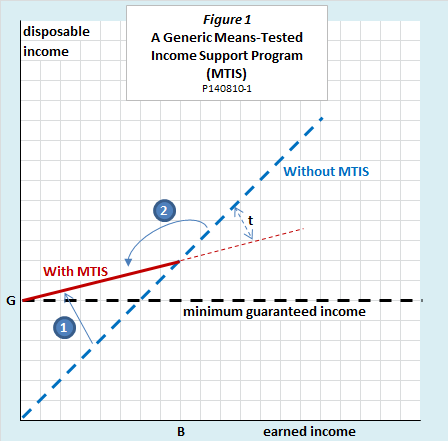
UBI does not suffer from this effect. If your income goes up, you do not lose benefits and so there are no perverse incentives at work here. Ed Dolan has analyzed how the current welfare state with its means-tested benefits is worse in terms of incentivizing work and alleviating poverty extensively. Here’s a slice of his analysis:

P140810-11

The horizontal axis in Figure 1 represents earned income while the vertical axis shows disposable income, that is, earned income plus benefits. To keep things simple, we will assume no income or payroll taxes on earned income—an assumption that I will briefly return to near the end of the post. The dashed 45o line shows that earned and disposable income are the same when there are no taxes or income support. The solid red line shows the relationship between disposable and earned income with the MTIS policy.

This generic MTIS policy has three features:

A minimum guaranteed income, G, that households receive if they have no earned income at all.

A benefit reduction rate (or effective marginal tax rate), t, indicted by the angle between the 45o line and the red MTIS schedule. The fact that t is greater than zero is what we mean when we say that the program is means tested. As the figure is drawn, t = .75, that is, benefits are reduced by 75 cents for each dollar earned.

A break-even income level, beyond which benefits stop. Past that point, earned income equals disposable income.

When these two factors are taken into account (that individuals know better than the government what they need to get out of poverty and there are significant poverty traps in our welfare state), it is no surprised that the empirical evidence on the effectiveness of these anti-poverty programs is far less rosy than Goldstein seem to think.

After reviewing the empirical literature on the relationship between income and welfare improvements for impoverished households, Columbia University’s Jane Waldfogel concluded “we cannot be certain whether and how much child outcomes could be improved by transferring income to low income families.” The Cato Institute’s Michael Tanner wrote in 2006:

Yet, last year, the federal government spent more than $477 billion on some 50 different programs to fight poverty. That amounts to $12,892 for every poor man, woman, and child in this country. And it does not even begin to count welfare spending by state and local governments. For all the talk about Republican budget cuts, spending on these social programs has increased an inflation-adjusted 22 percent since President Bush took office.

Despite this government largesse, 37 million Americans continue to live in poverty. In fact, despite nearly $9 trillion in total welfare spending since Lyndon Johnson declared War on Poverty in 1964, the poverty rate is perilously close to where it was when we began, more than 40 years ago.

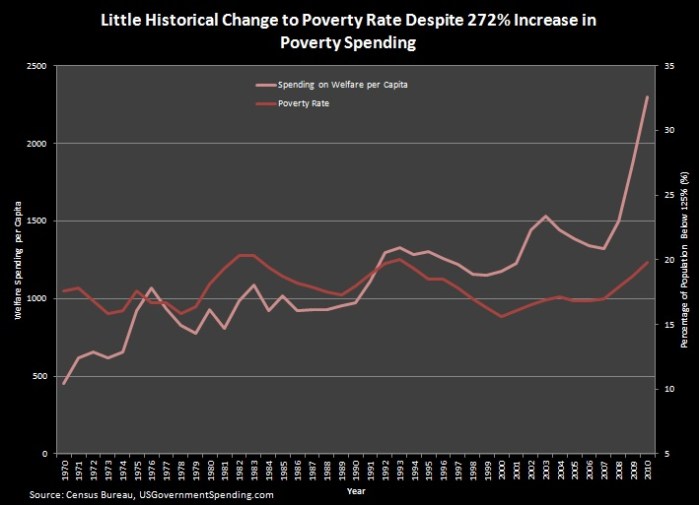
Tanner’s point remains true today. The chart below shows that, despite a massive increase in anti-poverty spending since the war on poverty was declared under Johnson’s “Great Society,” Poverty rates have remained woefully stagnant. In fact, the reduction in poverty that was occurring prior to Johnson’s interventions stopped soon thereafter.

US Poverty Spending

Also, the point is that UBI is a replacement for current welfare benefits. Most households probably would not see a decrease in amount of benefits under a UBI, depending on the specifics of the proposal, and some might even see an increase, contrary to Goldstein’s analysis. Further, they’d be able to actually spend this on what they know they need rather than what government bureaucrats thin they need.

UBI lacks the flaws of the current welfare state, and would likely decrease poverty far more effectively than Goldstein thinks, especially when compared to his favored status-quo.

[1] Though there are some technical differences between Milton Friedman’s proposal for a “negative income tax” and most Basic Income Guarantee proposals, they essentially have the same effect on income. See the Adam Smith Institute’s Sam Bowmen on this point.

[2] See Matt Zwolinski for the “Pragmatic Libertarian Case for a Basic Income,” it should be noted that “pragmatic reasons” here does not refer to my pragmatist philosophical views. Zwolinski has also made a moral case for the basic income on Hayekian grounds that a BIG could reduce coercion in labor negations. I am unsure to what extent I am convinced by this line of reasoning, but it is a valid argument nonetheless.

[3] The Niskanen Center’s Samuel Hammond has made the case that universal transfer programs like a Basic Income cannot be analyzed outside of the tax system that pays for it.”

[4] Or, as my think tank buddies jokingly call it, the “Center for Bigger Budgets.”

[5] Having said that, polls have shown that it is popular across the pond in the Eurozone. The Swiss proposal would call into question this point but it could be argued that the vagueness of the Swiss proposal is why it was turned down not necessarily the spirit of it.

[6] My colleague Ty Hicks of Students for Liberty has made this point well. See also Hayek’s “Intellectuals and Socialism.”

[7] Granted, the Affordable Care Act was not really what most on the left or the right wanted in the first place and has been a disaster.

[8] This number is selected because, according to the CBO, $9,000 is the average amount in means-tested welfare benefits per household for 2006. But that’s for households and a BIG discussed here is for individuals, so it is understandable to make a BIG slightly less than the current average. Goldstein would object that this is far below the poverty line, but BIG is not meant to be a replacement for total income on the labor market at all, so it is unclear why this is an objection in the first place.

[9] This is admittedly a crude and naïve calculation but it is virtually identical to the method Goldstein himself uses to estimate the cost.

[10] All figures for this section are for the 2015 budget and are taken from here.

[11] Goldstein is sure not to be happy with cutting education, and I myself would like to replace this spending with few-strings-attached funding for local education or private school tax vouchers. I’ll address this point more later in this piece.

[12] Much of this is food stamps, which would be rendered obsolete by a BIG anyways. Goldstein would object, more on that in the next section.

[13] Not all of this could be cut, and there would be legal and detailed nuances on how to treat financial obligations for Social Security, veteran’s benefits, and Medicare. The specific legal complexities of mandatory welfare spending are not my areas of expertise, admittedly, and is outside the scope of this paper. I’m just illustrating that it is possible to cut at least some of this spending, perhaps even the majority of it, to fund it.

[14] Many people would object to cutting veterans benefits. First of all, BIG could act in place of these benefits

[15] I have in mind expanding tax-exempt Health Savings Accounts here. I also think funding this by eliminating the employer-based deduction would be a step in the right direction and reduce cost fragmentation in the healthcare market, as Milton Freidman argued.

[16] I have in mind a private school taxpayer voucher system like what is in Sweden.

[17] I have in mind something similar to this proposal to reform social security from the Cato Institute.

[18] I have in mind something like the pre-bates proposed in the Fair Tax.

[19] For this reason, I prefer an NIT to a BIG, but I prefer both to our current welfare state.

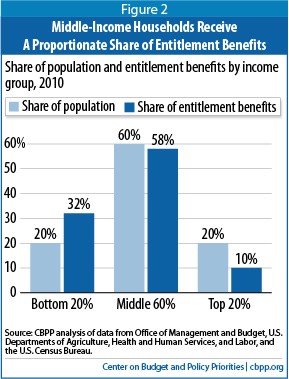
[20] This point is Ironic considering the fact that CBPP’s own research shows that government benefits in America overwhelmingly goes to households above the poverty line, in the middle and upper classes. See this chart (source):

1-SOlzSwsxa08Cno7PiQ9R7A

[21] The real-world numbers are probably different and vary a little bit from household to household, but this is just a hypothetical to illustrate a more general point.

[22] It should be noted, however, that the EITC, and some other programs, is largely free of this defect. This is because the EITC itself is modeled after Friedman’s NIT.

Note: The first chart has been edited since this was initially posted for readability.

The Moral Worth of Chloe Kardashian

Like many pack animals, I judge the hell out of the idiots surrounding me. It’s impossible not to have immediate gut reactions when we see our neighbors making stupid decisions; our brains are hard-wired to be nervous about how wisely our tribe used scarce survival resources. And let’s face it, it’s fun to make fun of doofuses in vinyl wrapped electric Hummers.

A couple semesters ago I asked my class for examples of useless things and landed on tabloid articles about Chloe Kardashian. Surely that’s one thing our economy can save some cash on without any real harm.

But it’s not so simple. Nobody is being forced to print those rags which means someone (bless their hearts) wants to read about Chloe Kardashian. And they want it enough that they’re willing to work for it.

If you set up an amateur print shop in your basement and made up a bunch of celebrities to gossip about as a hobby, nobody would have any reason to stop you. We may agree that your hobby is silly, but if you can’t have a silly hobby, then what’s the point of it all?!

When people buy those magazines at the check out counter, they’re putting their own effort into making up celebrities to gossip about, the difference is they don’t have to put in so much time and the production value is higher because of gains from trade.

Even silly things have moral worth when they exist because of people’s voluntary choices. We should all be more hesitant to ban behaviors we don’t understand.

Where did Homo Economicus come from?

Over on my Facebook page, I posted a short criticism of both neoclassical and behavioral economic scholarship on rational choice (drawing from a paper I’m working on exploring that topic). Stated a bit polemically,  though homo economicus has largely been dead in neoclassical theory, his spirit still haunts the work of most modern neoclassical scholars. Likewise, though behavioral economists are trying to dig the grave and put the final nails in the coffin of homo economicus, their nightmares are still plagued with the anxieties of his memory.

This led a former colleague from Hillsdale to ask me where I thought homo economicus came from historically. I wrote the following in response (lightly edited for this post):

It could be argued, in a sense, that the protestant Christian aim to complete moral purity and the Enlightenment aim to make man perfect in knowledge in morality (as embodied in Franklin’s virtue ethics) helped give rise to a culture that would be primed for such a model. Within economics, historically it comes from Bentham’s utilitarianism and Jevon’s mathematical extrapolations from Bentham’s psychology. However, I’d say this comes from a deeper “Cartesian anxiety” in Bernstein’s use of the term to make economic a big-T True, capital-C Certain, capital-S Science just like physics (which Jevon’s himself stated was an aim of his work,[1] and has preoccupied economists since the days of JS Mill). If economic science cannot be said to be completely positive and “scientific” like the natural sciences with absolutely falsifiable propositions and an algorithmic means of theory-choice, it is feared, it must be written off as a pseudo-scientific waste of time or else ideology to justify capitalism. If economics cannot make certain claims to knowledge, it must be solipsist and relativist and, again, be another form of pseudo-science or ideology. If economic models cannot reach definitive mathematical results, then they must be relativistic and a waste of time. This is just another example of the extreme Cartesian/Katian/Platonic (in Rorty’s use of the term) either/or: objectivity OR relativism, science OR nonscience, determinate mathematical solutions OR ideological emotional bickering. Homo economicus was erected as a means to be an epistemic foundation to solve all these anxieties and either/ors.

Of course, as any good Deweyan, I think all these either/ors are nonsense. Their understanding of science, as revealed through the so-called “growth of knowledge” literature in postempiricist philosophy of science (ie., the work of Thomas Kuhn, Lakotos, Karl Popper, Paul Feyerabend, Michael Polanyi, Richard Bernstein, Richard Rorty, etc.) has shown that this positivist conception of science, that is science consists of algorithmic theory choice selected based off correspondence with theory-free, brute “facts” of the “external world,” is woefully inaccurate. Dialogical Aristotelian practical reasoning in the community of scientists plays just as much of a role in formulating a scientific consensus as empirical verification. This does not undermine science’s claims to objectivity or rationality, in fact it puts such claims in more epistemically tenable terms.

Further, the desire to make the social sciences just another extension of the natural science, as Hayek shows in the Counterrevolution of Science, and as even positivists like Milton Freidman argue, is a completely misleading urge that has led to some of the worst follies in modern social theory. Obviously, I cheer the fact that “homo economicus is dead, and we have killed him,” but now that we’ve “out-rationalized the rationalizer of all rationalizers,” we must try to re-evaluate our economic theories and methods to, as Bernstein or Dewey would put it, “reconstruct” our economic science.

In short, immenatizing the eschaton in epistemology and philosophy of science created homo economicus.

For the record, you don’t have to be a radical scientific anti-realist like Feyerabend or Rorty to agree with my analysis here.[2] I myself wax more towards Quine than Rorty in scientific matters. However, the main point of philosophy of science since positivism is the exact type of foundationalist epistemology undergirding modern positivist methodology in the mainstream of the economics profession, and the concept of rationality that is used to buttress it, is a naive view of science, natural or social.

Notably, this critique is largely unrelated to much of the Austrian school. Mises’ own conception of rationality is mostly unrelated to homo economicus as he understands rationality to be purposive action, emphasizing that economists first understand the subjective meaning from the point of view of the economic actor him/herself before declaring any action “irrational.”[3] [4]

What are your thoughts on this? Are neoclassical and behavioral economics both still way too influenced by the spirit of homo economicus, or am I off the mark? Is my analysis of the historical conditions that led to the rise of homo economicus right? Please, discuss in the comments.

[1] Consider this quote from Jevon’s magnum opus Theory of Political Economy “Economics, if it is to be a science at all, must be a mathematical science.”

[2] In fact, I doubt anybody mentioned is really a scientific anti-realist, I agree with Bernstein that Feyerabend is best read as a satirist of the Cartesian anxiety and extreme either/or of relativism and objectivism in philosophy of science and think Rorty’s views are more complex than simple scientific anti-realism, but that’s an unrelated point.

[3] Of course, any critique of epistemic foundationalism would apply to Mises, especially his apriorism; after all, Mises did write a book called “Ultimate Foundations of the Social Sciences” and the Cartesian anxiety is strong with him, especially in his later works. Notably, none of this applies to most of Mises’ students, especially Schutz, Machlup, and Hayek.

[4] For a more detailed discussion of Mises and the Austrians on rationality, see my blog post here or this paper by Mario Rizzo. For a more general discussion of the insights of the type of philosophy of science I’m discussing, see Chapter 2 of Richard Bernstein’s excellent 1983 book Beyond Objectivism and Relativism: Science, Hermeneutics, and Praxis.

Libertarians and Pragmatists on Democracy Part 4: Why Market Anarchism is more Democratic than Democracy

Note: This is the final part of a series on democracy. It is assumed the reader is familiar with part one, defining democracy, part two, summarizing classical liberal perspectives on democracy, and part three, which analyzes how pragmatists conceive of democracy as a broader philosophy. Here, I will argue that a synthesis of libertarian and pragmatist perspectives on democracy will yield an argument in favor of market anarchy.

The insights of classical liberalism, and particularly modern libertarianism, have shown that democracy is likely to lead to a tyranny of an irrational and ignorant majority and public choice theory has shown how it results in awful policies thanks to a number of collective action issues. However, as pragmatists have argued, democracy’s philosophical aspirations to scientific public deliberation, seeking the consent of the governed, valuing the dignity of every individual, and decentralizing political authority to take advantage of dispersed intelligence are still admirable. However admirable these philosophical aspirations are, real-world democracies completely fail to fulfill them.

The natural question is, if not democracy, what political arrangements can live up to the philosophical goals of Dewey and Hook? I think the answer lies in market anarchism. In what follows, I will show how market anarchism could succeed in realizing the aspirations of philosophical democracy where political democracy has failed.

Before we get started, let’s take into account a few minor housekeeping notes. It is assumed that the reader has at least a cursory knowledge of how market anarchism and polycentric law works. If you are not familiar with these concepts I highly recommend watching this video by David Friedman before continuing. Also, I am in no way arguing that any of the thinkers discussed in this series are “really” anarchists unless they’re obviously so such as Huemer. I will not even claim that any of them “should have been” anarchists (with the exception of Hayek). I am simply arguing that if we take into account the insights of their various perspectives, one could plausibly defend market anarchism.

Market Anarchism, Unlike Democracy, Does Rest on the Voluntary Consent of the Governed

As Michael Huemer convincingly has shown, democracy does not actually “rest upon the freely given consent of the governed” as Sidney Hook claims. The bar tab example illustrates that we would not consider majority rule “consent” in any everyday interaction and there is little reason to think it should be any different in the context of political institutions. By contrast, market anarchism is almost by definition based off of consent. This is the primary reason why many deontological market anarchists, such as Murray Rothbard, are market anarchists in the first place and why they oppose the coercive, non-consensual nature of the state. While democracy’s claim to legitimacy is that the governed vote but they are still forced to follow the (unjustified) authority of a state that has the monopoly on force whether they agree or not to, market anarchism is based off of voluntarily consented to contracts between individuals and defense agencies and contracts between those defense agencies and private, voluntary court systems and arbitrators. Further, the content of the laws is agreed to and law becomes a product one buys in voluntarily agreeing to sign up with a defense company, just as one buys a car, a piece of furniture, or any other good.

It is curious that many pragmatist defenses of democracy sound very similar to what many market anarchists and libertarians write. Not just in Sidney Hook’s definition of a democracy as a government that “rests upon the freely given consent of the governed,” but perhaps most strikingly in John Dewey’s 1939 essay “I Believe.” In this essay, Dewey walked back some of his early Hegelian collectivist lines of his early years:

My contribution to the first series of essays in Living Philosophies put forward the idea of faith in the possibilities of experience at the heart of my own philosophy. In the course of that contribution, I said, “Individuals will always be the center and the consummation of experience, but what the individual actually is in his life-experience depends upon the nature and movement of associated life.” I have not changed my faith in experience nor my belief that individuality is its center and consummation. But there has been a change in emphasis. I should now wish to emphasize more than I formerly did that individuals are the final decisive factors of the nature and movement of associated life.

Indeed, throughout the whole essay he emphasizes “the idea that only the voluntary initiative and voluntary cooperation of individuals can produce social institutions that will protect the liberties necessary for achieving development of genuine individuality.” Throughout the essay, he decries (like many left-anarchists do) “state socialism” just as much as he does “state capitalism.” Dewey’s opposition to capitalism is well-known, but what is less known is his opposition to so-called “public collectivism.” His criticisms here could just as easily have been written by someone like Hayek:

Recent events have shown that state socialism or public collectivism leads to suppression of everything that individuality stands for. It is not too late for us in this country to learn the lesson taught by these two great historic movements [ie., the rise of state capitalism and state socialism]. The way is open for a movement which will provide the fullest opportunity for cooperative voluntary endeavor. In this movement, political activity will have a part, but a subordinate one. It will be confined to providing the conditions, both negative and positive, that favor the voluntary activity of individuals.

It is interesting that, like anarchists who favor direct action, he emphasizes that political activity is subordinate to the political movement he sees as necessary.

Of course, there are still notable differences between Dewey and libertarians, he still defends what he calls “functional socialism” in the socialization of medicine and still berates more than many libertarians would be comfortable with (except, of course, for left-anarchists) inequality caused by state capitalism. His vision of a truly individualist society, even in his later years, was one with localized, experimental democratic institutions and economics controlled by those localized governments in a “functional socialist” fashion (as I mentioned earlier, that economic vision is at odds with Dewey’s epistemological commitments).

However, I would argue that it is more than a mere superficial coincidence that Dewey’s criticisms of state capitalism are almost identical to those of market anarchists who decry “crony capitalism,” that his criticisms of state socialism are very similar to some individualist libertarian criticisms, and his overall rhetoric defending democracy on the grounds of “voluntary cooperation of individuals” sounds remarkably similar to many libertarians. This is because, largely, the philosophical ends Dewey seeks in politics are the same as those sought by libertarians, market anarchists, and classical liberals. However, the institutional means he advocates are very different and fail to meet those ends.

There is, conversely, one potential criticism that Sidney Hook would raise at this point: that market anarchism does not really rest upon the freely-given consent of the governed due to its allowance for economic inequality. Hook argued that income inequality undermines consent in democracy and, as a result, economic organization should be controlled by a democratically elected government. There are two points to be made. First of all, when economic organization is controlled by government in democracies it exacerbates the problem of income inequality. Rent-seeking culture arises in which concentrated interests use, through lobbying power, government force to accumulate and protect their wealth. Indeed, as I mentioned earlier,  there have been empirical studies showing how over-regulation lobbied for by those concentrated benefits have regressive effects. Even fairly anti-free market economists such as Joseph Stiglitz have argued that income inequality is not an inevitable result of market institutions, but a result of bad government policies such as corporate welfare.

Second, it is questionable to what degree income inequality would exist in pure market anarchy. Of course, much of the bad inequality experienced under state capitalism is the result of bad policies, but some if it is also just a result of market’s tendencies to disrupt economic distributions (which, as Mises argued in Liberalism: The Classical Tradition is not a bad thing because it allows for luxury markets which can serve as an experimental market for expensive, new goods that one day become popular consumer goods). Some market anarchists, such as Anna Morgenstern, have argued that the type of mass accumulation of capital under capitalism would be impossible under market anarchism. I am unsure to what extent I agree, and a systemic analysis of the economic roots of inequality is outside of the scope of this post. However, suffice it to say that it is an open, empirical question whether purely free markets would result in problematic levels of inequality, as Hook seems to think, and we have some good reasons to think it would not. At the very least, it is clear that the democratic institutions favored by Hook are not a serious solution to the problem.

Market Anarchism, Unlike Democracy, Relies on a Decentralized Process of Political Decision Making

Dewey argued in “Democracy and Educational Administration” that “it is the democratic faith that [the distribution of knowledge and intelligence] is sufficiently general so that each individual has something to contribute and value of each contribution can be assessed only as it enters into the final pooled intelligence constituted by the contributions of all.” He seems to echo Hayek’s knowledge problem critique of socialism when he argues that the democratic faith is based on the wisdom that “no man or limited set of men is [sic] wise enough or good enough to rule others without their consent[.]” As we have seen, democracies tend towards heavily centralized governments that undermine this faith and fail to take advantage of the dispersed knowledge (in Hayekian terms) among individuals in society.

Market anarchy, on the other hand, by definition takes advantage of this feature of dispersed intelligence. Rather than having law be designed by a centralized legislature, law arises out of voluntary market exchanges between individuals and, like common law, the precedent of judges in private courts. Of course, both Dewey and Hayek embraced democratic institutions (in Hayek’s case, as well as free market economic coordination) to take advantage of decentralized knowledge. However, both Dewey and Hayek, particularly the ladder (Dewey never wrote about market anarchism as it did not exist as a unique perspective until almost a decade after his death), failed to appreciate the extent to which a polycentric legal system does this much better. Peter Stringham and Todd Zywicki have noted this tension in Hayek’s thought in particular, as they put it in an abstract for their excellent paper on the issue:

Should law be provided centrally by the state or by some other means? Even relatively staunch advocates of competition such as Friedrich Hayek believe that the state must provide law centrally. This article asks whether Hayek’s theories about competition and the use of knowledge in society should lead one to support centrally provided law enforcement or competition in law. In writing about economics, Hayek famously described the competitive process of the market as a “discovery process.” In writing about law, Hayek coincidentally referred to the role of the judge under the common law as “discovering” the law in the expectations and conventions of people in a given society. We argue that this consistent usage was more than a mere semantic coincidence — that the two concepts of discovery are remarkably similar in Hayek’s thought and that his idea of economic discovery influenced his later ideas about legal discovery. Moreover, once this conceptual similarity is recognized, certain conclusions logically follow: namely, that just as economic discovery requires the competitive process of the market to provide information and feedback to correct errors, competition in the provision of legal services is essential to the judicial discovery in law. In fact, the English common law, from which Hayek drew his model of legal discovery, was itself a model of polycentric and competing sources of law throughout much of its history. We conclude that for the same reasons that made Hayek a champion of market competition over central planning of the economy, he should have also supported competition in legal services over monopolistic provision by the state — in short, Hayek should have been an anarchist.

There is one possibly fatal objection to this line of reasoning, that is also the most substantial objection to market anarchism as a whole: the possibility that market anarchy, like democracy, will eventually lead to a centralized state that undermines its attempt to take advantage of dispersed knowledge. This argument was initially hinted at by Robert Nozick in Anarchy, State, and Utopia in his argument about the “immaculate conception of the state” but was expanded on most convincingly by Tyler Cowen. Ultimately it is an empirical question whether market anarchy would eventually lead to more centralization, and it is outside the scope of this post to analyze that fascinating question in any satisfactory amount of detail. I will say, however, that Bryan Caplan has given more or less convincing reasons why this may not be the case.

Market Anarchism, Unlike Democracy, Values the Dignity of the Individual

One of the features central to the pragmatist “democratic faith” is the belief that “belief that every individual should be regarded as possessing intrinsic worth or dignity[.]” As I argued, the conflation of democratic governments with the “collective will” of the people undermines this faith as political dissenters and individual thinkers become viewed as opponents to “the people.” Indeed, it seems that the type of “public” and “private” collectivisms that Dewey ridiculed in “I Believe” are a result of democratic institutions run amuck.

Market anarchism, meanwhile, suffers from no such issues. Instead, the intrinsic worth of the individual is respected as their free choices and associations is the main driving mechanism for political organization. There is no violation of free speech and free thought by a deliberative government as such a government does not exist in the first place under anarchy, and thus the intrinsic worth and dignity are not found in the “will of the people” as in democracies, but in the sovereign individual’s choice of which defense provider to contract with.

Market Anarchism, Unlike Anarchy, is Scientific and Deliberative

Contrary to Dewey and Hook’s characterization of democracy as a deliberative, intelligent application of the scientific method to social issues, democracy is instead characterized by polarizing populist pandering and rationally ignorant and irrational voters casting meaningless ballots based cultural associations rather than reasoned consideration of policy issues. Market anarchism, meanwhile, does have the deliberative, scientific nature the pragmatists vainly hope democratic institutions could aspire to. While under democracy the cost of casting an informed vote is very high and the benefits very low resulting in massive amounts of rational ignorance, under market anarchism individuals have every incentive to ensure they are informed about the legal rules they are purchasing, so to speak, by contracting with rights defense agencies. Unlike in democracy where the benefits of casting an informed vote are extremely low because your vote has an infinitely small probability of making a difference, under market anarchy the rights defense agency you chose to contract with has immediate and certain impacts upon your life, thus creating a much larger incentive to cast an informed (metaphorical) vote by choosing to purchase the services of a preferred rights defense agency.

Deliberation about legal policy is far more likely to be more reasoned in market anarchy than in democracy. First, because market anarchism is more radically experimental than political democracy. Freedom of speech and of thought in democracy is often likened to a metaphorical “marketplace of ideas,” but in market anarchy it is a literal marketplace in which the ideas are not chosen just by speculation and public deliberation, but actually experimented with and acted upon in practice. Democracy is only “experimental” in a priori public deliberation about policies, but market anarchy is “experimental” in actually applying those policies and assessing their results a posteriori. Under democracy, once a policy is chosen it becomes difficult to assess counterfactually if another potential policy could have yielded better results, thus it is difficult to ascertain which was the superior policy. It is as if scientists in a lab simply talked about the hypothetical results of various hypothetical experiments and chose theories based on their discussions rather than actually testing the theories by actually running the experiments. Because of the polycentric nature of law under market anarchy, multiple policies are taken on at the same time, making it easier to tell which is more desirable in practice rather than simple theoretical deliberation.

Another reason why political deliberation is more likely to be reasoned in market anarchy than democracy is because of the institutional mechanisms for choosing policy. The main way law is “made” in democracy is through legislation voted on by representatives, who are ultimately accountable to the public through general elections. Often, debate on the floor of legislative bodies is anything but reasoned and deliberative, and clearly discussion about elections quickly devolves into mindless partisan bickering, sensationalist “scandals,” and populist rhetorical flair rather than reasoned discussion about policies. In market anarchy, however, law is “discovered” by private arbitrators and judges who are ultimately accountable to the defense firm’s consumers in the marketplace. It is pretty clear that real-world courtrooms tend to have a more elevated level of dialogue than legislative bodies, to say less of public elections, and I fail to see why this would not be the case under market anarchism.

Further, there wouldn’t be a need for partisan bickering and debates that bring down the level of public discourse in market anarchy, for similar reasons why there isn’t nearly as nasty debates about preferences for consumer goods as there are about politics. To use an analogy, in democracy, if we’re voting on what soda to consume, whoever wins the vote gets a monopoly on their preferred soda; so my preference for Coke could possibly eliminate your ability to enjoy Pepsi; but in a market, if I prefer Coke you still can drink Pepsi, meaning we don’t need to bicker about our consumer preferences. It is similar (though clearly not identical because when we’re talking about law it’s quite a bit more consequential) with legal policies: in democracy, if I prefer one set of legal rules to another which you prefer, we must fight over how to vote because the two are mutually exclusive; but in market anarchy, because law is polycentric and not monolithic, they are not mutually exclusive so we don’t need to fight nearly as hard for it. There’s a good reason why debates among consumers for products they prefer (Coke v. Pepsi, Apple v. Windows, Android v. iPhone) rarely get as nasty as debates in democratic politics, because there is room for disagreement at the end of the day in a market that there is not in politics.

Conclusion

Clearly, democracy is far from the ideal method of political organization. As classical liberals throughout history have shown, despite the fact that it may be possible to other political forms such as oligarchy and monarchy, it has a tendency towards the tyranny of the majority and massive collective action problems. However, the philosophical aspirations of the most ardent defenders of democracy are still extremely valuable, even if their preferred institutions fail to deliver. Market anarchism is a reasonable synthesis of these two insights; it has the potential to live up to the aspirations of pragmatist democrats without the major, systemic problems of real working democracies that undermine those aspirations.

John Dewey once said “democratic institutions are no guarantee for the existence no guarantee for the existence of democratic individuals,” what is needed is a better set of institutions that have a higher probability to cultivate Dewey’s idea of “democratic individuals.” Market anarchism appears to be a viable candidate for such a set of institutions.

Libertarians and Pragmatists on Democracy Part 3: Pragmatists on Democracy as a Way of Life

eNote: This is part of a series on democracy. It is assumed the reader is familiar with part one, defining democracy, and part two, summarizing classical liberal perspectives on democracy. In this section, we’ll analyze how pragmatists conceive of democracy as a broader philosophy. The final post will argue that a dialectical synthesis of libertarianism and pragmatism on democracy will yield an argument in favor of market anarchy.

As classical liberals have pointed out throughout history, particularly in since the mid-nineteenth century, democracy as a system of political decision-making can be extremely dangerous to individual liberty and social prosperity. It could lead to tyranny of the majority, it may be characterized in practice as the rule of the ignorant and irrational and yield awful policy, and it leads to a reification of the state as the just “voice of the people” which can cause further tyranny. For these reasons, there is a very strong argument from moving away from constitutions which rely primarily on democratic means for decision making for the protection of individual liberty. The natural question is: what is our current democratic regime to be replaced with?

To answer this question, perhaps it is worth examining what is admirable in democracy. Thus far, I have mostly been referring to democracy in the second sense mentioned in the introductory section (henceforth referred to, for want of a better term, political democracy), as a means of political decision making. However, there is also the fourth sense which, although related, is distinct from political democracy which may be called philosophical democracy. To further explore this meaning of democracy, and perhaps give an answer to the aforementioned question, it is worth engaging with the thought of some of the most strident defenders of democracy: the American pragmatists.

Pragmatists on Philosophical Democracy

The writings of John Dewey and Sidney Hook are exemplars of philosophical democracy (though certainly others in this tradition are as well). Dewey, in his 1888 essay “The Ethics of Democracy,” specifically argues against Henry Maine’s view that “democracy is only a form of government.” Dewey explicitly defines democracy as a much broader “way of life,” as he says in his 1937 work “Democracy and Education:”

Democracy is much broader than a special political form, a method of conducting government, of making laws, and carrying on government administration by means of popular suffrage and elected officials. It is that, of course. But it is something broader and deeper than that. The political and governmental phase of democracy is a means, the best means so far found, for realizing ends that lie in the wide domain of human relationships and the development of human personality. It is, as we often say, though perhaps without appreciating all that is involved in the saying, a way of life, social and individual. The keynote of democracy as a way of life may be expressed, it seems to me, as the necessity for the participation of every mature human being in the formation of the values that regulate the living of men together: which is necessary from the standpoint of both the general social welfare and the development of human beings as individuals.

Indeed, Dewey’s emphasis on how democracy allows for participation in the formation of social values is a common thread throughout his entire political philosophy. In his earlier days, he was deeply influenced by the Hegelian notion of society as a “social organism” (although, in his later work he became a bit more cautious about the collectivist and possible authoritarian implications of this doctrine; see his 1939 essay “I Believe”). In 1888, he argued that democracy, by allowing participation of all, “approaches most nearly the ideal of all social organization; that in which the individual and society are organic to each other.” He explains:

In every other form of government there are individuals who are not organs of the common will, who are outside of the political society in which they live and are, in effect, aliens to that which should be their own commonwealth. Not participating in the expression of the common will, they do not embody themselves. Having no share in society, society has none in them.

…The government is not made up of those who hold office, or who sit in the legislature. It consists of every member of political society. And this is true of democracy, not less, but more, than of other forms. The democratic formula that government derives its powers from the consent of the governed…means that in democracy, at all events, the governors and the governed are not two classes, but two aspects of the same fact—the fact of the possession of a unified and articulate will.

Thus, Dewey argues that “Democracy, in a word, is a social, that is to say, an ethical conception, and upon its ethical significance is based its significance as governmental.”

Dewey expands upon the sense in which Democracy is an “ethical conception” in his much later work “Creative Democracy: The Task Before Us,” in which he characterizes democracy as a “personal way of individual life” (his emphasis). In this sense, democracy is not only to be found in institutions but in “free gatherings of neighbors on the street corner to discuss back and forth what is read in uncensored news of the day, and in gathering of friends in living rooms of houses and apartments to converse freely with one another.”

The sense in which democracy is a personal way of life is characterized by what Dewey calls the “democratic faith.” There are two elements to this democratic faith, one is faith in “the possibilities of human nature.” That is, faith that “every human being, independent of the quality or range of his personal endowment, has the right to equal opportunity with every other person for the development of whatever gift he has.” Second, is a “faith in the capacity for human beings for intelligent judgment and action if proper conditions are fostered.” These two faiths combine to make democracy an overarching philosophy that characterized by “belief in the ability of human experience to generate the aims and methods by which further experience will grow in ordered richness.” It can be seen, then, how these faiths may be found in not so much the political institution of democracy but in every day deliberative discussion and face-to-face encounters like neighbors and friends discussing news.

Sidney Hook in his 1938 essay “The Democratic Way of Life” further expands on the ethical character of democracy as a personal way of life. He argues that there are “three related values which are central to democracy as a way of life.” Those are the “belief that every individual should be regarded as possessing intrinsic worth or dignity,” the “belief in the value of difference, variety and uniqueness,” and, to mediate between such values, a belief in “the method of intelligence, of critical scientific inquiry.”

In regards to that last value, it could be said that for Dewey and Hook participatory democracy is not only a “way of life” or an “ethic,” but also a social epistemology. He argues in “Democracy and Education” that, although intelligence is unevenly distributed among individuals, “it is the democratic faith that it is sufficiently general so that each individual has something to contribute and value of each contribution can be assessed only as it enters into the final pooled intelligence constituted by the contributions of all.” He says in Liberalism and Social Action that rapid changes in society “have to be directed” and “controlled that it will move in some end in accordance with the principles of life, since life itself is development.” For Dewey, taking advantage of the dispersed intelligence through the democratic process is essentially the application of the scientific method to political problems. Indeed, the idea of democratic experimentalism comes to the forefront in this philosophical conception of democracy precisely because of Dewey’s epistemological commitments to the scientific method.

Thus, democracy in this pragmatist sense is a personal philosophy and social epistemology that accepts scientific deliberation, humanism, and pluralism as necessary conditions for growth of individuals and society as a whole.

Dewey on Political Democracy

Of course, the pragmatists not only conceived of democracy as a way of life but defended democratic institutions. What is striking about this is how Dewey characterizes political democracy as a means to the aspirations of philosophical democracy rather than an end itself. Indeed, he writes in “Democracy and Administration” that the institutions of political democracy “are not a final end and a final value. They are to be judged on the basis of their contribution to end.” The end here, of course, is the extent to which it allows individuals to participate in the formation of social values and the defense of liberty necessary for such participation.

Recall that in The Constitution of Liberty Hayek also conceived of political democracy as an end, and there is a striking similarity between Dewey and Hayek on this point. One may be tempted to say that the ends they are seeking are entirely different as Hayek is seeking individual liberty. However, this is not necessarily the case, as Dewey argued in Liberalism and Social Action that the end of liberalism is “a social organization that will make possible the effective liberty and opportunity for personal growth in mind and spirit of all individuals.”

To be sure, Dewey’s and Hayek’s conceptions of what constitutes liberty are very different: Hayek specifically cites Dewey as conceptually confusing “power” with “liberty” for accepting a positive rather than negative conception of liberty. For Hayek, liberty simply means “the absence of coercion.” For Dewey, liberty means “the liberation of individuals so that realization of their capacities may be the law of their life.” However, what at first seems to be two contradictory beliefs in liberty are not necessarily contradictory. One may say, with Dewey, that positive liberties are necessary so that individuals may grow in mind and spirit and participate in the formation of social values, but agree with Hayek that a necessary prerequisite for such liberties is absence of coercion. Indeed, this defense of negative liberty for the sake of positive liberty is precisely the stance many modern neoclassical liberals take, most notably Jason Brennan and David Schmidt. Thus, Dewey’s and Hayek’s views on democracy as a means to the end of liberty are quite possibly complementary. (This is not to be confused with claiming they really said the same thing, which they clearly did not.)

Dewey defends democracy as the most effective means to this end on the basis that “no man or limited set of men is [sic] wise enough or good enough to rule others without their consent[.]” Political democracy is understood by the pragmatists, as Sidney Hook says, to be a society “where the government rests upon the freely given consent of the governed.” This consent (which Hook acknowledges is not in complete existence in reality) is given through voting.


Criticisms of the Pragmatist Incorporation of Political Democracy

The pragmatist conception of philosophical democracy is certainly admirable from a classical liberal standpoint. Its emphasis on dispersed knowledge, its call for liberal tolerance of diversity, its humanistic respect for the dignity of every individual, and its use of a broadly scientific (though not scientistic) approach to social issues are all well in line with classical liberalism’s goals. However, clearly the incorporation of political democracy as the political ideal by the pragmatists would irk many classical liberals and especially modern libertarians. In fact, I would argue that political democracy in practice is somewhat antithetical to the philosophical aspirations of the pragmatists.

There are four ways in which political democracy undermines the aspirations of philosophical democracy. First, in no meaningful sense could it be said that political democracy has the consent of the governed. Second, political democracy in practice is in no meaningful sense actually an application of intelligence and the scientific method to political issues in practice. Third, the centralization of political authority and planning in democracies undermines Dewey’s point that intelligence is distributed throughout society (particularly in his extremely interventionist views on economics). Finally, the democratic process undermines the mutual respect of individual human dignity philosophical democracy exalts.

Both Dewey and Hook argue that political democracy’s legitimacy and its epistemic superiority rest on its ability to take the freely given consent of the governed through the electoral process. Dewey is, at best, vague on what this means, but Hook is a bit more explicit in “The Democratic Way of Life:”

In saying that government rests upon the “consent” of the governed, it is meant that at certain fixed periods its policies are submitted to the governed for approval or disapproval. By “freely given” consent of the governed is meant that no coercion, direct or indirect, is brought to bear upon the governed to elicit their approval or disapproval. A government that “rests upon” the freely given consent of the governed is one that in fact abides by the expression of this approval or disapproval.

Hook gives three conditions of how this consent must be reached. First, the method of giving consent must not be obstructed (in this case, free elections without coerced voting). Second, there can be no economic threats to political dissenters, so the economic policy must be controlled through political means. Third, there can be no monopoly in education or the press. I argue, though the third may be reached in political democracy, the first two are nearly impossible to be achieved in political democracies.

On the first point, it is highly dubious that voting is truly a method of consent in the first place. Michael Huemer in The Problem of Political Authority identifies three arguments that are typically given to claim democracy has the consent of the governed. First, “naïve majoritarianism,” which believes that if all vote or have the opportunity to vote in an election the majority has just authority to govern as they please. Second, deliberative democracy, which holds that if participants can publicly reason about their proposals, have an equal voice, and a consensus can be aimed at, the resulting consensus or majority vote is just. Third, equality from authority which holds that treating others as equals means we must respect democratic decisions. Though neither Hook nor Dewey explicitly explain why they think a vote constitutes consent, it is safe to say that their beliefs fall somewhere between naïve majoritarianism and deliberative democracy, thus it is worth rehashing Huemer’s arguments against those views. (The equality argument is mostly irrelevant for present purposes.)

Against naïve majoritarianism, Huemer asks us what if such a principle were applied to everyday situations through a thought experiment of a number of friends trying to decide who pays for the tab in bar. Imagine that, against your wishes, everyone among your friends says they should take a vote on who should pay for the bar tab, and they happen to choose you. Are you morally obligated to pay the tab? Do your friends have the right to forcibly take your money away from you and pay the tab? Our intuition says no and that this isn’t really consensual, so why, Huemer asks us, is it any different with political institutions?

The more interesting argument Huemer takes up is Joshua Cohen’s conception of deliberative democracy, which certainly bears some similarity to the pragmatists. Huemer characterizes Cohen’s notion of deliberative democracy as bearing the following features:

  1. Participants take their deliberation to be capable of determining action and to be unconstrained by any prior norms
  2. Participants offer reasons for their proposals, with the (correct) expectation that those reasons alone will determine the fate of the proposals.
  3. Each participant has an equal voice.
  4. The deliberation aims at consensus, however if consensus is not achieved, it is decided by voting.

First of all, as Huemer notes, there is little reason why deliberation in democratic institutions should legitimize the claim that participants have consented to the results. If we return to the bar tab example, imagine if we just added the stipulation that before the vote was taken everyone gives you reasons and arguments about why you should pay the tab, fail to convince you, and still vote that you pay for it. Nothing changes in terms of your consent to their taking your money. Indeed, the fact that government coercion involves deliberation is irrelevant to whether that coercion was consented to.

However, there is a second reason why the argument for political authority from deliberative democracy fails, and this brings me to my second argument against the application of political democracy for the ends of pragmatist philosophical democracy. Dewey and Hook, as well as Cohen, act as if democratic discourse is actually deliberative as if reasons are actually given, as if everyone participates in the process. Dewey likens this process to the scientific method, holding that it is the “intelligence” that can control and direct changes in society.

This is decidedly not the case in any actual modern democracy. As public choice theorists note, the incentives facing voters is not to apply their intelligence and knowledge to voting, they instead vote as rationally ignorant. Further, contrary to Dewey’s democratic faith in the ability of people to make good decisions voting, they are systemically biased and irrational, as Bryan Caplan argued in The Myth of the Rational Voter. The result is not the controlled, experimental, scientific deliberation and discourse the pragmatists describe, but rule of an ignorant, irrational majority. How one can look at the cacophonic caterwauling in political discourse, the superficial pomp and circumstance of the electoral process, the irrational partisanship that low-information ideological voters possess, and the sensationalism of media coverage and call it “deliberative” or “intelligent” in any sense is quite beyond me. It seems that democracy is more like cheap pornography than science and deliberation, deliberative democracy and intelligence in the scientific method of actual democratic institutions is a myth.

Further, the idea that everyone has an equal say in any existing democracy is, at best, absurd. A fraction of the population votes and their votes are controlled by an even smaller fraction of the population in the press, policy research, and who controls campaign ads. The actual policies are not controlled by elections, but by backroom deals and bureaucracies in modern democracies. As public choice theory teaches us, this makes policy in democracy the whim of special interests who contribute to the politician’s campaigns, who engage in rent-seeking and regulatory capture, not the majority and this certainly undermines the idea that anyone has an equal say in political democracies.

Hook has another condition of consent for political democracies, that there is no indirect economic coercion. He elaborates on this point:

There are less obvious but no less effective ways of coercively influencing the expression of consent. A threat, for example, to deprived the governed of their jobs or means of livelihood, by a group which has the power to do so, would undermine a democracy even if its name were retained. In fact, every overt form of economic pressure, since it is experienced directly by the individual and since so many other phases of his life are dependent upon economic security, is an overt challenge to democracy…Where it cannot influence the expression of consent, it may subvert or prevent its execution. This is particularly true in modern social instruments of production, necessary for the livelihood of many, are privately own by the few…Genuine political democracy, therefore, entails the right of the governed, through their representatives, to control economic policy.

My strong disagreement with Hook here brings me to my third point, that political democracy’s tendencies towards centralization are antithetical to Hook and Dewey’s arguments that philosophical democracy acknowledges and takes advantage of the dispersed intelligence among individuals. Anyone schooled in public choice theory immediately sees the problem with Hook’s analysis that government policy controlling economics is necessary to reduce indirect economic coercion. As the concept of “concentrated benefits, dispersed cost” shows, the reality is that when policy is controlled by the government in democracies a select few special interests have the incentive to use government policy to their ends at the expense of the public good. In other words, what Hook calls “economic democracy” is undemocratic in every way due to the public choice problems embedded in the democratic process for selecting economic policy. Further, Hook’s point about unequal distribution of wealth needing to be subverted by state intervention is far off the mark; that exact state intervention is what causes such centralization of wealth in the first place.

But this brings me to my broader point about how political democracy is inconsistent with Dewey’s assertion that “it is the democratic faith that it is sufficiently general so that each individual has something to contribute and value of each contribution can be assessed only as it enters into the final pooled intelligence constituted by the contributions of all[.]” Political democracy has resulted in the centralization of decision making into ever larger governments by an increasingly elite group of bureaucrats, politicians, and special interests. This is not taking advantage of the intelligent contributions of each individual.

Further, Dewey’s general views on economic policy and favoring for big government that were bordering on socialism at times and were definitely in favor of progressive state intervention, are at odds with his broader epistemic commitments which are closely linked to philosophical democracy. This may be seen by directly comparing Dewey on these points with Hayek.

In a great paper entitled “Hayek’s Challenge to Dewey,” Alan Reynolds points out that both Hayek and Dewey have very similar epistemic views and both derive their political views from their respective epistemologies. However, Hayek’s and Dewey’s respective visions of liberalism are very different. Hayek counts himself in the old classical liberal tradition which seeks limited government to maximize individual negative liberty, while Dewey, despite acknowledging this older liberalism’s success at progress in the past, sees classical liberalism as an obstacle in Liberalism and Social Action and says it should be replaced with a “renascent liberalism” that embraces large government policies to guarantee positive liberties.

Yet, as Reynolds notes, both Hayek and Dewey have similar epistemologies, and his analysis is worth quoting at length on this point:

Dewey constantly argues that the philosophical tradition, starting with Plato but achieving its sharpest articulation with Descartes, portrayed humans as fundamentally rational beings, whose rationality has a single universal structure and is capable of detaching itself from experience to grasp universal truths.  Dewey instead puts forward a radically different view, in which knowledge is fallible, limited, social, embodied, and contextual.  He argues against the “old notion that intelligence is a ready-made possession of individuals.”   This view is a “purely individualistic notion of intelligence” that fails to recognize the social character of intelligence.   Knowledge, for Dewey, is not primarily acquired and developed in detachment from social interactions, but is embodied in them.  We live “in an environment in which the cumulative intelligence of a multitude of cooperating individuals is embodied.”   This means that knowledge is much broader than the articulation of it found in the philosophical tradition.  Dewey’s conception of knowledge, according to Posner, “includes tacit (‘how to’) knowledge as well as the articulate knowledge acquired by formal reasoning and systematic empirical methods, for both are useful.”   Knowledge is not confined to the articulate and explicit, but includes the knowledge weaved into the emotions, common sense, know-how, and intuition.   This broader sense of knowledge is not reducible to the articulate and explicit.

…Hayek’s vision of epistemology similarly deflates the pretensions of human rationality and broadens out our notion of knowledge to include those practical aspects of our know-how that remains unthematized (and possibly unthematizable).  Hayek offers a distinction between two opposing conceptions of “the place which reason plays in human affairs.”   There is the Enlightenment (and specifically Cartesian) view that “assumes that Reason, with a capital R, is always fully and equally available to all humans and that everything which man achieves is the direct result of, and therefore subject to, the control of individual reason.”   In contrast to this rationalist epistemology, he offers what he refers to as his evolutionist, “antirationalist approach,” which “regards man not as a highly rational and intelligent but as a very irrational and fallible being, whose individual errors are corrected only the course of a social process, and which aims at making the best of a very imperfect material.”   Human reason is able to provide the on-the-ground knowledge that helps to navigate particular contexts and situations – and this knowledge will be overwhelmingly what we might call “practical knowledge,” or know-how, which is not easy to formalize into know-that type information.  It is false (and potentially dangerous) to view humans as beings that are specially equipped to access universal truth via universal reason; contrarily, we are creatures that can navigate certain kinds of situations via practical problem-solving.  A great deal of this knowledge is “tacit, inarticulable, and therefore uncommunicable.”   In this view, “man has achieved what he has in spite of the fact that he is only partly guided by reason, and that his individual reason is very limited and imperfect.”   This rejection of Cartesian-inspired rationalism, and defense of an anti-rationalistic, fallibilist epistemology, is central to Hayek’s picture of the individual and the limits of knowledge.

Unlike Dewey, Hayek continually applies this critique of a hyper-inflated view of reason to government policy where Dewey stops short. Hayek’s point that our knowledge is inarticulate, incomplete, and fallible means that no man or group of men possess the knowledge to design an economy. Instead, we must rely on the decentralized decision making of the price system, on the spontaneous order of markets to allocate resources. Any attempts to design, plan, or control an economy are destined to fail due to this fundamental knowledge problem so closely linked to Hayek’s critique of Enlightenment rationalism that Dewey shares. Reynolds comments:

This assumption that socialist planning is possible and desirable relies, I argue, on the following moves on Dewey’s part: (1) Dewey throws out bad Enlightenment “Reason” and puts in its place the notion of “intelligence;” and (2) although “intelligence” does not harbor the pretenses of coming into contact with absolute truth like “Reason” does, it is still powerful enough to be capable of successfully planning and guiding the economy.  While Hayek joins Dewey in step (1) (deflating the pretensions of Reason), Hayek would rightly be concerned with step (2).  For Hayek, the shift from Enlightenment “Reason” to fallible “intelligence” should make us far more skeptical about the possibility and desirability of economic planning.  If Deweyans took Hayek seriously, they might find themselves in agreement with Richard Rorty when he asks the Left to “stop talking about the ‘anticapitalist struggle,’” and content itself with “sticking to small experimental ways of alleviating misery and overcoming injustice.”

It is a little strange, however, that Dewey failed to anticipate this Hayekian challenge. He does acknowledge in Liberalism and Social Action does acknowledge the very Hayekian point that “society in general is served by the unplanned coincidence of the consequences of a vast multitude of efforts put forth by individuals without reference to any social end” as a “new formulation” in classical liberalism. Further, his criticisms of aristocracy and the progressive tendency to over-rely on technocratic experts for government administration come close to Hayekian knowledge problem critiques of socialism at times. However, Dewey’s excessive focus on the historical abuses of early industrial state capitalism blinded him to the potential for markets to be a spectacular coordinating mechanism.

Getting off the topic of economics and back to democracy, it is clear that political democracy’s tendency to centralize everything and apply a one-size-fits-all approach to social problems based off of majority rule are at odds with the social epistemology of Deweyan philosophical democracy.

The final reason why political democracy fails to meet the end of philosophical democracy is it undermines the democratic faith in the dignity of humans, and deliberative discussion and hermeneutical openness to opposing opinions necessary for such a faith. Turn on cable news while covering a political issue or read the comments of the majority of internet political forums and you’ll be hard-pressed to find any examples of people respecting the dignity of “the other side.” Indeed, Jonathan Haidt notes in The Righteous Mind that political discussion tends to go ugly do to the way our minds process morality. Michael Huemer notes just how irrational political discourse in modern democracies can so often get. This bodes ill for any political project that seeks to use outright public debate (as opposed to dialogue) to be “deliberative,” especially pragmatist democracy.

Yet there’s another sense in which modern political democracy completely undermines the dignity of the human person. Modern democracies lead to a false identification of the state with “the will of the people,” a false identification Dewey himself bought in his earlier writings though repudiated after the rise of totalitarianism. Any individual who goes against the state, then, is going against “the people,” all of humanity. Often times, these people are written off with such labels as “unpatriotic,” “irrational,” “anti-democratic” (in the first sense as a meaningless insult) and the sort. That seems completely contrary to respecting the dignity of each individual, and to openness in dialogue and deliberation with other opinions that Dewey wants to embrace.

As we have seen, on almost every aspect political democracy fails to deliver the promises of philosophical democracy extolled by the pragmatists. Dewey himself did acknowledge in a later essay entitled “I Believe” that “democratic institutions are no guarantee for the existence no guarantee for the existence of democratic individuals.” Further, he insists that democratic institutions are a means to the philosophical ends and “are to be judged on the basis of their contribution to end[.]” It seems that it is not inconsistent, in light of recent evidence from public choice theory and experience, to oppose political democracy from a pragmatist perspective yet still embrace Dewey’s broadly “democratic” philosophical commitments.

Of course, Dewey would reject completely separating the means of democracy from the intended ends. As he wrote in an essay called “Democracy is Radical,” “The fundamental principle of democracy is that the ends of freedom and individuality for all can be attained only by the means that accord with those ends.” Further, he was immensely critical of Trotsky and revolutionary radicals for their attitude that the means justify the ends.

What is needed, then, is an alternative set of political institutions to democracy that can approximate the pragmatist philosophical aspirations of humanism, pluralism, open dialogue and serious scientific inquiry that are also consistent with individuality and liberty. In the next post, I will argue that this set of institutions can likely be found in market anarchism with a polycentric legal system.
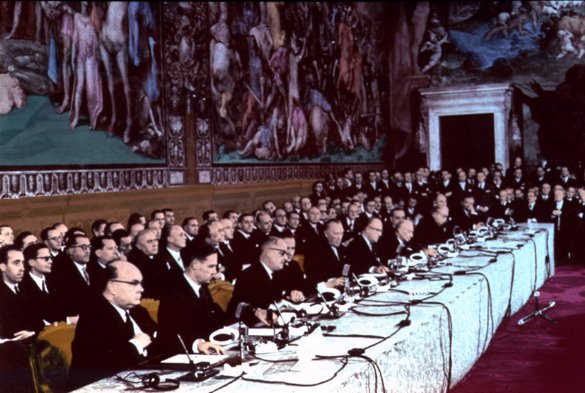
Libertarians and Pragmatists on Democracy Part 2: Classical Liberal and Libertarian Criticisms of Democratic Institutions

Note: This is part of a series on democracy. It is assumed the reader is familiar with part one prior to reading, in which the basic direction of this series is introduced and democracy is more concretely defined. This post is meant to do be a non-comprehensive, though fairly inclusive, look at a variety of views of democracy in classical liberal thought. The next post will survey progressive and pragmatist views of democracy, and the final post will argue that the truth in classical liberalism and pragmatism perspectives on democracy lead to a defense of market anarchy.

As alluded to in the introduction to this series, democracy has occupied a tricky place in the history of classical liberal thought. Despite the fact that the prevalence of democratic institutions in the West is at least partially a result of the influence of classical liberalism (in fact, I’d argue classical liberalisms’ role has been extremely significant in this regard), classical liberals have always been at best ambivalent to democracy. In recent years, libertarians have been critical and outright hostile towards democracy. For this reason, I’d argue that classical liberalism is, on net, critical of democracy, and there is a lot to learn from these criticisms. As a matter of housekeeping, it is important to note that I am using the term “democracy” in the second sense—as a system of political decision making—through most of this section unless otherwise noted.

Early Liberalism’s Cautious Enthusiasm for Democracy

At classical liberalism’s conception, democracy was in many ways the end-goal. No doubt, most classical liberals of the Enlightenment preferred democracy to the absolutist monarchism that had dominated Europe in their times. John Locke’s entire political project can be read as a criticism of absolutism, and he tended to more democratic views. In his Second Treatise on Government “democracy” is only mentioned twice by name in Chapter 10, mostly to define it in contrast to oligarchy and monarchy. However, throughout Locke there is a tendency to emphasize what we today would call “popular sovereignty”—a concept which strikes at the heart of the appeal of democracy. As Peter Laslett writes in his introduction to the Cambridge edition of Locke’s Two Treatises:

In his analysis of politics in terms of force as well as in rightful authority Locke is closer to the thought of our own day on the subject of sovereignty than the assumptions of his own time. Behind the superior power of the legislative in his system there is always to be seen the finally supreme, all-important power of the people themselves, again conceived of as a force, though justified once more by the concept of trust. It was a power which would only rarely display itself, and, as we have tried to show, there is considerable obscurity about the actual circumstances in which it could come to action and more about what it might achieve. Nevertheless, this residual power must be called Locke’s idea of what we now think of as popular sovereignty.

Drawing off of Locke, the American founders; inherited a skepticism towards absolutism and a little bit of faith in popular sovereignty. Of course, there is a slight difference in the founders’ conception of popular sovereignty and Locke’s in that it is far more individualist; in fact, it might be more accurate to say the founders did not so much believe in popular sovereignty as individual self-governance, but there is still an affinity between Locke and most of the founders’ on this point. Contra most west coast Straussians (ahem, Tom West and Harry Jaffa), it is important to note that the founders’ were influenced by much more than the classical liberal philosophy of John Locke. They, particularly John Madison, John Dickinson, and most of the early federalists, were just as influenced (if not more-so) by classical Greek and Roman political philosophy and the style of old whig conservatism of Burke and his contemporaries as classical liberalism. This can be illustrated in their perspective on democracy.

Though certainly wary of democracy’s dangers, most of the founders overall could still be described as democratic in some sense of the term. Of course, this point must be nuanced with the founders’ healthy criticisms of democracy influenced by classical liberal thought, whiggish conservatism, and Aristotelianism. Maddison is probably the most frequently cited example of an American founder who waxed pessimistic about democracy, given his writings on the “problem of factions” in Federalist No. 10. To be sure, most of the founders, as Ben Franklin famously said at the end of the constitutional convention, would have probably preferred the term “republic” to “democracy.”

Because of Madison’s Federalist No. 10 and a variety of quotes that were harshly critical democracy from the founders (many of which are false), a number of right-wingers today, particularly populist and nationalistic constitutional conservatives, argue that the founders were not democratic at all and are adverse to anything that refers to America as a “democracy.” To be sure, America is not a pure democracy, however there is little doubt that the founders still had at least some affinity for democracy, particularly in contrast to absolutist monarchy, with the possible exception of Hamilton sometimes (I would also argue that Hamilton was the least classically liberal of the founders and is largely my least favorite founder, but that’s another issue).

Further,  it is obvious the constitution incorporated democratic decision-making far more than any other of that time; in fact, the preamble beginning with “We the People” screams of the democratic, Lockean notion of popular sovereignty. Further, there is little doubt that even the America of the founders can be described as “democratic” at least in the third sense of the term (as a general term for modern Western governments).

Finally, some of the founders were pretty avidly pro-democratic, particularly Thomas Jefferson. As Jefferson wrote to John Taylor:

It must be acknowledged that the term “republic” is of very vague application in every language… Were I to assign to this term a precise and definite idea, I would say purely and simply it means a government by its citizens in mass, acting directly and personally according to rules established by the majority; and that every other government is more or less republican in proportion as it has in its composition more or less of this ingredient of direct action of the citizens.

Note how Jefferson’s definition of a “republic” is virtually indistinguishable from the way democracy is typically defined (in the second sense). Of course, Jefferson, especially in his later years in his later years was skeptical about the workability of this democratic/republican vision, writing “[s]uch a government is evidently restrained to very narrow limits of space and population. I doubt if it would be practicable beyond the extent of a New England township.” Nonetheless, it’s hard to consider Jefferson anti-democratic, especially in his younger years, when the notion of Jeffersonian democracy has been so influential in the history of American politics or if one considers Jefferson’s excuberance for the much more populist French Revolution prior to the Reign of Terror.

The Decline of Democracy in Classical Liberal Thought

After the founder’s era, however, experience with real-world democratic institutions began to contrast sharply with the theoretical hopes Enlightenment-era liberals had for democracy. The Jacobin reign of terror and aftermath of the French Revolution were sobering reminders of the dangers of the tyranny of the majority. As Edmund Burke wrote in Further Reflections of the French Revolution such a Democracy is a thing which cannot subsist by itself” and the specter of Robespierre led Burke to continually warn of mob-rule and the excesses of democracy. In America, the extremely low level of decorum in early elections (particularly in 1800 between Jefferson and Adams) must have made the more aristocratic and conservative of the founders (the likes of Washington, Hamilton, and John Dickinson) fearful of the direction in which their experiment was going.

By the Jacksonian era, it is safe to say that most classical liberal observers were waxing a bit more pessimistic on the prospects of democracy than their intellectual ancestors. The rise of a populist president in Andrew Jackson who had committed so many acts of tyranny against the Native Americans, the democratization of religious faith by the likes of Lorenzo Dow in the Second Great Awakening, and the growing of democracy into almost a political religion were signals of a disturbing trend to many of the surviving founders and European liberals like Mill and de Tocqueville. In fact, Jefferson even said of Jackson, in an interview with Daniel Webster:

I feel much alarmed at the prospect of seeing General Jackson President.  He is one of the most unfit men I know of for such a place.  He has had very little respect for laws and constitutions, and is, in fact, an able military chief.  His passions are terrible.  When I was President of the Senate, he was Senator; and he could never speak on account of the rashness of his feelings.  I have seen him attempt it repeatedly, and as often choke with rage.  His passions are, no doubt, cooler now; he has been much tried since I knew him, but he is a dangerous man.

No doubt, Jefferson’s critique of Jackson’s inability to control his passions mirror Plato’s critique of the “democratic soul” in the Republic.

However, it wasn’t until Alexis de Tocqueville’s famous Democracy in America that the classical liberal view of democracy truly turned critical. De Tocqueville saw democracy’s influence in America as resulting in the decline of an aristocratic class that “furnished the best leaders of the American revolution.” Socioeconomic egalitarianism was far from the worst of democracy’s problems in de Tocqueville’s eyes. He saw the concept of popular sovereignty as leading to “unlimited power of the majority” that was corroding the checks and balances of the American constitution in every branch of government. Indeed, there has perhaps never been as eloquent a critic of “tyranny of the majority” as de Tocqueville.

In England, JS Mill also was beginning to see the dangers of excessive democracy. Much of On Liberty can be read as building on and responding to de Tocqueville. For example, his warnings against the tyranny of majority opinion in the first chapter of On Liberty echo de Tocqueville’s concerns and are worth quoting at length (also, note how much of this anticipates much of the later insights of the Virginia School of Political Economy):

The notion, that the people have no need to limit their power over themselves, might seem axiomatic, when popular government was a thing only dreamed about, or read of as having existed at some distant period of the past. Neither was that notion necessarily disturbed by such temporary aberrations as those of the French Revolution….In time, however, a democratic republic came to occupy a large portion of the earth’s surface, and made itself felt as one of the most powerful members of the community of nations; and elective and responsible government became the subject of the observations and criticisms which wait upon a great existing fact. It was now perceived that such phrases as “self-government” and “the power of the people over themselves” do not express the true state of the case. The “people” who exercise the power are not always the same people with those over whom it is exercised; and the “self-government” spoken of is not the government of each by himself, but of each by all the rest. The will of the people, moreover, practically means, the will of the most numerous or the most active part of the people; the majority, or those who succeed in making themselves accepted as the majority: the people, consequently, may desire to oppress a part of their number; and precautions are as much needed against this as against any other abuse of power. The limitation, therefore, of the power of government over individuals, loses none of its importance when the holders of power are regularly accountable to the community, that is, to the strongest party therein.

…Like other tyrannies, the tyranny of the majority was at first, and is still vulgarly, held in dread, chiefly as operating through the acts of public authorities. But reflecting persons perceived that when society is itself the tyranny—society, collectively, over the separate individuals who compose it—its means of tyrannizing are not restricted to the acts which it may do by the hands of its political functionaries….Protection, therefore, against the tyranny of the magistrate is not enough: there needs to be protection also against the tyranny of the prevailing opinion and feeling[.]

By the generation of liberals after Mill, the insight that democracy itself can turn into tyranny became influential on the continent as well. French liberals such as Bastiat and Germans such as Mises became critical of democratic institutions. Both Bastiat and Mises noted how democracies are ultimately controlled by public opinion which can, often times, be irrational. Bastiat took note of this in regards to protectionist economics writing, “Protectionism is too popular for its adherents to be regarded as insincere. If the majority had faith in free trade, we should have free trade.” Mises elaborated on Bastiat’s insights more writing in Human Action:

Democracy guarantees a system of government in accordance with the wishes and plans of the majority. But it cannot prevent majorities from falling victim to erroneous ideas and from adopting inappropriate policies which not only fail to realize the ends aimed at but result in disaster.

(Note: Bryan Caplan has a great, more detailed analysis of Bastiat and Mises’ criticisms of democracy, it is highly recommended.)

Most of these problems of the tyranny of the majority highlighted by de Tocqueville and Mill, as well as the issue of a completely misinformed public, seemed confirmed in World War II after the rise of fascism via the democratic process in Germany and Italy.

Public Choice Theory and Democracy’s Continued Decline

In the middle of the twentieth century, classical liberals became influenced by a field of study that seemed to confirm and deepen their worst fears of democracy. I’m referring, of course, to the public choice theory of the Virginia School of Political Economy associated with the likes of James Buchanan, Richard Wagner, and Gordon Tulloch. It is important to note at this point, of course, that public choice theory itself is not a part of classical liberalism as it is a positive scientific research program that simply applies economic analysis to the political process that has been contributed to by libertarians, conservatives, and liberals like rather than any sort of political ideology; however, many of the founders of Public Choice Theory were themselves classical liberals and there is little doubt that this style of economic thinking has had more influence on libertarianism than any other political philosophy.

The new public choice theory found that democracy could result not only in the potential tyranny of the majority, but also in horrible policies thanks to the accumulation of special interests (akin to Madison’s analysis of the problem of factions). The idea that voters are rationally ignorant, the insight that elected representatives do not act in the public interest but out of their own rational self-interest and those of their lobbyist friends, and a number of concepts from the short-sightedness effect to the Arrow’s impossibility theorem seemed to cast poor prospects on democracy’s ability to protect individual liberty. The fact that so many democracies were adopting horrible Keynesian economic policies, and the explanation that this is due to the self-interest of politicians, caused further doubt on the compatibility of free markets and democratic institutions. Later insights from public choice theory revealed that voters were not only ignorant but also systemically biased and irrational, as Bryan Caplan’s Myth of the Rational Voter argued, only added to this anxiety.

This is not to say, of course, that classical liberals since the mid-nineteenth century have been wholly opposed to democracy. Indeed, Mill, Bastiat, Mises, and most of the public choice economists continued to prefer representative democracy strongly limited by a well-designed (well, at least for Buchanan) constitution to alternative systems of political organization. Even Mises in Liberalism: In the Classical Tradition defended democracy on the following grounds:

In the long run, no government can maintain itself in power if it does not have public opinion behind it, i.e., if those governed are not convinced that government is good….There is, therefore, in every form of polity a means for making the government at least ultimately dependent on the will of the governed, viz., civil war, revolution, insurrection. But it is just this expedient that liberalism wants to avoid. There can be no lasting economic improvement if the peaceful course of affairs is continually interrupted by internal struggles…Here is where the social function of democracy finds its point of application. Democracy is that form of political constitution which makes possible the adaptation of the government to the wishes of the governed without violent struggles.

The attitude of FA Hayek in The Constitution of Liberty towards democracy is perhaps the most typical attitude of most classical liberals and libertarians since the days of de Tocqueville, and the majority of libertarians in mainstream political discourse today. Hayek defends a heavily limited concept of democracy as a means to the end of individual liberty; as the most efficient of current possible political constitutions to ensure the freedom of the individual. He echoes Mises in the fifth chapter entitled “Majority Rule” where he writes:

If democracy is a means rather than an end, its limits must be determined in the light of the purpose we want it to serve. There are three chief arguments by which democracy can be justified, each of which may be regarded as conclusive. The first is that, whenever it is necessary that one of several conflicting opinions should prevail and when one would have to be made to prevail by force if need be, it is less wasteful to determine which has the stronger support by counting numbers than by fighting. Democracy is the only method of peaceful change that man has yet discovered.

Modern Libertarianism’s Hostile Opposition to Democracy

Since Hayek penned those words in 1960, before many of the most depressing insights of public choice had risen to prominence, classical liberals and libertarians—particularly more radical anarchists—have grown even more skeptical of democracy and are, at times, outright hostile to it. Hayek himself in his next major work on political theory, Law, Legislation, and Liberty, waxed a bit more pessimistic on constitutional representative democracy than he did in The Constitution of Liberty. Just thirteen years after he spent over five-hundred pages defending and articulating liberal constitutionalism, he opens the introduction to the first volume of his next major work by declaring “The first attempt to secure individual liberty by constitutions has evidently failed.” Though he still proclaims the destruction of liberty that was running rampant in the immediate aftermath of World War II was “not a necessary consequence of democracy,” he laments the role democracy had played in recent politics:

If I am right, it would indeed seem that the particular form of representative government which now prevails in the Western world, and which many feel they must defend because they mistakenly regard it as the only possible form of democracy, has an inherent tendency to lead away from the ideals it was intended serve. It can hardly be denied that, since this type of democracy has come to be accepted, we have been moving away from that ideal of individual liberty of which it had been regarded as the surest safeguard, and are now drifting towards a system which nobody wanted.

In other corners of classical liberal thought, the prospects for democracy were even grimmer. This hostile attitude is perhaps best exemplified by Hans Herman Hoppe’s book Democracy: The God that Failed. Hoppe argues that democracy suffers from a problem akin to the tragedy of the commons; whereas medieval monarchies, aristocracies, and feuds had some sense of ownership over the state, democracies have no clear sense of ownership and so democratic representatives have little incentive to make good policies that protect liberty and economic prosperity.

Though Hoppe spends far too much of the book on anti-intellectual, abrasive, and, at times, bigoted (in the literal meaning of the term) polemics, there is some truth to his central insight and it certainly has a resonance with the public choice research on the short-sightedness effect. I doubt that Hoppe’s insights have the radical implications he draws of by necessity (mainly that monarchy is preferable to democracy); there might be a case to be made that pre-democratic institutions had lower taxes and better protection of property rights, on virtually every non-tax matters it is fairly obvious that such governments were far more tyrannical. Freedom of movement, which was so important to Mises in Liberalism and is among our most important of liberties, was non-existent in feudal Europe; indeed, serfs in many European manors were little more than slaves, pieces of property tied to their land, rather than sovereign, free individuals. Further, social freedom and freedom of religion were virtually non-existent in such polities; homosexuals were executed, Muslims and Jews were persecuted, and there were a number of other violations of human rights I doubt even Hoppe (in his implicit and occasionally explicit homophobia) would defend. (Of course, Hoppe would throw a fit because his argument is purely deductive and a priori whereas mine actually uses empirical evidence, but his simpleton, idiosyncratic, and laughably unintelligent economic methodology and epistemology is another topic.) I highly doubt even the most dogmatic Rothbardian Hoppe-lover would rather live in a medieval Europe feudal manor or monarchy than a modern democracy, despite their flashy polemics.

More recently, Michael Huemer has had criticisms of democracy’s morality in his book (which I highly recommend) The Problem of Political Authority. Heumer’s argument throughout the book is that all attempts to justify the legitimacy of government authority or to argue that there is any real consent between real-world governments and citizens fail, and a better form of government may be found in market anarchism. He notes how democracy has created a false identification of voting with actual consent that can morally legitimize government, and argues against all attempts to claim that citizens of democracies—real world or hypothetical—are under legitimate authority by virtue of the fact that they are living in a democracy. In another chapter, Huemer analyzes the problematic psychology of authority and how democracy contributes to the idolization of government.

Even more recently, Jason Brennan has a forthcoming book out that is perhaps more critical of democracy than any other classical liberal—save perhaps Hoppe—aptly titled Against Democracy. Brennan argues, like Huemer, that our relationship to democracy is non-consensual. In line with most public choice theory, he argues that democracy is truly the “rule of the irrational and the ignorant” and that democratic deliberation, voting, and electoral participation actually makes people worse, more biased, more irrational citizens. Brennan, instead, defends what he dubs “epistocracy”—a sort of aristocratic rule of the knowledgeable. (I have yet to read through Brennan’s book as it hasn’t been released yet and I’m basing this entirely off of reviews and Brennan’s other writings, particularly BHL blog posts, so I may be butchering some of the details of his argument in this description.)

Clearly, the classical liberals—from de Tocqueville to Jason Brennan—have very good reason to be skeptical of democracy, and perhaps even to feverishly oppose democracy. I still do not take the conclusions to the extremes of Hoppe and (at least from my limited knowledge of his writing on this topic) Brennan. I would agree with Hayek and Mises that constitutional representative democracy is the nth best alternative to other systems such as feudalism, absolutist monarchy, and any form of authoritarianism. (Although my general opposition to nation-states for both anarchist and communitarian reasons makes me more critical of democracy than most moderate classical liberals.)

However, it is clear that democracy is far from the best of all possible governmental arrangements. At the very least, the truth that Aristotle emphasized in his Politics that it matters not so much the make-up of the government (rule of the many, few, or one) but the quality of government, whether it is tyrannical or not. There is very good reason to believe, due to most of the arguments by the great thinkers discussed above, that democracy is, unfortunately, more likely than not to lead to tyranny—even if it is less likely to do so than the existing alternatives.

Having said that, perhaps not all is lost for the spirit of democracy. In the next post, I will analyze the pragmatist conception of democracy perhaps most popular among American twentieth-century liberals and progressives. This conception of democracy is far more than a form of political decision making discussed by the classical liberals, but a broader social epistemology and philosophy as mentioned in the introduction. I hope it will be clear by the end of the next post in this series that it is possible to affirm some of the philosophical commitments of democracy extolled by thinkers such as John Dewey, Sidney Hook, and Richard Rorty without necessarily embracing democracy as a political decision-making progress or, as Hayek would argue, democracy as it presently exists.

A Modest Proposal for Fiscal Reform

Herewith, a modest proposal: abolish all federal taxes and substitute fees for state membership in the Union. $7 billion annually for each representative in Congress plus $7 billion for each Senator would cover current Federal spending. Each state would have to come up with this sum annually, raised in any way they see fit.

Comments:

  • Smaller states would pay more per capita since they have more Senators per capita. That seems only fair.
  • Where would states get the money? Same places the Feds get it: taxation and borrowing. The states would have to pay close attention to their credit ratings to keep borrowing costs low. That would of course require that they exercise fiscal prudence.
  • States would have to compete among themselves to find revenue sources that minimize the damage done to the private economy.
  • Citizens would have greater influence over their state politicians than they have over the Feds.
  • Crony capitalists, rent-seekers and their ilk would be slowed down by the need to devote more attention to 50 state governments and less to the central government.
  • What about deadbeat states? They would lose their votes in Congress until they paid up.  Conversely, wealthy states might be allowed to purchase extra seats in Congress.
  • Might this scheme encourage secession? Yes! Got a problem with that?
  • Wouldn’t this be a heavy burden on state taxpayers? Decidedly. With about 235,000 households per Congressman, that works out to $30,000 per household per year. But who’s bearing that burden now? Santa Claus?

The Federal debt is a thornier issue. Should it be paid off by the states? A drastic remedy would be to hand over securities to the states for payment as they come due. About $7.5 trillion per year would be required (counting gross debt rather than debt in the hands of the public). This would roughly triple the state taxpayer burden—admittedly a non-starter. Repudiation would be another remedy. Mandatory rollover would be another. No good solutions here.

Friedrich Hayek’s recollection of Ludwig Wittgenstein

Today is F.A. Hayek’s birthday, and if he would have been alive he would have been 117 years old now. Hayek is one of the most seminal economists and social philosophers of the 20th century. His works have left a deep impression on me when I first encountered them at the age of 20. The first three works of Hayek that I read were: 1. The Constitution of Liberty; 2. The Road to Serfdom; and 3. an essay entitled The Use Of Knowledge In Society. They have greatly influenced my views on political philosophy and the social sciences.

However, it was not so long ago that another illustrious philosopher, Ludwig Wittgenstein who was a second cousin and 10 years senior to Hayek, was born 127 years ago. In the same year that I became acquainted with Hayek, I also read Wittgenstein’s Tractatus Logico-Philosophicus or to put it more precisely: I attempted to read it. The work is incredibly dense and until today I still don’t feel confident that I have a sensible understanding of the book. Nonetheless, as a small tribute to both of them, I thought it would be nice to post a memoir that Hayek wrote of Wittgenstein.

Wittgenstein
Wittgenstein

F.A. Hayek – Remembering My Cousin, Ludwig Wittgenstein

BETWEEN THE RAILS and the building of the railway station of Bad Ischl there used to be ample space where, sixty years ago, in the season, a regular promenade used to develop before the departure of the night train to Vienna.

I believe it was on the last day of August 1918 that here, among a boisterous crowd of young officers returning to the front after visiting their families on furlough in the Salzkammergut district, two artillery ensigns became vaguely aware that they ought to know one another. I am not sure whether it was a resemblance to other members of our families or because we had actually met before that led us to ask the other, “Aren’t you a Wittgenstein?” (or, perhaps, “Aren’t you a Hayek?”). At any rate it led to our travelling together through the night to Vienna, and even though most of the time we naturally tried to sleep we did manage to converse a little.

Some parts of this conversation made a strong impression on me. He was not only much irritated by the high spirits of the noisy and probably half-drunk party of fellow-officers with which we shared the carriage without in the least concealing his contempt for mankind in general, but he also took it for granted that any relation of his no matter how distantly connected must have the same standards as himself. He was not so very wrong! I was then very young and inexperienced, barely nineteen and the product of what would now be called a puritanical education: the kind in which the ice-cold bath my father took every morning was the much admired (though rarely imitated) standard of discipline for body and mind. And Ludwig Wittgenstein was just ten years my senior.

What struck me most in this conversation was a radical passion for truthfulness in everything (which I came to know as a characteristic vogue among the young Viennese intellectuals of the generation immediately preceding mine only in the following university years). This truthfulness became almost a fashion in that border group between the purely Jewish and the purely Gentile parts of the intelligentsia in which I came so much to move. It meant much more than truth in speech. One had to “live” truth and not tolerate any pretence in oneself or others. It sometimes produced outright rudeness and, certainly, unpleasantness. Every convention was dissected and every conventional form exposed as fraud. Wittgenstein merely carried this further in applying it to himself. I sometimes felt that he took a perverse pleasure in discovering falsehood in his own feelings and that he was constantly trying to purge himself of all fraud.

THAT HE WAS VERY highly strung even at that time cannot be doubted. Among the remoter relatives he was thought of (though hardly known by them) as the maddest member of a rather extraordinary family, all of whom were exceptionally gifted and both ready and in a position to live for what they most cared for. Before 1914 I had heard much of (though being too young to attend) their famous musical soirees at the “Palais Wittgenstein”, which ceased to be a social centre after 1914. For many years the name meant to me chiefly the kind old lady who, when I was six years old, had taken me for my first car-ride—in an open electromobile round the Ringstrasse.

Apart from an even earlier memory of being taken to the luxurious apartment of an extremely old lady and being made to understand that she was the sister of my maternal great-grandfather— and, as I now know, Ludwig Wittgenstein’s maternal grandmother—I have no direct knowledge of the Wittgenstein family at the height of their social position at Vienna. The tragedy of the three elder sons apparently all ending their lives by suicide had attenuated it even more than the death of the great industrialist at its head would otherwise have done. I am afraid that my earliest recollection of the name of Wittgenstein is connected with the shocked account of one of my Styrian maiden great-aunts, surely inspired by envy rather than malice, that their grandfather “sold his daughter to a rich Jewish banker. . . .” This was the kind old lady I still remember—just.

I DID NOT MEET Ludwig Wittgenstein again for ten years; but I heard from him from time to time through his eldest sister who was a second cousin, an exact contemporary and a close friend of my mother. The regular visiting had made “Aunt Minning” a familiar figure to me (actually, she spelt her name, which is an abbreviation of Hermine, with a single “n”, but this would sound odd to English ears), and she remained a frequent visitor. Her youngest brother’s problems evidently occupied her much, and though she deprecated all talk about the “Sonderling”, the crank, and strongly defended him when occasional and undoubtedly often much-distorted accounts of his doings circulated, we did soon learn of them. The public eye did not take notice of him while his brother Paul Wittgenstein, a one-armed pianist, became a well-known figure.

But I did, through these connections, become probably one of the first readers of Tractatus when it appeared in 1922. Since, like most philosophically interested people of our generation I was, like Wittgenstein, much influenced by Ernst Mach, it made a great impression on me.

The next time I met Ludwig Wittgenstein was in the spring of 1928 when the economist Dennis Robertson, who was taking me for a walk through the Fellows’ Gardens of Trinity College, Cambridge, suddenly decided to change course because on the top of a little rise he perceived the form of the philosopher draped over a deckchair. He evidently stood rather in awe of him, and he did not wish to disturb him. Naturally, I walked up to him, was greeted with surprising friendliness, and we engaged in a pleasant but uninteresting conversation (in German) about home and family to which Robertson soon left us. Before long Wittgenstein’s interest flagged, and evident signs of his not knowing what to do with me made me leave him after a while.

IT MUST HAVE BEEN almost twelve years later that the first of the only real series of meetings I had with him took place. When I went to Cambridge in 1939 with the London School of Economics I soon learned that he was away working at some war hospital. But a year or two later I encountered him most unexpectedly. John Maynard Keynes had arranged for me to have rooms in the Gibbs building of King’s College, and after a while I was asked by Richard Braithwaite to take part in the meetings of the Moral Science Club (I think that was the name) which took place in his rooms just below those I occupied.

It was at the end of one of these meetings that Wittgenstein quite suddenly and rather dramatically emerged. It concerned a paper which had not particularly interested me and of the subject of which I have no recollection. Suddenly Wittgenstein leapt to his feet, poker in hand, indignant in the highest degree, and he proceeded to demonstrate with the implement how simple and obvious Matter really was. Seeing this rampant man in the middle of the room swinging a poker was certainly rather alarming, and one felt inclined to escape into a safe corner. Frankly, my impression at that time was that he had gone mad!

It was some time later, probably a year or two, that I took courage to go and see him, after having learnt that he was again in Cambridge. He then lived (as always, I think) in rooms several flights up in a building outside the College. The bare room with the iron stove, to which he had to bring a chair for me from his bedroom, has often been described. We talked pleasantly on a variety of topics outside philosophy and politics (we knew that we disagreed politically), and he seemed to like the very fact that I strictly avoided “talking shop”, not unlike one or two other curious figures I have met in Cambridge. But, though these visits were quite pleasant and he seemed to encourage their repetition, they were also rather uninteresting and I went along only two or three times more.

After the end of the War, when I had already returned to London, a new kind of contact by letter began when the possibility arose, first to send food parcels, and later to visit our relatives in Vienna. This involved all kinds of complicated contacts with bureaucratic organisations about which, he rightly assumed, I had found out details before he did. In this he showed a curious combination of impracticability and meticulous attention to detail which must have made all contacts with the ordinary business of life highly unsettling for him. However, he did manage to get to Vienna fairly soon after me (I had succeeded for the first time in 1946), and I believe he went there once or twice again.

I THINK IT WAS in the course of his return from his last visit to Vienna that we met for the last time. He had gone to see his dying sister Minning once more, and he was (though I did not know it) himself already mortally ill. I had interrupted the usual railway journey from Vienna via Switzerland and France at Basel and had boarded there the sleeping-car at midnight the next day. Since my fellow occupant of the compartment seemed to be already asleep I undressed in semi-darkness. As I prepared to mount to the upper berth a tousled head shot out from the lower one and almost shouted at me, “You are Professor Hayek!” Before I had recovered sufficiently to realise that it was Wittgenstein and to register my assent, he had turned to the wall again.

When I woke up next morning he had disappeared, presumably to the restaurant car. When I returned I found him deeply engrossed in a detective story and apparently unwilling to talk. This lasted only until he had finished his paperback. He then engaged me in the most lively conversation, beginning with his impressions of the Russians at Vienna, an experience which evidently had shaken him to his depth and destroyed certain long-cherished illusions. Gradually we were led to more general questions of moral philosophy, but just as it was getting really exciting we arrived at the port (in Boulogne, I believe). Wittgenstein seemed very anxious to continue our discussion, and indeed he said that we must do so on board ship.

But I simply could not find him. Whether he regretted having become so deeply engaged, or had discovered that, after all, I was just another Philistine, I do not know. At any rate, I never saw him again.

A Note on the Econometric Evaluation of Presidents

Sometimes, I feel that some authors simply evolve separately from all those who might be critical of their opinions. I feel that this hurts the discipline of economics since it is better to confront potentially discomforting opinions. And discomforting opinions are never found in intellectually homogeneous groups. However, a recent paper in the American Economic Review by Alan Blinder and Mark Watson suffers exactly from this issue.

Now, don’t get me wrong, the article is highly interesting and provides numerous factoids worth considering when debating economic policy and politics. Basically, the article considers the differences in economic performance under different presidents (and their party affiliation). Overall, it seems that Democrats have a slight edge – but in large part because of “luck” (roughly speaking).

However, no where in the list of references do we find an article to the public choice theory literature. And its not as if that field had nothing to say. There are tons of papers on policy decisions and the form of government. In the AER paper, this can be best seen when Blinder and Watson ask if it was Congress, instead of the president, that caused the differences in performance. That is a correct robustness check, but it is still a mis-specification. There is a strong literature on “divided government” in the field of public choice.

In the case of the United States, this would be presidents and congresses (or even different chambers of congress) of different party affiliation. Generally, government spending is found to grow much more slowly (even relative to GDP) when congress and the White House are held by different parties. Why not extend that conclusion to economic growth? I would not be surprised that lagged values of divided government (mixed partisanships in t minus one) would have a positive on non-lagged growth rates (growth in t-zero).

Now, this criticism is not sufficient to render uninteresting the Blinder-Watson paper. However, it shows that some points fall flat when two fields fail to link together. Public choice theory, in spite of the wide fame of James Buchanan (Nobel 1986), Gordon Tullock and affiliates (or off-spawns) like Elinor Ostrom (Nobel 2009), is still clearly unknown to some in the mainstream.

And that is a disappointment…

A depressing take on inequality

Recently, I reviewed Unequal Gains (Princeton University Press) which is basically the magnum opus of economic historians Peter Lindert and Jeffrey Williamson. In the pages of Essays in Economic and Business HistoryI survey the history of growth and inequality in the United States since 1700 that they portrayed in their book.

Coming out of their book, I could not help feel depressed and simultaneously vindicated in my classical liberal outlook of the world. While they avoid the Pikettyesque tendency to create “general laws” of inequality, their results suggest that inequality has risen in spite of massive government intervention since the 1920s.

To be clear, Unequal Gains is probably the best book you can get on understanding the dynamic of inequality. Although I am biased in their favor since both authors have given me great help in my academic career, the book should overthrow Capital in the 21st century as the reference work on inequality. Throughout the book, they use normal economic theory to explain why inequality increased or decreased (discrimination, capital flows, immigration, changes in labor force participation, urbanization, relative factor scarcities, uneven supply shocks, changes in returns to human capital, regional income differences). They constantly eschew general laws. From the book, we should understand that inequality is context-specific. Like a recipe, difference mixes of the ingredients of inequality will yield different courses. This is the main strength of the book (plus the tons of data).

And this is also why it is depressing. The vast majority of inequality before 1910 in the United States would have been the result of market forces (immigration, urbanization, capital flows, relative factor scarcities, regional income differences) and not of governmental decisions. I believe that the pre-1910 level of inequality is sensibly overestimated and that, while not gigantic, government policies did have a non-negligible role in raising inequality. Nonetheless, most of these inequalities are hard to judge negatively. More immigrants from poor Italy may depress (I do not agree with that claim, but people like G.Borjas of Harvard could make this claim) wages in the United States in 1900 and increase inequality, but the migration of the Italian to America leaves no one worse off while improving the living standard of the Italian migrant. Urbanization, as part of the industrialization, is a hard process to fault and criticize. So, inequalities before 1910 are simply an issue of explaining their levels and trends.

After 1910 however, there is what Lindert and Williamson call the “great leveling” where there is an important decrease in inequality which ends in 1970. This is where I become depressed. In my paper, I highlighted that most of the fall in inequality between 1910 and 1970 occurs because or regional convergence, gender wage convergence and racial wage convergence. Between the 1910s and 1970s, differences in per capita state-level incomes narrowed dramatically (and they have since slightly widened). Between 1910 and 1970, thanks to the migration of blacks to the north, wages between whites and blacks grew closer together. Between 1910 and 1970, thanks to the arrival of household amenities like running water, appliances and electricity, women joined the labor force and the gender wage gap narrowed. None of these factors have anything to do with redistributive policy. Now, I am not claiming that redistributive policy had no impact on inequality measures (that would be empirically false). What I am claiming is that numerous forces were at play – some of which were related to non-governmental factors. Between 1910 and 1970, if one looks at ratios of government spending to GDP, there is a massive increase in the size of government. And yet, many factors of convergence had little to do with government.

08-government-debt.jpg

Since the 1970s, inequality has surged again – and this is in spite of the fact that governments are growing larger in many respects. While spending is at all levels seems to be either stable or growing, regulatory barriers like licensing regulations and rent-seeking arrangements in the form of corporate bailouts have multiplied. Thus, the rise of inequality occurs in spite of a very active state. Not only that, but I am working on papers with John Moore of Northwood University to study inequality from 1890 to 1940 because we believe that the level is overestimated and misunderstood and (by definition) that this affects the trendline of inequality in the 20th century. If inequality in the 1920s falls slightly, the U-shaped curve of inequality (very high before 1910 falling to 1970 and increasing thereafter) described by Piketty and others becomes a flatter upward slopping curve (maybe more like a J-shaped curve). If me and John are correct (we are still crunching numbers and collecting data) inequality increased with state intervention.

And that is highly depressing. Now, I am a classical liberal who believes that state intervention should be limited. But it is not beyond to recognize that when the state throws tons of money of something, it might get a few things the way it wants (a broken clock is still right twice a day). Thus, I expected some social programs to have an impact (and I still believe that on a case-by-case basis, some social programs do reduce inequality) but I did not expect such a disappointing performance. One could even say “depressing” performance.

Nonetheless, I would suggest to everyone to read Unequal Gains and throw out Capital in the 21st century. 

Note: To be clear, Lindert and Williamson are not making the claim I am making here. While their book is predominantly a “positive economics” work, they do propose some policy courses to reduce inequality and argue favorably for redistributive policy. This is merely my “positive take” on their book.