A quick rant on NY’s Excelsior Scholarship

Long Island Business News had a cover story last week: “Free for all?

And the answer is no.

NoL readers don’t need to be reminded that there ain’t no such thing as a free lunch. But I want to focus on the “for all” aspect. And the answer there is also no. This is a program that benefits the middle class and simply won’t be available for the poorest kids in the state.

There are a lot of different programs for paying for schooling costs, and I don’t want to get bogged down in specifics. So here’s (roughly) how this new program works: full time students whose family income is below (approximately) the 75th percentile get more money for school. That money goes away if they stop meeting those criteria.

This is not going to be helpful to poor students who don’t have to resources necessary to go to school full time. It sounds inclusive, but they might as well make the income requirement family income between the 60th and 75th percentile.

In the best case scenario, we might end up getting a positive return on this program (generating more tax revenues from more productive workers). But we still have to ask about what alternatives were possible.

Here are three problems with that outcome:

  1. If those kids were going to go to school anyways, then we’re just creating a common pool problem where costs and benefits aren’t compared by the relevant decision makers.
  2. If some of those kids weren’t going to go to school otherwise, then we’ve increased the pressure on poor kids to get a college degree without helping them out. And if we’re thinking of this like an investment, the returns would be higher on getting more poor kids to go through school.
  3. If this program doesn’t have a return on investment high enough to offset the costs, then that budget line has to compete with some other program (tax returns would be nice, or investment in infrastructure, or something else).

I don’t expect any legislation to solve the problem once and for all. But this program is more likely to make the underlying problems worse, at the expense of poor people, and with little net gain. Not only is this bad economics, it’s not even in line with the more honorable goals of progressives. It’s simply a way for politicians to buy votes with other people’s money.

Markets for Secrets?

In a world without intellectual property, would it be possible to buy and sell secrets? I suggest the answer is yes. In this post, I provide both a theoretical framework for such markets, as well as pointing to real life examples of such markets already existing.

Introduction

In a previous post, we talked about why information is the only public good. But of course, it’s possible to keep information private. Such private information is called a secret. Currently, entrepreneurs and inventors have two choices when they have what they believe is a profitable secret: they can either keep recipe, industrial process, or so on, a secret, and be protected by “trade secret” laws; or they can “publicize” their secret in exchange for a patent (which they can use to either issue injunctions against competitors or to extract royalties).

But there has been a lot of economics literature in recent years that challenges the status of intellectual property (IP). Most famously, there is Michele Boldrin and David K. Levine’s book Against Intellectual Monopoly, where they detail both an empirical and theoretical case against the economics of intellectual property. Furthermore, patent lawyer Stephan Kinsella’s book Against Intellectual Property gives a principled legal and ethical case against IP.

Continue reading

How fast does populism destroy economic freedom in Latin America?

The turn of the twentieth century has seen an increase in populist government in Latin America. That populism is no friend of free markets is well known. And even if their movement against free markets if fairly quick, it is common for individuals to loose track of how fast they are loosing their economic freedoms.

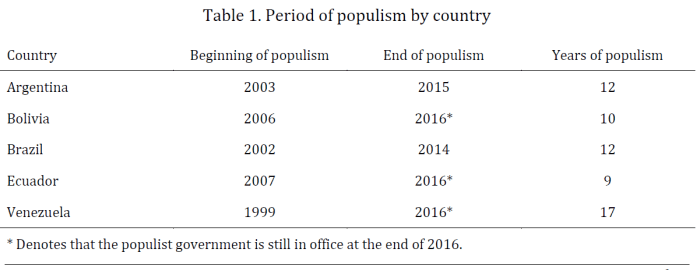
There are five cases of populist governments in Latin America that can work as benchmarks for the region. In particular, we can look at the behavior of governments in Argentina, Bolivia, Brazil, Ecuador, and Venezuela for the time frames depicted in the following table.

Table 1

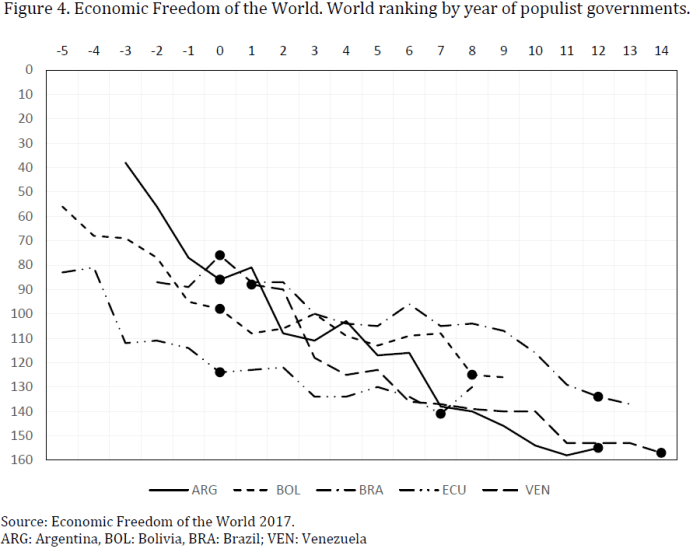
During this time period, populist governments failed to increase GDP per capita consistently faster than the region. The only exception is Argentina. But its fast increase in GDP is largely explained as recovery after the 2001 crisis and by consuming capital stock, not as an expansion of potential output. It is no accident that Argentina met stagflation in 2007. In the last three issues of the Economic Freedom of the World (Fraser Institute) Argentina ranks among the bottom 10 free economies in the world.

The following figure shows the fall in ranking of each country in the Economic Freedom of the World.

Figure 1

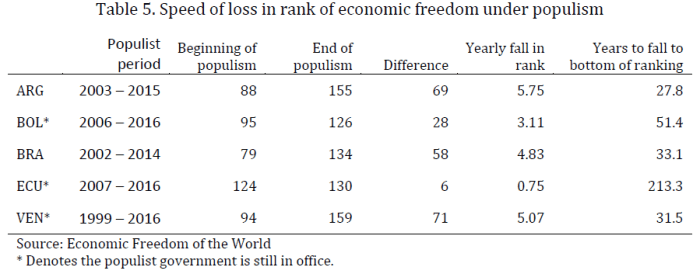
We can translate the information shown in the above into loss of ranking position per year of populist government. This is what is shown in the next table.

Table 2

This table offers a few readings:

  1. Argentina is the country that fall in the ranking of economic faster than its peers.
  2. Ecuador shows a very slow fall. This is due to two reasons: (1) Ecuador already starts from a low ranking position. (2) The last year of the index (2015) shows an improvement (without this improvement the fall is quite sharp as well.) Ecuador does not represent a case of “good populism.”

What this table is showing is that if an individual is born in any of these countries ranking 1st in economic freedom the same year a populist government takes office, then the same country will rank at the bottom of the world before he retires. In the case of Argentina, in 27.8 years the country will be at the bottom of the list, this means that by the time this individual starts to work, Argentina will already have a very repressed economy. By retiring time, this individual will have no experience of living and working in a free economy.

This numbers are not just descriptive of populism in Latin American countries. They also serve as a sort of warning for Europe and the United States, regions that have already seen some signs of populist behavior in their governments and political groups in the last few years. Populism can be emotionally attractive, but is very dangerous for our economic freedoms.

Physical Goods, Immaterial Goods, and Public Goods

Public goods in economics have been a contentious theoretical issue since Paul Samuelson introduced the concept in 1954. The main sources of contention are what real world things are public goods, and who should provide them. In this post I propose a new way of looking at goods that will shed light on why public goods have posed such a problem. In particular, I propose that there is an important distinction between physical goods and immaterial goods; that public goods can only be immaterial goods; and that this unique feature of public goods does not preclude the market to provide the “socially optimal level.

Introduction

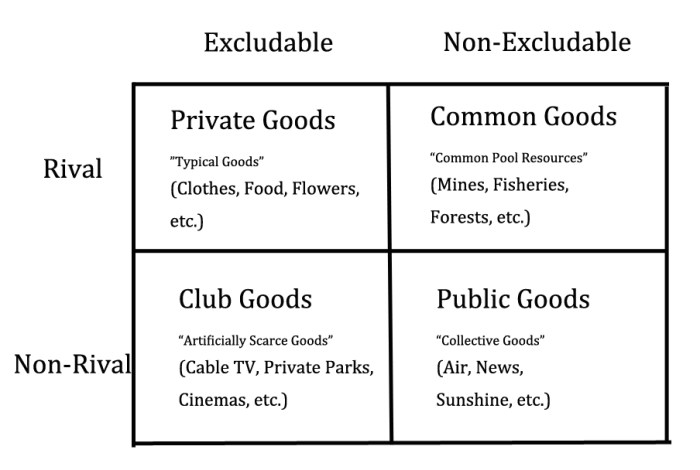
Economists define a public good as something that is “non-rival” (meaning that one person’s consumption does not affect another person’s), and “non-excludable” (meaning that one person cannot stop another person from consuming the good.) Public goods are often contrasted with private goods, which are rival and excludable.

The implications are that public goods cannot be provided by a free market, because no one would have to pay for such a good, and so there would be so incentive to produce it. Therefore, the argument goes, the government ought to provide public goods.

Features_of_goods

An example of a private good is an apple. Imagine a world with just you, me, and an apple. If I take a bite out of the apple, there is now less apple for you to consume. That means it’s rival. If I put the apple in a locker to which only I know the combination, then again you are prevented from consuming the apple. This makes it excludable.  Continue reading

North Korea at the North Sea?

Yesterday, both Houses of Dutch Parliament jointly opened the parliamentary year, which is always held on the third Tuesday in September, and is known as “Budget Day.” Normally, there is not much pomp and glory in the Low Lands, but on “Little Princes Day” (as the day is literally called), we go all-out: the King and Queen are driven in a horse-pulled carriage to the Hall of Knights, the oldest part of the parliamentary buildings (built around 1250), surrounded by military troops in full ceremonial dress. The King reads his speech (actually written by and under full political responsibility of the Prime Minister and cabinet) from a huge throne, announcing the government’s plans for the next year. Male ministers in morning coats, ladies in dresses and hats, with the powerful elites also assembled.

king and queen
King Willem-Alexander and Queen Maxima entering the Hall of Knights (source)

After the reading, the Royal couple make their way back to one of their palaces in the centre of The Hague, returning once to greet the masses from the balcony.

Meanwhile, the Minister of Finance officially presents the 2018 budget to the Lower House. The separate budgets of all departments are laws, which will have to pass both Houses before 31 December. This process is normally preceded by a two day debate on “the general state of the country,” but this year it is skipped because there is only a caretaker government in office. It awaits the finalization of negotiations for a new government, which started right after the elections on 15 March. Still no government is formed, although it is widely expected that a four-party coalition will be presented within a few weeks, consisting of small Christian left wingers, centre Christian Democrats, and two social liberal parties, D66, and Prime Minister Mark Rutte’s VVD.

Although much improved since the low point of the Great Recession, around 2011-2012, the public finances are still shocking from a classical liberal perspective. The income of the national government is 285 billion Euro (around 338.5 billion USD), which is 43% of GDP.

It consists mainly of several mandatory insurance premiums for collective arrangements (112.2 billion Euro), income tax (55.4 billion; the highest bracket of 51.5% tax applies to all personal income over 68.507 Euro), and VAT (52.8 billion). The rest are mainly specific taxes, related to companies, the environment, excises, dividends, et cetera. In 2011, the public share of GDP was still 47%, while in the 1980s it reached peaks of around 60%. Not exactly anywhere near an ideal liberal situation, no matter what liberal persuasion you are. Personally, I would argue that 25% should be the max for a decent set of state tasks, but I am sure that makes me some weird Northern European commie in some American libertarian eyes!

The situation is even more dire if we see where that money is spent. Health care (80.4 billion euro) and social security (79 billion) are always in competition as the largest spending departments. So that is 56% of the budget already and both increase annually, no matter the economic circumstances. The third post is public education (35.4 billion), followed by funds for provinces and municipalities (24.4 billion), foreign affairs and foreign aid (12), police and judiciary (10.3), defense (8.4), and infrastructure and environment (also 8.4), with the other departments taking parts of the rest. Despite a very rare expected budgetary surplus of 7.8 billion in 2018, the national debt is still 53.7% of GDP. Perhaps not bad in international comparison, still not good for any liberal.

These numbers are only part of the story, because there are also numerous local taxes, and the number of liberty-inhibiting regulations, from European, national, provincial and local origin are staggering. There is not one really free market, and there are hardly parts of individual life not regulated or influenced by the state. A comparison with North Korea is of course still far-fetched, yet socialism is alive and kicking on the North Sea shores.

In my view it is evidence of the remarkable power of capitalism that The Netherlands is still one of the richest countries on earth, a global top 15 economy (GDP per capita), with only 17 million inhabitants. No matter how hard you curb it, the capitalist system still delivers amazing results. Of course, the opportunity costs of the Dutch regulatory state are very high. In terms of personal liberty there are not many better places on the planet. Yet in other fields it is a different story. Economic freedom is a mess, which means that the material aspects of personal freedom are seriously restricted. Yet the worst is the mentality. Sadly, most Dutch have traveled the whole Hayekian Road to Serfdom, making a shift to classical liberalism highly unlikely.

On Financial Repression and ♀ Labor Supply after 1945

I just came back from the Economic History Association meeting in San Jose. There are so many papers that are worth mentioning (and many have got my brains going, see notably the work of Nuno Palma on monetary neutrality after the “discovery” of the New World). However, the thing that really had me thinking was the panel on which one could find Barry Eichengreen and Carmen Reinhart (who was an early echo of the keynote speech by Michael Bordo).

Here’s why : Barry Eichengreen seemed uncomfortable with the current state of affairs regarding financial regulation and pointed out that the after-war period was marked by rapid growth and strong financial regulation. Then, Reinhart and Bordo emphasized the role of financial repression in depressing growth – notably in the period praised by Eichengreen. I have priors that make more favorable to the Reinhart-Bordo position, but I can’t really deny the point made by Eichengreen.

This had me thinking for some time during and after the talks. Both positions are hard to contest but they are mutually exclusive. True, it is possible that growth was strong in spite of financial repression, but some can argue that by creating some stability, regulations actually improved growth in a way that surpassed the negative effects caused by repression. But, could there be another explanation?

Elsewhere on this blog, I have pointed out that I am not convinced that the Thirty Glorious were that “Glorious”.  In line with my Unified Growth Theory inclinations (don’t put me in that camp, but don’t exclude me either I am still cautious on this), I believe that we need to account for demographic factors that foil long-term comparisons. For example, in a paper on Canadian economic growth, I pointed out that growth from 1870 to today is much more modest once we divide output by household-size population rather than overall population (see blog post here that highlights my paper). Later, I pointed out the ideas behind another paper (which I am still writing and for which I need more data, notably to replicate something like this paper) regarding the role of the unmeasured household economy. There, I argued that the shift of women from the household to the market over-measures the actual increase in output. After all, to arrive at the net value of increased labor force participation, one must deduce the value of foregone outputs in the household – something we know little about in spite of the work of people like Valerie Ramey.

Both these factors suggest the need for corrections based on demographic changes to better reflect actual living standards. These demographic changes were most pronounced in the 1945-1975 era – that of the era of rapid growth highlighted by Eichengreen and of financial repression highlighted by Reinhart and Bordo. If these changes were most momentous in that period, it is fair to say that the measurement errors they induce are also largest in that era.

So, simply put, could it be that these were not years of rapid growth but of modest growth that were overestimated?  If so, that would put the clash of ideas between Bordo-Reinhart and Eichengreen in a different light – albeit one more favorable to the former than the latter.

But heh, this is me speculating about where research could be oriented to guide some deeply relevant policy questions.

The Cost of ‘Free’ – or why I don’t like freeware

This is a partial response to Fabio Rojas recent post on the fate of Stata, a statistics package, given the rise of a free alternative, R. Rojas and others have many reasons for why R is a good package, but for now I wish to deal with the argument that it being ‘free’ is a virtue.

R is free, but I see it as a fault because it reveals that it doesn’t have a devoted support system and because it isn’t free at all. It’s actually very costly!

If you’ve spent any time with an economist you should know that there is no such thing as a free lunch. If R is free we should not simply assume it is better. To the contrary we should ask why it is free. As I have tried to argue elsewhere, it is because when you purchase software you aren’t just purchasing a few lines of code. You’re purchasing the support system that comes with it. When a company purchases Stata, or any commercial software, they do so with the expectation that they can call a dedicated hotline for troubleshooting. As software has evolved you’ve seen companies experiment with pricing to acknowledge the fact that we don’t purchase a one time software but a continuous support system.

Consider Xbox or Playstation’s online services. Their use is charged on a per time basis because it costs money to run servers and provide customer support. Even ‘freemium’ games, which nominally don’t require any money to play, survive off micro transactions which enable companies to earn steady revenues in exchange for continuing support and new content. I would not be surprised if freemium statistical software is tried in the future – access to basic regressions is free but more advanced models cost money to run. I half joke.

But let’s assume you’re good at coding and don’t need much support outside of a few days reading an R book. Should you praise R for being ‘free’? No, because you still paid the time value of your time. Every hour spent learning how to code in R is an hour you could have spent doing any number of things.

Now to be clear, you may still want to learn R if it frees up your time in the future by automating X process. This post isn’t to argue against adopting R. My point is only to say that it isn’t free in a meaningful sense. Adopting R costs in the sense that you’re giving up a devoted support system and value of time equal to how long it takes you to become proficient in it.

It’s possible that once you account for those things R is still ‘cheaper’ than commercial software like Stata or SPSS. That is an empirical question beyond the scope of this post.

A Little More on “Price Gouging”

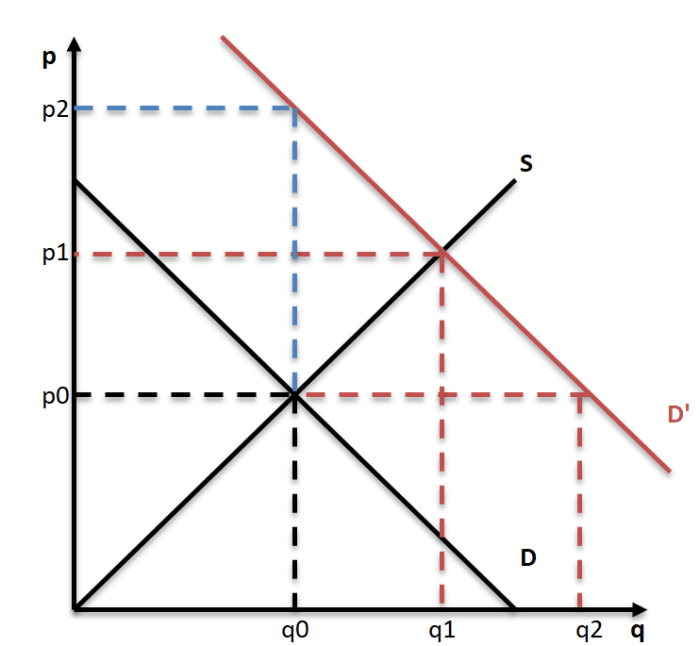
In my previous post on this subject I argued that the critics of “anti price-gouging laws” are mistakenly assuming that is possible to satisfy demand at the pre-natural disaster price. That is, sadly of course, fiction. It it not our reality anymore and we are better accepting the new situation than blindly deny it. As many economists are explaining these days, to not let prices increase after a natural disaster does more harm than letting prices increase. This can easily be seen in a demand and supply graph.

Prige gouging

Consider first just the lines in black. Those lines represent the pre natural disaster situation. What is considered “normal prices”. At price p0, a quantity q0 of a good is traded in the market (i.e. bottles of water.)

Now there is a shock. A hurricane hits this region and demand increases (shifts to the right). This is the demand line in color red. The red dotted line that extends to the right shows the size of the shortage (q2 – q1) at the “normal and fair” price.

Price gouging is an emotional loaded word, but it doesn’t have any specific economic meaning. How does “price gouging” show up in this graph? It is the increase in price from p0 to p1. This is the increase in price required to satisfy the higher demand and provide the extra number of goods (q1 – q0). No… supply is not horizontal.

What happens if price increases are banned? Then at the pre-crisis quantity (q0), consumers are willing to pay p2, a price even higher than price gouging. This means two things. First, a number of people in need will be unable to acquire the goods (the empty shelf problem). Second, that the actual total cost (to those who acquire the quantity q0) is p2, not p0. The difference between the price in the store and total cost falls into waiting in long lines, visiting a long number of stores, bribing producers (yes… with natural disaster price controls also lead to black markets), calling favors., etc. Any principles of microeconomic textbook has plenty of more examples under the price ceiling discussion.

There are three scenarios being discussed here.

  1. Quantity q0 at price p0
  2. Quantity q1 at price p1
  3. Quantity q0 at price p2

The natural disaster makes scenario 1 impossible. And it is not clear that scenario 3 is better for those in need than scenario 2. Less goods are provided at a higher total cost than in scenario 2.

One final remark. Note that in this analysis the natural disaster only affected demand. Of course, it is quite likely that supply would also be affected. The point, however, is to show that prices are not pushed up only by produces. As we can see in this case, it is consumers who are increasing the price and producers reacting to the new behavior of consumers.

The language of the economy: prices

50 Things That Made the Modern Economy is looking for a 51st thing. Below is the email I sent them.

Continue reading

Price Gouging: Reality vs Fiction

In a previous post I comment on a too common economic fallacy, that a natural disaster is good for the economy because of its alleged impact on GDP. Economic fallacies are not the only misconceptions gaining momentum during a natural disaster, but a confusion between reality and fiction becomes also quite common. The issue of price gouging provides a good example of this situation.

After a natural disaster, the price of certain goods such as water or gas, increases significantly. This is seen as an immoral exploitation by merchants who are taking advantage of the people affected by the natural disaster. Even though in this post I want to comment on another issue, it is worth mentioning that the now limited resources should be allocated to those in most need (rather than, for instance, to whoever happens to be the first one in line.) And unless someone has a crystal ball, there is no way of knowing who is in most need without changes in relative prices.

The mention to reality versus fiction refers to the fact that the critics of price gouging seem to (implicitly) assume that the natural disaster did not occur. It is plausible to assume that an event like this would (1) shift the supply to the left [reduce supply of goods] and (2) shift the demand to the right [increase the demand of goods.] At the usual (or “normal”) price these goods are in serious shortage.

This means that in the event of a natural disaster the option is between (1) having goods at a higher price or (2) not having goods at the “normal” price. This is the new reality. The old and normal reality does not exist anymore. To limit price gouging results in a lower price in the store, but not goods on the shelf. This would not help those in need. The fiction consists in thinking that a larger supply can be secured without an increase in the price (why should we assume supply is horizontal when these goods usually have a low elasticity?) An efficient policy would secure the provision of goods rather than secure a low price without the goods. Reality, rather than fiction, should be the first driver of a policy designed to assist during a natural disaster. As Milton Friedman insisted, a policy is to be valuated by its results (or design), not by its intentions.

The first rule for an efficient policy should be to not get in the way of changes in relative prices. Otherwise help will become erratic and inefficient. It might be more efficient, for instance, to make use of firms specialized in logistics (i.e. firms such as Walmart) and subsidize the demand than start a price control policy. For instance, a tax credit or a check can be sent to those affected by the natural disaster allowing them to pay the now higher prices. Similarly, a subsidy can be given to those firms bringing goods to the damaged areas (who says the government has the monopoly of charity or that the only one who can do it efficiently?) A policy on these lines would be more efficient than interfering with relative prices.

However, some opponents of price gouging seem to be more interested in damaging merchants than in making sure resources will be efficiently allocated among the ones affected by the natural disaster. Those who do not oppose price gouging do so because they have the affected ones first in line. It is not about merchant’s revenue, it is about allocating goods efficiently. Damaging the merchants should not be more important than worsening the situation of those in need.

No, natural disasters are not good for the economy.

Every time there is a natural disaster old economic fallacies make their appearance. And they are usually always the same. In particular, the argument that a natural disaster is good for the economy. This should make little sense. Wealth is not created by destroying things. A natural disaster destroys wealth, doesn’t create it. I doubt anyone affected by a hurricane would argue that he is better off after the natural disaster than before.

The argument that an event such as a natural disaster is good for the economy rests in the positive impact seen in GDP (as is argued) after the natural event. If GDP increases, then the economy is doing better. But this is a misreading of GDP. This variable is a flow of wealth, it is not a stock of accumulated wealth. It is possible that wealth creation (flow) increases at the same time the stock of wealth is decreasing. And this is what happens during a natural disaster.

Imagine that someone’s house caught fire and burns down. Because of this situation, this person decides to start working extra hours to increase his income and be able to buy a new one. The extra hours makes his income (GDP) increase. But his situation is considerable worst because he lost his stock of wealth (remember Bastiat’s broken window fallacy…?). Arguing that a natural disaster (or a war, etc…) is good for the economy is like arguing that this person is better of because he has to work extra hours to recover his loss.

This is just another case of a too common fallacy in economics. We know that if the economy is doing better the result will be better GDP and unemployment indicators. But from observing a better GDP and unemployment indicators we cannot, and should not, conclude that the economy is doing better. More important than observing what is happening to GDP is understanding why is changing its behavior.

It could be argued that one of the problem of the Keynesian view of the world is the focus on what happens to output and unemployment rather than why these variables are moving. Not surprisingly, we get to the conclusion that going to war (or having a natural disaster) would be a good way to achieve full employment.

Cycling in Amsterdam

I just got back from a week in London and a week in Amsterdam. Probably the most striking thing I encountered was the wonderful dutch cycling culture. Any transit system involves some implicit negotiation between motorists, pedestrians, and others. On Long Island the motorists won. In Amsterdam, cyclists won.

I’m on a bit of a Dutch cycling high, despite only spending about 2 hours on 2 wheels while in Amsterdam. The dutch take their bicycles seriously and they shape their environment to that end. The Airbnb I stayed at had frontage on a bicycle road but no direct access to a motorway. I’m not 100% on this, but I think the Netherlands’ liability laws make the faster vehicle strictly liable for accidents which serves as an implicit subsidy for bikes.

100_4514
A typical Dutch cycle path

Here are some things I like about this culture:

  • The engineering. I really like the way they do bike locks… nearly every bike has a built in lock that disables the rear wheel. Most of these locks also have a chain to lock the bike to a fence, but that chain locks with the same key for the rear wheel.
  • It encourages enough density to get people interacting with each other, but still expands your plausible travel distance. They’ve got a nice balance between closeness and congestion.
  • It’s easier on the environment (excluding the costs of building bikes and bike roads).
  • Light physical exercise feels great.
  • The infrastructure involved in managing bike traffic is pretty minimal. Speeds are slow enough that human judgement works well outside of the busiest areas.

Why should libertarians care? Well, most of them probably have better things to focus on. But those of us living in or near dense cities, this is an example of a way of life that fits nicely with our broader goal of a peaceful, prosperous, liberal order. If Manhattan tried to be more like Amsterdam it could be a huge boon (I think… based on my preferences and zero scientific analysis) to human flourishing.

Inventions that didn’t change the world

Have you ever learned about an amazing invention–whether it was the Baghdad battery or the ancient Roman steam engine or Chinese firecrackers–and wondered why it didn’t do more to change the world? In this podcast, we examine a selection of curiosities and explore hypotheses for why their inventors didn’t use them to full effect.

We move VERY quickly through a range of fascinating examples and hypotheses, and therefore leave a lot up to discussion. We hope to see your thoughts, feedback, and additions in the comments section!

For any invention that you want to learn more about, see the links below:

Knossos’ toilets

In the 2nd millennium BC, a “palace” (now thought to be a building that served as administrative, trade, and gathering hub) had running-water toilet flushing. Much like the Roman Cloaca Maxima, likely a HUGE public-health benefit, but basically died out. Does this show that military protection/staving off the “Dark Ages” was the only way to maintain amazing inventions?

Link: http://www.nature.com/news/the-secret-history-of-ancient-toilets-1.19960;

The Nimrud lens

Whether it was a fire-starter, a magnifying glass, or (for some overeager astronomy enthusaists), the Neo-Assyrian ground-crystal Nimrud lens is an invention thousands of years out of place. While the Egyptians, Greeks, and Romans all used lenses of different sorts, and glass-blowing was certainly popular by the 1st century BC in Roman Egypt, no glass lenses were made until the Middle Ages and the potential scientific and engineering uses of lenses–that can hardly be understated even in their 16th-to-18th-century applications–had to wait another couple millennia. Many devices like the Baghdad battery and Antikythera device are heralded for their possible engineering genius, but this seems like a simple one with readily available applications that disappeared from the historical record.

https://en.wikipedia.org/wiki/Nimrud_lens

Hero of Alexandria’s steam engine

In the 1st century AD, Hero was a master of simple machines (that were mostly used for plays) and also invented a force pump, a wind-powered machine, even an early vending machine. However, he is likely most famous for his Aeolipile, a rotating steam engine that used heated water to spin an axle. The best attested use of this is for devotion to the divine and party tricks.

https://en.wikipedia.org/wiki/Aeolipile

The ancient mechanical reaper

Ancient Gallo-Romans (or just Gauls) invented a novel way of grain harvesting: rather than using sickles or scythes, they used a mechanical reaper, 1700 years before Cyrus McCormick more than tripled the productivity of American farmers. This antiquated device literally but the cart before the oxen and required two men to operate: one man to drive the beasts, and another to knock the ears off the stalk (this reaper was obviously far less sophisticated than McCormick’s). This invention did not survive the Volkswanderung period.

http://www.gnrtr.com/Generator.html?pi=208&cp=3

http://reapertakethewheel.blogspot.com/2013/03/impacts-of-invention.html

Note: the horse collar (which allowed horses to be used to plow) was invented in 1600-1400 BC in China AND the Levant, but was not applied widely until 1000 AD in Europe. https://en.wikipedia.org/wiki/Horse_collar.

Inoculation

Madhav, an Indian doctor, compiled hundreds of cures in his Nidana, including an inoculation against smallpox that showed an understanding of disease transmission (he would take year-old smallpox-infected flesh and touch it to a recently made cutaneous wound). However, the next 13 centuries did not see Indian medical understanding of viruses or bacteria, or even copied techniques of this, development. https://books.google.com/books?id=Hkc3QnbagK4C&pg=PA105&lpg=PA105&dq=madhav+indian+smallpox+inoculation&source=bl&ots=4RFPuvbf5Y&sig=iyDaNUs4u5N7xHH6-pvlbAY9fcQ&hl=en&sa=X&ved=0ahUKEwic8e-1-JXVAhUp6IMKHfw3DLsQ6AEIOjAD#v=onepage&q=madhav%20indian%20smallpox%20inoculation&f=false

At least, thank god, their methods of giving nose jobs to those who had had their noses cut off as a punishment survived: https://en.wikipedia.org/wiki/History_of_rhinoplasty

The Chinese:

List of all chinese inventions:

https://en.wikipedia.org/wiki/List_of_Chinese_inventions#Four_Great_Inventions

Gunpowder

Gunpowder was discovered by Chinese alchemists attempting to discover the elixir of life (irony, no?)

https://www.thoughtco.com/invention-of-gunpowder-195160

https://en.wikipedia.org/wiki/Four_Great_Inventions

(maybe a good corollary would be Greek fire, which was used effectively in naval warfare by the Byzantines, but which was not improved upon and the recipe of which is still secret: https://en.wikipedia.org/wiki/Greek_fire)

Printing

The Chinese invented the printing press possibly as early as the 6th century. However, unlike the explosion of literacy seen in much of Europe (particularly Protestant Europe–see our last podcast), the Chinese masses never learned to read. In fact, in 1950 fewer than 20% of Chinese citizens were literate. Compare this to Europe, where some societies saw literacy rates of as high as 90% (Sweden, Male population) in some societies within a few centuries of the introduction of the printing press. Why? There may be several reasons–cultural, religious, political–but in our opinion, it would have to be the characters: 100,000 blocks were needed to create a single set.

http://www.nytimes.com/2001/02/12/news/chinas-long-but-uneven-march-to-literacy.html

https://en.wikipedia.org/wiki/History_of_printing_in_East_Asia

They also invented pulped paper by the 2nd century BC: https://en.wikipedia.org/wiki/List_of_Chinese_inventions.

The compass

Invented by 200 BC for divination and used for navigation by the Song dynasty; despite this and the availability of easily colonizable islands within easy sailing distance, the Chinese did not colonize Indonesia, Polynesia, or Oceania, while the Europeans did within the century after they developed the technology and first sailed there.

https://en.wikipedia.org/wiki/History_of_the_compass.

The rudder

While they did not invent the rudder, they invented the “medial, axial, and vertical” sternpost rudder that would become standard in Europe almost 1,000 years before it was used in Europe (1st century AD vs 11th century).

Natural gas

The Chinese discovered “fire wells” (natural gas near the surface) and erected shrines to worship there.

https://link.springer.com/referenceworkentry/10.1007%2F978-1-4020-4425-0_9568

They even understood their potential for fuel, but never developed beyond primitive burning and bamboo piping despite having advanced mining techniques for it by the 1st century BC.

Chinese miscelleni:

Hydraulic powered fan: https://en.wikipedia.org/wiki/Fan_(machine)#History

Cuppola furnace for smelting and molding iron: https://en.wikipedia.org/wiki/Cupola_furnace.

Coke as a fuel source: https://en.wikipedia.org/wiki/Coke_(fuel).

Belt-drive spinning wheel: https://en.wikipedia.org/wiki/Coke_(fuel).

The Precolumbian wheel

The pre- and early Mayans had toys that utilized primitive wheels, but did not use them for any labor-saving purpose (even their gods were depicted carrying loads on their backs). This may have been because scaling up met with mechanical difficulties, but the potential utility of wheels in this case with a bit of investment literally sat unrealized for centuries.

https://tcmam.wordpress.com/2010/11/11/did-pre-columbian-mesoamericans-use-wheels/

The Tucker:

http://www.smithsonianmag.com/history/the-tucker-was-the-1940s-car-of-the-future-135008742/

The following book contained some of our hypotheses:

https://books.google.com/books?id=ynejM1-TATMC&pg=PA399&lpg=PA399&dq=roman+and+greek+labor-saving+devices&source=bl&ots=BI6GVGTrxC&sig=8ZJqirOVUyjH7TNq0fcW6UUPn1k&hl=en&sa=X&ved=0ahUKEwj55O7395XVAhVqwYMKHSb2Dy4Q6AEIKTAB#v=onepage&q=roman%20and%20greek%20labor-saving%20devices&f=false


The rest of our hypotheses were amalgamated from our disparate classes in economics and history, but none of them are our own or uncommon in academic circles. Thanks for listening!
The Counterfactual and the Factual

Historians often appear skeptical of counterfactual arguments. E.H. Carr argued that “a historian should never deal in speculation about what did not happen” (Carr, 1961, 127). Michael Oakeshott described counterfactual reasoning as ‘a monstrous incursion of science into the world of history’ (quoted in Ferguson, 1999). More recently, Eric Foner is reported to have found “counterfactuals absurd. A historian’s job is not to speculate about alternative universes …It’s to figure out what happened and why” (cited in Parry, 2016, here).

Such skepticism is striking to the modern economic historian, who since Robert Fogel’s work on the impact of the railroad on American economic growth has been trained to think explicitly in terms of counterfactuals. Far from being the absurdity Foner suggests, counterfactuals represent the gold standard in economic history today. Why? Because they are the sine qua of causal analysis. As David Hume noted, a counterfactual is exactly what we invoke whenever we use the word “cause”: “an object, followed by another, . . . where, if the first object had not been, the second would had never existed” (Hume, 1748, Part II).

Hume’s reasoning can best be understood in the context of a controlled experiment. Suppose a group of randomly selected patients are treated with a new drug while another randomly selected group are assigned a placebo. If the treatment and control groups were ex ante indistinguishable, then the difference between the outcomes for these two groups is the causal effect of the drug. The outcome for the control group provides the relevant counterfactual which enables us to assess the effectiveness of the drug.

The modern revival of economic history is based largely on the skill with which economic historians have been able to use econometric tools to replicate this style of experimental design using observational data. Such techniques enable economic historians to assess such counterfactuals as how much did slavery contribute to Africa’s underdevelopment?, what was the impact of the Peruvian Mita? or the effects of the Dust bowl?

The rejection of the counterfactual approach by historians such as Foner seems to run deep and constitutes a major divide between historians and economic historians; it is therefore well worth exploring its source.


To begin with, let’s set aside some of the reasons why historians have dismissed counterfactuals in the past. We need not, for instance, pay too much attention to the attachment of Marxists (like Carr) and Hegelian idealists (like Oakeshott) to teleological history. Of course, if history represents the unfolding of a dialectical process, then events that did not occur cannot, by definition, constitute the subject of historical analysis. Crude Marxism (and Hegelianism) is, I hope, still out of favor. But another reason why historians are skeptical of the counterfactual seems better grounded. And this is historians’ attachment to the factual.

Consider, Niall Ferguson’s edited volume Virtual History. It provides an excellent defense of counterfactual history. The counterfactuals considered by Ferguson and co, however, are largely in military or diplomatic history: what would have happened had the Nazis’ invaded Britain? etc.

These counterfactuals are a useful way to think through a question. But their power typically depends on reversing a single decision or event, i.e. suppose Hitler doesn’t issue his Stop Order in June 1940 or Edward Grey decides not to defend Belgium neutrality, what then? To be plausible everything else has to be held constant. This means that counterfactuals in diplomatic and military history shed light on the short term consequences of particular events. But the ceteris paribus assumption becomes harder to maintain as we consider events further removed from the initial counterfactual intervention. Thus, we have a reasonable idea of what Nazi rule of Britain in 1940 might have looked like — with the SS hunting down Jews, liberals, and intellectuals and restoring Edward VIII to the throne. But once we consider the outcomes of a Nazi ruled Britain into the 1950s and 1960s, we have much less guidance. Lacking any documentary evidence of the intentions of Britain’s Nazi rulers in the post-war era leaves us in the realm of historical fiction like Robert Harris’ Fatherland or CJ Sansom’s Dominion; there are simply too many degrees of freedom to do conduct historical analysis. Counterfactuals become problematic once we run out of facts to discipline our analysis.

This is the one fact it a valid reason for historians to be skeptical of counterfactuals. The actual historical record has to serve as a constant constraint on historical writing. This goes back to Leopold von Ranke, the scholar responsible for history’s emergence as an academic discipline in the 19th century. Ranke and his followers insisted on rigorous documentation and established the idea that the craft of the historian lay in the discovery, assembly, and analysis of primary sources. Ranke urged historians to focus on what actually happened; simply put, the facts ma’am, just the facts. Many criticisms have been levied at Ranke in the intervening 150 years, and to jaded post-modern eyes this approach no doubt appears hopeless naïve. But we should not dismiss Ranke’s strictures too quickly given what happens when historians abandon them (here and here). What is important here is that the same Rankian strictures that helped form history as an academic discipline, also rule out speculating about things that didn’t happen. They instill in historians a natural skepticism of counterfactual, alternative, history.

Moreover, while military history lends itself naturally to counterfactual analysis, other areas of history such as social or economic history where change is typically more gradual appear less suitable. After all: how is one to assess such complex counterfactuals as the fate of slavery in the US South in the absence of the Civil War?


These are questions which benefit from counterfactual reasoning but which, unlike diplomatic, political or military history, often requires training in the social sciences to answer. For example, take a question that is of interest to historians of capitalism: would slavery have disappeared quickly without the civil war?

From the 1950s to the 1970s, cliometric historians utilized economic theory to try to answer this. They employed economic models to assess the profitably of slavery and to infer the expectations of slave owners in the south (here). The main finding was that, contrary to the suppositions of historians (who at the time were often sympathetic to the southern cause): slavery was extremely profitable in 1860 and slaveholders foresaw the institution lasting indefinitely. In this case, their use of counterfactual reasoning overturned the previous historical orthodoxy.

The issue of the economic importance of slavery to the American economy in the early nineteenth century is also a counterfactual question. Implicitly it asks what would GDP have been in the absence of the slave-produced cotton. Here it is not only economic historians who are making counterfactual arguments. Foner championed Ed Baptist’s book The Half Has Never Been Told. But in it, Baptist argued that almost 50% of GDP in 1836 was due to slavery, itself a counterfactual argument. He is arguing that, in the absence of slavery, the American economy would have been roughly half the size that it was. This claim is certainly false based as it is on double-counting. But the problem with Baptist’s argument is not that he had made a counterfactual claim, but that he conducted counterfactual analysis ineptly and that his estimates are riddled with errors (see here and here).

All of this sheds light on why counterfactuals are so often dismissed by historians. There is an important and deeply shared sense that the counterfactual approach is ahistorical and an unfamiliarity with the techniques involved. A natural lesson from the Baptist affair is that historians should become more familiar with the powerful tools social scientists have to assess counterfactual questions. Taking counterfactuals seriously is a way to make progress on uncovering answers to important historical questions. But there is also a sense in which the historians’ suspicion of counterfactual may be justified.


There remain many questions where counterfactuals are not especially useful. The more complex the event, the harder it is to isolate the relevant counterfactual. Recently Bruno Gonçalves Rosi at Notes on Liberty suggested such a counterfactual: “no Protestant Reformation, no freedom of conscience as we know today”.

But in comparison to what we have considered thus far, this is a tricky counterfactual to assess. Suppose Bruno had said, “no Martin Luther, no freedom of conscience as we know it today”. This would be easier to argue against as one could simply note that absent Luther there probably won’t have been a Reformation starting in 1517, but at some point in the 1520s-1530s, it is likely that someone else would have taken Luther’s place and overthrown the Catholic Church. But taking the entire Reformation as a single treatment and assessing its causal effect is much harder to do.

In particular, we have to assess two separate probabilities: (i) the probability of freedom of conscience emerging in Europe in the absence of the Reformation (P(Freedom of conscience|No Reformation)); and (ii) the probability of freedom of conscience emerging in Europe in the presence of the Reformation (P(Freedom of conscience| Reformation)). For Bruno’s argument to hold we don’t just need P(FC|R) > P (FC|NR), which is eminently plausible. We also need P(FC|NR) to equal zero. This seems implausible.

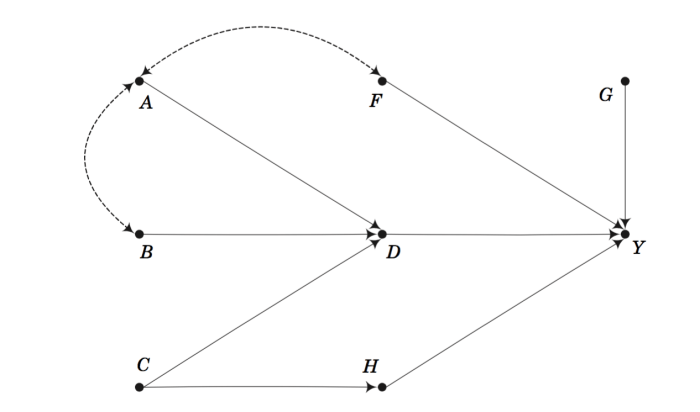
The problem becomes still more complex once one recognizes that the Protestant Reformation was itself the product of economic, social, political and technological changes taking place in Europe. If our counterfactual analysis takes away the Reformation but leaves in place the factors that helped to give rise to it (urbanization, the printing press, political fragmentation, corruption etc.), then it is unclear what the counterfactual actually tells us. This problem can be illustrated by considering a causal diagram of the sort developed by Judea Perle (2000).

Here we are interested in the effect of D (the Reformation) on Y (freedom of conscience). The problem is that if we observe a correlation between D and Y, we don’t know if it is causal. This is because of the presence of A, B, and F. Perhaps these can be controlled for. But there is also C. We can think of C as the printing press.

The printing press has a large role in the success of the Reformation (Rubin 2014). But it also stimulated urbanization and economic growth and plausibly had an independent role in stimulating the developments that eventually gave rise to modern liberalism, rule of law, and freedom of conscience. The endogeneity problem here seems intractable.

Absent some way to control for all these potential confounders, we are unable to estimate the causal effects of the Protestant Reformation on something like freedom of conscience. In contrast to the purely economic questions considered above, we don’t have a good theoretical understanding of the emergence of religious freedom. Counterfactual reasoning only gets us so far.

Historians need economic history (and this means economic theory and econometrics). And economists need historians. They need historians to make sense of the complexity of the world and because of their expertise and skill in handling evidence.

Public choice and market failure: Jeffrey Friedman on Nancy MacLean

Screen Shot 2017-08-09 at 23.25.50

Jeffrey Friedman has a well-argued piece on interpreting public choice in the wake of Nancy MacLean’s conspiratorial critique of one of its founding theorists, James Buchanan. While agreeing that MacLean is implausibly uncharitable in her interpretation of Buchanan, Friedman suggests that many of Buchanan’s defenders are themselves in an untenable position. This is because public choice allows theorists to make uncharitable assumptions about political actors that they have never met or observed. In this sense, MacLean is simply imputing her preferred own set of bad motives onto her political opponents. What is sauce for the goose is good for the gander.

I think Friedman’s arguments are a valid critique of the way that public choice is sometimes deployed in popular discourse. A lot of libertarian commentary assumes that those seeking political power are uniquely bad people, always having self-interest and self-aggrandisement as their true aim. Given that this anti-politics message is associated with getting worse political leaders who are becoming progressively less friendly to individual liberty, this approach to characterising politicians seems counterproductive. However, I don’t think Friedman’s position is such a good fit for Buchanan himself or most of those working in the scholarly public choice tradition.

Continue reading