When Russia invaded Ukraine a few short weeks ago, some people began to worry that China might try to do the same thing with Taiwan. I didn’t worry about this myself, as China is mostly a paper tiger, but also because the US has close military ties with Taiwan. Taiwan has close economic relationships with several wealthy democratic states in East Asia, too. Contrast this geopolitical context with Ukraine, and the parallels, while tempting, do not add up.
The whole debate and worry over Taiwan got me thinking again about federation as a libertarian foreign policy. Why shouldn’t Taiwan just join the United States? Here are the most common objections to such a federation:
Geography. This is probably one of the strongest cases against Taiwan joining the US, since it’s so far away from not only the mainland but Hawaii, too. Aaaand it’s just off the coast of China, which would likely cause friction with the regional power were Beijing to suddenly find itself neighboring a transoceanic republic.
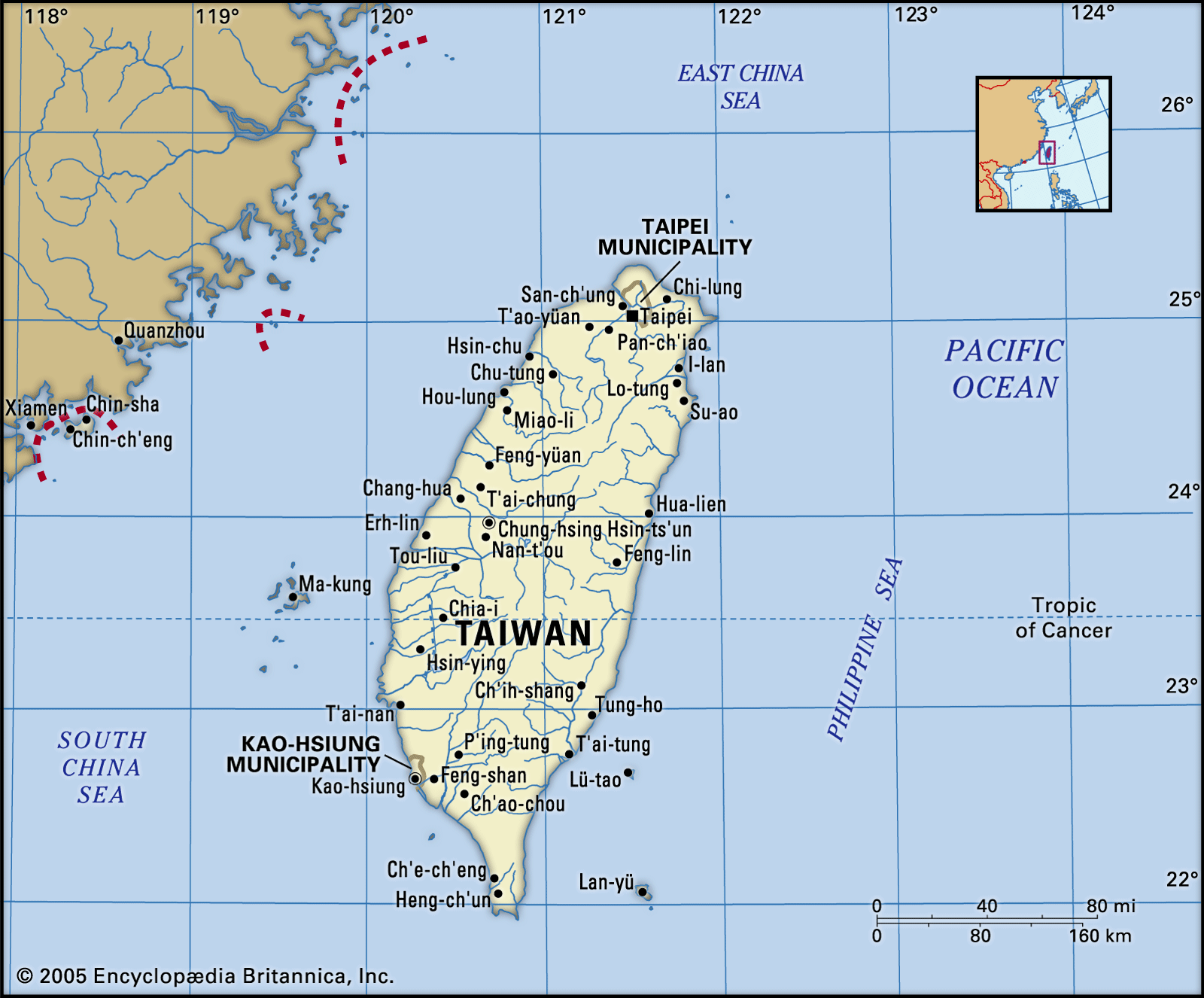
This is all much ado about nothing. A plane ride from Dallas to Taipei is 14 hours if you take out the layovers. Somebody living in Kaohsiung could send me an email after reading this essay and I could access it within minutes. Geography still matters, but its not an insurmountable barrier to a freer, more open world via the federative principles of the United States constitution.
Culture. A big complaint I see about adding “states” to the American republic is “culture.” Fellow Notewriter Edwin does this all the time, and it can make sense, on the surface, in some cases, but not in Taiwan’s, and not in the Indo-Pacific more generally.
Look at Taiwan’s 2020 presidential election results:
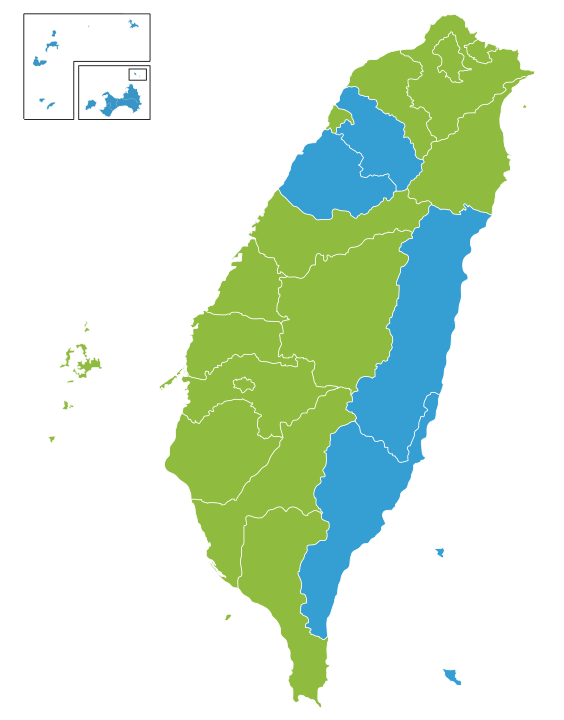
Look familiar? There’s only two colors. It’s a contest between a left-wing and right-wing, and both wings are committed to, and bound by, liberty and democracy. There are no “ethnic” parties, no “religious” parties, and no radical parties, mostly because Taiwan has the same electoral system as the US does: a “first-past-the post” one. So the cultural angle is even weaker than first imagined. Taiwan started out as a nationalist holdout against the Communist Party, but today nationalism doesn’t carry a whole lot of weight. Adding Taiwan to the republic would be like adding another California or Hawaii, albeit with more conservative votes. It’s plausible that adding Taiwan would give Democrats two more reliable seats in the senate, but this is merely cause to invite a polity that would reliably vote Republican to also join the United States.
Self-determination / cultural autonomy. There’s an argument in some circles that joining the US would be akin to losing self-determination and even cultural autonomy. I don’t see how any of this could be true. Even today, people in American states retain a “state-centric” identity when it comes to thinking about their place in the US. That Taiwanese would be able to add “American” to a plethora of other identities already at their disposal could only be a good thing.
China. Would China fight a war against the US over Taiwan statehood? Maybe, but given Russia’s poor showing in Ukraine, the war would end quickly, at least from a Taiwanese statehood perspective. The CCP’s military has no fighting experience, unproven tech, unproven hardware, and…no fighting experience. The worst that would happen, I think, is that the CCP threatens war, maybe sends some warships to the strait, maybe fires some rockets over the island and flies some fighter jets over the island, but that’s about it. The CCP just doesn’t have the muster to fight a war against the United States over Taiwan.
These four objections are so common that I can’t help but be exasperated by their banality, especially given the rich tradition of republican security theory and federalist thought over the past three or four thousand years. There are two reasons for Americans, and especially libertarians, to support Taiwan’s federation with the US:
The free riding problem. The first thing that all libertarians complain about when it comes to “foreign policy” is the free riding problem. This is a problem in political economy where agents will enjoy the benefits of a policy at the expense of other agents who are required to bear the costs. Libertarians aren’t wrong to complain about the free riding problem. It’s a big problem. Think of a Russian attack on NATO ally Lithuania.
Taiwan has a fairly hard guarantee of US military support were the Communist Party of China to attack it. This, the argument goes, allows Taiwan to be a bit more reckless than it otherwise would be when dealing with Beijing. Therefore, according to non-interventionists, the US should simply stop guaranteeing Taiwan’s military security and just trade with the people of the island instead. It would be an awful scenario to face were Taiwan to goad China into attacking it and thus draw the US into a war with China.
Federating would end the free riding problem once and for all. Taiwan’s citizens would be American citizens. They would benefit, and pay the costs, associated with such citizenship.
Sovereignty. Taiwan is not a sovereign nation-state, as China has blocked all of the island’s attempts to become so, and it never will be so long as nation-state status depends upon recognition by large states such as Russia and China (as well as the US). This actually makes it easier for Taiwan to join the republic. The American senate is a tool of international diplomacy that was utilized to bind independent states together in a federal union by trading their sovereignty for seats in a powerful upper house of Congress. Taiwan wouldn’t have to go through the arduous process of debating whether or not its sovereignty is worth the price of admission into a North American federal order, because its status as a Westphalian sovereign nation-state is non-existent.
By incorporating Taiwan into its federal order, the US could revamp the liberal world order, and it could do so by adhering to the principles which made it a beacon for liberty in the first place.

 Notes On Liberty