Socialism(s) – Part Two

Sweden’s Imaginary Socialism as a Non-Model

Part One of this essay was posted a couple of days ago. In it, I reviewed some of the avatars and zombies of the vague words “socialist” and “socialism.” I arrived at the inescapable conclusion that Sen. Sanders “democratic socialism” means only Scandinavian and, specifically, Swedish “socialism.” I look at that social and fiscal arrangement below.

First, let me say that Sweden is a good place to live; it’s a very civilized country. I just don’t know in what sense it’s “socialist.” Center-left parties took part in governing the country for most of the 20th century, true. Yet, little of Swedish commerce or industry is nationalized, or in any way public property. The Swedish government tends not to be invasive with regulations or direct intervention. Sweden even ranks a little higher than the US in “business freedom” on the 2016 (international) Index of Economic Freedom. Swedish companies are thriving, at home and abroad. Swedish capitalism is obviously alive and well.

I suspect that what confused Sen. Sanders and those of his supporters who have even thought about it is that the Swedish government offers extensive and high quality services to its citizens, many of which services that would belong to the private sector in other advanced societies. Let me say it again because this is an important point: The Swedish government is a quality service provider. But Swedes pay for these services with very high taxes. Swedish workers, on the average receive less than 50 of the income they earn. Careful: micro aggression coming. This is to me an unbearable negation of personal freedom, no matter how high the quality of services Swedish citizens receive “in return.”

Thus, even in moderate, impeccably democratic Sweden, “socialism” proves to be liberticide, it blocks on a massive scale and routinely the realization of individual wishes, the pursuit of happiness, in other words. To take an example: Those Swedes who would rather earn less money and spend more time reading philosophy, for example, practically are prevented by high taxes from even trying lest they starve. Incidentally, the share of GDP taken by Swedish taxes has been declining since the 90s. It would make sense for socialist Sen. Sanders to ask why. Hint: This decline was accompanied by a strong rise in GDP growth.

Sweden is a well managed capitalist welfare state. It would have been more ingenuous for Sen. Sanders to say this clearly rather than drag out the soiled word “socialism.” This assumes that he knows the difference, of course. His followers evidently do not.

I want to make a detour here about Swedish income inequality because inequality is a topic dear to Sen. Sanders’ supporters. As you would expect, and as is intended, Sweden has one of the lowest income inequality on Earth (Gini Index: 0.25 vs the US about 0.44). However, its wealth inequality is very high (Gini Index: 0.85). This curious divergence is compatible with several scenarios including this alluring possibility: Socialist-inspired schemes designed to procure income equality had the effect – probably unintended – of freezing wealth disparities to where they were before “socialism.” It’s almost impossible to get ahead from near the bottom of the economic ladder when your income is seized before you even see it. For one thing, high taxes make it difficult or impossible to accumulate capital to create a new small business and therefore, new jobs. In other words, in many years of Swedish socialism, the restaurant waiter remained a restaurant waiter, the local Rockefeller remained Rockefeller, while the former was earning $12/hour and the latter only $24 (figures made up). As I said, other scenarios can account for divergence between income inequality and wealth inequality. Play at imagining them. Good luck.

Whether or not one considers the objectives of Swedish-style “democratic socialism” desirable, there are considerable obstacles in the path of realizing it in America. Sen. Sanders and his followers semi-consciously assume that given the right legislation – not to forget far-reaching executive orders since the path has been open by President Obama – the United States could be turned into a kind of Sweden. There are three-plus things about American society that make this dream unrealistic.

First, until right now, Sweden was a thoroughly middle-class society. I mean by this that nearly everyone, except for a few skinheads, shared an understanding of the good life, and the same ethical system. We, in the USA, by contrast have a whole Third World inside our boundaries. I refer, of course, to all of Louisiana, to Chicago and its suburbs, to some parts of Texas and New Mexico, and to nearly all black inner-city ghettos. (Read carefully: I did not say “predominantly black areas.”) Third World conditions breed predatory behavior. That makes the job of civil servants difficult. It also sucks up public resources for policing.

Second, and at the risk of breaching the etiquette of political correctness, Swedish society if fairly restrained as compared to most others, certainly as compared to American society. It’s a collective trait. It does not mean that most Swedes are restrained but that many Swedes are. I mean by this, for example, that on the average Swedish drunks are more polite, less noisy and less dangerous than American drunks. Collective restraint makes all government functions easier to perform obviously.

Third, Sen. Sanders assumes implicitly that given a victory, his administration would easily generate the first-class federal civil service that makes the Swedish welfare state function effectively and smoothly. That is an unrealistic assumption. Think the IRS, of course, and TSA (that’s never caught a terrorist ever, or ever stopped a terrorist action). Think of the Bureau of Alcohol, Tobacco, Firearms, and Explosives that generously donated hundred of firearms to Mexican drug cartels. Think of the Environmental Protection Agency that declared CO2 – the main plant food – a noxious gas subject to its regulation. I could go on.

Good civil services are rooted in a broad social  tradition whereas smart, well-educated people chose careers in government in preference to a business career. There is no such American tradition. It would take many years of bad private employment before preferences of such individuals would shift away from business. Here is the question: can so-called “socialist” policies be implemented so quickly in America that private employment will worsen soon enough to serve the requirements of a quality civil service necessary to the implementation of the same-self “socialism”?

I must add a fourth obstacle to the success of Swedish style welfare state in the US, one that I don’t necessarily believe in myself. Swedes and also Danes keep telling me the following: Their form of welfare “socialism” involves a high degree of forced sharing. The acceptance of such taking from Peter to give to Paul is well served by the fact that Paul is a lot like Peter and even looks a lot like him. According to this view, the high population homogeneity of Sweden until now is a necessary condition to the confiscatory taxes imposed on ordinary wage earners that is at the heart of its “socialism.” Needless to say, the US population is low on homogeneity (a fact I celebrate myself).

So, a gifted, honest, competent civil service is central to the welfare capitalist supposedly “socialist” Swedish model (which the Swedes themselves explicitly do not propose as a model). My unavoidably subjective judgment is that a United States Sanderista civil service would, with some effort, with much reform, place somewhere between the French and the Brazilian. To think otherwise is the height of ignorant wishful thinking bordering on hubris.

I am not hugely alarmed at the prospect of a new American capitalist welfarism though, for the simple reason that we are already half-way there. Sen. Sanders’ more-of-the-same would not be Armageddon. It only promises an accelerated decline of this vibrant, inventive, culturally brilliant society accompanied by more short-term equality, less equity, and more poverty- and therefore less freedom – for all.

PS Incidentally, I am not much opposed to Sen. Sanders’ proposal to make state universities and college tuition-free. I think the proposal has the same justification as publicly supported elementary and secondary schooling. I would be willing to bet such a measure would have the same overall beneficial economic results as the GI Bill did right after WWII. Finally, there is just a chance that government management would put a brake on the unconscionable rise in the cost of tertiary schooling, of what universities charge without restraints. It’s not as if the current system that largely separates the decision makers from the payers, from the beneficiaries, has worked really well!
A depressing take on inequality

Recently, I reviewed Unequal Gains (Princeton University Press) which is basically the magnum opus of economic historians Peter Lindert and Jeffrey Williamson. In the pages of Essays in Economic and Business HistoryI survey the history of growth and inequality in the United States since 1700 that they portrayed in their book.

Coming out of their book, I could not help feel depressed and simultaneously vindicated in my classical liberal outlook of the world. While they avoid the Pikettyesque tendency to create “general laws” of inequality, their results suggest that inequality has risen in spite of massive government intervention since the 1920s.

To be clear, Unequal Gains is probably the best book you can get on understanding the dynamic of inequality. Although I am biased in their favor since both authors have given me great help in my academic career, the book should overthrow Capital in the 21st century as the reference work on inequality. Throughout the book, they use normal economic theory to explain why inequality increased or decreased (discrimination, capital flows, immigration, changes in labor force participation, urbanization, relative factor scarcities, uneven supply shocks, changes in returns to human capital, regional income differences). They constantly eschew general laws. From the book, we should understand that inequality is context-specific. Like a recipe, difference mixes of the ingredients of inequality will yield different courses. This is the main strength of the book (plus the tons of data).

And this is also why it is depressing. The vast majority of inequality before 1910 in the United States would have been the result of market forces (immigration, urbanization, capital flows, relative factor scarcities, regional income differences) and not of governmental decisions. I believe that the pre-1910 level of inequality is sensibly overestimated and that, while not gigantic, government policies did have a non-negligible role in raising inequality. Nonetheless, most of these inequalities are hard to judge negatively. More immigrants from poor Italy may depress (I do not agree with that claim, but people like G.Borjas of Harvard could make this claim) wages in the United States in 1900 and increase inequality, but the migration of the Italian to America leaves no one worse off while improving the living standard of the Italian migrant. Urbanization, as part of the industrialization, is a hard process to fault and criticize. So, inequalities before 1910 are simply an issue of explaining their levels and trends.

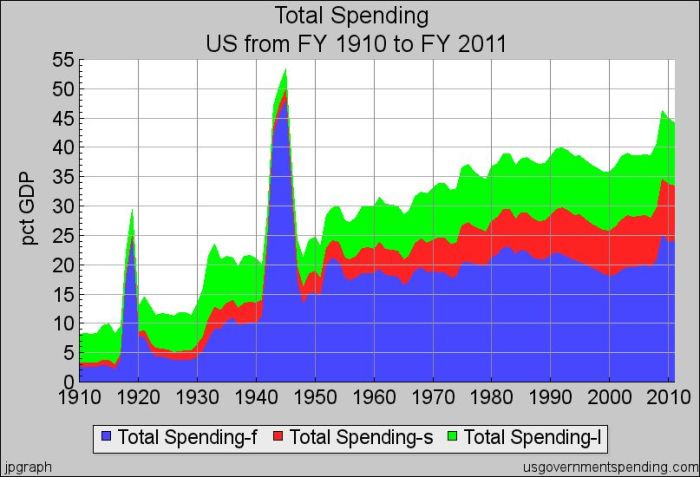
After 1910 however, there is what Lindert and Williamson call the “great leveling” where there is an important decrease in inequality which ends in 1970. This is where I become depressed. In my paper, I highlighted that most of the fall in inequality between 1910 and 1970 occurs because or regional convergence, gender wage convergence and racial wage convergence. Between the 1910s and 1970s, differences in per capita state-level incomes narrowed dramatically (and they have since slightly widened). Between 1910 and 1970, thanks to the migration of blacks to the north, wages between whites and blacks grew closer together. Between 1910 and 1970, thanks to the arrival of household amenities like running water, appliances and electricity, women joined the labor force and the gender wage gap narrowed. None of these factors have anything to do with redistributive policy. Now, I am not claiming that redistributive policy had no impact on inequality measures (that would be empirically false). What I am claiming is that numerous forces were at play – some of which were related to non-governmental factors. Between 1910 and 1970, if one looks at ratios of government spending to GDP, there is a massive increase in the size of government. And yet, many factors of convergence had little to do with government.

08-government-debt.jpg

Since the 1970s, inequality has surged again – and this is in spite of the fact that governments are growing larger in many respects. While spending is at all levels seems to be either stable or growing, regulatory barriers like licensing regulations and rent-seeking arrangements in the form of corporate bailouts have multiplied. Thus, the rise of inequality occurs in spite of a very active state. Not only that, but I am working on papers with John Moore of Northwood University to study inequality from 1890 to 1940 because we believe that the level is overestimated and misunderstood and (by definition) that this affects the trendline of inequality in the 20th century. If inequality in the 1920s falls slightly, the U-shaped curve of inequality (very high before 1910 falling to 1970 and increasing thereafter) described by Piketty and others becomes a flatter upward slopping curve (maybe more like a J-shaped curve). If me and John are correct (we are still crunching numbers and collecting data) inequality increased with state intervention.

And that is highly depressing. Now, I am a classical liberal who believes that state intervention should be limited. But it is not beyond to recognize that when the state throws tons of money of something, it might get a few things the way it wants (a broken clock is still right twice a day). Thus, I expected some social programs to have an impact (and I still believe that on a case-by-case basis, some social programs do reduce inequality) but I did not expect such a disappointing performance. One could even say “depressing” performance.

Nonetheless, I would suggest to everyone to read Unequal Gains and throw out Capital in the 21st century. 

Note: To be clear, Lindert and Williamson are not making the claim I am making here. While their book is predominantly a “positive economics” work, they do propose some policy courses to reduce inequality and argue favorably for redistributive policy. This is merely my “positive take” on their book.

Can we use tax units to measure living standards?

In the debate on inequality, I am a skeptic of how large a problem the issue is. Personally, I tend to believe that worries of inequality only increase when growth is stagnant. In fact, I also believe that there are numerous statistical biases causing us to misidentify stagnation as rising inequality. Most of the debate on inequality is plagued with statistical problems of daunting magnitudes (regional convergence in income, regional price levels, demographic changes, increasing heterogeneity of preferences, increasing heterogeneity of personal characteristics, income not being purely monetary, the role of taxes and transfers etc.)

One of them centers around the use of tax data. This has been the domain of Thomas Piketty and Emmanuel Saez. I can understand the appeal of using tax data since it is easily available and usable. Yet, is it perfect?

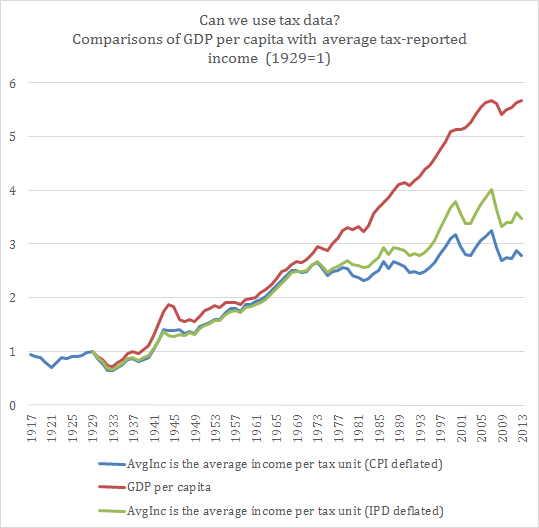
A year or two ago, I would have been inclined to simply say “yes” and not bother with the details. Theoretically, taxes should be an “okay” proxy for the income distribution and should follow average income even if at different levels. Yet, after reading the article of Phil Magness and Robert Murphy in the Journal of Private Enterprise I confess that I am no longer accepting anything as “granted” in the inequality debate. So, I simply decided to chart GDP per capita with the average taxable income per tax unit. Just to see what happens. Both are basically averages of the overall population, they should look pretty much the same (theoretically).  The data for the tax units is made available in the Mark W. Frank dataset based on the Piketty-Saez data (see here) and I deflated with both the CPI and the implicit price deflator available at FRED/St-Louis.

The result is the following and it shows two very different stories! Either the GDP statistics are wrong and we have average stagnation (which does not mean that there is no increase in inequality) or the taxable income data is wrong in estimating the trend of living standards and the GDP are closer to reality (which does not that there is no increase in inequality).  In the end, there is a problem to be assessed with the quality of the data used to measure inequality.

Tax Data

Basic income: a debate where demand magically disappears!

For a few months now, the case for the basic income has resurged (I thought it died with Milton Friedman in 2006, if not earlier). In the wake of this debate, I have been stunned by the level of disconnect between the pundits and what the outcome of the few experiments of basic income have been. The most egregious illustration of this disconnect is the case of the work disincentive.

To be clear, most of the studies find a minor effect on labor supply overall which in itself does not seem dramatic (see Robert Moffitt’s work here). Yet, this is a incomplete way to reflect on the equilibrium effect of a massive reform that would be a basic income.

Personally, I think that there is a good reason to believe that the labor supply reaction would be limited. At present, many tax systems have”bubbles” of increasing marginal tax rates. In some countries like Canada, the phasing out of tax credits for children actually mean that the effective marginal tax rate increases as income increases from the low 20,000$ to the mid 40,000$. As a result, a basic income would flatten the marginal tax rate for those whose labor supply curve is not likely to bend backward. In such a situation, labor supply could actually increase!

Yet, even if that point was wrong, labor supply could shift but without any changes in total labor provided. Under most basic income proposals, tax rates are dropped significantly as a result of a reduced bureaucracy and of a unified tax base (i.e. the elimination of tax credits). In such a situation, marginal tax rates are also lowered. This means greater incentives to invest (save) and acquire human capital. This will affect the demand for labor!

A paper in the Journal of Socio-Economics by  Karl Widerquist makes this crucial point. None of the experiments actually could estimate the demand-side reaction of the market. Obviously, a very inelastic labor demand would mean very little change in hours worked and the reverse if it was very elastic. But what happens if the demand curve shifts? Widerquist does not elaborate on shifts of the demand curve, but they could easily occur if a basic income consolidates all transfers (in kind and conditional monetary) allows a reduction in overall spending and thus the tax take needed to fund activities. In that case, demand for labor would shift to the right. A paper on the health effects of MINCOME in Manitoba (Canada) shows that improvement in health outcomes are cheaply attained through basic income which would entail substantial health care expenditures reduction.

I have surveyed the articles compiled by Widerquist and added those who have emerged since. None consider the possibility of a shift of the demand curve. Even libertarian scholars like Matt Zwolinski (who has been making the case forcibly for a basic income for sometime now) have not made this rebuttal point!

Yet, the case is relatively straightforward: current transfers are inefficient, basic income is more efficient at obtaining each unit of poverty reduction, basic income requires lower taxes, basic income means lower marginal tax rates, lower marginal tax rates mean more demand for investment and labor and thus more long-term growth and a counter-balance to any supply-side effect.

I hope that the Bleeding Heart Libertarians will take notice of this crucial point in favor of their argument!

Around the Web

  1. Criminal defense attorney Ken White has the most thoughtful take on the recent SCOTUS ruling that pit Clarence Thomas against Antonin Scalia
  2. Ayn Rand versus evolutionary psychology. Economist Bryan Caplan explains why Ayn Rand was wrong
  3. Why were American Economics textbooks so Pro-Soviet? A great question from Caplan (again)
  4. Inequality: Haven’t we had this discussion before? Economist Peter Boettke, a specialist in the history of economic thought, asks the question
  5. Remembering Why Hayek Mattered. A political scientist from Princeton, Keith Wittington, provides a great example

Inequality

President Obama’s signature achievement is in shambles. He believe himself that it cannot be saved. He is going for left-radical broke. Today he denounced “inequality.”

I am not sure younger people have the sophistication to realize that there are thousands of ways to measure inequality and that, therefore, you can always find one that serves your political purpose.

I don’t know how many could tell me what’s wrong with inequality.

By the way, I am far from rich myself, although I have worked all my life, not very hard, it’s true. (Did you notice how I often give you the answers to the questions I raise?)

“The Fastest Race Ever Run”

That’s a headline piece from the Economist. An excerpt:

Nate Silver, a blogger for the New York Times and sports statistician, points out that only five world records in track and field were broken in Beijing out of 47 events. Even that was a decent tally: the previous four Olympics saw a total of just seven new world bests, compared with a whopping 22 world records in swimming. Mr Silver attributes this disparity to economic inequality. “An athlete with the perfect swimmer’s build,” he writes, “and a world-class work ethic would still stand little chance of competing in this year’s games if he happened to be born in a poor nation like Cameroon or Panama—he might never have gotten into a pool, let alone an Olympic-size one.”

Running, in contrast, is more democratic […]

Read the rest here. I’m not a big fan of the Olympics, just because of the nationalistic impulses it taps into. Why shouldn’t these sports become completely separated from the state?

With that obligatory libertarian statement out of the way, I can’t help but admire the feats accomplished by some of these athletes. A lot of hard work goes into training for the Olympics, and I think that pushing the state out of the way would help to reduce the obvious inequalities associated with national competitions. Did anybody see the US basketball team play Nigeria?

If sports were separated from the state we’d see more games like the NBA: very competitive, cosmopolitan and lucrative (unlike the bloodbath between the US and Nigeria).

Anyway, I like it when individuals from poor states win big in the Olympics. Nothing like seeing an underdog win, especially an underdog with a name like Usain Bolt!

Update: I spoke too soon about the level of competitive play at London’s basketball tourney. Check out this piece in Grantland about the semis between Spain v. Russia and the US v. Argentina. And ESPN has a brief recap of the Russia v. Spain game. I’ll keep my eye out for a more passionate recap, though. Spottieottiedopalicious!

Update 2: Spain’s leading daily newspaper, El Pais, reports on the game with Russia. The Russian press spilled a lot of ink on their team’s quarterfinal win over Lithuania, and not so much ink on their semifinal loss to Spain…

What? You don’t surf with Google’s Chrome browser? I hope you have fun looking for some sort of translating software instead having Chrome do it for you on the spot…