UK considering long prison terms for file sharers

https://torrentfreak.com/uk-considers-throwing-persistent-internet-pirates-in-jail-140123/

Up to ten years in fact.  While there is debate in the libertarian community over intellectual property laws I think that I would be hard pressed to find many libertarians that think downloading a movie should put an “offender” in prison for a similar amount of time as stealing a car. 
 

David Theroux’s latest on Secular Theocracy, Part 2

Duck Dynasty and the Secular Theocracy, Part 2

Part 1 can be found here. For more Secular Theocracy as a concept, start here. David founded the Independent Institute, a highly-regarded think tank in the San Francisco Bay Area. In the summer after my first semester of college (2009; I started college in Feb of 2009 after hanging out in Ghana – long story!) I had the opportunity to attend the Independent Institute’s summer seminar for students.

In fact, that summer I attended four seminars put on by various libertarian think tanks and the Institute’s was the first of the summer. I really, really enjoyed it and was able to make some lifelong connections. For example, Dr Foldvary – the co-founder of this blog – was one of the lecturers there. Here is the Institute’s main web site.

Frihet eller rättvisa?

På sjuttiotalet formulerade Robert Nozick ett argument mot så kallade ”rättvisa resursfördelningar”, alltså politiska åtgärder som tar från en person och ger till en annan för att samhället ska uppnå ett mer rättvist resursinnehav. Argumentet har sedan slipats på av bland andra Eric Mack och lyder nu ungefär såhär.

Anta ett samhälle där privat egendom finns och får säljas, köpas eller bytas helt fritt, men först efter att den har arrangerats om politiskt enligt ett visst fördelningsschema. Fördelningsschemat kan vara exempelvis att alla får precis lika mycket eller att en andel tas från de rika och ges till de fattiga. Du, läsaren, får välja vilket slags fördelningsschema som ska användas och bestämma alla dess detaljer. Oavsett hur det ser ut ska det vara avsett att generera ett rättvist tillstånd av resursinnehav som kallas för D1.

Säg nu att detta fördelningsschema genomförs så att tillstånd D1 råder. Säg också att invånarna i samhället efter fördelningen byter resurser med varandra för att på egen hand uppnå ett tillstånd de själva föredrar. Müsli byts mot corn flakes. Kvällsskift byts mot lördagspass och en hundralapp byts mot åtta folköl. En duktig basketspelare erbjuder en halv miljon människor att komma och se henne spela för bara tio kronor per person och tillfälle, och blir därmed mycket rikare än de flesta andra i samhället. Saker och ting byts helt enkelt så att alla blir lite mer nöjda än vad de var tidigare. Det tillstånd som uppnås av att folk frivilligt byter saker med varandra kallas för D2.

Resursinnehavet i tillstånd D1 var rättvist. Det har uppnåtts genom det fördelningsschema som du, läsaren, själv har valt. Men D1 strider med D2, vilket var tillståndet som invånarna föredrog. Eftersom D1 är rättvist kan inte D2 vara det, för då hade du valt D2 redan från början när du utformade ditt fördelningsschema. Vad är det med fri byteshandel som medför orättvisa från D1 till D2?

Argumentet fångar någonting om essensen i marknadsekonomin. Först och främst är dess enkelhet en fingervisning åt svårigheten i att på politisk väg skapa ett ”rättvist” tillstånd. Den som bestämmer måste fördela resurserna så bra att ingen längre vill byta någonting (vilket socialismens kalkyleringsproblem visar är väldigt svårt, eller helt omöjligt). Men framför allt visar argumentet att ett fördelningsschema som är avsett att uppnå rättvisa är oförenligt med frihet. Om människor använder sin frihet till att byta saker med varandra rubbas det du kallar för rättvisa. Ett samhälle kan alltså inte ha både frihet och ett ”rättvist resursinnehav” samtidigt.

Läs mer:

  • Robert Nozick, Anarchy, State, and Utopia, kapitel 7, sektion 1
  • Eric Mack, ”Self-ownership, Marxism, and Egalitarianism”, Politics, Philosophy & Economics, vol. 1, no. 1, 2002

Is free trade an expediency?

Jacques Delacroix makes an odd argument over at his blog Facts Matter:

Free trade is not a moral principle, it’s an expediency; violating the principle just costs money.

This argument comes after he admits that he would be very, very open to protectionism because of Mexico’s recent decision to denationalize its oil and natural gas industries.

Before I continue, who does Dr Delacroix think would benefit from a protectionist union with the United States?

Would he really advocate denationalizing the Mexican energy sector simply to force resources north of the border through a protectionist union? This seems to be the implication of his argument. If expediency is indeed Dr Delacroix’s excuse for free trade, then he automatically loses the argument to mercantilists (what, for example, sounds more expedient to you: A nationalized energy sector or free trade?).

It is precisely because of this automatic defeat that an 18th century moral philosopher (Adam Smith) decided to write a book on the moral superiority of free trade over protectionism (The Wealth of Nations). At its core, free trade is about the freedom of the individual to do what she pleases so long as no force nor fraud is involved. Once this underlying moral argument is understood, free trade can easily be seen as the natural outgrowth of such a philosophy.

Here is something to look out for as you read arguments put forth in the press: The moral argument. If an argument claims to have no moral underpinning it doesn’t mean there is no moral underpinning. It just means that the proponent of a said argument does not care for opposing or alternative arguments.

Ugh, this is getting convoluted so let me see if I can use an example. Suppose a politician or an academic is making an argument in favor of a policy (the policy itself is irrelevant). Suppose the proponent of this policy argues that the best reason to show support for his policy is because it will make everybody better off (it doesn’t matter how). Suppose further that this politician or academic claims that his policy is expedient rather moral, and that this in and of itself is one of the policy’s main features.

Would you support it?

Because throughout history most people have. This support is why we see a stagnation – of incomes, of years lived, and of innovation – for thousands of years in human history. The impact on mores that the expediency-over-morality outlook had on humanity can also be reflected in our utterly violent past.

I point out the difference between arguing from a moral standpoint and arguing from an expedient one because of the consequences that each of these approaches tend to produce. For example, Dr Delacroix also advocates military adventurism abroad in the name of expediency rather than morality. Can you guess why he still defends the actions of the Bush administration? But the Iraqis held elections, right guys? Right?

The moral thing to do – secure the lives and liberties of individuals first and foremost – is usually also the hardest thing to do, especially when people continually wave expedient choices in the faces of those who must choose. Yet I think that when and where this simple moral principle is able to gain a foothold in the minds of enough people, the rewards are ample.

Speaking of rewards, the ‘comments’ section at Dr Delacroix’s blog is currently inundated with speculation about whether or not Santa Claus was (was) really white-skinned. One reaps what one sows, after all!

The Pope, Capitalism, and los Yanqis

Below is a comment that seems to me to be missing about Pope Francis’ current grasping for the Nobel in Economics. It’s beyond the simple observation that what he said recently about capitalism re-affirms the simple fact that princes of the church want to do good but have not understood simple economics, ever. And, by the way, there is nothing new to what the Pope said. I heard the same when I was growing up in a progressive Catholic parish in Paris, a long, long time ago. (And no, I was not molested, except by that older girl-scout, another story obviously.)

The current pope is a member of the Jesuit order. In the Catholic world, the Jesuits enjoy a reputation for intellectualism. It’s true that almost all have advanced degrees. (This pope appears to be an exception.) It’s also probably true that the many schools the Jesuits run, including universities, are not allowed to fall below a certain minimum level of competence. Beyond this, 25 years of close observation tell me that their good reputation only holds in a relative sense. Only the widespread ignorance of the Catholic church and of its other religious orders makes the Jesuits look good. They are quite tightly wrapped in their prevailing ideology and largely blinded by it. That ideology happens to be left wing right now. (Jesuits used to be fierce right-wingers of the most ignorant, closed-minded kind.) I don’t expect any Jesuit to be an intellectual giant although a few are.

The Pope is also an Argentinean, a provincial Argentinean. He did not suddenly free himself from the associated intellectual burdens upon his election. Like many, nearly all (I have not done a count, I confess, Your Holiness) of his compatriots he has had to struggle all his life with the following question:

Why isn’t Argentina Canada, with a constant high level of prosperity and political institutions that guarantee stability and peaceful alternance in power?

A subsidiary question: Why does Argentina become rich every thirty years only to plunge back into poverty?

Confounded by the brutal reality of the fact that there is no response that does not point straight at themselves, Argentinean intellectuals have developed a short, undemanding answer and a long-winded complicated one, both of which hold them innocent of their plight.

The short answer is this: It’s because of los Yanqis.

Of course, there is a problem in the fact that Canada with many more and tighter economic and political links to the US performs splendidly on any measure of economic or social welfare.

I spent a good deal of my scintillating youth debunking the second, long answer to the query described above. They came out of Argentina in the late fifties as a narrative production called “Teoría de la dependencia.” It later morphed into something called “World System Theory” under the influence of an excellent book by an American.

To make a long story short the theories’ main allegations about Third World poverty were that the more economically tied poor countries were to major developed economies, (such as the American economy) the poorer they became. Those allegations finally did not hold up under the scrutiny permitted by computers handling large amounts of archival data. (See my own co-authored piece for example: Delacroix, Jacques and Charles Ragin. 1981. “Structural blockage: a cross-national study of economic dependence, state efficacy and under-development.” American Journal of Sociology. 86-6:1311-1347.) The modern empirical research performed in the US and other part of the English-speaking world utterly destroyed Latin fantasizing in that area.

Pope Francis did not get the news apparently. Few Latin Americans did. Proudly innocent of any understanding of statistics, they cling to their beloved narrative as tightly as they did in 1965. They may cling to it even more tightly than they did then since they tasted the dust of South Korea’s and even of India’s economic development. (I am deliberately not mentioning China’s real development and its fake relationship to “socialism” because I don’t want to have to write another ten pages.) It’s not my fault; the Pope is older than me. He never sat in my classroom or in any of my former students’ classrooms. We never got a chance to straighten him out.

You have to think of every one of Pope Francis’ economic pronouncement with the understanding that he would probably not receive a B in the Econ. 101 class of a good public university. (In a good private university, in a Jesuit university for example, there is a good chance he would be made to achieve a B by any means necessary, including legitimate means.)

I don’t blame the Pope or the Catholic Church much. The old Adam Smith’s The Wealth of Nations (1776) is still esoteric reading to many of our contemporaries, including college graduates, including most college professors, I would guess, including many who tango on in the media. (Just listen to National Public Radio.)

Cell Phones on Airliners?

The FAA recently decided, tentatively, that cell phone use would be OK on commercial airplanes. But forthwith, moans went up from near and far and the FAA backed off. Lots of travelers understandably dread the prospect of captivity to loud conversations by boors seated inches away from them. It’s unclear at this time what the final decision will be.

Why does it never occur to anyone to let the owners of the airplanes decide this issue? They could experiment with various policies ranging from outright bans to unlimited use with all sorts of possibilities in between. Following Amtrak and some commuter railroads that have quiet cars, they could establish a no-talk section of the airplane like the non-smoking sections of yore. Or they could try pleading with talkers. Soon enough they will discover what their customers want and competitive pressures would force all airlines to fall into line.

That sort competitive experimentation works quite well in many market segments, as a moment’s reflection will confirm. So why do we hear nothing about this simple solution for the cell phone problem? Part of the answer, I fear, is that so many people are resigned to letting bureaucrats set the rules for practically all of life. An extreme example of this attitude is the kind of message that appears in my spam folder with a subject like “Obama lowers re-fi rates.” Of course this is nonsense but it suggests that a good many people think Obama has the power to set re-fi rates and worse: that it’s perfectly OK for him to wield such dictatorial powers.

Back to cell phones on airplanes: the whole issue came about as a result of determinations by the FAA technical staff that cell phone signals don’t really interfere with airplane communications as had been feared. That suggests a more difficult question: suppose there were credible evidence that cell phone use really was a threat to airplane communications. Should the FAA be empowered to ban cell phone use? I suggest that it does not. The airlines have an enormous incentive to avoid interference problems. If they were free to make their own decisions about this (again, assuming there was credible evidence of a real problem), their lawyers would be all over them about instituting their own prohibitions. The owners of the control towers (I’m envisioning a privatized FAA) would have strong incentives as well. Many passengers would be aware of the issue and would press for bans.

We have here another example of what a tough job we face, those of us who advocate free markets. The general public, Mencken’s “booboisie” if you will, hasn’t the mental horsepower to envision even modest deviations from the command and control paradigm that is smothering our society.

A (very) Quick Primer on Natural-Rights.

by Adam Magoon

The first step in understanding natural rights theory is to ask a simple but profound question.  Do you own yourself?

Well, let’s start with the definition of ownership.  Dictionary.com gives us “the act, state, or right of possessing something.” Digging deeper we find the definition of possession as “the state of having, owning, or controlling something.” The last part of that definition is key; controlling.  There is a modicum of truth in the old adage possession is 9/10ths of the law.  Nine times out of ten to own something is to control it.

Now getting back to our original question: Do you own yourself?  Well do you control your own body and mind?  We do not need to delve into psychology to answer this question.  I alone can move my arms up and down, I can choose to stand, walk, eat, think, write, create, or to do nothing at all.  I alone am in control over my body.    This is an indisputable fact.  The very act of questioning this fact proves it true; for if you do not have control over your thoughts and actions how could you possibly disagree?

Self-ownership is the cornerstone of libertarian natural rights philosophy and what the libertarian means when he uses the term “natural rights”.

To quote Murray Rothbard: “The fundamental axiom of libertarian theory is that each person must be a self-owner, and that no one has the right to interfere with such self-ownership”

Under this philosophy of self-ownership there are two important subcategories that I will just touch on for further elaboration at another time.

The Non-aggression Principle: is an ethical stance which asserts that “aggression” is inherently illegitimate. “Aggression” is defined as the “initiation” of physical force against persons or property, the threat of such, or fraud upon persons or their property.

This is why the threat of violence cannot be used to negate the concept of self-ownership.  Holding a gun to my head and telling me to raise my arm does not mean you own the right to raise my arm any more than a thief owns the jewelry he stole.  Ownership cannot be transferred through violent means.

And the concept of homesteading which is best explained by John Locke:

“[E]very man has a property in his own person. This nobody has any right to but himself. The labour of his body and the work of his hands, we may say, are properly his. Whatsoever then he removes out of the state that nature hath provided, and left it in, he hath mixed his labour with, and joined to it something that is his own, and thereby makes it his property. It being by him removed from the common state nature placed it in, it hath by this labour something annexed to it that excludes the common right of other men. For this labour being the unquestionable property of the labourer, no man but he can have a right to what that is once joined to. . . .

He that is nourished by the acorns he picked up under an oak, or the apples he gathered from the trees in the wood, has certainly appropriated them to himself. Nobody can deny but the nourishment is his. I ask then when did they begin to be his? . . . And ‘tis plain, if the first gathering made them not his, nothing else could. That labour put a distinction between them and common. That added something to them more than nature, the common mother of all, had done: and so they become his private right. And will any one say he had no right to those acorns or apples he thus appropriated, because he had not the consent of all mankind to make them his? . . . If such a consent as that was necessary, man had starved, notwithstanding the plenty God had given him. We see in commons, which remain so by compact, that ‘tis the taking part of what is common, and removing it out of the state Nature leaves it in, whichbegins the property; without which the common is of no use”

Very quickly I will also mention a couple of the more common arguments that arise when natural rights are discussed.

First, natural rights do not extend from god or any other supernatural or theological forces.  They are based on rational and philosophical thought.  They are what is known as an “a priori”  argument.  To put it simply, natural rights are a logical deduction based on a number of easily recognized facts, primarily the concept of self-ownership.

Second, governments do not, and indeed cannot, grant any rights that natural rights have not already granted.  Let’s look at a current event that everyone always seems to think about backwards; the legalization of drugs for personal consumption.  Because of the right to self-ownership each and every individual already has the right to do whatever they choose with their own body as long as they do so with their own property and do not violently harm others in the process.   Even if the U.S. government “legalized” the use of drugs tomorrow, they are not granting anyone the right to do drugs, they are merely removing their own restrictions on something that is already a right.   The idea that law comes from the state is known as ‘legal positivism’  and proponents are hard pressed to defend actions such as slavery and extermination that were made legal by many nations throughout the course of human history.


Recommended Reading:

http://mises.org/rothbard/ethics/ethics.asp

Equality and Fairness

Yesterday, President Obama gave a stirring speech on income inequality and he declared war on it. The President is a rich man who was abandoned by his drunken immigrant father. He was brought up by his hippie mother. She had a doctorate. It took her twenty years to earn it. (I don’t mean to say that she was idle during most or any of these twenty years.)

I am an immigrant myself. I came to this country with no money (that’s NO money), no degree, no skill, nothing. (I was white, it’s true, still am.)

(By the way, about half the people with African blood in the US have zero American slave ancestry. Yes, like the president. They are descendants of immigrants like me, people who volunteered to come to this allegedly racist country.)

I have an American doctorate too. It did not take me twenty years.

Fifty years after reaching this country , I live modestly but with no serious wants. And I live in a very desirable place, even by world standards.

I bet you filled in the blank: “Poor guy, poor immigrant worked hard all his life, blah, blah…”

But I didn’t. Nearly every time I found myself at a crossroad, I chose the other path; I selected psychic income over money income; I wanted more free time rather than a bigger car, or a bigger house. Now, does President Obama mean that I should feel bitter toward the other guy in initially similar circumstances who chose the income, who put in fifty hours weeks, and who is now worth several times what I am worth?

Does the President mean that I should be bitter because so many men my age are richer than I am ? Men who live in Cleveland and such?

Does President Obama really mean that I should enlist the services of government to take that other old guy’s money by force to give it to me? And next, will they take from me, equally by force, my golden memories of the three months I spend spear-fishing on the Caribbean coast of Mexico?

That would be fair, or would it?

And do we prefer to live in a society that gives even a poor immigrant the kind of choices I had or in a society where nearly everyone gets about the same regardless of personal preferences?

Is there such thing as Conservative Liberalism?

A friend sent me an email expressing confusion at the idea of Conservative Liberalism, which is apt because it combines two frequently misused words in a confusing way. Let me offer my views/definitions of important political terms to shed some light on this. This post will almost certainly raise more questions than it answers so disagree with me in the comments!

Hayek contrasted conservatism with liberalism and socialism, though a restatement would replace socialism with interventionism. My views are roughly in line with Hayek’s on what these terms mean, with an important caveat (below).

Conservatism is a support for the status quo, and is inherently anti-radical. But that status quo is a historical phenomenon and so conservatism isn’t per se pro- or anti-liberalism. So Conservative Liberalism is possible, just not in America today.

Liberalism is almost synonymous with goodness. It’s a big concept and trying to describe it adequately requires a whole library. All forms of liberalism are essentially concerned with freedom (from the latin Liber, i.e. liberty).

Interventionism is a belief that the government can usefully intervene in society and/or the market. Be that outlawing homosexuality or regulating hotels, this view has a distinctly illiberal flavor, though it’s essentially an orthogonal concept.

Hayek describes these categories as though distinct ideal types and with good reason. There are recurrent divisions along these lines that support thinking of politics in three dimensions, and lead to the formation of three groups (libertarians, conservative Republicans, and liberal [though not classically so] Democrats in the U.S., and similar factions elsewhere). However, I think it makes more sense to think of these as dimensions than ideal types. This adds some vagueness and makes it more difficult to put people in boxes. There can be Conservative Liberals (just not following the last few increasingly illiberal decades), and modern liberals can be understood as being descendant from classical liberal. Ideally everyone would be happy with this vagueness and instead of using labels as short-hand we’d discuss these sorts of things in depth.

But alas, it’s not so easy and even three dimensions is too many for most people, so we’ve got Left and Right wings. Us versus them! Good and evil! Which puts libertarians in the awkward position of not quite fitting in with Democrats on the left or Republicans on the right. I think the Nolan Chart is a step in the right direction. It makes Libertarians (top of the chart!) equidistant from left and right, but not really centrist either. It strips out political labels and gets to the principles at hand. And it’s ahistorical so it leaves room for radicalism and conservatism.

But then we’re left with a tricky situation because we’ve just eliminated an important dimension! And that leads to confusion when we discuss left and right because the ideas aren’t quite as simple as just particular bundles of policies, and that’s especially obvious in a two dimensional graph. If someone asks a libertarian if they’re left or right they should respond “freedom top!” and a neo-con should respond “power bottom!” I view Leftism as being an approach that is radical (i.e. anti-status quo) and Rightism as being pro-established interests. But it isn’t as simple as that either because the historical origins of the terms, and every day practice involves self-identification. The Tea Party is definitely in the Right but their views are typically radical (either radically small-government-liberal, or radically socially-conservative). There are right-wingers who are pro-market (a liberal position) and those who are pro-business (a pro-established interest position)

So what’s the solution? Libertarians would probably like to see an accurate taxonomy that accounts for a wide variety of political and moral dimensions, but left/right has adequate for many for so long. I think the Nolan Chart is a good first step to breaking this false dichotomy, but I also think that using terms like classical liberal is a good choice when it invites conversation with people who aren’t familiar with these ideas. And Conservative Liberalism? It’s a paradoxical term that would also invite discussion, but it’s irrelevant since in the current historical context, the status quo is illiberal.

Debunking the Wage Slavery Myth

By Adam Magoon

It is often stated by those who are ignorant of economics that work is not a voluntary endeavor even when a wage is agreed upon voluntarily by both parties.  The rationale behind this claim is that a human being must eat, drink, and have shelter and therefore the employer has this leverage to use in order to strangle wealth from the poor worker.  In order to examine this erroneous belief we must start as we do with all economic examination with the Robinson Crusoe scenario.

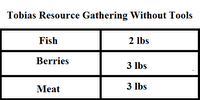
Assume a shipwrecked sailor (Tobias) on an island with no resources but his own two hands and his ingenuity.  To survive he has a number of options:  He can gather fruit/berries for a return of 3 pounds of berries per day, he can fish in the shallows(without tools) for a return of 2 pounds of fish per day, or he can hunt wildlife(without tools) for a return of 3 pounds of meat per day.
wageslavery1

Tobias requires 2 pounds of consumer goods per day to survive.  On this island consumer goods are either Berries, Meat, or Fish and given Tobias’ productive capacity of either 2 pounds of berries or 3 pounds of the other two consumer goods any intake of resources allows him to maintain his existence (subsistence).  It is at this point we must examine whether Tobias’ work is slave labor.

The definition [1] of a slave is:

1.

a person legally owned by another and having no freedom of action or right to property

2.

a person who is forced to work for another against his will

In our scenario is Tobias the property of anyone other than himself?  The answer is clearly “no” since Tobias is quite literally the only person on this island.  While he is “forced” to work due to his innate need for sustenance it would be counter-factual to claim he is somehow a slave to himself since the definitions of slave-master and slave are incompatible with another [2].  It is also absurd to say that because they provide his method of survival that Tobias is somehow slave to the ocean or the land [3].  So as we can see; when Tobias is alone on the island working to survive he is a slave to no one.

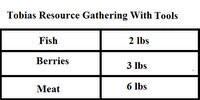
To this point we have been dealing with Tobias merely using his nature given resources to obtain and consume consumer goods.  However by collecting berries or hunting for two days (6pounds collected – 4 pounds consumed) he obtains 2 pounds of excess goods he can save.  Through this method of saving and then consuming the saved goods on the third day he can then use that time to create capital goods.  This means that on the third day, instead of hunting he can fashion himself a spear from collected wood.  The spear allows him to take on larger game and thus increases his collection of meat to 6 pounds per day.

 wageslavery2

At this point we need to examine two things.  First, at this point it would be foolish for Tobias to do anything other than hunt.  He has a decisive gain in resources due to his construction of the Spear and can use the vast amount of saved food to create even more goods (extra spears, traps, shelter, etc…).  As foolish as it may be objectively that diagnosis ignores his subjective valuations; perhaps he finds it distasteful to kill animals even in his situation, or simply prefers to pick berries due to the relative safety.  The reasons are irrelevant, just keep in mind that despite the obvious advantage of hunting in this scenario he can always choose not to.

The second thing we need to examine is whether Tobias is now a slave.  All of the evidence from the previous examination applies; he is still not a slave to himself.  The only thing that has changed is the creation of a spear from the saving of consumer goods.  It is clear that Tobias cannot be a slave to either the spear or his own saved consumer goods, again due to their nature as objects.  So we have seen that a worker working, both with and without capital goods, is a slave to no one.

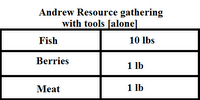
Now here is where the hypothesis comes into question.  Let us assume a second person becomes stranded on the island; except this person (let’s call him Andrew) has been able to scavenge from his wrecked ship a small life boat and netting that is suitable for fishing.  Using his tools while alone Andrew can Hunt for 1 pound of meat, gather 1 pound of berries, or gain 10 pounds of fish.

 wageslavery3

In this economy Tobias will gain the most by hunting and Andrew will gain the most by fishing and they both are likely to pursue those activities [4].  Now we must again identify if this change in circumstance has resulted in slavery.  Tobias’ situation has not changed at all, so he is not a slave to anyone.  Andrew is not interacting with Tobias in any way, he cannot be a slave to his boat, his net, the ocean, or himself so he is also obviously a slave to no one either.

However Andrew soon comes to believe that if he had someone to operate the net while he piloted the boat he could obtain 20 pounds of fish per day, this may be an erroneous prediction but that is the entrepreneurial risk Andrew must take to earn a profit.  For the sake of this examination we will assume that Andrew is an amazing entrepreneur and his prediction is exactly right; but to obtain the 20 pounds of fish Andrew needs an employee.

Here we reach the concept of wages.  In the economy where both Andrew and Tobias work alone they obtain 10 pounds and  6 pounds of consumer goods respectively for a total of 16 pounds.  Andrew, as an entrepreneur, sees that if he employed Tobias they would obtain 20 pounds of total consumer goods which is an increase in the size of their economy by 4 pounds of consumer goods.    At this point Andrew needs to hire Tobias.

If you remember; the subsistence level for Tobias is 2 pounds of consumer goods per day; so any attempt to hire Tobias for less than that will be ignored since he could not survive at that wage.  Currently though Tobias is producing 6 pounds of meat using just his own intelligence and skill so any attempt to hire Tobias below that rate will also be denied.

Andrew would obtain 10 pounds of goods without Tobias’ help so he would be amiss in paying Tobias more than that since then Andrew would then be taking a loss.  Using our final profit of 20 pounds if Tobias agrees to work for Andrew the wage rate must be between 6 and 10 pounds of goods per day.

In this scenario let’s assume Andrew offers to pay Tobias 7 pounds of goods in exchange for his work operating the net [5].   Tobias would then be gaining 1 pound of goods over his efforts if he worked alone.  Andrew would be gaining 3 pounds of goods compared to his work alone.  Tobias agrees to this arrangement and both parties are better off.  Here is where the proponent of wage slavery points to the fact that Tobias is seemingly generating 10 pounds of goods but only obtaining 7 pounds and thus he is being exploited by the capitalist-pig Andrew but let’s examine whether there is a master-slave arrangement here.

Andrew has freely chosen to hire Tobias at the cost of 7 pounds of consumer goods with the expectation of gaining 13 pounds for his own use.  He is free to terminate this agreement at any time.   Tobias is in a voluntary agreement to help Andrew obtain a total of 20 pounds of consumer goods in exchange for a payment of 7 pounds of goods.  He is free to leave at any time if the agreement becomes unsatisfactory and hunt for himself, though he would suffer a net loss of 1 pound of consumer goods to do so.

There is nothing here that fits the definition of slavery, Tobias is not forced to work against his will and Andrew is not forced to hire him.  Both parties own their own property and neither owns the other in part or in whole.  Even though Tobias would be taking a loss by leaving Andrew’s employment the loss to Andrew would be even greater!  Andrew would be losing 3 pounds of profit and Tobias would only be losing 1 pound.  Therefore despite Tobias’ innate need to work this does not cause a master-slave arrangement or “exploitation”.  It is true Tobias has to work to survive but he does not need to work for Andrew; but he voluntarily will continue to do so as long as it benefits him.

Finally, what of the “missing” 3 pounds of goods that Tobias is somehow losing?  The answer is obvious; it is the price put on Tobias’ use of Andrew’s capital goods which in this scenario are his boat and net.  Without these capital goods Tobias would not be able to generate 10 pounds of consumer goods and therefore there is a premium placed upon them by Andrew; after all they are his property and he must maintain them.  If Andrew’s boat was to spring a leak or his net tear Tobias would not have any responsibility to fix them and could happily take his 1 pound loss and go back to hunting while Andrew (if he had not achieved some profit) would suffer the far greater loss of both his 3 pounds of goods and the destruction of his capital goods.

It is worthwhile to note how this scenario compares to the classic opinion that people born into wealth have somehow acquired it illegitimately.  In our scenario Andrew did not need to save consumer goods like Tobias did in order to obtain capital goods, he simply has them due to luck, or fate, or what-have-you.  This does not change the fact that he does indeed own them and can utilize them how he wishes and that utilization is totally legitimate.  Would anyone scoff if Tobias handed down the hunting spear to a future son for his protection and livelihood?  To remain consistent we cannot then harry Andrew for passing down his fishing equipment for the sole reason that it would give his own heirs an “unfair competitive advantage”.

It is evident by now that the entire concept of wage slavery is simply a misunderstanding of economic principles.  Even the myth that somehow the wage earner does not get “his fair share” has been debunked.  The simple reason why so many find these concepts hard to extrapolate in the real world is due to the hundreds of years of savings, production of capital goods, and the highly specialized division of labor that has made worker productivity increase to such an extent that the fall to subsistence seems unfathomable.

The productivity of the workers in the industrialized world has become so great that any work outside of this world, such as gathering berries or fishing to feed an entire family, would require a massive drop in quality of life.  This is somehow turned around to be a slight on employers when they are the ones who have made this increase in the quality of life possible.

If we had replaced Andrew’s life boat in our scenario with a commercial fishing trawler that allowed Tobias to obtain 500 pounds of fish per day would we then say he is Andrew’s slave because he would be “forced” to return to hunting only 6 pounds of meat per day should he choose to leave?  Would Andrew be a villain for hiring Tobias and paying him such a vast increase over the wage he could obtain by working alone?  No! Of course not! It doesn’t logically follow!  Yet that is the accusation from the proponents of wage-slavery and it is clearly absurd.

[1] http://dictionary.reference.com/browse/slave?s=t

[2]  It is true that a slave could himself be the master of a third slave, but a slave master logically cannot be a slave to his own slave since either one slave or the other would end his own involuntary servitude.

[3] By their nature as objects they cannot own other objects.

[4] Whether they actually trade goods at this point is irrelevant because both parties are satisfying their base needs through their own effort.

[5] We are also assuming that the number of hours worked are the same and subjective preferences of hunting over fishing or vice versa are non-existent.
Obama’s Utilitarian Foibles

The utilitarian insists that the morally right way to act is to promote the greatest good for the greatest number (of people but perhaps of all sentient beings). This goes for public policy as well! The goal overrides any individual rights, so if to secure it some people’s rights to life, liberty and/or property need to be violated, so be it!

For example, if to provide health insurance for elderly folks it is necessary to coerce young people to purchase health insurance, then coerce them! Never mind their right to liberty and property. Those are irrelevant, even though they are supposed to be unalienable rights no one may violate, not in the American political tradition.

Here, then, is a clear example of how the Obama regime departs significantly, in its political philosophy and program, from the uniquely American framework. This framework supports securing the protection of individual rights as the primary job of government. Read the Declaration of Independence and see for yourself. That is indeed the central feature of the American Revolution, with its Bill of Rights and its Constitution.

Not only does that render the country one that’s free – under which all citizens may live as they choose provided they do not violate anyone’s rights – but is responsible for the great prosperity of the country, its freedom from arbitrary government intervention in people’s lives. Even the public good or interest does not permit it. While this may appear to be a restriction that stops the country from achieving utilitarian objectives, the very opposite is the result! That’s because free men and women make the most productive use of their liberty.

The idea is that human beings are by their very nature proactive. They think of ideas that they will implement and these are usually good ideas, ideas their fellows can make good use of. This is the essence of entrepreneurship. They don’t just daydream but think purposefully, which is to say their ideas can be marketed to others. Out of this process arises the bustling economy of a country and, indeed, of the world.

So long as men and women are free to think creatively and productively, they will make sure their work will have payoffs, either economic or personal or even charitable. This is how a free society works, creates products and services, and leads to high employment to boot.

But the likes of Obama & Co. want to step in and regiment how free men and women act and they believe or pretend to know what others should do to be productive. And that means, usually, that they misguide the economy. (The most notorious recent example of this was all those five-year plans Stalin and his gang unleashed upon Russia and its satellite states, which brought the Soviet Socialist system to its knees!)

But Mr. Obama & Co. fail or refuse to grasp any of this. Shame on them!

Liberty & Productivity

Statists routinely suggest their distrust of human initiative. This is why they keep advocating government stimuli instead of free markets.

In a free market, one which prohibits government intrusions, regulations and regimentation, it is understood that when men and women are free of such intrusions, they will most likely – though never certainly – engage in entrepreneurial initiative, the main result of which is productivity. No guarantee exists that free men and women will innovate and produce but that is most likely. Indeed, while slaves can be scared into work, free men and women will usually see the point of work and engage in it with gusto.

Statists, of course, deny this and claim that only if government creates artificial incentives or issues threats will citizens become productive. That is the basic theory behind stimulus packages, tax breaks, subsidies and so on.

But notice that all this omits the issue of why bureaucrats and politicians would be motivated to work. Why are they exceptions to the rule that statists assume, namely, a lethargic citizenry? How can we trust government agents to go to work, to produce, to innovate, etc., but not free men and women? Statists never address this as they advocate pushing citizens around, nudging them, stimulating them, etc. Who will nudge the nudgers?

At the heart of this issue lies a basic philosophical dispute: Are free men and women capable of initiative, of getting to think and work on their own or must they be dealt with like barnyard beasts that need to be driven to work by masters? Statists see people as such animals, incapable of innovation, of initiative, of creativity, so they need to be pushed around by bureaucrats and politicians. Yet this is completely inconsistent with the powers they grant to themselves. Why would only those running government possess the power to undertake productive, creative projects while the citizenry is deemed too passive?

Actually, a better way of understanding this is to realize that statists want to reserve to themselves the prerogative of spending resources on various projects – public works, they like to call them – and rob the rest of the citizenry of their resources to do as they judge sensible, prudent and wise.

In short, the statist wants to be in charge of what projects get to be undertaken, use everyone’s labor or property for these and not permit the rest of us to allocate our resources, including our labor, to projects of our own.

What do Mexicans read for intellectual nourishment?

I asked an old friend of mine (I think he’s a professional economist these days, but I deactivated my FB and haven’t been able to keep up with anyone) to help me find some Mexican media outlets to troll for knowledge and information. I also wanted to know how influential Mexico’s press is outside of Mexico (especially in regards to her smaller neighbors in Central America but also to Spain). He gave me the following heads up:

I’d recommend searching for articles in Nexos and Letras Libres magazines, which are something like the The Atlantic.

Mexico is very insular and there is almost no influence from media outside or from here to other places. However, I believe El País from Spain usually does a good job reporting about Mexico.

My friend and I actually met at a summer seminar put on by the Institute for Humane Studies back in 2009. It’s the same seminar that I met Rick at as well. If you are young and want to be a competent defender of liberty then I would highly suggest checking out the IHS’s programs.

Investment & Prudence

To be prudent amounts to making sure that one takes good care of oneself in all important areas of one’s life. Health, wealth, family, friendship, understanding, etc. are all in need of good care so that one will achieve and sustain one’s development as a human individual. It all begins with following the edict: “Know thyself!”

All those folks who make an effort to keep fit and to eat properly are embarking on elements of a prudent life. Unfortunately, the virtue of prudence has been undermined by the idea that everyone automatically or instinctively pursues his or her self-interest.

We all know the rhetorical question, “Isn’t everyone selfish?” Because of certain philosophical and related doctrines, the answer has been mainly that everyone is. In the discipline of economics, especially, scholars nearly uniformly hold the view that we all do whatever we do so as to please ourselves, to feel good. No room exists there for pure generosity or charity, for altruism, because in the final analysis everyone is driven to act to further his or her own wellbeing, or for carelessness, recklessness. If people do not achieve the goal of self-enhancement, it is primarily out of ignorance – they just don’t know what is in their best interest but they all intend to achieve it and even when they appear to be acting generously, charitably, helpfully and so on, in the end they do so because it gives them satisfaction, fulfills their own desires and serves their idea of what is best for them.

This is not prudence but what some have dubbed animal spirit. People are simply driven or motivated to be this way, instinctively, if you will. The virtue of prudence would operate quite differently.

One who practices it would be expected to make a choice to pursue what is in one’s best interest and one could fail also to do so. Practicing prudence is optional, not innately produced. Like other moral virtues, prudence requires choice. It is not automatic by any means. The reason it is thought to be so, however, has to do with the intellectual-philosophical belief that human conduct is exactly like the behavior of non-human beings, driven by the laws of motion!

Once this idea assumes prominence, there is no concern about people having to be prudent. They will always be, as a matter of their innate nature. What may indeed be needed is the opposite, social and peer pressure to be benevolent or kind, to adhere to the dictates of altruism, something that requires discipline and education and does not come naturally to people.

It would seem, however, that this idea that we are automatically selfish or self-interested or prudent doesn’t square with experience. Consider just how much self-destructiveness there is in the human world, how many projects end up hurting the very people who embark upon them. Can all that be explained by ignorance and error?

Or could it be, rather, that many, many human beings do not set out to benefit themselves, to pursue their self-interest? Could it be that human beings need to learn that they ought to serve their own wellbeing and that their conduct is often haphazard, unfocused, even outright self-destructive (as, for example, in the case of hard drug consumers, gamblers, romantic dreamers, fantasizers and the lazy)?

It seems that this latter is a distinct possibility if not outright probability. It is a matter of choice whether one is or is not going to be prudent, in other words. And once again, ordinary observation confirms this.

One can witness numerous human beings across the ages and the globe choosing to work to benefit themselves, as when they watch their diets or work out or obtain an education, and many others who do not and, instead, neglect their own best interest. Or, alternatively, they often act mindlessly, thoughtlessly, recklessly, etc.

The contention that they are really trying to advance their self-interest, to benefit themselves, seems to be one that stems from generalizing a prior conviction that everything in nature moves so as to advance forward. This is the idea that came from the philosopher Thomas Hobbes, who learned it from Galileo who took it from classical physics.

Accordingly, acting prudently, in order to advance one’s wellbeing, could be a virtue just as the ancient philosopher Aristotle believed it to be. And when one deals with financial matters, careful investing would qualify as prudence, just as is working out at a gym, watching one’s diet, driving carefully, etc.

What is Reality?

by Fred Foldvary

Reality is what actually exists. The philosophical question is how can we know reality. Idealists say that all we can do is perceive, and we cannot prove that objects exist in the way we perceive them, and so there is no objective reality. Some idealists go further and claim that all knowledge is based on language. In contrast, realists claim that there is indeed an objective reality apart from our perceptions.

In my judgment, the two methods that best justify a view of reality are foundationalism and coherentism. In foundationalism, truth is founded on a foundation of premises from which a structure of proposition is constructed or derived using on logic and evidence. In coherentism, truth is based on the logical consistency of observations. Coherentism has to have a foundation in order to judge consistency, so the two methods are perfect and necessary complements.

The outcome of coherent foundationalism is what philosopher Edward Pols calls “radical realism.” As I analyze it, the proposition of radical realism is that there is an objective reality apart from any perceptions. However, all that human and other living beings can know is logical propositions and observations. The problem with observations is that they can be false, and that facts are necessarily interpreted.

Reality is derived from observations that are filtered by logical consistency. A person can judge the consistency of objects over time. If I wake up and see a picture, and it is also there the next day, and every day, then this consistency leads me to believe that the picture is actually there. Consistency also involves agreement by a group of persons that their observations are the same. If I see a cat, maybe I imagined it, but if you see it also, and so do many others, then the conclusion that the cat is there is warranted by consistency across persons.

An idealist will reply that even if many people agree about some object, and it is observed consistently over time, it could be a continuing mass illusion. It is still no more than an observation. Radical realism does not deny that what is observed – seen, heard, touched, tasted, smelled – are sensations in the brain. What makes this realism radical, going to the roots of the issue, is the proposition that this is what reality is. Radical realism is the proposition that empirical reality consists of consistent observations and their logical deductions.

Radical realism differs from merely empirical realism in claiming that the observed objects actually exist, so that perceptions are not merely accepted as being useful. Idealists say that when an ordinary person accepts observations as real, this, what is called “direct knowing,” is “native realism” or “vulgar realism” because one cannot logically derive from observations the objective reality of the objects. But radical realism does not blindly accept the reality of observations. It sieves the observations through a filter of logic. It then proclaims that the results of consistent observation is reality, because reality cannot be anything better. We could call it “coherent reality.”

Radical realism also recognizes that facts are always interpretive. Facts are theory-laden. If I see a man wearing blue clothing and a badge, I interpret this as not just a man, but a police officer. But interpretations are also subject to logical consistency. The man might be going to a costume party. But if the actions of the man are consistent with that of a police officer, such as citing people for infractions, we can conclude that the interpretation is reality. Contrary to idealism, reality is not created by thoughts, but rather, reality consists of conclusions from consistent mind observations filtered through logic.

Radical reality recognizes that what we perceive as solid objects are actually made up of molecules, atoms, and other particles we cannot directly observe. But the existence of atoms derived from the observed tracking of the their effects, hence from consistent observation.

The foundation of radical realism is the acceptance of cause and effect, of inductive and deductive reasoning, and the criterion of consistency. If all human beings are somehow fooled into thinking that water exists even when it does not, the consistent perception of water and conclusions from its consequences become the coherent reality.

Radical realism is radical in going to the roots of how we can know reality. This grounding saves it from being merely vulgar or naive. There is much more that we can analyze regarding idealism and realism. Two good books on this topic are The Slightest Philosophy by Quee Nelson, available at Google Books, and Radical Realism by Edward Pols. Most folks handle their daily activities with naive realism, but they fall victim to perverse ideologies ultimately derived from idealism. Thus is it good philosophy to question your beliefs with the Socratic questions, “What do you mean?” and “How do you know?”