More on Chick-fil-A

Here’s a commentator in the New York Times who echoes my views on the Chick-fil-A matter, and in a more gracious manner:

… a society that truly believes in individual freedom will respect Mr. Cathy’s right to his views. Those who disagree with him are free to boycott Chick-fil-A in protest. But if our elected officials run Chick-fil-A out of town, they are effectively voting for all of us, regardless of our respective beliefs, and eliminating our individual freedoms.

The writer is Steve Salbu, dean of the Scheller College of Business at the Georgia Institute of Technology.  And he happens to be a gay man.  Here is the link.  Not sure if it’s gated.

Chicken Fascism

If anyone hadn’t yet gotten the message, the flap over Chick-fil-A ought to make it crystal clear that contemporary “progressives” are fascists, plain and simple.

The issue, of course, is the CEO’s statement in opposition to gay marriage, which has prompted a backlash across the country.  San Francisco’s mayor tweeted “Very disappointed #ChickFilA doesn’t share San Francisco’s values & strong commitment to equality for everyone” followed by “Closest #ChickFilA to San Francisco is 40 miles away & I strongly recommend that they not try to come any closer.”

Wow. It wouldn’t be much of a stretch to substitute “Closest Jews are 40 miles away and I strongly recommend they not try to come any closer.”  Mayor Lee would have fit right into 1930’s Nazi Germany.

The proper response to those who take offense at the CEO’s statement is a boycott, which just might work if Chick-fil-A were to set up shop in San Francisco.  It’s a totally different story when a mayor, backed by the armed might of the police, issues veiled threats against people who hold unpopular views.  This is a huge demonstration of our descent into fascism, right in front of our eyes.

By the way, do I recall correctly that the majority of California voters in 2008 approved Proposition 8 which banned gay marriage?


Romney and “Defense”

“If you don’t want America to be the strongest nation in the world, I’m not your President.”  Thus spake candidate Romney recently.  Well, I don’t and he’s not.

Sure, you could interpret “strongest” to mean most prosperous, fairest, etc.  But we all know darn well what Mitt, who is pals with the Zionist militant Netanyahu, had in mind: military might.

Of all the urgently needed reforms in this country, I submit that dismantling the empire is #1.  It is bankrupting us, generating enemies for us, and turning our homeland into a police state.

Yes, I said empire.  Depending on how you count, there are as many as 737 US military bases scattered across the globe, about 38 of which are medium- to large sized.  The number of military and other government personnel involved plus private contractors runs into the millions.  The CIA is hated all over the world and for good reasons.  And as Brandon Christensen pointed out, the US defense umbrella weakens incentives for the Europeans, Japanese, et. al., to take care of themselves.

Obama’s record on these matters is mixed.  The good news: the Iraq war has ended (for the present; keep your fingers crossed), Afghanistan is winding down, and cuts in the “defense” budget are coming.  On the other side of the ledger, there have been ominous buildups in Australia and Central Africa.  On the home front, the police state is escalating and the spiral toward bankruptcy is accelerating.  A pretty awful report card in all, yet Romney could make it worse.

No, I haven’t lost my senses.  I will not vote for Obama, who I believe to be hell-bent for fascist dictatorship, in consequence if not by conscious design.  If you forced me to choose between him and Romney I would cross my arms and refuse to choose.  I’m voting for Gary Johnson, who has called for a 43% cut in “defense” spending.

Who Stole Our Trillions?

When asked about the recent bankruptcy of the City of San Bernardino, California Governor Jerry Brown had this to say:  “We have to realize this country has been dealt a very heavy blow: trillions and trillions of dollars in the wealth of America has been destroyed by very powerful people, some of whom have never been punished.”

Let’s see what sense we can make of this.  “Wealth of America” presumably means real assets: homes, businesses, land, etc.  Taken literally, this makes no sense.  Where are the smoldering ruins?  The financial crisis did a lot of damage but little or no physical damage.  What did happen is that malinvestments were revealed.  Tracts of houses built in places like the California Central Valley on the presumption that home values could never decline were left empty or unfinished.  Wealth was indeed destroyed: not tangible wealth but wealth in the sense of people’s expectations of ever-rising future house prices.

The housing crash was a necessary if painful cleanup of the damage done by policies that created the boom in the first place.  What were those policies? A rough summary:

  • Government policies aimed at expanding homeownership.  Loans to marginal buyers were encouraged by government-sponsored entities, particularly Fannie Mae and Freddie Mac.
  • Low interest rates engineered by the Greenspan Fed during 2001-2005.
  • Tax deductions for mortgage interest.
  • And yes, private greed.  Institutions like Countrywide were churning out low-doc loans, no-doc loans, neg-am loans and God knows what else in defiance of common sense.  They were, of course, responding to incentives as a dog would respond to a piece of meat left on the kitchen counter.  But they are not dogs and should have known better.

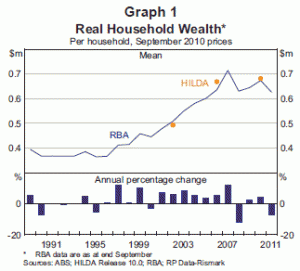
Now, what about those trillions and trillions?  Indeed, total real (inflation-adjusted) household wealth has fallen by moImagere than a trillion in the last few years – all the way back to 2005 levels.  In other words, a lot of illusory “wealth” that was the result of the government-created boom has been taken off the books.  Painful?  Sure, you can no longr refi and take cash out for a vacation.  Your house is no longer an ATM.  We’ve sobered up and that’s good.

It’s so easy for a politician like Brown to spout sound-bite demagoguery and get away with it.  The majority of voters, full of nonsense fed to them by public mis-education, lap it up.  The truth is often complicated and ill-suited to sound bites.  That’s why economics can be both frustrating and satisfying.  Personally, I find it satisfying to try to understand the truth and convey it in class or in a blog.   I urge bright young people to consider economics as a career and consider people like GMU professor and prolific writer Don Boudreaux as a role model.

An Ominous Expansion of Eminent Domain

A new assault on private property is in the works and it hasn’t gotten much attention – yet.  Needless to say, it goes by an Orwellian name, in this case the “Homeownership Protection Act.”  As summarized recently by Kathleen Pender in the San Francisco Chronicle, the scheme has been hatched by two cities in San Bernardino County and has not taken effect yet but is under serious consideration.  A new agency called a “Joint Powers Agreement” would be formed to do the dirty work.

The idea is to use the power of eminent domain to seize mortgages – not houses but mortgages owed to lenders by homeowners who have defaulted or are under water.  Using Ms. Pender’s example, suppose there is a $300,000 mortgage on a house worth $200,000.  The agency decides the mortgage balance should be $190,000 which would leave the homeowner with $10,000 in equity.  It seizes the mortgage and compensates the mortgage holder in an amount such as $170,000.  A new mortgage in the amount of $190,000 is then issued by a private firm which would reimburse the agency some lesser amount, say $180,000.  Thus the private firm pockets $10,000 up front and the agency another $10,000. One such firm, Mortgage Resolution Partners, has already been formed in San Francisco for this purpose.

There are some technical questions.  How is the house value determined?  By appraisers, presumably, but we saw in the housing bubble how useless their numbers were.  And what if the mortgage had been securitized, i.e., put into a mortgage-backed security?  The Federal Reserve holds a lot of these securities.  What if a local government entity tried to seize a mortgage that was ultimately owned by the Fed?  Wouldn’t that be fun?

Technical questions aside, the whole idea portends a massive new assault on private property by ravenous politicians and bureaucrats and their private co-conspirators.

Eminent domain has generally been understood as a way of solving holdout problems when a “public” project is proposed.  Such projects typically require acquisition of property from a number of owners and can’t be built at all unless and until all owners are willing to sell.  A single holdout can ruin the project.  Thus eminent domain has almost always been used to seize real property (land and buildings) as opposed to personal property such as mortgages.  (Private solutions to holdout problems have been proposed.)

The only ultimate limitation on the use of eminent domain is a clause in the Fifth Amendment to the U.S. Constitution which says “nor shall private property be taken for public use without just compensation.”  That clause is of course wide open to varying interpretations of “public use” and “just compensation.”

A landmark Supreme Court 5-4 decision in 2005 held that the City of New London could seize a modest house owned by Suzette Kelo and hand it over to a private developer.  The house and surrounding buildings were seized and destroyed but the project went bust and the land is still vacant.  This was a significant extension of the notion of “public use.”  Justice Stevens in his decision to uphold the City noted that “a public purpose will often benefit individual private parties.”

Indeed.  Can there ever be a public project that does not benefit some private party?  Any public project necessarily diverts resources to some private party such as a contractor or neighbors whose property values are enhanced.  Turning the proposition around, almost any private project throws off some public benefits.  Kelo opened the door to conspiracies of private developers and public officials to launch almost any sort of assault on anyone’s private property.

The “just compensation” clause is also gravely problematic.  Suzette Kelo loved her little pink house.  Its market value wasn’t nearly enough to compensate for the emotional loss she suffered when she was kicked out.  Values, as distinct from prices, are subjective and are revealed by voluntary transactions.

In addition to the obvious grave immorality of this latest assault on private property, consider the incentive problems that it raises.  Future savers will be reluctant to invest their savings in mortgages or financial products containing mortgages knowing they could be expropriated.  Homeowners will find loans harder to get, thanks to the “Homeowner Protection Act.”  (Echoes of Ludwig von Mises: government interventions invariably make things worse for their ostensible beneficiaries.) There will be a marginal shift away from saving toward consumption.  Economic growth will be marginally slowed, for which politicians will blame the free market and plump for yet more expansions of government power.

Should the San Bernardino project go forward, it will be very likely to end up at the Supreme Court.  The Kelo and Obamacare decisions do not bode well for the result.

August 15, 1971

People who were alive in 1941 can tell you right where they were on Pearl Harbor day.  I can tell you exactly where I was when I heard that President Kennedy had been shot.  We all remember 9/11.   Another day that I sticks in my memory just as clearly is one that is now remembered by few: Sunday, August 15, 1971.

There was no internet in those days and no cable news channels, so I was mercifully spared the news until the following morning at 8:15 when I opened my motel room door in Huntington Beach and saw the L.A. Times on the doorstep with a headline that said something like “Nixon Imposes Price Controls.”

I was shocked and disgusted for two reasons: though I was employed as an aerospace engineer, I was beginning to learn about free markets, having attended a FEE seminar the year before at which Mises and Hazlitt  – now saints of Austrian economics – lectured.  And I had voted for Nixon in 1968, naively believing the Republicans were the party of free markets.  The following year I signed up with the new Libertarian Party and never looked back on the Republicans until 2008 when Ron Paul ran.

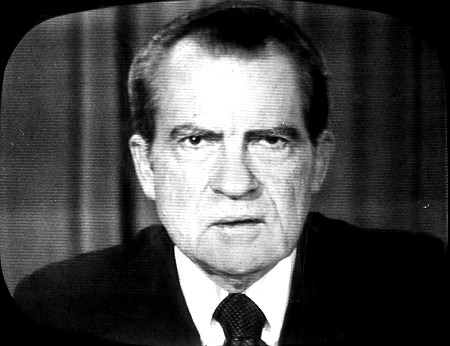
Here is a video recording of Nixon announcing a 90-day “freeze” on prices and wages. Note the Orwellian references to the evils of price controls even as he imposes them.Image

So what was the big emergency that prompted such a drastic response?  Unemployment was running about 6%; price inflation at about 5%.  Nixon’s problem was that an election was coming up in the following year.  He remembered bitterly his narrow loss to Kennedy in the 1960 election which he attributed to a mild recession of that year. Now he was determined to goose the economy and get himself re-elected. Like FDR, Nixon loved dramatic strokes and never mind the consequences. Earlier that year the man who had made his reputation as an implacable anti-communist had made a sudden and dramatic overture to communist China.  So on that sleepy Sunday Nixon delivered another bold stroke, in an end run around the Democratic opposition.  Perhaps it worked: he won 49 states in the 1972 election with considerable help from his bumbling opponent, George McGovern.

His action was quite popular.  The stock market surged that Monday morning and polls showed a 75% approval rate.  But Milton Friedman was right when he predicted “utter failure and the emergence into the open of suppressed inflation.”  Another freeze was imposed in 1973 but this time the damage to the economy became evident.  As explained in the excellent video series “The Commanding Heights,” “ranchers stopped shipping their cattle to the market, farmers drowned their chickens, and consumers emptied the shelves of supermarkets.”  Inflation reached a peak of about 14% before the decade was out and before the powers that be accepted the fact that excessive money creation is the main cause of price inflation. George Schulz, Nixon’s economic advisor and a vigorous opponent of price controls consoled himself with the thought that Nixon had demonstrated dramatically how not to fight inflation.

Nixon wasn’t finished.  During that same Sunday broadcast he slapped a 10% tariff on imported goods, accompanied by some blather about fairness.  More significantly, he ended the Bretton Woods international monetary system.  That arrangement, conceived in 1944, had the U.S. dollar convertible into gold at $35 per ounce, but only for foreign central banks.  Not only could private banks and private citizens not convert their dollars, it was even illegal to own gold (with exceptions for dentists, jewelers, etc.).  I made a point of violating that particular law on principle before the prohibition was lifted in 1974.

In all fairness, the Bretton Woods system was doomed long before that August.  The gold exchange standard had persisted only because of a gentlemen’s agreement that European central bankers would refrain from exercising their redemption rights to any significant degree.  So many new dollars had been created to finance Lyndon Johnson’s war in Vietnam and his “Great Society” at home, and so many of those dollars were parked overseas as a result of trade imbalances, that the U.S. government could not come close to honoring its Bretton Woods obligation in full.  The French under de Gaulle and his gold-bug advisor Jacques Rueff had become increasingly strident about the situation, but in early August the British ambassador showed up with $3 billion to be redeemed, and that may have been the straw that broke the camels back.

So on that same Sunday Nixon slammed the gold window shut (video here)  pushing us out of the frying pan of Bretton Woods, under which numerous wrenching devaluations had wracked international trade, into the fire of floating exchange rates, the system we have now.  The devaluations are gone but the wild swings in currency values, something that was not foreseen by Milton Friedman who was an early advocate of currency markets, are almost as bad.  Now, wonder of wonders, there is resurgent talk of some sort of gold standard.

Reagan tempted me with with some pretty inspiring rhetoric in his 1980 campaign about getting the government off our backs.  Not enough to vote for him, but I was glad he got elected and with the help of Fed chairman Paul Volcker he did break the back of inflation, but he never got spending under control and he didn’t deserve as much credit as he got for the fall of communism, which had been rotten at its core for decades.  But Bush I was terrible and in hindsight Clinton wasn’t all bad, yet I confess I was relieved when Bush II beat Gore in 2000.  I needn’t remind anyone what a disaster GWB was with his wars, his unfunded medicare expansion and his bailouts (OK, thanks for the tax cut).

I’m voting for Gary Johnson who won’t win, and I really don’t care who wins.  Gridlock is the least bad outcome, even if that means the despicable Obama stays in office facing a Republican congress.

Systeme D

In French, a man (or woman) who is particularly resourceful is called a débrouillard (débrouillarde).  In the former French colonies of West Africa, people have used this word to form a phrase, “l’economie de la débrouillardise” which refers to the vast network of “inventive, self-starting, entrepreneurial merchants who are doing business on their own, without registering or being regulated by the bureaucracy and, for the most part, without paying taxes.” Systeme D for short.

The concept and the quote are from a nifty and fairly new book I’m reading just now, “Stealth of Nations” by Robert Neuwirth.  He claims that the world-wide Systeme D economy would, if aggregated, amount to more than any other nation’s economy save the U.S. The claim may be hyperbolic but he leaves no doubt that in most of the developing world it is a major factor in the flow of goods and services.

He cleverly begins each chapter with a quote from Adam Smith’s “Wealth of Nations” and gives accounts, mostly first-hand, of how the Systeme D economy, or the informal economy or the black market if you will, works in various countries.

The participants in this economy sometimes operate entirely outside the law and sometimes with one foot in and one foot out.  They seldom count on the police or the courts for protection or redress.  Yet informal systems of protection of life and property spring up and seem to work pretty well.

Take the bustling street market that operates along the Rua Vinte e Cinco de Março (Avenue of March 25) in São Paulo, Brazil.  The daily routine begins at 3:30 AM when vendors of pirated CDs and DVDs set up their stands.  One vendor has done well enough buying movies for 50 centavos and selling them for double that, that he has moved into the middle class.  He and his wife own an apartment and a rental house.  At 4:30 a woman parks her truck and opens the back, where she offers homemade cakes and bread for sale.  Everyone respects her “ownership” of that particular parking space.  At 6 AM come the vendors of clothing, sunglasses, pirated NY Yankees baseball caps, you name it.  At 8:30, Paulo shows up and spends the next seven hours tossing plastic spider-men against a wall, watching them rappel down the wall.  They are made in China, trucked to Paraguay, and smuggled across the border into Brazil.  Paulo buys them for 80 centavos and sells them for about triple that.  So it goes, all day long.  By late evening all the stands and stalls are packed away, ready for the daily cycle to begin anew.

The rules are simple: “Vendors pay no rent to occupy the curbside, and there’s no protection money, taxes, or other fees … You simply ask, ‘Can I set up next to you?’ and if the answer is no and you do it anyway, you have a fight on your hands.”

What’s the volume of business on the Rua?  An estimated 400,000 people (!) per day and up to a million on major holidays, most of whom come to buy.  Annual turnover for this one street market, with its estimated 8,000 vendors, mostly unregistered, is estimated at US$10 billion.  If that figure is anywhere near correct, this one market would rank with Brazil’s five largest corporations.

The description of the Systeme D economy of Lagos, Nigeria is particularly fascinating.  This is a huge city that lacks most of what we would consider basic public services, even sewers and running water.  Yet thanks largely to Systeme D it works, after a fashion.

Author Neuwirth does not gloss over the problems of the world’s Systeme D economies.  There is fraud and sometimes violence, but not necessarily any worse than that of the above-ground regulated economy.  There is wide-open pirating of software, games, music and movies.

The bizarre private bus system of Lagos, though it works for the Nigerians after a fashion, is not something any of us in the developed world would be happy with.  Most of us are happy with our clean, well-lighted supermarkets (see my article “Sardines at Midnight.”) Yet there is a lesson we can take from the Systeme D economies.  Our economy is becoming increasingly hog-tied with regulations. We could make a big dent in unemployment if the politicians and bureaucrats would lighten up a bit and allow the “informal economy” to grow.  Yes, the politicians and bureaucrats and lawyers are to blame but they take their cues from consumers who demand near-perfection in product offerings and unlimited product liability.

I highly recommend “Stealth of Nations” as light but informative summer reading.  Read it for the stories and pay no attention to occasional stumbles into bizarre generalities like “There’s nothing natural about the free market.  It’s a fiction, an artificial construct created and held together with the connivance of government.”

Vote! Or not.

We have an election in California next week.  I offer two gloomy premises about voting:

  1. My vote doesn’t matter.
  2. The outcome doesn’t matter.

As to premise #1, have you ever voted in an election that was decided by one vote?  The odds favoring that outcome are somewhere in the lottery-winning range. The standard objection is, “what if everyone felt that way?”  My answer is, I don’t control everyone, just myself.

As to premise #2, I should say the outcome matters very little.  For many years I deluded myself that Republicans would hold back the tide of collectivism.  What was I thinking?  George Bush, who I would concede was a decent man, made a lot of mistakes and did a great deal of harm.  Must I elaborate?  The wars, the Patriot Act (an Orwellian name if there every was one), torture of “detainees,” the social security drug benefit, and worst of all, setting the stage by his failures for the current White House occupant who I take to be hell-bent for fascist dictatorship. Notwithstanding these premises, I’m going to vote as I always do.  I’ll tell you why at the end.  First a little about next week’s ballot.

I registered Republican in 2008 so I could vote for Ron Paul but then switched back to Libertarian. I find that in the Presidential primary, I can choose from no fewer than nine candidates on the Libertarian ticket.  I thought Gary Johnson already got the nomination at the convention.  What’s this vote all about?

This year California’s new “jungle primary” system takes effect. Now anyone can vote for candidates of any party in the primary (excepting Presidential choices), and the top two vote-getters, even if they are of the same party, will appear on the general election ballot.  This is supposed to make races more competitive but I think it will do the opposite – move us closer to a one-party state.  We’ll see how many of the general election races offer a choice of two Democrats (or in a few districts, perhaps two Republicans).

Leafing through the voter information pamphlet, I find a stew of 24 Senate candidates: six Democrats, 14 Republicans, two Peace & Freedom, and one each American Independent and Libertarian.  Incumbent Dianne Feinstein will win the primary and the general election without mussing a hair of her signature coiffure, and with so many Republicans competing with one another, it’s likely a Democrat will come in second and appear on the general election ballot along with Senator F (who can be quite sensible at times, for a Democrat).

I’ll vote for the Libertarian, the perennial Gail Lightfoot.  The Libertarian Party needs to draw enough votes in each election to keep its status as a qualified party, and it knows that a female name always draws a certain number of votes, and an American Indian name adds a few more.

Not much choice for Congress: the Democratic incumbent, another Democrat, and a Republican.  The other Democrat is a bit of a nut case, so it might be fun voting for him.  On second thought, I’ve never voted for a Democrat in my whole life, so why start now?  The Republican shows a faint libertarian spark.  I suppose I’ll vote for her.

Ours is the only county in California whose supervisors (county legislators) are elected by districts.  Yet every county voter gets to vote in all the districts.  Bizarre.  I did notice that one candidate opposed building a new jail.  I’ll vote for him and leave the rest blank.  I don’t want to become confused or discouraged by learning any of his other positions.

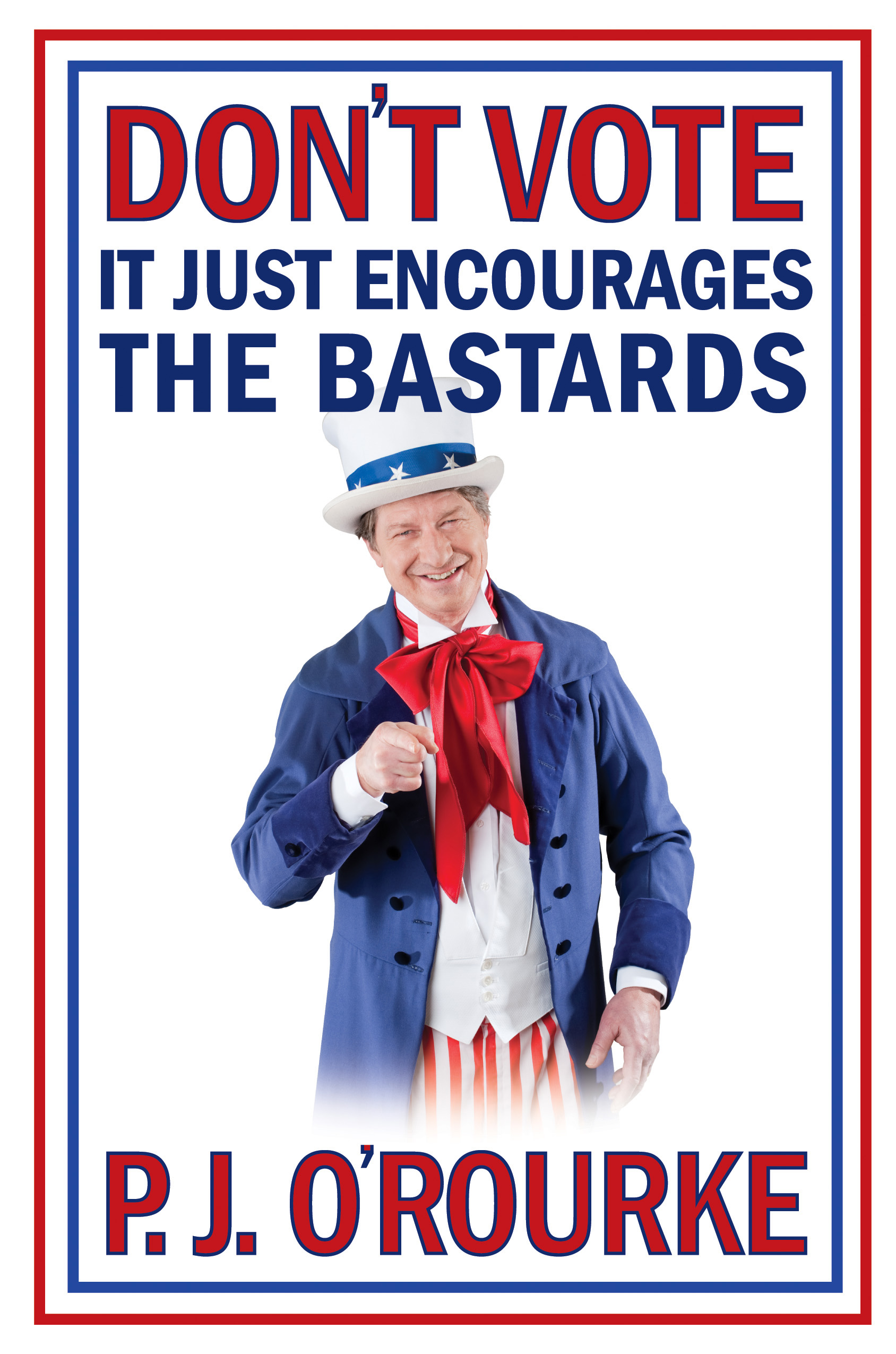
There are two state propositions, a dumb one about term limits and a $1 per pack cigarette tax.  Why not just send all the smokers to the gas chambers?  On second thought, we need to keep them alive so we can work them as slaves.
Three county tax measures are automatic noes.

So why will I vote?  I can only muster two reasons:

  1. With so many people voting by mail, they have consolidated the voting places.  Mine is now a mile away.  I like that because if the weather is good I’ll have a nice hike through the open space to get there.
  2. I feel some sort of emotive satisfaction in voting.  We all like to believe we are having our say when voting, preposterous as that notion is. For many young people, voting for Barack Hussein in 2008 was a positive expression of hope, which one hopes has been wrung out of all but the densest of them by now.  I felt that same youthful enthusiasm when casting my first-ever vote, for Barry Goldwater in 1964, so I understand.  But now the satisfaction, as you can tell, is thoroughly sardonic.

Not only will I vote, but I have actually contributed to candidates: Ron Paul, Gary Johnson, and Art Robinson who is running for Congress in Oregon.  I offer no excuse for this behavior.  I herewith publicly  resolve to make no further donations this year.

It gets worse.  I twice ran for office, once coming perilously close to winning.  That memory is too painful so I won’t elaborate.

In November I will vote for Gary Johnson.  Knowing that B.O. will carry California I needn’t worry about whether Mr. Romney might make a slightly less evil President.  There will be nasty state tax increases to vote against as well.
The Holographic Universe

Warning: this is not a libertarian post and I may get kicked out of this blog group for going way, way off topic! (It does have repercussions for Objectivists and others interested in ontology and epistemology.) This is an invitation to share a fascinating idea from modern physics: the holographic universe.  As I understand it, the idea is that everything within a volume of space can be thought of as encoded on the boundary of the region – like a conventional hologram.  (You can find runaway interpretations of the idea online which I suspect are bogus.)

Further warning: I am not a physicist.  I do have a Ph.D. in engineering and a decent grasp of mathematics and I have been studying modern physics with Prof. Leonard Susskind at Stanford.  His continuing education classes are just right for the likes of me – people who know elementary calculus, complex variables, etc. but cannot undertake a full-blast graduate physics course.

I commend to you Prof. Susskind’s lecture, The World as Hologram.  He is talking to a lay audience so he uses very little math.  But in his Stanford class he carefully took us through the math that leads to the conclusion that a black hole’s entropy is proportional to its surface area and not its volume as common sense would suggest.

If there’s a lesson here for a libertarian like me, perhaps it’s this: that we shouldn’t let ourselves get into a rut.  Don’t focus exclusively on libertarian issues, but stretch your mind from time to time in a new direction. Allow the possibility that you might learn something from a socialist like Lenny Susskind.  He’s someone I admire very much and I’m fortunate to have gotten personally acquainted with him.

By the way, you could hardly find a more moronic commentary on modern physics than this one, posted on the web site of the Ayn Rand Institute, from which I quote:

Today, physicists suppose that a particle can travel many different paths simultaneously, or travel backwards in time, or randomly pop into and out of existence from nothingness. They enjoy treating the entire universe as a “fluctuation of the vacuum,” or as an insignificant member of an infinite ensemble of universes, or even as a hologram. The fabric of this strange universe is a non-entity called “spacetime,” which expands, curves, attends yoga classes, and may have twenty-six dimensions.

Again, I’m not a physicist, but I have learned enough to recognize this paragraph as a preposterous know-nothing caricature of ideas that have been carefully worked out by physicists who almost without exception remain ruthlessly dedicated to experimental facts and correct logic.

Lester Maddox, Hero or Bum?

Ask anybody outside Georgia who Lester Maddox was and you’re likely to get a blank stare.  I’m not from Georgia but I remember the attention he got in the late 1960’s.  Aside from Alabama Governor George Wallace, Maddox was the best known rear-guard defender of racial segregation in the South at that time.

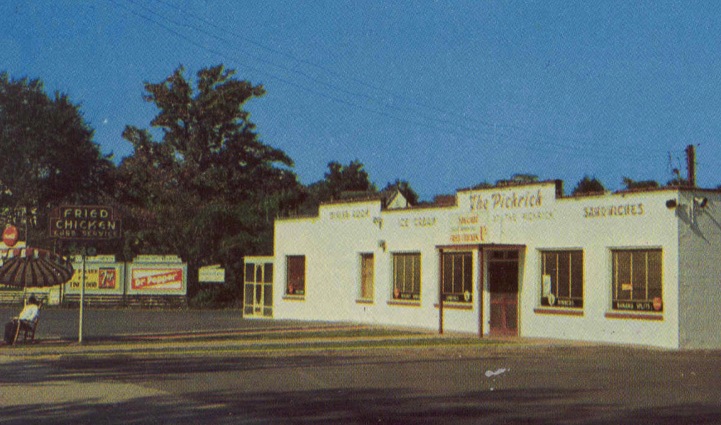
Mr. Maddox and his family operated a modest restaurant called the Pickrick adjacent to the Georgia Tech campus in Atlanta.  The fried chicken must have been good, because he prospered.  He gradually became interested in politics and began to express them bluntly.

Maddox was incensed when the Civil Rights Act became law in 1964.  Among other things, the Act outlawed racial discrimination in “public accommodations.”  He did not welcome black people as customers, and when three black men tried to enter his property in July of 1964, he reportedly waved a pistol at them and shouted: “You no good dirty devils! You dirty Communists!”  He believed that as owner of the restaurant, it was his prerogative to decide whom he wanted to serve. The pick handles that were initially decorations in his restaurant became symbols of his defiance, and he sold them as autographed “Pickrick drumsticks” in his souvenir shop.

Maddox consistently defended his stand as an issue of property rights. Continue reading

Gay Marriage? No, but …

The wait is over.  Our Dear Leader uttered this pronouncement recently.  Biden probably forced the issue when he opened his big mouth a short time before.

At a certain point,” Mr. Obama said in an interview in the Cabinet Room at the White House with ABC’s Robin Roberts, “I’ve just concluded that for me personally, it is important for me to go ahead and affirm that I think same-sex couples should be able to get married.

This on the heels of the previous day’s overwhelming vote in North Carolina that not only bans gay marriage but also civil unions.  If there’s one thing BO’s opinion is not, it’s for him personally.  His attempt to tiptoe past the issue will rouse the opposition in November.  The Romney camp must be licking their chops.

So, should gay marriage be allowed or not?  I find gay “marriage” troubling.  I believe marriage plays a fundamental role in human society that does not entirely translate to other unions.  But rather than argue my position I want to suggest that, as often happens in public discourse, we are presented with a false alternative: that gay marriage must be legal or illegal.

A cornerstone of libertarian social philosophy is the sanctity of contracts.  No one may interfere with agreements entered into voluntarily by competent adults.  A marriage is a ceremony in which a couple publicly declares their intention to enter a permanent relationship that is exclusive in many respects.  They may choose to have a clergyman bless their union or not, but there is always an invisible and uninvited party at the altar: the state.  Numerous laws dictate the form marriages may take with respect to divorce, property ownership, and taxation among other things.  This is wrong.  It is not the province of the state to restrict the content of voluntary contracts made by consenting adults.

I’m surprised opponents of gay marriage haven’t framed the debate as a slippery slope.  What’s next, they might ask, three-way marriage? In fact, there is no legitimate reason to outlaw such unions.  If allowed, they would be tested in the marketplace of ideas, and the experiences of people who entered informal threesomes and foursomes in the 1970’s suggests that only rarely would they succeed.

What about time-limited marriages?  Not “till death do us part” but a ten-year agreement, for example?  Again, no reason why they should be outlawed.

How then should we respond, those of us who are repelled by gay marriage? It is not a major issue for me.  If a man introduced someone to me as his husband, I might just say, “yeah, right” and leave it at that. For those who are passionate opponents, there is a long list of non-coercive actions that are possible – speaking out, blogging, boycotting, shunning.  A majority of Americans, a declining majority to be sure, would probably share my sentiment.  But that doesn’t mean we get to forcibly deny the rights of gay couples or threesomes to contract with each other.

What might we expect if the state were to cease its interference in marriage?  Brand names would arise for various forms of marriage.  For example, “Catholic marriage” would be a lifetime commitment that excluded divorce, with the brand perhaps identified by a logo.  “Open marriage” would signify that extramarital sexual affairs were permitted.  “Islamic marriage” might require the woman to wear a veil in public.  Once established, these brand names could not be misused by those who did not practice their tenets.

Couples could make financial arrangements that best suit them.  As it stands, the state decides for everyone by such things as community property laws and inheritance rules.

Married couples pay different tax rates under the income tax code.  Some couples pay a “marriage penalty” meaning they pay more tax than the total they would pay if filing as singles.  For other couples it’s the other way around.  Is this fair?  No, but as I have argued on this blog, there is no such thing as fair tax.  Repeal of the income tax is the best answer, or short of that, ever lower rates will lessen the impact of the disparities.

Bad Idea of the Year: Raise the Minimum Wage

Who can live on $8 per hour these days? Surely, in a country as rich as ours, no one who is willing and able to work should suffer the indignity of such paltry wages. The solution is simple and obvious: pass a law. If you work, you get at least $10 per hour, period.  Anything less is downright indecent. And so we have a ballot initiative to make this happen in San Jose, California.

It’s anything but simple and obvious if we stop and look and think about what’s happening in the real world. Today I went to a small family-owned sandwich shop near my house. They are very popular and so four young workers, probably students from the nearby college, were jammed in the tiny shop with the two owners. The sandwiches are great but I also enjoy watching them hustle at lunch time. I’m quite certain the helpers were all earning minimum wage but had other sources of income or support. Far more important than their wages, which will quickly be spent, is the work experience that will last them a lifetime – and the confidence that comes from knowing they are earning their money by doing a job in the very best way they can.

The McDonald’s near me employs a few senior citizens, likely at or near minimum wage. They almost certainly have other income. Just being active and involved in productive activity gives their lives meaning and may well enhance their health and longevity.

The sandwich shop operates on thin margins which are being squeezed by rising food prices. If they had to pay their young helpers $2 more per hour they would probably close. But the nearby Safeway store, which has a sandwich bar, would very likely absorb part of the wage increase and pass the rest on to customers, which would be easier to do with their family-owned competitor knocked out. Continue reading

Pushing Back Against the State

A friend recently brought my attention to the Orwellian American Community Survey (ACS), a 48-question survey that is sent by the Census Bureau to a random sample of households and asks whether you have difficulty concentrating, how much you paid to heat your home last year, how many times you’ve been married, whether you have a toilet, and on and on.

In 2010 (and in the previous three decades) I sent in my regular census form with the first two questions filled in, those that respond to the Census Bureau’s Constitutional authority to conduct an enumeration every ten years.  I left the rest blank.  I got one visit from a census-taker and told her to get lost.  That was the end of it.  My friend, who is less interested in matters of constitutionality, tells me he simply threw his away and ignored the people who came knocking on his door until they gave up.  I think that’s what I would do with the ACS if I ever got one.

I got my driver’s license renewed last week and they took my thumb print.  I thought of resisting, but to what end?  The DMV drones would simply deny my license, and then what?  Mount some kind of campaign?  I have no time for such a thing, and a driver’s license is a necessity.

Last fall I was summoned for jury duty.  I called the specified phone number the night before and heard that I needn’t report.  But for some reason they decided I was a no-show.  The consequence?  I got a post card scolding me, no more.  (I was prepared to quote the 13th Amendment to the judge, the one that outlaws involuntary servitude.  I was also prepared to go ahead and serve, if the case were an interesting one where I might apply jury nullification.)  My friend just ignores jury summons.

I am about to begin remodeling work on my house, including re-doing a couple of bathrooms.  The building code has gotten quite a bit more intrusive since I built my house in 1978.  My neighbors are laughing at me since both did their bathrooms without permits.  But for various reasons I am going the permit route.  And in truth, some of the provisions that I bristled at first turned out, upon reflection, to be beneficial to me.

And to round out my list of sins, I never mounted the front license plate on my Thunderbird convertible.  I just thought that would spoil its looks, but it occurred to me that I probably can’t be caught by red-light cameras.  I’m amazed that I haven’t been stopped in eight years.

So the question I ask myself (and you) is: where to draw the line — when to push back and when to go along.  The aforementioned examples suggest that the consequences of resistance are likely to be far less than what we fear.  For that we can thank bureaucratic ineptitude.  Random citizens are almost as likely to fall prey to some bureaucratic outrage as are resistors.

I guess the answer is that each of us should do our own cost-benefit analysis.  How good will I feel about resisting and what is it likely to cost me?  Of course that’s often difficult to estimate, but I know one thing: I don’t want to be just a bystander to the slide into fascist dictatorship, if that’s where we’re headed.

While freedom of speech survives we should make the best of it, as in blogs like this.  But almost all the tools are in place for government agents to persecute people for their expressed opinions.  For example, the NSA is developing a capability to intercept and decrypt almost any sort of electronic communication such as emails, phone calls or Google searches. They may well be trolling the entire internet for posts like this.

What are your thoughts?  How are you pushing back?

A Better Way to San Jose

Today I’m going to pick on the California High Speed Rail (HSR) project.  But that’s almost too easy, like shooting fish in a barrel.  So I’ll be brief and then propose a better alternative.

In case you don’t know, California voters passed an initiative in 2008 authorizing sales of bonds to finance a high-speed rail line from San Francisco to Los Angeles with branches to Sacramento on the north end and Anaheim on the south end.  Ten billion in state bond funds were to be matched by Federal and private funds.  The initiative also specified the running time and the fare to be charged.  (How many voters, who might balk at tax increases, understand that bonds have to be paid back with interest using tax revenue?)

Sure as God made green apples, the budget estimates have skyrocketed, the project scope has shrunk, and completion dates have stretched far out over the horizon.  In addition, citizens and local politicians along the route through the San Francisco Peninsula have risen up as one in response to the destruction and disruption that would accompany the construction and operation of the line through their back yards.  These are people in places like Palo Alto, many of them wealthy, articulate, and well-connected.  They appear to have succeeded in getting the Peninsula segment scaled down to a “blended system” where Caltrain and HSR trains share two tracks through most of the Peninsula rather than expanding to four tracks and wiping out hundreds of homes and businesses in the process.  There will likely be an initiative on the November ballot to kill the whole project and polls favor its passage.

For the record, I’m a rail fan.  I enjoy riding Caltrain to work, volunteering at the Western Railway Museum, and studying railroad history.  I’m fascinated by construction projects and still hold a license to practice civil engineering.  So if anything I should be biased in favor of the project but I hate it.

My alternative involves electric cars.  I know, they’ve been a flop so far (Obamacars?), mainly because the usable energy per kilogram of gasoline is about 35 times that of a lithium-ion battery!  A lot of smart people have been working on better energy storage devices and techniques with scant progress to date.

I propose that inductive pickup devices be added to electric cars and perhaps hybrids.  Induction coils would be buried in roadways like Interstate 5, the main SF-LA freeway.  This should make it easy to complete a long distance journey without stopping for a charge-up.  You would leave the freeway fully charged, probably with enough energy to complete your trip on conventional roads.

The payment for energy could be combined with a toll charge.  Tolls are a long overdue idea for roads like I-5 because they not only impose costs directly on beneficiaries but also because they enable congestion pricing – a toll that rises in times of heavy traffic and falls at other times.  This idea has already been implemented on a few California roads but on a very limited scale.  It has the potential to reduce congestion drastically, something carpool lanes have not accomplished.

A major advantage of this system over HSR is that it could be rolled out incrementally.  As soon as a few thousand cars were equipped with pickup devices and a few hundred miles of roadway fitted with induction coils, the benefits would begin.  In contrast, HSR won’t be much good until it’s completed all the way from downtown San Francisco to Los Angeles.  A good estimate for that time is: never.  There’s a real chance that HSR will be abandoned after a lonely segment has been built through Central Valley farmland.

Another advantage of the roadway proposal is that cabling could be included with the induction coils for future automated operation.  Under this longer-range scenario control of your car would be taken by an automated system soon after you entered I-5.  You would be accelerated to 120 or 150 MPH and safely guided to your exit.  This is not so far-fetched given that Google has been running driverless cars around city streets with great success, though perhaps not on freeways as yet.

Now let’s compare two ways of getting a family from San Jose to Disneyland as an example.  First is high speed rail.  You pack the family into the car and head for the downtown station, where you pay a hefty fee for five days’ parking.  You buy tickets for all, get on your train, and arrive in Anaheim, or downtown LA if the Anaheim branch hasn’t been built.  You rent a car and away you go.  Cost?  You figure it out, surely several hundred.  Elapsed time, several hours in all.

I’ve already laid out the induction-drive car scenario.  You come and go when and where you want at a much lower cost and close to the same elapsed time with automated operation.

So there you have it.  Sure, the devil is in the details.  I’ve given only the barest outline, and yet I guarantee you that no matter how solid a case might be built up for a proposal like mine and no matter how preposterous HSR is shown to be, some will not be swayed.  I’m not thinking of those who are merely dazzled by renderings of sleek trains.  I’m thinking of people ranging from busybodies to downright sociopaths who, to one degree or another, hate the freedom that comes with car ownership and want to herd people into public transportation.  In such people we find the root of the HSR boondoggle and so many other social problems.

Let’s Celebrate Loopholes

I’ve just finished my income tax return. (Have you finished yours?) Silly me, I do it myself using TurboTax – all 59 pages of my federal return plus 80 for California. I’ve got investment income, including partnerships and foreign stock dividends, two small businesses, social security and a pittance of wage income from San Jose State University. And a bunch of deductions and credits.

The whole process puts me in a foul mood, and my wife and even the cats know to steer clear till it’s done. One reason is obvious: the mind-numbing complexity, even with TurboTax. Even more galling is the humiliation and gross indecency of dropping my pants financially. This is the land of the free?

The New York Times had an interesting article in last Sunday’s Magazine, “What’s the Easiest Way to Cheat on Your Taxes?.” The article led off with the assertion: “If economists ran the tax system, there would be virtually no exemptions or loopholes.” To which I say, just a cotton-pickin’ minute! If I ran the tax system, and assuming I couldn’t set the rate at zero, exemptions and loopholes would stay and maybe even multiply.

How can I say this after belly-aching about the complexity of my return? Simple – the complexities provide me enough tax-cutting opportunities to outweigh the damage to myself, my wife and the cats. I’ll leave the details out just in case the gentle folk at the IRS read this humble blog.

Why do I do it myself? Partly because I don’t want to spend hundreds or maybe thousands on a professional preparer, but also because his interests would not align exactly with mine. His primary goal would be to cover his rear, especially with the IRS cracking down on professional preparers. My goal is to achieve the right mix of boldness and caution in claiming deductions and credits.

A good bit of ink has been spilled (and electrons) about “fair taxes” lately. It’s unfair, says the Community Organizer in the White House, that Warren Buffett’s average tax rate (or was it his marginal rate?) is lower than his secretary’s. Conveniently overlooked is the fact that his dividend income has already been taxed at the corporate level. As Gene Epstein showed recently in Barron’s, when you add in that corporate tax you get a much different story. The rich pay a substantially higher percentage of their income than most of us on this basis.

So what is a fair tax anyway? The same percentage for everyone? No exemptions, no deductions? Why is that any fairer than a head tax – a levy of so much per person? How about a regressive head tax, since poor people tend to use more government services than rich people?

What of two people earning the exact same income? Surely fairness demands that they pay the same tax – equality before the law and all that. But suppose Mr. A is a struggling young man with lots of debt, trying to start a family while Mr. B has inherited millions. Both earn the same income but is it fair that they pay the same tax? I leave it to you.

When you get right down to it, there just isn’t any such thing as a fair tax, simply because taxes are coercive exactions – theft, if you will.

Still why wouldn’t a flat tax with no deductions be at least a small improvement, as Steve Forbes and other conservatives advocate? The late Murray Rothbard demolished that idea in The Case Against the Flat Tax. Here’s his comment:

“The closing of ‘loopholes’ under a flat tax will mean a merciless and continuing search-and-destroy mission by which the government will root out and obliterate every little hideyhole in which many of us have been able to squirrel away a bit of our own earnings and are own property, and keep them safe from the ever-expanding maw of the federal government.”

I concur. Let’s celebrate all the loopholes, not just those that protect some of our own income, but any break for anybody at all.