The Mystique of Hedge Funds

Hedge funds are controversial these days. Though it’s unlikely that the average citizen or the average congressman could say just what hedge funds do, many are certain they must be reined in by additional regulation because they can—and do—cause widespread damage to our financial system. Almost everyone takes it for granted that regulation of some sort is the solution, ignoring the possibility that at least some of the problems are actually caused by regulation.

What is a hedge fund? The name implies hedging, a strategy that reduces risk. If you bet on several horses in a race, you are hedging your bets—spreading your risk. You can buy gold to hedge against inflation. You can sell interest-rate futures to hedge the risk that rising interest rates would pose to your bond portfolio.

The first hedge fund was created in 1949 by Alfred Jones. He believed he could pick stocks that would outperform and those that would underperform the overall market. But Jones didn’t know where the overall market was going, so he would buy his expected outperformers and sell short the expected underperformers. He thereby insulated his portfolio from general market moves, which would affect about half his holding positively and half negatively.

Most present-day hedge funds don’t do much hedging, but the name persists. Instead, they engage in a bewildering variety of trading methods, including buying on margin (using borrowed funds) and selling short (selling borrowed assets so as to profit from a price drop). They trade stocks, bonds, options, currencies, commodity futures, and sophisticated derivatives thereof. Some try to anticipate global political or economic events, while others seek opportunities in specific industries or companies. Continue reading

End Prohibition on Self-Defense in Schools

Of all the reactions to the horrible shooting at Stony Ridge Sandy Hook, this one from the Libertarian Party is the most sensible thus far.  It focuses on the federal Gun Free School Zone Act which prohibits firearms in schools.  It goes on to cite incidents where armed citizens have been able to stop or cut short these sorts of shootings.  Hat tip: Jeff Hummel.

Labor Unions as Squeegee Men

ImageIt seems like only yesterday, but it was in the 1980’s that squeegee men had their heyday, particularly in New York City.  These were young men who would approach cars stopped in traffic.  Without asking, they would start “cleaning” the victim’s windshield – often using just a dirty rag.  It was usually evident to the driver that a generous gratuity would be a good idea, as a smashed windshield would be a distinct headache.

As a lecturer at San Jose State University, I am victimized each month by a group of “squeegee men” known as the California Faculty Association.  A certain sum is extracted out of my paycheck and handed over to these gangsters so they can continue pressing their statist demands.  “Membership” in the union remains optional at extra cost, notwithstanding a recent dirty trick in the form of an announcement that everyone would be enrolled as a “member” unless they sent a letter to the union asking to be excluded.

What benefits do these squeegee men confer on me?  The pay I get for teaching one class is trivial so whether it rises or falls makes little difference to me.  I have other motives for teaching.  The benefits were pretty good, but having voluntarily cut back to one class, I no longer get benefits.  I see no return at all from the money that the union extracts from me.

A couple of years ago there was talk of a strike.  I had fond hopes that it would come to pass because I have long wished for an opportunity to cross a picket line.  That would have been great fun.  Alas, it’s unlikely, as budget woes have taken the steam out of such threats.

But wait, wasn’t the union legitimized by a vote of the faculty?  Yes, a vote was taken a few years before I got there.  In no way does that excuse the theft of my money.  It does exemplify the basic social malady of our time, which is social democracy – the idea that voting can legitimize acts that trample minority rights.

Unions have been taking it on the chin lately.  Most recently the Michigan legislature passed, and the governor signed, a “right to work law.”  Such laws, now on the books of some 24 states, make payment of union dues of any kind optional. The primary argument against these laws is that they enable “free riders,” non-payers who supposedly benefit from union activities, like motorists who drive off without paying the squeegee men.  This problem could be solved by excluding non-payers from union-negotiated settlements.

While it’s great fun to watch the unions getting pummeled, I must add a note of opposition to right-to-work laws.  If employers want to make union membership a condition of employment, and are able to find good workers willing to accept that condition, the law should not prohibit such arrangements.  The proper place of the law in labor relations is the prevention and punishment of criminal acts, principally violence and intimidation, and nothing more.  Any union that conducts its business in a peaceful manner – without threats against either employers or holdout workers – should not be molested.

A Glimmer of Freedom in Health Care

The politicians are bound and determined to seize total control of health care and damImagen the consequences.  And yet … And yet every so often a glimmer of a free market in health care appears like a weed pushing through a crack in the asphalt and bursting into bloom.

Here we have an inkling of a free market in medicine: an advertisement from a local paper featuring price, diversity of services, convenience and qualification (MD).  We mustn’t give up hope for health care freedom.

I had never heard of Dr. Marchasin but got a pleasant surprise when visiting his web site with links to his criticisms of Obamacare.

Reflections on the Income Tax

I’ve been spending quite a bit of time with TurboTax lately, looking for last-minute opportunities to manipulate my income – legally, of course – to minimize my income tax.  Why not just hire a professional to do it, you might ask?  I’ll tell you later.

First, let’s remind ourselves what a vile institution the income tax is.  Taxation in general is bad enough – legalized theft, really.  The income tax is particularly onerous because it requires us to drop our pants financially, because it’s hideously complicated and because it generates huge amounts of deadweight loss.

With all the concern about privacy these days we hear precious little about the intrusiveness of the income tax.  We must reveal intimate details of our economic activities.  Of course the IRS holds all that information in confidence – until they don’t.

The tax code, in case you didn’t know it, has become complex far beyond the comprehension of any single tax expert.  Consider, as a random example and a mild one at that, the instructions for line 31 of Form 6251, Alternative Minimum Tax for Individuals:

  • ImageIf you are filing Form 2555 or 2555-EZ, see instructions for amount to enter.
  • If you reported capital gain distributions directly on Form 1040, line 13; you reported qualified dividends on Form 1040, line 9b; or you had a gain on both lines 15 and 16 of Schedule D (Form 1040) (as refigured for the AMT, if necessary), Complete Part III on the back and enter the amount from line 54 here.
  • All others: If line 30 is $175,000 or less ($87,500 or less if married filing separately), multiply line 30 by 26% (.26).  Otherwise multiply line 30 by 28% (.28) and subtract $3,500 ($1,750 if married filing separately) from the result.

Can anyone set this to music?

The original form 1040, issued in 1913, ran to three pages in length with a single page of instructions.  The current federal income tax is set forth in Title 26 of the U.S. Code of Federal Regulations.  You can get your own copy, all twenty volumes running over 13,000 pages, from the Government Printing Office for just $974, free shipping included!

The complexity of today’s income tax leads to hundreds of billions of dollars worth of deadweight losses each year.  A deadweight loss, you will recall, is a loss that is no one’s gain.  Deadweight loss associated with income taxes consists of two parts: (1) tax preparation costs plus costs of finding and implementing avoidance or evasion strategies and (2) lost gains from production and trade because of the disincentives of taxation.  If you’re tempted to say that money spent on accountants isn’t deadweight loss because it generates income for accountants, you haven’t internalized Bastiat’s “Fallacy of the Broken Window.”  If you’re going to count income to accountants you have to subtract the value of their efforts which could be spent doing other things.

TurboTax is good news and bad news.  The good news is that it reduces tax preparation costs while generating profits for Intuit.  The bad news is that lower costs mean taxpayers are less inclined to rebel against the tax code.

What disturbs me most about the income tax is not its complexity but how resigned most people are to this heinous institution.  We forget that taxes are extracted using threats of physical violence.  People are so brainwashed!  Every time I open up TurboTax I face the picture shown here of happy taxpayers.  Or maybe they’re happy accountants.  Or happy IRS agents.  Anyway, I’ve managed to avoid barfing on my keyboard thus far.

So why do my own taxes?  Stubbornness, I guess.  First of all, I’m an engineer and a numbers guy.  I can figure this stuff out (I think).  With TurboTax I can play what mathematicians call finite-difference games to see how hypothetical increments of various kinds of income alter my tax liability.  Second, I hate to shell out a four-figure fee to an accountant who may add little or no value to what I can do on my own.  But mainly I guess it’s just the perverse satisfaction in doing first-hand combat with The Man.

If you’re like me and have some choices about income such as IRA withdrawals or realization of capital gains, better get cracking ‘cause you only have about three weeks left.

Warren Harding’s Fiscal Cliff

The economy is in rough shape right now but suppose it were even worse: unemployment at 12% rather than 8%; GDP falling at a 17% annual rate rather than rising slowly.  A close advisor to the President counsels an array of interventions to stimulate the economy but is ignored.  Instead, the President cuts Federal spending in half and engineers drastic reductions in income  tax rates for all groups.  Meanwhile the Federal Reserve, rather than cranking up the printing presses for a round of monetary stimulus, snoozes through the whole year.

Now there’s a fiscal cliff for you.  If today’s thinking about the fiscal cliff of Jan. 1, 2013 held true, surely such policies would tank the economy big-time.

The foregoing scenario actually happened.  The year was 1920, the President was Warren G. Harding and his close advisor was none other than Herbert Hoover, who as President from 1929 to 1933 would have his way – raising taxes, jawboning wages, and slapping a killer tariff on the economy, thereby doing a great deal to turn the rather mild downturn of 1929-30 into the Great Depression which, with lots of help from Franklin Roosevelt, would plague the nation for another decade.
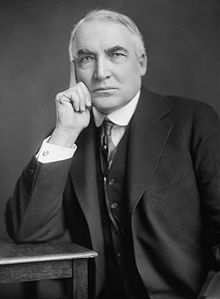
So what happened in Harding’s time?  Things were pretty rough for a while but by the summer of 1921, signs of recovery were already visible.  The following year, unemployment was back down to 6.7% and hit 2.4% by 1923 (source: Thomas Woods, “The Forgotten Depression of 1920″).  A budget surplus arose resulting in a noticeable decline in the national debt.  Business confidence soared and the 1920’s boom was off and running.

President Harding has gotten a bad rap from history because of the scandals that erupted during his administration as well as his chronic womanizing and his passion for the bottle.  But in the countdown of 20th century Presidents that I might do for this blog should I ever get ambitious, I will start with Harding as the least bad President of that sad century and work my way down from there.  I’ll let you  guess who I will honor as the Worst President of the Century.

How does the looming fiscal cliff compare with the policies of 1920?  In case you’ve been hiding under a rock lately (not a bad way to ride out the election campaign!), the fiscal cliff is the set of automatic tax increases and spending cuts that were agreed to when the debt ceiling was raised in 2011.  Congress decided to force its future self to act by lighting a time bomb that it would surely – surely! – defuse before it could go off.  The fuse has now burned to within 1/8 inch of the bomb.

The bomb’s tax increases and spending cuts would reduce the deficit by an estimated $600 billion in one year.  That may be the most accurate estimate but it’s only an estimate.  Congress can set tax rates but tax revenues depend on the size of the tax base.  If highly productive people, those who would take the biggest hit, decide to Go Galt, the tax base could shrink.  And as Jeff Hummel likes to point out, tax rates, particularly the top marginal rates, have varied drastically over the years and yet tax receipts have not varied much from 20% of GDP, excepting the World War II years.

Not only might tax receipts fall short, but expenditures could rise if additional welfare payments such as unemployment benefits or food stamps were to rise.

But let’s assume the fiscal cliff happens and the deficit is indeed reduced by $600 billion. Using figures for the fiscal year just ended, we would still have a $400 billion deficit which would have to be financed by borrowing.  As always, this would be new borrowing, on top of the borrowing needed to roll over the daily stream of maturing debt.  And we mustn’t forget the Social Security Trust Fund which until last year has mitigated the deficit by “investing” its surpluses (FICA tax revenues minus benefit payments) in Treasury securities.  Those FICA surpluses have now turned to deficits which for the present are offset by interest payments on Trust Fund holdings but will eventually require the Trust Fund to stop rolling over maturing securities and, should the trend continue, to deplete its holdings entirely.  All of these developments exacerbate the main federal deficit.  The same applies to the much smaller Medicare Trust Fund.

So I say, with a glance over my shoulder at 1920, bring on the fiscal cliff!  Let the cuts happen, thereby ending a lot of wasteful and harmful spending – particularly “defense” spending.  Let tax rates rise; people will work around them.

But it won’t happen because too many special interests will rise up to prevent it:

  • There are enough military personnel, military contractors, their suppliers, relatives and hangers-on to prevent significant cuts in defense spending.
  • The 27% cut in Medicare physician fees will lead doctors to brush away their Medicare patients like flies, sending those patients hobbling off to howl at their their Congressmen.
  • Millions of middle class people will gasp when their tax preparer tells them they’ve been caught in the dreaded Alternative Minimum Tax trap.  Others will escape the trap only to find that their ordinary income tax rates have risen substantially.
  • Still more millions will see their FICA (Social Security) tax rate revert to the 2010 rate of 6.2% from the current 4.2% “stimulus” figure.

The fiscal cliff won’t happen, at least not all of it, except perhaps for a brief period in January which will be fixed retroactively.  And so, though I hate to say it, I think the longer-term odds of pulling out of our fiscal death spiral are pretty slim.  Many think the government will resort to the time-honored remedy of the printing press, but Jeff Hummel has made a solid argument as to why this option won’t work and why there will be a default on Treasury securities instead.

Hummel also urges economists to do whatever they can to warn people not to count on government largess.  Most young people have written off Social Security for their future and that’s a good thing.  (Not so good for Social Security recipients like me who are increasingly unemployable yet hope to live another 25 years.)  We must take responsibility for our own health care, first by watching our health habits and second by cultivating a personal relationship with a physician, perhaps offering him or her cash payments.  We should be leery of Treasury Securities or of banks, mutual funds, etc. that rely heavily on these securities.  Sock away a few gold and silver coins.

We’re in for a rough ride, I fear, over the next few years.  But the sun will still rise and tangible assets will remain.  Provided enough of us have taken precautions, social unrest will be manageable and maybe, just maybe, the cancer that is called Social Democracy will be shaken off once and for all.


Obama: Any Silver Lining?

So it’s four more years of Obama.  What can we expect?

Obama makes me, a libertarian these last 40 years, nostalgic for the sort of “liberals” who until recently dominated the Democratic Party.  At least those folks have some respect for facts and tolerance for other points of view.  Obama is different.  I know longer think it an exaggeration to say that Obama hates America, as Rev. Wright preached to him for twenty years.  I have a new understanding of Obama thanks to Dinesh d’Souza’s book “Obama’s America.” Barack Obama had an epiphany at the grave of his father, a man who was a leader among the anti-colonialists of Kenya.  The man was a no-good drunkard who deserted and abused more than one wife and child, yet Barack was able to put aside these faults and hitch his star to his father’s cause. His first term in office gave us numerous actions that exemplify his quest to bring America down.  He likes to stir up class hatred.  His tax proposals are all about fairness, as defined by him, of course, and never mind the ensuing economic damage.  That they punish the most productive among us is all to the good; that they damage all of us in the long run doesn’t matter. He has seized control of health care.  He has acquiesced in a brutal war on medical marijuana patients, waged by his Northern California District Attorney and others.  He has ordered assassination of U.S. citizens and condoned domestic spying.  The CIA continues its massacre of civilians in Pakistan, a supposed ally.  All of this would make a high-class liberal like Adlai Stevenson gasp with horror.

Thank God we still have a Republican House and a Senate where they can filibuster.  Gridlock will probably prevent any new atrocities of the scale of Obamacare.  But the door remains open for a great deal of evil-doing.

First off, there will be at least three Supreme Court appointments in the next four years.  It’s a sure bet that Obama will appoint “social justice” types, the sort who have no concept of the Constitution as a document intended to limit the powers of government.  These are life appointments so the new appointees could be wreaking havoc long after Obama is gone.

Second, the President has a great deal of latitude in foreign affairs. Just look at the damage George Bush inflicted on the world with his senseless wars in terms of casualties, hatred of America, and insolvency.  But there is a ray of hope here.  The warmongering neo-cons are on the sidelines and Obama’s ineptness in foreign affairs may spare us some future dustup that Romney might have provoked.

This isn’t the silver lining I had in mind, however.  I present here, with misgivings, a viewpoint suggested by my colleague Jeff Hummel. He likes Obama’s victory because he thinks it will hasten our Götterdämmerung – the collapse of Social Security and Medicare and default on Federal debt.  Out of the ashes will come a new order in which Social Democracy has been rooted out of the polity, as the paroxysm that was the Civil War put an end to slavery.  This is a viewpoint with which I have a great deal of sympathy while continuing to hope for some sort of “soft landing” instead.

Social Democracy is the idea that individual choices of all sorts must be decided by voting and enforced by the government, the agency of compulsion and coercion as Mises called it.  I wouldn’t contest the proposition that Social Democracy is a cancer on our society that ranks with slavery in its banefulness. I dearly hope that a future upheaval might root it out but I’m not so sure.

I hasten to emphasize that I say “ashes” metaphorically.  We will survive the demise of the Federal government.  The sun will still rise and physical assets will remain in place.  The damage done to the social fabric will be lessened if people see the collapse coming.  That private individuals can and do step in when government collapses was illustrated on a small scale by a recent incident involving the California park system.  A list of parks scheduled for closure was published and it looked like private groups had raised enough money to keep at least some of them open. (Then some bureaucrat found $50 million lying around in the Parks Dept. and the private groups gave up in disgust.)

I confess to being a bit more conservative than Jeff Hummel.  I’m slightly older and may have more to lose as things get worse.  I continue to hope that libertarian ideas will continue to infiltrate the public discourse and that the respect for productive people that is still held by a substantial though declining segment of the population will rein in Obama and his hangers-on.

“Ayn Rand Explained”

Sales of Atlas Shrugged soared to 445,000 copies in 2011, more than 50 years after it was published. Books about Rand are proliferating as well, including major biographies by Anne Heller and Jennifer Burns. Is there room for yet another volume in this increasingly crowded field? Marsha Enright has shown that there is.

Ms. Enright promises a lot with her title, Ayn Rand Explained, and she delivers. She brings to her task a background reaching back to the early 1970’s when she first met Rand. Her writing suggests a keen intelligence and an independent spirit. The result is a book that is thorough and careful but not pedantic.

Her personal recollections portray Ayn Rand’s warm and approachable side and not the angry cult figure suggested by some. Particularly charming is the story about the cat jewelry.

A new reader or a moviegoer who wants to learn more about Rand and her philosophy, objectivism, will soon discover that there are two camps of followers. David Kelley’s Atlas Society promotes the view that objectivism, as a set of ideas, is necessarily open to extension by any serious thinker who accepts its basic premises. The Ayn Rand Institute is a far larger group because it receives royalties on the heft sales of Rand’s books. The ARI calls objectivism a closed system. Ms. Enright addresses this conflict head-on, explaining both positions evenhandedly and giving credit where credit is due.

Careful analyses of Rand’s novels are followed by a 40-page explication of objectivism, proceeding systematically, as Rand did, from metaphysics to epistemology to ethics to politics and esthetics. Some readers may find this section heavy going and may want to skip it and return later. If they do return, they should be well rewarded.

A separate chapter on politics takes up the uneasy relationship between libertarians and objectivists. She offers back-to-back sections outlining the case for the “plaintiff” (objectivism) and for the “defendant” (libertarianism). I found these sections particularly interesting now that ARI is making nice to libertarians, a sin that earlier got David Kelley kicked out of ARI.

I thought Nathaniel Branden deserved a little more sympathy than he got in this book. He and Barbara Branden have been the victims of vicious smears from the orthodox camp. Nathaniel has admitted the errors he made in his relationship with Rand while Rand never admitted hers, which were far greater. He has redeemed himself many times over, in my view, by the positive difference he has made in the lives of a great many people, both in person and through his books and lectures.

“Ayn Rand Explained” will be my top recommendation to anyone who asks me about Rand and objectivism.

Atlas Shrugged Part II

I got around to seeing the movie this morning along with about ten other folk. I was reminded of why I don’t go to movie theaters: they’re run by sadists who like to torment people with a quarter hour of promos following the advertised starting time, meat-locker temperatures and ear-splitting sound. I didn’t bring my wife knowing she couldn’t have endured the torment but I’ll get the DVD later.

So, what of the movie? Quite good, mostly. The screenplay is faithful to the novel, thanks, no doubt, to David Kelley. The special effects, notably the tunnel disaster and the airplane chase and crash, are powerful. I wasn’t bothered by the change to an all-new cast. Rearden’s trial was done well. The acting, however, is mixed. Rearden is good and the bad guys are good but Dagny, who is really the central character, was a disappointment. She looked almost bored as she piloted her plane toward what increasingly looked like death. Only later did she crank up the intensity.

Just a couple of nits: two men can’t lift a concrete railroad tie. Galt tells Dagny not to move because she’s hurt and then extends a hand to drag her out of the wrecked plane. A few others but nothing substantial, really.

I give it 3.5 stars out of 4, but I’m sure the critics won’t agree. It looks like the movie will follow Part I into oblivion, sad to say. One only hopes that DVD sales will pick up and that it will enjoy the same sort of underground success that the novel enjoyed following its scathing reviews.

Look Who’s Practicing Trickle-Down Economics

Thomas Sowell is one of the clearest contemporary thinkers on economic and political issues, both as a theoretician and a commentator on current events. His recent piece on “Tax Cuts for the Rich and Trickle-Down Theory” is an excellent example. In it, he shows how tax rate cuts for the highest earners can actually increase the tax revenue collected from that group. He also recalls challenging his readers to name a single economist who advocated a “trickle-down” theory of economics. No one did so.

Trickle-down is the idea that when the highest income-earners keep more of their income, some of their spending will eventually reach lower-income workers. Their purchases of luxury items will bolster employment in the production of those items. Leftists are fond of setting up this theory and then attacking it on the grounds that the benefits to the wealthiest overshadow the benefits that trickle down to those at the bottom. Government spending cuts hurt low-income people the most. Therefore, they say, tax cuts for the highest earners are a disguised scheme to siphon yet more wealth from the bottom to the top.

The “trickle down” phrase has been around at least since the 1930’s and was restated recently by the current White House occupant when he attacked what he called “The economic philosophy which says we should give more to those with the most and hope that prosperity trickles down to everyone else.”

Does the theory make sense? First off, it ignores the morality of the situation. As T. J. Rodgers, CEO of Cypress Semiconductor, puts it, “I’m proud of my wealth. I earned it.” He explains how increased income taxes will not reduce his personal consumption but will instead reduce his investments in Silicon Valley startups and his charitable activities. Just what is the benefit, he asks, in taking money away from these uses and giving it instead to programs like Cash for Clunkers or Solyndra?

Secondly, trickle-down theory ignores the fact that high-income people like T. J. tend to invest a greater portion of their marginal income. Capital accumulation is the key to higher worker productivity and thus higher wages and higher standards of living.

There is actually one institution that does practice trickle-down economics. That would be the Federal Reserve System. The Fed recently announced its QE3 program under which it will purchase $40 billion of mortgage-backed securities each month for an indefinite period of time. One aim of this program is to push down long-term interest rates and thereby encourage businesses to borrow. But those rates are already historically low. Can we really expect further cuts to have any significant stimulative effect given the current high level of regime uncertainty?

The other purpose mentioned by Chairman Bernanke is to keep the stock and bond markets propped up. The idea is to pump up the “wealth effect.” This is the idea that when people who see increases in the market value of their holdings of investment or real estate, they will be more inclined to spend, even with unchanged income. Their spending will then trickle down into the economy. As an investor I ought to say thanks but as a citizen I would say to the leftists, look to the Fed to find a real example of exploitative trickle-down economics.

The Clash of Civilizations: Where’s Obama?

I don’t know what’s in the Koran and I don’t care to know. I do know something about the Christian Bible, which is a mishmash of wisdom, poetry, geneology, misogyny, chauvinism, homophobia, fratricide, etc. The Bible can be used to defend just about any position and the same is likely true of the Koran.

To my mind, neither the historical Jesus (if he existed) nor the mythological Jesus is above reproach and the same is true of the historical or mythological “Prophet” Mohammed. If some followers of these figures believe their faith is so fragile that it cannot stand criticism and that they must advocate violent suppression of dissent, then their faith, whether Christian or Islamic, stands condemned. But intolerance among Christians is confined to a tiny few these days whereas intolerance seems to be widespread among Muslims. Thus we see laws that outlaw criticism of Islam or the “Prophet” in many countries.

As to the video which supposedly prompted the storming of the Libyan consulate and the murder of the U.S. ambassador, I have no taste for such things and don’t plan to watch it. But I do know that my own freedom is safest when such extreme expressions of opinion are protected. That’s why in these pages I defended the late Lester Maddox’s exercise of his freedom of association in running his chicken restaurant in Georgia.

I’m still waiting for the President or the Secretary of State to say even one word about freedom of speech, freedom of religion, or freedom of thought, which are the core issues here. All I heard from the President was a condemnation of the video. I don’t want him to threaten to impose free-speech rules on Libya or Egypt but simply to explain to the world that we uphold free speech in this country – period.

Back to Islam. Without knowing anything of Islamic theology, we can draw some conclusions about Islam from the status of the Muslim countries. Human rights are trampled, especially if you’re female, gay, a member of the wrong Islamic sect, or worse yet, a Christian or Jew. Virtually no scientific or technological advances have come out of Islamic countries in recent centuries. I am unaware of any significant recent Islamic artistic or literary accomplishments. A medieval view of interest is still in effect. Corrupt monarchies and corrupt theocracies rule many of the countries, notwithstanding the Arab Spring. Assad is butchering his own people in Syria.

In summary, Islam sucks. But even worse, the moral midget in the White House, the supposed leader of the free world, is silent on the essence of the conflict of Islamic versus enlightened Western values.

Opiates: Hillbilly Heaven or God’s Own Medicine?

I offer an essay written by a student in a beginning college English class. I was moved by the story she had to tell of how the drug warriors inflicted so much suffering on her terminally ill boyfriend and on her. Her manner is reserved but it the anguish comes through loud and clear.

These days the documentaries and media reports are hard to miss. Opiate and opioid abuse has become epidemic in many of our poorer states. In an attempt to get high, people have begun illegally buying prescription pain medications such as Oxycontin, and creating new and unusual ways to snort, shoot and shove in to places it was never intended to go.  According to the media the drug dealers are no longer the creeps on the street corner pushing to kids, but rather the pharmaceutical companies, patient advocacy groups and doctors who have managed to improve on and promote what many are convinced is a curse on society.I guess you can’t blame the media for telling a good story complete with tragedy, multibillion dollar villains, and clever names such as “hillbilly heroine” for this country’s current drug of choice. What bothers me is how one sided these stories have become. Rarely do you see the people who are in so much chronic physical or emotional pain that these types of drugs can be life sustaining despite the physical addiction that comes with it. I guess the media does not find these people sensational enough to focus on, but when the dust settles they will likely be the ones who end up losing the most from this “epidemic”. Thanks to our fears and the media that plays on them the majority of Americans have been convinced that all drug addiction is bad, and should be avoided at all cost even when it can ease the severe pain of some. I have seen the good that these strong pain relievers can offer the right people and would like to explain the other side to the opiate’s story.

The source of our modern day opiates is the opium poppy, a plant whose existence and use actually predates written history. Often called, “God’s own medicine” ever since people discovered that it was more than just a pretty face; mankind has had a love-hate relationship with the opium poppy. Similar to the way our endorphins work the active ingredients in opium trigger the opioid receptors in the brain, central nervous system and throughout the body.  This creates not only pain relief, but also a strong sense of pleasure, and well being. For many who are in severe pain these results can bring life to a person who otherwise would be forced to live in a world without relief. Several years ago I knew little about opiates, and like most people I believed their use was only for those who simply no longer cared. It was not until I met my boyfriend that I understood what a positive effect it could have for some.

My boyfriend Dave lived with chronic pain. His doctor had put him on a regular supply of Vicodin which helped to not only relieve that pain, but also gave him energy, so he no longer had to spend all his time in bed. Unfortunately when opiates are taken regularly the body will build up a tolerance, and physical addiction will develop. A good doctor will understand that their patient will eventually need an increase in their dosage, and no patient should ever be put in a position where they are forced to withdraw abruptly from their medication without professional help. Well that is the way it is supposed to work isn’t it? Dave’s doctor either was not aware of how addictions can form, or more likely was simply afraid to increase the dose due to the scrutiny put on doctors who are thought to be too generous with the pain medications they prescribe. When we finally accepted that his doctor hands were tied we went looking for an alternative.

I will never forget the first time we went to buy Vicodin off the street. There were actually people who had walked straight out of the hospital still attached to IV poles selling their prescription drugs. Heroin addicts hung out on the corners trying to fund their habits by helping newbies like us connect with the right people. Sometimes they were very helpful most of the time not, but Dave always tipped them anyway knowing that the pain from withdrawal is still the same regardless of how you get there. This was an end station for many. With the risk of arrest, or assault running high, most of the people there had nothing left to lose. The fact that my boyfriend had to spend the final years of his life going through so much to get some relief will always anger me. It nearly ruined him financially, and the stress alone likely took time off his already short life. Dave was a person who believed you should always work hard to get ahead, and play by the rules. He did what he could to help others, but when the time came there was no one there willing, or able to help him.

I would never underestimate the power of opium, and the drugs it has produced. Call it what you wish: “hillbilly heroine” or “God’s own medicine” — this is a drug that can give life just as fast as it can take it away. I am sure that some will argue, where is the line drawn? If our laws were to allow easier access to opiates wouldn’t most of the addicts simply claim that their use is medical? I guess if we lived in a perfect world a well-informed adult would be allowed to decide for themselves what substances they put inside their body, and accept responsibility for the choices they have made. We clearly do not live in such a world, so the next best thing is to make sure that the people who have a legitimate reason to take these drugs will still have access to them.

My ultimate fear is that with so much controversy surrounding them, opiates will eventually be made illegal. People like my boyfriend have enough challenges without having to spend all of their time and finances chasing down a drug that they should have legal access to.  Maybe it’s time to turn the typical Oxycontin story on its head, and shine a light on the other side. If people can learn to stop thinking in black and white maybe then our medical community will finally be able to do their job, and start offering the support and resources that these people are entitled to.

Breakfast Spoiled by “Liberal” Paean

This morning’s Wall Street Journal had an op ed piece (may be gated) by one Alan Colmes whose book “Thank the Liberals for Saving America” is just now coming out.  It’s a paean to the “liberal” policies of Lyndon Johnson and his successors, featuring a big photo of LBJ and Lady Bird under a “great society” banner.  I had to turn the page quickly as I was in the middle of breakfast, but have now reopened and read the whole thing.  Since the chances of the Journal publishing a rebuttal from me are essentially nil, I decided to inflict my response on my readership.  Both of you.

The piece brought back memories of the visceral disgust I used to feel at the sight of LBJ when he was in office even though I wasn’t much attuned to politics in those days.  I would be hard pressed to say who’s worse, Obama or Johnson.

To begin with, Johnson was a blatant criminal.  He and his wife got rich by manipulating radio and television licenses in Texas.  He stole the primary election in 1948 which got him into the Senate.  He may have been complicit in stealing Texas electoral votes in 1960.

But what of the article?  Most of it is a recitation of the accomplishments of “liberal” programs including food stamps, health care, bailouts, marriage equality, and women’s rights.  In essence, he tells us that the beneficiaries of “liberal” welfare programs benefited from them, and they’re not all lazy bums.

Well, duh.  This is the sort of shallow thinking that characterizes “liberal” discourse.  No recognition of short-term or long-term consequences.  No acknowledgement of public-choice insights into the perverse incentives of welfare administrators whose primary motive is to retain and expand their empires.

An overlooked consequence: the erosion of incentives to take responsibility for one’s own life; instead these programs have instilled a world-owes-me-a-living attitude which by now spans multiple generations of welfare recipients.

An overlooked consequence: the massive buildup of debt.

An overlooked consequence: the loss of personal freedom that must follow the loss of economic freedom as Hayek so eloquently showed in “The Road to Serfdom.”

An overlooked consequence: the insight of Mises that interventions invariably lead to outcomes contrary to the intentions of the intervenors, who then call for yet more interventions.  In our mixed economy, a blend of free markets and government force, markets take the blame for every problem.  And so the market takes the blame for everything.  As Jeff Hummel says, market failures are to be cured by more government; government failures are to be cured by more government.

Thanks to the “liberals” and the conservatives who have failed to mount a principled opposition in domestic affairs, and thanks to both parties who have launched disastrous foreign wars, we are hurtling toward an American brand of fascist dictatorship.

Election Reform: a Modest Proposal

Texas and other states have passed laws requiring voters to present valid ID at their polling place.  How could this be controversial?  These days we have to present ID to get on Amtrak, pick up mail at the post office, transact with a bank teller, etc., etc.  Is proper ID any less important for voting?  But a court recently struck down the Texas law saying it impacts minorities disproportionately.  Hummph.  If laws against aggravated assault affect minorities disproportionately should those be overturned also?

But why bother about this issue?  There surely is some voter fraud happening, but how much does it matter?  The real problem with democracy is simply the results.  The worst get on top, as Hayek put it, Exhibit A being, of course, the Sewer Rat in the White House.  As the electorate has broadened, starting with white male landowners at the Founding all the way down to today’s situation where anyone with a pulse who is at least 18 and claims to be a citizen can vote, and with direct election of senators in between, the quality of elected officials has gone steadily downhill.  Barack Obama!  Harry Reid!  Mike Huckabee!  Nancy Pelosi!  Compare this crew with George Washington, James Madison, Thomas Jefferson.  Are you sick at your stomach yet?

Herewith a modest reform proposal:

  1. Raise the voting age to 30
  2. Disqualify all government employees and all recipients of any government entitlement: social security, medicare, etc.
  3. Adopt a stiff qualification exam, to be re-taken every five years
  4. Mandate a poll tax sufficient to cover election expenses

Let’s now consider objections one by one:

Objection: people would feel disenfranchised. People who lost their vote would be bummed, no doubt, but they would still have the prospect of earning a vote to aspire to.  Voting would be seen as a privilege to be earned, and the quality of votes cast would skyrocket as would the quality of campaign rhetoric.

So as not to cause too much upset, the voting age could be raised gradually and the poll tax raised in steps.

Objection: corruption. It might be worthwhile for special interests to track down individual voters and offer them bribes or intimidation.  But if the voter roles were shrunk by a factor of a thousand, for the sake of argument, that would still leave a hundred thousand or so voters nationwide.  That leaves quite a bit of effort for lobbyists and other crooks to track them all down.

Besides, corruption is proportional to the amount of power that resides with government.  Regulation of lobbyists, campaign reform and all that will never mean anything as long as so much money and power are at the disposal of politicians.  My voter reform proposal will lead to a drastic shrinkage of government and thus drastically reduced rent-seeking opportunities and incentives.

Furthermore, as things stand with campaign promises.  How much worse would outright cash bribes be?

Objection: bias. Outcomes would be skewed toward the viewpoints of the eligible voters, which would not be representative of the general population.  Exactly!  The whole point is to restrict voting to an elite who can think and act rationally and not be swayed by the sort of demagogic appeals we hear from the aforementioned politicians and their ilk.

Is this idea likely to gain traction?  Not any time soon, but it’s fun to speculate.  An interesting alternative is Fred Foldvary’s “cellular democracy.”  Perhaps he’ll be moved to post that idea here.

Celebrating Chevron’s Profits

Recently there was a bad fire at the Chevron refinery in Richmond, CA, as you probably know.  The refinery will be offline for an unknown period, probably months.  Upon reading this, and knowing that the CA government prohibits “imports” of gasoline from other states, I knew the retail price would jump.  I made a mental note to fill up my Thunderbird next morning.  Too late – regular had jumped from $3.85 to $4.01.  This morning it was $4.06, and $4.13 by afternoon.

My reaction?  I’m delighted that the market is doing its job of balancing supply, which has suddenly dropped, with demand.  But predictably, ignorant fools have jumped on this situation, as in this letter in this morning’s San Francisco Chronicle:

Please ask Chevron to explain why the cost of gasoline will go up because of an accident at their plant.

Don’t they have insurance to cover the loss of their equipment? Is Chevron going to recoup the lost income (deducted from the billions of dollars in profit that they make every year) from us?

If the accident was determined to be due to Chevron’s negligence, are they going to compensate all of their neighbors “inconvenienced” by this?

But most of all, please ask all the other oil companies why their costs are going up because of a fire at a Chevron refinery.

If the other companies are not suffering a financial loss from this devastating environmental disaster in the Bay Area, why are prices expected to rise at Exxon-Mobil, Royal Shell Dutch, BP (Arco, lest anyone forget) and any other company I might be too angry to remember at this moment?

I might have to hold my breath until you find out the answers to these questions or until the air clears, whichever comes first. I’ll let you guess which one that will be.

Chevron probably doesn’t carry insurance because they are big enough to be self-insured, and the risks may be too large and uncertain for an insurance company to estimate.  But insurance is irrelevant to retail pricing.  The basic problem is the all too common myth on which this letter is based: that cost determines price.  The myth is that suppliers add up their costs and then tack on as much profit as they think they can get away with.  As anyone who has studied economics should know, supply and demand jointly determine price in a competitive market such as gasoline.  Set your price too high and you lose customers and your profit declines.  Set it too low and your margin declines, and you may sell out your supplies.  The sweet spot varies constantly with shifting supply and, to a lesser extent, shifting demand.

Of course, profits benefit Chevron’s shareholders.  But they are vastly more valuable to Chevron’s customers because they are the driving force (putting aside government interference) that tells Chevron what kind of products we want, where they are offered, how they are delivered, etc.

Of course, government interference is substantial and shouldn’t be set aside.  Politicians worried about rising gas prices could help out by lifting the prohibition on imports.

Hurray for profits!