The Good Life vs. reality

Recently, a former classmate badgered me into accompanying her on a run to the supermarket. As we were checking out, I, as a person who is very dedicated to the principle of self-interest, used a handful of coupons and a discount card to lower my final tally. My companion had a judgmental reaction to the proceedings: she gave me to understand that she never sought discounts or used coupons because to do so was beneath her station. Oddly, she could see no connection between her attitude and her continuous complaints about being short on funds. It was only much later that I connected her attitude at the cash register with her frequent monologues about a “broken society,” a slight fixation on “inequality,” and an overweening sense of entitlement.  

In 1971, NBC produced a sitcom called The Good Life, not to be confused with the British series of the same name. The American series was unsuccessful, in comparison to its competition, and it was canceled after fifteen episodes. I have never seen the show as NBC has never rerun it or provided a home release of it. I first heard of The Good Life in a book, whose title I have regrettably forgotten (for a long time I thought the book was Greg Easterbrook’s The Progress Paradox but now I can’t find any allusion to the tv show in Easterbrook’s book.). The author of the forgotten book alluded to The Good Life as a watershed moment in tv history with its portrayal of the so-called super-rich – the one bit I remember was that the book described the show as “the most luxurious show [in terms of portrayal of lifestyle]” and connected the show to a sudden increase in a broad sense of entitled victimhood throughout society. The Good Life  was also, apparently, part of creating the environment conducive for the success of the soap opera Dallas (1978 – 1991).

The plot behind The Good Life is that a middle-class couple become exhausted with the pressures of suburban life and maintaining a lifestyle that’s beyond their means. Consequently, the pair decide to scam their way into the household of an industrialist multimillionaire by disguising themselves as a butler and housekeeper. The theme which (apparently) underlay the show was the idea that there is a class of people who live extravagant, exotic lives (the proverbial good life) and therefore can afford to support some sponging malcontents.

When researching the show, one thing that struck me about it was how prescient it was in terms of foretelling some of the themes which are present in our current socio-political discourse. The two con-artists are reasonably successful college graduates who believe that society promised them the good life as a reward for going to college and having careers; however, when the pair see the lifestyle shown in glossy magazines – mansions, tennis courts, Rolls-Royce cars – the couple feels that society has reneged on its promise. The logic of the show’s premise is that the couple has been pushed by society – that wicked, amorphous “they” – toward a life of deception because there is no other path to riches open to them.

LitHub ran an article titled “How the well-educated and downwardly mobile found socialism.” The article isn’t worth reading, but the title touches on what began as the fictional premise of The Good Life and has become a full blown, ideologically fraught, issue today. What happens when perception of status is overblown and there is no sense of timeframe to temper expectations? 

Thinking of the popularity of AOC or Andrew Yang and the manner in which they have successfully tapped into the tropes of “unjust society” of “inequality,” the modern millennial (my own generation) seems to have embraced the premise of The Good Life. The tv show contained a very subtle, and completely subversive, inversion of the moral order: because “society’s promises” were broken, the dishonesty of the protagonists was not immoral. The extension of such reasoning is that the industrialist was obligated to support the swindlers anyway due to his greater wealth.

Capx just ran a terrific article by Jethro Elsden, “Jane Austen, the accidental economist,” in response to the new film version of Emma. One of the interesting tidbits the author found was that in modern terms, Mr Darcy’s £10,000 per annum income is probably equivalent to £60 million today, which would make his wealth around £3 billion. Even then Elizabeth Darcy had to “make small economies” once she decided to support her sponging sister and feckless brother-in-law. Granted the economies might have been the result of not telling her husband, but still the point remains that no one can long support spongers.

Elsden alluded to the logic of social pressure and the malignant effect it had on Austen’s characters who feel compelled to engage in an “arms race.” A major reason the swindlers of The Good Life turn to dishonesty is that they feel pressured to look like successful suburban college graduates. The problem was that  in the case of Austen’s characters and the tv show from 154 years later, the definition of “success” in relation to appearances was fungible. Rationally, it is ridiculous for the youngish couple of The Good Life to be in same place financially and socially as their mark, the middle-aged, widower industrialist whose lifestyle (but not work ethic) they covet.

To return, finally, to the anecdote regarding my shopping expedition, the episode is an example of a type of path that begins with frivolous preconceptions and ends with The Good Life on the comic end and the rise of Andrew Yang, Bernie Sanders, or Elizabeth Warren on the other. These politicians have located a demographic which has no sense of progression of time, stages of development, or realistic expectations. A perfect example is my ex-classmate, who has subjected herself to a fantasy regarding her own realistic expectation and now believes that the social contract has been broken.  For such a demographic, the emotional trumps the rational. It is easier to believe themselves wronged than as merely victims of their own imaginations.

The veil of nostalgia

In article for Worth, titled “A new wealth gap is growing – attention inequality,” authors Joon Yun and Eric Yun of the Yun Family Foundation, an institute dedicated to “transforming the way people think,” argued that “attention inequality” is having a destructive force on society and expressed nostalgia for the days of “monoculture.” They defined this idyllic time as one where all attention was focused on one or two people or groups, e.g. the Beatles, and on no one else. The idea expressed by the Yuns is that the new internet world where everyone may take his best shot at fame is unfair, and a veil that should not have been lifted has been removed. In the meantime, everyone, described as “the heart-broken masses,” wanders through the selection at will, as customers as well as fame-seekers. The Yuns’ complaint is very similar to a running theme in the works of Michel Houellebecq: the free market of choice has created winners and losers and in doing so has destroyed the dreams and self-respect of the last group.

Perhaps the question is whether existing in a world of dreams, one in which a person could feel good about himself using the “might have been” fantasy, is an acceptable burden to thrust upon society. After all, in his short story “The secret life of Walter Mitty [which the Ben Stiller film butchered],” satirist James Thurber’s point was that living in dreams replaces action, allowing people to imagine themselves as people filled with unrecognized abilities. Even Thurber’s picture of the type for whom such an existence is necessary was probably accurate: a passive middle-aged man who had missed opportunities in his youth (implied WWII vet, so both chances to be a military hero and cash in benefits to start a business, further education, etc.) and resents his wife as the cause and the personification of the mediocrity of his existence.

But are we better off with the veil of mediocre monoculture lifted? Is the fact that revelation may not be pleasant for those who discover that they are unappealing to the modern market really a justifiable cause for concern? Is the old world of “monoculture” really something to look back upon with nostalgia?

My former composition and counterpoint teacher was also a concert pianist, who trained at The Juilliard School. While still a student my teacher was signed by a major record label. One of the tidbits I learned from him was that back in “those days (mid-20th century)” practically the only way a young (classical) artist had of obtaining notice was to be at an elite conservatory since that is where the scouts went almost exclusively.

The MO for finding the “latest new thing” made perfect sense for the time period. There was (and still is) a tremendous amount of investment on the part of the label that went into publicity for and grooming of a young artist. Further, in my teacher’s case, the label handled studio and recording expenses, created and booked concert tours, and handled venue costs. The artist did not have to repay the funding; however, total expenses would be deducted from any royalties should he/she become successful. The investment risk meant that going to places where the already-succeeding were clustered was the safest bet for the big labels. There was very little room in the equation for a person who was not already positioned to join the upper professional echelons, or someone who had no insider access.

Was a situation where the major labels acted as gatekeepers and only considered people who fit a certain profile really better than the current one where the internet and digital tools allow artists to perform directly to the audience? The nostalgia for a time of “monoculture” speaks to a yearning for a closed, stratified world. The world where my teacher grew up and worked was a world in which someone with big dreams could imagine himself as simply undiscovered, an unrecognized talent whose gifts would never benefit society. There is some security, a perverse comfort, in such a dynamic. A person never has to confront the idea that maybe he has no talent, maybe his music is not good enough, maybe what he does is something no one finds interesting, perhaps there is no market for him to fill.

The breakup of the “monoculture” has forced average Joe dreamer to confront these possibilities. Instead of only playing and dreaming in his garage, he can now release his own albums on iTunes and Prime Music, upload videos to YouTube and Daily Motion; he can have his own website and create his own publicity. He can wait to see if his work is accepted and if there is an audience for it. The Yun family has argued that the process of exposure and competition is cruel, that it breaks up human contact, that it consigns the vast majority who desire to be part of the “culture” to being part of the “heartbroken masses.” But the real question is: How is average Joe dreamer any better off under the old system? Isn’t a situation in which he at least has a chance to be seen, to make it big, better than one in which he is simply locked out? 

Contempt for capitalism

Scarcity is merely contempt for that which is easily obtained.

                                                                                               ~ Seneca (attributed)[1]

While I am aware that many of the NOL writers do not agree with Jordan Peterson, I think he is correct when he says that many of the contemporary problems faced by society are the product of prosperity. The essence of his argument is that in an evolutionary sense mankind has two sets of priorities: 1) necessities of life and 2) social standing attached to life meaning. For the first time in history, we are living at a point where the necessities of physically staying alive, e.g. housing, food, medical care, etc. are obtainable and now people are free to fixate on the second set of priorities. The point where I personally diverge from Peterson and those of a traditional “conservative” inclination is that I do not think it is incumbent upon broader society to provide a sense of meaning or status for others.

In an interview with Christina Hoff Sommers and Danielle Crittenden of AEI for their Femsplainers podcast, Peterson illustrated his argument with an anecdote from his childhood on the Canadian plains. He described how, despite college being free in Canada at the time, he was the only one from his high school class to go onto tertiary education. Some but not all of the cause, he said, was ignorance. He observed that much of the reasoning related to an inability to delay gratification. At the time, his hometown was an oil center and was flush with money from the boom of the 1980s. Consequently, going to work immediately and making a lot of money was more attractive for high school seniors than was attending university. For the next decade this strategy worked. But, as Peterson recounted, when he was in the final year of his PhD, two things happened: 1) the wells supporting the town ran dry and 2) the oil bubble burst.

Unsurprisingly, what were a blip on the radar and a minor hiccup in the global and historical scope were disastrous for Peterson’s hometown. What became apparent in the fallout was a softening of character and mind. Counterintuitively, men who had no problem rising at 4:00 AM and working in subzero temperatures for sixteen hours were shown to be fragile in the face of greater adversity. Having manufactured an identity that emphasized the pointlessness of skill acquisition but also placed great importance upon high income, these beneficiaries of the oil bubble were devastated when their incomes disappeared and their lack of relevant skills left them unemployable and consequently without status. In the following decades, the town became one of many others of the rustbelt variety, plagued by unemployment, substance abuse, and apathy. It was this sequence that Peterson said caused him to start thinking in terms of the evolutionary stages of development. For us, the most relevant takeaway is the limitations of money on conferring status.  

As Alvin Saunders Johnson (1874 – 1971) wrote in his article “Influences affecting the development of thrift (1907)” in which he lamented the loss of capitalist mentality among the American people,

It is obvious that the more closely society is knit together, the greater the influence of social standards upon economic conduct. The solitary frontiersman shapes his economic conduct with very little regard for the opinion of other frontiersmen with whom he may occasionally associate. The one rich man in a community of poor men is scarcely at all under the dominance of social economic standards.

Saunders ultimately concluded that increased status anxiety or social dissatisfaction was, however counterintuitively, a sign of progress. After all, the real life of a frontiersman was quite different from that romanticized in Zane Grey books. Therefore, assuming that no one really wants to live a subsistence existence, a world in which people are materially comfortable, even if subjected to social pressures, is inherently better.

The concerns induced by social pressure are external to material wellbeing since a positive environment for the latter ensures that people can live above subsistence without difficulty. Social pressure is hardly objective, and because of its variable nature, symbolized in Johnson’s essay by a “suburbanite touring car,” which was both unproductive and quickly superseded by newer vehicles, sweeping claims about feelings of social pressure must be denied validity. Johnson presented the thirst, which he observed in 1907, for status symbols as both positive and negative. Positive because it indicated greater prosperity; Negative because it created a different set of societal problems. As society became increasingly removed from a subsistence existence, the human cycle of craving and acquisition – which in a hunter-gatherer environment meant survival of winter – developed into an obstacle, rather than a necessary tool. The contemporary extension to Johnson’s line of reasoning correlates to Peterson’s assertion that the fixation of broader society on status is a natural sequitur to achieving a level of prosperity sufficient for the basic needs of all to be addressed.

While the topic of interest to Johnson was thrift and capitalist mentality, or rather the lack of it, on the part of the American people, his essay contained an interesting and pertinent observation regarding land practices. Remembering that he wrote this particular essay in 1907, he remarked on an agricultural real estate bubble existing in the Midwest, his native region. The reason he thought it was important was that he maintained it demonstrated two points in the spending-thrift, status- (genuine) capitalist paradigm. Property prices and valuations had risen, he argued, past the productive potential and therefore market value of the real estate in question. This rise was driven, he said, by the farmers themselves who spent lavishly on land because of an association of ownership with status, even if they were then unable to use the land effectively and therefore unable to recoup the investment. He predicted that land purchased under these circumstances was not a good investment. Further he added that when the bubble collapsed, not only would there be monetary loses, there would also be ego and identity crises as those farmers who saw the value of their holdings diminish would feel as though they had lost social standing, even if they didn’t lose a single acre. However since, Johnson observed that many of the farmers he knew, and upon whom he based his hypotheses, had repeatedly mortgaged their current holdings in order to buy additional pieces, the economist predicted property forfeiture as well.

A prototype Austrian economist, though born and raised on the Nebraska plains, Johnson made no moral judgements about the acquisitive instinct or the needless purchase of property. The pettiness exemplified by Thorstein Veblen (1857 – 1929) and his claim that curved driveways was a pointless display of wealth and status because they used space that might be put to better use (The Theory of the Leisure Class, 1899) was simply not a factor in Johnson’s works. Johnson’s conclusion on improper land acquisition and use was based purely on dollars and cents: for a farmer, unprofitable land was not an investment, and no amount of wishful thinking would make it into one. Johnson’s predictions about an impending time of property price collapse and hurt egos came to pass in the 1920s with the agricultural depression, which was in full swing by 1924. The bubble burst was possibly delayed by World War I. The Dust Bowl and Great Depression of John Steinbeck’s The Grapes of Wrath was an epilogue to a situation that had begun many decades before.

In 1922, shortly before the agricultural bubble burst spectacularly, Johnson wrote another article, “The Promotion of Thrift in America,” in which he warned, again, that the American land-owning farmer was overleveraged. He also identified the existence of a tenant farmer class whose status was due to lending policies which encouraged current owners to become overleveraged through easy mortgages, thereby inflating property prices, but prevented first-time buyers from entering the market. The dispute between NIMBY and YIMBY is hardly new. To further exacerbate the situation, the agricultural sector had begun to receive federal subsidies as part of the war effort. While Johnson didn’t mention this in his article, the subsidies further distorted the connected real estate market as they made farming appear more profitable than it was. In response to criticism for his decision to refuse to subsidize agriculture in any way, Calvin Coolidge, who was desperately trying to salvage the American economy and took a firm anti-subsidy, anti-price control approach, said, “well, farmers never have made much money.” Johnson’s predictions from 1907 came true, but Coolidge’s 1926 decision on subsidies received the blame.   

What relevance, one might reasonably ask, has a set of observations from 1907 on the investment attitudes of, primarily Midwestern, American farmers have today? Why should these observations be combined with comments on status, work, and society made by a controversial academic? The reason is best exemplified by Sen. Marco Rubio’s article in the National Review titled “The case for common good capitalism.” It was an apology of soft socialism swaddled in pseudo-religious sanctimony culled piecemeal from various Catholic encyclicals. Since Kevin Williamson already dissected the article and its flaws, there is no need to rebut Rubio at this juncture. The overarching thesis to Rubio’s piece is that society has robbed the working man of dignity. The logic is tangled, to say the least, and it crescendos to the conclusion that a shadowy, disembodied society has mugged the working man and taken his dignity (or sense of status). The basic equations appear to be as follows:

  • burst property bubble = conspiracy to deny ownership, at least dignified ownership, to average Joe
  • loss of jobs for unskilled labor = denial of right to work;
  • lack of workforce-owned corporations = some vague travesty that is tied to denial of ownership.

For this last, Johnson in “The Promotion of Thrift in America” specifically mentioned such corporate arrangements as complete failures because they created hostility between employers and employees, and in fact reduced employee-loyalty, since the latter believed that such arrangements were intended to defraud them of their wages.

In his two articles, Johnson frankly argued that only the middle-classes and up practiced thrift and engaged in capital acquisition and investment. He dedicated most of “The Promotion of Thrift in America” to expounding upon the ways that the “wage earners (polite speak for working class back in the 1920s),” farmers, and the lower-middle class not refused to pursue capitalist behavior but would respond with active hostility when thrift campaigners (yes, there was an save-and-be-a-capitalist campaign in the aftermath of World War I, right up there with the temperance movement![2]) suggested that they should. The crux of the issue, one which Rubio’s article refuses to recognize, is that, like in the 1920s, the roots of broader societal complaints lie decades in the past. The efforts to create a quick fix are therefore both futile and infantile. Every couple of decades a specific subgroup, be it the overleveraged farmers of the early twentieth century or the unskilled oil workers of Peterson’s youth, discovers that its values are defective and that the signs its members believed to be markers of status are liabilities. Eventually the price of the decisions built on these misplaced values and symbols must be paid. In order for the payment to occur in a way that does not unjustly burden the rest of society, we must recognize that the scarcity experienced by the indebted subgroup lies more in their contempt for the genuine capitalist way of life than in any wrong society has inflicted upon them.


[1] Despite attribution to Seneca, I have been unable to find this aphorism among his works currently in my library, and I would be very appreciative if someone could tell me in which work he wrote this phrase (if indeed he did).

[2] Interesting which of the two movements gained enough political clout to have its agenda inscribed in the Constitution.  

Perspective and riches

Sometimes working in the arts can be quite disorienting, especially in terms of what comes out of the mouths of colleagues. For example, a close friend was in rehearsal and an ensemble member, having spent the first hour staring at her, suddenly demanded: 

“Are those real diamonds [pointing at a simple crystal strand bought at H&M]?” 

“What?! These?! No.”

“Oh, okay. I was trying to figure out how rich you are.” 

There were so many things wrong with this actual exchange that it is hard to know where to start. The main, collective reaction was: “Who openly admits to sitting there thinking things like that?” The episode embarrassed everyone except the person who asked the offensive question. Aside from the immediate disruptive effect it had, the incident was indicative of a greater socio-cultural problem, a shameless voyeurism that, while not new, has reached a fevered pitch today.

While one could easily say that reality TV and Instagram are primary causes, there are plenty of examples which predate these media, most memorably Gustave Flaubert’s Madame Bovary and its prescient view of tabloid and celebrity culture. What is new, though, is the idea that the envious and their curiosity have any legitimacy. We have come from Flaubert’s view that Emma Bovary was a colossal idiot to articles published by the BBC lamenting “invisible poverty.” The BBC writer’s examples of “invisible poverty” were an inability to afford “posh coffee,” a qualifier which he declined to define, and neighbors wondering if a “nice car” was bought on auto loan or owned outright. Like the question about diamonds, not only should such matters be outside the concern of others, to think that they are appropriate, or even a valid source of social strife, is disgusting and disturbing. 

In his book Down and Out in Paris and London, George Orwell complained about being sent to Eton, where he spent his school years feeling as though everyone around him had more material wealth. The essence of his lament was that he wished his parents had sent him to a small grammar school where he could have been the richest student. He also claimed, in a wild generalization, that his feelings on the matter were universal through the British upper-middle class. Further, he said that it was his time in secondary school, not as commonly claimed his time as a civil servant, which fueled his turn toward Marxism, following the traditional logic of grabbers – “they have so much and therefore can spare some for me.” 

The most baffling part for Orwell was the way that the upper-middle class, which included his family, was willing to move to far-flung corners of the globe and live in conditions the lowest British laborer would not accept in exchange for educational opportunity for their children and a high-status, reasonably wealthy retirement for themselves. For a comprehensive analysis of the phenomenon of self-sacrifice, its role in the development of capitalism, and why only the century upper- and upper-middle classes were the ones willing to make such exchanges, see Niall Ferguson’s Colossus

It is important today for us to become more critical regarding complaints about society and anecdotes that are presented as proof regarding unfair societal mechanisms that prevent social mobility. An example of the reason we must be careful is art recent article published by written by a Cambridge undergraduate for The Guardian, who identifying as working class and having many problems along those lines, cited as her biggest complaint the Cambridge Winter Ball. Her problem was not that she hasn’t been able to attend, but that she had had to work for an hour in order to get into the Ball for free. This is a questionable example of social immobility. Her complaint about the Ball was that there were others who could pay the £100 entrance fee upfront. From this, she assumed a level of privilege that might not necessarily exist, i.e. “the other students could part with 100 pounds.” 

Another example of failure to understand the availability of resources and extrapolating a false conclusion of social immobility is the Columbia University FLiP (First-generation, Low-income People) Facebook page, which was, through 2018, their primary platform. In response to Columbia University’s study on their first-generation low-income population, many of the complaints related to books and the libraries. FLiP students didn’t know that books were available in the library, and so they had purchased study materials while their “wealthier” peers simply borrowed the library copy or spent the necessary number of hours in the library working. Ironically, this complaint is not valid if you also consider that Columbia does an immersive orientation in which new students are taken into the libraries and are shown the basics of the book search system, card operations, checkout procedure, etc. In response to the publicity surround the FLiP drive[1] the university opened a special library for these people where there is no official checkout; all loans are on the honor system. On a hilarious side note, in the middle ages libraries would chain books to lecterns to keep the students from walking away with them.

While we may have moved away from a society that encouraged living modestly to avoid arousing the envy of one’s neighbors, we now live in a culture in which our neighbors’ jealousy is too easily aroused. Chaos is the natural resting state of existence, but people have lost the ability to construct order for themselves out of it. It is possible to argue that modern people have not been taught to do so; after all, no one comes into the world knowing the underlying skills that are the foundation of the “invisible poor” complaints, e.g. social interactions, sartorial taste, self-sacrifice, etc. To tell the truth, mankind’s natural state is closer to the savages of the middle ages whose covetous inclinations necessitated the chaining of library books. On the one hand, we have progressed tremendously past such behavior and in doing so created order from chaos; but on the other hand, the external signs of progress are now under fire as symbols of privilege. Chillingly, the anti-civilization narrative, because that is ultimately what it is, is being incorporated into an anti-capitalist agenda through the conflation of “civilized” with “privileged,” which in turn is conflated with “rich.” 


[1] It is also revealing that the sign off for these people while the drive lasted was FLiP [school name]. Yes, one must wonder if even the acronym was picked for its stunning vulgarity. 

Early 20th century socio-economic commentary: history in the making

Several years ago, I used to watch the television show Bones. The only quote I remember from that show was surprisingly pithy given its origins. Regarding a serial killer the team has finally tracked down and neutralized, the resident psychologist, Dr. Lance Sweets, says: “I was right. He was nobody – angry at history for ignoring him.” Contemplating the second part of the quote, one realizes that the potentially histrionic line holds some alarming applicability today.

Tom Palmer wrote a magnificent article, “The Terrifying Rise of Authoritarian Populism,” which he examined the way that failed individuals and communities turn to a collective identity to bolster their self-esteem, which in turn creates a dynamic conducive to populist ideologies of all stripes. The pressing question is: Why does the majority feel entitled to dictate to the minority, in a form of mob-rule wrapped in the husk of democracy? In order to understand, though never to solve, this question in America, the one country whose founders openly designed it specifically to avoid tyranny, both of the majority and the minority, one must look to a mixture of factors.

In Ayn Rand’s Atlas Shrugged, there is a snippet of story about the history professor “who couldn’t get a job because he taught that the inhabitants of slums were not the men who made this country.” Quite literally because none of the Founding Fathers came from insignificance, outside of Alexander Hamilton, the illegitimate son of a Scottish gentleman, a man who was rather blatantly waiting around for a woman of rank to become available and who didn’t leave his son any of his extensive property.[1]Given that Hamilton’s early promise belied his later invention of the early federal reserve and his apologetics for tariffs, the suspicion of historians – and Hamilton’s own peers if private letters among Jefferson, the Adams, and others are to be believed – that he had some bitterness toward the propertied class on the basis of his childhood is justifiable. Benjamin Franklin was very proud of the fact that he managed to make his own fortune – having parted acrimoniously with his solidly middle-class extended family. To be fair, Franklin never claimed to be “self-made,” just to have had to be self-reliant at an unusually young age for a man of his class. There is much to be admired in Franklin’s rigidly honest self-definition, especially today. To return to the quote from Rand, the idea expressed was not a comment upon the literal Founding Fathers but rather upon the building of identities and the falsity contained therein. 

The visualization graphic linked from FEE shows clearly the extent to which incomes have increased over the years. The discontent connected and displayed through dramatic claims about “shrinking middle-class,” “stagnant wages,” “1 percent,” etc. was predicted in 1907 by economist Alvin Saunders Johnson (1874 – 1971) in his study “Influences Affecting the Development of Thrift.” Starting with the question:

If it is proposed, through legislation, to liberate a given social class from some of the uncertainties and hardships of the laissez-faire regime, one of the first questions to be raised is: “What will be the effects upon the habits of saving of the class concerned?” 

After laying out in great detail why redistributive policies were bound to fail fiscally and socially, Johnson took direct aim at what he perceived to be the source of the problem:

To-day the working class is rising into an autonomous position. The workingman of to-day repudiates the term “the lower classes.” His position is not the same as that of the property owner, but it is not in his opinion inferior. It follows that any line of conduct rising normally out of his position as a wage earner will be held in honor by him. It is pertinent, therefore, to inquire what attitude toward thrift the exigencies of his situation lead him to adopt. 

It is no part of the workingman’s view of progress that each individual should become the owner of a capital whose earnings may supplement those of his labor. No such supplementary income should, in the laborer’s view, be necessary; and the work- man who endeavors to secure it for himself, instead of bending his efforts to the winning of better conditions for labor in general, is likely to be blamed for selfishness rather than praised for self-restraint. […]

Light-handed spending in time of prosperity, mutual aid in time of distress- such appears to be the approved conduct of a permanent body of property-less laborers. And if this is true, we may be quite certain that such practices will in the end be idealized, and that middle-class schemes of cultivating thrift among the working classes will meet with increasing resistance. Already it is easy to find bodies of intelligent workmen who express the greatest contempt for the fellow workman who is ” salting down ” a part of his earnings. 

All of these factors, predicted Johnson, would lead to increase inequality, social and financial, and anger with the socio-economic system. The inequality would stem, not from literal economic inequality, but from the loss of the “laborers” to discern genuine investment, in self, family, and business, from mere consumption, leading to a knowledge- and know-how gap.

At the time Johnson wrote his study, the Progressive movement and its acolytes were running rampant in the US, promoting what we would call today a “soft” socialist state, and the campaigners were experiencing unusual popularity in response to an agriculture bubble due to subsidies that inflated land prices and a more general move toward socialism among urban workers. While the prototype socialists blamed consumption, adopting eagerly the vocabulary of Thorstein Veblen’s The Theory of the Leisure Class(1899), Johnson rejected the idea completely:

“Conspicuous consumption” is a proof of economic success, and wherever it is the most telling proof, the standard of economic success is likely to be a standard of consumption. But wherever economic success is better displayed in some other way, as for example by increase in one’s visible assets or productive equipment, the standard of consumption exercises little influence upon economic conduct. A standard of conspicuous possession or of productive power takes its place.[2]

Instead, the root problem was a mass loss of will to be capitalists and to engage in and with the capitalist system. This in turn stemmed from a desire for dignity, a pursuit doomed to failure because it was built not on the dignity of work and the worthiness of independence but upon class identity. Exacerbating the situation, as Tom Palmer explored, is the fact that this identity is collective, which fits with a rejection of capitalist pursuit because entrepreneurship is inherently a singular, individual effort.  

Today, we are facing the consequences of the rejection of what Margaret Thatcher called “the strenuous life of liberty and enterprise.” Those who embrace this lifestyle ideal are the ones who have made and continue to determine history. While they may be mappable as a network or a general type of group, all of their achievements lie outside a collective identity. Any set of people can be distilled down to a select set of characteristics that give the impression of a collective unity; for example, one can make a blanket statement along the lines of “the majority of tech billionaires are Ivy Plus dropouts” which would be true in a literal sense and false in its reductionist view. 

The collective view of the social peer must fail of necessity. It is what Johnson meant when he mentioned the derision directed by working-men at those of their fellows who stepped outside a collective concept of “place” and tried to become capitalists through saving. The policing of the peer in America has failed miserably as Palmer described when he wrote of individuals seeking solace in the notion that their community is successful, even if they are not. The illogic of this position escapes them: it is impossible for a community of individual underachievers to become successful merely through combining into a collective. History shows many times over that such a situation only increases the multiplication of failure. And it is the inexorability of history – though not, heeding Karl Popper’s admonition, historicism – that is the source of the anger today. The collective from the slums does not make history, and those who make up the collective are now angry at history for ignoring them.        


[1]To be fair to Hamilton Sr., not much is known about the circumstances of his estate. It is perfectly possible that it was entailed and therefore could not be bequeathed at will. Hamilton Sr did pay for an elite, in a Caribbean-colonies context, education and funded his son’s early ventures in New York City. Also a good proof for the idea that the bank of mom and dad is NOT a Millennial invention.  

[2]Johnson is an American economist who really deserves greater recognition. He grew up on the Midwestern plains, and in these fairly isolated circumstances, he articulated a theory of economics which he later recognized as part of the Austrian School. He co-founded The New School in NYC and was single-handedly responsible for the university becoming a home to Austrian and other central European scholars forced to flee from the Nazis. 

Bourgeois IV: The Economics of difference

Economists Abhijit Banerjee and Esther Duflo studied the root causes of flawed decision making in their book Poor Economics. While much of the book is an applied economics redux of Ludwig von Mises’ more cerebral Human Action: A Treatise on Economics, there were several points that are particularly applicable in an examination on the difference between the bourgeois and the middle-class as defined only by income. The most important point is Banerjee and Duflo’s concept of the S-curve. According to this model, social mobility is not a sequence of steps or a diagonal line; it is shaped like the letter S, and each of the curves represents a significant hurdle on the path from the bottom left edge to the right top one. The first curve (obstacle) is a love of pointless material display, and the second is a desire for security and stability.

In Poor Economics, a crucial part is understanding the extent to which family plays in the equation. Banerjee and Duflo discovered that on the S-curve only the very top and the very bottom had more children than was the national average. The parents on both ends were more solicitous of their children’s educations and futures than those in the middle. In fact, having fewer children in the case of the middle which was recently elevated from the lower portion had an adverse effect on parental spending on education and opportunity, with the result that the middle became a place of stagnation. The economists explained that to some extent in cultures where having children is the retirement plan, middle parents felt as though they had less to spend because they had fewer children. But this did not explain similar gaps in cultures where reliance on grown children was not normative. 

Across the board, though, the top and bottom segments expressed the sentiment that they couldn’t afford to not invest in the very best for their children. For the top, the feeling was related to understanding that maintaining their position was contingent upon vast investment in the next generation; for the bottom, the only way having an above average number of children was worth the time and effort was for all of them to become highly successful. In other words, on both ends, the prevailing attitude was “can’t afford to fail.” Conversely, those in the middle of the S-curve aspired to security, rather than success, and the parents were only willing to spend as much as necessary to obtain that – it varied among the different countries studied, but no more than high school and a local college were quite common – even if the parents could afford much more and the children were capable of pursuing more. The correlation between more children and advanced, better quality education regardless of official social class was a shock to the researchers because it defied popular wisdom, which mandates that fewer children equals more opportunity and better education for them. Based on Banerjee and Duflo’s findings, parental indifference is more or less the root cause of modern “stagnation” and “inequality.”   

Given that today there is quite a bit of complaining in the developed world, particularly the US, about the “shrinking middle-class” and the ills, mostly portrayed as economic, associated with it. It is worth considering based on the data from Poor Economics that the middle-class is shrinking in a literal demographic sense, as well as a social one. The researchers found that it is common for families on the bottom half of the S to have, on average, four to five children (with as many as nine or twelve being usual in cultures with strong intergenerational dependency dynamics) and those at the top to have between three and four; middle families never had more than two. The image is that of an hourglass, with the “middle-class” being perceived as squeezed by virtue of the larger groups on the top and bottom. 

In July 2018, Brookings published a study on the subject of the “decline in social mobility,” with the surprise twist being that it was a downward drop from the American professional classes, rather than from an income-based general category:

As Aparna Mathur and Cody Kallen of AEI wrote in “Poor rich kids?”; “[P]erhaps the most puzzling – and least commented upon – finding is the large positive correlation between the parent’s income and the decline in absolute mobility over the years. Put more simply, the richer the parents, the larger has been the decline in mobility for their kids.”

While the “poor rich kids” phenomenon might be upsetting from the American mythos perspective, from the data collected by Banerjee and Duflo, it is completely to be expected. The researchers established that middle-S families experience diminishing returns over the course of multiple generations as a direct result of their priorities. For example, in India, one of the main countries studied, government bureaucratic jobs have been the favored, hereditary domain of middle-S families because of their security but over the course of the last-third of the 20thcentury and into the 21st these jobs have experienced wage stagnation, saturated markets, and, with the first two, declining social capital; in other words, they lose social mobility. However, middle-S families continue to persist in their established behavioral routines. Hence, Banerjee and Duflo diagnosed love of security as the second ill, the (almost) insurmountable “hump” in the quest for social mobility. 

According to the Brookings study, the fallen American middle-class has experienced all of these symptoms as well, and certainly the demagogues have happily adopted rhetoric relating to claiming a disappearance of the “middle-class.” Although, as the AEI study cited by Brookings cautioned, income is not a particularly good indicator of mobility, there is no doubt that there is a sharp decrease in perceived well-being among the children of the American “middle-class:”

The reason this is interesting is that it matches Banjeree and Duflo’s findings regarding the middle-S groups of all the countries they studied, which indicates that their research is applicable to developed and underdeveloped countries alike. 

But the loss of manufacturing jobs cannot explain what happened to the near-rich and the top 1%. Naturally, it may be difficult to surpass highly successful parents, but that does not explain why mobility rates have declined so sharply at the top income levels, especially if wealth and incomes are becoming more concentrated. Moreover, average incomes for the top 1% have remained at about 4 times the median income over these years. Yet, for the 95th percentile, absolute mobility fell from 84 percent for those born in 1940 to 20 percent for those born in 1984. And for those born in 1984, coming from a top 1% family essentially guarantees earning less than one’s parents, with a mobility rate of 1.2 percent.  

While there are some cultural differences that serve to obscure similarities, if one looks at American educational expenditure, for example, one sees that the average middle-American family spends more on semi-educational activities than other families in comparable situations in other cultures. However, viewed critically, very little of that expenditure is on efforts that advance career prospects, or even on pursuits that hold genuine cultural and intellectual value. This was the issue with the Abigail Fisher vs. University of Texas case. For those who might not be aware of the case, Fisher sued UT-Austin, claiming that the institution had racially discriminated against her using affirmative action; UT-Austin said that race hadn’t factored into its decision in regard to her because she simply wasn’t candidate material. After two hearings by the Supreme Court, the judges ruled in favor of the university. Ultimately, though, the case had little to do with affirmative action and everything to do with that all the extracurricular activities she cited as proof of extenuating circumstances for mediocre academic performance, e.g. involvement with Habitat for Humanity, were ultimately worthless. Cutting through the legalese, the lawyers for UT-Austin essentially explained that her “achievements” were not remarkable literally because every applicant put down something similar on his/her CV. It was a simple case of supply and demand.

From a Poor Economics perspective, the case fell within the bounds of middle-S behavior, the pursuit of security represented by conforming to “everyone else;” from a historical bourgeois view, it is proof that activities, or busyness, are not a replacement for true achievement and accomplishment. It is a classic example of value not always equaling cost with the twist that the cost of the cited extracurricular activities was not equal to their value. To map this firmly to the S-curve and the “squeezing” of the middle-class, it doesn’t matter if the refusal to invest is direct, as in middle-S parents interviewed by Banerjee and Duflo in developing countries, or insistence that average activities are equivalent to achievement, as in the Fisher case, the effect is the same: the ersatz middle-class with its aspirations to and mimicry of the bourgeois is revealed as simply inadequate, and it is so as a result of its choices.   

If there is one thing economist Tyler Cowen has been warning the country of for the last two decades, it is that many of the declines and discontents we face today stem squarely from a mania for stability that afflicted American post-War society. In the same vein, there was Kevin D. Williamson’s infamous, although completely justified, U-Haul article from right before the 2016 presidential election, which elicited anger because his prescription supposedly required people to “abandon their roots,” to reject something integral to themselves. 

One of the greatest pieces of wisdom from classical antiquity is that mimesis will ultimately fail; conversely, metamorphoses will ultimately succeed. Rising along the S-curve requires rejection, demolition of perceptions and of, possibly, mental values. It demands metamorphoses, not merely imitation. In The Anti-capitalistic Mentality, von Mises remarked that the resentment directed at multi-generational, hereditary prosperity and privilege overlooked that everyone involved went out and recaptured “every day” the ingredients for their own success. Their nice cars, big houses, fine clothes, etc. were simply the reward for their constant, invisible toil, one which Mises pointed out very specifically embraced the concept of sic transit gloria mundi. It is not an accident that the two hurdles of the S-curve are points of mimesis: the material and the perceived, which does not even exist. The question that people must ask is: Are we content to pretend, to wrap ourselves in the apparel of success and achievement, or do we wish to become?

Bourgeois III: Values in real-life

Today, there is a rising commercialization, a commodification of the character traits of the bourgeois. This in turn is leading toward a worldview in which bourgeois behavior is a “privilege,” instead of simply being an expectation of a civilized society. As part of such a change, the bourgeois, the real middle-class as exemplified by a set of genuine values and behaviors, not just income or the terrible Marxist clichés from authors such as Christina Stead (The Man Who Loved Children), have moved from being the group of idealized role-models to being portrayed as a slightly deviant clique. Now, words such as “censorious,” “sanctimonious,” “privileged [again],” “hectoring,” and “judgmental” are routinely thrown around concerning those of bourgeois persuasion by pundits and the commentariat on both sides of the political aisle.  

In 1960, psychologist Dr. Walter Mischel led the famous (or infamous depending on social leanings) marshmallow experiment. A young child, observed by researchers and parent(s), was left alone in a room deliberately devoid of stimulation outside of a candy marshmallow. The researcher who took the child into the room would tell the child he/she could eat the marshmallow but would promise a gift of two marshmallows if upon the adult’s return two minutes later, the original piece of candy was uneaten. Needless to say, once the researcher left the room, the majority of children promptly ate the thing. 

Mischel checked on them when they were teenagers and then located a smaller segment when they were almost 50 – those who had displayed deferred gratification had more successful lives than those who had gobbled the first marshmallow. Starting in 1990, when Mischel published the results of both the original test and the teenage checkup and revealed that those with self-control had achieved higher SAT scores and therefore received admission into the best universities, his work came under fire from the social justice coterie. The reason was that the results were an indictment of the difference in the parenting style of the majority, i.e. the single marshmallow gobblers, and the disciplined minority. In a logical world, the results should be cause for celebration because the two-marshmallow children came neither from a racially homogenous group nor from elite backgrounds, though the fact that the majority had one professional parent has formed a large part of “but the experiment is socially discriminatory” argument. 

The crux of the rejection is the evidence that the two-marshmallow children entered the experiment room having already learned self-control from their parents, while the candy wolfers had not. In an attempt to debunk Mischel’s study, a group of psychological researchers redid the experiment, publishing the results in 2018, with a larger sample and a thorough study of the home environments of the subjects. Instead discrediting Mischel, the second study upheld the macro principles of his work; those who did best on the “new and improved” version were children who came from homes with large numbers of books and had very attentive, responsive parents. In other words, two-marshmallow children came from a different type of family than was, or is, standard. Crucially, the study found that the culturally impoverished, those with money and possibly advanced degrees but no books, did not do significantly better than those from financial poverty, with both groups producing marshmallow snatchers. On an interesting side note on the book divide, parental attention did not seem to make much of a difference, though it is possible that this is because the book-readers were also the better parents – the language is a little ambiguous on this point. 

The Atlantic, for example, more or less gloated that Mischel and co.’s unconscious snobbishness had finally been unmasked to the world:

There’s plenty of other research that sheds further light on the class dimension of the marshmallow test. The Harvard economist Sendhil Mullainathan and the Princeton behavioral scientist Eldar Shafir wrote a book in 2013, Scarcity: Why Having Too Little Means So Much, that detailed how poverty can lead people to opt for short-term rather than long-term rewards; the state of not having enough can change the way people think about what’s available now. In other words, a second marshmallow seems irrelevant when a child has reason to believe that the first one might vanish. [….]

These findings point to the idea that poorer parents try to indulge their kids when they can, while more-affluent parents tend to make their kids wait for bigger rewards. Hair dye and sweet treats might seem frivolous, but purchases like these are often the only indulgences poor families can afford. And for poor children, indulging in a small bit of joy today can make life feel more bearable, especially when there’s no guarantee of more joy tomorrow.

It is important to note that Mischel’s critics completely distorted his findings. At no point did he claim one group was superior to the other in any sense. Nor, did he claim, as is often misrepresented, that “character was everything.” These were all things impugned to him by opponents. All he did was prove that patience and self-restraint at age five (the approximate age of his subjects) tended to translate into disciplined, high-achieving high school students.[1]

The real rub of the marshmallow test is that it forced recognition of the fact that different child-rearing methods convey value sets, and that these values can be a determining factor in success or failure. They have the potential to translate into material, cultural, and social capital, or to reveal the lack of these things to the world. To make things worse, from a social justice standpoint, the experiments appear to demonstrate that values of the upper echelons are better because they have consistently produced the same results. 

The excuse-seeking used by The Atlantic author, such as hair dye and sweets, is recognizable to anyone who has read George Orwell’s The Road to Wigan Pier because the logic’s template is his chapter on the dietary habits of the northern English working-class in the 1930s. What isn’t shown is Orwell’s own honesty. While he gave his subjects a pass on spending eight pounds[2] on sugar, as the only affordable indulgence, he excoriated them for spending on tinned corn beef and dried milk when fresh meat and dairy was both readily available and were much, much cheaper. For him, it was one of the little ironies in the social fabric that the middle-class, who preferred fresh products, lived cheaper and better than the working-class, whom he suspected bought canned meat and desiccated milk out of some misplaced notion that this was what the middle-class ate exactly because cans and boxes were more expensive.     

In his book The Wealth of Humans: Work and Its Absence in the Twenty-First Century, journalist-economist Ryan Avent wrote on the subject of social capital:

Wealth has always been sociable. The long process of cultural development that eventually yielded the industrial revolution was in many ways the process by which humanity learned ever better ways of structuring society in order to foster the emergence of complex economic activity. Wealth creation in rich economies is nurtured by a complex system of legal institutions (such as property rights and the courts that uphold them), economic networks (such as fast and efficient transportation and access to scientific communities and capital markets) and culture (such as conceptions of the ‘good life’, respect for the law, and the status accorded to those who work hard and become rich). No individual can take credit for this system; it was built and is maintained by society.

Avent is absolutely correct, especially in terms of this as the essence of a capitalist society. To return to the marshmallow test and its subjects, if one divides society into snatchers and waiters and then looks at Avent’s behavioral traits, such as “respect for the law,” or values – “property rights” – one immediately sees that one of the two groups is going to fare much better than the other. This is not because one group is inherently superior to the other; no, the difference is that one group received the value system, and therefore social capital, necessary to function acceptably in a capitalist system. The other did not. 

Training the values to be functional in a capitalist system has nothing to do with society at large, and everything to do with the family. That said, society does play a role in terms of upholding bourgeois values, but modern American society has, as previously indicated, not only disincentivized such values but has come to stigmatize them as unacceptable. Up next: examples of the bourgeois family!  


[1]Officially, he has not directly published the results of his check up with the available subjects at age 49; however, the APA report, hyperlinked above, indicates that the two-marshmallow children honored their potential and became successful, fulfilled adults. 

[2]He either observed that they spent eight pounds money, or that they bought eight pounds in weight; he was not clear in his wording.

Bourgeois II: place in the world

Quite recently, I was reading musicologist Martha Feldman’s book The Castrato: Reflections on Natures and Kinds, which is, unsurprisingly, a study on the castrato and the music written for the voice type during the 17thand 18thcenturies. The concept is exactly what it sounds like – a male singer whose physical development was surgically ended in order to preserve his access to the high soprano range. The surgery in theory created an ideal singer because his head and ribs continued to grow to normal male size, creating someone with tremendous lung capacity and also large head space which created greater resonance. 

For anyone who might be wondering, no, castrati did not sing female roles; the type was still male in identity and was often associated with nobility or demi-gods in character casting. Incidentally, the practice of castrati eventually led to the operatic custom, beginning in the late 18thcentury, of mid-range female singers (mezzo-sopranos) singing the roles of young males because as religious and civil laws cracked down on the creation of castrati, this particular type of singer gradually disappeared, even as the music written for them increased in popularity. By the time Mozart wrote Le Nozze di Figaro(1785 – 86) and La Clemenza di Tito(1789), the roles of the junior males, Cherubino and Annio respectively, were written for women singers from the outset. 

The aspect that was, for me, quite interesting about the castrati was the level to which a concept which musicians more or less take for granted stemmed from larger social, legal, and cultural changes in Europe in the late 1500s. Explaining the castrato’s history in Italy, where the practice originated, Feldman mentioned philosopher and sociologist Jürgen Habermas and his work, particularly on the “weakening of industrialization and the refeudalization of Europe” following the Renaissance. More directly related to the trend of castrati, Feldman wrote:

Most of the time first sons were excluded (from castration in order to make a castrato) because primogeniture was the rule in Italy, hence first sons were heirs, breeders, and eventual legatees, though very poor or very ambitious families sometimes did have first sons castrated, including the family of Handel’s principal castrato Senesino (Francesco Bernardi), whose older brother was a castrato, and first son Gaetano Berenstadt (1687 – 1734), of Tyrolean descent, who ended up caring extensively for his family’s needs (Feldman, 13).

And further explained,

If some form of patriarchy had long been the rule, patriliny by contrast took root in a historically precise way only around 1570, as we have glimpsed above [a preceding paragraph on the combination of increased lifespan and the introduction of estate entail in Italy]. Prior to that time the ideal had been to marry off all or most sons to increase a family’s power not just vertically but horizontally, within a wider network of kin, with the goal of fortifying the clan as a whole. With the marrying off of first sons only, a situation arose in which younger sons were typically consigned to military or ecclesiastical careers and thus formally speaking to legal or effective celibacy at the same time as most upper-class daughters entered convents. Both strategies intensified with the severe economic crisis of the seventeenth-century, but the practice continued afterward, albeit with increasing tendencies toward diversification (45).

Before 1570, the law of entail was not prevalent in continental Europe, which also tended to include females in the line of succession – Salic law applied only to the throne in the case of France, so noble women could and did inherit their parents’ property. Since one of the central points of the Counter-Reformation was ending the abuse of Catholic religious facilities, either as retirement homes for dowagers or as cold-storage for spare heirs once their elder brother fulfilled his duty, convents, monasteries, and the priesthood quickly became unviable career options, at least for the aristocracy. 

This little tweak to Canon Law had two effects: 1) the Catholic clergy gradually ceased being a profession as such, which resulted in an increased number of non-elites joining voluntarily and rising to high places, and 2) the performing arts, particularly music, exploded as the young men enrolled in ecclesiastical preparatory schools and originally destined for careers in the Church had to find new avenues for their skills. On a side note, the struggle to enforce the new regulation took centuries, was closely related to the battle for separation of church and state, and it is a story for another time.

The point to this tale is the response of the younger sons to their change in fortunes and status. Being in cathedral schools, and even more impractically in music-specialist cathedral schools, at first glance there was not much use for what these young men could do in the secular world. They were fluent in Latin, usually had a good command of Greek, frequently had a solid understanding of modern European languages and literature in general, and they were competent musicians. In a world that not only was still largely agrarian but was also “refeudalizing” into a system where they were, on the one hand, very much locked into the expectations of their caste – an impoverished younger son was still an aristocrat – while simultaneously being locked out of any claim to family property, the position of these men appeared hopeless. 

Instead of giving in to the circumstances, though, these men went out and turned their skills into an industry – classical music as we know it. They taught it, wrote it, and developed it into a dominant art form. Some found multivariant use for their “irrelevant” skills. For example, the castrato Carlo Broschi (1705 – 1782) didn’t use his real name out of respect to his aristocratic family, performing under the name Farinelli. However, his birth and skill with languages also caused him to be appointed a diplomat-at-large and it was not uncommon for him to be in cities, such as London or Madrid, for opera engagements and be suddenly called upon to go to the royal court and help sort out a diplomatic issue. When he died at the unusually old age of 77 (a perfect example of Jonah Goldberg’s point about Second Sons as both victims and beneficiaries of the upper-classes having better medicine), he left behind a fortune, which in a delightful ironic twist bailed out his elder brother’s family.[1]What is remarkable is not that he did this, but that he was only slightly unusual in terms of his financial success. 

In her book The Bourgeois Dignity, Deirdre McCloskey argued, rather controversially, that all movement, no matter how organic, comes top down in terms of the social pecking order. In the case of capitalism, the movement occurred, in part, because the group whom Goldberg termed “Second Sons” and McCloskey “bourgeois” had a particular knack for both recognizing and creating markets, even in very negative situations. The resilience evinced in the story of the castrati and their role in the history of music is a type of proof that McCloskey’s thesis is correct. 


[1]In fairness to the elder Broschi, he was a well-regarded musician in his own right and had a strong career up until he inherited the estate and, following convention, retired to it to become a penniless landed gentleman, rather than a wealthy performer, like his younger brother. The suspicion is that Farinelli covered most of his brother’s family’s living expenses; it is known that he paid for the education of his nephews and niece. 

Middle-class: questioning the definitions

  Vestis virum (non) redit

                                                                                    ~ Latin proverb

As Brexit drags on, there is a reassessment occurring of Margret Thatcher and her legacy. After all, in addition to being a stalwart defender of free markets, free enterprise, and free societies, she helped design the EEC, the precursor to the EU. So in the process of leaving the EU, there is a lingering question regarding whether the referendum is a rejection of Thatcher’s legacy. Those who equate the referendum with a repudiation of Thatcher offer explanations along the lines of: “Thatcher destroyed the miners’ way of life [NB: this is a retort spat out in a debate on the freedom-vs.-welfare split in the Leave faction; it has been edited for grammar and clarity.].” Sooner or later, Thatcher-themed discussions wend their way to the discontents of capitalism, especially the laissez-faire variety, in society, and the complaints are then projected onto issues of immigration, sovereignty, or globalism. 

On the other side of the Atlantic, Tucker Carlson’s January 2 polemical monologue contained similar sentiments and provoked a response that proved that the same issues have divided America as well. Much of Carlson’s complaints were predicated on the concept of “way of life,” and here lies a dissonance which has meant that swaths of society talk without understanding: merely possessing a way of life is not equal to having values. In all the discussion of the “hollowing out of the middle-class,” one question is never raised: What is the middle-class?

It is only natural that no one wants to ask this question; modern society doesn’t want to discuss class in a real sense, preferring to rely on the trite and historically abnormal metric of income. To even bring up the C- word outside of the comfortable confines of money is to push an unspoken boundary. Although there is an exception: if one is speaking of high-income, or high-net-worth individuals, it is completely acceptable to question an auto-definition of “middle-class.” Everyone can agree that a millionaire describing himself as middle-class is risible. 

It is the income dependent definition that is the source of confusion. The reality is that modernity has conflated having middle income with being middle-class. The two are not one and the same, and the rhetoric surrounding claims of “hollowing out” is truly more linked to the discovery that one does not equal the other. 

In his The Suicide of the West, Jonah Goldberg wrote on the subject of the back history of the Founding Fathers:

[….] British primogeniture laws required that the firstborn son of an aristocratic family get everything: the titles, the lands, etc. But what about the other kids? They were required to make their way in the world. To be sure, they had advantages – educational, financial, and social – over the children of the lower classes, but they still needed to pursue a career. “The grander families of Virginia – including the Washingtons – were known as the ‘Second Sons,’” writes Daniel Hannan [Inventing Freedom: How the English-Speaking Peoples Made the Modern World (HarperCollins, 2013)]. [….]

In fact, Hannan and Matt Ridley [The Rational Optimist: How Prosperity Evolves (Harper, 2010] suggest that much of the prosperity and expansion of the British Empire in the eighteenth century can be ascribed to an intriguing historical accident. At the dawn of the Industrial Revolution, the children of the affluent nobility had a much lower mortality rate, for all the obvious reasons. They had more access to medicine, rudimentary as it was, but also better nutrition and vastly superior living and working conditions than the general population. As a result, the nobility were dramatically more fecund than the lower classes. Consequently, a large cohort of educated and ambitious young men who were not firstborn were set free to make their way in the world. If you have five boys, only one gets to be the duke. The rest must become officers, priests, doctors, lawyers, academics, and business men.

Goldberg concisely summarized the phenomenon which Deirdre McCloskey argues created the original middle-class. But more importantly, Goldberg’s history lesson emphasizes that the origins of America, from an idea to a reality, have a deep socio-cultural angle, one that is tied to status, property rights, and familial inheritance, that is often lost in the mythology.

As Goldberg explained, the complex, painful history of disenfranchisement due to birth order was the real reason the Founding Fathers both opposed the law of entail while simultaneously focusing almost myopically on private property rights in relation to land. As Hernando de Soto studied in his The Mystery of Capital, George Washington, who held land grant patents for vast, un-surveyed tracts in Ohio and Kentucky, was horrified to discover that early settlers had established homesteads in these regions, before lawful patent holders could stake their claims. Washington found this a violation of both the rule of law and the property rights of the patent holders and was open to using military force to evict the “squatters,” even though to do so would have been against English common law which gave the property to the person who cleared the land (Washington was no longer president at that point, so there was no risk that the aggressive attitude he expressed in his letters would lead to real action.).   

Before repudiating Washington for his decidedly anti-liberty attitude on this score, we should turn to Deirdre McCloskey and her trilogy – The Bourgeois Virtues: Ethics for an Age of CommerceBourgeois Dignity: Why Economics Can’t Explain the Modern World, and Bourgeois Equality: How Ideas, Not Capital or Institutions Enriched the World – for an understanding on why this might be important, and why conflating way of life with social standing and identity is both fallacious and dangerous. 

Part II coming soon!

Semiotics in national dialogue: an observation

One thing the Notes on Liberty community may not know about me is that I worked for a while as a research (and writing) extern for the Victims of Communism Memorial Foundation. Because of my academic background in history and the arts, most of my work focused on historical communism, especially as related to propagandist representations from inside communist countries. The experience provided me with an opportunity to immerse myself in the documentation and wording of communism.

Most people know how the Soviet and Maoist propagandists portrayed their own people: the moral, brave underdogs who are hated and despised by rich, corrupt weaklings. Any of the sufferings connected to communism – famines, shortages, economic instability – these were all the fault of external forces. Except in the case of the Chinese, to whom Mao refused to offer explanation and simply told the people that their sufferings were glorious and were sacrifices to the revolution. Hua Yu in his memoir China in Ten Words conveys quite poetically exactly how “glorious” everyone’s sufferings were. Even today, we are still treated to a modern iteration in the form of Nicolás Maduro and his wild accusations regarding the cause of Venezuela’s collapse. Most of the time, the perpetrators are the White House and CIA, though in August 2018 he blamed Colombia and some unidentified Floridians and in December 2018 he threw in Brazil, along with the traditional “White House did it” trope.

What is less commonly known – outside of film and literature aficionados – about Cold War era portrayals is their representation of those who live on the other side of the divide, i.e. in capitalism. Across the board, the portrayals were fairly simplistic – the rich were evil, the poor were good. The premise was always that the former were useless and the latter were meritorious, belonging in a socialist workers’ paradise, instead of in a system that metaphorically chewed them up and spat them out. The propagandists were masters of imposing this interpretive paradigm universally, from traditional Western literature (or even their own traditional literature in the case of China) to news items. For example, the failed yachtsman and minor-league conman Donald Crowhurst became a proletariat hero in the Soviet film Race of the Century in which he is driven to his death by a greedy, capitalist sponsor (in real life, Crowhurst’s angel investor). The propaganda point being that in capitalism human life is expendable. One has only to read Alexander Solzhenitsyn’s Gulag Archipelago to see under which system an indifference to human life was, and still is, ingrained.

There is a reason that Marxist and post-structuralist theory and criticism focus on the concept of “the other.” It is because communism can only arise from chaos and conflict. In order to justify its existence and explain its ills and failures, there must be an “other” which opposes it. The other can be the White House, foreign intelligence services, or foreign bankers. “Othering” can be imposed on practically any person or group of people, and the dynamic can be read into any relationship. If one wants to find an “other” in Solzhenitsyn, a very good candidate is Fetyukov from One Day in the Life of Ivan Denisovich. For a literary criticism standpoint, Ivan Denisovich Shukov’s contempt for Fetyukov is a case of the former “othering” the latter. “Othering,” while a development of Marxist thought, is not a domain exclusive to communist writing. Ian Fleming used the paradigm, consciously or unconsciously, in his James Bond series, with their black-and-white portrayals of who was the good and who was the bad party.

Study of the language and structures of Marxist thought and propaganda is both lacking and overwhelming today. Yes, on the one hand, our universities have been overtaken with grievance studies and criticism classes. But on the other, the tropes and thought processes of Marxism have subtly appeared in contemporary American dialogue. More insidiously, they are not coming necessarily from the overt socialists, such as Alexandria Ocasio-Cortez, but from figures that identify as center and right. Ocasio-Cortez and her idol Bernie Sanders might be pardoned for regurgitating Marxist tropes, given that at least these politicians have had the decency to acknowledge their ideological leanings, but for “Conservative” [note the big “C”] intellectuals to do so is indicative of either ignorance or manipulation, both of which are unforgivable.

Consider what Michael Lind, a prominent neo-conservative, wrote in an article titled “Classless utopia versus class compromise,”published in American Affairs in summer 2018,

Democracy, then, requires strategically strengthening institutions that working-class people can control or at least influence. That means, among other things, defending the institutional independence of diverse religious communities, while sometimes favoring pragmatic municipal socialism. Whatever form an authentic grassroots working-class movement might take in the twenty-first-century United States, it is likely to look like historic precedents, including old-fashioned Milwaukee-style “sewer socialism” (municipal ownership of public utilities) and the Salvation Army. It will not look like the campus-based social justice and climate-change NGOs of progressive upper-middle-class professionals or, for that matter, free-market agitprop groups funded by the libertarian rich.

Lind has had a decades-old, well-publicized bugbear with libertarian thought, and to some extent his language reflects this. What is concerning about his words is the justification of localized socialism (history shows that this would not remain local for long) using the language of agency. The entire argument is built upon the fundamental Marxist assumption that the proletariat has no agency, wants it, and must collectivize to have it. In Marxist speak, Lind’s acceptance of the laborer-has-only-his-labor paradigm effectively “others” everyone on the other side of an indeterminate class line – upper-middle-class professionals (progressive or not), college students, free-marketeers, oh, and rich libertarians (one wonders where poor student classical liberals and middle-class libertarians fall in this equation).

In old fairy tales, a common theme is a beloved plant, usually a tree, that begins to wither away. The tree is externally healthy, and no one can discern a logical reason for it to be dying. After a long search, consulting of necromancers, and other typical fairy tale activities, the hero digs around the tree’s roots and discovers that there is a repulsive, venomous animal, usually a snake or a toad, living there, and it is the cause of the plant’s slow decline. Marxist thought and paradigms, not Marxism as an ideology, have become that snake for American Conservatism and center-right politics. Its poison is exacerbated by the fact that its acolytes and proselytizers appear to be unconscious of its presence as they argue that their only desire is to preserve the American Republic through preventing class conflict. But if they are doing is to hurl us faster and faster, more inexorably toward this very breakdown, as their ideas begin to overlap with those of the acknowledged far-left.

Peer pressure writ large

Part I

We fight for and against not men and things as they are, but for and against the caricatures we make of them.

~ Joseph A. Schumpeter

One hurdle to public discourse that is underrecognized and must be addressed is the simple fact that individuals in the broader population don’t really know what they want. There is often no clear center of self-awareness. Instead, the peer and peer-driven media substitute for personal and communal identity. On the one hand, this situation has existed throughout history without imperiling the human species. On the other hand, this is an era of mass media and peer influence. Therefore, examining role of the peer and its media, specifically social media, is important in a time of societal disruption and discontent.

In the FuturamaSimpsons crossover episode from November 2014, Homer Simpson tries to explain freemium games to the Futurama crew:

Okay, it starts free, right? Then you visit your friend’s game, and he’s got this awesome candy mansion. […] And you’re like, “99 cents?!” You bet I’d like one!” And that’s why I owe Clash of Candies $20,000.

The cartoon aptly summarizes the real-life effect the prevalence of the peer can have. Naturally, there is great comic potential in these situations, and the Simpsons creators capitalized appropriately. Though it is worth adding that the ongoing theme of Homer Simpson possessing a weak character not only made the above quote plausible, it might be a portent to the real problem.

Ruth Davidson of the Scottish Conservative Party wrote an article titled “Ctrl + Alt + Del. Conservatives must reboot capitalism,” in which she argued that the current capitalist arrangement has failed. Concerning the collapse of middle society towns and villages, in the face of growing prosperity in the metro areas she wrote:

How does a teenager living in a pit town with no pit, a steel town with no steel or a factory town where the factory closed its doors a decade ago or more, see capitalism working for them? Is the route for social advancement a degree, student debt, moving to London to spend more than half their take home pay on a room in a shared flat in Zone 6 and half of what’s left commuting to their stagnant-wage job every day; knowing there is precisely zero chance of saving enough to ever own their own front door?

Or is it staying put in a community that feels like it’s being hollowed out from the inside; schoolfriends moving away for work, library and post office closures and a high street marked by the repetitive studding of charity shop, pub, bookies and empty lot – all the while watching Rich Kids of Instagram on Channel 4 and footballers being bought and sold for more than the entire economy of a third world nation on Sky Sports News?

Not a single person familiar with this impossible choice should be surprised by the rise of the populist right and left, of Donald Trump and Jeremy Corbyn, with their simple, stick-it-to-the-broken-system narrative. This is what market failure piled upon social failure piled upon political failure looks like.

If the goal of government is to ensure that everyone has a job and paycheck, Davidson made some very good points. In fairness to her, the cultural attitude today, both in the US and the UK, does indeed tip toward the idea that it is the responsibility of government ministers, such as Davidson, to create magically a world of stable, predictable work and money. What Davidson caught but then also missed is that much of the desire of the people isn’t about money, jobs, or stability, it’s about “social advancement,” to use her own words.

Anyone who thinks that the workers of the old, idealized industrial world were spared non-material social concerns, or arriviste inclinations, is deluded about the course of social history. Nor, are such concerns a purely feminine pursuit, as the Victorians liked to think, supported in their belief by the works of authors such as Jane Austen, Elizabeth Gaskell, and George Eliot (nom de plume of Mary Ann Evans); William Faulkner, Sinclair Lewis, F. Scott Fitzgerald, and, to a lesser extent, Ernest Hemmingway all made careers out of chronicling male social climbing. There is probably something significant about the fact that the second set of authors were all between-the-Wars Americans, but that will have to be set aside for now.

As Polly Mackenzie of the UK think tank Demos wrote, weighing in on the concept of the “working class identity crisis,”

If you’re one of those people who gets a bit misty eyed about the jobs of the past, how fantastic they were, and how they’ll never be replaced, I can hear you scoffing at the notion that putting stuff in boxes [discussion centered on Amazon as the major employer for the low-skilled, under-educated] could ever be meaningful. Those who hark back to the pit villages and steel towns that gave working men a sense of pride and identity will tell me that putting stuff in boxes isn’t ‘man’s work.’

But those people are wrong about where meaning comes from in the workplace. True, some jobs are meaningful because of the direct impact they have in the world – some people save lives, educate children or create works of art. But there’s no such direct meaning in bashing coal off a rock face. Mining is grueling, physical labour, but if that were enough to create meaning then the warehouse jobs could match it, exhausted limb for exhausted limb.

To borrow the title of Gregg Easterbrook’s book, this is The Progress Paradox: everyone is better off but no one is happier. Mackenzie grasped that societal breakdown isn’t about actual jobs; as she also pointed out, none of the “disenfranchised” workers really want to go back to jobs that cost them health and limbs, and the social respect that they claim they’ve lost never truly existed – name one time in history when a coal miner held equal status to a professor or an artist.

Continuing on the confusing, conflicting perceptions of what people want, Henry Olsen of the Ethics and Public Policy Center in Washington, DC, went to Levittown, PA, and interviewed a wide range of locals in an effort to understand the skeleton of populism.

Greg [a local] put it this way: “Trump is telling them ‘it’s OK to be you.’ The rest of culture is telling them ‘it’s not OK to be you.’”

As Greg told me, whether the message is economic – “you have to go to college to succeed” – or cultural “I like to listen to AC/DC; what’s wrong with that?” – Levittowners and people like them have felt the brunt of elite disdain. In voting for Trump, these blue-collar workers were rebelling against the idea that America is no longer for people like them.

“Levittowners just want a good Christmas for their kids and to go to Jersey Shore for a couple of weeks. They want some acknowledgement that is OK,” Anthony [another local] said. Trump gives them that, and they are willing to overlook nearly everything in exchange.

In conclusion, Olsen wrote:

Rather than viewing global blue-collar discontent through an economic lens, we ought to be looking at populist-backing voters more as people like us, holding similarly cherished identities and hopes. And maybe if we did that, we might all be a bit better off.

It is important to note that according to Olsen, the majority of the local population held Bernie Sanders in equal esteem to Donald Trump. In a broad sense, Olsen’s comments and interviewees echo Davidson and Mackenzie: The good life, rather than simply money, is the fuel behind the average person. The dissonance is that “the good life” varies wildly by perception, not to mention goals.

Consider, for example, the statements uttered by Olsen’s source Greg regarding perceived attitudes on education, economics, and culture. Immediately, it is doubtful that anyone in wider society gives a hoot about any individual’s taste in rock music. In fact, it is more probable that Greg would find the noise issuing from average college dorms and frat houses to be quite recognizable. As a claim for difference and despite, popular culture is a non-starter.

On the success and career side, while the attitude Greg identified certainly exists, it is important to remember that it is the concoction of Americans by and for themselves. The “college-or-nothing” idea is a creation of the peer. The vocational and technical schools which benefited people like Greg didn’t spontaneously close in the decades after World War II; they closed because the market dried up (let’s ignore any correlation to the draft for now) as everyone, flush with post-War prosperity, raced into colleges and universities, regardless of quality or level of preparation. Even now, there are plenty of viable alternatives to obtain skills and commensurate financial independence for the less scholastically inclined. For someone to claim the college-success paradigm as a source of socio-cultural disenfranchisement suggests an ultimate conformity to the pressures of the peer through blind acceptance of a narrow definition of success. The number of fields where it is absolutely true that a person must attend college to succeed are quite few, require specific talents, and are highly specialized. It is not an organic thought for a person with average aspirations and expectations to compare himself to someone in one of these professional areas. Such a comparison only occurs through contact with and shaping of perception by a peer or group of peers.

But, one might argue, how is this possible if the Gregs of the world live their entire lives in circles of people with similar backgrounds and information levels? The answer is through images and the media of imagery. Particularly influential are television and social platforms, such as Instagram, largely because of their capacity to shape perception.

Part II
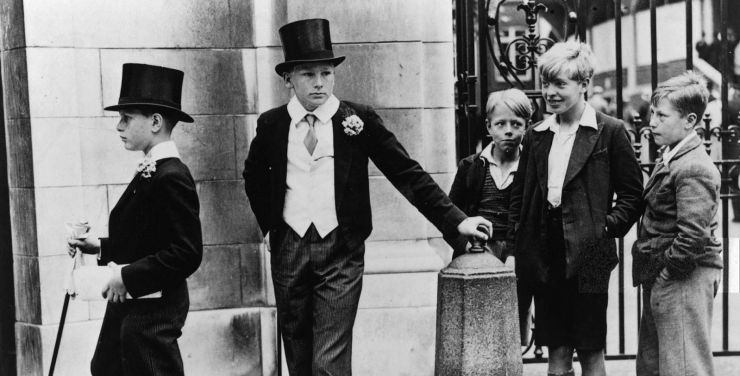
toffsandtoughs_cropped.jpg

This photo is titled “Toffs and Toughs,” taken by photographer Jimmy Sime in London in 1937, and it shows two English public (private for Americans) schoolboys waiting for their parents to come pick them up. The photo has two stories, the actual story, and the one built around it by malcontents. The day after Sime took the photo, the leftist and class-warfare fomenting News Chronicle, which later merged into the modern tabloid Daily Mail, published it underneath the headline “Every Picture Tells A Story,” but then declined to clarify the photo at all, beyond misidentifying the two boys in morning dress as Etonians attending the Eton-Harrow cricket match. Almost simultaneously, American Life magazine picked up the photo and published it with further misidentifications and lack of clarification. The message was clear: the elites ignore or turn their back on the underprivileged and working-class.

The real story of the two “elite princelings” was very different. Both boys, students at Harrow, came from solidly middle-class backgrounds; the only trait that might be interpreted as “elite” about them was that their fathers were Harrovians. The younger boy Peter Wagner (on the far left) came from a family of immigrant tradesmen who had bootstrapped their way up the ladder. By 1937, the Wagners had settled into being a family of scientists and stockbrokers, comfortable, respectable, conventional. Peter served honorably during World War II and then took over his family’s business. The older boy Timmy Dyson (center) came from a professional military family, great of name but lacking means. Born into decidedly ordinary circumstances, he spent his childhood as an army brat. His parents only afforded Harrow because he was an only child. He died suddenly a few months after Sime took the infamous photograph.

Of the three “poor” boys, their realities were also much different from the one implied by the photo. None of them was a street urchin. Since they were playing hooky from school the day of the photo, one can extrapolate that they came from families with sufficient means to keep teenage boys enrolled in school despite living in Depression-era London. The two smaller boys, flanking the tall one, both became successful businessmen, while the taller boy became a civil servant. The three never forgave the media for casting them in the role of impoverished victims, arguing that they all had much richer lives than the photograph showed. Literally richer in the case of the two small boys, who post-War reportedly lived at a level of luxury unknown to “elite” Timmy Dyson.

“Toffs and Toughs” is an interesting study of imagery and the myths and perceptions that it can create and perpetuate. It is not an accident that Ruth Davidson, when discussing the modern young person’s alienation from capitalism, wrote, “all the while watching Rich Kids of Instagram on Channel 4 and footballers being bought and sold for more than the entire economy of a third world nation on Sky Sports News.” These are highly visual media which are also highly ersatz, shaped into the appearance of a cohesive whole through skillful editing.

Sports stars (and musicians, dancers, and artists) are terrible for comparison because becoming one requires herculean efforts and hours of practice. An extension of the 10,000-hour rule is: if someone isn’t willing to put in 10,000 hours to master a skill, he has no right to engage in envious nattering. Rich Kids of Instagram is a British reality TV show that spun off of an eponymous Tumblr thread wherein the purported Instagram photos of the superrich are collected. If one examines the pictures with a critical eye, it becomes apparent that the majority are staged – anyone standing on a pier can take a selfie with a docked yacht; it doesn’t mean that he owns the boat.

In the fourth episode, “From Cradle to Grave,” of Milton Friedman’s Free to Choose, 1980 original, at 32:27, Helen Bohen O’Brian, then Secretary of Welfare for Pennsylvania, astutely observed that people estimated their quality of life based on the people around them. What visual media has done is to bring people like the exhibitionists of Rich Kids of Instagram into people’s lives and present them as if they are in some manner the viewer’s peers. It is as divisive and dishonest as claiming that “Toffs and Toughs” told a “story.” If one considers that Guardian columnist Marina Hyde outed the TV show by revealing that a “rich kid” was not particularly rich, was a former tenant of Hyde’s family, and the place portrayed as the reality starlet’s house was their own property, into which the TV crew had unknowingly broken and entered, the deception is exactly on par with the 1937 one. It is all a pitiful lie, but one which, as Davidson spotted, the vast majority of people see and envy as truth.

In closing, there is one last example to consider. Marc Stuart Dreier, currently in prison for fraud, is an ex-lawyer whose scams were eclipsed only by those of Bernie Madoff. In an interview for the BBC documentary Unraveled, Dreier explained that he wasn’t motivated by greed or desire for the “rich life,” no, he wanted to be someone who socialized with golf and football stars. At the start, he was the embodiment of the American dream – son of an immigrant goes to Yale and Harvard Law – but then he discovered that law was not his métier. He neither enjoyed it, nor was he good at it. Unable to succeed through honest means, he turned to fraud. He wanted to be successful, not for its own sake but for the peer group he hoped to join. The documentary shows repeatedly snippets of Dreier in the guise of lawyer-philanthropist glad-handing footballers and playing with famous golfers, always with cameras there to catch every move. The goal was the visuals, not the reality.

In a battle of the mythic caricatures of Joseph A. Schumpeter, the victim is going to be liberty and responsibility. Today, Schumpeter’s words are truer than ever. Everyone has caricatured everyone else. And at the same time, everyone imagines himself on stage with his peers as the audience. There is no doubt that social media and technology have exacerbated the problem of imagery and the peer – fictional Homer Simpson and his candy mansion and Rich Kids of Instagram – but it is delusional to pretend that it didn’t exist before apps and smart phones. Blaming capitalism for the discontent caused by voyeurism and false expectations is both a logical non sequitur and a very serious peril for liberty. For the sake of preserving freedom, it is important to ask, to demand even, by what metric are the disaffected judging their lives. If it is by the peer, as Bohan O’Brian argued, then it is not a valid metric and should be treated as such.

Sine qua non: No shortcuts

This past summer at language school a young man invited me to a party, which I had to refuse since there was a major exam coming up. In response he said, “But you’re smart, why do you have to study?” He was genuinely astonished at the idea that intelligent people have to study; for him, intelligence meant that one was spared the bother of having to work to master a skill or a subject. His bewildered reaction made me start thinking about the nature of the work surrounding achievement and how it is perceived.

Bluntly put, achievement is very hard work and requires tremendous sacrifice. Last weekend, Oxford had its matriculation ceremony, after which the individual colleges arranged group photoshoots. While waiting for one shoot, I overheard two young women discussing a celebratory evening party. One said that she couldn’t go because she had to finish the reading for the next day, but the other said that she had risen at five o’clock that morning in order to finish her reading so that she could attend the party. Neither one was bothered by the choices she had to make, and they were united in their agreement that study came first. Missing a party or missing sleep were simply prices for achievement.

There is an ancient Egyptian legend about a couple who stole the Book of Thoth, which contained all the wisdom of the natural and supernatural worlds, copied it down on a stone writing tablet, washed the stone, and then drank the runoff water; in doing so they acquired all that knowledge without having to read the book. (For those who are interested, the story doesn’t end well, mostly because Thoth is annoyed that his book is gone, but also because, having not genuinely learned the material, the couple can’t control their new-found powers.) In the Folger Museum in Washington DC, there is a medieval manuscript (MS V.b.26 (1)) that contains a spell to compel the spirits to do your writing for you, though as a friend of mine drily pointed out, there’s nothing promised about the quality of writing delivered. What is interesting about myths and spells concerning shortcuts to knowledge and accomplishment is that they are all focused on bypassing the sacrificial process, while still being crowned with the laurels.

The ancient/medieval view was that the spiritual sphere, being responsible in the first place, could help create a world where everyone could achieve without the bother of the foundational work. Now, in a post-Frankfurt School, Utilitarianist world, society speaks in terms of “talent,” as if it is a supernatural thing that requires no cultivation, existing fully formed in a vacuum. We have come from Thomas Jefferson arguing that every person should be free to pursue his own interests according to his endowments to John Rawls’ yowling about the “injustice” of modern society and a world where smart, talented people appear to “have it all.” In order for the Rawlsian vision of the world to work out in completely equitable justice, the work put in by achievers in pursuit of their goals must be negated.

On a personal note, I remember one chillingly funny episode when, during a seminar, a classmate informed a group of us that our coming in prepared, having done the readings and written up commentary, was an act of oppression against her. Her basic argument was that we were too smart, and it wouldn’t cost us anything to show up unprepared once in a while in order to let her shine. We finished on time; I ran into her three days before all MA theses were due for submission and she hadn’t started writing yet. I’m willing to bet, though, that in her movie she’s a victim and we’re all oppressors.

In a way, the romaticization and mythicization of people of genius has been very unhelpful to society, especially since the popular conception of these people appears to support Rawls and Co.’s complaints. Let us take the example of Wolfgang Amadeus Mozart, partially because his myth is a perfect example and partially because this is a topic I would be happy to discuss for days on end. The popular myth is fairly well established: genius infant who miraculously taught himself everything and created beautiful music as a three-year-old, before dying tragically young, in keeping with the romantic tradition of great geniuses.

The reality, while hardly prosaic, is much less romantic. W.A. Mozart’s parents, Leopold and Anna Maria, were superbly well-educated for the standards of their time. Their familial letters, written in a mix of German, French, Italian, Latin, some English, and mathematical substitution ciphers are a jumble of thoughts and observations on literature, music, art, history, political events, social commentary, and professional talk, along with some infantile humor. Musicologist Nicholas Till wrote a wonderful book, Mozart and the Enlightenment: Truth, Beauty and Virtue in Mozart’s Operas, that covers exactly how having an Enlightenment-era (possessing an unbound belief in the benefits of education and faith in the individual), Renaissance man (good at everything) for a father affected Mozart and his sister.

Due to the extensive concertizing tours undertaken throughout Wolfgang and Marianne Mozart’s childhood,[1]music history tends to treat their father as the epitome of a deranged stage parent. But one of Leopold’s primary reasons for the tours was to procure music lessons for his son with the best musicians in the world. On the infamous “Grand Tour,” where the Mozart family travelled across Europe, from 1763 to 1766, the family spent over a year in England, on stretched financial means, so Wolfgang could study composition with Johann Christian Bach, one of Johann Sebastian Bach’s surviving sons and a much-sought after composer and teacher. Leopold was absolutely determined that his son would study with a Bach and the family had first spent time in the Netherlands in an unsuccessful effort to contact Carl Philipp Emmanuel Bach, J.C.’s brother. Mozart senior also applied the same strategy to obtaining private instrumental and voice lessons for Wolfgang. So much for the spontaneous aspect of the child genius story; during his boyhood, the composer had lessons with masters for whom he had to prepare work and have it judged. Genius might exist, but it had to be formed and cultivated, a process that the Mozart myth has completely and deceptively lost.

Losing sight of the work, sacrifice, and constructive elements of achievement has, I believe, provided valuable fuel to the social resentment industry. It is easier to envy the accomplishments and standing of others if one believes that they are unearned endowments because the person holding them is “gifted.” In my own path and work that I do, I’ve seen many people of envious or resentful inclination become devastated emotionally and psychologically when they come into close contact with high-achievers and see the amount of work, time, investment, and sacrifice that being one requires.

In my experience, these people either develop personal persecution narratives, such as the girl from my class, or flounce out proclaiming that they “have a life.” My personal experience has made me doubt the efficacy of Charles Murray’s solution, proposed at the end of Coming Apart: The State of White America, 1960 – 2010, that the best cure for the culture of resentment and anger is for the top twenty percent, representative of the high-achieving, to become visible to the bottom eighty and in doing so to allow the bottom sectors to see how hard the top actually works. Historically, the argument is probably justified; returning to the example of the Mozart family, their close association with the aristocracy, both hereditary and professional, certainly provided impetus for the children to set themselves new challenges as part of winning respect and recognition. But that family had an openness to self-improvement, a belief in the possibility of it that as a larger cultural force was, as Nicholas Till repeatedly pointed out, unique to the Enlightenment.

The people of contemporary society not only lack such a belief, they are closed even to the possibility that there is room for improvement. This is not new; Nietzsche observed and decried the culture of ressentiment– defined by the OED as “a psychological state resulting from suppressed feelings of envy and hatred that cannot be satisfied.” Only now there is no suppression. Achievement through self-improvement is replaced with cries for equality of outcome. People are no longer willing to work for achievement, instead they want is for what they have done, no matter how small, no matter how inadequate, to be recognized as achievements, citing that they did invest time, energy, and money it their banalities. Since the investment aspect is very important, I’ll close here and we’ll look at it next.


[1]Marianne Mozart was, according to the entire family, the better musician and performer of the two siblings. By the time of her early teens, she had surpassed her father and brother as a violinist and pianist to such an extent that her brother gradually ceased playing seriously himself in order to concentrate on composing for her. However, her parents had her retire from the stage once she turned seventeen in order to leave her open for an aristocratic marriage, which she eventually made. After she was widowed, she became a very successful teacher and was able to support single-handedly her children, step-children, and nephews and leave behind a massive fortune.

The State and education – Part IV: Conclusion

On August 17, 2018, the BBC published an article titled “Behind the exodus from US state schools.” After taking the usual swipes at religion and political conservatism, the real reason for the haemorrhage became evident in the personal testimony collected from an example mother who withdrew her children from the public school in favour of a charter school:

I once asked our public school music teacher, “Why introduce Britney Spears when you could introduce Beethoven,” says Ms. Helmi, who vouches for the benefits to her daughters of a more classical education.

“One of my favourite scenes at the school is seeing a high-schooler playing with a younger sibling and then discussing whether a quote was from Aristotle or Socrates.”

The academic and intellectual problems with the state school system and curriculum are perfectly encapsulated in the quote. The hierarchy of values is lost, not only lost but banished. This is very important to understand in the process of trying to safeguard liberty: the progenitors of liberty are not allowed into the places that claim to incubate the supposed future guardians of that liberty.

In addition to any issues concerning academic curricula, there is the problem of investment. One of the primary problems I see today, especially as someone who is frequently asked to give advice on application components, such as résumés and cover letters/statements of purpose, is a sense of entitlement vis-à-vis institutional education and the individual; it is a sense of having a right to acceptance/admission to institutions and career fields of choice. In my view, the entitlement stems from either a lack of a sense of investment or perhaps a sense of failed investment.

On the one hand as E.S. Savas effectively argued in his book Privatization and Public-Private Partnerships, if the state insists on being involved in education and funding institutions with tax dollars, then the taxpayers have a right to expect to profit from, i.e. have a reasonable expectation that their children may be admitted to and attend, public institutions – it’s the parents’ money after all. On the other hand, the state schools are a centralized system and as such in ill-adapted to adjustment, flexibility, or personal goals. And if all taxpayers have a right to attend a state-funded institution, such places can be neither fully competitive nor meritocratic. Additionally, Savas’ argument serves as a reminder that state schooling is a manifestation of welfarism via democratic socialism and monetary redistribution through taxation.

That wise investing grants dividends is a truth most people freely recognize when discussing money; when applied to humans, people start to seek caveats. Every year, the BBC runs a series on 100- “fill-in-the-blank” people – it is very similar to Forbes’ lists of 30 under 30, top 100 self-made millionaires, richest people, etc. Featured on the BBC list for 2017 was a young woman named Camille Eddy, who at age 23 was already a robotics specialist in Silicon Valley and was working to move to NASA. Miss Eddy’s article begins with a quote: “Home-schooling helped me break the glass ceiling.” Here is what Eddy had to say about the difference between home and institutional schooling based on her own experience:

I was home-schooled from 1stgrade to high school graduation by my mum. My sister was about to start kindergarten, and she wanted to invest time in us and be around. She’s a really smart lady and felt she could do it.

Regarding curriculum choices, progress, and goals:

My mum would look at how we did that year and if we didn’t completely understand a subject she would just repeat the year. She focused on mastery rather than achievement. I was able to make that journey on my own time.

And the focus on mastery rather than achievement meant that the latter came naturally; Eddy tested into Calculus I her first year at university. Concerning socialization and community – two things the public schools pretend to offer when confronted with the fact that their intellectual product is inferior, and their graduates do not achieve as much:

Another advantage was social learning. Because we were with mum wherever she went we met a lot of people. From young to old, I was able to converse well with anyone. We had many friends in church, our home-school community groups, and even had international pen pals.

When I got to college I felt I was more apt to jump into leadership and talk in front of people because I was socially savvy.

On why she was able to “find her passion” and be an interesting, high-achieving person:

And I had a lot of time to dream of all the things I could be. I would often finish school work and be out designing or engineering gadgets and inventions. I did a lot of discovery during those home-school years, through documentaries, books, or trying new things.

In the final twist to the plot, Camille Eddy, an African-American, was raised by a single mother in what she unironically describes as a “smaller town in the US” where the “cost of living was not so high.” What Eddy’s story can be distilled to is a parent who recognized that the public institutions were not enough and directly addressed the problem. All of her success, as she freely acknowledges, came from her mother’s decision and efforts. In the interest of full honesty, I should state that I and my siblings were home-schooled from 1stgrade through high school by parents who wanted a full classical education that allowed for personal growth and investment in the individual, so I am a strong advocate for independent schooling.

There is a divide, illustrated by Eddy’s story, created by the concept of investment. When Camille Eddy described her mother as wanting “to invest time in us and be around,” she was simply reporting her mother’s attitude and motivation. However, for those who aspire to have, or for their children to attain, Eddy’s achievements and success, her words are a reproach. What these people hear instead is, “my mother cared more about me than yours cared about you,” or “my mother did more for her children than you have done for yours.” With statements like Eddy’s, the onus of responsibility for a successful outcome shifts from state institutions to the individual. The responsibility always lay with the individual, especially vis-à-vis public education since it was designed at the outset to only accommodate the lowest common denominator, but, as philosopher Allan Bloom, author of The Closing of the American Mind,witnessed, ignoring this truth became an overarching American trait.

There are other solutions that don’t involve cutting the public school out completely. For example: Dr. Ben Carson’s a single-, working-mother, who needed the public school, if only as a babysitter, threw out the TV and mandated that he and his brother go to the library and read. As a musician, I know many people who attended public school simply to obtain the requisite diploma for conservatory enrollment but maintain that their real educations occurred in their private preparation – music training, especially for the conservatory level, is inherently an individualistic, private pursuit. But all the solutions start with recognizing that the public schools are inadequate, and that most who have gone out and made a success of life in the bigger world normally had parents who broke them out of the state school mould. In the case of Dr. Carson’s mother, she did not confuse the babysitter (public school) with the educator (herself as the parent).

The casual expectation that the babysitter can also educate is part of the entitlement mentality toward education that is pervasive in American society. The mentality is rather new. Allan Bloom described watching it take hold, and he fingered the Silent Generation – those born after 1920 who fought in World War II; their primary historical distinction was their comparative lack of education due to growing up during the Great Depression and their lack of political and cultural involvement, hence the moniker “silent”[1]– as having raised their children (the Baby Boomers) to believe that high school graduation conferred knowledge and rights. As a boy Bloom had had to fight with his parents in order to be allowed to attend a preparatory school and then University of Chicago, so he later understandably found the entitlement mentality of his Boomer and Generation X students infuriating and offensive. The mental “closing” alluded to in Bloom’s title was the resolute refusal of the post-War generations either to recognize or to address the fact that their state-provided educations had left them woefully unprepared and uninformed.

To close, I have chosen a paraphrase of social historian Neil Howe regarding the Silent Generation, stagnation, and mid-life crises:

Their [Gen X’s] parents – the “Silent Generation” – originated the stereotypical midlife breakdown, and they came of age, and fell apart, in a very different world. Generally stable and solvent, they headed confidently into adult lives about the time they were handed high school diplomas, and married not long after that. You see it in Updike’s Rabbit books – they gave up their freedom early, for what they expected to be decades of stability.

Implicit to the description of the Silent Generation is the idea, expressed with the word “handed,” that they did not earn the laurels on which they built their futures. They took an entitlement, one which failed them. There is little intrinsic difference between stability and security; it is the same for freedom and liberty. History demonstrates that humans tend to sacrifice liberty for security. Branching out from education, while continuing to use it as a marker, we will look next at the erosive social effect entitlements have upon liberty and its pursuit.


[1]Apparently to be part of the “Greatest Generation,” a person had to have been born before or during World War I because, according to Howe, the Greatest Generation were the heroes – hero is one of the mental archetypes Howe developed in his Strauss-Howe generational theory – who engineered the Allied victory; the Silent Generation were just cogs in the machine and lacked the knowledge, maturity, and experience to achieve victory.

Debating a Marxist: An invitation

This week, I thought it might be fun to take a break from the series on the state and education and instead to introduce the topic of up-close and personal encounters with some very interesting people: Marxists. My reason for writing on this topic is simply that I’m curious to see if other people have had similar experiences and what the Notes on Liberty community thinks of this breed.

In my experience, there are two archetypes of modern Marxist. The first is the “cultural” one. This one is to my mind the more preferable of the two. This one conscientiously reads all the literature associated with Marxism and its derivatives, normally discards much of the economic aspects, and embraces the social and intellectual pieces. They tend to not think too highly of The Communist Manifesto but are crazy about Marx’s The Eighteenth Brumaire of Louis Napoléon. The result is that they cerebrally focus on class struggle, disenfranchisement, social inequality, etc., all while happily stipulating to all of the horrible famines, massacres, breadlines, general deprivation, etc. that occurred under Marxism. Their attitude is similar to a person who uses an old, long unpracticed religion as a form of social identification, e.g. “I’m Catholic (though I haven’t been to Mass in 40 years and support causes frowned upon by the Church).”

The standard response when asked about the fruits of Marxism tends to be a variant of “That wasn’t true Marxism; Marxism done right wouldn’t have caused that,” or “it just wasn’t implemented properly.” I have even heard one along the lines of “That was communism, not Marxism.” The cultural Marxist is easy to get along with. Because he tends to be a genuine intellectual and honest academic, when faced with reputable sources, he will graciously concede the point. Since this type respects skill and knowledge, there is a shared framework in which to debate. He is happy to debate anything and never views any author or source as particularly sacrosanct.

As a result, the cultural Marxist is reasonably open-minded and eager to find some common ground. My personal encounters with this type tend to be positive and normally end with everyone buying everyone else coffee and leaving the meeting as friends. They also tend to be pragmatic; during my time at Columbia (it’s reputation should be well known vis-à-vis Marxism), there was one faculty member who could only be described as fiscally capitalist and socially Marxist. Dovetailing with debates on class structure, we also received exhortations to secure our financial futures and received step-by-step instructions on how to invest in Vanguard mutual funds! It was slightly surreal, but I later discovered that this hybrid attitude is fairly typical among cultural Marxists. For them, it’s not about the money; it’s about the ideas. But because they mix and match ideas to create a personal worldview, they are neither invested in any particular aspect of Marxism, nor overly interested in practicing it.

The other archetype is the rabid ideologue who believes everything from Karl Marx, Vladimir Lenin, and, variably, Ivan Trotsky, Josef Stalin, or Mao Tse-tung is gospel. Unlike the cultural Marxist, the knowledge of ideologue tends to be constrained to a limited number of sources and works. The existence of The Eighteenth Brumaire can come as a surprise to these people, though they can quote The Communist Manifesto practically verbatim. Encounters with this type disintegrate to name calling and ad hominem attacks within a matter of minutes, in my case usually when their source foundations have been abolished in debate. The hallmark of their mentality is a fixed belief that if they personally are incapable of something, then no one else can do it either.

As an example, a group of students, including myself, went to a performance of La Traviata at Opéra Bastille in Paris. One of our number turned out to be a Marxist ideologue who spent the evening denigrating the entire affair. I recall one particularly embarrassing moment during an intermission when the person loudly ranted about how none of the attendees were there through love of music, being only drawn through an affected desire to show off and appear cultured. All attempts to inveigle the person to return quietly to our seats failed. Never once did it occur to the person to observe that evidence of genuine music appreciation was present just within the student group.

Recently, I tangled with a self-identified Marxist-Leninist ideologue online. Somehow the conversation careened from the original topic to his insistence that I couldn’t possibly have functional fluency in six languages (classical musicians have to be able to read and work in the five languages of music – English, French, German, Italian, and Latin – and I studied Ancient Greek through college). The only justification for his doubts appeared to be that he only had knowledge of three languages. The pivot and then ad hominem doubt is all par for the course in dealing with this type of person, but what struck me is that in all my history of engagements only ideologue Marxists have used the “you can’t possibly be or do X because I’m not or can’t” argument. This is where there is a real divergence between ideologue Marxists and cultural Marxists: all of the latter I have interacted with are highly capable people who go to the opposite extreme and assume that others are informed and thoughtful as well. On a side note, there is nothing quite as entertaining as watching a cultural Marxist debate an ideologue; it inevitably ends with a scorched earth defeat of the ideologue.

Since all of these interactions are anecdotal, they may be sheer personal experience and could very well be due to ideological ignorance. At this point, I invite members of the NOL community to relate their personal stories of brushes with Marxists and what most struck them about their mentality and approach. What is the most irrational thing you have heard on this topic? Were you able to reach a state of détente?  Did the discussion end in a draw, or a meltdown? Are there any archetypes you might add?

Notā bene: I am entering an intensive language course in preparation for doctoral studies. As a result, I may not be very present on NOL for the summer. I will do my best, though, to monitor comments and to be part of the conversation.

The State in education – Part III: Institutionalization of learning

In The State in education – Part II: social warfare, we looked at the promise of state-sponsored education and its failure, both socially and as a purveyor of knowledge. The next step is to examine the university, especially since higher education is deeply linked to modern society and because the public school system purports to prepare its students for college.

First, though, there should be a little history on higher education in the West for context since Nietzsche assumed that everyone knew it when he made his remarks in Anti-Education. The university as an abstract concept dates to Aristotle and his Peripatetic School. Following his stint as Alexander the Great’s tutor, Aristotle returned to Athens and opened a school at the Lyceum (Λύκειον) Temple. There, for a fee, he provided the young men of Athens with the same education he had given Alexander. On a side note, this is also a beautiful example of capitalist equality: a royal education was available to all in a mutually beneficial exchange; Aristotle made a living, and the Athenians received brains.

The Lyceum was not a degree granting institution, and only by a man’s knowledge of philosophy, history, literature, language, and debating skills could one tell that he had studied at the Lyceum. A cultural premium on bragging rights soon followed, though, and famous philosophers opening immensely popular schools became de rigueur. By the rise of Roman imperium in the Mediterranean around 250 BC, Hellenic writers included their intellectual pedigrees, i.e. all the famous teachers they had studied with, in their introductions as a credibility passport. The Romans were avid Hellenophiles and adopted everything Greek unilaterally, including the concept of the lyceum-university.

Following the Dark Ages (and not getting into the debate over whether the time was truly dark or not), the modern university emerged in 1088, with the Università di Bologna. It was more of a club than an institution; as Robert S. Rait, mid-20th century medieval historian, remarked in his book Life in the Medieval University, the original meaning of “university” was “association” and it was not used exclusively for education. The main attractions of the university as a concept were it was secular and provided access to books, which were prohibitively expensive at the individual level before the printing press. A bisection of the profiles of Swedish foreign students enrolled at the Leipzig University between 1409 and 1520 shows that the average male student was destined either for the clergy on a prelate track or was of noble extraction. As the article points out, none of the students who later joined the knighthood formally graduated, but the student body is indicative of the associative nature of the university.

The example of Lady Elena Lucrezia Cornaro Piscopia, the first woman to receive a doctoral degree, awarded by the University of Padua in 1678, illuminates the difference between “university” at its original intent and the institutional concept. Cornaro wrote her thesis independently, taking the doctoral exams and defending her work when she and her advisor felt she was ready. No enrollment or attendance at classes was necessary, deemed so unnecessary that she skipped both the bachelor and masters stages. What mattered was that a candidate knew the subject, not the method of acquisition. Even by the mid-19th century, this particular path remained open to remarkable scholars, such as Nietzsche since Leipzig University awarded him his doctorate on the basis of his published articles, rather than a dissertation and defense.

Education’s institutionalization, i.e. the focus shifting more from knowledge to “the experience,” accompanied a broader societal shift. Nietzsche noted in Beyond Good and Evil that humans have an inherent need for boundaries and systemic education played a very prominent role in contemporary man’s processing of that need:

There is an instinct for rank which, more than anything else, is a sign of a high rank; there is a delight in the nuances of reverence that allows us to infer noble origins and habits. The refinement, graciousness, and height of a soul is dangerously tested when something of the first rank passes by without being as yet protected by the shudders of authority against obtrusive efforts and ineptitudes – something that goes its way unmarked, undiscovered, tempting, perhaps capriciously concealed and disguised, like a living touchstone. […] Much is gained once the feeling has finally been cultivated in the masses (among the shallow and in the high-speed intestines of every kind) that they are not to touch everything; that there are holy experiences before which they have to take off their shoes and keep away their unclean hands – this is almost their greatest advance toward humanity. Conversely, perhaps there is nothing about so-called educated people and believers in “modern ideas” that is as nauseous as their lack of modesty and the comfortable insolence in their eyes and hands with which they touch, lick, and finger everything [….] (“What is Noble,” 263)

The idea the philosopher pursued was the notion that university attendance conveyed the future right to “touch, lick, and finger everything,” a very graphic and curmudgeonly way of saying that a certain demographic assumed unjustified airs.

Given that in Anti-Education, Nietzsche lamented the fragmentation of learning into individual disciplines, causing students to lose a sense of the wholeness, the universality of knowledge, what he hated in the nouveau educated, if we will, was the rise of the pseudo-expert – a person whose knowledge was confined to the bounds of a fixed field but was revered as omniscient. The applicability of Socrates’ dialogue with Meno – the one where teacher and student discuss human tendency to lose sight of the whole in pursuit of individual strands – to the situation was unmistakable, something which Nietzsche, a passionate classicist, noticed. The loss of the Renaissance learning model, the trivium and the quadrivium, both of which emphasize an integrated learning matrix, carried with it a belief that excessive specialization was positive; it was a very perverse version of “jack of all trades, master of none.” As Nietzsche bemoaned, the newly-educated desired masters without realizing that all they obtained were jacks. In this, he foreshadowed the disaster of the Versailles Treaty in 1919 and the consequences of Woodrow Wilson’s unwholesome belief in “experts.”

The philosopher squarely blamed the model of the realschule, with its clear-cut subjects and predictable exams, for the breakdown between knowledge acquisition and learning. While he excoriated the Prussian government for basing all public education on the realschule, he admitted that the fragmentation of the university into departments and majors occurred at the will of the people. This was a “chicken or the egg” situation: Was the state or broader society responsible for university learning becoming more like high school? This was not a question Nietzsche was interested in answering since he cared more about consequences. However, he did believe that the root was admitting realschule people to university in the first place. Since such a hypothesis is very applicable today, we will examine it in the contemporary American context next.