Small thought on the fundamental revolution of Blockchain

Mankind made a huge leap forward regarding human organization when it implemented the Constitution. Man was no longer to be ruled by kings and despots, but by a document that stipulated the rule of law. Still, we had the issue of who was going to interpret these laws and who was allowed to add new rules.

Now, we have made another revolutionary leap forward in human organization. We don’t need a third party – kings, governments, courts – to interpret the laws anymore if we have self-executing smart contracts that eliminate the need to trust these third parties. Trust is established through mass collaboration and clever code. On top of that, everyone is free to opt-in, to submit new rules, and to participate in a set of rules. No one is forced to participate. You can always secede. We have had many secessions in the blockchain space. Bitcoin Cash seceded from Bitcoin Core, Ethereum seceded from Ethereum Classic etc. It is therefore a peaceful means to organize human beings.

This is, in my opinion, the fundamental revolution of blockchain: a peaceful trust machine for social agreements and human organization.

Blockchain trust

Opportunities for blockchain-based social media in developing countries

IMG_0488.JPG

On September 22nd, I presented my Serey project – a blockchain based social media platform in Cambodia – at BitFest 2018 in Amsterdam. It was organized by the BitShares Foundation and mainly attended by enthusiasts of BitShares and Graphene technology. Being part of the Bitshares/Graphene family, I was invited to speak at the conference.

We shared the stage with other graphene projects as BitSpark, DasCoin, PayGer, BitCrab, RuDEX and many others. I look forward to work together with anyone that seeks to decentralize our future, that has a vision in which every human being is free, and where blockchain technology provides the tools to secure our rights to life, liberty, and property.

Stan Larimer was there as well, and he had something interesting to say about how BitShares will import EOS technology through a middle-layer. This will greatly benefit the whole BitShares/Graphene community, including Serey.

Regarding my own presentation, I have made the case that Blockchain is not only a technological revolution, but essentially a social, political and economic revolution. I believe it’s a tool that will move us into a more decentralized world that was envisioned by the earliest internet adopters. As more internet applications were built, it became clear that it would not become as decentralized as these adopters hoped. These applications suffered from a centralized system in which data was stored and controlled on a single or a small number of servers. Those who controlled these servers, the men-in-the-middle, dictated the rules of the platform. They could look into your data, modify your data, prevent you from accessing your data etc.

Blockchain eliminates these so-called “men-in-the-middle”. Its censorship-resistant property provides many great opportunities for developing countries where the rule of law are often weak or underdeveloped. One opportunity that I have been trying to seize in Cambodia is the creation of a social media platform that could not be controlled or censored by a single party. As Cambodians are becoming more tech savvy, and more connected to the outside world through internet access, it’s a great time to roll out a Blockchain-based social media platform where people can express themselves freely. The advantage of a social media is that it’s easier to build the network effect that can reach critical mass in a relatively short period of time. Once we gain enough momentum, I would like to tokenize the national currency, the Riel, develop a Serey Wallet, and provide anyone who has access to the internet the opportunity to open a wallet (bank account) for free and use our tokenized Riel for e-commerce, remittances, savings, loans etc. Although Cambodia has experienced tremendous economic growth in the past two decades and the World Bank has moved Cambodia’s status from a lower-income bracket to a lower-middle-income bracket, 83% of Cambodians still remain unbanked.

Doing so, I hope we will promote freedom of expression and an intellectual society in Cambodia, as well as help banking the unbanked.

Below, you can find my slides for the presentation.

1.jpg


2.jpg


3.jpg


4.jpg


5.jpg


6.jpg


7.jpg


8.jpg


9.jpg


10.jpg


11.jpg


12.jpg


13.jpg


14.jpg


15.jpg


16.jpg


17.jpg


18.jpg

Serey: a Cambodian blockchain-based social media platform inspired by Friedrich Hayek’s theory of dispersed knowledge

www.serey.io

Serey is a new Social Media platform that specifically targets the Cambodian market. The country that saw nearly a quarter of the population decimated during the civil war of the 60’s and 70’s, the Khmer rouge regime, and the subsequent famine, has gone through rapid economic developments in the past two decades due to its friendliness to free markets. Accompanying this development is the adoption of new information technologies. One such technology is blockchain.

The team behind Serey has now created a blockchain-based social media platform called Serey. It rewards content creators, such as writers, for their creativity. The platform now has 400-500 users who all contribute by writing content ranging from short fictional stories to history, philosophy, and technology. Users can post any content they want. There is no central authority that can censor the posts in any way. The system is based on a democratic voting system in which every user can vote on articles. Dependent on the votes, the content creators are rewarded with the platform’s native cryptocurrency called Serey coin (SRY).

What does Serey stand for? 

The name of the platform, Serey (សេរី in Khmer), is derived from the Khmer word seripheap (សេរីភាព) which stands for liberty or freedom. The platform is built on the philosophy of liberty and is inspired by Friedrich Hayek’s theory of dispersed knowledge. Realizing that every individual knows just a fraction of what is collectively known and that our collective knowledge is therefore decentralized, Serey is looking to encourage the sharing of the unique information that individuals possess through the Serey platform. It wants to create an open platform where everyone is free to enter, to exercise their creativity without fear of being coerced into silence or conformity, and to engage in thoughtful, civilized discussions.

There was no such online platform in Cambodia yet. Cambodia, at this moment, also doesn’t have a culture of reading and writing. Serey is aiming to transform this so there is also an educational component to it.

We need to learn to dance with our feet, with ideas, with words, and, need I add that one must also be able to dance with the pen?

The mission statement of Serey is as follows:

“Rewarding self-expression and creativity.”

Why is Serey run on a blockchain?

The Serey blockchain allows the storage of content – actually only the actual text of the article and no pictures or videos to keep block sizes minimal – in a distributed manner. Anything written on Serey is stored on a blockchain that is shared among many other servers, called witnesses, that run an exact copy of the blockchain. This makes all content tamper-proof and censorship nearly impossible. This is in line with Serey’s belief that everyone should have the right to free expression.

In addition, a blockchain serves the people’s right to keep the fruits of their labour. Serey cannot take away any of its users Serey coins. All earnings are rightfully theirs and they can spend it in any way they want.

What are the features of Serey?

Serey is principally a fork of Steemit – another social media platform on the blockchain – and therefore essentially makes use of the Graphene technology that also powers Steemit and Bitshares. However, whereas Steemit is trying to create a one-size-fit-all approach with their platform, Serey is entirely dedicated to the people of Cambodia. They believe that regional differences require different user interfaces and functionalities that match the people’s cultural makeup and level of sophistication with blockchain technology.

Compared to Steemit, Serey has a different layout, a market place section, a Khmer language option, an free advertisement section, and a simplified reward system.

The Serey Decentralized Exchange is currently under development and will offer an English and Khmer language option.

In addition, the Serey Decentralized Exchange is currently being built in cooperation with developers close to Steemit and Bitshares. It will be a full-fledged decentralized exchange that is accessible by anyone, anywhere in the world. Users will then be able to trade Serey coins (SRY) among 15-20 other cryptocurrencies such as Bitcoin, Ethereum, Dash, Bitshares etc.

Other features that Serey users can look forward to in the next six months are an online betting system, improvements of the market place section, an integrated chat feature similar to that of Messenger, and a mobile app.

If you are interested in Serey, please feel free to visit the website and to register for free. Most articles are written in Khmer, but English articles are welcome as well.

RIP John Perry Barlow – On the right to free information

Sadly, John Perry Barlow, the founder of the Electronic Frontier Foundation has died today. He was – to me – a huge inspiration for the internet anarchy and the cyberlibertarian movement I support.

His vision of the internet was to create “a world that all may enter without privilege or prejudice accorded by race, economic power, military force, or station of birth.”

As a tribute to Barlow, I would like to provide a summary of his speech on The Right To Know at TEDx Marin.

  1. The first time Barlow got online, he thought the internet would create the collective organism of mind.
  2. He believed that one day everyone on the planet would be endowed with the right to say whatever they want to say within their hearts, and nobody would be in the position to shut them up. In addition, everybody would have the right to not listen to what was said or written on the internet.
  3. The internet was going to be the great challenger of dogmatism.
  4. Having founded the Electronic Frontier Foundation in July 1990, he spent many years thinking about the intersection between Cyberspace and the physical world.
  5. All the existing power relations in the physical are being renegotiated in Cyberspace.
  6. We are now at the point where the physical world is starting to become terrified of Cyberspace. This is obviously shown by how governments deal with Wikileaks and the Arab awakening.
  7. Cyberspace has provided the bloggers, and journalists of Wikileaks and the Arab awakening with the opportunity to question the political structure. They knew that their real power was the ability to speak, and to be heard.
  8. They also understood that they had the right to know.
  9. If we play our cards right, the internet will make it possible for everybody on the internet to satisfy his curiosity to the fullest extent that is presently known by our species. Everyone interested, can know what is presently known.
  10. Nothing like this has had ever happened before.
  11. To achieve that, we have to realize that we cannot own free speech.
  12. Copyright is the wrong model for monetizing the expression of the mind. Thought is not a thing, … it is an action. The more a thought is heard and understood, the more powerful it becomes. It’s not like physical goods.
  13. Because of the old model of thinking of expression as a thing that must be regulated towards scarcity, there are many things going on right now that are militating against Freedom of expression.
  14. Comcast, yesterday, stopped all of our access to PirateBay. PirateBay is a notorious copyright infringement site, but is also an important cause with different members from European parliaments.
  15. The other thing is that the Freedom of expression necessarily includes tolerance to the other person’s right to speak up his mind. No matter how abominable his ideas may be.
  16. The answer to hate speech is love speech, and the answer of the speech you can’t stand is the speech of your own heart. Go out there and stop those who will try to own Freedom of expression.
  17. Take a look at the Electronic Frontier Foundation.

Catalonia: a philosophical case for Secession

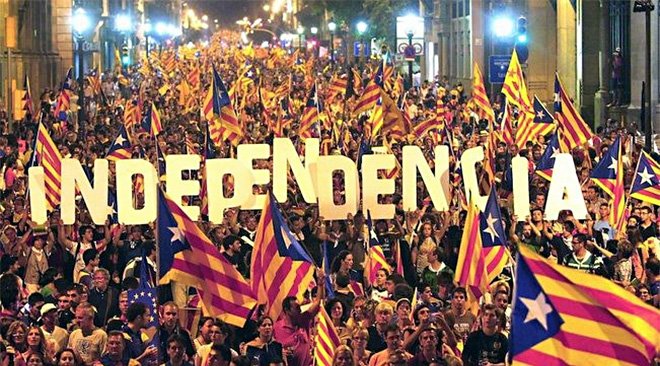
Yesterday, the Catalan government has overwelmingly voted for independence from Spain and to establish an independent republic. 70 were in favour, 10 were against, and 2 votes were blank. Unfortunately, it was rejected by the central governments of Spain and many other countries. Nonetheless, the Catalan case may inspire the other independence movements in Europe.

In this post I’d like to provide a philosophical case for the ethical right of secession based on a libertarian perspective of self-ownership. My argument is exclusively theoretical, although a discussion on how secession could be achieved practically would be interesting as well. I may save that for a post in the future.

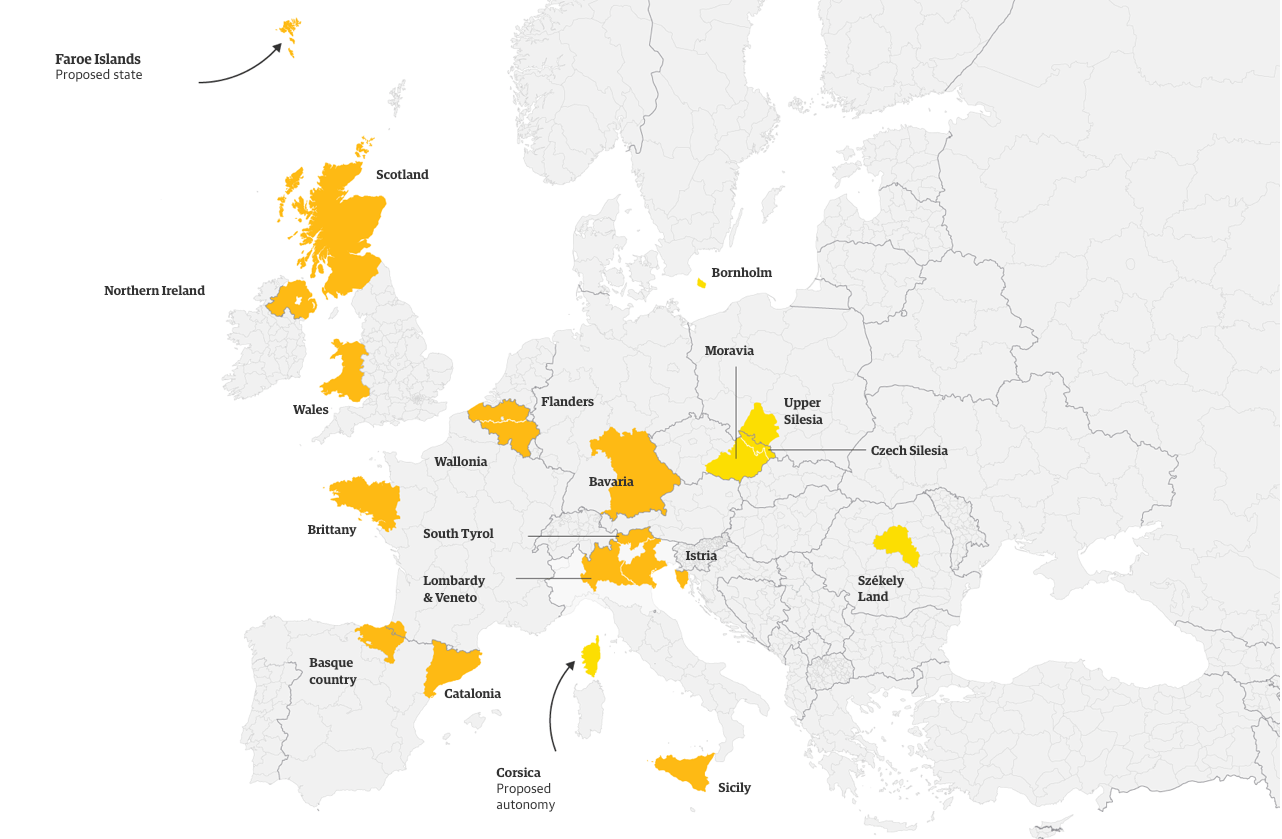
Below, you can find a map of other places in Europe with strong secessionist movements:

Structure of my argument

My argument is deductive and runs as follows:

  1. People have the right of self-ownership in accordance with the non-aggression principle, and based on the natural rights philosophy put forward by the political philosopher Murray Rothbard;
  2. If people have the right of self-ownership, they also have the right of voluntary association, voluntary formation of communities, and the right to choose their own leaders;
  3. Sometimes the state that the individual belongs to, violates the rights of the individual to the extent that the individual does not feel associated with it anymore;
  4. Under such circumstances the individual may perceive the state as an unacceptable aggressor, and he is justified to revolt by separating himself from the state. He can form communal associations to secede as a new political unit;
  5. There is no limit to secession. Provinces have the right to secede from a state, a district from the province, a town from the district, a neighbourhood from the town, a household from the neighbourhood, and an individual from the household.

The right of self-ownership and property rights

In For a New Liberty (1973), Murray Rothbard deduces natural law from the essential nature of human beings. He writes that it is in man’s nature to use his mind in order to select values, ends and the means to attain these ends so that he can “act purposively to maintain himself and advance his life”. He furthermore contends that it is absolutely “antihuman” to interfere violently with a man’s “learning and choices” as “it violates the natural law of man’s needs”. Therefore, man’s nature should be protected through his right of self-ownership. This right asserts that man has the absolute right to “own” his body and “to control that body free of coercive interferences”. This right includes the practice of such essential activities as thinking, learning, valuing, and choosing ends and means without any coercion, since such activities are necessary for the enhancement of man’s life.

From this natural right follows the right to do anything with one’s body, including the right to form free associations and communities, and the right not to be violated in one’s self-ownership. Thus, one has the right to associate oneself with the leader of one’s choice, but not the right to impose a leader unto someone else. Likewise, people should be free to join and to leave communities voluntarily.

In addition to the right of free association, people also have property rights. Rothbardian property rights are directly derived from self-ownership rights, and are based on the Lockean homesteading theory. It states that since man owns his person, he owns his labour, and therefore he also owns the fruits thereof. John Locke (1689) has put homesteading theory in the following way:

… every man has a property in his own person. … The labour of his body and the work of his hands, we may say, are properly his. Whatsoever, then, he removes out of the state of nature hath provided and left it in, he hath mixed his labour with it, and joined it to something that is his own, and thereby makes it his property.

Given that man has the right of self-ownership, and that he must employ natural objects for his survival, then the sculptor has the right to own the product he has made through the mixing of his labour. In other words, by producing something with one’s energy through the utilization of unowned nature, one has, as Rothbard calls it, “placed the stamp of his person upon the raw material”. One therefore rightfully owns the product. Any violation of self-ownership and property rights should hence be regarded as an act of aggression.

The state

The state is nonetheless a social institution that has historically interfered most often with people’s self-ownership and property rights. Max Weber has recognized it as an institution with a territorial monopoly of compulsion in his essay ‘Politics as a Vocation’ (1919). Hoppe, in Democracy – the God that failed (2001), asserts that every government will use this monopoly to exploit its citizens in order to increase its wealth and income.

“Hence every government should be expected to have an inherent tendency toward growth”. (Hoppe)

State exploitation happens in the form of expropriation, taxation, and regulation of private property owners. A state at best respects the rights of individual sovereignty and private property, but because its functioning is dependent on the expropriation of its citizens’ wealth there is a natural conflict between the state and its citizens. According to Franz Oppenheimer (1908), the state can impossibly finance itself without its productive citizens. It can only take that what has already been produced, and therefore it can only exist as a result of the “economic means”. However, this confiscation often involves state violence and aggression as nearly no one is willing to give up on his property voluntarily.

Under such circumstances, it is understandable that conflicts may arise between citizens and the state; sometimes resulting in citizens’ feelings of dissociation from their governments.

Secession

Frédérik Bastiat maintains in The Law (1850) that if everyone has the right to “his person, his liberty, and his property”, then

“a number of men have the right to combine together to extend, to organize a common force to provide regularly for this defense.”

Following Bastiat’s reasoning, I believe that citizens who feel dissociated can then revolt and opt for secession as a form of self-defense against state aggression on their self-ownership and property. Any state that does not recognize its citizens’ rights of secession does not sufficiently recognize the sovereignty of its people. Secession is a powerful means of political action to show the people’s discontent with their leaders. If secession would be impermissible, then the people who want to disassociate themselves from the state have the following three options:
(1) continue living under the oppressive state rule;
or (2) revolt against the state;
or (3) emigrate to another state.

By doing (1), the people continue living under perpetual state aggression, and their sovereignty is continually violated.

If the people choose option (2), then there will be severe and costly consequences which can involve war and destruction of private property. In addition, there are also no guarantees that the revolt against the state will be successful. For these two reasons, this option seems to most secessionists to be the least preferable of the three.

The people can alternatively choose (3) and emigrate to another state. This alternative is often used as an argument against secession under the presumption that those who are unhappy within one particular state, should simply emigrate. However, the cost of emigration can be so significantly high that it is unfeasible. One has for example the costs of finding information on the procedure of emigration, becoming accepted by the other state, finding a new workplace etc… The state can also exert barriers of emigration through tedious bureaucratic processes and passport controls, which makes emigration even more unattractive.

Who are morally justified to secede?

Following man’s right of free association, the answer should be: anyone, as long as it happens on a voluntary basis. Even though most secessionist movements are built on a common ethnicity or common cultural heritage, such precepts are not necessary to justify secession. Moreover, secessionists should not be prescribed any form of social organization as they should be free to choose their own form of government. This means that a multitude of social organizations are possible, including those that are currently non-existent. By being epistemologically modest of what governmental form is best, communities are allowed to experiment and find their own form of government. This will eventually add to our understanding of human social organizations.

Lastly, it is important to note that if secession is ethical, ultimately based on the principle of self-ownership, then it follows that the individual has the right to secede as well.

This right cannot be exclusively granted to groups, because only individuals can have ownership of their own bodies. Self-ownership cannot be shared, just like the mind cannot be shared. The mind is an attribute, inherent only to individuals, and collectives only derive their rights from the rights of their individual members. Therefore the right of self-ownership must necessarily imply the right to practice unlimited secession.

As Rothbard would assert, provinces should have the right to secede from a state, a district from the province, a town from the district, a neighbourhood from the town, a household from the neighbourhood, and an individual from the household. This logical consequence is anarchism.

Conclusion

In setting forward a natural rights defense of self-ownership, I have concluded that individuals have the right to free association and property rights. Unfortunately, states sometimes violate these rights to the extent that its people do not want to be associated with their state anymore. Under such circumstances they retain the right to secede. Secession should however not only be limited to communities. Single individuals also bear the right to secede, since only individuals can possess self-ownership, and since groups can only derive their rights from its individual members.

The case of James Damore: defending the Google engineer who was fired over a ‘controversial memo’

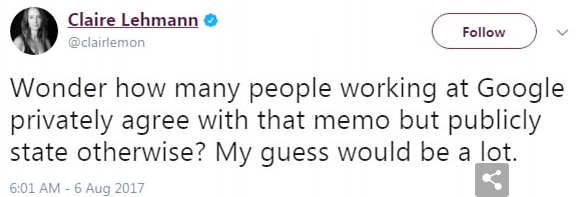
Yesterday, news broke out that Google had fired their engineer James Damore for disseminating a memo which was meant to be an invitation for open and honest discussion on Google’s left bias. CEO Sundar Pichai said the engineer had violated Google’s code of conduct by ‘advancing harmful gender stereotypes’.

DasKapital calls Damore a ‘diversity hater’, and Metro News calls him ‘anti-women’. The Guardian calls the memo ‘sexist’ and shamelessly maintains that the memo argues for the “biological inferiority of his female colleagues, and how this made them less suitable for tech.”

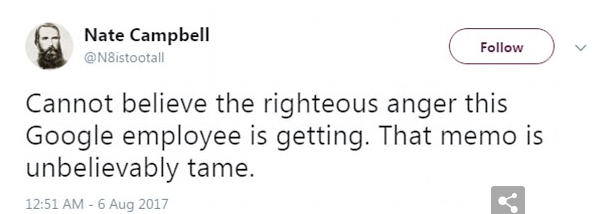
Reading through the 10-page memo myself, I find the memo very reasonable and I stand behind it 100%. Like Damore, I believe that we should stop assuming that gender gaps imply sexism.

What is Damore arguing against?

Damore argues that “Google’s left bias has created a politically correct monoculture that maintains its hold by shaming dissenters into silence.”

The several discriminatory practices that Google has instituted as a result of their left bias are:

  • Programs, mentoring, and classes only for people with a certain gender or race.
  • A high priority queue and special treatment for “diversity” candidates.
  • Hiring practices which can effectively lower the bar for “diversity” candidates by decreasing the false negative rate.
  • Reconsidering any set of people if it’s not “diverse” enough, but not showing that same scrutiny in the reverse direction (clear confirmation bias).
  • Setting org level OKRs for increased representation which can incentivize illegal discrimination.

In short, Damore argues that:

  • Google’s political bias has equated the freedom from offense with psychological safety, but shaming into silence is the antithesis of psychological safety.
  • This silencing has created an ideological echo chamber where some ideas are too sacred to be honestly discussed.
  • The lack of discussion fosters the most extreme and authoritarian elements of this ideology.
  • Extreme: all disparities in representation are due to oppression.
  • Authoritarian: we should discriminate to correct for this oppression.
  • Differences in distributions of traits between men and women may in part explain why we don’t have 50% representation of women in tech and leadership. Discrimination to reach equal representation is unfair, divisive, and bad for business.

What did Damore write about women?

Damore writes that women and men differ biologically and that this results in different personality traits, preferences they hold, and the career choices they make.

On biological differences

Damore writes that men and women differ biologically in many ways and that not all differences are socially constructed:

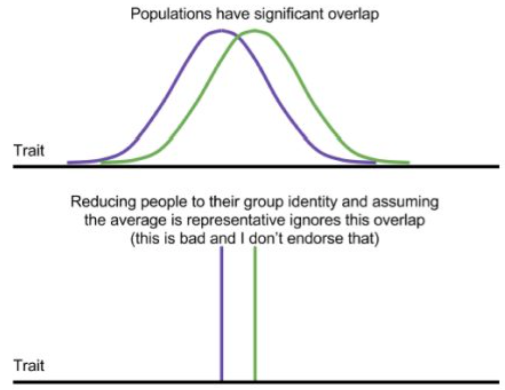
I’m simply stating that the distribution of preferences and abilities of men and women differ in part due to biological causes and that these differences may explain why we don’t see equal representation of women in tech and leadership. Many of these differences are small and there’s significant overlap between men and women, so you can’t say anything about an individual given these population level distributions.

On personality differences

Damore writes that women, on average, have more openness directed towards feelings and aesthetics rather than ideas. This makes them have a stronger interest in people rather than things and explains in part why women relatively prefer jobs in social or artistic areas.

In addition, women express their extraversion as gregariousness and agreeableness rather than assertiveness.

Women, on average, also have higher anxiety, and lower stress tolerance which makes high stress jobs less attractive to women.

Compared to men, women on average also look for more work-life balance.

Damore’s overall message

Damore explains his overall message as follows:

I hope it’s clear that I’m not saying that diversity is bad, that Google or society is 100% fair, that we shouldn’t try to correct for existing biases, or that minorities have the same experience of those in the majority. My larger point is that we have an intolerance for ideas and evidence that don’t fit a certain ideology. I’m also not saying that we should restrict people to certain gender roles; I’m advocating for quite the opposite: treat people as individuals, not as just another member of their group (tribalism).

Again, I think this is extremely reasonable. Unfortunately, in a world driven by irrational and zealous egalitarians, those who use logic and reason are easily labeled bigots.

Reference

Damore, J. (2017). Google’s Ideological Echo Chamber

Bruce Lee’s Application Of Taoist Philosophy In Jeet Kune Do

Bruce Lee - Jeet Kune Do

Bruce Lee was born on November 27, 1940 and died on July 20, 1973. Even though he was just 32 upon his death, he had achieved so much in his limited lifetime. He was recognized by Time magazine as one of the 100 most influential people of the 20th century.[1] He was a cha cha champion in Hong Kong at age 18, a world renowned martial artist and a Chinese actor who was not only immensely popular in Asia, but who also made his breakthrough in Hollywood at a time when oriental actors were rarely accepted for lead roles. What is less known among the public is his keen interest in philosophy, a subject he studied at the University of Washington. Writing about where his interest in philosophy came from, he wrote:

My majoring in philosophy was closely related to the pugnacity of my childhood. I often asked myself these questions: What comes after victory? Why do people value victory so much? What is ‘glory’? What kind of ‘victory’ is ‘glorious’?[2]

In one of my previous posts, I discussed the similarities between the libertarian concept of Spontaneous Order and the Taoist concept of the Tao. In this post I will discuss the application of Taoist philosophy in Jeet Kune Do (‘the way of the intercepting fist’), the martial arts that Bruce Lee founded in his mid-20s, and its roots in Taoist philosophy. I will identify several Taoist aspects that form the philosophical foundation of Jeet Kune Do. First however, I will give an anecdote of his wife Linda Cadwell on Bruce Lee’s initial motivation to develop Jeet Kune Do at all.

Bruce Lee’s initial motivation for Jeet Kune Do
Bruce Lee started teaching martial arts to Westerners in his newly founded Jun Fan Gung Fu Institute, a training gym in Oakland, California. Then by late 1964, Bruce Lee received a letter with the signatures of the most important elder Chinese martial arts masters in San Francisco who did not

look favourably on Bruce’s teaching martial art to Westerners, or actually to anyone who was not Chinese. So strongly did they harbour this historically bound belief, that a formal challenge was issued to Bruce, insisting that he participate in a confrontation, the result of which would decide whether he could continue to teach the ‘foreign devils’. (Cadwell, 1998, p. 8)

Without hesitation, Bruce Lee accepted the challenge. Linda Cadwell remembers the fight that followed as a pivotal point in Bruce Lee’s life:

Within moments of the initial clash, the Chinese gung fu man [Bruce Lee’s contender] had proceeded to run in a circle around the room, out a door that led to a small back room, then in through another door to the main room. He completed this circle several times, with Bruce in hot pursuit. Finally, Bruce brought the man to the floor, pinning him helplessly, and shouted (in Chinese), ‘Do you give up?’ After repeating this question two or three times, the man conceded, and the San Francisco party departed quickly. The entire fight lasted about three minutes, leaving James and me ecstatic that the decisive conquest was so quickly concluded. Not Bruce. Like it was yesterday, I remember Bruce sitting on the back steps of the gym, head in hands, despairing over his inability to finish off the opponent with efficient technique, and the failure of his stamina when he attempted to capture the running man. For what probably was the first time in his life, Bruce was winded and weakened. Instead of triumphing in his win, he was disappointed that his physical condition and gung fu training had not lived up to his expectations. This momentous event, then was the impetus for the evolution of Jeet Kune Do and the birth of his new training regime. (Cadwell, 1998, pp. 11-12)

Now that we know that Jeet Kune Do originated from Bruce Lee’s discontent with the physical condition he had achieved through traditional gung fu training, I will discuss how Bruce Lee was striving for a new martial arts that was superior to the already existent ones, and how this martial arts is ultimately rooted in Taoist philosophy.

Jeet Kune Do as a way of life
Bruce Lee had, throughout his whole life, always been intrigued by the question how to find his true potential, and how to express himself honestly. He wrote:

“Ever since I was a child I have had this instinctive urge for expansion and growth. To me, the function and duty of a quality human being is the sincere and honest development of one’s potential”.[3]

“When I look around, I always learn something, and that is to always be yourself, express yourself, to have faith in yourself. Do not go out and look for a successful personality and duplicate him. They always copy mannerism; they never start from the root of their being: that is, how can I be me?”[4]

Bruce Lee believed that the answers to both questions – how can I find my true potential and how can I be me so that I can express myself honestly – are ultimately related to one another.

1. Be one with the Tao; be formless like water, and be pliable
Bruce Lee believed that the person who is trained within a particular martial arts style and who clings to it indefinitely or a person who is only trained within a particular philosophical doctrine becomes self-delusional. He thought that the person who is incapable of exceeding his style or doctrine is stiff and narrow-minded. His narrow-mindedness makes him blind to observe objectively and to see the truth. He is what Bruce Lee calls, ‘the traditional man’. Bruce Lee wrote:

One can function freely and totally if he is ‘beyond system.’ The man who is really serious, with the urge to find out what truth is, has no style at all. He lives only in what is. (Bruce Lee, 1975, p. 17)

But in classical styles, system becomes more important than the man! The classical man functions with the pattern of a style! (Bruce Lee, 1975, p. 18)

How can there be methods and systems to arrive at something that is living? To that which is static, fixed, dead, there can be a way, a definite path, but not to that which is living. Do not reduce reality to a static thing and then invent methods to reach it. (Bruce Lee, 1975, p. 18)

Classical forms dull your creativity, condition and freeze your sense of freedom. You no longer ‘be,’ but merely ‘do,’ without sensitivity. (Bruce Lee, 1975, p. 19)

You cannot see a street fight in its totality, observing it from the viewpoint of a boxer, a kung-fu man, a karateka, a wrestler, a judo man and so forth. You can see clearly only when style does not interfere. You then see it without ‘like’ or ‘dislike;’ you simply see and what you see is the whole and not the partial. (Bruce Lee, 1975, p. 24)

He thought that committing himself to styles limits both his potential and his self-expression. This critique is however not only limited to martial arts. He extended this critique to Confucianism, a philosophy which he considered as too rigid, and too narrowly focused on set rules and traditions. According to Bruce Lee, man ceases being a human being and instead becomes a mechanical man, a product of mere tradition if he reveres and just follows rules and mannerisms. The philosophy that perfectly fits Bruce Lee’s vision of a self-expressive and ‘style-less’ martial arts is the epistemologically anarchistic Taoism. How can a person, according to Bruce Lee and Taoism, find his true potential and express himself honestly? The answer is to become formless, pliable, and forever adaptable just like the Tao is formless, pliable, and forever in flux.

The Tao Te Ching states the following metaphor of life (flexibility and softness) and death (rigidity and hardness):

A man is born gentle and weak.
At his death he is hard and stiff.
Green plants are tender and filled with sap.
At their death they are withered and dry.
Therefore the stiff and unbending is the disciple of death.
The gentle and yielding is the disciple of life.
Thus an army without flexibility never wins a battle.
A tree that is unbending is easily broken.
The hard and strong will fall.
The soft and weak will overcome. (Tao Te Ching, Chapter 76)

Both Lao Tze and Bruce Lee took water as the ultimate metaphor for that which is flexible and soft. Bruce Lee maintains that in order to fulfil your true potential and express yourself honestly you should become like water, formless. To be like water means to be an objective observant, relaxed and to be flowing with life – to be one with the Tao.

In the Tao Te Ching one can find the following lines:

Under heaven nothing is more soft and yielding than water.
Yet for attacking the solid and strong, nothing is better;
It has no equal.
The weak can overcome the strong;
The supple can overcome the stiff. (Tao Te Ching, Chapter 78)

There is a story about Bruce Lee’s discovery of what it means to be like water and to be united with the Tao. I am not sure about the authenticity of the story, but I will share it nonetheless as it helps to illustrate the significance of being formless in combat or in life:

Bruce, at the age of seventeen, had been training in gung fu for four years with Sifu Yip Man, yet had reached an impasse. When engaged in sparring Bruce found that his body would become tense, his mind perturbed. Such instability worked against his goal of efficiency in combat.

Sifu Yip Man sensed his trouble, and approached him. ‘Lee,’ he said, ‘relax and calm your mind. Forget about yourself and follow the opponent’s movements. Let your mind, the basic reality, do the counter-movement without any interfering deliberation. Above all, learn the art of detachment.’

Bruce Lee believed he had the answer to his problem. He must relax! Yet there was a paradox: the effort in trying to relax was inconsistent with the effortlessness in relaxing, and Bruce found himself back in the same situation.

Again Sifu Yip Man came to Bruce and said, ‘Lee, preserve yourself by following the natural bends of things and don’t interfere. Remember never to assert yourself: never be in frontal opposition to any problem, but control it by swinging with it.’

Sifu Yip Man told Bruce to go home for a week and think about his words. Bruce spent many hours in meditation and practice, with nothing coming of it. Finally, Bruce decided to go sailing in a junk (boat). Bruce would have a great epiphany. ‘On the sea, I thought of all my past training and got mad at myself and punched the water. Right then at that moment, a thought suddenly struck me. Wasn’t this water the essence of gung fu? I struck it, but it did not suffer hurt. I then tried to grasp a handful of it but it was impossible. This water, the softest substance, could fit into any container. Although it seemed weak, it could penetrate the hardest substance. That was it! I wanted to be like the nature of water.

Therefore in order to control myself I must accept myself by going with, and not against, my nature. I lay on the boat and felt that I had united with Tao; I had become one with nature.[5]

Bruce Lee emphasized the importance of ‘a style of no style’ that he later would regret the name Jeet Kune Do as a name implies limitations or specific parameters. Bruce Lee wanted it to resemble the Tao, nameless and of almost supernatural power. Chapter one of the Tao Te Ching states:

The Tao that can be told is not the eternal Tao.
The name that can be named is not the eternal name. (Tao Te Ching, Chapter 1)

See this video in which Bruce Lee asserts that we should be like water:

2. Break rules and conventions and have no way as your way
Jeet Kune Do does not limit itself to styles. It takes from other styles what is useful, discards what is useless, and adds what is uniquely our own. The slogan of the Jeet Kune Do logo reads two things: (a) take no way as your way, and (b) take no limitation as your limitation. As styles, rules, conventions, mannerisms limit us we should deconstruct and transcend them. Jeet Kune Do is therefore iconoclastic. Bruce Lee wrote:

Jeet Kune Do favors formlessness so that it can assume all forms and since Jeet Kune Do has no style, it can fit in with all styles. As a result, Jeet Kune Do utilizes all ways and is bound by none and, likewise, uses any techniques or means which serve its end. (Bruce Lee, 1975, p. 12)

What are the characteristics of a martial arts with no style? According to Bruce Lee, it becomes open-minded, non-traditional, simple, direct, and effective.

Bruce Lee contended that:

Jeet Kune Do does not beat around the bush. It does not take winding detours. It follows a straight line to the objective. Simplicity is the shortest distance between two points. (Bruce Lee, 1975, p. 12)

In Enter the Dragon, there is a scene in which an ostentatious man asks Bruce Lee what his style is. Bruce Lee answers: “You can call it the art of fighting without fighting”. Being challenged by the man to show this style, Bruce Lee cunningly proposes to take a boat to a nearby island where they can fight. When the man set foot on the boat, Bruce Lee let the boat drift away and pulls it on a line. The essence of the story is that (a) one should not be pretentious as that is not honest self-expression, and (b) a fight should be won in the most direct and easiest manner, preferably without the use of violence.[6]

You can find the videoclip here:

In order to break with traditions and conventions means that we should also get rid of our past attachments. This is what Bruce Lee meant when he metaphorically said that we should ‘empty our cup’.

3. Empty your cup and learn the art of dying
To empty your cup means to get rid of your self-delusion so that you can look at the world from a new and refreshed perspective. In order to find your true potential and your nature, you should first be self-conscious. You should know what you want, what you desire, what your strengths and weaknesses are, your pride, your fears, your accomplishments, your ambitions and eventually get rid of all that as they maintain an ego that interferes with who you truly are – a fluid personality who cannot be narrowly defined by your desires, fears, achievements etc.

In the Tao Te Ching one can read:

Empty yourself of everything.
Let the mind become still.
The ten thousand things rise and fall while the Self watches their return. (Tao Te Ching, Chapter 16)

This is frightening for most of us, because it confronts us with our own prejudices; we may find that our traditions that have previously given us a sense of security may be baseless. However, Bruce Lee did not only want us to break with the archaic, but he also showed us an alternative – a way of creating new values and skills to supersede the old. In this respect, Bruce Lee’s views of how to progress in life is very much in line with the iconoclastic Nietzschean übermensch: we must first break with traditions and try to rise above our culture so that a higher being can emerge from our renewed self-creation. This is how I personally interpret Bruce Lee’s saying that we should learn the “art of dying”.

In a famous scene in Longstreet, Bruce Lee taught us not to make a plan of fighting, he told us to empty our mind, and to be formless like water. The “art of dying” is the “art of being non-fixed” – the art of being a different person tomorrow than we are today by letting go our past attachments including our ambitions. I believe it is similar to the Nietzschean ideal of self-creation: continuously subjecting our current values to our personal judgements, breaking down ‘lower values’ and creating ‘higher values’. The art of dying is hence a metaphor for continuously breaking down our past selves, values, attachments, pride, desires (dying) and creating our new selves (being reborn) so that we can continuously improve. The “art of dying” is therefore also the “art of self-forgetfulness”, a skill that is characteristic of the ‘baby’ who is its self-propelling wheel in Nietzsche’s story of the ‘three metamorphoses’ from Thus Spoke Zarathustra.

See here the scene of Longstreet:

Bruce Lee wrote:

Empty your cup so that it may be filled; become devoid to gain totality. (Bruce Lee, 1975, p. 14)

Emptying our cup precedes our discovery of new truths or new values so that hopefully we can find ourselves and become our own standard. Bruce Lee told us not to despair when we cannot find solace within our past attachments as the creation of personal values is vastly more valuable.

See here a great explanation of ‘emptying our cup’:

The logical consequence of self-creation is that one becomes his own standard.

4. Become your own standard and accept life
According to Bruce Lee, we should not worry about what others think of us. He advised us not to look for a personality to duplicate as that would be a betrayal to our selves – one might call this practice ‘other-expression’ instead of ‘self-expression’. Being our own standard also encompasses the acceptance of disgrace and losses as much as accepting grace and victories. How else can we accept ourselves and fulfill our own potential?

The Tao Te Ching advises us the following:

Accept disgrace willingly.
Accept misfortune as the human condition.

What do you mean by “Accept disgrace willingly”?
Accept being unimportant.
Do not be concerned with loss or gain.
This is called “accepting disgrace willingly.”

What do you mean by “Accept misfortune as the human condition”?
Misfortune comes from having a body.
Without a body, how could there be misfortune?

Surrender yourself humbly; then you can be trusted to care for all things.
Love the world as your own self; then you can truly care for all things. (Tao Te Ching, Chapter 13)

5. Wei Wu Wei
Lastly, I would like to discuss another aspect of ‘having no way as your way’. To have ‘no way as your way’, is also Bruce Lee’s expression for following the Taoist doctrine of ‘wei wu wei’ (‘action without action’ or ‘effortless action’). Bruce Lee maintained that when a person is truly in control of himself, he experiences his action without consciously forcing his actions to happen. Self-consciousness is initially required for the understanding of ourselves, but to be truly expressing ourselves through our actions we must move into a state where we act unconsciously. I think it is best comparable with the English expression of ‘being in a state of flow’. Bruce Lee said:

I’m moving and not moving at all. I’m like the moon underneath the waves that ever go on rolling and rocking. It is not, ‘I am doing this,’ but rather, an inner realization that ‘this is happening through me,’ or ‘it is doing this for me.’ The consciousness of self is the greatest hindrance to the proper execution of all physical action. (Bruce Lee, 1975, p. 7)

This idea is expressed as follows in the Tao Te Ching:

Tao abides in non-action (‘wu wei’),
Yet nothing is left undone. (Tao Te Ching, Chapter 37)

Footnotes
[1] See http://www.ranker.com/list/time-magazine-100-most-important-people-of-the-20th-century/theomanlenz?format=SLIDESHOW&page=55http://www.ranker.com/list/time-magazine-100-most-important-people-of-the-20th-century/theomanlenz?format=SLIDESHOW&page=55

[2] I do not remember where I have found this quote.

[3] Idem

[4] Idem

[5] From http://www.becoming.8m.net/bruce02.htm

[6] The scene is actually based on an old Japanese Samurai folk tale. The tale goes as follows:

“While travelling on a ferry, a young samurai began bullying and intimidating some of the other passengers, boasting of his fighting prowess and claiming to be the best in the country with a samurai sword. When the young warrior noticed how unmoved [Tsukahara] Bokuden [a legendary Japanese swordsman] was, he was enraged and not knowing who he was dealing with challenged the old master to a duel. Bokuden told him;

‘My art is different from yours. It consists not so much in defeating others but in not being defeated.’

He continued to inform him that his school was called The Mutekatsu Ryu meaning ‘to defeat an enemy without hands’. The young samurai saw this as cowardice and demanded satisfaction so he told the boats-man to stop at an island so they could do battle there.

However when he jumped into the shallow waters to make his way to the fight venue, Bokuden got hold of the boats-man’s pole and proceeded back to deeper waters minus a now irate young samurai. The wise old master laughed and shouted to his would be adversary; ‘Here is my no sword school!’” (See, http://www.historyoffighting.com/tsukahara-bokuden.php)

Bibliography
History Of Fighting. Retrieved from http://www.historyoffighting.com/tsukahara-bokuden.php

Lao Tze. Tao Te Ching. Retrieved from http://www.schrades.com/tao/taotext.cfm?TaoID=1

Lee, B. (1975). Tao Of Jeet Kune Do. Santa Clarita: Ohara Publications.

Little, J. (1998). Bruce Lee: The Art Of Expressing The Human Body. North Clarendon: Tuttle Publishing.


SteemFest interview

The first ever international Steemit conference was held on November 11, 12 and 13. I loved the positive vibe that radiated from the community and I enjoyed meeting people I have had known only from the Steemit online platform.

Steemit is a social network that looks quite similar to Reddit and that rewards people with the cryptocurrency Steem for blogging and curating content. SteemFest, consisting of 206 attendees, had a remarkable mix of people from different nationalities. They joined the event from 32 different countries including Russia, China, India, Japan, Panama, Lithuania, Cambodia, Mexico, and the US. There were also many female attendees, something that you don’t see often in other cryptocommunities. 35% were female and 25% were developers. The event attracted famous writers like for example Neil Strauss, bitcoin artists like Tatiana Moroz, and Ned Scott who is the co-founder of Steemit. I loved listening to people’s stories and how they got involved with Steemit. I met someone who lived together with Vitalik Buterin (founder of Ethereum) in Barcelona, a homeless person who tries to get by by living on the cryptocurrency Steem, and so many other interesting people.

I was one of the 35 speakers at the event, and was also interviewed on some of my libertarian philosophical views. You can see the interview above.

If you’d like to know more about Steemit, then visit Steemit.com to see what it’s all about.

The Genetics of Success

In this article, I will explore the latest science on how our genetic makeup is correlated to our ‘life success’. This post is not for egalitarians who believe that everyone is equally beautiful and talented or that everyone can become an Aristotle through immense self-effort. No, this post argues that our genetic differences result in different expected life outcomes.

genetics-of-success
Image source

We are living in extremely interesting times. We may have reached a tipping point in genomic research. It seems that we can now weakly predict life outcomes based on genetic tests. Daniel Belsky from Duke University and his team of researchers have recently released a paper asserting that genetic tests can predict adult life outcomes. The magnitude of correlation between genomic tests and adult life outcomes is still very modest, but I believe that the predictions will grow more accurate once we gain more knowledge about the genetic makeup of ‘success’. I believe that this is big news, since this is the first well-developed psychometric/genetic research I have read so far that asserts that life success is to some extent related to our genetic makeup.

When Belsky et al looked at the genetic profiles and the people they studied, they found that people with higher polygenic scores did not only have greater educational attainments, but also had more prestigious occupations, higher incomes, more assets, greater upward social mobility, and were more likable and friendly.

Main research findings

The main research findings can be summed up as follow:

  1. polygenic scores predicted adult economic outcomes even after accounting for educational attainments;
  2. genes and environments were correlated: Children with higher polygenic scores were born into better-off homes;
  3. children’s polygenic scores predicted their adult outcomes even when analyses accounted for their social-class origins; social-mobility analysis showed that children with higher polygenic scores were more upwardly mobile than children with lower scores;
  4. polygenic scores predicted behavior across the life course, from early acquisition of speech and reading skills through geographic mobility and mate choice and on to financial planning for retirement;
  5. polygenic-score associations were mediated by psychological characteristics, including intelligence, self-control, and interpersonal skill.

Belsky’s main research question

In 2013, Rietveld et al reported the first successful genome-wide association study (GWAS) of educational attainment. They analyzed millions of genetic variants in more than 100,000 individuals and found a genetic map that was related to people’s educational attainment. This genetic map could even explain differences in educational attainment between siblings in the same family.

The main research question that Belsky et al ask is: “do genetic discoveries for educational attainment predict outcomes beyond schooling?”

If so, what are the developmental and behavioral pathways that connect differences in DNA sequences with divergent life outcomes?


Image source

Belsky’s research methodology

1,037 people born between April 1972 and March 1973 in Dunedin, New Zealand, were tracked through a 38-year assessment of their socioeconomic development. This study became known as ‘the Dunedin study’. The cohort represented the full range of socioeconomic status (SES).

The researchers derived polygenic scores from the approximately 2.3 million genotypes that according to Rietveld et al would make up the genetic predisposition to educational attainment. In addition, adult-attainment scores were derived from extensive analyses of Dunedin members’ life developments. See table 1 for developments that were tracked and the methods through which these developments were measured.

The researchers have for example measured SES, determined from the higher of either parent’s occupational status throughout the Dunedin Study members’ childhoods. Educational attainment was measured, looking at the highest obtained degree. Attainment beyond education were measured by members’ reports of occupation, income, assets, credit problems when they were 38 years old and from social welfare and credit-score records. Reading abilities, taken when the Dunedin Study members were 7, 9, 11, 13, 15, and 18 years old, were measured as well. What I find extremely interesting is the fact that the researchers have measured not only cognitive ability through picture vocabulary tests and IQ tests, but also certain personal traits like self-control, impulsive aggression, hyperactivity, lack of persistence, inattention and interpersonal skills.

More substantive research results

I will list all research results here:

  1. people with higher polygenic scores tended to achieve higher degrees;
  2. people with higher polygenic scores tended to be more socioeconomically successful, holding more prestigious occupations, earning higher incomes, having more assets, relying less on social-welfare benefits, having higher credit scores and reporting fewer difficulties paying expenses;
  3. children with higher polygenic scores tended to come from families with higher SES;
  4. children with higher polygenic scores tended to attain more regardless of whether they began life in a family of low SES or high SES. Children from low SES with high polygenic scores tended to have greater upward social mobility than their low SES peers with low polygenic scores;
  5. children with higher polygenic scores were more likely to talk earlier and quicker to begin communicating using sentences;
  6. children with higher polygenic scores were able to read at younger ages;
  7. adolescents with higher polygenic scores had higher educational aspirations at the age of 15;
  8. adolescents with higher polygenic scores performed better academically and outperformed their peers on standardized tests;
  9. people with higher polygenic scores were more likely to pursue occupational opportunities outside of New Zealand;
  10. people with higher polygenic scores were more financially planful;
  11. people with higher polygenic scores tended to find partners with higher socioeconomic attainments;
  12. people with higher polygenic scores were not more satisfied with their lives;
  13. people with higher polygenic scores performed better on IQ tests and showed more rapid cognitive development during childhood;
  14. people with higher polygenic scores had stronger noncognitive skills, such as self-control, friendliness, confidence, being cooperative and communicative;
  15. children with higher polygenic scores were no healthier than their peers.

Tough questions

Knowing that our genetic makeup partly determine our success in life, would it be ethical to screen embryos for genetic signs of success in life? In some cases, embryologists already check embryos for major diseases, but should we allow parents to select embryos with the greatest genetic odds of future success?

These are interesting questions that, I believe, we will be facing in the near future.


Image source

Reference

Belsky et al – The genetics of success

Early childhood memories of a Cambodian refugee camp

In 1991, sixteen Khmer families from Cambodian refugee camps (mostly from Khao I Dang) received asylum in the Netherlands. This Saturday, November 5, we will celebrate the 25th anniversary. To commemorate our stay in the Netherlands, I would like to share some of my early childhood memories about being born in a Cambodian refugee camp in 1986.

I understand that my story is just one small, but essential part of my family’s overall journey for safety from the civil war (1967-1975), Khmer Rouge (1975-1979) regime, and the subsequent Vietnamese occupation. According to some estimates, 2 million out of 8 million people died during this long period. This figure has been contested many times. I don’t think anyone knows how many people have actually died, but if I look at the family members of my parents’ households: 40% from my mum’s side died and 25% from my dad’s side.

Khao I Dang, the refugee camp where I was born

My parents were forced to work in labour camps in the countryside in Battambang by the Khmer Rouge. They eventually met each other while fleeing from Battambang to the Thai border when the Vietnamese invaded Cambodia. As with most fleeing Cambodians, my parents decided to get together – not out of love, but more out of the need and desire to share their hardships. This was after all, a months-long journey through the heart of the Cambodian jungle in which my father lost his father, the granddad I never came to know. My mother lost her brother and her father. As my mother was separated from her brother early on during the Khmer Rouge regime and never witnessed his death, she had always held hope that one day she would find him again.

My parents’ long journey towards Thailand brought them to the Sa Kaeo camp which was the first organized refugee camp that opened in 1979. Within just 8 days, the refugee population grew to 30,000. The camp eventually closed down half a year later, because of unfavorable conditions. The drainage in the campsite was for example so poor that several refugees, too weak to lift their heads, drowned from a flood as they laid on the floor in tents made of plastic sheets.

One month after the opening of Sa Kaeo, the Khao I Dang camp was opened and many people were repatriated into Khao I Dang. My parents eventually ended up there as well.

Khao I Dang camp

Khao I Dang was a refugee camp on the Thai-Cambodian border where I was born. It was a bamboo village with dirt roads, barbed wire, and armed guards. Within just 5 months, the camp’s population reached 160,000. Population wise, this would make the camp the 11th largest municipality in the Netherlands.

Although the camp gave us more safety, violence and theft ran rampant.

Religion and death

People continued their religious activities and some houses were transformed into places for Buddhist ceremonies. In this picture you see my two brothers, my father, and I wearing our best clothes. We just came back from a visit to a local ‘temple’. The husband of my aunty, who had just been allowed to find refuge in Australia, had recently died in the camp.

My two brothers, me, and my father

Behind me is a grave of him. My father hired a photographer to take this picture so that he could send it to my aunty. I am the one barefooted.

Hospital

My father worked at the hospital. The hospital was a large hall with beds placed next to each other. I remember that I visited the hospital where I was given a doctor’s gloves to play with. I would blow it and enjoy a child’s kick out of it.

Hospital in Khao I Dang

Night raids

I remember that during some nights, rebels with guns would raid people’s houses to steal their belongings. Often, the word about night raids spread faster than the rebels themselves, and so most of the times we were warned before the rebels reached us. I remember very well one incident when we did not flee early enough.

My brothers and I ran after my father, while my mother took my baby sister in her arms to flee in separate directions. My father brought us into a nearby canal to hide there. When the Thai patrolling soldiers within the camp arrived at the scene, shooting between the two groups erupted. When I think back to this moment, I can still clearly feel the fear I had. I wanted to cry, but my father put his hands tightly on my mouth so that I would not make any sound. We then fled to the hospital where my father was working, and stayed there during the night. We were too afraid to go back home, and waited until the next morning.

In another incident, our neighbors were too late to flee and somehow for reasons unknown, a rebel threw a hand grenade inside their little home that killed the whole family.

Kindergarten

Despite the violence and misery, people tried to rebuild their normal lives. I went to kindergarten and remember so well one incident that I played hooky.

I was 4 years old and walking to school by myself, I stopped and decided to return home to my mother’s small shop. This is an incident that I am personally extremely proud of. As long as I can remember, I have always detested school. I hated to sit still and to be told what to do and what not to do. I took this attitude with me to the Netherlands, and still today I am very critical of schooling. My mother, a soft young woman, let me stay with her at the shop. But then my father came by, got angry with me, and spanked me for not going to school. Until this day I still don’t think that I did anything wrong.

Our little shop

Trade went on. Although it was illegal, industrious people were trying to make money by starting small businesses. This shows to me that entrepreneurship is natural to us human beings, and that economics and trade are naturally emerging processes as people are always looking for ways to improve their lot and to fulfill their needs.

Thai merchants would come to the fences, away from the Thai soldiers who were patrolling, in order to sell food to the refugees inside. Such activities occurred during night-time. When Thai soldiers would find out that we were trading with outsiders, they would beat us and take away our belongings. We, refugees, were also not allowed to get outside of the camp or we would risk being shot dead by Thai soldiers.

My mother, my brothers and I at our little shop. I am the one in the blue jersey

During day-time, people inside the camp would expose their new belongings and small shops would emerge. My mother sold small products of convenience. Some of it was smuggled by Thai people into the camps that we, Cambodians, were selling to other Cambodians. Other things like oil and sugar were given to us as part of a food relief program that we used sparingly so that we could sell it further. With the money we earned, we could then buy other goods that we needed more.

Other ways through which we made money was by brewing alcohol made from rice and apples. Although alcohol was illegal, it did not stop my parents from brewing it. Whenever a Thai soldier would come to our house for inspection – I don’t think you can really hide the alcoholic odor that was surrounding our little house when we were brewing alcohol – my parents would bribe him with money so that he would leave us alone.

Continuing story

These are some of my childhood memories of our lives in Khao I Dang. Maybe next time I can tell more about our life in the camp, share some of my older brothers’ memories, our cat that was lost, killed and eaten by someone or my first encounter with inspiring Superman and Spider-Man comic books. Maybe, I will also write about our continuing journey to the Netherlands and the psychological impact my experiences in Khao I Dang had on me. I can tell about the nightmares that haunted me until my teenage years, how I always felt alienated from the people here and the inferiority complex towards Dutch people that I developed as a little child for feeling different. Feeling different made me feel insecure. Every time I met someone, and I think it lasted until my later teenage years, I would always ponder whether the person would kill me if he would be put in similar circumstances as those many killers from the Khmer Rouge period. In other words: as a child, I already wondered excessively about the “banality of evil”. These thoughts were of course extremely unhealthy, especially when you are as young as 4 or 5 years old.

The biggest lesson I have learned from my childhood is that both good and bad experiences are important in our lives. Happiness, in my opinion, is very much overrated and hardship is at least as valuable.

I have not written this so that people pity me. Pity, and in particular self-pity, is an extremely damaging emotion. It multiplies our suffering and reveals an extremely pathological egoism. When I look back at the hardships my family has overcome, I like to remind myself of Haruki Murakami’s saying that “only assholes feel sorry for themselves”.

Invitation to Steemit – a blockchain based social media platform

As some might already suspect from some of my previous posts, I am a cryptocurrency enthusiast. As of now, there is another crypto-project founded by two libertarian anarchists that I find extremely interesting and that I would like to share with you.

In this post, I’d like to introduce this project called Steemit, a new social media platform where content creators (bloggers) can earn money with every ‘upvote’ (comparable to ‘likes’ on Facebook) they receive from the community. I am not encouraging my fellow note writers to quit posting articles on Notes on Liberty, but I would recommend them to share their articles both here and on the Steemit platform.

So what is Steemit?

“Collectively, user-generated content has created billions of dollars worth of value for the shareholders of social media companies, such as Reddit, Facebook, and Twitter. Steem supports social media and online communities by returning much of its value to the people who provide contributions by rewarding them with virtual currency.”

Steemit is most similar to Reddit, but with the important difference that you can monetize your blog. You can take a look at my first two ‘hits’ on Steemit for proof that you can monetize your blogging skills:

Steemit was founded half a year ago by entrepreneurs Ned Scott and Daniel Larimer. Daniel Larimer has been a familiar face in the cryptocurrency scene as the founder of Bitshares, which currently ranks as the 19th largest cryptocurrency in market cap on www.marketcap.com. Steem itself, the currency that drives steemit, has risen in prominence among other cryptocurrencies. According to www.marketcap.com, Steem is now the 4th largest behind Bitcoin, Ethereum and Ripple.

The concept behind Steemit is very simple, and you don’t need in-depth knowledge of the workings of cryptocurrencies to start writing (and curating posts) and earning some money. If you have a facebook account or a reddit account, you can sign up at www.steemit.com. At first sign up, you will receive $10 worth of Steem Power – I will later get to Steem Power to explain what it is. Once you sign up you can immediately start submitting posts or comments on other people’s submissions. You can earn money through both ways.

The website is still in beta, and you may argue that it is not as user friendly as Reddit or other social media networks, but the pace in which applications have been rolled out on the platform in the one month that I have been using it is impressive!

A chat functionality with private messaging, a functionality to follow other writers, and weekly insights in your earnings have for example all been added in the past four weeks.

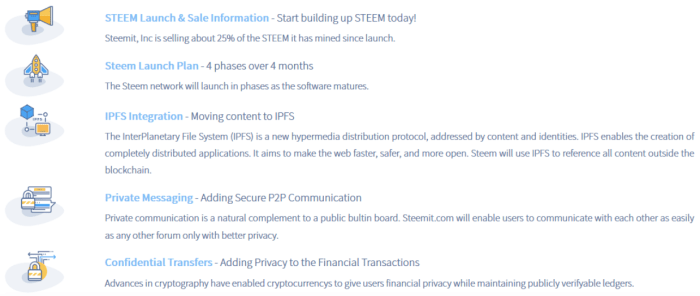
Steemit roadmap

This, however, is just the beginning. The founders of Steemit have far larger plans than just creating a blockchain based social network. The social network is the means to attract enough users of its currency (Steem and Steem Dollars) that a full-fledged market place based on these currencies can emerge. The first step is to increase the user base, but next steps are to create a market place in which people can trade goods with Steem and Steem Dollars and where Steem will grow in such prominence that it will compete with already existing fiat currencies like the USD, Euro, GBP, Yen, and RMB. We are still far off from this actually happening, but it’s great to see these kinds of experiments with the free market.

Is Steemit a scam?
I have read about people who have called it a scam, but the funny thing is that you don’t need to put any monetary investments in the platform to submit an article and earn some money. Normally in scams, you are encouraged to give away your money for little or nothing in return. With Steemit, all you need is to create content that the community values and in return you will receive some money.

Steem, Steem Power and Steem Dollars
Lastly, I’d like to say some words about the three tokens you can hold when using Steemit: liquid Steem, Steem Power and Steem Dollars (SBD).

Liquid Steem, or simply Steem by name, is immediately convertible to bitcoin and fiat currencies as USD. People who would like to speculate on the price of Steem can hold it to sell at a higher price.

You can also convert your Steem into Steem Power. Steem Power gives you, if I am not mistaken, interest of approximately 0.7% in Steem Power per day. Holding Steem Power is like holding a stake in the long-term development of Steemit as you can only convert 1% per week of your Steem Power in Steem and exchange it for bitcoins and fiat currencies.

Steem Dollars are tokens pegged to the USD at an exchange rate of around 1 : 1. People who don’t like the volatility of cryptocurrencies can hold Steem Dollars.

For more information about Steemit, you can read the Steem White Paper or watch this excellent interview of its founders:

I hope that I have triggered your curiosity about Steemit, and I hope that you will take this invitation to post your content not only on Notes on Liberty, but also on www.steemit.com. Please don’t forget to follow me once you are on Steemit. You can find me at www.steemit.com/@chhaylin.

Why a Nexit would be good for the Netherlands

Past Friday, 51.9% of the British have voted to leave the European Union against 48.1% of those who have voted to remain. The details of the EU referendum can be found on BBC’s EU referendum page. Although it is still unclear what shape the relationship between Britain and the EU will take, I expect that the Brexit will offer good economic opportunities for Britain provided that they can reach free trade agreements with all nations within the EU and provided that they will continue to open up their markets for free trade with other countries outside of the EU.

An Exit of the Netherlands, or a Nexit, will have more consequences than a Brexit as the Netherlands are also participants in the European Monetary Union. A Nexit could therefore lead to an end of the Euro. An analysis of the EU is a political analysis and as politics is always complemented by power, this analysis should hence incorporate insights on power struggles and competing visions. Each country has its own interests within the EU, just like any politician within the EU has his own special interests that he is serving. Participation in the EU is often represented as an exercise of solidarity and political appeasement, however it is still politics with politicians’ usual desire for self-enrichment.

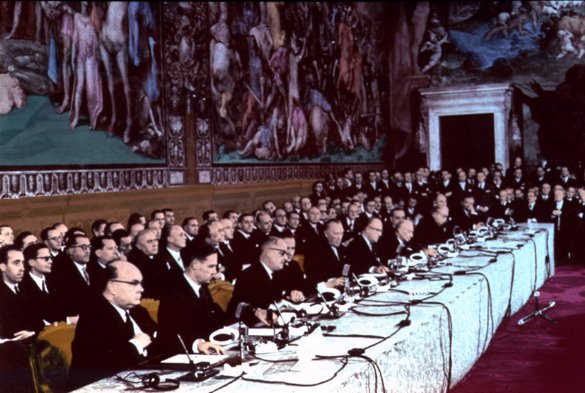
There have always been two competing visions of the EU. The first one is a classical liberal vision, led by German speaking Christian democrats Schuman (France), Adenauer (Germany) and Alcide de Gasperi (Italy) with the Treaty of Rome (1957) as the greatest achievement of this classical liberal vision for Europe. The Treaty sought to deliver the following four freedoms: free movement of goods, freedom of movement for workers, the right of establishment and freedom to provide services, and free movement of capital. The other vision was a socialist vision led by mainly French politicians, such as Jacques Delors and François Mitterrand whose goal was to create a supranational state.

Treaty of Rome signed
Treaty of Rome.

Classical liberal vision
The first vision promotes political competition between the EU’s member states by opening up borders. When a person is discontent with the excessive taxes in his country, he could leave his country for another. Competition between member states would lead to smaller governments, lower taxes, and political respect for people who would want to pursue their individual freedoms in another member state. It would represent a return to the political model that was prevalent in Europe from the Middle Ages to the 19th century when different political systems coexisted independently. There were independent cities or city states in Flanders, Germany and Northern Italy. There was the kingdom of Bavaria, the republic of Venice, and small city states like Ghent and Bruges embraced their autonomy. The German writer and poet Johann Wolfgang von Goethe (1749-1832) had expressed the beauty of such a political system as follows when he discussed a Germany that was still splintered in 39 independent states:

“I do not fear that Germany will not be united; … she is united, because the German Taler and Groschen have the same value throughout the entire Empire, and because my suitcase can pass through all thirty-six states without being opened. … Germany is united in the areas of weights and measures, trade and migration, and a hundred similar things. … One is mistaken, however, if one thinks that Germany’s unity should be expressed in the form of one large capital city, and that this great city might benefit the masses in the same way that it might benefit the development of a few outstanding individuals. … What makes Germany great is her admirable popular culture, which has penetrated all parts of the Empire evenly. And is it not the many different princely residences from whence this culture springs and which are its bearers and curators? … Germany has twenty universities strewn out across the entire Empire, more than one hundred public libraries, and a similar number of art collections and natural museums; for every prince wanted to attract such beauty and good. Gymnasia, and technical and industrial schools exist in abundance; indeed, there is hardly a German village without its own school. … Furthermore, look at the number of German theaters, which exceeds seventy. … The appreciation of music and song and their performance is nowhere as prevalent as in Germany, … Then think about cities such as Dresden, Munich, Stuttgart, Kassel, Braunschweig, Hannover, and similar ones; think about the energy that these cities represent; think about the effects they have on neighboring provinces, and ask yourself, if all of this would exist, if such cities had not been the residences of princes for a long time. … Frankfurt, Bremen, Hamburg, Lübeck are large and brilliant, and their impact on the prosperity of Germany is incalculable. Yet, would they remain what they are if they were to lose their independence and be incorporated as provincial cities into one great German Empire? I have reason to doubt this.”[1]

In addition to the advancement of political competition, the vision also promotes economic competition. A German employee would not be obstructed from working in France anymore, a Dutchman would not be taxed by the government if he transfers money from a Dutch to a Spanish bank or when he decides to buy stocks on the Italian equity market. Nobody would withhold a Belgian brewery from selling beer in other countries within the European free trade area.

Socialist vision
The second vision promotes a European central state that holds the power to enact more regulations, redistribution of wealth, and harmonization of legal systems within the whole Union. A strong central political body is to coordinate such efforts. The consequence is that its member states would increasingly have to give up their sovereignty. This is clearly visible from the political events in Greece and Ireland during the financial crisis of 2008 when Brussels demanded from Greece and Ireland how they should deal with their deficits and what austerity measures they should take. The socialist vision of Europe is an ideal for the political class, bureaucrats, interest groups and the subsidized sectors that want a powerful central state for their self-enrichment. Political competition among its member states, something that the classical liberals supported, should be eliminated. Doing so, Europe becomes less democratic and political power is increasingly shifted into the hands of bureaucrats and technocrats in Brussels. Historically, such plans for concentrated political power had been realized by such figures as Charlemagne, Napoleon and Hitler. The difference with our times is that the creation of a modern European superstate does not directly require military means. The introduction of new institutes like the European Central Bank, a common currency like the Euro, and extended power of the European Commission would suffice. Similar socialist intentions were already visible from the start of the European integration in the European vision of Jean Monnet, the intellectual father of the European community. Fearing an independent and emerging Germany after the second World War, an integration of Germany into Europe was considered to be a good thing. Next to that, the French wanted to have control over the Rühr area and they wanted to keep other vital German resources out of solely German hands. After losing her colonial powers in Indochina and Africa, the French ruling elite were also looking for new influence and pride which they eventually found in the European community.[2] The French premier in 1950 had for example proposed a plan to install a European army under the leadership of the French.

Why it is good for the Netherlands to leave the European Union
I believe that the EU should never have had more ambitions than the free trade zone that requires no supranational institutes, except for a European Court of Justice that is restricted to supervising conflicts between the member states and guaranteeing the four freedoms. The EU has become so far removed from the classical liberal vision of political and economic competition that it is not worthwhile anymore for the Netherlands to participate. It has declined into a malignant cartel of states that can tell its members with whom and how they should conduct their trade. A good example were the quotas and import levies on Chinese solar panels in 2013 under the disguise of ‘anti-dumping’ measures. Several countries like the Netherlands and Germany had first opposed to these measures as they would like to maintain good relationships with China. Nonetheless, the European Committee, apparently under influence of solar panel lobbyists like those of the German producer Solarworld AG, introduced ‘anti-dumping’ measures. The eventual winners of such measures are European solar panel producers and its victims are the European people that simply want to buy cheap solar panels. Another example are the sanctions that the EU had imposed on Russia since the Ukrainian conflict – a conflict that was provoked by American imperialists and NATO.[3] The deteriorating trade relationships between the EU and Russia is also detrimental to the wealth of ordinary European citizens. Another recent example is the prohibition of high-powered vacuum cleaners and possible future bans on other energy appliances such as kettles and hairdryers in order to reach environmental targets.[4] Those who profit from such measures are mainly large legacy organizations such as Bosch and Siemens that have enough capital to meet the strict EU regulations.

Another reason why a Nexit would be good for the Netherlands is that it offers an opportunity to extricate oneself from the Euro and the implicitly pledged financial aid when a future financial crisis will tear through Europe.

The tragedy of the Euro
The introduction of the Euro has proven to be a huge mistake, because it has enabled fiscally irresponsible governments of such countries like Portugal, Italy, Greece, Spain etc. to conduct unsustainable economic policies. In the past, when these states had their own currency, their governments had to finance their budget deficits through the sales of government bonds which resulted in higher government debts. The higher government debts manifested itself in higher interest rates on their government bonds, and a greater money supply would lead to devaluations of their currencies.

To illustrate how the process of government bonds financing works in the European Monetary Union, we could look at the development of 10-year government bonds. The graph below shows the interest rates that governments have to pay to the financiers of their 10-year government bonds from 1995 to 2011:

Development in Interest Rates on 10-year Government Bonds
Interest rates on 10-year government bonds from 1995-2011.

The y-axis represents the rates of interest that an investor receives from 10-year government bonds. Countries that are economically stronger and fiscally more conservative are rewarded with lower interest rates due to the smaller risk that these governments will not pay back their loans. In the case of Germany, a country with traditionally a stronger economy, a more conservative Bundesbank, and a fiscally more responsible government than many other European nations, investors received 7.5% interest on their 10-year government bonds in 1995. Greek government bonds had a yield of 18% in 1995. 1995 was the year in which the European Committee had announced that the Euro would arrive in 2002. Interest rates on government bonds consequently converged in the following years. At the end of 1997 all rates of interest on Portuguese, Irish, Spanish, Italian, French and German 10-year government bonds were more or less equal despite the fact that many of the governments of these countries still spent more than they received in tax incomes. The consequence of sharing a common currency with fiscally more responsible countries like Germany and the Netherlands is that fewer price signals in the form of higher interest rates on government bonds of fiscally irresponsible governments emerge. Irresponsible governments can issue government bonds to the banking sector that transfer these bonds as collateral to the ECB in return for loans. The interest rate that banks pay for the loans of the ECB are issued as profits to their governments. This is in short how ‘seigniorage’, the profits derived from money creation when the costs of money production and the distribution of money are lower than the value of money itself, is created.

Sovereign debt financing in EMU
Sovereign debt financing in the European Monetary Union.

This process leads to inflation, but the costs of inflation in the EMU are not solely borne by the respective country that issues the government bonds, but by all countries that participate in the EMU. A country like Spain can for example issue government bonds that traditionally would correspond with 10% inflation. However, when other countries like the Netherlands and Germany issue an amount of bonds that corresponds with 5% inflation, Spain benefits from seigniorage as the inflation created by Spain is higher and borne partly by the Netherlands and Germany. A Euro in this regard is beneficial for fiscally irresponsible governments. It is actually a “Tragedy of the commons”. Abusing the Euro in this way is exactly what countries like Portugal, Italy, Ireland, Greece, Spain and France have done. This works until a financial crisis shows how insolvent the governments of these countries actually are. That has happened in 2008, the moment when interest rates on European government bonds started diverging. The ECB had even decided to buy up Greek government debts in May 2010 in order to lower the interest rates on Greek government bonds. In June 2010, a temporary European Financial Stability Facility (EFSF) was founded with guarantees of up to €440 billion to combat the European sovereign debt crisis. It has provided financial assistance to Ireland, Portugal and Greece. The EFSF was later replaced by the European Stability Mechanism (ESM) in October 2012 with a total described capital of around €700 billion of which the Netherlands has pledged €40 billion in capital participation. The Dutch prime minister, Mark Rutte, had promised the Dutch in 2011 that the Netherlands would receive back the money it has loaned out to Greece in May 2010.[5] The total sum that was loaned to Greece by the Dutch was €3.2 billion. However, in 2012 when the Netherlands loaned out €14.5 billion of the second financial aid package of €130 billion that was pledged by Europe and the IMF to Greece, the Dutch minister of Finance, Jeroen Dijsselbloem, admitted that the Netherlands were losing money. Rutte also admitted that he could not guarantee that the Dutch loans to the Greeks would not be forgiven.[6] Three years later, on July 13 2015, the Netherlands loaned out another €22.6 billion to Greece.[7] It has become clear that such financial pledges of the Netherlands to fiscally irresponsible governments like that of Greece are not beneficial for the Dutch. Even in the long run it is not beneficial for the EU as it supports and prolongs a socialist European system that is deeply rotten to its core and destined to fail. What the EU needs is a radical return to decentralization and political competition.

The EU has become a sinking ship. It appears to me that the Netherlands should leave the Union as soon as possible. I do not see how Europe can maneuver itself safely through the next financial crisis that is at the point of breaking out as more banks are on the brink of collapse.[8] I also expect greater centralization of political power within the EU and a greater loss of individual member countries’ sovereignty. On June 27, 2016, the Polish media had reported that France and Germany were taking matters into their own hands and are using the Brexit to unveil their plan to morph the continent’s countries into one giant superstate. Under their radical proposals,

“EU countries will lose the right to have their own army, criminal law, taxation system or central bank, with all those powers being transferred to Brussels.”[9]

Conclusion
A sensible Netherlands would leave the European Union and the European Monetary Union in order to preserve political and economic sovereignty. They would have free trade agreements with all countries within and outside of the EU. EenVandaag, a popular Dutch TV programme, had published the results of their 27,000 large online poll on Sunday June 26, 2016 in which 54% of the Dutch would like to hold a referendum about the Netherlands’ participation in the EU. 48% of the poll wanted the Netherlands to leave the EU against 45% who would like to remain in the EU.[10] In the meantime, the Remain camp will continue their nauseating snobbery accusing the Leave camp of being racist, nationalistic, isolationist or simply ignorant.

References
Bagus, P. (2010). The Tragedy of the Euro.

BBC. (2016). EU referendum: The result in maps and charts.

China Courant. (2014). Mogelijk nieuwe straffen voor producenten Chinese zonnepanelen.

Dijkstra, M. (2015). Griekse crisis: wat heeft het allemaal gekost?

DutchNews.nl. (2016). Dutch PM rejects referendum calls: not in the Netherlands’ interest.

Fullfact.org. (2016). First they came for the vacuum cleaners: will it be kettles next?

Gutteridge, N. (2016). European SUPERSTATE to be unveiled: EU nations ‘to be morphed into one’ post-Brexit.

Hoppe, H.H. (2001). Democracy the god that failed.

Judt, T. (2006). Postwar: A History of Europe Since 1945.

McMurtry, J. (2016). Ukraine, America’s “Lebensraum”. Is Washington prepared to wage war on Russia?

NOS. (2011). Rutte verwacht Grieks geld terug.

NU.nl. (2012). Rutte geeft verbreken verkiezingsbelofte toe.

Zerohedge.com. (2016). Deutsche Bank tumbles near record lows as yield curve crashes.

Footnotes
[1] From Johann Peter Eckermann’s Conversations with Goethe (1836-1848).

[2] Tony Judt writes in Postwar: A History of Europe Since 1945 (2006) that “[U]nhappy and frustrated at being reduced to the least of the great powers, France had embarked upon a novel vocation as the initiator of a new Europe” (p. 153). He also writes that “[F]or Charles de Gaulle, the lesson of the twentieth century was that France could only hope to recover its lost glories by investing in the European project and shaping it into the service of French goals (p. 292).”

[3] See for example Prof. John McMurtry’s “Ukraine, America’s ‘Lebensraum’. Is Washington prepared to wage war on Russia?” for an analysis how Washington had provoked the Ukrainian conflict with Russia.

[4] See “First they came for the vacuum cleaners: will it be kettles next?”

[5] See “Rutte verwacht Grieks geld terug” (2011). http://nos.nl/artikel/275035-rutte-verwacht-grieks-geld-terug.html

[6] See “Rutte geeft verbreken verkiezingsbelofte toe” (2012). http://www.nu.nl/algemeen/2968363/rutte-geeft-verbreken-verkiezingsbelofte-toe.html

[7] See “Griekse crisis: wat heeft het ons allemaal gekost?” http://www.elsevier.nl/economie/article/2015/07/griekse-crisis-wat-heeft-het-ons-allemaal-gekost-2657386W/

[8] See for example “Deutsche Bank tumbles near record lows as yield curve crashes.” http://www.zerohedge.com/news/2016-06-13/deutsche-bank-tumbles-near-record-lows-yield-curve-crashes

[9] See “European SUPERSTAT to be unveiled: EU nations ‘to be morphed into one’ post-Brexit.” http://www.express.co.uk/news/politics/683739/EU-referendum-German-French-European-superstate-Brexit

[10] See “Dutch PM rejects referendum calls: not in the Netherlands’ interest.” http://www.dutchnews.nl/news/archives/2016/06/92520-2/

Black Women are not the most educated group in the United States

Several news media have published in the past weeks that Black Women are the most educated group in the United States or that they are the most educated according to race and gender. I decided to look into the statistics, ran some numbers, and found out that this is not the case. Black Women don’t perform as well as Caucasian and Asian Men and Women.

Here are examples of articles that wrongly claim that Black Women are the most educated group:

These media outlets have misrepresented the statistics from the National Center for Education Statistics and have misunderstood the report’s finding that

“From 1999–2000 to 2009–10, the percentage of degrees earned by females remained between approximately 60 and 62 percent for associate’s degrees and between 57 and 58 percent for bachelor’s degrees. In contrast, the percentages of both master’s and doctor’s degrees earned by females increased from 1999–2000 to 2009–10. Within each racial/ethnic group, women earned the majority of degrees at all levels in 2009–10. For example, among U.S. residents, Black females earned 68 percent of associate’s degrees, 66 percent of bachelor’s degrees, 71 percent of master’s degrees, and 65 percent of all doctor’s degrees awarded to Black students.”

From this, they conclude that Black Women are therefore necessarily the most educated group. What it shows however, is not that Black Women are the most educated, but that they have the highest proportion of graduates in comparison to their male counterparts by race. See here the data from the NCES:

Degrees conferred to Black Women
Table 1: Number of degrees conferred to females.

The data shows the following:

  • of the total Black population with an Associate Degree, 68% are female and 32% are male;
  • of the total Black population with a Bachelor’s Degree, 66% are female and 34% are male;
  • of the total Black population with a Master’s Degree, 71% are female and 29% are male;
  • of the total Black population with a Doctor’s Degree, 65% are female and 35% are male.

These findings indicate that Black Women have been much more successful in their educational endeavors in comparison to Black Men, but tell us nothing about the educational performances of Black Women compared to those of other or similar sexes of other races.

What is striking about the statistics of the NCES is that women far outperform men for all races. This graph is a clear depiction of that finding:

Degrees conferred to females
Table 2: Degrees conferred to females.

We can therefore conclude that women are more successful in obtaining degrees in Higher Education than men, but the gender gap is nowhere as wide for other races than for Blacks.

In order to have more insights in how well educated Black Women are compared to other groups, I have looked at statistics from the NCES on the educational level of people that are 25-29 years old:

Bachelor's degrees or higher for people ages 25-29 by race
Table 3: Bachelor’s degree or higher conferred by race.

According to the NCES, 60.1% of Asians aged 25-29 have at least a Bachelor’s Degree. Hispanics are the lowest performing group with 15.7%. Blacks have 20.5% and Whites 40.4%. Since the obtainment of Bachelor’s Degrees decreases the obtainment of Associate Degrees, it is more meaningful to look at the percentages of Bachelor’s Degrees or higher than to the percentages of conferred Associate Degrees. This graph however, has not specified the proportion of degree holders by gender. To approximate the degree holding male-female proportion, I have looked at table 1.

I have not found statistics that indicate the proportion of exclusively Asian degree holders by sex in Higher Education so I will make the assumption that the percentage of conferrals to Asian Women among the Asian population is approximately the same as that for Asian/Pacific Islander Women at around 55%. Hence, among the Asian group of which 60.1% aged 25-29 hold a Bachelor’s degree or higher, 55% are female: 33% of the total Asian population is female and holds a Bachelor’s degree or higher. 20.5% of Blacks aged 25-29 hold a Bachelor’s degree or higher of which around 68% is female. This means that around 14% of the total Black population is female and holds a Bachelor’s degree or higher. We can thus conclude that Asian Women perform much better educationally than Black Women with a ratio of almost 2:5.

How do Black Women perform in comparison to White Women? If we say that around 58% – this may not be entirely accurate, but from the NCES statistics it is reasonable to assume this number – of Bachelor’s Degrees and higher conferred to Whites are conferred to Women, we can assert that approximately 23% aged 25-29 of the total white population that have obtained these degrees are Women. According to my calculation, White Women thus perform far better than Black Women as well.

What if you would compare Black Women with Asian Men? According to my calculation, around 27% of all Bachelor’s Degrees and higher that have been conferred to the Asian population were conferred to Asian Men. Asian Men hence outperform Black Women with an approximate ratio of 1:2.

If you would compare Black Women with White Men, we can find that around 17.4% of the white population aged 25-29 that have obtained a Bachelor’s Degrees or higher are Men. This again is higher than the 14% of Black Women.

You can find a clear overview of my findings in the following table:

Group by gender and race Percentage holding Bachelor’s or higher degree w.r.t. their race
Black Men 7%
Black Women 14%
White Men 17%
White Women 23%
Asian Men 27%
Asian Women 33%

Conclusion
Black Women are by far not the most educated group within the United States. According to my calculations Black Women proportionally hold fewer Bachelor’s Degrees or higher compared to White Men, White Women, Asian Men, and Asian Women. An Asian Woman aged 25-29 is almost 2.5 times more likely to hold a Bachelor’s Degree or higher than a Black Woman aged 25-29. An Asian Man is almost 2 times more likely to hold a Bachelor’s Degree or higher. White Women more than 1.5 times more likely. I have not included Hispanics into my calculations, but I can see in one glance that Black Women do perform better than female and male Hispanics. Comparing Black Men with Asian Women, I find it shocking that an Asian Woman is almost 5 times more likely to hold a Bachelor’s Degree or higher than a Black Man.

I find it a shame that many news media have misinterpreted the data from the NCES and have spread the untruth that Black Women are the most educated group in the United States. Lastly, I would like to add that in order to gain more insights in how much better educated a group is we should also look into the type and quality of the courses and universities where these degrees were conferred. This is something I have not looked into.

References
Black Women Are Now The Most Educated Group In The U.S.
National Center for Education Statistics
Report: Black Women Have Become The Most Educated Group In The U.S.
Study: Black Women Most Educated in U.S.

Elon Musk on the Heroic Journey for a Fantastic Future

In ‘The Entrepreneur on the Heroic Journey’ (1997), Dwight Lee and Candace Allen write that entrepreneurs are heroic figures of society whose accomplishments are worth celebrating. Elon Musk is certainly an entrepreneur whose ingenuity and drive to create a fantastic future are admirable. In our current times when it seems fashionable to castigate entrepreneurs and those who have earned a fortune, it is nonetheless hard to read Ashlee Vance’s biography of Elon Musk and not to be in awe of his accomplishments. Elon Musk perfectly matches Lee and Allen’s description of our modern day heroes: individuals who shape society by serving the people and adding value to society through their entrepreneurial activities.

According to Lee and Allen, a hero travels through three stages.

1. The first stage of the modern entrepreneurial hero is a venturing away from the world of accepted norms. The hero asserts “There is a better way, and I will find it!” Deviating from familiar social norms and customs, he travels into unknown territory while risking failure and loss for some greater purpose or idea. That is exactly what Elon Musk did several times in his life. First, as a teenager when he dropped out of the University of Pretoria to leave South Africa for Canada. For someone who has an early inclination toward computers and technology – Musk had taught himself the BASIC programming language at the age of 9-10 and created homemade explosives and rockets – South Africa was like a prison. Although he did not know back then what exactly he wanted to achieve in Canada, his curiosity and intrinsic desire to leave an everlasting impact on the world led him to the United States. His daydreams at Queen’s University and the University of Pennsylvania usually led him to the conclusion that the Internet, the Renewable Energy, and the Space industries were the areas where he could make a huge impact. Back then, Musk already vowed to pursue projects in all three. This was in 1994 when few could’ve predicted the many ways in which the Internet would change people’s lives, when the last successful American automobile startup (Chrysler) was dates back to 1925, and when the American aerospace industry was dominated by only Boeing and Lockheed Martin. A vow like this was surely considered super-crazy. Musk pushed himself, characterized by energy, vision and bold determination into the unknown.

2. In the second stage, the entrepreneurial hero sacrifices himself for a vision or dream he has, putting his own comfort at stake. The two Internet companies he founded were Zip2, the Web’s first yellow pages, and X.com that would eventually merge with Confinity to form PayPal. The second stage of the entrepreneurial hero is his overcoming of hardships and challenges. With just $28,000 invested in Zip2, Musk seemed to never leave the office and slept on a beanbag next to his desk. He would take showers at the YMCA and when Heilman, an early Zip2 employee, would come into the office at 7:30 or 8:00 AM he would give him a kick so Musk would wake up and get back to work. Musk’s slavish devotion to the success of his startups is best expressed when he told a VC investor, “My mentality is that of a samurai. I would rather commit seppuku than fail.” (Vance, 2015, p. 72)

Zip2 would eventually be taken over by Compaq Computer for $307 million and would earn Musk $22 million for his 7% stake in the company.

Musk’s second start-up was X.com which was an initial attempt to create an online bank. During his internship at the Bank of Nova Scotia, he found out that “bankers are rich and dumb” (p. 83) and that this provided a massive opportunity to disrupt the industry. Realizing that money is nothing but an entry in a database, Musk thought that he could enter the industry with relatively little investment. This could however not be any further from the truth. The regulatory issues they were facing seemed insurmountable and several of the early employees of X.com soon left the company after believing that Musk’s vision to disrupt the banking industry is unrealistic. One other X.com employee said, “There were a million laws in place to block something like X.com from happening, but Musk didn’t care” (p. 92). Despite such issues, Musk held on and secured a banking license, FDIC insurance and formed a partnership with Barclays.

Musk had also faced many other misfortunes in the two companies that he founded soon after he left X.com: Tesla and SpaceX. In 2008, he was almost broke while divorcing his first wife – fearing he had been wasting almost all of his $180 million he earned from the sales of PayPal to eBay. SpaceX had just enough money for its fourth Falcon 1 launch, and possibly the last launch of SpaceX. Tesla had still not delivered on its promise to produce its Roadster and needed a government loan at a time when other automobile and financial corporations were also struggling. In Musk’s words: “I remember waking up the Sunday before Christmas in 2008, and thinking to myself, ‘Man, I never thought I was someone who could be capable of a nervous breakdown.’ I felt this is the closest I’ve ever come, because it seemed… pretty dark.”

3. In the third stage, the heroic entrepreneur returns to the community with his product, service, or new process. Having been just days or weeks away from bankruptcy for both Tesla and SpaceX, Musk had eventually survived and created the first successful car company since Chrysler in 1925 and was now competing with Boeing, Lockheed Martin, the Russians and the Chinese in the aerospace industry. Tesla has since delivered the Roadster, the Model S, X and is planning to deliver the Model E which will have a starting price of $35,000 by late 2017. Tesla is on its way to alter the automobile industry. SpaceX had produced rockets that can return back safely on earth which significantly lowers the costs of sending rockets into space. Elon Musk’s reward for increasing benefits to society are his profits and his wealth that he could only have accumulated when people value his products enough that they are willing buy them.

Looking at the many accomplishments of Musk and how he has served the public with his products, I believe that he can truly be considered a modern hero. The greatest contribution I think is that he has given people hope and renewed faith in what technology can do for mankind.

References
Allen, C., & Lee, D.R. The Entrepreneur on a Heroic Journey, 1997
Vance, A. Elon Musk: Tesla, SpaceX, and teh Quest for a Fantastic Future, 2015

Friedrich Hayek’s recollection of Ludwig Wittgenstein

Today is F.A. Hayek’s birthday, and if he would have been alive he would have been 117 years old now. Hayek is one of the most seminal economists and social philosophers of the 20th century. His works have left a deep impression on me when I first encountered them at the age of 20. The first three works of Hayek that I read were: 1. The Constitution of Liberty; 2. The Road to Serfdom; and 3. an essay entitled The Use Of Knowledge In Society. They have greatly influenced my views on political philosophy and the social sciences.

However, it was not so long ago that another illustrious philosopher, Ludwig Wittgenstein who was a second cousin and 10 years senior to Hayek, was born 127 years ago. In the same year that I became acquainted with Hayek, I also read Wittgenstein’s Tractatus Logico-Philosophicus or to put it more precisely: I attempted to read it. The work is incredibly dense and until today I still don’t feel confident that I have a sensible understanding of the book. Nonetheless, as a small tribute to both of them, I thought it would be nice to post a memoir that Hayek wrote of Wittgenstein.

Wittgenstein
Wittgenstein

F.A. Hayek – Remembering My Cousin, Ludwig Wittgenstein

BETWEEN THE RAILS and the building of the railway station of Bad Ischl there used to be ample space where, sixty years ago, in the season, a regular promenade used to develop before the departure of the night train to Vienna.

I believe it was on the last day of August 1918 that here, among a boisterous crowd of young officers returning to the front after visiting their families on furlough in the Salzkammergut district, two artillery ensigns became vaguely aware that they ought to know one another. I am not sure whether it was a resemblance to other members of our families or because we had actually met before that led us to ask the other, “Aren’t you a Wittgenstein?” (or, perhaps, “Aren’t you a Hayek?”). At any rate it led to our travelling together through the night to Vienna, and even though most of the time we naturally tried to sleep we did manage to converse a little.

Some parts of this conversation made a strong impression on me. He was not only much irritated by the high spirits of the noisy and probably half-drunk party of fellow-officers with which we shared the carriage without in the least concealing his contempt for mankind in general, but he also took it for granted that any relation of his no matter how distantly connected must have the same standards as himself. He was not so very wrong! I was then very young and inexperienced, barely nineteen and the product of what would now be called a puritanical education: the kind in which the ice-cold bath my father took every morning was the much admired (though rarely imitated) standard of discipline for body and mind. And Ludwig Wittgenstein was just ten years my senior.

What struck me most in this conversation was a radical passion for truthfulness in everything (which I came to know as a characteristic vogue among the young Viennese intellectuals of the generation immediately preceding mine only in the following university years). This truthfulness became almost a fashion in that border group between the purely Jewish and the purely Gentile parts of the intelligentsia in which I came so much to move. It meant much more than truth in speech. One had to “live” truth and not tolerate any pretence in oneself or others. It sometimes produced outright rudeness and, certainly, unpleasantness. Every convention was dissected and every conventional form exposed as fraud. Wittgenstein merely carried this further in applying it to himself. I sometimes felt that he took a perverse pleasure in discovering falsehood in his own feelings and that he was constantly trying to purge himself of all fraud.

THAT HE WAS VERY highly strung even at that time cannot be doubted. Among the remoter relatives he was thought of (though hardly known by them) as the maddest member of a rather extraordinary family, all of whom were exceptionally gifted and both ready and in a position to live for what they most cared for. Before 1914 I had heard much of (though being too young to attend) their famous musical soirees at the “Palais Wittgenstein”, which ceased to be a social centre after 1914. For many years the name meant to me chiefly the kind old lady who, when I was six years old, had taken me for my first car-ride—in an open electromobile round the Ringstrasse.

Apart from an even earlier memory of being taken to the luxurious apartment of an extremely old lady and being made to understand that she was the sister of my maternal great-grandfather— and, as I now know, Ludwig Wittgenstein’s maternal grandmother—I have no direct knowledge of the Wittgenstein family at the height of their social position at Vienna. The tragedy of the three elder sons apparently all ending their lives by suicide had attenuated it even more than the death of the great industrialist at its head would otherwise have done. I am afraid that my earliest recollection of the name of Wittgenstein is connected with the shocked account of one of my Styrian maiden great-aunts, surely inspired by envy rather than malice, that their grandfather “sold his daughter to a rich Jewish banker. . . .” This was the kind old lady I still remember—just.

I DID NOT MEET Ludwig Wittgenstein again for ten years; but I heard from him from time to time through his eldest sister who was a second cousin, an exact contemporary and a close friend of my mother. The regular visiting had made “Aunt Minning” a familiar figure to me (actually, she spelt her name, which is an abbreviation of Hermine, with a single “n”, but this would sound odd to English ears), and she remained a frequent visitor. Her youngest brother’s problems evidently occupied her much, and though she deprecated all talk about the “Sonderling”, the crank, and strongly defended him when occasional and undoubtedly often much-distorted accounts of his doings circulated, we did soon learn of them. The public eye did not take notice of him while his brother Paul Wittgenstein, a one-armed pianist, became a well-known figure.

But I did, through these connections, become probably one of the first readers of Tractatus when it appeared in 1922. Since, like most philosophically interested people of our generation I was, like Wittgenstein, much influenced by Ernst Mach, it made a great impression on me.

The next time I met Ludwig Wittgenstein was in the spring of 1928 when the economist Dennis Robertson, who was taking me for a walk through the Fellows’ Gardens of Trinity College, Cambridge, suddenly decided to change course because on the top of a little rise he perceived the form of the philosopher draped over a deckchair. He evidently stood rather in awe of him, and he did not wish to disturb him. Naturally, I walked up to him, was greeted with surprising friendliness, and we engaged in a pleasant but uninteresting conversation (in German) about home and family to which Robertson soon left us. Before long Wittgenstein’s interest flagged, and evident signs of his not knowing what to do with me made me leave him after a while.

IT MUST HAVE BEEN almost twelve years later that the first of the only real series of meetings I had with him took place. When I went to Cambridge in 1939 with the London School of Economics I soon learned that he was away working at some war hospital. But a year or two later I encountered him most unexpectedly. John Maynard Keynes had arranged for me to have rooms in the Gibbs building of King’s College, and after a while I was asked by Richard Braithwaite to take part in the meetings of the Moral Science Club (I think that was the name) which took place in his rooms just below those I occupied.

It was at the end of one of these meetings that Wittgenstein quite suddenly and rather dramatically emerged. It concerned a paper which had not particularly interested me and of the subject of which I have no recollection. Suddenly Wittgenstein leapt to his feet, poker in hand, indignant in the highest degree, and he proceeded to demonstrate with the implement how simple and obvious Matter really was. Seeing this rampant man in the middle of the room swinging a poker was certainly rather alarming, and one felt inclined to escape into a safe corner. Frankly, my impression at that time was that he had gone mad!

It was some time later, probably a year or two, that I took courage to go and see him, after having learnt that he was again in Cambridge. He then lived (as always, I think) in rooms several flights up in a building outside the College. The bare room with the iron stove, to which he had to bring a chair for me from his bedroom, has often been described. We talked pleasantly on a variety of topics outside philosophy and politics (we knew that we disagreed politically), and he seemed to like the very fact that I strictly avoided “talking shop”, not unlike one or two other curious figures I have met in Cambridge. But, though these visits were quite pleasant and he seemed to encourage their repetition, they were also rather uninteresting and I went along only two or three times more.

After the end of the War, when I had already returned to London, a new kind of contact by letter began when the possibility arose, first to send food parcels, and later to visit our relatives in Vienna. This involved all kinds of complicated contacts with bureaucratic organisations about which, he rightly assumed, I had found out details before he did. In this he showed a curious combination of impracticability and meticulous attention to detail which must have made all contacts with the ordinary business of life highly unsettling for him. However, he did manage to get to Vienna fairly soon after me (I had succeeded for the first time in 1946), and I believe he went there once or twice again.

I THINK IT WAS in the course of his return from his last visit to Vienna that we met for the last time. He had gone to see his dying sister Minning once more, and he was (though I did not know it) himself already mortally ill. I had interrupted the usual railway journey from Vienna via Switzerland and France at Basel and had boarded there the sleeping-car at midnight the next day. Since my fellow occupant of the compartment seemed to be already asleep I undressed in semi-darkness. As I prepared to mount to the upper berth a tousled head shot out from the lower one and almost shouted at me, “You are Professor Hayek!” Before I had recovered sufficiently to realise that it was Wittgenstein and to register my assent, he had turned to the wall again.

When I woke up next morning he had disappeared, presumably to the restaurant car. When I returned I found him deeply engrossed in a detective story and apparently unwilling to talk. This lasted only until he had finished his paperback. He then engaged me in the most lively conversation, beginning with his impressions of the Russians at Vienna, an experience which evidently had shaken him to his depth and destroyed certain long-cherished illusions. Gradually we were led to more general questions of moral philosophy, but just as it was getting really exciting we arrived at the port (in Boulogne, I believe). Wittgenstein seemed very anxious to continue our discussion, and indeed he said that we must do so on board ship.

But I simply could not find him. Whether he regretted having become so deeply engaged, or had discovered that, after all, I was just another Philistine, I do not know. At any rate, I never saw him again.