- David Bergland, R.I.P.
- The case against the case against the American Revolution Ilya Somin, Volokh Conspiracy
- One of the most peculiar aspects of the history of democracy Salih Emre Gercek, Age of Revolutions
- Reason, naturalism, and free will David Potts, Policy of Truth
Libertarian Party
Books I’ve been reading (and elections I’ve been watching)
The elections were pretty decent overall. The GOP actually picked up some seats in the Senate, the Democrats picked up some seats in the House. It was a draw, and now Trump is weaker than he was in 2016 and so are the Democrats. It’s a win-win for libertarians.
Speaking of libertarians, we have a political party here in the States, and it didn’t do too bad in the elections. It looks as if the Libertarian Party has started to run candidates in districts where a representative usually goes unchallenged. So, in heavily Democratic areas like urban Dallas or suburban Denver, or in heavily Republican areas like Wyoming, Libertarians have begun running legitimate campaigns. Jennifer Nakerud won 4% of the vote in suburban Denver, and Shawn Jones got nearly 9% of the vote in urban Dallas. In West Virginia, Rusty Hollen took 4% of the vote in the Senate race. Gary Johnson didn’t do too bad, either, finishing with almost 15% of the vote in New Mexico. He was running for Senate, and he was a very successful governor there, so his losing success was somewhat assured, but still, it’s encouraging. Also encouraging is the re-election of Clint Bolick, a libertarian judge in Arizona (Damon Root reports on Bolick’s victory at Reason, here).
I’ve plowed through a bunch of books recently: Sinclair Lewis’ Main Street (1920), Francis Spufford’s Red Plenty (2010), Nicolai Gogol’s Dead Souls (1842), the Three-Body Problem trilogy (2014-2016), and Prador Moon (2006), the first book in a long, 15-part science fiction series. They’ve all been richly rewarding, and I’ll be blogging my thoughts about them sporadically throughout the next few months, so be sure to keep checkin’ in on NOL!
Vote Different. Be A Libertarian. Let Life Live
John McAfee’s latest political campaign ad is inspiring as it asks voters to vote libertarian. It is an homage to Apple’s “Think Different” ad as well as to individual freedoms, creativity and intellect.
The video shows ‘rebels’ and game-changers who have moved the world forward. You do find Steve Jobs, Elon Musk, Edward Snowden, Julian Assange, Peter Thiel, Bradley Manning, Ross Ulbricht, Martin Luther King, Ayn Rand and many more. You even see Bitcoin and crypto-capitalism which is simply another form of libertarian anarchism. Ending with the lift-off of a spaceshuttle, the ad presents a message of hope for libertarians and a message of progress as long as we “let life live”.
The same celebration of human individualism and message of hope was also apparent in McAfee’s earlier campaign ad that was released two weeks ago.
Fifty Years of Voting
I cast my first vote in 1964, shortly after turning 21, the legal voting age in those days. I voted for Barry Goldwater who, although he described himself as a conservative, didn’t fit that category by today’s standards. He was for free markets but he was not particularly religious and he held a laissez-faire attitude toward alternate lifestyles. He was, unfortunately, a war hawk, so he wouldn’t fit very well into today’s libertarian category, either.
Four years later I voted for Richard Nixon, sad to say. I somehow thought he was for free markets, being a Republican. I was cured of that delusion by a wakeup call at 8:15 AM on Monday, August 16, 1971. That was the moment I saw the headline in the L.A. Times announcing Nixon’s dastardly Sunday evening perfidy: price controls, closing the gold window, and an import tariff surcharge. All of these statist actions very quickly played out disastrously. Their personal import was to cure me of any notion that Republicans were necessarily friends of liberty. I became a libertarian that Monday morning and never looked back.
Of course that decision meant never again voting for a winner. I voted for John Hospers in 1972, and he actually got one electoral vote from a renegade Republican elector, Roger MacBride, who was the LP candidate in 1976. Ed Clark’s 1980 campaign on the Libertarian ticket, generously funded by the Koch brothers, gave me brief hope for the new party, which we all know has come to naught. I’ve “wasted” my vote on Libertarian candidates ever since. Thanks to Proposition 14 in California, I can only vote for Libertarians in the primary elections; minor parties are shut out of the general election. In many races the general election is a contest between two Democrats. I resist any urge to vote for the lesser evil of the two so now I just leave most of my ballot blank and vote against all tax measures.
If we must have voting, I offer a couple of common-sense reforms:
- Raise the voting age to 30. People under that age are clueless.
- Require voters to pass a stiff qualification exam, something far more rigorous than the simple literacy tests of yore.
- Institute a stiff poll tax, at least enough to cover election costs. Why force non-voters to pay?
I’m tempted to throw in land ownership as another criterion, but the foregoing should suffice. Of course this reform would leave many people feeling disenfranchised, but so what? Most people are far too ignorant to judge issues and candidates rationally and should be kept away from voting booths at all costs. Anyway, the system would leave a path open for people to earn enfranchisement by working hard to satisfy the above criteria.
Would I apply for enfranchisement under my proposed system? No way; I have better things to do. Will I vote this year? I suppose so. I have no idea what will be on the ballot, but there will doubtless be some lame-brain propositions to vote against.
Ed Lazear’s WSJ op-ed on California’s water problems
Ed Lazear had an outstanding op-ed, “Government Dries Up California’s Water Supply,” in the June 26 Wall Street Journal.
It brings me back to 1982, when I first moved to California from Texas. Less Antman had the California Libertarian Party hire me as research director, and one of the biggest political issues at the time was water. The fight was over a ballot initiative authorizing construction of a Peripheral Canal around the San Joaquin-Sacramento River delta to divert more water to Central Valley farmers and southern California. It would have been an enormous, expensive boondoggle that united environmentalist and libertarians in opposition. I ended up not only writing but speaking before all sorts of audiences about the issue. My studies made me quite familiar with the socialist bureaucracy, much of unelected with taxing power, which manages California’s feudalistic water system, severely mispricing and misallocating water.
Fortunately, the Peripheral Canal went down to defeat. But little was done to reform California’s water system, and Lazear provides an excellent survey of the myriad drawbacks still plaguing it today. His solution: “Rather than praying for rain, we should get government out of the water-allocation business.” One noteworthy detail he doesn’t mention is that even in non-drought years, because the system encourages overuse of water, the Central Valley’s ground water continues to get depleted. This ensures that each subsequent drought will generate ever more serious problems. Worst of all, one solution being pushed during the current drought is a jazzed up version of the Peripheral Canal.
HT: Corrie Foos
Libertarian Foreign Policy: A Dialogue on Imperialism
Brandon: I stand corrected on the unimportant issue of whether you belong to the Libertarian Party or not. Most of your assertions could come straight out of one of the Libertarian organizations; that’s what misled me. Yet, I confess that you are not a Libertarian but an orthodox libertarian (small “l”).
I think our conversations are fairly useful to the many who are repelled by orthodox libertarians although they have much analysis and many positions in common with them.
The most useful thing you did recently to help this cause is to affirm clearly that we, as a nation, have no responsibility toward the victims of mass massacres in which we could intervene at little cost and at little risk to ourselves. I refer to Rwanda, of course and not to Iraq where there was always much risk.
We have radically different moral compasses. There is an impassable gulf there.
The second problem I have with orthodox libertarians and that you illustrate concerns the use of facts. As you know, in one Republican debate, candidate Ron Paul affirmed, under his own power, with no incitement, that the US armed forces spent twenty billion dollars a year on air-conditioning alone in Iraq and in Afghanistan. No Libertarian and no orthodox libertarian of note took the trouble to question him on this absurd figure.
You too, seem to not pay enough attention to facts that are both important and easy to ascertain. I find this common among followers of severe political or religious doctrines. Here is your latest example.
You take to me to task tersely for something we would agree is very important: not understanding the constitutional provision that places the initiation of war within the province of congressional action. In particular, you insist that I and my readers agree with you that both the Afghanistan War and the Iraq War are illegal, unconstitutional. Here are the relevant facts:
A Joint Resolution of Congress was passed on September 18th 2001. It gave the President authority to use all necessary force against against whoever he determined planned, committed, or aided the attack on 9/11. (Public Law 107-40.) The votes were: 401 – 1 and 98 – 0.
How is that for Congressional authorization?
“Authorization for Use of Military Force Against Iraq” was passed October 16th 2002. (Public Law 107-243.) The votes were 297-133 and 77 – 23. That’s comfortably more than 2/3 majority in both houses.
It’s disconcerting to me that sometimes, you seem to get your information impressionistically only and only from the liberal media.
I am not blameless myself. My statement that “95%” of terrorist acts in the past twenty years were committed by people who called themselves Muslim was a bit overblown. That statement needs correction. See below but let me explain my mistakes.
I did not include much of Columbia in my mental count of terrorist acts because I am under the impression that there have been few intentional homicidal acts committed in Columbia not directed at one chain of command or another (not civilians). In addition, it seems to me that so many homicidal acts there are connected with the drug trade that there is little room left in the numbers for victims of terrorism as conventionally defined.
As for the Tamil Tigers, I have followed their story from their beginnings to their recent end. They were formally classified as a terrorist organization by a large number of governments. Yet I don’t think they committed a large number of terrorist acts defined as deliberate acts of violence against civilians. They were responsible for considerable collateral damage, I think, they were callous, but that’s different.
Thanks to your influence, I have become more conscious of what I mean by terrorism. It includes intentionality and blindness toward the (civilian) victims. Thus, I have revised my concept of terrorism. I will be more precise in the future.
In response to your intervention, I am reducing my estimate of worldwide responsibility for terrorism by people who claim to be Muslims from 95% to 85%. That’s a big reduction of more than 10%. Yet, it has not implications at all with respect to the substance of my argument.
And I repeat that I am not anti-Muslim but that I deplore vigorously the moral blindness of American Muslim organizations. By the way, for readers who are interested, there is a good, thick recent book by a Muslim scholar that both documents and, ironically, illustrates the same blindness: Akbar, Ahmed. 2010. Journey Into America: The Challenge of Islam. Brookings: Washington D.C.
Libertarian Foreign Policy: A Dialogue on Imperialism
Like shooting fish in a barrel…
I think that’s not the Libertarian position. The party’s position instead is to wait until we are attacked, as in Pearl Harbor, to engage in active defense on the basis of a military establishment much smaller than the current one. Please, correct me on these specific points if my perception is wrong.
To be honest, I have no idea what the LP’s position on foreign policy is. I don’t think it worth my time to even look it up either. I don’t know why you keep conflating libertarians with an irrelevant political party, either. It probably helps your position to look better, I suppose, but most libertarians vote and participate within the two parties that are dominant today. Just look at yourself. I know I do.
This particular aspect of your argument is disturbing though:
The party’s position instead is to wait until we are attacked, as in Pearl Harbor, to engage in active defense on the basis of a military establishment much smaller than the current one.
First of all, the United States didn’t “wait around” for Japan to attack us at Pearl Harbor. Nobody saw it coming, including, I am sure, a large number of Japanese policymakers and elites. The assumption that the U.S. was innocent in the whole affair is disingenuous as well. Did Roosevelt not impose an oil embargo on Japan? Is that not, essentially, an act of war? If we remember our Bastiat, then we must surely realize that when goods stop crossing borders, armies will.
I think it is also a mistake to confuse Japan – an industrialized imperial power – with the likes of North Korea and Iran. I have already addressed this in a number of other arguments, so I don’t think it is worth repeating here. Free men have nothing to fear from toothless despots. It is our own government that we must be wary of, first and foremost.
Drumming up fear and suspicion of far-away despots has never had a place at the table of Liberty. It is not hard to see why.
You refer mysteriously to the constitutional limits of military actions. I think both the Iraq war and the Afghanistan wars are constitutional. I think, the help to Libyan is borderline.
What part of “only Congress can declare war” don’t you understand? Tinkering with words is something only liberals do, I have found.
Speaking of bleeding hearts, my answer to your strange question regarding Rwanda is a wholehearted and resounding “yes“.
The people who took part in those massacres were all or mostly adults. That means that they are capable of making decisions for themselves. Paternalism is another idea that has no place at the table of Liberty. The people responsible for the massacres in Rwanda were the Rwandans. If we stretch this, we can even pin some of the blame on European imperialism. But to the bleeding heart liberal, living safely and comfortably in the United States, the Rwandan massacres were all our fault! We didn’t do anything about it!
95% of all terrorist acts in the world in the past twenty years have been committed by people who call themselves Muslims and most often, in the name of Islam.
It would be nice if you could provide some statistics to back up this rather mendacious claim. What about Columbia? Sri Lanka? What about the fact that most terrorist acts committed by Muslims kill other Muslims?
The rest of your argument I can mostly agree with. Except, of course, for the part where you have celebrated the successes of removing dictators from Iraq and Libya. Although I usually don’t have any problem wading in to a fight to help out a friend, I think I would be better to let you stand on your own for this one. Libya and Iraq are successes of American bombing campaigns and “nation-building” exercises. Yeah, sure, Dr Delacroix, and fairies sometimes fly out of my butt when I fart.
Vote! Or not.
We have an election in California next week. I offer two gloomy premises about voting:
- My vote doesn’t matter.
- The outcome doesn’t matter.
As to premise #1, have you ever voted in an election that was decided by one vote? The odds favoring that outcome are somewhere in the lottery-winning range. The standard objection is, “what if everyone felt that way?” My answer is, I don’t control everyone, just myself.
As to premise #2, I should say the outcome matters very little. For many years I deluded myself that Republicans would hold back the tide of collectivism. What was I thinking? George Bush, who I would concede was a decent man, made a lot of mistakes and did a great deal of harm. Must I elaborate? The wars, the Patriot Act (an Orwellian name if there every was one), torture of “detainees,” the social security drug benefit, and worst of all, setting the stage by his failures for the current White House occupant who I take to be hell-bent for fascist dictatorship. Notwithstanding these premises, I’m going to vote as I always do. I’ll tell you why at the end. First a little about next week’s ballot.
I registered Republican in 2008 so I could vote for Ron Paul but then switched back to Libertarian. I find that in the Presidential primary, I can choose from no fewer than nine candidates on the Libertarian ticket. I thought Gary Johnson already got the nomination at the convention. What’s this vote all about?
This year California’s new “jungle primary” system takes effect. Now anyone can vote for candidates of any party in the primary (excepting Presidential choices), and the top two vote-getters, even if they are of the same party, will appear on the general election ballot. This is supposed to make races more competitive but I think it will do the opposite – move us closer to a one-party state. We’ll see how many of the general election races offer a choice of two Democrats (or in a few districts, perhaps two Rep ublicans).
Leafing through the voter information pamphlet, I find a stew of 24 Senate candidates: six Democrats, 14 Republicans, two Peace & Freedom, and one each American Independent and Libertarian. Incumbent Dianne Feinstein will win the primary and the general election without mussing a hair of her signature coiffure, and with so many Republicans competing with one another, it’s likely a Democrat will come in second and appear on the general election ballot along with Senator F (who can be quite sensible at times, for a Democrat).
I’ll vote for the Libertarian, the perennial Gail Lightfoot. The Libertarian Party needs to draw enough votes in each election to keep its status as a qualified party, and it knows that a female name always draws a certain number of votes, and an American Indian name adds a few more.
Not much choice for Congress: the Democratic incumbent, another Democrat, and a Republican. The other Democrat is a bit of a nut case, so it might be fun voting for him. On second thought, I’ve never voted for a Democrat in my whole life, so why start now? The Republican shows a faint libertarian spark. I suppose I’ll vote for her.
Ours is the only county in California whose supervisors (county legislators) are elected by districts. Yet every county voter gets to vote in all the districts. Bizarre. I did notice that one candidate opposed building a new jail. I’ll vote for him and leave the rest blank. I don’t want to become confused or discouraged by learning any of his other positions.
There are two state propositions, a dumb one about term limits and a $1 per pack cigarette tax. Why not just send all the smokers to the gas chambers? On second thought, we need to keep them alive so we can work them as slaves.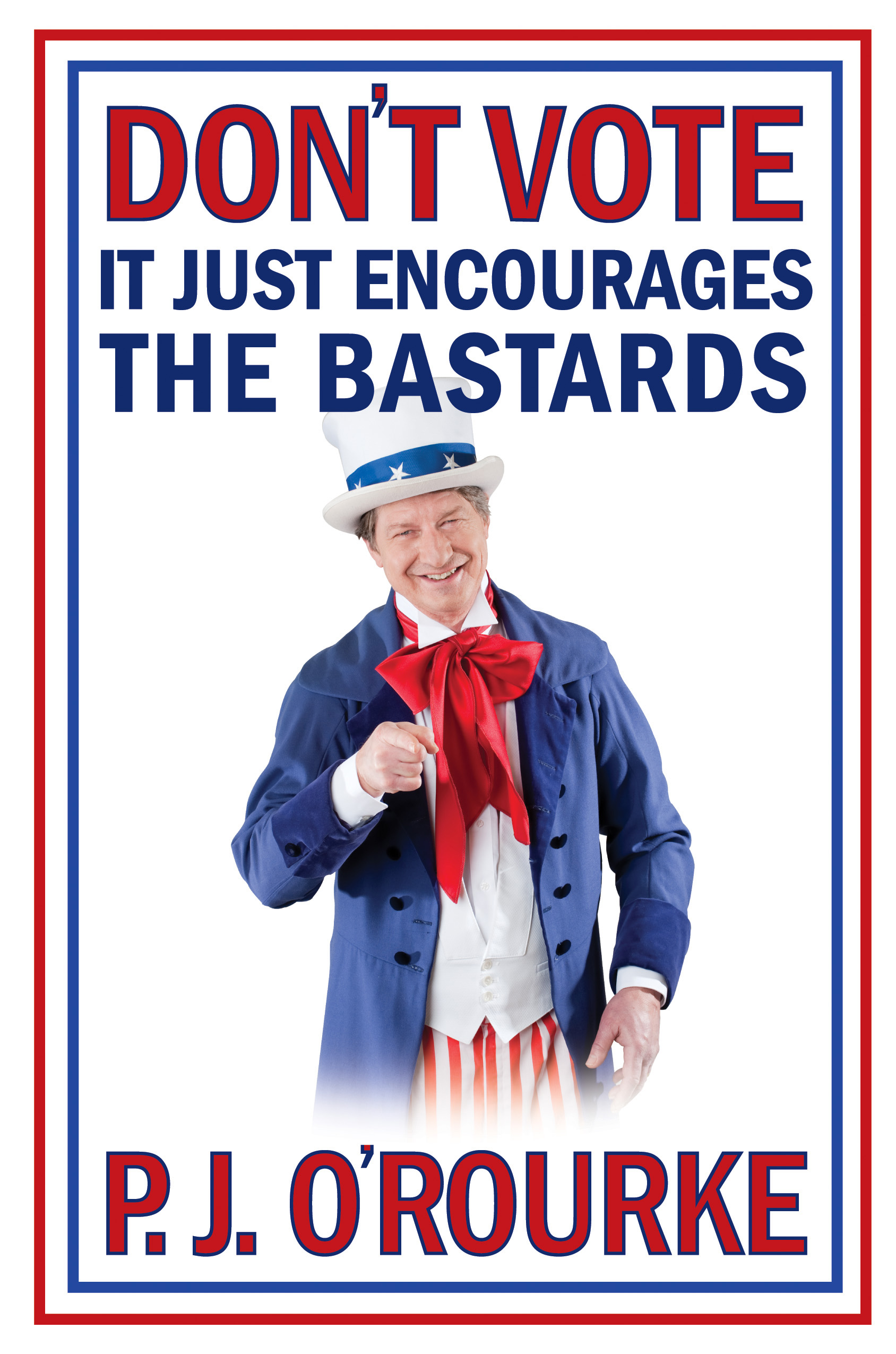
Three county tax measures are automatic noes.
So why will I vote? I can only muster two reasons:
- With so many people voting by mail, they have consolidated the voting places. Mine is now a mile away. I like that because if the weather is good I’ll have a nice hike through the open space to get there.
- I feel some sort of emotive satisfaction in voting. We all like to believe we are having our say when voting, preposterous as that notion is. For many young people, voting for Barack Hussein in 2008 was a positive expression of hope, which one hopes has been wrung out of all but the densest of them by now. I felt that same youthful enthusiasm when casting my first-ever vote, for Barry Goldwater in 1964, so I understand. But now the satisfaction, as you can tell, is thoroughly sardonic.
Not only will I vote, but I have actually contributed to candidates: Ron Paul, Gary Johnson, and Art Robinson who is running for Congress in Oregon. I offer no excuse for this behavior. I herewith publicly resolve to make no further donations this year.
It gets worse. I twice ran for office, once coming perilously close to winning. That memory is too painful so I won’t elaborate.
In November I will vote for Gary Johnson. Knowing that B.O. will carry California I needn’t worry about whether Mr. Romney might make a slightly less evil President. There will be nasty state tax increases to vote against as well.
Links From Around the Web
Co-editor Fred Foldvary on the destruction of the Libertarian Party.
Newest member of the consortium, Warren Gibson, writes in the Freeman about GDP.
Ninos Malek on associating in peace.
Jacques Delacroix questions Ron Paul’s credibility.
And writing over in the Atlantic, Conor Friedersdorf celebrates the failed boycott attempts of Rush Limbaugh’s show.
I just started school today, so if you don’t hear from me for a while, you now know why. Have a great spring!
A Libertarian sales-tax party?
Is the Libertarian Party becoming a sales tax party? The past several LP candidates for president have favored excise taxes. I don’t recall any of them declaring, “Taxation is Theft!” Now we have former New Mexico governor Gary Johnson as a leading candidate for the LP nomination for president, having abandoned the quest for the Republican Party nomination. His tax plan as a Republican was a national sales tax, and that remains his tax plan as a Libertarian.
The main organization pushing for a national sales tax calls it a “Fair Tax.” That is excellent propaganda, but a sales tax is no more fair or just than a tax on wages. A sales tax violates free trade, makes products more expensive, and indirectly taxes wages and other incomes. The advocates claim that a shift from income to sales taxes would not raise prices, since the income tax already raises prices, but they are wrong, because much of the burden of a tax on wages is on labor. A sales tax has about the same excess burden or deadweight loss as an income tax. Income taxes punish savings, but sales taxes punish borrowing, and there is no logical reason to favor savings over borrowing. Savings and borrowing should be voluntary individual choices not skewed by taxes or subsidies.
The “Fair Tax” plan exempts business purchases, putting the burden on households. That invites massive tax evasion, as folks would claim to be buying stuff for a business. The response of government would be a sales tax gestapo. If you did not have a receipt for your purchase and could not prove it was for business, you could go to prison.
If the Libertarian Party becomes a sales tax party, it will be unpopular and get little support. Historically, sales tax advocacy has been a political loser. This may well be why Gary Johnson got so little support as a Republican candidate for president. If the LP nominates a sales taxer, I for one will promote the Free Earth Party (http://free-earth.foldvary.net/) as a truly libertarian alternative.
 Notes On Liberty