- Public and private pleasures (the coffeehouse) Phil Withington, History Today
- The historical state and economic development in Vietnam Dell, Lane, & Querubin, Econometrica
- The liberal world order was built with blood Vincent Blevins, New York Times
- Bowling alone with robots Kori Schake, War on the Rocks
Nightcap
- On the new conservative movement in the United States C Bradley Thompson, American Mind
- The sense of shame and the politics of humiliation Thomas Laqueur, Literary Review
- Money, modern life, and the city Daniel Lopez, Aeon
- Space exploration, and comparative coranavirus lockdowns Scott Sumner, MoneyIllusion
Nightcap
- Alesina was one of the most creative economists of his time Guido Tabellini, Il Foglio
- Alberto Alesina. A free-spirited economist Papaioannou & Stantcheva, VOXEU
- “Nation-Building, Nationalism, and Wars” Alesina, Reich, & Riboni, NBER
- The case against Mars Byron Williston, Boston Review
Broken incentives in medical research
Last week, I sat down with Scott Johnson of the Device Alliance to discuss how medical research is communicated only through archaic and disorganized methods, and how the root of this is the “economy” of Impact Factor, citations, and tenure-seeking as opposed to an exercise in scientific communication.
We also discussed a vision of the future of medical publishing, where the basic method of communicating knowledge was no longer uploading a PDF but contributing structured data to a living, growing database.
You can listen here: https://www.devicealliance.org/medtech_radio_podcast/
As background, I recommend the recent work by Patrick Collison and Tyler Cowen on broken incentives in medical research funding (as opposed to publishing), as I think their research on funding shows that a great slow-down in medical innovation has resulted from systematic errors in organizing knowledge gathering. Mark Zuckerberg actually interviewed them about it here: https://conversationswithtyler.com/episodes/mark-zuckerberg-interviews-patrick-collison-and-tyler-cowen/.
Nightcap
- The humbling of Dominic Cummings Harry Lambert, New Statesman
- Pandemic futarchy design Robin Hanson, Overcoming Bias
- Quite the IR controversy has broken out Jarrod Hayes, Duck of Minerva
- Republics, Extended and Multicultural William Voegeli, Claremont Review of Books
Nightcap
- The optimistic case for Hong Kong Anka Lee, Politico
- Taking political and economic frictions seriously Kevin Bryan, A Fine Theorem
- Patriarchy, fascism, and Dominic Cummings Maria Farrell, Crooked Timber
- Manga Soviet Union World War II Bunna Takizawa, Asahi Shimbun
Launching our COVID-19 visualization
I know everyone is buried in COVID-19 news, updates, and theories. To me, that makes it difficult to cut through the opinions and see the evidence that should actually guide physicians, policymakers, and the public.
To me, the most important thing is the ability to find the answer to my research question easily and to know that this answer is reasonably complete and evidence-driven. That means getting organized access to the scientific literature. Many sources (including a National Library of Medicine database) present thousands of articles, but the organization is the piece that is missing.
That is why I launched StudyViz, a new product that enables physicians to build an updatable visualization of all studies related to a topic of interest. Then, my physician collaborators built just such a visual for COVID-19 research, presenting a sunburst diagram that users can select to identify their research question of interest.
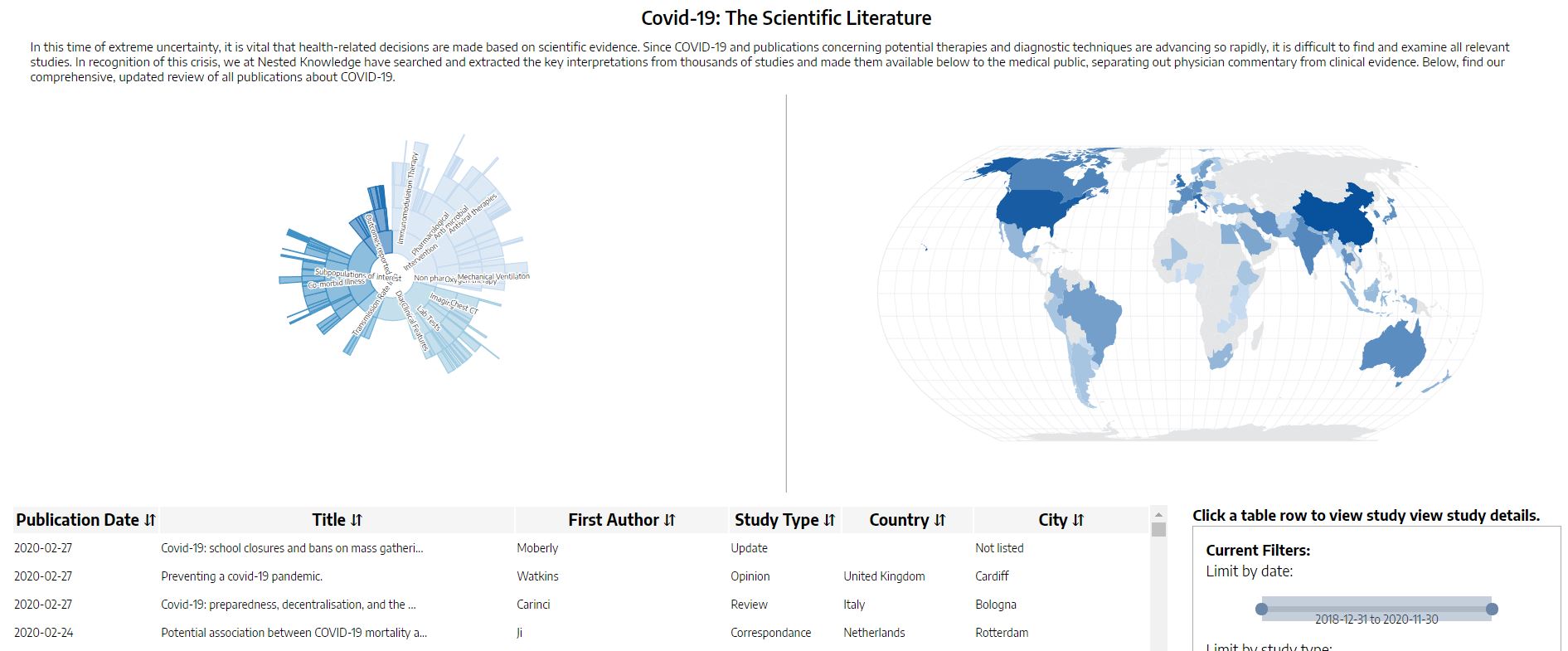
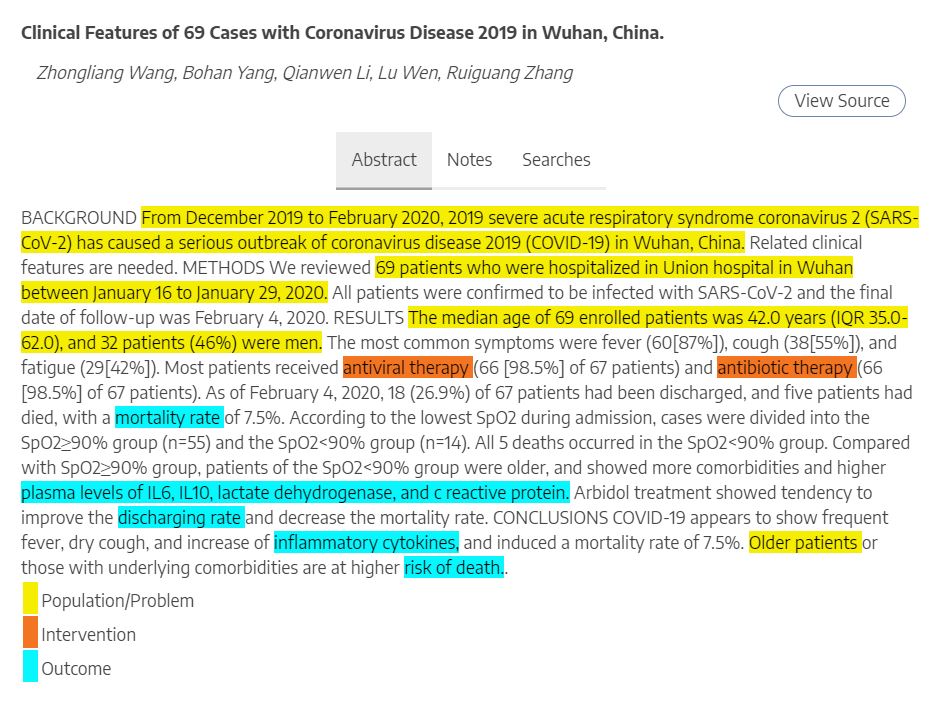
For instance, if you are interested in the impact of COVID-19 on pregnant patients, just go to “Subpopulations” and find “Pregnancy” (or neonates, if that is your concern). We nested the tags so that you can “drill down” on your question, and so that related concepts are close to each other. Then, to view the studies themselves, just click on them to see an abstract with the key info (patients, interventions, and outcomes) highlighted:
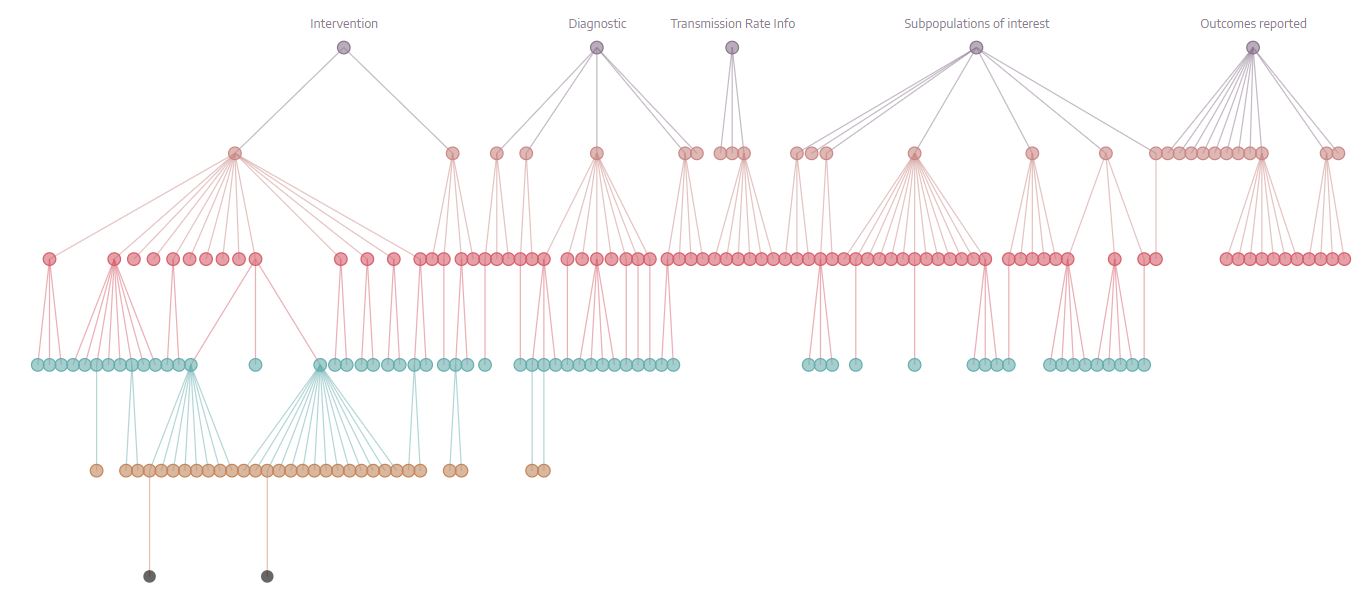
This is based on a complex concept hierarchy built by our collaborators and that is constantly evolving as the literature does:
Even beyond that, we opened up our software to let any researchers who are interested build similar visuals on any disease state, as COVID-19 is not the only disease for which organizing and accessing the scientific literature is important!
We are seeking medical coinvestigators–any physician interested in working with us, simply email contact@nested-knowledge.com or contact us on our website!
Pathologies in higher education: a book, a review, and a comment
Cracks in the Ivory Tower, by Jason Brennan and Phillip Magness, brings a much needed discussion of the pathologies of US higher education to the table. Brennan and Magness are two well-known classical liberals with a strong record of thoughtful interaction with Public Choice political economy.
Public Choice is an application of mainstream economic concepts to political situations. One of the key points of Public Choice is that people are self-interested and rational. This drives the choices they make. But people also act within formal and informal institutional environments. This constrains and enables some of their choices to a large degree. In other words, people react to incentives.
The Public Choice approach is not so much a normative handbook, but rather an attempt to explain how politics operate. The application of this theory to understand higher education in the US is a welcome addition to a growing literature on the economics of higher education.
It is perhaps surprising how the subtitle of the book stresses an aspect that tends to be extraneous to Public Choice scholarship: “The Moral Mess of Higher Education”. Of course we all draw on moral reasoning and assumptions in order to pass judgment on economic and political phenomena, but normally the descriptive side is kept separate – at least by economists – from explicit value judgment.
John Staddon, from Duke University, has reviewed Brennan’s and Magness’ book. In his review, he focuses on three main key issues. First, colleges and universities act on distorted incentives created, for example, by college rankings, to recruit students in ways that are not necessarily related to maintaining or expanding the academic prestige of the institution.
Second, teaching in higher education, at least in the US, is poorly evaluated. Historically, it has shifted from student evaluation to administrative assessment.
So why the shift from student-run to administration-enforced? And why did faculty agree to give these mandated evaluations to their students? Faculty acquiescence — naiveté — is relatively easy to understand. Who can object to more information? Who can object to a new, formal system that is bound to be more accurate than any informal student-run one? And besides, for most faculty at elite schools, research, not teaching, is the driver. Faculty often just care less about teaching; some may even regard it as a chore.
The incentives for college administrations are much clearer. Informal, student-run evaluations are assumed to be unreliable, hence cannot be used to evaluate faculty for tenure and promotion. But once the process is formalized, mandatory, and supposedly valid, it becomes a useful disciplinary tool, a way for administrators to control faculty, especially junior and untenured faculty.
This is not necessarily conducive to improvement in the quality of teaching. Perhaps colleges fare better than universities here, given that their faculty is not expected to allocate a large amount of hours per week to research and writing.
Third, Brennan and Magness offer a critique of what is known in the US system as “general education” courses. In their view, it is clear that those courses are unhelpful in a world where academic disciplines are increasingly more specialized. However, offering those courses is a good excuse for universities to grab more money from the students.
This is where Staddon begs to differ:
Cracks in the Ivory Tower usefully emphasizes the economic costs and benefits of university practices. But absent from the book is any consideration of the intrinsic value of the academic endeavor. Remaining is a vacuum that is filled by two things: the university as a business; and the university as a social activist. Both are destructive of the proper purpose of a university.
I tend to agree with this point, and I do not think it is a minor point. We can do colleges and universities without football, without gigantic administrative bureaucracies, and without the gimmicks to game the college ranking system. I could even go further and argue that we should do colleges and universities without dorms and an artificial second and worse version of teenage years right when students are supposed and expected to behave like adults. Getting rid of those tangential features of US higher education should help refocus on knowledge and reduce the cost.
Colleges and universities in the US are also expensive and unnecessarily inflated because of the structure of the student loans system, which also generates perverse incentives. But this point has been explained and described to exhaustion in the economic literature. This also has to change.
However, I am not convinced that making universities focus on professionalizing their students would be the best way to go. Brennan and Magness raise some important issues and concerns, some of which also apply outside the US, but the Staddon highlights in his review an important counterpoint: higher education, at least on the undergraduate level, shouldn’t be seen 100% as an investment good, but also as a consumer good:
Higher education does not exist for economic reasons. It exists (in the famous words of Matthew Arnold) to transmit “the best that has been thought and said,” in other words the ‘high culture’ of our civilization. Job-related, practical training is not unimportant. Universities, and much else of society, could not exist without a functioning economy. But — and this point is increasingly ignored on the modern campus and by the authors of CIT — these things are not the purpose, the telos if you like, of a university.
Undergraduate education is there to hand over knowledge to the next generation. It can be small and cheap. You need an adequate building, a small library with the best classic books, electronic access to journals, and faculty that excels at teaching. Courses would be general, comprehensive, and interdisciplinary by definition. The program could last only three years. An optional additional year could be offered to those with an academic profile, where they could pursue more specialization as a bridge to graduate education.
This is more or less the mediaeval model. I am not sure we need to reinvent the wheel in order to deal with the crisis of higher education. What we need is to get back on track – back to the bread and butter of college education. This is a reflection that both sides of the story – those who demand education and those that offer it – need to make.
Read more:
In a recent contribution to Notes on Liberty, Mary Lucia Darst has recently commented on the status of higher education during the 2020 pandemic and prospects for the future.
I also wrote about the college trap in the US a few years ago.
Nightcap (again)
(Ooops, lol. I hope all of NOL‘s American readers had a good Memorial Day, and that everybody else had a good Monday. The Glasner piece is an excellent discussion of the Austrian School of Economics.)
- An Austrian (School) tragedy David Glasner, Uneasy Money
Nightcap
- An Austrian (School) tragedy David Glasner, Uneasy Money
Nightcap
- The surprising lexical history of infectious disease Charles McNamara, Commonweal
- Immigration and virologic hysteria Michael Agovino, Not Even Past
- Against scarcity Marilynne Robinson, NYRB
- Can we escape from information overload? Tom Lamont, 1843
Be Our Guest (Sunday Poetry): “Food & Drinks to Rats & Finks”
Our latest Be Our Guest post comes from poet N.D.Y. Romanfort, and it’s another poem. Once again I’m taking liberties in regards to Alex’s “Sunday Poetry” series and sharing Romanfort’s poem today. An excerpt:
Two-legg’d rodents have seized
the cherished eateries.
For these rats of great size
Mere food scraps aren’t the prize.
Please, read the rest. Enjoy. And if you’ve got something to say and no place to say it, Be Our Guest.
Nightcap
- Is Turkey moderating its foreign policy? Fehim Tastekin, Al-Monitor
- On Rudyard Kipling’s World War I-era book Lance Morrow, City Journal
- Habsburgs: The rise and fall of a world power John Adamson, Literary Review
- The end of the New World Order Ross Douthat, New York Times
Foundering in academia
For the last couple of weeks, I have been reading and re-reading Gerard Klickstein’s book The Musician’s Way: A Guide to Practice, Performance, and Wellness. Klickstein is a musician and professor who has spent much of his teaching career helping other musicians recover from physical injury or overcome psychological issues, such as performance anxiety. Klickstein argues that the vast majority of musicians’ problems, physical and psychological, are a result of poor formation at critical stages of development. Reversing problems engendered by “unqualified,” i.e. incompetent, teachers is an overarching theme in the book. Reading Klickstein’s anecdotes in which many of his students are recent college graduates, one becomes alarmed at the sheer number of incompetent teachers present in “higher education.”
Several summers ago, at a music festival, I sat with an opera singer friend and we assembled her audition book. An audition book is a selection of opera arias which a singer provides to producers during the audition process. My friend and I were deep into research and consideration, when another musician, also a singer, joined us. His contribution was to question us as to why we bothered with the book at all.
He went on to reveal that he wasn’t planning on attempting the opera house and festival audition cycle, nor was he considering trying for a choral ensemble. Instead, he was applying for faculty positions at small colleges. He was a recent doctoral graduate from a university which is overall relatively famous but not particularly well-regarded for its music school. At that time, the three of us were roughly at the same level. His experience and education were slightly above average for the types of small, regional institutions he was targeting.
Behind his dismissive behavior lay a mentality of minimal effort. Why should he go to the trouble of researching roles, evaluating musical suitability, and learning parts when his résumé would satisfy the expectations of small, provincial colleges? He lacked the vocabulary to explain his vision, but what he described was a sinecure. Before the festival ended, he had secured a full-time position at an institution in a backwater of the American southwest.
One side of the proverbial coin says that the institution was lucky to have him – his background certainly was above anything the college could expect on the basis of its own reputation and musical standing; the other side of the coin says that it is concerning that someone like him could see academia as a safety net.
Now American colleges have begun to furlough staff. As you can imagine, many of my Facebook friends are people who attended and are now staff at small liberal arts colleges and small state universities throughout the country. In the atmosphere of uncertainty, my own FB feed has filled up with people lashing out against a society, which, they insist, doesn’t value them. There is an underlying financial element; few can afford to be furloughed. But there is a deeper issue present: a professional inactivity that has pervaded American small liberal arts academia for the last few decades.
In truth, financial concerns are more a symptom of professional inactivity than they are representative of some overarching truth about poor pay for teachers. I recall how one of my Columbia professors told my class never to rely on a single income stream. He would talk about how all breaks are opportunities to be productive. He told us about how when he was starting his career in the 1960s, he deliberately accepted a part-time position, rather than a full-time one, so that he could finish writing his first book. In terms of his career, the book was more important than his job at a small city college because the book paved the way for the big opportunities. To tell the truth, it didn’t matter that he taught at a small city college, outside of gaining some official teaching experience which he could have obtained through teaching just one class. There’s a difference between being professionally active and simply being busy or being employed.
There is a species of person who follows the same MO as the singer from the music festival. Academia is a safety net, and the goal is to rush into a full-time position and sit there for a lifetime. Their attitude is that of a career teacher, not a professor. They lecture and grade, however there is no professional contribution or creativity on their part. Such people tend to be barren of original thought and to react with hostility to new ideas or concepts. A quick search of academic databases shows that they don’t write articles, they haven’t written books (their theses don’t count), and they don’t write for think tanks or journals. An egregious example is a college professor who writes movie reviews for popular art enthusiast magazines; he’s been passing this activity off as “publishing” and “being published” for years.
There is, I know, a perception of a double standard on some level. For example, Kingsley Amis taught English Literature at Oxford for the majority of his career. He published comparatively little on the academic side in contrast to some of his peers, and much of his lighter work took the form of reviews, essays, and opinion pieces for newspapers and magazines, such as the London Times or The New Yorker. But he averaged a novel a year. Recognized in his own lifetime as a giant of twentieth century English literature, no one questioned his publication record or his ability to teach the field.
The subtle stagnation at the liberal arts college level has contributed to a culture of belief in talent and luck, rather than good decision making and hard – by which I mean calculated and carefully weighed – work. There are many people today who would classify my Columbia professor’s story as one of privilege and make assumptions about a background of wealth that allowed part-time work. In actual fact, he did not come from a particularly “privileged” background: he simply settled on his priorities, thought ahead, and made his decisions accordingly.
One thing one learns very quickly in the arts is that one must create without expectation of immediate payment. Singers learn arias, instrumentalists study concerti, filmmakers shoot reels all so that when the moment is right, they can produce a piece that demonstrates ability and wins a commission. One tidbit my professor included was that he had to write several critically acclaimed books before he began to receive advances for his work. The principle is the same: create first then receive a reward. A person who works according to the parameters of payment is a drone, and it is unsurprising that such people do not create new works, make discoveries, or have groundbreaking insights. If one considers that American small colleges have populated themselves largely with professional drones, one must reevaluate their worth to education.
Nightcap
- Oliver Williamson (RIP) and the Austrians Peter Klein, Mises Daily
- On the pioneer of Indian nationalism Soni Wadhwa, Asian Review of Books
- The politics of Star Trek Timothy Sandefur, Claremont Review of Books
- The psychology of entrenched privilege Côté et al., PSPB
 Notes On Liberty