A short note on Brazil’s elections

In October Brazilians will elect the president, state governors, and senators and congressmen, both at the state and the national level. It’s a lot.

There is clearly a leaning to the right. The free market is in the public discourse. A few years ago most Brazilians felt embarrassed to be called right wing. Today especially people under 35 feel not only comfortable but even proud to be called so.

The forerunner for president is Jair Bolsonaro. The press, infected by some form of cultural Marxism, hates Bolsonaro. Bolsonaro’s interviews in Brazilian media are always dull and boring. Always the same questions. The journalists decided that Bolsonaro is misogynist, racist, fascist, guitarist, and apparently, nothing will make them change their minds. Of course, nothing could be further from the truth. Bolsonaro is a very simple person, with very simple language, language that can sound very crude. But I defy anyone to prove he is any of these things. Also, Bolsonaro is one of the very few candidates who admits he doesn’t know a lot about economics. That’s great news! Dilma Rousseff lied that she had a Ph.D. in economics (when she actually didn’t have even an MA), and we all know what happened. Bolsonaro is happy to delegate economics to Paulo Guedes, a Brazilian economist enthusiastic about the Chicago School of Milton Friedman. One of Bolsonaro’s sons is studying economics in Institute Von Mises Brazil.

It is very likely that Brazil will elect a record number of senators and congressmen who will also favor free market.

Even if Bolsonaro is not elected, other candidates like Marina Silva and Geraldo Alckmin favor at least an economic model similar to the one Fernando Henrique Cardoso implemented in the 1990s. Not a free market paradise, but much better than what we have today.

Unless your brain has been rotten by cultural Marxism, the moment is of optimism.

China and the liberal vision of the Indo-Pacific

Mike Pompeo’s recent speech (titled ‘America’s Indo-Pacific Economic Vision’) at the Indo-Pacific Business Forum hosted by the US Chamber of Commerce in Washington, DC, has been carefully observed across Asia. Beijing has understandably paid close special attention to it. Pompeo emphasized the need for greater connectivity within the Indo-Pacific, while also highlighting the role which the US was likely to play (including financial investments to the tune of $113 million in areas like infrastructure, energy, and digital economy). The US Secretary of State, while stating that this vision was not targeted at anyone, did make references to China’s hegemonic tendencies, as well as the lacunae of Chinese connectivity projects (especially the economic dimension).

The Chinese reaction to Pompeo’s speech was interesting. Senior Chinese government officials were initially dismissive of the speech, saying that such ideas have been spoken in the past, but produced no tangible results.

A response article in the Global Times is significant here. Titled ‘Indo-Pacific strategy more a geopolitical military alliance’ and published in the communist state’s premier English-language mouthpiece, what emerges clearly from this article is that Beijing is not taking the ‘Indo-Pacific vision’ lightly, and neither does it rule out the possibility of collaboration. The article is unequivocal, though, in expressing its skepticism with regard to the geopolitical aspect of the Indo-Pacific vision. Argues the article:

[…] the geopolitical connotation of the strategy may lead to regional tensions and conflicts and thus put countries in the region on alert.

The piece is optimistic with regard to the geo-economic dimension, saying that American investment would be beneficial and would promote economic growth and prosperity. What must be noted is that while the US vision for an ‘Indo-Pacific’ has been put forward as a counter to the Belt and Road Initiative (BRI) of China, the article also spoke about the possible complementarities between the US vision for an ‘Indo-Pacific’ and China’s version of BRI. While Pompeo had spoken about a crucial role for US private companies in his speech, the article clearly bats in favor of cooperation between the Indian, Japanese, Chinese, and US governments, rather than just private companies. This is interesting, given the fact that China had gone to the extent of dubbing the Indo-Pacific vision as “the foam on the sea […] that gets attention but will soon dissipate.”

While there is absolutely no doubt that there is immense scope for synergies between the Indo-Pacific vision and BRI, especially in the economic sphere, China’s recent openness towards the Indo-Pacific vision needs to be viewed in the following context.

First, the growing resentment against the economic implications of some BRI projects. In South Asia, Sri Lanka is a classical example of China’s debt trap diplomacy, where Beijing provides loans at high interest rates (China has taken over the strategic Hambantota Project, since Sri Lanka has been unable to pay Beijing the whopping $13 billion). Even in the ASEAN grouping, countries are beginning to question the feasibility of BRI projects. Malaysia, which shares close economic ties with Beijing, is reviewing certain Chinese projects (this was one of the first steps undertaken by Mahathir Mohammad after taking over the reigns as Prime Minister of Malaysia).

Secondly, the Indo-Pacific vision has long been dubbed as a mere ‘expression’ that lacks gravitas in the economic context (and even now $113 million is not sufficient). Developments over recent months, including the recent speech by Pompeo, indicate that the American Department of State seems to be keen to dispel this notion that the Indo-Pacific narrative is bereft of substance. Here it would be pertinent to point out that Pompeo’s speech was followed by an Asia visit to Indonesia, Malaysia, and Singapore.

The US needs to walk the course and, apart from investing, it needs to think of involving more countries, including Taiwan and more South Asian countries like Sri Lanka and Bangladesh in the Indo-Pacific partnership.

The Indo-Pacific also speaks in favor of democracy as well as greater integration, but countries are becoming more inward-looking, and their stands on democracy and human rights are more ambiguous than in the past. Japan is trying to change its attitude towards immigration, and is at the forefront of promoting integration and connectivity within the Indo-Pacific. Neither the US, nor India, Japan, or Australia have criticized China for its human rights violations against the Uighur minority in Xinjiang province.

Here it would also be important to state that there is scope for China to be part of the Indo-Pacific, but it needs to look at certain projects beyond the rubric of the BRI. A perfect instance is the Bangladesh, China, India, Myanmar (BCIM) Corridor, which India was willing to join, but China now considers this project as a part of BRI.

In conclusion, Beijing can not be excluded from the ‘Indo-Pacific’ narrative, but it cannot expect to be part of the same, on its own terms. It is also important for countries like the United States and India to speak up more forcefully on key issues pertaining to freedom of speech and diversity (and ensure that these remain robust in their own respective countries), given that one of the objectives of the Indo-Pacific vision is a ‘Free and Open Indo-Pacific’.

Why Hayek was Wrong about American and European Conservatism IV

Continuing a discussion from here inspired by F.A. Hayek’s essay ‘Why I am Not a Conservative’.

One central claim of Hayek’s essay is that American conservatism is not the same as European conservatism, as it is rooted in the classical liberalism of the Declaration of Independence, the Constitution, and the Bill of Rights. He notes that ‘European’ style conservatism exists in the US but claims it is an artificial import that looks odd. A really big problem here is Hayek’s assumption that there are native national forms of political culture which are authentic compared with alien intrusions. Of course national context and tradition are important, but that should not conceal understanding of pluralism, emergence from the margins of positions that have always been there, change, and influences across national frontiers.

Hayek’s talk of odd looking imports into American conservatism may cover Russell Kirk and William Buckley, both major influences on American conservatism in second half of the twentieth century and their influence lingers in central parts of US conservatism. Buckley’s conservatism was connected with his traditionalist Catholics. The founders of the American Republic were Protestants and anti-Catholicism has been a significant force in the United States until well into the 20th century.

Hayek himself was a person without religious belief from a Catholic culture who attributed great importance to the Catholicism of Alexis de Tocqueville and David Acton (see my comments in last post). He considered naming the Mont Pelerin Society the Acton-Tocqueville society, apparently because of the role Catholics played in the German groups resisting Hitler. This is all very strange, as it was certainly not only Catholics who resisted Hitler and there is no need to name a free market institution after a British and a French Catholic to get support from German liberals. Even leaving that aside there is an extraordinary tangle here with regard to how American conservatism relates to American and European religious traditions, along with the question of where Hayek fits.

Kirk brought Burkean conservatism into the US, where Burke’s most famous critic, Thomas Paine (what we might now call a left libertarian), is more associated with the early republican heritage. Of course, as I have pointed out, Hayek was a big Burke fan. So we see another tangle about how to connect American conservatism with Europe. In general the imports into American conservatism come from sources Hayek liked, Catholicism (though he was an atheist as well as divorced and twice married), and Burke. What was Hayek’s presence at the University of Chicago or his impact on US conservatives and libertarians then? Hayek was very much a late Habsburg in character, not at all American.

I also question how far US conservatism can be seen as an outgrowth of classical liberalism – distinct from a supposed European conservatism tied to non-liberal tradition and slowing down change. An account of American conservatism must acknowledge paleoconservatism along with paleolibertarianism, which are both outgrowths of neo-Confederate thought idealising the slave-holding and then white supremacist societies of the southern states, turning Abraham Lincoln into a villain. There is also southern Agrarianism, an idealisation of southern rural society. Most significantly for party politics, there is the tradition which goes back to the Bourbon Democrats (that is southern pro-slavery and segregationist Democrats) which became the Old Right of the Republican Party from which Ron Paul emerged.

We cannot go very far in discussing American conservatism without running into nostalgia for pre-liberal societies and organicist rural tradition, which looks remarkably like traditionalist conservatism in Europe. The early foundational documents of the American Republic are great things, but do not in themselves stand in the way of local illiberal communities undisturbed by the federal state. This is how slavery and then Jim Crow (segregationism and white supremacism) survived.

The story of an American system with a truly individualist, equal rights way-of-thinking enforced by the federal state for all only really starts with Abraham Lincoln (main text here is the Gettysburg Address of course, which in essence advocates ‘a new birth of freedom’ as the transformation of the union of states into a democratic nation), followed by the 13th, 14th, and 15th amendments which abolished slavery, gave the Federal state a bigger role in enforcing constitutional protections, and created a federal guarantee for voting rights.

Sadly the triumph of southern ‘Redemption’ over Congressional Reconstruction after the Civil war prevented proper protection of basic rights for African-Americans until the 1960s. Of course most American conservatives now see the slavery and Jim Crow periods as the wrong kind of conservatism, based on a failure to apply the best parts of constitutional and natural law thinking.

There are many other aspects to American conservatism, the important point is to emphasise that significant parts of it have been based on traditionalist admiration for pre-liberal communities and the violent state imposition of social hierarchies (often accompanied by illegal violence tolerated, or even encouraged by the state) denying basic rights to humans of the wrong ‘race’. This has also influenced the more ‘paleo’ forms of libertarianism.

However many good things we can find in the US constitution, it was not applied so as to guarantee citizen and personal rights for all more than a century and a half after its adoption. Its initial design incorporated measures to allow the persistence of slavery. Whatever one might think about its proper meaning, the reality is that veneration for it was not a barrier to slavery or Jim Crow, along with many other abuses.

Hayek was no doubt sincere in wishing to distinguish his thought from conservatism and I certainly do not think his best insights can be applied within a conservative framework, but clearly he prefers conservatism to the more radical republican end of liberal thought (which did have an impact on some of the best moments in American politics) and it is not a surprise that conservatives have found it easy to digest a version of Hayek. Hayek’s thoughts about European conservatism are inadequate and he becomes stuck in an extraordinary tangle in his view of American conservatism.

Why Hayek was Wrong about American and European Conservatism III

I am continuing from here, where I mainly discussed definitions of liberalism and conservatism. This sequence of posts was inspired by F.A. Hayek’s essay ‘Why I am Not a Conservative’. I am happy to share Hayek’s sentiment that market liberalism is not the same thing as conservatism, but I find some of the argument rather unsatisfactory. What I have concentrated on so far is what I see as the inadequacy of Hayek’s view of conservatism as just a position of slowing down change. What I am getting on to is firstly his view of European liberalism and then of American conservatism.

Hayek’s essay seems to me to contain rather odd claims about the difference between British and continental European liberalism. He suggests:

the majority of Continental liberals stood for ideas to which these men were strongly opposed, and that they were led more by a desire to impose upon the world a preconceived rational pattern than to provide opportunity for free growth. The same is largely true of what has called itself Liberalism in England at least since the time of Lloyd George.

I certainly sympathise with his suggestion that British (unfortunately Hayek makes the common place but still highly incorrect error of substituting England for Britain, particularly absurd here because David Lloyd George was Welsh) liberalism went to much in the direction of top down rationalism (i.e. statism) from about the time of Lloyd George in the early 20th century. It is of interest here that LG (as he was frequently know) split the Liberal Party and was Prime Minster with Conservative support, wishing his faction of the Liberal Party to merge with the Conservative Party, while advocating statism at home and foreign policy adventurism abroad (in Ottoman Anatolia, shortly before it became Turkey), topped by a rather Caesarist personal style.

Returning to the main issue, the sweeping views Hayek indicates of continental liberalism are rather reductive. He equates continental liberalism (or at least a very large part of it) with what comes out of the French Revolution. He can only be thinking of neo-Jacobin currents in France (known as ‘radicals’) and related national-republican currents elsewhere. There is certainly also a history of more individualistic market liberalism on the continent along with what could be called a kind of liberal moderate constitutional royalism.

It would be better, I suggest, to think of continental liberalism as tending to split between the poles of national-republicanism and constitutional royalism. Hayek concedes in this essay that conservatism can be aligned with nationalism, but claims he cannot follow this up because he is not sympathetic enough to nationalism to be able to talk about it. This does not stop him from a more unrestrained attack on the nationalist tendencies of neo-Jacobins, though frequently such people had a desire for a union of European nations. The Italian national-republican and admirer of British liberalism, Giuseppe Mazzini, is a good example.

It seems clear enough that Hayek leans in the conservative direction of the two pole distinction I mention above. We can see this in his list of liberal heroes in the essay: Edmund Burke, Thomas Babington (Lord) Macaulay, Alexis de Tocqueville, David (Lord) Acton, and William Ewart Gladstone. Burke is a hero of conservatism and my last post explains why I think he stands for conservatism rather than liberalism, calling Benjamin Constant as my prime witness.

Macaulay was a Whig Liberal, deeply attached to the landowning classes and the empire, the sort of people who abandoned Gladstone when he started to emphasise the rights of the Irish. Macaulay ought to be read by liberty advocates. He was a great historian and had some admirable pro-liberty sentiments, but we cannot doubt that he leaned towards the conservative imperial state end of liberalism.

Tocqueville is someone popular with conservatives, but then there are also many left leaning Tocqueville admirers. It is part of the character of his writing that there is something for almost anyone. There was certainly an aristocratic and imperial side of his thinking, with strong criticisms of the Jacobins during the French Revolution and after. However, it should also be noted that he was at least happy to work with moderate republicans in French politics, that is those following a toned down Jacobinism and preferred them to the strong royalists. He saw the world as taking a democratic turn, which he thought had some dangerous aspects, but which he said should be followed in a way foreign to Burke and Macaulay.

Acton’s view of liberty leaned strongly in the direction that any restraint on central power was a good thing, to an extent that meant disregarding universal rights. The most famous example of this is his support for the slave states during the American Civil War and his correspondence with Robert E. Lee, which expressed gushing admiration for this prominent Confederate general and slave holder. Acton had some very pertinent things to say about the dangers of democracy, but failed to see that the danger is unrestrained majoritarianism rather than democracy as such, or at least failed to see that democracy constrained by constitutionalism was a better corrective for democratic vices than his attempts to cling onto non-democratic forms of government, or at least very attenuated forms of democracy (as in indirect elections). We can safely place him on the extreme right of the liberty movement.

Gladstone was a friend of Acton and was strongly influenced by him for many years. However, Gladstone, who started off as a High Tory (traditionalist conservative), ended up as a radical promoting home rule for Ireland and Scotland (to the horror of the Whig, that is conservative, Liberals) and extension of the suffrage beyond the property owning classes, who restricted the rights of Irish and Scottish landowners when he saw how they were treating their tenants against natural justice. These measures led him to be condemned as a dangerous socialist at the time, which is of course nonsense. He had an understanding that traditional property rights could become abusive and oppressive over time and that it was the legitimate role of the representative state to use its law making capacity to to challenge such abuse despite the protests of traditional landowners. Though he was influenced by Acton in his view of the US Civil War, he took a rather more national-republican leaning view of the Risorgimento (Italian movement of unification), and his later policies certainly suggest a less Burke-Macaualy-Acton oriented approach.

Hayek’s views of 18th and 19th century liberalism show a strong inclination towards the conservative end of liberalism (even if we assume that we are only concerned with individualistic market based liberalism here) and a very strong reaction against any national-republican elements of liberalism, while evading the issue of conservative-nationalist affinities.

To be continued

Finally, the US is getting serious about the Indo-Pacific

China has not been particularly comfortable with the Trump Administration’s repeated use of the term ‘Indo-Pacific’ instead of ‘Asia-Pacific’ (of late, it has been quite scathing in it’s criticism). The term ‘Indo-Pacific’, which has been used for a few years, has now gained more attention after a few developments:

First, during Trump’s Asia visit in 2017, in which he visited Japan, Vietnam, and attended the ASEAN Summit, he used this term on more than one occasion.

Before his India visit in October 2017, former Secretary of State Rex Tillerson articulated a vision for a ‘Free and Fair Indo-Pacific’. Tillerson, while pitching for a greater role for India in the Indo-Pacific, also highlighted the need for preventing illiberal multilateralism. Said the former US Secretary of State:

We need to collaborate with India to ensure that the Indo-Pacific is increasingly a place of peace, stability, and growing prosperity — so that it does not become a region of disorder, conflict, and predatory economics.

The use of the term ‘Indo-Pacific’ was followed by the revival of the Quad Grouping (India, Australia, US, Japan). Senior officials of these four countries met on the eve of the East Asia Summit, held in Manila, and discussed ways to strengthen cooperation for promotion of a ‘Free and Fair Indo-Pacific’.

There have been a number of meetings between representatives of Japan, the US, and India to discuss a wide range of issues such as maritime cooperation, connectivity, and strengthening collaboration between these countries

China’s criticism of Indo-Pacific and Quad

China dismissed the Indo-Pacific as an ‘attention grabbing idea’, while the Quad too has been criticized by Beijing. Foreign Minister Wang Yi, while commenting on the Quad, likened the Quad to ‘foam on the sea’ that ‘will soon dissipate’ once the attention due to headlines turns elsewhere.

The Indo-Pacific narrative did lack a vision

One issue on which it is hard to disagree with Beijing, and those skeptical about the ‘Indo-Pacific’, is the fact that countries who have joined hands for promoting a Free and Fair Indo-Pacific (as a sort of counter narrative to China’s Belt and Road Initiative), did not have clarity in terms of enhancing connectivity and economic linkages. They have met on a number of occasions to discuss connectivity projects and a myriad of other issues but nothing substantial has emerged so far. This lack of effort, according to many, has been one of the main reasons for the Indo-Pacific narrative not being taken seriously (even by US allies). The other problem, of course, has been the Trump administration’s differences with allies like Japan and South Korea on economic and geopolitical issues.

US rolls out an economic vision for the Indo-Pacific

At the Indo-Pacific Business Forum, organized by the US Chamber of Commerce, Secretary of State Mike Pompeo articulated a broader economic vision for the Indo-Pacific, while also speaking about the likely role of the US in promoting cooperation.

First, Pompeo yet again reiterated the US desire for a Free and Open Indo Pacific, and how the US was fervently opposed to the hegemonic tendencies of certain countries (in a clear reference to China).

Second, at a time when a number of countries, such as Malaysia and Sri Lanka, are beginning to question the financial feasibility of China’s Belt and Road Initiative-related projects, Pompeo’s words are significant. It may also be pointed out that his address at the US Chamber of Commerce was made days before he began his Asia trip (which included visits to Malaysia, Indonesia, and Singapore).

Third, Pompeo spoke about the $113 million investment in areas such as digital economy, energy, and infrastructure. Pompeo dubbed this investment as a ‘…down payment on a new era in US economic commitment to peace and prosperity in the Indo-Pacific region’.

Fourth, the US Secretary of State also spoke about the potential role of the US private sector in promoting economic growth, prosperity, and cooperation in the Indo-Pacific. In an interview with CNBC, Pompeo stated:

We want private industry with the assistance of the United States government, understanding that we’re going to support this effort, we’re going to have private industry go in and develop relationships. When American businesses come to these countries, they’ll thrive

China’s reaction to Pompeo’s speech

China was dismissive of the US commitment towards Indo-Pacific, and Chinese foreign ministry spokesman Geng Shuang stated that even in the past, there has been talk of cooperation between Japan, the US, and Australia working jointly for developing infrastructure, but so far not much has been achieved.

While there is absolutely no doubt that an alternative narrative is needed to China, the US also needs to be more predictable in terms of economic and strategic relations with key players in the Indo-Pacific. One of Washington’s closest allies in the past, Japan, has been extremely uncomfortable with not just the tariffs, but also on Trump’s handling of strategic issues (such as the North Korea issue).

The example of Indian and Japanese Companies in South Asia

If differences can be ironed out, there is clear space for companies of different countries to work together in the Indo-Pacific. India and Japan have already taken the lead in Sri Lanka and Bangladesh (two countries likely to play an important role in the Indo-Pacific). In Bangladesh, Marubeni and Larsen and Toubro shall work jointly for supplying electrical and mechanical railway systems for Phase 6 of the Dhaka Mass Rapid Transport. In Sri Lanka, Petronet, along with Japanese companies, is setting up an LNG terminal near Colombo (L&T has already been working with Marubeni for setting up a 400 MW gas plant in Habibgant district, Bangladesh). Petronet will hold 47.5 per cent stake in the project while Japan’s Mitsubishi and Sojitz Corp will take 37.5 per cent stake, while the remaining 15 percent stake will be held by a Sri Lankan company.

Conclusion

Pompeo’s emphasis – on the need for greater transparency in investments, US support for areas such as technology in the Indo-Pacific, and a more pro-active role for the private sector in the Indo-Pacific – all make sense. A lot will depend upon Donald Trump’s approach on critical geopolitical and economic issues, and whether he is able to take along key allies such as Japan. A lot will also depend upon relations of countries, especially Japan and India, with China. In recent months, Japan and India have been trying to recalibrate economic ties with Beijing (a number of Japanese companies are in fact participating in the BRI). While this in no way implies that the narrative of the Indo-Pacific will lose its relevance, it does remain to be seen whether Japan and India would put it on high priority.

Pompeo’s speech is interesting, and it remains to be seen how companies from other countries react and whether they explore the possibility of investing in big ticket connectivity projects.
Why Hayek was Wrong about American and European Conservatism II

The first post in this series concentrates on the more radical authoritarian populist side of conservatism in Europe. Before getting on to American conservatism and other aspects of European conservatism, I will respond to requests in the comments for definitions of what I mean by liberalism and conservatism. The shortest class definition I am aware of is that of David Hume in his essay ‘Of the Parties of Great Britain’ where he suggests that Whigs (liberals) favour liberty with a monarchy and that Tories (conservatives) favour monarchy with liberty. This can be expanded with little, if any controversy, to be taken as: liberals advocate liberty with order; conservatives favour order with liberty.

I will move from Hume to Benjamin Constant in Principles of Politics Applicable to all Governments. Constant is surely an unimpeachable source on what it is to be a classical liberal and it is important to note that Constant thinks there is something different in a politics based on principles of freedom than the thought of Edmund Burke. The distinction Constant makes is key to thinking about the relation between classical liberalism and conservatism, so is key to the claim that I make that (classical) liberalism are very distinct.

To increase the force of collective authority is never other than giving more power to some individuals. If the wickedness of men [an emphasis on this is a mark of conservative thinking], it is an even stronger one against power. For despotism is only the freedom of one or a few against the rest. Burke says that freedom is power. One can likewise say that power is freedom.(Book XV, Chapter 2)

This thought flows right into this thought from a later chapter:

Freedom is a power only in the sense that a shield is a weapon. So that when one speaks of possible abuses of the principle of freedom, such an expression is inaccurate. The principles of freedom would have prevented anything under the heading of abuses of freedom. These abuses, whoever their author, taking place always at the expense of another’s freedom, have never been the consequence of these principles, but rather their reversal.  (Book XVII. Chapter 1)

In my summary of the above: conservatism defines freedom as limited because of a dangerous power in excess, so requiring tradition, hierarchy, and the aggressive use of state sovereignty to to curb it, while liberalism suggests that more freedom is the answer to abuses of power.

Since Burke is a key figure for those advocating some kind of kind of intimate alliance, or even identity, between (classical) liberalism and conservatism or libertarian conservative fusionism, Constant’s criticism of Burke is important. I won’t get into the detail of Reflections on the Revolution in France, Burke’s central text on politics here, I will just note that the reader of this classic of conservatism will find many passages on the absolute sovereignty of the state, the virtues of rigid social hierarchy and of traditions supporting such hierarchy, along with the perfection of the British constitution of the time.

These passages, it seems to me, should raise concern to the advocate of liberty, which I believe derives its energy from the criticism of tradition, hierarchy, and existing institutions. As Constant recognises, we should not be quick to replace institutions that have grown over centuries with a perfect new design, but we should certainly not be afraid to innovate either, as we should not be slow to notice the growing faults of institutions over time as they come into conflict with new circumstances.

Burke was perhaps a bit more liberty-minded and a bit more innovation-friendly than the other famous critics of liberalism and Jacobinism – de Maistre, de Bonald and Donoso Cortés, but the understanding of liberty as particular Liberties inherited from tradition, upheld by a state that insists on its own absolute authority is something he has in common with them. For Constant, the excesses of the French Revolution are a reason to argue for more liberty, for Burke they are a reason to uphold hierarchy, tradition, and royal authority along with endless war against the French.

While addressing comments to the last post, I should refer to my fellow Notewriter, Edwin van de Haar, though thinking just as much of a previous social media conversation as his recent comment. As far as I understand, he advocates a definition of conservative liberalism that corresponds with F.A. Hayek’s views in The Constitution of Liberty and a share of GDP devoted to public spending substantially below the the average in advanced industrial countries. I’m not aware of anywhere in which Hayek used such a term, though he was certainly more sympathetic to Burke than I am here.

My argument is that there is nothing inherent to conservatism that makes it opposed to expanding the state in terms of welfare intervention or in terms of the police power of the state. Otto von Bismarck is just one particularly notable conservative from history who had a great belief in an intrusive state in various ways, including measures designed to take voters away from the strong Marxist-socialist current of the time, through incorporating socialist-friendly policies. Conservatism is a doctrine of order, state power (where national or imperial), and tradition.

Where conservatives have favoured market-friendly and relatively small state polices, they have done so in order to preserve order, the core of state power and tradition. Economically liberal conservatives like Margaret Thatcher and Ronald Reagan were also great believers in narratives of restored national grandeur, the security state, ‘law and order’ and ‘war on drugs’ polices expanding state power, while sucking an increasing number of people into the extreme state-socialist institution of prison.

As far as I can see Thatcher and Reagan are the heroes of ‘liberal conservatism’. With all due respect to their valuable economic reforms, the liberalism seems to me to be very subordinate to the conservatism. As I pointed out in the last post, ideas of aggressive populism are growing in the conservative world, ideas which have deep precedents in the ways that Bismarck figures have mobilised nationalism, statism, and reactionary identity politics against liberals.

Why Hayek was Wrong About American and European Conservatism I

The title of this post refers to F.A. Hayek’s essay ‘Why I am Not a Conservative’, which can be found as an appendix to his 1960 book The Constitution of Liberty. What this post is really about is the deficiencies of American conservatism and the general idea of liberal conservatism or a natural alliance between classical liberals and conservatives. However, first a few words about Hayek’s essay as Hayek is an important figure for liberty advocates. The essay in question is well known and particularly easy to find online.

Hayek’s criticism of conservatism overestimates the extent to which it is just a limiting position, slowing down change. The relation of conservatism to tradition is seem too much as conservatism being too slow to accept changes to tradition. Traditionalist conservatism, however, has been a much more active and dangerous force than that. ‘Traditionalism’ as far as I know is a 20th century term used particularly in France (René Guénon) and Italy (Julius Evola) to refer to a spiritual based for politics of an extreme conservative kind which found natural alliance with fascism. It seems clear enough that it has precedents in late 18th and 19th century conservative monarchist thinkers like Joseph de Maistre, Louis de Bonald, and Juan Donosó Cortes.

Carl Schmitt, who was maybe the greatest 20th century admirer of those thinkers, joined the Nazi Party in 1933, though found himself purged as not properly Nazi from his post as head of a jurists’ association in 1936. Not only did Schmitt admire the French and Spanish thinkers mentioned, he was a great admirer of Edmund Burke. Burke is a favourite of those claiming a conservative-liberty affinity. It would be unfair to suggest that Burke would have welcomed National Socialism (though the same applies to de Bonald, de Maiste, and Donosó Cortes).

It is a fact that a large part of conservative thinking of the time of the rise of Fascism, and allied forms of illiberal government such as corporatism, regarded it as a legitimate counter to Bolshevism and disorder. Even Ludwig von Mises defiled his own 1927 book Liberalism with generous words about Fascism as a counter to Bolshevism. The reality is that at the time such regimes came to power there was no immediate risk of Communist take over and this is a horrifying position, which cannot be justified by suggesting that Mises was writing in the heat of the moment as Bolsheviks stalked power in any particular country. Winston Churchill welcomed Fascism in Italy and even initially welcomed Hitler’s rise in Germany, before becoming acquainted with the reality of his regime. It is of course the case that Fascism and National Socialism had socialist roots as well as traditionalist conservative roots, but then a liaison between socialism and traditionalist conservatism as a counter to liberal individualism has a history going well back into the 19th century.

We can see right now in Europe the growing force of conservatism with a populist-nationalist emphasis targeting abnormals (as in everyone who does not fit their assumptions of a normal person in their country). This is not some new addition to the repertoire of the right. The strong man of the Northern League in Italy, Metteo Salvini, has aligned himself with Mussolini recently by tweeting a variation of Mussolini’s slogan ‘many enemies, much honour’ on Mussolini’s birthday. The Hungarian equivalent of Salvini, the Prime Minister Viktor Orbán, has rehabilitated the pre-war authoritarian leader Miklós Horthy. The Legue, Orbán’s Fidesz party, the Bannonite wing of the Republican Party and the like are stuffed with Vladimir Putin apologists, or at least as in Bannon’s case slippery arguments according to which he does not like Putin, but we should ally with him. In any case, Bannon is very active supporting the pro-Putin parties in Europe.

These parties draw on long traditions of conservative populism, monarchist anti-liberalism, and the like. The appeal to conservative love of monarchy, state church, and social conformity was a major weapon of monarchist conservative forces after the 1848 Springtime of the Peoples in Europe, helped by violent Russian intervention in the Austrian Empire to ‘restore order’. We see something like this now in the growing strength of a brand of conservatism which does not just limit change but fosters change in the direction of illiberalism, nationalism, xenophobia, Islamophobia, Christian identity, free trade, liberal protections of the individual from state power, the rights of civil society organisations to stand up to the state, and economic protection, seeking inspiration from the kleptomaniac nationalist authoritarian regime in Russia.

Enthusiasm for Recep Tayyıp Erdoğan is less obvious, but Orbán has put him on his list of ‘illiberal democracy’ heroes, and we can reasonably say that the rhetoric and methods of Erdoğan have been an inspiration for the populist right throughout Europe, even as, like Órban, it puts Islamophobia at the centre.

The role of Donald Trump and Steven Bannon as friends of, and models for, European populists should give reason to wonder whether Hayek misunderstood US conservatism. More on this in the next post.

How will Imran Khan’s electoral triumph affect Pakistan’s relationship with China?

All eyes are on how Imran Khan will fulfill the ambitious promises which he and his party (Pakistan-Tehreek-i-Insaaf, or PTI) have made for creating a ‘Naya Pakistan’ (New Pakistan). Khan, who will take his oath as Prime Minister on August 11, 2018, needs to hit the ground running given the myriad of economic (Pakistan’s external debt is well over $90 billion, and accounts for over 30 percent of the country’s GDP) and geopolitical challenges. As Pakistani senior officials were drawing up plans to approach the IMF for a loan (estimated at $12 billion), US Secretary of State Mike Pompeo warned the IMF that there is absolutely no justification for ‘IMF Dollars’ to bail out ‘Chinese bond holders’ or China.

Given the high expectations as well as the impatience amongst the youth, Khan is not likely to have a very long honeymoon period.

Pakistan-China relationship under PTI government

It will be interesting to see how the crucial Beijing-Islamabad relationship pans out under Imran Khan. During his first address (after his party’s victory) to the Pakistani nation, he dubbed the Pakistan-China relationship as the most important for Pakistan. Khan also emphasized the point that Pakistan had a lot to learn from China in the context of poverty alleviation, as well as the latter’s anti-corruption campaign.

China’s relationship with Imran Khan

In the past, Khan, while supporting the China-Pakistan Economic Corridor (CPEC) project in principle, had expressed certain apprehensions during his meetings with Chinese diplomats. Khan had also stated that the government of Pakistan needs to be more transparent with regard to the contours of the project, and that each province should get it’s rightful due.

The Chinese in turn were uncomfortable with Khan’s dharna (protests) of 2014 (it was as a consequence of these protests that the inauguration of the CPEC Project had to be delayed). Khan’s 2016 protests against the Nawaz Sharif government (after the names of three of Sharif’s family members, who held offshore accounts, appeared in the Panama leaks) were also watched with skepticism by the Chinese.

It would be pertinent to point out that the PTI manifesto, while praising the project, has pointed to some of CPEC’s short comings, including investments as a consequence of ‘insufficient transfer of knowledge and capabilities, fewer partnerships with local businesses and Pakistan’s high dependence on imports of goods and services from China’.

PTI’s chief rival, the PML-N, often spoke about the need for an independent foreign policy, but never ever alluded to this aspect.

Beijing’s preference for PML-N

It would also be pertinent to point out that while Beijing has had problems with Pakistan, it has had a close relationship with the Pakistan Muslim League (Nawaz), or PML-N. Beijing, which has maintained robust relations with the army, also shared cordial relations with Shehbaz Sharif, the President of PML-N and former Chief Minister of Punjab. China has praised Shehbaz Sharif for his efficiency more than one occasion, even referring to his style of working as ‘Shehbaz Speed’ and Punjab speed. When Shehbaz was appointed President of the PML-N, he received a congratulatory message from senior members of the Chinese Communist Party.

The PML-N also sought to take credit for the CPEC project on more than one occasion. In August 2016, while addressing a meeting of his party’s parliamentary committee, then-Prime Minister Nawaz Sharif stated:

He [Xi Jinping] said this is a gift to you from China. They were also waiting for the time when our government would be in power so that they could make this investment.

Chinese Media’s comments on Imran Khan and CPEC

Post the election results, Chinese media has sought to be positive, and has been confident that the CPEC project will go ahead as planned. One op-ed published in the Global Times (‘Will Imran Khan pivot Pakistan from US to China’) referred to how the West was creating unnecessary paranoia with regard to the economic ramifications of the CPEC project. The op-ed also said that Imran Khan may take Pakistan further into the ‘Chinese orbit’ and that he had no problem with the CPEC project. The article cites the PTI manifesto to bolster its argument (saying that PTI has dubbed the project as a ‘game changer’). Other sections of the Chinese media have also welcomed Imran Khan’s election. Only one analyst, Tom Hussain, has categorically made the point that PTI had strained ties with China in the past. Said Hussain:

the PTI has been working overtime to repair its relations with the Beijing, which had been damaged by its disparaging remarks and allegations of corruption about CPEC projects in the past.

Likely developments in the short run

Imran Khan doesn’t have too many options, but there could be some re-examination of some of the CPEC projects. While Pakistan is now dependent upon China given Islamabad’s rock bottom ties with the US, the question on many people’s minds is if Khan can do a Mahathir (Malaysia’s Prime Minister), where maintaining good ties with China does not mean shying away from questioning the financial feasibility of certain projects within CPEC.

In the short run, this is impossible, and many would argue that even in the long run this may seem like nothing but a pipe dream. Yet, if Imran Khan can harness relations more effectively with neighbors (as he emphasized in his speech) and build a robust economic relationship with India (something which the Chinese may not mind), we could witness a course correction. One of the reasons why Nawaz Sharif advocated good ties with India was so that Pakistan could develop an independent foreign policy and end its dependence upon the US. One of Sharif’s slogans in 2013 was ‘Trade not Aid’. While Imran himself has spoken about trade ties with India, will the establishment allow him to go ahead.

Changing geopolitical dynamics in South Asia

If one were to look beyond economics, even in the context of Afghanistan, one of the significant developments in South Asia has been a decision by India and China to work jointly in Afghanistan. It remains to be seen how Imran Khan’s government perceives this. India and Pakistan are also likely to participate jointly in anti-terror drills in Russia, in August 2018, under the umbrella of the Shanghai Cooperation Organisation (SCO).

Conclusion

It is very tough to predict how Imran Khan handles ties with China, but one thing is for sure: Beijing may publicly be welcoming Khan’s election but from the opinion pieces in the Global Times, there is a worry deep down concerning his maverick nature. Imran, unlike the Sharif’s (who were businessmen), may not be as transactional in the economic sphere. His economic ideology is left-of-center (with a strong thrust on welfare). While he needs foreign direct investment, he is not as obsessive about mega projects as the Sharif’s.

Imran on his part will have numerous challenges to contend with, and needs to strike a fine balance. A less hostile relationship with the neighbors will benefit him, and a slightly less hostile relationship with the US would give him space. Given the plethora of challenges he is likely to face, no real changes should be expected in the context of Pakistan-China ties, though over a period of time, recalibration of policies should not be ruled out.

The promise and peril of blockchain distributed governance

neoliberalthoughtcollective

I was very fortunate to learn that my essay ‘Markets for rules‘ has won the Mont Pelerin Society’s 2018 Hayek essay competition for young scholars (one of the perks of academia is being defined as young well until your 30s). I am now looking forward to presenting at MPS’s famous conference, originally organised by F.A. Hayek to build the post-war intellectual case for liberalism.

The essay is an attempt to explain the governance possibilities of blockchain technology through the lens of new institutional economics and more specifically private governance. Blockchains allow people to develop rules that can then be enforced autonomously by the participants that use them without further central direction. This could allow communities to rely more on common rules and less on formal coercive authorities to achieve widespread social cooperation. I am cautiously optimistic about the technology (it could also turn into a dystopian nightmare) though not any particular currently existing blockchain.

Here is the abstract: Classical liberals seek the paradoxical: government powerful enough to protect individuals from preying off each other, but limited enough to prevent it becoming a fierce predator itself. The emergence of blockchain technology heralds a potential revolution in our collective capacity to implement limited government. Blockchains offer a more secure and transparent way of implementing rules while permitting individual choice between rulesets that can co-exist at the same time and place. What this could ultimately mean is that a great deal of what we have traditionally conceived to be governance might be disintermediated from the territorially defined monopolistic coercive authorities that classically define states.

Ottomanism, Nationalism, Republicanism VIII

Continuing from Ottomanism, Nationalism, Republicanism VII.

The Democrat Party returned to power under the name of Justice Party (a name possibly referring to ‘justice’ for Adnan Menderes, who was certainly executed as the result of a very politicised trial, but was no genuine martyr of democracy) in 1965. This hint at an enduring idealisation of Menderes sets up many problems in Turkey to the present day.

Recep Tayyıp Erdoğan has appealed to the same theme, which has very evidently turned under his rule into a drive for ‘revenge’ against anyone who supposedly defies the National Will.

The National Will, in practice, is based on preserving a monolithic majoritarianism based on ethnic Turkish nationalism and Sunni religious identity along with loyalism to the state under its rightful leader, who looks more like a Reis (a traditional chief) than the head of a liberal democracy.

This process begins under Süyleman Demirel (1924-2015) as leader of the AP (short for Adalet Partisi, the Turkish words for Justice Party). Demirel himself was despised by Erdoğan, and in the end sided with his old enemy, the Republican People’s Party, against Erdoğan’s AKP. However, AKP stands for Adalet ve Kalkınması Partisi, which is Justice and Development Party, so clearly Erdoğan placed himself in Demirel’s tradition. Demirel was Prime Minister or President for nearly half of the time from 1965 to 2000, but never acquired the status of a giant in national history, as such a long occupation of the highest offices of state might suggest.

The most grotesque single item of evidence of Demirel’s desire for revenge over the 1960 coup came in the case of Deniz Gezmiş, a leading figure on the revolutionary left, who was arrested for the kidnapping of two American soldiers. Gezmiş was executed in 1972, along with two associates, after Demirel had said ‘we want three’, in a clear reference to the execution of Menderes and two of his ministers in 1961, and possibly referring to Gezmiş’ self-declared Kemalism (though he is usually seen as more a revolutionary Marxist). We have two major problems in Turkish politics in one here. Firstly the attraction of some parts of the left to political violence; secondly the unendingly vengeful attitude of the right towards the 1960 coup and a belief in state violence as the solution to the far left.

State violence against the far left has been constant in the Republic. As long as there was Soviet Socialist Russia and then the USSR, the far left tended to be seen as part of an assault by a traditional national rival, whether run by a Tsarist or Bolshevik regime. This combined with a never ending fear of the weakness of liberal democracy in the face of possibly existential enemies in which political compromise has been seen as treason.

The continuing idolisation of Gezmiş, who was it must be said an attractive and charismatic person, who died young and very good looking, by the far left continues a vicious cycle in which the state establishment under various governments treats any expression of far left views as subversion, only one stop at most from outright terrorism, while the far left can then see violence as politically legitimate. Not everyone who continues the memory of Gezmiş advocates violence and we can only hope he does become a symbol of revolutionary purity detached from advocacy of political violence.

The existence of the revolutionary groups where Gezmiş operated itself tells us something about the difficulties of the 1960s. Economic growth and stability was reasonable, but there was no state understanding of how to incorporate the most disaffected parts of society. The far left was not very working class in its base, which has a stronger social core in Aleviism, that is a heterodox off shoot of Shia Islam, which constitutes the largest religious minority in Turkey.

The strongest geographical concentration of Alevis is in the Tunceli (also known as Dersim) region. These Zazaki (Persian dialect) speaking Alevis, along with Alevis elsewhere, had an antagonism to the Republican People’s Party as a result of extreme suffering during state-Zazaki Alevi conflict in Tunceli during the later 30s. However, when the Democrat Party-Justice Party line became the new state establishment and expression of Sunni supremacy, Alevi support switched to the Republican People’s Party and has stayed with it ever since as a major component. The far left also has a strong Alevi component, expressed at its most extreme in the DHKP/C terrorist/insurgent group.

Support for the far left reflects to some degree the incapacity of the state to deal with Alevi identity, while also failing to adapt to the kind of radicalised student political culture of the late 60s that existed on a global level. A significant part of this international trend comes from the growth of higher education to accommodate more people from non-elite backgrounds, which meant an increasing proportion of students with little hope of achieving the elite status more easily achieved by earlier students.

Pesant families were moving from the land into illegally constructed buildings in city suburbs, creating a target audience for the far left, though providing more support overall for the most conservative aspects of the right. The ultranationalist right found political expression in the Republican Peasants’ National Party after its take over by Alparslan Türkeş. Türkeş had announced the 1960 coup on the radio, but in politics deviated from the Kemalist ideology of the military government, certainly by the late ’60s when Türkeş went on pilgrimage to Mecca and changed the name of the party to Nationalist Action, with a party emblem of three crescent moons, referring to an Ottoman military standard.

The Nationalist Action Party was named as such in 1969, the year that Necemettin Erbakan founded National View. National View is a Muslim conservative movement which takes much of its inspiration from the Arab-based Muslim Brotherhood. The National View of Erbakan evidently refers to Turkish nationalism. The nationalist movement had secular aspects and the religious conservative movement had aspects of a Muslim universalism beyond nations, though particularly directed towards the Arab world, so seeking a kind of authentic source for religion. On the whole, the Grey Wolf/Idealist Hearth nationalists of Türkeş and the National View religious conservatives of Erbakan converged. This tendency is often referred to as the Turkish-Islamic Synthesis and has roots going back to the late 19th century, but is mostly thought of as something that grew in the 60s.

More on this and related topics in the next post.

Brexit Breakdown and Confusion

I posted earlier this month on Brexit Breakdown suggesting that the aims of enthusiasts for the United Kingdom of Great Britain and Northern Ireland, leaving the European Union, have been eroded as the UK government’s positions drifts towards ‘soft Brexit’ accepting alignment with EU regulations on industrial goods and food, at the very least. This is still the case, but the situation has become increasingly complex, driven in an unpredictable way by contradictory forces, as I will attempt to explain below.

Full ‘soft Brexit’ would mean membership of the European Free Trade Association (EFTA), with almost complete adherence to European regulation. ‘Hard Brexit’ means eliminating any adherence to EU regulations, which in its most rock hard form means a willingness, even a preference, for crashing out of the EU with no agreement, resorting to World Trade Organisation rules to govern trade. On the other side are ‘Remainers’, including myself, who ideally would like to stay in the European Union after a referendum reversing the decision of two years ago; and who if this is not possible will work for the return of the UK to the EU at a future date.

It is still the case that over time the government has drifted towards soft Brexit, though not EFTA, and seems likely to end up agreeing to an even softer Brexit after EU negotiations are complete. The most notable area of likely compromise with the EU is to preserve an almost completely open border between Northern Ireland and the Republic of Ireland by allowing de facto membership of the EU Customs Union of Northern Ireland through a de facto border in the Irish Sea between Great Britain and Northern Ireland, largely in the form of EU customs inspections on ships between Northern Ireland and Great Britain.

The House of Commons anyway came very close recently to voting for the UK as a whole to form a customs union between the UK and the EU, so a proposal backed by the government for a form of customs union between the UK and the EU allowing an open border between Northern Ireland and the Republic without a customs border in the Irish Sea would certainly pass the House of Commons. It is one of the oddities of Brexit that a free vote of the House of Commons would result in the UK joining EFTA and this is resisted by the leadership of the two largest parties.

The Labour Party leadership resists EFTA (or any other way in which the UK stays in the Customs Union or the Single Market) though most Labour Party Members of Parliament, party members, and voters support remaining in the EU. The Labour leader Jeremy Corbyn supported Remain in the referendum though he has always looked like a socialist critic of the EU as a capitalist club. The Conservative Party leadership resists EFTA, though most Conservative MPs supported Remain in the referendum and would vote for EFTA now, and the leader (who is also Prime Minister), Theresa May, supported Remain during the referendum. In the case of the Conservatives though, party members and voters are mostly Leave and hard Brexit.

Theresa May gathered her Cabinet at the Prime Minister’s country residence, Chequers, recently to force through a soft Brexit package, in the hope of ending increasingly public conflict on the issue. Two members of the Cabinet have since resigned and Brexiteers in the House of Commons have forced some concessions, though of a rather secondary kind, which might disappear in further negotiations with the EU and the final parliamentary vote on the exit deal.

The consequences of recent political manoeuvres are as follows:

  1. The government has moved towards a softer Brexit,
  2. Hardcore Brexiteers have pushed back with some success,
  3. A second referendum seems more likely though not the most likely scenario,
  4. A no deal hard Brexit seems more likely though not the most likely scenario.

These four things do not seem to go together and what has happened is a drift from what seemed like the overwhelming probability of a hard Brexit with an agreement, to a relatively chaotic situation in which it is becoming harder and harder to decide on the most likely of the possible outcomes.

Hard Brexit without a deal has come to seem more likely because hard Brexiteers in the Conservative Party may undermine any agreement the Prime Minister (who has recently started to exercise direct control over negotiations) may reach with the EU and there are signs that the United Kingdom Independence Party (UKIP) will take voters from the Conservatives in the case of a soft Brexit. Theresa May is trying to achieve a position which can get most MPs behind her, and most Conservative MPs will probably support any deal she proposes. However, the hard Brexit people are willing to do anything to undermine a deal they consider inadequate and may vote with Labour in voting down a deal, though for very different reasons.

May’s hold on the Conservative Party is weak after her very poor performance in last year’s general election and no one expects her to be the leader at the next election (though given that the impossible seems to be becoming possible maybe we should not accept this as a given). Any election for the leader requires a contest in the parliamentary party to determine two candidates, with the Conservative Party membership as a whole deciding between them. The membership will undoubtedly vote for the more hard Brexit candidate, which at the moment seems likely to be Boris Johnson or Jacob Rees-Mogg. Rees-Mogg has absolutely no governmental experience at all, which would create an unprecedented situation if he does become Conservative leader and Prime Minister.

Neither Rees-Mogg nor Johnson is popular with the parliamentary party, so there must be a real possibility that neither makes it the final list of two candidates, presuming the parliamentary party does not persuade the candidates behind the leader of the first round to abandon the contest, which is what happened in May’s case. This could set off a major crisis in the Conservative Party.

The possibility of a second referendum (labelled a People’s Vote by its main advocates) is increasing because it seems likely that hard Conservative Brexiteers allied with the Labour Party will vote down any soft Brexit, and it also seems likely (but less likely as hard Brexiteers are more willing to vote against their own government) that an alliance of soft Conservative Brexiteers and the Labour Party will vote down any hard Brexit. It also seems very possible that the EU will reject any UK offer, as the arguments within Parliament and the Cabinet on the terms of Brexit refer to what can be agreed within British politics, not what the EU might find acceptable. At the very least it seems increasingly likely that substantive Brexit will be postponed, apart from withdrawal of UK representatives from EU institutions, for at least a couple of years after next year’s formal withdrawal.

The various forms of deadlock described above have not yet made a second referendum likely, but are increasing the likelihood of a second resort to the People to find a solution, though the question that would be asked, the form of any such referendum, its timing and so on remain unclear. Opinion polls show increasing support for a second vote and for then remaining in the EU, while the media is giving more coverage to the possibility. I would be happy to see such a result myself. The increasing uncertainty about what Brexit means itself undermined Leave claims that it would be an easy exit. Nevertheless, I have to say that the UK is probably leaving and that a no-deal Brexit is also increasing in probability.

Is NoL discriminating against Trojan fans?

I should, as all good academics should, be writing. Instead I’m using my Saturday afternoon to settle an academic wager. Click here if you wish to help do so.

Image result for trojan usc beaten

For over a year now I’ve been obsessed with figuring out why studies find that non-whites are discriminated against in the labor market and in political representation. It isn’t that I don’t believe that elites indulge themselves in discrimination. I think that the marketplace places a cost to discrimination but that some people have a sufficiently high willingness to pay to discriminate.

What I have difficulty believing is that people decide to discriminate on something as mundane as responding to resumes. Imagine that you work for human resources in Notes On Liberty Inc. Your job is to screen resumes and, if someone meets the bare requirements they get considered for recruitment. Regardless of whether they are recruited to the company or not, you don’t actually have to interact with this individual. You work a 9-5 shift and are based remotely somewhere in westwood. Why should you care if NoL Inc hires someone you personally dislike (say a Trojan fan), if you never interact with them?

One possibility, related to existence value for those versed in the environmental econ literature, is that the very idea of a Trojan fan being employed causes you distress. It doesn’t matter that you never actually interact with them. This distress is high enough that you are willing to both actively reduce their likelihood of being employed by NoL Inc and to increase the likelihood that your boss will fire you for unethical behavior.

Another possibility is that you, the human resource manager, aren’t discriminating against Trojan fans at all. It is possible that the algorithm that receives resumes from Trojan fans, for some reason, flags them as spam and filters them away before any human being gets involved. Maybe the algorithm mis-interprets the USC Trojan logo as an actual Trojan virus. Likewise is that possible that ethnically non-white names (e.g. Jamal, Xochitl) are flagged by resume algorithms as likely spam due to their relative weirdness.

If you’re willing to help me test this possibility, please click here.

How will Imran Khan’s electoral triumph affect Pakistan’s relationship with India?

Many analysts (internal and external) believed that the 2018 election would be a tough fight with the PTI (Pakistan-Tehreek-I-Insaaf) having a slight edge (as a consequence of support from Pakistan’s deep state). Surveys also predicted a close fight (the importance of undecided voters was highlighted in all of these) with the PTI having a slight edge.

Former PM Nawaz Sharif’s return to Pakistan, along with daughter Maryam Nawaz Sharif, in spite of both facing jail terms, was thought of by many as a gamble which could have been a game changer in Punjab. Sharif returned to Pakistan, leaving his ailing wife Kulsoom Nawaz in London, and this, many believed, would help PML-N (PTI’s chief rival) in securing sympathy votes.

Ultimately, the PTI actually romped home quite comfortably, and emerged as the single largest party with 119 parliamentary seats, while the PML-N was a distant second with 63 seats (PML-N did emerge as the single largest party in the provincial election) and the People’s Party of Punjab (PPP) was at the third position.

Imran Khan’s India Policy

While there has been a lot of focus on the support which PTI has received from the army, there is also curiosity about what sort of policy Imran Khan will follow vis-à-vis India. It has been argued that the Indian establishment is not particularly comfortable with Imran Khan (who, unlike Sharif, may not challenge the Pakistan army’s India policy). The Indian High Commission in Islamabad is supposed to have been in touch with some of his close advisors (every government keeps channels of communications open with all political forces, and there is nothing unusual about this) in the run up to the elections.

At this stage, it is very tough to predict Imran Khan’s precise approach towards India. On the one hand, he has made belligerent statements against India, accusing Nawaz Sharif of being soft on India. While speaking in 2016, Khan had stated:

‘Our premier [Nawaz Sharif], instead of raising voice [for Kashmiris], is busy in making his business flourish there.

On another occasion he had taken a dig at Nawaz Sharif, saying that not every Pakistani is more concerned about his business than his country.

In fact, a day before the polls, Khan stated that Nawaz Sharif was more concerned about India’s interests and was even willing to discredit Pakistan’s army, which is why India preferred him.

How seriously should we take Imran Khan’s rhetoric

In the past few elections, including Nawaz Sharif’s triumphs in 1997 and 2013, anti-India propaganda did not find much traction, and the PML-N itself has indulged in anti-India rhetoric. So Khan’s statements should not be taken seriously.

A retired diplomat who has served in Pakistan, TCA Raghavan, also the author of a book titled People Next Door very aptly stated:

These statements are very common in Pakistan politics. We have to separate political rhetoric from what he actually does when he is in power.

No substantial headway can be expected over the next few months, between both countries, given the mammoth geopolitical and economic challenges which Imran Khan is facing. On the Indian side too, no grand gesture can be expected, given the fact that elections are to be held in May 2019. Backdoor diplomacy, of course, cannot be ruled out. A meeting between Imran Khan and Indian Prime Minister Narendra Modi on the sidelines of the United Nations General Assembly (UNGA) is also a possibility.

In the long run however, there could be some movement forward. In his first address to the Pakistani people, Imran Khan spoke in favor of resolving contentious issues through dialogue, while also pitching for closer economic linkages and jointly combating poverty.

In a media interview recently, he stated:

If you have a good relationship with India, it opens up trade, and trade with a huge market. Both countries would benefit.

PTI has made strong inroads into Punjab, and the business community of the province has been in favour of closer economic ties with India for sometime.

Imran’s familiarity with India

During Khan’s address to the Pakistani people, he also spoke about his familiarity with India, as well as personal ties through his cricketing career.

In 2015, during his visit to India, Imran met with PM Modi and backed peace initiatives between both countries. During his visit, Imran also met with Delhi Chief Minister Arvind Kejriwal (who he praised) and, in the past, he has had kind words for Nitish Kumar’s governance.

Even some of Khan’s close advisors, like former Foreign Minister Khurshid Kasuri and current Vice President of PTI Shah Mahmood Qureshi (who also served as Foreign Minister during the PPP government led by Asif Ali Zardari), are experienced and are familiar with India. Kasuri has numerous personal friendships in India, Qureshi, an agriculturalist, was president of the Farmers Association of Pakistan and has strong links in Indian Punjab.  

Conclusion

Pakistan is facing numerous internal challenges and it is virtually impossible to comment on how things will pan out in the context of India-Pakistan ties. A lot will, however, depend upon the intent of the Pakistan army, as well as ties between Imran Khan and the army, and the role which both China and the United States play in South Asia. While Imran Khan’s initial overtures should be welcomed, it is best to wait and watch and not prophesize, as far as India-Pakistan relations are concerned.

Ottomanism, Nationalism, Republicanism VII

Now this series moves onto the first government that resulted from a peaceful electoral transfer of power in Turkish and Ottoman history, the government of Adnan Menderes and the Democrat Party (DP), which came to power in 1950.

The DP was more open to religious conservative sentiment and more free market oriented, though that has to be understood in a very relative way. In power, the DP expanded the number of state enterprises, used economic clientelism to generate business backing, and tolerated an inflation rate of about 20%, though it did also open the economy more to international investment. It was not only more open to religious conservatism (which included creating more pressure for school students to take religion classes and openly Islamist attitudes from some DP politicians), but had a highly nationalist aspect to it, which overlapped. This can be seen most dramatically in the case of the attacks on Greeks in Istanbul in 1955, leading to systematic destruction of property and the loss of about 30 lives.

Though the Menderes government tried to deny involvement and engaged in a token crackdown on ultranationalist groups afterwards, there is plenty of eye-witness information that Democrat Party officials orchestrated mob violence and the police were ordered to remain passive. The army also played a role, drawing on the NATO Gladio structure (groups preparing to resist Soviet occupation, which have also been associated with violent deep state activities in Italy and Spain), to establish a covert command-and-control group. The riots were orchestrated in reaction to armed Greek resistance to British rule in Cyprus, which was seen as threatening the reduction of Cypriot Turks to a second class minority in Cyprus.

We see here the intersection of religious chauvinism (as in Muslim hatred of Orthodox Christians), nationalist chauvinism (as in Turkish hatred of Greeks), inter-state conflict (Greek-Turkish rivalry over the future of Cyprus), inter-communal tension in a historically connected territory (Greek-Turkish rivalry in Cyprus which was an Ottoman possession for centuries), decolonisation (the breakdown of British colonialism in Cyprus) and Cold War covert security structures.

We also see here how troubled claims of the Turkish right to offer something more liberal than Kemalism are. There has been a persistent tendency of some Turkish liberals to go along with this for Menderes in the 50s, Türgüt Özal in the 80s, and Erdoğan in the 2000s and even early 2010s. This is all highly misguided, as will be discussed in future posts. For now, we can concentrate on the record of the Menderes government in encouraging and instrumentalising a combination of ethnic and religious chauvinism, along with growing attacks on the freedom the press and freedom of opposition culminating in the imposition of martial law in early 1960.

The Democrat Party pioneered the politics now followed by the AKP, in which democracy means the dominance of the majority (understood in artificially homogenous terms) in terms of political processes and officially promoted culture combined with the squeezing out of minority and oppositional politics and culture. Elements of economic liberalisation become drowned in state cronyism and inflationary debt-financed vote buying. This is what we might now call authoritarian populism, illiberal democracy, or electoral authoritarianism. Sad to say this has taken place with the assistance of those in Turkey who describe themselves as liberal.

This bad understanding of democracy was promoted by the manner in which the Menderes government ended. A military coup led to: government by military council, the dissolution of the Democrat Party, the arrest of DP politicians, the subsequent execution of Menderes and two other ministers, the adoption of a new constitution by referendum during the military government, the creation of a military-dominated national security committee with power to place issues on the cabinet agenda, and the encouragement of nationalisation.

The complication in this highly illiberal process is that aspects of the new constitution were good from a liberal point of view, including the creation of an elected senate (the first upper house in republican history) and the legalisation of the socialist left, which had been previously heavily squeezed by both the Republican People’s Party and the Democrat Party. Some of the more liberal members of the Democrat Party contributed to the constitutional revision process, so we just can see the process as a straightforwardly anti-liberal process, however undesirable the process was from a liberal point of view.

The political change through coup left disturbing elements in later Turkish political life, which are still with us: the attitude that military intervention is a normal way to end political crisis, the identification of opposition to government with the formulation of a military coup, a victim-desire for revenge mentality amongst the most socially and religiously conservative parts of Turkish society.

The army colonel who proclaimed the 1960 coup on state radio, Alparslan Türkeş, was already known as a militant nationalist. He was purged from the military government along with other colonels who were formulating some kind of long term radical authoritarian regime, and carried on in politics as the most prominent figure in the history of Turkish ultranationalism.

İsmet İnönü enjoyed his last period in power from 1961 to 1965 as Prime Minister. Süleyman Demirel emerged as the new big figure on the centre right. Türkeş and his associates entered politics through infiltration of the National Peasant Party, which broke away from the Democrat Party in the 60s with a more aggressively religious and nationalist program. More on this and later developments in the next post.

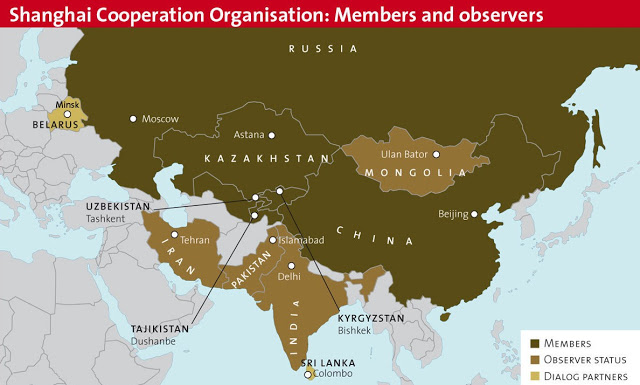
Eye Candy: Shanghai Cooperation Organization

NOL map SCO 2018
Source

First off, Shanghai and Warsaw are two very different cities, and because of that I think the SCO is a different animal than the Warsaw Pact. For one thing (aside from the difference in the two cities, one being selected for its geographical prominence, the other for its commercial acumen), the Warsaw Pact was a military alliance led by the Soviet Union, while the SCO is dedicated to political and economic cooperation as well as military security. Notably, the security aspect of the SCO is dedicated to coordinating state-led efforts against terrorism and separatism rather than against a rival alliance.

I don’t see anything wrong with multilateral efforts undertaken by states other than the US. I don’t see any need to worry, fret, or otherwise suspect the SCO of undermining world peace and prosperity. The fact that the SCO is made up of cooperating autocratic regimes rather than democratic ones does not faze me. The SCO has been making overtures to the democracies of India, Iran, and Sri Lanka (be sure to check out Tridivesh’s excellent take on India and the SCO), and multilateral cooperation among states is in itself an exercise in political participation among equals, albeit not at an individual level.

There is also cause to be happy that China and Russia have bound themselves up in such a prominent cooperative venture, too, given the two powers’ history of fighting each other. The SCO is contributing to peace and prosperity, and while it appears on the surface that the venture is designed to be a rival of the Western-built world order, the Shanghai Cooperation Organization actually contributes to it.

(h/t Nick)