Robert Frost’s lovely poem, “Mending Wall,” says something profound about the importance of the institution of property. The poem is about Frost and his neighbor meeting together to piece together a crumbling wall between their two properties. Frost pokes fun at the tradition; without a wall, will Frost’s apple trees sneak across the property line and gobble up the cones piled up beneath the neighbors’ pines? As the two walk the line, replacing a stone here and a stone there, the neighbor, in an almost ritualistic mantra, responds to Frost’s skepticism with the well-worn line, “Good fences make good neighbours.”
Some can and have interpreted Frost’s poem as a gentle argument against erecting barriers that separate us. I think that’s a mistake. Of course, I admit to overlaying my own political and philosophical views atop his writing. But with that in mind, the poem tells me to that clear property lines do indeed make good neighbors. In fact, this wall is what draws Frost and his neighbor together in a valuable social ritual. Even in the absence of an obvious need for the wall, the tradition stokes good will.
In a broader and more directly political sense, property does indeed make good neighbors. Where property rules are unclear or have not been established, social strife and distrust tend to proliferate. Where they are established by law or custom, parties have a neutral arbiter whose presence alone allows them to avoid dispute and uncertainty.
This seems to hold true on small and large scales. Parents of young children have all learned that allowing kids common ownership of toys is a recipe for constant conflict. If parents establish clear ownership of childrens’ possessions, then order settles in and kids can learn important social values like sharing–a virtue that will never arise if property rules are unclear or non-existent. Truly, in a home of common ownership, children only learn to cling desperately to everything and not give an inch.
The same appears true for communities and nations. Where countries do not have established customs and laws governing property, strife, distrust, and corruption fester (Russia is, unfortunately, a prime example of this problem). A similar phenomenon seems to have played its role in the rapid demise of the various utopian communal arrangements that cropped up during the Second Great Awakening in 19th century America.
Frost’s repeated refrain throughout his poem is: “Something there is that doesn’t love a wall.” I think Frost’s neighbor had the right of it–communities survive and thrive thanks to walls. We should take time to mend them.
The last few weeks were quite a blast for me: I’ve interned at the German embassy in Rome. A new job in a new city. I thought to process the experiences I made here in one (or a few?) articles.
It’s been quite a rough month for Germany’s Foreign Affairs department. First, Daniel Kriener, the German ambassador in Venezuela, was forced to leave the country after welcoming Interim President Guiadó at the airport of Caracas. Interestingly, although plenty of other diplomats joined him, he was the only one to be declared a “persona non grata” for interfering in Venezuela’s internal affairs. A few weeks later, a deputy speaker of the German Bundestag (who is also a member of the liberal party) demands to expel the US ambassador Grenell for the same offence. Prior, the US diplomat has criticized Germany’s plan to break their promise of contributing more to NATO’s defence budget. Albeit I politically agree with both actions of the diplomats in these cases, they delineate the ongoing structural changes in the diplomacy sector. To illustrate this, I will first provide a theoretical framework to analyze ongoing diplomatic challenges before trying to examine the role of diplomacy in the future.
Principal-Agent Theory and decreasing relevance
I conceive diplomacy as mostly a principal-agent based problem. I believe that many problems in diplomatic negotiations can be traced back to the classic effects of asymmetric information. Since two principals, in this case two states, cannot negotiate with each other directly in most cases, these arbitrations are carried out between various agents. Those agents are of course not always the ambassadors. In a broad meaning, one can apply the principal-agent paradigm to diplomacy by every negotiating process initiated by the state.
Through the lens of the principal-agent paradigm, I perceive the main task of diplomacy to achieve a good negotiating position, for example through an informational advantage. However, due to globalization, state-to-state diplomacy has been drastically weakened. The negotiating game is now mostly carried out within other institutions with lower transactions costs. Two countries want a new trade deal? Just orientate on WTO Rules. Sue another country? Call the International Criminal Court. A few voices made reasonable arguments even for abolishing unnecessary embassies and only keeping the crucial ones. The Trump administration, for example, seems not eagerly committed to fill the around 18 vacant ambassador positions hastily.
Certainly, the globalization combined with the expansion of robust institutions leaves little space for traditional diplomacy as a driving force in interstate relations. This is not necessarily a bad development: As Paul W. Meerts points out, this can be a huge chance for weaker states since negotiating in multilateral rather than bilateral constellations tends to weaken the position of stronger states. Thus, playing out the trump cards in negotiations will be harder for the hegemon. We can currently witness this in the Brexit debate: Even though the strong states, Germany and France, have a vast repertoire of power resources to use as leverage against GB in the negotiations, the can hardly deploy them through EU’s multipolar negotiating structure.
Contrary, there are also recent examples of deploying bilateral traditional diplomacy measures successfully. China’s initiation of Italy’s accession to the Belt Road Initiative (see Tridivesh Singh Maini’s great article here for a quick overview) is a prime example for this. But no other case shows the weaknesses of bilateral diplomacy in a more drastic way: China was able to transpose their tremendous power resources into a deal which heavily favours the Chinese economy. The very ambiguous agreement laid down a strategy of “closer economic collaboration.” The oppositional criticism of the deal coming from the very left and the right is based on economic nationalism and thus misses the important point. Chinese government exerts immense influence on key enterprises like Tencent, Alibaba, and Badoo: Digital fundamental research topics such as AI were distributed to the firms not through competition but through the state ( I highly recommend Amy Webb’s EconTalk if you want to dig deeper into this.). Once they build sufficient digital infrastructure here in Europe, network effects and technological advantage will come into effect and engender high entry barriers and exit costs. This makes it easy for China to enforce its regulation rather than obeying European ones. Although it is hard to finally determine if multilateral negotiations would have secured a politically better deal, I favour higher short-term transaction cost of multilateral negotiations over the long-term threat showed above.
Embassies as service provider
Of course, taking care of a good interstate negotiation position is not the only task of an embassy. A popular counterargument is that the principal-agent perspective neglects the vital daily business of embassies to help their citizens abroad. Speaking of large and prestigious Embassies though, I estimate that their role as service provider for abroad living citizens will further decline. Most of their maintenance work for citizens living abroad will be redundant due to technological process and further institutionalization. Renewing a Passport, issuing visas and transporting back coffins (yep) are a frequent task, but easy to “source out” to private actors in the future.
But what is the role for ambassadors and embassies then?
This question is where it gets interesting in my opinion. Deeply rooted in international conventions and international customary law, discreet and silent work has been prerequisite for an ambassador. Carefully collecting small pieces of information and building bridges to local actors were the key for a good negotiating position. But as elaborated above, international institutions do the job more efficiently. A new role of ambassadors as advocates for concrete policy measures would be diametrically opposed to international conventions. Based upon the “legality creates legitimacy” premises, a further politicization of diplomacy seems not at present having a majority and thus is unlikely to be buttressed by legal means.
However, if we fall back into a narrative of nationalism, bilateral diplomacy will regain relevance. Otherwise, it will continue to slowly lose importance and eventually wane. Hence, the main challenge nowadays is to look for the right niche for traditional diplomacy – and it seems that it has not been found yet.
Over the last two decades online services have transformed from a product of a multitude of enterprises to being dominated by a handful of corporate-owned platforms such as Apple, Microsoft, Facebook, Google and Amazon. They specialize in connecting media producers to users. These are often mutual interactions with users both producing and consuming content. These platforms play an increasing role governing commercial exchange, as well as civil discussion, with plausibly pernicious implications for liberal democracy. As I propose in a recent paper ‘Markets for Rules’, blockchains offer a promising solution to this danger by helping to displace corporate ownership in favor of common platforms sustained by users themselves.
Corporate concentration has produced enormous efficiencies and innovations, improving user experiences and boosting investment in hardware and infrastructure. But it has also had several bad consequences. These enterprises face extremely low marginal costs and network effects whereby additional users add value to an existing user-base. Some of these effects are explained by these platforms’ business models of collecting personal data to target advertising more effectively at customers. The more interactions on a single platform users have with each other, the more useful the data for advertisers. The result is overwhelming returns to scale and a winner-takes-all competition for profits.
This has troubling implications for economic inequality, especially if we end up with a handful of corporations taking a bite out of every conceivable transaction. Of greater concern is the way owners exert control over who can join and what people are allowed to do on their platforms. Content producers can be demonetized or banned, effectively denying them access to a user-base or revenue. Online sellers can find themselves frozen out of a platform payment system without legal remedies. Controversial or unpopular producers survive at the whim of executives or, at best, a patchily enforced official policy.
This reliance on private governance is a problem for consumers, producers and ultimately citizens. But it is also a challenge for executives who find themselves mediating acrimonious personal disputes and political debate. With all the data in the world, they struggle to judge consistently what belongs on their platforms. The fact that these corporations have ended up functioning as unofficial censors and wielders of sanctions has led some commentators to propose regulating these platforms as public utilities or, more radically, nationalizing them so that access to them is decided democratically. These solutions have their own perils because any centralized system of monopoly control, whatever the underlying democratic credentials, can produce authoritarian outcomes. Liberal democracies up until now have been sustained by an independent civil society constituted by overlapping and competing spheres of governance, not the monopoly of either democratic or corporate government.
The prosecution of the CEO and founders of Backpage, who failed to exclude sex workers from their platform, illustrates the reliance of these private enterprises on government support on controversial policy issues even in relatively free societies. The combination of privately-developed data-collecting networks with over-arching state control is arguably reaching a nadir in China which is rolling out an unaccountable surveillance system of ‘social credit’ that can identify political dissidents and automatically exclude them from significant spheres of civil society.
Is there a way that blockchains can help navigate around the centralising and authoritarian impetus of technology-facilitated governance? Blockchains emerged from two pre-existing technologies – public ledgers and asymmetric cryptography – to produce a way of sharing data across a network that is resistant to manipulation by unauthorized actors. Initially conceived as offering alternatives to state-backed currencies, blockchains are now used to build decentralized autonomous organizations (DAOs) and dapps (decentralized apps). They can supply similar functions as corporate platforms but without an overall owner.
These systems are sustained by rewarding network participants with tokens (through completing intensive computing processes called mining). Tokens are convertible into ordinary currency, albeit currently at volatile rates. The entrepreneurs that build these platforms typically reward themselves and investors a large stake in those tokens but once the network is launched, they do not have control over how it is utilized. The rules of each network are self-enforcing. These rules can be changed, either through the original (or new) developers launching a rule-set that others may choose to switch over to (a fork). Alternatively, the rule-sets might contain provision for amendment. Such amendment schemes are, of course, open to manipulation as is the case for all political processes. Nevertheless, what these schemes offer is a way of interacting and exchanging at large distances without an overarching ruler. Instead, conduct is permitted on the basis of fixed rules enforced mechanically by people’s decisions to participate in the system. One way of looking at these schemes is that they have decentralized properties of communal norms, combined with the possibility of more deliberate design and experimentation of more formal rules and institutions. I call this common government.
The implications of this new technology and kind of governance might turn out to be very far-reaching, approaching that of the development of the Internet itself or even the printing press. But what could it mean for familiar Internet platforms in the medium-term? First, participating in mutual platforms might better align the incentives of users and platform designers. Right now, platform owners rely on squeezing as much data out of users as possible in order to sell it on to advertisers and to sell additional services. Mutual platforms, without responsibilities to shareholders, can experiment with different funding models. Individual users might elect to sell access to their profile to advertisers but the data itself can be made more secure as it will be a property of an encrypted network rather than a profile stored in a central private database. Privacy can be better assured than private management with public regulation.
Second, the networks can be more robust both to natural and political perturbations. Under decentralized protocols, ordinary users help store and serve content to each other. With the addition of blockchains, these users can be compensated for making their idle computer resources available for network use. This means that data doesn’t have to travel so far as is currently the case from host to user and the network as a whole can better cope with outages from particular nodes without data loss. Without a central controller, there is no particular agent that a government can coerce or punish for allowing specific interactions over a platform. Governments would then face the more difficult choice of permitting or prohibiting Internet communications altogether. It is thus more robust against arbitrary government censorship and manipulation of trade.
The relationship between users on a platform is mutual. The relationship between users and platform owners, however, is presently hierarchical – a private dynamic that government agencies can exploit. What blockchains may eventually permit is the provision of relatively efficient networks reliant neither on a single public agency nor private owner.
I recently had a paper rejected in Political Analysis. I fully expected a rejection given the journal’s high ranking and had submitted it for the sake of feedback. As I’m sure academic readers know, getting someone to read our papers can be hard. Unsurprisingly I got a rejection notice earlier today.
Surprisingly, all reviews were actually constructive feedback and, while critical, kind. To add strangeness to the whole ordeal, the process took less than a month from submission.
Since I have no way to contact the anonymous reviewers, I post my thanks here. Thank you anonymous reviewers. I wish reviewer #2, and here too I’m sure academics know the type I am referring to, should be more like you.
Brexit isn’t the only ridiculous thing happening in the United Kingdom. In April, the British government is rolling out statutory adult verification for pornography websites and content platforms. This requires all adult content providers to have proof of age or identity for all their users, whether a passport or a credit card (or more ludicrously a ‘porn pass’ that Brits wishing to browse anonymously will have to buy from local newsagents). The government plans to require internet service providers to block pornography websites that are not in compliance with adult verification once the system is in place. For those with university institutional access, Pandora Blake has written a timely explanation and critique published in Porn Studies: ‘Age verification for online porn: more harm than good?’.
Technical challenges with rolling out the system have led the dominant pornography search platform owner, MindGeek, to develop proprietary solution, AgeID, in cooperation with regulators. This cooperation between the dominant commercial pornography platform supplier and a Conservative government publicly intent on restricting access to pornography might appear surprising. However, it can be explained by a particular pattern of regulatory capture identified in public choice theory as a Bootlegger and Baptist coalition. Bruce Yandle observed that throughout the 20th century, evangelical Christians in the United States agitated for local restrictions on the sale of alcohol with the avowed aim of reducing consumption but with the secondary effect of increasing demand for alcohol for illegal bootleggers. Hence both interest groups, apparently opposed in moral principle came to benefit in practice. We now have a classic British case study. In this case, MindGeek is not acting as a literal bootlegger. It intends to be fully legally compliant with the filtering regime. However, the law will block all non-compliant competitors without a comparable verification system. They can gain a competitive advantage with a proprietary technical solution to the barrier introduced by the government.
Introducing identity verification systems has high fixed costs and low marginal costs. It is costly to develop or implement but easy to scale once integrated. The larger the pornography enterprise, the more easily these costs can be absorbed without the risk that it will not be worthwhile to serve the British market. For many smaller international pornography websites, without in-house legal advice or technical expertise, it might prove uneconomical to serve British users directly. So MindGeek’s platforms could become the least-cost legal gatekeeper between small enterprises producing pornographic content and the British public. The government is raising transaction costs to accessing pornography in a way that impacts larger and smaller platforms asymmetrically and favors one dominant platform in particular.
Both the premise of this policy and its likely impact on the market for pornography is unpromising. At its most benign, this could be a characterized as a ‘nudge’ against the consumption of pornography and reducing access of inappropriate content to minors. But these limited benefits have costs for both producers and consumers. On the consumption side, it increases risks to data security and privacy because it will plausibly tie records of pornographic access to verified identities, with a clear likelihood of being to infer an individual’s sexuality from private browsing. This could represent a particular vulnerability for LGBTQ identifying individuals who live in communities where there is still stigma attached to minority sexual orientations.
On the supplier side, it takes what already appears to be a market with strong tendencies towards a winner-takes-all model, and then augments it so that a dominant platform has a legally enforceable competitive advantage over potential rivals in the market. Ultimately, it threatens to further strengthen the bargaining position of a single corporate pornography platform against the sex workers who supply their content.
But as abstract ideas go, pollution taxes are pretty appealing. Holding constant lots of things that we can’t really hold constant, it means replacing the inefficiency resulting from poorly defined/enforced property rights with a world where prices more accurately reflect the costs of one’s decisions.
Let me come back to the things we’re “holding” constant in a bit. Why do I want to throw my weight behind shifting public perceptions in favor of pollution taxes?
Which is not to say a carbon tax isn’t overrated by the median policy wonk. There are a ton of important caveats, but on balance, as a policy for use in the next 50 years, I think they’re a useful tool to enhance efficiency or replace worse tools.
Again, there are no panaceas. I’m also not a huge fan of the “Economists’ Statement on Carbon Dividends” as written (for reasons I’ve hopefully mostly addressed). I suspect the best case scenario for my preferred carbon tax policy would be a modest improvement. I think the bulk of the gain would be a cultural shift away from “let’s regulate our problems!” to “let’s leverage incentives to address our problems!” Not Earth shattering, but a step in the right direction.
So let me state my position, then we can dig into criticisms and caveats.
Let’s make marginal shifts away from taxing investment and towards taxing negative externalities. As we go, let’s spend a lot of effort trying to study the impacts and adjust accordingly. Let’s heavily agument that with abatement policies rather than trying to return to some pre-industrial climate target.
Okay, let’s dig into criticisms and caveats.
Public choice considerations
Geoengineering and other alternatives
Cost
Coordination
Uncertainty
1-Public choice considerations
A Green New Deal will be a rent-seeking bonanza. Pollution taxes will face the same sorts of problems that plague the tax code in general. There will be intentional loop-holes and accidental screw ups.
We have to continue to push for reducing the complexity of tax codes in general. But I can’t deny that a carbon tax would be a step back on this margin.
Minus a hundred points for my position.
2-What about geoengineering?
Geoengineering sounds like a possible panacea. Maybe it is. But I’m not willing to flip a switch and find out the hard way all at once.
First off, geoengineering is scary. The climate is a complex system and complex systems are difficult-impossible to manage well. And that’s especially concerning if it means that anyone with a few million bucks can try to fiddle with Earth’s thermostat.
But it seems like a plausible tool that might be used to address climate change. Similar to my take on a carbon tax, I think the way to go is baby-steps plus research.
What about subsidizing “green _____”
Personally, I’m skeptical. Solar sounds appealing, and I (personally) think windmills are beautiful. But I don’t think the government will do a good job of picking winners and losers. Pollution taxes are appealing to me because they don’t require bureaucrats to choose. Again, I think the way to go is to use pollution taxes to offset other taxes–while continuing to advocate for reduced size/scope of government and a return to federalism.
Plus five points for my position.
3-Cost
We should also remember that GDP is an imperfect measure of well being. The current figures aren’t directly comparable to the figures we’d get in a post-carbon-tax world. A one-time fall in GDP doesn’t (necessarily) mean we’ve screwed things up.
Still, it’s worth remembering that a) we can go too far with a carbon tax, and b) we don’t have access to a silver-bullet solution. So let’s start small and gradually increase carbon taxes till we get close to (our best estimate of) the optimal level.
Plus epsilon points for my position.
4-Coordination
The basic idea of a carbon tax is that we’re dealing with a global-scale externality problem. But small scale taxes are unlikely to do much beyond shifting where pollution happens. A fully effective tax would require multi-lateral coordination. And, as a country, we aren’t very good at that.
Trying to create a tax on imported carbon-intensive goods that didn’t face a tax at home seems a) sensible at first blush, and b) a massive opportunity for public choice problems.
On the other hand, we could justify a tax commensurate with the local impacts (something like 10% of the global impact). This fits nicely with my idea of starting small and adjusting at the margin.
But even within the U.S. there are coordination issues. Long Island will likely face net costs from climate change, but other areas will benefit from a longer growing season.
Plus 10 points for my position, but also minus 10 points.
5-Uncertainty
Uncertainty cuts both ways: we’re currently accidentally manipulating the climate and that could turn out to be catastrophic. Trying to intentionally manipulate it in the other direction is also dangerous. Again, the appropriate focus is on marginal tinkering [much as it clashes with my non-interventionist priors] rather than ambitious global engineering [which grabs my priors by the lapels and knees them in the groin].
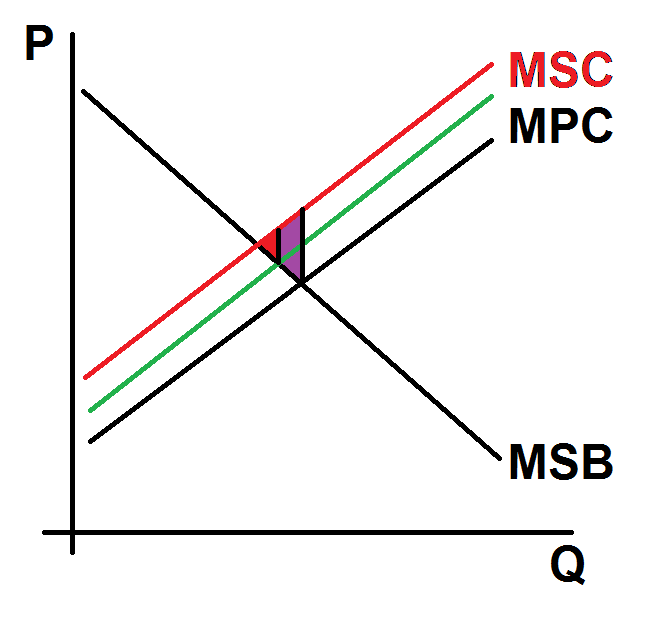
When I teach externalities, I draw a graph like this:
Negative externalities when we magically know their magnitude.
In this market, we end up with an equilibrium quantity defined by the point where Marginal Private Cost equals Marginal Social Benefit (MPC = MSB). But the Marginal Social Cost (MSC) is greater, so we get a deadweight loss equal to the triangle I’ve shaded in red and purple.
It’s important to note: we don’t actually know where the MSC curve is. It’s somewhere above MPC, but we’re basically in the position of trying to eliminate a subsidy we don’t know the size of.
The relevant models–climate models and economic models–are filled with uncertainty that we simply cannot resolve without real life experience.
What does the economic way of thinking tell us? Act on the margin. Setting a tax that pushes supply (MPC) up to the green line doesn’t fully address the problem (as I’ve assumed it to be in this graph), but it’s an improvement.
Even better, it’s an improvement where the biggest returns are experienced up front. This modest tax fails to get rid of the red deadweight loss (DWL) area, but it eliminated 3/4 of the total DWL.
Plus X points for my position where X is a random variable with an unknown distribution, positive first derivative, and negative second derivative.
tl;dr:
At my friend’s behest I’ve been looking at Bob Murphy’s critique of carbon taxes. I find it’s shifted the magnitude of my prior opinion, but not the direction. I still think carbon/pollution taxes are a good idea, but I no longer think they’re a great idea. My take away from Murphy’s work is that the optimal carbon tax is fairly modest. My response is to advocate for getting a very modest carbon tax on the books, then gradually shift tax policy in that direction.
For climate change (and any other problem) we ought to be pluralists. A mix of approaches is ideal. Part of the appeal of Pigouvian taxes is that they allow and encourage a wide range of responses. The best pollution abatement scheme isn’t something we can look up in a binder. We have to discover it, and crowdsourcing is the appropriate way to do that.
But carbon taxes are only one part. We should also advocate for changes that will ameliorate harm. I am more bullish on these policies than I am on a carbon tax:
Make it easier for the world’s poorest people to move to rich countries that will be better able to cope with climate change.
Quit subsidizing flood insurance.
Quit subsidizing polluting industries (and other industries).
Even though geoengineering scares me, we should try to learn more. Ditto for any other possible tools that come along.
Neomi Rao, nominee to the D.C. Circuit Court of Appeals, has fallen victim to an old fissure–conservative and libertarian disagreement over unenumerated rights. At the hint that she believes that rights exist outside the express text of the Constitution, conservatives have pounced, concerned that Rao will betray conservatives on abortion issues. On both political and legal dimensions, this concern is silly.
As a general matter, it’s beyond clear that Rao is qualified. Conservatives shouldn’t cripple a great candidate over a minor issue. The Supreme Court has many times confirmed that unenumerated rights exist. Rao is bound by those precedents, including Roe, and whether she agrees with those precedents or not is immaterial to the job she’s nominated to do. The chance that Rao will even have a chance to expand the existing list of recognized unenumerated rights is exceedingly low. It just doesn’t come up that often, and the courts already have tests for assessing whether a right should be recognized.
But perhaps more importantly, non-enumerated rights don’t lean toward one side of the ideological spectrum or the other. The Supreme Court of the early twentieth century recognized, for instance, liberty of contract as a constitutionally protected right–though unenumerated. Progressive jurists bent on defending Roosevelt’s New Deal did so in part by opposing the enforcement of unenumerated rights. Unenumerated rights also include other “conservative” causes such as the right to earn a living. And, of course, unenumerated rights have also favored “liberal” values such as a broad right to privacy. In short, it is unclear why Rao’s alleged support for the enforcement of unenumerated rights should enter into the partisan calculus.
And then there’s the simple fact that unenumerated rights do in fact exist and deserve constitutional protection. The history and passage of the Ninth Amendment, which says enumeration of rights shouldn’t detract from those retained by the people, make this clear. The founding generation didn’t see rights as reserved to a fixed set of especially important activities. In fact, many feared that the enumeration of certain rights would imply that the unenumerated ones shouldn’t be recognized. That fear has turned to be prescient, despite the inclusion of the Ninth Amendment, which was written to make clear that the enumerated rights shouldn’t be seen as implying that unenumerated rights should go unprotected.
In short, not only would Rao be right to recognize such rights–though the scope of those rights is always a matter of intense debate–she has to recognize them under binding law, and her thoughts on the matter are unlikely to make much difference to her job. If she gets nominated to the Supreme Court later down the road, the concern may have more relevance. For now, just get her confirmed.
Last election, Jillian Ostrewich drove to a polling place at a Houston rec center, expecting to vote. But she made the mistake of wearing a “Houston Fire Fighters” t-shirt. An election worker confronted Jillian, insisting that she couldn’t vote unless she turned the offending shirt inside out. The rationale: a measure on the ballot was related to firefighter pay, and the shirt was related to firefighters.
Tony Ortiz suffered a similar fate in Dallas. Tony’s crime was wearing a MAGA hat while he stood in the voting line outside his local library. An election worker said he couldn’t wear the hat to the polls because the MAGA slogan constituted “electioneering.” Tony responded that the hat had nothing to do with any issue or candidate on the ballot. The election worker threatened to call the police.
These election workers were relying on a Texas law that forbids electioneering or wearing “a badge, insignia, emblem, or other similar communicative device relating to a candidate, measure, or political party appearing on the ballot” in or near a polling place. The law even prohibits someone from wearing an ID if the name is the same as someone appearing on the ballot. A violation is a criminal misdemeanor. Today, my colleagues and I at Pacific Legal Foundation filed a lawsuit on behalf of Jillian and Tony challenging the Texas ban.
As it happens, the Supreme Court issued a decision just last year striking down a similar law in another case brought by Pacific Legal Foundation called Minnesota Voters Alliance v. Mansky. The Minnesota law in MVA prohibited wearing a “political badge, political button, or other political insignia” in the polling place. The Court said states can limit some electioneering at the polling place to prevent voter intimidation and excessive disruption. But the government has to have some clear and logical basis for sifting “what may come in from what must stay out.”
The word “political” was not a clear boundary. As the Court noted, almost anything could be considered political, and the fuzzy language offered too much wiggle room for abuse and discrimination. The attorney arguing for Minnesota drove this point home during an onslaught of blistering questions in oral argument: how about a rainbow flag shirt? Permitted, maybe. How about a “Parkland Strong” shirt? Permitted, probably. How about an NRA shirt? Definite no. How about a shirt with the text of the Second Amendment? Definite no. At about that point, most everyone knew the outcome of the case–the attorney had just proven the inherently arbitrary standard he was trying to defend.
The Texas case filed today is a bit different. For one, the ban extends to 100 feet outside the polling place, which clearly encompasses sidewalks and other public areas where speech rights enjoy their widest berth. But the ban is not quite as amorphous as the word “political.” Instead, the ban extends to messages that relate to a candidate, measure, or party on the ballot.
This slightly narrower language probably doesn’t save the Texas law. After all, almost anything can be considered related to a candidate if the candidate has taken any kind of position on it. If a candidate has criticized Trump (have any not?), then is Tony’s MAGA hat “related” to the candidate? If Ben & Jerry’s takes a position on a ballot measure, does a Ben & Jerry’s shirt relate to that ballot measure? Maybe, but it depends on the election worker–and therein lies the problem. As the Supreme Court said in MVA, “A rule whose fair enforcement requires an election judge to maintain a mental index of the platforms and positions over every candidate and party on the ballot is not reasonable.” Not only would such an index be impossible, but the contents and application of that index would be dictated by an election worker’s own biases and background.
The integrity of the electoral process is vital. But surely Jillian’s firefighter shirt or even the much-reviled MAGA emblem do not imperil the right to vote. Wed don’t shed the right to express ourselves in peaceable ways when we step into a polling line.
The SEC wants to slam Elon Musk with contempt over a thirteen word tweet. Musk has taken to Twitter to both vaunt his company and castigate the SEC. He’s under an existing SEC settlement that requires company oversight of his communications. Musk’s brief tweet on Feb. 19 that stoked the ire of the SEC said: “Tesla made 0 cars in 2011, but will make around 500k in 2019.” The SEC swooped in, charging that Musk hadn’t received preapproval for the tweet and convinced Musk had misled the public.
The SEC’s overzealous attempt to wield the contempt power is disturbing. Especially given Musk’s vocal and mocking disdain for the SEC, the regulator’s attempted coup over the content of his tweets raises serious First Amendment concerns. Here, it seems the 500K estimate was not precise, but Musk went on to clarify on his Twitter feed, and he didn’t conjure the number from the ether. At worst, it was incomplete information. Welcome to Twitter. I just can’t quite stomach the fact that a regulator is out there lurking, ready to pounce on any linguistic imprecision in a forum where brevity is the name of the game. Obviously, Musk’s statements have an impact on the market, but investors are sophisticated actors who should be expected to do their homework. The SEC’s paternalistic and aggressive monitoring of Twitter feeds should raise our hackles.
I recently saw a thoroughgoing Twitter conversation between a Caleb Brown, which most of you presumably know from the Cato Daily Podcast, and the Neoliberal Project, an American project founded to promote the ideas of neoliberalism, regarding the differences between libertarianism and neoliberalism. For those who follow the debate, it is nothing new that the core of this contention goes way beyond an etymological dimension – it is concerned with one of the most crucial topics in the liberal scholarship: the relationship between government and free markets.
Arbitrary categories?
I can understand the aim to further structure the liberal movement into subcategories which represent different types of liberalism. Furthermore, I often use these different subcategories myself to distance my political ideology from liberal schools I do not associate with, such as paleo-libertarianism or anarcho-capitalism. However, I do not see such a distinct line between neoliberalism and libertarianism in practice.
As describes by Caleb Brown (and agreed on by the Neoliberal Project), neoliberalism wants to aim the wealth generated by markets at specific social goals using some government mechanism, whilst libertarianism focuses on letting the wealth created by free markets flow where it pleases, so to say. In my opinion, the “difference” between these schools is rather a spectrum of trust in government measures with libertarianism on one side and neoliberalism on the other.
I’ve often reached a certain point in the same discussion with fellow liberals:
Neoliberal: I agree that free markets are the most efficient tool to create wealth. They are just not very good at distributing it. By implementing policy X, we could help to correct market failure Y.
Libertarian: Yeah, I agree with you. Markets do not distribute wealth efficiently. However, the government has also done a poor job trying to alleviate the effects of market failures, especially when we look at case Z… (Of course, libertarians bring forth other arguments than public choice, but it is a suitable example.)
After reaching this point, advocating for governmental measures to fix market failures often becomes a moral and personal objective. My favourite example is emission trading. I am deeply intrigued by the theoretical foundation of the Coase-Theorem and how market participants still can find a Pareto-efficient equilibrium by just negotiating. Based on this theoretical framework, I would love to see a global market for carbon emission trading.
However, various mistakes were made during the implementation of emission allowances. First, there were way too many emission allowances on the market which engendered the price to drop dangerously low. Additionally, important markets such as air and ship transportation were initially left out. All in all, a policy buttressed by a solid theory had a more than rough start due to bad implementation.
At this point, neoliberals and libertarians diverge in their responses. A libertarian sees another failure of the government to implement a well-intended policy, whereas a neoliberal sees a generally good policy which just needs a bit further improvement. In such cases, the line between neoliberals and libertarians becomes very thin. And from my point of view, we make further decisions based on our trust in the government and on our subjective-moral relation to the topic as well.
I saw government too often fail (e.g. engaging in industry politics), which should be left nearly entirely to free markets. However, I also saw the same government struggling to find an adequate response to climate change. Contrary, I believe that officials should carry on with their endeavours to counteract climate change whereas they should stay out of industry politics.
Although these examples may define libertarianism in their own context, the general message remains clear to me: libertarians are prone to support governmentalmeasures if they rank the value of a specific end higher than the risk of a failed policy. Since such an article is not the right framework to gather a robust amount of data to prove my point empirically, I rely on the conjecture, that the core question of where the government must interfere is heavily driven by subjective moral judgements.
Summary
Neoliberals and Libertarians diverge on the issue of government involvement in the economy. That’s fine.
Governmental policies often do not fully reach their intended goals. That’s also fine.
The distinction between neoliberals and libertarians is merely a threshold of how much trust one puts in the government’s ability to cope with problems. Both schools should not value this distinction too much since it is an incredibly subjective issue.
Today, Justice Clarence Thomas issued a solo opinion urging the Supreme Court to reconsider a hallmark case in First Amendment law–New York Times v. Sullivan. That case held that defamation claims brought by public figures had to meet a heightened standard of proof by showing “actual malice” by the alleged defamer. The basic premise is that muscular use of private defamation suits discourages criticism of public figures and thus clashes with First Amendment interests.
Justice Thomas’s primary complaint with this standard is that judges created it with a wave of the wand rather than a serious analysis of the original understanding of the First Amendment. He points out that the ratifiers of the Constitution gave no indication that they intended to abrogate the long-standing common law of libel that had existed in the colonies and England for centuries. For those who believe that the Constitution’s meaning should reflect what the ratifiers thought the language meant at the time, I think Justice Thomas makes a convincing case.
The two dominant American political parties have one defining trait in common, and it’s the trait that makes them both undeserving to hold the power they seek to wield. Both parties fail the Gandalf test.
I derive the Gandalf test from one of my favorite conversations in the Lord of the Rings. Gandalf pays a visit to Frodo Baggins after concluding that Bilbo’s old ring is in fact the One Ring–the single most dangerous and powerful object in Middle-earth. Once the full enormity of the ring dawns on Frodo, he tries to thrust it upon Gandalf. Gandalf flatly refuses. “With that power I should have power too great and terrible.” He recognized that he cannot embrace so much power even though he would want to do good with it. “Yet the way of the Ring to my heart is by pity, pity for weakness and the desire of strength to do good. Do not tempt me!”
The Gandalf test is simple: a righteous cause and a genuine desire to save the world do not qualify anyone for the exercise of extensive unilateral power. The Republican and Democratic Parties both have recently failed this test, and not for the first time. On one side, President Trump has turned to emergency powers to barge through constitutional barriers, so convinced he is that his cause is just. On the other side, the Green New Deal proposes to remake the United States economy. We tend to too often squabble over the merits of these policies instead of stepping back to apply the Gandalf test. Even if the policies themselves are good ones, even urgent ones, we must ask whether any person or cadre should wield the extraordinary power to put them into action. The “desire of strength to do good” is not enough.
A clear message of Gandalf’s and the Lord of the Rings generally is that progress toward the good and worthy comes through the everyday courage and goodness of ordinary people, not a few great souls on gilded thrones. Elsewhere, Gandalf points out: “Saruman believes it is only great power that can hold evil in check, but that is not what I have found. It is the small everyday deeds of ordinary folk that keeps the darkness at bay.” And in the Return of the King: “It is not our part to master all the tides of the world, but to do what is in us for the succour of those years wherein we are set, uprooting the evil in the fields that we know, so that those who live after may have clean earth to till. What weather they shall have is not ours to rule.” What a wonderfully apt response to the Green New Deal’s attempt to rule with an iron fist today in order to literally rule the weather that others might have tomorrow. That kind of hubris is poison to a republic.
We need to subject our leaders to the Gandalf test. We need to know if they are the type to vainly “master all the tides of the world,” or whether they will lead in humility by quietly empowering the everyday deeds of everyday people. If they can’t pass the test, I couldn’t care less whether they’re proposing a wall, a tax hike, or a clean energy revolution.
Does law enforcement need a human touch? The Supreme Court of Iowa says no. The Court recently decided that automated traffic enforcement (ATE) does not violate the Iowa Constitution. The Court, however, did take some time to address an important topic in constitutional jurisprudence: the nature of rational basis review.
Rational basis is a test applied to a variety of constitutional challenges. In the ATE case, the plaintiffs had brought due process and equal protection claims, both of which relied on the rational basis test. Rational basis is the weakest test in the hierarchy of judicial scrutiny. If a law is rationally related to a legitimate government interest, then a court won’t strike it down. As you might expect, plaintiffs very rarely succeed on this flimsy rational basis standard.
And so it was here. The Plaintiffs had argued that the ATE system in Cedar Rapids was not rationally related to an interest in public safety because, among many other things, the system punished a vehicle’s owner for speeding even if the owner was not the driver at the time. The Court had misgivings, but it ultimately deferred to the City and let the law slide.
The Court did, however, give a little boost to rational basis. The Court correctly noted that many state constitutions offer a stronger rational basis test than the federal test. That’s an important reminder to constitutional litigators–sometimes state constitutions may have analogous provisions to the federal constitution, but the protections they offer might be more robust.
The Court also made an important point about evidence in a rational basis claim. In many rational basis cases, plaintiffs don’t even get a chance to present evidence as to whether a law is rationally related to a legitimate government interest. If the government just asserts–without evidence–that a law furthers a legitimate interest like public safety, then the game is over. But the Iowa Supreme Court correctly noted that while a law is entitled to a presumption of constitutionality under rational basis, plaintiffs have a right to present evidence to rebut that presumption. Hence, “the mere incantation of the abracadabra of public safety does not end the analysis.” This evidentiary point is vital for strengthening the constitution’s protections against expansive government power.
Last week the Crown Prosecution Service published updated guidance for prosecutions under the Obscene Publications Act (1959). Legal campaigning has brought about a big change: the liberal tests of harm, consent and legality of real acts are now key parts of their working definition of obscenity. The CPS explain:
… conduct will not likely fall to be prosecuted under the Act provided that:
It is consensual (focusing on full and freely exercised consent, and also where the provision of consent is made clear where such consent may not be easily determined from the material itself); and
No serious harm is caused
It is not otherwise inextricably linked with other criminality (so as to encourage emulation or fuelling interest or normalisation of criminality); and
The likely audience is not under 18 (having particular regard to where measures have been taken to ensure that the audience is not under 18) or otherwise vulnerable (as a result of their physical or mental health, the circumstances in which they may come to view the material, the circumstances which may cause the subject matter to have a particular impact or resonance or any other relevant circumstance).


 Notes On Liberty