An argument against Net Neutrality

First off, Comcast sucks. Seriously, screw those guys.

But let’s assume a can opener and see if that doesn’t help us find a deeper root problem. The can opener is competition in the ISP network. Let’s consider how the issue of Net Neutrality (NN) would play out in a world where your choice of ISP looked more like your choice of grocery store. Maybe a local district is set up to manage a basic grid and ISPs bid for usage of infrastructure (i.e. cities take a page out of the FCC’s playbook on spectrum rights). Maybe some technological advance makes it easy to set up decentralized wireless infrastructure. But let’s imagine that world.

Let me also assume a bit of regulation. The goal is to create some simple rules that make the market work a bit better. Two regulations that I’d like to see are 1) a requirement that ISPs have a public list of any websites they restrict access to*, and 2) a limitation on how complicated end user agreements can be. I’m not sure these things would be possible in my anarchist utopia, but in a second best world of governments I’m pretty comfortable with them.

Let’s also create a default contracts for content providers with ISPs. “Unless otherwise agreed to, content providers (e.g. YouTube, my crazy uncle Larry, the cafe around the corner, etc.) relationship with ISPs is assumed to take the following form:…” An important clause would be “access/speed/etc. to your content will meet ______ specifications and cannot be negatively altered at the request of any third party.”

A similar default contract could be written for ISPs and end users. “Universal access under ____________ conditions will be provided and cannot be negatively altered at the request of any third party.”

Explicitly and publicly setting neutral defaults means we can get NN by default, but allow people the freedom to exchange their way out of it.

Do we need, or even want, mandated NN in that world? There are some clear potential gains to a non-neutral Internet. Bandwidth is a scarce resource, and some websites use an awful lot of it. YouTube and Netflix are great, but they’re like a fleet of delivery trucks creating traffic on the Information Super Highway. Letting them pay ISPs for preferred access is like creating a toll lane that can help finance increased capacity.

Replacing NN with genuine competition means that consumers who value Netflix can pay for faster streaming on that while (essentially) agreeing to use less of the net’s bandwidth for other stuff. We should encourage faster content, even if it means that some content gets that extra speed before the rest.

Competing ISPs would cater to the preferences and values of various niches. Some would seem benign: educational ISPs that provide streamlined access to content from the Smithsonian while mirroring Wikipedia content on their volunteer servers. Bandwidth for sites outside the network might come at some price per gigabyte, or it might be unlimited.

Other ISPs might be tailored for information junkies with absolutely every website made available at whatever speed you’re willing to pay for. Family friendly ISPs would refuse to allow porn on their part of the network (unsuccessfully, I suspect), but couldn’t stop other ISPs from anything. Obnoxious hate group ISPs would probably exist too.

There would be plenty of bad to go along with the good, just like there is in a neutral network.

I’m okay with allowing ISPs to restrict access to some content as long as they’re honest about it. The Internet might not provide a universal forum for all voices, but that’s already the case. If you can’t pay for server space and bandwidth, then your voice can only be heard on other people’s parts of the Internet. Some of those people will let you say whatever you want (like the YouTube comments section), but others are free to ban you.

Similarly, big companies will be in a better position to provide their content, but that’s already the case too. Currently they can spend more on advertising, or spend more on servers that are physically closer to their audience. A non-neutral net opens up one more margin of competition: paying for preferred treatment. This means less need to inefficiently invest physical resources for the same preferred treatment. (Hey, a non-neutral net is Green!)

There might be reason to still be somewhat worried about the free speech implications of a non-neutral net. As consumers, we might prefer networks that suppress dissident voices. And those dissident voices might (in the aggregate) be providing a public good that we’d be getting less of. (I think that’s a bit of a stretch, but I think plenty of smart people would take the point seriously.) If that’s the case, then let’s have the Postal Service branch out to provide modestly priced, moderate speed Internet access to whoever wants it. Not great if you want to do anything ambitious like play Counter Strike or create a major news network, but plenty fine for reading the news and checking controversial websites.

tl;dr: I can imagine a world without Net Neutrality that provides better Internet service and better economizes on the resources necessary to keep the Information Super Highway moving. But it’s not the world we currently live in. What’s missing is genuine market competition. To get there would require gutting much of the existing regulatory frameworks and replacing it with a much lighter touch.

What I’m talking about seems like a bit of a pipe dream from where we’re sitting. But if we could take the political moment of the Net Neutrality movement and redirect it, we could plausibly have a free and competitive Internet within a generation.


*Or maybe some description about how they filter out websites… something like a non-proprietary description of their parental filters for ISPs that (attempt to) refuse adult content access.

Some ideas to guide your thoughts on health care

This post is meant to help my non-economist friends think more clearly about how we pay for health care. I’ll talk about markets, but the truth is that the American system is built of deeply bastardized markets. If our car markets worked like our health markets, most of us would walk to work. I’m trying to focus on the essential logic of the situation which is going to sound Utopian because Congress isn’t going to give us any sort of logical policy any time soon. But we aren’t going to get a logical solution until we as voters understand the logic of health care finance.

I’ve got a few big points to make:

  1. Trying to health insurance also work like charity is bound to end poorly for everyone.
  2. A single-payer system has a lot of nice features for individuals, but a lot of systemic problems.
  3. It’s fundamentally impossible to insure pre-existing conditions. Insurance is about sharing risk, not unavoidable expenses.

(This post is longer than I’d like, so thanks for your patience!)

Markets and Charity

I’ve said it before, and I’ll say it again: we don’t have to ruin markets to do charity.

The essence of markets is that they aggregate knowledge about the relative costs and benefits of different goods based on the preferences of the real people involved in producing and consuming those goods.

The demand side of markets provide information by giving you (as a consumer) a choice between more of something you like and more money to spend on other stuff. On the supply side they give you (as a supplier–probably of your own labor) the choice between providing more of what people are willing to pay for or having less money to buy the stuff you want. Markets crowdsource cost-benefit analysis.

Prices also give suppliers an incentive to produce things that consumers want while trying to save resources (i.e. cut costs). In other words, a price is a signal wrapped up in an incentive.

So what about fairness? The bad news is that markets are a system of “from each according to their ability, to each according to how much other people are willing to pay for the product of their ability.” (Not very catchy!) It’s mostly fair for most of us, but doesn’t do much good for people who are just unlucky (e.g. kids born with genetic defects). Here’s the good news: we can use charity alongside markets.

We can debate how much role government should play in charity some other time. For now, let’s whole-ass one thing instead of half-assing two things. We have to appreciate that interfering with markets interferes with the ability of those markets to function as sources of reliable information. It doesn’t matter how good our intentions are, we face a trade off here… unless we do something to establish a functioning charity system parallel to the health care finance system.

Single Payer

Anecdotes about the merits of a single-payer health care system are powerful because they shed light on the biggest benefit to such a system: individual convenience.

Part of the appeal has to do with the general screwiness of the American system. It’s a cathedral built of band-aids. But even in an idealized market system, a single-payer system has the advantage of not making me go through the work of evaluating which plan best suits my needs.

A single-payer system is, from an individual perspective, about as ideal as having your parents pay for it. But we don’t really  want our parents buying our stuff for us.

Single payer system sacrifice the informational value of markets (probably even more so than America’s current system of quasi-price controls). Innovation would be harder as long as new treatments had to be approved by risk-averse bureaucrats (and again, we already face a version of this with Medicare billing codes and insurance companies).

Essentially, a single payer system creates a common pool problem: each of us gets the individual benefit of being able to be lazy. But then we’re left trusting bureaucrats, special interest groups, and think tanks to keep an eye on things. It could be an improvement over the current American system, but that’s like saying amputation is better than gangrene.

Insurance

Premium = expected cost + overhead

Consider two alternatives. In scenario A you start with $150, flip a coin, and if it comes up tails you lose $100. In scenario B you get $90. The expected value of A is $100, but most of us would still prefer the sure thing.

Here’s how insurance works: You start with $150, give $60 to the insurance company, then flip the coin. If it comes up tails, you lose $100, but the insurance company gives you back $40. You’ve just gotten the sure thing. And by taking on thousands of these bets the insurance company is able to make enough money to pay their employees.

But here’s the thing: the premium they charge is fundamentally tied to that expected value. Change the odds, or the costs (i.e. the claims they have to pay for) and you’ll change the premium.

(BTW, Tim Harford did a nice ~8 minute podcast episode on insurance that’s worth checking out.)

Pre-existing conditions are the equivalent of changing our thought experiment to a 100% chance of flipping tails. No amount of risk sharing that will get you to the $90 outcome you want. You can’t insure your car after you’ve been in an accident and you can’t insure a person against a loss they’ve already realized. If you’re Bill Gates, that’s no big deal, but for many people, this might mean depending on charity. That’s a bummer, but wishful thinking can’t undo that.

If we insist that insurance companies cover pre-existing conditions* the result can only be higher premiums. This is nice for people with these pre-existing conditions, but not so great for (currently) healthy poor people. Again, charity matters needs to be part of the debate, but it needs to be parallel to insurance markets.

Covering more contingencies also affects premiums. The more things a policy covers, the higher the expected cost, and therefore the higher the premium. We each have to decide what things are worth insuring and what risks we’re willing to face ourselves. Politics might not be the best way to navigate those choices.

High deductibles and catastrophic care

Actuaries think about the cost of insuring as a marginal cost. In other words, they know that the odds that you spend $100 in a year are much higher than the odds that you spend $1000. So the cost of insuring the first dollar of coverage is much higher than the cost of insuring the 5000th dollar. This is why high deductible plans are so much cheaper… they only pay out in the unlikely situation where something catastrophically bad happens to you. This is exactly why most of us want insurance. We aren’t afraid of the cost of band-aids and aspirin, we’re afraid of the cost of cancer treatment.

For those of us firmly in the middle class, what we really need is a high-deductible plan plus some money in the bank to cover routine care and smaller emergencies. (Personally, my version of this is a credit card.) Such a plan has the added benefit of encouraging us to be more cost conscious.

A big problem with our current system is that it’s set up like an all-you-can-eat buffet. You pay to get in (your premiums) but once you’re in the hospital, any expenses are the insurance company’s problem (read: everyone else on your health plan). The logic here is the same as with pollution. When I drive my car I get the benefits of a quick and comfortable commute but I also suffer a little bit more pollution. But I don’t have incentive to think about how that pollution affects you so I pollute more than would be ideal. Multiply that by millions of people and we can end up with smog.

tl;dr

If I were trying to put together a politically palatable alternative to our current system, I’d have an individual mandate with insurance vouchers for the poor (it’s not very libertarian, and it’s far from my Utopian ideal, but I think it would be a huge improvement over what we’ve got now). I would also expand the role of market competition by encouraging high deductibles plus flexible health savings accounts.

Reality is complicated, but I’m trying to get at the fundamental logic here. We don’t have a properly functioning market system. To get there we need competition, transparency, and a populace with the mental tools and mathematical literacy necessary to understand what their insurance can and can’t do. That’s a tall order, but it doesn’t mean we shouldn’t keep trying to move in that direction.

To have a fruitful debate we need to understand what we want from our healthcare system: help for the poor (charity), convenience, and efficiency from an individual and social perspective. By trying to lump all these things together we muddy the waters and make it harder to understand one another.


*I don’t know what the deal is with the idea that the AHCA will treat rape as a pre-existing condition. Some webpages give a bunch of random tweets as evidence of this, and others call bullshit. Let’s just leave it at this: in a competitive market this would be considered terrible marketing and savvy companies wouldn’t do it. The lesson then is to keep calling companies on bad marketing, and avoid protecting politically powerful companies from market competition.

But who will build the roads?!

It’s not a great time for Atlanta’s highways… they’ve just had another incident.

We could certainly overreact… freak occurrences happen in markets too. But maybe it’s not a freak occurrence. Maybe government just isn’t that good at providing infrastructure.

Where is the line between sympathy and paternalism?

In higher-ed news two types of terrifying stories come up pretty frequently: free speech stories, and Title IX stories. You’d think these stories would only be relevant to academics and students, but they’re not. These issues are certainly very important for those of us who hang out in ivory towers. But those towers shape the debate–and unquestioned assumptions–that determine real world policy in board rooms and capitols. This is especially true in a world where a bachelor’s degree is the new GED.

The free speech stories have gotten boring because they all take the following form: group A doesn’t want to let group B talk about opinion b so they act like a bunch of jackasses. Usually this takes place at a school for rich kids. Usually those kids are majoring in something that will give them no marketable skills.

The Title IX stories are Kafkaesque tales where a well-intentioned policy (create a system to protect people in colleges from sexism and sexual aggression) turns into a kangaroo court that allows terrible people to ruin other people’s lives. (I hasten to add, I’m sure Title IX offices do plenty of legitimately great work.)

A great article in the Chronicle gives an inside look at one of these tribunals. For the most part it’s chilling. Peter Ludlow had been accused of sexual assault, but the claims weren’t terribly credible. As far as I can tell (based only on this article) he did some things that should raise some eyebrows, but nothing genuinely against any rules. Nonetheless, the accusations were a potential PR and liability problem for the school so he had to go, regardless of justice.

The glimmer of hope comes with the testimony of Jessica Wilson. She managed to shake them out of their foregone conclusion and got them to consider that women above the age of consent can be active participants in their own lives instead of victims waiting to happen. Yes, bad things happen to women, but that’s not enough to jump to the conclusion that all women are victims and all men are aggressors.

The big question at the root of these types of stories is how much responsibility we ought to take for our lives.

Free speech: Should I be held responsible for saying insensitive (or unpatriotic) things? Who would enforce that obligations? Should I be held responsible for dealing with the insensitive things other people might say? Or should I even be allowed to hear what other people might say because I can’t take responsibility for evaluating it “critically” and coming to the right conclusion.

Title IX: Should women be responsible for their own protection, or is that akin to blaming the victim? We’ve gone from trying to create an environment where everyone can contribute to taking away agency. In doing so we’ve also created a powerful mechanism that can be abused. This is bad because of the harm it does to the falsely accused, but it also has the potential to delegitimize the claims of genuine victims and fractures society. But our forebears weren’t exactly saints when it came to treating each other justly.

Where is the line between helping a group and infantilizing them?

At either end of a spectrum I imagine caricature versions of a teenage libertarian (“your problems are your own, suck it up while I shout dumb things at you”) and a social justice warrior (“it’s everyone else’s fault! Let’s occupy!”). Let’s call those end points Atomistic Responsibility and Social Responsibility. More sarcastically, we could call them Robot and Common Pool Responsibility. Nobody is actually at these extreme ends (I hope), but some people get close.

Either one seems ridiculous to anyone who doesn’t already subscribe to that view, but both have a kernel of truth. Fair or not, you have to take responsibility for your life. But we’re all indelibly shaped by our environment.

Schools have historically adopted a policy towards the atomistic end, but have been trending in the other direction. I don’t think this is universally bad, but I think those values cannot properly coexist within a single organization.

We can imagine some hypothetical proper point on the Responsibility Spectrum, but without a way to objectively measure virtue, the position of that point–the line between sympathy and paternalism–its location is an open question. We need debate to better position and re-position that line. I would argue that Western societies have been doing a pretty good job of moving that line in the right direction over the last 100 years (although I disagree with many of the ways our predecessors have chosen to enforce that line).

But here’s the thing: we can’t move in the right direction without getting real-time feedback from our environments. Without variation in the data, we can’t draw any conclusions. What we need more than a proper split of responsibility, is a range of possibilities being constantly tinkered with and explored.

We need a diversity of approaches. This is why freedom of speech and freedom of association are so essential. In order to get this diversity, we need federalism and polycentricity–stop trying to impose order from the top down on a grand scale (“think globally, act locally“), and let order be created from the bottom up. Let our organizations–businesses, churches, civic associations, local governments and special districts–adapt to their circumstances and the wishes of their stakeholders.

Benefiting from this diversity requires open minds and epistemic humility. We stand on the shore of a vast mysterious ocean. We’ve waded a short distance into the water and learned a lot, but there’s infinitely more to learn!

(Sidenote: Looking for that Carl Sagan quote I came across this gem:

People are not stupid. They believe things for reasons. The last way for skeptics to get the attention of bright, curious, intelligent people is to belittle or condescend or to show arrogance toward their beliefs.

That about sums up my approach to discussing these sorts of issues. We’d all do better to occasionally give our opponents the benefit of the doubt and see what we can learn from them. Being a purist is a great way to structure your thought, but empathy for our opponents is how we make our theories strong.

Pride and Subsidies

Freakonomics had an episode on the dramatic impact of subsidies on the visual effects (VFX) industry. Long story short: 1) VFX companies operate on razor thin margins, 2) the industry chases subsidies from competing local governments–Canada and London are  currently important locations, 3) Californian politicians want to bring these jobs back to LA, but doing so would probably be a net burden.

(Let’s put aside the issue of the state of California trying to play central planner by effectively creating different tax rates for different industries. That’s a bad idea for reasons we can explore later.)

Putting yourself in the head of a Californian, something about the policy feels right (maybe not for the typical NOL reader, but probably for the median voter). I’m sure you could convince the median voter that these subsidies are a bad idea, economically. But even so, I’d be willing to bet that you’d still get significant support.

I’m confident that if you were to talk this issue over with a representative sample of California voters–or X industry in Y region for similar industry upheavals–you could convince them of the probable negative impact of such policy and still see many voters at least weakly supporting the policy. Why? Because being able to point to a movie and say “that awesome explosion was made in my backyard,” is worth some degree of sacrifice for these people.

Perhaps people want our government to give us something to be proud of (God knows they give us enough things to be ashamed of!). Perhaps people have some latent willingness to pay to be able to say that some high status industry is in their community/city/state/country.

We like pride, but it costs us. This puts us squarely in the domain of economics. How do we figure out how to make the trade off between pride, and the price we must pay for it? Some cases seem easy, at least in hindsight–the sacrifice of the civil rights movement was a small price to pay for the pride generated–but cases like the VFX industry, aren’t so obvious, but still high stakes.

I don’t think we’re likely to be able to figure out the bill. We can be proud of NASA, movies, the post office, and whatever else. But how much of the cost can we attribute to engaging in activities that make us proud? We get the same issue in markets. I have more than brand loyalty for Honda (the maker of my motorcycle); I’m also proud to associate with Honda as an innovative company with a history of liberating the world’s poor.

A clever statistician or economist could estimate some important facts about how people tend to make these trade offs. Doing so could help us make better decisions, but can’t ultimately replace our own judgment.

Given the uncertainty we face we really have to make a decision about whether to err on the side of over- or under-provision of pride goods–and this is true in a variety of settings.

I suspect that the “let 1000 flowers bloom” approach is the appropriate one here. We don’t want to have one Secretary of Pride deciding to err on the side of over-provision and the result is that a bunch of children die from preventable causes so that we can all feel proud about how cool the latest domestically produced Fast and Furious movie is going to be. On the other hand, it would be a tragedy of slavery was never ended because it would interrupt business as usual.

Markets, civil society, and government face different sorts of pros and cons with respect to how they might make these trade offs. Arguing about them could create a new academic discipline at the intersection of ethics, economics, and sociology.

In all three spheres, there will be many very bad decisions made. But if you aren’t free to be wrong, you aren’t free. The question to ask is what sort of pride goods will tend to survive, and in which spheres?

What we can say for sure is that private, voluntary exchange and cooperation (free markets and civil society) at least allow us to choose our associations. And they require us to choose, and choose again on a regular basis. Our nation is mostly based on luck. Where we live tends not to change much. Voting with your feet is costly, so we should expect it to be that much harder to dismantle big mistakes. The political process routinely results in outcomes we’re ashamed of (about half of voters are ashamed of the results every presidential election!).

There aren’t markets in pride so it’s hard to know how the benefits compare to the costs. But we can (and do) exhibit pride in markets. We should probably do more of it. And perhaps we should also be more skeptical of government, even though we normally think of them as providing pride goods. On the margin, anyways, I think this is a good direction for most people to move. Be proud of your community because the people have whatever unique traits they do. Be proud of the brands you buy from for their contributions to the state of the art. Be proud of your local sports team.

Why do we teach girls that it’s cute to be scared?

I just came across this fantastic op-ed while listening to the author being interviewed.

The author points out that our culture teaches girls to be afraid. Girls are warned to be careful at the playground while boys are expected… to be boys. Over time we’re left with a huge plurality of our population hobbled.

It’s clear that this is a costly feature of our culture. So why do we teach girls to be scared? Is there an alternative? This cultural meme may have made sense long ago, but society wouldn’t collapse if it were to disappear.

Culture is a way of passing knowledge from generation to generation. It’s not as precise as science (another way of passing on knowledge), but it’s indispensable. Over time a cultural repertoire changes and develops in response to the conditions of the people in that group. Routines, including attitudes, that help the group succeed and that are incentive-compatible with those people will persist. When groups are competing for resources, these routines may turn out to be very important.

It’s plausible that in early societies tribes had to worry about neighboring tribes stealing their women. For the tribe to persist, there needs to be enough people, and there needs to be fertile women and men. The narrower window for women’s productivity mean that men are more replaceable in such a setting. So tribes that are protective of women (and particularly young women and girls) would have an cultural-evolutionary advantage. Maybe Brandon can tell us something about the archaeological record to shed some light on this particular hypothesis.

But culture will be slower to get rid of wasteful routines, once they catch on. For this story to work, people can’t be on the razor’s edge of survival; they have to be wealthy enough that they can afford to waste small amounts of resources on the off-chance that it actually helped. Without the ability to run randomized control trials (with many permutations of the variables at hand) we can never be truly sure which routines are productive and which aren’t. The best we can do is to try bundles of them all together and try to figure out which ones are especially good or bad.

So culture, an inherently persistent thing, will pick up all sorts of good and bad habits, but it will gradually plod on, adapting to an ever-changing, ever evolving ecosystem of competing and cooperating cultures.

So should we still teach our girls to be scared? I’d argue no.* Economics tells us that being awesome is great, but in a free society** it’s also great when other people are awesome. Those awesome people cure diseases and make art. They give you life and make life worth living.

Bringing women and minorities into the workplace has been a boon for productivity and therefore wealth (not without problems, but that’s how it goes). Empowering women in particular, will be a boon for the frontiers of economic, scientific, technical, and cultural evolution to the extent women are able to share new view points and different ways of thinking.

And therein lies the rub… treating girls like boys empowers them, but also changes them. So how do we navigate this tension? The only tool the universe has given us to explore a range of possibilities we cannot comprehend in its entirety: trial and error.

We can’t run controlled experiments, so we need to run uncontrolled experiments. And we need to try many things quickly. How quickly depends on a lot of things and few trials will be done “right.” But with a broader context of freedom and a culture of inquiry, our knowledge can grow while our culture is enriched. I think it’s worth making the bet that brave women will make that reality better.


* But also, besides what I think, if I told parents how to act… if I made all of them follow my sensible advice, I’d be denying diversity of thought to future generations. That diversity is an essential ingredient, both because it allows greater differences in comparative advantage, but also because it allows more novel combinations of ideas for greater potential innovation in the future.

** And here’s the real big question: “What does it mean for a society to be free?” In the case of culture it’s pretty easy to say we want free speech, but it runs up against boundaries when you start exploring the issue. And with billions of people and hundreds (hopefully thousands) of years we’re looking at a thousand-monkey’s scenario on steroids… and that pill from Flowers for Algernon.

There’s copyright which makes it harder to stand on the shoulders of giants, but might be justified if it helps make free speech an economically sustainable reality. There’s the issue of yelling “Fire!” in a crowded theater, and the question of how far that restriction can be stretched before political dissent is being restricted. We might not know where the line should be drawn, but given enough time we know that someone will cross it.

And the issue goes into due process and business regulation, and any area of governance at all. We can’t be free to harm others, but some harms are weird and counter-intuitive. If businesses can’t harm one another through competition then our economy would have a hard time growing at all. Efficiency would grow only slowly tying up resources and preventing innovation. Just as there’s an inherent tension in the idea of freedom between permissiveness and protection, there’s a similar tension in the interdependence of cooperation and competition for any but the very smallest groups.

The Roots of Truth and the Roots of Knowledge

John Oliver raises a Hayekian point on the roots of knowledge:

Just because they believed you and you believed them, doesn’t make it true! This isn’t like Peter Pan where believing in fairies will keep Tinker Bell alive. This isn’t a magic thing Peter, she has Lou Gehrig’s Disease.

He’s rightly picking on Donald Trump, who has a) been a particularly bad epistemologist, and b) should be held to a higher standard because he’s the president.

But the truth is that we’re all in the same boat: we believe what we hear from what we believe are reputable sources (because we heard those sources were reputable from sources we believed to be reputable). Most of our knowledge we take on faith from other people. In essence, we can’t simply know the truth in a vacuum; we depend on the context created by our culture, language, and personal experience. It’s only by trusting others that we can stand on the shoulders of giants.

What’s so special about science is that the standards are higher than in other domains. Knowledge has been carefully curated over generations by fallable humans engaged in a particular subculture of society. To the extent science makes good predictions, it creates value in society, and to the extent it can verify and capture that value, its practitioners get funding and get taken (mostly) seriously by the educated public.

You might notice that there are many places where science can go wrong. And the history of science is replete with blind alleys and shameful episodes. But also glorious advances in our knowledge, capability, and humanity. The same is true of all areas of life that deal with knowledge from politics and journalism to how you clean your kitchen. To the extent we see both competition and cooperation (in a variety of institutional forms) we will tend to see knowledge and truth converge. (I think.)

In this respect, we’re all, essentially, in the same boat. We should expect fallability and adopt a humble attitude. As surely as I want to believe John Oliver’s portrayal of current events (most of the time), I’m not about to fly to DC to check things out for myself.

Because, this isn’t about belief, it can’t be… Faith and Fact aren’t like Bill Pullman and Bill Paxton. When you confuse them it actually matters. Real people get hurt when you make policy based on false information.

We face trade offs when it comes to knowledge. Received wisdom might be correct enough to operate a bed and breakfast. But we’ve created real fragility in our political system by vesting so much power in the White House. It means that the standard of truth has to be so high that not even a crazed billionaire hell-bent on becoming president (a segment of society usually celebrated for their levelheadedness!) can be trusted to pursue.

Let me sum up:

  1. Our knowledge is always based on the trust we place in others. As such we can be more or less certain about any thing we might know. I am very certain (0.99×10^-100) that gravity exists and keeps me rooted to the earth, but less certain (0.05) that I am organizing my bookshelves correctly.
  2. We can, and do, have different standards of truth in different areas of our lives. I don’t make any important decisions that don’t account for the severity of gravity. But I’m not going to sweat it if I put a new book on an inappropriate shelf.
  3. We absolutely need to hold our government to very high standards. Nuclear weapons are scary, but lesser powers also call for very high standards. The level of certainty I’d insist on for nukes is at least an order of magnitude higher than the level for regulating pollution. But the level of certainty for the latter is orders of magnitude higher than might be possible under alternative arrangements.
  4. At the same time, we have to accept our own fallability, particularly when it comes to our ability to accurately know the truth. But that’s no reason to be nihilistic; it should inspire a striving for constant improvement in general (while making the appropriate trade offs on the margin).

Angry? Learn economics!

The election didn’t go your way (and if it did, just think about past elections… at least some of those didn’t go your way) and now you’re itching to do something about it. You’re angry and motivated, and at risk of making things worse

Economics isn’t just about money. In fact, it’s barely about money. It’s mostly about cooperation between strangers. But economists also study competition. Most importantly, we study decision making which is essential to understand if you want people to make different decisions!

More importantly, economics helps us understand how to navigate costs and benefits wisely. It turns out wise decision making isn’t as straight forward as we’d hope. So if you care enough to work hard to make the world better, economics is worth your time.

Still here? You really want to make the world a better place! Let me suggest that you study social science. Something I’ve learned during my first decade of studying economics (Jan. 2018 will by my 10 year mark) is that thinking clearly about something as complex as society requires mental tools that we aren’t born with. Our intuitions will lead us astray. The good news: economics mostly boils down to common sense rigorously applied.

Economics doesn’t have a monopoly on the truth (if we did, this post would be shorter but you’d have to pay to read it). But I think econ is the best place to start in an intellectual exploration of society. It will help you build a robust and modular framework for understanding the world. Economics is the ultimate modular social science; you can plug-and-play with insights from anywhere.

So why econ? Because at the end of the day, economics deals with the most important aspect of life: how to live life well. It boils down to this: every choice comes at the cost of a foregone alternative. Opportunity cost. All (good) economics comes down to this profound truth. Whether your goal is to reduce poverty, pollution, or parenting woes, learning to think of cost in these terms will serve you well.

Let’s take that concept for a test drive… would banning plastic bags reduce environmental harm? The benefit is that you’ll eliminate the problems associated with these bags (litter, use of oil, etc.). But we need to understand the costs before we know if we’re helping or hurting the environment. Notice that link starts with the question “paper or plastic” and goes on to say nothing about paper bags; it’s looking at the silver lining without acknowledging any possibility of a storm cloud. That lack of economic thinking opens us up to new problems: making heavy paper bags also creates pollution and could very well create more.

In other words, this simple concept showed us that it’s possible to do harm by doing something that sounds good (the road to hell is paved with good intentions!).

It’s easy to miss the forest for the trees: economists specialize in researching very specific areas–foreign exchange markets, agricultural futures, political change, pirates–and it’s easy to get bogged down in the details. Studying economics in school means studying under specialists. But once you’ve got the basics of the economic way of thinking down, you’ll see that those specializations are really just applications of the same general concepts and the same basic way of thinking. It’s easier to understand once you speak our language, but there are lots of great resources. Two places I would start:

Now get to it! Start making things better!

A beautiful bit of small world mojo

The first time I went to Boston was to look for an apartment. On my last day I was hanging around Downtown crossing. Gmail confirms it was June 12th, 2010. I was having a polish sausage, and this guy approached me. I don’t remember what we talked about, but we chatted for a few minutes. Good town. That sort of thing is exactly what I’d expect in SLO (Central Coast California) or Santa Cruz… but this was in a place with a skyline! Anyways, he wasn’t in a cult and I didn’t get robbed.

Flash forward to some time that fall. I was in Inman Square and saw a chair left on the curb for anyone who needed a chair. I needed a chair. I lived in Union Square, but that was just the next neighborhood north (if I lived on Prospect Hill, there’s no way that chair would have made it, but I might have realized that before picking it up). So I pick up this chair and walk. Google Maps puts my route at 0.5 miles. I got a couple blocks short of that before I crap out. Fortunately I’ve got a place to sit down. So I’m sitting in an easy chair on the sidewalk, hauling it forward a few yards, and plopping down again.

Across the street, someone’s trying to get my attention. He comes over, and he’s the guy I’d randomly met months earlier. He lives across the street from me! And he helps me carry home my chair. We have a beer and chat.

Flash forward to Thanksgiving of that fall. I’m hanging out by myself. This is my first Thanksgiving alone. Neighbor guy knocks on my door and invites me over. Inside are a bunch of his musician friends, and this fantastic music is coming from one of the bedrooms. An impromptu jam session is playing the sort of dusty sounding blues I’m enamored with at the time. After they finish I mention that it sounds like this African blues guitarist, Ali Farka Toure. It turns out I pronounced his name right, because I’m immediately informed that his son was playing guitar just now!

Just now I was listening to Spotify, and a song reminds me of another song which led me to the song above from that album I’d bought when I lived in SLO and was trying to be worldly. Absolutely fantastic music, a mish-mash of cultural influences bouncing back and forth around the world, and I got to experience something of it first hand because of the grace and generosity of a fellow human.

But more than that, a mix of technology, globalization, and absolutely random chance created that beautiful memory and triggered it again just now. We live in a beautiful world.

Free lunch: college edition

Andrew Cuomo recently proposed making college free taxpayer funded for middle class New Yorkers. He argues that college is a “mandatory step if you really want to be a success.” For the sake of argument, let’s assume that he’s making adequate adjustments for vocational training.

As a SUNY employee, I’m not sure how to feel about this. On the one hand, it means an increased demand for my services. On the other hand, it means increased pressure to keep costs down, which could mean a fall in my future earnings potential. Increased admissions pressure means I might have easier to teach students, but also probably means less chances for the low-income students coming from the worst public schools.

At best, we’re looking at a middle-class to middle-class transfer that will trade off the benefits of market pressure against the benefits (to families paying for school) of not having to think too hard about how to manage a large expense.

I won’t go into the issue of signaling (see Bryan Caplan), or the sheer wastefulness of having people get bachelor’s degrees for jobs that don’t need them (see Dick Vedder… esp. table 1). These are important points, because they get at the root problem Cuomo is misdiagnosing. College is mandatory because of subsidies and subsidies will only make it worse. But we don’t even need to be that sophisticated to understand why this plan is a problem.

Here’s my basic problem with “free” college tuition: it’s too good to be true. I get the desire to help out poor people, but the average household in NY makes just under $60K/year and this plan is for all households making less than $125K. That’s “free” tuition to a lot of households that would be sending their kids to school anyways. That money has to come from somewhere. The people paying for this program will largely overlap with the people benefiting from it.

If everyone thinks their kids should go to school, then what’s the point in taking away their money to send their kids to school?! We all like burritos, so give me your money and I’ll buy us all the burritos we want. Doesn’t make sense! Giving up control of your spending can only make you worse off, so this will ultimately be a bad thing for the middle class. And that lack of control from middle class helicopter parents will likely be a bad thing for the working poor people who could have been net beneficiaries (hopefully… I’m not certain this won’t back fire on net). Even if subsidizing higher-ed were a good idea, this is almost certainly a terrible way to go about it.

We can’t engineer our way out of this

Folks on the left have been getting more interested in science lately (though history tells us that might be something to worry about). They’re right to celebrate the incredible results of scientific progress–but scientific victory isn’t uniform across disciplines.

In some areas (including just about all areas on the cutting edge), scientists disagree with one another.It’s a big, complex world we live in, and we don’t understand it fully. That disagreement doesn’t mean we should discount science entirely, but it does mean we should be careful with it.

Imagine a world where engineers disagreed about the capabilities of their techniques and the strength of the materials they use. Some might be beholden to special interests (which gives me an idea for a public choice version of the Three Little Pigs), others might be dogmatic/superstitious. But even without concerns of systemic issues, we should be hesitant to try to get to the moon. That disagreement should tell us that we aren’t certain enough in our knowledge to make anyone but volunteers put their lives in the hands of those engineers.

Social scientist in particular frequently disagree with each other. Most are trying earnestly to apply the scientific way of thinking to understanding the social world, and it’s worth considering their view points. But applying that knowledge should only be done in a decentralized way. Applying the incredible insights of behavioral economics from the top down is appealing, but it’s probably best to do it piecemeal.

Social engineering and social science are harder than physical engineering and the physical sciences. Part of the problem Western governments face is that they’re trying to engage in social engineering. And politicians are promising them greater degrees of social engineering to improve the well-being of their constituents.

The trouble is two-fold: 1) those social engineering techniques aren’t good enough, even if they’re sometimes appealing. 2) The cost to decision makers of buying snake oil is too low in voting booths.

To my friends who are looking to the government to make things better: whether your hope is for government to help people be better versions of themselves, or to stop bad guys, we should push as much of that policy to the local level as possible. It might be nice if the whole country were more like Berkeley or Salt Lake City, but trying to make it happen at the national level is a recipe for conflict, disorder, and doing more harm than good. Keep policy local.

Summing up: the year of irrationality

Brandon says I’ve got one last chance to write his favorite post of the year. But it’s the end of a long semester and I’m brain dead, so I’m just going to free ride on his idea: a year end review. If I were to sum up the theme of this year in a word, that word would be irrational.

After 21 months of god awful presidential campaigning, we were finally left with a classic Kodos vs Kang election. The Democrats were certain that they could put forward any turd sandwich and beat Trump, but they ultimately lost out to populist outrage. Similar themes played out with Brexit, but I don’t know enough to comment.

Irrationality explains the Democrats, the Republicans, and the country as a whole. The world is complex, but big decisions have been made by simple people.

We aren’t equipped to manage the world’s complexity.

We aren’t made to have direct access to The Truth; we’re built to survive, so we get a filtered version of the truth that has tended to keep our ancestors out of trouble long enough to get laid. In other words, what seems sensible to each of us, may or may not be the truth. What we see with our own eyes may not be worth believing. We need more than simple observation to actually ferret out The Truth.

Our imperfect perceptions build on imperfect reasoning faculties to make imperfect folk economics. But what sounds sensible often overlooks important moving parts.

For every complex problem there is an answer that is clear, simple, and wrong.

Only a small minority of the population will ever have a strong grasp on any particularly complex thing. As surely as my mechanic will never become an expert in economics, I will never be able to do any real work on my car. The trouble arises when we expect me or my mechanic to try to run the country. The same logic applies to politicians, whose job (contrary to what your civics teacher thinks) is to get re-elected, not to be a master applied social scientist. (And as awful as democracy is, the alternative is just some other form of political competition… there is no philosopher king.)

But, of course, our imperfect perception and reasoning have gotten us this far. They’ve pulled us out of caves and onto the 100th floor of a skyscraper*. Because in many cases we get good enough feedback to learn a lot about how to accomplish things in our mysterious universe.

We’re limited in what we can do, but sometimes it’s worth trying something. The trouble is, I can do things that benefit me at your expense. And this is especially true in politics (also pollution–what they have in common is hot air!). But it’s not just the politicians who create externalities, it’s the electorate. The costs of my voting to outlaw gravity (the simplest way for me to lose a few pounds) are nil. But when too many of us share the same hare-brained idea, we can do some real harm. And many people share bad ideas that have real consequences.

Voting isn’t the only way to be politically engaged, and we face a similar problem in political discourse in general. A lot of Democrats are being sore losers about this election rather than learning and adapting. Trump promised he would have done the same had he lost. We’re basically doomed to have low-quality political discourse. It’s easy and feels (relatively) good to bemoan that the whole world is going to hell.

We’re facing rational irrationality. Everyone is simply counting on someone else to get their shit together, because each of us individually is more comfortable with our heads firmly up our asses.

It’s a classic tragedy of the commons and it should prompt us to find some way to minimize the harm of our lousy politics. We’ve been getting better at this over the centuries. Democracy means the levers of power can change hands peacefully. Liberalization has entailed extending civil and economic rights to a wider range of people. We need to continue in this vein. More freedom has allowed more peace and prosperity.


So what do we do? I’d argue that we should focus on general rules rather than trying to have flawed voters pick flawed politicians and hope for the best. I don’t mean “make all X following specifications a, b, and c.” I mean, if you’re mad, try and sue someone. We don’t need dense and exploitable regulations. We don’t need new commissions. We just need a way for people to deal with problems as they arise. Mind you, our court system (like the rest of our government) isn’t quite ready for a more sensible world. But we can’t be afraid to be a little Utopian when we’re planning for the long run. But let’s get back to my main point…

We live in an irrational world. And it makes sense that it’s that way; rationality is hard. We can see irrationality all around us, but we see it most where it’s cheapest: politics and Facebook. The trouble is, sometimes little harmless irrational acts add up to cause real harm. Let’s admit we’ve got a problem with irrationality in politics so we can get better.


*Although that’s only literally true in 17 cases.

Come back Jon Stewart!

By the way, I’m enjoying the crap out of John Oliver’s righteous indignation, but the truth is he’s probably doing more harm than good. Oliver panders to his dedicated fan base. Jon Stewart held his audience to a higher standard. He was biased, but he didn’t let his side get away with sloppy thinking.

Also by the way, Malcolm Gladwell had a nice episode that (if I’m remembering this right) nicely reflected the sort of ideological pluralism that Jonathan Haidt promotes. A recent video of Haidt has prompted a lot of my recent thinking on this issue.

Two points that bear repeating

  1. We could have elected Hitler and it wouldn’t have turned out significantly worse than if Clinton had won.
  2. The left and right aren’t speaking the same language, and whoever fails to take the first step (which is to not blame the other side) shares the larger share of the blame.

I just listened to the post election episode of the excellent series, The United States of Anxiety. Two interviews stand out: the Trump supporter who fails (I think) to understand the genuine (albeit overblown) fear of a black teenager, and the Trump opponent who fails to understand that trump supporter. (There was also a notably boring interview with another Trump opponent, some hand wringing by the hosts, and some genuinely insightful commentary from Chris Arnade stuffed into the back corner of the episode.)

Maybe I’m in a privileged position because I used to see myself as part of the right and now see myself as part of the left (what’s left of it). Many people on the left are being sore losers about this election and they’re making things worse. I’m talking about humans, not (necessarily) politicians. That’s what’s really disappointing.

To be fair, it’s a common pool problem. We each get social capital brownie points for being angry (“10 reasons you should be angry” gets more Internet points than “difficult social science that requires you to do things you don’t like“), and we don’t get the same rewards for sober reflection (or maybe NOL is a sensible echo chamber? Agree with me in the comments.).

The fact remains that in-group signalling trumps ideological inclusion. The result could mean wild swings of power between the right and the left with due process (and the blessings of civilization… like tolerance, economic growth, freedom, and social mobility) being steamrolled in the process.

It’s fun to blame Facebook, the media, politicians, or anyone else but ourselves. The truth is, consumer sovereignty is far stronger a force than is commonly accepted. We aren’t the victims, we’re the perpetrators. It feels good to have an ideologically tight-knit Internet cocoon and so we spend more time listening to our podcasts (talk radio) while driving our Priuses (pickups) past the coast (vast ocean of farms).

And we’ll always have some of that, but we’ve got important disagreements that we have to resolve… not permanently, but for the next generation or so. All sides (libertarians have to participate too; I don’t think we’re to blame, but some people do) have to eat some humble pie and try to genuinely understand what the others are talking about. They aren’t all morons (and we aren’t all geniuses).

What really struck me in those interviews (mostly the second, longer, better quality one by the well spoken liberal academic) was that they weren’t speaking as though they were really trying to convince their intellectual opponents. Patty (Trump supporter) was happy and felt like she was finally part of the decision making process in DC (whether that’s true is another issue). He was speaking to a liberal

Both sides need to try to adopt the language of the other side. You should be trying to convince them! Why should you expect any degree of success when you say shit like “just look at the evidence [you big dummy!]” as though they don’t think they’ve been looking at legitimate evidence. You’re both falling for confirmation bias.

The way forward is intellectual humility. Will that happen? Not a chance, but that’s all the more reason for me to shout into the void. Culture changes slowly.

People will always disagree, and always should. Ideologies have blind spots and need to depend on critics from the other ideologies to account for them. The policy we get reflects the desires of those who might do something about it. Even dictators have to walk a thin line to stay in power. What seems to be at issue here is meta-policy (Buchananian constitutional issues… not the literal constitution, but informal shared understandings about how government wields power). Right now the position from the two big camps is “to the victor go the spoils.” That’s happening because each camp has closed themselves off to the other. It’s similar to what Bastiat said; when we don’t get gains from ideological trade and cooperation, we get political strife.

Everything will be fine

Eight years ago I identified more with the right. Obama represented a charismatic leader with scary ideologies and an uncertain background. (McCain represented a very old man who didn’t seem to care much about freedom.) Obama had a cult of personality and looked ready to dismantle society.

What do I think now? I think he’s handled his position gracefully (though I haven’t been following too closely… gov’t is ~1/5 of the economy and I intend to keep it <1/5 of my life), and he’s done a good deal of harm (further entrenching the role of insurance in health care finance, drone strikes, etc.). But I don’t think he did any more harm than a Republican candidate in his position. The world didn’t end, and despite a big recession, freedom ultimately proved to be a hearty weed rather than a delicate flower.

I think Trump will follow a similar trajectory. He’ll make things worse, but the outcome won’t be dramatically different (overall) than if Clinton had won. Different special interests will be rewarded, and different special interest groups will suffer. But overall, four years from now we’ll be a little less free, a bit more rich (though probably going through a recession… that would have happened under either candidate), and ready for some more political change.

Bill Burr’s got it right: nothing’s going to change. Meet the new boss, same as the old boss.

Lifehacks: How to use Facebook better

Despite disagreeing with many (most?) of my friends on political issues I don’t think I’ve lost any Facebook friends this election. Let me share my secrets.

Step 1: Empathize. Life is hard, and few of us are trained for political life.

Step 2: Listen. We all have the same goal… getting other people to agree with us. You’re not going to be successful by telling people their stupid. You’ll get lots of Internet points… but only from people who already agree with you. You’re actually making things worse because fewer people will listen to people who are apparently incapable of treating them like a decent human being (and most people outside the Beltway are, in fact, decent and human).

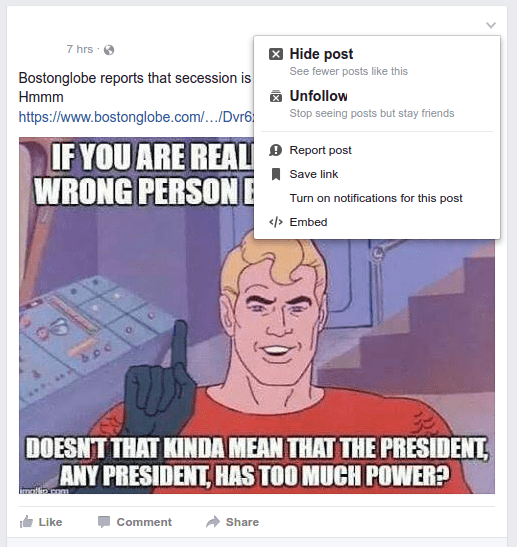
Step 3: Filter. (This is the big one.) You’re not going to convince everyone. For good or ill, morality isn’t about rationality for most people. So click that little “V” in the top right of your idiot friend’s post and tell Facebook to hide it.
fb-posts

Step 4: Relax. This stuff works by osmosis. You’re not going to change anyone’s mind over night (certainly not anyone over the age of 25). Be like the Colorado river. You don’t get a Grand Canyon of tolerance by refusing to trickle over land that doesn’t already agree with you.

Step 5: Step back. The government is about 20% of the economy. Try not to let it be more than 20% of your life. Your attention is scarce. Political life matters, but don’t let it get out of proportion. The Internet isn’t just for getting angry, it’s also for adorable gifs and pictures of pigs wearing boots.

Meta-intolerance doesn’t work. Take the worst case scenario: you’re Facebook friends with actual Hitler. You’ve got three options: A) Argue with him constantly. B) Unfriend him. C) Ignore his hateful posts and like his posts about his art. Which will do the most good for the world? Alright, potential employers and friends would probably prefer to avoid Hitler’s friends. But they’ll be more tolerant of your crazy uncle Rudy and you’ll do more good by being an occasional voice of reason in his feed than by stepping out of his Internet bubble entirely.

Most people are basically good even if they’ve got silly opinions about how to be good. And communication is hard. We speak different languages when we talk about politics and few of us have the tools to properly express ourselves. When people support politicians or policies you dislike, it might just be that they think that’s the lesser of two evils. (I’ve got opinions on why it’s sad that people think they’re “wasting” their vote by voting with their conscience, but I can hardly be mad at them for learning the fallacious reasoning that’s been foisted on them since high school civics. Let me add that if Vermonters had voted Stein and New Hampshirtonians had voted Johnson, then maybe next cycle we’ll get better options and we might push out of this two party system so many people dislike.)

I promised you Facebook lifehacks. They all boil down to this: tend your Internet bubble. You can do this with three easy steps:

  1. Like more non-controversial stuff than controversial stuff.
  2. Ignore and hide infuriating posts from people you’d rather respect (and imagine that you live in a world of respectable but flawed people instead of a world of evil charlatans).
  3. excellent