In Pursuit Of The Human Aim Of Leisure

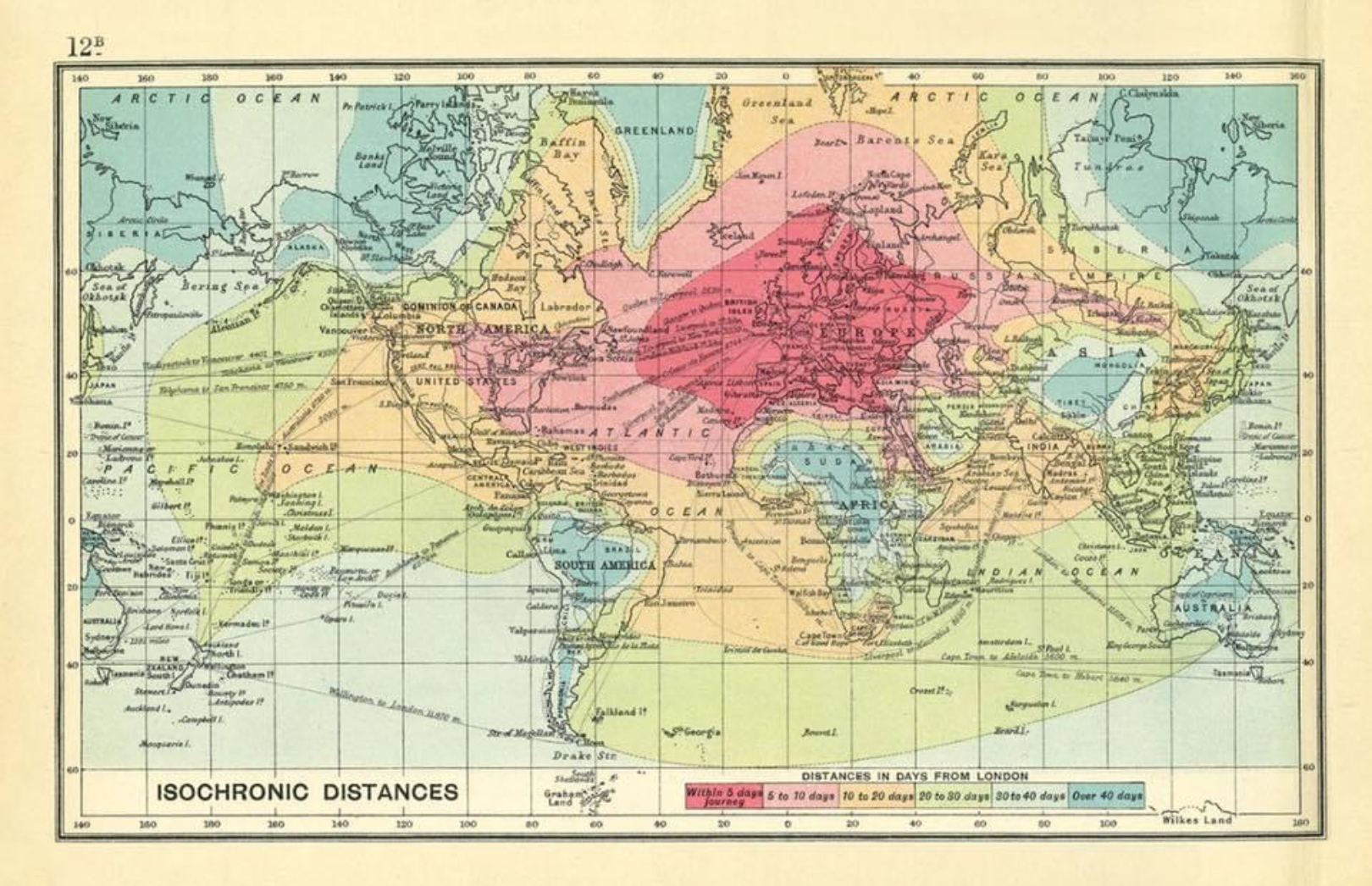
This fascinating isochrone map—how many days it took to get anywhere in the world from London in 1914—at first blush evokes the cliché that the world has now shrunk. Obviously it hasn’t shrunk. While the distance between London and New Delhi is still 4,168 miles, what has shrunk is time, and this has had profound aftermaths on our lives.

One of the great ironies in the remarkable proliferation of time-saving inventions is they haven’t made life simple enough to give us more time and leisure. By leisure, I don’t mean a virtue of some kind of inertia, but a deliberate organization based on a definite view of the meaning and purpose of life. In the urban world, the workweek hasn’t shortened. We still don’t have large swaths of time to really enjoy the good life with our families and friends.

In 1956, Sir Charles Darwin, grandson of the great Charles Darwin, wrote an interesting essay on the forthcoming Age of Leisure in the magazine New Scientist in which he argued: “The technologists, working for fifty hours a week, will be making inventions so the rest of the world need only work twenty-five hours a week. […] Is the majority of mankind really able to face the choice of leisure enjoyments, or will it not be necessary to provide adults with something like the compulsory games of the schoolboy?”

He is wrong in the first part. The world may have shrunk but cities have magnified. Travel technologies have incentivized us to live farther away and simply travel longer distances to work and attract anxiety attacks during peak hour traffic [Google Marchetti’s constant]. So, rather than being bored to death, our actual challenge is to avoid psychotic breakdowns, heart attacks, and strokes resulting from being accelerated to death.

Nonetheless, Sir Charles Darwin is accurate about “compulsory games” for adults. What else are social media platforms, compulsive eating, selfies, texts, Netflix bingeing, and 24/7 news media that dominate our lives? They are the real opiates of the masses. We have been so conditioned to search for happiness in these anodyne pastimes that defying these urges appears to be a denial of life itself. It is not surprising that we can no longer confidently tell the difference between passing pleasure and abiding joy. Lockdown or no lockdown, we are all unwittingly participating in these compulsory games with unwritten rules, believing that we are now that much closer to the good life of leisure. But are we?

‘Time is the wealth of change, but the clock in its parody makes it mere change and no wealth.’— Rabindranath Tagore

The unyielding middlemen: A timeline of 2020-2021 Indian farmers’ protest

What’s the first question in the field of public policy? According to the Indian Economist Ajay Shah, “What should the state do?” is the first question. He says, “A great deal of good policy reform can be obtained by putting an end to certain government activities and by initiating new areas of work that better fit into the tasks of government.

This question is especially essential for a weak state like India. But what if people prefer government subsidies, assertive intermediaries and a weak state? I don’t know the answer to this question. The story of the Indian farm protest is an illustrative example; it is a rebellion to stay bound to the old status quo, fearful of free choice.

Protest Timeline

04 June 2020: Union Cabinet clears three ordinances meant for reforms in the Indian Agricultural sector. These reforms upgrade farmers from being just producers to free-market traders. Agriculture is a state subject in India, but state governments have had no political will to usher in these reforms. China reformed its agriculture sector first, followed by other industries. India is doing it the other way round and thirty years late. So, the union government followed constitutional means to usher in the reforms.

04-05 June 2020: Leader of Bharatiya Kisan Union (BKU), Rakesh Tikait, welcomes the ordinances.

09 August 2020: Two months after the cabinet’s ordinance, voices of dissent emerge in Punjab, Haryana, and U.P. because a minority of well-off farmers in these states are associated with APMC—the post-green revolution status-quo— that makes them comfortable middlemen.

14-20 September 2020: All the three bills cleared in the two houses of the parliament. But a party member from Punjab pulls out as a symbolic protest.

25 September 2020: Protest gets a ‘Bharat Bandh’ (India Shutdown) tag even though farmer unions in only three states oppose the reforms. The Union Govt opens a communication channel and holds several talks with these farmer associations over their concerns.

04 December 2020: The Union Govt offers a work-around the dilution of MSP. By the way, MSP sets an unnaturally high price and cuts out the competition, so the middlemen club in the farmer’s association of Punjab, Haryana, and U.P. want nothing less than the scraping of these reforms.

21 December 2020: Farmer associations boycott Jio and Reliance products unrelated to the farmer bills.

08 January 2021: Greta Thunberg’s online toolkit for a planned Twitter campaign against the Indian government is launched to invoke human rights violations; it confirms a hashtag.

10 January 2021: Online narrative set and future social media posts finalized.

12 January 2021: The supreme court of India makes a committee to examine the laws.

21 January 2021: The Union Govt offers to stay the laws for 18 months for a consultation, but it gets rejected.

26 January 2020: The farmers, during their Tractor Rally protests, breach the Red Fort, leads to a scuffle with the police. They hoist a religious flag at the Red Fort, thereby giving this arcane legal issue an unwanted sectarian color.

Bottom line: A) The Ordinances aim to liberalize Agri trade and increase the number of buyers for farmers. B) de-regulation alone may not be sufficient to attract more buyers.

Almost every economist worth his salt acknowledges the merit in point A) and welcomes these essential reforms that are thirty years late but better late than never. Ajay Shah says, “We [Indians] suffer from the cycle of boom and bust in Indian agriculture because the state has disrupted all these four forces of stabilization—warehousing, futures trading, domestic trade and international trade. The state makes things worse by having tools like MSP and applying these tools in the wrong way. Better intuition into the working of the price system would go a long way in shifting the stance of policy.”

However, the middlemen argue on point B), that acts as a broad cover for their real fears of squandering their upper-hand in the current APMC/MSP system. Although nobody denies that a sudden opening of the field for competition will threaten the income of these middlemen, such uncertainties should not justify violent protests, slandering campaigns, that look to derail the entire process of upgrading the lives of a great majority of poor farmers in the country.

Even worse, these events get branded in broad strokes as state violence and human rights abuses by pre-planned Twitter and street campaigns and unnecessary road blockades. Everybody questions internet outages during these protests but no one questions the ethics of protesters blocking essential roads in the city. A section of the Indian society and diaspora hates Prime Minister Modi for sure. I have no qualms with this, but the reckless hate shouldn’t negate all nuances in analyzing perfectly sane reforms. Social justice warriors legitimize the vicious cycle of dissent without nuance because they don’t take the trouble of even reading the farm bill but make it a virtue to reason from their “bleeding hearts.”

Talking about social justice warriors, the sane voice of Sadanand Dhume, a Resident Fellow at the American Enterprise Institute, one of the few left-leaning voices from India I respect writes, “What do Rihanna, Greta Thunberg, and Vice President Kamala Harris’s niece, Meena Harris, have in common? They’re all rallying support for India’s farmer protests, which are morphing from an arcane domestic dispute into an emotive international cause. And they’re all mostly wrong in their thinking.

Ordinarily, the Indian state works inadequately, experiences confusion when faced with a crisis. It comes out with a communication of a policy package that attempts to address the problem in a short-term way and retreats into indifference. So, there are two aspects to its incompetence, one, there is a lack of political will because special interest groups persuade the government towards the wrong objectives. And two, the state capacity is so weak that it fails to achieve the goal. The farm protest is a hideous third kind of difficulty: a special interest group of assertive, influential middlemen want the strong-willed, long-term thinking Indian government policy—a rare entity— to sway towards short-termism under the pretext of human rights abuse. The hard left is actually supporting the Indian state to remain weak. They will also be the first to blame the state when it comes off as weak in the next debacle.

The story never ends.

‘South Asian’ identity signals alignment without being aligned to anything specific

Of late, a growing number of Indian-Americans look to assert a South Asian identity for most of their sociopolitical and cultural expressions even though actual residents of ‘South Asia’ don’t claim this identity in any way, home or abroad. I realize that second-generation Indian-Americans embrace ‘South Asian’ forums in reaction to various domestic conditions. However, they ignore the polysemy of the term ‘South Asia’ when they project it internationally, for example, to express ‘South Asian’ pride over Kamala Devi Harris’s historic election for the Vice Presidency, instead of just Indian-American pride. Of course, I’m not talking about African-American pride here; it is beyond the purview of my discussion.

According to my understanding, increasing application of the term ‘South Asia’—just like the Middle East—precludes a nuanced perception of the particular countries that make up the region. It permits Americans to perceive the region like it is a monolith. Although the impression of the United States is striking in the Indian imagination, the image of India, as it turns out, is not very obvious for the average citizen in the United States, not even among second-generation Indian Americans, as I see it. To gauge American curiosity in a particular region, language enrollment in US universities is a decent metric. It turns out, around seven times more American students study Russian than all the Indian languages combined. The study of India compares unfavorably with China in nearly every higher education metric, and surprisingly, it also fares poorly compared to Costa Rica! As an aside, to understand India and her neighborhood, an alternate perspective to CNN or BBC on ‘South Asian’ geopolitics is WION (“World is One” News – a take on the Indic vasudhaiva kutumbakam). I highly recommend the Gravitas section of WION for an international audience. 

Back to the central question: ‘South Asia’ and why Indians do not prefer this tag?

For decades, the United States hyphenated its India policy by balancing every action with New Delhi with a counterbalancing activity with Islamabad. So much so that the American focus on Iran and North Korean nuclear proliferation stood out in total contrast to the whitewashing of Pakistan’s private A.Q. Khan network for nuclear proliferation. Furthermore, in a survey conducted by the Chicago Council on Global Affairs that gauges how Americans perceive other countries, India hovered between forty-six and forty-nine on a scale from zero to one hundred since 1978, reflecting its reputation neither as an ally or an adversary. With the civil-nuclear deal, the Bush administration discarded the hyphenation construct and eagerly pursued an independent program between India and the United States. Still, in 2010, only 18 percent of Americans saw India as “very important” to the United States—fewer than those who felt similarly about Pakistan (19%) and Afghanistan (21%), and well below China (54%) and Japan (40%). Even though the Indo-US bilateral relationship has transformed for the better from the Bush era, the increasing use of ‘South Asia’ on various platforms by academics and non-academics alike, while discussing India, represents a new kind of hyphenated view or a bracketed view of India. Many Indian citizens in the US like me find this bracket unnecessary, especially in the present geopolitical context. 

What geopolitical context? There are several reasons why South Asian identity pales in comparison to our national identities:

  1. The word ‘South Asia’ emerged exogenously as a category in the United States to study the Asian continent by dividing it. So, it is a matter of post Second World War scholarship of Asia from the Western perspective.
  2. Despite scholarship, ‘South Asia’ has low intelligibility because there is no real consensus over which countries comprise South Asia. SAARC includes Afghanistan among its members; the World Bank leaves it out. Some research centers include Myanmar—a province of British India till 1937, and Tibet, but leave out Afghanistan and the Maldives. For instance, the UK largely accepts the term ‘Asian’ rather than ‘South Asian’ for academic centers. The rest of Europe uses ‘Southeast Asia.’
  3. Besides, geopolitically, India wants to grow out of the South Asian box; it cares a lot more about the ASEAN and BRICS grouping than SAARC. 
  4. Under Modi, India has a more significant relationship with Japan than with any South Asian neighbor. With Japan and South Korea, India plans to make Indo-pacific a geopolitical reality. 
  5. South Asia symbolizes India’s unique hegemonic fiefdom, which is viewed unfavorably by neighboring Nepal, Sri Lanka, Bangladesh, and Pakistan.
  6. According to the World Bank, South Asia remains one of the least economically integrated regions globally.
  7. South Asia is also among the least physically integrated (by road infrastructure) regions of the world and this disconnect directly affects our politics and culture.

Therefore, the abstract nature of ‘South Asia’ is far from a neutral term that embraces multiple cultures. It is, at best, a placeholder for structured geopolitical co-operation in the subcontinent. However, in socio-cultural terms, ‘South Asia’ used interchangeably with India signals India’s dominance over her neighborhood. Contrarily, in India’s eyes, it is a dilution of her rising aspirations on the world stage. These facts widen the gap between the US’s intentions (general public and particularly, second-generation Indian-Americans) and a prouder India’s growing ambitions. 

Besides, it is worth mentioning that women leaders have already held the highest public office in Pakistan, India, Sri Lanka, Bangladesh, etc. So as you see in this video, the Indian international actress, Priyanka Chopra, tries her best to be diplomatic about this nebulous ‘South Asian’ pride thingy, but she rejoins with the more solid identity, her Indian identity. The next time, say a Nepalese-American does something incredible in the US, and you want to find out how another Nepali feels about this achievement, as a matter of experiment, refer to the accomplishment as Nepali pride, instead of South Asian pride, and see the delight on the person’s face. Repeat this with another Nepali, but this time use the ‘South Asian’ identity tag and note the contrast in the reaction.

Why is the Republic of India a Civilization-State?

Why is the Republic of India a Civilization-State?

On 26 January 1950, India’s Constitution came into effect amidst severe apprehensions about India’s balkanization. So, seventy-one years later, the Indian democratic republic may still appear to be a historical accident, but it is not. Here is why:

India has always been a fertile territory for experiments in governance, but surprisingly, there is no more than a casual reference to the ideas underlying non-western civilizations in Political Science courses or History of Political Thought. The neglect of Indian polity is particularly striking, for apart from Western political thought, Indic political ideas comprise the most extensive and most crucial body of political philosophy. Moreover, these political ideas are integral to Indic civilization—one of the only surviving non-western civilizations. Today, we know that Western ideas have clearly impacted Indian political thought. Still, what is generally not realized is that India has also contributed to Western political thinking in all probability. 

The problem of scant attention given to Indic political thought compared to Indic religion and philosophy was partly remedied with the re-discovery of Kautilya’s Arthashastra —the Indic equivalent of the Machiavellian, The Prince. However, other great works like Kamandaki’s Nitisara— Elements of Polity, the Raj Dharma (administrative ethics) section of the epic, Mahabharata, the epic Ramayana, Digha Nikaya (Collection of Long Discourses), and to some extent antiquated Hitopadesha (Beneficial Advice) also deal with an Indian way of thinking about the state-society relationship. 

Drawing from these essential texts and Indic political thinkers, the king’s role is viewed mainly as an administrator—the ruler is not an agent of social change. This view is radically different from its counterparts in the West. In Western political theory—Rousseau, Locke, and Hegel—political order means the subjugation of society to the state. In Indian tradition, the society and culture are always supreme, and the ruler is accountable to dharma (Indic ethics—a common internal bond) and society. Therefore, the conception of the “state of nature” in Hobbes and Rousseau is irrelevant to Indic tradition because ethics and civilization preceded the state’s development in India. In the Ramayana and Mahabharata’s grand narratives, an esoteric reading accounts for personal ethics and the path to profound spiritual freedom. But an exoteric view informs us of political power, administrative ethics, and the limits of provisional freedom. According to these epics, the state is created to protect against the disintegration of social order, and the state is given only those powers required to do so. Thus, a ruler’s powers are not like those of the Leviathan conceptualized in Hobbes.

Despite these radical Indic political concepts, the popular view on ancient and early medieval India is that it was merely a region invested in despotism with no knowledge of Freedom or Liberty. Hegel assumed that only one tribe of men were free in Asia, and others were their slaves. It is worth noting that for almost thousand eight hundred years after the Greek republics collapsed, the Western world also lived through monarchical despotism and tyranny. Likewise, apart from ancient Greece and Rome, in India too, there existed republics and proto democracies. A fair study of Indic history informs you that ancient Indian republics were not only in existence from the 8th century B.C. to 4th century A.D., but they were doing some fascinating experiments in state-society relations. With time, at least four different forms of constitutions emerged. 

  1. Arajya: A political community without a king. These communities self-governed using Dharma texts (Indic ethics).
  2. Ganarajya: A state or a political community ruled by a ‘gana’ or an assembly of people.
  3. Youvarajya: A political community ruled by a crown prince.
  4. Dvairajya: A political community ruled by two kings.

For various reasons, Ganarajya and Youvarajya systems thrived much more than the other two. 

The ‘Gana‘ seems to be the earliest Indic political forum of the entire community (Jana). The Jana’s formulation of political policies rested with the Samiti (Sanskrit for Committee) and the Sabha (an assembly of elders). Over time, these Ganarajya states developed into Janapada—a self-sufficing political and cultural unit. Every Janapada had its peculiar dialect and customs developed from regional interpretations of Indic Dharma (ethics). Several of these Janapada states even joined hands to form a federation of Mahajanapada (mega-Janapada). Over time, however, powerful Indic monarchies who performed the state’s integrative functions better than the assemblies of Gana overwhelmed them. Fortunately, imperial states incorporated these republics into their fold; republics were not entirely stamped out, even after repeated invasions by the Turks, Mongols, Portuguese, French, and the British. 

The Gana-Sabha system emerged from the shadow as soon as these imperial powers became weak. The Sabha system was active in the village setting as Panchayat (village associations) that included both notable big men and peasants, in contestation with each other and in opposition to the state. Here, different qualities of people and opinions were tested, rather than the scene of a pronunciamento by elders. Even the British acknowledged this system. Henry Maine, who was influenced by J. S. Mill, was sent to India in the 1860s to advise the British government on legal matters. He came across several accounts of thriving indigenous systems of autonomous village governments, whose structure and practice shared many characteristics of participatory democracy. Later, Maine articulated a theory of the village community as an alternative to the centralized state. In the Panchayat system, De Tocqueville saw an ideal model of a society with a limited state. He planned to study it, comparable to Democracy in America but overwhelmed by his political duties, he never managed a trip. So, while Indian electoral democracy was only instituted in the first half of the twentieth century, the practice of public reasoning, deliberation, and toleration of a plurality of ideas is a much older phenomenon, dating back to ancient Indic traditions. 

During the 1947 Constituent Assembly Debates of post-colonial India, there was an Alexander Hamilton vs. Thomas Jefferson sort of debate between Gandhi’s idea of Indic village-style, decentralized administration vs. B. R. Ambedkar’s —the principal architect of the Indian constitution—healthy centralized state. Although Ambedkar’s view prevailed, the village democracy did not entirely disappear from the Indian constitution. India officially called itself Bhārat Gaṇarājya, and the first two words of the Indian national anthem honor Jana and Gana. Hence, the constitutional democracy of the Indian republic was not an accident; it is a sui generis phenomenon reflecting the plural character and age-old but essential values of Indic civilization. Therefore, modern-day India is a Civilization-State. The West can only describe it from the outside, but it is for India to interpret herself from within—an ongoing process.  

Finally, it merits mentioning that Professor of international history Arnold J. Toynbee reminded the world, “India is a whole world in herself; she is a society of the same magnitude as our Western society.”

To know more about India’s constitutional debates, check this excellent ten-episode series. Subtitles are available in English.
Internet villages and algorithmic-speech

We find ourselves in an overlap of classical free-speech abstractions, editorialized-media discourse, and algorithmic-social media diatribe. Each of these is a product that cannot reproduce the stability of the system that produced them. And yet, these platforms—print, electronic and social media—represent disruptions that fill in a vacuum felt in the other system.

Besides, we tend to think that the IT revolution’s transformations with our iPhones, Facebook, and Twitter, are without a parallel, but think of what urbanization brought to the rural life, what the railway brought in the nineteenth century or the telephone in the early twentieth. Disruptive innovations that increased transportation speed in the past couple of hundred years have not lowered commuting time but instead increased commuting distances. The size of an average individual’s ‘extended family’ cluster is an approximate invariant—it doesn’t change with city size. In a village, we are limited to a community by proximity, whereas in a city, we are free to choose our own “village” by our likes and dislikes.

Similarly, social media tools have not brought us closer the way we intended it would. Instead, they have allowed us to construct our “internet villages.” These internet villages are scaled-up, combustible derivatives that cannot reproduce the stability of offline, real-world social interactions that produced them. Instead of free-speech, they cater to our preconceived notions by exposing us to algorithmic-speech that makes each of us a volatile, motivated political actor outside the legal institutions born out of civil society. Their extreme negative externalities include conspiracies, real-world riots, and unrest. Nonetheless, in a primal way, internet populism coming out of these internet villages is gesturing at the real-world rifts created by liberal legalism’s parchment antidotes on the one end and lack of upward mobility on the other end.

As Tyler Cowen points out in his book, The Complacent Class, in our digital realm, the word “disruption” is no longer violent but the peaceful label for an ingenious upheaval of an established business order. Taking a cue from this digital paradox, it is not unreasonable to assume that a radical improvement in our physical realm may occur when we volunteer to act with moderation on social media platforms. If we don’t act with moderation, someone else will moderate it for us. Responsible self-regulation can preclude complicated centralized government regulation.

A criticism of Indian Americans by an Indian national in the US

This Atlantic article got me thinking. As an Indian national in the U.S., I would like to make a limited point about some (definitely not all) Indian Americans. In my interactions with some Indian Americans, the topic of India induces, if you will, a conflicting worldview. India —the developing political state—is often belittled in some very crude ways, using some out-of-context recent western parallels by mostly uninformed but emboldened Indian Americans.

Just mention Indian current affairs, and some of these well-assimilated Indian Americans quickly toss out their culturally informed, empathetic, anti-racist, historically contingent-privilege rhetoric to conveniently take on a sophisticated “self-made” persona, implying a person who ticked all the right boxes in life by making it in the U.S. This reflexive attitude reversal comes in handy to patronize Indians living in India. They often stereotype us as somehow lower in status or at least less competent owing to the lack of an advanced political state or an ”American” experience—therefore deficient in better ways of living and a higher form of ”humanistic” thinking.

This possibly unintentional but ultimately patronizing competence-downshift by a section of Indian Americans results in pejorative language to sketch generalizations about Indian society even as they recognize the same language as racist when attributed to American colored minorities.

In the last decade, I have learned that one must always take those who openly profess to be do-gooders, culturally conscious, anti-racist, and aware of their privileged Indian American status as a contingency of history with a bucket load of salt. Never take these self-congratulatory labels at face value. Discuss the topic of India with them to check if Indian contexts are easily overlooked. If they do, then obviously, these spectacular self-congratulatory labels are just that — skin-deep tags to fit into the dominant cultural narrative in the U.S.

Words of the economist Pranab Bardhan are worth highlighting: “Whenever you find yourself thinking that some behavior you observe in a developing country is stupid, think again. People behave the way they do because they are rational. And if you think they are stupid, it’s because you have failed to recognize a fundamental feature of their current economic environment.”