Whatever was true now was true from everlasting to everlasting….

A very interesting post popped up in the technology subreddit on reddit.com a couple of days ago.    It was simply titled “What reddit looked like 9 years ago”  and the content was “Exactly what it says on the tin”.   

A web archive of reddit nine years ago.  The real fun was in the comments though where a redditor with the highly appropriate and musically astute username of “WarOnErrorism” posted the following:   

Third fuckin page. “NSA Spied on U.N. Diplomats in Push for Invasion of Iraq “

Edit: And on the 6th page: “AT&T NSA Wiretap Whistleblower Marc Klein’s Story In His Own Words”

Edit 2: Same page: “Whistle-Blower Outs NSA Spy Room”  

Links added for posterity.  

Nearly a decade ago the truth was out in the open for anyone to see and it was ignored.

Elephant Poaching: National Tragedy or Tragedy of the Commons?

Elephant Poaching: National Tragedy or Tragedy of the Commons?

Tanzania recently ended a policy of summary execution of elephant poachers predictably due to “a litany of arbitrary murder, rape, torture and extortion of innocent people.”  The prime minister gave a PR response that, for me at least, sums up most government policy saying “The anti-poaching operation had good intentions, but the reported murders, rapes and brutality are totally unacceptable.”

World governments have taken the same measures they always do when individuals consume something that they arbitrarily deem distasteful and simply banned the sale of ivory; a method which has been categorically proved to simply not work.  After all, how easy is it to buy narcotics in America?  Or alcohol in the Middle East?  Or other drugs…in prisons.     

So what is my solution?

As with other commons violations such as over-fishing the answer to the dwindling elephant population is simple.  Privatize it.  Privatize what? You ask.  The elephants of course!  Ivory is a hot commodity in the third world, used for obvious things such as jewelry and decoration and not-so-obvious things like aphrodisiacs and snake-oil like medicines and this demand is not going away any time soon.

Allow promising entrepreneurs to tag, herd, breed, and protect groups of elephants for the purpose of harvesting their ivory, meat, hides, and any other parts of value for later sale throughout Asia and the world.  By doing this you would ensure the existence of these animals for as long as there continues to be demand for them.

Still on vacation but wanted to make sure everyone saw this…

Weigh in below on this meddling in India by their reserve bank.

Happy 100th Birthday to the Federal Reserve!

How have they done?  


Image


…oh.

A (very) Quick Primer on Natural-Rights.

by Adam Magoon

The first step in understanding natural rights theory is to ask a simple but profound question.  Do you own yourself?

Well, let’s start with the definition of ownership.  Dictionary.com gives us “the act, state, or right of possessing something.” Digging deeper we find the definition of possession as “the state of having, owning, or controlling something.” The last part of that definition is key; controlling.  There is a modicum of truth in the old adage possession is 9/10ths of the law.  Nine times out of ten to own something is to control it.

Now getting back to our original question: Do you own yourself?  Well do you control your own body and mind?  We do not need to delve into psychology to answer this question.  I alone can move my arms up and down, I can choose to stand, walk, eat, think, write, create, or to do nothing at all.  I alone am in control over my body.    This is an indisputable fact.  The very act of questioning this fact proves it true; for if you do not have control over your thoughts and actions how could you possibly disagree?

Self-ownership is the cornerstone of libertarian natural rights philosophy and what the libertarian means when he uses the term “natural rights”.

To quote Murray Rothbard: “The fundamental axiom of libertarian theory is that each person must be a self-owner, and that no one has the right to interfere with such self-ownership”

Under this philosophy of self-ownership there are two important subcategories that I will just touch on for further elaboration at another time.

The Non-aggression Principle: is an ethical stance which asserts that “aggression” is inherently illegitimate. “Aggression” is defined as the “initiation” of physical force against persons or property, the threat of such, or fraud upon persons or their property.

This is why the threat of violence cannot be used to negate the concept of self-ownership.  Holding a gun to my head and telling me to raise my arm does not mean you own the right to raise my arm any more than a thief owns the jewelry he stole.  Ownership cannot be transferred through violent means.

And the concept of homesteading which is best explained by John Locke:

“[E]very man has a property in his own person. This nobody has any right to but himself. The labour of his body and the work of his hands, we may say, are properly his. Whatsoever then he removes out of the state that nature hath provided, and left it in, he hath mixed his labour with, and joined to it something that is his own, and thereby makes it his property. It being by him removed from the common state nature placed it in, it hath by this labour something annexed to it that excludes the common right of other men. For this labour being the unquestionable property of the labourer, no man but he can have a right to what that is once joined to. . . .

He that is nourished by the acorns he picked up under an oak, or the apples he gathered from the trees in the wood, has certainly appropriated them to himself. Nobody can deny but the nourishment is his. I ask then when did they begin to be his? . . . And ‘tis plain, if the first gathering made them not his, nothing else could. That labour put a distinction between them and common. That added something to them more than nature, the common mother of all, had done: and so they become his private right. And will any one say he had no right to those acorns or apples he thus appropriated, because he had not the consent of all mankind to make them his? . . . If such a consent as that was necessary, man had starved, notwithstanding the plenty God had given him. We see in commons, which remain so by compact, that ‘tis the taking part of what is common, and removing it out of the state Nature leaves it in, whichbegins the property; without which the common is of no use”

Very quickly I will also mention a couple of the more common arguments that arise when natural rights are discussed.

First, natural rights do not extend from god or any other supernatural or theological forces.  They are based on rational and philosophical thought.  They are what is known as an “a priori”  argument.  To put it simply, natural rights are a logical deduction based on a number of easily recognized facts, primarily the concept of self-ownership.

Second, governments do not, and indeed cannot, grant any rights that natural rights have not already granted.  Let’s look at a current event that everyone always seems to think about backwards; the legalization of drugs for personal consumption.  Because of the right to self-ownership each and every individual already has the right to do whatever they choose with their own body as long as they do so with their own property and do not violently harm others in the process.   Even if the U.S. government “legalized” the use of drugs tomorrow, they are not granting anyone the right to do drugs, they are merely removing their own restrictions on something that is already a right.   The idea that law comes from the state is known as ‘legal positivism’  and proponents are hard pressed to defend actions such as slavery and extermination that were made legal by many nations throughout the course of human history.


Recommended Reading:

http://mises.org/rothbard/ethics/ethics.asp

A Drip of Local Flavor

The city of Little Falls, New York is missing nearly 400,000 gallons of water.

Located about twenty-five miles from me; the small central New York city is unable to locate over half of water that had been distributed in 2011. This amounts to about $300,000 dollars in wasted tax payer dollars and on top of that the city is expected to raise water rates.

Unsure whether the losses are caused by leaks, faulty meters or anything else the lead plant operator Daniel Benett says “”Some of it may be going in the ground. Some of it may be not captured by meters. We don’t really know. That’s why we’re out trying to fix as many leaks as we can.”

The cost of replacing the system is reported at a million dollars a mile which Benett assured citizens “The labor is the smallest cost ’cause the guys have to be here to work anyhow.”

Which  leads me to wonder what are those workers doing on a regular basis if it would cost no additional labor hours to do additional work.

Lost Innocence.

One of the defining features of a “free society” is that the citizens in such a society are innocent of crimes unless proven otherwise by a body that can be trusted to be impartial in its deliberations. In other words, the right to a fair trial and the belief in innocence until guilt is proven. This natural right was guaranteed to United States citizens in the U.S. BIll of Rights under the 4th, 5th and 6th amendments of the Constitution.

Time and again in modern America that right is ignored by those whose job it is to protect it. Recently a particularly vile example took place near Houston, Texas. The article speaks for itself but to make a long story short police invaded the personal lives and property of two individuals under no legal pretense. The message is clear, we are not secure in our persons or our properties if the police decide we are of particular interest to them. These officers will likely go unpunished and even if disciplinary measures are taken they will not be the same measures as if, lets say, I removed two people from a car at gun point, bound them, and held them hostage for eleven hours. There are two sets of laws, one for the people and the other for the state.

Anti-Tesla bill rejected by Ohio Senate.

On December 3rd, an amendment to Ohio Senate Bill 137 failed to pass. The amendment would have required Tesla Motors to sell its electric cars through a third party rather than directly to consumers. Ohio is number two in auto manufacturing in the midwest and Tesla’s new line of ultra-efficient electric vehicles are a threat to the entire automotive industry. Contrary to what those in Detroit and Ohio would have you think, this is a good thing.

For far too long the automotive unions and automotive industry lobbyists have suckered the individuals in this country into believing they were the backbone of American manufacturing when in fact they were a leech sucking money from more productive uses. For example through the years 2008 to 2011 Ohio granted $80.8 million in subsidies to General Motors, $54.4 million to Ford, and $28.7 million to Chrysler. This is ignoring the billions of dollars spent on the auto bailout last decade which, much like Chrysler bailout in 1980, simply saved failing corporations from their own shoddy business practices. While Tesla gets its own fair share of subsidies any threat to the auto industry is a positive thing for consumers.

Blind Faith

By Adam Magoon

On November, 26th Eric Liu, founder of “Citizen University”, a pro-government think-tank, wrote a telling article about having faith in government on the CNN opinion page. He begins the piece with a story about leaving his suitcase in a New York City cab saying:

“I had an experience recently that reinvigorated my faith in humanity — and bureaucracy.”

Keep that equivalency in your mind for a few minutes. Humanity and bureaucracy.

He goes on to explain that he did not even realize he left the suitcase in the cab for twenty minutes and only then began calling people for help. He explains this process in detail, emphasis mine:

“For almost three hours, various people tried to help me — two folks at my bank, whose credit card held the only record of the cab ride; three people at two yellow cab companies based in Long Island City; a service rep at the New York City Taxicab & Limousine Commission; people in my office back in Seattle.”

So Eric was helped by no less than eight individuals (counting the cab driver) in his successful search for his luggage. Eight people helped improve Eric’s business trip. He then claims this experience taught him three lessons.

First:

“Always, always get a receipt.”

This, as he says, is obvious.

Second:

“Another is that New Yorkers, contrary to popular belief and their own callous pose, are essentially nice.”

As someone born in New York I would like to think this is true, but I adhere to the maxim that terms such as “New Yorker” can only describe places where someone lives or is born. Saying “all New Yorkers are nice” is equivalent to saying “all Scots are drunks” or “all Scandinavians are attractive”. Essentially it is a non-statement that is easily refuted. There are just as many people who would have taken anything of value from his case and threw it into the nearest dumpster.

That is just the appetizer though, here is the main course.

His final lesson, and where the train totally leaves the rails, is this:

“But the third, even more deeply contrary to popular belief, is that government is not the enemy.”

Wait, what?! What kind of logic is Mr. Liu using? Of the eight people who helped him only one (the service representative at the New York City Taxicab & Limousine Commission named Valerie) even worked for a governmental organization and “she insisted she was just doing her job”. How did Mr. Liu get to “government is not the enemy” from that series of events? He goes on to claim that:

“Government is not inherently inept. It’s simply us — and as defective or capable of goodness as we are”.

Mr. Liu tries to rationalize his faith in government with a single good experience with a few select people. What he ignores though, is that many people are not “essentially nice”. If that were the case crime, corruption, and violence simply wouldn’t exist. There are people in the world who only seek to exploit and profit from the work of others and to quote the great classical liberal theorist Frédéric Bastiat:

As long as it is admitted that the law may be diverted from its true purpose — that it may violate property instead of protecting it — then everyone will want to participate in making the law, either to protect himself against plunder or to use it for plunder”

Even if we were to assume that most people in the world are “essentially nice” the very nature of government attracts precisely the opposite type; the corrupt, the malevolent and the lazy. His agenda finally becomes clear nearly two-thirds of the way through the article when Mr. Liu unabashedly asks us to not wonder what our country can do for us, but rather what we can do for our country in response to the failed Obamacare launch.

Individuals are expected to bail the government out when it fails at intruding into our lives? How can we expect the government to run healthcare without kickbacks and corruption when they cannot even get someone to build the website without it being a disaster?

Mr. Liu fails to offer any helpful advice on how to improve things but he does offer one revealing suggestion. He says that citizens should not expect the “state…to serve us perfectly” and that individuals should not “forget how to serve”.

The argument often goes that taxes pay for services provided by the government but Mr. Liu suggests we shouldn’t expect too much from those services. That we shouldn’t get upset when we pay a third of our labor to the government and it spends that money on things we do not want; in fact he implies we should fix for free the broken things they have already spent our money on.

If Mr. Liu goes out to dinner and his silverware is dirty when he sits at the table does he go back to the sink and wash them? Or does he expect more from the things he spends his money on? At least in that situation Mr. Liu could choose to spend his money elsewhere. With the government spending our money for us we aren’t even afforded that meager victory.

Debunking the Wage Slavery Myth

By Adam Magoon

It is often stated by those who are ignorant of economics that work is not a voluntary endeavor even when a wage is agreed upon voluntarily by both parties.  The rationale behind this claim is that a human being must eat, drink, and have shelter and therefore the employer has this leverage to use in order to strangle wealth from the poor worker.  In order to examine this erroneous belief we must start as we do with all economic examination with the Robinson Crusoe scenario.

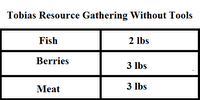
Assume a shipwrecked sailor (Tobias) on an island with no resources but his own two hands and his ingenuity.  To survive he has a number of options:  He can gather fruit/berries for a return of 3 pounds of berries per day, he can fish in the shallows(without tools) for a return of 2 pounds of fish per day, or he can hunt wildlife(without tools) for a return of 3 pounds of meat per day.
wageslavery1

Tobias requires 2 pounds of consumer goods per day to survive.  On this island consumer goods are either Berries, Meat, or Fish and given Tobias’ productive capacity of either 2 pounds of berries or 3 pounds of the other two consumer goods any intake of resources allows him to maintain his existence (subsistence).  It is at this point we must examine whether Tobias’ work is slave labor.

The definition [1] of a slave is:

1.

a person legally owned by another and having no freedom of action or right to property

2.

a person who is forced to work for another against his will

In our scenario is Tobias the property of anyone other than himself?  The answer is clearly “no” since Tobias is quite literally the only person on this island.  While he is “forced” to work due to his innate need for sustenance it would be counter-factual to claim he is somehow a slave to himself since the definitions of slave-master and slave are incompatible with another [2].  It is also absurd to say that because they provide his method of survival that Tobias is somehow slave to the ocean or the land [3].  So as we can see; when Tobias is alone on the island working to survive he is a slave to no one.

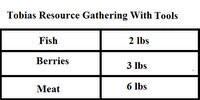
To this point we have been dealing with Tobias merely using his nature given resources to obtain and consume consumer goods.  However by collecting berries or hunting for two days (6pounds collected – 4 pounds consumed) he obtains 2 pounds of excess goods he can save.  Through this method of saving and then consuming the saved goods on the third day he can then use that time to create capital goods.  This means that on the third day, instead of hunting he can fashion himself a spear from collected wood.  The spear allows him to take on larger game and thus increases his collection of meat to 6 pounds per day.

 wageslavery2

At this point we need to examine two things.  First, at this point it would be foolish for Tobias to do anything other than hunt.  He has a decisive gain in resources due to his construction of the Spear and can use the vast amount of saved food to create even more goods (extra spears, traps, shelter, etc…).  As foolish as it may be objectively that diagnosis ignores his subjective valuations; perhaps he finds it distasteful to kill animals even in his situation, or simply prefers to pick berries due to the relative safety.  The reasons are irrelevant, just keep in mind that despite the obvious advantage of hunting in this scenario he can always choose not to.

The second thing we need to examine is whether Tobias is now a slave.  All of the evidence from the previous examination applies; he is still not a slave to himself.  The only thing that has changed is the creation of a spear from the saving of consumer goods.  It is clear that Tobias cannot be a slave to either the spear or his own saved consumer goods, again due to their nature as objects.  So we have seen that a worker working, both with and without capital goods, is a slave to no one.

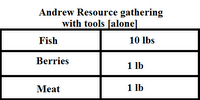
Now here is where the hypothesis comes into question.  Let us assume a second person becomes stranded on the island; except this person (let’s call him Andrew) has been able to scavenge from his wrecked ship a small life boat and netting that is suitable for fishing.  Using his tools while alone Andrew can Hunt for 1 pound of meat, gather 1 pound of berries, or gain 10 pounds of fish.

 wageslavery3

In this economy Tobias will gain the most by hunting and Andrew will gain the most by fishing and they both are likely to pursue those activities [4].  Now we must again identify if this change in circumstance has resulted in slavery.  Tobias’ situation has not changed at all, so he is not a slave to anyone.  Andrew is not interacting with Tobias in any way, he cannot be a slave to his boat, his net, the ocean, or himself so he is also obviously a slave to no one either.

However Andrew soon comes to believe that if he had someone to operate the net while he piloted the boat he could obtain 20 pounds of fish per day, this may be an erroneous prediction but that is the entrepreneurial risk Andrew must take to earn a profit.  For the sake of this examination we will assume that Andrew is an amazing entrepreneur and his prediction is exactly right; but to obtain the 20 pounds of fish Andrew needs an employee.

Here we reach the concept of wages.  In the economy where both Andrew and Tobias work alone they obtain 10 pounds and  6 pounds of consumer goods respectively for a total of 16 pounds.  Andrew, as an entrepreneur, sees that if he employed Tobias they would obtain 20 pounds of total consumer goods which is an increase in the size of their economy by 4 pounds of consumer goods.    At this point Andrew needs to hire Tobias.

If you remember; the subsistence level for Tobias is 2 pounds of consumer goods per day; so any attempt to hire Tobias for less than that will be ignored since he could not survive at that wage.  Currently though Tobias is producing 6 pounds of meat using just his own intelligence and skill so any attempt to hire Tobias below that rate will also be denied.

Andrew would obtain 10 pounds of goods without Tobias’ help so he would be amiss in paying Tobias more than that since then Andrew would then be taking a loss.  Using our final profit of 20 pounds if Tobias agrees to work for Andrew the wage rate must be between 6 and 10 pounds of goods per day.

In this scenario let’s assume Andrew offers to pay Tobias 7 pounds of goods in exchange for his work operating the net [5].   Tobias would then be gaining 1 pound of goods over his efforts if he worked alone.  Andrew would be gaining 3 pounds of goods compared to his work alone.  Tobias agrees to this arrangement and both parties are better off.  Here is where the proponent of wage slavery points to the fact that Tobias is seemingly generating 10 pounds of goods but only obtaining 7 pounds and thus he is being exploited by the capitalist-pig Andrew but let’s examine whether there is a master-slave arrangement here.

Andrew has freely chosen to hire Tobias at the cost of 7 pounds of consumer goods with the expectation of gaining 13 pounds for his own use.  He is free to terminate this agreement at any time.   Tobias is in a voluntary agreement to help Andrew obtain a total of 20 pounds of consumer goods in exchange for a payment of 7 pounds of goods.  He is free to leave at any time if the agreement becomes unsatisfactory and hunt for himself, though he would suffer a net loss of 1 pound of consumer goods to do so.

There is nothing here that fits the definition of slavery, Tobias is not forced to work against his will and Andrew is not forced to hire him.  Both parties own their own property and neither owns the other in part or in whole.  Even though Tobias would be taking a loss by leaving Andrew’s employment the loss to Andrew would be even greater!  Andrew would be losing 3 pounds of profit and Tobias would only be losing 1 pound.  Therefore despite Tobias’ innate need to work this does not cause a master-slave arrangement or “exploitation”.  It is true Tobias has to work to survive but he does not need to work for Andrew; but he voluntarily will continue to do so as long as it benefits him.

Finally, what of the “missing” 3 pounds of goods that Tobias is somehow losing?  The answer is obvious; it is the price put on Tobias’ use of Andrew’s capital goods which in this scenario are his boat and net.  Without these capital goods Tobias would not be able to generate 10 pounds of consumer goods and therefore there is a premium placed upon them by Andrew; after all they are his property and he must maintain them.  If Andrew’s boat was to spring a leak or his net tear Tobias would not have any responsibility to fix them and could happily take his 1 pound loss and go back to hunting while Andrew (if he had not achieved some profit) would suffer the far greater loss of both his 3 pounds of goods and the destruction of his capital goods.

It is worthwhile to note how this scenario compares to the classic opinion that people born into wealth have somehow acquired it illegitimately.  In our scenario Andrew did not need to save consumer goods like Tobias did in order to obtain capital goods, he simply has them due to luck, or fate, or what-have-you.  This does not change the fact that he does indeed own them and can utilize them how he wishes and that utilization is totally legitimate.  Would anyone scoff if Tobias handed down the hunting spear to a future son for his protection and livelihood?  To remain consistent we cannot then harry Andrew for passing down his fishing equipment for the sole reason that it would give his own heirs an “unfair competitive advantage”.

It is evident by now that the entire concept of wage slavery is simply a misunderstanding of economic principles.  Even the myth that somehow the wage earner does not get “his fair share” has been debunked.  The simple reason why so many find these concepts hard to extrapolate in the real world is due to the hundreds of years of savings, production of capital goods, and the highly specialized division of labor that has made worker productivity increase to such an extent that the fall to subsistence seems unfathomable.

The productivity of the workers in the industrialized world has become so great that any work outside of this world, such as gathering berries or fishing to feed an entire family, would require a massive drop in quality of life.  This is somehow turned around to be a slight on employers when they are the ones who have made this increase in the quality of life possible.

If we had replaced Andrew’s life boat in our scenario with a commercial fishing trawler that allowed Tobias to obtain 500 pounds of fish per day would we then say he is Andrew’s slave because he would be “forced” to return to hunting only 6 pounds of meat per day should he choose to leave?  Would Andrew be a villain for hiring Tobias and paying him such a vast increase over the wage he could obtain by working alone?  No! Of course not! It doesn’t logically follow!  Yet that is the accusation from the proponents of wage-slavery and it is clearly absurd.

[1] http://dictionary.reference.com/browse/slave?s=t

[2]  It is true that a slave could himself be the master of a third slave, but a slave master logically cannot be a slave to his own slave since either one slave or the other would end his own involuntary servitude.

[3] By their nature as objects they cannot own other objects.

[4] Whether they actually trade goods at this point is irrelevant because both parties are satisfying their base needs through their own effort.

[5] We are also assuming that the number of hours worked are the same and subjective preferences of hunting over fishing or vice versa are non-existent.