Proposal: Let’s stop calling them “Property Rights”

I think an alternative that is both clearer and more general is “Decision Rights”. When I teach Coase Theorem I use both terms, and (I think) students have an easier time grasping it when they realize that property rights are really just rights to make certain decisions. I can’t see a good reason to keep using the term property rights except that by historical accident it’s become entrenched jargon.

Property sounds like “stuff” to most people. And property rights sounds like “owning stuff”. This raises two points that need clarifying:

1. There is more to the world than just the physical, and there is more to property than just stuff.

I would argue that economic rights are human rights. (I would also argue that corporations are owned and staffed by humans but are not humans themselves.) And I would say that right to self-ownership is a particular type of economic/human right.

When we talk about environmental issues, the root problem is usually over some shared resource (e.g. we can’t neatly privatize the atmosphere and let now-private conflicts be resolved in court). It’s much easier to focus in on the relevant particulars when our language directs us to what’s really at stake (e.g. whether I can decide to put more than X amount of pollution into the atmosphere without legal consequences).

2. I own a bit of land and I can make many decisions about how to use it. But I can’t set up a nuclear reactor or burn a massive pile of debris. My ownership is not carte blanche, but a bundle of different rights. I have the right to use (for normal domestic purposes), to exclude, to sell, etc. By “I own” what I really mean is “I can make a particular set of decisions.

I hope my hard core libertarian friends will agree with me that the decisions I can make are not limited by what is explicitly legislated. I suspect my interventionist friends will disagree. But I also think interventionists can agree that it’s more reasonable for me to have a set of decision rights (how ever nebulous the extent of that set is) than some more magical sounding dominion/ownership over a particular fifth of an acre.

The notion of decision rights makes it clearer what political debates are over. If we want to pass a law saying you can’t put a pool in your yard because of spotted owls, “property rights” muddies the discussion. The law would take away a particular property right–which is to say, the right to make a particular decision. But the debate is going to devolve into “you’re taking our land” vs. “no we aren’t.” It’s close to the real issue, but not close enough.

tl;dr: When we talk about “property rights” or ownership what we really mean is a set of various decisions that one has a right to make. Those decisions might be over the use of what we traditionally call property (e.g. my yard), but it might also be over shared resources (e.g. the atmosphere), decisions with collective impacts (e.g. ecosystem management–or lack thereof), or socially constructed issues (e.g. intellectual property). The term “property rights” is not clear or obvious (particularly for people who aren’t already likely to read this blog). A better term would be “decision rights.”

Old Property

Property is the basis for every right and ounce of autonomy we have. James Madison called property “that dominion which one claims and exercises over the external things of the world, in exclusion of every other individual.” Madison went on to argue that basically every right we enjoy is reducible to a property right. We have property in our opinions, in the free use of our faculties, in the safety and liberty of our body, and so on. He believed that “Government is instituted to protect property of every sort” and a government can only be just if it “impartially secures to every man, whatever is his own.”

But government has not remained impartial in this endeavor. It has become a massive property owner in its own right.  It has also become a gatekeeper, setting the terms for individuals’ uses of their own property. It has also become a broker and redistributor of property. And finally, it has =become a creator of property in the form of entitlements–what Charles Reich famously called “new property.” It’s this last role that I’d like to discuss here.

Government’s role as a creator of property has muddled and watered down the strength of property rights. The problem began when U.S. courts started grappling with claims that individuals had been deprived of a constitutional right when government stripped them of a government-created entitlement, such as social security.

Courts confronted with this problem basically held that while constitutional rights do attach to entitlements, the government has an increased authority to limit the rights to those entitlements. Essentially, since the government created the entitlement, the government can define the scope and terms of that entitlement.

This “new property” doctrine then became entangled with a different idea altogether. The United States Constitution protects against deprivations of life, liberty, and property without due process of law. The Constitution, however, does not define property. Courts have held instead that state law defines property , and the Constitution then protects rights to that property.

That does not mean, however, that all property can be whisked away at a whim as if it is all “new property.” Rather, even though state law may establish what property is, states do not have the power to mutate and redefine all property rights on a whim. In essence, there is “new property” and then there is “old property.”

“Old property” is a bundle of long-recognized property rights rooted in common law. But just because those rights have arisen from common law courts over the centuries does not mean that these are property rights created by government in the same sense as less-protected “new property.” There is a fundamental difference, for constitutional purposes, between government recognizing a boundary line and creating a food stamp program. In some sense, this difference strikes a deeper philosophical chord, one that distinguishes between positive law and natural law–or fundamental rights that are acknowledged and respected by government, and entitlements that are created and controlled by government.

What are these fundamental property rights? Most are intuitive and understood by babies as soon as their hands are capable of grasping. They include the right to exclude others (the first property right understood by all children everywhere), the right to quiet enjoyment, the right dispose of the property by sale or lease, the right to develop and improve the property, etc. That right extends to chattel and land–things the government does not create but simply exist and are brought under human ownership through a first-in-time rule or a transfer.

The idea that “new property” deserves lesser protection because government dictates its bounds has bled over into the “old property” rights. This stems from confusion between government recognizing the existence of a fundamental right and government creating an entitlement. Extensive permitting regimes have only exacerbated this confusion. When local governments demand a permit before a property owner can do something with their land, the government looks upon that permit as an entitlement–a privilege and not a right. Thus, “new property” ideas come to overlay and suffocate “old property.” As permitting regimes expand, the world of “old property” retracts. But that permit is not a “new property” entitlement–it’s a condition placed upon a fundamental background right–an intruder upon natural law. When a permitting authority tries to strip away or deny a permit, that denial should be subjected to the full rigor of constitutional scrutiny offered to “old property,” not the weak sauce protections for entitlements.

If a government is only just if it limits itself to protecting what is ours, as Madison believed, then we don’t have many just governments left to us. Courts could help by establishing a clearer distinction between the old and the new forms of property so that governments can’t get away with redefining or stripping away fundamental property rights.

Three Lessons on Institutions and Incentives (Part 8): Conclusion

Far from the custom of assigning to cultural factors, or educational, or geographic or relative to the particular constitution of the ruling elites, the three works reviewed – Institutions, Institutional Change and Economic Performance, by Douglass C. North; The Elusive Quest for Growth, by William Easterly and Why Nations Fail, by Daron Acemoglu & James A. Robinson, state an explanation of the progress and decline of nations articulated on abstract incentives, which serve as a structure in which frame the rational agent makes his choices. The four authors have a common reference to methodological individualism, but such an individual agent does not make decisions in a vacuum, but inserted within a framework of incentives.

That such incentives, to act as points of reference for individual action, should materialize historically, does not mean that such conditions for action come from a particular circumstance of time and place, but that they depend on an abstract structure that relates to different terms and that is present in every phenomenon of human interaction.

To finish, it is worth referring to the conclusions reached by North in his referenced work: the case of the two successive Spanish Americas, the Habsburg and the Bourbons. The first extended from the discovery and colonization of America to the early eighteenth century. The viceroyalties of America enjoyed great political autonomy – Spanish immigration had been little and a “Creole” elite had developed – and they were closed to trade, which was limited to the “export” of gold to Spain. With the arrival of the Bourbons at the beginning of the 18th century and the implementation of their Reforms – which from the economic point of view were a resounding success both in Spain and in America – the relationship was reversed: political power passed into the hands of the “Peninsular Spaniards” and an opening of a more fluid trade between the metropolis and its colonies was launched. North explains that the independence movements could be successful due to a transitory alliance between the sectors that wanted to return to the Habsburg system and those who wanted to deepen the modernizing and free-market impulse of the Bourbons. Once achieved independence, these two currents came into conflict, which, according to the author, would extend until today.

According to North’s thesis on Spanish America, there would be two political patterns in tension: on the one hand, an elitist politician who is open to the economy and on the other a “popular” current that is traditionally protectionist. In the second half of the 19th century, success belonged to the “Bourbon pattern” and, in the 20th Century, the “Habsburg pattern” prevailed. In terms of Acemoglu & Robinson, it would be the dispute between a combination of extractive political institutions with inclusive economic institutions and another combination of inclusive political institutions with extractive economic institutions. Of course, in practice, moments of extractive political and economic institutions were also known, as well as short-lived experiences of inclusive institutions, both politically and economically.

The notion of polarized societies used by Easterly can serve as a way to deepen this analysis. It is much clearer to find problems of countries with societies divided into distant and dissimilar regions, in which the policy is expressly articulated as a function of tribes or ethnic groups and which the dispute over public policies expressly favors or harms a another ethnic group. However, as it has been stated, it is not ethnicity or nationality that determines the low economic and institutional performance of a country, but the polarization structure itself, whatever the functions in which such polarization is expressed (language, religion, ethnicity, ideology, etc.). Understanding these latter is fundamental to be able to provide a common thread for a principle of solution.

Just as on the political level an express agreement can be reached on the way to choose who exercises public power and under what conditions, Easterly states a series of conditions related to economic institutions whose agreement would allow for economic growth, regardless of the region, culture, or education of the ruling class of each country. Throughout The Elusive Quest for Growth you can find mentioned to free trade as a main factor of progress, monetary stability and exchange freedom as examples of clear and equitable rules, a state that participates in large infrastructure works but that refrain from arbitrating in the distribution of economic rents among various groups, a low level of public indebtedness, stability in property rights and an independent justice that allows individuals to innovate and save, as well as support programs and incentives to members of society who are immersed in poverty traps.

As mentioned, many times the policy -especially when, in the terms of Acemoglu & Robinson, it is inclusive- consists of the composition of interests of various kinds for the purpose of articulating a government program. From the work of the authors commented here, it can be inferred that, just as there is an agreement on the political plane regarding the rules of the democratic game, which include periodic elections, limited re-elections and division of powers, among others, there should also be a consensus in a body of economic institutions that should be left out of political negotiation, so that economic policy is as neutral as possible against the conflicting interests of which a country with a polarized society is composed.

[Editor’s note: Here is Part 7, and here is the entire, Longform Essay.]

Three Lessons on Institutions and Incentives (Part 6): Breaking the mold

Daron Acemoglu & James Robinson acknowledge that the weakest point of their theory consists of recommendations to “break the mold.” How to change the historical matrix that leaves the nations stagnant in extractive political and economic institutions, or that move them back from having inclusive economic institutions with extractive political institutions to being trapped in exclusively extractive institutions with the risk of falling into a failed state. This brings us to Douglass C. North and his theory of institutional change.

Although he published works before and after Institutions, Institutional Change and Economic Performance, this book can be taken as the archetypal expression of neo-institutionalism. In the United States, institutionalism, whose main speaker was the Swedish immigrant Thorstein Veblen, was the local expression of what in Europe was known as “historicism”: a romantic current, inspired by Hegelian idealism, which denied the universal validity of institutional rules and claimed the particularism of the historical experience of each nation. American historicism was called institutionalism, because it concentrated the sciences of the spirit in the empirical study of the institutions given in the United States.

On the contrary, North’s school is called “neo-institutionalist” because it does exactly the opposite: it studies the phenomenon of institutions from a behavioral point of view and, therefore, universal. As already noted here, for North institutions are limiting the choice of the rational agent in his context of political, economic and social interaction. These limitations are abstract; that is, they are not physical, like the law of gravity, nor do they depend on a specific and specific order of authority. Examples of these abstract limitations can be found in social customs and uses, in moral rules, in legal norms insofar as they are enunciated in general and abstract terms.

Attentive to such diversity, Douglass C. North groups institutions in formal and informal. Within the formal institutions we find, unquestionably, the positive law, in which its rules of formation and transformation of the statements that articulate them can be identified very clearly. In a modern democracy, laws are sanctioned by the legislative body of the State. Meanwhile, the rules of formation and transformation of statements concerning morality are more diffuse – previously, Carlos Alchourrón and Eugenio Buligyn, in Normative Systems, had used this distinction to support the application of deontic logic to law, since deontic statements of law are much more easily identifiable than those of morality.

On the other hand, North distinguishes two types of institutional change: the disruptive and the incremental. An example of disruptive institutional change can be a revolution, but it can also be a legislative reform. The sanction of a new Civil Code, entirely new, can mean a disruptive change, while partial reforms, which incorporate judicial interpretative criteria or praetorian creations, can be examples of incremental changes.

Institutional changes do not necessarily have to come from their source of creation or validity. Scientific discoveries, advances in transport and telecommunications, information technologies, are some of the innovations that can make certain institutions obsolete or generate a new role or interpretation for it, depending on the open texture of the language.

Therefore, following the tradition of Bernard Mandeville and Adam Ferguson, neo-institutionalism admits that there are unintended consequences in the field of institutional change. Not only the incremental change of institutions, be they formal or informal, depends largely on changes in the cultural and physical environment in which institutions are deployed. Also the disruptive and deliberate change of a formal institution can generate unforeseen consequences, since it is articulated on a background of more abstract informal institutions.

Both Acemoglu & Robinson and North acknowledge that there is no universal law of history that determines institutional change -i.e., they deny historicism, as Karl R. Popper had defined it at the time-; what we have, on the other hand, is an “evolutionary drift,” a blind transformation of institutions. In this transformation, political will and environmental conditions interact. The latter not only limit the range of options for the exercise of “institutional engineering,” but also introduce an element of uncertainty in the outcome of such institutional policies, the aforementioned unintended consequences.

Much more complex is to identify which components are included in that black box that is called “environment” (environment). In principle, there could reappear the creatures that both William Easterly and Acemoglu & Robinson had banished from their explanations: the geography, culture and education of the ruling elites; more sophisticated elements such as the one referred to in the previous paragraph could also be incorporated: technological change. However, the discoveries of science would have no impact if the institutional framework pursued “creative destruction”, seeking to protect already installed activities from competition, or a lifestyle threatened by technological innovation.

We arrive here at a seemingly paradoxical situation: the institutions’ environment is the institutions. Using the Douglass North classifications system, one could try as a solution to this paradox the assertion that formal institutions operate on the background of informal institutions, which escape political will, and that disruptive institutional changes occur in a context of other institutions that are transformed in an incremental way. From this solution to reintroduce culture as a factor of ultimate explanation of institutional change, only one step remains.

At the other extreme, following the typologies used by Acemoglu & Robinson, the institutions can be political or economic and these in turn can be extractive or inclusive, jointly or alternatively. Inclusive economic institutions within a framework of extractive political institutions can result in a limitation of creative destruction and, consequently, produce a regression to extractive economic institutions. In the institutional dynamics of Acemoglu & Robinson, history can both progress and regress: from economic institutions and extractive policies it can be involuted even to situations of failed state and civil war. To reach the end of history, with inclusive institutions, seems to depend on the conjugation of a series of favorable variables, among which is the political will; while to fall back into chaos and civil war it is enough to let go. Without looking for it, the conceptual background of Why Nations Fail rehabilitates the thesis of Carl Schmitt insofar as it presupposes that in the background of human interaction there is no cooperation but conflict.

For his part, William Easterly in The Elusive Quest for Growth does not ask these questions, but simply works under a hypothesis that already has it answered: whenever there is human interaction, there will be a framework of incentives and such a framework of incentives will have certain universal characteristics. Douglass C. North’s central concern in Institutions, Institutional Change, and Economic Performance, as well as that of Acemoglu & Robinson in Why Nations Fail, was to establish patterns of events and conditions that made some nations be prosperous while others could not emerge from stagnation. That is, they are works that must necessarily be about the differences between one country and another and, therefore, emphasize the different conditions. Notwithstanding that both North and Acemoglu & Robinson expressly shun culturalist explanations, but instead postulate abstract models and typologies of institutions and institutional change to be applied universally, when the moment of exemplification arrives, they must necessarily resort to the differences between countries and regions. While it is true that both books resort to the description of the problems of the southern United States when illustrating how certain institutions generate results similar to those of third world countries, the culturalist explanation is always available.

In contrast, William Easterly in his The Elusive Quest for Growth: Economists’ Adventures and Misadventures in the Tropics focuses almost exclusively on countries with low economic performance and only tangentially refers to cases of high performance. Therefore, in his work, the empirical analytical tools used to dissect it are well separated. To do this, Easterly will not only use a utility-maximizing rational agent model, but will also enunciate abstract models of universally valid human interaction.

In the first part of the work, Easterly describes the failed panaceas of growth: direct aid, investment, education, population control, loans to make adjustments and subsequent debt forgiveness. Affirms that such policies invariably failed because they did not take into account the basic principle of the economy that indicates that people respond to incentives (people respond to incentives, a statement that is repeated as a mantra throughout the book). While acknowledging that in some cases of extreme poverty and bad luck it is necessary for governments to take direct action to help people escape from poverty traps, the author proposes as the main means for people to take a path of prosperity: work to establish the right incentives. It clarifies, however, that this should not be a new panacea but a principle to be implemented little by little, displacing the layers of vested interests impregnated with the wrong incentives and allowing the entrance of the right incentives.

These incentives, right or wrong, do not depend on the culture, nor on the education of the elites, nor on geography. On the contrary, they consist of abstract models of human interaction, which can materialize at any time or latitude. Since the main interest of The Elusive Quest for Growth is, precisely, growth, such models concern this matter, but nothing prevents future research from identifying other abstract patterns of behavior that allow us to infer incentives to address other issues, such as crime, equity, violence, etc.

Some incentive structures that Easterly describes in relation to the problem of growth are the following: conditions for increasing returns – instead of decreasing ones – that come from technological innovation, which in turn depend on phenomena identified as “leakage of technological knowledge” (leaks of technological knowledge), “combination of skills” (matches of skills) and traps (traps) of poverty -although there are also wealth traps.

Technological knowledge has the capacity to filter into a population because it is mainly abstract. It can be exemplified in an accounting system, the practice of carrying inventories, literacy, techniques and procedures for the production, distribution and sale of products, etc. If the technological knowledge consisted exclusively of physical machinery, then yes it would be to a point where yields would become decreasing. On the contrary, understanding technological knowledge as consisting of “abstract machines”, it acquires the characteristics of a public good: it is not consumed with its use nor can it be exclusive. This is how technological knowledge can be extended in a society, multiplying the productivity of its members without entering into diminishing returns.

Also, following the ideas of the recent Nobel Prize in Economics Paul Romer, Easterly highlights that technological change can generate increasing returns thanks to the work of an endogenous agent of the economy, the entrepreneur. Being the labor force a fixed factor of production with respect to machinery, it is expected that, at a certain point, capital will generate diminishing returns, thus conditioning the growth rate of an economy (the main concern of The Elusive Quest for Growth). For its part, the entrepreneur is not only that agent of the economy who discovers new business, he also discovers new uses for existing capital goods. Easterly does not mention it, but this is also the main conclusion reached by Ludwig Lachmann in his work Capital and Its Structure. This work of the entrepreneurs, to find a new utility for a set of capital goods that had come to generate diminishing returns, making them continue to generate increasing returns is what frees the rate of growth of the economy from the limits of technological change and, in turn, makes it depend on the endogenous factor of the economy: the incentives for entrepreneurs to develop their activity -which some call creative destruction.

[Editor’s note: Here is Part 5 and here is the entire, Longform Essay.]
Three Lessons on Institutions and Incentives (Part 5): “Spontaneous” institutions

When Friedrich A. Hayek referred to the coordination problems among rational agents as a consequence of the dispersion of information in the economic system -and that made him worthy of the Nobel Prize in Economics- he did not refer to an information problem that could be solved with better statistical tools. This is also a problem of the economics of information and what Hayek himself called “limit relative to knowledge,” since the frontiers of science could be continuously extended, generating more and more information. The limit that Hayek qualified as absolute for knowledge came from the increasing degrees of abstraction and complexity characteristic of any “extended society.” This to the point of calling such phenomena spontaneous orders, or abstract or extended. Such orders allowed the prediction of the general configuration of the system, but they made impossible the concrete prediction regarding the relative position of each particular element of the system. If one looks for an example of such an institutional arrangement, Hayek himself would point as such to the legal systems that structured the mercantile communities, not because they lacked legislation or a state that monopolized its enactment, but because it provided the members of such a mercantile community of a dispute resolution system whose complexity acted as a guarantee of impartiality.

There is much talk of the virtues of institutions as guarantors of predictability, or legal security, or political stability and clear rules of the game. All of them are positive qualities that express the favorable consequences of a negative quality -negative not in the sense of pernicious, but of absence of a particular characteristic- that can be defined as “absence of arbitrariness.” In general, the concept of freedom is related to that of “free will,” which is very desirable for those who exercise it, but it could become a hell for those who suffer the free will of a third party. The institutions are, as it was pointed out, abstract limitations to the social human action that are structuring of the political, economic, and social interaction; in other words, they limit the arbitrariness of the decisions of own and third parties.

In a certain sense, institutions limit individual freedom, whether we define it in a positive way -as the faculty to exercise its own free will in a legitimate way- or negative -like the absence of coercion to exercise one’s free will. However, for the definition of freedom as absence of domination or absence of arbitrary coercion (similar to that coined by Quentin Skinner), institutions cease to be limiting of individual freedom to be functioning as the abstract devices that make it possible.

An institution is made up of a set of rules that not only limits the action of the rational agent and the action of a third party, but also limits, fundamentally, the actions of the political authority. The said procedural due process, for example, belong to the category of institutions that limit governmental action: no one can be punished except by a judgment based on a law prior to the fact of the process and dictated by its natural judges. The due process is not exhausted in this formulation, but this already constitutes in itself a strong restriction to the power of the government over the citizens. These limits make foreseeable the actions of the government that can interfere in the free will of the individuals and, therefore, define their spheres of autonomy.

Of course, although an institution by itself provides stability and predictability to the system and this generates dividends in terms of the coordination of expectations and individual plans, not all institutions are equally efficient if the mentioned predictability is taken as an evaluation parameter. A system of multiple castes, for example, depends on numerous but ambiguous indicators for the identification of each individual, necessary for the purpose of determining what rights and obligations that person owns. In contrast, a modern system, at the other end of the arch, which equates, with the exception of certain political rights, citizens with inhabitants, and agrees equal rights and obligations for anyone who proves distinctive features of humanity, drastically reduces the “transaction costs” of a system of social control structured around abstract institutions.

The summum of arbitrariness can be identified in despotic systems, in which the free will of the ruler or the group of rulers finds no abstract limit in the law -only concrete limits of other more powerful ones. In these systems, the rules are mere orders to the subjects that have a changing and unpredictable content. In any case, if there are positive laws, we are not facing the rule of law, but government through law. When a case of such extreme arbitrariness is exercised from one man to another, we call it slavery or, in the best of cases, servitude.

At the other pole of the arch we have, as has been pointed out, the modern system, which recognizes in each individual the inalienable right to exercise his free will within a sphere of autonomy that is equal for all. Thus, in a system of isonomy, knowing the limits of the sphere of autonomy itself, the limits of the spheres of autonomy of the third parties are known and, consequently, each individual can form expectations regarding a range of expected behavior of his fellows. They will have a high degree of certainty, as will their respective plans.

In the middle of the two poles of these two ideal types of legal-political systems we have the range of possible and specifically given societies, in which freedom as absence of arbitrary coercion (in the meanings given by both Skinner and Hayek) verify to a greater or lesser extent. What Daron Acemoglu & James Robinson do in this regard, is to open two axes of institutional analysis: the political and the economic, and in turn introduce the distinction between extractive and inclusive institutions. Extractive institutions would be halfway between despotism and isonomy: there are limiting rules of free will, but they are not equal for all, fundamentally restricting the right to access certain prerogatives: limitations on access to food, of political decisions or legal monopolies, to cite examples.

It is worth remembering that the birth of individual rights took place, primitively, as prerogatives that the powerful took from the despot. Such is the case of the Magna Carta of 1215. That is why it is said that rights do not pre-exist the individual but that they are conquered. These prerogatives that were pulling the sovereigns one by one and that is why there is no talk of “liberty” in the singular, but of “liberties”: of trade, of industry, of speech, of transit, etc. These prerogatives or liberties were initially torn from the ruler by militarily or financially powerful men and then extended to the rest of the inhabitants, to the point of recognizing their ownership every human being. Correlatively, by virtue of this process of institutionalization, in which each new prerogative was taken from the ruler, this implied a new limit to governmental power, so that the political system was evolving from tyranny to a constitutional system.

Following the course of this evolution, Acemoglu & Robinson work with the ideal substitute types of “failed state” and “modern state,” the complementary ideal types of “political institutions” and “economic institutions” and again with ideal substitute types of “extractive institutions” and “inclusive institutions.” Political democracy, with a plurality of voices and the extension of political rights, as to elect and be elected to public office, means the realization of inclusive political institutions. An economy that enjoys of sound money, a balanced public budget, openness to international trade, free access to markets, absence of legal monopolies and regulation of natural monopolies is the example of what inclusive economic institutions mean. For all this, we need a degree of political centralization crystallized in the modern state, which enforces the law, whose prescriptions must establish a public sphere whose administration the rulers must be accountable of.

Obviously, the analytical instruments of Acemoglu & Robinson are useful both in political and economic liberalism and, although they do not make a total use of almost three centuries of doctrinal and philosophical elaborations, their classification system is susceptible of being deepened by the incorporation of such concepts. For example, on the end of Why Nations Fail, the authors are at the crossroads of answering the question that serves as the title for the work. For this, they allude to the fact that certain critical situations cause a country to take one or another path: the development of inclusive political and economic institutions or the fate of stagnation, but that there is no such thing as a general law of history that determines that one or the other path will be taken forcibly at some specific historical moment.

This is how the authors invoke, timidly and tangentially, the current of cultural evolutionism, according to which the social customs and habits are evolving following the changes in environmental conditions, but without having a predetermined course, following an evolutionary drift. In the same way, they could have explained the institutionalization that the emerging state implies a modern state through the names and procedural principles that are previously in the uses and customs that make up private law. This is how Max Weber explained it and such studies can be used to delve into the historical analyzes formulated by Acemoglu & Robinson when answering why countries fail.

Notwithstanding this, these economists do establish certain patterns of institutional evolution that are apt to be applied when designing public policies or, plain and simple, a government program. In this sense, they allude to cases such as those of Argentina in the late nineteenth and early twentieth centuries, which had a resounding success at the moment of formal institutionalization through the enactment of a written constitution and the establishment of a central government of a federal nature. As explained by Acemoglu & Robinson, Argentina incorporated inclusive economic institutions, while it was slower to leave behind extractive political institutions. Initially, Argentina was strongly benefited by the “catch up” regarding the degree of progress of its economic partners, mainly England.

However, following these evolutionary patterns, sooner or later a crucial point is reached in which, in order for the economy to continue to progress, higher levels of competition must be developed that make it necessary to tolerate the impact of the so-called “creative destruction.” When the political system is extractive, it is much easier to resist innovation in the economic sphere when it threatens their economic rents. Arriving at that stage, there are the conditions given for the economic and political progress of a country to be reverted to extractive economic institutions.

That is to say, with inclusive institutions, both politically and economically, it becomes more difficult to find shortcuts to the sectors threatened by the creative destruction of all innovation that progress brings, in order to neutralize it. Once the regulatory, interventionist and protectionist apparatus that characterizes the extractive economic institutions is assembled, the contest moves to the political level: whoever has the springs of political power will distribute the benefits of the economic system. If we add to this a polarized society, it is not difficult to explain why the alternation of popular governments emerged from popular democracies and military civic coups. Specifically, in the case of Argentina, Acemoglu & Robinson add the factor of justice: for a country to be involved in such a spiral of institutional involution, it was necessary for justice to lose its independence from political power.

[Editor’s note: Here is Part 4; here is the entire, Longform Essay.]
Three Lessons on Institutions and Incentives (Part 4): Institutions and the Rule of Law

Daron Acemoglu & James Robinson call the set of regulations that obstruct innovation “extractive institutions.” Of course, here again, extractive institutions are less harmful than the total absence of institutions. Not every change in the status quo can be interpreted as “creative destruction” or “entrepreneurship.” As Friedrich Hayek pointed out in Law, Legislation and Freedom, so that the most mutually compatible plans can be carried out, it is necessary that a well-defined set of expectations be systematically frustrated: the usurpations, the frauds, collusions, the paramilitary bands, etc., etc. The main thing is to have institutions that guarantee a minimum of order. Now, many times the institutions manage to be put into effect as a result of having the consensus of a certain number of interests that see in the law an opportunity to extract benefits. It is the distinction between Acemoglu & Robinson between the already mentioned “extractive institutions” and “inclusive institutions.” The latter are constituted by that set of rules that formally are equal for all and that materially protect private property, the value of money, competition understood as freedom of entry to markets, among other values ​​of modern capitalism.

The distinction between extractive and inclusive institutions can find its parallelism in the expressions of “Rule by Law” and “Rule of Law.” The first consists on the accommodation of general and abstract normative statements with a second intention: to benefit a group at the expense of society as a whole. It is common to hear the criticism that the law has a false neutrality and that therefore any defense of the “Rule of Law” must be ideological (in the Marxist sense of the term). However, what distinguishes the concept of “Rule of Law” from “Rule by Law” is that, for the first of the terms, the consequences are unlikely to be predicted in terms of their particular and even more individual, while the second has an intentionality, declared or hidden.

To give an example, the procedural due process has such a degree of abstraction that it can hardly be predicted who will benefit from those proceedings. However, a law that prohibits the importation of a product of domestic manufacture clearly aims to redistribute resources from consumers to the local producers (although this type of regulation usually also generates consequences that are very difficult to foresee and often contrary to its original intentional).

Critics of the Rule of Law state that it is not neutral, because it protects exclusively the interests of the proprietors. However, such criticism loses sight of the fact that in the Modernity, any inhabitant, even those who are not citizens, can have access to the right to property, regardless of whether or not they belong to a certain caste, class, or social class. This, unlike the legal and political systems of the so-called Ancien Régime, which limited access to private property in perpetuity and irrevocably to a certain group of people, or even more, to a certain clan or group of families. It does not matter if, in Modernity, a person does not own any particular good, as long as he can count on the expectation of being able to become one at some time. In this sense, private property understood in the modern sense as that right that any inhabitant can enjoy from having stability in their possessions to the point of only being stripped of it by their own consent or by following the procedural due process.

This unlike laws protecting infant industries, professions or trades, or promotion of certain activities that are deemed as socially necessary or valuable, which establish a regime of transfers of resources from one sector of society to another. As the School of Public Choice indicates, such laws encourage “lobbying” and reduce the efficiency in the allocation of resources. In such institutional arrangements, individuals and businesses do not prosper through the discipline of serving the consumer, but through political agreements. Economic agents continue to maximize, but at the expense of regulations that deliberately establish certain winners (the owners of protected activities) and certain losers (consumers and potential producers who are denied access to protected activities). Under these circumstances, the citizenry begins to perceive an arbitrary sense in the norms and have no moral issues with challenging them (any contraband, without commercial purposes, is a clear example of this). Obviously, when non-compliance with standards becomes so extensive, regulations become ineffective. Moreover, as James M. Buchanan put it in his brief essay “A policy in the interests of producers,” the stagnation generated by protectionism means that the winners of such a system – the protected producers – turn out to be less rich than they would be in an open and competitive institutional framework.

Sometimes protectionism seeks its foundation in a mistaken theory of “original accumulation.” (Joseph Schumpeter ruled out the validity of such proposals by pointing out that, although those could have had some basis until the 19th century, the development of capital markets made this theory completely obsolete.)

However, neither Douglass North, nor William Easterly, nor Acemoglu & Robinson, deal with the problem of original accumulation. They prefer to encompass such phenomena within the set of erroneous theories that serve to justify policies arising from political agreements in polarized societies. This means that a certain institutional arrangement, an economic growth policy, a stabilization program, a constitutional reform, foreign policy and so on, in a polarized society is not inspired by abstract and formal principles but in concrete goals that benefit certain sectors of society above others.

The examples of polarized societies, to which Easterly and Acemoglu & Robinson turn, come mostly from African countries since these are mostly created in the process of decolonization and comprise different ethnic groups and languages ​​within themselves, so polarization is much more evident: certain policies benefit a certain ethnic group over another. Easterly specifically cites the case of an African nation in which an ethnic group that represents 10% of the population lives in the region where a certain commodity is produced and whose export generates large revenues and, in the meantime, the government is elected, with some exceptions, by 90% of the remaining population, which imposes export rights on the said commodity, whose collection is destined to industrialization plans that systematically fail.

It is often tempting to explain the failure of such industrialization plans for the corruption evidenced in their execution. In fact, corruption cases are verified, but public policy would also fail even if those involved were incorruptible. Many times bad policies destroy much more wealth than political corruption. Corruption implies a transfer of resources and, therefore, an inefficient allocation of resources, while bad public policies result in the destruction of wealth.

However, examples of polarized societies in African countries can generate confusion around the main message of The Elusive Quest for Growth and Why Nations Fail. The economic performance of nations has nothing to do with geography, culture, or lack of preparation of the ruling elites to draw the plans of government. Easterly holds the main responsibility for the rise and fall of nations in incentives, while Acemoglu & Robinson point to the institutions that establish such incentive schemes. Regarding the opinion of Douglass C. North, although his line of research can lend itself to a “culturalist” interpretation, he himself recognizes the disruptive change of formal institutions as a determining factor of economic performance.

In summary, the three works discussed here have as a common denominator the role of incentives as a determinant of the economic performance of countries, above culture (which North would call “informal institutions”), geography, or the level of education of its elites. However, the case of polarized societies is presented as a critical point of such approaches.

José Luis de Imaz in Los que mandan (The ones who command) had defined politics as the activity consisting of articulating diverse interests according to a coherent plan of government. The definition of Imaz deserves to be put back into use, since it addresses the problem of polarization and also because its double edge allows to tie the loose ends left by the visions that we can group, with greater or lesser precision, under the “neo- institutionalist” (clearly the case of North, although it would be pending to discuss the label for Easterly and Acemoglu & Robinson).

Notwithstanding, that polarization is manifest in tribal or caste societies does not mean that it is not present in other societal forms. In the United States, the north and south; in Europe, the separatist movements; in Argentina, the interior and Buenos Aires. With greater or lesser intensity, manifestly or latently, politics is always structured on a space of tension of interests in competition for resources. Those who frequent the work of Carl Schmitt often claim that trade and law are “civilized” means for the exchange and dispute of such resources, politics and war are on the other side of the same question in terms of intensity of the conflict.

However, the term institutions – which define incentives – does not refer only to deliberate political agreements in pursuit of a specific purpose, such as a given public policy. The concept of institution also concerns a series of abstract and general principles whose final result at a particular level no one can foresee, because their level of abstraction imposes an insurmountable limit for the knowledge of its concrete consequences.

[Editor’s note: Here is Part 3; Here is the entire, Longform Essay]

Further thoughts on the carbon tax.

This post is in response to feedback from my previous post on this topic.


There are no panaceas.

But as abstract ideas go, pollution taxes are pretty appealing. Holding constant lots of things that we can’t really hold constant, it means replacing the inefficiency resulting from poorly defined/enforced property rights with a world where prices more accurately reflect the costs of one’s decisions.

Let me come back to the things we’re “holding” constant in a bit. Why do I want to throw my weight behind shifting public perceptions in favor of pollution taxes?

I think they’re underrated by the median voter. Climate change is just a subsidy paid in the form of worse conditions. But most people (including people who should know better) don’t have a good understanding of the problems caused by subsidies.

Which is not to say a carbon tax isn’t overrated by the median policy wonk. There are a ton of important caveats, but on balance, as a policy for use in the next 50 years, I think they’re a useful tool to enhance efficiency or replace worse tools.

Again, there are no panaceas. I’m also not a huge fan of the “Economists’ Statement on Carbon Dividends” as written (for reasons I’ve hopefully mostly addressed). I suspect the best case scenario for my preferred carbon tax policy would be a modest improvement. I think the bulk of the gain would be a cultural shift away from “let’s regulate our problems!” to “let’s leverage incentives to address our problems!” Not Earth shattering, but a step in the right direction.

So let me state my position, then we can dig into criticisms and caveats.

Let’s make marginal shifts away from taxing investment and towards taxing negative externalities. As we go, let’s spend a lot of effort trying to study the impacts and adjust accordingly. Let’s heavily agument that with abatement policies rather than trying to return to some pre-industrial climate target.

Okay, let’s dig into criticisms and caveats.

  1. Public choice considerations
  2. Geoengineering and other alternatives
  3. Cost
  4. Coordination
  5. Uncertainty

1-Public choice considerations

A Green New Deal will be a rent-seeking bonanza. Pollution taxes will face the same sorts of problems that plague the tax code in general. There will be intentional loop-holes and accidental screw ups.

We have to continue to push for reducing the complexity of tax codes in general. But I can’t deny that a carbon tax would be a step back on this margin.

Minus a hundred points for my position.

2-What about geoengineering?

Geoengineering sounds like a possible panacea. Maybe it is. But I’m not willing to flip a switch and find out the hard way all at once.

First off, geoengineering is scary. The climate is a complex system and complex systems are difficult-impossible to manage well. And that’s especially concerning if it means that anyone with a few million bucks can try to fiddle with Earth’s thermostat.

But it seems like a plausible tool that might be used to address climate change. Similar to my take on a carbon tax, I think the way to go is baby-steps plus research.

What about subsidizing “green _____”

Personally, I’m skeptical. Solar sounds appealing, and I (personally) think windmills are beautiful. But I don’t think the government will do a good job of picking winners and losers. Pollution taxes are appealing to me because they don’t require bureaucrats to choose. Again, I think the way to go is to use pollution taxes to offset other taxes–while continuing to advocate for reduced size/scope of government and a return to federalism.

Plus five points for my position.

3-Cost

We should also remember that GDP is an imperfect measure of well being. The current figures aren’t directly comparable to the figures we’d get in a post-carbon-tax world. A one-time fall in GDP doesn’t (necessarily) mean we’ve screwed things up.

A tax big enough to halt climate change would be incredibly costly. Too big a tax yields a negative net benefit.

Still, it’s worth remembering that a) we can go too far with a carbon tax, and b) we don’t have access to a silver-bullet solution. So let’s start small and gradually increase carbon taxes till we get close to (our best estimate of) the optimal level.

Plus epsilon points for my position.

4-Coordination

The basic idea of a carbon tax is that we’re dealing with a global-scale externality problem. But small scale taxes are unlikely to do much beyond shifting where pollution happens. A fully effective tax would require multi-lateral coordination. And, as a country, we aren’t very good at that.

Trying to create a tax on imported carbon-intensive goods that didn’t face a tax at home seems a) sensible at first blush, and b) a massive opportunity for public choice problems.

On the other hand, we could justify a tax commensurate with the local impacts (something like 10% of the global impact). This fits nicely with my idea of starting small and adjusting at the margin.

But even within the U.S. there are coordination issues. Long Island will likely face net costs from climate change, but other areas will benefit from a longer growing season.

Plus 10 points for my position, but also minus 10 points.

5-Uncertainty

Uncertainty cuts both ways: we’re currently accidentally manipulating the climate and that could turn out to be catastrophic. Trying to intentionally manipulate it in the other direction is also dangerous. Again, the appropriate focus is on marginal tinkering [much as it clashes with my non-interventionist priors] rather than ambitious global engineering [which grabs my priors by the lapels and knees them in the groin].

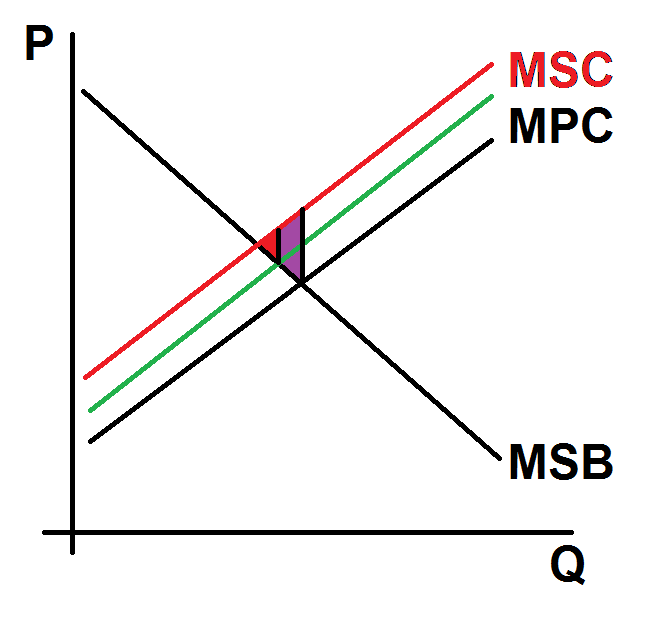
When I teach externalities, I draw a graph like this:

Negative externalities when we magically know their magnitude.

In this market, we end up with an equilibrium quantity defined by the point where Marginal Private Cost equals Marginal Social Benefit (MPC = MSB). But the Marginal Social Cost (MSC) is greater, so we get a deadweight loss equal to the triangle I’ve shaded in red and purple.

It’s important to note: we don’t actually know where the MSC curve is. It’s somewhere above MPC, but we’re basically in the position of trying to eliminate a subsidy we don’t know the size of.

The relevant models–climate models and economic models–are filled with uncertainty that we simply cannot resolve without real life experience.

What does the economic way of thinking tell us? Act on the margin. Setting a tax that pushes supply (MPC) up to the green line doesn’t fully address the problem (as I’ve assumed it to be in this graph), but it’s an improvement.

Even better, it’s an improvement where the biggest returns are experienced up front. This modest tax fails to get rid of the red deadweight loss (DWL) area, but it eliminated 3/4 of the total DWL.

Plus X points for my position where X is a random variable with an unknown distribution, positive first derivative, and negative second derivative.

tl;dr:

At my friend’s behest I’ve been looking at Bob Murphy’s critique of carbon taxes. I find it’s shifted the magnitude of my prior opinion, but not the direction. I still think carbon/pollution taxes are a good idea, but I no longer think they’re a great idea. My take away from Murphy’s work is that the optimal carbon tax is fairly modest. My response is to advocate for getting a very modest carbon tax on the books, then gradually shift tax policy in that direction.

For climate change (and any other problem) we ought to be pluralists. A mix of approaches is ideal. Part of the appeal of Pigouvian taxes is that they allow and encourage a wide range of responses. The best pollution abatement scheme isn’t something we can look up in a binder. We have to discover it, and crowdsourcing is the appropriate way to do that.

But carbon taxes are only one part. We should also advocate for changes that will ameliorate harm. I am more bullish on these policies than I am on a carbon tax:

  • Make it easier for the world’s poorest people to move to rich countries that will be better able to cope with climate change.
  • Quit subsidizing flood insurance.
  • Quit subsidizing polluting industries (and other industries).

Even though geoengineering scares me, we should try to learn more. Ditto for any other possible tools that come along.

The Rao Roe Row

Neomi Rao, nominee to the D.C. Circuit Court of Appeals, has fallen victim to an old fissure–conservative and libertarian disagreement over unenumerated rights. At the hint that she believes that rights exist outside the express text of the Constitution, conservatives have pounced, concerned that Rao will betray conservatives on abortion issues. On both political and legal dimensions, this concern is silly.

As a general matter, it’s beyond clear that Rao is qualified. Conservatives shouldn’t cripple a great candidate over a minor issue. The Supreme Court has many times confirmed that unenumerated rights exist. Rao is bound by those precedents, including Roe, and whether she agrees with those precedents or not is immaterial to the job she’s nominated to do. The chance that Rao will even have a chance to expand the existing list of recognized unenumerated rights is exceedingly low. It just doesn’t come up that often, and the courts already have tests for assessing whether a right should be recognized.

But perhaps more importantly, non-enumerated rights don’t lean toward one side of the ideological spectrum or the other. The Supreme Court of the early twentieth century recognized, for instance, liberty of contract as a constitutionally protected right–though unenumerated. Progressive jurists bent on defending Roosevelt’s New Deal did so in part by opposing the enforcement of unenumerated rights. Unenumerated rights also include other “conservative” causes such as the right to earn a living. And, of course, unenumerated rights have also favored “liberal” values such as a broad right to privacy. In short, it is unclear why Rao’s alleged support for the enforcement of unenumerated rights should enter into the partisan calculus.

And then there’s the simple fact that unenumerated rights do in fact exist and deserve constitutional protection. The history and passage of the Ninth Amendment, which says enumeration of rights shouldn’t detract from those retained by the people, make this clear. The founding generation didn’t see rights as reserved to a fixed set of especially important activities. In fact, many feared that the enumeration of certain rights would imply that the unenumerated ones shouldn’t be recognized. That fear has turned to be prescient, despite the inclusion of the Ninth Amendment, which was written to make clear that the enumerated rights shouldn’t be seen as implying that unenumerated rights should go unprotected.

In short, not only would Rao be right to recognize such rights–though the scope of those rights is always a matter of intense debate–she has to recognize them under binding law, and her thoughts on the matter are unlikely to make much difference to her job. If she gets nominated to the Supreme Court later down the road, the concern may have more relevance. For now, just get her confirmed.

Expression at the polls

Last election, Jillian Ostrewich drove to a polling place at a Houston rec center, expecting to vote. But she made the mistake of wearing a “Houston Fire Fighters” t-shirt. An election worker confronted Jillian, insisting that she couldn’t vote unless she turned the offending shirt inside out. The rationale: a measure on the ballot was related to firefighter pay, and the shirt was related to firefighters.

Tony Ortiz suffered a similar fate in Dallas. Tony’s crime was wearing a MAGA hat while he stood in the voting line outside his local library. An election worker said he couldn’t wear the hat to the polls because the MAGA slogan constituted “electioneering.” Tony responded that the hat had nothing to do with any issue or candidate on the ballot. The election worker threatened to call the police.

These election workers were relying on a Texas law that forbids electioneering or wearing “a badge, insignia, emblem, or other similar communicative device relating to a candidate, measure, or political party appearing on the ballot” in or near a polling place. The law even prohibits someone from wearing an ID if the name is the same as someone appearing on the ballot. A violation is a criminal misdemeanor. Today, my colleagues and I at Pacific Legal Foundation filed a lawsuit on behalf of Jillian and Tony challenging the Texas ban.

As it happens, the Supreme Court issued a decision just last year striking down a similar law in another case brought by Pacific Legal Foundation called Minnesota Voters Alliance v. Mansky. The Minnesota law in MVA prohibited wearing a “political badge, political button, or other political insignia” in the polling place. The Court said states can limit some electioneering at the polling place to prevent voter intimidation and excessive disruption. But the government has to have some clear and logical basis for sifting “what may come in from what must stay out.”

The word “political” was not a clear boundary. As the Court noted, almost anything could be considered political, and the fuzzy language offered too much wiggle room for abuse and discrimination. The attorney arguing for Minnesota drove this point home during an onslaught of blistering questions in oral argument: how about a rainbow flag shirt? Permitted, maybe. How about a “Parkland Strong” shirt? Permitted, probably. How about an NRA shirt? Definite no. How about a shirt with the text of the Second Amendment? Definite no. At about that point, most everyone knew the outcome of the case–the attorney had just proven the inherently arbitrary standard he was trying to defend.

The Texas case filed today is a bit different. For one, the ban extends to 100 feet outside the polling place, which clearly encompasses sidewalks and other public areas where speech rights enjoy their widest berth. But the ban is not quite as amorphous as the word “political.” Instead, the ban extends to messages that relate to a candidate, measure, or party on the ballot.

This slightly narrower language probably doesn’t save the Texas law. After all, almost anything can be considered related to a candidate if the candidate has taken any kind of position on it. If a candidate has criticized Trump (have any not?), then is Tony’s MAGA hat “related” to the candidate? If Ben & Jerry’s takes a position on a ballot measure, does a Ben & Jerry’s shirt relate to that ballot measure? Maybe, but it depends on the election worker–and therein lies the problem. As the Supreme Court said in MVA, “A rule whose fair enforcement requires an election judge to maintain a mental index of the platforms and positions over every candidate and party on the ballot is not reasonable.” Not only would such an index be impossible, but the contents and application of that index would be dictated by an election worker’s own biases and background.

The integrity of the electoral process is vital. But surely Jillian’s firefighter shirt or even the much-reviled MAGA emblem do not imperil the right to vote. Wed don’t shed the right to express ourselves in peaceable ways when we step into a polling line.

Musk in contempt?

The SEC wants to slam Elon Musk with contempt over a thirteen word tweet. Musk has taken to Twitter to both vaunt his company and castigate the SEC. He’s under an existing SEC settlement that requires company oversight of his communications. Musk’s brief tweet on Feb. 19 that stoked the ire of the SEC said: “Tesla made 0 cars in 2011, but will make around 500k in 2019.” The SEC swooped in, charging that Musk hadn’t received preapproval for the tweet and convinced Musk had misled the public.

The SEC’s overzealous attempt to wield the contempt power is disturbing. Especially given Musk’s vocal and mocking disdain for the SEC, the regulator’s attempted coup over the content of his tweets raises serious First Amendment concerns. Here, it seems the 500K estimate was not precise, but Musk went on to clarify on his Twitter feed, and he didn’t conjure the number from the ether. At worst, it was incomplete information. Welcome to Twitter. I just can’t quite stomach the fact that a regulator is out there lurking, ready to pounce on any linguistic imprecision in a forum where brevity is the name of the game. Obviously, Musk’s statements have an impact on the market, but investors are sophisticated actors who should be expected to do their homework. The SEC’s paternalistic and aggressive monitoring of Twitter feeds should raise our hackles.

Originalism and defamation

Today, Justice Clarence Thomas issued a solo opinion urging the Supreme Court to reconsider a hallmark case in First Amendment law–New York Times v. Sullivan. That case held that defamation claims brought by public figures had to meet a heightened standard of proof by showing “actual malice” by the alleged defamer. The basic premise is that muscular use of private defamation suits discourages criticism of public figures and thus clashes with First Amendment interests.

Justice Thomas’s primary complaint with this standard is that judges created it with a wave of the wand rather than a serious analysis of the original understanding of the First Amendment. He points out that the ratifiers of the Constitution gave no indication that they intended to abrogate the long-standing common law of libel that had existed in the colonies and England for centuries. For those who believe that the Constitution’s meaning should reflect what the ratifiers thought the language meant at the time, I think Justice Thomas makes a convincing case.

Obscenity law liberalised

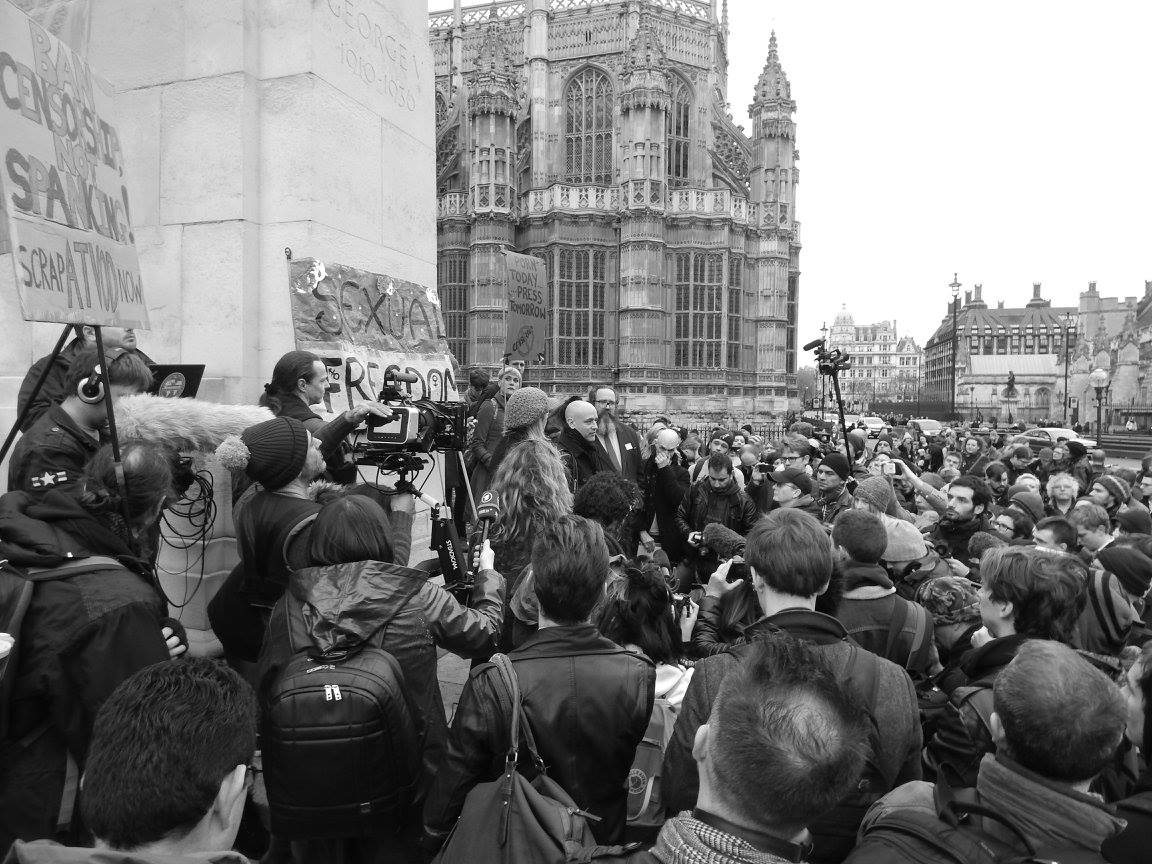
2014 Protest outside parliament for sexual expression. Photo by BeeMarsh BeePhoto
December 2014 Protest outside parliament against sex censorship. Photo by BeeMarsh BeePhoto

This is a cross-post from my contribution to the Adam Smith Institute blog.

Last week the Crown Prosecution Service published updated guidance for prosecutions under the Obscene Publications Act (1959). Legal campaigning has brought about a big change: the liberal tests of harm, consent and legality of real acts are now key parts of their working definition of obscenity. The CPS explain:

… conduct will not likely fall to be prosecuted under the Act provided that:

  • It is consensual (focusing on full and freely exercised consent, and also where the provision of consent is made clear where such consent may not be easily determined from the material itself); and
  • No serious harm is caused
  • It is not otherwise inextricably linked with other criminality (so as to encourage emulation or fuelling interest or normalisation of criminality); and
  • The likely audience is not under 18 (having particular regard to where measures have been taken to ensure that the audience is not under 18) or otherwise vulnerable (as a result of their physical or mental health, the circumstances in which they may come to view the material, the circumstances which may cause the subject matter to have a particular impact or resonance or any other relevant circumstance).

Continue reading

Bad guys and bad thinking

AOC made waves with her recent “lightning round” during a hearing on a new campaign finance behemoth lumbering through the House, HR 1. Her basic point was that under our current campaign finance regime, it’s “super legal” to be a “pretty bad guy.”

I wrote recently that much campaign finance rhetoric resembles a religious canon. If so, then AOC is vying for the position of high priestess. I can’t review all the many flaws in her five-minute fable, but I’ll briefly canvas her commitment to orthodoxy.

First, she asks the hearing panel whether there is anything stopping a “bad guy” from being entirely funded by corporate PACs. The panel answered that no law prevents that. But surely common sense does. Running on a campaign solely funded by corporate PACs would be a titanically stupid campaign strategy. First off, thanks to disclosure laws and the realities of a media-rich society, all constituents would know that the candidate was running solely off corporate PACs. Why any candidate would intentionally sell themselves as a corporate lackey is beyond me.

Not only would this look bad, but it would also come at a huge financial cost. Congressional campaigns are mostly funded by individual contributions, not corporate PAC money, so basically a candidate would be refusing a huge amount of loot in order to broadcast themselves as the Peter Pettigrew of electoral candidates. I’m not convinced this is a looming threat to our democracy. Why should we regulate a non-existent problem?

Of course, she also trotted out important theological terms such as “dark money.” She seems to think campaigns are directly funded by dark money. Not so–any contribution over $200 faces extensive disclosure requirements. Dark money usually refers to independent political expenditures, which still face a variety of disclosure requirements and make up a surprisingly small amount of total political expenditures. Again, she is swiping at phantasms.

A larger issue is that even if her claims are true, HR 1 and most other campaign finance laws are hugely overbroad. The overwhelming majority of political spending occurs with no eye toward extracting favors from a candidate. Yet HR 1 would impose huge burdens on all groups speaking in the political arena. The better route to catch “bad guys” is to enforce criminal laws that prohibit bribery. Will you catch every instance of quid pro quo corruption? Almost certainly not. But since when was this a controversial price to pay for a free society? We’ve long ago decided that it’s best to have less than perfect enforcement in order to preserve individual liberty.

The collateral damage that HR 1 would impose on legitimate, non-corrupt speech is tremendous. I’m not confident AOC is fretting over the real “bad guy.”

Time to emerge from the campaign finance mythology

Campaign finance laws long ago ascended to the Mount Olympus of political mythos. The mantra that we must exorcize money from politics has become an article of faith. But the basic premises undergirding this creed rest on a sandy foundation made up of unsound logic and unsupported claims. Not to mention a total disregard for First Amendment rights. The Supreme Court, however, will soon have a chance to reconsider campaign finance laws’ often dubious rationales and uncomfortable relationship with the First Amendment.

Campaign finance laws kicked off in the late nineteenth and early twentieth centuries with some early laws that banned corporation contributions, but they mostly gathered dust. Then, ironically, Republicans in 1947 used campaign finance laws to try and stifle union contributions, which led unions to create the much-hated PAC to dodge the restrictions. Then first serious attempt at comprehensive campaign finance regulation swept through in 1971 with the Federal Election Campaign Act. FECA laid down strict contribution and expenditures limits. Six years later, FECA led to the Supreme Court’s major canonical work in campaign finance lore, Buckley v. Valeo.

Buckley was a mixed bag. On the one hand, it struck down limits on independent expenditures by people who spend their own money on political communication during a campaign. On the other, it upheld limits on direct campaign contributions. Hence, both sides of the campaign-finance divide gripe about Buckley—First Amendment advocates want campaign contributions to be just as uninhibited as independent expenditures, and campaign-finance believers think government should be able to curtail independent expenditures to the same degree as campaign contributions.

As a speech advocate, I fall into the camp that feels Buckley did not do enough to protect First Amendment interests. Buckley relied on flawed notions about the nature of campaign contributions and the alleged need for limiting them. For example, the Buckley Court claimed that contributions don’t deserve as much First Amendment protection as expenditures because the speech facilitated by the contribution is someone beside the contributor. The trouble is that the same is true of expenditures—typically a political spender’s message is conveyed through a go-between, like an ad agency or a TV station. Courts have never held that reliance on someone else to convey your message robs you of the right to promote that message. Except for Buckley.

Another rationale for distinguishing contributions and expenditures is the “general” nature of a contribution. An expenditure allows the speaker to tailor his precise message. I.e.: I support Daenaerys Targaryen because she fries Lannisters with dragon fire. But if you just give a contribution to the Targaryen campaign, then no one knows why you support her. Anti-slavery? Dragons? Small Hands? You could be contributing for any reason, and the lack of specificity translates to a weaker First Amendment right. This is another lame excuse. After all, does the guy holding a “Warren 2020” deserve less First Amendment protection than someone holding a “Harris for better healthcare” sign? No case has ever said so or will ever say so. Except for Buckley.

The third rationale for contribution limits is that the quantity of the contribution does not strengthen or weaken the speech being regulated. That is, Buckley says if you give $5 or $500 to the Palpatine campaign, your message is the same. But surely the number is a clear metric for degree or intensity of support. If you gave $1 to Albus Dumbledore and $100 to Lord Voldemort, that says something about your viewpoint. If a cap is placed on contributions, the government is essentially saying that you can only support your candidate up to X amount—that’s more than a minor burden on someone’s right to political expression and participation. Plus, the contribution is not just about the symbolic act of giving—it’s also about the speech facilitated by that contribution, which is obviously affected by the quantity of the donation.

Buckley allowed contribution limits for the sake of combating corruption or the appearance of corruption. Here, too, Buckley falters. Study after study has failed to demonstrate that campaign contributions purchase special favors on anything approaching a widespread basis. Yet contribution limits take a widespread approach. Certainly, anecdotal evidence of quid pro quo exchange of contributions for favors exists. But that can hardly support a widespread cap where the overwhelming majority of contributions are motivated by ideological commitment, not a desire to obtain special political favors post-election.

Bereft of actual evidence, campaign finance zealots resort to bumper sticker slogans like “money buys elections.” Certainly, candidates who receive a lot of money tend to also receive a lot of votes. But this is just correlation. People will tend to donate to strong candidates, and people will also tend to vote for strong candidates. The likely variable here is a candidate’s popularity, not campaign contributions.

And what in the world is the “appearance” of corruption? No other First Amendment right that I know of lives or dies by the grace of the subjective feelings of the public. Rights are supposed to exist despite any prevailing hostility from the public. Yet that’s the Buckley standard. Indeed, courts have looked to public opinion polls and other tenuous evidence to uphold severe contribution limits in cities and states across the country.

While contribution limits likely don’t do any good, they do plenty of harm. Even beyond the injury done to the First Amendment interests of contributors, campaign finance laws tend to only help one group of people: incumbents. Campaign finance laws erect such arcane labyrinths that only the savvy, experienced politicians who can afford pinstriped election-law attorneys and have lots of name recognition will come out ahead. Contribution limits also do huge favors for wealthy, self-funded candidates.

Often, what political amateurs with no name recognition need is a concentrated boost of support from a small group of supporters to kickstart a competitive campaign. Contribution limits make this nigh impossible. But instead of loosening campaign finance laws that fortify incumbency, politicians peddle terrible ideas like term limits. If they truly wanted competitive politics (which they don’t), then they’d liberalize campaign finance.

Since we can hardly rely on the incumbents to break down incumbency protections, the time has come for the Supreme Court to return to Buckley. The Court will have the chance to do just that with a petition from a case called Illinois Liberty PAC v. Madigan. We could do for some fresh air in politics—the way to do that is to strip away an orthodoxy that only serves to protect the powerful.

Spaghetti Monsters and Free Exercise

Should Flying Spaghetti Monster worshipers be allowed to wear colanders on their heads in drivers’ license photos? Maybe so. Today, four conservative justices hinted that someone might want to bring them a good Free Exercise case soon so they can unseat a long-standing and long-criticized case called Employment Division v. Smith. That case, penned by Justice Scalia, had in turn uprooted several decades-worth of precedent that had built up a robust bulwark of religious rights under the First Amendment’s Free Exercise Clause.

It’s a funny twist. Liberal justices like Justice William Brennan had built up strong protections under the Free Exercise Clause, such as allowing Amish to pull their children from high school early because of their faith, or allowing Saturday Sabbath worshipers to enjoy certain exceptions to work requirements for unemployment benefits. Then the penultimate conservative justice, Antonin Scalia, dealt a severe blow to those precedents in Smith. Scalia said that religious practices did not merit exemption from generally applicable laws.

Now, the conservative justices want to rethink Smith, while the liberal justices may hang back. Perhaps the shift in the culture wars has caused this parallel shift in jurisprudential alliances. In any case, I think we should welcome reconsideration of Smith.

Scalia’s opinion in Smith raised some legitimate concerns. He argued that if we allowed judges to have a heavy hand in deciding which religious practices deserved special exemptions from the law and which did not, then judges would inevitably engage in subjective judgment calls and descend into the very parochialism that the First Amendment is designed to thwart. He also worried that allowing exemptions from generally applicable law would court anarchy—we would have a legal code peppered with holes for a thousand individualized religious beliefs and practices. Both are legitimate concerns.

Smith did prompt a strong legislative response. Congress and quite a few states thereafter passed Religious Freedom Restoration Acts (RFRAs) that basically revived the pre-Smith law. But legislatures can and do exempt some laws from RFRAs, and many states do not have them.

My primary issue with Justice Scalia’s Smith opinion is that his worry about subjective judgment calls seems to prove too much. Judges are called upon to make these kinds of sensitive and controversial decisions all the time. We rely on things like tenure and salary protection to shelter their independence and impartiality as much as we can, but these kinds of difficult decisions arise in innumerable other contexts. I would prefer a robust and imperfectly enforced Free Exercise Clause to one that does almost nothing at all.

Likewise, the concern about courting anarchy may be overblown. Laws and religious practices usually do not clash in a fundamental way, and under the pre-Smith “compelling interest” test, legislators can still forbid child sacrifice while allowing Muslim police officers to keep their beards. Plus, freedom of speech and many other rights already require exceptions to the scope of otherwise legitimate laws—they just can’t be applied in certain circumstances. The Free Exercise Clause is not unique in that way.

If the Court does confront Smith, it may also have to deal with the Flying Spaghetti Monster problem. That is—the Court may have to address a question which it has mostly avoided: what is a “religion” under the First Amendment. Does the Church of the Flying Spaghetti Monster count? Should Pastafarians be allowed to wear colanders on their heads in drivers’ license photos while everyone else has to go bareheaded? What about the Church of Diego Maradona, a real church dedicated to the Argentine soccer legend? Clearly, asking a court to define a “religion” raises the same concerns of parochial judgment calls that drove the decision in Smith. But maybe the answer is to let them all in, with perhaps just a low-threshold sincerity requirement. Beyond the occasional colander-clad guy in the DMV line, we haven’t seen a huge number of people adopting faux beliefs just so they can get a religious exemption for smoking dope. But then, there is an International Church of Cannabis that would surely see a surge in conversions if Smith is overturned.