Disclaimer: I’m not a philosopher of science by training, but I occasionally play one in the classroom.
The above playlist is* an excellent overview to the issues surrounding the question, “How do you know?”
I first stumbled into the topic of the philosophy of science (PS) as an undergrad at San Jose State. I was required to take an upper-division general elective class from a list of what seemed like tree-hugging indoctrination courses. I don’t remember what the other options were, but this class was probably the most important class I’ve ever taken.
This spring I taught “Modern Economic Theory” which I twisted into a mix of PS and History of Economic Thought. The biggest lesson I wanted to convey was: there are no right answers, there are lots of wrong answers, and our task is to seek the less wrong answers.
From my syllabus:
I hope to convince you of two big ideas:
1. There are no “right answers” but there are plenty of wrong answers.
2. What we know about the world rests on a foundation of received wisdom. And that foundation isn’t always as solid as we’d hope.
The video playlist above does a nice job of shedding light on how and which science is difficult. There is surely some objective truth to the universe, but it’s bigger than we can fit in our limited brains. Trying to understand our universe requires a heavy dose of humility, lest we impose grand plans that make things worse.
*As far as I know… a) See the disclaimer at the top. b) There’s an inescapable irony here. Science is fundamentally about uncertainty, so even if I was a philosopher of science, I wouldn’t be in a position to guarantee anything. See Feyerabend for more details.
I think an alternative that is both clearer and more general is “Decision Rights”. When I teach Coase Theorem I use both terms, and (I think) students have an easier time grasping it when they realize that property rights are really just rights to make certain decisions. I can’t see a good reason to keep using the term property rights except that by historical accident it’s become entrenched jargon.
Property sounds like “stuff” to most people. And property rights sounds like “owning stuff”. This raises two points that need clarifying:
1. There is more to the world than just the physical, and there is more to property than just stuff.
I would argue that economic rights are human rights. (I would also argue that corporations are owned and staffed by humans but are not humans themselves.) And I would say that right to self-ownership is a particular type of economic/human right.
When we talk about environmental issues, the root problem is usually over some shared resource (e.g. we can’t neatly privatize the atmosphere and let now-private conflicts be resolved in court). It’s much easier to focus in on the relevant particulars when our language directs us to what’s really at stake (e.g. whether I can decide to put more than X amount of pollution into the atmosphere without legal consequences).
2. I own a bit of land and I can make many decisions about how to use it. But I can’t set up a nuclear reactor or burn a massive pile of debris. My ownership is not carte blanche, but a bundle of different rights. I have the right to use (for normal domestic purposes), to exclude, to sell, etc. By “I own” what I really mean is “I can make a particular set of decisions.
I hope my hard core libertarian friends will agree with me that the decisions I can make are not limited by what is explicitly legislated. I suspect my interventionist friends will disagree. But I also think interventionists can agree that it’s more reasonable for me to have a set of decision rights (how ever nebulous the extent of that set is) than some more magical sounding dominion/ownership over a particular fifth of an acre.
The notion of decision rights makes it clearer what political debates are over. If we want to pass a law saying you can’t put a pool in your yard because of spotted owls, “property rights” muddies the discussion. The law would take away a particular property right–which is to say, the right to make a particular decision. But the debate is going to devolve into “you’re taking our land” vs. “no we aren’t.” It’s close to the real issue, but not close enough.
tl;dr: When we talk about “property rights” or ownership what we really mean is a set of various decisions that one has a right to make. Those decisions might be over the use of what we traditionally call property (e.g. my yard), but it might also be over shared resources (e.g. the atmosphere), decisions with collective impacts (e.g. ecosystem management–or lack thereof), or socially constructed issues (e.g. intellectual property). The term “property rights” is not clear or obvious (particularly for people who aren’t already likely to read this blog). A better term would be “decision rights.”
But as abstract ideas go, pollution taxes are pretty appealing. Holding constant lots of things that we can’t really hold constant, it means replacing the inefficiency resulting from poorly defined/enforced property rights with a world where prices more accurately reflect the costs of one’s decisions.
Let me come back to the things we’re “holding” constant in a bit. Why do I want to throw my weight behind shifting public perceptions in favor of pollution taxes?
Which is not to say a carbon tax isn’t overrated by the median policy wonk. There are a ton of important caveats, but on balance, as a policy for use in the next 50 years, I think they’re a useful tool to enhance efficiency or replace worse tools.
Again, there are no panaceas. I’m also not a huge fan of the “Economists’ Statement on Carbon Dividends” as written (for reasons I’ve hopefully mostly addressed). I suspect the best case scenario for my preferred carbon tax policy would be a modest improvement. I think the bulk of the gain would be a cultural shift away from “let’s regulate our problems!” to “let’s leverage incentives to address our problems!” Not Earth shattering, but a step in the right direction.
So let me state my position, then we can dig into criticisms and caveats.
Let’s make marginal shifts away from taxing investment and towards taxing negative externalities. As we go, let’s spend a lot of effort trying to study the impacts and adjust accordingly. Let’s heavily agument that with abatement policies rather than trying to return to some pre-industrial climate target.
Okay, let’s dig into criticisms and caveats.
Public choice considerations
Geoengineering and other alternatives
Cost
Coordination
Uncertainty
1-Public choice considerations
A Green New Deal will be a rent-seeking bonanza. Pollution taxes will face the same sorts of problems that plague the tax code in general. There will be intentional loop-holes and accidental screw ups.
We have to continue to push for reducing the complexity of tax codes in general. But I can’t deny that a carbon tax would be a step back on this margin.
Minus a hundred points for my position.
2-What about geoengineering?
Geoengineering sounds like a possible panacea. Maybe it is. But I’m not willing to flip a switch and find out the hard way all at once.
First off, geoengineering is scary. The climate is a complex system and complex systems are difficult-impossible to manage well. And that’s especially concerning if it means that anyone with a few million bucks can try to fiddle with Earth’s thermostat.
But it seems like a plausible tool that might be used to address climate change. Similar to my take on a carbon tax, I think the way to go is baby-steps plus research.
What about subsidizing “green _____”
Personally, I’m skeptical. Solar sounds appealing, and I (personally) think windmills are beautiful. But I don’t think the government will do a good job of picking winners and losers. Pollution taxes are appealing to me because they don’t require bureaucrats to choose. Again, I think the way to go is to use pollution taxes to offset other taxes–while continuing to advocate for reduced size/scope of government and a return to federalism.
Plus five points for my position.
3-Cost
We should also remember that GDP is an imperfect measure of well being. The current figures aren’t directly comparable to the figures we’d get in a post-carbon-tax world. A one-time fall in GDP doesn’t (necessarily) mean we’ve screwed things up.
Still, it’s worth remembering that a) we can go too far with a carbon tax, and b) we don’t have access to a silver-bullet solution. So let’s start small and gradually increase carbon taxes till we get close to (our best estimate of) the optimal level.
Plus epsilon points for my position.
4-Coordination
The basic idea of a carbon tax is that we’re dealing with a global-scale externality problem. But small scale taxes are unlikely to do much beyond shifting where pollution happens. A fully effective tax would require multi-lateral coordination. And, as a country, we aren’t very good at that.
Trying to create a tax on imported carbon-intensive goods that didn’t face a tax at home seems a) sensible at first blush, and b) a massive opportunity for public choice problems.
On the other hand, we could justify a tax commensurate with the local impacts (something like 10% of the global impact). This fits nicely with my idea of starting small and adjusting at the margin.
But even within the U.S. there are coordination issues. Long Island will likely face net costs from climate change, but other areas will benefit from a longer growing season.
Plus 10 points for my position, but also minus 10 points.
5-Uncertainty
Uncertainty cuts both ways: we’re currently accidentally manipulating the climate and that could turn out to be catastrophic. Trying to intentionally manipulate it in the other direction is also dangerous. Again, the appropriate focus is on marginal tinkering [much as it clashes with my non-interventionist priors] rather than ambitious global engineering [which grabs my priors by the lapels and knees them in the groin].
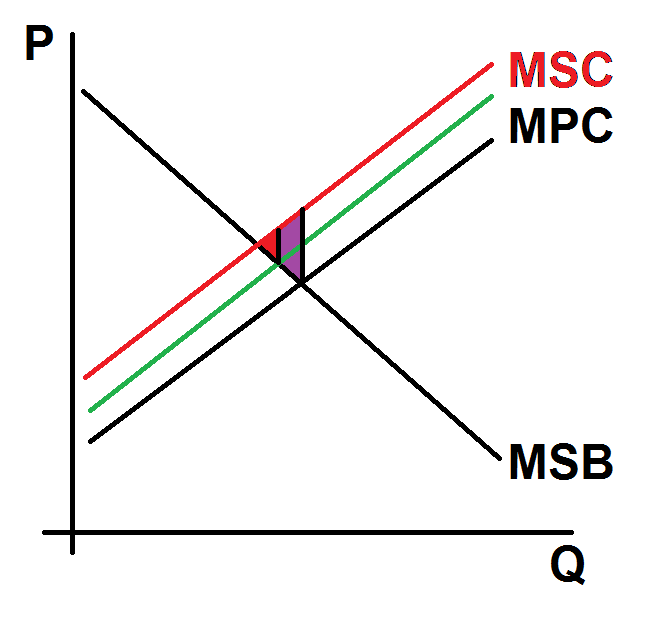
When I teach externalities, I draw a graph like this:
Negative externalities when we magically know their magnitude.
In this market, we end up with an equilibrium quantity defined by the point where Marginal Private Cost equals Marginal Social Benefit (MPC = MSB). But the Marginal Social Cost (MSC) is greater, so we get a deadweight loss equal to the triangle I’ve shaded in red and purple.
It’s important to note: we don’t actually know where the MSC curve is. It’s somewhere above MPC, but we’re basically in the position of trying to eliminate a subsidy we don’t know the size of.
The relevant models–climate models and economic models–are filled with uncertainty that we simply cannot resolve without real life experience.
What does the economic way of thinking tell us? Act on the margin. Setting a tax that pushes supply (MPC) up to the green line doesn’t fully address the problem (as I’ve assumed it to be in this graph), but it’s an improvement.
Even better, it’s an improvement where the biggest returns are experienced up front. This modest tax fails to get rid of the red deadweight loss (DWL) area, but it eliminated 3/4 of the total DWL.
Plus X points for my position where X is a random variable with an unknown distribution, positive first derivative, and negative second derivative.
tl;dr:
At my friend’s behest I’ve been looking at Bob Murphy’s critique of carbon taxes. I find it’s shifted the magnitude of my prior opinion, but not the direction. I still think carbon/pollution taxes are a good idea, but I no longer think they’re a great idea. My take away from Murphy’s work is that the optimal carbon tax is fairly modest. My response is to advocate for getting a very modest carbon tax on the books, then gradually shift tax policy in that direction.
For climate change (and any other problem) we ought to be pluralists. A mix of approaches is ideal. Part of the appeal of Pigouvian taxes is that they allow and encourage a wide range of responses. The best pollution abatement scheme isn’t something we can look up in a binder. We have to discover it, and crowdsourcing is the appropriate way to do that.
But carbon taxes are only one part. We should also advocate for changes that will ameliorate harm. I am more bullish on these policies than I am on a carbon tax:
Make it easier for the world’s poorest people to move to rich countries that will be better able to cope with climate change.
Quit subsidizing flood insurance.
Quit subsidizing polluting industries (and other industries).
Even though geoengineering scares me, we should try to learn more. Ditto for any other possible tools that come along.
Working in a college, I’m at the front lines of a significant problem: wasteful bullshit jobs. In fact, I am writing this post to procrastinate editing a bureaucratic report (that nobody cares about) that has been slowly grinding the joy out of my life for the past several months. I have to write this report for the benefit of regulatory oversight which, ironically, is supposed to ensure that I use my privileged position for the benefit of society instead of wasting my efforts on pointless or destructive outlets.
In my case, this bullshit aspect of my job is a predictable outcome of working in a state sponsored bureaucracy. But the same disease afflicts private industry too.
If I’m the head of a Fortune 500 company, I have incentive to increase profitability of my company, but I have competing interests too. Most importantly I have to maintain my position of power within the company. Bruce Bueno de Mesquita and coauthors have laid out the logic of the situation in The Dictator’s Handbook, and The Logic of Political Survival–in a nutshell, I have to worry about competition for positions of power within any hierarchy. This requires engaging in cooperative rent-seeking to keep the right people happy. If I don’t, I risk losing my position to a sycophant who will.
We shouldn’t be surprised to see Niskanenian logic show up in these situations. Corporate flunkies are like a private army that can help me keep my position of power even if they don’t contribute to the profitability of the firm. Even if I want to maximize profits, if I have to worry about keeping my position, I have to engage in some of this costly, inefficient rent-seeking.
In other words, “firms maximize profit” is an approximation that brushes aside methodological individualism. Don’t get me wrong, there’s evolutionary pressure on firms that will push in that direction. But within a firm there’s evolutionary pressure preventing the firm from fully maximizing. (In other other words, if I survive this report I’ll have to start reading up on corporate governance.)
This logic is a natural source of bullshit jobs, even in a free market. Regulatory capture should make it worse, but we’ll never completely eliminate it.
On a more speculative note, I think we also have to worry about culture. For one, our current culture drives the demand for increased regulation. For another, we prize work for work’s sake to the point that most people would rather see someone fritter away their brief experience as a sentient being than see them fail to live up to social expectations. Such notions, I think, are behind the surprising lack of riots in the street you might expect in a world where most people know we face this problem of bullshit jobs. But I’ll leave any further speculation for the comments.
tl;dr: Our economy is beset with bullshit jobs that sap our creative capacity and crush our souls. And pretty much everyone knows it. Government is part of the problem, partly because regulation creates demand for paper-pushing, and partly because anti-competitive regulation converts lively, profit-seeking firms into private bureaucracies in their own right. But there are deeper problems: our willingness to abide, and the fundamental logic of hierarchical organizations.
I just got an email asking me to sign on to an open letter arguing for some carbon tax policies. I’m seeing some push back from (smart, economically literate) Facebook friends, but I think it’s a viable step in the right direction.
Here’s the statement paraphrased:
We think global warming is an important and urgent issue and we recommend these five things:
1. A carbon tax is the best, most cost-efficient way to do as much about carbon as needs to be done. [For a given level of carbon reduction, I agree. How much carbon reduction should happen (and how much at government behest) I am deeply agnostic about.]
2. We think this should be phased in over time and should be revenue neutral. [Yes on both points, but the rest of the statement makes it seem like they’re talking about a pretty short time horizon. I’m not sure how fast is too fast, but I’m sure there’s such thing.]
3. A carbon tax is more efficient than a set of specific regulations. [Certainly!] It’s also less likely to be subject to changing political winds. [Is it though?]
4. We should also apply a carbon tax to imported goods. This would reward energy-efficient American firms and prod other countries to follow suit. [Hmmmm… I can’t really disagree with the general principle, but this sounds like it will require bureaucratic oversight that will be subject to regulatory capture. On the other hand, we’ve already got that.]
5. We should give the revenue collected back to U.S. citizens, to offset increases in energy prices. [Okay, but if it’s going to be revenue neutral and come with a transfer scheme, that’s going to take some detangling!]
I buy into the notion that carbon emissions create large scale externalities that will probably be more bad than good on balance. Not universally bad, mind you. And not something that humanity won’t ultimately adapt to. But I think the people who will face the brunt of the bad outcomes will be the world’s poor (who we should help migrate to better climates!).
I don’t think we can just impose “the right” carbon tax and have everything come out just right. Even though I routinely draw out the case with a supply and demand graph in class, the truth is that nobody has access to those curves in real life. But a small tax can serve to reduce the inefficiency of pollution even if we don’t get it exactly right.
The revenue neutral part is important–we’re currently taxing lots of things we actually want more of (like investment). So if we can cut those taxes by taxing things we want less of (pollution), we’re reducing two sources of inefficiency in the current setup. Of course you and I have bolder views about what policy should look like in 100 years, but restricted to a 10 year window, a revenue neutral carbon tax looks pretty good to me.
The letter dramatically over-simplifies things. Climate change is probably a problem, but probably not as big a problem as proffered by proponents of proposals to prepare for apocalypse. It’s not clear to me that we have a good idea of a) all of the effects (good and bad), b) how people will adapt, and c) how people will adapt to a changing policy regimen.
Figuring out how to handle the tax on imports will be difficult and rife with rent seeking. Unmentioned is the impact on exports. If all our trading partners follow a similar policy, there’s no problem, but in the mean time there’s a tension that will probably be resolved with some unfortunate bit of rent seeking.
I’m sure most reasonable people would agree that instantaneous change would probably be unduly costly, but it’s not clear what the right speed of implementation is.
There are some miscellaneous rhetorical points I have issue with, but I suspect those are in there to throw a bone to people who aren’t me.
I hope that 10 years from now this open letter looks a bit silly. But I also hope that 10 years from now pollution taxes start to replace more inefficient taxes. On balance, I’m happy to see the letter prodding us in that direction.
I’ve always had a weird relationship with patriotism. As a Canadian kid I wondered if the thing I was supposed to be proud of was that Canadians weren’t so brashly patriotic. Later I moved to America and jumped on the “we’re #1” bandwagon. I got off after first realizing that politics is messy and there aren’t any leaders worth admiring, then realizing that that’s always been true (and may even have been worse in the past). My default position over the past few years (before and after getting citizenship) has been “America The world is a nice place, with nice people. And America has one of the better (deeply flawed) political systems.” But I’m not the sort of person who goes out of his way to say the pledge of allegiance.
But I might have stumbled on a secret patriotic feeling that swells in my heart nearly every time I read the news: a profound embarrassment.
Maybe bureaucratic reports have worn me thin, but I’m increasingly shouting “Get it together America! You’re embarrassing me!” any time I encounter news.
When crazy people do crazy stuff I’m not inclined to feel embarrassed, because I don’t know that angry lady who doesn’t understand traffic lights! But family can embarrass you. Embarrassment is an expression of your fear that you’re more like Uncle Joe than you feel comfortable with.
If this is what patriotism feels like, I don’t get it.
Mariana Mazzucato has some interesting ideas, but her basic thesis (which I’m guessing based only on her recent Freakonomics interview) forgets a simple fact: had the government not made GPS, not only would we not have GPS, resources would have been allocated somewhere else.
In other words, she’s right that without government involvement we’d miss all sorts of valuable things like the basic research it turns out government has financed, physical infrastructure (no matter how neglected), GPS, the specific form the Internet we got, etc., etc.
But that’s only half the story. What happens if DARPA closes shop just before starting on GPS? Those engineers end up somewhere else, the money for the project goes somewhere else, the steel and titanium for the satellites they would have built end up in some other shop.
If we could know that nothing else would have happened at that point, then GPS is a free lunch–some bold committee scooped up a handful of clay, handed it to brilliant engineers, and created something from nothing.
More likely some of those engineers would have made dozens of other projects a little bit better, and one or two of them might even have, through some series of unpredictable events, ended up creating some totally different innovation that would have put us on to an entirely different path.
Which is the better path? There’s no way to know. The people on that other path exist in a completely different paradigm from our own. It’s comparing meta-apples with meta-oranges. We are where we are and we ought to appreciate all the costs and benefits of the system we’ve inherited. I think Mazzucato is right that many of us have underrated the government. (Certainly 23-year-old-Rick was guilty of the over-complete counterfactual fallacy.)
She makes a compelling argument that Solyndra doesn’t look like such a boondoggle when you take the wider view we would expect of the smallest venture capital investor. But if it’s true that pointing at government failures is invalid, then so is pointing at government success.
What’s important is improving the future performance of our current institutional mess. To do that, I think we’re better off backing away from her broad claims and focusing on her more sensible (and jarring) arguments about how the current system encourages destructive rent seeking through intellectual property protection of basic research that might be better left in the public domain.
The core assumption of economics is that people tend to do the thing that makes sense from their own perspective. Whatever utility function people are maximizing, it’s reasonable to assume (absent compelling arguments to the contrary) that a) they’re trying to get what they want, and b) they’re trying their best given what they know.
Which is to say: what people do is a function of their preferences and priors.
Politicians (and other marketers) know this; the political battle for hearts and minds is older than history. Where it gets timely is the role algorithms play in the Facebookification of politics.
The engineering decisions made by Facebook, Google, et al. shape the digital bubbles we form for ourselves. We’ve got access to infinite content online and it has to be sorted somehow. What we’ve been learning is that these decisions aren’t neutral because they implicitly decide how our priors will be updated.
This is a problem, but it’s not the root problem. Even worse, there’s no solution.
Consider one option: put you and me in charge of regulating social media algorithms. What will be the result? First we’ll have to find a way to avoid being corrupted by this power. Then we’ll have to figure out just what it is we’re doing. Then we’ll have to stay on top of all the people trying to game the system.
If we could perfectly regulate these algorithms we might do some genuine good. But we still won’t have eliminated the fundamental issue: free will.
Let’s think of this through an evolutionary lens. The algorithms that survive are those that are most consistent with users’ preferences (out of acceptable alternatives). Clickbait will (by definition) always have an edge. Confirmation bias isn’t going away any time soon. Thinking is hard and people don’t like it.
People will continue to chose news options they find compelling and trustworthy. Their preferences and priors are not the same as ours and they never will be. Highly educated people have been trying to make everyone else highly educated for generations and they haven’t succeeded yet.
A better approach is to quit this “Rock the Vote” nonsense and encourage more people to opt for benign neglect. Our problem isn’t that the algorithms make people into political hooligans, it’s that we keep trying to get them involved under the faulty assumption that people are unnaturally Vulcan-like. Yes, regular people ought to be sensible and civically engaged, but ought does not imply can.
The last few years I’ve loudly protested that home ownership is overrated; it’s a bad investment plus lots of responsibility. And yet, this summer my fiance and I bought a 100 year old house on the south shore of Long Island.
Yes, I have lost my mind.
I basically stand by my earlier position, but with greater nuance. Owning a home is a complicated undertaking. But it’s given me a greater appreciation for the nuance involved in managing real estate.
Home ownership is a great big Gordian knot of inter-dependencies. It’s massive set of knowledge problems wrapped in externality problems.There’s a massive role for local knowledge which means policy makers’ attention should be less focused on things like home ownership rates, and more on guiding the right people into the right places to take advantage of that local knowledge.
With local knowledge comes local politics. I don’t know anything about local politics, but expect more posts about what’s going on in my town hall over the next few decades.
So what have I learned in this first month of home ownership?
There’s something to be said about pride in ownership
It’s still a real trip to turn on my lights in my kitchen so I can do my laundry in my laundry machines. I didn’t think I’d enjoy it this much. The endowment effect is real. One effect has been to increase my interest in contributing to local public goods via civic engagement and other routes.
I haven’t been to a town hall meeting yet, but I plan on going to one tomorrow. I suspect it will be awful. But I’m walking distance, so I’ll be a little bit drunk.
The real estate market has some serious frictions
This might be obvious, but it’s interesting. There are artificial and natural obstacles to the efficient use of real estate. Transaction costs are significant and property rights issues are hairy.
Buying a house is a complicated transaction and going through the process has really made clear to me how difficult it is to commodify land. Each piece of land has a unique location and history. Information asymmetries are substantial. The neighborhood you’re buying into is utterly out of your control. Put simply: Amazon won’t be selling real estate any time soon.
Part of the reason I’m happy with buying a house is that our rent had been increasing about $100/month/year. Land lords absolutely take advantage of real estate frictions to charge as much as they can. The alternative (which I chose) is to lock-in to a specific property.
The required knowledge to operate a home is significant and difficult to evaluate.
It takes a lot of knowledge to manage a house. If I were to take a wild guess (at this non-quantifiable variable), I’d say that between 5% and 50% of a homeowner’s brain is necessary to operate a house. Even if you bring in experts to do everything, evaluating those experts is a lot of work.
There are repairs and upgrades to make, and my formal education prepared me for exactly none of those projects. On the other hand, I’ve got the Internet. Without YouTube and Reddit I’d be a half dozen unlucky mistakes away from homelessness.
On the other other hand, I’ve learned a ton of stuff I’ve got no use for. Like how to grow asparagus (which it turns out it isn’t worth doing except out of boredom).
You can’t evaluate knowledge until it’s too late. And there’s more to learn than you ever will, so you have to make mistakes. It’s true of home ownership and it’s true of life more generally.
Gardening is a real trip.
In History of Economic Thought professor Gonzalez shared a story about two economists meeting in Switzerland during WWII. On showing his vegetable garden to the visiting economist, the visitor said “that’s not a very efficient way to grow food,” to which the gardener said, “yes, but it’s a very efficient way to grow utility.”
I’ve wanted to garden for some time, but the market for gardens is thin. So now I’m starting with almost no useful experience. My public stance has been that lawns are boring and dumb. But figuring out how to manage a little ecosystem ain’t easy. I now get why someone would just put in a lawn and be done with it.
At my old apartment complex the entire ecosystem was made of: humans, trees, lawns, cockroaches. I suspect the cockroaches did so well because all their competition was poisoned away. As an emergent order guy, I’m not really into that. But I get it now. In the same way the king wants everyone living in neat little taxable rows my life would be easier if I could just slash and burn all the complexity out of my yard.
Tl;dr: My biggest surprise as a new home owner is just how big a cognitive load owning a house is. You hear homeowners talk about how much work it can be, but I think it’s rare to hear someone talk about how much know-how is required.
Given the capacity to generate externalities, I’m a bit surprised that there isn’t more public policy devoted to issues of home ownership* (beyond subsidizing finance and increasing barriers to entry). I supposed I’ll learn a lot more about these issues as I learn about local politics.
*That isn’t to say I think it’s a good idea to get the government involved in trying to tell people how to go about the business of daily life. I think homeowners are (basically) doing fine left to their own devices.
I see two big lessons here: 1) wise use of metrics requires wisdom… i.e. appropriate interpretation and critical thinking. 2) Maximization is just one version of one part of the whole story. (There are also important questions to ask about what we can expect from others, but I’ll leave that for the comments.)
Readers of NOL should be familiar with the notion that GDP is only an imperfect proxy for well being. But not everyone is so we have to repeat ourselves. There’s what we’re after, and there’s what we can measure, and the two are not the same. GDP is a really clever way to aggregate total production in an economy, but production is only valuable to the extent we’re producing the things that actually improve people’s lives. It’s easy for busy people to confuse a proxy measure for the latent variable we actually care about, so we need someone whispering in the emperor’s ear “the metric is not the mission.”
Economics is easier to describe using the simplifying assumption that people want more stuff. It’s easy to forget that people also want more leisure (and so less work). This is a subtle reappearance of the seen and unseen. We can see when someone gets a cool new car and we can’t see when someone has a fun evening with friends and family. We have to check our bias towards trying to get more stuff and remember that reducing work is another feature of human flourishing.
Here’s how this whole classification thing works: Immigration and Customs Enforcement (ICE) has a “STEM Designated Degree Program List” that specifies which programs on the Department of Education’s list of degree programs qualify as STEM. Students with degrees in these fields get special status as far as immigration. ICE’s list includes (among others) several psychology programs and three social science programs: Archaeology; Cyber/Computer Forensics and Counterterrorism; and Econometrics and Quantitative Economics.
What can we infer from this? That the feds are defining STEM narrowly, with a greater emphasis on engineering than science. STEM is about training people to do science-y work with practical applications. Basic research gets lip service, but only really matters so far as it’s likely to have clear applications in the future.
Economics has some parts that fit into such a view of STEM. Even I’ll admit (controversially for Austrians and Anarcho-Capitalists) that positive-sum social engineering a) is possible (in modest increments), and b) has something to learn from economics. But to include all of econ in STEM would require using a broader definition of STEM.
So what’s the upshot? High profile departments will focus more on a narrower part of economics pushing much of the field to the periphery. This is a retreat into more isolated academic silos. “Economics, general” leaves a vague space around a department, but taking a more specific designation means they can be held to more specific expectations. It might have little impact on the day-to-day life of a department, but in the long run they’re hamstringing themselves.
The problem these departments are trying to address is that ICE has too much power. But by playing this game they’re letting ICE play central planner in the education industry!
I’m still not sure where I land on the issue of Universal Basic Income (UBI), but I just thought of a bit of clarifying language that lead to a thought. I’m sure this thought isn’t original, but I’m also sure it doesn’t come up as often as it ought to.
A UBI system’s appeal stems from the fact that it’s a minimal welfare state (kinda sorta).We all know the old debate between proponents of a minimal state–and the debates about what exactly that constitutes–and those of a welfare state–and again, there’s plenty of disagreement on what that actually means.
On a 0-10 spectrum of “how important should the government be? / how important is the government currently” a UBI is a lateral move with obvious efficiency gains. It strips out all the bureaucracy in our current welfare state, provides a wide safety net, and allows the poor to exercise their own agency using their local knowledge about their particular circumstances and opportunities. No cookie cutter solutions, no lines, just a modest check in the mail and an entire population looking for good ways to use it.
On the other hand, it lays bare some of the worst case scenarios of a maximal welfare state. Subsidizing sloth and dependency, enormous costs, reduction in savings, net negative cultural effects, and who knows what else!
But still, perhaps UBI with some minimal modifications is an improvement over what we’ve got now?
2×2 matrix (robust vs thin welfare state and broad vs targeted welfare state).
The maximal welfare state is robust, and broad. There’s a housing bureau, a food bureau, a work bureau, and nearly everyone is waiting in line at one of them at some point each week.
The minimal state would have no welfare, but the minimal welfare state would have a thin and targeted system. No social workers, no bureaucrats, just a check. And unlike a UBI, this would only apply to the poor. Which might cost it political support.
A UBI is thin but broad. That might require it to be less generous, but could (literally) buy it some votes. On the other hand, what do I know about what makes people vote?
The thinness and breadth of a UBI makes it startling next to the old dichotomy. It simultaneously opens up whole new realms of possibilities–it dramatically increases the opportunity cost of drudgery and bureaucracy and provides an easy enough safety net to allow widespread entrepreneurial activity. If we had the right culture we could do anything! But (!) we don’t get to choose the culture.
That breadth is pretty scary when we consider some of the negative behaviors it will surely breed. The lunatic fringe will be funded by the rest of us. A cult is easy to finance when all your members sign over a government check to you every month.
Here’s a possibility: Imagine a vastly simpler tax code. “What’s your income? Scan your tax/employment card that isn’t as stupid as a Social Security Number.” $X “Thank you, give us f(X). Insert cash or card into the machine.” You could file taxes every month (or more or less frequently if you prefer). In that world, we could just give a refundable tax credit to anyone who had a low enough income.
Mind you, I’m assuming away the issue of designing the right marginal tax rates and setting the level of the tax credit. But such a system could be simultaneously broad (it kicks in for anyone as soon as you need it) and narrow (you only get it if you’re poor… and you end up paying it back if you get rich). I think a simpler tax system would be necessary to make a minimal UBI workable
“… normally we start from whatever behavior we want to get, then try to design a system that will produce it. Yet to do this reliable, we have to restrict ourselves to systems whose behavior we can readily understand and predict–for unless we can foresee how a system will behave, we cannot be sure that the system will do what we want.
“But unlike engineering, nature operates under no such constraint. So there is nothing to stop systmes like those at the end of the previous section from showing up. And in fact one of the important conclusions of this book is that such systems are actually very common in nature.
“But because the only situations in which we are routinely aware both of the underlying rules and overall behavior are ones in which we are building things or doing engineering, we never normally get any intuition about systems like the ones at the end of the previous section.”
The deeper you dig into math and computer science, the more Hayekian things look. The impossibility of economic calculation under socialism has important counterparts in Godel and Turing/Church.
The most profound technologies are those that disappear. They weave themselves into the fabric of everyday life until they are indistinguishable from it.
The medical profession has an ethic: First, do no harm.
Silicon Valley has an ethos: Build it first and ask for forgiveness later.
Now, in the wake of fake news and other troubles at tech companies, universities that helped produce some of Silicon Valley’s top technologists are hustling to bring a more medicine-like morality to computer science.
Far be it from me to tell people to avoid spending time considering ethics. But something seems a bit silly to me about all this. The “experts” are trying to teach students the consequences of the complex interactions between the services they haven’t yet created and the world as it doesn’t yet exist.
What distinguishes good and bad public policy experts? Friedrich Hayek defines one kind of bad expert pic.twitter.com/9mzt0SBlVx
My inner cynic sees this “ethics of tech” movement as a push to have software engineers become nanny-state-like social engineers. “First do no harm” is not the right standard for tech (which isn’t to say “do harm” is). Before 2016 Facebook and Twitter were praised for their positive contribution to the Arab Spring. After our dumb election the educated western elite threw up our hands and said, “it’s an ethical breach to reduce our power!” Freedom is messy, and “do no harm” privileges the status quo.
The root problem is that computer services interact with the public in complex ways. Recognizing this is important and an ethics class ought to grapple with that complexity and the resulting uncertainty in how our decisions (including design decisions) can affect the well being of others. My worry is that a sensible call to think about these issues will be co-opted by power-hungry bureaucrats. (There really ought to be ethics classes on the “Dark Side of Ethical Judgments of Others and Education Policy”.)
I don’t doubt that the motivations of the people involved are basically good, but I’m deeply skeptical of their ability to do much more than offer retrospective analysis as particular events become less relevant. History is important, but let’s not trick ourselves into thinking the lessons of 2016 Facebook will apply neatly to whatever network we’re on in 2026.
It hardly seems reasonable to insist that Facebook be put in charge of what we get to see. Some argue that’s already the world we live in, and they aren’t completely wrong. But that authority is still determined by the voluntary individual decision of users with access to plenty of alternatives. People aren’t always as thoughtful and deliberate as I’d like, but that doesn’t mean I should step in and be a thoughtful and deliberate Orwellian figure on their behalf.

 Notes On Liberty